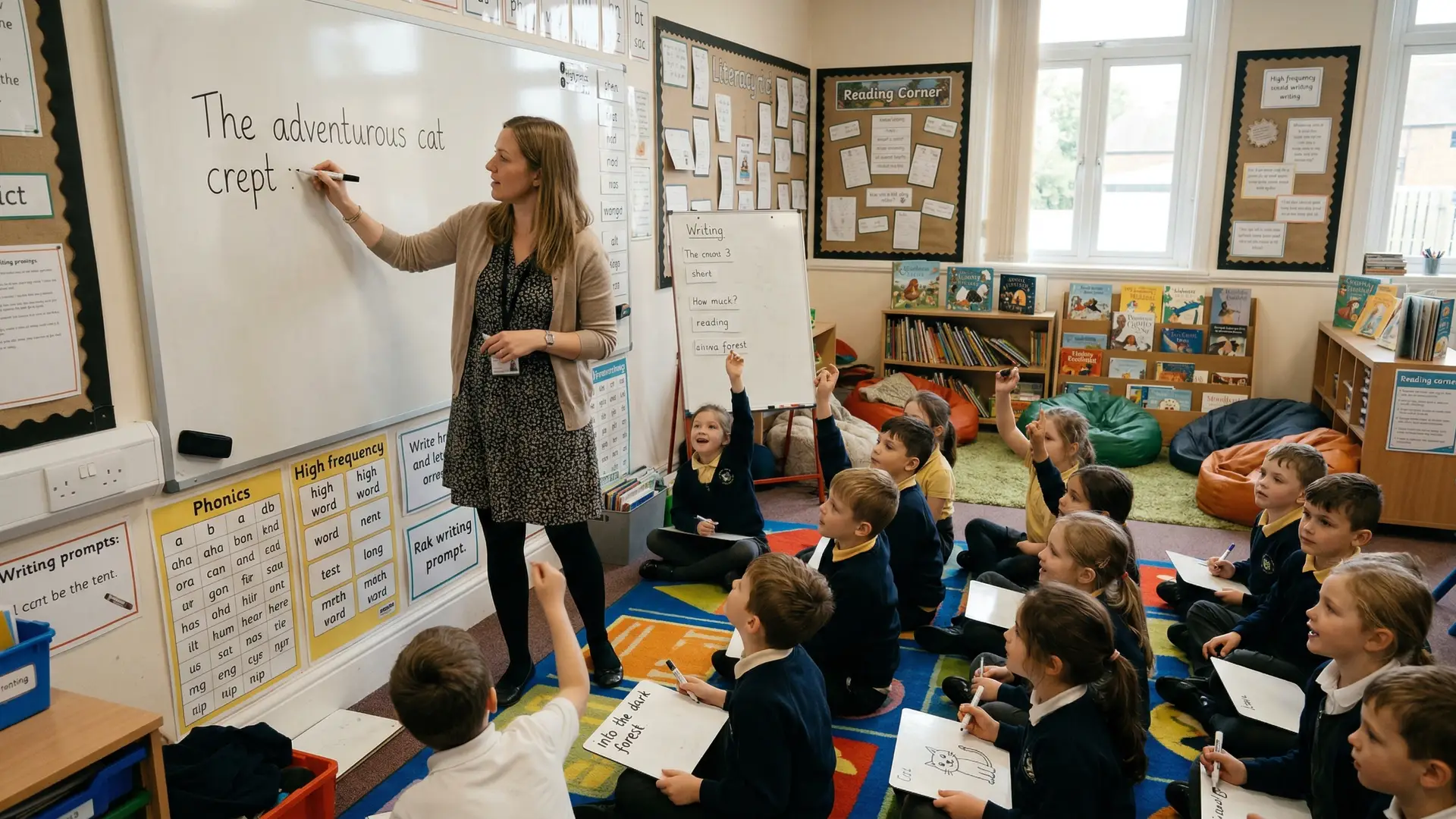
Reading, writing, vocabulary, and oracy across all subjects. Evidence-based approaches for teachers at every key stage. Updated for 2026.
Literacy is not the responsibility of English teachers alone. When a Year 8 learner cannot extract the key argument from a science textbook paragraph, that is a literacy problem, and it is a science teacher's problem. Beck, McKeown, and Kucan (2013) demonstrated that vocabulary knowledge is one of the most reliable predictors of reading comprehension, and reading comprehension is a prerequisite for learning in every subject. The vocabulary gap between the most and least advantaged learners at age 7 already stands at approximately 4,000 words, and it widens through school without deliberate intervention.
This hub covers the full range of literacy demands in schools: early reading and phonics, reading comprehension strategies, vocabulary instruction, academic writing, oracy and spoken language, and whole-school approaches. Each article is grounded in the research and provides practical techniques for classroom implementation across key stages and subjects.
Start with Reading Comprehension Strategies for the foundations, then follow the pathway below.
| Approach | What It Involves | Best Used For | Evidence Strength |
|---|---|---|---|
| Systematic Phonics | Explicit, sequenced teaching of grapheme-phoneme correspondences and blending skills. | Early reading (Reception to Year 2). Intervention for older struggling readers. | Very strong. The strongest evidence for any early reading approach. Recommended by EEF and Rose Review (2006). |
| Reading Comprehension Strategies | Explicit teaching of strategies: predicting, clarifying, summarising, questioning, and visualising. | Once decoding is secure. Key Stages 2, 3, and 4 across all subjects. | Strong. EEF rates reading comprehension strategies at +6 months with high security. |
| Explicit Vocabulary Teaching | Direct instruction of Tier 2 and Tier 3 words: definition, context, morphology, and multiple encounters. | Across all subjects and key stages. Particularly important for disadvantaged learners. | Strong. Beck et al. (2013) and EEF Improving Literacy in Secondary Schools guidance both recommend this. |
| Writing Instruction | Explicit modelling of writing processes: planning, drafting, revising. Genre knowledge and sentence-level work. | All key stages. Extended writing tasks in any subject that requires analytical or argumentative prose. | Strong when combining strategy instruction with content knowledge. Shared and modelled writing particularly effective. |
The complete guide to explicit comprehension instruction. Predicting, clarifying, summarising, questioning, and visualising.
Two of the highest-impact approaches: building word knowledge systematically and using peer dialogue to deepen text comprehension.
Structured supports for written and spoken language development that work across subjects and key stages.
The Structural Learning platform has CPD courses, interactive lesson planning tools, and a growing library of resources built on the research above. Open a free account to browse.
No credit card required.
About this hub. Articles are written by practising educators and reviewed against peer-reviewed research. Citations follow author-date format. New content added regularly. Get in touch if you cannot find what you need.
Start with the most-comprehensive guide in the list below. Look for titles that say A Teachers Guide those are flagship deep-dives. They link out to all the related concepts.
Every article cites peer-reviewed research and translates findings into classroom practice. Where research is contested, we say so. Where the evidence is strong, we explain why and what to do.
Each guide ends with practical next-lesson actions. You can also use our AI lesson planning tools which generate full lesson plans grounded in these methods.