A comprehensive IB jargon translation table, word-for-word scripts for parent information evenings, and a one-page handout template for IB schools. Covers PYP, MYP, and DP terminology in plain English. Designed for school leaders, admissions teams, and marketing coordinators.
A parent sits in the school hall for the IB information evening. The head of the Primary Years Programme says that 'transdisciplinary inquiry supports the development of the learner profile through structured lines of inquiry centred on a central idea.' The parent nods, but they do not know what this means.
They go home and wonder whether they have made the right choice of school. In plain terms, the phrase means a structured way to use evidence to make a classroom decision. It is not just a label on its own.
This happens in IB schools worldwide every year, in every admissions season. The IB framework is joined up, demanding, and genuinely different from national curriculum approaches. Yet its vocabulary was not written for parents who went through A-levels or traditional state schooling.
When an admissions coordinator says 'ATL skills,' parents may only hear an acronym. When a Year 7 teacher writes 'criterion-referenced assessment' on a report card, parents may need to look it up. The problem is not intelligence; it is unfamiliarity.
This article gives you the tools to fix that. It provides a comprehensive translation table covering PYP, MYP, and DP terminology, word-for-word scripts for the questions parents ask most frequently, and a guide to the one-page handout that will improve your next information evening. The International Baccalaureate framework deserves parents who understand it. Your job is to make that possible.
Key Takeaways
The vocabulary gap is real and consequential: Hattie (2012) places parent engagement at an effect size of 0.50, above the 0.40 threshold that defines meaningful impact on learner outcomes. Parents who understand the IB engage more effectively. Parents who are confused disengage or become anxious.
Translation, not simplification: The goal is not to water down IB concepts. It is to give parents the accurate meaning in language they already understand. A parent who knows what 'ATL skills' actually means is better positioned to support their child than one who nods and hopes for the best.
Scripts matter more than slides: Information evenings fail not because the content is wrong but because the delivery slips into jargon. Word-for-word scripts give every member of your admissions team the same clear, consistent answers.
One handout, taken home, does more than an hour of presentation: Parents absorb information at home, in conversation with a partner, over days. A well-designed one-page summary continues working long after the information evening ends.
The Thinking Framework principle applies here: Matching communication to your audience's prior knowledge is the Perspective operation in action. Effective parent communication starts by asking: what does this parent already know, and what is the shortest bridge from there to understanding?
IB Jargon for Parents Podcast
Listen to this guide's key ideas.
~22 min
Why Parents Do Not Understand (And It Is Not Their Fault)
The IB has developed its framework since 1968. Decades of internal documentation, academic collaboration and programme review have produced a precise vocabulary. Terms such as 'central idea', 'lines of inquiry' and 'approaches to learning' have defined meanings inside the framework. Outside it, they can act as a barrier.
This is an access issue, not a branding issue. Hayden and Thompson (2013) note that international schooling often carries forms of cultural capital that are easier for globally mobile, professional families to decode. IB language can work in the same way. When schools translate it accurately, they reduce one source of socio-economic gatekeeping without weakening the framework itself.
Many parents in IB schools attended national curriculum schools, or learned through a different language, system or cultural tradition. Their reference points are subjects, percentages, grades and exams. They understand what it means to get 72% in a history test. They do not instinctively understand what it means to achieve a level 5 in Criterion B.
This is not a failure of intelligence. It is a failure of translation on the school's part. For families using a home language other than English, the same principle applies twice: translate the IB term and translate the language of delivery.
Hattie (2009) placed parent engagement above the hinge point often used in Visible Learning. But engagement only leads to useful action when parents understand what schools mean. If parents cannot decode reports or information evenings, they cannot talk about revision, assessment or study routines with confidence. Epstein et al. (2019) make the same practical point: school-family partnership depends on clear expectations, fewer technical barriers and two-way communication.
There is also a leadership issue here. In a competitive school sector, the IB's rigour and global currency are real strengths. But they only help when families understand them. Poor translation leads to repeated emails, anxious follow-up meetings and extra pressure on programme coordinators.
For headteachers, clear IB language matters for staff retention as well as admissions. When fewer parents are confused, teachers face fewer preventable conflicts. The translation table that follows is both an ethical duty to existing families and a practical tool for admissions.
The IB Translation Table
Use this table in newsletters, on your school website, in handouts at information evenings, and as training material for your admissions team. The 'What to Say Instead' column provides language you can use directly. It is accurate without being technical.
IB Term
What Parents Hear
What It Actually Means
What to Say Instead
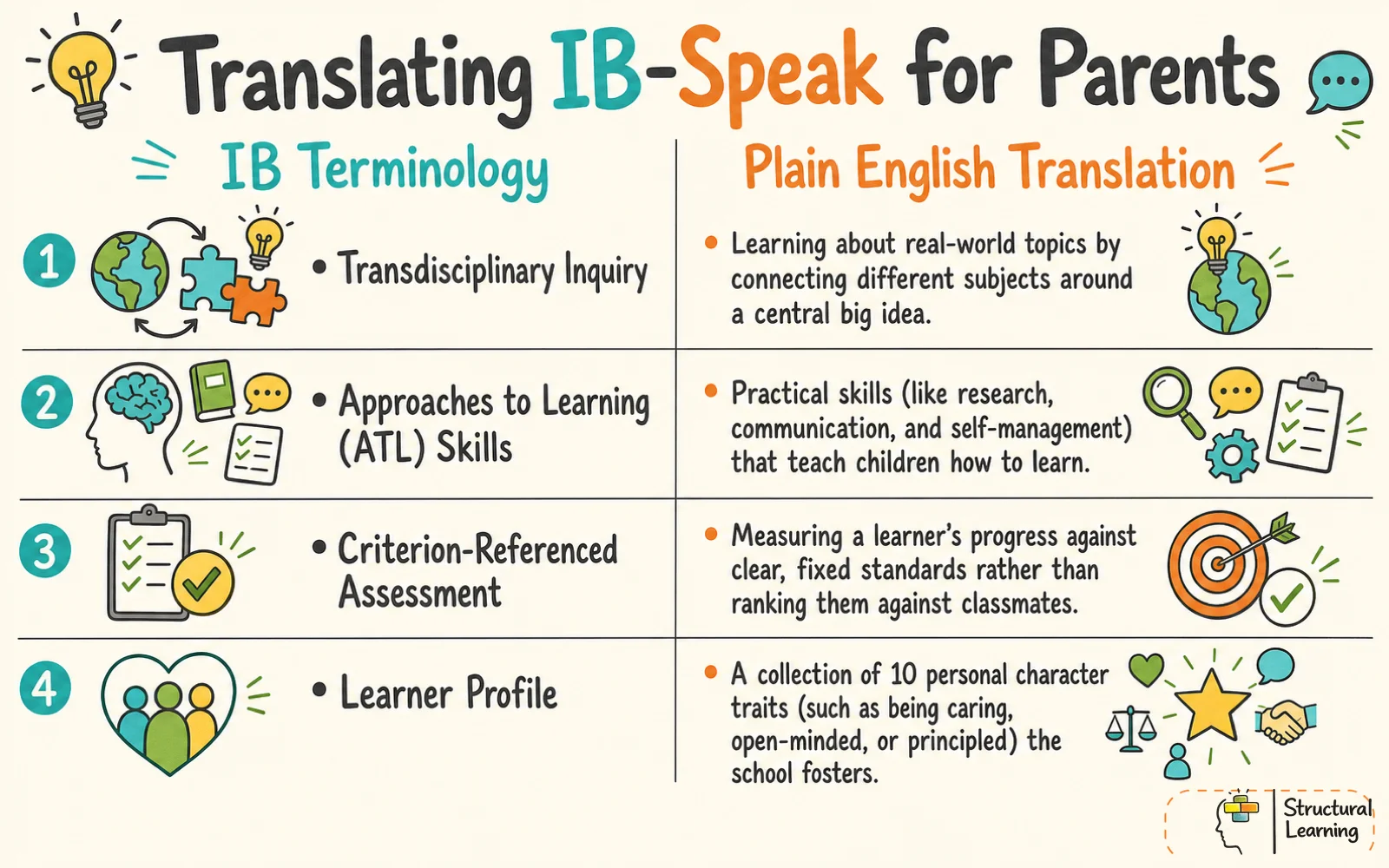
Transdisciplinary themes
'They don't teach subjects?'
Six overarching themes that connect learning across subjects. Science, maths, art, and literacy all contribute to the same inquiry.
'Your child studies one big question using science, history, and art together, rather than keeping subjects in separate boxes.'
Lines of inquiry
'Is there even a curriculum?'
Structured investigation pathways within a unit. The teacher plans these in advance. They guide what learners investigate each week.
'These are the specific questions your child investigates each week. The teacher plans them carefully. It is a structured curriculum, not free-for-all.'
Central idea
'Sounds vague and wishy-washy.'
The core understanding a unit builds toward. It is a transferable concept, not a fact. By the end of the unit, every learner should understand this idea deeply.
'This is the big idea your child will understand deeply by the end of the unit. It's the destination the whole unit is driving toward.'
ATL skills
'Another acronym I don't understand.'
Approaches to Learning. The five skill categories (thinking, communication, social, self-management, research) taught explicitly alongside content in all IB programmes. See our guide to ATL skills.
'We explicitly teach your child how to learn, not just what to learn. This covers how to research, how to work with others, and how to manage their own study habits.'
Learner Profile
'Is this just character education?'
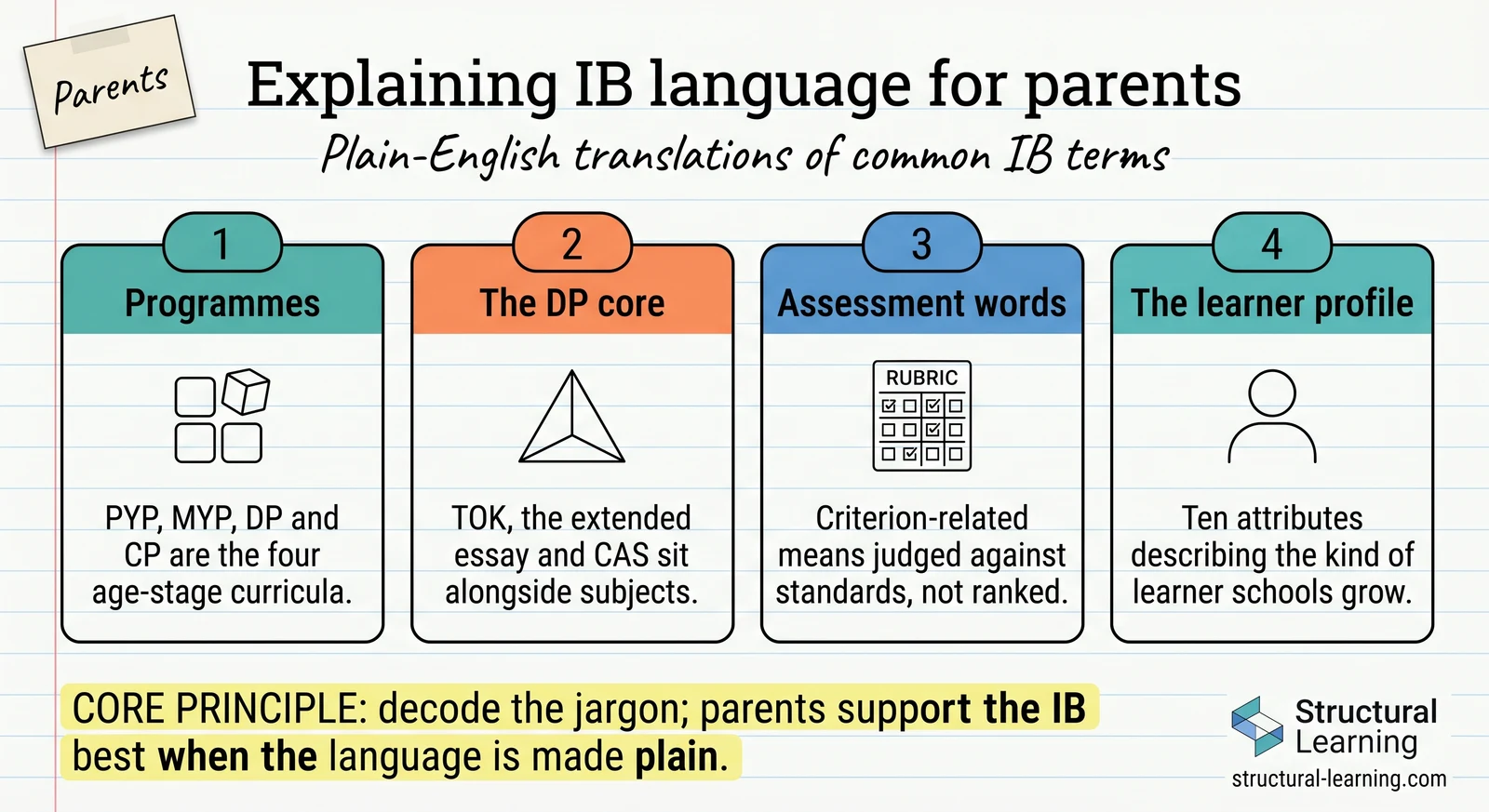
Ten attributes the IB develops across all programmes: inquirers, knowledgeable, thinkers, communicators, principled, open-minded, caring, risk-takers, balanced, and reflective. These are integrated into academic work, not separate from it. The full guide to the IB Learner Profile explains how each attribute develops across age groups.
'These are ten qualities we develop in every lesson and every subject. Your child's teacher refers to them in class. They shape how we design learning, not just what we put on report cards.'
Criterion-referenced assessment
'So there are no grades?'
Assessment against a fixed set of criteria rather than against other learners. A learner is measured by what they can do, not by whether they beat their classmates. This produces scores on a 1, 7 scale in the DP.
'Your child is measured against what they should be able to do, not ranked against classmates. A level 5 means they've met a specific standard. It doesn't change based on how other learners performed.'
CAS
'Is this just extracurricular stuff?'
Creativity, Activity, Service. A compulsory pass/fail core component of the Diploma Programme. The DP core is Theory of Knowledge, the Extended Essay and CAS. CAS does not add diploma points; it is a completion requirement documented through experiences, reflection and evidence. The full guide to IB CAS covers what counts and how to document it.
'Your child must show creative work, physical activity and community engagement as part of the diploma. CAS is compulsory, but it does not earn points. Diploma points come from six subjects plus the TOK and Extended Essay matrix.'
TOK
'Is this a philosophy class?'
Theory of Knowledge. A required DP course built around the knowledge framework: scope, perspectives, methods and tools, and ethics. Current TOK, first assessed in 2022, has a core theme, optional themes and five areas of knowledge. The old Ways of Knowing model and presentation are superseded. Learners complete a TOK exhibition using three objects and write a TOK essay on a prescribed title. Our guide to Theory of Knowledge explains the assessment in full.
'Your child learns to question evidence, evaluate arguments and think carefully across subjects. They build an exhibition around three objects and write an essay on a prescribed title. Universities value this because it shows how a learner handles evidence, perspective and judgement.'
Extended Essay
'A 4,000-word essay on top of everything else?'
An independent research essay on a topic of the learner's choice within a chosen subject. Supervised by a teacher. Develops the skills needed for undergraduate dissertations. Universities treat it as evidence of academic readiness.
'Your child chooses a question that interests them and writes a research paper about it, with support from a teacher. Universities love it because it proves your child can do the kind of work degree courses require.'
Unit of Inquiry (UOI)
'What is a unit?'
A planned block of learning, typically four to six weeks, organised around a central idea and structured by lines of inquiry. Each PYP year has six units. Planning a PYP Unit of Inquiry is a detailed process covered in our PYP inquiry planning guide.
'This is a four to six week block of learning built around one big theme. Your child's class does six of these per year. Each one has a clear learning goal and structured activities.'
PYP Exhibition
'A school show?'
The culminating assessment of the Primary Years Programme in Year 5 or 6. Learners identify a real-world issue, conduct sustained inquiry over several weeks, and present their findings. It is internally moderated and reported to the IB.
'Your child leads their own research project on a real issue they care about, then presents their findings to the school community. It's the capstone of primary school. It's assessed by the teacher against IB criteria.'
MYP Personal Project
'Another project?'
A self-directed project completed in the final year of the Middle Years Programme. The learner identifies a goal, plans and completes a product or outcome, and reflects on the process in a report. Externally moderated. Our guide to the MYP Personal Project covers what supervisors need to know.
'Your child picks something they want to create or achieve, plans it themselves, does it, and writes about what they learned. A teacher guides but does not direct. It proves they can work independently.'
Concept-based learning
'Isn't all learning concept-based?'
Learning organised around transferable ideas rather than isolated facts. In the current PYP, the seven specified concepts are form, function, causation, change, connection, perspective and responsibility. Reflection used to be the eighth key concept, but the Enhanced PYP in 2018 repositioned it as an embedded practice across inquiry, assessment and action. Many school websites still say '8 lenses' in 2026; this article uses the current seven. See how concept-based learning works in practice.
'We teach ideas that transfer across subjects. When your child understands "change" as a concept in history, they apply that thinking in science too. Facts are the vehicle; understanding is the destination.'
MYP Global Context
'Global citizenship again?'
Six lenses through which MYP units are framed, such as Identities and Relationships, Globalisation and Sustainability, or Scientific and Technical Innovation. Each unit sits within one context to give learning real-world relevance.
'Each unit connects to a real-world theme so your child can see why the learning matters. It can be sustainability, technology, or identity. It stops learning feeling like it only exists inside school.'
Internal/External assessment
'Who marks what?'
In the DP, internal assessments are marked by the subject teacher and moderated by an external IB examiner. External assessments are end-of-course examinations marked by IB examiners. Both contribute to the final grade. The way MYP conceptual assessment works is distinct from both.
'Some work is marked by your child's teacher and then checked by the IB. Some is marked by IB examiners directly, like standard exams. The final grade combines both.'
Bolted-on inquiry
'What's wrong with our current planning?'
When inquiry is added to existing content teaching rather than built in from the start, it produces surface-level questioning without genuine conceptual understanding. The bolted-on concept trap explains why this matters for PYP planning.
'Inquiry built into the planning from the start is different from adding a "what do you wonder?" question at the end. We plan backwards from the big idea, not forwards from the content.'
Scripts for the Information Evening
These scripts are for admissions coordinators, heads of programme, and school leaders. They answer the questions parents ask most. Read them, adapt them to your school's context, and practise them until they feel natural. Consistency across your team is what matters: every parent who asks the same question should hear a version of the same clear answer.
Script 1: 'What makes IB different from the national curriculum?'
This is the question every IB school hears at every open day. Most schools answer it with a list of features. Parents need a story.
What to say (2 minutes): 'The national curriculum tells teachers what to teach and when. The IB framework asks a different question: what kind of thinker do we want this child to become? Your child still learns photosynthesis, historical causation and mathematical method. The difference is that knowledge is used to investigate a bigger idea, such as how systems change and collapse.'
'The IB has four programmes: the PYP for ages 3 to 12, the MYP for ages 11 to 16, the DP for ages 16 to 19 and the Career-related Programme, or CP, for ages 16 to 19. The programme names change, but the core promise is consistent: learners build knowledge and learn how to use it.'
Script 2: 'Will my child be prepared for university?'
This is the anxiety underneath most IB questions. Parents are making a high-stakes choice. They need evidence, not reassurance.
What to say (3 minutes): "Yes, and there is data to support that. The IB publishes commissioned research on what happens after school. For example, an IB summary of US DP graduate outcomes reports higher immediate college enrolment, first-year persistence and four-year degree completion for the studied DP cohort than national comparison figures. This is not a guarantee for every learner, but it shows that the DP prepares learners for independent study, extended writing and university-level expectations."
Script 3: 'What about exam results? My neighbour's child got four A*s at A-level.'
Grade comparisons across systems can confuse parents. This script turns the comparison into something they can use.
What to say: 'The IB Diploma scores each of six subjects on a 1 to 7 scale. That gives a maximum of 42 subject points. The remaining three possible points come from the TOK and Extended Essay matrix, so the maximum diploma score is 45. CAS is compulsory but pass/fail; it earns no points.'
'A score of 38 or above is highly competitive internationally. Universities use well-established translation tables: a 7 in a Higher Level subject is usually equivalent to an A* at A-level, and a 6 is often treated like an A. The comparison is not exact because the DP keeps breadth across six subjects. Universities understand this, and their offers reflect it.'
Script 4: 'Is IB harder than A-levels?'
This question is a trap. 'Harder' implies that one is better. The right answer reframes the comparison.
What to say: 'Broader is more accurate. A-levels allow a learner to specialise deeply in three subjects. The DP asks learners to stay broad across six. If your child wants chemistry, physics and biology in depth, A-levels may fit that route well.'
'If you want your child to study science and keep a language and a humanity alongside it, the DP makes that possible. The intellectual demands are comparable. The structure is different. Learners who complete the DP often arrive at university with more options because their breadth gives them more to draw on.'
International Baccalaureate Inquiry in Action in practice: learners use inquiry routines in an International Baccalaureate classroom.
Explaining IB Assessment at the First Parent-Teacher Conference
The first parent-teacher conference in an IB school is often where misunderstanding becomes clear. Parents arrive expecting percentages, but they are given criterion descriptors instead. The conversation can break down before it starts.
The Thinking Framework's Compare operation helps here. When a parent hears that their child has a level 5 in Criterion B of MYP Mathematics, they need a clear comparison.
'In a traditional school, 72% tells you nothing about what your child can do. In IB, a level 5 in Criterion B: Investigating Patterns tells you this clearly: they can choose and use mathematical problem-solving techniques, spot patterns, and generalise from them. They still need support to check whether their generalisation is correct. A percentage is a rank, while an IB criterion level describes capability.'
For MYP reports, train teachers to include one sentence of plain English after every criterion score. 'Your child scored a 4 in Criterion C: Communicating. This means their mathematical arguments are understandable but lack the precision that a level 5 or 6 requires. We are working on the vocabulary of mathematical explanation this term.' That sentence costs thirty seconds to write. It saves ten minutes of confused conversation at the conference.
For the DP, parents by Year 12 usually know the 1 to 7 subject scale. The core is the part that can confuse them.
Explain it clearly: 'Your child has a predicted score from six subjects, each marked out of 7, giving up to 42 subject points. TOK and the Extended Essay can add up to 3 further points through the TOK/EE matrix. CAS is required for the diploma, but it is pass/fail and earns no points.'
That distinction matters. CAS builds reflection and service habits, but it should never be presented as part of the 45-point calculation. How MYP conceptual assessment differs from traditional grading is worth revisiting if your team is struggling with this communication challenge.
What NOT to Say to Parents
The mistakes IB schools make in parent communication are consistent. Here are the most common, and the corrections. Use it as a starting point for professional discussion: identify the learner's current need, record evidence from more than one lesson, and agree the next classroom adjustment with the SENCO or family.
Mistake 1: Using IB jargon in newsletters without translation. Most parents will not understand this newsletter line: 'This term, Year 4 are in their second Unit of Inquiry, exploring the transdisciplinary theme of How We Organise Ourselves through the central idea that Systems shape how communities function'. Add one plain English sentence after every IB term: 'This term, Year 4 are working on a six-week project exploring how organisations and communities work, using science, history, and literacy together.'
Mistake 2: Assuming parents know what ATL means. The abbreviation may have been part of the school's vocabulary for years. For the parent, it may only have appeared at the information evening two weeks ago.
Spell it out every time in written communication. Abbreviations save time for the writer, but they cost time for the reader.
Mistake 3: Sending reports full of criterion descriptors without explanation. A criterion descriptor may be correct, such as 'Demonstrates limited understanding of the central idea, with minimal connections to the lines of inquiry'. But a parent may read this as 'my child is failing.' After each descriptor, add one plain-English sentence that explains what it means in practice and what will happen next.
Mistake 4: Letting the Thinking Framework go unmentioned. The Thinking Framework gives parents a concrete, memorable picture of how their child learns to think. Eight cognitive operations, named and practised across subjects, is something a parent can ask about at home. 'How are you using the Compare operation in Maths this week?' is a question a parent can ask their child. That is parent engagement made possible by clear communication.
Mistake 5: Conflating the PYP, MYP, and DP in a single explanation. Parents of a Year 2 child need to understand the PYP. They do not need a detailed explanation of the DP. Parents of a Year 10 child are close to making choices about the DP, so tailor every message to the programme stage.
Mixed-programme information evenings that cover all four IB programmes in ninety minutes leave every parent unclear about something. If your school does not offer the CP, name it briefly as the fourth IB programme and then move on. The six PYP transdisciplinary themes deserve their own dedicated session for primary parents, not a footnote in a whole-school presentation.
Free slide deck
The key ideas on this topic as classroom-ready slides.
The information evening ends. The journey home starts. One parent says to another: 'What was that thing they said about ATL?' Neither can remember. The information evening has done half its work and will do no more.
A one-page handout keeps working after parents take it home. It sits on the kitchen table and gets read again. It may be shown to a grandparent who has questions. Design yours around these elements.
Section 1: Your Child's IB Route (four panels, one per programme). Each panel should be no more than 80 words.
PYP panel: 'Ages 3 to 12. Your child learns through six big themes each year, linking subjects together. They build ten learner attributes and five skill areas. The programme ends with the PYP Exhibition, where your child leads a research project on a real issue.'
MYP panel: 'Ages 11 to 16. Your child studies eight subject groups, each marked against clear criteria. They complete a Personal Project in the final year. Global Contexts link learning to the real world.'
DP panel: 'Ages 16 to 19. Your child studies six subjects, completes the Extended Essay and Theory of Knowledge, and completes CAS. The six subjects can earn 42 points, with up to 3 more points from TOK and the Extended Essay.'
CP panel: 'Ages 16 to 19. Your child combines DP courses with career-related study, personal and professional skills, service learning, language development and a reflective project. It suits learners who want academic breadth tied to a vocational or professional pathway.'
Section 2: The Learner Profile at a Glance. List the ten attributes with a two-word description for each one. Inquirer (loves learning), Knowledgeable (builds understanding), Thinker (solves problems), Communicator (shares ideas), Principled (acts with integrity), Open-minded (respects difference), Caring (shows empathy), Risk-taker (tries new things), Balanced (looks after themselves), Reflective (learns from experience).
An at-a-glance visual summary of Translating IB-Speak for Parents: Scripts for Your Next Parent Information Evening.
This gives parents the whole profile in a format they can read in ninety seconds. For the full explanation of how each attribute develops, send parents who want more detail to the IB Learner Profile guide.
Section 3: Three FAQs Answered. 'Does IB prepare my child for university?' Yes. IB graduates are valued because they study a wide range of subjects. They also build research skills and critical thinking.
'What do the grades mean?' DP subjects are scored from 1 to 7. Six subjects can earn 42 points, and TOK plus the Extended Essay can add up to 3 more. CAS is compulsory but earns no points.
'What if my child finds it too demanding?' The IB has support structures in place. Approaches to Learning skills help learners build strong study habits, so the workload feels more manageable. Our guide to ATL skills explains this in detail.
What to Prepare Before September
For admissions coordinators and school leaders, the communication infrastructure needs to be in place before the new school year starts. These are the four priorities. Use it as a starting point for professional discussion: identify the learner's current need, record evidence from more than one lesson, and agree the next classroom adjustment with the SENCO or family.
Priority 1: A parent glossary on your school website. Build a dedicated page titled 'IB Explained for Parents.' Use the translation table from this article as the foundation. Link to it from every programme page, every newsletter and every report card.
In 2026, add a checked 'IB translator' on the page if your site supports it. This can be a simple search box that gives the approved school definition, a parent-facing example and, where possible, a translation into the family's home language. The OECD (2025) AI adoption report notes that multilingual messenger apps and AI-powered chatbots can support parent-school communication when automatic translation is adapted for education. Use AI for first drafts and routing, not final authority; programme coordinators should own the glossary.
Priority 2: A three-minute video explaining IB in plain language. Record a head of school or programme coordinator speaking directly to camera, without slides. Keep it to three minutes, with no jargon, and answer three questions: What is the IB? How does it differ from the local alternative? Why did this school choose it?
Host it on your website homepage and your admissions page. Share it in the first newsletter of the year. Parents who watch a video retain more than parents who read the same information.
Priority 3: A parent information evening in the first two weeks of term. Do not wait until October or until after the first reports. Hold it in the first two weeks. Parents who understand the framework from the start ask better questions throughout the year. Parents who stay confused for the first half-term build up anxiety, which can damage later conversations.
The information evening should be programme-specific, not school-wide. Put PYP parents together, MYP parents together and DP parents together. Each group needs different information.
Priority 4: A parent ambassador from each year group. Identify one or two parents per year group who understood the IB well enough in Year 1 to explain it to others. Brief them before the information evening. Ask them to be available afterwards for informal peer-to-peer conversations.
Parent-to-parent communication is more trusted than school-to-parent communication, and it moves faster than any newsletter. For the DP, consider asking parents of current Year 13 learners to speak at the Year 10 information evening. No testimonial is more credible than 'here is what the Extended Essay actually looked like for my child, and here is what it got them.' Understanding the full scope of the International Baccalaureate is the foundation for that conversation.
The IB framework deserves parents who understand it. Clear communication is not a courtesy. It is the mechanism through which parent engagement becomes parent support. Hattie (2009) shows why that matters, but the school still has to make engagement possible.
The translation table, scripts and one-page handout in this article are ready to use. The information evening is a starting point, not a destination. What happens in conversations between parents and children at home, after the event, is where the real work gets done. Make sure those conversations start with understanding, not confusion.
Ready to plan it?
You have explored Curriculum Design. Now turn it into a lesson learners will remember.
Free for teachers. The platform builds a classroom-ready lesson plan from your topic in under two minutes.
Learners meet clearer challenge across the sequence.
Difficult concepts are broken into teachable steps.
International Baccalaureate Organisation. Primary Years Programme curriculum framework. Current programme overview.
International Baccalaureate Organisation. (2014, updated 2022). MYP: From principles into practice. Use the current school-accessible IB guide or programme resource centre version when citing this document.
The evidence for parent communication is strong enough to guide practice, but it should not be treated as a universal script. Hattie (2009) gives parent engagement a visible effect in aggregate, yet Snook et al. (2009) and Simpson (2017) argue that some Visible Learning rankings can hide differences in context, study quality and implementation. A parent evening can look impressive while changing little about what happens at home.
A second limitation is methodological. Hill and Tyson (2009) found that academic socialisation matters more for older learners than generic school involvement. This means attendance, enthusiasm and newsletter readership are weak proxies for the thing schools need: parents understanding expectations well enough to discuss learning, assessment and study habits with their child.
There is also a cultural critique. Bourdieu (1986) described cultural capital as a way institutions reward the language and habits of dominant groups. Hayden and Thompson (2013) make a related point about international schooling. IB vocabulary can therefore act as a status marker, not just a technical language. Translating it into English may still leave EAL families, non-elite parents and families from more communal cultures outside the conversation, especially when terms such as 'Risk-taker' carry individualistic assumptions.
Finally, there is little direct evidence that using proprietary Learner Profile labels at home improves cognition beyond established forms of parental support. The enduring value of this approach is practical rather than doctrinal: it reduces avoidable confusion, protects teacher time and gives families a fairer route into serious conversations about learning.
Further Reading: Key Research on Parent Engagement and School Communication
These papers provide the evidence base for effective parent communication strategies in international schools and IB programmes.
Visible Learning for Teachers: Maximizing Impact on LearningView study ↗ 627 citations
Hattie, J. (2012)
Hattie's synthesis of over 800 meta-analyses identifies parent engagement as having an effect size of 0.50 on learner achievement, well above the 0.40 hinge point for meaningful impact. The synthesis distinguishes between different forms of engagement: attending information evenings, understanding report feedback, and supporting study habits each have distinct effect sizes. Clear school communication is the prerequisite for all three.
Family Involvement in Middle and High School Students' Education: A Meta-Analytic AssessmentView study ↗ SAGE Journals
Hill, N. E. & Tyson, D. F. (2009)
Hill and Tyson (2009) found academic socialisation best supports secondary learners. This means explaining school aims, and setting expectations. Parents need to grasp the school's plan, beyond just helping out (Hill & Tyson, 2009).
School, Family, and Community Partnerships: Your Handbook for ActionView source ↗ Corwin / SAGE
Epstein, J. L., Sanders, M. G., Sheldon, S. B., Simon, B. S., Salinas, K. C. and colleagues (2018/2019, 4th ed.)
Epstein's partnership framework is a stronger source than the previous fabricated Oxford title. Use it to support the practical point: parents engage better when schools remove technical barriers, explain expectations clearly and make communication two-way.
Assessment Literacy: The Foundation for Improving Student LearningView study ↗ Assessment in Education
Brookhart, S. M. (2016)
Brookhart's work on assessment literacy found that parents who understand how their children are assessed are better able to interpret feedback and support revision strategies at home. For IB schools, this means criterion-referenced assessment requires active explanation, not just disclosure. Schools that taught parents to read IB criteria saw measurable improvements in how parents discussed assessment with their children.
Schools, Families, and Communities Partnering for Middle Level Student SuccessView study ↗ 279 citations
Sanders, M. G. (2009)
Sanders examined how partnership programmes between schools and families improved outcomes specifically in the middle school years, which maps closely to the MYP phase. Schools that used clear communication strategies at the start of each programme year reported stronger parent involvement in academic conversations at home and better outcomes on assessments that required sustained home study.
Sequence a Curriculum Design unit in three steps.
Mapped to the curriculum. CPD-aligned. Free for teachers.
Curriculum PlatformCurriculum design
Learners meet clearer challenge across the sequence.
Difficult concepts are broken into teachable steps.
Plans keep the curriculum thread visible.
1
Year
Year 5
2
Lesson plan
Sequenced unit
3
Export
PDF
Cognitive Science Platform
Make Thinking Visible
Open a free account and help organise learners' thinking with evidence-based graphic organisers. Reduce cognitive load and guide schema building dynamically.
Paul Main is an educator and metacognition researcher who founded Structural Learning in 2002. With a psychology degree from the University of Sunderland and 22+ years helping schools embed thinking skills, he bridges the gap between educational research and classroom practice. Fellow of the RSA and Chartered College of Teaching, with 128+ Google Scholar citations.