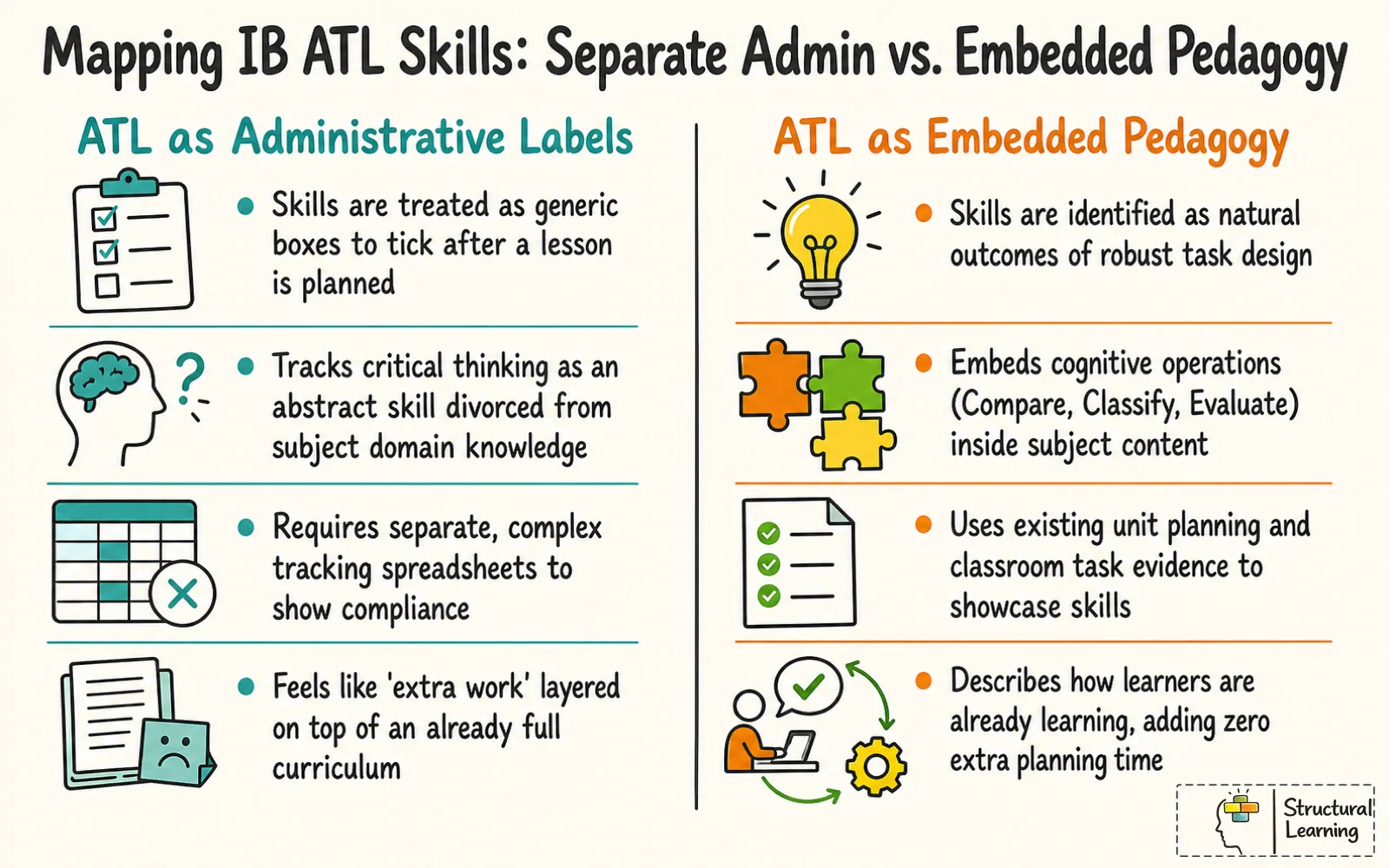
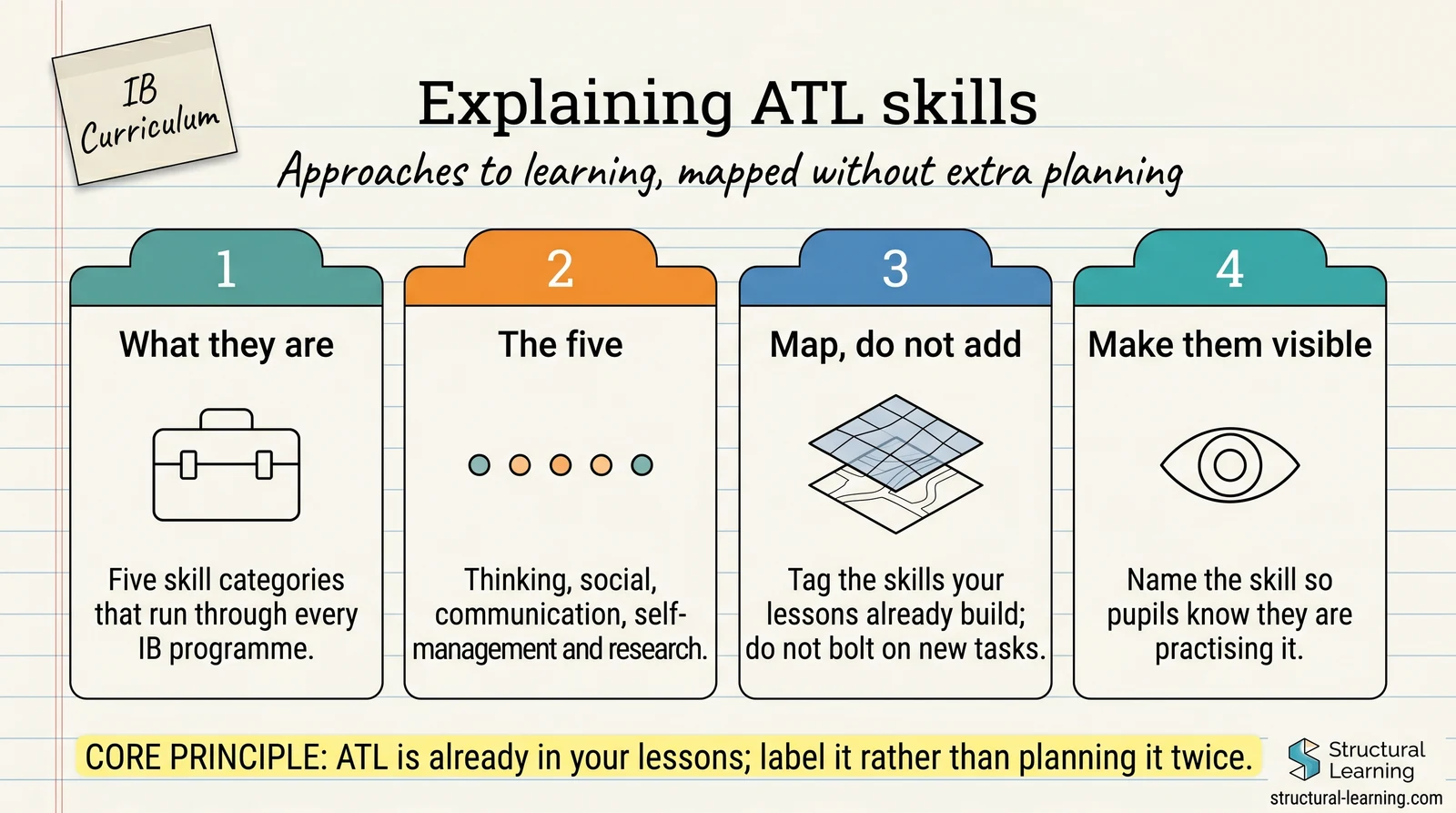
IB teachers spend unnecessary time documenting ATL skills that are already embedded in their teaching. This guide shows how the Thinking Framework maps directly onto ATL Thinking Skills, how one well-designed task can evidence all five ATL categories, and how a five-question coordinator audit replaces complex tracking systems without losing any evidential value.
Mapping IB ATL Skills: Separate Admin vs. Embedded Pedagogy
Every IB teacher knows the feeling. A coordinator says that ATL skills must be mapped in unit planners, and the room quietly sinks. It sounds like another column, another expectation, and another thing to document on top of an already full planner.
The problem is not that teachers resist ATL skills. It is that they often see ATL as something extra, added on top of what they already do. The term describes a structured process for turning evidence into a classroom decision, not a label on its own.
It is not. And once you see why, the documentation burden almost disappears.
Key Takeaways
ATL is already in your teaching: When learners explain their reasoning, work in pairs, or evaluate sources, they are already using ATL skills. The gap is labelling, not doing.
The Thinking Framework maps directly onto ATL Thinking Skills: Choosing a cognitive operation (Compare, Cause and Effect, Systems Thinking) automatically satisfies ATL Thinking documentation with no extra planning step.
One well-designed task can evidence all five ATL categories: Research, Social, Communication, Self-Management, and Thinking skills can all emerge from a single Thinking Framework activity.
Coordinators need evidence of embedding, not separate tracking spreadsheets: The IB requires ATL to be visible in teaching and learning, not recorded in a separate document from lessons.
The five-question audit turns compliance into recognition: Asking "did learners explain something to a partner?" is faster than completing a tracking grid and gives more honest evidence of ATL in practice.
◆ Structural Learning
How to Map IB ATL Skills Without Adding a Single Minute to Your Planning
A deep-dive audio episode
A concise Structural Learning audio episode on How to Map IB ATL Skills Without Adding a Single Minute to Your Planning, grounded in the curated research dossier and focused on practical classroom use.
The ATL Admin Problem
The planning conversation usually sounds familiar. A teacher has a well-structured lesson on environment interdependence, with paired discussion, a source evaluation task and a reflection question. Then someone asks: "Have you mapped the ATL skills?"
The teacher then adds a column to the planner, writes "Thinking Skills: Critical Thinking" in it, and moves on. Nothing about the lesson changed. Only the documentation did.
Many schools misuse ATL skills by treating them as labels, not teaching decisions. That is not a teacher time-management weakness; it is a problem with how the curriculum is organised. When leaders ask departments to track critical thinking as a generic skill, they separate it from history evidence, science models or language choices.
Willingham (2007) and Tricot and Sweller (2014) argue that this kind of thinking depends heavily on domain knowledge. The IB Organisation (2014) calls ATL "the bedrock of how learners learn", but that bedrock has to sit inside subject work.
The fix is not a better spreadsheet. It is a clearer rule for how teachers plan: name the cognitive work inside the task, then record the relevant ATL categories. That protects planning time and produces better evidence than a separate tracker.
ATL Is Already in Your Teaching
Typical MYP lessons start with retrieval questions. These ask learners to recall ideas and apply them. Use it as a starting point for professional discussion: identify the learner's current need, record evidence from more than one lesson, and agree the next classroom adjustment with the SENCO or family.
Learners discuss answers together, so they practise listening and collaboration. Teachers give them conflicting sources, and learners judge them using information literacy and critical thinking. Learners also write short explanations and reflect on their confidence in the day's learning. This shows Self-Management.
That is five ATL categories in one lesson, and none were planned as separate ATL activities. They were planned as good pedagogy. Erickson and Lanning (2014) argue that concept-based learning asks learners to transfer thinking across contexts.
The vehicle is still a content task, such as comparing sources in history, classifying organisms in science, or testing claims in geography. ATL lives inside the task, not alongside it.
The documentation problem starts because teachers look at their planning and mainly see subject content, not the learning behaviours within activities. They have been trained to plan through topics, learning objectives and classroom activities, so ATL skills are hard to see in that lens. These skills are embedded in the how, not the what.
The solution is a change in perspective, not more planning time. Teachers who use a Thinking Framework to design their activities already have that lens built in.
The Thinking Framework Shortcut
The Thinking Framework uses eight operations: compare, classify, sequence, cause and effect, part-whole relationships, analogy, perspective and systems. The labels can be shared across subjects, but the quality of the thinking is domain-specific. Comparing two poems is not the same mental work as comparing two river systems. In this article, the table is a practical mapping between those operations and IB ATL Thinking Skills, not a claim from a separate study by Murdoch and Wilson.
Thinking Framework Operation
ATL Thinking Skills Subcategory
Example Task
Compare
Critical thinking: evaluating evidence
Compare two historians' interpretations of the same event
Classify
Critical thinking: identifying categories
Sort organisms into consumer categories by feeding behaviour
Sequence
Transfer: applying thinking across contexts
Order the steps in a chemical reaction process
Cause and Effect
Critical thinking: considering ideas and perspectives
Analyse why a character's decision changed the story
Part-Whole
Creative thinking: making connections
Identify how each organ system contributes to homeostasis
Analogy
Creative thinking: generating novel ideas
Explain economic supply and demand using a school tuck shop
Perspective
Critical thinking: considering perspectives and viewpoints
Write from the viewpoint of a refugee in a historical event
Systems Thinking
Transfer: seeing interconnections
Map how industrial farming affects global food security
Teachers plan ATL Thinking Skills when they design lessons with these operations. The planning column is easier to complete when the teacher names the cognitive operation already in use. This makes administration simpler without weakening documentation. It also fits well with habits-of-mind and backward-design approaches.
Sweller (1988) helps explain the workload benefit. Planning content and ATL skills as separate jobs increases extraneous cognitive load for teachers. Merging the two means the same planning decision serves subject knowledge, ATL skill development, differentiation and pacing.
The Five ATL Categories: What You Are Already Doing
Teachers routinely make choices that link to ATL skill categories. The table shows common lesson structures that can provide ATL evidence without creating a separate planning task. The important move is to name the thinking demanded by the lesson, not to add a new compliance layer.
ATL Category
Already in Your Planning When You...
Observable Learner Behaviour
Thinking
Assign a Thinking Framework operation as the lesson task
Learners analyse, evaluate, categorise, or connect ideas
Communication
Ask learners to explain, present, write, or justify
Learners express understanding through language, visual, or multimodal means
Social
Use paired discussion, group tasks, or peer feedback
Learners listen, negotiate, delegate, and support each other
Self-Management
Include reflection, goal-setting, or time management in a task
Learners monitor their understanding, manage materials, or pace their work
Research
Set an inquiry task, source evaluation, or note-taking activity
Learners gather, select, record, and cite information
Zimmerman (2002) described self-regulated learning as a cycle of forethought, performance and self-reflection. In simple terms, learners plan, act and then look back. These phases align with the IB's Self-Management Skills.
When learners set targets and then reflect, they practise Zimmerman's cycle. Teachers do not need separate activities because lessons already include this cycle. See self-regulation of learning for more.
Learners show Communication Skills when they speak, write or represent their thinking. Social skills appear when a task requires genuine interdependence, not just sitting in a group. Research Skills develop when learners find, judge and use new information. In one carefully designed task, teachers can evidence the five ATL categories while still teaching the planned curriculum (Ritchhart et al., 2011).
One Lesson, All Five ATLs
Systems Thinking helps learners grasp pond pond habitats in Year 8 MYP Science. A lesson can use this framework to move from naming parts of the pond environment to explaining relationships between those parts. The practical value comes from the quality of learner thinking and the evidence teachers collect during the lesson.
The teacher's planning note reads: "Systems Thinking task: learners map the feeding relationships in a pond environment and identify what happens if one species disappears." That is one sentence in the planning document. What actually happens in the lesson covers all five ATL categories.
Learners research pond organisms for ten minutes, using Research Skills as they select, record and evaluate information. In pairs, they build food webs and negotiate placements, which gives direct evidence of Social Skills and accountable collaboration (Johnson & Johnson, 2009). Each pair then writes about the effect of removing frogs, which makes Communication Skills visible through explanation.
The reflection question, "What surprised you?", gives evidence of Self-Management Skills. It does this because learners monitor their own understanding. The Systems Thinking task asks them to recognise interdependence and anticipate consequences, which is the Thinking Skills layer. Dewey (1933) treated this kind of disciplined inquiry as central to critical thinking.
The teacher planned a task that covered all five ATL categories. This works because the task design is cognitively rich, so learners have to think in several ways.
Hattie (2009) identified self-reported grades, now often called learner expectations, as a strong influence on achievement. Self-evaluation helps learners see their own thinking without a separate ATL activity. The pond lesson's self-assessment question does this without extra planning.
Inquiry builds ATL skills, and IB PYP unit planning offers one useful place to make those skills visible. In current PYP guidance, the specified concepts are seven: form, function, causation, change, connection, perspective and responsibility. Reflection was the eighth key concept before the Enhanced PYP in 2018, but it is now an embedded practice across inquiry, assessment and action. Many school websites still refer to eight lenses in 2026; use the current seven when mapping PYP MYP planning documents.
What the IB Actually Requires
A significant part of the ATL planning burden comes from misunderstanding what the IB actually asks for. The IB Organisation's (2014) ATL framework does not require a separate tracking spreadsheet. It does not require every ATL subcategory to be documented in every lesson. It requires that ATL skills are "embedded in all subject groups" and that schools provide learners with repeated opportunities to develop and use these skills across programmes.
That phrase, "provide opportunities," is doing a great deal of work. It does not mean "demonstrate in a separate column that each skill was explicitly taught." It means that learners who pass through an MYP classroom should leave it having practised the skills. The evidence for this can come from unit planners showing inquiry tasks (Research Skills), group activities (Social Skills), and reflective questions (Self-Management Skills). It does not need to come from a lesson-by-lesson ATL tracker.
Schools sometimes make complex ATL spreadsheets because they mistake paperwork for evidence. Where staff are spending hours updating trackers, leaders should treat that as a curriculum design problem, not a mark of professional diligence. A sound system weaves ATL skills through real lessons and records where learners actually use those skills. That protects teacher workload and gives coordinators better evidence.
For teachers working across IB programmes, ATL skills sit within all four programmes. These are PYP for ages 3 to 12, MYP for ages 11 to 16, and the DP and Career-related Programme, or CP, for ages 16 to 19.
At each stage, the skills become more complex and learners take more ownership. In PYP MYP transitions, teachers usually lead ATL skills first, and learners then begin to name them for themselves.
By DP and CP, learners should choose approaches to learning strategies with more independence. Linking your planning to the IB Learner Profile helps show how ATL skills support the wider aim of developing internationally minded learners.
Why Metacognition Is the Key to ATL Thinking Skills
ATL Thinking Skills are often weak in school records. Teachers may write broad phrases such as "learners used critical thinking", but they do not say what learners actually did. Metacognitive skills sit within Thinking Skills, and the EEF (2018) reports that metacognition and self-regulated learning can add, on average, seven months of progress. So the record should name the thinking move, not just the category.
Flavell (1979) defines metacognition as knowledge and regulation of one's own thinking. Learners need to know the strategy they are using, monitor whether it is working, and adjust when it fails. These skills match ATL Thinking Skills: transfer, critical thinking, creative thinking and reflection.
The Thinking Framework helps learners understand their thinking by providing shared language. Teachers can say "We'll use Systems Thinking," so learners know the thinking skill expected. Learners can then check: "Am I connecting parts or just describing them?". This metacognitive monitoring comes from naming the thinking operation (see metacognition and critical thinking).
Communication and Social Skills: The Oracy Connection
Learners may complete paragraphs or worksheets without showing ATL Communication Skills. This category includes reading, writing, speaking, listening, presenting and media literacy. The evidence still needs to show meaning-making. This means learners are making sense of ideas.
"Group work occurred" says little about the quality of collaboration. Vygotsky (1978) and Piaget (1936) both link talk, interaction and explanation with cognitive development. This is why social skills and communication need observable thinking, not seating arrangements.
Communication skills need real meaning-making, not simple sharing of information. When teachers ask learners to explain a diagram, challenge an interpretation and respond to questions, they also teach critical thinking. Learners must choose evidence, think about the listener's response and revise the explanation.
Oracy links communication and social skills because learners explain ideas and respond to others. This shows accountability (Mercer, 1995). Teachers can plan one speaking task that gives evidence for two ATL categories. Explore language development or collaborative learning (Vygotsky, 1978).
The Coordinator's Five-Question Audit
Coordinators can quickly audit any lesson using these five questions. Use them in reviews or meetings to support teachers' ATL work. The questions draw evidence from teacher recall, not paperwork, and connect it to ATL categories (Costa & Kallick, 2008). This approach reduces teacher workload (Wiggins & McTighe, 2005).
"In your last lesson, did learners explain something to a partner or to the class?" If yes, that is Communication Skills: speaking and listening. Ask them to note it in the unit planner under Communication.
"Did learners make a choice about how to approach a task, or manage their time to complete something?" If yes, that is Self-Management Skills: organisation and self-regulation. Zimmerman (2002) describes this as the performance phase of self-regulated learning.
"Did learners use any information they did not already have, from a text, video, or database?" If yes, that is Research Skills: information literacy and media literacy. Even a reading comprehension task qualifies.
"Did learners work with someone else to produce or discuss something?" If yes, that is Social Skills: collaboration. The quality of the collaboration is what matters for assessment, not its occurrence.
"Which Thinking Framework operation did the task require?" Whatever the answer, that is Thinking Skills. Compare maps to critical thinking and evaluating evidence. Systems Thinking maps to transfer and seeing interconnections. The specific subcategory follows from the operation.
This audit takes five minutes. It converts a compliance exercise into a recognition exercise, helping teachers see that they are already doing what is asked. It also produces more honest ATL evidence than a pre-filled planning column because it reflects what actually happened in the lesson, not what was anticipated.
Using MYP planning frameworks with this audit can create a stronger school ATL culture. The combined approach is more useful than a spreadsheet-only process because it connects planning, lesson evidence and reflection. Use current PYP MYP planning materials alongside this audit so the record reflects what happened in classrooms, not what someone predicted in a template.
◆ Structural Learning
How to Map IB ATL Skills Without Adding a Single Minute to Your Planning
Classroom-readyWhat the theory means in practice
How to Map IB ATL Skills Without Adding a Single Minute to Your Planning in practice, a classroom-ready briefing you can use this week.
One persistent myth about ATL Research Skills is that they only apply during inquiry projects, personal projects, or extended essays. This leads teachers in non-inquiry lessons to assume Research Skills do not apply to their unit, and to leave that row in the ATL planner blank.
IB ATL research skills include forming questions, finding credible sources, collecting data, using information well, reading media and referencing ethically (Kuhlthau, 2004; Eisenberg and Berkowitz, 1988). Learners use these skills whenever they work with information from any source (Bruner, 1961).
When learners use a database, survey tool or GenAI assistant, information literacy also means checking the privacy policy before sharing personal information. In MYP and DP research tasks, a privacy policy is part of ethical source use. It is not just an IT footnote.
Year 10 geography learners compare case studies. They identify one similarity and one difference. This makes it a Research Skills lesson. They read critically, choose evidence and bring sources together.
When Year 7 learners research a word's etymology and use it accurately, this is also Research Skills. Compare structures the geography task, while Analogy may structure the vocabulary work. The evidence is already in tasks teachers have designed.
This matters for schools that want stronger ATL records. Teachers can document research skills in more lessons without changing the plans themselves.
An at-a-glance visual summary of How to Map IB ATL Skills Without Adding a Single Minute to Your Planning.
Ready to plan it?
You have explored IB ATL Skills Mapping. Now turn it into a lesson learners will remember.
Free for teachers. The platform builds a classroom-ready lesson plan from your topic in under two minutes.
Learners meet clearer challenge across the sequence.
Difficult concepts are broken into teachable steps.
Take your next lesson plan, but do not add an ATL column. Instead, ask one question: "Which Thinking Framework operation am I asking learners to perform?" If the answer is Cause and Effect, you have Thinking Skills documented; if learners discuss their answer in pairs, you have Social Skills.
If they write their conclusion, you have Communication Skills; if they look at a source to find the evidence, you have Research Skills. If they check their own understanding at the end, you have Self-Management Skills.
Consider ATL evidence during planning; this action does not change lessons. It improves lesson design because teachers must define the task's required thinking. Willingham (2009) argued that learners remember material through meaningful thought, not mere exposure. Naming the thinking before lessons helps teachers and learners approach content with the right mental frame.
In the GenAI era, a polished ATL-mapped unit plan is no longer strong evidence by itself. The EEF and NFER ChatGPT lesson-preparation trial found that guided use reduced planning time for Year 7 and Year 8 science teachers by 31 per cent (Education Endowment Foundation, 2024). That helps workload, but it does not prove learners encountered useful cognitive friction. Annotated sources, discussion notes, graphic organisers and exit reflections give stronger evidence that the thinking happened in the room.
Share this approach with one colleague before the next department planning meeting. Ask them to identify the Thinking Framework operation in one of their upcoming lessons. Then ask the five coordinator questions together. The ATL documentation almost writes itself, and neither of you will have spent extra planning time to produce it.
Limitations and Critiques
The strongest scholarly challenge is transfer. ATL skills can be written as general capacities, but critical thinking, creative thinking and information literacy do not move cleanly from one subject to another. Willingham (2007) argues that critical thinking depends on background knowledge, while Tricot and Sweller (2014) make the stronger claim that attempts to teach generic cognitive skills without domain knowledge are weakly supported. This means ATL skills taught as labels may look tidy in a planner but produce little change in learner reasoning.
There are also methodological cautions. Hattie (2009) gives useful language for making learning visible, yet critics of meta-meta-analysis warn that combining very different interventions can hide context, implementation quality and measurement error (Snook et al., 2009). Zimmerman (2002) is valuable for self-regulated learning, but goal-setting and reflection routines can be measured superficially, especially when schools collect compliance evidence rather than observing how learners monitor thinking during a difficult task.
Cultural and inclusion critiques matter as well. Gutierrez and Rogoff (2003) caution against treating cultural patterns of participation as individual traits, and Waitoller and Thorius (2016) show how assessment can privilege some behaviours while marking others as deficit. An ATL rubric that rewards eye contact, fast talk or visible confidence may misread neurodivergent learners and multilingual learners. Even with these limits, ATL remains useful when it is grounded in subject knowledge, visible classroom evidence and flexible ways for learners to show thinking.
◆ Structural Learning
How to Map IB ATL Skills Without Adding a Single Minute to Your Planning: Quick-Check Quiz
10-question self-test
Q1 of 10
0%
References
Hattie, J. (2009). Visible learning.
Zimmerman, B. (2002). Becoming a self-regulated learner.
Further Reading: Key Research Papers on ATL Skills and Thinking Frameworks
Approaches to Learning in the IB ProgrammesView study ↗ IB Organisation (2014) The foundational IB document outlining the five ATL skill categories, their subcategories, and expectations across PYP, MYP, and DP programmes. Essential reading for any coordinator designing school-wide ATL implementation, as it clarifies that ATL is meant to be embedded in subject teaching rather than tracked as a separate discipline.
Transitioning to Concept-Based Curriculum and InstructionView study ↗ Erickson, H. L. and Lanning, L. A. (2014) Erickson and Lanning's framework for concept-based teaching explains how transferable thinking skills are inherently embedded in conceptual understanding tasks. Teachers designing lessons around big concepts and key questions are simultaneously designing ATL Thinking Skills opportunities without additional planning effort.
Promoting Self-Efficacy in Self-Regulated LearnersView study ↗ Zimmerman, B. J. (2002). Journal of Educational Psychology Zimmerman's model of self-regulated learning (forethought, performance, self-reflection) maps directly onto IB ATL Self-Management Skills. This paper provides the theoretical grounding for why goal-setting and reflection activities at the start and end of lessons generate genuine ATL evidence, not mere compliance documentation.
Metacognition and Self-Regulated Learning: Guidance ReportView study ↗ Education Endowment Foundation (2018) The EEF guidance report on metacognition and self-regulated learning rates these skills as among the highest-impact, lowest-cost interventions available to teachers (seven additional months of progress). The report's seven recommendations translate directly into ATL Thinking and Self-Management skill development, providing robust evidence for why embedding these skills improves outcomes.
Visible Learning: A Synthesis of Over 800 Meta-Analyses Relating to AchievementView study ↗ Hattie, J. (2012). Routledge Hattie's synthesis of meta-analyses identifies self-reported grades (effect size 1.33) and self-evaluation (effect size 0.75) as among the most powerful influences on student achievement. Both are ATL Self-Management Skills. This evidence base strengthens the case for reflective activities in every lesson as both an ATL requirement and a high-yield teaching strategy.
Plan your next lesson in three steps.
Mapped to the curriculum. CPD-aligned. Free for teachers.
Curriculum PlatformLesson planning
Learners meet clearer challenge across the sequence.
Difficult concepts are broken into teachable steps.
Plans keep the curriculum thread visible.
1
Year
Year 5
2
Lesson plan
Knowledge + skills
3
Export
PDF
Cognitive Science Platform
Make Thinking Visible
Open a free account and help organise learners' thinking with evidence-based graphic organisers. Reduce cognitive load and guide schema building dynamically.