Growth Mindset: What Dweck's Research Actually Found
Dweck's growth mindset, scrutinised: the Sisk (2018) meta-analysis, a zero-impact trial, and PISA 2022 data, plus what teachers should actually do.


Dweck's growth mindset, scrutinised: the Sisk (2018) meta-analysis, a zero-impact trial, and PISA 2022 data, plus what teachers should actually do.
Walk into almost any school in the United Kingdom and you will find growth mindset posters on the walls. Phrases like 'Mistakes help us grow,' 'The power of yet,' and 'You can train your brain' are very common in schools. Because of this, it feels like questioning effort itself if you question these ideas. But what does the research actually show?
Carol Dweck's growth mindset framework, first popularised in her 2006 book Mindset: The New Psychology of Success, proposed a compelling idea: learners who believe their intelligence can be developed through effort and good strategies (growth mindset) outperform those who believe intelligence is fixed and unchangeable (fixed mindset). The implication was straightforward and appealing. Teach learners that their brains can grow, and they will work harder, persist longer, and achieve more.
Schools across the UK adopted this idea enthusiastically. Growth mindset became a cornerstone of personal development curricula, assembly themes, and behaviour policies. Teachers were trained to praise effort over ability. Entire school improvement plans were built around shifting learner mindsets. But between the original research and the classroom application, something important got lost.
Dweck's original studies in the 1990s and early 2000s demonstrated correlations between mindset beliefs and academic outcomes. Learners who endorsed growth mindset statements tended to show greater resilience after setbacks and, in some studies, achieved better grades. These were genuinely important findings that opened a new line of enquiry in educational psychology.
However, correlation is not causation. Showing that learners with growth mindsets tend to perform better is not the same as proving that teaching growth mindset causes better performance. The critical question for schools was always: if we intervene to change mindsets, will achievement follow? This is where the evidence becomes considerably more complicated.
Dweck's early intervention studies were conducted with relatively small samples under controlled conditions. When independent researchers attempted to replicate these findings at scale, the results were far less convincing. The replication crisis that has affected psychology more broadly has been particularly significant for growth mindset research.
Li and Bates (2019) conducted a rigorous replication of Dweck's core claims, published in the Journal of Experimental Psychology: General. Their findings were stark: growth mindset interventions changed learners' beliefs about intelligence. Students came to believe intelligence could change. However, these new beliefs had no significant effect on resilience to failure, cognitive ability, or educational attainment. Learners said the right things about growth mindset but did not perform any differently.
The most thorough challenge came from Sisk, Burgoyne, Sun, Taylor, and Macnamara (2018), who published two meta-analyses in Psychological Science. Across dozens of studies with thousands of participants, they found the overall effect size was just 0.08. This measures how growth mindset interventions affect academic achievement. To put this in context, an effect size of 0.08 is considered negligible in educational research. For comparison, the effect of getting adequate sleep on academic performance is approximately 0.3, nearly four times larger.
For typical learners in typical school settings, growth mindset interventions frequently failed to reach statistical significance. The meta-analysis did find slightly larger effects for lower-achieving learners, but even these were modest and inconsistent across studies.
Burgoyne, Hambrick, and Macnamara (2020) went further in Psychological Science, re-analysing Dweck's own published studies. They found that some core claims were unsupported by the data, effect sizes were weaker than originally presented, and conclusions had been overstated. The foundations of mindset theory, they concluded, were shakier than the public had been led to believe.
Not all the evidence is negative. Yeager, Hanselman, Walton and colleagues published a large national experiment in Nature in 2019. They identified specific conditions where growth mindset interventions can produce real, though small, effects.
The study found that growth mindset interventions worked for lower-achieving learners who were enrolled in challenging, advanced courses such as honours mathematics. Crucially, the interventions only worked in schools where the peer culture already valued effort and treated mistakes as learning opportunities. In schools without this supportive culture, the interventions had no effect.
The effect sizes in Yeager's study ranged from approximately 0.1 to 0.2, which are small but meaningful. The key insight is that context matters enormously. A growth mindset intervention delivered as a one-off assembly or poster campaign is unlikely to change anything. This is especially true in schools that do not structurally support persistence and challenge.
Successful implementations combined mindset messaging with specific academic challenge, peer models of persistence, and reattribution training. This training taught learners to see setbacks as signals to try different strategies, not as proof of inability.
A 20-minute deep-dive episode on Growth Mindset: What Dweck's Research Actually Found, voiced by Structural Learning. Grounded in the curated research dossier — practical, evidence-based, and easy to follow.
To her credit, Dweck herself has publicly acknowledged the oversimplification of her work in schools. In a 2015 piece for Education Week, she introduced the concept of "false growth mindset" to describe the gap between what she intended and what schools were actually doing.
Dweck identified several problems with how schools had implemented her ideas:
Dweck's self-critique is important because it confirms what other studies found. The simple version of growth mindset that most schools use does not work. The theory is more nuanced than the posters suggest.
For UK teachers, the most relevant evidence comes from the Education Endowment Foundation's (2019) Changing Mindsets evaluation, one of the largest randomised controlled trials of growth mindset interventions conducted in English schools.
The findings were clear:
The disconnect is striking. Learners learned about growth mindset and agreed with it in surveys. However, this new belief did not lead to different behaviour or better academic results. The EEF concluded that "schools should be cautious about using growth mindset interventions alone as a mechanism for boosting academic attainment." See also our guide on visual thinking routines.
This does not mean mindset is irrelevant. It means that changing beliefs without changing the structures, strategies, and teaching practices that support learning is insufficient. A learner who believes they can improve but does not know how to improve, and is not given appropriately challenging work with adequate scaffolding, will not achieve more simply because of their beliefs.
The evidence does not suggest that mindset is meaningless. It suggests that mindset alone is not enough. The research points toward a more integrated approach that combines mindset messaging with concrete support for learning.
Mindset plus strategy. Rather than simply telling learners they can improve, teach them how to improve. Retrieval practice, metacognitive planning, and deliberate practice are evidence-based techniques that give learners the tools to translate effort into progress. When learners experience genuine improvement through specific strategies, growth mindset becomes self-reinforcing.
Mindset plus challenge. Growth mindset is most meaningful when learners face genuine difficulty. If the work is easy, effort is irrelevant. Schools that combine growth mindset messages with high expectations do well. They also use challenging lessons. This creates a place where staying persistent truly helps learners succeed. For related guidance, see our article on translating IB for parents.
Mindset plus peer models. Yeager's research shows that peer culture is a powerful moderator. When learners see classmates persist through difficulty, struggle openly, and improve through effort, growth mindset becomes real. It stops being just an abstract concept. Teachers can help this through collaborative learning, visible thinking routines, and normalising productive struggle.
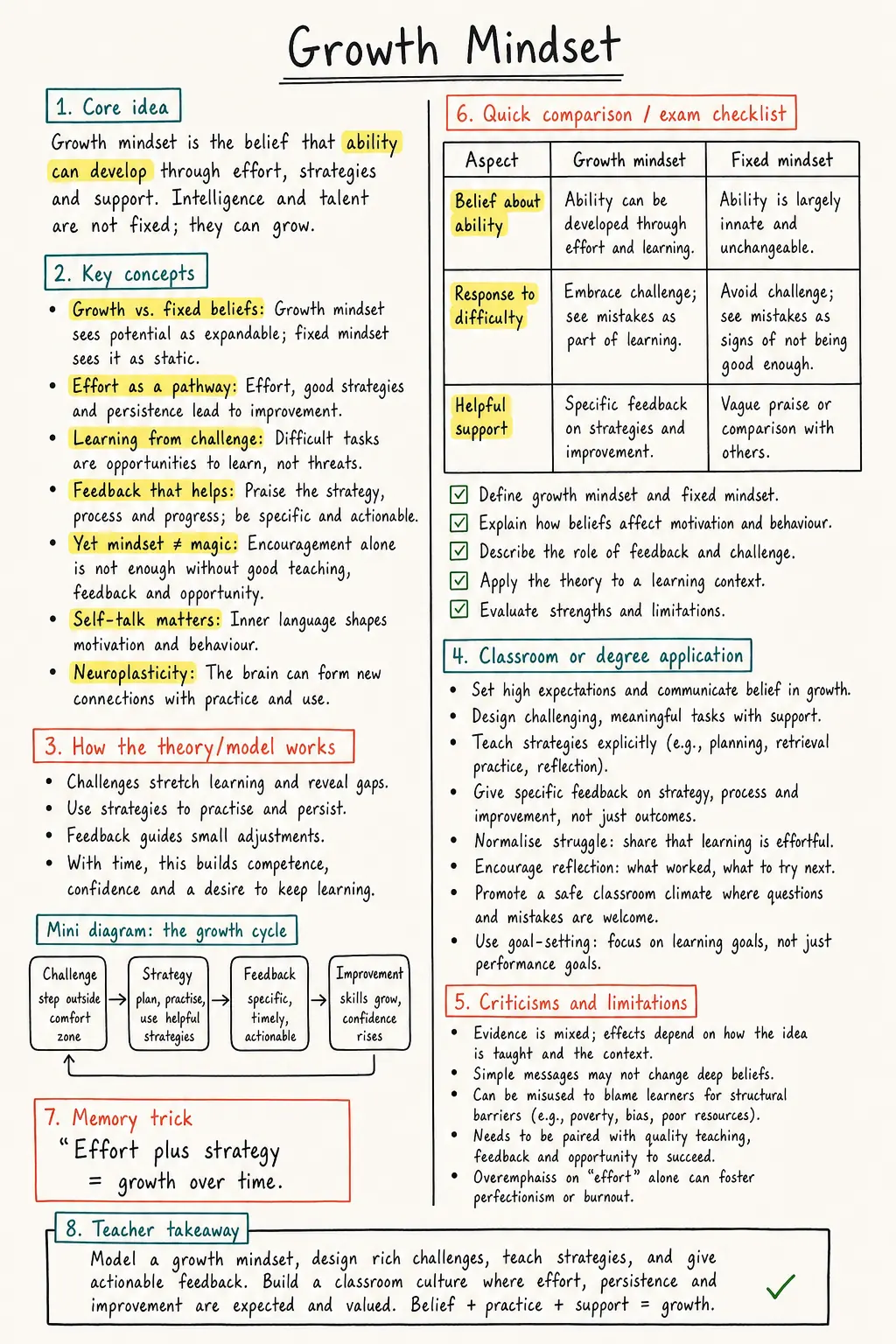
Download a one-page study note for Growth Mindset, with the key ideas, limitations and classroom links in one place.
Mindset plus feedback. The quality of feedback matters enormously. Feedback that is specific, actionable, and focused on the process of learning (not just the outcome) supports both growth mindset and actual improvement. Telling a learner "try harder" is not feedback. Telling them "your argument would be stronger if you added a counter-example in paragraph two" gives them something to act on.
Mindset plus safe culture. Learners will not take risks, make mistakes, or persist through difficulty if the classroom culture punishes failure. Schools that genuinely support growth mindset create environments where errors are treated as data, not as deficiencies. This requires changes to marking practices, classroom talk, and the way adults respond to wrong answers.
If your school has invested in growth mindset programmes, you have not wasted your time entirely. The underlying principle that learners' beliefs about their own capacity matter is well-established. What the evidence challenges is the idea that changing those beliefs through posters, assemblies, and standalone interventions will improve academic outcomes.
Consider these practical steps:
A related challenge for schools is the overjustification effect, first described by Lepper, Greene, and Nisbett (1973). When learners receive external rewards for activities they already find intrinsically motivating, their internal motivation can decrease. This is directly relevant to growth mindset implementation. Many schools pair mindset messaging with reward systems such as stickers, certificates and house points for demonstrating effort.
The research suggests this combination can be counterproductive. Learners may begin to associate effort with the reward rather than with the intrinsic satisfaction of learning and improving. When the rewards are removed, effort decreases. Deci and Ryan's (1985) self-determination theory provides a stronger framework. Learners feel most motivated when they have choice in their learning. They also need to see real improvement and feel connected to teachers and peers who value learning.
Schools would benefit from examining whether their growth mindset programmes inadvertently rely on extrinsic motivation systems that contradict the underlying message. If effort helps growth, using sticker charts to encourage effort goes against this idea. The reward system can weaken the main psychological principle.
One area where growth mindset messaging requires particular care is in relation to learners with special educational needs and disabilities (SEND). The broad claim that anyone can achieve anything through effort can feel dismissive. This especially affects learners whose difficulties are neurological, developmental, or cognitive. A learner with dyslexia may interpret growth mindset messaging as suggesting their reading difficulties are caused by lack of effort. In reality, these difficulties come from a genuine processing difference.
Effective practice for SEND learners involves acknowledging both the reality of their specific challenges and the genuine capacity for growth within those parameters. Teachers need to be precise about what growth looks like for individual learners. They should avoid using universal growth mindset language that may accidentally blame learners for difficulties beyond their control. The combination of growth mindset with realistic, differentiated expectations and targeted support is more constructive than mindset messaging alone.
One of the most common misunderstandings of Dweck's work is the treatment of mindset as a binary: you either have a growth mindset or a fixed mindset. Dweck has clarified that mindset exists on a continuum and varies across domains. A learner might hold a growth mindset about their ability in art but a fixed mindset about mathematics. A teacher might believe intelligence is malleable in general but hold fixed beliefs about certain learners' capacity for improvement.
This domain specificity has important implications for classroom practice. Rather than delivering generic growth mindset messaging, teachers should identify specific areas where fixed mindset beliefs are most limiting. They can then address those areas directly. A Year 9 student who says 'I am not a maths person' needs domain-specific reattribution. This means showing them that mathematical thinking develops with practice and specific strategies, rather than just a poster about the power of yet.
The evidence from cognitive science supports this targeted approach. Cognitive load theory demonstrates that effective learning requires appropriate challenge at the boundary of current understanding. When tasks are set at the right level, learners see real progress from their effort. Then, growth mindset forms naturally, without needing direct teaching.
Free for teachers. The platform builds a classroom-ready lesson plan from your topic in under two minutes.

Growth Mindset: what the research actually shows — the evidence, the critiques, the classroom implications.
Growth mindset is not irrelevant, but it is not the significant intervention many schools believed it to be. The evidence shows that mindset beliefs alone do not improve achievement. What matters is combining growth-oriented beliefs with specific learning strategies, genuine challenge, and supportive school culture. Mindset is one ingredient, not the whole recipe.
Focus on evidence-based strategies with stronger effect sizes. The EEF's Teaching and Learning Toolkit identifies metacognition and self-regulation (+7 months), feedback (+6 months), and collaborative learning (+5 months) as high-impact approaches. These give learners the tools to improve, rather than just the belief that improvement is possible.
Dweck's original findings about the correlation between mindset and achievement have been broadly supported. What has not been supported is the assumption that teaching mindset through interventions causes improved achievement. Li and Bates (2019), Sisk et al. (2018), and the EEF trial all found that changing beliefs did not change outcomes. Dweck herself acknowledges that schools have oversimplified her work.
Growth mindset is intuitively appealing, easy to explain to parents, and aligns with teachers' genuine desire to help every learner succeed. Commercial programmes and CPD providers have marketed mindset interventions aggressively. The theory also arrived during a period when schools were seeking non-academic approaches to improvement. These factors created a perfect storm of adoption that outpaced the evidence.
An effective growth mindset is part of the school's culture. It uses specific learning strategies and challenging content. Quality feedback also strengthens it. Growth mindset approaches that don't work have several features (Yeager et al., 2019). They are delivered as standalone interventions and focus only on posters and language. They praise effort without strategy and operate in schools where structural conditions for persistence are missing.
Scaffolded. Self-regulated. Free for teachers.
Open a free account and help organise learners' thinking with evidence-based graphic organisers. Reduce cognitive load and guide schema building dynamically.
These peer-reviewed sources underpin the evidence base for this article. Consensus.app links aggregate the paper with its journal DOI.
A National Experiment Reveals Where a Growth Mindset Improves Achievement View study ↗
1002 citations
Yeager et al. (2019), Nature
The most cited (1,002 citations) and most-discussed growth mindset study, published in Nature. Pre-registered, nationally representative US sample. Found a short (under one hour) online intervention improved grades for lower-achieving students and increased advanced maths enrolme
To What Extent and Under Which Circumstances Are Growth Mind-Sets Important to Academic Achievement? Two Meta-Analyses View study ↗
729 citations
Sisk et al. (2018), Psychological Science
Two meta-analyses (273 studies, 365,915 students for the correlation analysis; 43 studies, 57,155 students for the intervention analysis). Found weak overall effects but specific benefit for low-SES students and academically at-risk students. Established the moderator pattern tha
What Can Be Learned from Growth Mindset Controversies? View study ↗
483 citations
S. Dweck (2020), American Psychologist
Yeager and Dweck's response to the controversies. Concedes that mindset effects are heterogeneous across individuals and contexts and describes three field advances: standardised measures and interventions, deliberate studies of where interventions fail, and a conceptual framewor
A Systematic Review and Meta-Analysis of Growth Mindset Interventions: For Whom, How, and Why Might Such Interventions Work? View study ↗
215 citations
Burnette et al. (2022), Psychological Bulletin
Most rigorous moderator-focused meta-analysis to date. With high-fidelity implementation and targeted subsamples, academic achievement effect was d = 0.14 and mental health was d = 0.32. The 95% prediction intervals are wide (-0.08 to 0.35 for academic achievement) which means sc
Do Growth Mindset Interventions Impact Students' Academic Achievement? A Systematic Review and Meta-Analysis with Recommendations for effective methods View study ↗
170 citations
Macnamara and Burgoyne (2022), Psychological Bulletin
The most-cited critical meta-analysis (63 studies, 97,672 students). Found a small overall effect (d = 0.05) that became non-significant after correcting for publication bias, with significantly larger effects in studies by financially incentivised authors. The highest-quality 6