Updated on
October 8, 2026
Retrieval Practice: 26 Strategies for Stronger Recall
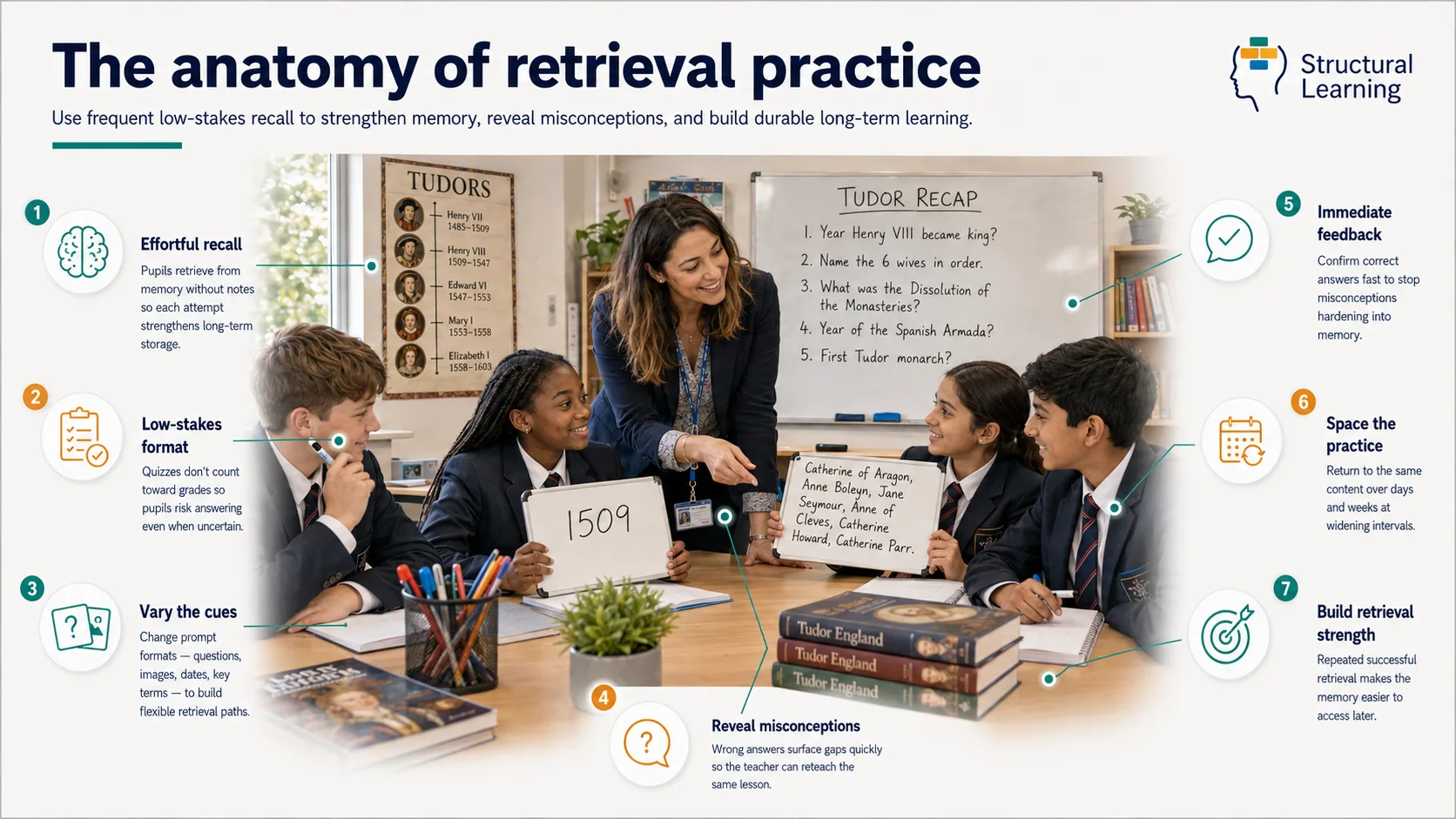
Retrieval practice strengthens recall by bringing knowledge to mind. Use brain dumps, low-stakes quizzes, flashcards and feedback across everyday lessons.

Updated on
October 8, 2026
Retrieval practice strengthens recall by bringing knowledge to mind. Use brain dumps, low-stakes quizzes, flashcards and feedback across everyday lessons.
Retrieval practice is the process of bringing information to mind so learners strengthen what they know and remember it for longer. Instead of just rereading notes, learners actively recall key ideas through quick quizzes, low-stakes questions, flashcards or discussion. When used well, it helps teachers check understanding, uncover gaps and make learning stick without overcomplicating lessons. Read on to see how retrieval practice can become a simple, powerful part of everyday teaching.
For a broader view of how this fits alongside other classroom methods, see our guide to effective pedagogy.
Retrieval practice means actively recalling past facts from memory. This builds understanding and improves long-term memory. Frequent recall helps learners remember more details. Roediger and Karpicke (2006) found that taking memory tests improved long-term retention compared with additional study.
For a practical overview of how these ideas apply in lessons, see our guide to working memory in the classroom.
 structural-learning.com
Roediger and Karpicke (2006) showed learners recall more with retrieval practice. They found testing helps learners store knowledge longer than rereading. Active recall by learners creates the testing effect. This recall differs from the first learning (Ebbinghaus).
Karpicke and Blunt (2011) found learners remember more through recall than concept mapping. Roediger and Butler (2011) showed recall improves memory for future learning. This helps learners easily retain information.
Karpicke and Blunt (2011) show teachers use quizzes for retrieval practice. Learners actively search memory, not just read. This builds retrieval strategies, say Roediger and Butler (2011). Bjork (1975) argued that retrieval can modify later memory.
Frequent, small tests boost learner confidence and attainment. Learners track their progress; this builds self-belief. Even test-resistant learners may warm to tests (Willingham, 2009). They may notice better long-term memory.
| Technique | Description | Implementation | Benefits |
|---|---|---|---|
| Low-Stakes Quizzing | Frequent tests without grades | Daily or weekly quizzes | Reduces test anxiety |
| Brain Dumps | Write everything remembered | Start of lesson, blank paper | Identifies gaps |
| Flashcards | Question and answer cards | Self-study or paired work | Portable, flexible |
| Retrieval Grids | Matrix of topics and questions | Structured recall activity | Covers multiple topics |
| Think-Pair-Share | Individual recall then discuss | After teacher question | Social reinforcement |
Teachers change lessons for learners' needs. Existing knowledge and subject difficulty shape retrieval (Bjork, 1992). Space out practise and increase challenge. Kornell and Bjork (2008) found that interleaved examples can improve inductive learning and discrimination of categories.
Pretesting learners primes the brain for learning (Roediger & Karpicke, 2006). Learners attempt questions before lessons, activating prior knowledge. This highlights understanding gaps and focuses attention (Smith & Karpicke, 2014; Richland et al., 2009).
Retrieval in lessons involves short, low-stakes activities that strengthen memory, reveal gaps, and build learner confidence. These low-stakes tasks strengthen memory and find learning gaps. They also build learner confidence. Learners can explain ideas in pairs to boost memory (Roediger and Butler, 2011). Regular, low-stakes tasks build confidence and knowledge (Agarwal et al., 2012).
Retrieval practice varies across year groups. Learners recall initial learning mentally or on paper. Complex materials are not required (Karpicke & Blunt, 2011). Teachers can easily use retrieval practice in class (Brown, Roediger & McDaniel, 2014).
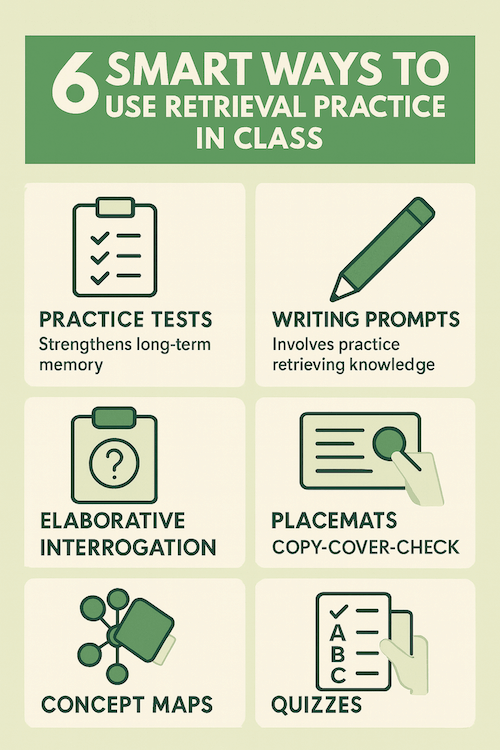
Teachers can use practise tests with learners in science classes. Learners write their own questions or use textbook examples. They can share these with partners or find questions online. Teachers can ask learners to write short answers, then answer multiple-choice questions (Agarwal et al., 2012).
2. Flashcards, For students in primary grade levels, teachers can ask students to write questions on one side of the index card and answers on the other side of the card. Students can also use flashcard software systems or create flashcards on a computer and print them out.
Learners recall facts using flashcards, testing themselves (Karpicke & Blunt, 2011). This active recall enhances retention, supporting subject learning (Dunlosky et al., 2013). Use flashcards for quick, targeted knowledge checks (Toppino & Cohen, 2009).
3. Writing prompts - The writing prompts technique is very effective for encouraging students to think about a specific subject and to show what they know. For example, the teacher can write an incomplete sentence on a card and ask the students to complete the sentence e.g. “A plant needs sunlight to ________".
Writing prompts present a question or a statement to the student that they have to answer, employing their knowledge of a given subject. Writing prompts can be used to gauge how well the student understands the material, and help them prepare for upcoming exams.
4. Concept maps: Karpicke Et Al. (2014) explained that c reating concept maps, is like writing prompts; but, students create a keyword map of related words instead of writing complete details of retrieval tasks. Students will create concept maps by writing the title at the top of the page and drawing a large circle. Then, they will add circles with keywords about the topic. For different grade levels, the concept maps would indicate what the students don’t know while showing what they already possess in their long term memory.
Concept maps improve learner progress. Learners link ideas, boosting subject knowledge (Novak & Cañas, 2006). Creating maps helps learners think critically and form hypotheses. (O'Donnell, Dansereau, & Hall, 2002) showed they build connections.
Elaborative interrogation uses detailed questioning for retrieval practice. Learners work in pairs to ask and answer questions on a topic. This encourages deeper thought and memory recall. No writing is needed, but learners may note answers (Roediger & Karpicke, 2006).
Below are some examples:
6. Quizzes: For different grade levels, quizzes are the key ingredient that can be performed in several different ways. These can be performed individually or in groups, pairs, or as a class. Teachers can give colour cards or clickers to the students for answering or they can make the different teams in the class. While considering the level of difficulty, teachers can also use different apps and websites to ask multiple-choice questions or to conduct multiple-choice tests.
Quizzes reinforce knowledge, a key part of retrieval practice. They also track learner understanding of concepts. Teachers gain valuable feedback on learning and areas needing work. Retrieval practice benefits learners, quizzes help teachers ensure effective learning.
Confident errors are easier to correct than unsure ones (Butterfield & Metcalfe, 2001). This hypercorrection effect means surprise improves learning. (Metcalfe, 2017). Teachers should ask learners to commit to answers before giving feedback (Kulhavy, 1977).
Placemats are easy to create and worksheets assess what learners know. Like other methods, placemats work best with varied resources. Placemats help younger learners, but boredom remains a risk. Use placemats purposefully for complex tasks.
Copy-cover-check helps learners remember. Teachers cover slides, learners recall text, then check their answers (Agarwal et al., 2021). This quick method assesses learning easily in the classroom, according to Karpicke and Blunt (2011).
Recall activities across the curriculum are classroom tasks that prompt learners to retrieve knowledge in different subjects and apply it flexibly. Roediger & Butler (2011) showed science learners diagram processes and explain events. Brown, Roediger, and McDaniel (2014) found English learners summarise texts, recalling literary devices. Agarwal and Bain (2019) noted history teachers use timelines and explain cause and effect.
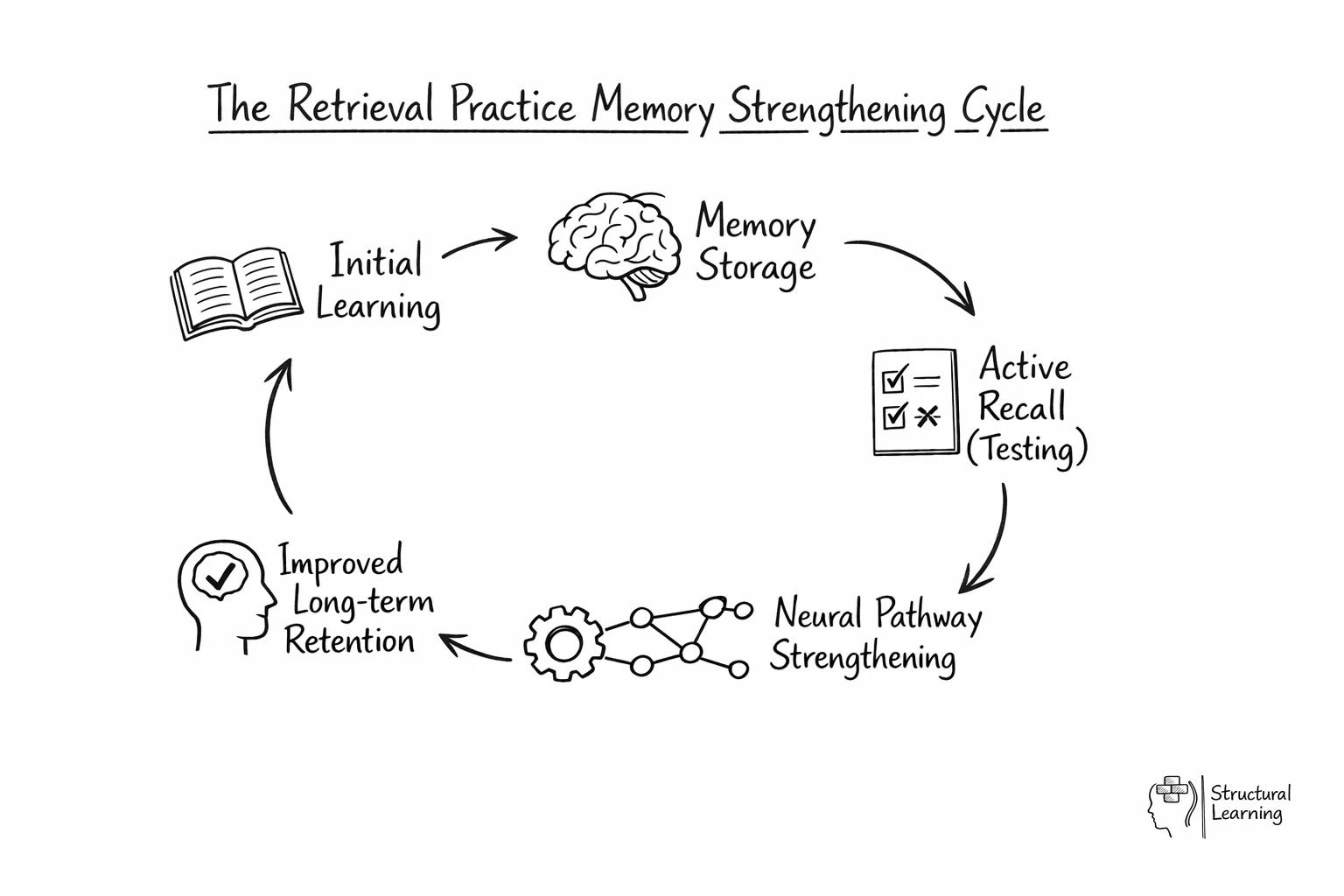
Test-enhanced learning boosts education (Brown et al., 2014). Researchers list seven ways to integrate subjects. These methods help learners succeed and avoid extra teacher work.
Researchers (e.g., Karpicke & Roediger, 2008; Agarwal et al., 2012) show retrieval boosts long-term memory. It makes the learner think harder (Bjork, 1994). This method improves learning in all subjects (Brown et al., 2014).
Key Insights:
Memorable teaching and evidence based education offer useful insights.
Brown et al. (2014) show low-stakes tests build learner confidence by showing progress. Roediger & Butler (2011) suggest active recall tasks over simple recognition. Learners improve comprehension when they apply knowledge to new situations (Bjork & Bjork, 2011). Karpicke (2012) reviewed evidence that active retrieval promotes meaningful learning.
Use exam questions so learners practise retrieval. This helps them remember for tests. Karpicke and Blunt (2011), Roediger and Butler (2011), and Rowland (2014) show retrieval practice helps memory.
Cued recall tests help learners with tough topics; teachers use cue cards (Karpicke & Blunt, 2011). Learners check notes and books after retrieval to confirm accuracy (Agarwal et al., 2012). Cue cards fix errors and provide feedback on knowledge gaps (Brown et al., 2014).
Retrieval practice aids learning with other strategies. Karpicke and Roediger (2008) found revision improves memory. Testing assists learners, and revision helps memory recall. Bjork (1975) showed these methods create new memory links.
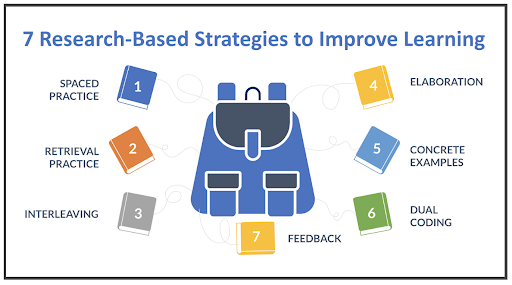
Spacing is the planned revisiting of learning over time to strengthen memory retention and reduce forgetting. Spaced retrieval helps learners retain information long term. It beats cramming, says research (no date given).
Spaced retrieval helps learners by reviewing topics with time gaps. Cognitive Science research shows this retrieval-based learning works well. The spacing effect improves long-term learning (Cepeda et al., 2008). This method divides learning into manageable sessions.
The space must be of longer duration rather than very short breaks. This strategy works better than rote learning because students get the time to forget the details before striving to access them. The best way to use spaced retrieval practice in classroom settings is to not quiz the students for some time after studying the information. Afterwards, students can be engaged in retrieval-based learning activities or they will be asked short-answer questions using flashcards or other learning techniques for practising spacing and retrieval.
Bjork and Bjork (2011) showed "desirable difficulties" help learners remember more. Retrieval practice may feel hard, but it aids learners. Spacing and interleaving stretch memory (Bjork & Bjork, 2011). Clear instructions improve learning; confusing instructions hinder it. Low stakes quizzes give helpful desirable difficulty. Our guide explains spacing strategies.
Spaced retrieval helps learners remember things for longer. Regular study with breaks improves learner retention (Rohrer & Pashler, 2007). Short study and random topic revision helps recall (Kornell & Bjork, 2008).
Karpicke (2012) showed games aid learner recall. Learners enjoy revising content through games. Butler (2010) found games help compare knowledge.
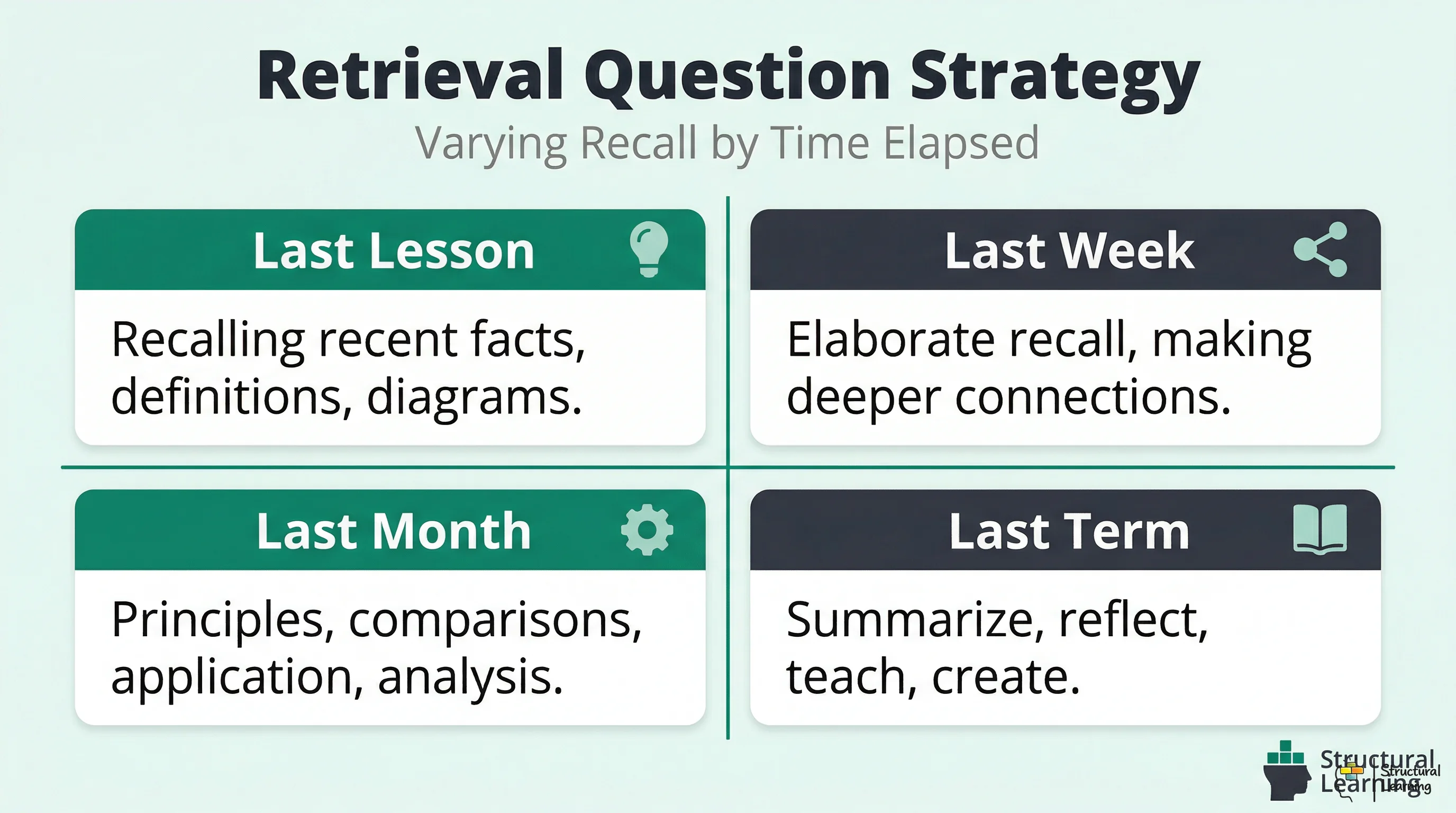
Interleaving with recall is the deliberate mixing of topics or question types to strengthen strategy selection and understanding. Learners choose strategies, which improves their understanding. Brown et al. (2014) suggest teachers interleave by mixing questions or skills.
Interleaving means learners switch between topics, not just focus on one. Instead of four hours of Biology, learners could study Chemistry, Biology, History, and Mathematics for one hour each. (Rohrer, 2012)
Learners use flashcards, create mind maps, or self-quiz for long-term learning. This supports effective retrieval practice in classrooms (Brown et al., 2014; Roediger & Karpicke, 2006; Weinstein et al., 2018).
Spacing and interleaving boost learners' lasting memory of key facts, research shows. (Kang, 2016; Rohrer, 2012) Use these techniques to help learners retain information longer. Practise makes perfect (Willingham, 2009).
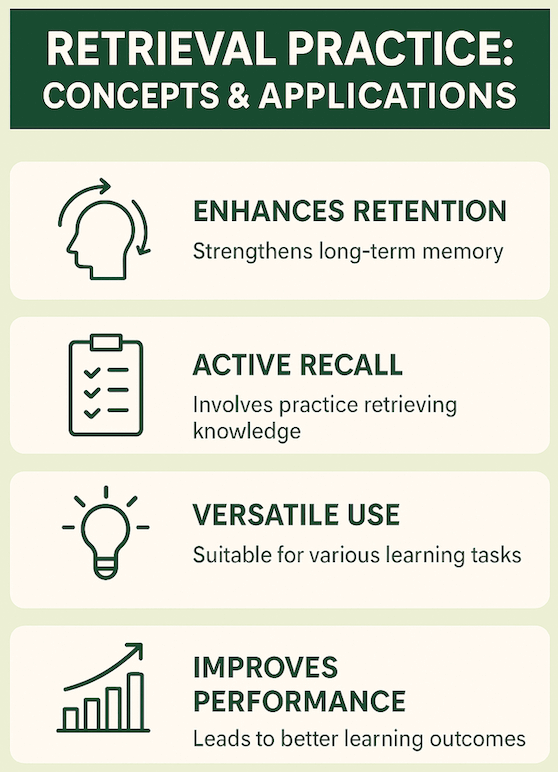
Interleaving, spacing, and retrieval improve learner learning. Using them together makes each strategy more effective. Research shows this helps learners keep knowledge (Rohrer, 2009; Dunlosky et al., 2013; Weinstein et al., 2018).
Kornell and Bjork (2008) found that interleaved/spaced examples improved inductive learning of categories, not recall across subjects. Rohrer (2012) reviewed evidence that interleaving related topics can improve retention and help learners distinguish similar concepts. Yan et al. (2016) noted this helps learners tell concepts apart.
The benefits of recall for students are stronger memory, greater confidence, deeper understanding, and more accurate knowledge of their learning. Learners understand topics better with regular quizzes. When learners see retention gains, they accept testing. This work develops thinking skills and useful knowledge (Roediger & Karpicke, 2006).
Flavell (1979) described what learners know about their own thinking. Zimmerman's (2002) model helps learners control their learning. This directly benefits each learner in your classroom now.
Roediger and Butler (2011) proved retrieval practice helps learners. This strategy aids information recall for learners. Research by Roediger and Butler (2011) lists nine benefits.
Retrieval research shows that active recall improves long-term retention across ages and subjects more than re-reading or concept mapping. Studies show it improves long-term retention over re-reading. This works across ages and subjects, say researchers (Roediger & Butler, 2011; Brown, Roediger & McDaniel, 2014).
Retrieval practice improves long-term memory (Bjork, 1994). Research by Karpicke and Roediger (2008) shows it helps learners in many subjects. Using memory techniques, like those suggested by Brown, Roediger and McDaniel (2014), boosts learning.
1. Repeated retrieval during learning is the key to long-term retention (Jeffrey D. Karpicke & H. Roediger, 2007)
Karpicke and Roediger (2008) showed retrieval practice improves learner memory, more than re-reading. Rowland (2014) found that retrieval strengthens learners' memories. Agarwal et al. (2012) found that retrieval practice improved classroom learning in applied research.
Retrieval practice works better than regular studying. Roediger & Karpicke (2006) found testing memory improves learner retention. Bjork (1994) and Karpicke (2012) showed recall tests change how learners remember things.
2. The critical role of retrieval practice in long-term retention (H. Roediger & A. C. Butler, 2011)
Karpicke and Roediger (2008) showed retrieval practice helps learners remember better than re-reading. Feedback increases how well retrieval practice works. Agarwal and Roediger (2018) suggest teachers use it.
Questions aid memory; this is retrieval practice. Research proves it improves learner knowledge. See our article on Rosenshine's principles for practical teaching tips.
Roediger and Karpicke (2006) showed testing helps learners remember information later on. Their research indicates that tests improve how well learners retain information long term. Practise tests help learners recall facts better.
Retrieval practice improves learner memory more than extra studying. Longer gaps between learning and testing benefit learners most (Roediger & Karpicke, 2006). This supports using the testing effect in classrooms (Agarwal et al., 2012; Dunlosky et al., 2013).
4. Retrieval practice enhances new learning: the forwards effect of testing (Bernhard Pastötter & K. Bäuml, 2014)
Research (Karpicke & Blunt, 2011) shows retrieval practice helps learners remember. It also helps learners grasp new knowledge. This "forwards effect" (Kang et al., 2007; Pastötter et al., 2011) makes retrieval practice useful.
Retrieval practice helps learners retain and learn new information. It is useful for adaptive teaching and effective learning (Karpicke & Blunt, 2011). Research by Roediger & Butler (2011) shows its advantages.
5. Putting Action into Testing: Enacted Retrieval Benefits Long-Term Retention more than Covert Retrieval (Veit Kubik, Fredrik U. Jönsson, M. De Jonge, & A. Arshamian, 2020)
Actions help learners remember more than just thinking. (Engelkamp & Zimmer, 1994; Nilsson, 2000) Studies show different memory processes help learners. (Decoene & Verfaillie, 1999; Zimmer et al., 2000) This affects how well learners remember things later.
This aids enriched learning, especially for learners who learn through movement.
The testing effect is the improvement in memory that follows active recall rather than further study. Retrieval practice helps learners retain information longer (Agarwal et al., 2012; Karpicke, 2012).
Roediger and Karpicke (2006) found learners recalling information via three tests remembered 61% after a week. Learners reading the passage four times, but taking no tests, only retained 40%. This finding challenges education’s focus on repeated reading (Roediger & Karpicke, 2006).
Retrieval helps learners reconstruct knowledge, not just access it. This strengthens memory (Bjork, 1975). Multiple retrieval routes emerge. Failed retrieval followed by feedback creates lasting learning (Kornell et al., 2009; Roediger & Butler, 2011). The effort to search memory helps.
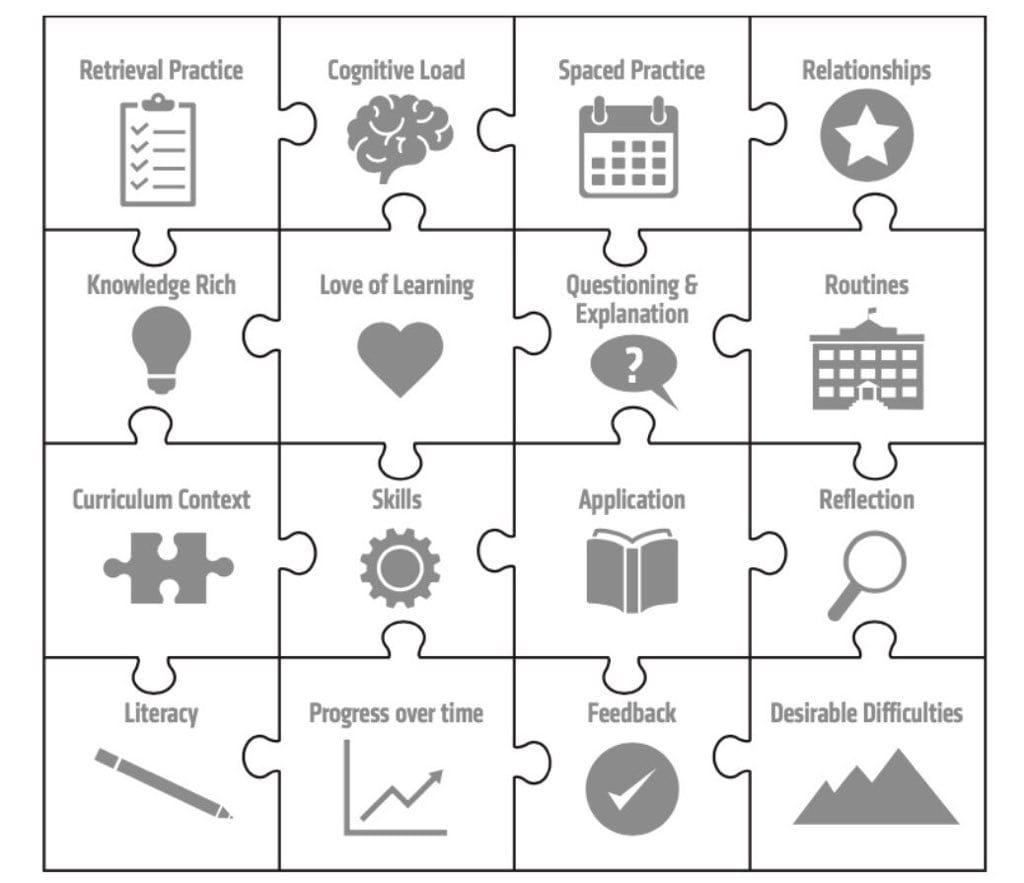
Retrieval practice helps learners focus and participate (Agarwal et al., 2012). Learners show deeper understanding teaching each other (King, 2007). The testing effect works across subjects for facts, skills and concepts (Roediger & Butler, 2011).
Re-reading notes gives learners a false sense of knowing the content (Bjork, 1999). Retrieval practice exposes gaps in knowledge and tackles this illusion. Correction of confident wrong answers strengthens memory more than uncertain ones (Butterfield and Metcalfe, 2001). Use retrieval to fix common errors. Ask learners to rate confidence before checking. Our guide helps develop helpful metacognitive strategies.
Testing helps learners fix information in memory. Retrieval shows the brain what matters (Bjork, 1992). This prompts changes that protect those memories. Spaced retrieval strengthens memories through reconsolidation. Learners retain more with spaced practice, not cramming (Karpicke & Roediger, 2008).
Nader, Schafe & Le Doux (2000) showed recall makes memory briefly unstable. The brain rebuilds memory; we can then strengthen or alter it. Retrieval practice helps learners recall information faster. Effortful recall, not rereading, helps learners build stronger memories.
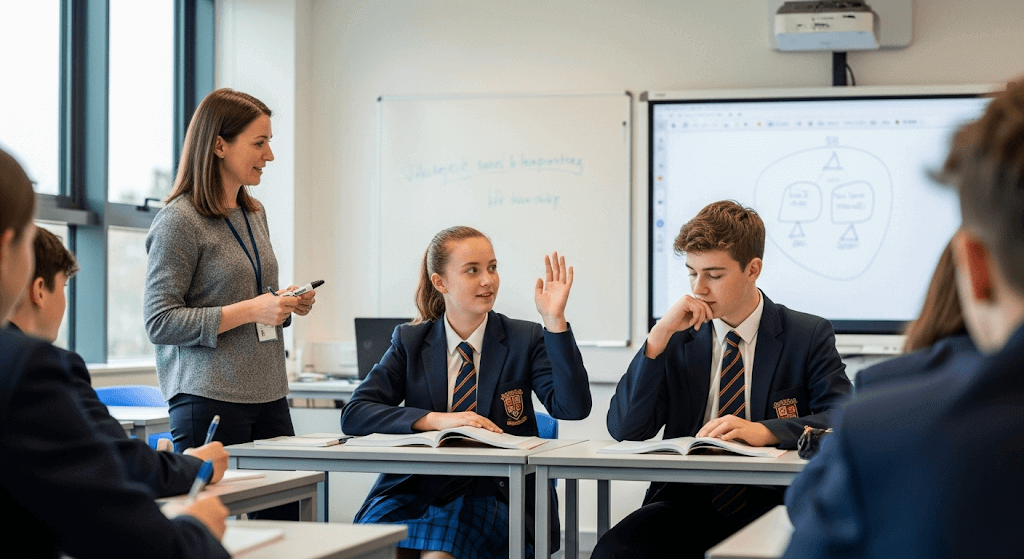
Classroom routines that build recall are regular retrieval activities that strengthen long-term memory across subjects and year groups. Use these techniques across all subjects and year groups. Testing helps learners retain knowledge long term (Roediger & Butler, 2011). Brown, Roediger, and McDaniel (2014) offer useful strategies.
Jones (Year 7 geography) starts lessons with a retrieval wheel. Learners answer six questions (past month's content) for five minutes, without notes. Pairs then discuss answers before Jones shares the correct ones. This helps learners remember previous topics and feel confident (Jones, n.d.).
Misusing retrieval practice means reducing recall to routine quizzes on disconnected facts. If every lesson starts with the same five questions because policy says so, retrieval has slid into tick-box pedagogy. Recent EEF guidance warns that this approach can miss the point, especially when questions stay at factual recall simply because they are easier to write (Coe, 2019; Cattrall, 2024).
The stronger alternative is schema building. Retrieval should help learners reconnect prior knowledge, compare examples and explain relationships so that recall supports meaning-making rather than becoming a disconnected pub quiz. This kind of relational recall supports cognitive integration, and retrieval can improve how knowledge is organised as well as how easily it is accessed later (Roediger et al., 2011; EEF, 2021).
In a Year 8 history lesson, a teacher might say, "Write two terms of the Treaty of Versailles, then draw arrows to show how each one fed later political extremism." Learners first retrieve dates and key terms, then produce an annotated diagram linking "economic hardship", "resentment" and "political instability"; one learner writes, "I remembered the facts first, but the arrows helped me see why they mattered." Here, recall is doing real curriculum work because facts are being organised into a usable model.
This is where recent UK commentary is useful. EEF has argued that retrieval should not become a single, separate activity and should be adapted intelligently to subject content (Cattrall, 2024), while Ofsted has warned that superficially broad curricula can lack depth (Ofsted, 2024). A practical rule for teachers is simple: if the task only checks what learners can name, it may rehearse memory; if it helps them connect, classify, explain or predict, it is much closer to the real purpose of retrieval.
You can use AI tools to automate retrieval practice. Generative AI drafts recall resources from your current teaching materials. It works best as a first-draft tool. You can use it for flashcards, hinge questions, and exit tickets. You can also build automated quizzes. This matches current DfE guidance. The guidance states that AI can help create teaching resources. It can also help with revision tasks and admin. However, teachers must always check the accuracy of the output.
The practical gain is reduced teacher workload, not a new teaching method. A simple prompt engineering routine might be to paste a Year 7 knowledge organiser into a school-approved tool and ask for ten short retrieval questions, three likely misconceptions and two stretch items at a specified reading level. You then tighten the wording, remove weak distractors and turn the set into a starter, homework quiz or quick check at the end of the lesson.
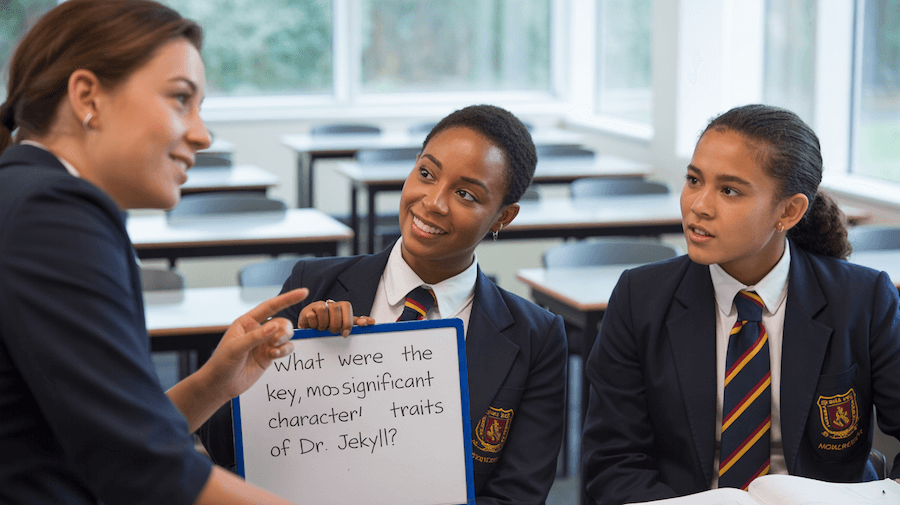
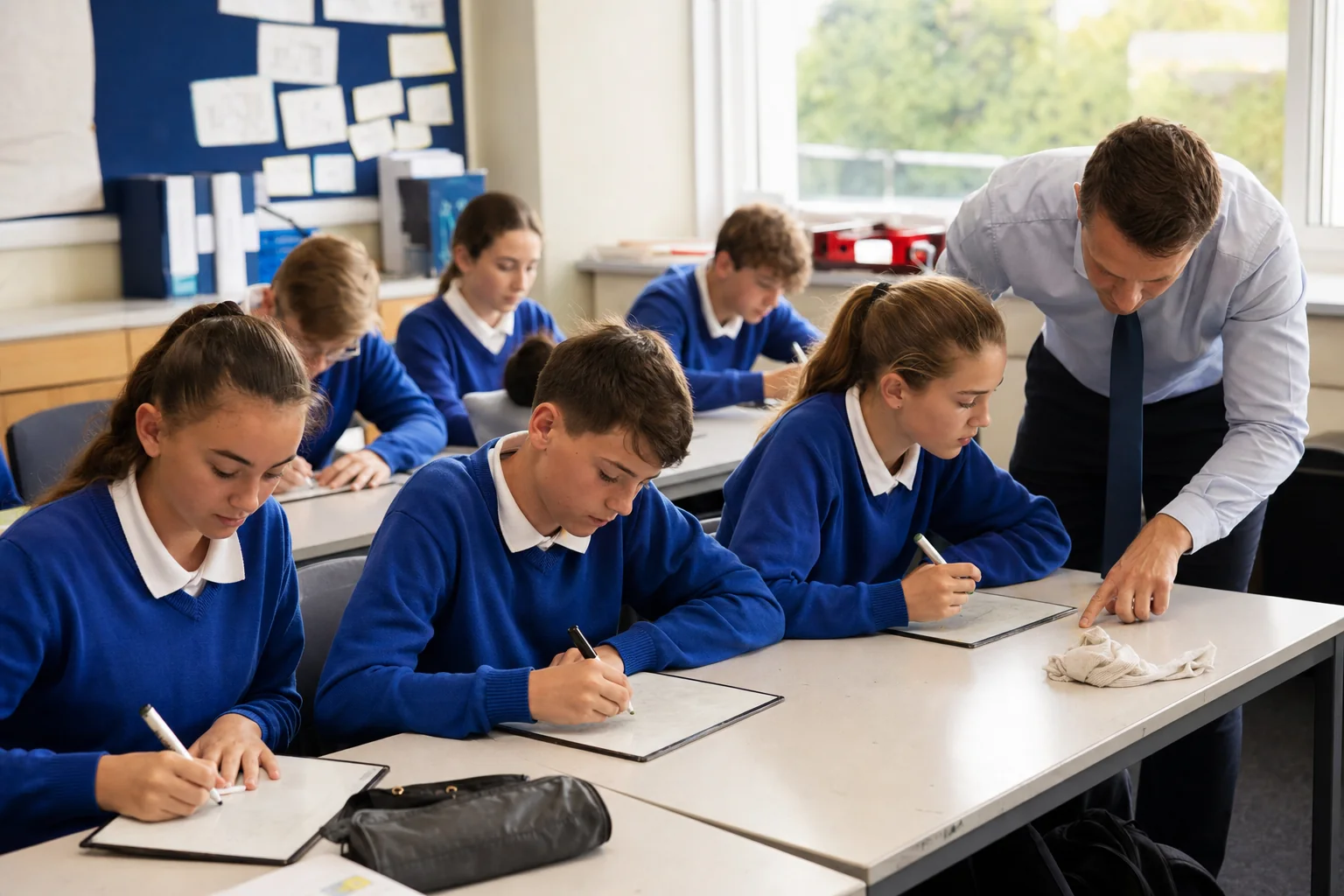
Adaptive algorithms in EdTech platforms add the next step by changing what learners see after each response. In a Year 8 science lesson, the teacher says, “Whiteboards out. Five questions from last fortnight’s work on cells.” Learners write answers such as “nucleus” and “membrane”, but several write “osmosis” when the correct answer is “diffusion”; the platform spots that pattern and reschedules those items through spaced repetition tools later in the week. That matters because retrieval practice improves long-term retention (Roediger and Karpicke, 2006), and adaptive spaced systems can improve learning efficiency by focusing repetition where it is needed most (Kerfoot, 2010).
The caution is straightforward. Generative AI can invent facts, miss curriculum nuance or produce poor distractors, so teachers should treat it as a drafting assistant rather than an answer key. If questions are anchored to subject content, checked carefully and used in low-stakes routines, AI and adaptive EdTech platforms can help schools run more frequent retrieval practice without adding another hour of planning.
Two ways to study the same facts. One feels easier, one sticks. Run the experiment on yourself and watch your own recall settle the argument. This is about how you study, not geography.
You will study two sets of four facts. You will re-read Set A and actively recall Set B. After a short pause, you will be tested on all eight. Takes about 90 seconds.
| Study method | Feels effective? | Long-term recall |
|---|---|---|
| Re-reading and highlighting | Yes, very | Weak |
| Retrieval practice (self-testing) | Often feels harder | Strong |
| Retrieval plus feedback | Harder still | Strongest |
A retrieval homework policy is a fair and research-informed approach to setting recall tasks across key stages and subjects. We will give you research-based ideas for fairness (Kraft et al., 2014; Reimers, 2021). These recommendations support every learner (Wiliam, 2011; Hattie, 2012).
Retrieval practice works best when learners rebuild links between ideas. Give learners concept maps with the topic filled, but connections blank. They retrieve concepts and their relationships for better memory (Karpicke and Blunt, 2011). The map's layout cues memory; each blank node prompts a specific memory search.
Map It offers blank and part-filled templates for this. Teachers can use retrieval practice with a skeleton organiser (Karpicke & Blunt, 2011). Learners complete it alone, then discuss as a class. This discussion corrects errors for lasting memory (Roediger & Butler, 2011). This quick routine replaces passive reading with active recall.
Novak and Gowin (1984) showed flowcharts suit timelines. Horton (1990) found tree diagrams work for classification. Use Venn diagrams or T charts to compare texts, said Robinson (1998). We sorted templates by content for learners.
These peer-reviewed studies provide the research foundation for the strategies discussed in this article.
The critical role of retrieval practice in long-term retention
1,525 citations
H. Roediger et al. (2011), Trends in Cognitive Sciences
Roediger and Karpicke's research demonstrates that retrieval practice significantly boosts long-term memory compared to repeated studying. This suggests teachers should incorporate regular retrieval activities into their lessons, as this approach promotes knowledge retention and transferability for students.
Test-potentiated learning: distinguishing between direct and indirect effects of tests
199 citations
Kathleen M. Arnold et al. (2013), Journal of Experimental Psychology: Learning, Memory, and Cognition
Arnold et al. (2013) found that even unsuccessful attempts at retrieval can improve learning from later restudy. This suggests that low-stakes quizzes, even when students struggle, can still be a valuable learning tool, not just a form of assessment.
Retrieval practice enhances new learning: the forward effect of testing
162 citations
Bernhard Pastötter et al. (2014), Frontiers in Psychology
Research shows that retrieval practice not only reinforces previously learned material, but also improves the learning of new information presented afterwards. This "forward testing effect" suggests that starting lessons with retrieval practice can enhance students' ability to grasp new concepts.
Retrieval Practice Consistently Benefits Student Learning: a Systematic Review of Applied Research in Schools and Classrooms
137 citations
P. Agarwal et al. (2019), Educational Psychology Review
Agarwal et al.'s systematic review found that retrieval practice consistently improves student learning across different ages, subjects, and testing formats. This research is valuable for teachers as it confirms the effectiveness of retrieval practice in real classroom settings.
The Value of Applied Research: Retrieval Practice Improves Classroom Learning
126 citations
P. Agarwal et al. (2012), Educational Psychology Review
Agarwal et al.'s large-scale classroom study found that retrieval practice, particularly delayed quizzes, significantly improves pupils' long-term retention and transfer of knowledge. These findings suggest that teachers can use regular, low-stakes quizzing to boost learning outcomes in their classrooms.
Real public posts on X, quoted word for word. We have not edited or endorsed them.
Themes are our labels.
| Theme | What teachers said | Who and when |
|---|---|---|
| A mandated starter that moves on | Example 2: Retrieval practice Purpose Intact: Students recall prior learning, and errors inform what the teacher revisits. Purpose Lost: A mandated daily starter where many students answer incorrectly and the lesson moves on anyway. | @XpatEducator3 October 2026Original post |
| An open book is not retrieval | @adamboxer1 I was told this term by my T&L lead, I SHOULD be getting all my pupils to use their knowledge organiser and book to write answer thier Do Now retrieval practice questions, as this is great teaching practice. Think our definition of a retrieval practice question were different. | @Sci_Hypothesis25 October 2025Original post |
| A retrieval starter makes the objective a spoiler | @DavidNautilus1 In the era of retrieval practice starters it seems obsolete as either part of routine or an easy opener. In RS/Philosophy I hate opening with the learning objective as it is essentially a spoiler and skews their perspective before we’ve started. Important they know by the end. | @nimblehippo3 September 2026Original post |
| More than a starter quiz | Retrieval practice is more than a starter quiz. Ask pupils to recall, explain, draw, perform, compare and apply from memory. Then give feedback. The aim is not to catch pupils out. It is to make knowledge easier to access when needed. 5/10 | @dnleslie13 August 2026Original post |
| Questions from earlier in the year | @mathsmuse That's what we do, except I set questions on a topic covered earlier in the year, rather than something current. Retrieval practice is useful, having a cover teacher badly explain a new idea isn't so much... | @MathsImpact6 February 2024Original post |
| Year 7s on mini whiteboards | @steven_kolber @drselenafisk @alfiejs Apps such as @Socrative @quizlet @quizizz are used by lots of secondary students - my Year 7s are very happy to engage in retrieval practice with a mini whiteboard, marker & eraser… #edureading | @talkinged1925 June 2023Original post |
| They still remembered it a year on | @SciInTheMaking The teacher who gets my students after me was telling me yesterday how well they are remembering what we did last year. I am sitting her knowing it has much to do with how much retrieval practice we did. | @rachelCA202029 August 2026Original post |
| Brick retrieval in history classes | @AmberBHaven @msrebeccabirch @NathanielRSwain Amber, what a great episode! I loved the brick retrieval practice! You showed aspects of it on Twitter last year and I loved it so much that I made it work for my history classes. It was one of my students favorite activities to study vocab! | @katie_a_baker21 July 2026Original post |
Retrieval practice helps learners remember facts, say Karpicke and Roediger (2008). They proved recall improves learner retention. Dunlosky et al. (2013) found remembering works better than re-reading.
Retrieval practice builds learning. Start with quick quizzes (Brown et al., 2014). Learners explain ideas without notes in pairs. Space out harder tasks later on (Roediger & Karpicke, 2006). Keep activities regular and relaxed to boost confidence (Agarwal & Bain, 2019).
Flashcards and sentence completion work well for younger learners. Older learners benefit from self-testing and concept mapping (Brown et al., 2014). Paired questioning also helps. Mixed-subject recall boosts learning for all ages.
Retrieval practice helps learners apply knowledge to new problems or explain concepts. This deeper processing builds understanding across subjects. The technique makes learners actively generate answers (Karpicke & Blunt, 2011). This promotes sophisticated thinking (Smith et al., 2016; Brown et al., 2014).
Low-stakes retrieval practice builds self-efficacy as learners see their progress. Those reluctant at first become more accepting with better memory (Roediger & Karpicke, 2006). Make it clear: these are learning tools, not grades. Learners will see improvements in confidence and work. (Brown, Roediger & McDaniel, 2014).
Retrieval practice helps learners beat peers using concept mapping. This technique uses testing effect and the Ebbinghaus curve. Learners retain information longer. Pretesting activates prior knowledge and shows gaps.
Adapt teaching for each learner's needs, building on their existing knowledge. For learners with less prior knowledge, begin with simple recall. Gradually increase challenge and space out tasks (Rohrer, 2015). Use varied methods, like visual aids, suggested Dunlosky et al (2013). Verbal activities also support learners (Pressley, 1994).