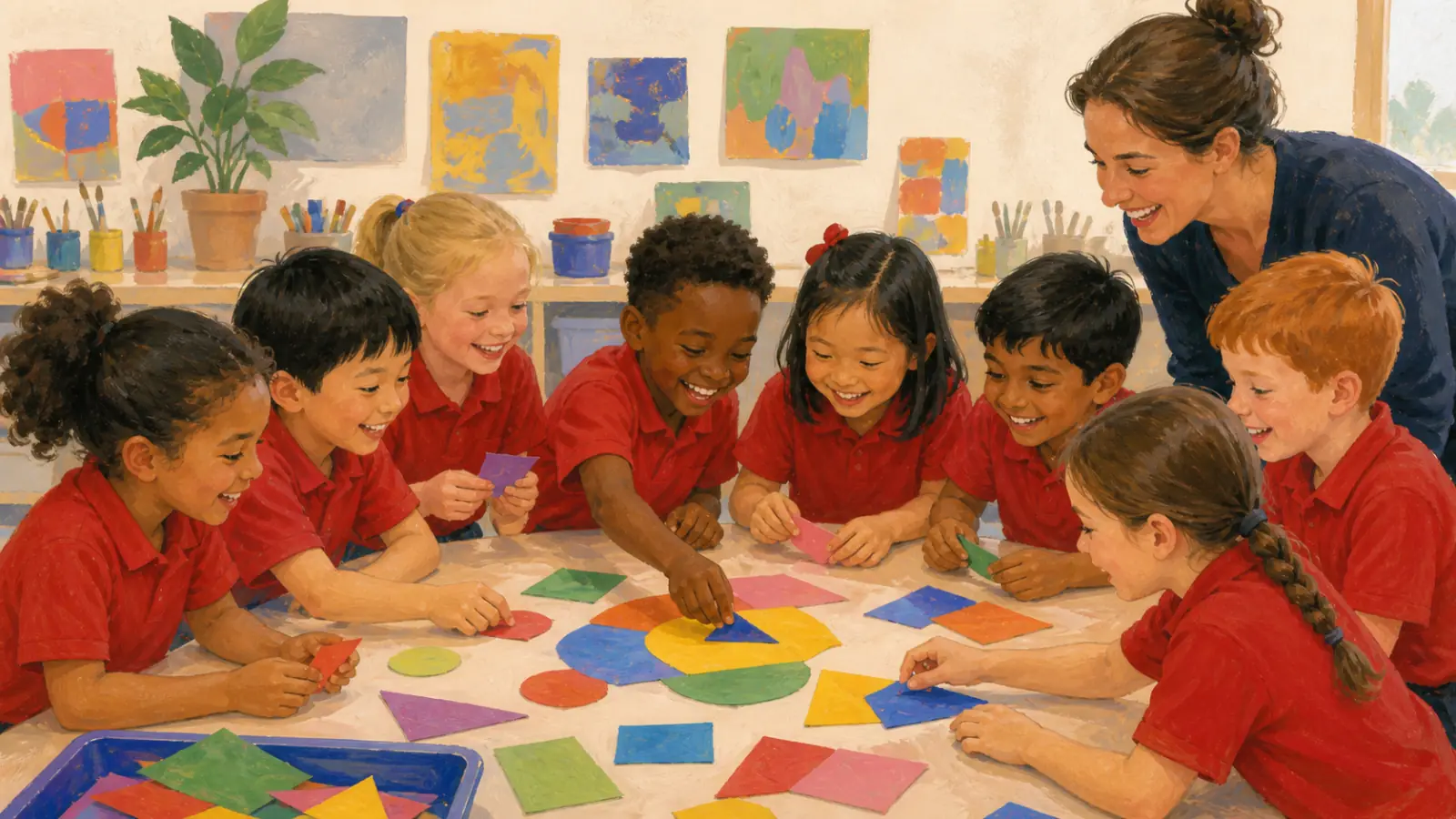
Implementing P4C in Your ClassroomEarly years students in navy blazers, aged 5-7, discuss ideas at classroom learning stations for Philosophy for Children (P4C) activity.

Updated on  

January 16, 2026

Implementing P4C in Your Classroom

|

September 27, 2024

Discover why Philosophy for Children (P4C) is key for fostering critical thinking in the classroom and how teachers can integrate it into daily lessons.

Course Enquiry
Copy citation

Main, P. (2024, September 27). Implementing P4C in Your Classroom. Retrieved from www.structural-learning.com/post/p4c

How Does Philosophy for Children Build Thinking Skills?

Philosophy for Children builds thinking skills through structured dialogue where students explore big questions together, learning to listen to different viewpoints and develop their own arguments. The method creates a community of enquiry in classrooms, helping students gain confidence in expressing their ideas while developing critical reasoning abilities. Research shows P4C students make two additional months' progress in reading and maths compared to their peers.

Philosophy for Children (P4C) transforms how students think, question, and communicate in the classroom. Since Matthew Lipman developed this teaching approach in the 1960s, thousands of teachers have used it to build students' reasoning skills and confidence in expressing their ideas.

Key Takeaways

  1. Two Months Ahead: Discover why P4C students gain two additional months in reading and maths, and how simple philosophical questions unlock this progress
  2. The Think-Commit-Justify Framework: Master the four-phase structure that transforms classroom discussions into powerful thinking communities where every voice matters
  3. Breaking the Silence: Learn why 93% of teachers report clearer communication from students, especially those with SEND and EAL needs
  4. Picture Books to Ethics: Navigate age-appropriate stimuli selection from Reception fairy tales to Year 6 ethical dilemmas using everyday classroom resources

P4C works by creating a community of enquiry in your classroom. Students explore big questions together, learn to listen to different viewpoints, and develop their own arguments through structured dialogue. The approach doesn't require a philosophy degree or specialist knowledge. You simply need the right stimulus, a good question, and a willingness to let students lead the discussion.
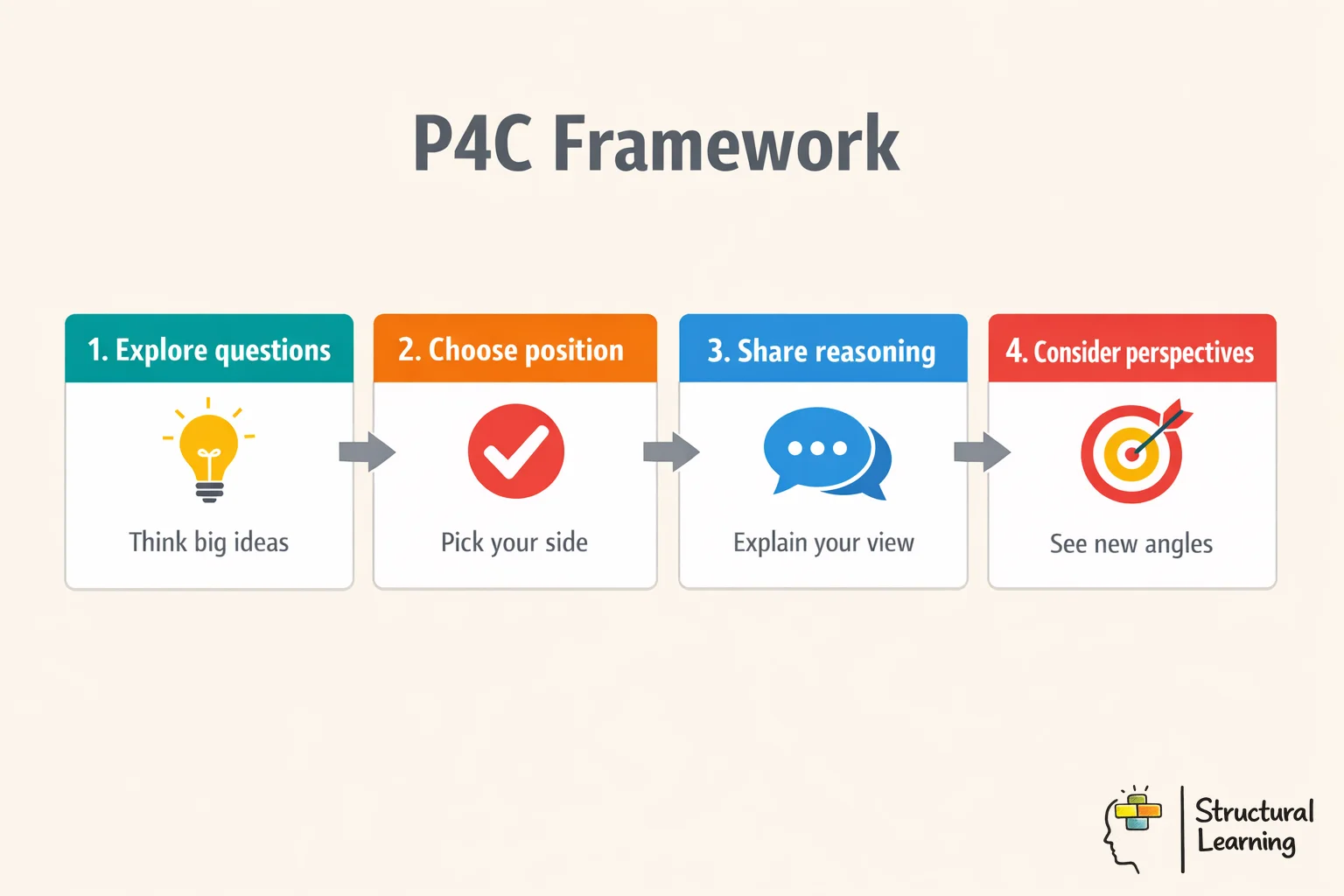
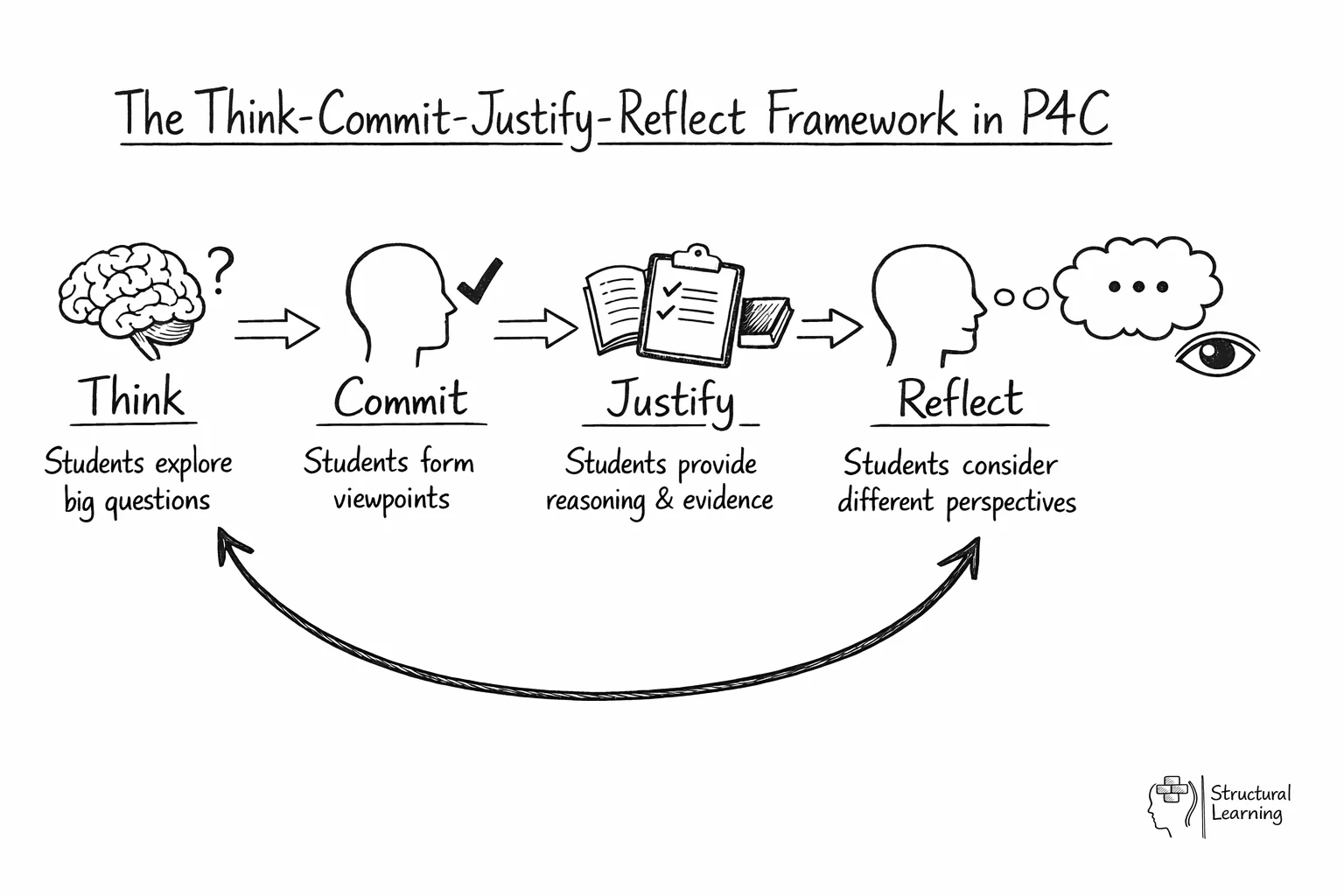
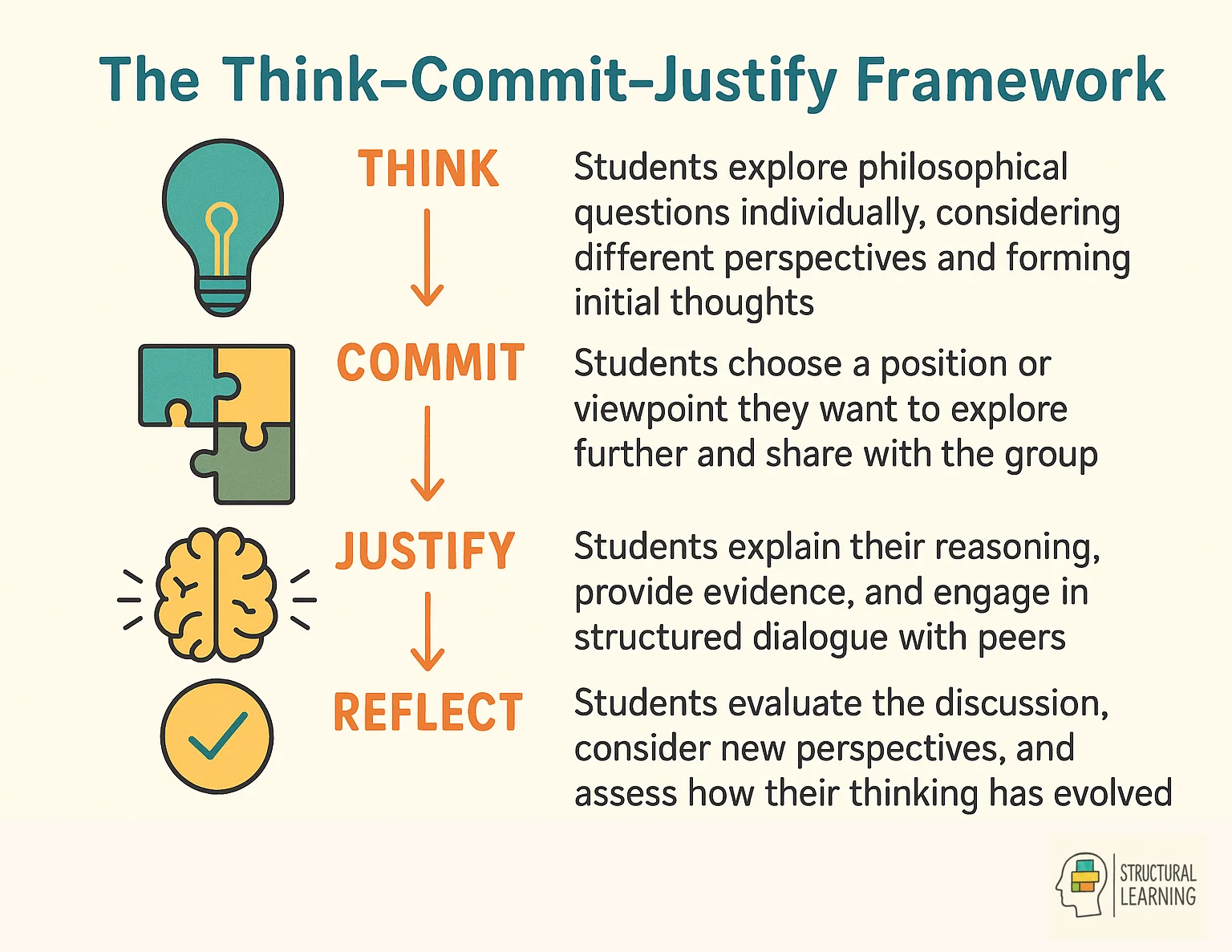
Four-stage P4C framework showing Think, Commit, Justify, Reflect phases for classroom discussions
The Think-Commit-Justify Framework

Research from the Education Endowment Foundation shows that students who participate in P4C make two additional months' progress in reading and maths compared to their peers. Teachers report even stronger gains in communication skills, with 93% noting that students express their thoughts more clearly after regular P4C sessions.

The method suits any age group, from nursery to secondary school. Reception teachers use picture books and simple questions to get young children thinking. Year 6 teachers tackle complex ethical dilemmas with their classes. The structure remains the same: Think, Commit, Justify, Reflect.

Flow diagram showing P4C's four-phase process from Think through Commit, Justify, to Reflect
Flow diagram: The Think-Commit-Justify-Reflect Framework in P4C

P4C also supports students who struggle in traditional lessons. English as an Additional Language learners gain confidence in speaking. Students with special educational needs find their voice in a supportive environment where all contributions matter. Shy students discover they have valuable ideas to share.

This article shows you how to set up P4C in your classroom, what resources work best, and how to structure effective philosophical discussions. You'll find practical activities, sample questions, and real examples from teachers who use P4C every day.

What is P4C?
  • A structured discussion method that uses philosophical questions to develop critical thinking, where students explore concepts like fairness, truth, and identity through guided dialogue.
  • A community of enquiry where every student's contribution is valued, creating a safe space for children to share ideas, challenge assumptions, and learn from different perspectives.
  • A teaching approach that works across all subjects and age groups, using stimuli like stories, images, or current events to spark meaningful conversations about complex ideas.
  • Students sitting in circle discussing philosophical questions with teacher facilitating P4C session
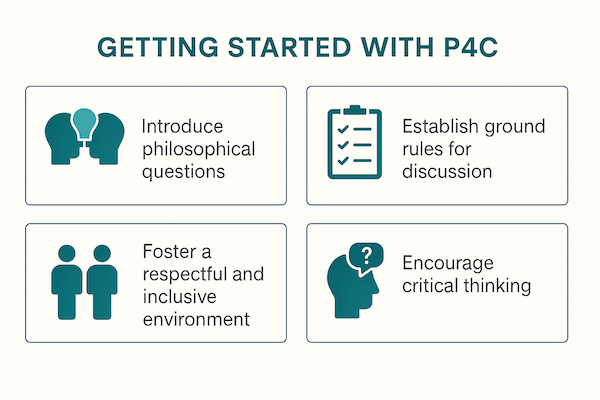
    Getting started with P4C

    Why Does P4C Work in Primary and Secondary Classrooms?

    P4C works across all age groups because it adapts to developmental stages, using picture books and simple questions for Reception children while tackling complex ethical dilemmas with Year 6 students. The approach doesn't require specialist philosophy knowledge, just the right stimulus, good questions, and willingness to let students lead discussions. Teachers report 93% of students express thoughts more clearly after regular P4C sessions, with particularly strong gains for SEND and EAL learners.

    Philosophy for Children, or P4C, revolutionizes school life by introducing students to the realm of philosophical questions. This compelling approach to teaching was pioneered by Matthew Lipman in the 1960s to develop critical thinking and communication skills from foundation to advanced school years. P4C cultivates a communal atmosphere, the community of enquiry, where stimulating resources kick-start profound discussions and collaborative thinking.

    Table: Key P4C Components


    Component

    Description

    Dialogue

    Encourages deeper thinking through conversation

    Enquiry

    Framework for investigating philosophical concepts

    Critical Thinking

    Fosters logical reasoning and analysis

    Creativity

    Nurtures innovative and imaginative ideas

    Collaboration

    Promotes teamwork and respect for others' views
                                                                           

    What Resources Start Strong P4C Discussions?

    Strong P4C discussions start with age-appropriate stimuli like picture books for Reception classes, fairy tales for younger students, and ethical dilemmas for Year 6 pupils. Teachers can use everyday classroom resources including stories, images, objects, or short videos to spark philosophical questions. The key is selecting materials that connect to students' experiences while opening up bigger questions about life, fairness, or relationships.

    Resources for P4C aren't just tools; they're keys that unlock a world of inquiry and discussion in classrooms. Their effectiveness in sparking lively discussions is well-documented, earning appreciation from educators who value engaging teaching methods. Through stimulating debates and explorations of diverse subjects, teachers and students alike find renewed enthusiasm for learning. These valuable P4C resources contribute to an environment where collaborative learning thrives.

    Reports from schools consistently highlight the positive outcomes of P4C implementation. From social skills to communication abilities, the overall behavior and cognitive functioning of students see noticeable improvements. Furthermore, the approach fosters a respectful atmosphere for philosophical inquiry, enhancing teacher-student dialogues. By empowering children to articulate their thoughts confidently, P4C bolsters their critical and creative thinking skills. This lays the groundwork for more facilitated and purposeful classroom discussions.

    P4C four Cs classroom poster showing caring, collaborative, critical, and creative thinking skills for philosophical enquiry
    4cs of P4C

    How to Choose Stimuli for Philosophical Enquiry

    The beauty of P4C lies in its versatility when it comes to stimuli for philosophical discussions. Fairy tales and class readings serve as fertile ground for year 3 and year 4 students to explore big concepts while internalizing important life lessons. Teachers adeptly tap into the zeitgeist by introducing current events into discussions, leveraging the natural curiosity stirred by news and sports.

    The genesis of these philosophical explorations is the children's own responses, ensuring that the content of discussion is as dynamic as their developing perspectives. This strategy also has the added benefit of fostering interdisciplinary connections, integrating philosophical enquiry within English, Religious Education, and History. Teachers have the discretion to shape these discussions further, guiding students with pointed questions or carefully chosen stimuli to delve into specific areas of philosophical discourse.

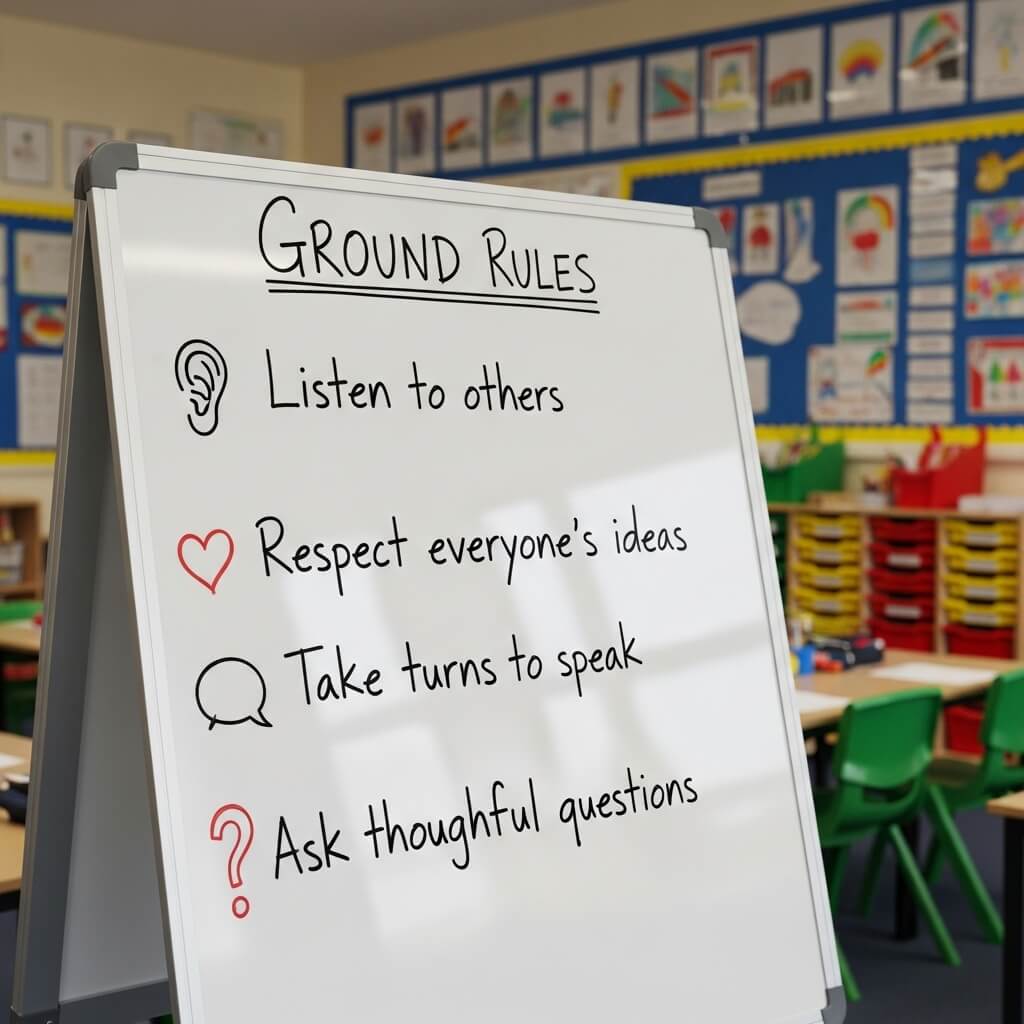
    P4C classroom ground rules displayed on whiteboard for Philosophy for Children implementation
    P4C ground rules

    P4C Activities You Can Use Tomorrow

    At the heart of P4C are classroom enquiries. In a typical session, the group might engage with a particular stimulus, dissect its key concepts, and then formulate questions surrounding themes of equality, identity, truth, and beauty. The outcome is as rewarding for teenagers and adults as it is for children, enhancing self-esteem and communication skills across the board.

    The P4C environment is consciously safe and structured, consisting of phases such as Think, Commit, Justify, and Reflect, which guide participants through the enquiry process. Such a format encourages learners to scrutinize information and contest ideas without fear of judgment. Moreover, P4C isn't confined to the traditional classroom; it's versatile enough to be integrated into diverse spaces including nurseries, hospitals, and community centers.

    The impact of P4C is tangible; empirical evidence suggests that participation can lead to significant academic progress. In terms of reading and mathematics, for instance, students involved in P4C can advance an additional two months compared to their peers in standard educational settings. This demonstrates the efficacy of P4C, painting a clear picture of its value in educational curricula.

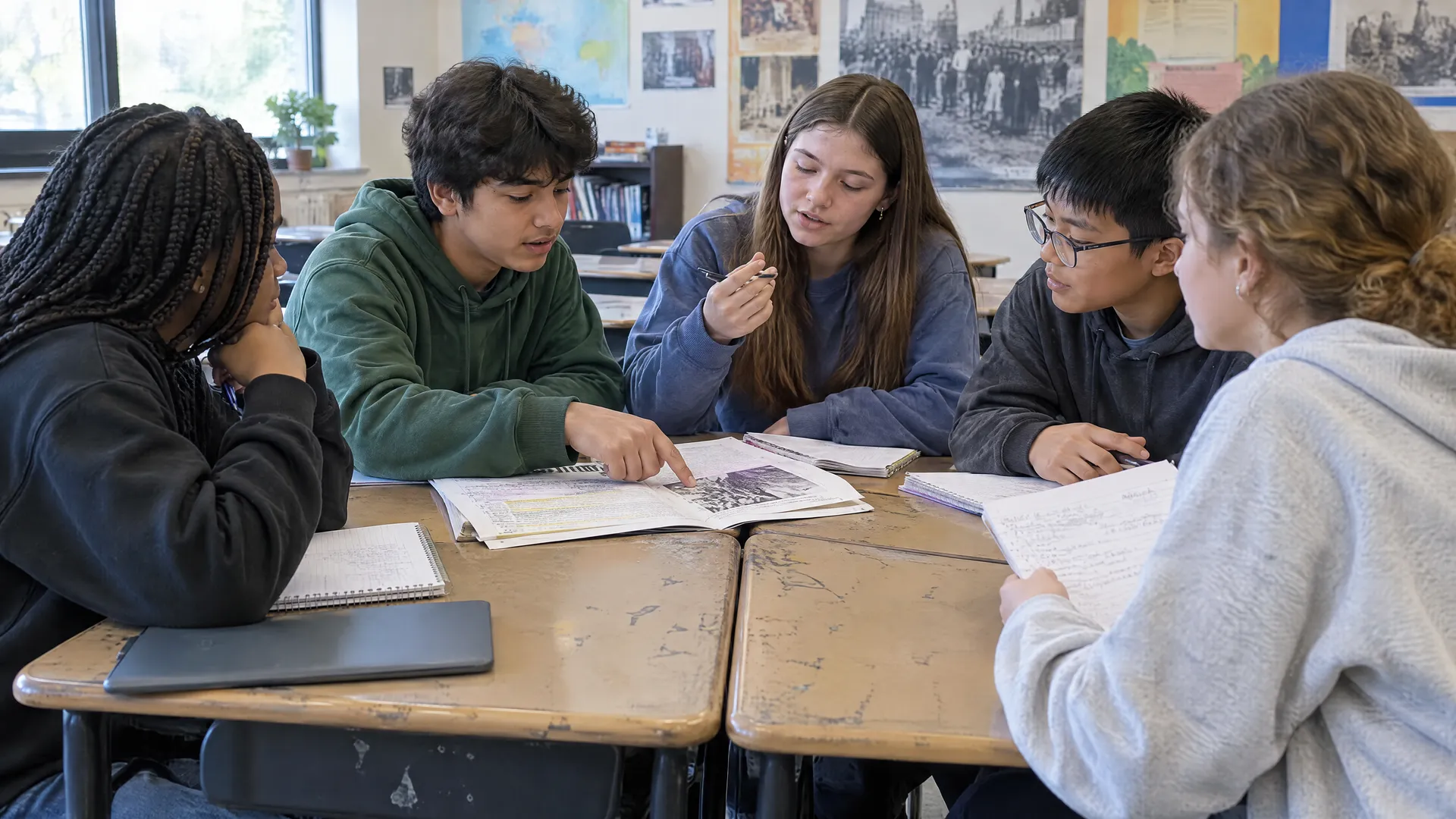
    Primary school pupils engaged in P4C group discussion around a table in classroom
    Facilitating philosophy for children

    What Do Teachers Say About P4C Success?

    Teachers report that 93% of students communicate more clearly after implementing P4C, with especially strong improvements among SEND and EAL students who previously struggled to express themselves. Many teachers note that quiet students become more confident speakers and that classroom discussions become more respectful and thoughtful. The Education Endowment Foundation confirms these observations, showing two months' additional progress in core subjects for P4C students.

    Teachers have observed remarkable changes in their classrooms after integrating P4C into their teaching methods. Teacher Pamela Shaw pointed out that P4C didn't just have a lasting effect on school culture but also extended to students' engagement with cultural discussions beyond the classroom. She witnessed an enriched dialogue amongst students about various topics, suggesting that P4C was shaping more globally aware citizens.

    FS2 teacher Elli Herbert reported noticeable advancements in her students' communication abilities. She emphasized that P4C supported language development and cultivated a nurturing environment where students felt comfortable expressing themselves. This resonated in the atmosphere of her classroom, as it became a hub for supportive and constructive dialogue.

    The impact on pupil respect for diverse opinions has been significant, with feedback from 96% of intervention teachers observing enhanced respect for different viewpoints. Furthermore, 93% of these teachers saw a boost in the clarity with which students communicated their thoughts. This highlights P4C's role not only in deepening understanding but also in refining students' abilities to articulate themselves clearly.

    Pupil Nicole's experience with P4C demonstrates this impact at an individual level. She found that P4C sessions helped her to think more profoundly about various subjects, which, in turn, sharpened her thought processes and speech.

    Teachers and students alike find P4C to be enjoyable and captivating, noting its particular benefits for English as an Additional Language (EAL) pupils, those with special educational needs (SEN), and individuals who might be grappling with self-assurance in their academic capabilities.

    Ten-step P4C session structure diagram from circle time through to reflection
    Structure of a P4C session

    Case Studies: Tracey, Tara, and Christine Kirton

    An efficacy trial funded by the Education Endowment Foundation provided substantial evidence for P4C's effectiveness. Students involved in P4C showed two additional months' progress in key areas such as reading and maths compared to their peers not involved in P4C. Tracey, Tara, and Christine Kirton, all educators with direct experience with P4C, can testify to the approach’s impact on their students.

    The P4C program goes beyond occasional sessions and encourages a more holistic school approach. It suggests weaving the philosophy into the fabric of the school's curriculum and daily classroom practice. This inclusive and adaptable method can suit a wide range of educational settings, from nurseries to higher education. It’s also been proven effective in various learning environments, including special schools and alternative education spaces.

    For Tracey, P4C was a transformational force in her current class, guiding students to engage with and understand complex material in a profound way. Under Tara's guidance, lively classes turned into hubs for philosophical enquiry, where every child had the chance to voice their opinions and learn from one another. Christine Kirton noticed an especially positive shift in her reception and Y1 classes, where the youngest of learners began showing remarkable social and academic growth.

    Through these case studies, it's evident that P4C is not just a teaching strategy but a powerful tool for cultivating a school life that champions deeper understanding and empathy among students.

    How Do You Create a Dialogue-Friendly Classroom Environment?

    Create a dialogue-friendly environment by arranging seats in a circle so everyone can see each other and establishing clear ground rules about respectful listening and turn-taking. Use the Think-Commit-Justify Framework to structure discussions, giving students time to form opinions before sharing them. Regular practice with this format helps students feel safe expressing different viewpoints and builds a true community of enquiry.

    Creating a dialogue-friendly classroom environment is a cornerstone of Philosophy for Children (P4C), a teaching approach that fosters rich communication skills through philosophical enquiry. The methodology values the development of oracy, where students refine their ability to articulate thoughts, respond to peers, and structure discourse effectively.

    P4C encourages teachers to nurture independence in thought and exploration. This expectation shift creates a supportive community of enquiry, a space where students feel empowered to delve into philosophical questions. In such an atmosphere, trust flourishes alongside critical thinking, essential elements for robust, meaningful dialogues.

    In a P4C-enhanced classroom, every student contribution is valued, facilitating a lively, collaborative, and creative dynamic. From foundation years through to Y6, P4C introduces fabulous and stimulating resources to teachers, ensuring that the project remains vibrant and impactful throughout school life.

    By integrating P4C, teachers at any level, from the energetic reception class to the thoughtful Y6 class, can witness the profound impact on pupils, propelling school ethos to champion deeper and more collaborative thinking.

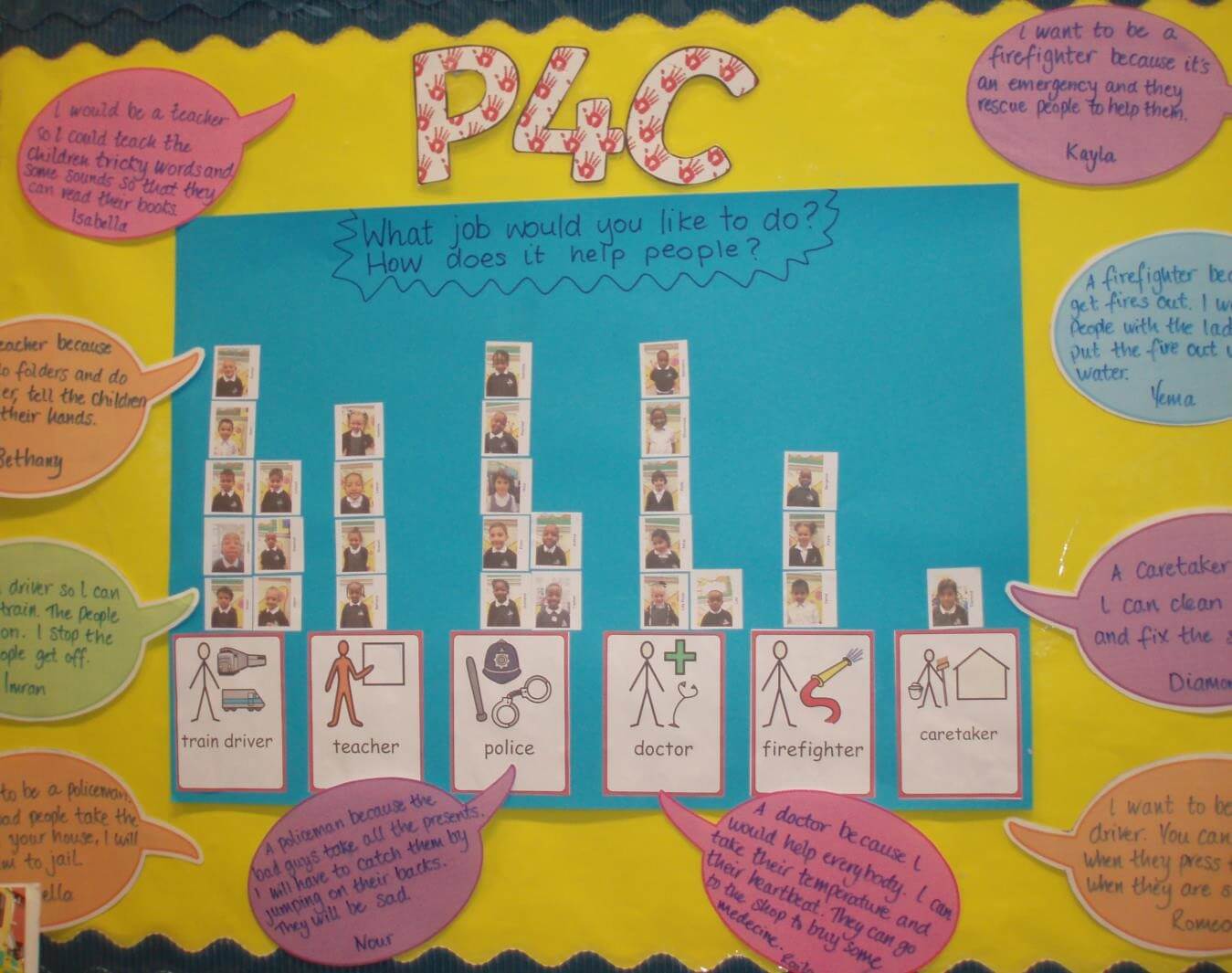
    P4C classroom display board exploring the philosophical question: What job would you like to do and how does it help people
    Monitoring P4C Progress

    How Do You Encourage Student Participation in P4C?

    Encourage participation by starting with pair discussions before whole-class sharing, allowing hesitant students to test ideas in a safer space first. Use thinking time and non-verbal signals like thumbs up/down to let all students commit to positions before speaking. Accept all contributions neutrally and build on student ideas rather than judging them, which helps quiet students gain confidence.

    P4C is more than a project in school; it promotes a community of enquiry where every participant's voice is valued. It invites children to ponder philosophical questions, fostering a school ethos where collaborative thinking is central.

    In P4C sessions, pupils, from as young as those in the reception class to those approaching their final year in a Y6 class, learn to articulate their ideas with confidence. This process develops communication skills that are essential to their current class interactions and beyond. By encouraging students to grapple with challenging dialogues about real-life scenarios, P4C lays the groundwork for critical thinking and creative problem-solving.

    The impact on pupils is immense. Through philosophical enquiry, children develop a mutual respect for different opinions and learn the importance of listening attentively. Reception teachers and other educators utilize P4C's fabulous resources to prompt deeper thinking and stimulate engaging discussions that resonate with students.

    By consistently applying the P4C methodology, students begin to see themselves as capable of making thoughtful and reasoned judgments. This positively influences every aspect of school life, making it a lively, thoughtful, and caring learning environment.


    Secondary school students participating in P4C philosophical discussion sitting in circle formation
    P4C

    What Makes an Effective P4C Question?

    Effective P4C questions are open-ended, conceptually rich, and connect to students' experiences while exploring universal themes like fairness, friendship, or identity. Good questions have no single right answer and invite multiple perspectives, such as 'Is it ever okay to break a promise?' or 'What makes something real?' The best questions emerge from student wonderings about the stimulus material rather than being imposed by teachers.

    A strong philosophical question in a P4C classroom should invite open-ended thinking, challenge assumptions, and encourage deep reflection. Good questions don’t have simple, factual answers. Instead, they stimulate critical, creative, and collaborative thinking, encouraging students to explore different perspectives and think more deeply about complex ideas.

    These questions should also be inclusive, ensuring that every student can engage in the enquiry, regardless of their background knowledge or experience.

    Here are seven examples of effective P4C questions to use in the classroom:

    1. What does it mean to be truly happy?
    2. Is it ever okay to break the rules?
    3. Can something be true for one person and false for another?
    4. What makes a person ‘good’?
    5. Is it possible to have freedom without responsibility?
    6. Do animals have rights, and if so, what are they?
    7. Does technology make us more connected or more isolated?

    These questions are designed to open up a broad range of philosophical enquiry, allowing students to explore deep concepts and develop critical thinking skills.
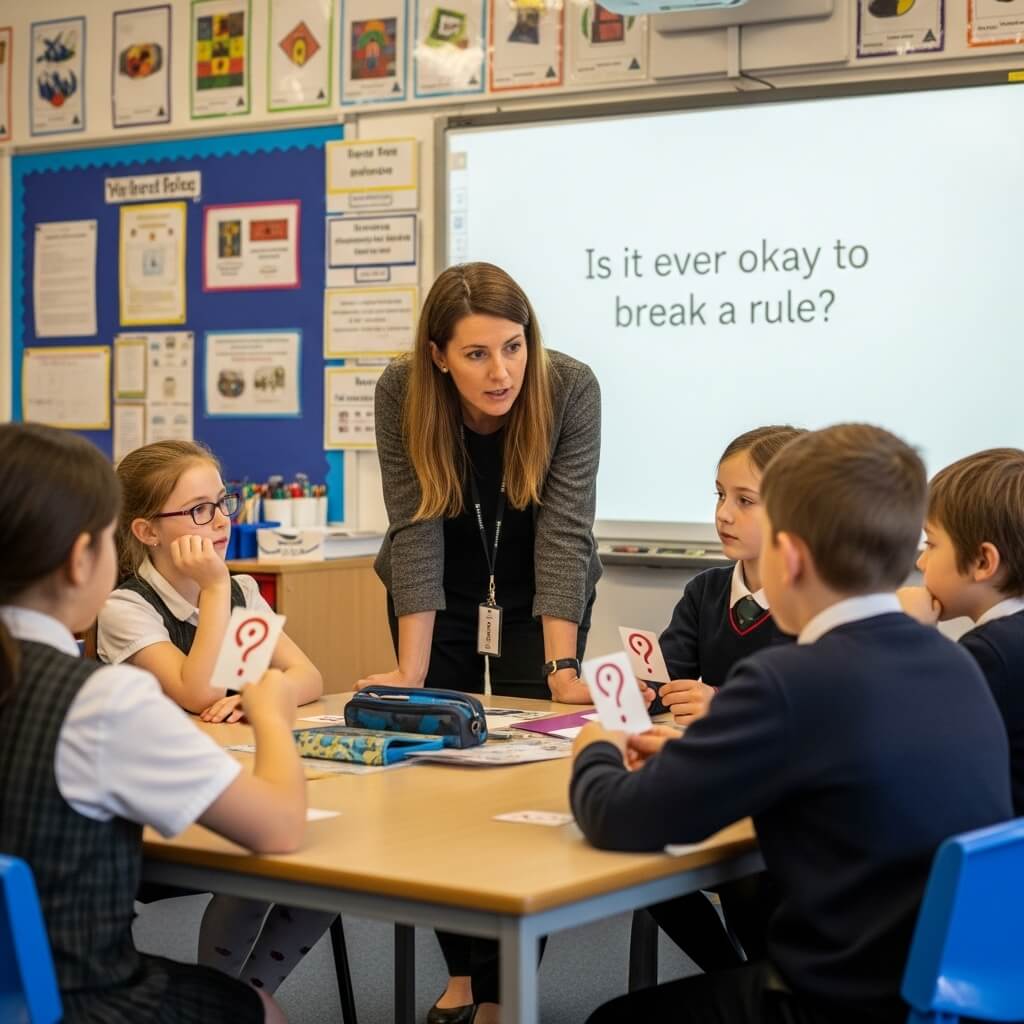
    Teacher facilitating P4C enquiry with pupils holding question cards asking: Is it ever okay to break a rule
    Faciliating Philosophy for Children

    How Does P4C Align with Curriculum Standards?

    P4C directly supports curriculum standards by developing speaking and listening skills required across all subjects, while the questioning and reasoning abilities transfer to improved performance in reading comprehension and mathematical problem-solving. The approach meets PSHE objectives around respectful relationships and critical thinking, and supports British Values through democratic participation. Many schools map P4C sessions to specific curriculum areas, using philosophical discussions to deepen subject understanding.

    P4C approaches teaching by building a community of inquiry within the classroom, where philosophical questions stimulate learners to think critically and creatively. This philosophy not only fits perfectly within current educational frameworks but also enriches school life by supporting character education and metacognition, skills vital for understanding differing viewpoints and excelling academically.

    By integrating P4C, schools tap into fabulous resources that fuel deeper thinking from foundation years to advanced classes. For instance, a Reception teacher might use P4C techniques in a lively class to spark interest, and the same resources could be adapted for a Y6 class engaged in more complex inquiries. P4C's structured questioning enhances key communication skills and encourages students, including those with Special Educational Needs (SEN), to articulate their thoughts clearly, reinforcing oral communication throughout their school journey.


    Early years children sitting in circle on carpet for P4C philosophy discussion session
    Philosophy for children promotes critical thinking

    How Do Structural Learning Tools Scaffold Philosophical Enquiry?

    Structural learning tools like thinking maps, question stems, and the Think-Commit-Justify Framework provide scaffolds that help students organize philosophical thinking and express complex ideas clearly. Visual tools such as concept maps help students see connections between ideas, while sentence starters like 'I agree because...' or 'Building on that idea...' support productive dialogue. These tools gradually release responsibility to students, moving from teacher-led to student-led enquiry.

    Philosophical enquiry, like that in Philosophy for Children (P4C), thrives when students are equipped with the right tools to explore and articulate their ideas. The Structural Learning tools, including the Thinking Framework, Writer’s Block, graphic organizers, and the Talking Toolkit, can effectively scaffold this process by giving students practical methods for structuring their thoughts and engaging in meaningful discussions. Here are five strategies teachers can use to enhance philosophical enquiry with these tools:

    1. Use the Thinking Framework to Build Deeper Questions
      Start by guiding students to use the Thinking Framework to develop critical and reflective questions. Encourage them to use learning actions like connect, categorise, or justify to explore philosophical ideas. This structure helps students break down complex issues into manageable parts and think about how different concepts relate to each other.
    2. Writer’s Block for Collaborative Thought Structuring
      Use the Writer’s Block as a physical scaffold during enquiry sessions. Each block can represent a different idea or argument, and students can physically move blocks around to see how different viewpoints interact. This tactile approach helps to visually represent abstract ideas, allowing students to collaborate and explore different perspectives.
    3. Graphic Organizers for Organizing Arguments
      Graphic organizers, such as mind maps or Venn diagrams, can help students visually organise their thoughts and the ideas discussed in the enquiry. These tools are especially useful when comparing contrasting viewpoints or exploring the relationships between different ideas, helping students clarify their thinking.
    4. Talking Toolkit for Structured Discussions
      The Talking Toolkit provides sentence starters and talk tactics that students can use to engage in respectful, thoughtful dialogue. By using prompts from the toolkit, such as agreeing with justification or asking for clarification, students can deepen their enquiry and ensure everyone’s voice is heard. This also reinforces the skills of listening and empathizing during discussions.
    5. Reflective Journaling with the Thinking Framework
      After the enquiry, encourage students to use the Thinking Framework to reflect on what they’ve learned. They can use actions like evaluate or explain to summarize their thoughts in a reflective journal. This supports metacognitive thinking, helping students think about how their understanding has grown throughout the discussion.

    By integrating these Structural Learning tools, teachers can scaffold philosophical enquiry in a way that promotes deeper thinking, structured dialogue, and collaborative learning.

    What Are the Benefits of Implementing P4C?

    P4C implementation delivers measurable academic benefits including two months' additional progress in reading and maths, plus significant improvements in communication skills with 93% of teachers reporting clearer student expression. Beyond academics, students develop confidence, empathy, and critical thinking skills while learning to respectfully engage with different viewpoints. The approach particularly benefits SEND and EAL students by providing structured opportunities to develop language and thinking skills together.

    Implementing P4C in schools brings numerous advantages that extend beyond academic achievement. This innovative program lays a strong foundation for children's development, augmenting not only their intellect but also their personal growth. By delving into philosophical discussions, children naturally refine their thinking and communication capabilities.

    This process contributes significantly to boosting their confidence, self-esteem and also fosters a more harmonious classroom environment. Their enhanced ability to think both critically and compassionately prepares them for the complexities of life, helping to shape them into happier, well-adjusted individuals who can contribute positively to society.

    The efficacy trial funded by the EEF has provided evidence of P4C's effectiveness, showing that participants made additional progress in reading and math. Moreover, through exploring important life concepts in a nurturing environment, children achieve a greater understanding of significant topics like fairness and equality, which are vital for their holistic development.

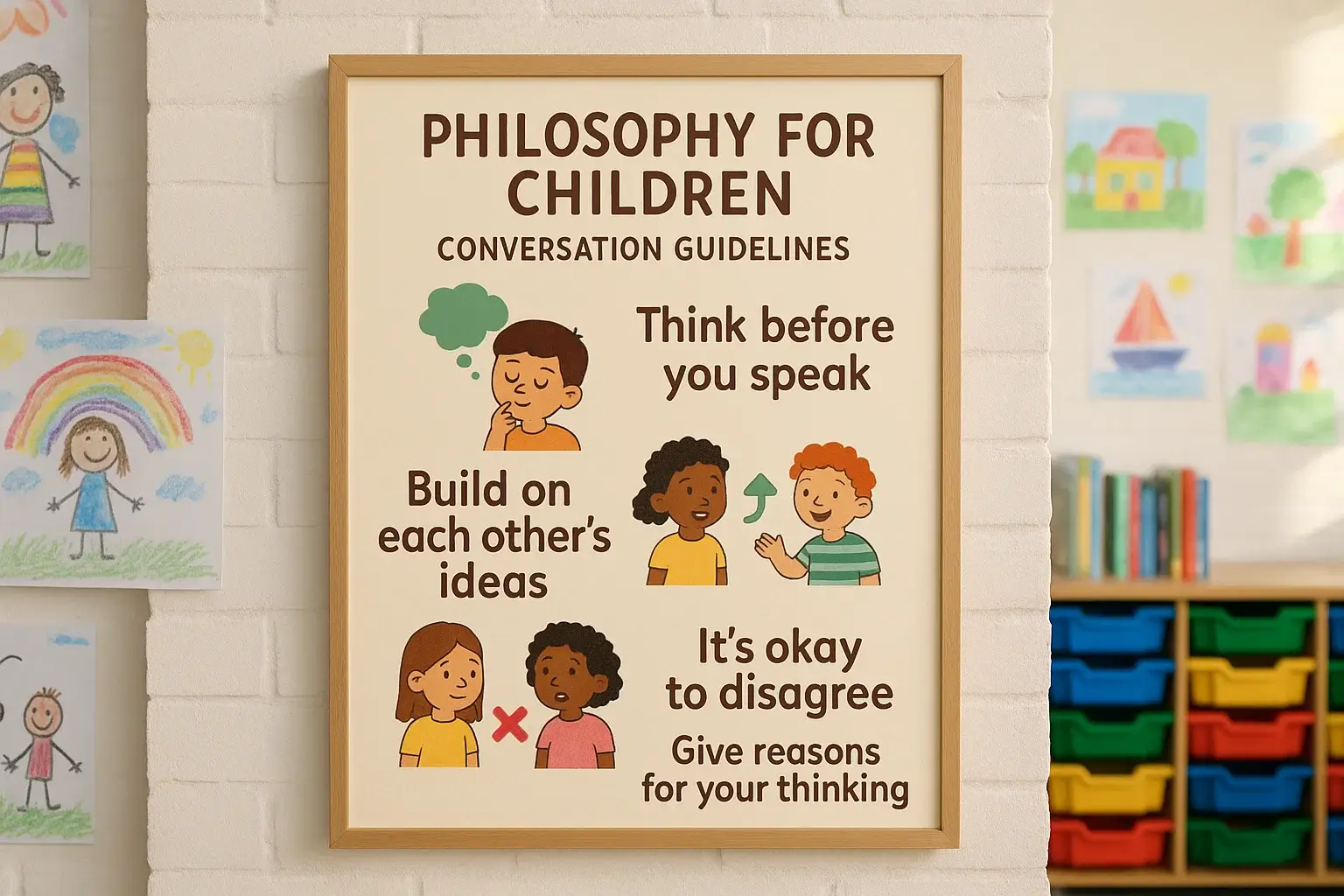
    Philosophy for Children conversation guidelines poster: think before you speak, build on ideas, give reasons for disagreement
    P4C wall display

    Enhancing Critical Thinking Skills

    Philosophy for Children champions the development of critical thinking skills through its structured framework that emphasizes questioning, reasoning, and evaluative judgment. The SAPERE's 4Cs thinking model, caring, collaborative, critical, and creative, forms the backbone of P4C and guides children to become more thoughtful individuals.

    The approach allows children to articulate their points of view, consider others' perspectives, and reason effectively, all of which serve to enrich their vocabulary and reflective thinking abilities. It also strengthens the relationship between teachers and pupils, with educators adopting a role that emphasizes listening and facilitation.

    As a result, students are encouraged to explore ideas independently, which is instrumental in bolstering their critical thinking prowess. At the heart of P4C's methodology is its ability to provide a systematized progression from thought to argumentation to reflection, enhancing pupils’ learning encounters and thought processes.

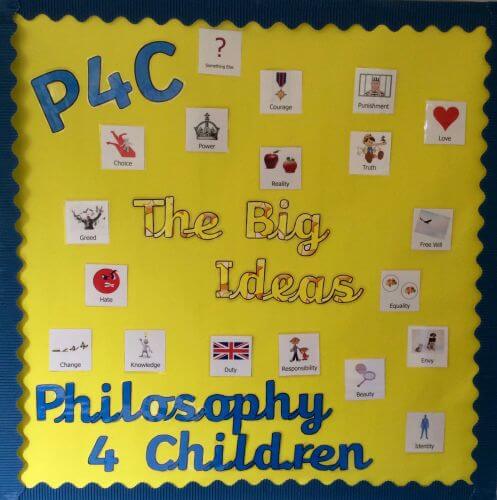
    P4C Big Ideas display board showing philosophical concepts including courage, power, truth, equality, and free will
    P4C Display Board

    Fostering Collaborative Discussions

    Central to the P4C methodology is the community of enquiry, a setting that promotes mutual respect and equal contribution among peers. In these collaborative sessions, children get the opportunity to voice initial thoughts, pose thought-provoking questions, and engage in meaningful dialogue.

    By using a structured investigative method, learners connect with and examine complex, debatable concepts, thereby fostering a collective intellectual pursuit. Through interaction in this communal space, students learn the importance of constructing upon and reacting to each other's ideas.

    These collaborative discussions not only sharpen children's abilities to articulate and justify their own reasoning but also to listen actively and consider the perspectives of others. This reciprocal component of dialogue within P4C is crucial; it not only improves students' comprehension and communication skills but also underpins their social interaction capabilities.

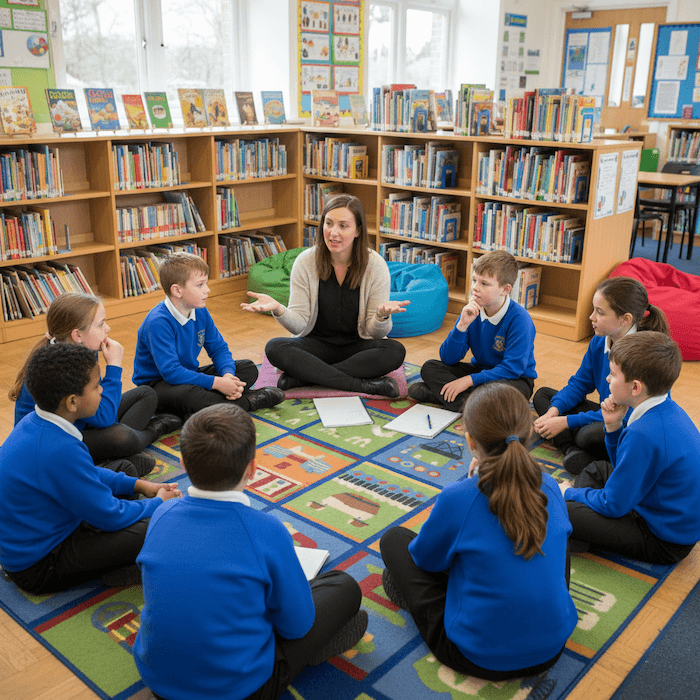
    School pupils sitting in circle in library for P4C philosophical enquiry session
    P4C in Primary

    How Can You Integrate P4C into Everyday Lessons?

    Integrate P4C by starting with one dedicated session per week, then gradually incorporating philosophical questions into regular subject lessons when natural connections arise. Use curriculum content as stimuli for enquiry, such as exploring ethical dilemmas in history lessons or examining assumptions in science investigations. Build P4C vocabulary and thinking routines into daily classroom talk, encouraging students to justify opinions and build on others' ideas across all subjects.

    Here's how educators can integrate P4C into everyday lessons:

    1. Select a Topic: Teachers can choose stimulating resources or allow students to pick topics they find intriguing, ensuring the content is lively and encourages deeper thinking.
    2. Four Phases: Guide students through the P4C process, Think, Commit, Justify, Reflect, to structure their enquiry, promoting collaborative thinking among peers.
    3. Across Subjects: Apply the P4C model to various subject areas, using philosophical questions to enhance learning and reasoning, regardless of the current class, be it a reception or Y6 class.
    4. Teacher's Role: Reception teachers or instructors in other grades become facilitators, offering resources to teachers to foster a school ethos of enquiry.

    Incorporating P4C leads to a transformative impact on pupils, enriching their school experience with essential skills. This approach cultivates an engaging, reflective, and lively class atmosphere, beneficial for both students and educators.

    What Are Common Questions About P4C Implementation?

    Teachers commonly ask whether they need philosophy training (they don't), how much time P4C requires (one hour weekly is effective), and how to handle controversial topics that arise. The key is facilitating rather than teaching, letting students explore ideas while maintaining respectful dialogue boundaries. Most concerns disappear after trying a few sessions, as the structured approach and student engagement quickly demonstrate P4C's value.

    What is Philosophy for Children (P4C)?
    Philosophy for Children, or P4C, is an approach that integrates philosophical inquiry into everyday learning. It encourages students to engage in discussions that challenge their thinking and help them develop critical, creative, caring, and collaborative skills. It’s not just a subject; it’s a way of enhancing students’ overall approach to learning.

    How does P4C benefit students?
    P4C has shown positive impacts across several academic areas, including improvements in reading and math. It also fosters stronger social and communication skills. Through structured enquiry, students learn to articulate, analyze, and reflect, which helps them grow intellectually and emotionally.

    Who can participate in P4C?
    P4C is highly adaptable and can benefit a range of age groups, from nursery children as young as three to students in higher education. It is effective in primary, secondary, and post-16 education, as well as alternative education provisions like pupil referral units and special schools.

    How do you assess the outcomes of P4C?
    Assessing P4C outcomes looks beyond traditional academic scores. While P4C may not always impact reading and math attainment, teachers consistently report improvements in students’ respect for others' opinions and their ability to express their thoughts clearly. It’s especially engaging for English as an Additional Language (EAL) learners and students with special educational needs (SEN).

    Does P4C require specific training for teachers?
    Yes, effective P4C implementation relies on high-quality teacher training and support from senior staff. Teachers need to be equipped with the right skills to guide philosophical enquiries and foster a reflective, open learning environment.

    Can P4C be used across subjects?
    Yes, P4C can be applied across various subjects. It helps students think critically and creatively, skills that are essential in any subject. The strategies of P4C, such as thinking, committing, justifying, and reflecting, can be used to deepen understanding in subjects like math, science, and literacy.

    How do teachers get started with P4C?
    Starting with standalone P4C sessions is a great way to introduce it. Over time, it can be embedded into everyday lessons. Having senior staff support and quality training for teachers are key factors in successful implementation.

    Philosophy for Children expectations

    Where Can Teachers Find Further Reading on Philosophy for Children?

    Teachers can access P4C resources through SAPERE (Society for Advancing Philosophical Enquiry and Reflection in Education), which offers training, lesson plans, and research evidence. The Philosophy Foundation provides free resources and example questions, while books by Matthew Lipman and Joanna Haynes offer theoretical background and practical guidance. Many local authorities also run P4C networks where teachers share resources and experiences.

    The following studies highlight the effectiveness of using philosophy in the classroom to develop critical thinking, reasoning, and metacognitive strategies.

    1. Philosophy, Critical Thinking and Philosophy for Children

    Summary: This paper argues that Philosophy for Children (P4C) enhances critical thinking through philosophical dialogue. It also discusses how philosophical discussions in the classroom foster deeper thinking and metacognitive strategies, promoting a culture of thoughtful inquiry (Daniel & Auriac, 2011).

    2. Doing Philosophy Effectively: Student Learning in Classroom Teaching

    Summary: The study explores how doing philosophy in the classroom, supported by teacher-student interaction, enhances student learning. The findings show that students engaging in philosophical discussions display higher levels of critical reasoning and reflective thinking (Kienstra et al., 2015).

    3. The Nature of Philosophy for Children and Its Role in Teaching and Learning

    Summary: This article discusses how P4C helps students engage in deeper discussions by introducing them to big questions. It focuses on the integration of philosophy into different subjects and encourages the development of reasoning and deeper thinking through structured classroom debates (Yahya, 2015).

    4. Philosophy for Children in Teacher Education: Effects, Difficulties, and Recommendations

    Summary: This study examines the challenges and benefits of incorporating P4C into teacher education. It highlights the positive impact on teachers’ ability to foster metacognitive strategies and intelligent behavior in children, although more training in philosophical dialogue is recommended (Çayır, 2019).

    5. Philosophy with Children as an Educational Platform for Self-Determined Learning

    Summary: This paper discusses the role of P4C in promoting self-determined learning and enhancing flexible thinking. It advocates a shift from traditional teaching methods to a philosophy-driven, inquiry-based learning approach to foster critical and creative thinking in children (Kizel, 2016).

    Frequently Asked Questions

    What is Philosophy for Children (P4C) and how does it work in practice?

    P4C is a structured discussion method that uses philosophical questions to develop critical thinking, where students explore concepts like fairness, truth, and identity through guided dialogue. It creates a community of enquiry in classrooms where students explore big questions together, learn to listen to different viewpoints, and develop their own arguments. The approach doesn't require a philosophy degree or specialist knowledge, just the right stimulus, a good question, and willingness to let students lead the discussion.

    How do I choose appropriate resources and stimuli for different age groups in P4C?

    For Reception classes, use picture books and simple questions, whilst Year 6 students can tackle complex ethical dilemmas. Teachers can use everyday classroom resources including stories, images, objects, or short videos that connect to students' experiences while opening up bigger questions about life, fairness, or relationships. The key is selecting age-appropriate materials that spark meaningful philosophical conversations.

    What is the Think-Commit-Justify framework and how do I implement it?

    The Think-Commit-Justify framework is the four-phase structure that transforms classroom discussions into powerful thinking communities where every voice matters. The structure remains consistent across all age groups: Think, Commit, Justify, Reflect. This framework helps students develop their reasoning abilities whilst gaining confidence in expressing their ideas through structured dialogue.

    What specific benefits can I expect from implementing P4C in my classroom?

    Research from the Education Endowment Foundation shows that P4C students make two additional months' progress in reading and maths compared to their peers. Additionally, 93% of teachers report that students express their thoughts more clearly after regular P4C sessions, with particularly strong gains for students with SEND and EAL needs. The approach also helps shy students discover they have valuable ideas to share.

    How does P4C support students with special educational needs and English as an Additional Language?

    P4C creates a supportive environment where all contributions matter, helping English as an Additional Language learners gain confidence in speaking. Students with special educational needs find their voice in discussions where different perspectives are valued and respected. The structured approach allows these students to participate meaningfully whilst developing their communication and reasoning skills.

    Can P4C be integrated across different subjects and what does this look like in practice?

    P4C works across all subjects and age groups, fostering interdisciplinary connections within English, Religious Education, and History. Teachers can introduce current events into discussions, leverage fairy tales and class readings for exploration of big concepts, or use everyday classroom situations to spark philosophical enquiry. The versatility allows teachers to adapt philosophical discussions to any curriculum area whilst maintaining the core structure.

Loading audit...

How Does Philosophy for Children Build Thinking Skills?

Philosophy for Children builds thinking skills through structured dialogue where students explore big questions together, learning to listen to different viewpoints and develop their own arguments. The method creates a community of enquiry in classrooms, helping students gain confidence in expressing their ideas while developing critical reasoning abilities. Research shows P4C students make two additional months' progress in reading and maths compared to their peers.

Philosophy for Children (P4C) transforms how students think, question, and communicate in the classroom. Since Matthew Lipman developed this teaching approach in the 1960s, thousands of teachers have used it to build students' reasoning skills and confidence in expressing their ideas.

Key Takeaways

  1. Two Months Ahead: Discover why P4C students gain two additional months in reading and maths, and how simple philosophical questions unlock this progress
  2. The Think-Commit-Justify Framework: Master the four-phase structure that transforms classroom discussions into powerful thinking communities where every voice matters
  3. Breaking the Silence: Learn why 93% of teachers report clearer communication from students, especially those with SEND and EAL needs
  4. Picture Books to Ethics: Navigate age-appropriate stimuli selection from Reception fairy tales to Year 6 ethical dilemmas using everyday classroom resources

P4C works by creating a community of enquiry in your classroom. Students explore big questions together, learn to listen to different viewpoints, and develop their own arguments through structured dialogue. The approach doesn't require a philosophy degree or specialist knowledge. You simply need the right stimulus, a good question, and a willingness to let students lead the discussion.

Four-stage P4C framework showing Think, Commit, Justify, Reflect phases for classroom discussions
The Think-Commit-Justify Framework

Research from the Education Endowment Foundation shows that students who participate in P4C make two additional months' progress in reading and maths compared to their peers. Teachers report even stronger gains in communication skills, with 93% noting that students express their thoughts more clearly after regular P4C sessions.

The method suits any age group, from nursery to secondary school. Reception teachers use picture books and simple questions to get young children thinking. Year 6 teachers tackle complex ethical dilemmas with their classes. The structure remains the same: Think, Commit, Justify, Reflect.

Flow diagram showing P4C's four-phase process from Think through Commit, Justify, to Reflect
Flow diagram: The Think-Commit-Justify-Reflect Framework in P4C

P4C also supports students who struggle in traditional lessons. English as an Additional Language learners gain confidence in speaking. Students with special educational needs find their voice in a supportive environment where all contributions matter. Shy students discover they have valuable ideas to share.

This article shows you how to set up P4C in your classroom, what resources work best, and how to structure effective philosophical discussions. You'll find practical activities, sample questions, and real examples from teachers who use P4C every day.

What is P4C?

  • A structured discussion method that uses philosophical questions to develop critical thinking, where students explore concepts like fairness, truth, and identity through guided dialogue.
  • A community of enquiry where every student's contribution is valued, creating a safe space for children to share ideas, challenge assumptions, and learn from different perspectives.
  • A teaching approach that works across all subjects and age groups, using stimuli like stories, images, or current events to spark meaningful conversations about complex ideas.
  • Students sitting in circle discussing philosophical questions with teacher facilitating P4C session
    Getting started with P4C

    Why Does P4C Work in Primary and Secondary Classrooms?

    P4C works across all age groups because it adapts to developmental stages, using picture books and simple questions for Reception children while tackling complex ethical dilemmas with Year 6 students. The approach doesn't require specialist philosophy knowledge, just the right stimulus, good questions, and willingness to let students lead discussions. Teachers report 93% of students express thoughts more clearly after regular P4C sessions, with particularly strong gains for SEND and EAL learners.

    Philosophy for Children, or P4C, revolutionizes school life by introducing students to the realm of philosophical questions. This compelling approach to teaching was pioneered by Matthew Lipman in the 1960s to develop critical thinking and communication skills from foundation to advanced school years. P4C cultivates a communal atmosphere, the community of enquiry, where stimulating resources kick-start profound discussions and collaborative thinking.

    Table: Key P4C Components


    Component

    Description

    Dialogue

    Encourages deeper thinking through conversation

    Enquiry

    Framework for investigating philosophical concepts

    Critical Thinking

    Fosters logical reasoning and analysis

    Creativity

    Nurtures innovative and imaginative ideas

    Collaboration

    Promotes teamwork and respect for others' views
                                                                           

    What Resources Start Strong P4C Discussions?

    Strong P4C discussions start with age-appropriate stimuli like picture books for Reception classes, fairy tales for younger students, and ethical dilemmas for Year 6 pupils. Teachers can use everyday classroom resources including stories, images, objects, or short videos to spark philosophical questions. The key is selecting materials that connect to students' experiences while opening up bigger questions about life, fairness, or relationships.

    Resources for P4C aren't just tools; they're keys that unlock a world of inquiry and discussion in classrooms. Their effectiveness in sparking lively discussions is well-documented, earning appreciation from educators who value engaging teaching methods. Through stimulating debates and explorations of diverse subjects, teachers and students alike find renewed enthusiasm for learning. These valuable P4C resources contribute to an environment where collaborative learning thrives.

    Reports from schools consistently highlight the positive outcomes of P4C implementation. From social skills to communication abilities, the overall behavior and cognitive functioning of students see noticeable improvements. Furthermore, the approach fosters a respectful atmosphere for philosophical inquiry, enhancing teacher-student dialogues. By empowering children to articulate their thoughts confidently, P4C bolsters their critical and creative thinking skills. This lays the groundwork for more facilitated and purposeful classroom discussions.

    P4C four Cs classroom poster showing caring, collaborative, critical, and creative thinking skills for philosophical enquiry
    4cs of P4C

    How to Choose Stimuli for Philosophical Enquiry

    The beauty of P4C lies in its versatility when it comes to stimuli for philosophical discussions. Fairy tales and class readings serve as fertile ground for year 3 and year 4 students to explore big concepts while internalizing important life lessons. Teachers adeptly tap into the zeitgeist by introducing current events into discussions, leveraging the natural curiosity stirred by news and sports.

    The genesis of these philosophical explorations is the children's own responses, ensuring that the content of discussion is as dynamic as their developing perspectives. This strategy also has the added benefit of fostering interdisciplinary connections, integrating philosophical enquiry within English, Religious Education, and History. Teachers have the discretion to shape these discussions further, guiding students with pointed questions or carefully chosen stimuli to delve into specific areas of philosophical discourse.

    P4C classroom ground rules displayed on whiteboard for Philosophy for Children implementation
    P4C ground rules

    P4C Activities You Can Use Tomorrow

    At the heart of P4C are classroom enquiries. In a typical session, the group might engage with a particular stimulus, dissect its key concepts, and then formulate questions surrounding themes of equality, identity, truth, and beauty. The outcome is as rewarding for teenagers and adults as it is for children, enhancing self-esteem and communication skills across the board.

    The P4C environment is consciously safe and structured, consisting of phases such as Think, Commit, Justify, and Reflect, which guide participants through the enquiry process. Such a format encourages learners to scrutinize information and contest ideas without fear of judgment. Moreover, P4C isn't confined to the traditional classroom; it's versatile enough to be integrated into diverse spaces including nurseries, hospitals, and community centers.

    The impact of P4C is tangible; empirical evidence suggests that participation can lead to significant academic progress. In terms of reading and mathematics, for instance, students involved in P4C can advance an additional two months compared to their peers in standard educational settings. This demonstrates the efficacy of P4C, painting a clear picture of its value in educational curricula.

    Primary school pupils engaged in P4C group discussion around a table in classroom
    Facilitating philosophy for children

    What Do Teachers Say About P4C Success?

    Teachers report that 93% of students communicate more clearly after implementing P4C, with especially strong improvements among SEND and EAL students who previously struggled to express themselves. Many teachers note that quiet students become more confident speakers and that classroom discussions become more respectful and thoughtful. The Education Endowment Foundation confirms these observations, showing two months' additional progress in core subjects for P4C students.

    Teachers have observed remarkable changes in their classrooms after integrating P4C into their teaching methods. Teacher Pamela Shaw pointed out that P4C didn't just have a lasting effect on school culture but also extended to students' engagement with cultural discussions beyond the classroom. She witnessed an enriched dialogue amongst students about various topics, suggesting that P4C was shaping more globally aware citizens.

    FS2 teacher Elli Herbert reported noticeable advancements in her students' communication abilities. She emphasized that P4C supported language development and cultivated a nurturing environment where students felt comfortable expressing themselves. This resonated in the atmosphere of her classroom, as it became a hub for supportive and constructive dialogue.

    The impact on pupil respect for diverse opinions has been significant, with feedback from 96% of intervention teachers observing enhanced respect for different viewpoints. Furthermore, 93% of these teachers saw a boost in the clarity with which students communicated their thoughts. This highlights P4C's role not only in deepening understanding but also in refining students' abilities to articulate themselves clearly.

    Pupil Nicole's experience with P4C demonstrates this impact at an individual level. She found that P4C sessions helped her to think more profoundly about various subjects, which, in turn, sharpened her thought processes and speech.

    Teachers and students alike find P4C to be enjoyable and captivating, noting its particular benefits for English as an Additional Language (EAL) pupils, those with special educational needs (SEN), and individuals who might be grappling with self-assurance in their academic capabilities.

    Ten-step P4C session structure diagram from circle time through to reflection
    Structure of a P4C session

    Case Studies: Tracey, Tara, and Christine Kirton

    An efficacy trial funded by the Education Endowment Foundation provided substantial evidence for P4C's effectiveness. Students involved in P4C showed two additional months' progress in key areas such as reading and maths compared to their peers not involved in P4C. Tracey, Tara, and Christine Kirton, all educators with direct experience with P4C, can testify to the approach’s impact on their students.

    The P4C program goes beyond occasional sessions and encourages a more holistic school approach. It suggests weaving the philosophy into the fabric of the school's curriculum and daily classroom practice. This inclusive and adaptable method can suit a wide range of educational settings, from nurseries to higher education. It’s also been proven effective in various learning environments, including special schools and alternative education spaces.

    For Tracey, P4C was a transformational force in her current class, guiding students to engage with and understand complex material in a profound way. Under Tara's guidance, lively classes turned into hubs for philosophical enquiry, where every child had the chance to voice their opinions and learn from one another. Christine Kirton noticed an especially positive shift in her reception and Y1 classes, where the youngest of learners began showing remarkable social and academic growth.

    Through these case studies, it's evident that P4C is not just a teaching strategy but a powerful tool for cultivating a school life that champions deeper understanding and empathy among students.

    How Do You Create a Dialogue-Friendly Classroom Environment?

    Create a dialogue-friendly environment by arranging seats in a circle so everyone can see each other and establishing clear ground rules about respectful listening and turn-taking. Use the Think-Commit-Justify Framework to structure discussions, giving students time to form opinions before sharing them. Regular practice with this format helps students feel safe expressing different viewpoints and builds a true community of enquiry.

    Creating a dialogue-friendly classroom environment is a cornerstone of Philosophy for Children (P4C), a teaching approach that fosters rich communication skills through philosophical enquiry. The methodology values the development of oracy, where students refine their ability to articulate thoughts, respond to peers, and structure discourse effectively.

    P4C encourages teachers to nurture independence in thought and exploration. This expectation shift creates a supportive community of enquiry, a space where students feel empowered to delve into philosophical questions. In such an atmosphere, trust flourishes alongside critical thinking, essential elements for robust, meaningful dialogues.

    In a P4C-enhanced classroom, every student contribution is valued, facilitating a lively, collaborative, and creative dynamic. From foundation years through to Y6, P4C introduces fabulous and stimulating resources to teachers, ensuring that the project remains vibrant and impactful throughout school life.

    By integrating P4C, teachers at any level, from the energetic reception class to the thoughtful Y6 class, can witness the profound impact on pupils, propelling school ethos to champion deeper and more collaborative thinking.

    P4C classroom display board exploring the philosophical question: What job would you like to do and how does it help people
    Monitoring P4C Progress

    How Do You Encourage Student Participation in P4C?

    Encourage participation by starting with pair discussions before whole-class sharing, allowing hesitant students to test ideas in a safer space first. Use thinking time and non-verbal signals like thumbs up/down to let all students commit to positions before speaking. Accept all contributions neutrally and build on student ideas rather than judging them, which helps quiet students gain confidence.

    P4C is more than a project in school; it promotes a community of enquiry where every participant's voice is valued. It invites children to ponder philosophical questions, fostering a school ethos where collaborative thinking is central.

    In P4C sessions, pupils, from as young as those in the reception class to those approaching their final year in a Y6 class, learn to articulate their ideas with confidence. This process develops communication skills that are essential to their current class interactions and beyond. By encouraging students to grapple with challenging dialogues about real-life scenarios, P4C lays the groundwork for critical thinking and creative problem-solving.

    The impact on pupils is immense. Through philosophical enquiry, children develop a mutual respect for different opinions and learn the importance of listening attentively. Reception teachers and other educators utilize P4C's fabulous resources to prompt deeper thinking and stimulate engaging discussions that resonate with students.

    By consistently applying the P4C methodology, students begin to see themselves as capable of making thoughtful and reasoned judgments. This positively influences every aspect of school life, making it a lively, thoughtful, and caring learning environment.


    Secondary school students participating in P4C philosophical discussion sitting in circle formation
    P4C

    What Makes an Effective P4C Question?

    Effective P4C questions are open-ended, conceptually rich, and connect to students' experiences while exploring universal themes like fairness, friendship, or identity. Good questions have no single right answer and invite multiple perspectives, such as 'Is it ever okay to break a promise?' or 'What makes something real?' The best questions emerge from student wonderings about the stimulus material rather than being imposed by teachers.

    A strong philosophical question in a P4C classroom should invite open-ended thinking, challenge assumptions, and encourage deep reflection. Good questions don’t have simple, factual answers. Instead, they stimulate critical, creative, and collaborative thinking, encouraging students to explore different perspectives and think more deeply about complex ideas.

    These questions should also be inclusive, ensuring that every student can engage in the enquiry, regardless of their background knowledge or experience.

    Here are seven examples of effective P4C questions to use in the classroom:

    1. What does it mean to be truly happy?
    2. Is it ever okay to break the rules?
    3. Can something be true for one person and false for another?
    4. What makes a person ‘good’?
    5. Is it possible to have freedom without responsibility?
    6. Do animals have rights, and if so, what are they?
    7. Does technology make us more connected or more isolated?

    These questions are designed to open up a broad range of philosophical enquiry, allowing students to explore deep concepts and develop critical thinking skills.

    Teacher facilitating P4C enquiry with pupils holding question cards asking: Is it ever okay to break a rule
    Faciliating Philosophy for Children

    How Does P4C Align with Curriculum Standards?

    P4C directly supports curriculum standards by developing speaking and listening skills required across all subjects, while the questioning and reasoning abilities transfer to improved performance in reading comprehension and mathematical problem-solving. The approach meets PSHE objectives around respectful relationships and critical thinking, and supports British Values through democratic participation. Many schools map P4C sessions to specific curriculum areas, using philosophical discussions to deepen subject understanding.

    P4C approaches teaching by building a community of inquiry within the classroom, where philosophical questions stimulate learners to think critically and creatively. This philosophy not only fits perfectly within current educational frameworks but also enriches school life by supporting character education and metacognition, skills vital for understanding differing viewpoints and excelling academically.

    By integrating P4C, schools tap into fabulous resources that fuel deeper thinking from foundation years to advanced classes. For instance, a Reception teacher might use P4C techniques in a lively class to spark interest, and the same resources could be adapted for a Y6 class engaged in more complex inquiries. P4C's structured questioning enhances key communication skills and encourages students, including those with Special Educational Needs (SEN), to articulate their thoughts clearly, reinforcing oral communication throughout their school journey.


    Early years children sitting in circle on carpet for P4C philosophy discussion session
    Philosophy for children promotes critical thinking

    How Do Structural Learning Tools Scaffold Philosophical Enquiry?

    Structural learning tools like thinking maps, question stems, and the Think-Commit-Justify Framework provide scaffolds that help students organize philosophical thinking and express complex ideas clearly. Visual tools such as concept maps help students see connections between ideas, while sentence starters like 'I agree because...' or 'Building on that idea...' support productive dialogue. These tools gradually release responsibility to students, moving from teacher-led to student-led enquiry.

    Philosophical enquiry, like that in Philosophy for Children (P4C), thrives when students are equipped with the right tools to explore and articulate their ideas. The Structural Learning tools, including the Thinking Framework, Writer’s Block, graphic organizers, and the Talking Toolkit, can effectively scaffold this process by giving students practical methods for structuring their thoughts and engaging in meaningful discussions. Here are five strategies teachers can use to enhance philosophical enquiry with these tools:

    1. Use the Thinking Framework to Build Deeper Questions
      Start by guiding students to use the Thinking Framework to develop critical and reflective questions. Encourage them to use learning actions like connect, categorise, or justify to explore philosophical ideas. This structure helps students break down complex issues into manageable parts and think about how different concepts relate to each other.
    2. Writer’s Block for Collaborative Thought Structuring
      Use the Writer’s Block as a physical scaffold during enquiry sessions. Each block can represent a different idea or argument, and students can physically move blocks around to see how different viewpoints interact. This tactile approach helps to visually represent abstract ideas, allowing students to collaborate and explore different perspectives.
    3. Graphic Organizers for Organizing Arguments
      Graphic organizers, such as mind maps or Venn diagrams, can help students visually organise their thoughts and the ideas discussed in the enquiry. These tools are especially useful when comparing contrasting viewpoints or exploring the relationships between different ideas, helping students clarify their thinking.
    4. Talking Toolkit for Structured Discussions
      The Talking Toolkit provides sentence starters and talk tactics that students can use to engage in respectful, thoughtful dialogue. By using prompts from the toolkit, such as agreeing with justification or asking for clarification, students can deepen their enquiry and ensure everyone’s voice is heard. This also reinforces the skills of listening and empathizing during discussions.
    5. Reflective Journaling with the Thinking Framework
      After the enquiry, encourage students to use the Thinking Framework to reflect on what they’ve learned. They can use actions like evaluate or explain to summarize their thoughts in a reflective journal. This supports metacognitive thinking, helping students think about how their understanding has grown throughout the discussion.

    By integrating these Structural Learning tools, teachers can scaffold philosophical enquiry in a way that promotes deeper thinking, structured dialogue, and collaborative learning.

    What Are the Benefits of Implementing P4C?

    P4C implementation delivers measurable academic benefits including two months' additional progress in reading and maths, plus significant improvements in communication skills with 93% of teachers reporting clearer student expression. Beyond academics, students develop confidence, empathy, and critical thinking skills while learning to respectfully engage with different viewpoints. The approach particularly benefits SEND and EAL students by providing structured opportunities to develop language and thinking skills together.

    Implementing P4C in schools brings numerous advantages that extend beyond academic achievement. This innovative program lays a strong foundation for children's development, augmenting not only their intellect but also their personal growth. By delving into philosophical discussions, children naturally refine their thinking and communication capabilities.

    This process contributes significantly to boosting their confidence, self-esteem and also fosters a more harmonious classroom environment. Their enhanced ability to think both critically and compassionately prepares them for the complexities of life, helping to shape them into happier, well-adjusted individuals who can contribute positively to society.

    The efficacy trial funded by the EEF has provided evidence of P4C's effectiveness, showing that participants made additional progress in reading and math. Moreover, through exploring important life concepts in a nurturing environment, children achieve a greater understanding of significant topics like fairness and equality, which are vital for their holistic development.

    Philosophy for Children conversation guidelines poster: think before you speak, build on ideas, give reasons for disagreement
    P4C wall display

    Enhancing Critical Thinking Skills

    Philosophy for Children champions the development of critical thinking skills through its structured framework that emphasizes questioning, reasoning, and evaluative judgment. The SAPERE's 4Cs thinking model, caring, collaborative, critical, and creative, forms the backbone of P4C and guides children to become more thoughtful individuals.

    The approach allows children to articulate their points of view, consider others' perspectives, and reason effectively, all of which serve to enrich their vocabulary and reflective thinking abilities. It also strengthens the relationship between teachers and pupils, with educators adopting a role that emphasizes listening and facilitation.

    As a result, students are encouraged to explore ideas independently, which is instrumental in bolstering their critical thinking prowess. At the heart of P4C's methodology is its ability to provide a systematized progression from thought to argumentation to reflection, enhancing pupils’ learning encounters and thought processes.

    P4C Big Ideas display board showing philosophical concepts including courage, power, truth, equality, and free will
    P4C Display Board

    Fostering Collaborative Discussions

    Central to the P4C methodology is the community of enquiry, a setting that promotes mutual respect and equal contribution among peers. In these collaborative sessions, children get the opportunity to voice initial thoughts, pose thought-provoking questions, and engage in meaningful dialogue.

    By using a structured investigative method, learners connect with and examine complex, debatable concepts, thereby fostering a collective intellectual pursuit. Through interaction in this communal space, students learn the importance of constructing upon and reacting to each other's ideas.

    These collaborative discussions not only sharpen children's abilities to articulate and justify their own reasoning but also to listen actively and consider the perspectives of others. This reciprocal component of dialogue within P4C is crucial; it not only improves students' comprehension and communication skills but also underpins their social interaction capabilities.

    School pupils sitting in circle in library for P4C philosophical enquiry session
    P4C in Primary

    How Can You Integrate P4C into Everyday Lessons?

    Integrate P4C by starting with one dedicated session per week, then gradually incorporating philosophical questions into regular subject lessons when natural connections arise. Use curriculum content as stimuli for enquiry, such as exploring ethical dilemmas in history lessons or examining assumptions in science investigations. Build P4C vocabulary and thinking routines into daily classroom talk, encouraging students to justify opinions and build on others' ideas across all subjects.

    Here's how educators can integrate P4C into everyday lessons:

    1. Select a Topic: Teachers can choose stimulating resources or allow students to pick topics they find intriguing, ensuring the content is lively and encourages deeper thinking.
    2. Four Phases: Guide students through the P4C process, Think, Commit, Justify, Reflect, to structure their enquiry, promoting collaborative thinking among peers.
    3. Across Subjects: Apply the P4C model to various subject areas, using philosophical questions to enhance learning and reasoning, regardless of the current class, be it a reception or Y6 class.
    4. Teacher's Role: Reception teachers or instructors in other grades become facilitators, offering resources to teachers to foster a school ethos of enquiry.

    Incorporating P4C leads to a transformative impact on pupils, enriching their school experience with essential skills. This approach cultivates an engaging, reflective, and lively class atmosphere, beneficial for both students and educators.

    What Are Common Questions About P4C Implementation?

    Teachers commonly ask whether they need philosophy training (they don't), how much time P4C requires (one hour weekly is effective), and how to handle controversial topics that arise. The key is facilitating rather than teaching, letting students explore ideas while maintaining respectful dialogue boundaries. Most concerns disappear after trying a few sessions, as the structured approach and student engagement quickly demonstrate P4C's value.

    What is Philosophy for Children (P4C)?
    Philosophy for Children, or P4C, is an approach that integrates philosophical inquiry into everyday learning. It encourages students to engage in discussions that challenge their thinking and help them develop critical, creative, caring, and collaborative skills. It’s not just a subject; it’s a way of enhancing students’ overall approach to learning.

    How does P4C benefit students?
    P4C has shown positive impacts across several academic areas, including improvements in reading and math. It also fosters stronger social and communication skills. Through structured enquiry, students learn to articulate, analyze, and reflect, which helps them grow intellectually and emotionally.

    Who can participate in P4C?
    P4C is highly adaptable and can benefit a range of age groups, from nursery children as young as three to students in higher education. It is effective in primary, secondary, and post-16 education, as well as alternative education provisions like pupil referral units and special schools.

    How do you assess the outcomes of P4C?
    Assessing P4C outcomes looks beyond traditional academic scores. While P4C may not always impact reading and math attainment, teachers consistently report improvements in students’ respect for others' opinions and their ability to express their thoughts clearly. It’s especially engaging for English as an Additional Language (EAL) learners and students with special educational needs (SEN).

    Does P4C require specific training for teachers?
    Yes, effective P4C implementation relies on high-quality teacher training and support from senior staff. Teachers need to be equipped with the right skills to guide philosophical enquiries and foster a reflective, open learning environment.

    Can P4C be used across subjects?
    Yes, P4C can be applied across various subjects. It helps students think critically and creatively, skills that are essential in any subject. The strategies of P4C, such as thinking, committing, justifying, and reflecting, can be used to deepen understanding in subjects like math, science, and literacy.

    How do teachers get started with P4C?
    Starting with standalone P4C sessions is a great way to introduce it. Over time, it can be embedded into everyday lessons. Having senior staff support and quality training for teachers are key factors in successful implementation.

    Philosophy for Children expectations

    Where Can Teachers Find Further Reading on Philosophy for Children?

    Teachers can access P4C resources through SAPERE (Society for Advancing Philosophical Enquiry and Reflection in Education), which offers training, lesson plans, and research evidence. The Philosophy Foundation provides free resources and example questions, while books by Matthew Lipman and Joanna Haynes offer theoretical background and practical guidance. Many local authorities also run P4C networks where teachers share resources and experiences.

    The following studies highlight the effectiveness of using philosophy in the classroom to develop critical thinking, reasoning, and metacognitive strategies.

    1. Philosophy, Critical Thinking and Philosophy for Children

    Summary: This paper argues that Philosophy for Children (P4C) enhances critical thinking through philosophical dialogue. It also discusses how philosophical discussions in the classroom foster deeper thinking and metacognitive strategies, promoting a culture of thoughtful inquiry (Daniel & Auriac, 2011).

    2. Doing Philosophy Effectively: Student Learning in Classroom Teaching

    Summary: The study explores how doing philosophy in the classroom, supported by teacher-student interaction, enhances student learning. The findings show that students engaging in philosophical discussions display higher levels of critical reasoning and reflective thinking (Kienstra et al., 2015).

    3. The Nature of Philosophy for Children and Its Role in Teaching and Learning

    Summary: This article discusses how P4C helps students engage in deeper discussions by introducing them to big questions. It focuses on the integration of philosophy into different subjects and encourages the development of reasoning and deeper thinking through structured classroom debates (Yahya, 2015).

    4. Philosophy for Children in Teacher Education: Effects, Difficulties, and Recommendations

    Summary: This study examines the challenges and benefits of incorporating P4C into teacher education. It highlights the positive impact on teachers’ ability to foster metacognitive strategies and intelligent behavior in children, although more training in philosophical dialogue is recommended (Çayır, 2019).

    5. Philosophy with Children as an Educational Platform for Self-Determined Learning

    Summary: This paper discusses the role of P4C in promoting self-determined learning and enhancing flexible thinking. It advocates a shift from traditional teaching methods to a philosophy-driven, inquiry-based learning approach to foster critical and creative thinking in children (Kizel, 2016).

    Frequently Asked Questions

    What is Philosophy for Children (P4C) and how does it work in practice?

    P4C is a structured discussion method that uses philosophical questions to develop critical thinking, where students explore concepts like fairness, truth, and identity through guided dialogue. It creates a community of enquiry in classrooms where students explore big questions together, learn to listen to different viewpoints, and develop their own arguments. The approach doesn't require a philosophy degree or specialist knowledge, just the right stimulus, a good question, and willingness to let students lead the discussion.

    How do I choose appropriate resources and stimuli for different age groups in P4C?

    For Reception classes, use picture books and simple questions, whilst Year 6 students can tackle complex ethical dilemmas. Teachers can use everyday classroom resources including stories, images, objects, or short videos that connect to students' experiences while opening up bigger questions about life, fairness, or relationships. The key is selecting age-appropriate materials that spark meaningful philosophical conversations.

    What is the Think-Commit-Justify framework and how do I implement it?

    The Think-Commit-Justify framework is the four-phase structure that transforms classroom discussions into powerful thinking communities where every voice matters. The structure remains consistent across all age groups: Think, Commit, Justify, Reflect. This framework helps students develop their reasoning abilities whilst gaining confidence in expressing their ideas through structured dialogue.

    What specific benefits can I expect from implementing P4C in my classroom?

    Research from the Education Endowment Foundation shows that P4C students make two additional months' progress in reading and maths compared to their peers. Additionally, 93% of teachers report that students express their thoughts more clearly after regular P4C sessions, with particularly strong gains for students with SEND and EAL needs. The approach also helps shy students discover they have valuable ideas to share.

    How does P4C support students with special educational needs and English as an Additional Language?

    P4C creates a supportive environment where all contributions matter, helping English as an Additional Language learners gain confidence in speaking. Students with special educational needs find their voice in discussions where different perspectives are valued and respected. The structured approach allows these students to participate meaningfully whilst developing their communication and reasoning skills.

    Can P4C be integrated across different subjects and what does this look like in practice?

    P4C works across all subjects and age groups, fostering interdisciplinary connections within English, Religious Education, and History. Teachers can introduce current events into discussions, leverage fairy tales and class readings for exploration of big concepts, or use everyday classroom situations to spark philosophical enquiry. The versatility allows teachers to adapt philosophical discussions to any curriculum area whilst maintaining the core structure.

Big Ideas

Back to Blog