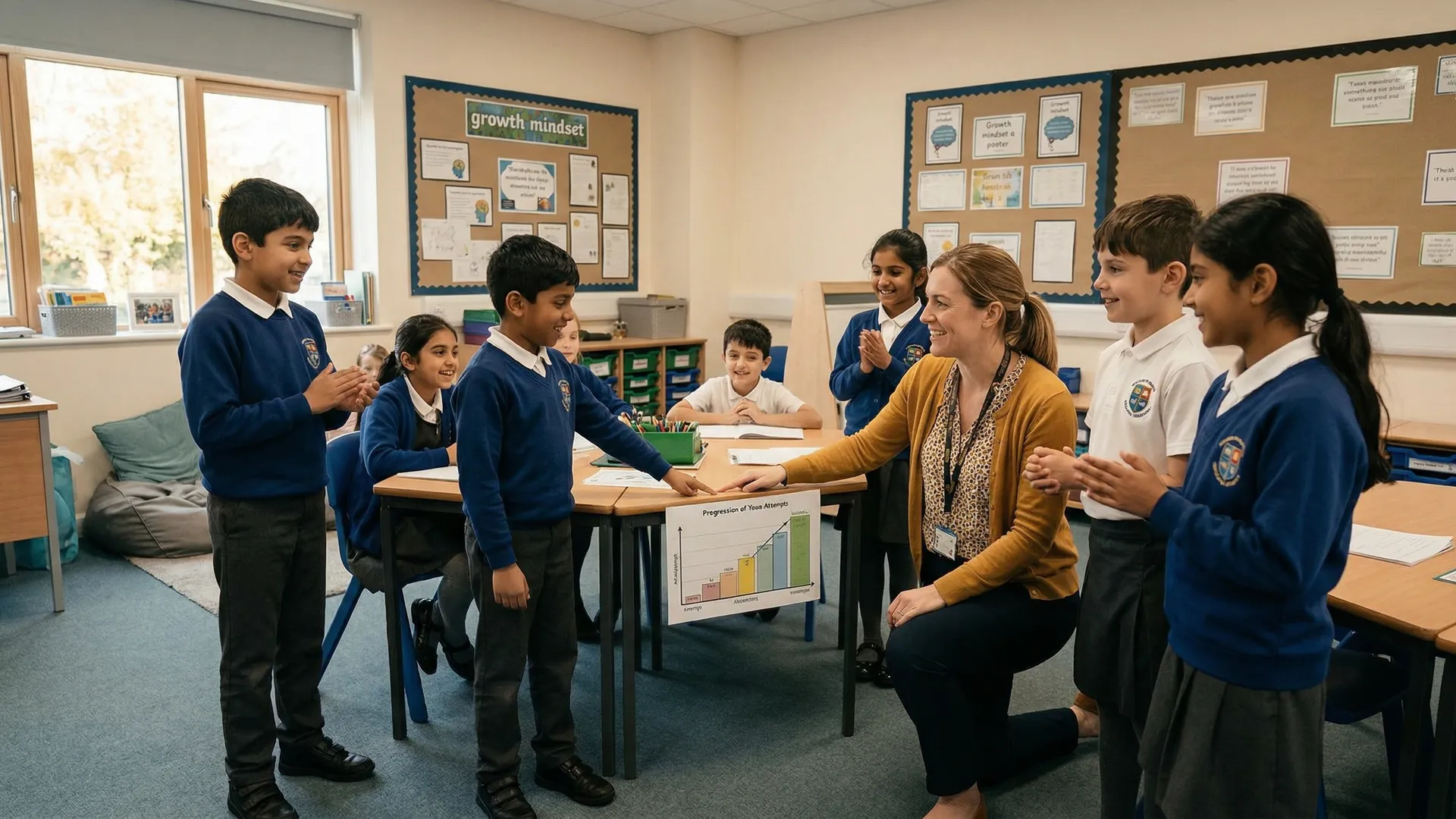
MYP Personal Project: A Complete Supervisor's Guide
A practical guide for MYP supervisors: all four assessment criteria, process journal coaching, managing 20 projects at once, and a September-to-May timeline.


A practical guide for MYP supervisors: all four assessment criteria, process journal coaching, managing 20 projects at once, and a September-to-May timeline.
The MYP Personal Project can look simple. In Year 10, learners work alone for 25 hours. They make a product, keep a journal, and write a report. For teachers, supervising many projects is still demanding, and the IBO guide is very long (IBO, n.d.).
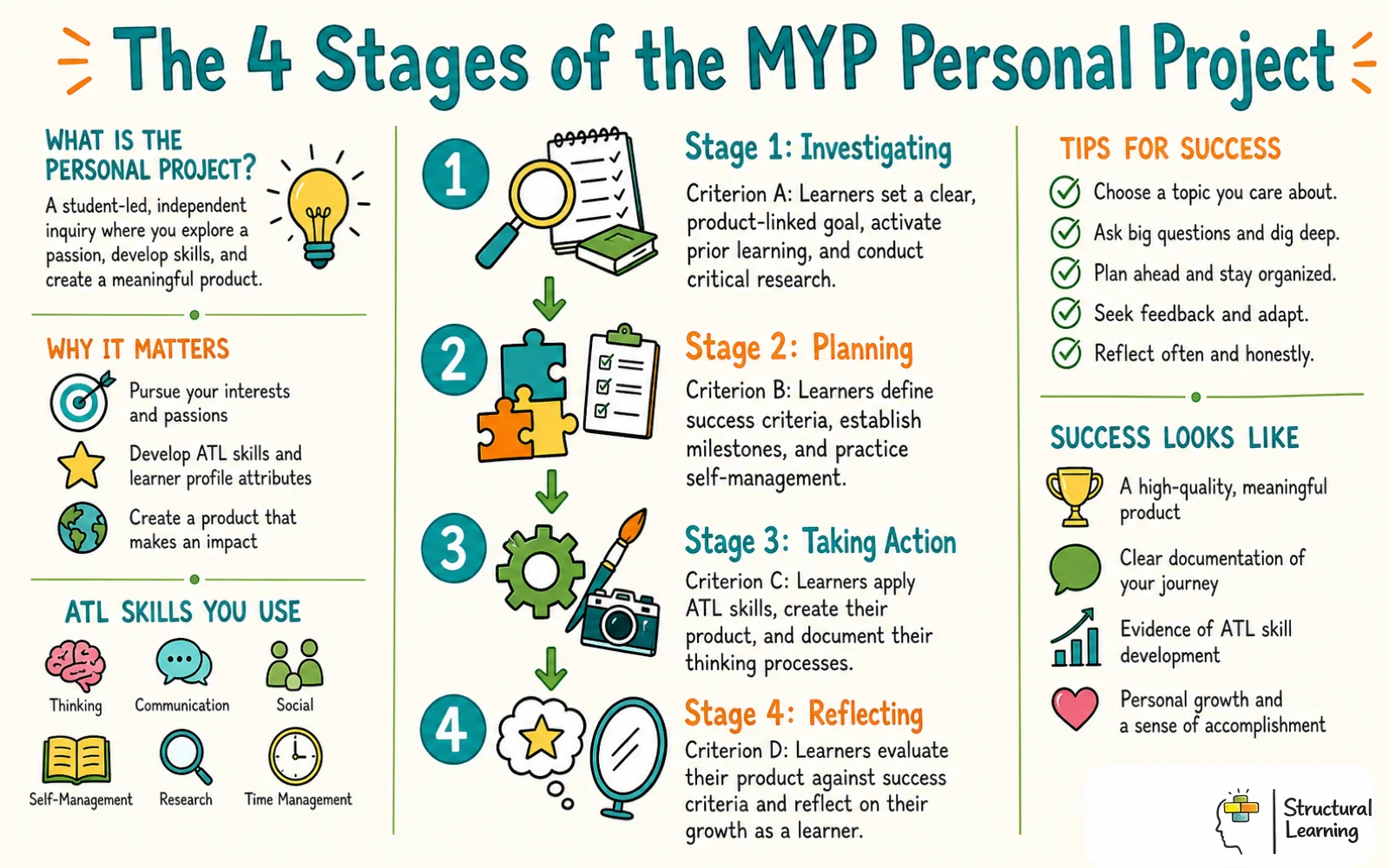
This guide strips away the policy language and gives you the practical version. What does a supervisor actually do? How do you help learners narrow topics without writing the project for them?
How do you manage 20 learners at different stages of 20 completely different projects without losing track? How do you help learners produce genuine reflection, not just a diary of events? Those are the questions this guide answers.
The IB offers four programmes: PYP (ages 3-12), MYP (11-16), DP (16-19) and CP (16-19). The MYP Personal Project sits in the final year of the Middle Years Programme. Each learner sets a learning goal, develops a final product, keeps a process journal and writes a reflective report of 1,500-3,500 words. The personal project designed for MYP5 assesses inquiry, planning, action and reflection, not just the finished product.
Learners make diverse products: novels, websites, and more. The IBO values thinking quality, not product type (IBO, n.d.). Explain this distinction often to learners, parents, and supervisors (Wiggins & McTighe, 2005).
Assessment uses four criteria, each worth a maximum of eight marks:
| Criterion | Focus | What the learner must demonstrate |
|---|---|---|
| A: Investigating | Goal, prior learning, research | A clear goal, understanding of existing knowledge, a range of research sources used critically |
| B: Planning | Design, milestones, self-management | A realistic plan with success criteria, evidence of self-management, adjustments made in response to challenges |
| C: Taking Action | Skills, thinking, product creation | ATL skills applied to the creation of the product, evidence of thinking about decisions made |
| D: Reflecting | Product quality, personal growth | Honest evaluation of the product against the original goal, reflection on what the project revealed about the learner as a learner |
Vague goals harm later progress (Wiggins, 1998). Learners with clear goals plan better and produce stronger work. Supervisors who focus on goal setting save time for everyone (Wiggins, 1998).
The most common reason for a low Criterion A mark is a topic that is too broad. "I want to investigate climate change." "My project is about mental health." "I'm going to write about sport." These are areas, not goals. A goal is specific, product-linked and achievable in 25 hours. "I will design and produce a 20-page illustrated guide to reducing food waste for secondary school learners" is a goal. "Climate change" is not.
Use the Thinking Framework's Part-Whole operation to narrow topics. Learners identify the main parts of a broad area. They then choose one manageable part to investigate.
For example, "sport" includes training, nutrition and psychology (Thinking Framework). One focused option is "performance anxiety in young athletes." The framework gives learners a method for being specific, not just another instruction to narrow the topic.
Research skills sit inside Criterion A. Learners need to show three things: they used a range of sources, judged reliability and connected evidence to their learning goal. Common weak spots are easy to spot: too much use of Wikipedia, no reason for source choice and research presented as a fact list.
At the first check-in, ask: "Where did you find this? How do you know this source is reliable? What does it tell you about your goal that you did not know before?"
Criterion A also asks learners to explain prior learning: the knowledge, experience or MYP subject work that connects them to the topic. This is often mistaken for biography: "I have always liked art." Stronger evidence links existing learning to the new investigation: "My study of biology in MYP Year 4 gave me an understanding of nutrition that I will apply to my investigation of plant-based diets for athletes." That sentence demonstrates prior learning. A list of interests does not.
Criterion B assesses whether the learner can design a realistic plan, set success criteria and demonstrate self-management. It is also where inequality shows. A learner with parents, specialist equipment and quiet weekend time can create hidden hours that the 25-hour planning model does not capture. Bunnell (2011) is useful here: IB access claims need a social lens, not just a policy one.
The most useful planning tool for Year 10 learners is a fortnightly milestone chart. Map it against the official 25 hours. Use the Thinking Framework's Sequence operation: "What are the steps from here to a finished product? Put them in order. Estimate the time."
Then add a hidden-hours column. Include school time, home time, adult help, and paid or specialist resources. This shows when a personal project has too much support. It helps you spot unfair access before the final product becomes the evidence.
| Fortnightly milestone | Target activity | Hours |
|---|---|---|
| September (week 4) | Topic area identified, goal drafted | 2 |
| October (week 2) | Research complete, sources evaluated | 4 |
| October (week 4) | Goal finalised, success criteria written, plan approved | 2 |
| November (weeks 2, 4) | Product creation begins, journal entries recorded | 6 |
| December (week 2) | Mid-point review: product halfway complete, plan adjusted | 3 |
| January (weeks 1, 3) | Product creation completed | 4 |
| February (weeks 1, 2) | Report Criteria A and B written | 2 |
| February (weeks 3, 4) | Report Criteria C and D written | 2 |
Success criteria deserve more time. Many learners write product specifications instead: "My website will have five pages and a contact form." A success criterion answers a different question: "How will I know if this is good?" For example: "A reader with no prior knowledge will be able to explain the three main arguments after reading the site." That is an evaluative standard. Teach the difference before planning begins.
Criterion B also assesses self-management. This means checking whether the learner changed the plan when the project changed. Fortnightly check-ins should ask, "What has changed since last time? What did you adjust?" That gives learners clear language and evidence for real self-management.
A learner who never adjusted the plan may have had an unusually smooth project. They may also have missed where the work moved off plan. Metacognitive awareness of planning is exactly what Criterion B rewards.
Criterion C is where the product gets made. It assesses whether the learner applied relevant skills, demonstrated thinking throughout the creation process, and connected their ATL skills to the decisions they made. Learners often conflate Criterion C with "doing the project," but the criterion is about how the learner thought while they were doing it, not just what they produced.
The most useful prompt for Criterion C is the Compare operation from the critical thinking repertoire. Ask: "At this point in your project, you had two options. What were they? How did you compare them? Why did you choose one over the other?" This helps learners explain their choices, not just list what they did.
Learners who show that they considered different approaches give stronger Criterion C evidence. A reasoned choice matters more than a simple description of the work. The decision log is the evidence. The product is only the outcome of those decisions.
ATL skills assessed under Criterion C include thinking skills, communication skills, research skills, self-management skills, and social skills. Learners need to name the skill and provide evidence of using it. "I used thinking skills" is not evidence. "When my first design prototype did not meet my success criterion for accessibility, I used systems thinking to identify which elements of the design needed to change and in what order" is evidence. Supervisors should train learners to use this structure: skill name, specific situation, what the learner actually did.
The ATL skills framework gives the MYP approaches to learning vocabulary behind Criterion C. It includes thinking, communication, research, self-management and social skills. Learners who use ATL language in subjects can describe their process more clearly in the personal project.
If your school uses the ATL skills planning approach described in our teacher guide, learners will already practise linking cognitive operations to specific tasks. This is exactly what the MYP Personal Project requires.
Self-assessment checkpoints throughout the process give Criterion C its evidence. Use one fortnightly prompt: "Compare your product as it stands today with your success criteria. What matches? What does not yet match? What will you do differently in the next two weeks?"
Learners who answer this regularly build a Criterion C evidence bank by submission. Learners who reflect only at the end are reconstructing, not reporting.
Criterion D is the most frequently under-achieving criterion, and it is almost entirely within the supervisor's control to change this. The reason learners underperform on Criterion D is not that they lack the capacity to reflect; it is that no one has taught them how. Left without a framework, most 15-year-olds write a description of what happened. What they need is a structure for evaluating what happened and connecting it to their development as learners.
Gibbs' Reflective Cycle (Gibbs, 1988) is useful because it gives learners a sequence rather than a blank page. The full cycle has six stages: description ("what happened?"), feelings ("what was I thinking and feeling?"), evaluation ("what was good and difficult?"), analysis ("what sense can I make of this?"), conclusion ("what else could I have done?") and action plan ("what will I do next?"). Criterion D draws on the same movement from account to judgement.
The most important Criterion D question is the one connected to the IB Learner Profile: "What did you learn about yourself as a learner?" This moves the reflective report beyond project description. "I learned I need to start earlier" is logistical. A stronger response says: "I underestimated research time because I confused reading with understanding. Extracting and evaluating an argument took three times longer than reading the source. I now plan research as analysis, not collection." That is high-band reflection.
Criterion D asks learners to evaluate their product against the original success criteria. Good success criteria from September help here. Measurable criteria let learners assess if their product met each one, explain why or why not, and say what they'd change. Vague success criteria leave learners with nothing specific, leading to general statements.
Introduce Gibbs' Reflective Cycle in September, when you introduce the project. Do not wait until March, when learners start writing the report.
Give learners a one-page template with the six stages and a worked example from a fictional project. Then use the cycle in check-ins: "Let's do a quick Gibbs on the research you did this week. What happened? How did you feel about it? What worked? What could you do next?" The cycle should become a habit, not a report-writing trick.
New supervisors often struggle with Personal Project logistics because the role is treated as a pastoral add-on. Managing 20+ personal projects means managing 20 topics, 20 timelines and 20 different self-management profiles. Monthly meetings take 4-5 hours before any preparation or follow-up.
Heads of teaching and learning should model this workload clearly. If they do not, supervision competes quietly with the core timetable.
The solution is not longer meetings. It is shorter contact, more often. A three-minute standing check-in can do most of the work of a 30-minute meeting if the learner arrives prepared. This can happen at the start of a lesson or during registration.
Before meeting the supervisor, every learner completes a fortnightly progress card. It covers what I have done, what I plan next, and one point of uncertainty. The supervisor reads it in 30 seconds. The conversation then starts in the right place.
Tracking 20 projects needs a simple spreadsheet, not a complex system. Five columns are enough: learner name, current criterion focus, last check-in date, next check-in date, and a brief status note. Update it after every contact. Colour-code by RAG (red: at risk, amber: progressing but needs attention, green: on track).
This takes less than two minutes per learner each fortnight. It also means you are not surprised by a learner who has done nothing for six weeks.
The Thinking Framework gives all 20 projects a shared vocabulary. That is why it belongs at the start of the year. Learners need to understand Compare, Sequence, Part-Whole, and Perspective as cognitive operations, or thinking moves. Then check-in questions can be reused across different project types.
Ask, "Which Thinking Framework operation did you use this week? Show me how." The same prompt works for the learner writing a novel and the learner building a prototype circuit. The Thinking Framework is a supervision tool as well as a thinking scaffold.
Stagger start dates by one week between form groups or tutor groups where possible. If all 20 learners submit their goal statements on the same day, you face a marking pile. If group A submits in week 3 of September and group B submits in week 4, the work is easier to manage.
Use the same approach for plan approvals, mid-point reviews, and draft report feedback. Small administrative decisions in September save significant time in February.

The process journal is the most misunderstood element of the Personal Project. Learners often produce detailed diaries of activity with almost no thinking. "On Monday I looked at three websites about nutrition. On Wednesday I started writing my plan." This is a log. It is not a process journal, and it will not contribute meaningful evidence to any criterion.
A process journal is a record of thinking in progress. It captures decisions made and the reasoning behind them, problems encountered and how they were addressed, connections made between research and the evolving product, and moments of uncertainty or insight. The test for any journal entry is: if a stranger read this, would they understand how this learner thinks, not just what they did?
| Weak entry (diary) | Strong entry (process journal) |
|---|---|
| Today I researched food waste. I found some interesting statistics about how much food is wasted each year. | I compared two sources on food waste statistics. The WRAP report (2019) focuses on household waste; the FAO (2011) report includes the whole supply chain. I decided my guide should focus on the point of consumption, not production, because my audience is secondary learners who have no control over supply chain decisions. |
| I changed my plan because I wasn't making enough progress. | My original plan had the illustrated sections completed by week 6, but I have only completed two of five. I identified two causes: I underestimated illustration time (each takes 90 minutes, not 45) and I spent two sessions re-researching after finding conflicting information. I adjusted the timeline by removing one illustration and adding a written explanatory section instead, which is faster to produce and still meets my success criteria for clarity. |
| I used communication skills this week. | I tested my guide with a Year 8 learner to check whether the language was accessible. She understood the main argument but was confused by the term "embodied carbon." I revised that section to use "the carbon produced during manufacturing" instead. This feedback loop improved the clarity of my writing for the target audience. |
Show learners these examples in September. Then show them again in November. The diary habit is hard to shift.
Many learners were praised for detailed diaries in junior school. They may not see why this approach fails at MYP5. Explain the difference clearly, with side-by-side examples, instead of only asking them to "reflect on your thinking."
The process journal format is flexible. It can be handwritten, digital, audio recorded, visual or mixed. The IBO does not prescribe a format.
Some learners produce annotated sketchbooks. Others keep a running document with dated entries. Some use bullet points, while others write paragraphs.
The format is secondary. The evidence of thinking is what matters.

The predictable problems are practical: late starts, inaccessible topics, product obsession and AI-assisted reports that hide weak thinking. Treat these as design risks in the supervision system, not character flaws in learners. The best prevention is an early timeline, a narrow learning goal, regular process journal checks and short verbal defences of key decisions.
When learners start late, they struggle to research well and reflect with care. The project can then feel rushed instead of becoming a thoughtful inquiry. To prevent this, require topic exploration in September, goals in October, and approved plans in November.
For late submissions, supervisors should speak with learners directly, not only send emails. Research shows that conversations work better than reminders for overcoming anxiety (Steel, 2007; Ferrari, 1992; O'Brien, 2002). When early starts feel normal, learners face fewer psychological barriers.
Choosing a topic they cannot access. A learner may want to investigate refugee experiences. But if they have no relevant contacts, ethical route or suitable way to conduct primary research, they cannot investigate the topic properly.
The same applies to topics that need equipment, access or expertise the learner does not have. Ask at goal-setting: "How will you investigate this? What sources are available? What can you do that no one else has done?" If the answer is "I'll search the internet," revise the topic.
Product versus process imbalance. Learners who fall in love with the product and forget to document thinking produce polished products and weak reports. The supervision check-in is the corrective: "Your product is looking good. Show me three process journal entries from the last two weeks that explain a decision you made." If the learner cannot produce them, address the problem now, not at submission.
Generative AI makes evidence harder to judge in Personal Project reports. Learners can outsource written reflection, so supervisors should collect live evidence as well as text. Use two-minute viva voce checks: "Why did you reject that source? What changed after your prototype failed? Which part of the process journal proves this?" Bearman et al. (2024), including Dawson, describe this as assessment validity, not just plagiarism detection: the learner must judge, explain and defend the work.
Parent communication about the Personal Project is where schools often create the workload they later inherit. Parents want their children to do well, but many read "your child is responsible" as "please step in". If a parent writes the learning goal, structures the research or produces part of the final product, the learner loses the evidence needed for Criteria A, B and C. Be explicit in September.
The letter should set a clear boundary. Supervisors give feedback and keep the learner moving, but they do not direct the project.
Parents can provide transport, encouragement, routine and questions about progress. They should not choose sources, rewrite goals, organise the report or make the product. The MYP Personal Project assesses independent thought, not family project management.
Send the parent communication in September at the project launch, not in February when the work is underway. A parent who understands the project from the start is a supervisor's ally. A parent who only hears about it when their child is panicking in February is a variable that is much harder to manage.
Free for teachers. The platform builds a classroom-ready lesson plan from your topic in under two minutes.
September decisions largely decide May's Personal Project outcome. Schools starting concept work sooner get better results. Setting up in September (around three hours) saves time later and improves learner outcomes. (Wiggins & McTighe, 2005; Hattie, 2008).
The sequence from September to May should look like this:
September: Introduce the project concept. Show anonymised examples of strong and weak projects from previous years. Explain the four criteria in plain language.
Give learners the Part-Whole brainstorming tool and ask them to generate five possible topic areas. They do not need to commit yet, as this stage is for exploration.
Introduce the Thinking Framework operations that learners will use throughout the project. Then set the first process journal entry: "Write about a topic area you are considering and why it interests you."
In October, learners explore their topics further. They use Part-Whole (October) to cut five areas to two. The first supervisor checks in now.
Learners draft their goal statement and start researching (October). They compare two sources (October), then write about it (October).
November: The supervisor finalises and approves the goal statement. Learners write the success criteria and complete the planning timeline. The supervisor formally approves the plan before the end of the month.
This is the critical gate. No learner should begin creating the final product without a supervisor-approved plan. Learners who skip this gate almost always struggle with Criterion B.
December: Learners begin creating their products and recording process journal entries. Schedule fortnightly check-ins and use a mid-point review against the assessment criteria. Document any changes to the plan.
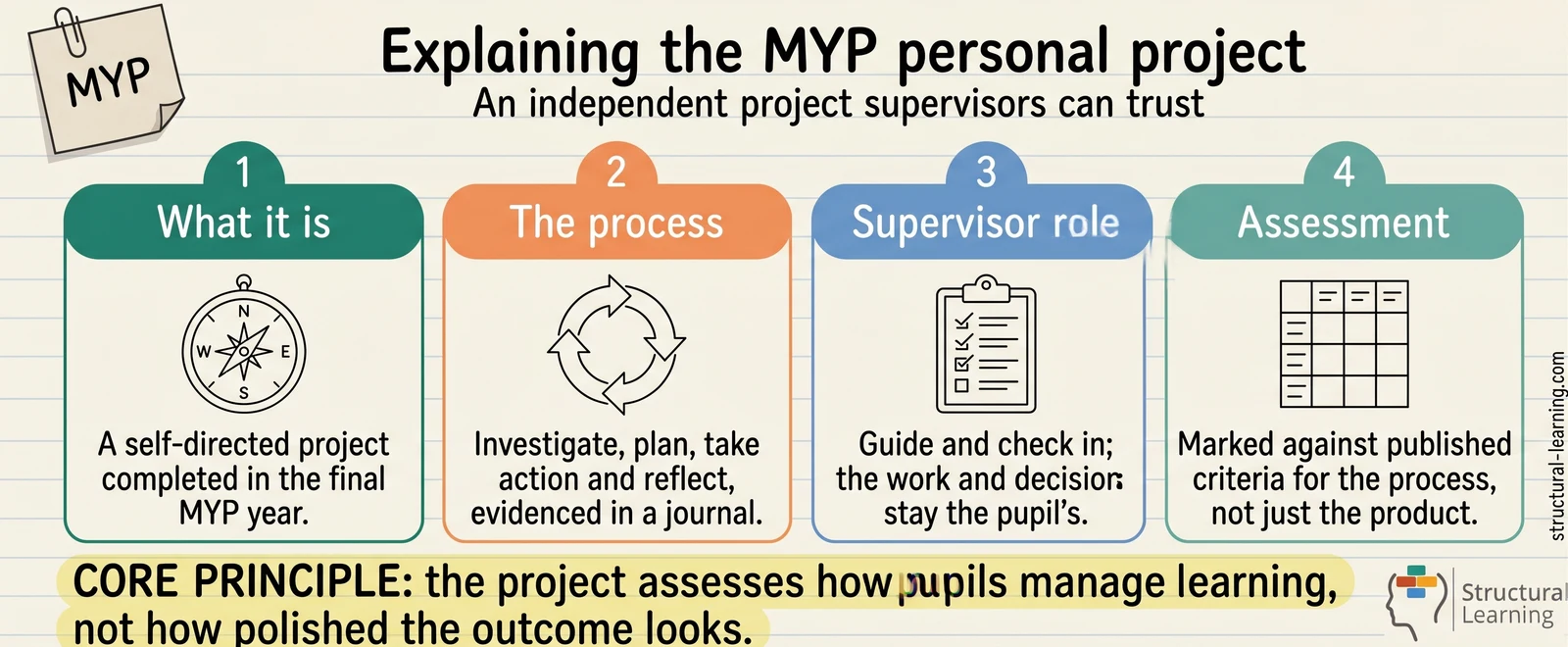
Supervisor scaffolding, such as prompts and milestone questions, supports self-management. It works best when responsibility stays with the learner.
January to March: Learners complete product creation. Report writing begins in February with Criteria A and B. Learners write Criteria C and D in late February and early March.
They submit a draft report to the supervisor. The supervisor gives formative feedback, and learners revise. The reflection sections take longer than learners expect, so protect two full weeks for Criterion D.
April: Submit final reports. Some schools ask learners to present projects to a panel. If presenting, give learners two weeks between submission and presentation so they can prepare, rehearse and respond to likely questions.
Supervisors should review each project before IBO submission in May. Check that the learner's work, journal, report and academic honesty requirements are complete. A simple checklist helps reduce administration errors before moderation.
The Personal Project places heavy executive-function demands on every learner. These include long-range planning, getting started, monitoring progress and switching between tasks. They can be especially hard for ADHD, autistic and anxious learners when schools treat independence as a fixed trait, rather than a skill to teach.
Regular check-ins, clear milestones and worked examples reduce avoidable load. They still keep responsibility with the learner (Diamond, 2016; Vygotsky, 1978; Armstrong, 2012).
The IB Personal Project, when well supervised, can be a rigorous learning journey. It develops research, self-management and reflective practice when supervisors teach the process and then step back (Darling-Hammond, 2008; Wiliam, 2011). The aim is not a flawless product. It is a learning journey in which the learner can explain how interests, skills, evidence and judgement changed over time.
The MYP Personal Project is not a neutral independent-learning task. Bunnell (2011) warns that IB growth and access claims need a social lens; in practice, the 25-hour guideline can hide major differences in home support, equipment, language confidence and time outside school. Supervisors therefore need to audit hidden hours, not treat the timetable as equal for every learner.
A second critique concerns rubric pressure. Torrance (2007) argued that explicit criteria and feedback can become criteria compliance, where learners work to satisfy descriptors instead of developing judgement. The Personal Project carries this risk because the open inquiry ideal sits beside four tightly procedural criteria. Gibbs' cycle has a related limitation: Finlay (2008) cautioned that reflective models can become mechanistic unless teachers push learners towards critical reflexivity.
Generative AI adds a newer methodological problem. Written journals and reflective reports no longer provide secure evidence of cognition on their own. Bearman et al. (2024), including Dawson, place the issue in assessment validity: schools need evidence that learners can judge, explain and defend work, so short viva voce conversations are now part of credible supervision.
There are also cultural and neurodiversity limits. Performative reflection, long-range planning and self-management privilege learners already fluent in academic self-narration, and Armstrong (2012) argues for strength-based support for neurodivergent learners. Gibbs' model and the Personal Project still have lasting value when schools use them as taught tools for reasoning, not as proof that every learner already knows how to manage an independent inquiry.
Gibbs, G. (1988). Learning by doing: A guide to teaching and learning methods.
These studies underpin the supervisory strategies described in this guide.
Zimmerman (2002) linked self-regulated learning to academic success by showing how learners use forethought, performance control and self-reflection. The overview appeared in Theory Into Practice. Fortnightly check-ins for Personal Projects should therefore help learners plan, monitor and adjust their tactics without handing the project over to the supervisor.
Flavell (1979) researched metacognition's development, which helps learners. Think about how each learner thinks to boost their learning skills. This improves learner outcomes.
Flavell (1979) found learners can develop metacognition. Process journal questions let learners label their own thinking, says Flavell (1979). Supervisors see this builds skills for independent study. It is practical, not just paperwork.
Gibbs (1988) found reflective writing improves learner engagement. Oxford Polytechnic research supports this teaching method. Use Gibbs' ideas to better assist learners (Gibbs, 1988).
Gibbs' Cycle prompts learners to reflect better than open tasks. Criterion D responses are richer when learners use the five stages (Gibbs, 1988). Research backs structured reflection over unstructured writing (Moon, 2004; Boud et al., 1985).
Metacognition helps learners succeed (Education Endowment Foundation, 2018). Teach learners to think about their thinking. This improves how they learn.
EEF metacognition guidance shows that teaching planning, monitoring and evaluation can support learner progress when strategies are explicitly taught and connected to the task. This makes check-ins and reflection frameworks useful teaching moves, not just administration (Education Endowment Foundation, 2018).
The IB Organisation (2014) presents MYP principles in practice. This document guides teaching and learning in the Middle Years Programme. Educators can use it to understand how MYP concepts work.
The IBO framework stresses learner agency and ATL skills in the Personal Project. The process is more important than the product. Use the framework and guide to understand project flexibilities. Supervisors should read both (IBO, n.d.).
Mapped to the curriculum. CPD-aligned. Free for teachers.
Open a free account and help organise learners' thinking with evidence-based graphic organisers. Reduce cognitive load and guide schema building dynamically.