Main, P. (2023, June 20). Self-Regulated Learning: Three Phases and Strategies. Structural Learning. https://www.structural-learning.com/post/self-regulation-of-learning
Self-regulated learning helps learners plan, monitor and check their own learning. This allows them to work more independently. In the classroom, this means teaching learners to set clear goals. They must choose useful strategies and check their understanding. They also need to reflect on what to improve. Teaching these habits directly makes learners more confident and resilient. They can then take greater ownership of their progress. This article explores practical ways to build these skills. For a comprehensive overview, see our guide on how to develop metacognition.
Key Takeaways
SRL is a skill, not a personality trait: Self-regulated learners are not simply more disciplined by nature. Intervention research shows that self-regulated learning strategies can be explicitly taught and learned (Zimmerman, 2000), and that learners' self-regulatory ability improves with structured practise.
Three phases structure the SRL cycle: Zimmerman's model describes forethought (planning and goal-setting before a task), performance (monitoring and strategy use during a task), and self-reflection (evaluation and adaptation after a task).
Metacognition is the engine of SRL: Without the ability to monitor one's own understanding accurately, planning and reflection are ineffective. Developing metacognitive awareness is the foundation of any SRL programme.
Self-efficacy affects which strategies learners use: Bandura (1986) showed that learners with low self-efficacy avoid challenging tasks and attribute failure to fixed ability. SRL instruction must address both strategy knowledge and learners' beliefs about their own capacity.
SEND learners need explicit SRL scaffolding: Learners with working memory difficulties, ADHD, or executive function challenges often struggle most with the planning and monitoring phases of SRL. Checklists, templates, and structured reflection prompts provide essential external scaffolds.
Self-Regulated Learning Defined
Self-regulated learning is not an innate ability, fixed intelligence or personality trait. It is a learnable cycle in which learners set a goal, choose a strategy, monitor progress and adjust their behaviour as the task unfolds (Pintrich, 2000). With practice, learners become more strategic, motivated and independent. Consider a Year 9 learner, Sarah, preparing for a history essay. Instead of passively reading the textbook, she first analyses the essay question and creates a detailed outline. She then identifies relevant sources, takes notes strategically, and monitors her understanding by summarising key points. After completing a draft, she reviews her work against the marking criteria and seeks feedback before submitting the final version. Sarah is actively employing self-regulated learning. Self-regulated learning differs from traditional notions of studying. Traditional approaches often emphasise rote memorisation and passive reception of information. In contrast, SRL focuses on learners' active construction of knowledge and skills. This active construction includes understanding when, why, and how to use different learning strategies. Flavell (1979) described metacognition as knowledge and cognition about cognitive phenomena, often summarised as 'thinking about thinking.' SRL skills are vital for academic success and beyond. Learners equipped with SRL strategies are better prepared for lifelong learning. They can adapt to new challenges, manage their time effectively, and take ownership of their personal and professional development. Explicit instruction in SRL can help learners develop growth mindset and metacognition, leading to increased confidence and resilience. A practical implication for teachers is to explicitly teach and model SRL strategies. Start by explaining the concept of SRL and its benefits. Model your own thought processes as you approach a task. Think aloud as you plan, monitor, and evaluate your own work. Provide learners with opportunities to practise these strategies in a supportive environment. This practice builds confidence and competence in self-regulation.
Zimmerman’s Model of Self-Regulation
Barry Zimmerman (2002) provides a framework for understanding the cyclical nature of SRL. This model divides the process into three key phases: forethought, performance, and self-reflection. Each phase involves specific strategies and cognitive processes that contribute to effective learning. The model is iterative, with self-reflection informing future forethought. Imagine a science class where learners are tasked with designing an experiment. During the forethought phase, they might analyse the problem, set specific goals, and plan their approach. In the performance phase, they conduct the experiment, collect data, and monitor their progress. Finally, during the self-reflection phase, they evaluate their results, identify areas for improvement, and adjust their strategies for future experiments. This cycle reinforces SRL skills. The forethought phase involves analysing the task, setting goals, and planning strategies. Learners consider their prior knowledge, identify potential challenges, and select appropriate learning strategies. The performance phase focuses on implementing the planned strategies while monitoring progress and maintaining motivation. Learners use techniques such as self-monitoring, self-instruction, and help-seeking to stay on track. The self-reflection phase involves evaluating the outcomes of the learning experience and attributing success or failure to specific factors. Learners reflect on their strategy use and make adjustments for future tasks. Zimmerman's model emphasises the importance of learners taking control of their learning. It moves away from passive reception of information towards active construction of knowledge. By understanding the different phases of the SRL cycle, teachers can design instruction that supports learners in developing their self-regulatory skills. Scaffolding in education can be used to support learners through each phase of the cycle. A practical implication is to structure learning activities around Zimmerman's model. Provide opportunities for learners to plan, monitor, and reflect on their learning. Use prompts and checklists to guide learners through each phase. Encourage them to articulate their goals, strategies, and reflections. Regularly provide feedback on their self-regulatory processes, not just on the final product.
Three Phases of Self-Regulation
The forethought phase sets the stage for effective learning. During this phase, learners analyse the task, set specific and measurable goals, and plan their approach. Effective planning includes selecting appropriate learning strategies and allocating time and resources. Learners with strong forethought skills are more likely to approach tasks with confidence and purpose. For example, a teacher might ask, "Before you start reading this chapter, what do you already know about the topic? What do you want to learn? How will you check your understanding as you read?" Learners might respond by brainstorming prior knowledge, setting specific questions to answer, and planning to summarise each section. This active planning improves comprehension. The performance phase involves implementing the planned strategies while actively monitoring progress. Learners use self-monitoring techniques to track their understanding and identify areas of difficulty. They may also use self-instruction to guide their actions and maintain focus. Effective performance requires learners to be aware of their cognitive processes and adjust their strategies as needed. Techniques like retrieval practice and spaced practice can be incorporated into this phase, although Bjork (1994) cautions that learners often mistake fluent study for durable learning. The self-reflection phase helps learners consolidate learning and improve future performance. Learners evaluate the outcomes of their learning experience, identify factors that contributed to their success or failure, and adjust their strategies accordingly. This phase involves attributing outcomes to specific actions and developing a sense of self-efficacy. This reflection is a key component of SRL. A practical implication for teachers is to provide structured opportunities for each phase. Use planning templates, progress trackers, and reflection prompts to guide learners through the SRL cycle. Encourage learners to articulate their goals, strategies, and reflections in writing or through discussion. Provide feedback on both the process and the product of learning. By explicitly addressing each phase, teachers can help learners develop their self-regulatory skills. Consider using formative assessment to check in during each phase.
Metacognition and Independent Learning
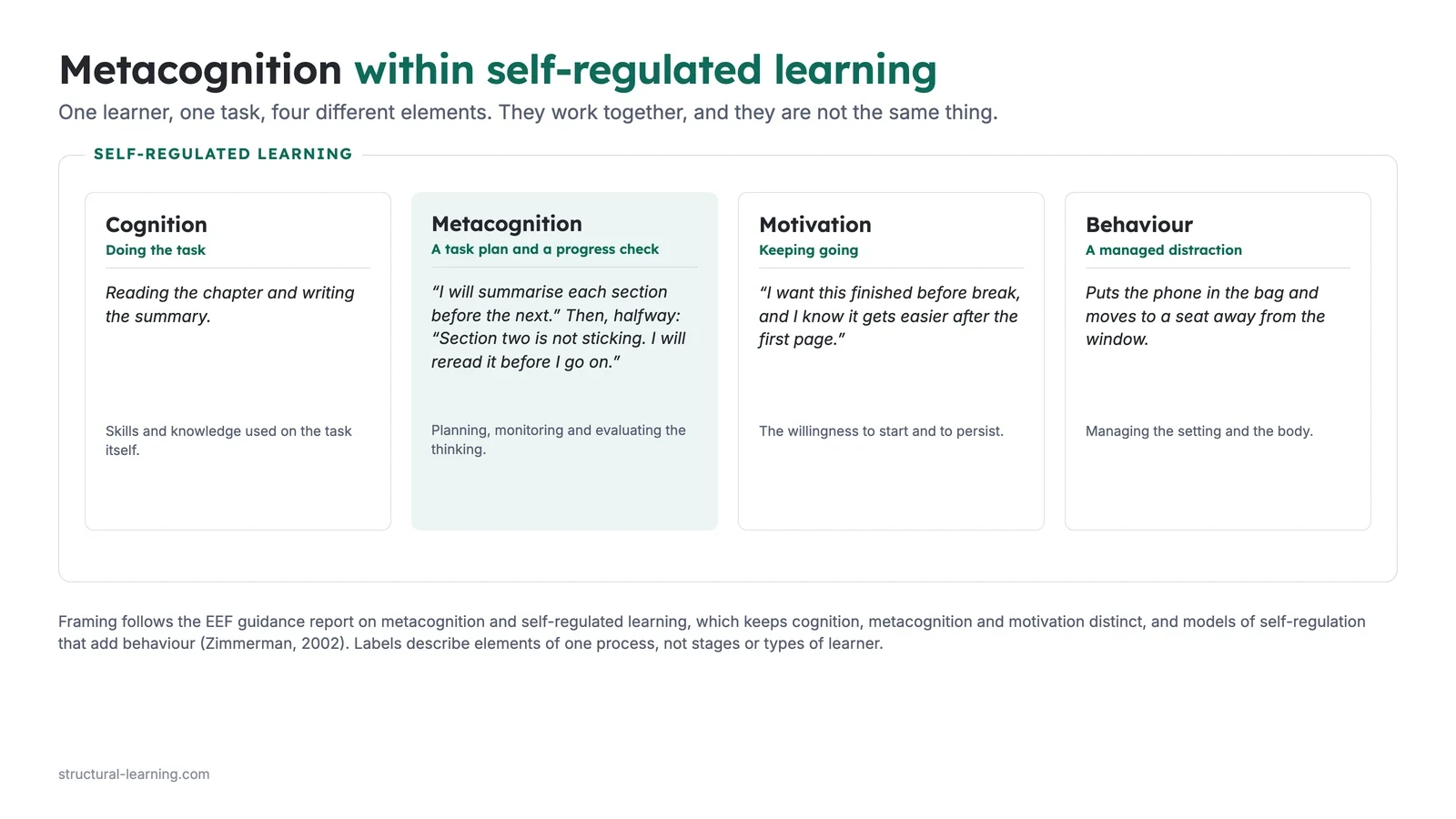
Metacognition is the awareness and understanding of one's own thought processes (Flavell, 1979). It is the ability to think about thinking, to monitor one's own comprehension, and to regulate one's learning strategies. Metacognition is the engine that drives self-regulated learning. Without metacognitive awareness, learners cannot effectively plan, monitor, or evaluate their learning. Imagine a learner struggling with a maths problem. A metacognitively aware learner might pause and ask themselves, "What strategies have I tried so far? Why aren't they working? Do I need to approach the problem differently?" They might then try a different strategy, such as drawing a diagram or breaking the problem into smaller steps. This self-monitoring and regulation is metacognition in action. Metacognitive skills include planning, monitoring, and evaluating. Planning involves setting goals, selecting strategies, and allocating resources. Monitoring involves tracking progress, identifying difficulties, and adjusting strategies as needed. Evaluating involves assessing the outcomes of learning and reflecting on the effectiveness of different strategies. Each of these skills is essential for self-regulated learning. Research consistently demonstrates the link between metacognition and academic achievement. Learners' metacognitive self-regulation is positively, though modestly, related to school achievement (Dent and Koenka, 2016). They are better able to understand their strengths and weaknesses, select appropriate learning strategies, and persist through challenges. Developing metacognition is therefore a key goal of education. A practical implication for teachers is to explicitly teach metacognitive strategies. Model your own thinking processes aloud. Ask learners to explain their reasoning and justify their choices. Provide opportunities for learners to reflect on their learning and identify areas for improvement. Use prompts and checklists to guide learners through the metacognitive process. By encouraging metacognitive awareness, teachers can enable learners to take control of their learning. Be aware of the demands on working memory when introducing new metacognitive strategies.
Metacognition within self-regulated learning. Four elements of one process, working together and not interchangeable. Framing follows the EEF guidance and models that add behaviour (Zimmerman, 2002).
Self-Efficacy and Learner Motivation
Motivation plays an important role in self-regulated learning. Learners who are motivated are more likely to engage in the SRL cycle, persist through challenges, and achieve their goals. Motivation can be intrinsic (driven by interest and enjoyment) or extrinsic (driven by external rewards or pressures). Both types of motivation can contribute to SRL, but intrinsic motivation is generally associated with deeper learning and greater persistence. Consider a learner who is passionate about creative writing. They are intrinsically motivated to improve their writing skills. They actively seek feedback, experiment with different techniques, and revise their work until they are satisfied with the result. Their intrinsic motivation fuels their self-regulated learning process. Bandura (1977) argued that beliefs about capability shape the effort learners invest in difficult tasks; in SRL, this is usually discussed as self-efficacy, or learners' belief that they can succeed in a specific task or domain. Learners with high self-efficacy are more likely to set challenging goals, persist through difficulties, and attribute failure to lack of effort rather than lack of ability. Self-efficacy influences which strategies learners choose and how diligently they apply them. Learners with low self-efficacy may avoid challenging tasks, give up easily when faced with difficulties, and attribute failure to fixed ability. This can create a negative cycle where lack of effort leads to poor performance, which further undermines self-efficacy. SRL instruction must address both strategy knowledge and learners' beliefs about their own capacity. Social learning theory can provide insights into how self-efficacy develops. A practical implication is to encourage a growth mindset and promote self-efficacy. Encourage learners to view challenges as opportunities for growth, not as threats to their self-worth. Provide specific feedback that focuses on effort and strategy use, rather than on fixed ability. Help learners set achievable goals and celebrate their progress. By building self-efficacy, teachers can enable learners to take ownership of their learning.
Teaching Self-Regulation
Teaching self-regulated learning requires a structured approach: explicit instruction, modelling and guided practice. Teachers must create a supportive learning environment that encourages learners to take risks, make mistakes, and learn from their experiences. Effective SRL instruction is not a one-time event but an ongoing process that is embedded in the curriculum. For example, a teacher might introduce a unit on persuasive writing by explicitly teaching the SRL cycle. They could model their own planning process by thinking aloud as they analyse a sample essay question, brainstorm ideas, and create an outline. They could then provide learners with a planning template to guide their own work. During the writing process, the teacher could circulate and provide feedback on learners' self-monitoring and strategy use. Finally, after completing their essays, learners could engage in structured reflection activities to evaluate their learning and identify areas for improvement. Explicit instruction involves directly teaching SRL strategies and explaining their benefits. Teachers can use mini-lessons, demonstrations, and think-alouds to model effective SRL behaviours. They can also provide learners with checklists, templates, and other tools to support their self-regulation efforts. This explicit instruction is particularly important for learners with special educational needs who may require additional scaffolding in education. Modelling involves demonstrating SRL strategies in action. Teachers can think aloud as they approach a task, sharing their thought processes, strategies, and reflections. This allows learners to see how SRL strategies are applied in real-time. Guided practice involves providing learners with opportunities to practise SRL strategies in a supportive environment. Teachers can provide feedback, answer questions, and offer encouragement as learners work on tasks. A practical implication is to integrate SRL instruction into existing curriculum. Look for opportunities to teach SRL strategies within the context of specific subject matter. Use project-based learning, inquiry-based learning, and other active learning approaches to promote SRL. Provide learners with regular opportunities to plan, monitor, and reflect on their learning. By embedding SRL instruction in the curriculum, teachers can help learners develop these skills naturally and effectively.
Landmark Studies on Self-Regulation
Zimmerman, B. J. (2000). Self-efficacy: An essential motive to learn. Contemporary Educational Psychology, 25(1), 82-91. View study This paper explores the critical role of self-efficacy in motivating learners to engage in self-regulated learning. It highlights how beliefs about one's capabilities influence the strategies chosen and the effort invested in learning tasks.
Pintrich, P. R. (2000). The role of goal orientation in self-regulated learning. In M. Boekaerts, P. R. Pintrich, & M. Zeidner (Eds.), Handbook of self-regulation (pp. 451-502). Academic Press. View study Pintrich examines how different goal orientations (e.g., mastery goals, performance goals) impact learners' self-regulatory strategies and academic outcomes. It provides insights into how teachers can design learning environments that promote adaptive goal orientations.
Winne, P. H., & Hadwin, A. F. (1998). Studying as self-regulated learning. Handbook of self-regulation, 3, 277-304. View study This chapter presents a detailed model of studying as a form of self-regulated learning, focusing on the cognitive processes and strategies learners use during studying. It offers practical guidance for teachers on how to support learners' self-regulated studying behaviours.
Bjork, R. A., Dunlosky, J., & Kornell, N. (2013). Self-regulated learning: Beliefs, techniques, and illusions. Annual Review of Psychology, 64, 417-444. View study This review examines learners' beliefs about effective learning techniques and highlights potential illusions of competence that can hinder self-regulated learning. It emphasises the importance of using evidence-based strategies and promoting accurate self-assessment.
EEF. (2021). Metacognition and Self-Regulation. Education Endowment Foundation. View study The EEF provides a summary of research on metacognition and self-regulation, including practical recommendations for teachers. It highlights the potential impact of these strategies on learner outcomes and offers guidance on implementation.
Zimmerman (2002) describes self-regulated learning as a cycle of planning, monitoring and reviewing work. Learners set goals, check their understanding and reflect on what to improve. The EEF Teaching and Learning Toolkit currently reports an average impact of about eight months' additional progress for metacognition and self-regulation approaches when implemented well.
Goal Setting for Independent Learning
Goal-setting is a cornerstone of SRL. Learners who set specific, measurable, achievable, relevant, and time-bound (SMART) goals are more likely to stay motivated and on track. Goals provide a clear direction for learning efforts. They also create a standard against which learners can measure their progress. Imagine a Year 9 English class working on persuasive writing. Instead of simply saying, "Write an essay," the teacher guides learners to set individual goals. For example, a learner might aim to "include three counter-arguments and rebuttals in my essay to strengthen my position." This specific goal gives the learner a concrete target to aim for during the writing process. Effective goal-setting involves more than just stating an intention. Learners benefit from breaking down larger goals into smaller, manageable steps. This approach reduces feelings of being overwhelmed. It also provides frequent opportunities for success, which boosts self-efficacy. Teachers can model this process by thinking aloud while setting their own goals for a lesson or unit. For instance, before starting a new unit on the Second World War, a history teacher might say, "My goal for this week is to help you understand the key causes of the war. To achieve this, we'll spend one lesson on the Treaty of Versailles, one on the rise of fascism, and one on appeasement." This explicit articulation of goals and steps provides a clear roadmap for learners. You can also link goal setting to growth mindset and metacognition by framing goals around learning and improvement rather than performance. Another practical strategy is to encourage learners to write down their goals. This simple act increases commitment and accountability. Goal-setting templates or planners can be useful tools, especially for learners who struggle with organisation. Reviewing and revising goals regularly is also essential. This allows learners to adapt their plans based on their progress and changing circumstances. Teachers can facilitate this process by providing regular opportunities for reflection and feedback.
Self-Monitoring for Learner Progress
Self-monitoring is the process of paying attention to one's own learning and understanding during a task. It involves asking questions such as, "Do I understand this?", "Am I on the right track?", and "What strategies am I using?". Flavell (1979) highlighted the importance of metacognitive monitoring in effective learning. Without accurate monitoring, learners may persist with ineffective strategies or fail to recognise when they are struggling. Consider a Year 10 maths class working on algebra problems. The teacher encourages learners to use a self-monitoring checklist while they work. The checklist includes questions like: "Have I read the problem carefully?", "Have I identified the key information?", and "Am I using the correct formula?". By regularly checking in with themselves, learners become more aware of their problem-solving process and can identify areas where they need help. One effective technique for promoting self-monitoring is to use think-aloud protocols. Teachers model this by verbalising their own thought processes while solving a problem. This provides learners with a concrete example of how to monitor their understanding. Learners can then practise thinking aloud themselves, either individually or in pairs. This activity helps them to identify and articulate their own thought processes. Another useful strategy is to incorporate regular formative assessment activities into lessons. These activities provide learners with feedback on their understanding and allow them to adjust their learning strategies accordingly. Examples include quick quizzes, exit tickets, and peer assessment tasks. These activities can be particularly effective when combined with self-reflection prompts. For instance, after completing a practise test, learners might be asked to reflect on their performance by answering questions such as: "What topics did I find easy?", "What topics did I find difficult?", and "What strategies will I use to improve my understanding of the difficult topics?". Self-monitoring is closely linked to working memory capacity. Learners with limited working memory may struggle to monitor their understanding while simultaneously processing new information. In these cases, providing external supports such as checklists or graphic organisers can be helpful.
Self-Regulation Strategies for SEND Learners
Learners with special educational needs (SEND) often face unique challenges in developing self-regulated learning skills. Difficulties with executive functions, such as planning, organisation, and working memory, can make it harder for these learners to manage their learning effectively. Explicit instruction and tailored support are important for helping SEND learners develop SRL strategies (EEF, 2021). Imagine a learner with ADHD struggling to focus during independent reading. The teacher provides a structured reading log with specific prompts. These prompts include: "What is the main idea of this paragraph?", "What new words did I learn?", and "What questions do I have?". The log acts as an external scaffold, helping the learner to stay focused and monitor their understanding. One key strategy for supporting SEND learners is to provide clear and explicit instruction in SRL strategies. This involves breaking down complex tasks into smaller, more manageable steps. It also means providing learners with specific tools and techniques to help them plan, monitor, and evaluate their learning. For example, learners with dyslexia may benefit from using text-to-speech software to support their reading comprehension. They might also need explicit instruction in note-taking strategies. Another important consideration is to create a supportive and inclusive learning environment. Learners need to feel safe and comfortable taking risks and making mistakes. Teachers can encourage this environment by providing regular encouragement and positive feedback. They can also promote a growth mindset by emphasising the importance of effort and perseverance. Learners with autism spectrum disorder (ASD) may benefit from visual supports and structured routines. Visual schedules, checklists, and social stories can help them to understand expectations and manage their learning environment. Teachers can also use visual timers to help learners stay on task and manage their time effectively. Remember that scaffolding in education is not about simplifying the content, but about making the learning process more accessible.
Evidence for Teaching Self-Regulation
The evidence supports explicit SRL teaching, but effects depend on how it is taught and measured. Meta-analyses of self-regulated learning interventions link strategy instruction with gains in academic performance, motivation and self-efficacy (Dignath and Büttner, 2008). The Education Endowment Foundation (EEF) consistently highlights the positive impact of metacognitive and self-regulation strategies. One meta-analysis of SRL interventions found an average effect size of 0.69, indicating a substantial positive impact on academic achievement. This means that learners who received SRL instruction outperformed those who did not by a measurable margin. The benefits of SRL instruction have been observed across a wide range of subjects and grade levels. SRL interventions are particularly effective when they are integrated into the regular curriculum. This involves embedding SRL strategies into everyday lessons and activities, rather than teaching them as separate skills. For example, a science teacher might incorporate self-questioning prompts into a lab activity. A history teacher might use a structured reflection template after a class discussion. It's important to note that the effectiveness of SRL interventions depends on several factors. These include the quality of instruction, the fidelity of implementation, and the characteristics of the learners. Teachers need to be well-trained in SRL strategies and able to adapt their instruction to meet the needs of their learners. Learners also need to be motivated to engage in SRL activities and willing to put in the effort required to develop these skills. The principles of social learning theory can inform how teachers model and reinforce SRL behaviours. Furthermore, the benefits of SRL extend beyond academic achievement. Learners who develop strong SRL skills are better equipped to cope with challenges, manage their time effectively, and pursue their goals independently. These skills are essential for success in school, work, and life.
AI and Digital Self-Regulation
Self-regulated learning is a cyclical process in which learners actively plan, monitor and adapt their own learning. Large Language Models (LLMs) can support AI-assisted study, but without planning, monitoring and reflection they can become a shortcut for cognitive offloading, where learners remember where to get an answer rather than how to build one themselves (Sparrow et al., 2011; Risko and Gilbert, 2016). UNESCO (2023) and the Department for Education (2023) both frame AI use as something that needs human judgement, clear limits and safe routines.
For teachers, that means AI literacy should sit inside the SRL cycle. Learners need digital self-regulation: deciding when Generative AI is useful, when it should be avoided, and how to test what it produces. They also need prompt evaluation, asking whether a prompt will deepen thinking, request feedback, or simply outsource the task, which reflects wider calls for critical AI use in education (Walter, 2024; Kasneci et al., 2023).
In a Year 8 history lesson, a teacher might say, “Write your explanation first. Then use the chatbot for two checks only: spot one weak claim and ask one question that would improve the paragraph.” Learners submit their own draft, compare the AI response with their notes, and label each suggestion as accepted, rejected or needs checking. What they produce is a stronger paragraph and a short log of how the tool was used, which keeps academic integrity visible.
This matters because independent study now means choosing when not to use AI. A simple classroom routine works well for this. First, state the purpose and limit the tool. Next, check claims against lesson material. Finally, record what changed after getting AI feedback. Learners should use Generative AI as a feedback partner, not an answer generator. This makes self-regulated learning a vital safeguard. It protects both thinking and attainment.
Common Barriers to Self-Regulation
Several barriers can limit SRL. Some learners do not yet know how to set goals, monitor progress or evaluate performance. Others avoid self-regulation because previous failure has lowered their belief that effort and strategy will make a difference.
There is also a cognitive load trap. Tricot and Sweller (2014) argue that many so-called general skills depend on domain-specific knowledge. Asking learners to monitor how they learn while they are still struggling with unfamiliar content can overload working memory. Teachers should attach SRL prompts to the subject task, such as checking a science method, planning a history explanation or reviewing a maths worked example.
For school leaders, the risk is treating metacognition as a pastoral drop-down day. SRL is more likely to improve attainment when departments build planning, monitoring and reflection routines into schemes of work, assessment rubrics and lesson models. Generic assemblies rarely change classroom habits.
Further Landmark Studies On Self-Regulation
Zimmerman, B. J. (1989). A social cognitive view of self-regulated academic learning. Journal of Educational Psychology, 81(3), 329-339. View study This seminal paper lays out the social cognitive framework for understanding SRL, emphasising the interplay between personal, behavioural, and environmental factors. It highlights the importance of self-efficacy and goal-setting in academic achievement.
Pintrich, P. R. (2000). An achievement goal perspective on self-regulated learning. Contemporary Educational Psychology, 25(4), 453-474. View study This article explores how achievement goals (mastery vs. performance) influence learners' self-regulatory strategies. It suggests that learners with mastery goals are more likely to engage in deep learning and persist in the face of challenges.
Winne, P. H., & Hadwin, A. F. (1998). Studying as self-regulated learning. Handbook of self-regulation, 3, 277-304. View study This chapter provides a detailed overview of the cognitive processes involved in SRL during studying. It examines how learners plan, monitor, and evaluate their learning strategies, and how these processes contribute to academic success.
Bjork, R. A., Dunlosky, J., & Kornell, N. (2013). Self-regulated learning: Beliefs, techniques, and illusions. Annual Review of Psychology, 64, 417-444. View study This review examines the effectiveness of various SRL techniques, such as self-testing and spaced practice. It also discusses common illusions of competence that can hinder learners' self-regulation.
Dignath, C., Buettner, G., & Luenenburger, M. C. (2008). How can primary school learners learn self-regulated learning strategies most effectively? A meta-analysis on self-regulation training programmes. Educational Research Review, 3(2), 101-129. View study This meta-analysis focuses on SRL interventions in primary schools, identifying key features of effective training programmes. It highlights the importance of explicit instruction, strategy practise, and teacher support in promoting SRL skills in young learners.
Self-Regulated Learning in the Age of AI
Self-regulated learning now needs to include how learners use Generative AI. If learners can produce an answer at once, access is not the main issue. The question is whether they can avoid cognitive offloading, which means handing too much thinking to the tool, and stay in control of the learning process. Lodge et al. (2023) frame this as a problem of evaluative judgement: learners need to judge the quality, limits and usefulness of AI feedback before they act on it. This makes AI literacy and digital self-regulation central to independent study, especially when learners are doing homework or revision without immediate teacher support.
Zimmerman’s three-phase model still fits this issue. Learners plan before they use AI, check what it produces, and then reflect on whether it improved their understanding (Zimmerman, 2000). In class, this means teaching learners how to plan prompts, instead of letting them type vague requests and accept the first answer. Critical evaluation should become a normal habit, because AI outputs can sound confident but still contain errors, bias or hallucinations (UNESCO, 2023).
A simple classroom routine helps. A teacher might say, “Before you use AI, write what you already know, what you need help with, and what a good answer should include.” Learners then compare the AI response against their notes, highlight one accurate idea, one weak claim, and one point that needs checking in a textbook or trusted source, producing a short audit trail rather than a copied paragraph.
The Anatomy of a Metacognitive Learner in practice: learners monitor whether their strategy is working.
This matters because weaker learners are often the most likely to over-trust fluent answers and miss gaps in reasoning. Research on metacognition shows that novices are not always good judges of what they understand, so AI can amplify false confidence unless teachers build in structured monitoring and reflection (EEF, 2021). Used well, Generative AI can support planning, retrieval and feedback, but it should not replace the thinking that SRL is designed to strengthen.
For teachers, the priority is straightforward: do not ban every AI tool, but do not leave learners to manage them alone. Teach prompt engineering as self-scaffolding: learners write a purpose, ask for feedback rather than an answer, check claims against course material and record what they accepted or rejected. This keeps AI inside the SRL cycle as a scaffold, not a substitute.
From Co-Regulation to Self-Regulation: A Stepping Stone Approach
Before learners can manage their own learning, they usually need to practise it with someone else. Co-regulation means that a teacher, teaching assistant, or peer briefly shares the work of planning, monitoring and reviewing. This lets learners practise these habits with support. This idea fits with Vygotsky (1978), who argued that children first develop control through social interaction, then gradually internalise it.
When teachers model the process out loud, learners begin to see what effective regulation looks like. In a writing lesson, for example, a teacher might verbalise how to set a goal, choose a strategy and check against success criteria before starting. Learners can then complete the same planning frame with guided prompts such as, "What is my first step?" and "What will I do if I get stuck?" This shared routine gives learners a structure they can later use on their own.
Co-regulation is also important during the task itself, not just at the start. A simple strategy is to build in short pause points where learners stop, compare their work to a checklist and explain their next step to a partner. Another useful approach is to provide visual cue cards for routines such as reading instructions twice, underlining key information, or checking whether the chosen strategy is working. These supports are especially important for learners with SEND, who may need external organisation before they can develop internal control.
Reflection should be co-regulated too. After a task, the teacher can guide the class through short review questions such as, "What helped you concentrate?", "Where did you need to change strategy?" and "What will you try next time?" This aligns closely with Zimmerman's self-reflection phase, but it keeps the thinking visible and shared. Over time, as prompts are reduced and routines become familiar, learners move from borrowed regulation towards genuine independence.
Frequently Asked Questions
Routines That Build Self-Regulated Learning
Use short, repeatable routines at key points in the lesson. Start with a clear goal prompt, pause midway for a quick self-check, and finish with a brief reflection on what worked and what needs more practise. When these routines are used consistently, learners begin to manage more of the learning process themselves.
Independent Feedback Use
Give learners a simple structure for responding to feedback, such as read it, identify one improvement, and act on it straight away. Model how to turn comments into specific next steps rather than vague intentions. This helps learners see feedback as something to use, not just something to receive.
Assessing Self-Regulated Learning
Look beyond final outcomes and gather evidence from the learning process. You can use planning sheets, reflection logs, exit tickets, and short learner conferences to see how well learners are setting goals, checking their understanding, and adapting their approach. A simple rubric focused on these behaviours can make assessment more manageable.
Self-Regulation in Group Work
Group work becomes more effective when learners are given clear roles for planning, monitoring, and reviewing their progress together. Ask groups to set a shared goal, pause to check whether they are on task, and reflect on how well their approach worked. This keeps collaboration focused and helps learners learn how to regulate both their own thinking and the group's progress.
Tools for Tracking Progress
Simple tools often work best, such as checklists, success criteria, learning journals, and traffic light self-assessments. These give learners a visible way to judge where they are and what they need to do next. Digital forms or classroom templates can also help make progress tracking quick and consistent.
Limitations and Critiques
Self-regulated learning is valuable, but it is not a neutral cure for every learning problem. One criticism is that SRL can be taught too generically. Tricot and Sweller (2014) argue that many so-called general skills depend on domain-specific knowledge; asking novice learners to monitor strategy use while also learning unfamiliar content can overload working memory.
A second problem is measurement. Much SRL research has relied on self-report tools such as the MSLQ, yet learners often report the strategies they think they use rather than the behaviours they actually show. Winne and Perry (2000) and Panadero et al. (2016) argue for stronger evidence from trace data, think-alouds, observations and performance-linked measures.
There are also cultural and inclusion limits. SRL frameworks often value independence, verbal reflection and individual goal-setting, which may fit Western classroom norms better than communal or apprenticeship models of learning (Rogoff, 2003). Neurodiversity scholars also warn that executive-function differences should not be treated as laziness or poor character; Kapp (2020) argues that deficit-only accounts can misread autistic and ADHD learners' regulation needs.
These critiques do not make SRL disposable. They mean teachers should teach it through subject content, measure it carefully and adapt scaffolds to learners' cultural, cognitive and sensory contexts. Used in that way, SRL remains one of the most useful frameworks for helping learners take more control of their learning.
References
Bandura, A. (1977). Social learning theory.
Bjork, R. (1994). Memory and metamemory considerations.
Vygotsky, L. (1978). Mind in society: The development of higher psychological processes.
Zimmerman, B. (2002). Becoming a self-regulated learner.
Further Reading: Key Papers on Self Regulation Of Learning
These peer-reviewed sources underpin the evidence base for this article. peer-reviewed evidence links aggregate the paper with its journal DOI.
Self-Regulated Learning Strategies and Academic Achievement in Online Higher Education Learning Environments: A Systematic Review View study ↗
1336 citations
Broadbent, J., & Poon, W. L. (2015), The Internet and Higher Education
The most-cited (1,336 citations) systematic review of which self-regulated learning strategies actually predict achievement. Time management, metacognition, effort regulation, and critical thinking show the strongest positive correlations. Rehearsal, elaboration, and organisation had the least empirical support.
Self-Regulated Learning Training Programs Enhance University Students' Academic Performance, Self-Regulated Learning Strategies, and Motivation: A Meta-Analysis View study ↗
320 citations
Maria Theobald (2021), Contemporary Educational Psychology
Recent three-level meta-analysis (32 studies, 4,106 participants, 182 effect sizes). Strongest effects for planning and goal-setting (g = 0.55) and weakest for organisation and rehearsal (g = 0.23). Cooperative arrangements predicted larger effects on cognitive strategies.
About the Author
Paul Main
Founder & Metacognition Researcher
Paul Main is an educator and metacognition researcher who founded Structural Learning in 2002. With a psychology degree from the University of Sunderland and 22+ years helping schools embed thinking skills, he bridges the gap between educational research and classroom practice. Fellow of the RSA and Chartered College of Teaching, with 128+ Google Scholar citations.