Concept-Based Learning: Teaching for Deep Transfer
Concept-based learning: move beyond topic coverage to transferable understanding. Erickson's model with practical strategies for primary and secondary schools.


Concept-based learning: move beyond topic coverage to transferable understanding. Erickson's model with practical strategies for primary and secondary schools.
Concept-Based Learning: Teaching for Deep Transfer is a way to design curriculum. It organises facts, skills and vocabulary around ideas that transfer, such as change, systems, power or evidence. This matters because learners do not transfer knowledge just by memorising more content. They need well organised schemas, metacognitive monitoring and repeated chances to use ideas in new contexts (Brown, 1987; Bransford, Brown, & Cocking, 2000).
In a Year 7 history lesson, a teacher might teach the factual causes of the Industrial Revolution, then ask learners to test the concept of change against a science unit on states of matter and a geography unit on urbanisation. The concept is useful only when learners can explain what stays the same, what changes, and what evidence supports the comparison.
Concept-based learning organises curriculum around broad concepts that transfer, such as systems, change, power and evidence. It still teaches factual knowledge and skills. Teachers can use inquiry. However, novice learners usually need clear vocabulary, worked examples and guided practice before they explore concepts more openly (Kirschner, Sweller, & Clark, 2006; Sweller, 1988).
Evidence overview
The aim is transfer. A learner who studies "systems" in science should later recognise system features in economics, grammar or a school council decision. Teachers make this more likely by naming the concept, teaching the facts that give it substance, and asking learners to explain where the concept does and does not apply.

Concepts should guide the unit. They should not replace subject knowledge. In a three-dimensional curriculum, teachers link concepts, content and skills through questions, guided practice and well-chosen examples. The key test is whether learners can use a concept such as "cause", "pattern" or "responsibility" to explain new material while staying accurate in the subject.
Researchers find that traditional models focus mainly on content and skills. Because they stress knowledge and skills so strongly, they can limit learning opportunities for each learner.
Concept-based learning is best seen as a way to design curriculum. It is not a stand-alone cognitive intervention. Erickson (2007) and Wiggins and McTighe (2005) argue that teachers should start with understandings that transfer, then choose the facts, vocabulary and tasks that make those ideas precise. This is why teacher-facing sources such as Atlas Curriculum Mapping, Inspiring Inquiry and Professional Learning International should be treated as implementation guides, while research claims still need named evidence.
Cognitive science gives stronger support to the parts beneath the approach than to the whole branded model. Research on schema construction, category learning and conceptual change suggests that learners need repeated examples, contrast cases and correction of misconceptions before they can transfer ideas (Vosniadou & Mason, 2022). The route differs by subject. Science concepts often need misconception repair, while history and English need careful work on evidence, interpretation and perspective.
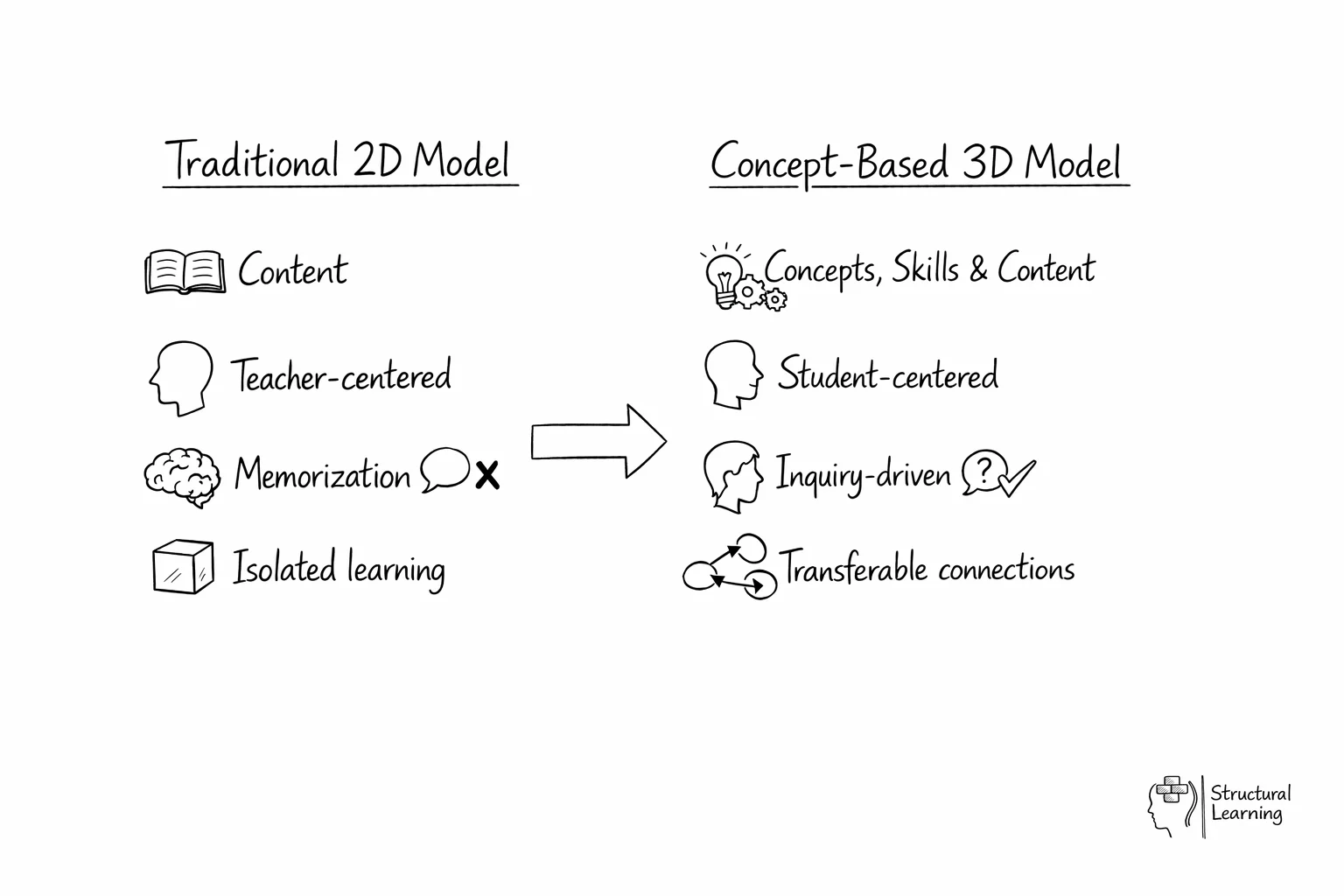
Concept-based approaches embrace concepts and allow them to drive the content and process skills through inquiry. This learning is blended and connected to real life and the world, in authentic ways and enables the development of deeper thinking.
Concept-based teaching works best when learners build knowledge through examples, talk and careful comparison. Vygotsky (1978) argued that social interaction and scaffolding shape learning, but scaffolding still needs clear teacher guidance. For example, a teacher might model two examples of "adaptation" first. Learners could then compare a desert plant, a polar animal and a character adapting to a new setting.
Thinking about concepts helps learners make links between subjects. These links help them transfer skills. (Wiggins and McTighe, 2005) Understanding key ideas supports learning (Bruner, 1960) and helps learners retain knowledge (Ausubel, 1963). This approach also helps learners apply knowledge in different contexts (Bereiter, 2002).
Traditional education focuses on content and skills. Modern models, like those of Bruner (1960), favour concepts. Concepts guide content and skills, connecting to themes, as argued by Dewey (1938) and Piaget (1954). Inquiry approaches help the learner, according to Vygotsky (1978).
Concepts help learners think more deeply. They use higher-order skills that can transfer to new work (Erickson, 2002). A three-dimensional curriculum teaches concepts alongside content and skills (Wiggins & McTighe, 2005). This approach makes learning more effective for the learner.
This can boost learner focus and questioning skills, (Vygotsky, 1978). It differs from standard teaching's memorisation focus (Bloom, 1956). Teacher-led approaches may be less engaging for learners (Piaget, 1936).
Conceptual learning depends on moving between factual recall, procedural skill and conceptual explanation. The knowledge base is not optional. Learners cannot compare "systems" in biology and economics unless they know the parts, processes and vocabulary in each domain.
The stronger route is sequence first, abstraction later. Teach the facts, model comparison, then ask learners to explain a concept in a new example. This reduces working memory load and avoids the mistake of asking novices to think like experts before they have enough knowledge to organise their thinking.

Concept-based learning helps learners understand more deeply and build useful skills. Learners can use these skills, says Hattie (2009), to solve complex issues. Wiggins and McTighe (2005) suggest this prepares learners for a fast-changing world.
A concise Structural Learning audio episode on Concept-Based Learning: Teaching for Deep Transfer, grounded in the curated research dossier and focused on practical classroom use.
Consider research by Erickson (2002) and Lipton and Strong (2011). Plan lessons carefully and adapt teaching. Use practical strategies to include concept-based learning for each learner. Use it as a starting point for professional discussion: identify the learner's current need, record evidence from more than one lesson, and agree the next classroom adjustment with the SENCO or family.
Concept-based learning gives learners a clear reason to compare ideas across subjects. A Year 5 class studying "change" might sort examples from evaporation, the Industrial Revolution and line graphs, then explain what kind of change each example shows. This keeps transfer visible and assessable.
Concept-based learning moves beyond just content (Erickson, 2002). It helps learners think critically and solve problems. This approach builds transferable understanding when inquiry comes after explicit teaching, interleaving, comparison and retrieval practice (Wiggins & McTighe, 2005; Kirschner, Sweller, & Clark, 2006). Learners engage with subjects, then revisit important ideas through spaced retrieval so they can recall them and use them in new contexts (Karpicke, 2008; Hattie, 2012).
Concept-based learning can engage learners in classrooms. Guide learners to explore big ideas, as Wiggins and McTighe (1998) suggest. Help learners connect ideas and use knowledge creatively, like Marzano (2000) proposed. This develops understanding, making learners active, per Hattie (2009).
Erickson and Lanning (2014) say concept-based assessment should test more than recall. Teachers need to distinguish near transfer, where learners apply an idea to a similar task, from far transfer, where they use it in a less familiar subject or context (Barnett & Ceci, 2002; Wiggins & McTighe, 2005).
Performance-based tasks are key. Instead of asking learners to define photosynthesis, teachers could use scenarios. Learners explain plant growth variations by applying their knowledge of systems and energy transfer. This shows if learners understand the ideas (Wiggins, 1998).
Conceptual rubrics help UK teachers check what learners understand. They look at facts, concepts, and transfer.
For example, learners recall dates as factual knowledge. They explain how economics causes tension as conceptual understanding. They then apply these concepts to current global issues (Wiggins, 1998; McTighe & O'Connor, 2005).
Portfolios work well in concept-based learning. They help learners record how they understand core concepts.
A Year 8 geography portfolio could show how learners grasp "interdependence" (Wiggins & McTighe, 2005). This idea can link living systems with global economies (Darling-Hammond et al., 1995). Portfolios also show conceptual growth over time (Erickson, 2002).
Peer assessment and self-reflection let learners explain what they know. Learners solidify learning when they link "balance" to maths and chemistry (Black & Wiliam, 1998). Teachers then see where learners still need help (Sadler, 1989; Boud, 1995).
Concept mapping software lets teachers see learner thinking. This helps track how understanding grows (Novak, 1972). Visuals pinpoint misconceptions and show learner progress (Ausubel, 1968; Jonassen, 2000). This benefits both teachers and learners.
Wiggins and McTighe (2005) suggest careful planning is needed for conceptual units. UK schools often start by choosing 6 to 8 key concepts that thread through the curriculum. This only supports transfer when teachers also map the factual knowledge, vocabulary and examples needed in each subject.
Backwards design helps teachers create units. Start with enduring understandings (Wiggins and McTighe, 2005). Then, identify the content and skills learners need. A Year 5 "Change" unit links science (states of matter), history (Industrial Revolution), and maths (data).
Cross-curricular work helps when it protects subject precision. Year teams in UK primary schools might align examples, not merge subjects. When a science teacher covers adaptation, the English teacher could compare how a character adapts to a new setting, while the maths teacher might examine how data representations change for different audiences.
Essential questions keep conceptual units focused on big ideas rather than discrete topics. Instead of asking "What is the water cycle?", teachers might ask "How do systems maintain balance?" or "What happens when systems are disrupted?" Learners can then compare the water cycle, economic systems and the school playground as a social system.
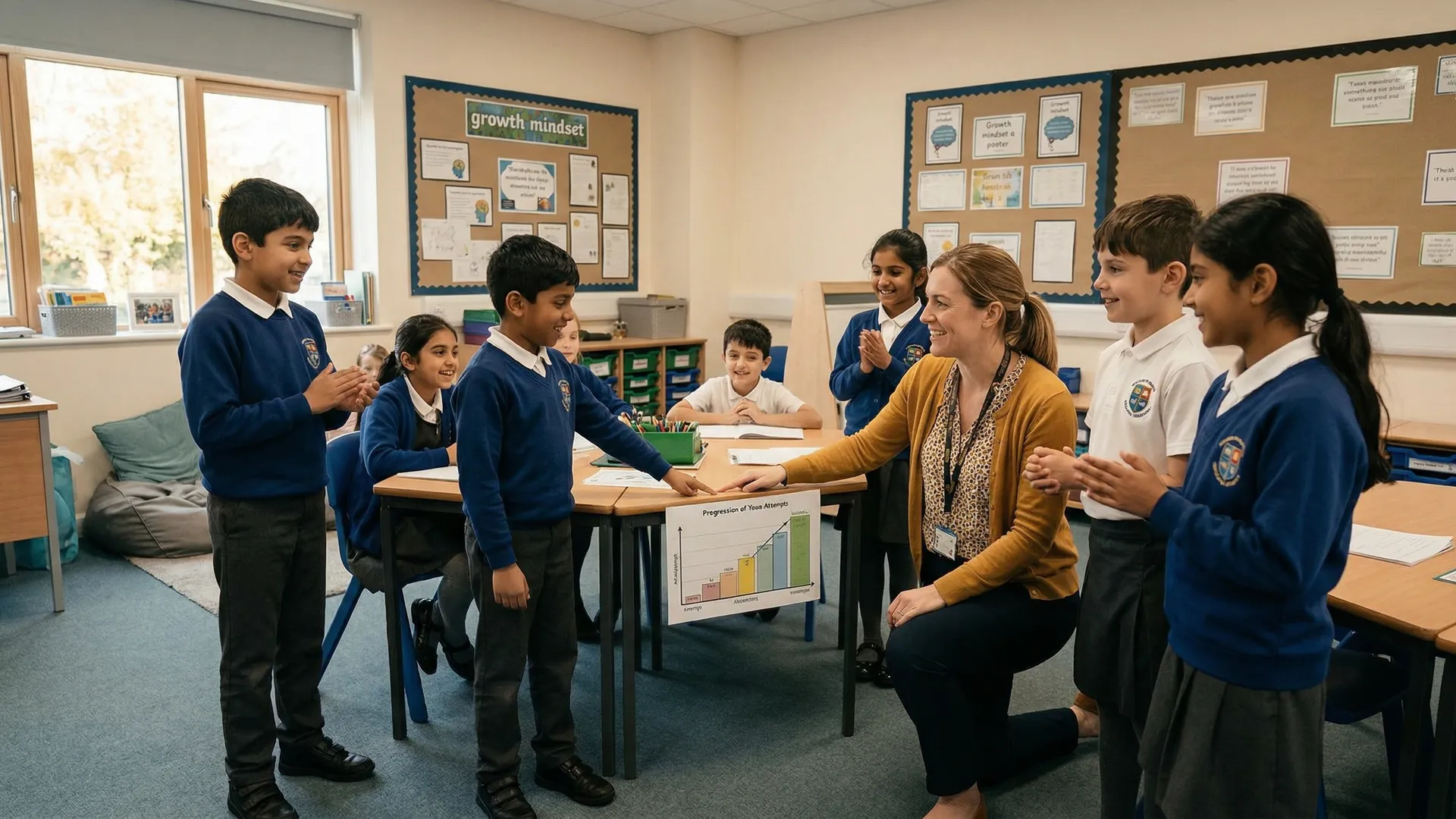
Concept-based units usually move through three classroom phases: hook, exploration and synthesis. The hook activates prior knowledge. Exploration gives learners several examples, and synthesis asks them to apply the concept elsewhere. In a "Power" unit, learners might analyse power in a novel, compare it with political power in history, then propose a fairer classroom decision process.
Teachers choose resources for units. They use varied materials, not just textbooks, to show concepts (Erickson, 2002). Primary sources and current events help learners explore ideas. Learners understand scientific phenomena and maths patterns (Wiggins & McTighe, 2005).
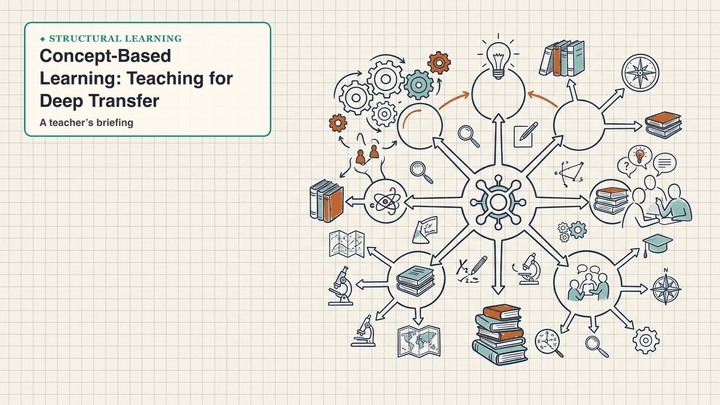
Concept-Based Learning in practice — a classroom-ready briefing you can use this week.
Concept-based learning can fail when schools change the language of planning without changing curriculum sequencing, assessment or staff time. Headteachers should treat the move as a multi-year curriculum project. If inspection, GCSE or SATs pressures still reward rapid factual recall, a sudden whole-school switch can raise workload without improving attainment.
Teachers often worry about coverage because the risk is real. Concepts do not make content optional. A safer route is to teach core knowledge first, then use concepts such as "cause and consequence" to organise and revisit that knowledge across examples.
Parents can resist change, especially in traditional subjects. Schools are more likely to succeed when they explain learning outcomes clearly. They can also show what learners understand. Parent workshops build knowledge (Hattie, 2012) and support (Epstein, 2011).
Staff confidence can dip during the transition. Teachers may be asked to plan abstract inquiry, redesign assessment and produce new resources at the same time. Leaders should protect planning time, use shared unit templates, and start with one subject or year group before scaling.
Curriculum demands can make time feel tight. Schools often succeed when they start small. They might use concept-based teaching in one subject, or use afternoons for inquiry projects (Wiggins and McTighe, 2005).
In this way, teachers build confidence alongside normal lessons.
SATs and GCSE preparation can reveal weak implementation. Learners still need fluent recall, accurate vocabulary and exam practice. Concept work should organise knowledge so learners can use it later. It should not replace interleaved examples, spaced practice, worked examples or low-stakes testing (Karpicke, 2008; Wiliam, 2011).
Resource limits do not have to stop implementation. Concept-based activities need planning time more than extra resources. Schools must give teachers time to plan and build resource collections for conceptual work (Wiggins & McTighe, 2005).
This supports learning across subjects (Erickson, 2002; Hattie, 2012).

In 2026, generative AI makes concept mapping cheap and fast. Tools can draft links between "systems", "change" and "power" across subjects in seconds, so the planning bottleneck shifts from producing maps to checking whether the links are accurate, age-appropriate and grounded in subject knowledge (UNESCO, 2024; OECD, 2026).
Teachers can use AI as a first draft, not as authority. For a Year 8 unit on "systems", an AI map might link cells, markets and school rules. Learners then verify each link, reject weak comparisons, add evidence from lessons and explain which subject details cannot be transferred.
Patel teaches 'change' in all subjects. AI identifies learners struggling with thematic change in literature, not history. The platform creates concept maps linking changes for each learner. This tailored approach supports textbooks.
Reviews of digital concept-mapping tools suggest they can support knowledge transfer when learners use them to organise their understanding (Novak, 1972). Teachers should watch for bias in algorithms. Machine learning should fit good teaching, not just boost clicks.
Free for teachers. The platform builds a classroom-ready lesson plan from your topic in under two minutes.
Concept-based learning uses broad ideas to connect facts, skills and subjects. It aims for deep transfer: learners use a concept such as "change" or "systems" in a new context, while still drawing on accurate subject knowledge (Erickson, 2007; Stern, Ferraro, & Mohnkern, 2021).
Concept-based learning starts with key concepts in your curriculum. Design lessons that encourage learners to explore these concepts. Help learners connect ideas and use their knowledge practically. Ask questions to guide thinking and improve discussions (Erickson, 2002).
Concept-based learning helps learners understand better and think critically. It builds skills they can transfer, connecting different subjects. This makes learning more relevant and interesting for learners. It also prepares them to use knowledge and solve problems (Erickson, 2002).
A common mistake is asking learners to inquire into abstract concepts before they have enough knowledge. Teach examples, vocabulary and worked models first, then ask learners to compare cases and test a generalisation. This balances content, concepts and skills without overloading working memory (Kirschner, Sweller, & Clark, 2006; Sweller, 1988).
Concept-based learning improves understanding and thinking. Do learners transfer knowledge between subjects? Can they connect ideas and solve problems? Observe their work and get regular feedback (Wiggins & McTighe, 2005).
For further academic research on this topic: Use it as a starting point for professional discussion: identify the learner's current need, record evidence from more than one lesson, and agree the next classroom adjustment with the SENCO or family.
Wiggins and McTighe (2005) give key insights. Erickson (2002) explains concept-based curriculum design. Hattie (2009) shows how visible learning affects the learner.
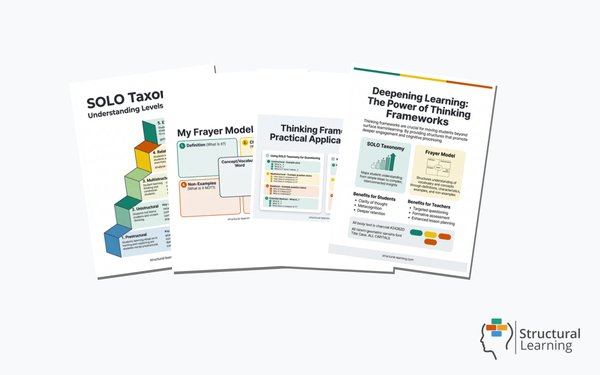
Download this free SOLO Taxonomy, Frayer Model & Thinking Frameworks resource pack for your classroom and staff room. Includes printable posters, desk cards, and CPD materials. Use it as a starting point for professional discussion: identify the learner's current need, record evidence from more than one lesson, and agree the next classroom adjustment with the SENCO or family.
4 ready-to-use resources to deepen understanding and structure learning for teachers and learners.

Fill in your details below to get instant access to your resources.
Click the button below to download your resources.
Mapped to the curriculum. CPD-aligned. Free for teachers.
Concept-based learning has a stronger basis as curriculum design than as a tested intervention. Erickson's model has shaped planning in International Baccalaureate and inquiry-based schools, but the full model has not been tested through many controlled comparative studies. Claims about transfer should therefore be tied to narrower evidence on schema construction, retrieval practice and conceptual change rather than treated as proof of the whole approach (Erickson, 2007; Karpicke, 2008; Vosniadou & Mason, 2022).
A second criticism concerns novice learners. Kirschner, Sweller and Clark (2006) argue that minimal guidance can overload working memory, especially when learners lack the background knowledge needed to see patterns. Concept-based teaching can confuse the expert state, organised conceptual knowledge, with the instructional route novices need. In many classrooms, explicit teaching, worked examples and vocabulary instruction must come before open inquiry (Sweller, 1988).
There are also cultural limits. Concepts such as "civilisation", "progress" or "order" can present particular Western, middle-class assumptions as neutral. Critical curriculum scholars warn that curriculum knowledge is never culturally empty (Ladson-Billings, 1995; Young, 2008). Schools should ask whose examples, histories and forms of evidence are being used.
The enduring value of concept-based learning is that it keeps teachers focused on transfer, but its use is strongest when paired with subject knowledge, explicit instruction and careful assessment.
Brown, A. (1987). Metacognition, executive control, self-regulation, and other more mysterious mechanisms.
Karpicke, J. (2008). The critical importance of retrieval for learning.
Vygotsky, L. (1978). Mind in society: The development of higher psychological processes.
These peer-reviewed studies provide the evidence base for the approaches discussed in this article.
Instructors' attitudes to concept-based statistics teaching were measured. A scale was developed and validated for health and behavioural science courses. The study supports the importance of teacher attitudes when adopting concept-based statistics teaching.
R. Hassad (2010)
found teachers' views on concept teaching matter. Successful use needs more than content. UK teachers should consider how they feel about teaching statistics. This reflection should improve learner understanding and use of concepts.
Problem-based learning supports creative thinking. Learners actively engage with real-world problems. This approach improves their critical thinking. Implement problem-based learning in your classroom. It helps learners develop important skills.
H. Awang & Ishak Ramly (2008)
Problem-based learning can help learners think creatively. It aligns with concept-based learning aims. Teachers can design lessons applying concepts to new situations. This promotes understanding and transfer, according to.
Santamaria, Alcalde, & Galarza (2021) present a new method. It blends performing arts learning, both online and in person. This model helps learners following COVID-19 disruptions, they argue (Santamaria, Alcalde, & Galarza, 2021).
Qingyun Li et al. (2021)
Concept-based learning helped performing arts during the pandemic. Teachers can find new context inspiration to engage learners (Nicholson, 2020; O’Sullivan, 2021; Race, 2022).
Using the Concept of Game-Based Learning in Education View study ↗ 144 citations
Zi-Yu Liu et al. (2020)
Game-based learning can engage learners and develop 21st-century skills. UK teachers can add game elements to lessons to make learning more interactive. This will help make it relevant for learners' lives.
A Proof-of-Concept Study of Game-Based Learning in Higher Education View study ↗ 124 citations
Francesco Crocco et al. (2016)
Game-based learning can improve outcomes, say researchers. UK teachers can use this as proof it works. Game strategies within learning frameworks improve learner engagement and understanding.