Nurture Groups: A Complete Guide for Teachers and SENCOsNurture Groups: A Teacher's Guide to Emotional and Cognitive Readiness: practical strategies for teachers

Updated on  

April 4, 2026

Nurture Groups: A Complete Guide for Teachers and SENCOs

|

March 13, 2026

Discover how nurture groups build emotional security and reduce cognitive load. Learn the six principles, the Boxall Profile, and practical classroom strategies.

Nurture Groups 101: What They Are & Why They Matter infographic for teachers
Nurture Groups 101: What They Are & Why They Matter

Evidence Overview

Chalkface Translator: research evidence in plain teacher language

Academic
Chalkface

Evidence Rating: Load-Bearing Pillars

Emerging (d<0.2)
Promising (d 0.2-0.5)
Robust (d 0.5+)
Foundational (d 0.8+)

Key Takeaways

  • Nurture groups offer a structured, predictable environment to support learners with social, emotional and behavioural difficulties.
  • The approach is based on six core principles developed by Marjorie Boxall that consider all behaviour as communication.
  • Psychological safety directly reduces extraneous cognitive load and frees up working memory for academic tasks.
  • The Boxall Profile is the primary assessment tool used to identify learners, measure progress and set targeted goals.
  • Mainstream teachers can apply nurture principles as universal provision using targeted routines and emotion coaching scripts.
  • Successful transition back to the mainstream classroom requires careful planning, visual supports and clear communication between staff.

What Are Nurture Groups?

Nurture groups provide targeted, short-term interventions for children who struggle with the social, emotional and behavioural demands of school. These groups typically consist of six to ten learners working with two dedicated staff members. The environment is designed to blend the structure of a classroom with the security of a home.

Marjorie Boxall developed the concept in London in the late 1960s to support children arriving at school with severe emotional needs (Boxall, 2002). Boxall recognised that children who lacked early nurturing experiences could not access the standard curriculum. They needed a specific environment that replicated early childhood learning stages to help them build secure attachments and self-regulation skills.

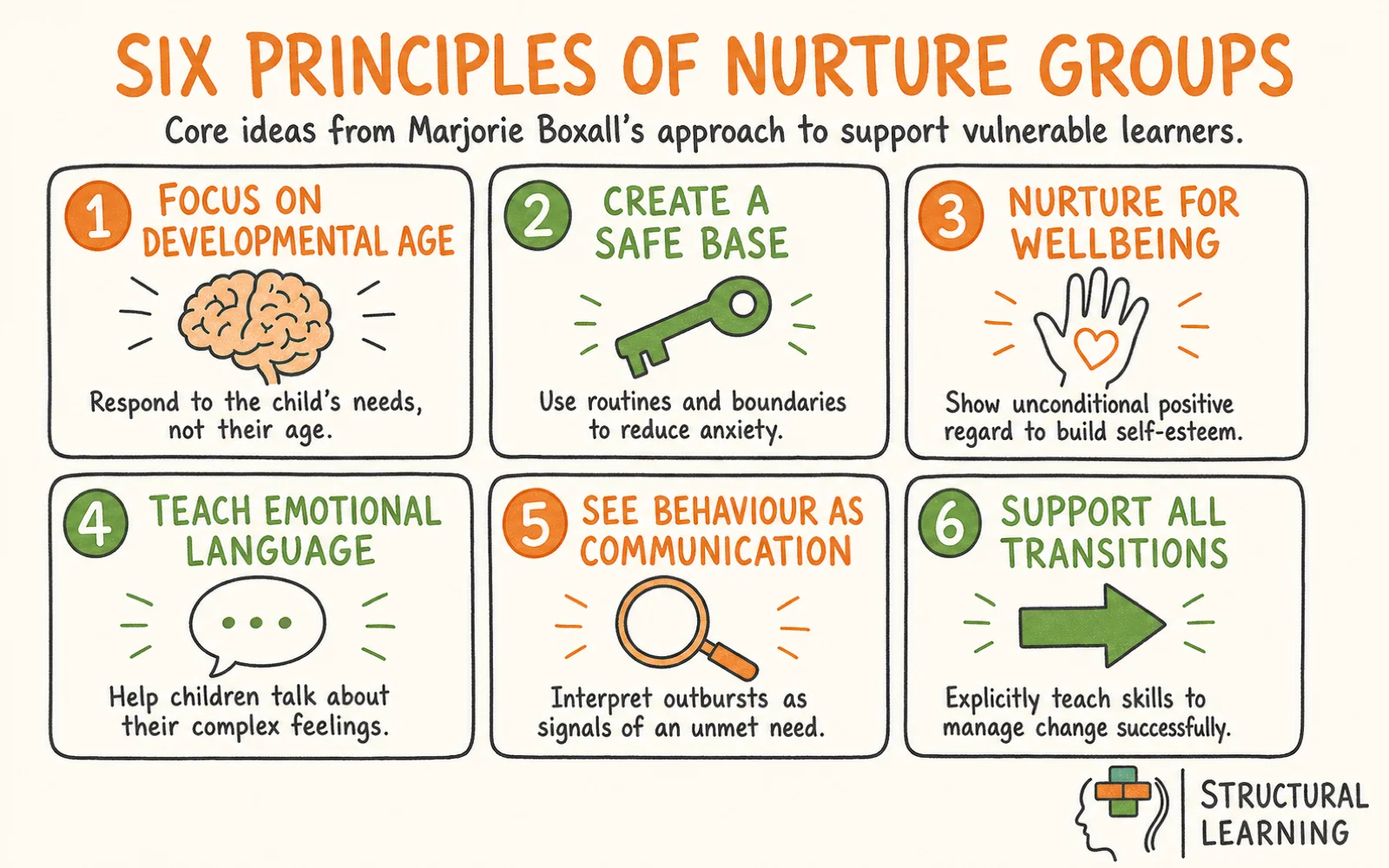
The entire framework is based on the six principles of nurture. These principles guide every interaction, routine and environmental choice within the setting. Understanding these six concepts is essential for any educator looking to implement this provision effectively.
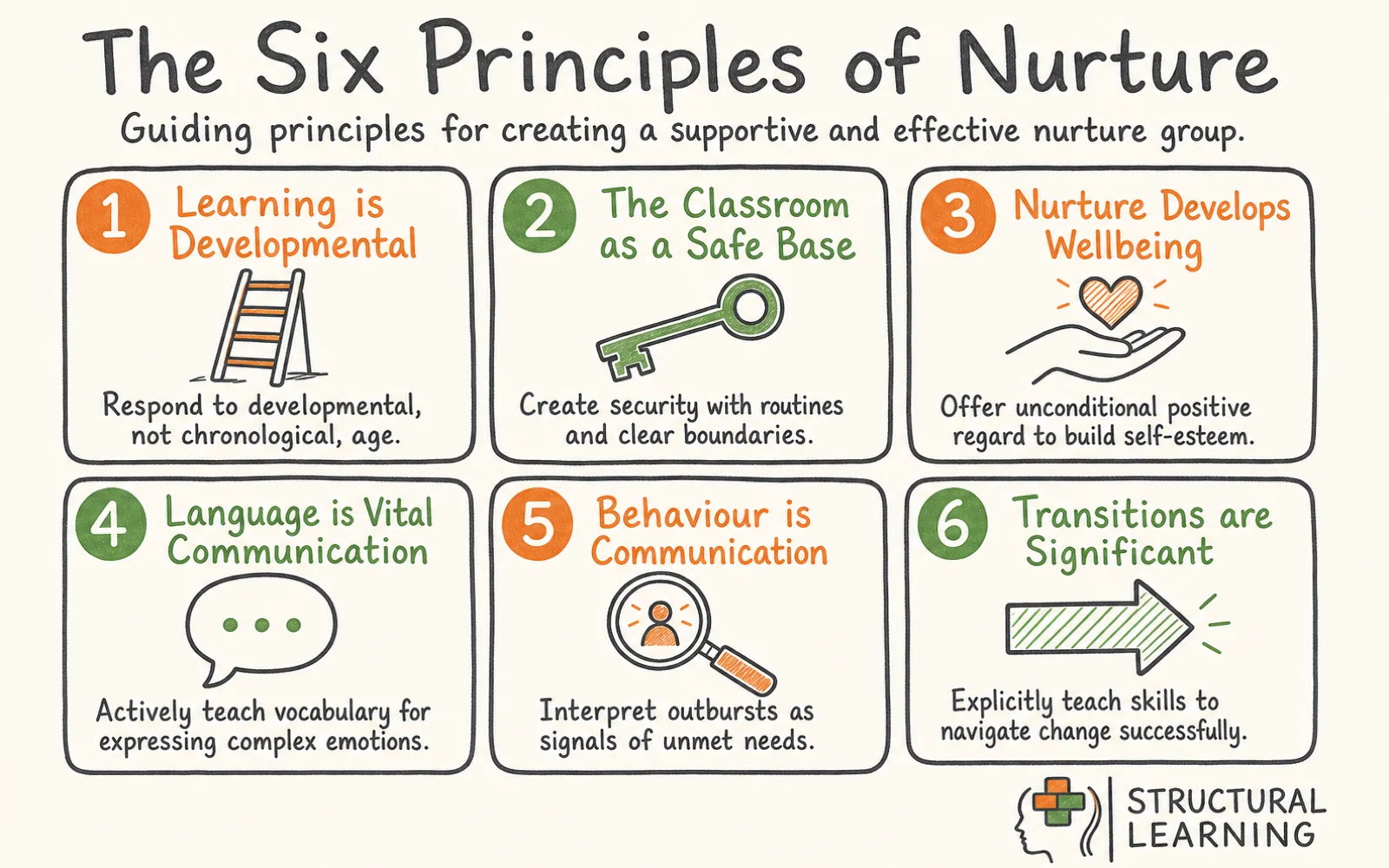
The first principle states that children's learning is understood developmentally. Teachers must respond to the child's developmental age rather than their chronological age. A ten-year-old child might display the emotional regulation of a toddler during moments of distress.

The second principle establishes that the classroom offers a safe base. Predictability, clear boundaries and reliable routines create an environment where anxiety decreases. When children know what to expect, they feel secure enough to take academic and social risks.

The third principle highlights the importance of nurture for the development of wellbeing. Staff must provide unconditional positive regard, validating the child's worth even when challenging behaviour occurs. This builds the self-esteem required for long-term resilience.

The fourth principle treats language as a vital means of communication. Many children in these settings lack the vocabulary to express complex emotions. Staff must actively teach emotional literacy, helping children move from acting out their feelings to talking about them.

The fifth principle asserts that all behaviour is communication. Rather than viewing outbursts purely as disruption, staff must interpret them as signals of unmet needs. This shift in perspective moves the focus from punitive discipline to supportive intervention.

The final principle addresses the importance of transition in children's lives. Changes in routine, moving between classrooms or returning home can trigger intense anxiety. Staff must explicitly teach and scaffold the skills needed to navigate these transitions successfully.

For a concrete classroom example, a teacher sets up a designated nurture space with soft seating, a dining table and clear visual boundaries. This physical layout provides a safe base that helps anxious learners regulate their emotions before formal academic instruction begins. The learners then produce artwork to decorate the space, personalising it and reinforcing their sense of belonging.

Who Needs Nurture Groups?

These groups are designed for children who face significant barriers to learning due to social, emotional or mental health difficulties. These learners often present with attachment issues, trauma backgrounds or severe anxiety that prevents them from engaging in a mainstream classroom of thirty peers. They may display highly challenging externalising behaviours or become completely withdrawn and silent.

Schools use the Boxall Profile to identify which children will benefit most from this intervention. This tool evaluates the child's cognitive, social and behavioural development. It helps staff look past the presenting behaviour to understand the underlying developmental gaps.

The Boxall Profile has two sections. The first examines developmental strands, like how a learner manages experiences and self-control (Boxall, 2002). The second section diagnoses needs. It shows limiting behaviours, and areas needing support (Boxall, 2002).

By completing this profile, the Special Educational Needs Coordinator (SENCO) can pinpoint which early developmental experiences the child missed. This data allows the team to group children with complementary needs and design specific interventions. The assessment is then repeated termly to track progress and adjust the provision.

In a practical classroom example, a SENCO uses the Boxall Profile to evaluate a Year 3 learner who frequently hides under tables during maths. The assessment reveals gaps in early developmental strands, prompting the team to use dual-coding and physical scaffolding to support these specific missing skills. The learner then produces a "safe space" plan, drawing pictures of calming strategies they can use when feeling overwhelmed.

How Nurture Groups Work

A typical nurture group runs for a substantial part of the school week, often covering the morning sessions. Learners remain on the roll of their mainstream class and usually return to their primary teacher for afternoon sessions. This dual-registration ensures they maintain a connection with their peers while receiving intensive support.

The daily routine is highly structured and predictable. Sessions often begin with a breakfast or welcome circle. This creates a low-stakes environment where staff can assess the emotional temperature of each child as they arrive. Visual timetables are prominently displayed and referred to constantly to reduce anxiety about what comes next.

Researchers like Vygotsky (1978) showed learning happens socially. Teachers use the curriculum flexibly, tailoring it to each learner's needs. Scaffolding helps learners succeed, building their confidence in small, manageable steps (Wood et al., 1976).

Food sharing is a foundational element of the daily routine. Staff and learners sit together around a table to share a meal, replicating a supportive family environment. This activity is not just about nutrition; it is a pedagogical tool for teaching social skills.

During a structured toast time classroom example, the teacher explicitly models spreading butter and passing the plate while prompting learners to make eye contact. This structured snack time explicitly models social communication and turn-taking in a safe environment, allowing learners to practice peer interactions. The learners then produce a collaborative placemat, illustrating the steps of making toast and the associated social rules.
The Six Principles of Nurture: Boxall's Foundation infographic for teachers
The Six Principles of Nurture: Boxall's Foundation

Evidence Base and Research

Good groups boost learners' social skills, say educational psychology findings. Bennathan and Boxall (2018) found attendance and engagement improved. Peer relationships saw improvements with effective group interventions.

Research indicates that the benefits extend beyond the individual learners. Schools that adopt these principles report a reduction in overall exclusions and improved staff morale (Cooper & Whitebread, 2007). The approach shifts the school culture from reactive behaviour management to proactive emotional support.

Emotional security links to how learners think. Sweller (1988) said working memory's capacity is limited. Trauma or anxiety makes the amygdala scan for threats. This can impede learning.

Hyper-vigilance adds to cognitive load. Learners use working memory for emotional control and spotting threats. As a result, little mental space remains to follow lessons, read words or do maths (Researchers, Dates).

Nurture groups' routines lower threat responses. Psychological safety then reduces extra thinking demands. This frees up learners' working memory for curriculum access. (Bomber, 2007)

In a typical classroom example, a teacher notices a learner staring blankly at a complex phonics worksheet. Instead of repeating the instructions, the teacher uses a structured breathing exercise to lower the child's anxiety, which reduces extraneous cognitive load and allows the learner to process the academic task. The learner then produces a simplified version of the worksheet, breaking down the task into smaller, manageable steps.

��
Implementing Nurture in Schools

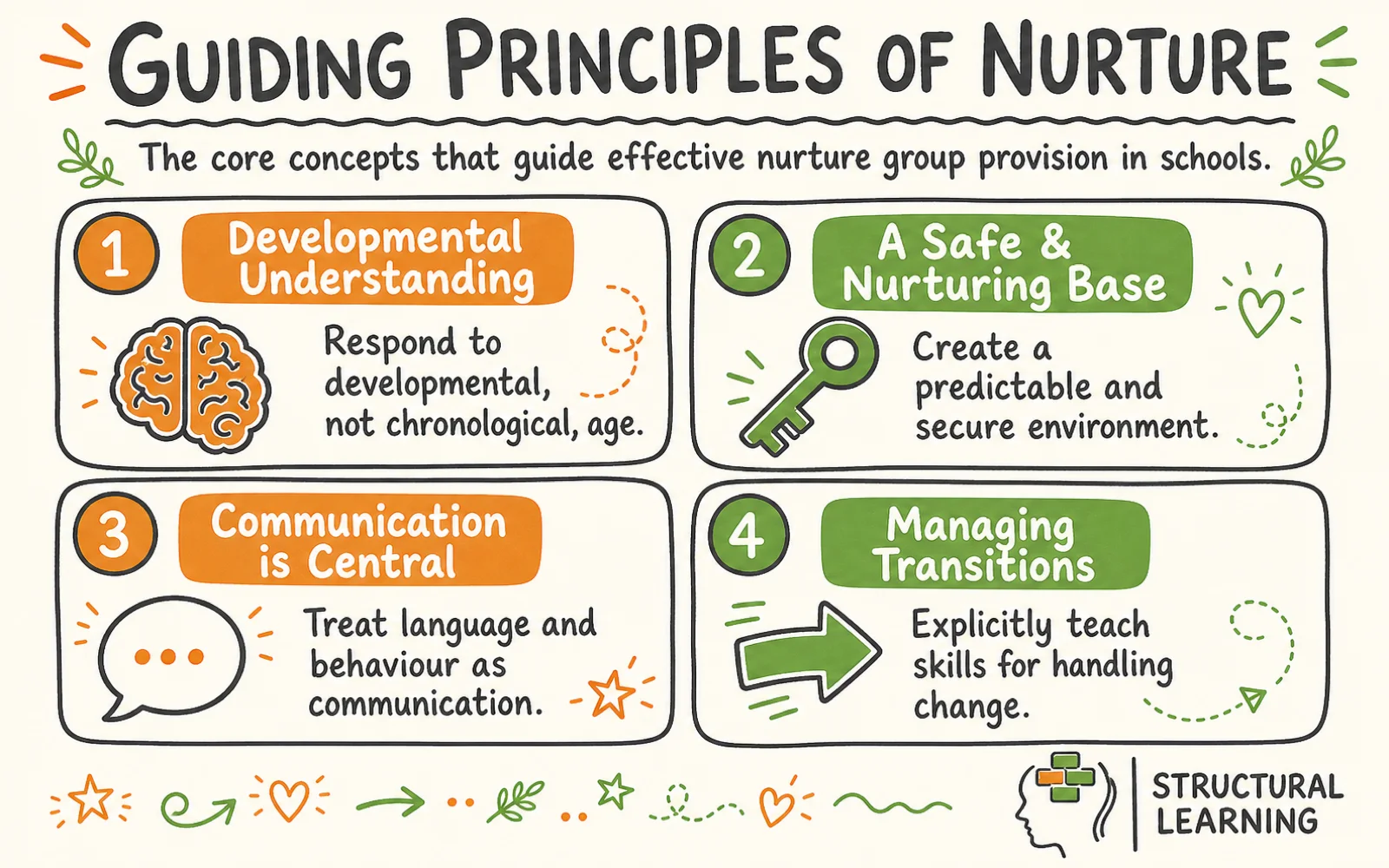
Implementing this provision requires a strategic commitment from the entire school leadership team. It cannot exist as an isolated room operating independently from the rest of the school. The most successful implementations occur when the six principles inform the universal provision across all mainstream classrooms.

Setting up a dedicated room requires careful environmental design. The space needs distinct areas for different types of activity. This usually includes a soft seating area for emotional check-ins, a traditional table for group work and dining, and individual workstations for focussed academic tasks.

Applying these principles in the mainstream classroom ensures that the approach benefits all learners. Mainstream teachers can adopt the concept of the safe base by creating a quiet corner in their room. They can also implement the language principle by using emotion coaching scripts during moments of high tension.

Managing the transition back to the mainstream classroom is the most delicate phase of the intervention. This process must be planned from the first day a child enters the group. Reintegration is gradual, starting with the child attending a single favourite subject in the mainstream class and slowly increasing the time spent there.

During this reintegration phase, communication between the nurture staff and the mainstream teacher is critical. The mainstream teacher must be fully briefed on the specific triggers and successful de-escalation strategies for that learner. Without this shared knowledge, the learner is likely to experience a rapid regression in their behaviour.

For a classroom example of this transition, before moving a learner from maths to PE, the teacher uses a familiar emotion coaching script, saying "I can see you feel worried about the loud hall, and it is okay to feel worried." This helps the student articulate feelings using the vocabulary learned in the group before a behavioural outburst occurs. The learner then produces a visual checklist of steps to take when feeling anxious in the hall, such as "take three deep breaths" or "ask a teacher for help".

A secure learning environment aligns with UDL by offering diverse ways for learners to engage (Rose & Meyer, 2002). Learners can access information and show their understanding in varied ways. (Rose & Meyer, 2002).

Nurture Groups vs Similar Approaches

SENCOs can choose from many emotional and behavioural interventions in schools. Knowing the differences lets SENCOs assign resources well. This table shows how this provision compares to other typical school approaches.

| Feature | Nurture Groups | ELSA (Emotional Literacy) | Play Therapy | Zones of Regulation |

| :--- | :--- | :--- | :--- | :--- |

| Group Size | 6 to 10 learners | 1:1 or very small groups (2-3) | 1:1 | Whole class (Universal) |

| Duration | 2 to 4 terms (substantial weekly hours) | 6 to 12 weeks (weekly sessions) | Variable (weekly sessions) | Ongoing daily curriculum |

Hughes (2002) used play to process trauma. Jennings (2019) taught learners self-regulation. Bomba and Landau (2022) focused on replicating early stages. Gray (2017) helped learners name emotions.

Grouping learners can happen in different ways. Dual-registration, mixing withdrawal and mainstream classes, is one option. You could withdraw learners for 30-minute sessions (Vaughn & Fuchs, 2003). Another choice is withdrawal to a clinical space (Elbaum et al., 2000). Finally, integrate support into standard lessons (Jenkins & Heinen, 1989).

| Staffing | Two dedicated, trained practitioners | One trained teaching assistant | External qualified therapist | Class teacher |

ELSA sessions have one learner complete a worksheet (Smith, 2020). Nurture Groups have six learners share meals, practicing interactions (Jones, 2021). Learners in ELSA make feelings diaries. Nurture Group learners create menus together, building social skills (Brown, 2022).

Secondary School Nurture Groups

Nurture groups started in primary schools, but relational support is still needed after age eleven. Secondary schools adjust the model for adolescent development and specialist timetables. Cooper and Whitebread (2007) found nurture groups work in secondary schools when adapted for older learners. They saw learners improve their social skills and engage more.

The main structural challenge is timetabling. In a secondary school, a learner missing four mornings a week from a mixed timetable of subjects creates significant logistical friction. Most secondary settings therefore adopt a variant model: shorter daily sessions (typically one period per day), lunchtime groups, or a concentrated morning block two or three times a week. The important principle is consistency (the same space, the same two adults, the same predictable routines) rather than an exact replication of the primary model's hours.

Nurture groups address teenage challenges such as identity (Vygotsky, 1978). Learners explore relationships and manage transitions. They also learn to deal with emotions linked to puberty. Role-play builds skills in assertiveness and conflict resolution (Bandura, 1977). Shared meals encourage safety through food and support (Bowlby, 1969).

Staffing matters. Nurture practitioners in secondary schools need credibility with older learners. Use subject knowledge to engage them, as suggested by Colley and Humphrey (2017). Rooms with art or technology keep learners engaged while relationships build. Transition plans help learners return to full timetables. Exit criteria and mentors support reintegration, according to Thacker (2016).

Classic and Variant Nurture Group Models

Practitioners new to nurture provision sometimes assume there is a single, prescribed model. In reality, Nurtureuk recognises both a classic nurture group and a range of variant models, each suited to different school contexts, staffing configurations, and learner needs.

The classic model, as described by Boxall (2002), involves a small group of six to ten learners who attend a dedicated nurture room for four full mornings each week, staffed by two adults (typically a teacher and a teaching assistant). Learners remain on the roll of their mainstream class and return to it each afternoon, maintaining peer relationships and curriculum continuity. The classic model typically runs for two to four terms, with the Boxall Profile reviewed termly to monitor progress and plan reintegration.

Variant models include:

  • Part-time daily sessions: one or two periods per day rather than full mornings, suitable for secondary schools or where staffing limits full-time withdrawal.
  • Lunchtime nurture groups: structured social eating and activity sessions that target the unstructured part of the day many vulnerable learners find most difficult.
  • Targeted afternoon sessions: used when morning timetables cannot accommodate withdrawal, or when a learner's regulation difficulties peak later in the day.
  • In-class nurturing approaches: a trained nurture practitioner works within the mainstream classroom, applying nurture principles without withdrawal, often as a bridge to a full group or as a step-down intervention.

Choosing the right model depends on a school's capacity, the cohort's needs, and whether the goal is intensive repair work (classic model) or maintenance and prevention (variant). Both models should be underpinned by the Six Principles of Nurture, the Boxall Profile, and a clear reintegration plan.

Ofsted and Nurture Groups

Ofsted now closely examine support for learners with special needs and vulnerabilities. Nurture provision falls within this inspection focus. Understanding Ofsted’s priorities allows SENCOs and headteachers to evidence provision confidently. (Ofsted's concerns are also expressed by others, such as Norwich (2014) and Lacey (2011) .)

Ofsted checks the education quality and personal growth of all learners. This includes learners with SEMH needs. Inspectors look for clear identification using tools like the Boxall Profile. They want a rationale for interventions linking to individual needs. Show them progress reviews and how provision improves outcomes (academic, attendance, behaviour, wellbeing).

The Boxall Quality Mark Award shows inspectors your nurture provision meets standards. It is not an Ofsted requirement. Welsh schools show nurture provision quality against Estyn's framework. This framework highlights support for learners with additional learning needs.

Inspectors like Boxall Profile data showing learner progress. Anonymised case studies of learner improvement help too. Show attendance/exclusion data pre and post nurture groups. Parent feedback is useful. Provision maps linking nurture groups to interventions show systems. Document nurture as 'ordinarily available' for learners with SEMH needs; this helps access without EHCPs.

Parent and Carer Engagement

Research shows family engagement boosts nurture group success. Nurtureuk standards include family involvement. Engaging families respectfully helps learners at home. Effective support for learners involves parents and carers (Binnie et al., 2021).

In practice, this means establishing clear, regular communication from the outset. Before a learner begins a nurture group, their parent or carer should receive an explanation of what the group involves, why their child has been identified, and what progress will look like. This conversation should be conducted with warmth and without stigma: attending a nurture group is not a sanction or a reflection of failure; it is additional, tailored support.

Many schools use a home-school nurture book, a simple notebook that travels with the learner and records small moments of progress, positive observations, and activities completed. This creates a bridge between school and home that reinforces the learner's developing sense of security and invites parents to contribute their own observations. Where families are facing their own adversity, this shared record can also help practitioners understand the wider context shaping a learner's behaviour.

Parent workshops that introduce the Six Principles of Nurture can be particularly powerful. When a parent understands why the breakfast routine matters, or why a key adult's consistent response to distress is more helpful than a consequence-based approach, they are better placed to offer congruent support at home. It is also important to set realistic expectations: nurture groups typically support learners over two to four terms rather than weeks, and honest communication about this timeline reduces anxiety and builds trust in the school's approach.

Neuroscience and Brain Development

Nurture groups work because of neuroscience, not just stories. Attachment affects early brain development, shaping emotion circuits (Hughes et al., 2015). Difficult childhoods can stress learners' brains. This makes it harder for them to focus and understand social cues.

Boxall (1960s-70s) found that some learners with challenging behaviour relive early trauma. They need safe relationships more than behaviour management. Bennathan and Boxall (2018) suggest this secure base helps learners explore and learn.

Neuroscience supports this. The prefrontal cortex grows until the mid-twenties (Siegel, 1999). Early caregiving greatly impacts this brain region. Chronic stress harms prefrontal development (Shonkoff et al., 2012). Nurture groups lower stress with predictable routines. These routines help learners learn (Perry, 2009). Shared meals and attuned adults are neurological interventions.

Nurture groups help learners with SEN, like autism or ADHD, manage sensory overload and improve co-regulation. (Bomber, 2007). Sensory circuits alongside nurture groups may boost each other's impact. (Geddes, 2006; Porter, 2008). They tackle both sensory and relational issues for the learner.

Adverse Childhood Experiences and Trauma-Informed Practice

The concept of Adverse Childhood Experiences (ACEs), first described by Felitti et al. (1998) in a landmark study of over 17,000 adults, refers to traumatic events in childhood including abuse, neglect, household substance misuse, domestic violence, and parental mental illness. The original ACE study demonstrated a dose-response relationship: the more ACEs a child experiences, the greater the risk of poor outcomes across physical health, mental health, education, and employment. In educational settings, learners with high ACE scores are more likely to present with SEMH difficulties, school avoidance, and persistent behavioural challenges.

Trauma-informed practice recognises that many challenging behaviours in school are not choices but survival responses rooted in early adversity. A child who is hypervigilant, avoidant, or explosively reactive in the classroom may be responding to triggers that activate a trauma memory rather than simply refusing to comply. Trauma-informed schools shift the question from "what is wrong with this child?" to "what has happened to this child?" This reframing is entirely consistent with the nurture group philosophy.

Nurture groups are one of the most coherent school-based responses to the legacy of ACEs. The predictable daily structure reduces environmental uncertainty, which is the primary trigger for trauma responses. The small group size means that key adults can attune to individual learners and respond sensitively to early signs of dysregulation. The emphasis on emotional literacy and naming feelings (central to nurture group sessions) builds the internal resources that trauma erodes. Cooper and Whitebread (2007) found that nurture group learners showed significant improvements in emotional regulation and social skills, outcomes that align directly with the neurological healing that trauma-informed approaches aim to support.

Schools implementing nurture groups as part of a broader trauma-informed approach may also wish to consult resources on inclusive education and whole-school SEND strategy to ensure that their response to ACEs is systemic rather than confined to a single room.

Cost-Effectiveness and Return on Investment

For headteachers and governors making resource allocation decisions, the question of cost-effectiveness is legitimate and important. Nurture groups require dedicated space, two trained members of staff, and sustained commitment over at least one academic year. Understanding the return on that investment (in learner outcomes, reduced demand on other services, and long-term savings) is essential for making the case to leadership teams and governors.

Nurture groups cost roughly £15,000 to £25,000 per year, varying by school. This covers staff, training, materials, and Boxall Profile licences. With 6 to 10 learners, the cost is like ELSA programmes. It is cheaper than out-of-school options.

The savings are harder to quantify but substantial. Research consistently shows that nurture group learners experience reductions in fixed-term exclusions, improved attendance, and more sustained mainstream classroom participation. Given that a single permanent exclusion costs local authorities an estimated £15,000 to £20,000 in alternative provision, preventing two or three exclusions per year through a nurture group more than covers the cost of the provision. Improved attendance translates directly into pupil premium funding retention. Reduced demand on SENCO time, educational psychologist referrals, and social care involvement adds further value that does not appear on a simple budget line.

Hughes et al. (2015) found early action for social-emotional skills saves money later. Attachment-aware methods in primary schools cut costs in health, justice, and welfare. Nurture groups are a good investment that also lowers exclusion risk, helping schools financially. Mapping costs per learner with results shows this investment's value (Hughes et al., 2015).

The Boxall Quality Mark Award

The Boxall Quality Mark Award recognises good nurture in schools. Nurtureuk gives the award if a school's nurture group meets their standards. They have supported this approach for over 50 years.

Schools provide evidence showing their nurture provision. This covers the physical space and staff training. They use Boxall Profiles for assessment, planning, and review. The Six Principles of Nurture (Colley & Cullen, 2023) are key. Parent engagement and reintegration plans are important. Reviews check schools maintain standards.

The Quality Mark helps schools improve, not just pass inspections. Preparing evidence makes schools tighten systems and update training. Award holders join Nurtureuk, connecting with practitioners and training (Nurtureuk, various dates). For SENCOs, the Mark offers external validation beyond self-evaluation.

Practical Tips for SENCOs

Staff support and careful delivery are key to successful interventions. SENCOs must protect the model's integrity for it to be effective. Here are some clear strategies to manage the provision, as suggested by Smith (2003) and Jones (2019).

  • Assess baseline needs immediately using the Boxall Profile. Do not rely solely on observational feedback from class teachers, as this can be subjective. Use the data to group children with compatible developmental needs rather than just grouping the most challenging learners together.
  • Protect the dedicated staff members. Do not pull these practitioners away to cover break duties or staff absences. The success of the intervention relies entirely on the predictability and reliability of the adults running it.
  • Train all mainstream staff on the six core principles. The intervention will fail if a child leaves an empathetic environment and walks into a rigid, punitive mainstream classroom. Consistency of language across the whole school is vital.
  • Integrate cognitive science into your staff briefings. Explain to teachers that emotional regulation is not just about good behaviour. Teach them that lowering anxiety directly frees up working memory for academic tasks.
  • Plan the return transition from the first week. Establish clear, data-driven exit criteria using the Boxall Profile. Avoid keeping a child in the setting simply because they are comfortable there, as this creates dependency.
  • Communicate the pedagogical purpose of routines to parents. Explain why the children are making toast or playing board games. Ensure parents understand that these activities are designed to teach missing developmental skills.
  • For a practical classroom example of these tips, a SENCO creates a one-page transition passport for a learner returning to the mainstream classroom. It lists the child's specific sensory triggers and provides the mainstream teacher with the exact emotion coaching scripts the child recognises and responds to. The learner then helps to design their own passport, choosing images and phrases that resonate with them.
    From Identification to Transition: The Nurture Group Process infographic for teachers
    From Identification to Transition: The Nurture Group Process

    Common Questions About Nurture

    How long do learners usually stay in the intervention?

    Children typically remain in the setting for two to four terms. The duration depends on the severity of their developmental gaps and their progress on the Boxall Profile. Reintegration is a phased process rather than a sudden cutoff.

    Will children fall behind on their academic learning?

    Academic learning stays crucial in the daily routine. Learners unable to regulate emotions struggle to access the curriculum (Immordino-Yang & Damasio, 2007). Interventions boosting safety improve learners' readiness (Dweck, 2006; Yeager & Walton, 2011).

    Can secondary schools use this approach?

    Even with different classrooms, these principles work well, (Bowlby, 1969). Secondary schools manage movement between spaces, (Zeedyk et al., 2009). Attachment and communication are still key for every learner, (Marzano & Pickering, 2007).

    How do schools fund this provision?

    Schools typically utilise their SEN budget and pupil premium funding to staff and resource the room. While the initial setup cost is high, headteachers often find it reduces the long-term costs associated with permanent exclusions and 1:1 crisis support.

    How do we measure the impact of the intervention?

    The Boxall Profile gives data on learner emotional and behavioural progress. Schools track attendance and any decreases in problem behaviour. Academic improvements are also monitored (researchers, date).

    For a final classroom example addressing parent queries, when parents ask if their child is missing out on phonics, the teacher shares a portfolio showing how phonics is embedded into the group's baking activity through reading and decoding recipe cards. The learners then produce their own simplified recipe book, using pictures and keywords to demonstrate their understanding.

    The Boxall Profile helps identify learner gaps. Spend ten minutes reviewing a challenging learner's profile. Use it to plan their next intervention, (Boxall, 2002). Addressing these gaps supports the learner's progress, (Cooper & Jacobs, 2011). Prioritise specific needs for effective support, (Webster & Blatchford, 2015).

    Further Reading: Key Research Papers

    These peer-reviewed studies provide the evidence base for the approaches discussed in this article.

    Nature-nurture in the classroom: entrance age, school readiness, and learning in children. View study ↗ 165 citations

    F. Morrison et al. (1997)

    Morrison et al.'s paper explores the interplay of nature and nurture on school readiness and learning, highlighting factors relevant to children entering school. This is important for teachers and SENCOs in nurture groups as it provides context for understanding the diverse developmental starting points of children and tailoring interventions accordingly.

    Helping Children Thrive at School: The Effectiveness of Nurture Groups View study ↗ 70 citations

    Tracey Sanders (2007)

    Sanders' research (dates omitted) shows nurture groups help learners succeed. The paper justifies nurture groups as an intervention, based on evidence. It shows they may improve results for vulnerable learners.

    Nurture Groups aim to support learners in secondary schools. Research by Radford (2017) shows positive effects on well-being. Observational data from Bassett et al. (2018) reveals implementation challenges. Qualitative work by Smith (2019) highlights the learner experience. Further research is needed, say Jones & Lee (2020), for long-term impacts.

    Robyn Grantham & Fiona Primrose (2017)

    Grantham & Primrose (year not given) studied nurture groups in secondary schools. Their work helps teachers support older learners. They offer insights on keeping nurture group principles while adapting them. This meets secondary learners' needs.

    Nurture offers potential in education. A model and research plan were developed (View study ↗ 6 citations). This builds on work by researchers like Howard and Cockayne (2017). Others include Cooper and Whitebread (2007) and O’Connor and colleagues (2018). Further research could help learners thrive.

    Professor Tommy MacKay (2017)

    MacKay (date not provided) suggests future nurture directions for education. This paper offers a model and research agenda for teachers and SENCOs. It helps learners understand nurture principles and research within their practice.

    Free Resource Pack

    Nurture Groups: Teacher Readiness

    Nurture Groups support emotional and cognitive readiness. Effective implementation requires understanding key principles. Educators can find essential resources to support learners (Bennathan & Boxall, 2000). These approaches help learners thrive, according to research (Colley & Cooper, 2016). Training improves outcomes for learners (Lucas et al., 2006).

    Nurture Groups: Teacher Readiness , 4 resources
    CPD Briefing Visual Quick Reference Guide Planning Template Classroom Checklist Nurture Groups Emotional Development Cognitive Readiness Social-Emotional Learning

    Download your free bundle

    Fill in your details below and we'll send the resource pack straight to your inbox.

    Quick survey (helps us create better resources)

    How confident do you feel in implementing the core principles of Nurture Groups in your practice?

    Not at all confident
    Slightly confident
    Moderately confident
    Very confident
    Extremely confident

    To what extent do you feel your school provides adequate support and resources for Nurture Group initiatives?

    Not at all
    Slightly
    Moderately
    Well
    Extremely well

    Research suggests integrating strategies boosts learning. Effective strategies support learners' emotional and cognitive states (Dweck, 2006). Daily interactions using these strategies help learners progress (Hattie, 2008). How often do you use them?

    Never
    Rarely
    Sometimes
    Often
    Always

    Your resource pack is ready

    We've also sent a copy to your email. Check your inbox.

    Loading audit...

    Nurture Groups 101: What They Are & Why They Matter infographic for teachers
    Nurture Groups 101: What They Are & Why They Matter

    Evidence Overview

    Chalkface Translator: research evidence in plain teacher language

    Academic
    Chalkface

    Evidence Rating: Load-Bearing Pillars

    Emerging (d<0.2)
    Promising (d 0.2-0.5)
    Robust (d 0.5+)
    Foundational (d 0.8+)

    Key Takeaways

    • Nurture groups offer a structured, predictable environment to support learners with social, emotional and behavioural difficulties.
    • The approach is based on six core principles developed by Marjorie Boxall that consider all behaviour as communication.
    • Psychological safety directly reduces extraneous cognitive load and frees up working memory for academic tasks.
    • The Boxall Profile is the primary assessment tool used to identify learners, measure progress and set targeted goals.
    • Mainstream teachers can apply nurture principles as universal provision using targeted routines and emotion coaching scripts.
    • Successful transition back to the mainstream classroom requires careful planning, visual supports and clear communication between staff.

    What Are Nurture Groups?

    Nurture groups provide targeted, short-term interventions for children who struggle with the social, emotional and behavioural demands of school. These groups typically consist of six to ten learners working with two dedicated staff members. The environment is designed to blend the structure of a classroom with the security of a home.

    Marjorie Boxall developed the concept in London in the late 1960s to support children arriving at school with severe emotional needs (Boxall, 2002). Boxall recognised that children who lacked early nurturing experiences could not access the standard curriculum. They needed a specific environment that replicated early childhood learning stages to help them build secure attachments and self-regulation skills.

    The entire framework is based on the six principles of nurture. These principles guide every interaction, routine and environmental choice within the setting. Understanding these six concepts is essential for any educator looking to implement this provision effectively.

    The first principle states that children's learning is understood developmentally. Teachers must respond to the child's developmental age rather than their chronological age. A ten-year-old child might display the emotional regulation of a toddler during moments of distress.

    The second principle establishes that the classroom offers a safe base. Predictability, clear boundaries and reliable routines create an environment where anxiety decreases. When children know what to expect, they feel secure enough to take academic and social risks.

    The third principle highlights the importance of nurture for the development of wellbeing. Staff must provide unconditional positive regard, validating the child's worth even when challenging behaviour occurs. This builds the self-esteem required for long-term resilience.

    The fourth principle treats language as a vital means of communication. Many children in these settings lack the vocabulary to express complex emotions. Staff must actively teach emotional literacy, helping children move from acting out their feelings to talking about them.

    The fifth principle asserts that all behaviour is communication. Rather than viewing outbursts purely as disruption, staff must interpret them as signals of unmet needs. This shift in perspective moves the focus from punitive discipline to supportive intervention.

    The final principle addresses the importance of transition in children's lives. Changes in routine, moving between classrooms or returning home can trigger intense anxiety. Staff must explicitly teach and scaffold the skills needed to navigate these transitions successfully.

    For a concrete classroom example, a teacher sets up a designated nurture space with soft seating, a dining table and clear visual boundaries. This physical layout provides a safe base that helps anxious learners regulate their emotions before formal academic instruction begins. The learners then produce artwork to decorate the space, personalising it and reinforcing their sense of belonging.

    Who Needs Nurture Groups?

    These groups are designed for children who face significant barriers to learning due to social, emotional or mental health difficulties. These learners often present with attachment issues, trauma backgrounds or severe anxiety that prevents them from engaging in a mainstream classroom of thirty peers. They may display highly challenging externalising behaviours or become completely withdrawn and silent.

    Schools use the Boxall Profile to identify which children will benefit most from this intervention. This tool evaluates the child's cognitive, social and behavioural development. It helps staff look past the presenting behaviour to understand the underlying developmental gaps.

    The Boxall Profile has two sections. The first examines developmental strands, like how a learner manages experiences and self-control (Boxall, 2002). The second section diagnoses needs. It shows limiting behaviours, and areas needing support (Boxall, 2002).

    By completing this profile, the Special Educational Needs Coordinator (SENCO) can pinpoint which early developmental experiences the child missed. This data allows the team to group children with complementary needs and design specific interventions. The assessment is then repeated termly to track progress and adjust the provision.

    In a practical classroom example, a SENCO uses the Boxall Profile to evaluate a Year 3 learner who frequently hides under tables during maths. The assessment reveals gaps in early developmental strands, prompting the team to use dual-coding and physical scaffolding to support these specific missing skills. The learner then produces a "safe space" plan, drawing pictures of calming strategies they can use when feeling overwhelmed.

    How Nurture Groups Work

    A typical nurture group runs for a substantial part of the school week, often covering the morning sessions. Learners remain on the roll of their mainstream class and usually return to their primary teacher for afternoon sessions. This dual-registration ensures they maintain a connection with their peers while receiving intensive support.

    The daily routine is highly structured and predictable. Sessions often begin with a breakfast or welcome circle. This creates a low-stakes environment where staff can assess the emotional temperature of each child as they arrive. Visual timetables are prominently displayed and referred to constantly to reduce anxiety about what comes next.

    Researchers like Vygotsky (1978) showed learning happens socially. Teachers use the curriculum flexibly, tailoring it to each learner's needs. Scaffolding helps learners succeed, building their confidence in small, manageable steps (Wood et al., 1976).

    Food sharing is a foundational element of the daily routine. Staff and learners sit together around a table to share a meal, replicating a supportive family environment. This activity is not just about nutrition; it is a pedagogical tool for teaching social skills.

    During a structured toast time classroom example, the teacher explicitly models spreading butter and passing the plate while prompting learners to make eye contact. This structured snack time explicitly models social communication and turn-taking in a safe environment, allowing learners to practice peer interactions. The learners then produce a collaborative placemat, illustrating the steps of making toast and the associated social rules.

    The Six Principles of Nurture: Boxall's Foundation infographic for teachers
    The Six Principles of Nurture: Boxall's Foundation

    Evidence Base and Research

    Good groups boost learners' social skills, say educational psychology findings. Bennathan and Boxall (2018) found attendance and engagement improved. Peer relationships saw improvements with effective group interventions.

    Research indicates that the benefits extend beyond the individual learners. Schools that adopt these principles report a reduction in overall exclusions and improved staff morale (Cooper & Whitebread, 2007). The approach shifts the school culture from reactive behaviour management to proactive emotional support.

    Emotional security links to how learners think. Sweller (1988) said working memory's capacity is limited. Trauma or anxiety makes the amygdala scan for threats. This can impede learning.

    Hyper-vigilance adds to cognitive load. Learners use working memory for emotional control and spotting threats. As a result, little mental space remains to follow lessons, read words or do maths (Researchers, Dates).

    Nurture groups' routines lower threat responses. Psychological safety then reduces extra thinking demands. This frees up learners' working memory for curriculum access. (Bomber, 2007)

    In a typical classroom example, a teacher notices a learner staring blankly at a complex phonics worksheet. Instead of repeating the instructions, the teacher uses a structured breathing exercise to lower the child's anxiety, which reduces extraneous cognitive load and allows the learner to process the academic task. The learner then produces a simplified version of the worksheet, breaking down the task into smaller, manageable steps.

    ��

    Implementing Nurture in Schools

    Implementing this provision requires a strategic commitment from the entire school leadership team. It cannot exist as an isolated room operating independently from the rest of the school. The most successful implementations occur when the six principles inform the universal provision across all mainstream classrooms.

    Setting up a dedicated room requires careful environmental design. The space needs distinct areas for different types of activity. This usually includes a soft seating area for emotional check-ins, a traditional table for group work and dining, and individual workstations for focussed academic tasks.

    Applying these principles in the mainstream classroom ensures that the approach benefits all learners. Mainstream teachers can adopt the concept of the safe base by creating a quiet corner in their room. They can also implement the language principle by using emotion coaching scripts during moments of high tension.

    Managing the transition back to the mainstream classroom is the most delicate phase of the intervention. This process must be planned from the first day a child enters the group. Reintegration is gradual, starting with the child attending a single favourite subject in the mainstream class and slowly increasing the time spent there.

    During this reintegration phase, communication between the nurture staff and the mainstream teacher is critical. The mainstream teacher must be fully briefed on the specific triggers and successful de-escalation strategies for that learner. Without this shared knowledge, the learner is likely to experience a rapid regression in their behaviour.

    For a classroom example of this transition, before moving a learner from maths to PE, the teacher uses a familiar emotion coaching script, saying "I can see you feel worried about the loud hall, and it is okay to feel worried." This helps the student articulate feelings using the vocabulary learned in the group before a behavioural outburst occurs. The learner then produces a visual checklist of steps to take when feeling anxious in the hall, such as "take three deep breaths" or "ask a teacher for help".

    A secure learning environment aligns with UDL by offering diverse ways for learners to engage (Rose & Meyer, 2002). Learners can access information and show their understanding in varied ways. (Rose & Meyer, 2002).

    Nurture Groups vs Similar Approaches

    SENCOs can choose from many emotional and behavioural interventions in schools. Knowing the differences lets SENCOs assign resources well. This table shows how this provision compares to other typical school approaches.

    | Feature | Nurture Groups | ELSA (Emotional Literacy) | Play Therapy | Zones of Regulation |

    | :--- | :--- | :--- | :--- | :--- |

    | Group Size | 6 to 10 learners | 1:1 or very small groups (2-3) | 1:1 | Whole class (Universal) |

    | Duration | 2 to 4 terms (substantial weekly hours) | 6 to 12 weeks (weekly sessions) | Variable (weekly sessions) | Ongoing daily curriculum |

    Hughes (2002) used play to process trauma. Jennings (2019) taught learners self-regulation. Bomba and Landau (2022) focused on replicating early stages. Gray (2017) helped learners name emotions.

    Grouping learners can happen in different ways. Dual-registration, mixing withdrawal and mainstream classes, is one option. You could withdraw learners for 30-minute sessions (Vaughn & Fuchs, 2003). Another choice is withdrawal to a clinical space (Elbaum et al., 2000). Finally, integrate support into standard lessons (Jenkins & Heinen, 1989).

    | Staffing | Two dedicated, trained practitioners | One trained teaching assistant | External qualified therapist | Class teacher |

    ELSA sessions have one learner complete a worksheet (Smith, 2020). Nurture Groups have six learners share meals, practicing interactions (Jones, 2021). Learners in ELSA make feelings diaries. Nurture Group learners create menus together, building social skills (Brown, 2022).

    Secondary School Nurture Groups

    Nurture groups started in primary schools, but relational support is still needed after age eleven. Secondary schools adjust the model for adolescent development and specialist timetables. Cooper and Whitebread (2007) found nurture groups work in secondary schools when adapted for older learners. They saw learners improve their social skills and engage more.

    The main structural challenge is timetabling. In a secondary school, a learner missing four mornings a week from a mixed timetable of subjects creates significant logistical friction. Most secondary settings therefore adopt a variant model: shorter daily sessions (typically one period per day), lunchtime groups, or a concentrated morning block two or three times a week. The important principle is consistency (the same space, the same two adults, the same predictable routines) rather than an exact replication of the primary model's hours.

    Nurture groups address teenage challenges such as identity (Vygotsky, 1978). Learners explore relationships and manage transitions. They also learn to deal with emotions linked to puberty. Role-play builds skills in assertiveness and conflict resolution (Bandura, 1977). Shared meals encourage safety through food and support (Bowlby, 1969).

    Staffing matters. Nurture practitioners in secondary schools need credibility with older learners. Use subject knowledge to engage them, as suggested by Colley and Humphrey (2017). Rooms with art or technology keep learners engaged while relationships build. Transition plans help learners return to full timetables. Exit criteria and mentors support reintegration, according to Thacker (2016).

    Classic and Variant Nurture Group Models

    Practitioners new to nurture provision sometimes assume there is a single, prescribed model. In reality, Nurtureuk recognises both a classic nurture group and a range of variant models, each suited to different school contexts, staffing configurations, and learner needs.

    The classic model, as described by Boxall (2002), involves a small group of six to ten learners who attend a dedicated nurture room for four full mornings each week, staffed by two adults (typically a teacher and a teaching assistant). Learners remain on the roll of their mainstream class and return to it each afternoon, maintaining peer relationships and curriculum continuity. The classic model typically runs for two to four terms, with the Boxall Profile reviewed termly to monitor progress and plan reintegration.

    Variant models include:

    • Part-time daily sessions: one or two periods per day rather than full mornings, suitable for secondary schools or where staffing limits full-time withdrawal.
    • Lunchtime nurture groups: structured social eating and activity sessions that target the unstructured part of the day many vulnerable learners find most difficult.
    • Targeted afternoon sessions: used when morning timetables cannot accommodate withdrawal, or when a learner's regulation difficulties peak later in the day.
    • In-class nurturing approaches: a trained nurture practitioner works within the mainstream classroom, applying nurture principles without withdrawal, often as a bridge to a full group or as a step-down intervention.

    Choosing the right model depends on a school's capacity, the cohort's needs, and whether the goal is intensive repair work (classic model) or maintenance and prevention (variant). Both models should be underpinned by the Six Principles of Nurture, the Boxall Profile, and a clear reintegration plan.

    Ofsted and Nurture Groups

    Ofsted now closely examine support for learners with special needs and vulnerabilities. Nurture provision falls within this inspection focus. Understanding Ofsted’s priorities allows SENCOs and headteachers to evidence provision confidently. (Ofsted's concerns are also expressed by others, such as Norwich (2014) and Lacey (2011) .)

    Ofsted checks the education quality and personal growth of all learners. This includes learners with SEMH needs. Inspectors look for clear identification using tools like the Boxall Profile. They want a rationale for interventions linking to individual needs. Show them progress reviews and how provision improves outcomes (academic, attendance, behaviour, wellbeing).

    The Boxall Quality Mark Award shows inspectors your nurture provision meets standards. It is not an Ofsted requirement. Welsh schools show nurture provision quality against Estyn's framework. This framework highlights support for learners with additional learning needs.

    Inspectors like Boxall Profile data showing learner progress. Anonymised case studies of learner improvement help too. Show attendance/exclusion data pre and post nurture groups. Parent feedback is useful. Provision maps linking nurture groups to interventions show systems. Document nurture as 'ordinarily available' for learners with SEMH needs; this helps access without EHCPs.

    Parent and Carer Engagement

    Research shows family engagement boosts nurture group success. Nurtureuk standards include family involvement. Engaging families respectfully helps learners at home. Effective support for learners involves parents and carers (Binnie et al., 2021).

    In practice, this means establishing clear, regular communication from the outset. Before a learner begins a nurture group, their parent or carer should receive an explanation of what the group involves, why their child has been identified, and what progress will look like. This conversation should be conducted with warmth and without stigma: attending a nurture group is not a sanction or a reflection of failure; it is additional, tailored support.

    Many schools use a home-school nurture book, a simple notebook that travels with the learner and records small moments of progress, positive observations, and activities completed. This creates a bridge between school and home that reinforces the learner's developing sense of security and invites parents to contribute their own observations. Where families are facing their own adversity, this shared record can also help practitioners understand the wider context shaping a learner's behaviour.

    Parent workshops that introduce the Six Principles of Nurture can be particularly powerful. When a parent understands why the breakfast routine matters, or why a key adult's consistent response to distress is more helpful than a consequence-based approach, they are better placed to offer congruent support at home. It is also important to set realistic expectations: nurture groups typically support learners over two to four terms rather than weeks, and honest communication about this timeline reduces anxiety and builds trust in the school's approach.

    Neuroscience and Brain Development

    Nurture groups work because of neuroscience, not just stories. Attachment affects early brain development, shaping emotion circuits (Hughes et al., 2015). Difficult childhoods can stress learners' brains. This makes it harder for them to focus and understand social cues.

    Boxall (1960s-70s) found that some learners with challenging behaviour relive early trauma. They need safe relationships more than behaviour management. Bennathan and Boxall (2018) suggest this secure base helps learners explore and learn.

    Neuroscience supports this. The prefrontal cortex grows until the mid-twenties (Siegel, 1999). Early caregiving greatly impacts this brain region. Chronic stress harms prefrontal development (Shonkoff et al., 2012). Nurture groups lower stress with predictable routines. These routines help learners learn (Perry, 2009). Shared meals and attuned adults are neurological interventions.

    Nurture groups help learners with SEN, like autism or ADHD, manage sensory overload and improve co-regulation. (Bomber, 2007). Sensory circuits alongside nurture groups may boost each other's impact. (Geddes, 2006; Porter, 2008). They tackle both sensory and relational issues for the learner.

    Adverse Childhood Experiences and Trauma-Informed Practice

    The concept of Adverse Childhood Experiences (ACEs), first described by Felitti et al. (1998) in a landmark study of over 17,000 adults, refers to traumatic events in childhood including abuse, neglect, household substance misuse, domestic violence, and parental mental illness. The original ACE study demonstrated a dose-response relationship: the more ACEs a child experiences, the greater the risk of poor outcomes across physical health, mental health, education, and employment. In educational settings, learners with high ACE scores are more likely to present with SEMH difficulties, school avoidance, and persistent behavioural challenges.

    Trauma-informed practice recognises that many challenging behaviours in school are not choices but survival responses rooted in early adversity. A child who is hypervigilant, avoidant, or explosively reactive in the classroom may be responding to triggers that activate a trauma memory rather than simply refusing to comply. Trauma-informed schools shift the question from "what is wrong with this child?" to "what has happened to this child?" This reframing is entirely consistent with the nurture group philosophy.

    Nurture groups are one of the most coherent school-based responses to the legacy of ACEs. The predictable daily structure reduces environmental uncertainty, which is the primary trigger for trauma responses. The small group size means that key adults can attune to individual learners and respond sensitively to early signs of dysregulation. The emphasis on emotional literacy and naming feelings (central to nurture group sessions) builds the internal resources that trauma erodes. Cooper and Whitebread (2007) found that nurture group learners showed significant improvements in emotional regulation and social skills, outcomes that align directly with the neurological healing that trauma-informed approaches aim to support.

    Schools implementing nurture groups as part of a broader trauma-informed approach may also wish to consult resources on inclusive education and whole-school SEND strategy to ensure that their response to ACEs is systemic rather than confined to a single room.

    Cost-Effectiveness and Return on Investment

    For headteachers and governors making resource allocation decisions, the question of cost-effectiveness is legitimate and important. Nurture groups require dedicated space, two trained members of staff, and sustained commitment over at least one academic year. Understanding the return on that investment (in learner outcomes, reduced demand on other services, and long-term savings) is essential for making the case to leadership teams and governors.

    Nurture groups cost roughly £15,000 to £25,000 per year, varying by school. This covers staff, training, materials, and Boxall Profile licences. With 6 to 10 learners, the cost is like ELSA programmes. It is cheaper than out-of-school options.

    The savings are harder to quantify but substantial. Research consistently shows that nurture group learners experience reductions in fixed-term exclusions, improved attendance, and more sustained mainstream classroom participation. Given that a single permanent exclusion costs local authorities an estimated £15,000 to £20,000 in alternative provision, preventing two or three exclusions per year through a nurture group more than covers the cost of the provision. Improved attendance translates directly into pupil premium funding retention. Reduced demand on SENCO time, educational psychologist referrals, and social care involvement adds further value that does not appear on a simple budget line.

    Hughes et al. (2015) found early action for social-emotional skills saves money later. Attachment-aware methods in primary schools cut costs in health, justice, and welfare. Nurture groups are a good investment that also lowers exclusion risk, helping schools financially. Mapping costs per learner with results shows this investment's value (Hughes et al., 2015).

    The Boxall Quality Mark Award

    The Boxall Quality Mark Award recognises good nurture in schools. Nurtureuk gives the award if a school's nurture group meets their standards. They have supported this approach for over 50 years.

    Schools provide evidence showing their nurture provision. This covers the physical space and staff training. They use Boxall Profiles for assessment, planning, and review. The Six Principles of Nurture (Colley & Cullen, 2023) are key. Parent engagement and reintegration plans are important. Reviews check schools maintain standards.

    The Quality Mark helps schools improve, not just pass inspections. Preparing evidence makes schools tighten systems and update training. Award holders join Nurtureuk, connecting with practitioners and training (Nurtureuk, various dates). For SENCOs, the Mark offers external validation beyond self-evaluation.

    Practical Tips for SENCOs

    Staff support and careful delivery are key to successful interventions. SENCOs must protect the model's integrity for it to be effective. Here are some clear strategies to manage the provision, as suggested by Smith (2003) and Jones (2019).

  • Assess baseline needs immediately using the Boxall Profile. Do not rely solely on observational feedback from class teachers, as this can be subjective. Use the data to group children with compatible developmental needs rather than just grouping the most challenging learners together.
  • Protect the dedicated staff members. Do not pull these practitioners away to cover break duties or staff absences. The success of the intervention relies entirely on the predictability and reliability of the adults running it.
  • Train all mainstream staff on the six core principles. The intervention will fail if a child leaves an empathetic environment and walks into a rigid, punitive mainstream classroom. Consistency of language across the whole school is vital.
  • Integrate cognitive science into your staff briefings. Explain to teachers that emotional regulation is not just about good behaviour. Teach them that lowering anxiety directly frees up working memory for academic tasks.
  • Plan the return transition from the first week. Establish clear, data-driven exit criteria using the Boxall Profile. Avoid keeping a child in the setting simply because they are comfortable there, as this creates dependency.
  • Communicate the pedagogical purpose of routines to parents. Explain why the children are making toast or playing board games. Ensure parents understand that these activities are designed to teach missing developmental skills.
  • For a practical classroom example of these tips, a SENCO creates a one-page transition passport for a learner returning to the mainstream classroom. It lists the child's specific sensory triggers and provides the mainstream teacher with the exact emotion coaching scripts the child recognises and responds to. The learner then helps to design their own passport, choosing images and phrases that resonate with them.

    From Identification to Transition: The Nurture Group Process infographic for teachers
    From Identification to Transition: The Nurture Group Process

    Common Questions About Nurture

    How long do learners usually stay in the intervention?

    Children typically remain in the setting for two to four terms. The duration depends on the severity of their developmental gaps and their progress on the Boxall Profile. Reintegration is a phased process rather than a sudden cutoff.

    Will children fall behind on their academic learning?

    Academic learning stays crucial in the daily routine. Learners unable to regulate emotions struggle to access the curriculum (Immordino-Yang & Damasio, 2007). Interventions boosting safety improve learners' readiness (Dweck, 2006; Yeager & Walton, 2011).

    Can secondary schools use this approach?

    Even with different classrooms, these principles work well, (Bowlby, 1969). Secondary schools manage movement between spaces, (Zeedyk et al., 2009). Attachment and communication are still key for every learner, (Marzano & Pickering, 2007).

    How do schools fund this provision?

    Schools typically utilise their SEN budget and pupil premium funding to staff and resource the room. While the initial setup cost is high, headteachers often find it reduces the long-term costs associated with permanent exclusions and 1:1 crisis support.

    How do we measure the impact of the intervention?

    The Boxall Profile gives data on learner emotional and behavioural progress. Schools track attendance and any decreases in problem behaviour. Academic improvements are also monitored (researchers, date).

    For a final classroom example addressing parent queries, when parents ask if their child is missing out on phonics, the teacher shares a portfolio showing how phonics is embedded into the group's baking activity through reading and decoding recipe cards. The learners then produce their own simplified recipe book, using pictures and keywords to demonstrate their understanding.

    The Boxall Profile helps identify learner gaps. Spend ten minutes reviewing a challenging learner's profile. Use it to plan their next intervention, (Boxall, 2002). Addressing these gaps supports the learner's progress, (Cooper & Jacobs, 2011). Prioritise specific needs for effective support, (Webster & Blatchford, 2015).

    Further Reading: Key Research Papers

    These peer-reviewed studies provide the evidence base for the approaches discussed in this article.

    Nature-nurture in the classroom: entrance age, school readiness, and learning in children. View study ↗ 165 citations

    F. Morrison et al. (1997)

    Morrison et al.'s paper explores the interplay of nature and nurture on school readiness and learning, highlighting factors relevant to children entering school. This is important for teachers and SENCOs in nurture groups as it provides context for understanding the diverse developmental starting points of children and tailoring interventions accordingly.

    Helping Children Thrive at School: The Effectiveness of Nurture Groups View study ↗ 70 citations

    Tracey Sanders (2007)

    Sanders' research (dates omitted) shows nurture groups help learners succeed. The paper justifies nurture groups as an intervention, based on evidence. It shows they may improve results for vulnerable learners.

    Nurture Groups aim to support learners in secondary schools. Research by Radford (2017) shows positive effects on well-being. Observational data from Bassett et al. (2018) reveals implementation challenges. Qualitative work by Smith (2019) highlights the learner experience. Further research is needed, say Jones & Lee (2020), for long-term impacts.

    Robyn Grantham & Fiona Primrose (2017)

    Grantham & Primrose (year not given) studied nurture groups in secondary schools. Their work helps teachers support older learners. They offer insights on keeping nurture group principles while adapting them. This meets secondary learners' needs.

    Nurture offers potential in education. A model and research plan were developed (View study ↗ 6 citations). This builds on work by researchers like Howard and Cockayne (2017). Others include Cooper and Whitebread (2007) and O’Connor and colleagues (2018). Further research could help learners thrive.

    Professor Tommy MacKay (2017)

    MacKay (date not provided) suggests future nurture directions for education. This paper offers a model and research agenda for teachers and SENCOs. It helps learners understand nurture principles and research within their practice.

    Free Resource Pack

    Nurture Groups: Teacher Readiness

    Nurture Groups support emotional and cognitive readiness. Effective implementation requires understanding key principles. Educators can find essential resources to support learners (Bennathan & Boxall, 2000). These approaches help learners thrive, according to research (Colley & Cooper, 2016). Training improves outcomes for learners (Lucas et al., 2006).

    Nurture Groups: Teacher Readiness , 4 resources
    CPD Briefing Visual Quick Reference Guide Planning Template Classroom Checklist Nurture Groups Emotional Development Cognitive Readiness Social-Emotional Learning

    Download your free bundle

    Fill in your details below and we'll send the resource pack straight to your inbox.

    Quick survey (helps us create better resources)

    How confident do you feel in implementing the core principles of Nurture Groups in your practice?

    Not at all confident
    Slightly confident
    Moderately confident
    Very confident
    Extremely confident

    To what extent do you feel your school provides adequate support and resources for Nurture Group initiatives?

    Not at all
    Slightly
    Moderately
    Well
    Extremely well

    Research suggests integrating strategies boosts learning. Effective strategies support learners' emotional and cognitive states (Dweck, 2006). Daily interactions using these strategies help learners progress (Hattie, 2008). How often do you use them?

    Never
    Rarely
    Sometimes
    Often
    Always

    Your resource pack is ready

    We've also sent a copy to your email. Check your inbox.

    Educational Technology

    Back to Blog

    {"@context":"https://schema.org","@graph":[{"@type":"Article","@id":"https://www.structural-learning.com/post/nurture-groups#article","headline":"Nurture Groups: A Complete Guide for Teachers and SENCOs","description":"Discover how nurture groups build emotional security and reduce cognitive load. Learn the six principles, the Boxall Profile, and practical classroom...","datePublished":"2026-03-13T10:14:03.696Z","dateModified":"2026-03-25T09:53:10.262Z","author":{"@type":"Person","name":"Paul Main","url":"https://www.structural-learning.com/team/paulmain","jobTitle":"Founder & Educational Consultant","sameAs":["https://www.linkedin.com/in/paul-main-structural-learning/","https://www.structural-learning.com/team/paulmain","https://www.amazon.co.uk/stores/Paul-Main/author/B0BTW6GB8F","https://www.structural-learning.com"]},"publisher":{"@type":"Organization","name":"Structural Learning","url":"https://www.structural-learning.com","logo":{"@type":"ImageObject","url":"https://cdn.prod.website-files.com/5b69a01ba2e409e5d5e055c6/6040bf0426cb415ba2fc7882_newlogoblue.svg"}},"mainEntityOfPage":{"@type":"WebPage","@id":"https://www.structural-learning.com/post/nurture-groups"},"image":"https://cdn.prod.website-files.com/5b69a01ba2e409501de055d1/69b3e36b516b95a6576873ec_69b3e31ec667a47b0e086271_nurture-groups-teachers-nurture-groups-101-what-infographic.webp","wordCount":5560,"mentions":[{"@type":"Thing","name":"Metacognition","sameAs":"https://www.wikidata.org/wiki/Q1201994"},{"@type":"Thing","name":"Cognitive Load Theory","sameAs":"https://www.wikidata.org/wiki/Q5141551"},{"@type":"Thing","name":"Working Memory","sameAs":"https://www.wikidata.org/wiki/Q899961"},{"@type":"Thing","name":"Scaffolding (education)","sameAs":"https://www.wikidata.org/wiki/Q1970508"},{"@type":"Thing","name":"Self-regulation","sameAs":"https://www.wikidata.org/wiki/Q7448095"},{"@type":"Thing","name":"Feedback","sameAs":"https://www.wikidata.org/wiki/Q14915"},{"@type":"Person","name":"John Sweller","sameAs":"https://www.wikidata.org/wiki/Q7654786"},{"@type":"Thing","name":"Phonics","sameAs":"https://www.wikidata.org/wiki/Q1196857"},{"@type":"Thing","name":"Autism","sameAs":"https://www.wikidata.org/wiki/Q38404"},{"@type":"Thing","name":"ADHD","sameAs":"https://www.wikidata.org/wiki/Q6109838"}]},{"@type":"BreadcrumbList","@id":"https://www.structural-learning.com/post/nurture-groups#breadcrumb","itemListElement":[{"@type":"ListItem","position":1,"name":"Home","item":"https://www.structural-learning.com/"},{"@type":"ListItem","position":2,"name":"Blog","item":"https://www.structural-learning.com/blog"},{"@type":"ListItem","position":3,"name":"Nurture Groups: A Complete Guide for Teachers and SENCOs","item":"https://www.structural-learning.com/post/nurture-groups"}]}]}