Updated on
September 24, 2026
Boxall Profile: Assessing Social and Emotional Development
What the Boxall Profile measures, how the assessment works in practice, what it costs, and how to use the results to plan nurture provision.


Updated on
September 24, 2026
What the Boxall Profile measures, how the assessment works in practice, what it costs, and how to use the results to plan nurture provision.
The Boxall Profile is an observational SEMH assessment that helps teachers identify social and emotional developmental needs, plan support and track progress. It grew from Marjorie Boxall's work with nurture groups in Inner London schools during the 1970s and 1980s, rather than from a single 1960s publication (Kallitsoglou, Akgul & Moore, 2025). In 2023/24, nurtureuk reported that 5,920 schools completed Boxall Profile assessments for just over 113,000 learners aged 5 to 16. A Year 3 learner who avoids group work, refuses transitions and clings to one adult can be assessed as showing developmental gaps, not simply labelled as defiant.
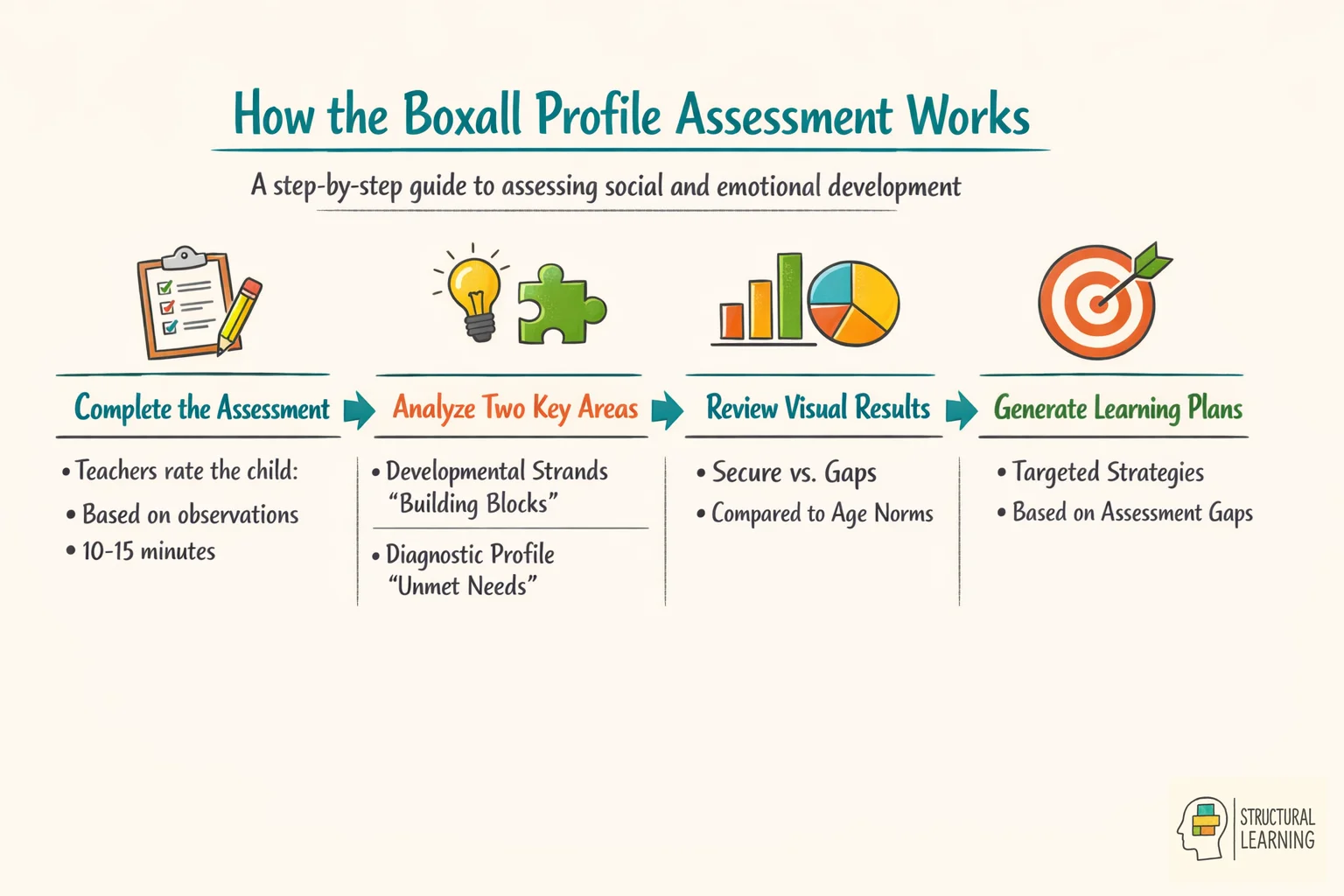
The Profile examines two key areas. Developmental strands check whether a learner can trust adults, manage transitions, tolerate frustration and engage with peers. Diagnostic strands record behaviours that may signal unmet needs, such as avoidance, anxiety, withdrawal or self-limiting patterns. This helps schools move from "What rule has been broken?" to "What support does this learner need to join learning safely?" (Geddes, 2018; Kallitsoglou, Akgul & Moore, 2025).
Boxall found that many learners had missed key early experiences needed for school learning. Some had missed attuned interactions: adults noticing, responding and helping them build social and emotional skills. She used Bowlby's (1969) attachment theory to identify the missing developmental blocks (Boxall, 2002).
The Profile assesses two main areas across 34 descriptors:
Developmental strands measure the skills learners need for interaction and learning. These include organising experience, internalising controls and connectedness. A learner with low scores for attention and participation may need help to join a small-group task, keep shared attention or recover after a transition. The Profile helps staff avoid seeing every difficulty as a deliberate behaviour choice.
Diagnostic Profiles show behaviours that may indicate unmet needs, including self-limiting and undeveloped behaviours. A compliant learner who says little, never asks for help and freezes during group work may be masking anxiety rather than coping well. The Profile can reveal needs that ordinary behaviour monitoring misses (Prior & Glaser, 2006).
Teachers or other adults who know the child well complete the Profile by rating the child against each descriptor on a scale. The assessment takes approximately 10-15 minutes per child and should be based on observations gathered over at least four weeks of sustained contact. Both primary and secondary versions are available, automatically selected based on the child's date of birth in the digital platform.
For the most accurate results, wait 6-8 weeks into a new school term before the first assessment. This gives children time to settle. Staff are then more likely to see their usual behaviour, not reactions to sudden change or stress. Ask more than one staff member to share observations, because children can behave differently in different places: a child who is withdrawn in whole-class teaching may be animated in small group work or on the playground.
Results display as visual charts showing which developmental strands are secure and which show gaps. Scores are contextualised against age-expected norms, making it clear whether a child's profile falls within typical range or indicates areas requiring support. The diagnostic profile highlights behaviours that may be masking or expressing unmet needs.
Year 3 learners may score low on standards and positive regard (Bowlby, 1969). Diagnostic profiles might flag avoidance and negative self-behaviour (Ainsworth, 1978). The SENCO may see a lack of secure attachment experiences (Main, 1991). This differs from calling the learner "poorly behaved" and guides better interventions (Howe, 1995).
BPO suggests learning plans from assessment results. These strategies tackle specific gaps, giving teachers a start for planning interventions. Learners needing connection could benefit from routines and key adults (Bowlby, 1969). For impulse control, try turn-taking games and teaching waiting (Mischel et al., 1989).
Generated plans are starting points. Teachers adapt recommendations to their school and the learner's needs. Use nurture groups and classroom strategies from teachers and teaching assistants for best results.
As of May 2026, Boxall Profile Online pricing starts at £325 per year for primary schools and £500 per year for secondary schools, with unlimited assessments, learning plans and staff users. Pay-as-you-go tokens start from £35 plus VAT for 20 assessments. Schools can choose an annual subscription, a PRO plan with the accredited educator course and Transitions Passport, or tokens for lower-volume use.
Annual subscriptions provide better value for schools that conduct regular SEMH assessments. The whole-school subscription is advertised from £0.24 per learner per year, based on an average secondary setting assessing all learners twice a year. Small schools with fewer than 100 learners qualify for discounted pricing.
PRO subscriptions include access to the CPD Standards Office accredited educator course and the Boxall Profile Online Transitions Passport. Pay-as-you-go tokens do not expire, making them suitable for schools trialling the platform. Academy trusts and local authorities should contact BPO for group pricing. A 30-day free trial is available with no card required.
Schools often ask whether they need the Boxall Profile, the Strengths and Difficulties Questionnaire (SDQ), or both. These tools serve different purposes within SEMH assessment.
Many effective schools use both tools in a tiered approach. The SDQ serves as a universal screener, completed for all learners or targeted year groups, to identify children who may need further assessment. The Boxall Profile then provides the detailed developmental analysis needed to plan specific interventions for identified learners. This two-stage approach is cost-effective and ensures that the more detailed (and time-consuming) Boxall assessment is directed where it will have most impact.
For EHCP evidence, the Boxall Profile is strongest when it sits inside the graduated approach: baseline profile, planned support, review date and evidence of response. The SDQ can add a wider screening picture, but it does not generate the same developmental map or learning plan.
Not sure whether the Boxall Profile, SDQ, or another SEMH tool is right for your learner? Answer four questions about the child's presentation and your assessment purpose, and this tool will recommend the most appropriate assessment approach.
The Boxall Profile was developed alongside nurture groups, and the two remain closely linked in practice. Marjorie Boxall created the first experimental nurture groups in Inner London schools in 1969, while the Profile itself was developed later through work in the 1970s and 1980s and published for wider school use in the late 1990s (Bennathan & Boxall, 1998; Kallitsoglou, Akgul & Moore, 2025). It was designed to identify which learners would benefit most from nurture provision and to track progress within it.
| Subscription Type | Annual Cost | What's Included |
|---|---|---|
| Primary | £325/year | Unlimited assessments and learning plans, unlimited staff |
| Primary PRO | £475/year | All above plus The Boxall Profile: An Educator's Guide one-day course, worth £225, and the Transitions Passport |
| Secondary | £500/year | Unlimited assessments and learning plans, unlimited staff |
| Secondary PRO | £650/year | All above plus Theory and Practice CPD course (worth £225) |
| Pay-As-You-Go (20) | £35 + VAT | 20 assessments and learning plans |
| Pay-As-You-Go (50) | £65 + VAT | 50 assessments and learning plans |
| Pay-As-You-Go (100) | £110 + VAT | 100 assessments and learning plans |
A nurture group is a small, structured class in a mainstream school, usually for 6-12 learners. A teacher and teaching assistant staff it. It gives children a warm, predictable place where adults notice and respond to them, using clear routines that build social and emotional foundations. Sessions usually include a shared breakfast or snack, structured play, explicit teaching of social skills, and supported academic work.
The Boxall Profile helps nurture groups match support to each learner. A learner with low scores in "gives attention" and "shows involvement" may need short, predictable adult-led activities before joining open-ended group work. A learner with self-limiting scores may need low-pressure success, trusted adult check-ins and a plan for asking for help. This makes nurture provision targeted rather than generic.
Research on nurture groups reports positive outcomes, but schools should not treat cost-saving claims as certain. Reynolds, MacKay and Kearney (2009) found that Boxall Profile scores improved after four terms, and these gains lasted after learners returned to mainstream classes. For leaders, the stronger claim is about evidence: repeated Boxall profiles can show whether nurture provision is changing social and emotional functioning over time.
Analysing Boxall Profile data helps SENCOs and senior leaders spot patterns that single behaviour logs can miss. For example, low scores for internalised controls across Year 7 may point to transition stress, playground routines or curriculum demands. This may show a wider need, rather than separate behaviour problems in each learner. Aggregated data can then shape provision maps, staff training, nurture groups and graduated-response evidence for local authority funding discussions (Boxall, 2002).
A SENCO might use Boxall Profiles after SDQ screening for Year 3 learners. If seven of twelve learners score low on internalised standards and accommodating others, the response should not be twelve separate behaviour plans. It may show a class need for taught self-regulation, calmer transitions and structured peer routines.
The same logic matters for EBSA. In England, the Department for Education reported that 18.14% of learners were persistently absent in 2024/25, still well above the 10.86% pre-pandemic rate in 2018/19. For a learner returning after emotionally based school avoidance, Boxall data can help staff plan graded re-entry, safe adult contact, low-arousal transitions and review points alongside attendance data (DfE, 2026; Chian et al., 2024).
Aggregated data is most useful when leaders use it to test policy, not rank learners. If a zero-tolerance behaviour policy leads to repeated removals for learners with low internalised controls, the data supports a different response. Leaders can move towards predictable routines, relational repair and targeted adult coaching. The same dataset can strengthen provision maps, High Needs SEND funding requests and Ofsted conversations because it shows assessed need, planned response and reviewed impact, not just a list of incidents.
Use Boxall data with academic data in learner meetings each term. Schools find learners with poor academic progress often have Boxall Profile gaps. This confirms Boxall (2002) argued social and emotional growth impacts learning.
The BPO interface supports scoring, but staff still need training and moderation. Without shared criteria, assessors may judge surface behaviour rather than the need behind it. Trained teachers are more likely to notice patterns such as withdrawal, compliance masking anxiety and self-limiting behaviour.
| Feature | Boxall Profile | SDQ |
|---|---|---|
| Purpose | Detailed developmental assessment and intervention planning | Brief screening for emotional and behavioural difficulties |
| Items | 34 descriptors across 2 sections | 25 items across 5 scales |
| Time to complete | 10-15 minutes | 5 minutes |
| Generates learning plans | Yes (automatic via BPO) | No |
| Cost | From £35 (PAYG) or £325/year | Free for non-commercial use |
| Best for | Individual intervention planning, nurture groups, EHCP evidence | Whole-class screening, research, initial identification |
| Parent version | No (teacher-completed only) | Yes (parent and teacher versions) |
At least one trained member of staff should lead the work. Current BPO subscriptions include the Introduction to the Boxall Profile Online course for a set number of users, while PRO subscriptions include the CPD Standards Office accredited one-day educator course. Training should cover attachment, child development, scoring and moderation. It should also show staff how to turn results into classroom support (Bowlby, 1969; Piaget, 1936).
Ongoing moderation matters as much as initial training. Schools can improve assessment quality by discussing anonymised cases and comparing evidence from different staff. They should also agree what each descriptor looks like in their own setting. This is especially important for learners whose behaviour changes across lessons, breaktimes and home contexts.
The Boxall Profile is useful because it turns observation into a shared record, but it remains an adult-rated tool. Two staff members may score the same learner differently if one sees withdrawal as anxiety and another sees it as refusal. Schools should therefore moderate profiles, compare evidence across settings and avoid treating a single score as a fixed description of the learner (Kallitsoglou, Akgul & Moore, 2025).
Inter-rater reliability is the main assessment risk. This means different staff may score the same learner in different ways. Teacher judgement can be shaped by workload, stress, relationship history and implicit expectations. Research on teacher assessment finds that subjective judgements are more open to bias than test-based measures, with disadvantage and SEN among the common risk areas (Lee & Newton, 2021).
For Boxall use, staff should check scores through paired observation and SENCO moderation. They should also use clear examples of observable behaviour.
The Profile can make poverty look like a medical issue. It can also make neurodivergence look like a problem if schools treat every difference as a developmental deficit. A learner who avoids eye contact, uses scripted language or needs time alone to recover may be masking autism or ADHD. This does not always mean they lack connectedness.
In the same way, a learner facing housing insecurity, hunger or caring duties may find regulation hard because of pressure outside school. This is not always a sign of poor attachment. Schools should read profiles alongside sensory, attendance, safeguarding and family-context information (Gillies, 2016; Keller, 2018; Milton, 2012).
Bronfenbrenner (1979) argued that development is shaped by nested settings, so learner behaviour can change across contexts. A classroom profile shows one setting, not the learner's whole world. Families, lunchtime staff, transport teams, previous schools and the learner's own account can explain why behaviour changes between English, PE, the playground and home.
The Boxall Profile pinpoints social and emotional patterns; it does not diagnose autism, ADHD, trauma or attachment disorder. It is also almost entirely adult-led, so learner voice needs a deliberate place in the review. Ask what the learner experiences before, during and after difficult moments, then use the profile as one part of a wider graduated assessment (Boxall, 2002).
The Boxall Profile identifies learners' social, emotional, and mental health needs. It measures developmental strands and behaviours that show unmet needs. Teachers use 34 descriptors to rate learners after observing them.
The platform provides visual charts. It also provides learning plans. (Boxall, 2002)
As of May 2026, Boxall Profile Online costs £325 per year for primary schools and £500 per year for secondary schools. Pay-as-you-go tokens start from £35 plus VAT for 20 assessments. PRO subscriptions cost £475 for primary and £650 for secondary, and include the accredited educator course worth £225 plus the Transitions Passport. A 30-day free trial is available with no card required.
Schools assess learners first after 6-8 weeks. They then reassess every 12-16 weeks. This regular cycle keeps interventions relevant and tracks improvements. Staff monitor progress to decide when a learner can return to mainstream activities.
Boxall Profile analyses development and makes learning plans for interventions. The SDQ screens whole classes with 25 questions, useful for research. Many schools use SDQ for initial checks and Boxall Profile for detailed assessment.
Formal training improves BPO accuracy, which helps staff guide learners (Bjorklund, 2012). Without training, assessors often judge surface behaviour rather than real ability. Training lasts 2-3 days. PRO offers CPD on theory, administration, and interpretation (Vygotsky, 1978).
The Boxall Profile can support EHCP evidence when it shows assessed need, provision tried, review dates and learner response over time. It should be combined with parent views, learner voice, attendance data, work samples and specialist advice rather than presented as a stand-alone assessment.
Bowlby, J. (1969). Attachment and loss: Vol. 1. Attachment.
Bronfenbrenner, U. (1979). The ecology of human development.
These studies provide the evidence base for the Boxall Profile and nurture group provision in schools.
Nurture Groups in Schools: Principles and Practice
Boxall, M. (2002)
Boxall's work explains nurture groups and the Boxall Profile. She uses attachment theory and psychology to show some learners lack social-emotional skills (Boxall, 2002). Structured nurture provision, as Boxall describes, addresses these needs.
Researchers have investigated nurture groups extensively (Cooper & Whitebread, 2007). These groups aim to support learners' social and emotional development. Studies show positive links to academic gains (Dowling & Barnes, 2021). Further research explores long-term impact (Geddes, 2006; Boxall, 2002). Researchers (Colley & Humphrey, 2011) examined practical implementation.
Reynolds, S., MacKay, T. & Kearney, M. (2009)
Researchers tracked learners in Scottish nurture groups (large study). After four terms, Boxall Profile scores significantly improved. Learners kept gains after returning to mainstream, demonstrating nurture's effectiveness (linked to Boxall).
Cooper, P. & Jacobs, B. (2011)
Cooper and Jacobs (2011) link attachment experiences with learner progress at school. They give background for the Boxall Profile’s focus on building relationships. Understanding attachment helps teachers interpret Boxall results and plan useful support (Cooper & Jacobs, 2011).
The Contribution of Nurture Groups to the Social and Emotional Well-Being of Learners
Sellman, E. (2011)
Sellman (2016) showed nurture groups boosted learner wellbeing in schools. Boxall Profile assessments inform useful interventions. These interventions strengthened learner peer relationships and engagement (Sellman, 2016). Sellman (2016) also found that learner self-confidence clearly improved.
Social and Emotional Aspects of Learning: Improving Behaviour, Improving Learning
Humphrey, N., Kalambouka, A., Wigelsworth, M. & Lendrum, A. (2010)
Researchers found structured assessment and intervention helped learners' emotional development. The evaluation, set in English primary schools, supports using SEMH tools like the Boxall Profile. This fits with a whole school approach.