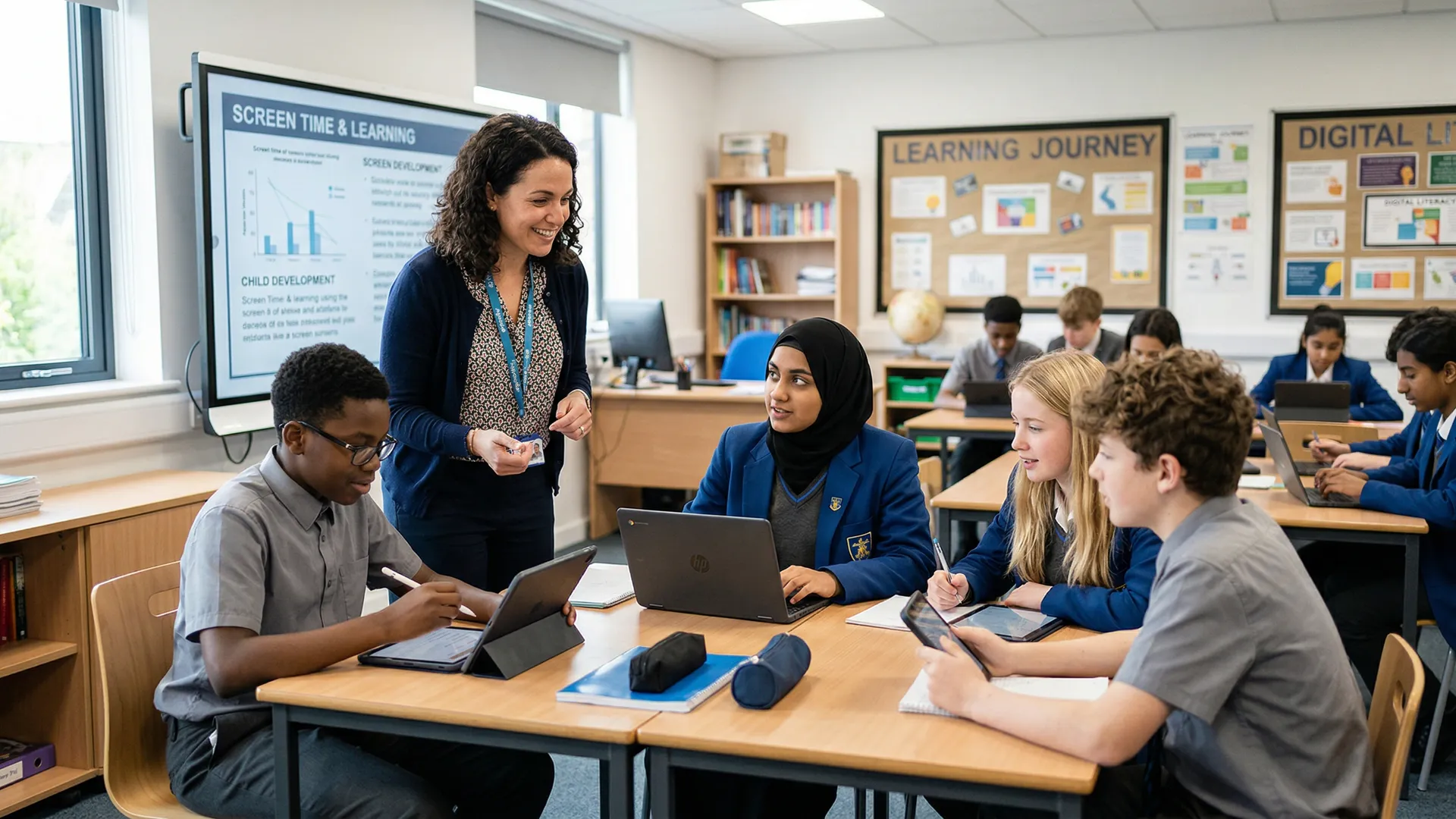
Evidence-based guidance on screen time and child development. Covers the research on digital media effects, age-appropriate limits, and practical classroom strategies for teaching healthy technology habits.
Learners arrive with shorter attention spans (DfE, 2026). They also show smaller vocabularies and weaker self-regulation. In 2026, the UK Government gave screen time guidance. It confirms screen time impacts sleep and play (DfE, 2026). Physical activity and adult conversations are also affected.
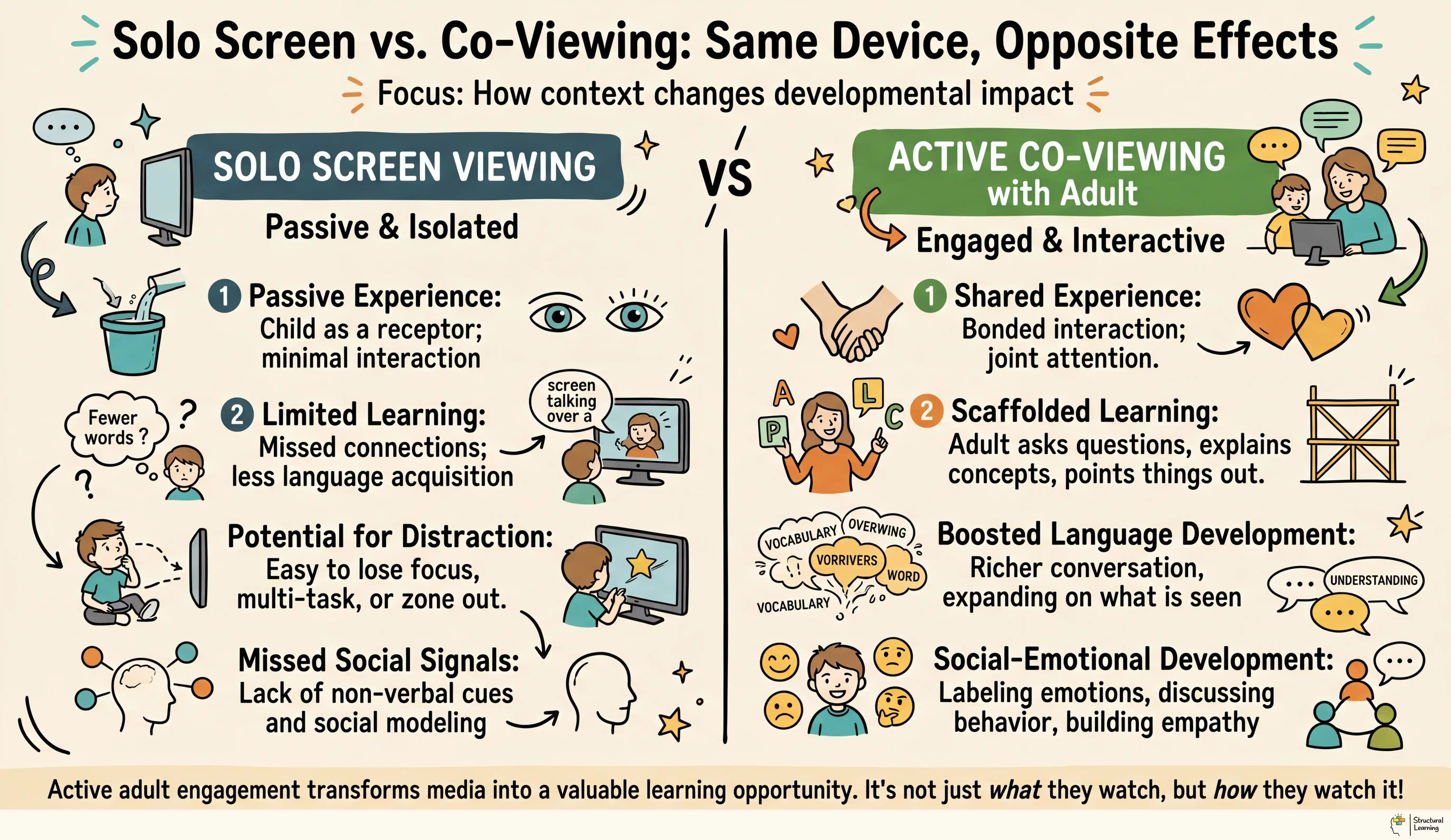
This is not an argument that screens are inherently harmful. The evidence is more nuanced than that. What matters is not the screen itself but what it replaces, how it is used, and whether an adult is present. A meta-analysis of 100 studies (Santos et al., 2024) found that solo screen viewing is associated with poorer cognitive outcomes, while co-viewing with an engaged adult is associated with better outcomes. The same device, used differently, produces opposite developmental effects.
Teachers need to understand this evidence because its consequences arrive in their classrooms every morning. When a child cannot sustain attention during a read-aloud, cannot take turns in discussion, or cannot regulate their frustration when a task gets difficult, the question is not always whether that child has a learning difficulty. Sometimes the question is what that child is not doing at home.
Solo Screen vs. Co-Viewing: Same Device, Opposite Effects
The Displacement Hypothesis
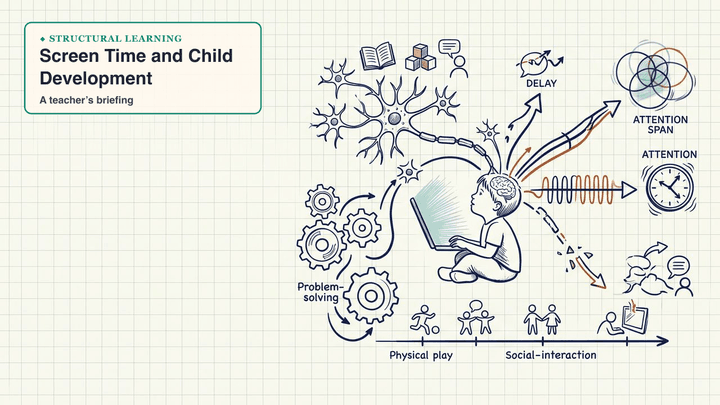
The displacement hypothesis proposes that screen time harms development not through some direct toxic effect but by replacing activities that are more developmentally beneficial. When a two-year-old watches a screen for an extra minute, that minute comes from somewhere. Brushe et al. (2024) found that each additional minute of screen time at 36 months was associated with 6.6 fewer adult words spoken to the child, 4.9 fewer child vocalisations, and 1.1 fewer conversational turns.
These are not trivial losses. Conversational turns are the mechanism through which language develops. When Vygotsky (1978) described the Zone of Proximal Development, he was describing a process that requires another person, typically an adult, to scaffold the child's thinking through dialogue. A screen cannot do this. Even well-designed educational content cannot respond contingently to a child's emerging understanding in the way a parent or teacher can.
Hinkley et al. (2022) tracked toddlers from 12 to 36 months and found that screen time specifically displaced peer play, not reading time. The developmental delay they observed was not a direct effect of screens. It was mediated through the lost peer play. In other words, what the children were not doing mattered more than what they were doing.
Professor Russell Viner, co-chair of the UK's Early Years Screen Time Advisory Group, summarised this clearly: "Too much solo screen time can crowd out the things that make the biggest difference: sleep, play, physical activity and talking with parents and carers" (DfE, 2026).
Evidence Overview
Chalkface Translator: research evidence in plain teacher language
Academic
Chalkface
Evidence Rating: Load-Bearing Pillars
Emerging (d<0.2)
Promising (d 0.2-0.5)
Robust (d 0.5+)
Foundational (d 0.8+)
What Happens to the Developing Brain
Three mechanisms explain how excessive screen time affects cognitive development.
Joint Attention and Language
Joint attention, where a child and adult focus together on the same object or event, is fundamental to language acquisition (Bruner, 1983). It is through these shared moments that children learn to map words to objects, understand communicative intent, and develop conversational skills.
Parental smartphone use disrupts this process. Azhari et al. (2022) measured mother-child brain synchrony during shared reading and found that maternal smartphone interruptions reduced neural coupling between parent and child. The mother was physically present but cognitively absent.
This phenomenon has a name. McDaniel and Radesky (2018) coined the term "technoference" to describe technology-based interference in parent-child interactions. Their longitudinal research with 183 families found a bidirectional cycle: child behaviour difficulties lead parents to withdraw into devices, and device use then predicts increased child behaviour problems over time. The cycle reinforces itself.
Devine et al. (2021) found phone notifications alone hurt infant vocabulary. Notifications increased how controlling parents were. This reduced responsiveness in parent-learner interactions.
Executive Function
Executive functions, including working memory, inhibitory control, and cognitive flexibility, develop rapidly in early childhood and are shaped by experience. Sugimoto et al. (2025) followed 280 children from 6 months to 4 years and found that screen media multitasking before age 3 was associated with executive function problems. Positive parenting and strong mother-child interaction were protective factors.
Theodorou et al. (2025) assessed 1,016 preschoolers aged 5-6 and found weak but significant negative correlations between screen time and cognitive flexibility, verbal working memory, and inhibitory control. The effect sizes were small, but they are consistent across studies: the more time spent on screens, the less time spent on activities that build these capacities.
For teachers, this matters because executive function predicts academic achievement more reliably than IQ (Diamond, 2013). A child who arrives at school with depleted inhibitory control will struggle to wait their turn, stay on task, and follow multi-step instructions. These are not character flaws. They are developmental consequences of how that child has spent their time.
Sensorimotor Development
Piaget (1952) described the first two years of life as the sensorimotor stage, during which children learn about the world through physical manipulation: grasping, mouthing, stacking, dropping, and exploring. Touchscreen interaction provides visual and auditory stimulation but limited proprioceptive or haptic feedback. Swiping is not the same as building.
The UK Government's guidance (2026) reported that 28% of children starting reception attempt to "swipe" or "tap" book pages as if they were devices. This is not a charming anecdote. It suggests that some children's primary mode of interacting with objects has been shaped by screens rather than by physical exploration.
The Evidence by Age
The research suggests different risks and recommendations at different developmental stages.
Under 2
The UK Government and WHO both recommend avoiding screen time entirely for this age group, with one exception: shared activities that involve bonding, interaction, and conversation, such as video calls with grandparents or looking at photos together.
The evidence supports this position. Santos et al. (2023) found that children with more than 2 hours of daily screen time at 18 months had significantly lower cognitive development scores. Fang et al. (2020) followed 274 children to age 4 and found that earlier onset of screen exposure, combined with less verbal interaction during viewing, predicted decreased preschool cognition.
According to a nationally representative study of babies growing up in England, nine-month-olds spent 29 minutes on screens each day on average, although 28% did not use screens daily (Bernardi et al., 2023). By age two, the same children spent an average of 127 minutes on screens each day, with only 2% not using screens daily (Fish et al., 2026). Children in the lowest income quintile had nearly double the screen time of those in the highest: 179 minutes compared to 97 minutes per day (Fish et al., 2026).
Ages 2 to 5
The UK guidance sets a limit of one hour per day, with the caveat that "less is possible." The AAP has moved away from time-based limits entirely, instead proposing a "5 Cs" framework: Child, Content, Calm, Crowding Out, and Communication.
Carson et al. (2022) found that preschoolers who met the one-hour guideline had 3.48 times the odds of better working memory compared to those who exceeded it. Fajardo et al. (2023) found that co-viewing was protective: children who watched with a parent were 8.56 times less likely to develop excessive screen habits.
The type of content matters as much as the duration. Li et al. (2020) studied 579 five-year-olds and found that passive screen time was negatively associated with maths, science, executive function, and social skills. Active, interactive screen time was positively associated with receptive language and science knowledge.
The EYSTAG panel found that harms appear non-linear, accelerating after approximately 1.5 hours per day at age two (Gath et al., 2026). Short periods of screen use, up to 30 minutes at a time, were in and of themselves not harmful for children aged two and over (EYSTAG, 2026). This distinction between brief, supervised use and extended solo viewing is central to the guidance.
School-Age (5 to 11)
The displacement effect shifts in this age range. Screen time competes with homework, reading for pleasure, physical activity, and face-to-face socialising. Ahrens et al. (2023) studied 8,673 European children aged 8-18 and found that smartphone use combined with media multitasking was associated with higher impulsivity and lower cognitive flexibility, particularly in girls.
Adolescents
For adolescents, the evidence centres on social media, sleep disruption, and attention fragmentation. Przybylski (2019) analysed data from 50,212 children and found that each additional hour of screen time was associated with 3-8 fewer minutes of nightly sleep. The effect was modest, but sleep is a non-negotiable requirement for memory consolidation and emotional regulation.
The Displacement Chain: How Screen Time Replaces Critical Development Activities
What Content Type Matters
The EYSTAG report identified a phenomenon called the "video deficit": young children learn significantly less from screen-based media than from equivalent real-life interactions, and this gap may persist until around school age (Sticca et al., 2025; Strouse and Samson, 2021). This means that even well-designed educational content on a screen may produce weaker learning outcomes than the same activity conducted face-to-face with an adult.
Beyond duration, the pace and structure of content shape how the developing brain responds. Research reviewed by the EYSTAG panel distinguishes fast-paced from slow-paced content across visual, auditory, and narrative dimensions.
Feature
Fast-Paced (Avoid)
Slow-Paced (Preferred)
Visual
Frequent scene cuts, vivid or bright colours, objects constantly moving
Slow static shots, focus on faces, simple backgrounds, limited movement
Auditory
Rapid speech, multiple characters talking at once, dense backing tracks
Character speech against a backdrop of silence, clear single voice
Narrative
Complex multi-layered stories, frequent scene changes, large cast
Repeated sequences, songs with repeated chorus, retellings of the same story
Adapted from EYSTAG (2026), Screen use by children aged under five: independent report.
The panel also found no convincing evidence analysing the impacts or safety of AI chatbots or AI-enabled toys for children under five (EYSTAG, 2026). Given the rapid pace of development in generative AI, the panel recommended a precautionary approach: parents should not let young children use AI tools, toys, or chatbots until the evidence improves.
Co-Viewing Changes Everything
The most important finding in the entire screen time literature may be this: the same activity produces opposite developmental outcomes depending on whether an adult is present and engaged.
Trinh et al. (2023) conducted an umbrella review of 102 meta-analyses involving 1.9 million participants. Screen use was negatively associated with literacy (r = -0.14). But when parents co-viewed, the association turned positive (r = +0.15). The sign flipped.
Professor Sam Wass, speaking on BBC Radio 4 on 27 March 2026, described the concept of "shared adult/parent time," where both the adult and child attend to the same screen content and talk about it together. His research at the University of East London has shown that what matters is not whether a screen is present but whether the adult is cognitively present.
The socioeconomic dimension makes this finding particularly important. Co-viewing, the single most protective factor identified in the research, may be hardest for time-poor and resource-limited families to practise. Yet evidence suggests it may benefit them most: screen co-viewing with parents appeared to limit potential negative impacts for young children from more deprived backgrounds (Xie et al., 2024). This means the children who stand to gain most from shared viewing are often those with the least opportunity to experience it.
Chen et al. (2024) found that parent-child conversation during screen exposure fully mediated the link between screen exposure and comprehension in 8-month-old infants. The conversation was the active ingredient, not the screen content.
This finding aligns with everything we know about how children learn. Mercer (2000) demonstrated that talk is the primary tool for cognitive development. Alexander (2020) showed that dialogic teaching, where adults and children reason together through structured conversation, produces substantial learning gains. When an adult watches a programme with a child and asks "Why do you think the character did that?", the screen becomes a prompt for the kind of contingent interaction that builds language and reasoning.
What Teachers See in the Classroom
More than half of teachers surveyed by the charity Kindred said that excessive screen time was a key factor in children not being ready for school (DfE, 2026). The effects manifest in specific, observable ways.
Reduced vocabulary. Children who experience fewer conversational turns at home arrive at school with smaller vocabularies. This is not the same as the "word gap" debate, which focused on socioeconomic factors. Screen displacement affects families across all income levels.
Shorter sustained attention. Screen content, particularly fast-paced social media-style video, habituates children to rapid stimulus changes. Professor Sam Wass's research focuses specifically on moments where "the content is happening at a speed which is too fast for [the child's] brain to track." When these children encounter a 10-minute teacher explanation, they have not practised sustaining attention for that duration.
Difficulty with peer interaction. Hinkley et al. (2022) found that screen time specifically displaces peer play. Children who spend less time negotiating, sharing, and resolving conflict with other children arrive at school less equipped for collaborative learning.
UK guidance links fast content to emotional issues (Wass, 2026). Learners struggle with reactions, transitions, and frustration. Teachers observe these difficulties impacting learners within the classroom.
Physical indicators. Children attempting to swipe book pages. Difficulty holding a pencil due to reduced fine motor practice. Fatigue from disrupted sleep patterns.
What Teachers Can Do
Teachers cannot control what happens at home. They can, however, design classroom environments that compensate for developmental gaps and communicate with parents in evidence-informed ways.
Build Conversational Capacity
If a child's home environment lacks conversational turns, the classroom must provide them. Structured oracy activities, such as Think-Pair-Share, Kagan structures, and sentence stems for academic discussion, create the conditions for the kind of contingent interaction that screens displace.
A Year 1 teacher might begin each morning with a "talk partner" routine: "Tell your partner one thing you did yesterday. Your partner asks one question about it." This takes two minutes and generates the kind of reciprocal dialogue that builds language and social cognition.
Rebuild Attention Through Graduated Challenge
Sustained attention is not a fixed trait. It is a capacity that develops through practice. Rather than expecting all learners to attend for 20 minutes immediately, teachers can build attention gradually: 5 minutes of focused work, then a brief partner discussion, then 7 minutes, then a movement break, then 10 minutes.
The goal is not compliance but capacity-building. Each successful period of sustained focus strengthens the neural pathways that support the next one.
Use Screens Purposefully, Not Habitually
The evidence does not support removing all screens from classrooms. It supports being intentional about when and how they are used. Passive screen time, such as a background YouTube video during independent work, produces negative outcomes (Santos et al., 2024). Interactive, scaffolded screen use, where a teacher guides learners through digital content, produces positive outcomes.
Ask two questions before using a screen in your lesson: (1) Could this learning happen without a screen? (2) Am I present and engaged while learners use this screen, or are they using it independently? If the answer to the first question is yes and the second is "independently," consider an alternative.
Communicate With Parents
Teachers report that conversations about screen time with parents feel judgmental or intrusive. The evidence provides a way through this.
The message is not "ban screens." The message is "add shared activities." Parents do not need to feel guilty about screen use. They need to know that the single most protective factor is being present and talking during screen time. Watching a programme together and discussing it is developmentally beneficial. Watching the same programme alone in another room is not.
Teachers can find helpful resources for parents on beststartinlife.gov.uk. Share these resources at parents' evenings or in newsletters. You can also use school communication platforms (UK Government, n.d.).
Prioritise SEND Considerations
Screen-based assistive technologies are essential for many learners with additional needs. A child with dyslexia may read more fluently on a screen with adjustable text size. A child with autism may use visual schedule apps that support transitions. The UK guidance explicitly states that time limits should "not apply in the same way" for assistive technology.
The key distinction for teachers is between screens used as assistive tools and screens used for passive consumption. The former supports learning. The latter, without adult mediation, does not.
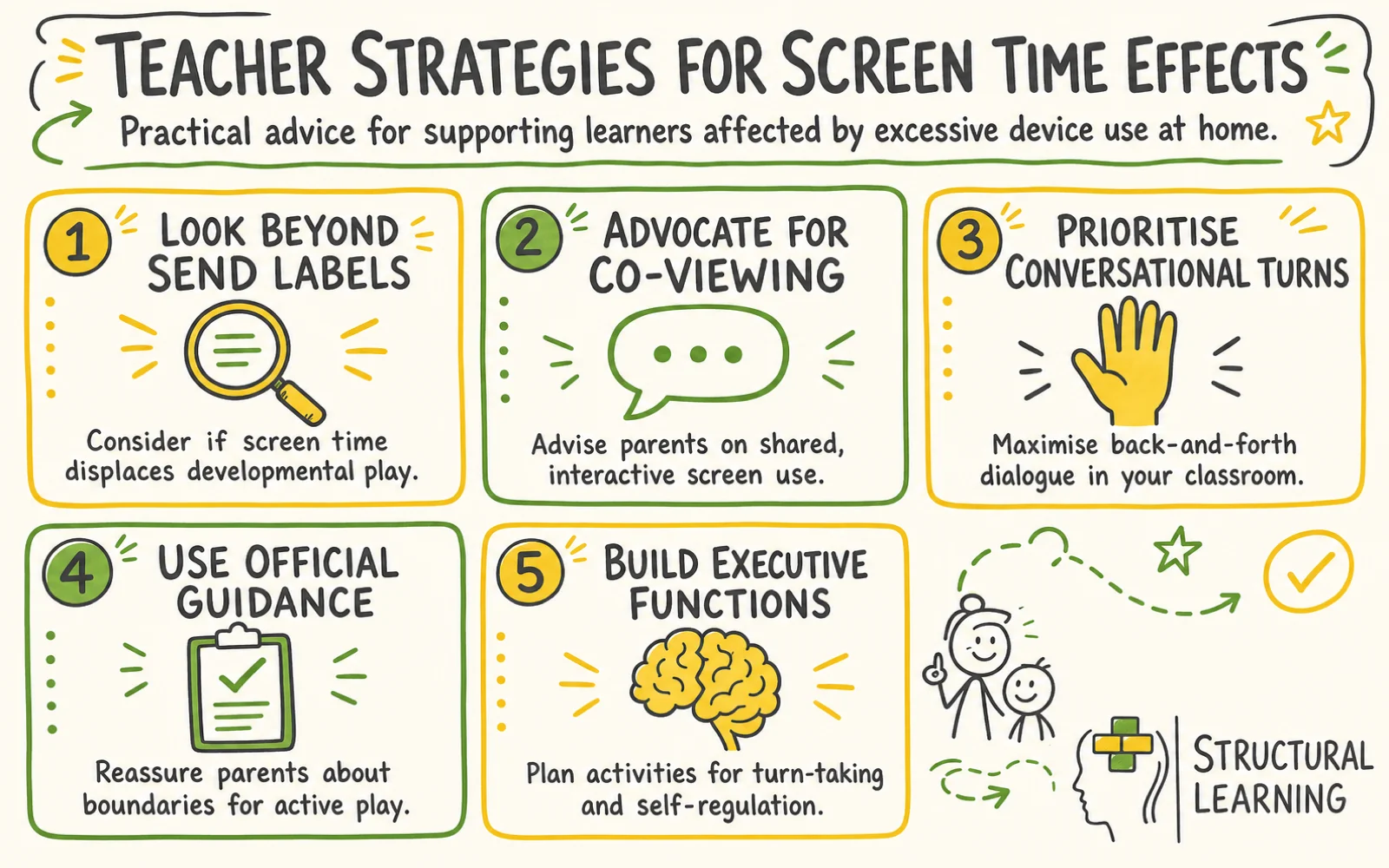
The 3 Factors That Determine Screen Impact: What, How, and Who
Screen Time Age GuideEvidence-based screen time recommendations by age group, from the EYSTAG report (2026)
4 Age GroupsEYSTAG 2026Evidence-Based
Click to explore age-specific screen time guidance
Recommendation
Avoid screen time except for shared activities that support bonding and learning (EYSTAG, 2026).
Approved Activities
Video calls with relatives and family members
Reviewing family photos together with a parent or sibling
Reading e-books together with a parent or sibling
All screen use should be shared and interactive
What to Avoid
Solo screen viewing of any kind
Background TV while the child is awake or playing
Any unsupervised screen use
Using screens as a pacifier or distraction tool
Sleep
11-14 hours recommended (WHO). Bedrooms should be screen-free environments.
Physical Activity
3+ hours per day including active play (UK Chief Medical Officers).
Alternatives to Screen Time
Tummy time and floor play Reading physical books together Singing and nursery rhymes Sensory play with safe objects Outdoor exploration
"The video deficit means children under 2 learn significantly less from screens than from real-life interaction."
EYSTAG (2026)
Recommendation
No more than 1 hour per day, ideally in short chunks of 30 minutes or less (EYSTAG, 2026).
Content Guidance
Slow-paced content with faces and simple backgrounds
Limited movement and repetition in programming
Co-view together: ask questions, talk about what you see
Keep sessions to 30 minutes or less at a time
What to Avoid
Fast-paced videos with frequent scene cuts
Rapid speech and multiple characters talking at once
Social media-style short-form videos
Screen use during mealtimes or the hour before bed
Co-Viewing
Watch together, ask questions, talk about what you see. Co-viewing turns negative outcomes positive (EYSTAG, 2026).
Screen-Free Times
Protect mealtimes and the hour before bed as completely screen-free periods.
Alternatives to Screen Time
Water and sand play Simple puzzles and building blocks Outdoor play and nature walks Drawing and mark-making Imaginative play with toys
"Harms appear non-linear, accelerating after approximately 1.5 hours per day at age two."
Gath et al. (2026), cited in EYSTAG (2026)
Recommendation
Same 1-hour limit applies. "How screens are used matters as much as the length of time" (EYSTAG, 2026). Interactive, educational content produces positive outcomes.
What Works Well
Interactive, educational content with clear learning goals
Educational apps that improve vocabulary, working memory, and problem-solving
Short periods of up to 30 minutes per session
Co-viewing and discussing content together
What to Avoid
AI toys and chatbots: "no convincing evidence on impacts or safety" (EYSTAG, 2026)
Fast-paced content with rapid scene changes
Advertising, branded, or gamified commercial content
Adult-directed content not designed for young children
Key Statistics
19% of 3-5 year olds have their own phone. 91% use video platforms. Average screen time at age 2: 127 min/day.
SEND Note
Screen time limits do not apply to assistive technologies for children with SEND (EYSTAG, 2026).
Alternatives to Screen Time
Construction play and small world toys Physical games and active play Storytelling and shared reading Creative arts and messy play Cooking and gardening together
"Short periods of screen use, of up to 30 minutes, were in and of themselves not harmful."
EYSTAG (2026)
What Teachers See
28% of reception children try to swipe or tap book pages. Over half of teachers say screen time affects school readiness (Kindred, 2025).
What Schools Can Do
Structured oracy activities to build vocabulary
Collaborative learning to develop peer interaction
Attention-building tasks with gradual challenge increases
Screen-free reading time with physical books
Clear parent communication about shared activities at home
Classroom Indicators to Watch
Reduced vocabulary compared to age expectations
Shorter sustained attention during group tasks
Difficulty with peer interaction and turn-taking
Emotional dysregulation and difficulty managing frustration
Fine motor difficulties (pencil grip, cutting, threading)
Key Statistic
52% of UK primary staff report worsening school readiness linked to excessive screen exposure at home (Kindred, 2025).
Home-School Link
Share the EYSTAG age-specific guidance with parents. Emphasise co-viewing and the 1-hour maximum for under-5s.
Classroom Alternatives
Talk partners and oracy circles Loose parts and construction areas Role play and small world scenarios Outdoor learning and Forest School Fine motor skill stations
"52% of UK primary staff report worsening school readiness."
Kindred (2025), cited in EYSTAG (2026)
Fast-Paced vs Slow-Paced Content
Understanding what makes screen content harmful or beneficial for young children (EYSTAG, 2026)
Fast-Paced (Avoid)
Visual
Frequent scene cuts, vivid and overly bright colours, objects moving constantly
Auditory
Rapid speech, multiple characters talking at once, dense backing tracks
Narrative
Complex multi-layered stories, frequent scene and location changes
Slow-Paced (Choose This)
Visual
Slow static shots, focus on faces, simple backgrounds with limited distractions
Auditory
Songs with repeated chorus, clear single narrator, gentle pacing
Narrative
Repetition, retellings, simple linear stories with one setting
Why this matters: Fast-paced content over-stimulates developing attention systems and reduces a child's capacity for sustained focus. Slow-paced, repetitive content supports language development and self-regulation (EYSTAG, 2026).
Family Shared Activity PlannerGenerate a week of screen-free shared activities mapped to developmental domains
5-Day PlanScreen-FreeEvidence-BasedPrint-Ready
Click to plan screen-free shared activities
The Shared Activity Framework
Researchers like Przybylski and Weinstein (2017) and Twenge (2017) show screen time can impact learners. Replace solo screen use with shared activities. This can improve development affected by screen exposure, according to researchers.
Language and communication. Shared reading, storytelling, word games, and conversation during daily routines (cooking, shopping, walking). Bruner (1983) showed that these interactions scaffold language acquisition through joint attention and contingent responses.
Physical development. Outdoor play, building, drawing, and manipulating objects. Piaget (1952) described how physical exploration of the environment is the foundation of cognitive development in the early years.
Social and emotional development. Board games, collaborative cooking, pretend play, and family meals. Harbec et al. (2024) found that high-quality family meals compensate for some of the long-term risks of increased screen use.
Cognitive development. Puzzles, sorting, counting during play, and simple science experiments. These activities require working memory, planning, and problem-solving, the executive functions that screen time tends to weaken (Diamond, 2013).
These activities do not require special materials, dedicated time, or professional expertise. They require an adult who is present, engaged, and talking with the child about what they are doing together. That is the mechanism. Everything else is secondary.
Research Podcast: Screen Time and Child Development
An AI-generated discussion exploring the EYSTAG report on screen time, digital media, and child development. Covers Twenge (2017), Przybylski and Weinstein (2017), and the Goldilocks hypothesis.
Generated by NotebookLM from peer-reviewed research sources
Further Reading: Key Research Papers
These peer-reviewed studies provide the evidence base for the strategies discussed above.
Family involvement impacts learner success, say researchers (Kraft & Rogers, 2015). Effective implementation and assessment can help (Christenson et al., 2011). These actions improve results for families, schools, and learners (Hill & Tyson, 2009).
Garbacz et al. (2017)
Effective partnerships boost learner achievement (Epstein, 2011). Teachers should actively involve families in decisions and interventions (Christenson, 2004). Research-backed methods strengthen home-school links (Hill & Tyson, 2009).
How young children spend their time: television and other activities.View study ↗ 276 citations
Huston et al. (1999)
The research by (Researcher Names, Date) examines how young learners spend time watching TV. Teachers can use this to understand learners' media habits. This helps create strategies to balance screen time with learning and exercise within lessons.
(N=4,421). Common concerns claim screen time pushes out other hobbies. Przybylski and Weinstein (2017) found little evidence for this displacement. Their research, using ABCD study data, focused on young learners. They examined 9 and 10 year olds' recreational activities. Screen use didn't reduce other hobbies, say Przybylski and Weinstein (2017).
Lees et al. (2020)
Research found that screen media use doesn't necessarily replace other recreational activities like sports, music, or art among 9-10 year-olds. This reassures teachers that moderate screen time may coexist with diverse interests rather than completely displacing creative pursuits.
Childbearing Age Women Characteristics in Latin America. Building Evidence Bases for Early Prevention. Results from the ELANS StudyView study ↗
Herrera-Cuenca et al. (2020)
The study by researchers examines Latin American women's lifestyles. It focuses on inactivity and eating habits. Teachers working with Hispanic families can understand cultural contexts better. This helps them understand health habits and screen time at home.
Abriendo Caminos, detailed in the View study, aimed to cut obesogenic eating. A family based RCT, culturally tailored for Hispanic learners, tackled this (Sallis et al., 2015). Researchers found behaviour changes occurred (Davis et al., 2016; Elder et al., 2013). Improved family meals impacted learners' food choices (Golan et al., 2010; Ramirez et al., 2012).
Learners arrive with shorter attention spans (DfE, 2026). They also show smaller vocabularies and weaker self-regulation. In 2026, the UK Government gave screen time guidance. It confirms screen time impacts sleep and play (DfE, 2026). Physical activity and adult conversations are also affected.
This is not an argument that screens are inherently harmful. The evidence is more nuanced than that. What matters is not the screen itself but what it replaces, how it is used, and whether an adult is present. A meta-analysis of 100 studies (Santos et al., 2024) found that solo screen viewing is associated with poorer cognitive outcomes, while co-viewing with an engaged adult is associated with better outcomes. The same device, used differently, produces opposite developmental effects.
Teachers need to understand this evidence because its consequences arrive in their classrooms every morning. When a child cannot sustain attention during a read-aloud, cannot take turns in discussion, or cannot regulate their frustration when a task gets difficult, the question is not always whether that child has a learning difficulty. Sometimes the question is what that child is not doing at home.
Solo Screen vs. Co-Viewing: Same Device, Opposite Effects
The Displacement Hypothesis
The displacement hypothesis proposes that screen time harms development not through some direct toxic effect but by replacing activities that are more developmentally beneficial. When a two-year-old watches a screen for an extra minute, that minute comes from somewhere. Brushe et al. (2024) found that each additional minute of screen time at 36 months was associated with 6.6 fewer adult words spoken to the child, 4.9 fewer child vocalisations, and 1.1 fewer conversational turns.
These are not trivial losses. Conversational turns are the mechanism through which language develops. When Vygotsky (1978) described the Zone of Proximal Development, he was describing a process that requires another person, typically an adult, to scaffold the child's thinking through dialogue. A screen cannot do this. Even well-designed educational content cannot respond contingently to a child's emerging understanding in the way a parent or teacher can.
Hinkley et al. (2022) tracked toddlers from 12 to 36 months and found that screen time specifically displaced peer play, not reading time. The developmental delay they observed was not a direct effect of screens. It was mediated through the lost peer play. In other words, what the children were not doing mattered more than what they were doing.
Professor Russell Viner, co-chair of the UK's Early Years Screen Time Advisory Group, summarised this clearly: "Too much solo screen time can crowd out the things that make the biggest difference: sleep, play, physical activity and talking with parents and carers" (DfE, 2026).
Evidence Overview
Chalkface Translator: research evidence in plain teacher language
Academic
Chalkface
Evidence Rating: Load-Bearing Pillars
Emerging (d<0.2)
Promising (d 0.2-0.5)
Robust (d 0.5+)
Foundational (d 0.8+)
What Happens to the Developing Brain
Three mechanisms explain how excessive screen time affects cognitive development.
Joint Attention and Language
Joint attention, where a child and adult focus together on the same object or event, is fundamental to language acquisition (Bruner, 1983). It is through these shared moments that children learn to map words to objects, understand communicative intent, and develop conversational skills.
Parental smartphone use disrupts this process. Azhari et al. (2022) measured mother-child brain synchrony during shared reading and found that maternal smartphone interruptions reduced neural coupling between parent and child. The mother was physically present but cognitively absent.
This phenomenon has a name. McDaniel and Radesky (2018) coined the term "technoference" to describe technology-based interference in parent-child interactions. Their longitudinal research with 183 families found a bidirectional cycle: child behaviour difficulties lead parents to withdraw into devices, and device use then predicts increased child behaviour problems over time. The cycle reinforces itself.
Devine et al. (2021) found phone notifications alone hurt infant vocabulary. Notifications increased how controlling parents were. This reduced responsiveness in parent-learner interactions.
Executive Function
Executive functions, including working memory, inhibitory control, and cognitive flexibility, develop rapidly in early childhood and are shaped by experience. Sugimoto et al. (2025) followed 280 children from 6 months to 4 years and found that screen media multitasking before age 3 was associated with executive function problems. Positive parenting and strong mother-child interaction were protective factors.
Theodorou et al. (2025) assessed 1,016 preschoolers aged 5-6 and found weak but significant negative correlations between screen time and cognitive flexibility, verbal working memory, and inhibitory control. The effect sizes were small, but they are consistent across studies: the more time spent on screens, the less time spent on activities that build these capacities.
For teachers, this matters because executive function predicts academic achievement more reliably than IQ (Diamond, 2013). A child who arrives at school with depleted inhibitory control will struggle to wait their turn, stay on task, and follow multi-step instructions. These are not character flaws. They are developmental consequences of how that child has spent their time.
Sensorimotor Development
Piaget (1952) described the first two years of life as the sensorimotor stage, during which children learn about the world through physical manipulation: grasping, mouthing, stacking, dropping, and exploring. Touchscreen interaction provides visual and auditory stimulation but limited proprioceptive or haptic feedback. Swiping is not the same as building.
The UK Government's guidance (2026) reported that 28% of children starting reception attempt to "swipe" or "tap" book pages as if they were devices. This is not a charming anecdote. It suggests that some children's primary mode of interacting with objects has been shaped by screens rather than by physical exploration.
The Evidence by Age
The research suggests different risks and recommendations at different developmental stages.
Under 2
The UK Government and WHO both recommend avoiding screen time entirely for this age group, with one exception: shared activities that involve bonding, interaction, and conversation, such as video calls with grandparents or looking at photos together.
The evidence supports this position. Santos et al. (2023) found that children with more than 2 hours of daily screen time at 18 months had significantly lower cognitive development scores. Fang et al. (2020) followed 274 children to age 4 and found that earlier onset of screen exposure, combined with less verbal interaction during viewing, predicted decreased preschool cognition.
According to a nationally representative study of babies growing up in England, nine-month-olds spent 29 minutes on screens each day on average, although 28% did not use screens daily (Bernardi et al., 2023). By age two, the same children spent an average of 127 minutes on screens each day, with only 2% not using screens daily (Fish et al., 2026). Children in the lowest income quintile had nearly double the screen time of those in the highest: 179 minutes compared to 97 minutes per day (Fish et al., 2026).
Ages 2 to 5
The UK guidance sets a limit of one hour per day, with the caveat that "less is possible." The AAP has moved away from time-based limits entirely, instead proposing a "5 Cs" framework: Child, Content, Calm, Crowding Out, and Communication.
Carson et al. (2022) found that preschoolers who met the one-hour guideline had 3.48 times the odds of better working memory compared to those who exceeded it. Fajardo et al. (2023) found that co-viewing was protective: children who watched with a parent were 8.56 times less likely to develop excessive screen habits.
The type of content matters as much as the duration. Li et al. (2020) studied 579 five-year-olds and found that passive screen time was negatively associated with maths, science, executive function, and social skills. Active, interactive screen time was positively associated with receptive language and science knowledge.
The EYSTAG panel found that harms appear non-linear, accelerating after approximately 1.5 hours per day at age two (Gath et al., 2026). Short periods of screen use, up to 30 minutes at a time, were in and of themselves not harmful for children aged two and over (EYSTAG, 2026). This distinction between brief, supervised use and extended solo viewing is central to the guidance.
School-Age (5 to 11)
The displacement effect shifts in this age range. Screen time competes with homework, reading for pleasure, physical activity, and face-to-face socialising. Ahrens et al. (2023) studied 8,673 European children aged 8-18 and found that smartphone use combined with media multitasking was associated with higher impulsivity and lower cognitive flexibility, particularly in girls.
Adolescents
For adolescents, the evidence centres on social media, sleep disruption, and attention fragmentation. Przybylski (2019) analysed data from 50,212 children and found that each additional hour of screen time was associated with 3-8 fewer minutes of nightly sleep. The effect was modest, but sleep is a non-negotiable requirement for memory consolidation and emotional regulation.
The Displacement Chain: How Screen Time Replaces Critical Development Activities
What Content Type Matters
The EYSTAG report identified a phenomenon called the "video deficit": young children learn significantly less from screen-based media than from equivalent real-life interactions, and this gap may persist until around school age (Sticca et al., 2025; Strouse and Samson, 2021). This means that even well-designed educational content on a screen may produce weaker learning outcomes than the same activity conducted face-to-face with an adult.
Beyond duration, the pace and structure of content shape how the developing brain responds. Research reviewed by the EYSTAG panel distinguishes fast-paced from slow-paced content across visual, auditory, and narrative dimensions.
Feature
Fast-Paced (Avoid)
Slow-Paced (Preferred)
Visual
Frequent scene cuts, vivid or bright colours, objects constantly moving
Slow static shots, focus on faces, simple backgrounds, limited movement
Auditory
Rapid speech, multiple characters talking at once, dense backing tracks
Character speech against a backdrop of silence, clear single voice
Narrative
Complex multi-layered stories, frequent scene changes, large cast
Repeated sequences, songs with repeated chorus, retellings of the same story
Adapted from EYSTAG (2026), Screen use by children aged under five: independent report.
The panel also found no convincing evidence analysing the impacts or safety of AI chatbots or AI-enabled toys for children under five (EYSTAG, 2026). Given the rapid pace of development in generative AI, the panel recommended a precautionary approach: parents should not let young children use AI tools, toys, or chatbots until the evidence improves.
Co-Viewing Changes Everything
The most important finding in the entire screen time literature may be this: the same activity produces opposite developmental outcomes depending on whether an adult is present and engaged.
Trinh et al. (2023) conducted an umbrella review of 102 meta-analyses involving 1.9 million participants. Screen use was negatively associated with literacy (r = -0.14). But when parents co-viewed, the association turned positive (r = +0.15). The sign flipped.
Professor Sam Wass, speaking on BBC Radio 4 on 27 March 2026, described the concept of "shared adult/parent time," where both the adult and child attend to the same screen content and talk about it together. His research at the University of East London has shown that what matters is not whether a screen is present but whether the adult is cognitively present.
The socioeconomic dimension makes this finding particularly important. Co-viewing, the single most protective factor identified in the research, may be hardest for time-poor and resource-limited families to practise. Yet evidence suggests it may benefit them most: screen co-viewing with parents appeared to limit potential negative impacts for young children from more deprived backgrounds (Xie et al., 2024). This means the children who stand to gain most from shared viewing are often those with the least opportunity to experience it.
Chen et al. (2024) found that parent-child conversation during screen exposure fully mediated the link between screen exposure and comprehension in 8-month-old infants. The conversation was the active ingredient, not the screen content.
This finding aligns with everything we know about how children learn. Mercer (2000) demonstrated that talk is the primary tool for cognitive development. Alexander (2020) showed that dialogic teaching, where adults and children reason together through structured conversation, produces substantial learning gains. When an adult watches a programme with a child and asks "Why do you think the character did that?", the screen becomes a prompt for the kind of contingent interaction that builds language and reasoning.
What Teachers See in the Classroom
More than half of teachers surveyed by the charity Kindred said that excessive screen time was a key factor in children not being ready for school (DfE, 2026). The effects manifest in specific, observable ways.
Reduced vocabulary. Children who experience fewer conversational turns at home arrive at school with smaller vocabularies. This is not the same as the "word gap" debate, which focused on socioeconomic factors. Screen displacement affects families across all income levels.
Shorter sustained attention. Screen content, particularly fast-paced social media-style video, habituates children to rapid stimulus changes. Professor Sam Wass's research focuses specifically on moments where "the content is happening at a speed which is too fast for [the child's] brain to track." When these children encounter a 10-minute teacher explanation, they have not practised sustaining attention for that duration.
Difficulty with peer interaction. Hinkley et al. (2022) found that screen time specifically displaces peer play. Children who spend less time negotiating, sharing, and resolving conflict with other children arrive at school less equipped for collaborative learning.
UK guidance links fast content to emotional issues (Wass, 2026). Learners struggle with reactions, transitions, and frustration. Teachers observe these difficulties impacting learners within the classroom.
Physical indicators. Children attempting to swipe book pages. Difficulty holding a pencil due to reduced fine motor practice. Fatigue from disrupted sleep patterns.
What Teachers Can Do
Teachers cannot control what happens at home. They can, however, design classroom environments that compensate for developmental gaps and communicate with parents in evidence-informed ways.
Build Conversational Capacity
If a child's home environment lacks conversational turns, the classroom must provide them. Structured oracy activities, such as Think-Pair-Share, Kagan structures, and sentence stems for academic discussion, create the conditions for the kind of contingent interaction that screens displace.
A Year 1 teacher might begin each morning with a "talk partner" routine: "Tell your partner one thing you did yesterday. Your partner asks one question about it." This takes two minutes and generates the kind of reciprocal dialogue that builds language and social cognition.
Rebuild Attention Through Graduated Challenge
Sustained attention is not a fixed trait. It is a capacity that develops through practice. Rather than expecting all learners to attend for 20 minutes immediately, teachers can build attention gradually: 5 minutes of focused work, then a brief partner discussion, then 7 minutes, then a movement break, then 10 minutes.
The goal is not compliance but capacity-building. Each successful period of sustained focus strengthens the neural pathways that support the next one.
Use Screens Purposefully, Not Habitually
The evidence does not support removing all screens from classrooms. It supports being intentional about when and how they are used. Passive screen time, such as a background YouTube video during independent work, produces negative outcomes (Santos et al., 2024). Interactive, scaffolded screen use, where a teacher guides learners through digital content, produces positive outcomes.
Ask two questions before using a screen in your lesson: (1) Could this learning happen without a screen? (2) Am I present and engaged while learners use this screen, or are they using it independently? If the answer to the first question is yes and the second is "independently," consider an alternative.
Communicate With Parents
Teachers report that conversations about screen time with parents feel judgmental or intrusive. The evidence provides a way through this.
The message is not "ban screens." The message is "add shared activities." Parents do not need to feel guilty about screen use. They need to know that the single most protective factor is being present and talking during screen time. Watching a programme together and discussing it is developmentally beneficial. Watching the same programme alone in another room is not.
Teachers can find helpful resources for parents on beststartinlife.gov.uk. Share these resources at parents' evenings or in newsletters. You can also use school communication platforms (UK Government, n.d.).
Prioritise SEND Considerations
Screen-based assistive technologies are essential for many learners with additional needs. A child with dyslexia may read more fluently on a screen with adjustable text size. A child with autism may use visual schedule apps that support transitions. The UK guidance explicitly states that time limits should "not apply in the same way" for assistive technology.
The key distinction for teachers is between screens used as assistive tools and screens used for passive consumption. The former supports learning. The latter, without adult mediation, does not.
The 3 Factors That Determine Screen Impact: What, How, and Who
Screen Time Age GuideEvidence-based screen time recommendations by age group, from the EYSTAG report (2026)
4 Age GroupsEYSTAG 2026Evidence-Based
Click to explore age-specific screen time guidance
Recommendation
Avoid screen time except for shared activities that support bonding and learning (EYSTAG, 2026).
Approved Activities
Video calls with relatives and family members
Reviewing family photos together with a parent or sibling
Reading e-books together with a parent or sibling
All screen use should be shared and interactive
What to Avoid
Solo screen viewing of any kind
Background TV while the child is awake or playing
Any unsupervised screen use
Using screens as a pacifier or distraction tool
Sleep
11-14 hours recommended (WHO). Bedrooms should be screen-free environments.
Physical Activity
3+ hours per day including active play (UK Chief Medical Officers).
Alternatives to Screen Time
Tummy time and floor play Reading physical books together Singing and nursery rhymes Sensory play with safe objects Outdoor exploration
"The video deficit means children under 2 learn significantly less from screens than from real-life interaction."
EYSTAG (2026)
Recommendation
No more than 1 hour per day, ideally in short chunks of 30 minutes or less (EYSTAG, 2026).
Content Guidance
Slow-paced content with faces and simple backgrounds
Limited movement and repetition in programming
Co-view together: ask questions, talk about what you see
Keep sessions to 30 minutes or less at a time
What to Avoid
Fast-paced videos with frequent scene cuts
Rapid speech and multiple characters talking at once
Social media-style short-form videos
Screen use during mealtimes or the hour before bed
Co-Viewing
Watch together, ask questions, talk about what you see. Co-viewing turns negative outcomes positive (EYSTAG, 2026).
Screen-Free Times
Protect mealtimes and the hour before bed as completely screen-free periods.
Alternatives to Screen Time
Water and sand play Simple puzzles and building blocks Outdoor play and nature walks Drawing and mark-making Imaginative play with toys
"Harms appear non-linear, accelerating after approximately 1.5 hours per day at age two."
Gath et al. (2026), cited in EYSTAG (2026)
Recommendation
Same 1-hour limit applies. "How screens are used matters as much as the length of time" (EYSTAG, 2026). Interactive, educational content produces positive outcomes.
What Works Well
Interactive, educational content with clear learning goals
Educational apps that improve vocabulary, working memory, and problem-solving
Short periods of up to 30 minutes per session
Co-viewing and discussing content together
What to Avoid
AI toys and chatbots: "no convincing evidence on impacts or safety" (EYSTAG, 2026)
Fast-paced content with rapid scene changes
Advertising, branded, or gamified commercial content
Adult-directed content not designed for young children
Key Statistics
19% of 3-5 year olds have their own phone. 91% use video platforms. Average screen time at age 2: 127 min/day.
SEND Note
Screen time limits do not apply to assistive technologies for children with SEND (EYSTAG, 2026).
Alternatives to Screen Time
Construction play and small world toys Physical games and active play Storytelling and shared reading Creative arts and messy play Cooking and gardening together
"Short periods of screen use, of up to 30 minutes, were in and of themselves not harmful."
EYSTAG (2026)
What Teachers See
28% of reception children try to swipe or tap book pages. Over half of teachers say screen time affects school readiness (Kindred, 2025).
What Schools Can Do
Structured oracy activities to build vocabulary
Collaborative learning to develop peer interaction
Attention-building tasks with gradual challenge increases
Screen-free reading time with physical books
Clear parent communication about shared activities at home
Classroom Indicators to Watch
Reduced vocabulary compared to age expectations
Shorter sustained attention during group tasks
Difficulty with peer interaction and turn-taking
Emotional dysregulation and difficulty managing frustration
Fine motor difficulties (pencil grip, cutting, threading)
Key Statistic
52% of UK primary staff report worsening school readiness linked to excessive screen exposure at home (Kindred, 2025).
Home-School Link
Share the EYSTAG age-specific guidance with parents. Emphasise co-viewing and the 1-hour maximum for under-5s.
Classroom Alternatives
Talk partners and oracy circles Loose parts and construction areas Role play and small world scenarios Outdoor learning and Forest School Fine motor skill stations
"52% of UK primary staff report worsening school readiness."
Kindred (2025), cited in EYSTAG (2026)
Fast-Paced vs Slow-Paced Content
Understanding what makes screen content harmful or beneficial for young children (EYSTAG, 2026)
Fast-Paced (Avoid)
Visual
Frequent scene cuts, vivid and overly bright colours, objects moving constantly
Auditory
Rapid speech, multiple characters talking at once, dense backing tracks
Narrative
Complex multi-layered stories, frequent scene and location changes
Slow-Paced (Choose This)
Visual
Slow static shots, focus on faces, simple backgrounds with limited distractions
Auditory
Songs with repeated chorus, clear single narrator, gentle pacing
Narrative
Repetition, retellings, simple linear stories with one setting
Why this matters: Fast-paced content over-stimulates developing attention systems and reduces a child's capacity for sustained focus. Slow-paced, repetitive content supports language development and self-regulation (EYSTAG, 2026).
Family Shared Activity PlannerGenerate a week of screen-free shared activities mapped to developmental domains
5-Day PlanScreen-FreeEvidence-BasedPrint-Ready
Click to plan screen-free shared activities
The Shared Activity Framework
Researchers like Przybylski and Weinstein (2017) and Twenge (2017) show screen time can impact learners. Replace solo screen use with shared activities. This can improve development affected by screen exposure, according to researchers.
Language and communication. Shared reading, storytelling, word games, and conversation during daily routines (cooking, shopping, walking). Bruner (1983) showed that these interactions scaffold language acquisition through joint attention and contingent responses.
Physical development. Outdoor play, building, drawing, and manipulating objects. Piaget (1952) described how physical exploration of the environment is the foundation of cognitive development in the early years.
Social and emotional development. Board games, collaborative cooking, pretend play, and family meals. Harbec et al. (2024) found that high-quality family meals compensate for some of the long-term risks of increased screen use.
Cognitive development. Puzzles, sorting, counting during play, and simple science experiments. These activities require working memory, planning, and problem-solving, the executive functions that screen time tends to weaken (Diamond, 2013).
These activities do not require special materials, dedicated time, or professional expertise. They require an adult who is present, engaged, and talking with the child about what they are doing together. That is the mechanism. Everything else is secondary.
Research Podcast: Screen Time and Child Development
An AI-generated discussion exploring the EYSTAG report on screen time, digital media, and child development. Covers Twenge (2017), Przybylski and Weinstein (2017), and the Goldilocks hypothesis.
Generated by NotebookLM from peer-reviewed research sources
Further Reading: Key Research Papers
These peer-reviewed studies provide the evidence base for the strategies discussed above.
Family involvement impacts learner success, say researchers (Kraft & Rogers, 2015). Effective implementation and assessment can help (Christenson et al., 2011). These actions improve results for families, schools, and learners (Hill & Tyson, 2009).
Garbacz et al. (2017)
Effective partnerships boost learner achievement (Epstein, 2011). Teachers should actively involve families in decisions and interventions (Christenson, 2004). Research-backed methods strengthen home-school links (Hill & Tyson, 2009).
How young children spend their time: television and other activities.View study ↗ 276 citations
Huston et al. (1999)
The research by (Researcher Names, Date) examines how young learners spend time watching TV. Teachers can use this to understand learners' media habits. This helps create strategies to balance screen time with learning and exercise within lessons.
(N=4,421). Common concerns claim screen time pushes out other hobbies. Przybylski and Weinstein (2017) found little evidence for this displacement. Their research, using ABCD study data, focused on young learners. They examined 9 and 10 year olds' recreational activities. Screen use didn't reduce other hobbies, say Przybylski and Weinstein (2017).
Lees et al. (2020)
Research found that screen media use doesn't necessarily replace other recreational activities like sports, music, or art among 9-10 year-olds. This reassures teachers that moderate screen time may coexist with diverse interests rather than completely displacing creative pursuits.
Childbearing Age Women Characteristics in Latin America. Building Evidence Bases for Early Prevention. Results from the ELANS StudyView study ↗
Herrera-Cuenca et al. (2020)
The study by researchers examines Latin American women's lifestyles. It focuses on inactivity and eating habits. Teachers working with Hispanic families can understand cultural contexts better. This helps them understand health habits and screen time at home.
Abriendo Caminos, detailed in the View study, aimed to cut obesogenic eating. A family based RCT, culturally tailored for Hispanic learners, tackled this (Sallis et al., 2015). Researchers found behaviour changes occurred (Davis et al., 2016; Elder et al., 2013). Improved family meals impacted learners' food choices (Golan et al., 2010; Ramirez et al., 2012).
{"@context":"https://schema.org","@graph":[{"@type":"Organization","@id":"https://www.structural-learning.com/#org","name":"Structural Learning","url":"https://www.structural-learning.com/","logo":{"@type":"ImageObject","url":"https://cdn.prod.website-files.com/5b69a01ba2e409501de055d1/5b69a01ba2e40996a5e055f4_structural-learning-logo.png"}},{"@type":"Person","@id":"https://www.structural-learning.com/team/paul-main/#person","name":"Paul Main","url":"https://www.structural-learning.com/team/paul-main","jobTitle":"Founder","affiliation":{"@id":"https://www.structural-learning.com/#org"}},{"@type":"BreadcrumbList","@id":"https://www.structural-learning.com/post/screen-time-child-development-teachers-guide#breadcrumb","itemListElement":[{"@type":"ListItem","position":1,"name":"Home","item":"https://www.structural-learning.com/"},{"@type":"ListItem","position":2,"name":"Blog","item":"https://www.structural-learning.com/blog"},{"@type":"ListItem","position":3,"name":"Screen Time and Child Development: A Teacher's Guide","item":"https://www.structural-learning.com/post/screen-time-child-development-teachers-guide"}]},{"@type":"BlogPosting","@id":"https://www.structural-learning.com/post/screen-time-child-development-teachers-guide#article","headline":"Screen Time and Child Development: A Teacher's Guide","description":"","author":{"@id":"https://www.structural-learning.com/team/paul-main/#person"},"publisher":{"@id":"https://www.structural-learning.com/#org"},"datePublished":"2026-03-27","dateModified":"2026-03-27","inLanguage":"en-GB"}]}