The 6 IB PYP Transdisciplinary Themes: A Guide to Programme Planning
Master the IB PYP transdisciplinary themes. This guide explores the six themes, primary years programme planning, and how to build strong conceptual units.

Master the IB PYP transdisciplinary themes. This guide explores the six themes, primary years programme planning, and how to build strong conceptual units.
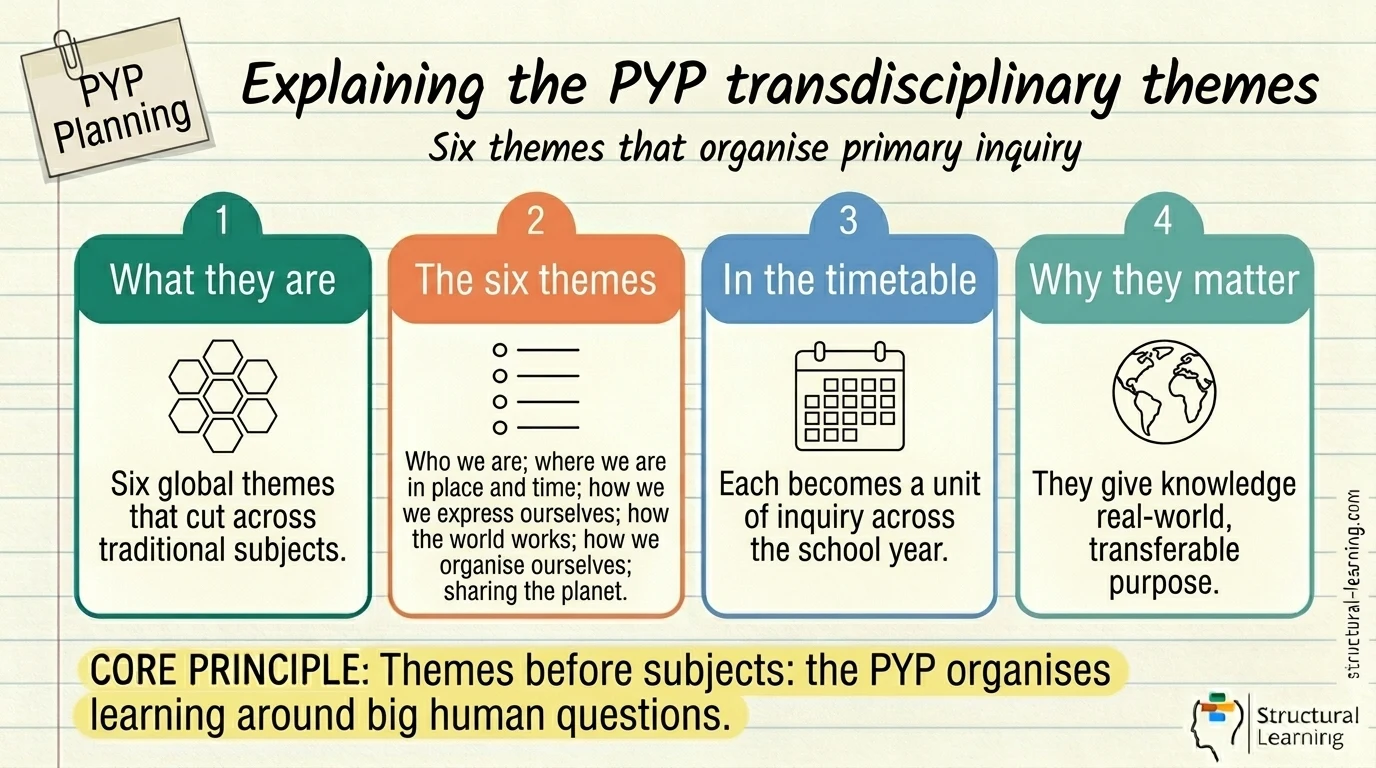
The 6 IB PYP Transdisciplinary Themes: A Guide to Programme Planning describes the six organising themes that shape the IB Primary Years Programme and help teachers plan inquiry across, between and beyond subject boundaries. A clear PYP unit links required knowledge to a larger human question; it does not replace explicit teaching of subject content. This framing aligns with the IB's post-2018 account of transdisciplinary inquiry as learning that works across, between and beyond subjects (IBO, 2018).
For example, in a Year 4 'Sharing the planet' unit, learners can analyse school water-use data in maths. In science, they test filtration, and in English, they write a short proposal to governors. The theme gives coherence, while the teacher still teaches graphs, variables, vocabulary and persuasive language directly. This matters for UK schools because the Programme of Inquiry must fit with National Curriculum coverage, inspection evidence and realistic planning time.
Transdisciplinary learning means learners use ideas, methods and concepts from more than one discipline to explore a shared problem. Its roots came before the PYP, including Piaget's account of how children actively build knowledge (Piaget, 1952) and Nicolescu's work on transdisciplinarity (Nicolescu, 2002). The International Baccalaureate introduced the PYP in 1997 and now organises the Primary Years Programme through six transdisciplinary themes. The Enhanced PYP update in 2018 strengthened agency, action and the learning community (IBO, 2018).
In practice, a class studying local traffic could use maths to analyse flow, geography to map routes and social studies to consider community impact.
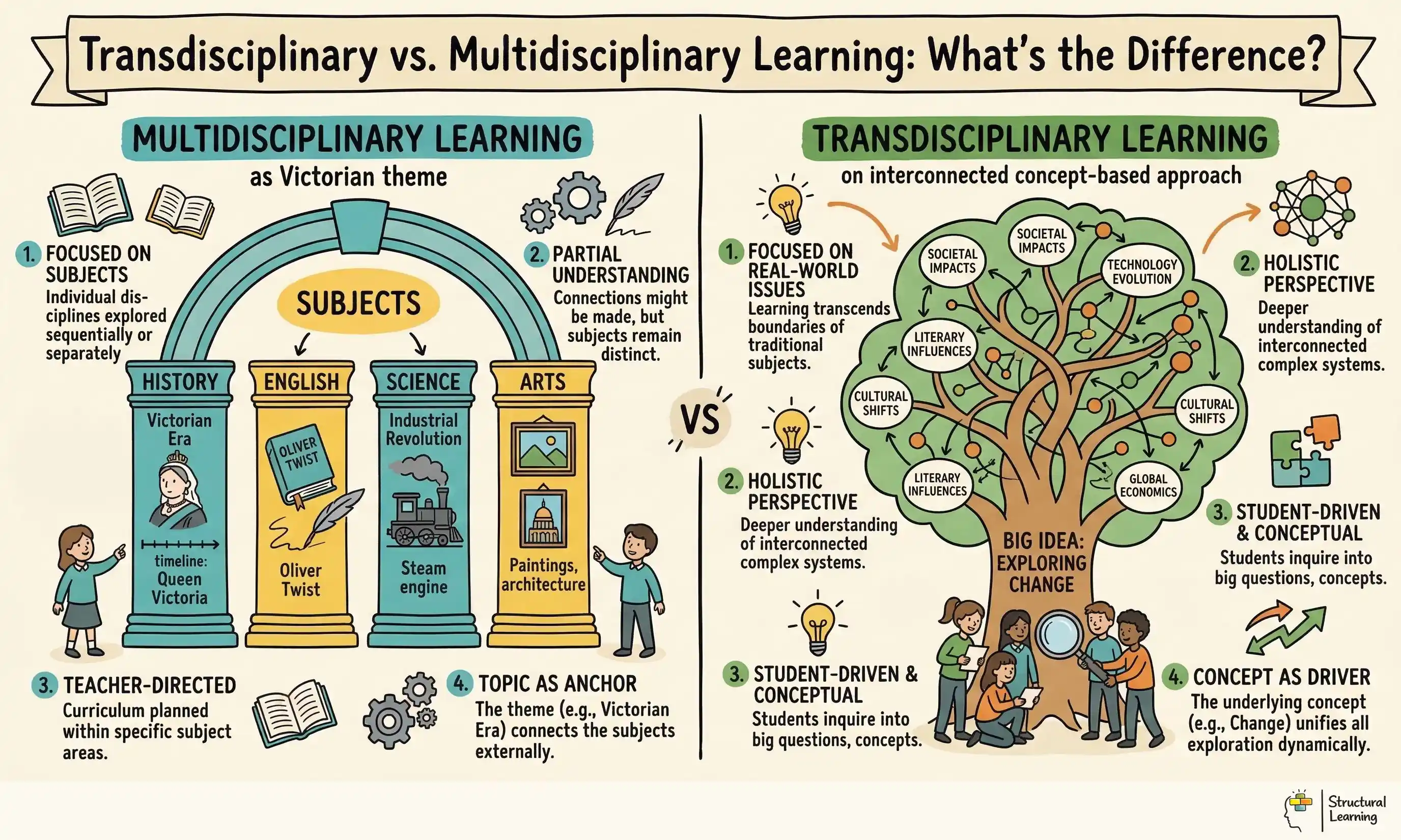
This differs from multidisciplinary learning. In a multidisciplinary approach, a teacher chooses 'The Victorians' and plans separate tasks: counting Victorian money in maths, reading a Victorian poem in English, and building a Victorian toy in art. The subjects stay separate and share only a surface theme. Transdisciplinary learning starts with a conceptual central idea, then asks learners to use disciplines as needed to solve a problem or answer a question.
To achieve this, teachers use macro-concepts to give their units a clear focus. Macro-concepts are big ideas, such as 'Change', 'Systems', or 'Causation'. These can act as cognitive bridges, or links between ideas. Even so, transfer is not automatic.
Current PYP planning also uses seven specified concepts: form, function, causation, change, connection, perspective and responsibility. Earlier PYP materials listed eight key concepts, with Reflection as the eighth. Since the Enhanced PYP, Reflection is embedded across inquiry, assessment and action, not treated as a standalone lens. Many school websites and teacher resources still refer to "8 lenses" in 2026; this guide follows the current seven.
A learner may understand 'Systems' in biology. Even so, they may not use the same idea when they study mechanical or political systems.
In PYP planning, the transfer myth is the belief that naming a macro-concept will make learners use it in other contexts. This rarely happens. Teachers need to build the disciplinary schema first, then ask learners to compare cases across biology, mechanics, politics or social studies (Willingham, 2009; Tricot & Sweller, 2014).
Erickson's concept-based model is strongest when teachers plan factual knowledge and conceptual reasoning together. It is not at its strongest when themes replace subject teaching (Erickson, 2012).
A concise Structural Learning audio episode on The 6 IB PYP Transdisciplinary Themes: A Guide to Programme Planning, grounded in the curated research dossier and focused on practical classroom use.
What the teacher does: The teacher presents a problem (e.g., a local traffic bottleneck) and asks learners to identify which subjects can help them solve it.
What learners produce: Learners create a mind map linking the problem to different subjects (maths for traffic flow, geography for road layout, social studies for community impact).
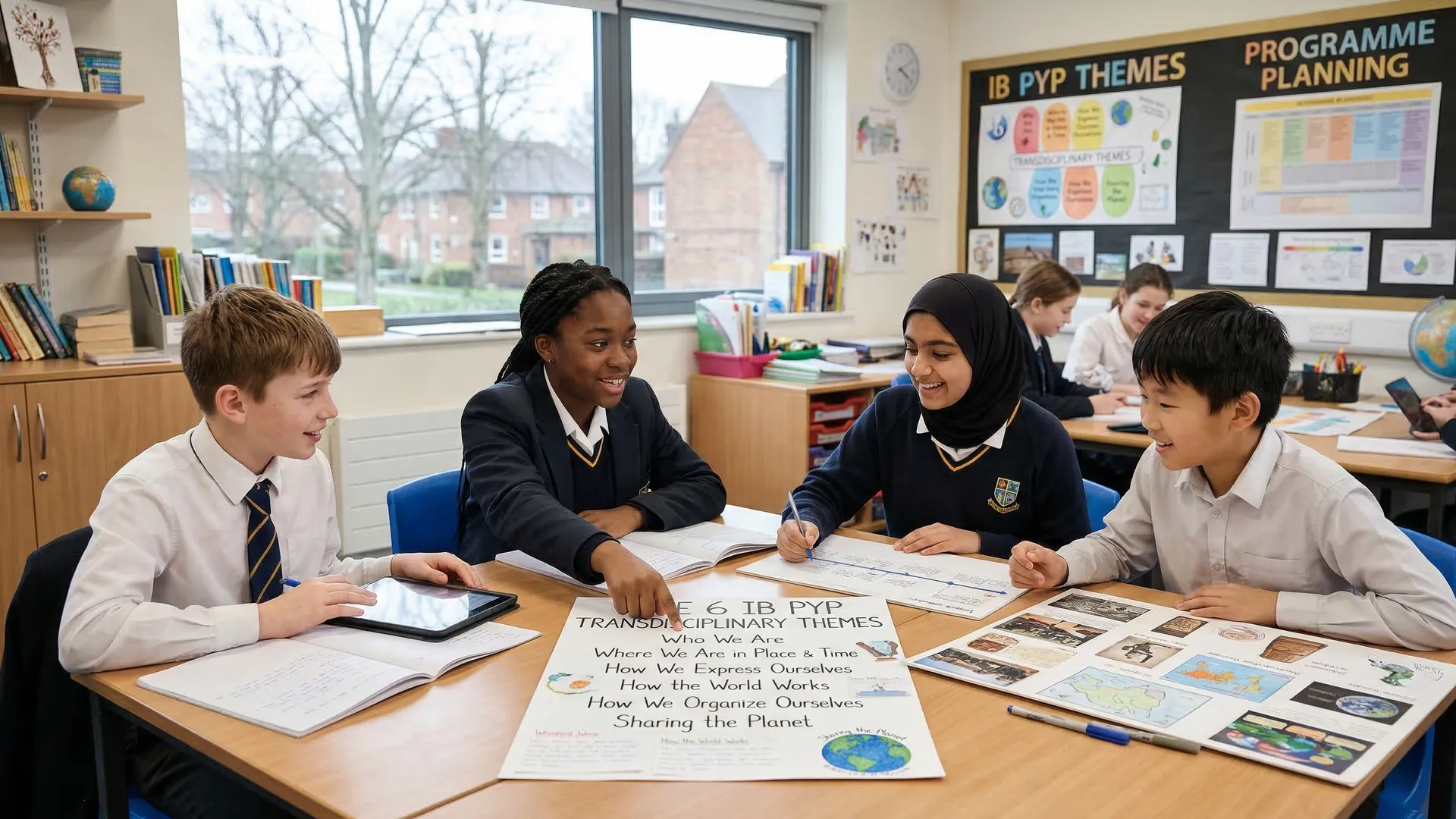
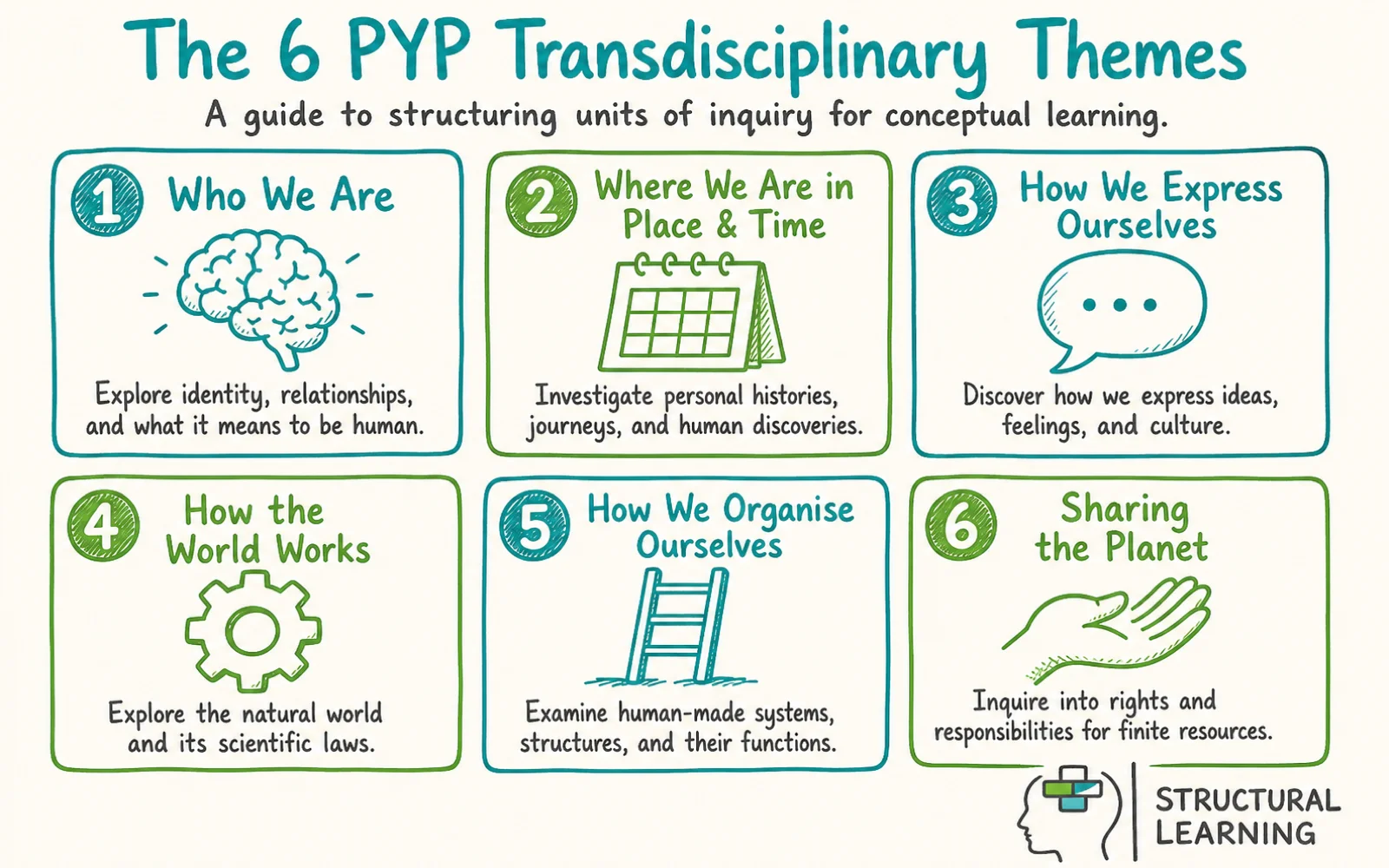
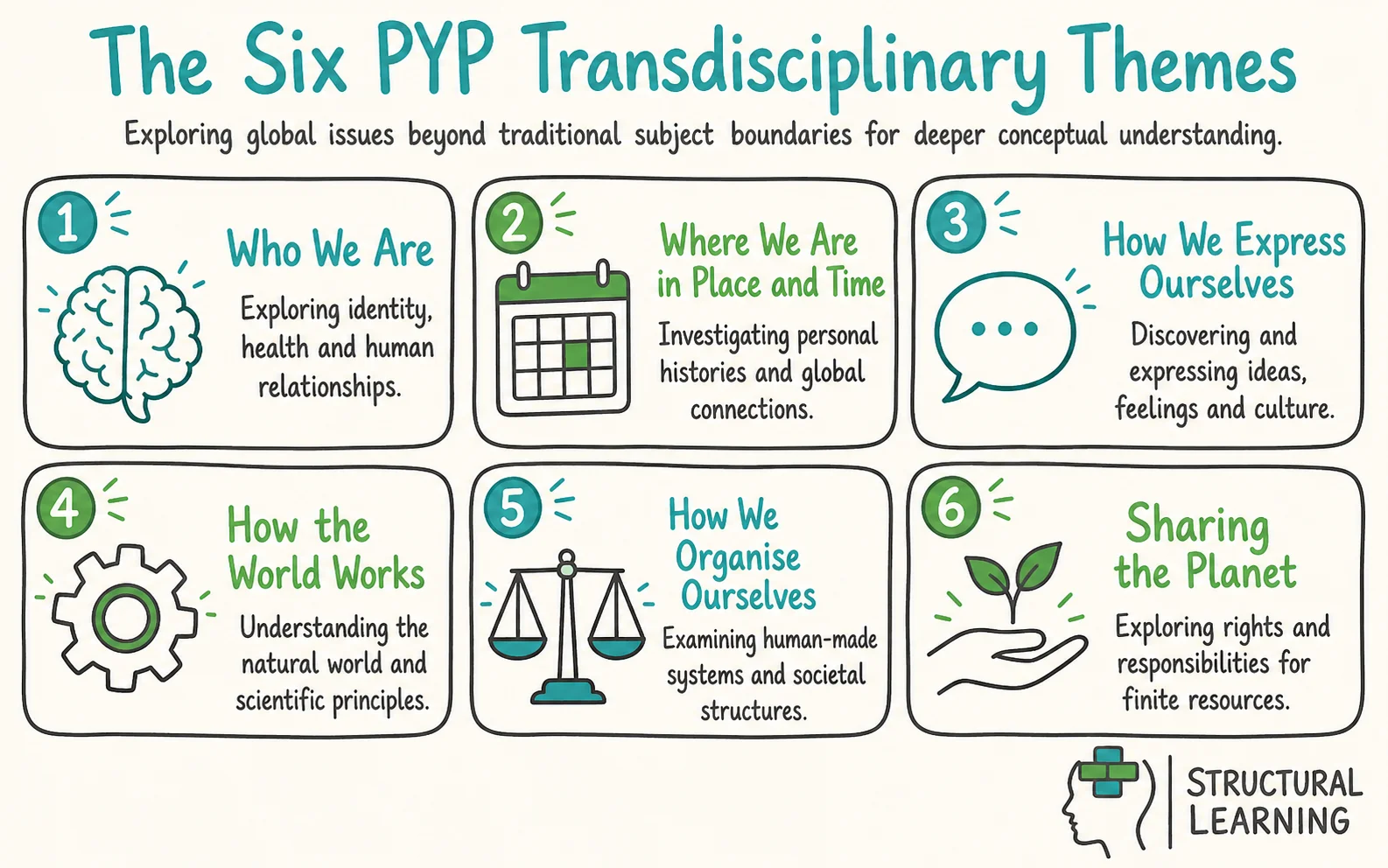
The Primary Years Programme requires schools to structure their curriculum around six specific PYP transdisciplinary themes. These themes are considered essential to the human experience and provide the architecture for the school's Programme of Inquiry (POI). Each year group, except early years, completes one unit of inquiry under each theme; the early years requirement is at least four units. The IB Learner Profile should then be planned through evidence-rich work inside each unit, not added as a separate display or final reflection.
This theme explores the nature of the self, human relationships, physical and mental health, and human rights. It asks learners to consider what it means to be human in a complex society. Teachers should avoid treating international mindedness as a neutral, English-speaking view of the world. A stronger unit asks whose identity is represented, whose language is missing and how local histories shape belonging (Tarc, 2009; Bunnell, 2011; Resnik, 2012).
In the classroom, the teacher uses concept mapping to explore personal identity. The teacher gives learners a central node labelled 'My Identity' and invites them to add branches in English and, where useful, their home languages. Translanguaging helps multilingual learners build concepts before their English academic vocabulary is fully secure.
What the teacher does: The teacher models how to add nodes related to values, beliefs, and relationships.
Learners develop concept maps. The maps explore cultural influences, emotional regulation, and children's rights. Research by Novak (1998) and Buzan (2006) support this. It goes beyond simple family tree diagrams.
This theme explores where we are in space and time. It includes personal histories, local and global history, and the links between people and civilisations. Learners look back so they can understand the present and anticipate the future. The focus is on causation and change over time.
In the classroom, the teacher links past migration patterns to modern refugee crises. The teacher uses cause-and-effect thinking frameworks to make these links clearer.
What the teacher does: The teacher models how to identify root causes and cascading effects using a current news article.
Learners create cause-and-effect diagrams about human movement. They identify 'push' factors, such as famine and conflict. They also identify 'pull' factors from history, such as opportunity and safety.
This theme looks at how learners discover and express ideas, feelings, nature, culture, beliefs and values. It includes the arts, language, design and aesthetic judgement. Recent work on integrated learning suggests that creativity depends on clear teacher actions, such as modelling, questioning and feedback, not on open choice alone (Brauer et al., 2024).
In the classroom, the teacher presents various forms of protest art and asks the class to identify the underlying message. The teacher models how to analyse colour, composition, and text.
What the teacher does: The teacher provides a checklist of elements to consider (e.g., symbolism, target audience, emotional impact).
Learners create multimedia campaigns. They share messages about local issues and craft speeches (Rowsell & Pahl, 2007). Learners also design visual symbols (Kress, 2010) to support their message (Bearne & Wolstencroft, 2007).
Learners explore the laws of the natural world and technological systems. They also study how both interact with societies and the impact of science and technology (Bybee, 2014). In 2026, 'How the world works' should include algorithmic literacy, generative AI, deepfakes and epistemic trust, as well as natural systems. Learners can compare a water cycle model with a recommendation algorithm, test a generated image of a flood against local evidence and ask why source evidence matters.
Learners still ask questions, test ideas and use scientific methods. They also learn how digital systems affect trust, evidence and decision making (National Research Council, 2012; UNESCO, 2024).
Teachers introduce units that link natural cycles with human inventions. They then guide learners through energy transfer experiments using circuits. This draws on constructivist learning theory and Vygotsky (1978) on social mediation (Piaget, 1954). Learners build understanding when these tasks connect new ideas to what they already know (Bruner, 1966; Ausubel, 1968).
What the teacher does: The teacher demonstrates how to record observations and draw conclusions from the experiment.
What learners produce: Learners carry out scientific experiments to gather data. They then produce creative writing pieces that explain how an electron moves from a power station to their bedroom lamp.
This theme explores how human systems, communities and economies are organised. Learners examine rules, laws, supply and demand, public services, representation and decision making. The aim is to help learners see that systems are designed by people, carry trade-offs and can be improved through evidence and fair debate.
In the classroom, the teacher simulates a micro-economy. The teacher gives limited classroom resources (pencils, paper, rulers) unevenly to the groups. The teacher then asks the groups to complete a project that needs all the resources.
What the teacher does: The teacher acts as a facilitator, guiding the process. They help learners negotiate and keep the work fair.
Learners negotiate and share. They create a written charter outlining resource allocation fairly. This turns the theme into a visible classroom routine rather than an abstract discussion.
Learners explore how people and other living things share limited resources. They think about communities, relationships, fairness, peace and how people solve conflict. The theme also covers sustainability, rights, responsibilities and choices about shared resources.
In class, the teacher introduces a sustainable living unit. The class analyses local water use data, and the teacher gives clear frameworks for policy analysis.
What the teacher does: The teacher presents different perspectives on water rights and conservation.
Learners create a project that combines water data in science with policy ideas from social studies. They present local solutions to school leaders, using evidence rather than general appeals.
Moving from traditional subject teaching to conceptual inquiry can help learners think more clearly. When teachers organise facts around a central concept, learners build stronger cognitive schemas. This structure reduces the load on working memory because learners attach new facts to a concept they already understand (Sweller, 1988).
Conceptual inquiry teaches for transfer. The goal of education is not simply retaining facts for a test, but applying learning to new situations. When learners deeply understand 'Migration' rather than memorising dates of the Oregon Trail, they can apply that understanding to a modern news story about climate refugees. This ability to transfer knowledge across contexts is the hallmark of deep learning (Perkins, 2014).
The approach respects teachers' professional judgement. Teachers design transdisciplinary units; they do not just deliver textbooks. Work across subjects and year groups matters. Central ideas must be accurate within each discipline and still interest learners (Wiggins & McTighe, 2005; Drake & Reid, 2020).
Teachers design interdisciplinary lessons around these concepts (Darlington, 2018). This means lessons connect subjects and help learners use subject skills together, such as maths and art (Donnelly & Fitzmaurice, 2005). This approach builds stronger subject knowledge (Hussein, 2021) and supports critical thinking.
What learners produce: Learners show their understanding of the central idea through a performance task. The task requires them to apply knowledge from multiple disciplines.
Vygotsky (1978) argued that learning is socially mediated. This means PYP inquiry needs scaffolded dialogue, modelling and shared tools. Scaffolding stops open tasks from feeling overwhelming, while explicit teaching guides learners through the inquiry process (Bruner, 1960). If a learner struggles to plan an investigation, record evidence from more than one lesson, agree the next adjustment with the SENCO or family, and reduce the scaffold only when independence is visible.
Graphic organisers make learners' thinking visible across subjects. These tools give shape to abstract ideas, so learners can sort information more clearly. They also support sequencing and analysis, (Novak, 1998). Over time, they become a steady cognitive anchor as learners move between subjects, (Hyërle, 2009; Al-Kharusi, 2017).
The teacher introduces a 'Frayer Model' to explore the concept of 'Conflict' during a 'Sharing the planet' unit. The teacher models how to fill in the definition, characteristics, examples, and non-examples boxes on the board.
What the teacher does: The teacher provides sentence starters to help learners articulate their ideas.
Frayer Models help learners explore conflict. They find examples from history texts and news articles. Learners also use playground experiences (Frayer, 1969). This activity helps learners understand different conflict types.
The Central Idea is the foundation of any PYP unit. It is a single, concise statement that expresses a timeless, universal truth. A strong Central Idea does not mention specific topics, places, or times. Instead, it links two or more concepts together to provide a destination for the inquiry.
Teachers look at rivers in geography and states of water in science. Rather than plan a unit called "Rivers," they use this central idea: "Water distribution impacts human settlement and environments".
What the teacher does: The teacher uses a 'concept mapping' activity to brainstorm related concepts before writing the central idea.
What learners produce: Learners create research portfolios testing this idea against different global case studies, such as the Nile and the local town river.
Thinking routines are short, repeatable protocols that help learners structure their analysis of new information. They are useful at the 'tuning in' phase of an inquiry to activate prior knowledge and generate learner questions. Routines like 'See, Think, Wonder' or 'Claim, Support, Question' are effective.
The teacher displays a complex photograph of a bustling, futuristic city to launch a 'How we organise ourselves' unit. The teacher guides the class through the 'See, Think, Wonder' routine, recording responses on a large chart.
What the teacher does: The teacher encourages learners to justify their 'think' and 'wonder' statements with evidence from the image.
What learners produce: Learners create a list of questions grouped by category about urban planning, transport systems, and social equity. These questions become the guiding lines of inquiry for the next six weeks.

The 6 IB PYP Transdisciplinary Themes in practice, a classroom-ready briefing you can use this week.
Established inquiry and curriculum writers such as Drake (1993), Mathison (1998), Murdoch (2015) and Freire (1970) help teachers spot common mistakes in primary years curriculum design. Learners make progress when they understand transdisciplinary ideas. This matters more than choosing appealing topics alone.
The most common misconception is the 'Topic Trap'. Many teachers think that choosing an engaging topic, such as 'Dinosaurs' or 'Space', makes an inquiry unit.
However, 'Dinosaurs' is a locked topic because it does not transfer to other areas of learning. Teachers need to draw out the concept, then teach the knowledge learners need to use it.
Changing the unit to 'Adaptation over time' lets learners study dinosaurs, modern animals, plant life and human technological adaptation. The topic carries the learning, and the concept gives it direction. Even so, transfer still depends on secure domain knowledge (Willingham, 2009).
Another common error is forced integration. Teachers can feel pressure to include every subject in every unit. This can lead to artificial and confusing lessons, such as asking learners to write a poem about long division during a maths-heavy unit.
Evidence-based planning needs authentic connections. If a subject does not naturally support the Central Idea, the teacher should teach it separately as a stand-alone lesson. They can connect it later when the link is real.
Finally, some people think inquiry learning means giving up direct instruction. Sceptical teachers may see inquiry as a loose free-for-all, where learners must find complex knowledge by themselves.
This view is wrong and can cause harm. Kirschner, Sweller and Clark (2006) argued that novice learners need clear teaching, worked examples and key vocabulary before open inquiry, because too much element interactivity can overload working memory (Tricot & Sweller, 2014). The teacher builds the base first, then moves learners into guided investigations.
What the teacher does: The teacher names these misconceptions clearly. They address them during staff training sessions.
Learners use a compare-and-contrast task to show how they understand topic-based and conceptual learning. This helps them see the differences between the two methods.
Work with class teachers, specialist teachers, SEND staff and curriculum leaders to build a balanced Programme of Inquiry. A single teacher cannot create it alone. Use a shared planning protocol: agree the central idea, identify the disciplinary knowledge each teacher owns, mark the explicit teaching that must happen outside the unit, co-construct a small number of learner questions, then check assessment evidence together. In the Enhanced PYP, agency means voice, choice and ownership inside clear curriculum constraints; it is not a licence to let coverage drift (IBO, 2018; Wiggins & McTighe, 2005; Drake & Reid, 2020).
Step one is matrix mapping. The curriculum leadership team lists all year groups against the six transdisciplinary themes, then maps National Curriculum or state standards to the grid.
In UK schools, keep a separate subject-progression view for Ofsted inspection conversations. This helps leaders show what substantive and disciplinary knowledge is taught. It also shows when learners revisit that knowledge and how teachers assess it. The hidden cost is time: PYP coordinators need protected planning sessions, so teachers are not rebuilding six transdisciplinary themes, National Curriculum coverage and assessment evidence alone.
This prevents duplication without hiding subjects inside broad themes. For example, if Year 3 covers the Roman Empire under 'Where we are in place and time', Year 4 should not repeat the Romans under a different theme.
Step two is drafting the Central Ideas. Grade-level teams meet to review the standards assigned to their units.
They then synthesise these standards into one conceptual statement. A practical formula for teachers is: Concept A + Context + Concept B.
For example: 'Human migration (Concept A) is driven by environmental changes (Context). It also creates cultural diversity (Concept B)'.
Step three is developing the Lines of Inquiry. These are three or four bullet points that clarify the Central Idea and guide day-to-day lessons.
They should build in complexity. The first line is usually factual, the second is conceptual and the third is debatable.
For the migration unit, line one can be 'The reasons people migrate', line two 'The challenges faced during migration', and line three 'The impact of migration on local communities'.
Step four is assessment design. Before planning learning activities, teachers define success in three areas: recall, disciplinary method and conceptual transfer. Formative checks should come early, such as quick retrieval, vocabulary probes, hinge questions, annotated observations and draft feedback.
The final task must ask learners to show their understanding of the Central Idea, not just repeat facts. If the Central Idea is about systems, the assessment must ask learners to evaluate or design a system.
The teacher designs a summative performance task for the end of the migration unit. They create a rubric to assess historical knowledge, geographical mapping skills, and empathy.
What the teacher does: The teacher provides learners with a choice of formats for their summative assessment (e.g., presentation, report, model).
Learners build a 'Migration Museum' exhibit. They choose a historical migration and map its routes. Learners also present primary source diaries to parents (Wiggins and McTighe, 2005). This gives them agency (Hattie, 2012).
Transdisciplinary learning works when subjects keep their rigour and serve a clear inquiry purpose. Maths, English, science, the arts and humanities should not disappear into a theme; teachers decide which subject knowledge is essential, which can connect later and which needs a separate lesson.
In Maths, data handling and statistics are the most transferable skills. During a 'Sharing the planet' unit on waste management, maths should not be taught in isolation. The teacher instructs the class on how to construct and interpret bar charts and pie graphs.
What the teacher does: The teacher provides real-world examples of how data is used to inform waste management policies.
What learners produce: Learners conduct a school-wide waste audit, tally the types of rubbish produced in different classrooms, and create detailed statistical reports to present to the headteacher. The mathematical skill is the tool used to understand the global theme.
In English and Language Arts, the reading and writing genres should fit the unit purpose. In a 'How we organise ourselves' unit on advertising and media, the English block moves to persuasive writing. The teacher analyses the language in different adverts, such as rhetorical questions and emotive language.
What the teacher does: The teacher provides a template for writing persuasive arguments.
What learners produce: Learners write their own advertising copy for a new playground initiative. They use the explicit grammar skills taught in the English lesson to persuade their peers.
In Science, the focus shifts to the scientific method as a way of knowing the world. During a 'How the world works' unit investigating structural engineering, science lessons focus on fair testing and variables. The teacher models how to isolate a single variable (e.g., the shape of a bridge support).
What the teacher does: The teacher gives clear safety rules. These rules guide learners during experiments.
Learners build models with craft materials. They test how much weight the models hold in controlled conditions. Learners then write conclusions explaining triangles' strength .
Free for teachers. The platform builds a classroom-ready lesson plan from your topic in under two minutes.
Schools must teach six units of inquiry per year, one under each of the transdisciplinary themes. The exception is the early years programme (ages 3-5), which requires a minimum of four units per year due to the developmental needs of younger children.
No, Central Ideas must be unique to each unit across the whole Programme of Inquiry. However, macro-concepts, such as 'Change' or 'Responsibility', will appear often. This helps learners build a deeper and more developed understanding of these concepts as they mature.
If a specific skill, such as long division or fractions, does not authentically connect to the current unit of inquiry, do not force it. Teach that maths standard as an isolated, stand-alone unit. Authentic connection is always preferable to superficial integration.
Teachers assess these through the Approaches to Learning (ATL) framework. They do not only grade factual knowledge. They observe learners during the inquiry process. They also use rubrics to assess communication skills, thinking skills, self-management, research, and social skills.
A standard unit of inquiry usually lasts four to six weeks. This gives learners enough time to work through the full inquiry cycle. They move from early interest and factual research to deeper conceptual understanding and action.
What the teacher does: The teacher uses a backward design approach to plan the unit, starting with the summative assessment and working backwards to the daily lessons.
Learners show unit understanding through assessment tasks that check both recall and transfer. Formative and summative tasks help gauge progress (Wiliam, 2011; Black & Wiliam, 1998). Karpicke (2008) shows why short retrieval checks help teachers see whether essential vocabulary and facts are secure before learners apply concepts in a new context. Teachers use this data to inform teaching (Hattie, 2012; Leahy et al., 2005).
Take out your current term plan, identify one purely topic-based unit (like 'Space' or 'The Romans'), and rewrite it as a conceptual Central Idea for your next planning meeting.
Transdisciplinary planning has limits. First, transfer is harder than many PYP planning guides imply. Willingham (2009) argues that thinking depends on what learners already know, while Tricot and Sweller (2014) argue that domain-specific knowledge explains skilled performance better than generic thinking skills. Novice learners can struggle when a unit asks them to move across science, history and language before the basic vocabulary and procedures are secure.
Second, inquiry can increase cognitive load if it starts too openly. Kirschner, Sweller and Clark (2006) warn that minimally guided tasks are least effective for beginners; PYP units therefore need explicit phonics, maths, vocabulary and worked examples before independent investigation. The methodological evidence is also uneven. Vygotsky (1978) offers a powerful account of socially mediated learning, but his work is not direct proof that every PYP unit improves learning. Karpicke (2008) shows the value of retrieval practice, yet laboratory findings on recall do not by themselves validate broad thematic units.
Third, cultural critique matters. Scholars of international education argue that international mindedness can reflect mobile, English-speaking and Western norms unless schools include local knowledge, home languages and contested histories (Tarc, 2009; Bunnell, 2011; Resnik, 2012). These limits do not weaken the PYP. They make it more precise: transdisciplinary themes work best when teachers protect disciplinary knowledge, teach novices explicitly, assess transfer cautiously and adapt the programme to the community they serve.
Karpicke, J. (2008). The critical importance of retrieval for learning.
Vygotsky, L. (1978). Mind in society: The development of higher psychological processes.
These peer-reviewed studies provide the evidence base for the strategies discussed above.
Research, like that of Grainger (2004) and McWilliam (2007), shows teachers can support creativity. Dawes (2020) and others find specific behaviours useful for learner growth. This review of existing research by researchers like Mulnix (2012) explores these behaviours.
Brauer et al. (2024)
Teachers' actions support learner creativity . Reviews show evidence-based teaching grows creative learners across subjects. This is useful for IB PYP's transdisciplinary learning.
Learners face uncertainty in sustainability topics. Metacognitive learning helps, say researchers (View study ↗). Kember et al. (2001) found reflection supports deeper understanding. Zohar (2012) highlights metacognition's role in complex problem solving. Veenman et al. (2006) link it to better learning outcomes.
Bohm et al. (2024)
The research explores how learners use metacognition facing sustainability challenges. Teachers can use this to support thinking during inquiries into uncertain real-world issues. (Schwartz et al., 2009; Kuhn, 2005; Zimmerman, 2002)
Transdisciplinary STEM: Examples of Student Thinking within Nonformal Learning Experiences View study ↗
Lesseig et al. (2023)
This work by researchers examines learner thinking in integrated STEM (nonformal). It gives teachers examples of reasoning across subjects. This offers practical insights for designing effective learning experiences (Brophy et al., 2023).
Why Did All the Residents Resign? Key Takeaways From the Junior Physicians' Mass Walkout in South Korea. View study ↗
23 citations
Park et al. (2024)
This paper examines a mass resignation of junior physicians in South Korea. It appears less relevant to classroom teaching and transdisciplinary education compared to the other papers in this collection.
Mapped to the curriculum. CPD-aligned. Free for teachers.
Open a free account and help organise learners' thinking with evidence-based graphic organisers. Reduce cognitive load and guide schema building dynamically.