


The Bolted-On Concept Trap: Why Your PYP Units Feel Like Traditional Lessons
Why most PYP units are topic-driven with concepts bolted on, and how the Thinking Framework fixes this. A practical guide for PYP coordinators and teachers.

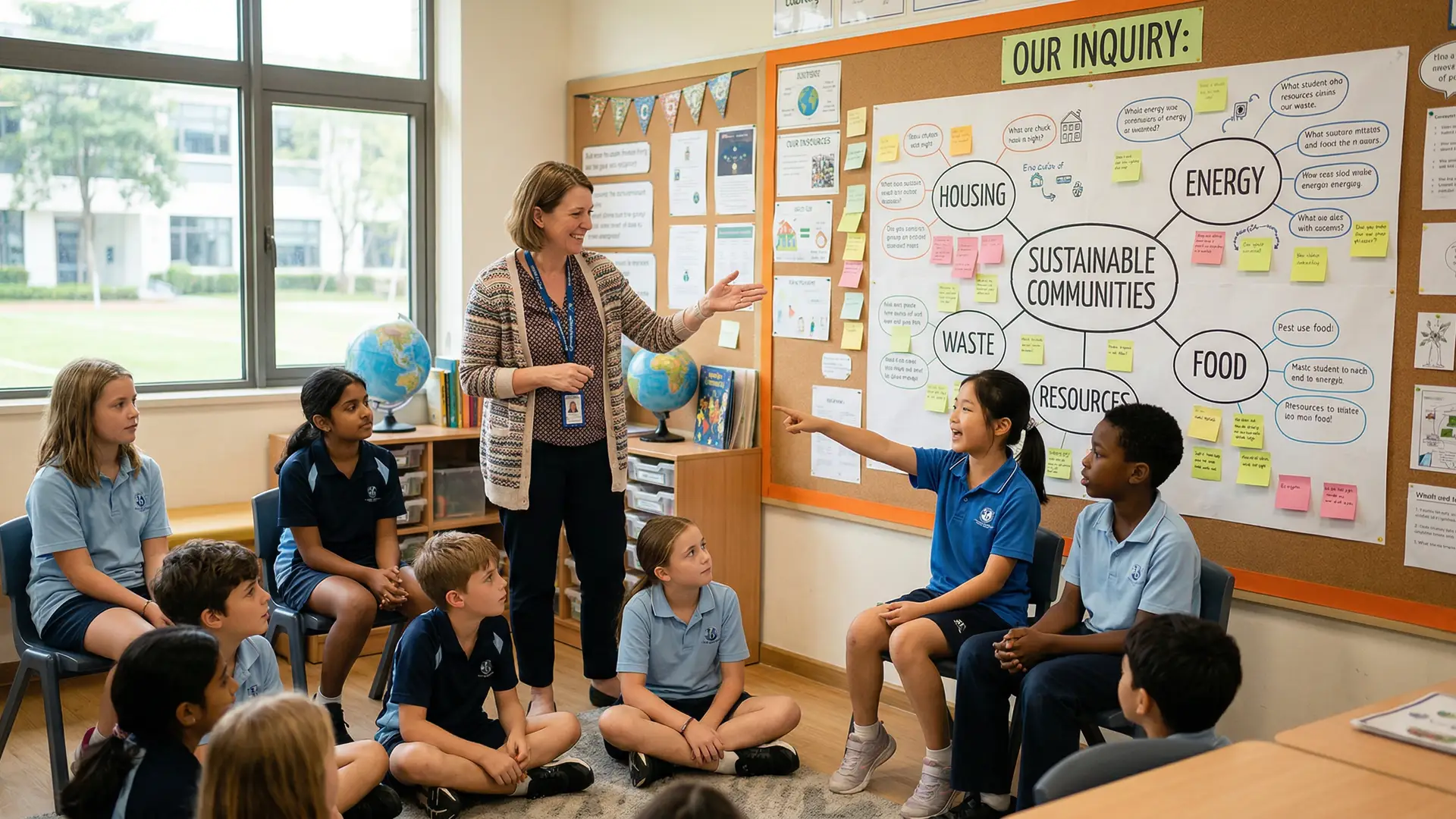
Why most PYP units are topic-driven with concepts bolted on, and how the Thinking Framework fixes this. A practical guide for PYP coordinators and teachers.
The bolted-on concept trap is a curriculum-design error. It happens when a PYP key concept is added after the topic, activities and assessment have already been planned. As a result, the concept does not shape inquiry, thinking or transfer.
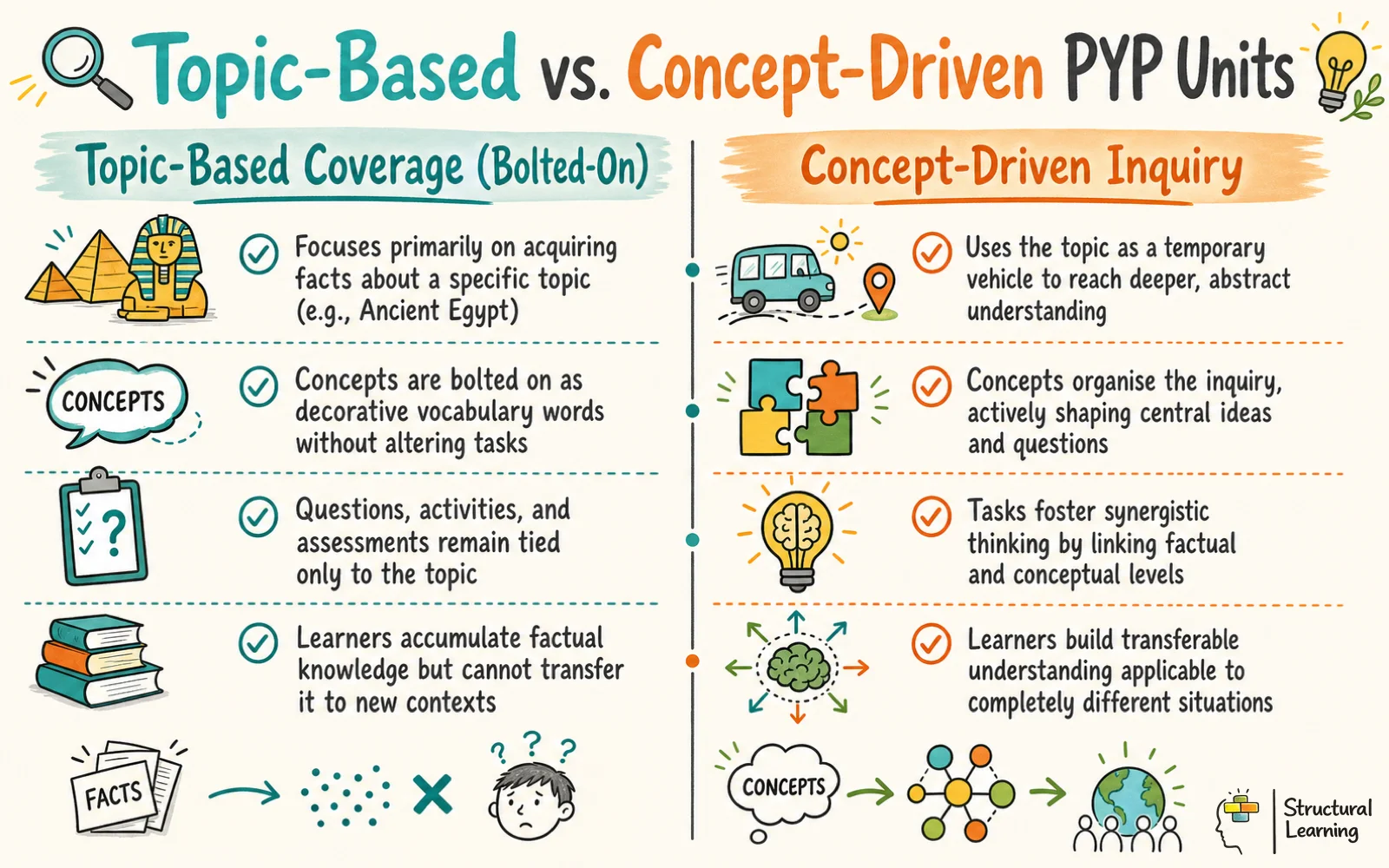
Erickson's concept-based curriculum work describes a familiar trap: concept-based units can miss the mark when a concept is added to an existing topic rather than used to drive the inquiry. For example, a unit on Ancient Egypt may appear complete. "Change" links to the central idea, but the concept does not guide inquiry.
The concept did not drive that unit. It was bolted on afterwards, like a label on a box that was already packed. Erickson, Lanning and French (2017) argue that concepts should organise inquiry and support transfer; when the concept is appended to a topic, learners can complete the work without building transferable conceptual understanding.
They may spend three weeks learning about Egypt in English, art and maths. Change appears on the word wall and in the final reflection, but it does not alter the questions, tasks or assessment. In Erickson and Lanning's (2014) terms, the unit remains topic coverage rather than concept-driven inquiry.
Thinking Frameworks connect ideas and lessons. Eight cognitive operations help learners apply knowledge to tasks. A five-point checklist can help teams diagnose whether the concept is shaping learner thinking or simply decorating the unit plan. This gives coordinators a practical way to address a common planning issue.
Erickson (2002) used the language of concept-based curriculum to separate factual topic coverage from deeper conceptual understanding. Strong IB concept learning includes both content and thinking processes. Learners gain knowledge and practise key processes. Both elements matter, but neither one alone prepares them fully to transfer learning.
Erickson (2002) says conceptual understanding involves learners building big ideas with facts. This creates a Structure of Knowledge. Learners move fluidly between facts and concepts. This helps them construct understanding and examine new information (Erickson, 2002).
Concept training often names the vocabulary but misses the planning structure (Erickson, 2002). The current PYP uses seven specified concepts: form, function, causation, change, connection, perspective and responsibility. Older PYP materials listed eight because Reflection was once treated as a separate lens.
Since the Enhanced PYP in 2018, reflection is woven through inquiry, assessment and action. It is not listed as a standalone concept. Many school websites and teacher resources still say "8 lenses" in 2026, but this article aligns to the current seven.
Units meet the checklist, yet encourage only topic-based thought. Learners finish an "Ancient Egypt: Change" unit knowing about Egypt. However, they may not grasp transferable concepts of change.
Erickson and Lanning (2014) say concepts are abstract, timeless, and transferable. "Change" is a concept. "The Egyptians changed" is not. It uses "change" as a verb. What understanding about Change will learners retain beyond Egypt?
IB PYP units use central ideas, not just topics, to express generalisations. These generalisations link concepts and make broader claims. For example, "Systems depend on balanced parts" (Erickson, 2002). Learners can then test this transferable idea.
Use examples like Egyptian irrigation or the school (Wiggins and McTighe, 2005). Rainforests and governments can also demonstrate this concept (Costa and Kallick, 2008). In this way, the topic reveals the generalisation.
This is where transdisciplinary planning is different from normal cross-curricular work. In a transdisciplinary PYP unit, subjects act as lenses for one shared conceptual inquiry.
An interdisciplinary unit links two or more subjects, but still keeps each subject's questions clear. Ancient Egypt in English, art and maths is not automatically either approach. The concept must change the questions each subject asks.
This distinction matters because Erickson's synergistic thinking depends on secure factual knowledge. Topic coverage is not the enemy of conceptual learning. It is the raw material. Willingham (2009) argues that thinking depends on available background knowledge, and cognitive load theory makes the same point about novice learners (Sweller, 1988).
A learner cannot reason well about Change in Ancient Egypt if key words still feel unfamiliar. These include pyramids, pharaohs, labour systems and religious beliefs.
A comparison from outside education clarifies the boundary of transfer. Security teams do not improve information security by adding a "security culture" label to old training slides, and security teams do not protect a supply chain by writing "cloud security" at the top of a risk form. The shift from reactive proactive work only makes sense when security design changes the questions, evidence and decisions in the system design. PYP planning follows the same rule: the concept must change what learners attend to.
Wiggins and McTighe's (2005) Understanding by Design framework makes the same point from a different direction. Enduring understandings, their term for the generalisations worth retaining, cannot be assessed with a quiz about facts. They require performance tasks that demand transfer: take what you understood here and apply it there. If you cannot write a transfer task for your central idea, you may not have a central idea.
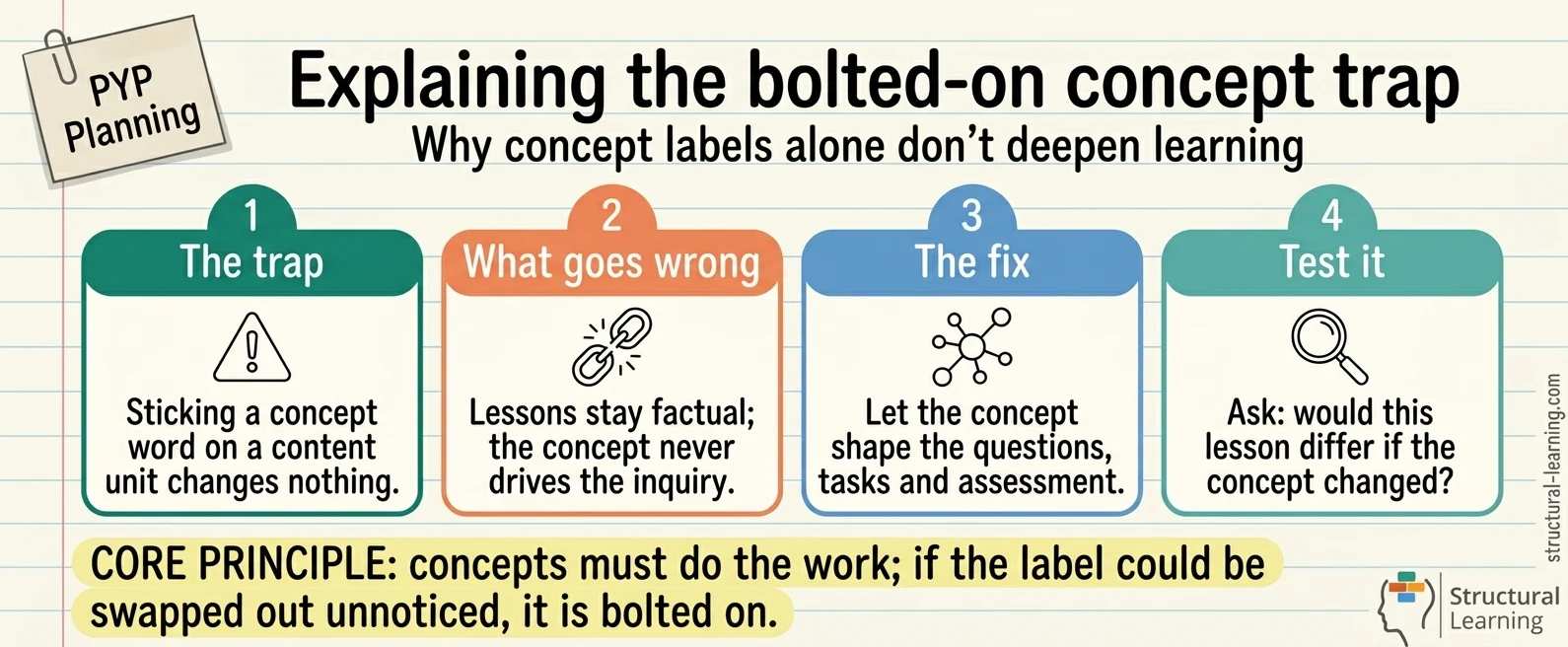
Teachers can use this checklist to test the structure of a PYP unit plan. Each warning sign points to a curriculum-design problem and a planning response. Use it in team planning to check whether the concept changes the central idea, the lines of inquiry, the learning tasks and the assessment evidence.
Warning sign 1: The central idea reads like a topic sentence. "Ancient Egyptians built pyramids that changed their society" describes a topic. It contains a fact and a concept-word, but it makes a claim only about Egypt, at a particular time and place. A learner could not use it to think about another civilisation, a school building or a local memorial.
The fix is to rewrite the idea using this Central Idea formula: Concept A + Context + Concept B. "Human societies create structures that reflect and reinforce their values" can still use Egypt as the example. It can also support inquiry into modern architecture, religious buildings or digital platforms.
Warning sign 2: Lines of inquiry are activities, not inquiry pathways. "How pyramids were built," "What the pyramids looked like," and "Why they were important" are research questions about Egypt. They are not inquiry pathways into the concept. Inquiry pathways for the generalisation above would look different: "What values do different societies express through their built environment?" and "How do power structures shape what gets built, preserved, or destroyed?" These questions cannot be answered by recalling facts. They require learners to think with the concept.
Warning sign 3: Assessment measures knowledge recall, not conceptual transfer. If the summative assessment task asks learners to write about Egypt, it is a topic assessment. A transfer task asks learners to apply their conceptual understanding to a new context. "Using what you now understand about how societies express values through structures, evaluate a building in your own community" is a transfer task. The Egyptian content is no longer the subject: it is the prior experience from which the learner draws.
Warning sign 4: The key concept could be swapped without changing the unit. Try this thought experiment: replace "Change" with "Connection" in your unit planner. Does the unit look clearly different?
If not, the concept was not shaping the unit. In a genuinely concept-driven unit, the conceptual lens decides which parts of the topic come first, which lines of inquiry are followed, and which transfer tasks matter. Swapping the concept should create a recognisably different unit.
Warning sign 5: Learners can answer "What did you learn?" but not "What did you understand?" Ask learners at the end of a unit to complete both stems. "What did you learn?" invites recall. "What did you understand?" asks for a generalisation.
In a bolted-on unit, learners often answer the first question in detail and the second with vague claims such as "things change". A stronger answer is: "I understood that societies use physical structures to maintain power and signal what they value, and that this pattern appears in different times and places."
Erickson and Lanning's (2014) formula helps fix central ideas: Concept A + Context + Concept B. The formula needs a claim. The claim should link two concepts using a contextual relationship. The relationship must be valid across contexts.
| Topic-driven version | Concept-driven version | Why the second works |
|---|---|---|
| Ancient Egyptians built pyramids that changed their civilisation. | Human societies create structures that reflect and reinforce the values of those in power. | Connects Systems and Values; transferable to any built environment across time. |
| The water cycle describes how water moves around the Earth. | Natural systems maintain balance through cyclical processes that distribute resources. | Connects Systems and Balance; applies to water cycles, food webs, carbon cycles. |
| Communities have rules that help people live together. | Shared agreements shape the rights, responsibilities, and identity of a community. | Connects Agreement, Rights, and Identity; transfers from school rules to national constitutions. |
| Migration has affected the culture of many countries. | When people move, they bring their cultural identity with them, transforming both their new community and themselves. | Connects Migration, Identity, and Transformation; applies to historical migration and contemporary displacement. |
A practical test for any central idea: replace the specific topic with "people," "systems," or "communities" and check whether the idea still makes sense. If it does, you likely have a generalisation. If it collapses without the specific topic, you have a topic sentence.
Marschall and French (2018) suggest checking structure: central ideas should actively link concepts. A weak idea is "Change has many causes". Marschall and French (2018) say a strong idea is: "Economic factors speed social change faster than politics." This claim is specific and debatable.
Erickson and Lanning's (2014) framework helps check inquiry lines lead learners to the central idea. Coordinators can use it to audit lines of inquiry. Ensure they build towards, not just around, the core concept.
Factual questions establish the knowledge base. They have correct answers that can be verified. "Which key concepts does the IB define?" and "What are the six IB PYP transdisciplinary themes?" are factual questions. They are necessary but not sufficient. A unit composed entirely of factual lines of inquiry is a research assignment, not an inquiry.
Conceptual questions ask learners to use facts to build wider ideas, or generalisations. Learners cannot answer them by recall alone. They need to connect, compare, or evaluate ideas.
"How do the structures a society builds reflect its values?" is a conceptual question. Learners need factual knowledge to answer it, but the answer is a generalisation, not a single fact. These questions drive concept-driven inquiry.
Debatable questions sit at the top of the framework. They are provocative, open-ended, and do not have consensus answers. "Is it ever justified to destroy the physical structures of a past culture?" is debatable. These questions develop the perspective-taking and moral reasoning that are central to the IB Learner Profile. They also signal to learners that the inquiry matters beyond the classroom.
When auditing a unit's lines of inquiry, check that all three tiers are present and that the conceptual questions are genuinely conceptual, not disguised factual questions with the word "why" added. "Why did the Egyptians build pyramids?" is factual in disguise: it has a conventional historical answer. "Why do powerful groups in every era build monuments?" is genuinely conceptual.
Naming the problem is straightforward. Fixing it in the classroom requires tools that make abstract concepts operational for learners, not just for curriculum designers. This is where the Thinking Framework enters.
Marzano et al. (1988) identified cognitive operations, such as comparing, classifying and analysing relationships. In this article, those operations become classroom steps for working with a concept. A concept alone gives learners a label, but a cognitive operation gives them a process. They can compare the cases, classify the examples, sequence the change, or map the system.
Consider a Year 4 unit on "How We Organise Ourselves" with the key concept of Function. The bolted-on version: "Let us learn about how communities work. The concept is Function." The Thinking Framework version uses Part-Whole analysis as the cognitive procedure:
"Imagine every adult in our school disappeared for one day. Which roles would the community miss immediately? Which could wait a week? Use the Part-Whole operation to map which functions are essential and which are supporting. Now transfer this: what roles are essential in a hospital? What roles could a hospital survive without for a day?"
The Part-Whole operation gives learners a cognitive procedure for working with Function as a concept. They are not memorising what function means. They are using it to analyse, and then transferring that analysis to a new domain. The concept is doing structural work.
This also affects accessibility. Abstract-first prompts can disadvantage autistic learners, multilingual learners and learners with limited background knowledge when the hidden rule is not made clear. Universal Design for Learning asks teachers to show concepts through concrete examples, visuals, talk, sorting, mapping and action. This makes the abstraction visible before learners are asked to generalise (CAST, 2018).
Each cognitive operation maps naturally onto specific conceptual work:
| IB Key Concept | Thinking Framework operation | What learners do |
|---|---|---|
| Change | Sequence + Cause and Effect | Map the stages of a change process; identify what triggered each stage; transfer to a different change process. |
| Connection | Systems Thinking + Analogy | Map the connections within a system; identify which connections are essential; find analogous systems in different domains. |
| Causation | Cause and Effect + Compare | Distinguish proximate causes from underlying causes; compare two events to identify common causal patterns. |
| Form | Classify + Part-Whole | Identify the features that define a category; analyse how parts contribute to the defining whole. |
| Perspective | Perspective + Compare | Articulate how the same event or object is experienced differently from different standpoints; compare what each perspective reveals and conceals. |
| Responsibility | Perspective + Systems Thinking | Map who is affected by a decision and how; evaluate which actors have agency; consider systemic responsibilities beyond individual action. |
| Function | Part-Whole + Analogy | Map the role each part plays in the whole; find analogous functional structures in a different domain. |
The Thinking Framework also makes the IB Learner Profile more concrete. Attributes such as "thinker" and "reflective" can be named in a planner yet absent from lesson design. When learners compare, classify, argue from evidence and revisit their reasoning, they enact those attributes rather than perform them for assessment purposes (Costa and Kallick, 2008; Fisher and Frey, 2007; Ritchhart et al., 2011).
The following example is based on a composite of real planning conversations with PYP coordinators. The original unit is not unusual: it would pass a standard planner review. The rewritten version addresses each of the five warning signs.
Original unit (bolted-on):
Learners explore rainforests and how human actions change them. We'll ask: What are rainforests, and why do they matter?
Then learners ask how people damage rainforests and what protects them. They create conservation posters (Sharing the Planet).
The limitation is not that this unit ignores theory; it uses theory too weakly. Vygotsky (1978) argued that learning develops through mediated social interaction, Piaget (1952) described how learners build cognitive structures through experience, and Bruner (1960) argued that curriculum should revisit powerful ideas with increasing depth. None of those claims is satisfied by placing a concept word on a poster brief.
Rewritten unit (concept-driven):
Sharing the Planet explores interdependence, or how living things depend on each other. Human actions can have wide effects on nature. Learners study rainforest relationships to see how systems change (Meadows, 2008).
They debate rights to resources. For the final task, they map a local natural system and argue about decisions from different views (Meadows, 2008).
The rewritten unit is not harder; it is better directed. The rainforest remains the context, but learners now practise Systems, Interdependence and Perspective before testing those ideas against coral reefs, a local river or a food supply chain. Far transfer is harder (Perkins and Salomon, 1992). Moving the same logic into software development, a system development review or security teams mapping cyber threats would require more domain knowledge, not just better concept words.
Notice that the summative task changed fundamentally. The poster asked learners to recall and present information. The rewritten task asks learners to map, reason, and argue from multiple viewpoints. This is what Murdoch (2015) means when she writes about inquiry-based learning as a recursive process: the assessment task should require learners to use the conceptual understanding they have built, not describe the topic they have studied.
The following ten questions give PYP coordinators a consistent framework for evaluating unit planners. They also reveal a leadership issue. Asking teachers to turn a topic-led curriculum into concept-led inquiry during normal PPA time is not a small admin task. It needs shared examples, protected planning time and CPD that treats curriculum design as intellectual work.
Central Idea audit:
Lines of Inquiry audit:
Assessment audit:
Concept audit:
A unit that scores 8 or higher is genuinely concept-driven. A unit that scores 5 or below has structural issues that no amount of resourcing will solve: the concept will remain bolted on regardless of how many thinking routines are added to lessons.

Assessment makes the problem clear. Topic assessment asks learners to recall facts, complete quizzes, or write in a subject-based way. Concept assessment is harder because learners must show understanding (Wiggins and McTighe, 2005). They need to show more than knowledge, as classified in Bloom (Bloom, 1956)'s taxonomy of educational objectives (Bloom, 1956).
Stern, Ferraro, Mohnkern and Snell (2021) link assessment to transfer design. Level one checks learners' recall and explanation of facts. Level two checks whether learners can use ideas with familiar examples. Level three asks whether learners can apply understanding to new situations.
Most PYP units assess levels one and two adequately. Level three is where the bolted-on problem shows up most clearly. If the summative task is about the same topic the class has been studying, it is not a transfer task: learners are demonstrating knowledge, not conceptual understanding.
Wiggins and McTighe (2005) propose GRASPS for transfer assessment (Goal, Role, Audience, Situation, Product, Standards). Learners get a scenario with a role and product. This setup stops simple recall; learners must use understanding anew.
Analogies help learners link a topic to new areas, which supports formative assessment. Their reasoning can show understanding better than quizzes alone. A clear analogy, such as Egyptian irrigation (Gentner, 1983; Holyoak, 1985), shows Systems thinking. A vague analogy shows gaps that teachers can then address (Novick, 1988; Duit, 1991).
For quick checks, ask for four things: the learner's conceptual claim, evidence from the topic, a transfer example and a counterexample. This keeps formative assessment focused on conceptual understanding, not neat presentation.
Metacognitive reflection is also more productive in a concept-driven unit. "What did I learn about Egypt?" invites recall. "What do I now understand about how systems maintain themselves that I did not understand before?" invites genuine conceptual reflection. The latter question is also a check on whether the concept drove the unit: if learners cannot answer it, the concept did not do its job.

Macroconcepts give the curriculum breadth. Systems, Change and Connection are broad enough to work across subjects (Erickson, 2002). They should not be confused with the PYP's seven specified concepts: form, function, causation, change, connection, perspective and responsibility. Learners also need microconcepts, such as adaptation and environment in science, because these subject ideas give the broad concept something concrete to work on.
Vertical articulation matters here. A Year 1 class may classify forms in a school building, while a Year 3 class may map functions in a community system. By Year 6, learners may use the same concepts to debate who holds responsibility when a shared resource is damaged. The concept can repeat, but the knowledge, language and evidence should become more demanding.
Learners need both concept levels to think clearly. Macroconcept units can be too abstract for practical questions. Microconcept units can be too specific for concept transfer.
Classify works with microconcepts, which are small ideas within a topic (Wiggins and McTighe, 2005). Systems Thinking works with macroconcepts, which are bigger ideas that link across topics (Erickson, Lanning, and French, 2017).
When you link discipline microconcepts, the small ideas in a subject, to macroconcepts, the big ideas, you can see which Thinking Framework operation the unit needs. This makes higher-order thinking easier to spot and shows that abstract vocabulary is not enough. Graphic organisers can show how concepts connect, such as adaptation within Systems. This gives learners a concrete map for inquiry (Wiggins and McTighe, 2005; Marzano, 2010).
Take the next unit planner you are reviewing. Read the central idea. Ask whether a learner who completed that unit could transfer the understanding to a completely different context. If not, apply the Central Idea formula: find the two concepts the central idea should connect, identify the relationship between them, and write a new version that makes a transferable claim.
Then take one learning activity from the unit and ask which Thinking Framework operation it is using. If the answer is none, choose the operation that best matches the concept being explored, and rewrite the activity around that operation. One activity rewritten in this way gives you a working example to share with your team.
Hyerle (2009) and Costa (2008) point to focused thinking actions. These actions help learners work with concepts beyond a general Bloom level. Instead of naming levels such as "analyse," specify the thinking procedure: "Compare using two criteria" or "Sequence the causes before judging impact." Procedures are easier to teach, observe and transfer.
Use the coordinator's audit tool with each team, each term. Treat it as a planning protocol, not an evaluation tool. It also helps you check AI-generated unit plans.
LLMs have made the bolted-on concept easier to miss. Baytak (2024) found that ChatGPT and Gemini can produce lesson plans that resemble teacher-written work, and UNESCO (2024) argues that teachers need the expertise to validate AI-created curriculum materials. The swap test cuts through polished planner language: if changing the key concept does not change the questions, tasks and evidence, the concept is still bolted on.
Free for teachers. The platform builds a classroom-ready lesson plan from your topic in under two minutes.
In Year 6, learners choose PYP Exhibition topics and note key concepts. When coordinators allow "topic-first" choices, learners often pick topics such as "pollution" and add a concept later (Wiggins & McTighe, 2005; Erickson, 2002). The result is a topic report with a concept label, not a real inquiry (Lipton & Wellman, 2014).
The fix: start with the conceptual understanding, not the topic. Ask learners: "What big idea matters to you?" If a learner says "fairness," that IS the concept.
The topic becomes the vehicle: fairness in school rules, fairness in access to clean water, fairness in how technology is distributed. Use the Thinking Framework's Perspective operation so the learner examines their concept from at least three stakeholder viewpoints. Use Systems Thinking to map how their concept connects to wider structures.
Check each learner's central idea before the exhibition. If you can swap the concept, it's bolted on. If removing it collapses the inquiry, it's concept-driven (Katz & Chard, 2000). Use our PYP Exhibition plan (Wiggins & McTighe, 2005) for scaffolding help.
Concept-based PYP planning can overpromise transfer. Perkins and Salomon (1992) distinguished near transfer from far transfer, and Detterman (1993) argued that far transfer is rare unless teaching makes the conditions of use explicit. A rainforest unit may support later thinking about a local river; it will not automatically prepare learners to reason about economic systems, cloud security or medical supply chain failure.
A second critique concerns cognitive load. Sweller (1988) and Kirschner, Sweller and Clark (2006) warned that novice learners need sufficient worked knowledge before open inquiry becomes productive. For some learners, especially those with language difficulties, autistic learners or learners with weak background knowledge, abstract-first discussion of "change" or "connection" can raise barriers rather than remove them. Universal Design for Learning asks teachers to represent concepts through examples, visuals, talk and concrete action, not only planner language (CAST, 2018).
There are also cultural and methodological limits. Piaget's stage theory has been criticised for underestimating children's reasoning when tasks are unfamiliar or culturally loaded (Donaldson, 1978), while Vygotsky's social constructivism is sometimes reduced to group work rather than careful mediation (Vygotsky, 1978). Bloom's taxonomy can also be treated as a fixed ladder, despite later revisions and debates about the hierarchy of cognitive processes (Anderson and Krathwohl, 2001).
These critiques do not make concept-driven inquiry disposable. They show that its value depends on domain knowledge, careful scaffolding, assessment evidence and teacher judgement.
Bloom, B. (1956). Taxonomy of educational objectives.
Bruner, J. (1960). The process of education.
Piaget, J. (1952). The origins of intelligence in children.
Vygotsky, L. (1978). Mind in society: The development of higher psychological processes.
These peer-reviewed studies provide the evidence base for the strategies discussed above.
Competency-based assessment tools for engineering higher education: a case study on complex problem-solving View study ↗
Garay-Rondero et al. (2024)
This case study highlights the importance of genuine experiences to support complex problem-solving competencies. It warns teachers against treating critical skills as superficial checklists, prompting them to design deeply integrated tasks rather than bolting skills onto the curriculum.
Husnul Huluq Al-Ghazali Concept as the Core of learner Character Education View study ↗
Sholicha et al. (2024)
This paper demonstrates that character education must be embedded deeply into learners' daily personalities rather than being superficially added. It encourages teachers to model noble behaviours consistently, ensuring values are fully integrated into classroom culture instead of treated as standalone lessons.
Worker-Driven Computing Education View study ↗
Lachney et al. (2024)
This study reveals how culturally responsive education can become shallow if critical concepts are merely bolted on. It advises teachers to integrate social context and learners' experiences deeply into curriculum design, ensuring computing lessons are authentically inclusive and meaningful from the outset.
“…No one knows what it exactly means”: how do design graduates approach the concept of sustainability? View study ↗
Arda et al. (2025)
This study reveals that vague conceptual teaching leaves learners confused about real-world application. For teachers, it highlights the danger of treating key concepts as superficial add-ons, underscoring the need for clear, explicit integration throughout the planning process to support genuine understanding.
A Study on the Implementation of the Green School's Sustainability Concept in the Curriculum from the Perspective of Whole-child Education View study ↗
Myung (2025)
This paper analyses how whole-person sustainability concepts can be successfully embedded across an entire curriculum. It offers teachers a model for whole-child planning, demonstrating how to weave core concepts naturally through all subjects rather than bolting them on as isolated topics.
Structural Learning offers frameworks for thinking and curriculum (Structural Learning Research Team). This Framework gives learners tools to learn concepts and use them in class. As a result, classroom learning becomes more active (Structural Learning Research Team).
Mapped to the curriculum. CPD-aligned. Free for teachers.
Open a free account and help organise learners' thinking with evidence-based graphic organisers. Reduce cognitive load and guide schema building through explicit schema-building steps.

![Restorative Justice in Schools: A Complete Guide [2026]](https://cdn.prod.website-files.com/5b69a01ba2e409501de055d1/69d10d1b8439e584054873c1_69d10d186a5477665840c608_restorative-justice-in-schools-classroom-teaching.webp)
