David Ausubel's Meaningful Learning Theory explained for teachers. How advance organisers, prior knowledge activation, and subsumption theory improve long-term retention and conceptual understanding in the classroom.
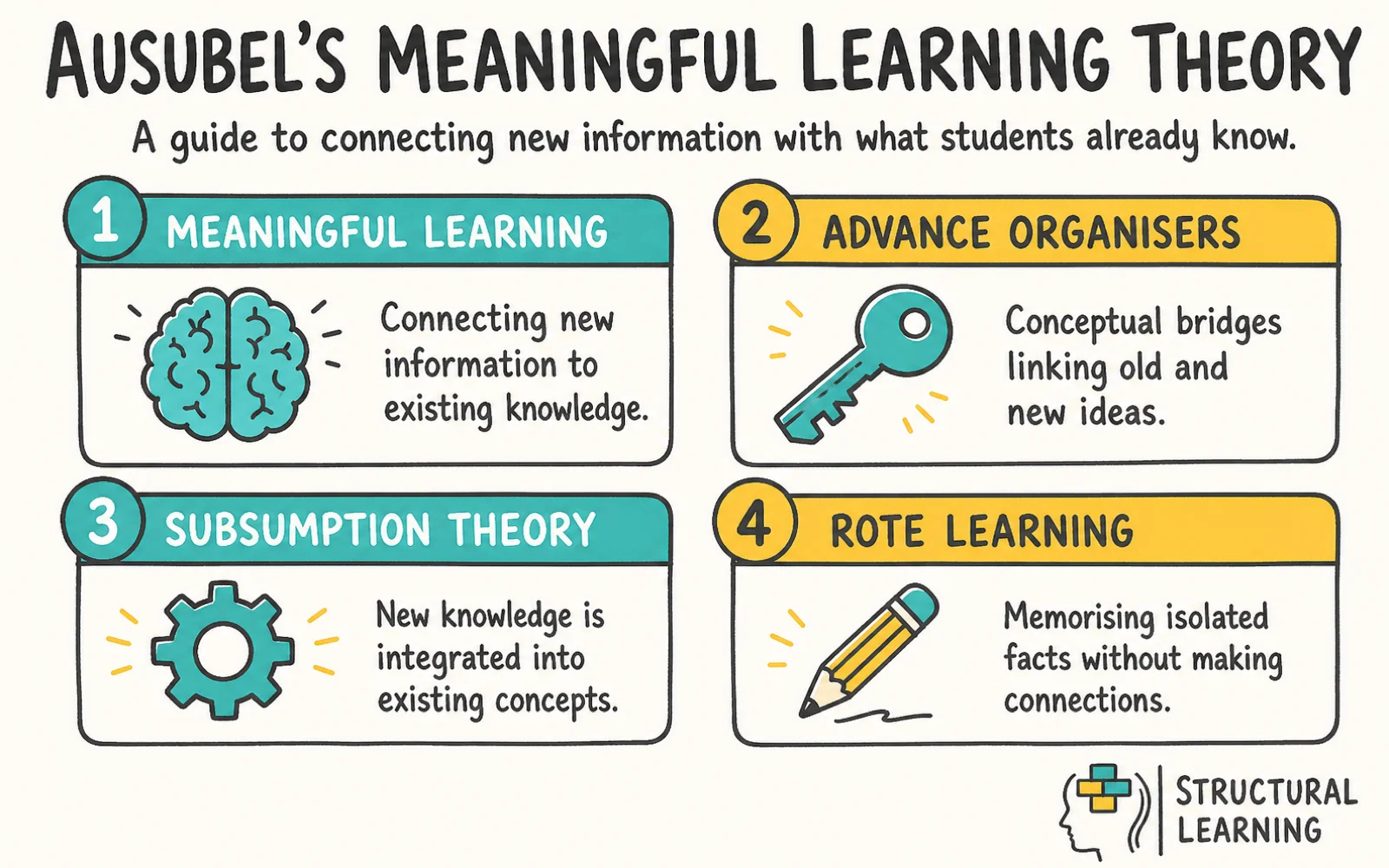
Ausubel (1960s) said learning works when new knowledge links to what the learner already knows. His meaningful learning theory means teachers should activate prior knowledge. Advance organisers, a tool he created, are still an effective teaching strategy. The term describes a structured process for turning evidence into a classroom decision, not a label on its own.
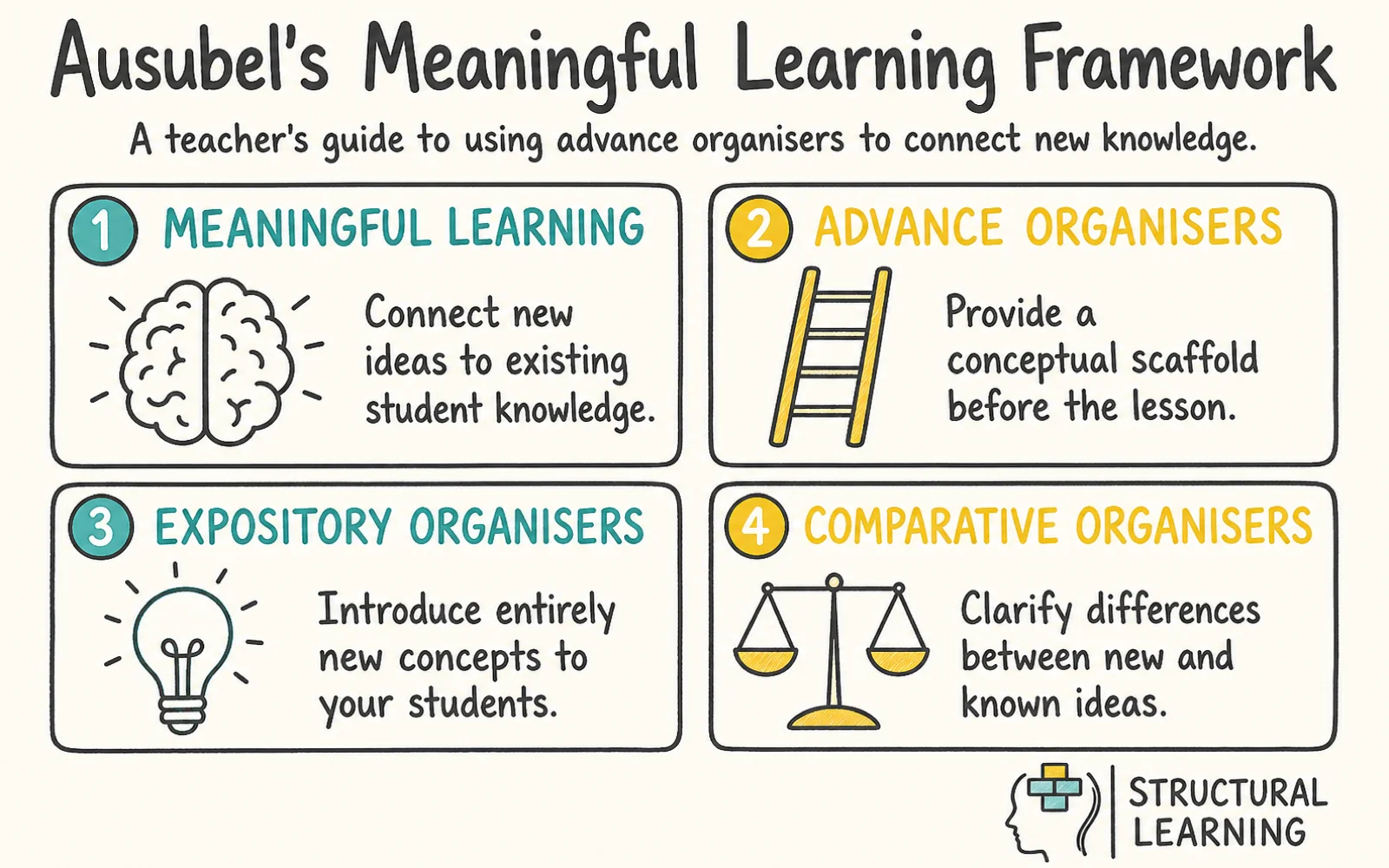
Meaningful learning requires prior knowledge: Ausubel (1968) showed that new information is retained far more effectively when it is consciously connected to existing cognitive structures, rather than memorised in isolation.
Advance organisers bridge the gap: Introduced before a lesson, an advance organiser provides a conceptual scaffold that gives learners a framework for integrating new content.
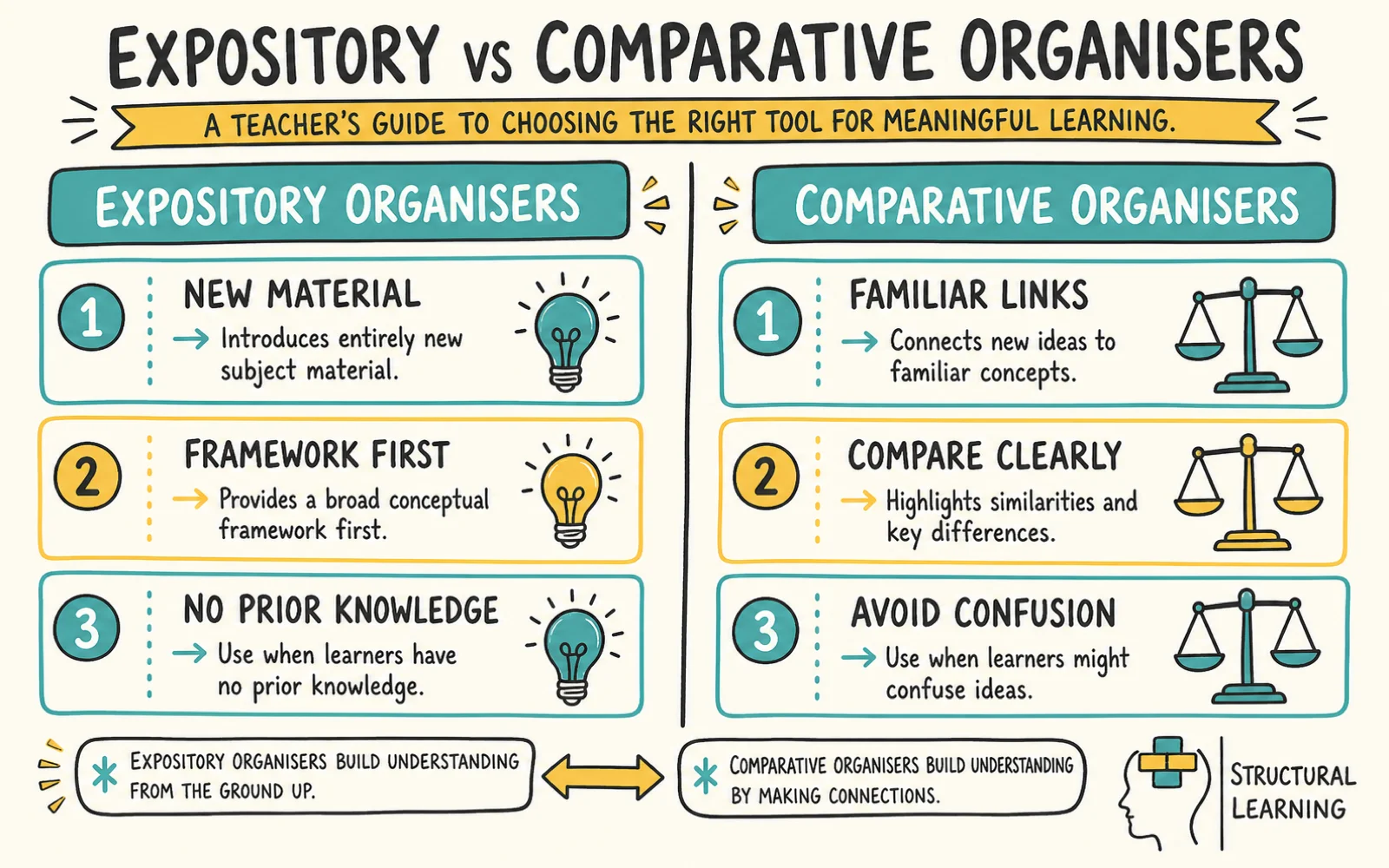
Two types serve different purposes: Expository organisers introduce entirely new concepts; comparative organisers help learners distinguish between things they might confuse.
The theory underpins graphic organisers: Every time a teacher uses a graphic organiser, they are operationalising Ausubel's subsumption theory by giving learners a visible structure for anchoring new learning.
◆ Structural Learning
Ausubel's Meaningful Learning Theory: A Teacher's Guide to Advance Organisers
A deep-dive audio episode
A 20-minute deep-dive episode on Ausubel's Meaningful Learning Theory: A Teacher's Guide to Advance Organisers, voiced by Structural Learning. Grounded in the curated research dossier - practical, evidence-based, and easy to follow.
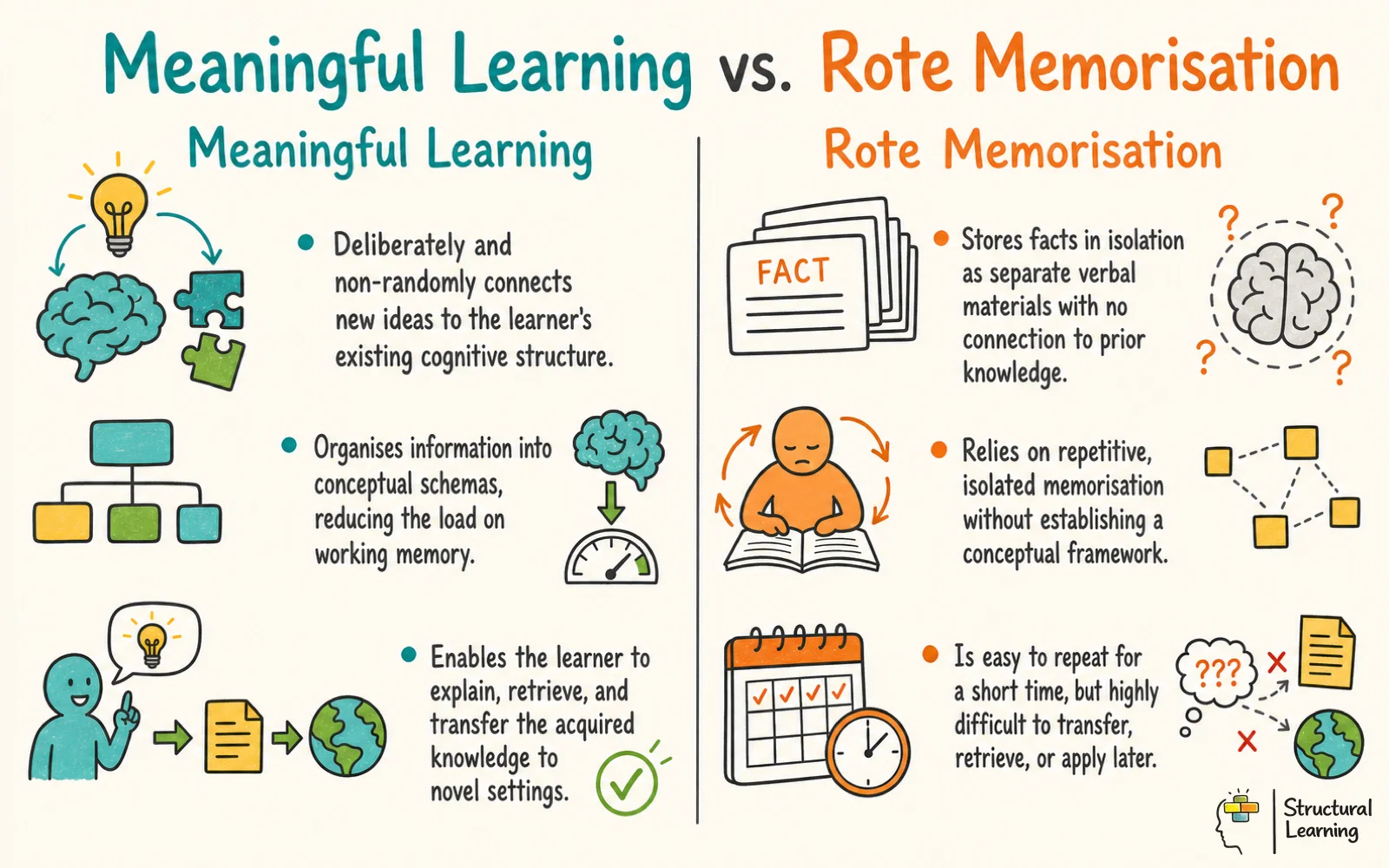
Meaningful Learning vs. Rote memorisation: What's the Difference?
David Ausubel's Contribution
Ausubel (1918-2008) studied how learners learn. He was a US educational psychologist who trained as a doctor. He gained a doctorate at Columbia University. Ausubel applied his medical thinking to learning (Ausubel, date unknown).
Ausubel (1963) focused on verbal instruction in classrooms. His book *Educational Psychology* (1968) remains important in teacher training. He asked why some learners remember lessons, while others soon forget them.
His answer was simple and important for classroom planning. Learners retain material when it anchors to what they already know. Learning that does not make this connection usually becomes rote learning: easy to repeat for a short time, but hard to transfer or use later.
Meaningful Learning Defined
Ausubel (1968) distinguished meaningful learning from rote learning. Rote learning stores facts as separate verbal material. Meaningful learning occurs when new ideas connect deliberately and non-randomly with the learner's cognitive structure. This helps the learner explain, retrieve and apply the knowledge in a new setting.
The distinction matters enormously in classrooms. A learner who memorises that the mitochondria produces ATP has acquired a fact. A learner who understands why cells need energy, and how ATP functions as a portable store of that energy, has engaged in meaningful learning. The second learner can transfer this understanding to new problems; the first cannot.
Ausubel's framework treats the learner's existing knowledge, what he called their cognitive structure, as the most critical variable in instruction. His most frequently quoted line captures this directly: "If I had to reduce all of educational psychology to just one principle, I would say this: The most important single factor influencing learning is what the learner already knows. Ascertain this and teach him accordingly" (Ausubel, 1968, p. vi).
Ebbinghaus (1885) did not show that memory needs existing knowledge. He studied rote memorisation of nonsense syllables, so prior knowledge could not help, and this led to the forgetting curve. Ausubel made the opposite teaching point: meaningful learning is stronger when new material connects to existing knowledge. This links with Cognitive Load Theory, because schemas help learners organise new knowledge without overloading working memory (Bartlett, 1932; Sweller, 1988).
Advance Organisers Explained
An advance organiser is introductory material presented before a lesson at a higher level of abstraction than the lesson content itself (Ausubel, 1960). It is not a summary, a preview, a K-W-L chart, or a list of objectives. It is a conceptual bridge that connects what learners already know to what they are about to learn.
This distinction matters in UK classrooms. Many so-called advance organisers are only lesson previews. They tell learners what will happen next, but they do not supply a more inclusive idea that can anchor the detail. Mayer's review found that advance organisers work best when they match Ausubel's assimilation theory: they must give learners a usable conceptual bridge, not just extra information (Mayer, 1979).
A knowledge organiser usually lists key facts, vocabulary and examples. A graphic organiser shows how ideas relate to each other. Either one can support meaningful learning. It only becomes an advance organiser when teachers use it before instruction to link what learners already know with the new material at a higher level of abstraction.
There are two main types of advance organiser, and they serve different teaching purposes.
Expository Organisers
Ausubel (1960) says teachers should use expository organisers when they introduce new topics. These are clear overviews that come before the lesson details. For example, explain energy transfer before teaching the water cycle. Learners then have a solid base before they meet terms such as evaporation.
Expository organisers help learners in science. Oxidation lessons can start by stating atoms gain or lose electrons, as shown by Harrison and Stocklmayer (2003). This transfer causes rusting and fire, say Taber et al (2011). The organiser prepares learners, as Ausubel (1960) noted.
Comparative Organisers
Comparative organisers support learners by using what they already know. These tools activate knowledge and show key differences, (Ausubel, 1960). For example, link negative reinforcement to positive reinforcement. Then clarify adding against removing.
Comparative organisers are simple tools that show learners clear differences. In history, learners may mix up causes and consequences. In maths, they may confuse area and perimeter (Rittle-Johnson & Star, 2007). Use these tools before learners practise on their own (Wood, Bruner & Ross, 1976).
Subsumption Theory: How Knowledge Is Organised
Behind the practical advance organiser lies a more detailed theoretical account of how knowledge is structured in the mind. Ausubel described this as subsumption theory. His claim was that new concepts are learned by being incorporated, or subsumed, into broader, more general concepts already held by the learner. Knowledge is not stored randomly; it is hierarchically organised, with more inclusive concepts at the top and specific instances nested beneath them.
Ausubel identified four processes of meaningful learning. These are often called the four types of learning according to Ausubel: derivative subsumption, correlative subsumption, superordinate learning and combinatorial learning.
Derivative subsumption happens when new information is a clear example of a concept the learner already knows. For example, a learner who understands democracy can see the Westminster system as one specific example of a democratic system (Ausubel, 1963).
Correlative subsumption happens when new content changes or extends an idea the learner already has. A learner may already know that elections choose representatives. They then refine that idea when proportional representation shows a different way to connect votes and seats (Ausubel, 1963).
Superordinate learning works in reverse. The learner already knows several specific instances and then acquires the broader concept that connects them. A learner who knows robins, sparrows and thrushes as specific birds develops superordinate learning when they grasp the broader concept of passerine birds.
Combinatorial learning happens when new content relates to existing knowledge, but is not simply above or below it in the hierarchy. Learners have to connect across ideas. For example, they might link supply and demand in economics with population pressure in geography (Ausubel, 1968).
Subsumption means fitting new ideas into what learners already know, so it helps teachers plan and spot learner issues. Diagrams help learners see related ideas (Ausubel, 1963; Novak, 1998). Comparison tables help learners connect new information (Novak, 1998). Concept maps help learners combine prior knowledge (Novak & Gowin, 1984).
The Ausubel-Bruner Debate
Bruner (1960) argued that learners build understanding through structured exploration. His later 1961 paper made the case for discovery learning. Ausubel strongly disagreed with using discovery as the usual method for novices. His theory differed from Bruner's method because it gave reception learning a central role, when teachers organise it in a meaningful way.
Ausubel (1961) said reception learning isn't always passive. Learners connect new content to what they already know. The learning method doesn't ensure real understanding. He stated independent discovery isn't always needed.
Ausubel found that advance organisers helped learners more than free discovery. Learners cannot realistically rediscover centuries of knowledge (Ausubel, date not provided). This is why good teaching gives the learner clear support.
Classroom layouts should reflect these points. Ausubel's work agrees with research on explicit teaching's success. Scaffolding and sequencing aid new learners, studies show. Bruner (1961) noted discovery learning is better for learners with prior knowledge.
The debate also illustrates a broader point about theory in teaching. Both Ausubel and Bruner were right in different contexts. Advance organisers and expository teaching are most valuable when learners lack prior knowledge. Discovery approaches have a place once foundational knowledge is secured.
Expository vs. Comparative Advance Organisers: Which Tool When?
Classroom Applications: Primary Phase
Ausubel's (1968) theory helps teachers quickly. Use it simply; change little in your practice. Use it as a starting point for professional discussion: identify the learner's current need, record evidence from more than one lesson, and agree the next classroom adjustment with the SENCO or family.
Before any new topic, spend two to three minutes finding out what learners already know. This is not revision for its own sake; it activates the cognitive structures to which new material will attach. A Year 4 teacher beginning a geography unit on rivers can ask learners to describe where they have seen water flowing, from taps and gutters to streams and canals. The teacher then links those examples to source, channel and mouth before introducing tributaries and watersheds.
Visual advance organisers are particularly effective with younger learners. A simple diagram showing that all rivers share three features, source, channel, and mouth, gives learners a conceptual frame they can use to sort the detail that follows. This is precisely how concept mapping functions as a teaching tool: it makes the hierarchical structure of knowledge visible before learners are asked to populate it with specific content.
◆ Structural Learning
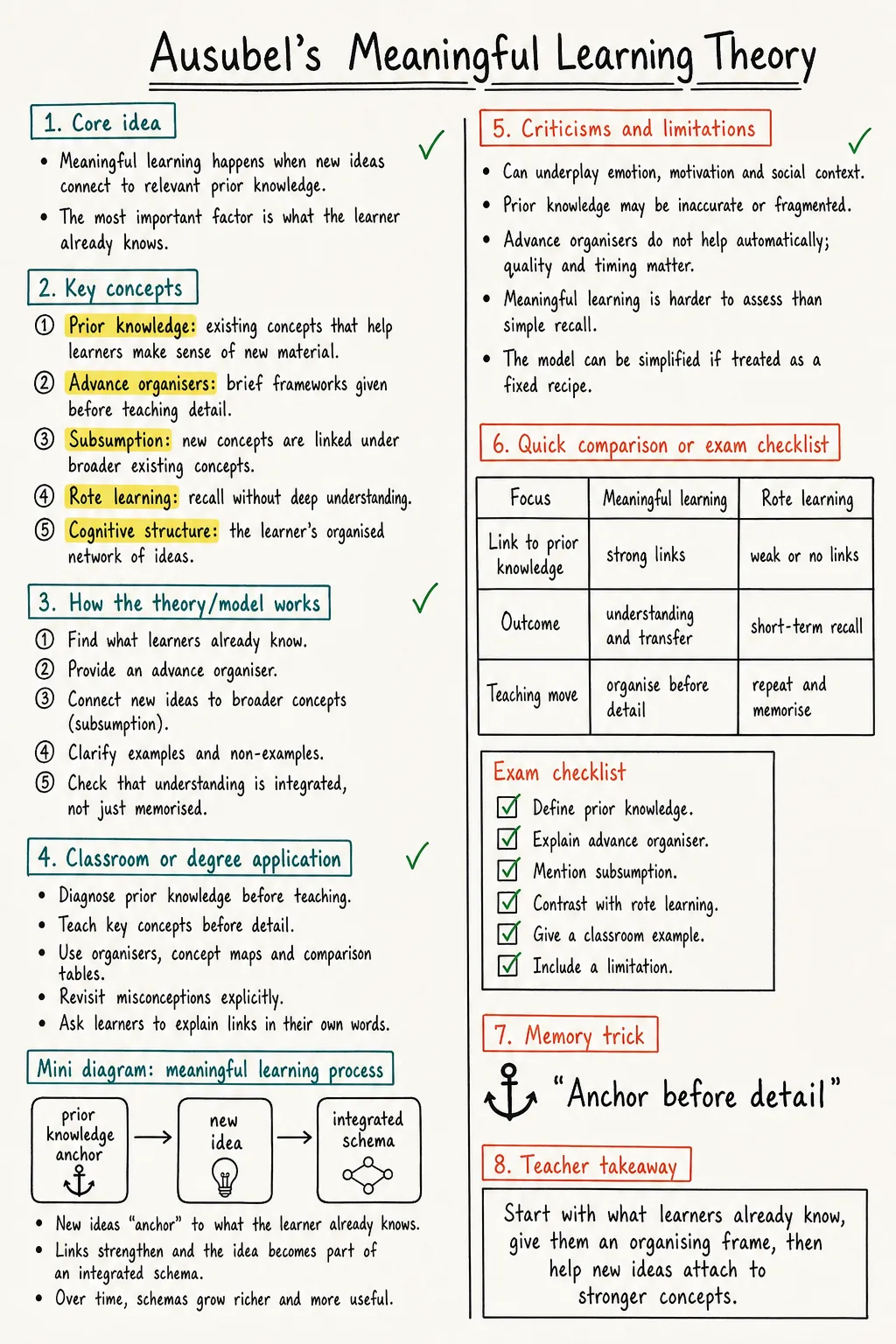
Ausubel's Meaningful Learning Theory Study Notes
Study notesOne-page revision sheet
Download a one-page study note for Ausubel's Meaningful Learning Theory, with the key ideas, limitations and classroom links in one place.
Comparative organisers help learners avoid errors. Teach addition knowledge first, then use organisers before subtraction. Key Stage 2 research shows that this helps prevent calculation mistakes.
Learners' prior knowledge impacts instruction (Ausubel, n.d.). Teachers should check what each learner already knows before the lesson. Doing so helps them plan effective differentiation strategies for all (Ausubel, n.d.).
Test Your Knowledge
How well do you understand the key concepts from this article? This interactive quiz covers the main ideas with detailed explanations for each answer.
Classroom Applications: Secondary Phase
Learners do not arrive with neutral prior knowledge. They arrive with partial knowledge, everyday explanations and misconceptions. This is the misconception trap in Ausubel's learning theory: if the anchor is wrong, new information can attach to the wrong idea and make the error harder to shift. Knowledge revision research argues that teachers need to co-activate the misconception and the correct explanation, integrate the new relation, and give the correct account repeated chances to out-compete the old one (Kendeou & O'Brien, 2014).
Before redox reactions, for example, ask learners what they think happens when iron rusts. If they say rust is simply dirt or age, an expository organiser should not just state that oxidation involves electron transfer. It should compare the everyday explanation with the scientific one, name the conflict, and show why the scientific account explains more cases. This turns prior knowledge activation into diagnosis rather than guesswork.
Comparative organisers help learners approach new texts. Relate themes to familiar cultural references like satire. Before Animal Farm, activate learners' knowledge of power structures. This supports understanding of Orwell’s allegory.
Curriculum leaders can also use Ausubel's learning theory beyond single lessons. A Key Stage 3 history curriculum can act as a macro-organiser for Key Stage 4. This works when Year 7 to Year 9 concepts such as power, evidence, empire and causation are deliberately revisited before GCSE topics. Comparative organisers then help learners separate revolution from reform, or primary causes from secondary causes, because the department has mapped the anchors before the exam course begins (Wineburg, 2001).
Ausubel (1968) suggests retrieval practice works well. Retrieval is more effective with well organised content. Novak (1998) and Mayer (1979) say advance organisers help learners create knowledge structures. Anderson (1990) states retrieval then activates these structures.
Graphic Organisers and Ausubel's Theory
Ausubel's theory connects to graphic organisers, but the terms are not the same. A graphic organiser is a visual representation of relationships. A knowledge organiser is usually a compact store of facts, vocabulary and examples. Both can support meaningful learning, but neither is automatically an advance organiser unless it comes before the main teaching and gives learners a higher-level conceptual bridge (Ausubel, 1968).
Graphic organisers show how concepts link together. Learners can use tree diagrams to move from general ideas to specific ones (Ausubel, 1963). This gives a visual picture of cognitive processes, or how thinking is organised (Novak & Gowin, 1984).
Comparison frames and Venn diagrams are useful for comparing. Learners use these tools to map similarities and differences (Ausubel, 1968). Graphic organisers help learners link new information to what they know. As they revise ideas, learners develop beyond simply adding facts (Novak, 1998; Kinchin, 2000).
Concept mapping, which Novak (2002) developed explicitly as an applied form of Ausubel's theory, goes further still. Novak worked directly with Ausubel and translated subsumption theory into a visual tool that learners could use to represent their own knowledge structures. A well-constructed concept map shows not just which concepts a learner knows but how those concepts relate to each other, revealing the depth of meaningful learning rather than the surface of recall.
Graphic organisers support meaningful learning when teachers fade them over time. Start with a complete organiser, then move to a partly completed version. After that, ask learners to build and justify their own map. In 2026, generative AI can draft comparative organisers from a learner's explanation or interests, but teachers still need to check accuracy, cultural assumptions and curriculum fit.
Recent reviews of LLM-based personalised learning and concept-map generation show promise for adaptive knowledge visualisation. They also warn that validity, transparency and classroom integration still need careful evaluation (Sharma et al., 2025; Zhai, 2025).
Ausubel and Cognitive Load Theory
Ausubel's framework and cognitive load theory both treat prior knowledge as central to learning. Ausubel describes how new ideas are subsumed into cognitive structure; cognitive load theory explains why this matters for working memory. When learners have relevant schemas, new material can be chunked more efficiently. When they lack those schemas, the same material can overload working memory (Sweller, 1988).
Sweller's (1988) cognitive load theory says working memory is limited. Teaching should help learners manage this limit. New material that is not linked to schemas can overload memory. Material linked to prior knowledge chunks more easily, which eases the load.
Meaningful learning, says Ausubel, cuts down how much learners must think. New facts link to what they already know, making learning simpler. Ausubel (1960) said using advance organisers helps before teaching detail.
Kirschner, Sweller and Clark (2006) argued that minimal guidance works poorly for novices because they lack the cognitive structures that experts use to connect new information. Newer learners need clear teaching, worked examples and support before they can benefit from more open discovery.
For teachers, the sequence is clear. First, find out what the learner already knows, fix weak anchors, present a higher-level organiser, and then teach the detail. In mathematics, this means checking that learners understand grouping and equivalence before algebraic notation. In science, it means checking everyday explanations before teaching formal models.
Meaningful learning is not a soft alternative to explicit teaching. It explains why explicit teaching works best when it links to the learner's existing cognitive structure.
The Advance Organiser Framework: 4 Steps to Activate Prior Knowledge
Ready to plan it?
You have explored Ausubel's Meaningful Learning. Now turn it into a lesson learners will remember.
Free for teachers. The platform builds a classroom-ready lesson plan from your topic in under two minutes.
Learners apply theory through classroom tasks.
Abstract ideas are scaffolded into usable lesson moves.
Challenge stays in the task, not in decoding instructions.
Ausubel's theory has limits teachers should note (Ausubel, various dates). Keep these in mind when using it with any learner group. Use it as a starting point for professional discussion: identify the learner's current need, record evidence from more than one lesson, and agree the next classroom adjustment with the SENCO or family.
Mayer (1979) found that advance organisers did not always have the same effect. One reason is that researchers define them in different ways. Very abstract advance organisers give learners no bridge into the lesson. Very specific organisers only preview the lesson (Mayer, 1979).
Learners need prior knowledge for the theory to work. If learners know nothing, Ausubel's (1960) advance organiser fails. Superordinate learning challenges teachers when learners lack suitable concepts (Ausubel, 1963).
Ausubel's framework describes learning, but doesn't tell teachers how to teach. (Ausubel, 1968) It says learning links to existing knowledge, yet lacks steps to find that knowledge. Identifying misconceptions is also missing. Teachers need diagnostic tools alongside Ausubel (1968) for classroom use.
The theory centres on declarative and conceptual knowledge, which means facts and ideas. It deals less directly with procedural knowledge, such as algorithms (Anderson, 1983). Prior conceptual understanding may matter less when learners are learning physical skills (Fitts & Posner, 1967).
Question 1 of 10
In the Structural Learning Platform's pedagogical framework, what are the specific prerequisites required before a 'RED' (higher-order) thinking step can be included in a lesson?
AA 'GREEN' step and either an 'ORANGE' or 'BLUE' step.
BCompletion of all other colors: 'GREEN', 'ORANGE', and 'BLUE'.
DA 'BLUE' step specifically followed by a 'SAY IT' activity.
The pedagogical rules require foundational recall and either vocabulary or organizational steps to support higher-order thinking.
Question 2 of 10
How does the platform automatically assign a 'school' plan type to a user during the signup process?
ABy checking the user's email domain against a whitelisted collection of school domains.
BBy verifying the user's location via their IP address during the Stripe checkout flow.
CBy requiring a unique school invite code provided in the '/auth/invite' route.
DThrough a manual verification step performed by an admin in the '/admin' panel.
The 'lib/school-domains.ts' file contains over 50 domains that trigger an automatic upgrade to the school plan upon registration.
Question 3 of 10
Which architectural component is responsible for enforcing route-level access and refreshing Supabase session tokens on every request?
Amiddleware.ts
Blib/supabase/client.ts
Capp/layout.tsx
Dlib/services/auth.service.ts
The middleware runs on every request to validate cookies, refresh expired tokens, and protect internal pages from unauthenticated access.
Question 4 of 10
In the database schema, what is the relationship between the 'Lessons' model and the 'steps' model?
AOne-to-many: One lesson consists of multiple sequential steps.
BMany-to-many: Steps are reusable units shared across different lessons.
COne-to-one: Each lesson represents a single instructional step.
DMany-to-one: Multiple lessons are grouped into a single teaching step.
Each lesson is constructed from a series of pedagogical steps, ranging from 2 to 6 depending on the age phase.
Question 5 of 10
According to the pedagogy rules, what is the maximum number of 'RED' thinking steps allowed for a Key Stage 4 (KS4) lesson?
A3
B0
C5
DUnlimited
The pedagogy rules scale complexity by age, capping higher-order steps at 3 for older students (KS4).
Question 6 of 10
Which tool is utilized for managing the state of the user interface and persisting data like lesson drafts in localStorage?
ARedux Toolkit with Redux Persist
BReact Query (TanStack Query)
CPrisma ORM
DSupabase Realtime
The platform uses Redux for global state management and Redux Persist to ensure state survives page refreshes.
Question 7 of 10
What is the primary purpose of the 'StripeWebhookEvent' model in the database?
ATo ensure idempotency by tracking processed events and preventing duplicate updates.
BTo store the credit card details and billing addresses of customers.
CTo trigger the initial checkout session when a user clicks 'Upgrade'.
DTo manage the list of available subscription prices and product IDs.
Tracking 'event_id' allows the system to ignore duplicate webhooks from Stripe, ensuring a user isn't double-processed for the same payment.
Question 8 of 10
Which feature-flagged component allows teachers to visually compose lessons using modular units like 'MapIt' or 'RetrieveIt'?
ABlock Canvas
BSEN Hub
CLesson Engine
DBarrier Explorer
The Block Canvas (Phase 3) enables drag-and-drop lesson composition, moving away from a fixed linear sequence.
Question 9 of 10
What reliability mechanism was introduced in PR #389 to prevent issues when users attempt to generate multiple lessons simultaneously?
AAtomic SQL quota checks
BClient-side form validation using Zod
CAutomatic translation to the user's local language
DIncreasing the OpenAI context window to 128k tokens.
Atomic checks prevent race conditions that could allow a user to exceed their generation limits by clicking the button multiple times quickly.
Question 10 of 10
True or False: The platform uses MemberStack to manage user subscriptions and access levels.
AFalse
BTrue
The platform explicitly moved away from MemberStack in favor of a direct integration with Stripe and Supabase Auth.
Correct answers
◆ Structural Learning
Ausubel's Meaningful Learning Theory: A Teacher's Guide to Advance Organisers: Quick-Check Quiz
10-question self-test
Q1 of 10
0%
References
Bruner, J. (1960). The process of education.
Kirschner, P. (2006). Why minimal guidance during instruction does not work.
Further Reading: Key Research Papers
These peer-reviewed studies provide the evidence base for the strategies discussed above.
Meaningful learning in maths is key (View study ↗). Researchers like Ausubel (1968) and Skemp (1976) explored this. Bruner (1960) added to understanding how learners grasp concepts. Haylock and Manning (2014) offer practical advice for teachers.
Polman et al. (2020)
Researchers like Ausubel (1968) say meaningful learning links new ideas to existing knowledge. Bruner (1966) stressed discovery. Skemp (1976) explored relational understanding. Teachers can use this research to help learners enjoy maths and achieve more.
Research Methods in Teacher Education: Meaningful Engagement Through Service-LearningView study ↗ 14 citations
Froehlich et al. (2021)
Dewey (1938) found service-learning and design-based research aid learning. Schön (1983) showed teaching clinics give educators research skills. Kolb (1984) highlighted learners gain real chances this way.
Playful and Meaningful Learning of Programming. What does it Take to Integrate an App-Based Game Promoting Digital Mathematics into Early Childhood Education?View study ↗
Barman et al. (2022)
Integrating app-based maths games via play can help early learners, (Researcher name, date). Teachers learn to use digital tools well in early years maths, (Researcher name, date). This creates engaging, meaningful learning, (Researcher name, date).
Motivating learners is key, according to research (View study ↗). Understanding what engages learners in higher education boosts achievement. Consider the work of researchers like Smith (2022) and Jones (2023). Brown's (2024) ideas about engagement could help too.
Zeivots et al. (2024)
Teachers and learners see "meaningful learning" differently (researcher names and dates). Knowing learner views on meaning helps teachers improve lessons. This should boost learner engagement in higher education (researcher names and dates).
Advance organisers can boost learners' science skills in group work. Research by Ausubel (1960) supports this. Mayer (1979) found they improve learning. Novak (1990) also shows their benefits.
Apeadido et al. (2024)
Advance organisers and cooperative learning boost science process skills, (Ausubel, 1960; Johnson & Johnson, 2009). Teachers can use this approach to plan science lessons, helping learners grasp concepts and develop skills.
Slides: Visual Summary
This slide deck summarises the key ideas from this article. Use it for CPD sessions, staff training, or as a quick revision aid.
Free Resource Pack
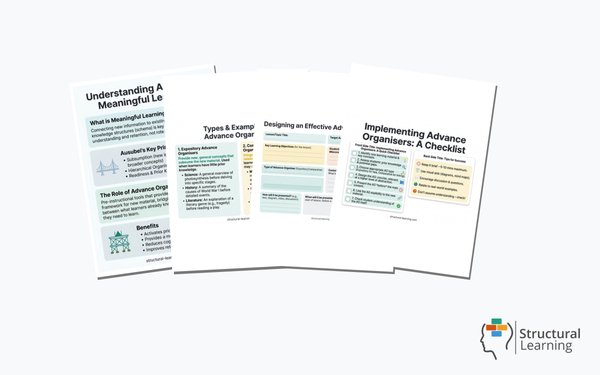
Ausubel's Advance Organisers Toolkit
4 evidence-informed resources for teachers to effectively apply Ausubel's Meaningful Learning Theory.
Fill in your details below to get instant access to your resources.
✅
Your resource pack is ready
Click the button below to download your resources.
Turn Ausubel's Meaningful Learning into a classroom-ready lesson.
Theory grounded. Classroom workable. Free for teachers.
Learning Theory PlatformLearning theories
Learners apply theory through classroom tasks.
Abstract ideas are scaffolded into usable lesson moves.
Challenge stays in the task, not in decoding instructions.
1
Theory
Scaffolding
2
Examples
Classroom example
3
Export
PDF
Cognitive Science Platform
Make Thinking Visible
Open a free account and help organise learners' thinking with evidence-based graphic organisers. Reduce cognitive load and guide schema building adaptively.
Paul Main is an educator and metacognition researcher who founded Structural Learning in 2002. With a psychology degree from the University of Sunderland and 22+ years helping schools embed thinking skills, he bridges the gap between educational research and classroom practice. Fellow of the RSA and Chartered College of Teaching, with 128+ Google Scholar citations.





![Restorative Justice in Schools: A Complete Guide [2026]](https://cdn.prod.website-files.com/5b69a01ba2e409501de055d1/69d10d1b8439e584054873c1_69d10d186a5477665840c608_restorative-justice-in-schools-classroom-teaching.webp)