Oracy and Critical Thinking Hub
Comprehensive hub linking oracy development, Socratic questioning, P4C, dialogic teaching, and critical thinking resources for teachers.


Comprehensive hub linking oracy development, Socratic questioning, P4C, dialogic teaching, and critical thinking resources for teachers.
Oracy and Critical Thinking Hub is a teacher-facing guide to the taught use of spoken language for reasoning, explanation and evidence-based discussion. It defines oracy as the learned ability to speak, listen and respond in ways that help learners test ideas, build subject knowledge and make their thinking visible. Wilkinson (1965) coined the term oracy, and Wiliam (2011) shows why teachers need evidence of thinking during lessons, not just written work after them.
In practice, this could be a Year 5 learner explaining why a fraction comparison works. It could be a Year 9 historian using evidence to challenge a source claim. It could also be an EAL learner rehearsing a scientific explanation before writing it. Strong classroom talk is planned, assessed and linked to the curriculum, not just used to build confidence.
A complete resource hub for evidence-based practice. Use it as a starting point for professional discussion. Identify the learner's current need and record evidence from more than one lesson. Then agree the next classroom adjustment with the SENCO or family.
Oracy is the teachable use of speaking and listening for learning. Learners explain ideas clearly, listen to others, ask questions and use evidence to reason together (Mercer, 2000; Alexander, 2005; Barnes, 2008). In a Year 5 science lesson, this might mean explaining why evaporation changes the water level, then testing a partner's explanation against the evidence.
Wilkinson (1960s) found oral skills are key for learners. Classrooms often neglect oracy, though. They value writing and see speaking as less important (Wilkinson, 1960s).
Talk with others shapes how learners understand ideas, as Mercer (1995) and Vygotsky (1978) argued. Learners benefit from clear communication across subjects (Alexander, 2008; Barnes, 1976). This affects life outcomes.
Oral language skills support critical thinking when learners have enough subject knowledge to discuss. Vygotsky (1978), Mercer (1995) and Barnes (1976) show why dialogue matters, but talk is not a substitute for teaching the concepts and vocabulary first. In class, this means modelling the idea, then asking learners to test the claim, evidence and counter-example together.
Sweller (1988) argued that instructional design should protect working memory from extra load. For novice learners, open discussion before teaching can overload thinking and spread misconceptions. Kirschner (2006) raised the same boundary condition in his critique of minimally guided instruction. Once the idea has been taught, learners can spot gaps in reasoning when thinking is voiced clearly.
Neil Mercer et al. (2004) found talk routines help learners in classrooms. Cambridge research showed teachers who teach these routines get results. These routines assist with learning (Mercer, 2004).
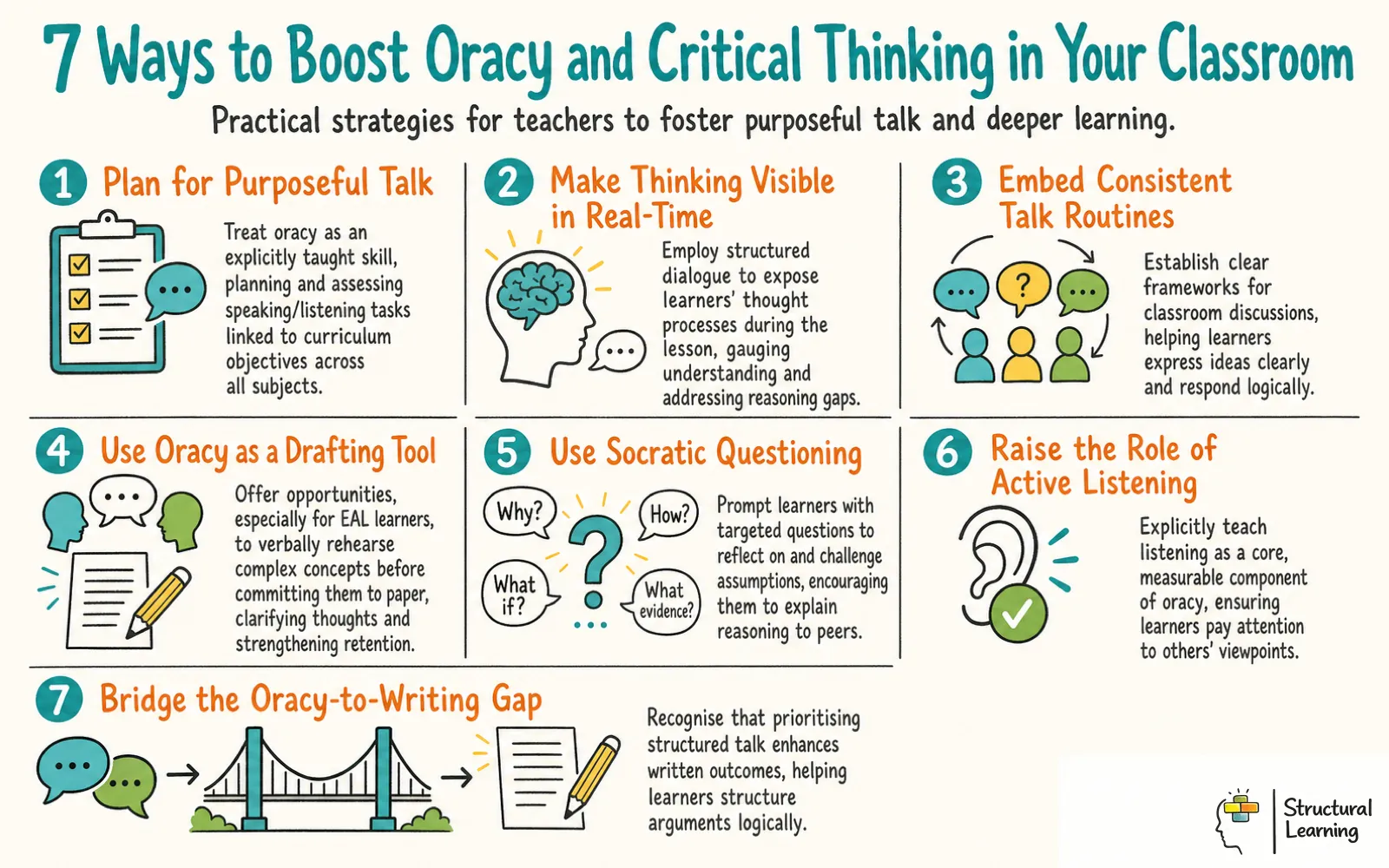
Structured dialogue asks learners to be precise. When learners explain ideas to people who disagree, they must give reasons, test assumptions and respond to other views. This sharpens reasoning because learners have to test the claim, the evidence and the counter-example in the moment.
This approach promotes critical thinking and deeper understanding (Paul & Elder, 2007). Research by Costa and Kallick (2009) highlights that this questioning encourages learners to reflect on their assumptions. These interactions build reasoning skills, as shown in work by Facione (2011). Studies from Fisher (2001) demonstrate learners become more engaged and independent.
What happens in practice: A teacher shows a bar model for a maths problem and asks, "What does this section represent?" instead of saying, "This shows the amount we need to find." Learners must think aloud to answer, and their thinking is exposed to scrutiny.
Why it works: Socratic questioning can give learners more time to reason, justify answers and connect ideas. The article should not claim a precise 40% improvement without a traceable source. Link the practice to dialogic teaching, oral language development and formative assessment, rather than a fabricated statistic.
Hinge questions quickly check learner understanding of core ideas (Dylan Wiliam, 2011). Teachers use them mid-lesson to gauge comprehension before proceeding. This helps inform teaching.
Re-teaching helps learners grasp hard content quickly. After teaching mitosis/meiosis, teachers can ask about chromosome separation. Black and Wiliam (1998) showed that quick checks can address confusion early. This helps prevent bigger problems later.
Hinge questions let learners voice thoughts and get quick fixes, speeding learning. Immediate correction shrinks the feedback gap (Black & Wiliam, 1998). This benefits all learners (Christodoulou, 2017; Lemov, 2015).
P4C was created by Matthew Lipman (1980s). It uses group talk about philosophical questions. Learners build reasoning, empathy, and their use of evidence by asking questions together.
Learners discuss moral questions after stories, for example, "Is lying always wrong?" (Mercer & Littleton, 2007). They build on ideas, challenge reasoning, and listen to different views. The teacher guides discussions but does not give answers (Alexander, 2020).
Philosophy for Children (P4C) has mixed evaluation evidence. The first EEF efficacy trial reported about two additional months of progress in Key Stage 2 reading and maths, with larger reading gains for learners eligible for free school meals (EEF, 2015). A later effectiveness trial found no average impact on KS2 reading or maths (EEF, 2021). Treat P4C as a structured route into reasoning and listening, not as a guaranteed attainment intervention.
Mercer (1995) describes exploratory talk as learners sharing ideas, challenging reasons and working towards a better answer. Use Accountable Talk ground rules: everyone can ask for evidence, no one has to accept a claim without a reason, and disagreement targets the idea rather than the person. Barnes (1976) also argued that learners need to ask each other to explain their reasons.
What happens in practice: When designing an experiment, learners say things like, "I think we should control the temperature because..." and peers ask, "What do you mean by 'control'?" before agreeing or disagreeing. This differs from predictable right-answer talk where learners guess what the teacher wants.
Why it works: Classroom research (Littleton & Howe, 2010) shows that exploratory talk is the strongest predictor of science learning gains. Learners who engage in genuine reasoning achieve higher test scores than learners who follow instructions.
Dialogic teaching (Alexander, 2020) uses real conversation to help learners understand. Teachers and learners work together, instead of relying on simple rote reading. This encourages more engagement.
What happens in practice: During a history lesson on the Industrial Revolution, a learner asks, "Didn't people mind moving to cities?" The teacher says, "That's a great question. What do you think? What would you have missed about farm life?" Learners reason through trade-offs rather than receiving a summary.
Mercer (2000) and Alexander (2008) argue that dialogic teaching supports thinking when teachers build on learners' responses rather than control the whole exchange. Davies and Meissel (2023) add that high-level classroom questions support critical thinking when teachers use learner responses to extend reasoning.
Teach academic talk directly, but link it to each subject rather than using one generic whole-school script. In science, learners need causal language, precise variables and challenge prompts such as "What evidence would falsify that?" In history, they need language for sources, consequences and interpretations. Mercer and Littleton (2007) and Alexander (2017) support this kind of structured classroom talk.
Simple example (Year 1, 2): "I think... because..." Learners complete the sentence stem when sharing ideas, which pushes them to provide reasoning.
Learners should agree or disagree with peers, citing evidence. They can start with "I agree/disagree with [peer name] because..." Add a metacognitive pause after the exchange: "What changed your mind?", "Which evidence was strongest?" or "What are you still unsure about?" This keeps oracy connected to thinking about thinking, not just taking turns.
Think individually, talk with a partner, share with the class. This structure ensures all learners have thinking time before peer talk, reducing the dominance of confident speakers.
What happens: The teacher poses a question: "Why can this character make this choice?" Learners think alone (30 seconds), discuss with a partner (1 minute), then selected pairs share (whole class). By then, most learners have something to say.
Listening matters as much as speaking. Teach learners active listening: eye contact, asking questions, and not interrupting (Brownell, 2010). Research by Rost (2002) and Field (2008) supports this.
This routine makes listening visible. Teachers ask, "What did [speaker] say?" then invite the speaker to confirm or clarify. For EAL learners, SEND learners and anxious speakers, accept rehearsal time, partner rehearsal, AAC, pointing, writing or short recorded responses where these show the same thinking. Learner-perception research also reminds teachers that the right to speak sits alongside the right to remain silent until the classroom feels safe (Cook, Guihen & Gaunt, 2022).
Not all questions are equal. A strong oracy-building lesson uses a mix:
Research shows Mary Budd Rowe (1974) found that many teachers wait for about one second after asking a question after asking a question before expecting an answer. Increasing this "wait time" to 5, 10 seconds transforms oracy.
What happens: More learners attempt to answer. More raise their hands. Answers become longer and more reasoned. This is one of the highest-ROI changes a teacher can make.
Researchers such as Mercer (2000) and Alexander (2008, 2020) show that classroom talk can support thinking and learning. Even so, assessing oracy is difficult: a fluent answer is not always strong reasoning, and a quiet learner may still be thinking carefully. Where schools use the Voice 21 Oracy Framework or Cambridge Oracy Assessment Toolkit, treat the categories as prompts for observation, not as proof that critical thinking has happened. Assess reasoning, evidence and listening, not accent, eye contact, speed or compliance with one version of academic speech (Cushing, 2024).
| Criterion | Developing | Secure |
|---|---|---|
| Clarity | Mumbles or uses vague words like "stuff" | Speaks audibly and uses precise vocabulary |
| Reasoning | States a view but gives no reason | Explains reasoning with "because" and evidence |
| Listening | Interrupts or doesn't respond to others | Listens actively and builds on peers' ideas |
| Critical Engagement | Accepts all ideas without question | Respectfully challenges weak reasoning with evidence |
Use this rubric to give feedback: "Your reasoning was clear, and you built on Sam's idea well. Next time, challenge the assumption you both made about..." In an AI-era classroom, add short oral defence to important written work: ask learners to explain one choice, justify one source and respond to one counter-example. This viva voce check is hard to outsource and gives teachers live evidence of understanding, misconception and metacognitive control.

Alexander (2020) offers a key guide for dialogic teaching. It spans both primary and secondary phases. Teachers can use "A Dialogic Teaching Companion" (Routledge) to improve practice.
Mercer, N., Wegerif, R., & Dawes, L. (2004). From Social Interaction to Individual Reasoning. Learning and Instruction, 14(5), 485, 503. Foundational research on how talk shapes thinking.
Wiliam, D. (2011). Embedded Formative Assessment. Solution Tree. This explains hinge questions and assessment during the lesson.
The EEF Toolkit (2018) has evidence on dialogue. It covers Philosophy for Children and similar work. These interventions can help learners. Consider the toolkit when planning lessons.
Free for teachers. The platform builds a classroom-ready lesson plan from your topic in under two minutes.
Surface misconceptions in 30 seconds. Print-ready prompts.
Further authoritative guidance on metacognition: EEF guidance report on metacognition and self-regulation, EEF Teaching and Learning Toolkit on metacognition and self-regulation.
Alexander (2020).
Brownell (2010).
Mercer (2004).
Sweller (1988).
Vygotsky (1978).
Wilkinson (1960s).
These peer-reviewed studies provide the evidence base for the strategies discussed above.
Social in/justice and the deficit foundations of oracy
Cushing (2025)
Cushing's paper critically examines historical oracy theories, suggesting they inadvertently penalised working-class, disabled, and racialised children's speech. For teachers, this means critically reflecting on how oracy approaches might perpetuate stereotypes and ensuring inclusive practices that value diverse linguistic backgrounds.
Oracy and cultural capital: the transformative potential of spoken language
Knight (2023)
Knight argues oracy offers more than just communication skills; it develops personal transformation through exploratory talk and supports students with a civic voice. Teachers can harness oracy to cultivate deeper student engagement and support learners to become agents of societal change.
Oracy for civic voice: Deconstructing practice through classroom vignettes
Knight (2025)
Knight's analysis of classroom vignettes highlights effective oracy practices: authentic discussions, valuing diverse linguistic styles, and teachers ceding control to students. This encourages educators to create dialogic spaces where learners can genuinely develop their civic voice beyond standardised methods.