A week-by-week Exhibition scaffolding blueprint for IB PYP coordinators and Year 6 teachers. Covers central idea selection, structured research, action planning, presentation preparation, and Gibbs reflection using the Thinking Framework. Includes a coordinator timeline template and compressed plan for late starters.
Year 6 teachers in IB schools face spring challenges. They must guide many inquiry projects, helping learners with research and presentations. Teachers manage parents, mentors and the curriculum at the same time. Schools need a shared timeline so coordinators do not have to rebuild the process every year.
Key Takeaways
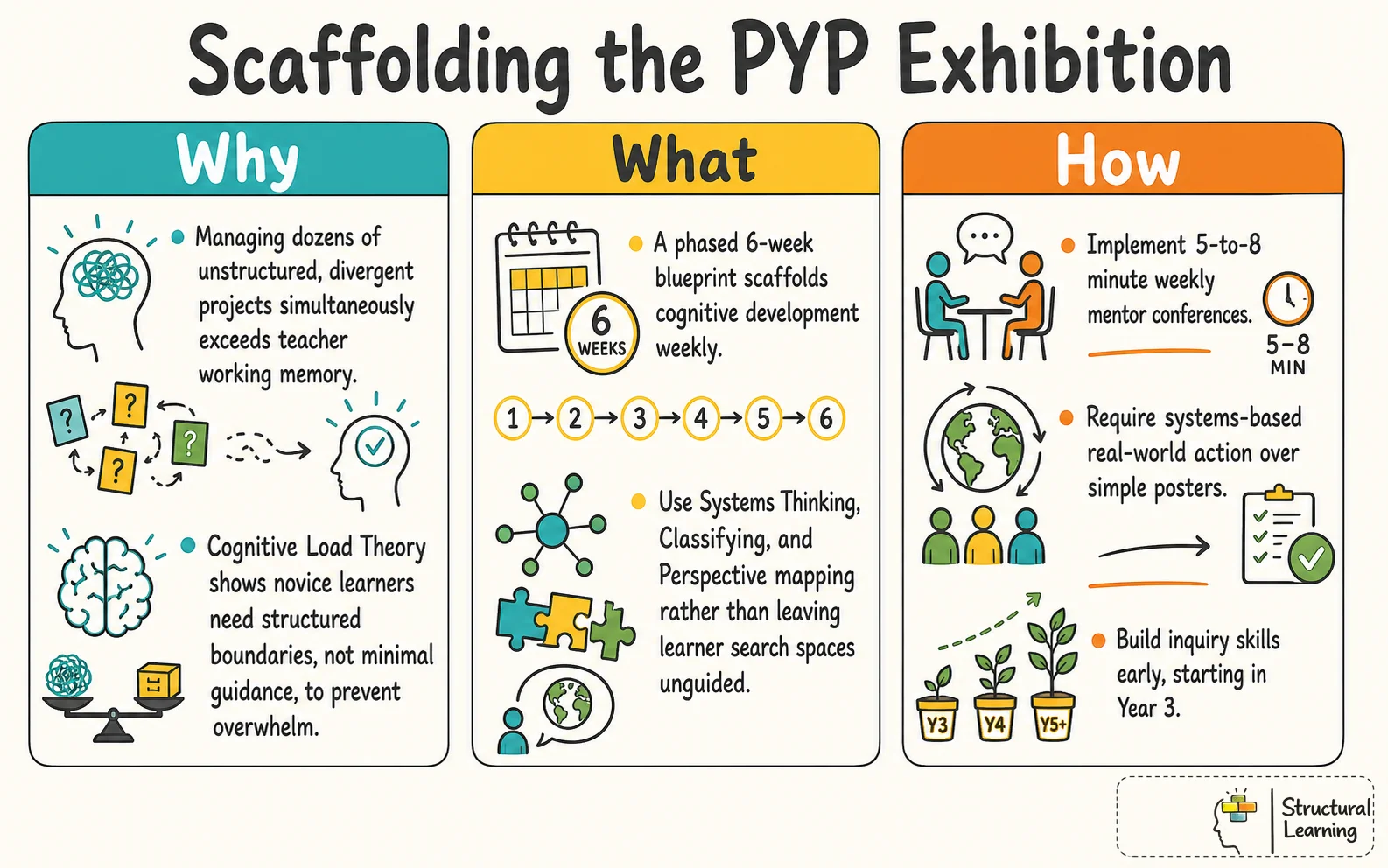
Cognitive load is the real Exhibition problem: Teachers fail not because of poor pedagogy but because managing twenty-five divergent inquiry projects simultaneously exceeds working memory capacity. A phased timeline reduces this load to manageable weekly tasks.
The Thinking Framework structures each week: Systems Thinking (Week 1), Compare and Classify (Week 2), Analogy and Perspective (Week 3), and Part-Whole and Sequence (Week 5) map directly onto Exhibition phases and give learners a cognitive scaffold that transfers across projects.
Action is not optional: The current International Baccalaureate PYP curriculum framework treats responsible action as part of inquiry, although action can be individual, community-based or digital. Directing learners to identify intervention points using Systems Thinking prevents the common failure mode of producing a poster instead of taking real-world action.
Formative check-ins, not summative judgements: Weekly mentor conferences of five to eight minutes are more effective than end-of-unit assessments for keeping inquiry on track (Murdoch, 2015).
Start building Exhibition readiness from Year 3: Schools that embed the inquiry cycle and Thinking Framework operations from the earliest years produce Year 6 learners who need far less scaffolding during the Exhibition itself.
The PYP Exhibition Podcast
Listen to this guide's key ideas.
~22 min
Scaffolding the PYP Exhibition
Why the Exhibition Breaks Teachers
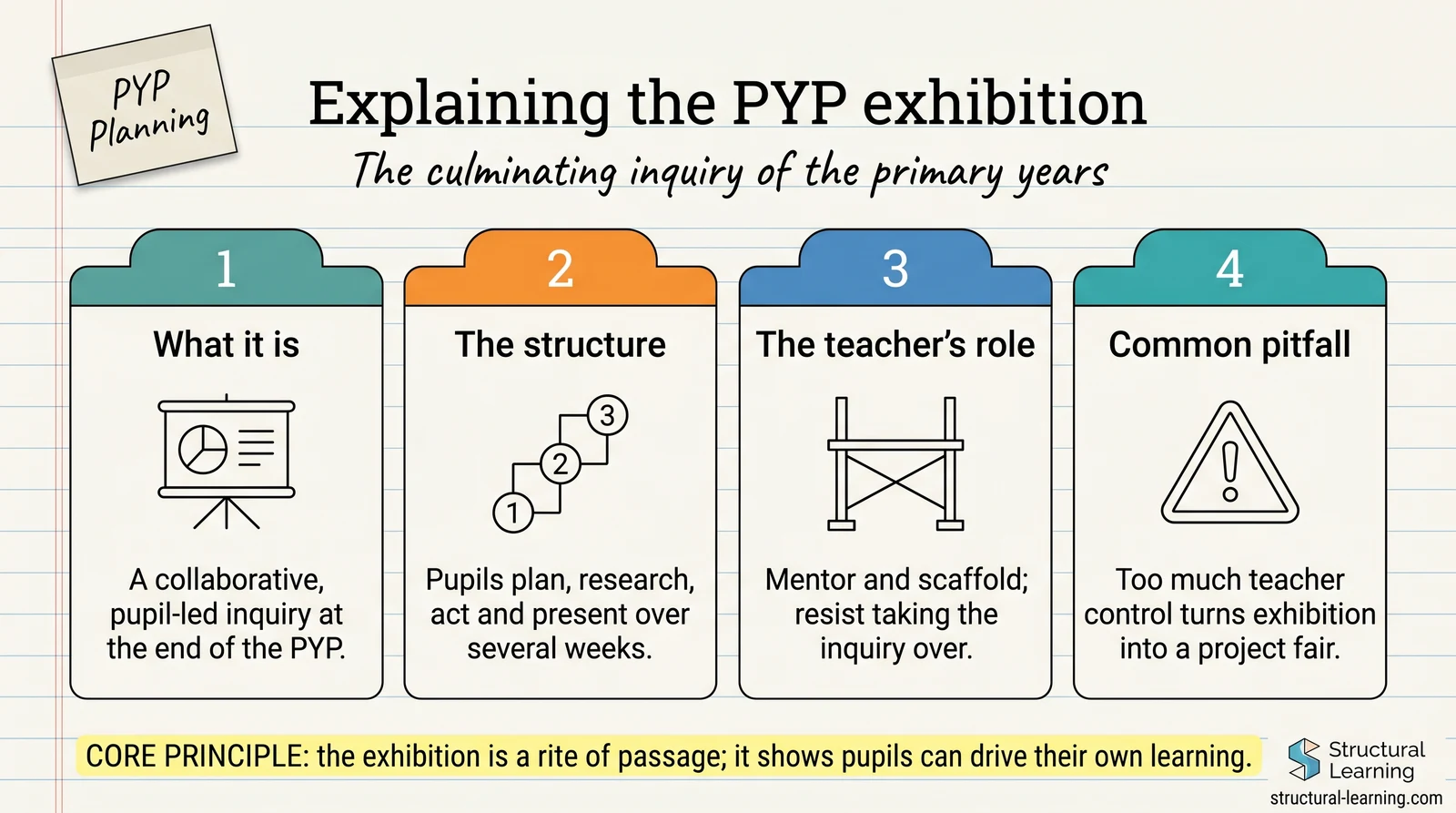
Year 6 teachers in an international school usually know how to teach inquiry. The workload problem starts when the PYP Exhibition turns one class into twenty-five parallel research programmes. Teachers are no longer teaching one sequence; they are tracking topic scope, source quality, mentor input, parental support, action plans and presentation readiness at the same time (Gürkan, 2021).
Cognitive Load Theory explains why this can break down. The intrinsic load of inquiry is real because the task itself is hard. But avoidable load comes from unclear check-ins, shifting criteria, uneven mentor advice and no shared research vocabulary.
Unstructured learner-led inquiry is not neutral. It rewards learners who already have strong prior knowledge, executive function and parental help. Novice learners, meanwhile, spend their working memory on search terms, decisions and presentation anxiety.
The six-week plan is guided inquiry, not direct instruction. Kirschner, Sweller and Clark (2006) warned that minimal guidance gives novices too much search space. In the Exhibition, teachers need to set clear boundaries for topic scope, source selection, inquiry action and reflection.
For headteachers, this is a resource allocation risk as well as a curriculum unit. Release time, mentor training and common rubrics help protect the Primary Years team. Without them, teachers carry too much hidden workload alone.
Week 1: Central Idea Selection Using Systems Thinking
The most common Exhibition failure happens in Week 1. Learners choose topics that are either too broad to investigate meaningfully ("pollution", "poverty", "climate change") or so personal they lack transdisciplinary scope ("my dog's diet", "football injuries"). Both errors consume weeks of teacher time on re-scoping work that should not have started.
The Thinking Framework's Systems Thinking operation helps prevent this. Before learners commit to a topic, teach them to ask three questions: What systems are involved in this issue? Who is affected, and how? What are the upstream causes, not just the visible symptoms?
A learner might begin with "food waste" and work through these questions. They can then reach a focused issue they can act on: the connection between school lunch systems, family behaviour, and municipal composting infrastructure in their community.
Week 1 teacher task: run a single sixty-minute tuning-in session using this Systems Thinking protocol. Learners draft their topic using the three questions as a filter. The teacher's role is to confirm scope, not approve content. A topic passes Week 1 if it is transdisciplinary, locally researchable, and connected to one of the six International Baccalaureate transdisciplinary themes from the PYP programme of inquiry.
When learners refine the central idea, link it to the current Primary Years Programme specified concepts: form, function, causation, change, connection, perspective and responsibility. Older PYP resources often list eight key concepts because Reflection used to be a separate lens. In the Enhanced PYP introduced in 2018, Reflection became an ongoing practice across inquiry, assessment and action, not a standalone lens. Many school websites still say "8 lenses" in 2026, but this article follows the current seven.
Formative check-in format (five minutes per learner, Week 1 end): "Tell me the system. Tell me who is affected. Tell me one cause that is not obvious." If a learner cannot answer all three, the topic needs refining before research begins.
IB PYP Inquiry in Action in practice: primary learners build understanding through guided inquiry.
Week 2: Research Phase with Compare and Classify
Exhibition projects often stall when learners research online. They gather URLs, but they struggle to synthesise findings. This is not due to lack of effort. Use it as a starting point for professional discussion: identify the learner's current need, record evidence from more than one lesson, and agree the next classroom adjustment with the SENCO or family.
Unstructured information causes high cognitive load (Sweller, 1988). Learners face too many sources without enough organisation.
The Thinking Framework's Compare and Classify operations address this directly. Teach learners to limit their collection to five to seven sources, including primary and secondary evidence. They can then classify each source with a simple research matrix: Source / What type of evidence is this? / What claim does it make? / How reliable is it, and why? After that, learners compare sources: Where do they agree? Where do they conflict? What is missing from all of them?
In 2026, research starts with a different risk: generative AI can summarise sources before the learner has built understanding. Treat AI as a disclosure point, not a shortcut. After the matrix, require an oral defence: "Which source changed your mind? Which claim might be wrong? What evidence would you still need?" Dawson (2024) frames this as an assessment problem created by cognitive offloading, which matters for SEND learners who need sentence stems, fewer sources, multilingual notes or speech-to-text without having their inquiry narrowed.
Fixed organisers lower extra thinking for learners, unlike blank pages. They also build information skills needed for the IB "knowledgeable" attribute. A learner who sorts sources gains real insight.
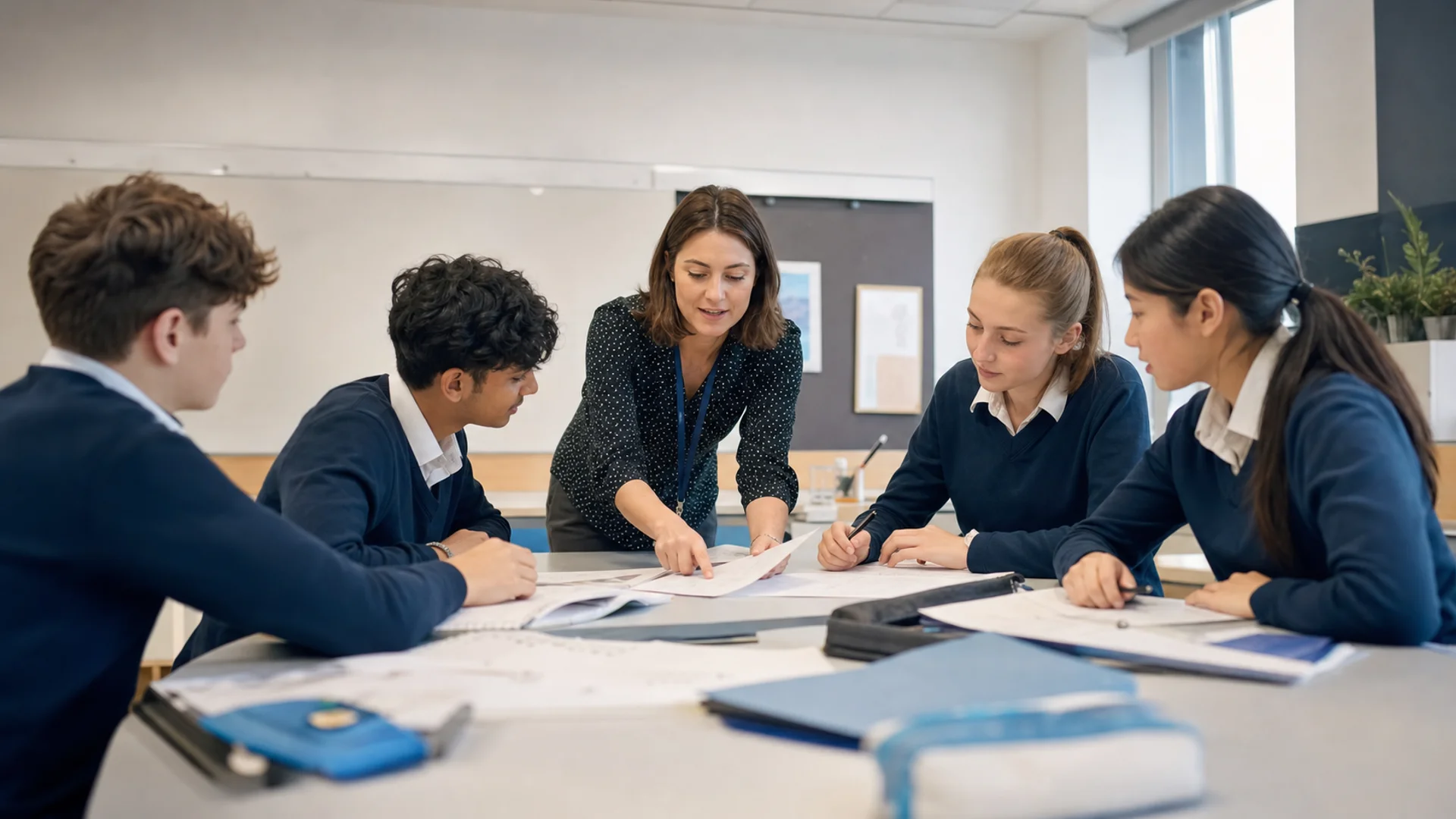
Teacher task for Week 2: run a short model lesson of about twenty minutes. Use a topic that is not linked to any learner's project, and think aloud as you complete the research matrix. This shows cognitive apprenticeship in action (Collins, Brown and Newman, 1989).
Sasse (2025) adds a key warning for primary inquiry: scaffolding must change in the moment. Reading, note-taking and self-management learning skills can vary a lot. Check-in protocol: review three completed research matrices per day. Flag any learner with fewer than three source types, no clear reliability judgement, or no conflicting piece of evidence.
Thinking Framework Operation
Exhibition Week
Cognitive Task
What Learners Produce
Systems Thinking
Week 1
Map the issue as a system with causes, actors, and effects
Scoped topic statement with three systems questions answered
Compare and Classify
Week 2
Organise and evaluate research sources
Completed research matrix (5, 7 sources, classified and compared)
Analogy and Perspective
Week 3
Connect issue to other contexts; take multiple viewpoints
Perspectives map (4 stakeholders) and analogy statement
Systems Thinking (Action)
Week 4
Identify use points for real-world action
Action plan with named stakeholders and measurable outcome
Part-Whole and Sequence
Week 5
Structure the presentation logically
Display board layout and five-minute presentation outline
Week 3: Making Connections Through Analogy and Perspective
By Week 3, learners have a scoped topic and a research foundation. The risk is surface fluency: facts gathered, opinions listed, but no conceptual depth. The aim is making thinking visible, so teachers can see the categories, analogies and perspective shifts that sit behind the final display (Ritchhart, Church and Morrison, 2011). This is where the Thinking Framework's Analogy and Perspective operations do their most important work.
The Perspective operation asks: How would different stakeholders view this issue? Learners map at least four stakeholder views on a simple grid: Who are they? What do they want, fear and already know? In multilingual PYP classrooms, invite learners to collect evidence in a home language and then translate the claim, not just the words. This protects cultural knowledge and helps the learner profile attribute "open-minded" become something teachers can see, rather than a word on display.
Analogies help learners understand ideas in new ways. Ask them to link a problem to something very different.
For example, river pollution is like online misinformation (Erickson & Lanning, 2014). In both cases, one small source can spread and become hard to trace. This kind of conceptual transfer fits IB learning.
Week 3 formative check-in: ask each learner to share one stakeholder perspective that surprised them and one analogy they discovered. If a learner cannot identify a surprising perspective, their research has stayed inside their existing worldview. This is a prompt to go back to sources with new questions, not a failure.
Week 4: Taking Action Using Systems Thinking
Exhibition action should be transdisciplinary, not just a long report. The current International Baccalaureate PYP curriculum framework treats responsible action as part of inquiry. Since the pandemic, that action has become more flexible: it may be individual, collaborative, community-based or digital.
The test is not whether the action looks impressive. The test is whether learners can explain three things: the system they tried to influence, the people involved and the evidence that something changed.
Systems Thinking makes this concrete. After three weeks of research and connection-making, learners return to their Week 1 systems map and ask: Given everything I now know about this issue, where in the system can a Year 6 learner actually make a difference? The key insight from systems theory is that use is rarely where the visible problem is. A learner studying food waste in the school canteen may find that the highest point of influence point is not reducing what learners throw away, but changing how the menu is structured by speaking to the catering manager with data.
The IB describes responsible action as central to the PYP, and the Exhibition gives Year 6 learners a practical rehearsal for later independent inquiry. Link the action to a real local or global issue, then ask learners to show what changed, who was involved and what they learned from the attempt.
This week, teachers, run 15-minute group sessions on use points before learners complete action plans. Show two real action examples (one from Exhibition, one from elsewhere). Then, learners redraft plans (15 minutes), naming a contact, request, and measurable result for Exhibition reporting.
Week 5: Preparing the Presentation
Presentation preparation is often the most chaotic week of the Exhibition. Learners know what they want to say, but they may not know how to structure it. Use it as a starting point for professional discussion: identify the learner's current need, record evidence from more than one lesson, and agree the next classroom adjustment with the SENCO or family.
Display boards are often put together the night before. Learners may rehearse once, then lose their sequence under pressure. Teachers spend the week answering the same organisational questions twenty-five times.
Thinking Framework’s Part-Whole solves structural issues. Ask learners to name key Exhibition parts: issue, research, connections, action, reflection. (Costa & Kallick, 2008). These parts link to IB criteria. This gives learners a checklist, not a blank page.
Sequence gives the presentation a clear shape. Start with a relevant question, then share a key research finding that most people do not know. Next, explain the action taken and its outcome.
Learners then consider what they'd change next time. This sequence supports metacognitive reflection because it helps them think about their own choices.
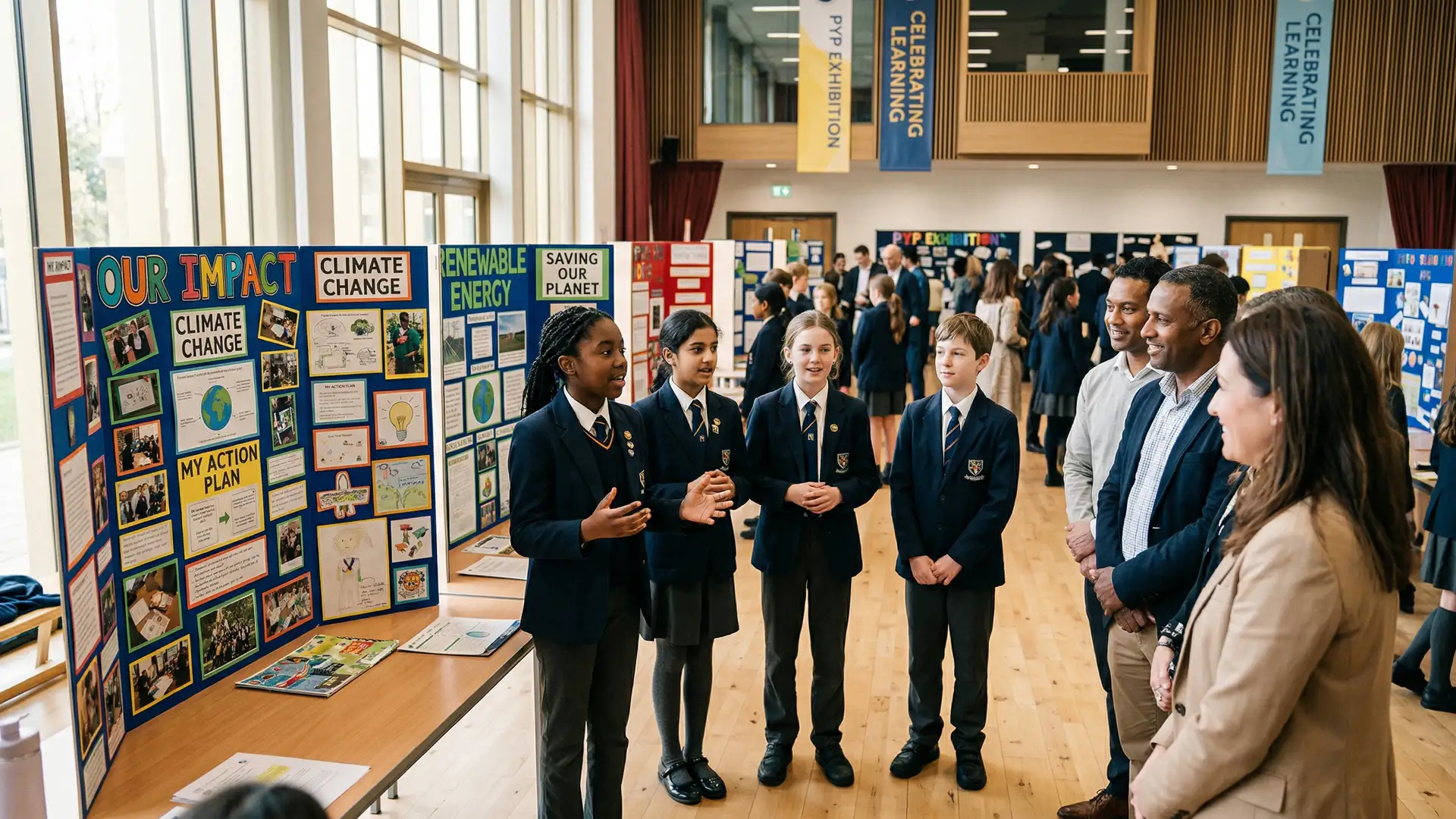
Use this display board layout template as a starting point. The board has five sections arranged left to right: My Issue and Why It Matters | What the Research Shows | Multiple Perspectives | My Action | What I Learned About Myself as a Learner. Each section is no more than 150 words of text, supplemented by visuals the learner has created rather than downloaded. The five-minute presentation follows the same structure.
Assess the process as well as the product. A polished board can hide weak inquiry; a less polished board can show strong source evaluation, ethical action and self-regulation. Use a simple rubric for scope, evidence, perspective, action and reflection, then ask learners to annotate one decision in each category. That builds assessment literacy without turning the Exhibition into a display competition.
Learners rehearse twice before the Exhibition. First, they present to a partner (lower threat). Next, they present to their mentor.
Each rehearsal uses feedback on clarity and questions. This peer feedback, like graphic organisers, reduces working memory load. (Based on principles seen in research, e.g., Sweller, 1988).
Week 6: Exhibition Day and Structured Reflection
Reflection after Exhibition day needs deliberate time and structure. Schools often manage logistics well, such as room setup and parent contact, but learners still need a supported reflection routine so they can explain what changed in their thinking and action.
Gibbs' Reflective Cycle (Gibbs, 1988) gives learners a clear six-stage framework. It helps them move beyond "it went well / it was hard" and think about their own learning. This is metacognitive processing, or noticing how they think, decide and improve. The stages are Description, Feelings, Evaluation, Analysis, Conclusion and Action Plan.
For the PYP Exhibition, the final stage matters most. Learners should explain what they would do differently if the inquiry continued, because that links reflection to action rather than treating it as a polite end-of-unit comment. This final stage connects directly to the Gibbs Reflective Cycle in teaching practice.
Year 6 learners answer three questions in writing on Exhibition day: What surprised you during issue discovery? What would you change in your research or action? How did you learn about yourself as a learner? These prompts keep reflection close to evidence, self-regulation and future planning rather than asking for a general diary response.
Keep learner reflections for Exhibition portfolios. They show inquiry learning, action and self-management more clearly than display boards alone.
They also prepare learners for the four International Baccalaureate programmes. These are PYP for ages 3-12, MYP for ages 11-16, DP for ages 16-19 and the Career-related Programme, or CP, for ages 16-19.
An at-a-glance visual summary of The PYP Exhibition is Breaking Your Teachers: A 6-Week Scaffolding Blueprint.
Later reflection becomes more formal in the MYP Personal Project. In the DP, it sits at the core of Theory of Knowledge (TOK), Extended Essay (EE) and Creativity, Activity, Service (CAS). TOK and EE can contribute up to three bonus points through the matrix; CAS is a completion requirement and earns no points.
The Coordinator's Timeline Template
Share this week-by-week plan with your Year 6 team for Exhibition. Adjust the schedule to fit your school's dates. Use it as a starting point for professional discussion: identify the learner's current need, record evidence from more than one lesson, and agree the next classroom adjustment with the SENCO or family.
Week
Learner Milestone
Teacher Check-In
Parent Communication
Week 1
Topic scoped using Systems Thinking three-question protocol
5-min verbal check: system, affected parties, upstream cause
Launch letter: overview, timeline, mentor name, Exhibition date
Week 2
Research matrix completed (5, 7 sources, classified and compared)
Review 3 matrices/day; flag <3 source types or no conflicting evidence
Progress update: research phase underway, key question being investigated
Week 3
Perspectives map (4 stakeholders) and analogy statement
Share one surprising perspective and one analogy
Action preview: ask parents to support connection-making where relevant
Week 4
Action plan finalised (named stakeholder, specific request, measurable outcome)
Confirm action is genuine use, not performative
Action week update: what your child is doing and who they are contacting
Week 5
Display board draft and 5-minute presentation outline
Review board layout against 5-section template; confirm rehearsal schedule
Exhibition day logistics: time, venue, what to expect
Week 6
Exhibition day + written reflection (3 questions)
Collect reflection records for portfolio
Post-Exhibition thank-you and reflection summary from coordinator
What to Do If You Are Already Behind
Many coordinators reading this will be in Week 3 of a six-week window with none of the scaffolding above in place. That is a realistic situation, not a cause for panic. The compressed version preserves the most important structural elements while reducing scope.
Merge Weeks 1 and 2. Run the Systems Thinking protocol and the research matrix in the same week. Learners scope their topic on Monday, begin the research matrix on Tuesday, and complete their first draft by Friday. This is achievable if you reduce the source requirement from five to seven down to three to four and focus on depth of classification rather than breadth of collection.
Perspective in Week 3 remains worth protecting in a shorter timescale. Learners can map two stakeholders in one hour rather than four. This creates a visible conceptual shift and supports the self-monitoring cycle Zimmerman (2002) described: learners set a view, test it against evidence and revise their thinking. Do not skip it; reduce the number of perspectives, not the thinking demand.
The action component can be compressed to a single week by narrowing scope. A learner who began with "global food waste" may need to re-scope to "food waste in our school canteen" to make action achievable in five days. This is not a failure of ambition. It is the kind of scoping decision that experienced researchers make, and modelling it explicitly teaches learners something valuable about how inquiry actually works.
Free slide deck
The key ideas on this topic as classroom-ready slides.
The six-week blueprint works because it assumes learners have some prior experience with inquiry and the Thinking Framework operations. In schools where the PYP Exhibition consistently goes well, that preparation starts in Year 3 of the primary years, not Year 6. The gap between these schools and those that struggle annually is not resources or school culture. It is whether the PYP unit of inquiry planning process embeds Thinking Framework operations as routine cognitive tools across the school.
Year 3 learners can use Systems Thinking to explore how their classroom community works. Year 4 learners can use Compare and Classify to investigate the transdisciplinary theme "How the World Works." Year 5 learners can practise Perspective-taking through historical inquiry. By the time these learners reach Year 6, the operations are not new tools that require instruction. They are already part of how these learners approach any complex question.
Erickson and Lanning (2014) note concept-based curriculum’s core challenge: build understanding through inquiry, not after facts. Many PYP teachers fall into the "bolted-on concept trap". They label completed work, instead of using concepts as ongoing inquiry lenses.
The Exhibition is the summative demonstration of six years of inquiry learning, but the timeline should not pretend that authentic research is linear. Learners will loop back: a source changes the central idea, an interview reopens the action plan, or a failed email forces a new stakeholder route. The weekly structure protects attention and workload; it is not a script that forbids iteration.
Plan Thinking Framework use across Year 3, 4, and 5 teams in a one-hour session. Explicitly map frameworks in two units per year group for next year. Record plans in your Programme of Inquiry documentation. This beats Year 6 scaffolding for Exhibition success.
Ready to plan it?
You have explored Cognitive Load Theory. Now turn it into a lesson learners will remember.
Free for teachers. The platform builds a working-memory-aware lesson plan from your topic in under two minutes.
Learners retrieve, connect and explain key ideas.
Complex content is chunked without lowering challenge.
There are limits to applying Cognitive Load Theory to the PYP Exhibition. Kirschner, Sweller and Clark (2006) were criticising minimal guidance for novice learners. They were not arguing that all inquiry should become scripted instruction.
Hmelo-Silver, Duncan and Chinn (2007) made the counter-case. Well-designed inquiry can work when guidance is explicit, adaptive and tied to disciplinary reasoning. So the six-week blueprint should be treated as a scaffold, not a lockstep programme.
A second limit is theoretical. Classic Cognitive Load Theory was built mainly around short teaching tasks. These often involved one person solving a clear problem. A multi-week exhibition is different.
It adds collaborative load, regulatory load and social negotiation. Janssen et al. (2010) show that these can change how a group shares mental effort. So teacher workload cannot be explained only by individual working memory.
Reflection also has risks. Gibbs (1988) gives a useful structure. But Boud, Keogh and Walker (1985) argued that reflection is shaped by emotion, context and prior experience. This matters when teachers judge what learners know.
For multilingual learners, SEND learners and learners with heavy parental shadow scaffolding, a written reflective cycle may hide what they understand. Paris (2012) also reminds schools that inquiry tasks can favour dominant cultural knowledge. To avoid this, schools need to treat local language, family knowledge and community histories as valid evidence.
These critiques do not weaken the value of the blueprint. They show where teachers need professional judgement: keep the structure, adjust the support, and treat inquiry as hard thinking work. It should not become a celebration that teachers carry alone.
References
Gibbs, G. (1988). Learning by doing: A guide to teaching and learning methods.
Kirschner, P. (2006). Why minimal guidance during instruction does not work.
Zimmerman, B. (2002). Becoming a self-regulated learner.
Quick-check quiz
10-question self-test
Q1
0%
Further Reading: Key Research on PYP Exhibition and Inquiry Scaffolding
Further Reading: Key Research Papers
Wood and Wood's (1988) research is important. Stone's (1998) work informs scaffolding methods. Vygotsky (1978) offers vital insights. PYP coordinators should read these when designing Exhibition programmes.
Researchers at Harvard's Project Zero developed Making Thinking Visible (Ritchhart et al., 2011). The framework promotes learner engagement and deeper understanding. It also helps learners develop independent thinking skills (Ritchhart et al., 2011). Many educators have used this approach successfully in classrooms (Ritchhart et al., 2011).
Ritchhart, Church and Morrison (2011)
Thinking routines (Ritchhart & Perkins, 2011) make enquiry visible. See-Think-Wonder and Claim-Support-Question work well. Coordinators can use them weekly (Ritchhart, Church & Morrison, 2011). These routines cut preparation time (Costa & Kallick, 2008). They keep learners thinking hard.
The IB PYP curriculum framework presents responsible action as integral to the programme. The IB research summary on the PYP Exhibition also links Exhibition work with international-mindedness, critical thinking and learner profile attributes. Use these sources instead of placeholder study prompts.
Murdoch (2015)
Murdoch's inquiry framework is popular with teachers because it positions teachers as co-inquirers. This helps explain why Exhibition teaching is demanding: teachers must monitor learner progress, research quality and action planning, not just curriculum coverage (Murdoch, 2015).
Concept-based curriculum (CBC) links content and thinking skills. Researchers like Erickson and Lanning (2014) show its value. CBC helps learners connect facts with big ideas. Hattie (2012) notes thinking skills boost learner success. Wiggins and McTighe (2005) promote "backward design" for focused units.
Erickson and Lanning (2014)
Inquiry should build conceptual understanding, not follow it. The difference matters for Year 6 Exhibition preparation. Learners using concept-based units (Years 3-5) create better Exhibition work (Wiggins & McTighe, 2005).
The EEF highlights structured reflection as effective and cheap. Week 6's Exhibition reflection uses this. Learners explain what they know and need to know. Doing so builds self-regulation, linked to better learning (EEF).
A Theory of Self-Regulated Learning and Academic AchievementView study ↗ 3,200+ citations
Zimmerman (2002)
Zimmerman's self-regulated learning work describes learning as a cycle of forethought, performance and self-reflection. The Exhibition mirrors this pattern: weeks 1-2 are planning, weeks 3-5 are doing, and week 6 is reflecting. Teachers using this structure can spot issues earlier and support struggling learners (Zimmerman, 2002).
Plan a working-memory-aware Cognitive Load Theory lesson.
Working-memory-aware. Schema-building built in. Free for teachers.
Cognitive Science PlatformCognitive load
Learners retrieve, connect and explain key ideas.
Complex content is chunked without lowering challenge.
Working-memory supports are built into the plan.
1
Topic
Photosynthesis
2
Generated
3-chunk lesson
3
Export
PDF
Further Reading: Key Papers on Pyp Exhibition Scaffolding Blueprint
These peer-reviewed sources underpin the evidence base for this article. Consensus.app links aggregate the paper with its journal DOI.
Seeing the Forest for the Trees: The International Baccalaureate Primary Years Programme Exhibition and Global Citizenship Education 11 citations
Nicholas Palmer (2016), Journal of Research in International Education
The most directly relevant paper: a qualitative study of the PYP Exhibition itself with a Year 6 cohort at the International School of Azerbaijan. Develops a conceptual framework that positions authentication, co-creation, and substantiation as the three enabling features of an e
Living Transdisciplinary Curriculum: Teachers' Experiences with the International Baccalaureate's Primary Years Programme 25 citations
Sandy Drake (2016), International Electronic Journal of Elementary Education
Phenomenological study of 24 PYP educators' lived experience of teaching the transdisciplinary curriculum that the exhibition extends. The 'It's a framework', 'Get on board', and 'Their learning journey' themes give exhibition leaders a vocabulary for the practical implementation
Transdisciplinary Integrated Curriculum: An Analysis of Teacher Experiences Through a Design Model Within the Framework of IB-PYP 14 citations
Burcu Gürkan (2021), International Online Journal of Educational Sciences
Multiple-case study of 50 teachers designing transdisciplinary IB-PYP units across three Turkish cities. Identifies the planning and evaluation stages teachers find hardest, and shows that brainstorming and cross-discipline collaboration consistently relieve those frictions. Ma
They Are Never Too Young to Develop Research Skills
Ingrid Skirrow (2021), School Library Association
Argues that information literacy and research skills are embedded in the PYP framework from age 3, not bolted on at exhibition. Practical guidance for school librarians and exhibition mentors on collaborative planning that builds the research capability the exhibition assumes.
The Impact of Implementing the International Baccalaureate Primary Years Programme on Students' Self-Efficacy Beliefs
El Souefi (2021), Universal Journal of Educational Research
Inductive qualitative study capturing how PYP pedagogy builds the self-efficacy beliefs that exhibition success depends on. Identifies the specific aspects of school culture (autonomy, voice, mentor relationships) that exhibition leaders should design for if they want learners to
About the Author
Paul Main
Founder & Metacognition Researcher
Paul Main is an educator and metacognition researcher who founded Structural Learning in 2002. With a psychology degree from the University of Sunderland and 22+ years helping schools embed thinking skills, he bridges the gap between educational research and classroom practice. Fellow of the RSA and Chartered College of Teaching, with 128+ Google Scholar citations.