Teaching History: Evidence-Based Strategies
Evidence-based strategies for teaching history in secondary schools. Covers historical thinking, source analysis, misconceptions, retrieval practice, and Ofsted requirements.


Evidence-based strategies for teaching history in secondary schools. Covers historical thinking, source analysis, misconceptions, retrieval practice, and Ofsted requirements.
History teachers face a particular challenge. The subject is engaging, but learners often see it as dates and names to memorise for an exam. The problem is not the content. It is how we frame the discipline.
When history is taught as facts alone, learners practise recall more than reasoning. This guide explains what research says about effective history teaching and turns it into classroom practice. The term means a structured process for turning evidence into a classroom decision, not a label on its own.
Wineburg (2001) says historical thinking feels unnatural. People often judge the past using present views. They may also treat evidence as simple confirmation. Use it as a starting point for professional discussion: identify the learner's current need, record evidence from more than one lesson, and agree the next classroom adjustment with the SENCO or family.
Teach learners historical thinking through explicit instruction. This helps change habits, rather than just pass on information.
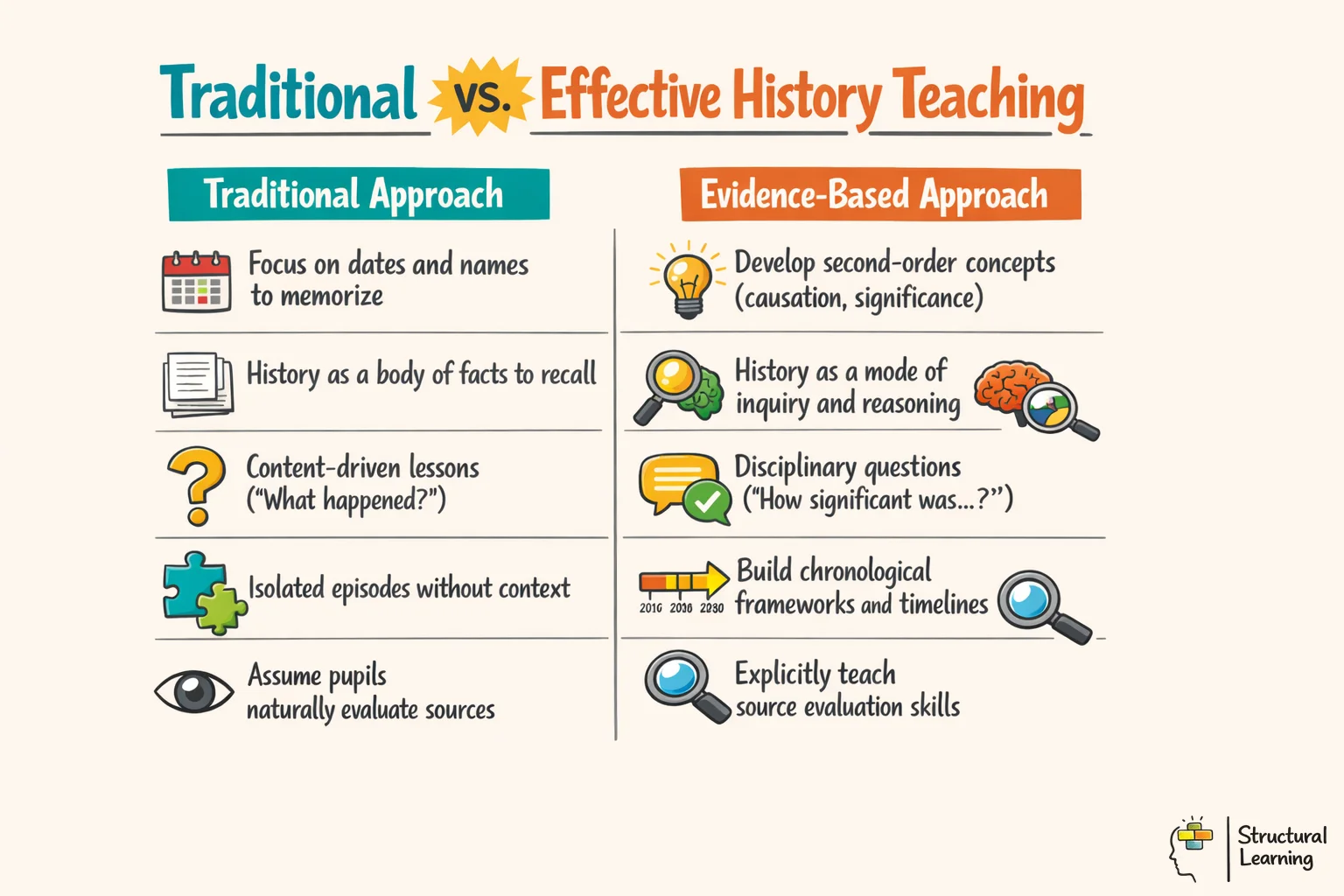
Historical thinking needs both substantive and disciplinary knowledge. Substantive knowledge means knowledge about the past. This includes events, people, places and historical terms. Disciplinary knowledge means knowing how historians build claims, accounts and arguments from evidence (Ofsted, 2021).
Learners need both types of knowledge. A learner may list the causes of the First World War. But if they do not understand causation as a historical concept, they will struggle to build a strong argument.
In practice, this means designing lessons around disciplinary questions, not just content coverage. Instead of "What happened at the Battle of the Somme?", ask "How significant was the Somme in changing attitudes to the war?" The second question requires learners to deploy their knowledge rather than simply reproduce it. It also signals to learners that history is a subject in which they reason, not one in which they receive.
Show learners a concept, such as "significance", at each lesson's start. At the end, revisit it; (Counsell, 2018). In a Year 8 lesson, learners rate factors from one to five and explain their rating. This builds vocabulary and aids thinking before extended writing (Christodoulou, 2017; Fordham, 2022).
Chronological understanding gives learners a base for historical knowledge. Without a clear historical timeline, they struggle to place events and ideas. Fordham (2016) highlights sequence as important knowledge. Schema research shows that linking new information to what learners already know supports retention and reduces avoidable working memory demand (Sweller, 1988).
The most effective approach is to build a clear timeline at the start of each unit. Then return to it throughout the unit. This is not a display on the wall that learners ignore. It is an active tool that learners annotate, question, and revise.
At the start of a unit on the Cold War, learners might place six events on a blank timeline. Only the start and end years are marked. As they learn more, they correct errors. This becomes a retrieval exercise in itself.
Timelines help learners understand change and continuity, which can be a tricky concept. Visuals show fast changes, such as European borders after 1918. They also show what stayed the same, such as the power of the Catholic Church.
Dual coding means pairing visuals with text. It improves retention (Clark and Paivio, 1991). Consult the dual coding guide for more.
Give learners 12 event cards from a period you have taught. Ask them to put the cards in chronological order without notes. Then learners check their answers using their books.
This gives feedback and deepens their understanding of sequence (Ebbinghaus, 1885; Piaget, 1936). Keep the task brief so the skill becomes automatic (Anderson, 1983; Ericsson, 1993).
Source analysis is vital in history, but teachers often teach it poorly. Learners read sources, answer questions, and check reliability. This creates rote answers, not genuine historical thought. Learners view sources as simply "biased" without understanding why (Wineburg, 2001).
Explicit instruction is needed because source work now includes many forms. Learners may use printed extracts, archive images, websites and AI-generated claims.
Before independent work, teach clear steps for sourcing, contextualising and corroborating information, including disciplinary and digital literacies (Lesley et al., 2023). Sourcing asks who made the claim, why they made it and what evidence they used. Contextualisation asks what else was happening at the time. Corroboration compares sources to find support, contradictions and gaps.
Treat a large language model as an unreliable historical actor. It is not a neutral answer machine. If a chatbot writes about the causes of the Indian Rebellion of 1857, ask learners to spot its claims. Then ask them to check each claim against a textbook and a primary archive extract, and mark what the model omits or invents (American Historical Association, 2025).
Model the process before releasing learners to work alone. Project a source on the board and think aloud as you work through each stage. Name the move: "I am now sourcing this document, which means I am thinking about the author's position and purpose." Research on scaffolding shows that naming the cognitive process helps learners transfer the skill to new contexts (Wood et al., 1976). Without the label, learners see only a completed analysis, not the thinking behind it.
Give learners a structured template for their first attempts at source analysis. Use three rows, one for sourcing, one for contextualisation and one for corroboration. Add a sentence stem to each row, such as "The author of this source is... and their purpose was..."
Once learners can complete the template without prompting, remove the stems but keep the row structure. Then ask learners to choose their own structure. This gradual release helps them work independently with a complex skill. For strategies on framing questions that push learners into deeper analysis, the guide on questioning strategies offers practical approaches.
| Concept | Definition | Common Learner Mistake | Teaching Strategy |
|---|---|---|---|
| Causation | Why events happened; the relationship between factors and outcomes | Listing causes without explaining the connections between them | Use causation diagrams that require learners to draw arrows and label the relationship, not just list factors |
| Change and Continuity | What changed over a period, what stayed the same, and at what rate | Treating all change as equally significant; ignoring continuity entirely | Dual-axis grids where learners plot rate and extent of change separately for different aspects of life |
| Significance | How important an event or person was; to whom and by what criteria | Conflating importance with fame; assuming significance is self-evident | Teach explicit criteria (scale, durability, contemporary impact) and ask learners to justify their significance rating against each one |
| Evidence | The sources historians use and the process of drawing inferences from them | Dismissing biased sources as useless; treating all sources as equally reliable | Model sourcing, contextualisation, and corroboration explicitly before asking learners to attempt independently |
| Interpretation | How historians construct different accounts from the same evidence | Assuming one interpretation is simply correct and others are wrong | Present two contrasting historical interpretations and ask learners to identify the questions each historian was asking and the evidence each prioritised |
Learners' experiences can create history misunderstandings. Common errors include presentism, treating the past as a simple story of progress, and assuming modern categories map neatly onto earlier societies. Tackle these errors head-on across age groups. Do not assume content exposure alone will fix them (Lee & Ashby, 2000; Wineburg, 2001).
Presentism means judging people in the past by today's morals. For example, learners may call peasants "stupid" for believing in witchcraft. They may also condemn factory owners without context.
This blocks historical understanding and warps cause and effect. As Wineburg (2001) argues, discuss what people knew at the time. Then ask learners: "What would you believe, then and there?"
The "great man" theory says that a few people make history. If learners focus only on Hitler, they miss the economic, political and cultural conditions that made Nazi rule possible. Ask them to identify non-human causes, such as post-war settlement, economic crisis and propaganda systems. Then ask them to connect these causes in a causation diagram, building the multi-causal reasoning that historical explanations require (Chapman, 2021).
Learners often think history is fixed, not an interpretation. Expose learners to two contrasting views of an event. This helps them analyse claims instead of accepting the newest (Wineburg, 1991; Seixas, 1993; Counsell, 2011). Use a topic they know well already.
Correcting misconceptions takes work. Vosniadou's (2013) research shows telling learners they are wrong rarely changes beliefs. Create cognitive conflict. Learners should predict before seeing facts, and discuss why their idea failed.
History has a memory problem. Learners study the First World War in Year 9, then return to it in Year 12 to find that most of what they learned has faded. This is not a sign of poor teaching; it is a predictable consequence of the forgetting curve. The solution is systematic retrieval practice: regularly bringing previously learned material back to mind rather than assuming it is retained because it was once taught.
Low-stakes quizzes help learners remember history. Begin lessons with five spaced questions (Roediger & Butler, 2011). Review content from last week, last month, and last term.
Delayed retrieval improves memory more than immediate review. This method helps learners retain historical knowledge.
The content of retrieval quizzes matters. Avoid questions that only test surface facts, such as "In what year did the Berlin Wall fall?" Include questions that require learners to use their knowledge: "Give two reasons why the Berlin Wall was built and explain why one was more important than the other."
The second question retrieves substantive knowledge and second-order reasoning. It asks learners to connect events, causes and significance, so the recall task supports historical thinking. This matches research on spaced practice, which shows the value of distributing review across a course.
Brain dumps help learners recall prior knowledge. Learners write everything they remember on a blank page for two minutes. They then compare their recall with a partner and check a knowledge organiser.
Gaps between their recall and the organiser guide the next ten minutes of teaching. See the guide on working memory for more context.

Learners need clear narratives for analytical essays (Counsell, 2000). A narrative gives them a cause-and-effect frame for analysis. So use narrative as a tool for thinking, not just as a story.
Teach learners directly that historical narratives are constructions, not transcriptions. This means they are built from choices, not copied straight from the past. A narrative involves selection, sequencing and interpretation. Historians make the same decisions, but with more evidence and a wider field of debate.
When a Year 10 class writes an account of the causes of the First World War, they decide what to include, what to leave out and how to connect events. Making those decisions visible helps learners write stronger historical accounts.
Historical stories hinge on causation, or why events happened. Chapman (2021) found that learners struggle with multiple causes, especially when ranking them. Research shows that learners need causation frameworks.
One such framework includes long-term, short-term, and contingent causes. Apply it to familiar events before moving on to unfamiliar ones, so learners can build the skill.
Give learners eight cause cards for a historical event and sort them into three piles. Then, rank the top two causes from each category. Explain your choices in a paragraph to solidify their thinking. Graphic organisers support this task effectively.
Ofsted's 2023 history subject report, the 2021 history research review and the Initial Teacher Training and Early Career Framework stress clear curriculum aims, careful sequencing, secure knowledge and subject-specific professional development (Ofsted, 2021; Ofsted, 2023; Department for Education, 2024). History departments should be able to explain why they teach content in this order. They should also show how learners build knowledge over time.
History lessons need clear content, concepts and breadth. By the end of Key Stage 3, learners should have studied British, European and world history from medieval to modern periods, with repeated attention to how local, national and global histories connect.
Decolonising the curriculum is not a bolt-on module. It means checking the whole Key Stage 3 timeline for whose knowledge, migration, empire, labour and resistance appear in the core sequence (Lidher et al., 2023). Learners still need to explain causes, judge interpretations and analyse sources (Wineburg, 1991; Lévesque, 2008; Seixas, 2017).
Sequencing is the part of a history curriculum leaders must be able to explain most clearly. Inspectors will ask why topics are taught in a particular order and how later content builds on earlier content.
This matters when non-specialists teach Key Stage 3. A department that teaches the First World War in Year 9 and the Congress of Vienna in Year 8 needs a shared map showing how earlier knowledge prepares learners for later work. Map second-order concepts alongside substantive content so staff can see how complexity builds over time.
During inspection, Ofsted may ask learners what they know and how ideas connect. Help them use subject vocabulary well. Ask regular questions about second-order concepts and links between lessons (Coe et al., 2018). This metacognitive habit helps with inspection and builds deeper understanding (Bjork et al., 2013).
See the metacognition guide for practical strategies (EEF, 2021).
Assessment should match curriculum aims. If you teach historical thinking, assess it as well as facts. An essay about Rome's fall tests knowledge and reasoning. A quiz on emperors only tests recall.
Balance these tasks based on your goals. Direct instruction, such as modelling, makes assessment more useful (Archer & Hughes, 2011). It also helps you give fairer feedback to each learner (Rosenshine, 2012; Christodoulou, 2017).
Interleaving can work well when it asks learners to discriminate between historical concepts, not merely switch topics. In one starter, learners might compare a war cause, a person's significance and a source inference, then explain which kind of thinking each question needs. Blocked practice feels easier, yet interleaving can improve retention and category discrimination (Kornell and Bjork, 2008; Ofsted, 2021).
Learners with good schemas learn faster. Schemas are mental frameworks that link new facts to what learners already know (Bartlett, 1932). For example, a learner understands hyperinflation better if they know about interwar Germany.
Reviewing topics builds strong schemas (Anderson & Pearson, 1984). Read guides for schema theory's cognitive background (Rumelhart, 1980).
Knowledge organisers help when they are used for retrieval, checking and explanation. Copying and filing them offers little gain. Use organisers for weekly quizzes, self-testing and short explanations, which matches evidence on practice testing and elaborative study (Dunlosky et al., 2013; Karpicke and Blunt, 2011). Make retrieval practice part of the curriculum so teachers return to important content before it fades from memory (Ebbinghaus, 1885).
Free for teachers. The platform builds a classroom-ready lesson plan from your topic in under two minutes.
Evidence-based history teaching has limits if it becomes generic pedagogy. Counsell argued that knowledge and skill are not separate. Historical knowledge works best when it is linked to disciplinary concepts, such as causation, evidence and significance (Counsell, 2000).
Ofsted gave a similar warning about reductive heuristics for source work. These simple routines can give learners misconceptions about historical enquiry (Ofsted, 2021). Retrieval practice is useful, but a quiz made only of dates can make history look like recall rather than argument.
A second limit is about method. Much cognitive science evidence comes from controlled studies that make tasks simpler. History classrooms are different because learners read sources that are partial, contradictory and culturally loaded.
Chapman argues that historical accounts depend on clear assumptions, concepts and methods (Chapman, 2021). So teachers sometimes need useful complexity, not simpler materials. Too much scaffolding can make answers look neater while weakening learners' grasp of uncertainty.
Cultural critique matters too. Work from the Runnymede Trust and CoDE shows that more inclusive history teaching depends on teacher education, subject knowledge and curriculum sequence, not token topics added to an unchanged timeline (Lidher et al., 2023). Sensitive histories also bring emotional and ethical demands. Stoddard warns that difficult knowledge cannot be treated as neutral content alone (Stoddard, 2021).
These limits do not weaken evidence-informed history teaching. Instead, they show how to use it well. Evidence should support rich, contested and carefully sequenced encounters with the past.
Bartlett (1932).
Bjork et al. (2013).
Chapman (2011).
Chapman (2021).
Christodoulou (2014).
Clark and Paivio (1991).
Coe et al. (2018).
Counsell (2018).
Counsell (2000).
Ebbinghaus (1885).
EEF (2021).
Lee (2004).
Lesley et al. (2023).
Lidher et al. (2023).
Ofsted (2021).
Rumelhart (1980).
Stoddard (2021).
Sweller (1988).
Wineburg (2001).
Wood et al. (1976).
Seixas (2004) and Wineburg (2001) are frequently cited researchers. Their work links history teaching to cognitive science principles. Counsell (2011) shows how learners benefit from these insights. They provide a solid base for evidence-informed history in UK classrooms.
Progression in Historical Understanding Among Students Ages 7-14 View study ↗
Foundational study
Lee, P. and Ashby, R. (2000)
Lee and Ashby (2000) provide a useful framework to understand how learners aged 7 to 14 progress in history. They found stages for using evidence and building explanations. This informs the second-order concept model in many history curriculums. Departments can use this when planning Key Stage 3 assessments.
Historical Thinking and Other Unnatural Acts View study ↗
Essential reading
Wineburg, S. (2001)
Wineburg (2001) says teach historical thinking; it doesn't just happen. He found experts and learners read documents in different ways. His chapter on presentism helps teachers understand learner difficulties. He offers practical advice for the classroom.
Knowing History in Schools View study ↗
Current practice
Chapman, A. (2021)
Chapman (UCL Press) connects history knowledge to reasoning skills. This directly helps teachers in the classroom. Curriculum sections assist heads of department preparing for Ofsted inspections. Chapman's framework reflects inspector queries regarding sequence and purpose.
Historical Knowledge and Historical Skills: A Distracting Dichotomy View study ↗
Influential chapter
Counsell, C. (2000)
Counsell (2000) says teachers need not pick knowledge over skills. Substantive knowledge and second-order concepts work together. This idea changed curriculum planning in UK history. Class activities should build thinking skills on strong knowledge. Learners need tools to use knowledge well (Counsell, 2000).
Knowledge and Language: Being Historical with Substantive Concepts View study ↗
Advanced practice
Fordham, M. (2016)
Fordham (2016) says some learners know history facts but need help with vocabulary. He thinks we should teach concepts directly, not just through reading. His work supports departments with longer writing pieces. Teachers can use Fordham's analysis to prepare learners for GCSE and A-level exams.
Mapped to the curriculum. CPD-aligned. Free for teachers.
Open a free account and help organise learners' thinking with evidence-based graphic organisers. Reduce cognitive load and guide schema building dynamically.