Task avoidance is usually a metacognitive planning deficit, not defiance. This guide helps pastoral leads, SENCOs, and teachers reframe 'won't start' as 'can't yet plan' and gives practical strategies to scaffold the forethought phase.
A learner puts their head on the desk as soon as you set the task. Another sharpens their pencil for three minutes, then asks to go to the toilet. A third stares at the blank page with their pen hovering.
For example, a Year 7 learner who freezes when given a multi-step essay task is rarely refusing to work, instead, they have failed to plan, monitor and regulate the task in working memory.
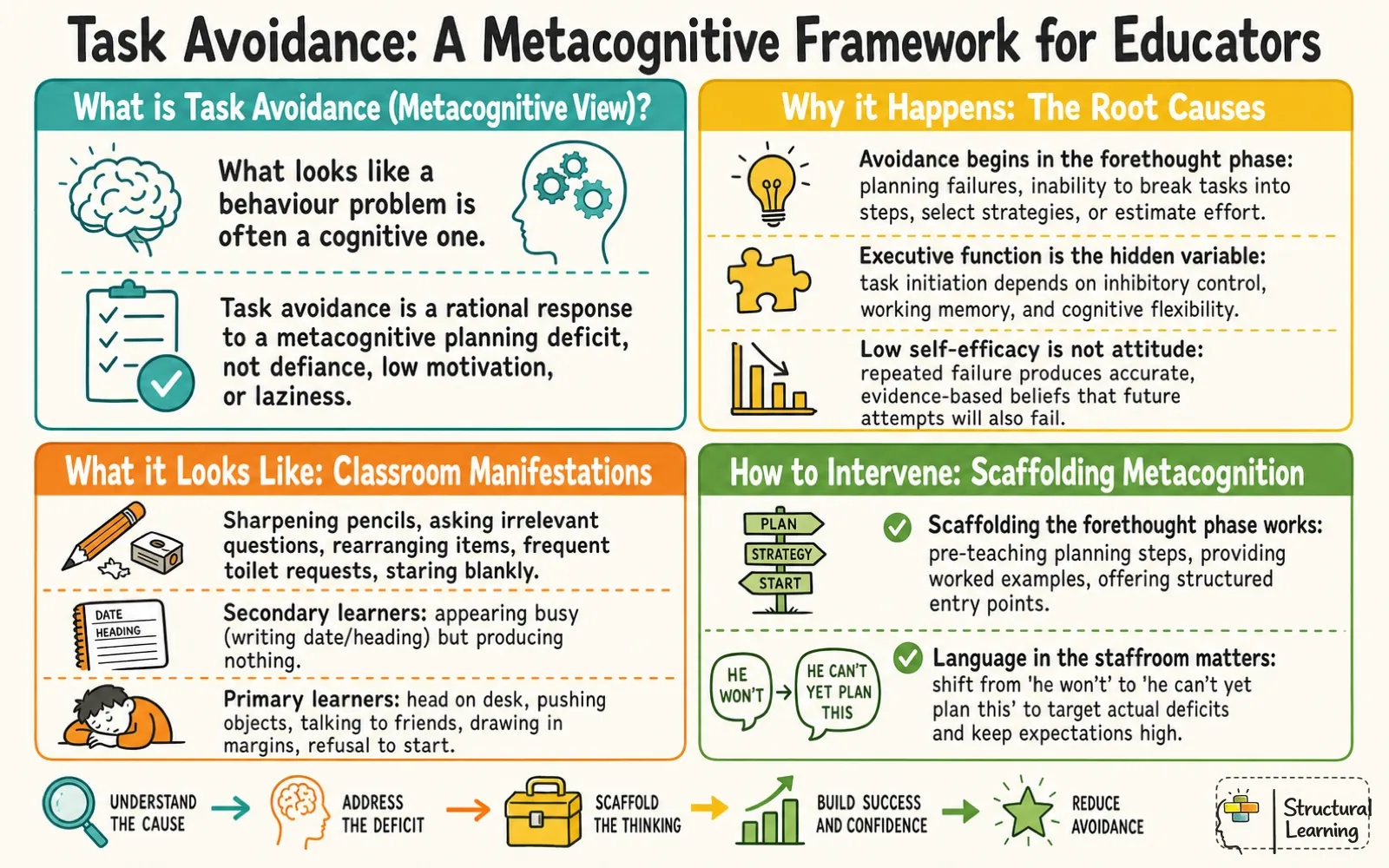
Task Avoidance: A Metacognitive Framework for Educators
You have explained the task clearly, and the rest of the class has started. So what is going on?
In many staffrooms, the first response is to call this defiance, low motivation, or laziness. Sometimes staff link it to attitude, parental background, or a rough morning. These explanations rarely help, and they are often wrong.
What looks like a behaviour problem is often a cognitive one. Task avoidance is, in most cases, a rational response to a metacognitive planning deficit, which means a difficulty with planning and monitoring learning.
Key Takeaways
Avoidance begins in the forethought phase: Zimmerman's self-regulation model shows that planning failures precede the blank page. Learners who cannot break a task into steps, select a strategy, or estimate the effort required will avoid the task because avoidance is rational.
Executive function is the hidden variable: Task initiation depends on inhibitory control, working memory, and cognitive flexibility. Diamond (2013) and Barkley (1997) show these are measurably weaker in learners with ADHD and are underdeveloped in many younger learners.
Low self-efficacy is not attitude: Bandura (1997) shows that repeated failure at similar tasks produces accurate, evidence-based beliefs that future attempts will also fail. This is not a mindset problem; it requires a different intervention.
Scaffolding the forethought phase works: Pre-teaching planning steps, providing worked examples, and offering a structured entry point dramatically reduce avoidance without lowering expectations or changing the task.
Language in the staffroom matters: The shift from 'he won't' to 'he can't yet plan this' changes the intervention from punishment to teaching. It also keeps expectations high while targeting the actual deficit.
What Task Avoidance Looks Like in the Classroom
Task avoidance shows specific behaviours. Learners can sharpen pencils or ask irrelevant questions. They may rearrange things, request toilet trips, or stare blankly. Avoidance is active, requires effort, and can be socially adept (adapted from conceptualisations of task avoidance).
Secondary-age learners may turn this into a performance. They open their book, write the date, and seem to be thinking. If you walk past, they look busy, but nothing is produced.
The blank page builds up. By the end of the lesson, there may only be a heading and a date. A learner who does this often across several subjects is not lazy; they are distressed by the act of starting.
Primary-age learners are often less subtle. Head on the desk, pushing a rubber around the table, talking to friends, drawing in the margin. A reception child who refuses to pick up a pencil during a phonics activity is telling you something important. So is the Year 6 learner who becomes challenging every time a writing task is set.
Does the learner avoid one type of task? If they avoid writing but take part in practical tasks, writing is likely to be the barrier. If they avoid open-ended tasks, they may be struggling to plan.
If avoidance happens across many tasks, it often points to anxiety, trauma, or wider executive-function difficulties rather than a behaviour problem alone (Barkley, 1997; Diamond, 2013). Once you understand the pattern, you can change your response.
The Metacognitive Planning Deficit
Zimmerman (2002) says self-regulated learning is a cycle of forethought, performance, and self-reflection. Avoidance often starts during forethought, before the learner has begun the task. Use it as a starting point for professional discussion: identify the learner's current need, record evidence from more than one lesson, and agree the next classroom adjustment with the SENCO or family.
Before writing, learners must understand what the task is asking. They need to set goals, choose strategies, and estimate the effort involved. They also need to believe that their effort can lead to success.
For learners with strong metacognitive skills, this planning process is quick and often automatic. They read the task, form a simple plan, and begin. For learners with a metacognitive planning deficit, these steps can be hard, slow, or missing.
They read the task and feel blank. They cannot see where to start or which strategy to use. They do not know how long it will take, or whether they can do it. The blank page is not a starting point; it is a wall.
Avoidance can feel rational when learners cannot plan a task. If starting seems to guarantee public failure, avoidance helps them avoid that failure (Steel, 2007). Teachers should respond with pedagogy rather than frustration.
This means teaching metacognitive skills during forethought, the stage where learners think ahead and plan. Consequences or pep talks are not enough, and this fits Zimmerman's (2002) focus on the forethought phase in the self-regulated learning model.
Zimmerman (2002) found high achieving learners plan more than others. It isn't about brains or trying harder, it's good planning. Teachers can help learners plan better; this supports self regulation, say the researchers.
◆ Structural Learning
Task Avoidance is Not a Behaviour Problem: A Metacognitive Approach
A deep-dive audio episode
A concise Structural Learning audio episode on Task Avoidance is Not a Behaviour Problem: A Metacognitive Approach, grounded in the curated research dossier and focused on practical classroom use.
Executive Function and Task Initiation
Diamond (2013) states that learners need inhibitory control, working memory and cognitive flexibility. These executive functions help learners stop distractions, hold ideas in mind, switch approach, and begin activities. Learners with ADHD, language disorder, or hardship may struggle with these demands (Diamond, 2013).
Diamond (2013) says inhibitory control lets learners choose a better response. Learners start tasks by suppressing the urge to avoid them. Weak inhibitory control makes this very tiring, according to Barkley (1997). The desire to avoid feels physical, not just a simple preference.
Working memory is the mental workspace where planning happens. To break a task into steps, learners must hold the goal in mind, create smaller goals, and put them in order. This is a working memory operation.
Barkley (1997) demonstrated that learners with ADHD have working memory capacities that make this kind of multi-step planning much harder than it is for neurotypical peers. For them, the blank page is not blank in the same way it is for others. It can feel overwhelming because the planning needed to fill it is beyond their cognitive capacity in that moment.
Cognitive flexibility helps learners change tactics when the first one does not work. When a learner gets stuck, they need another method to try. Without this, they may freeze (Diamond, 2013).
Teachers can respond by supporting working memory and teaching strategy sets (Gathercole & Alloway, 2008). This gives learners more than one route through a task. It helps them persevere when the first approach fails.
The blank page represents the moment of highest planning demand in any lesson. It is not coincidental that avoidance is concentrated at that moment. Everything the task requires from the learner's executive function is demanded simultaneously, before any words have been written and before any momentum has been established. Pre-scaffolding this moment is not lowering the bar; it is teaching.
The Self-Efficacy Connection
Bandura (1997) says self-efficacy is believing you can succeed at tasks. It is task-specific, not general confidence. If a learner struggled with writing and got low marks, they have evidence. Their low writing self-efficacy is accurate, based on their experience.
Bandura (1997) says self-efficacy comes from four sources: mastery, vicarious experience, verbal persuasion, and physiological state. When a learner often fails, they do not build mastery experience, or the belief that they can succeed. Negative feelings can also weaken this belief, so teachers' encouragement is often not enough (Bandura, 1997).
This is why a common pastoral response often fails. Teachers may tell the learner they are capable and set high expectations through encouragement alone. But the learner is not being stubborn when they doubt they can do it. They have past evidence that they cannot.
Self-efficacy changes through restructured success, not encouragement alone. When a teacher redesigns the entry point so the first step is truly achievable, the learner can complete it successfully. This is a mastery experience. It is the only intervention that reliably builds self-efficacy over time.
Dweck (2006) adds an important point here. Growth mindset research shows that learners view future failure differently when success is linked to effort and strategy, rather than fixed ability. But a growth mindset message is not enough without real experiences of success.
Learners need to succeed first. Then the teacher can link that success to their planning and effort. The order matters. For learners with low self-efficacy, the scaffold comes before the mindset message.
Dweck's (2006) research shows how teachers' feedback affects learners. Dweck (2006) says that praising effort ("You worked hard") can build resilience. Highlighting strategy ("You broke it into steps") shows learners an approach they can repeat.
Metacognition ("You noticed when stuck") is a strong attribution for avoidant learners, because it names how they monitored their thinking. Rotate these attributions during the first half-term. Over time, this helps build strong competence narratives.
The connection to growth mindset is real but often applied in the wrong order in schools. Telling a learner with a history of failure that effort determines outcomes is not wrong, but it is premature if the task design guarantees another failure experience. Restructure the task entry point first.
What Teachers Can Do: The Planning Scaffold
The intervention for a metacognitive planning deficit is explicit instruction in the forethought phase. This does not mean completing the task for the learner. It means teaching them to plan, step by step, before they encounter the blank page.
The first strategy is micro-tasking the first step. Instead of saying 'write an essay about the causes of the First World War', the teacher says 'your first job is to write one sentence about one cause you have already studied.' The full task is still there, unchanged. But the entry point is now clear.
For many learners, this is enough to help them start. Once they have started, momentum often takes over. The avoidance was about the planning demand, not the content.
The second strategy is a worked example. Providing a model of a completed first paragraph, or even a partially completed one with blanks to fill, shows the learner what the output looks like and how it is structured. For learners who cannot form a mental representation of the finished task, the model provides one externally. This is one of the most robust findings in cognitive science: worked examples reduce cognitive load at the point of highest demand and allow learners to observe the expert's planning process rather than having to construct it independently.
The third strategy is choice of entry point. Instead of making every learner start in the same place, let learners begin with the part of the task they find easiest to access. A learner who can write about one cause, but cannot yet sequence an essay, can begin there.
Starting creates text. That text can be organised into an essay structure later. The alternative is to wait for a learner to plan the whole essay before writing anything. This often leads to nothing at all.
Graphic organisers help learners plan before writing. Using boxes for 'cause', 'evidence', and 'consequence' lowers planning stress. Learners see and adjust their plan on paper, then write (Thinking Framework).
The fifth strategy is to use AI to model step-by-step breakdowns. A teacher can use AI tools to create a worked breakdown of a task type. They can then share it with the whole class as a planning model, not as content to copy.
AI in the classroom is well suited to creating step-by-step structures that make the planning phase clear and concrete. The learner reads the breakdown, selects their approach, and writes. The planning work has been modelled; now the learner applies it.
Writer's Block (Structural Learning) makes planning concrete. Learners arrange physical blocks with task steps before writing. This externalises planning. Learners struggling with internal planning can plan externally first (Flower & Hayes, 1981), then write.
The EEF (2018) suggests teaching metacognition directly. Model strategies and then give learners control. Evidence shows good progress using this approach across ages and subjects. Learners can gain seven months extra progress (EEF, 2018).
Reframing the Conversation in the Staffroom
The language that circulates about task-avoiding learners in staffrooms is significant. 'He won't engage.' 'She just doesn't try.' 'He could do it if he wanted to.' Each of these phrases locates the problem in the learner's motivation or character. This framing produces a particular set of responses: behaviour warnings, phone calls home, seating changes, detentions. None of these change the learner's capacity to plan the task.
The reframe is straightforward: replace 'won't' with 'can't yet.' 'He can't yet plan this type of task without support.' 'She can't yet sustain the planning demands of an extended piece of writing.' This language does not lower expectations; it identifies a teachable deficit. Expectations remain high. The task remains unchanged. What changes is the intervention.
Pastoral leads and heads of year can model this language in team meetings and when logging concerns. When a teacher says 'He's refusing to work again', a useful response is 'At what point in the task does the refusal happen?' If the answer is 'at the very start', the conversation shifts towards planning. If the answer is 'after a few minutes', the conversation shifts towards sustained effort and strategy selection when stuck.
Senior leaders should also ask whether the scheme of work is creating overload that could be avoided. Dense worksheets, missing worked examples, sudden moves from input to independent work, and long writing tasks before vocabulary is secure can lead to avoidance across the school. In these cases, task avoidance is often a sign of curriculum design, not only a pastoral concern.
Behaviour policies can support learners with planning and still stay consistent. Every learner should engage with the task. The change is in the support offered at the start of the lesson.
This is not lowering standards. It is offering differentiated access (e.g., Rose & Meyer, 2002). It also means responding to learning barriers that look like bad behaviour, rather than punishing learners. This puts Barkley's (1997) account of ADHD into practice, by treating it as a self-control deficit rather than a wilful behaviour problem.
For NQTs, this reframe matters. In the first months, it is easy to see task avoidance as a personal challenge or a test of authority.
It rarely is. The learner who does not start is not trying to undermine you. They are trying to cope with a cognitive demand that is too much for them right now. If you respond with curiosity rather than confrontation, everyone is more likely to do well.
SEND Considerations
Task avoidance matters for many learners with special educational needs. Teachers need to know why it is happening, because different forms of avoidance need different actions. This understanding helps the learner get the right support.
For learners with PDA, demand avoidance is key. Demands that feel real to the learner can cause overwhelming anxiety.
Scaffolding may not work, so try collaborative framing instead. Remove direct instructions where you can, and build learner independence. PDA is a physiological response, not a choice.
Learners with autism often find transitions and starting new tasks hard. Executive function and managing change add to their cognitive load. Giving advance warning, using visual schedules, and pre-teaching tasks can help. These adjustments let the learner show their knowledge.
Barkley (1997) showed ADHD learners often struggle with executive functions. They may find task initiation, working memory, and self-control hard. Medication can help, but learners need classroom support. Provide short tasks with clear starts, frequent wins, and active breaks, supported by research.
Anxiety often makes learners avoid tasks. Teachers may read this as defiance, but the cause may be fear or stress. The Zones of Regulation helps learners name their feelings (Kuypers, 2011).
This helps them explain when they can't start work. This isn't avoiding work; it's understanding their learning needs. When we support learners based on their feelings, everyone benefits.
The Zones of Regulation (Kuypers, 2011) uses colours to describe emotional states. Blue Zone learners need prompts that help them become more active. The Green Zone shows calm focus.
Yellow Zone learners need familiar tasks. Red Zone learners need help to return to Green or Yellow before they plan. For best results, match the task to the learner's zone.
Ready to plan it?
You have explored Metacognition. Now turn it into a lesson learners will remember.
Free for teachers. The platform builds a classroom-ready lesson plan from your topic in under two minutes.
Learners plan, monitor and reflect on their thinking.
Scaffolds support hard tasks without doing the thinking.
Before your next lesson with a class that includes persistent task avoiders, identify the moment of highest planning demand in the tasks you have set. It is almost always at the point where the blank page first appears.
Try one of three things. Write the first sentence of the expected response on the board, in the form 'One reason why X is...' or 'The main cause of X was...' Tell the class this is the sentence starter; they complete it and keep going. This removes the entry point demand without reducing the intellectual content.
Alternatively, provide a graphic organiser with three or four labelled boxes that correspond to the structure of the expected response. Give learners three minutes to fill the organiser before they write anything. Their plan is then on paper, external, and usable. Watch what happens to the learners who usually spend the first ten minutes sharpening pencils.
Or break the task into three numbered steps on the board: 1) Write your main point (one sentence). 2) Write your evidence (one quote or example). 3) Write your explanation (two sentences). The task has not changed. The structure has been made visible. For learners whose metacognitive planning is weak, visible structure is the difference between starting and not starting.
Record what you observe. If the usual avoiders start work and produce something, you have identified the deficit.
The next step is planning instruction. Teach learners clearly how to break tasks into steps, choose strategies, and estimate effort. This is the long-term investment. The scaffolded entry point is the short-term fix that keeps learning going while you build the capacity.
Developmental Language Disorder, Cognitive Flexibility, and Task Avoidance
Learners with Developmental Language Disorder (DLD) avoid tasks more often than other learners. DLD affects language in 7% of learners (Bishop et al., 2017), so most classes include at least two learners with DLD. Behaviour policies often miss the reason for this avoidance.
Academic tasks often ask learners to follow spoken instructions and plan at the same time. This can overload verbal processing before the learner has even started. The task feels hard because the first step takes so much effort, not because the learner lacks motivation.
Effective support for learners with DLD reduces the amount of spoken language they must process before they start. Written task instructions with visual anchors (a simple image alongside each step) lower the working memory demand, because learners do not have to hold every instruction in mind.
Colour-coded planning frames also help. Each step uses a different colour, matched to the colours used in the teacher's modelling, so learners can scan the plan rather than recall it.
Paired planning gives another route in. A supportive peer talks through the steps aloud while the learner writes, using a social scaffold to reduce verbal processing. These adjustments do not make the task itself less demanding; they reduce the cost of getting started. For more on language-based learning needs, see our guide to oracy in language development.
Cognitive flexibility means being able to change tactics when stuck. Task-avoidant learners may not have back-up plans, so they give up (Diamond, 2013). Teachers can build this by teaching several methods and praising changes in strategy.
Use "When I'm stuck" cards with three options. Model strategy switching aloud, such as "This isn't working, I'll try another way." Ask learners to name the strategies they used on exit tickets. This shows that being stuck is temporary and helps learners widen their strategy choices.
Limitations and Critiques
A metacognitive account of task avoidance is useful, but it can become too tidy if schools treat Zimmerman's cycle as a universal sequence. Pintrich (2000) and Winne and Hadwin (1998) both caution that self-regulated learning is recursive: planning, monitoring, and evaluation often overlap rather than unfold in a neat order. In a live classroom, avoidance can emerge from mixed causes, including task design, anxiety, peer status, fatigue, and learned escape.
A second limitation is methodological. Much self-regulation and self-efficacy research relies on self-report, teacher rating, or short intervention studies. Usher and Pajares (2008) show that sources of self-efficacy do not operate identically across groups, which limits simple transfer into school-wide policy. Cultural context also matters. The same avoidance pattern can therefore trigger support for one learner and sanction for another.
Neurodivergent learners also test the model. Buckle et al. (2021) describe autistic inertia as difficulty initiating, stopping, or switching action; in those cases, forethought may be experienced as bodily threat rather than rational planning. Boekaerts (1999) also reminds educators that learners protect well-being goals as well as mastery goals. Despite these limits, the metacognitive lens remains valuable because it directs teachers towards diagnosis, scaffolding, and teachable strategies rather than blame.
◆ Structural Learning
Task Avoidance is Not a Behaviour Problem: A Metacognitive Approach: Quick-Check Quiz
10-question self-test
Q1 of 10
0%
References
Bandura, A. (1977). Social learning theory.
Zimmerman, B. (2002). Becoming a self-regulated learner.
Further Reading: Key Research Papers
Teachers can look at why learners behave a certain way, beyond just managing behaviour. Research by Steel (2007) shows task avoidance connects to thinking skills. These studies help teachers understand learners better than just using motivation.
Self-Efficacy: The Exercise of ControlView study ↗ 2,847 citations
Bandura, A. (1997)
Bandura (1997) identified four self-efficacy sources; mastery is key for belief changes. For teachers, create early success experiences before offering motivational messages.
Self-Regulation and Academic Learning: Self-Efficacy Enhancing InterventionsView study ↗ 3,100+ citations
Zimmerman, B. J. (2002)
Zimmerman's (2000) self-regulation cycle highlights forethought, linking it to avoiding tasks. We explain how planning lessons targets the root of learner avoidance.
Diamond (2012) reviews executive functions like inhibitory control. The research examines working memory and cognitive flexibility development. This explains task initiation struggles for some learners.
ADHD and the Nature of Self-ControlView study ↗ 5,200+ citations
Barkley, R. A. (1997)
Barkley (1997) showed ADHD affects self-regulation more than attention. Learners with ADHD struggle to start tasks because of this. Behaviour strategies alone, without thinking skills support, don't work well (Barkley, 1997).
Metacognition and Self-Regulated Learning: Guidance ReportView study ↗ EEF, 2018
Education Endowment Foundation (2018)
The EEF report reviews metacognition and gives advice for teaching. It is accessible and suggests ways to use it in lessons. The report has specific ideas for learners with SEND.
Build metacognitive strategies into your next lesson.
Scaffolded. Self-regulated. Free for teachers.
Metacognition PlatformMetacognitive strategies
Learners plan, monitor and reflect on their thinking.
Scaffolds support hard tasks without doing the thinking.