AI Metacognition: What Teachers Need to Know
Harness ai metacognition teaching students to think critically. Learn how to use artificial intelligence as a Socratic partner rather than an answer engine.


Harness ai metacognition teaching students to think critically. Learn how to use artificial intelligence as a Socratic partner rather than an answer engine.
AI metacognition is the deliberate use of AI to help learners plan, monitor and evaluate their thinking rather than simply generate answers. In practice, a teacher can ask learners to compare an AI response with their own explanation, spot what is missing, and revise the prompt so the tool becomes a mirror for reasoning. This matters because AI can either strengthen self-regulation or quietly replace it. The teaching move is to keep learners explaining choices, checking evidence and improving subject knowledge.
* AI serves as a cognitive mirror, prompting learners to articulate and refine their thinking.
* Prompt engineering is a metacognitive exercise requiring subject knowledge and self-awareness.
* Teachers should integrate AI as a Socratic dialogue partner, not just focus on cheating prevention.
* Evaluating AI inaccuracies builds critical evaluation and fact-checking skills.
* Balancing cognitive support with the risk of cognitive offloading is important for learning. See also: Learning science ai lesson planning.
* Combining AI interactions with frameworks like Webb's Depth of Knowledge improves outcomes.
Metacognition uses tools and routines to help learners monitor and adjust their thinking; Flavell (1979) defined this as metacognition. The Education Endowment Foundation Teaching and Learning Toolkit reports that metacognition and self-regulation approaches have an average impact of eight months additional progress. Teachers use large language models as cognitive mirrors, not just answer engines. The output reflects the prompt's quality, so learners see gaps in understanding. Vague questions get generic answers, so learners must analyse and refine communication.
AI helps make thinking visible, not harms learning (Holmes et al., 2023). Focus on using AI to encourage deeper thought, instead of only preventing cheating. Learners need subject knowledge to create useful prompts (Wiggins, 1998). Prompting AI structures a learner's knowledge (Wiliam, 2018).
Imagine uses like this enable powerful, individualised learning experiences (Holmes et al., 2022). History teachers can have learners define the Industrial Revolution using classroom chat. If a learner types a vague request, they get a broad summary. The teacher asks them to find words lacking historical detail. The learner rewrites their request for dates, locations, and inventions. They then monitor communication and build vocabulary (Holmes et al., 2022). The teacher then assesses the better question.
Flavell (1979) said metacognition is thinking about thinking. He split it into knowledge and regulation. Now, learners use this when using digital tools. They must control interactions with databases. The machine needs learner monitoring.
Lodge et al. (2023) highlight the tension between cognitive offloading and cognitive support when using generative AI. Cognitive offloading occurs when learners let the machine do the thinking, reducing their cognitive effort and harming memory retention. Support happens when the machine helps the learner reach a higher level of understanding than they could achieve alone. The challenge is designing tasks that provide support while preventing offloading. If the AI provides the final product, the learner offloads. If the AI provides a component that the learner must then analyse or improve, the AI supports the learning process.
Molenaar (2022) says learners need guidance to use AI tools well. Learners often seek quick answers and lack self-regulation skills. Hattie (2012) notes the value of feedback. AI offers instant feedback, but learners must learn how to use it. AI provides a safe space to experiment, as it does not judge learners.
For example, a teacher provides a complex physics problem. A learner asks the AI for the answer. The teacher requires the learner to ask the AI to explain only the first step of the equation. The learner reads the first step, attempts the second step on paper, and then asks the AI to check their working. This transforms the interaction from cognitive offloading into structured cognitive support. The teacher reviews the learner's working and the AI's feedback.
A concise Structural Learning audio episode on AI Metacognition: What Teachers Need to Know, grounded in the curated research dossier and focused on practical classroom use.
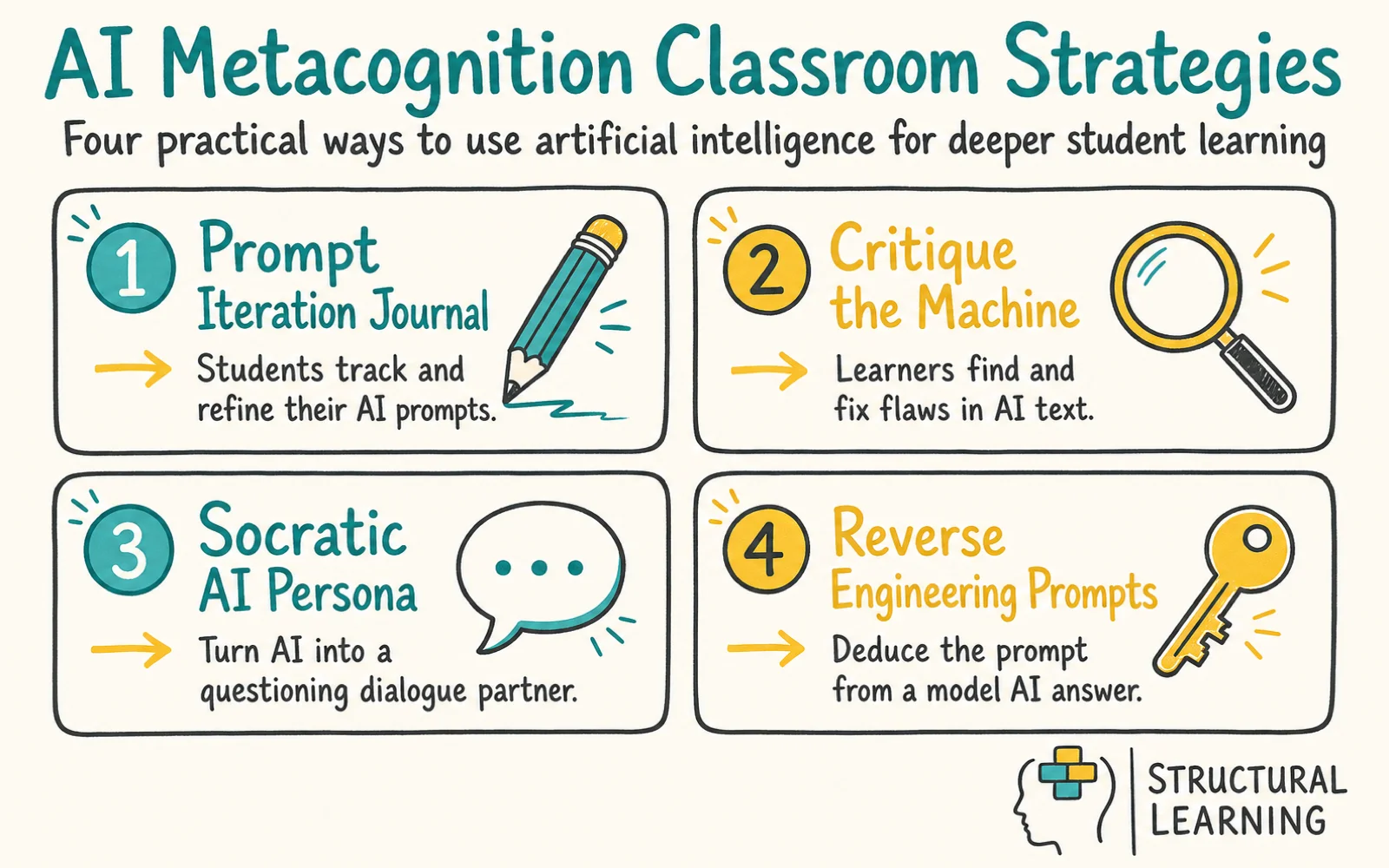
This strategy makes the metacognitive process of refining language visible and gradable. The teacher provides a complex task and requires learners to track their interactions with an AI tool in a dedicated journal. The focus shifts from the final generated text to the process of generation.
Learners record their initial prompt, copy the resulting AI output, and write a critical reflection on why the prompt succeeded or failed. They then write a second, improved prompt based on their reflection. This forces them to analyse their instructions and recognise how ambiguity leads to poor results.
A learner attempting to generate a summary of the water cycle logs their first attempt as too broad. The AI produces a university-level explanation. The learner writes a reflection noting that they failed to specify the target audience. They refine the prompt to ask for a summary suitable for a 10-year-old using specific scientific terminology. The journal serves as the assessed piece of work.
This approach builds critical evaluation skills by treating AI outputs as flawed drafts rather than authoritative sources. The teacher generates a deliberately flawed, biased, or incomplete essay using AI. The teacher then distributes this text to the class alongside a strict marking rubric.
Learners find errors and fix facts using textbooks (Bloom, 1956). They mark the machine's work with rubrics, backing grades with text evidence (Wiggins, 1998). This flips roles, making the learner the expert evaluator (Sadler, 1989).
Learners receive an AI biography of Churchill with timeline errors and political bias. They check the essay using primary sources, applying the historical-thinking concepts of evidence and perspective (Seixas, 2004; Wineburg, 2001). Learners rewrite the conclusion, fixing dates and bias to improve critical reading. The teacher then assesses their corrected work and reasoning.
Teachers can use system prompts to change how the AI interacts with learners, turning it into a dialogue partner. The teacher provides a custom prompt that instructs the AI to act as a Socratic tutor. The prompt explicitly forbids the AI from giving direct answers, instructing it to only ask guiding questions.
Learners must converse with the AI to solve a complex problem. Because the AI will not do the work for them, learners must articulate their hypotheses, test their ideas, and respond to the machine's probing questions. This makes their internal thinking visible in the chat log.
A learner struggling with fractions interacts with the Socratic AI. The AI asks what the learner thinks happens when the denominators are different. The learner types their guess. The AI points out a logical flaw in the guess and asks another question. The teacher reviews the chat log to pinpoint exactly where the learner's understanding broke down. The teacher provides targeted support based on the chat log.
Learners break down good examples to grasp how they work. The teacher shows an AI answer on the board but hides its source. (Willingham, 2009; Christodoulou, 2014; Hattie, 2008).
Learners must work backwards to deduce the exact, detailed prompt used to generate that specific output. They must identify the tone, the structural constraints, the specific vocabulary, and the persona requested. They test their hypotheses by inputting their deduced prompts into the AI and comparing their results to the teacher's original text.
The class reads a structured haiku about photosynthesis that includes specific scientific vocabulary. Learners must write the prompt that they believe created it. They quickly realise that simply typing 'write a poem about plants' does not work. They must refine their prompt to specify the poetic form, the exact biological process, and the required terminology, demonstrating comprehension of the subject matter. The teacher assesses the deduced prompts.
A primary misconception is that AI is simply an automated answer engine. This view assumes the technology exists only to retrieve facts. In reality, AI is a cognitive mirror that reflects the user's clarity of thought. Treating it solely as a source of facts leads directly to cognitive offloading and superficial learning. Teachers must reframe the tool as a conversational partner that requires careful direction and constant monitoring.
Schools wrongly focus on preventing cheating. Overemphasising plagiarism detection ignores important teaching integration. Detection tools are unreliable; they can flag original work. Banning tools isn't the answer; change assessments instead. Assess the process, the prompt and chat logs, or learner critiques of AI output, in line with the wider case for assessing learning processes rather than just final products (Sadler, 1989).
Prompt engineering needs more than just typing. Good prompts require subject knowledge. Learners must predict AI understanding and set constraints (Brown et al., 2020). The learner’s subject vocabulary also matters, and learners predictably struggle to write good prompts on topics they have not yet studied, because they lack the schema needed to interrogate the AI output (Willingham, 2009).
AI gives fast text, but it lacks teaching insight (Holmes et al., 2023). Teachers build strong learner relationships, not machines (Luckin et al., 2016). Guide learners to use AI, correcting its errors (O'Neil, 2016; Holmes et al., 2023).
Consider, for instance, learners using AI for geography work. Instead of punishing them, change the task. Now, learners use AI to create counterarguments (Holmes, 2024). Learners must write essays, addressing and refuting these AI points. Assess the essays and AI argument refutation skills.
Mathematics teaching benefits when learners focus on the process, not just answers. AI can be like an interactive textbook that explains methods. Learners can ask AI about quadratic formula rules, rather than just solve equations. (Researchers: No specific researchers cited in original).
Learners read the AI explanation and then solve equations. They annotate each written step, stating which rule they applied. Teachers review annotations alongside the AI to check learner comprehension (Chi et al., 1981; Ericsson & Simon, 1980; Sweller, 1988).
Learners find identifying persuasive techniques tough. Teachers can use AI to create texts for analysis. Learners instruct the AI to write a speech arguing against uniforms, using the rule of three and rhetorical questions.
The teacher provides a highlighter code. Learners highlight the persuasive devices used by the AI within the generated text. They then write a short evaluation assessing whether the machine applied these devices effectively or clumsily. This forces the learner to move from reading for content to reading for structural mechanics. The teacher assesses the highlighted text and the evaluation.
Learners design plant growth experiments with varied light. They list equipment and method, checking for flaws. AI identifies potential confounding variables or missing controls (Bell, 2005; Hofstein & Lunetta, 2004).
The AI can point out that the prompt did not specify the temperature or the volume of water. The teacher monitors as learners adjust their physical experiment and rewrite their method based on this critique. This interaction models the peer-review process essential to scientific research. The teacher assesses the revised method and the learners' explanations of the changes.
Learners should grasp history's subjective nature. They ask AI to explain the First World War's causes. AI offers British and German viewpoints (Wineburg, 2001; Seixas, 2004). This helps learners compare national narratives (Lee & Ashby, 2000).
Learners compare AI outputs with primary sources, as prompted. They summarise how perspective alters the history, building on the historical-thinking work on perspective and evidence (Lee & Ashby, 2000; Seixas, 2004). Learners note AI errors, reinforcing critical analysis of all texts. The teacher assesses summaries and bias identification.
The Universal Thinking Framework organises learning with clear actions. AI can help with the "create" stage. For example, AI can produce brainstorming ideas. Learners then evaluate those ideas (Bloom, 1956), refining the output. This supports learning without a blank page (Anderson & Krathwohl, 2001).
Webb's Depth of Knowledge categorises academic tasks by their cognitive complexity. Using AI to generate a list of facts is a Level 1 task involving basic recall. Critiquing an AI essay against a marking rubric pushes the task to Level 3, which involves Strategic Thinking, or Level 4, Extended Thinking. AI becomes a tool to reach higher cognitive demands. By providing the baseline information instantly, the technology frees up lesson time for analysis.
Self-regulated learning requires learners to plan their approach, monitor their progress, and reflect on their outcomes. Engaging with an AI chatbot demands all three phases. Learners must plan their prompt carefully, monitor the AI output as it generates, and reflect on how to adjust their strategy if the answer is inadequate. The AI acts as a feedback mechanism that only responds well to self-regulation.
For example, a teacher explicitly maps an AI task to Webb's Depth of Knowledge on the whiteboard. They tell the class that generating a summary of a novel is a Level 2 task. They explain that finding logical flaws in that summary and rewriting it to improve the academic tone is a Level 3 task. Learners actively aim for Level 3 by annotating the AI text with corrections, visibly tracking their cognitive depth. The teacher assesses the annotated text and the learners' explanations of their corrections.

Free for teachers. The platform builds a classroom-ready lesson plan from your topic in under two minutes.

AI Metacognition in practice — a classroom-ready briefing you can use this week.
Design tasks where the AI output is the starting point of the lesson, not the final product. Ask learners to critique, improve, format, or apply the generated text rather than simply submitting it. If the assignment requires learners to evaluate the machine's logic, they cannot offload their thinking; they must engage with the material to complete the task.
Yes, provided there is teacher support. In primary settings, the teacher should act as the sole driver of the AI, projecting the interface on the board. The class collectively decides what prompt to type, and they evaluate the response together. This models the metacognitive process out loud, teaching young learners how to question information before they interact with technology independently.
Inaccuracies offer learning chances. Teachers, ask learners to check AI facts using textbooks. This builds confidence and shows the need for human checks. Learners find errors in AI, using reliable sources.
Prompting well needs subject knowledge. Learners must know biology to tell AI what details to use,. Clear language strengthens a learner’s subject knowledge,. This skill applies curriculum communication, not just tech,.
Assess the process of learning, not just the final product. Grade the Prompt Iteration Journal, the learner's written critique of the AI output, or the chat logs showing their line of questioning. This shifts the focus from grading a potentially machine-written essay to grading the learner's documented metacognitive process.
For example, a teacher addresses the fear of incorrect information by creating a weekly challenge called Spot the Inaccuracy. The teacher projects an AI text containing one deliberate historical or scientific error. Learners race to find and correct the error using their textbooks, turning a software flaw into an active learning game that demands close reading and factual verification. The teacher awards points for the first correct answer.
Project an AI chatbot on your whiteboard for the next lesson. Use a vague prompt about your topic. Ask learners to explain why the chatbot's answer is poor. This active learning strategy, suggested by Holmes et al (2023), develops critical thinking and is consistent with the wider literature on metacognition and evaluative expertise (Sadler, 1989).
Related reading: A Diamond 9 CPD lesson for ranking classroom AI uses
These peer-reviewed studies provide the research foundation for the strategies discussed in this article:
Almusharraf & AL-Shammari (2023) researched AI's ethics in language learning at Ha'il University. Their study investigated how AI impacts both learners and teaching practice.
F. Aljabr & A. Al-Ahdal (2024)
Aljabr and Al-Ahdal (2024) studied Ha'il University teachers' views on AI in language teaching, mapping their varied levels of acceptance and the specific teaching worries that emerged. Knowing teachers' perspectives helps schools handle the practical challenges of AI adoption and informs the pedagogical questions that need to be answered before classroom roll-out.
COVID-19 moved learning online, and Cadamuro et al. (2021) surveyed teachers and learners in Italy on the technology, attitudes and thinking skills required to learn at a distance. The study is useful background for SENCOs and CPD leads making decisions about AI tools embedded in remote-learning provision.
A. Cadamuro et al. (2021)
Cadamuro and colleagues (2021) examined distance learning at an Italian school during COVID-19, considering technology, learner attitudes and metacognitive skills. The findings inform teachers' choices about remote instruction strategies and the conditions under which learners can take up self-regulated study at home.
Global Trends and Research Clusters in Student Metacognition in Mathematics Education View study ↗
Sandra Agustina et al. (2025)
Metacognition in maths education is a key global research trend. The study shows it builds learners' logical and critical thinking. Teachers can use global research to improve maths learning (e.g. research by ).
Scaffolded. Self-regulated. Free for teachers.