Updated on
September 24, 2026
Webb's DOK Levels: A Teacher's Guide to Depth of Knowledge
Webb's four DOK levels explained with classroom examples. Learn why DOK measures cognitive complexity, not difficulty, and align tasks with assessment.


Updated on
September 24, 2026
Webb's four DOK levels explained with classroom examples. Learn why DOK measures cognitive complexity, not difficulty, and align tasks with assessment.
What are Webb’s Depth of Knowledge levels?
Webb's Depth of Knowledge (DOK) is a four-level framework for judging the cognitive complexity of a task: recall, skill or concept, strategic thinking, and extended thinking. It asks how much reasoning and transfer a task demands, not how hard it sounds. For teachers, it helps match questions and assessments to the thinking you actually want.
You are looking at tomorrow's task and asking one question: what thinking will this demand of the learner? Webb's Depth of Knowledge gives that question four possible answers, and the answer changes what you plan, not how hard you make it. This guide shows you how to judge a task's DOK level, change the question without throwing the activity away, and hold the demand when learners struggle.
Norman Webb built the Depth of Knowledge model in 1997 at the University of Wisconsin-Madison, as a way for review panels to check whether a state test asked for the same depth of thinking as the standards it claimed to assess (Webb, 1997). It does more than check whether a task is difficult. The model has four levels.
For example, "describe the water cycle" may be Level 1 when a learner repeats taught stages. It becomes Level 3 when they use rainfall data to explain why a local flood happened. This guide helps teachers plan questions, activities and assessments that move learners from recall towards strategic and extended thinking, without mistaking difficulty for depth.
This article is part of our thinking frameworks guide, which reviews 42 models and shows when to use each one.
The generator below gives you question openers for a subject at each of the four levels. Use it to find a stem, then judge the level from what your learners will have to do with the content, because the stem on its own does not decide it.
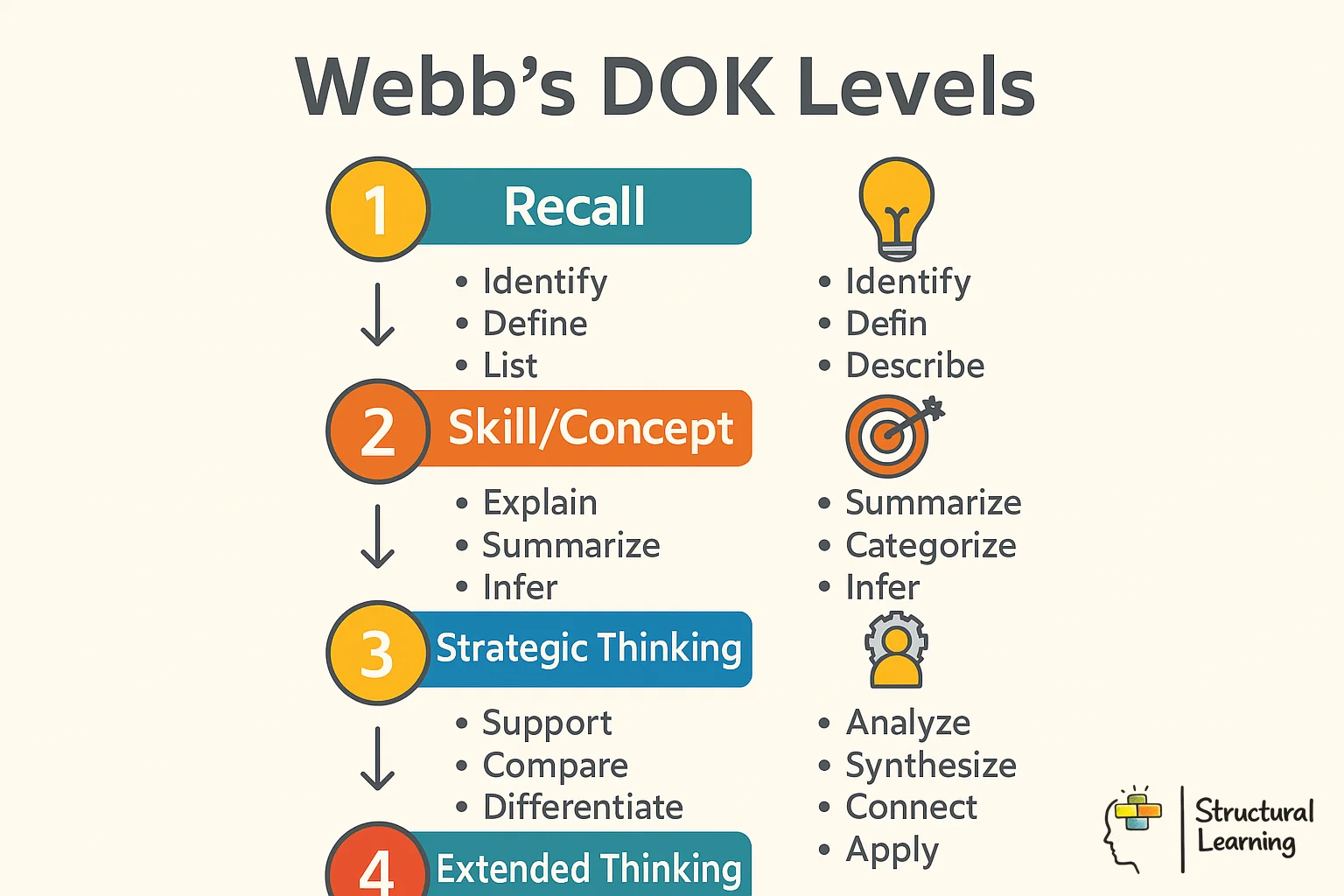
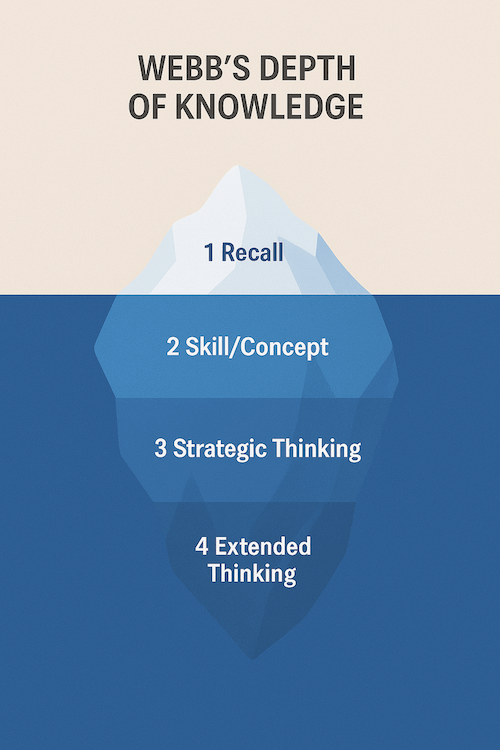
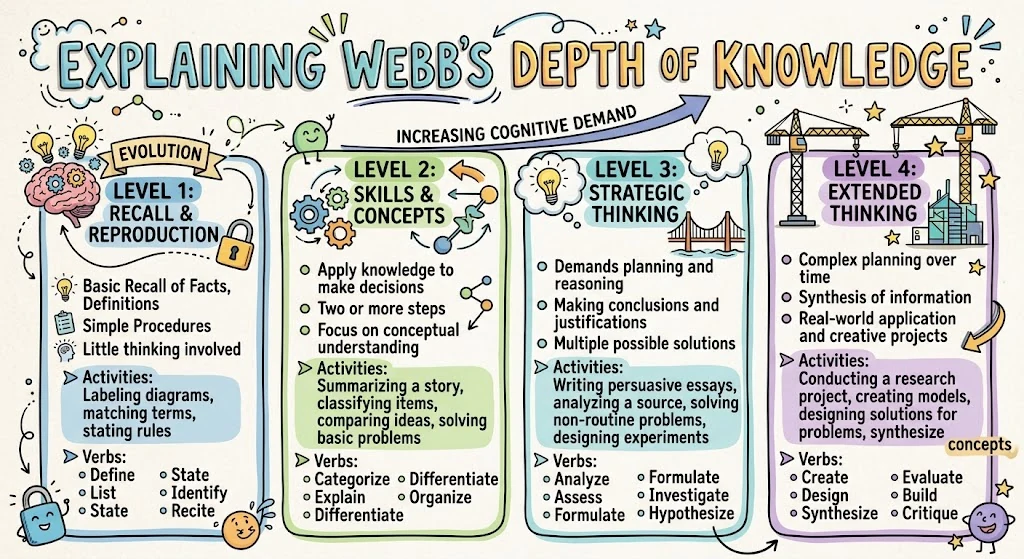
The infographic below shows the four levels as a single strip rather than a staircase, which is the right picture: a lesson moves between them, and the level of a task is set by what learners do with the content, not by where it sits on the strip.
The video below walks through the same four levels with a classroom example at each one. Watch for the moment the question changes while the task stays the same, because that is the move the rest of this guide keeps returning to.
Webb's Depth of Knowledge helps teachers design and review tasks by cognitive demand (Webb, 1997).
The four levels describe increasing cognitive complexity. The first level is recall: learners retrieve information from memory. This may be terms, definitions, historical facts or a one-step procedure.
At the second level, learners must show they understand a concept or skill. They might explain a concept, interpret data to support a claim, or summarise the key ideas from a text.
Level three asks learners to reason with what they know. They might argue from sources, develop a research question, choose and justify a method, or judge which of two explanations fits the evidence better. There is more than one defensible answer.
The fourth level asks for extended thinking: an investigation, design or argument that draws on several sources over several lessons. Learners plan, gather, synthesise and present, and they revise when the first idea fails.
The levels are not a staircase. One US edtech consultant put it this way: Webb's Depth of Knowledge isn't a ladder where Level 1 is easy and Level 4 is hard.
(@alicekeeler). Learners do not need to complete Level 1 and Level 2 before they reason: higher-order retrieval questions improved higher-order performance where fact quizzes alone did not transfer (Agarwal, 2019). A good lesson often moves between levels several times.
Take climate change. At Level 1, learners define it or name the greenhouse gases. At Level 2, they explain a cause or read a graph. At Level 3, they decide which of two policies would cut more emissions and defend the choice with data. At Level 4, they investigate a local question over several lessons and report to someone who can act on it.
Hands-on work sits at every level too: sorting animal cards into mammals and birds is Level 1, building a water-cycle model is Level 2, and designing a prototype to cut canteen waste, then justifying the materials, is Level 3.
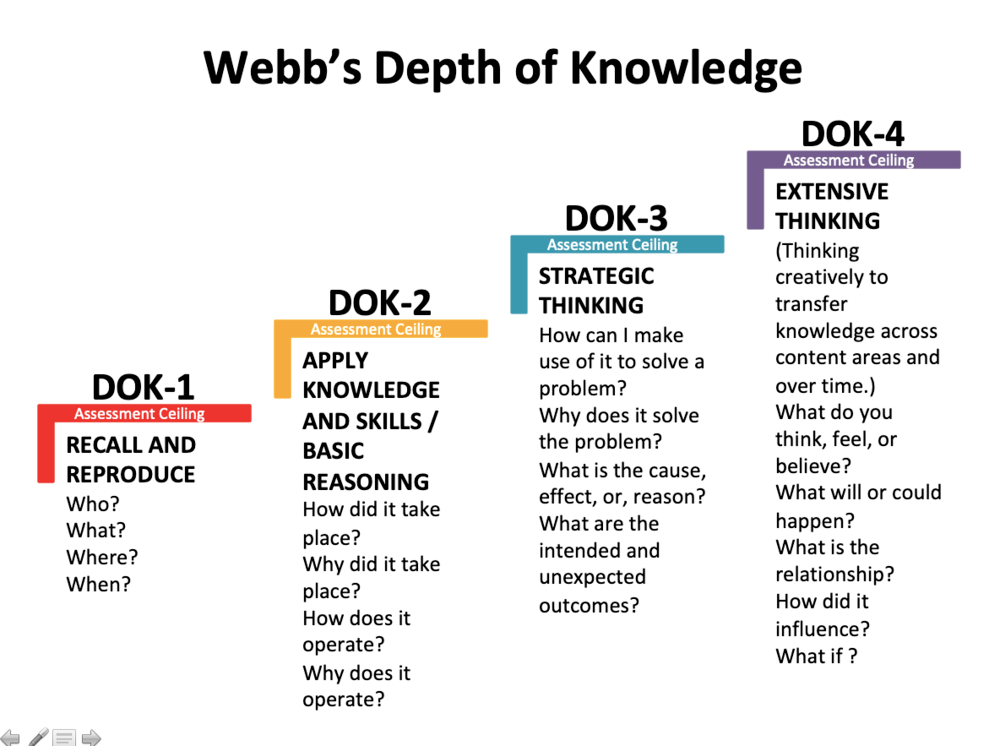
The question stems live in two places on this page, so they are not repeated here: the generator above gives you openers for a subject at each level, and the Depth of Knowledge Toolkit further down prints them as a desk card. Treat every stem as an opener. The level is set by what the learner must do with the content after the stem, not by the stem itself, so the same opener can sit at two levels in two subjects, and the list grows with the subject and the learning objectives. For an organiser that holds the reasoning a Level 3 stem asks for, see our guide to deeper learning.
The Webb learning theory label is misleading. DOK is not a theory of how learners acquire knowledge. It is an alignment method: the question it asks is whether test items reflect the cognitive demand of the intended curriculum.
Teachers can still use DOK for lesson and assessment design, but its strongest use is alignment. It helps staff ask a simple question. Are learners being taught and assessed on recall, routine application, strategic reasoning or extended investigation at the point where the curriculum expects that demand?
Used well, DOK helps teachers design better assessments. Used badly, it becomes a tick-box language of higher-order tasks, even when the underlying work is still recall. That difference matters for curriculum leaders.

From 2010, the Common Core developers used DOK to balance cognitive demand across standards and to reduce the risk that a standard asked only for recall. That is why most of the DOK material online is American. In the UK the framework is rarely named; UK teachers will recognise the underlying question, what a task really requires, in Ofsted's curriculum reviews and in the EEF's guidance on setting an appropriate level of challenge (more on the UK evidence under Limitations).
The DOK wheel is the most shared DOK image online, and it is not Webb's. It files each verb at one level, which is the misreading Webb has warned against: a wheel cannot show whether a learner must use one fact, connect two ideas, justify a strategy or sustain an investigation.
A safer test is to cover the verb and ask what comes after it. Describe the character is Level 1 if learners recall a taught description and Level 3 if they use several quotations to defend a judgement about motive.
One New York PE teacher drew this as a four-column chart, the same throw with four questions, and captioned it Same activity. Different questions. Bigger thinking. Don’t raise the DOK. Raise the thinking.
(@Eileenstrong925).
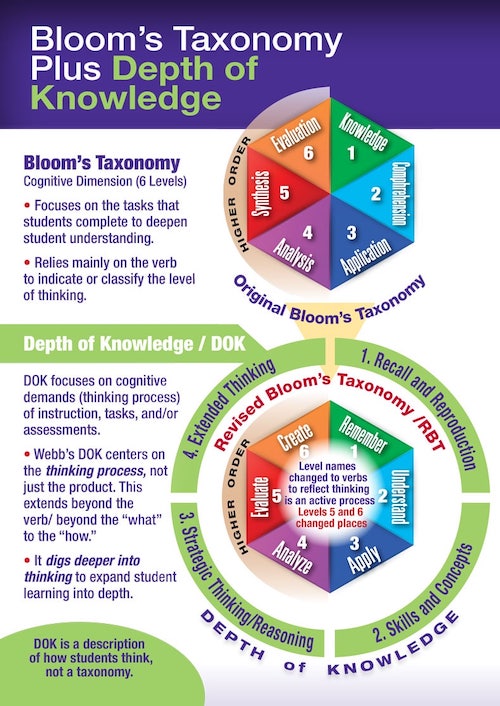
Benjamin Bloom's 1956 taxonomy sorts the type of thinking learners use. Webb's DOK (Webb, 1997) looks at how deeply they must engage with the content. The Cognitive Rigor Matrix crosses the two: learners may analyse at DOK 2 when they compare two familiar texts, and analyse at DOK 4 when they combine several sources to build and defend an original argument (Hess et al., 2009).
Another difference is assessment alignment. Bloom's Taxonomy helps teachers name the type of thinking attached to a content aim. Webb's DOK helps teachers check two things. Do classroom assessments match the cognitive demand of the curriculum standards? And must learners use knowledge in the way the standard expects?
Webb's DOK should be implemented through task analysis and moderation, not by choosing a verb from a wheel. Teachers should compare examples together and agree the evidence needed for each level. Then they should revisit their ratings after looking at learner responses.
The two work together when each does its own job: Bloom's names the cognitive process, DOK checks the depth and context of the task. The trap is reading a high Bloom's verb as a high DOK level. One Louisiana science coach put it plainly: A student can be asked to "create" something and still engage in low-level thinking if the task only requires recalling information.
(@MsWilliamsPhys1). A poster made from a template, with every fact supplied, is creating at Level 1.

Biggs and Collis (1982) created the SOLO taxonomy to sort learner answers by their structure, from prestructural up to extended abstract. DOK measures how complex the task is; SOLO measures the quality of the answer it got. Used together they show whether a gap lies in the task or in the learner.
A DOK Level 3 task may receive a unistructural response from a struggling learner or an extended abstract response from one operating above expectations.
Teachers on social media spend more words correcting DOK than praising it. The same points come up: it is not a rigid staircase, Level 2 is not creative problem solving, the harder question needs more working memory, and a lot of what is sold as DOK is busywork.
Many people treat DOK as a rigid staircase where you have to climb from level 1 to level 4.
DOK 2 isn't creative problem solving. It's procedural application.
The harder Depth of Knowledge question which most of them got wrong requires a significantly greater WM capacity.
TPT has been bad for a long while for having stolen, copyrighted, inaccurate, and now AI slop. Their content often being geared towards low-level DOK busy work.
One teacher asked “why are you making us work, these PD’s don’t matter!”
My students state test scores match their grade. My students are given DOK III and IV challenging assessments.
Difficulty is how many learners get a task right. Depth is the kind of thinking it requires. The two are independent, and treating DOK as a difficulty sticker is the commonest way it goes wrong.
One US edtech founder wrote: A recall task can be hard and still be recall. The planning question is what thinking the student has to do, not how long the worksheet looks.
(@drakmog). Ten definitions instead of five is more work, not more depth.
For school leaders, the risk runs the other way too. A curriculum map can look ambitious when it labels tasks DOK 3 and 4, while the tasks as taught ask for recall. Demand set on paper reliably falls during the lesson, and specific teacher moves keep it up: pressing for an explanation, scaffolding without taking over, and modelling what a good answer looks like (Stein, Grover and Henningsen, 1996). A Year 7 science team might teach particle-model vocabulary first, then have learners justify which model best explains a new observation, and hold that question open when the first answers are thin.
Teachers using Webb's DOK should first check what thinking the curriculum and assessment actually require. DOK works best in planning and moderation meetings, where staff can inspect tasks and learner work together. It should not become a learning-walk checklist used to judge a teacher during a 20-minute visit.
The move that works is not a new task; it is a different question on the task you already have. Keep the decimal number line, the source, the practical. After learners have done it, ask one question that makes them justify, compare or plan.
A Year 5 class placing decimals on a number line is a Level 1 or Level 2 task. Asking each learner to justify why their number goes where it does, with a stem to start them off, moves the thinking to Level 3 without changing the activity. The stems are the openers; the justifying is the depth.
Webb's DOK helps teachers align teaching, activities and assessment. Differentiation should not mean giving some learners a lower DOK level by default. Adjust vocabulary, models, talk frames, worked examples and time instead, so more learners can reach the intended cognitive demand (Webb, 1997).
Every guide lists the levels. What teachers ask for is the same task at each level, side by side, so the difference is visible. The three rows below start from one classroom task and rewrite it four times. Nothing about the topic changes; what changes is what the learner has to do with it.
| Subject and task | DOK 1: recall | DOK 2: skills and concepts | DOK 3: strategic thinking | DOK 4: extended thinking |
|---|---|---|---|---|
| Maths: fractions, decimals and percentages | Write three quarters as a decimal. | Order three quarters, 0.7 and 65% from smallest to largest and show how you converted each one. | Two learners disagree about whether three quarters or 0.7 is larger. Decide who is right and explain why the other answer is a tempting mistake. | Over a week, collect three real prices or measurements given as fractions, decimals or percentages. Build a one-page guide for younger learners on when each form is the most useful, and test it on them. |
| Reading: the class novel | Who tells the story, and where does it open? | Summarise what the narrator learns in chapter three in two sentences. | Using three quotations, argue whether the narrator can be trusted. | Compare how this novel and one other text you have read handle an unreliable narrator. Write an essay that draws on both texts and on one critic's view. |
| Science: dissolving | Name two substances that dissolve in water. | Explain, using the particle model, why sugar dissolves faster in warm water than in cold. | Plan a fair test to find which factor most affects how fast sugar dissolves, and justify your choice of variables. | Investigate over several lessons how a local water company removes dissolved substances. Gather evidence from at least two sources and present a recommendation. |
Read down a column and the pattern shows. Level 1 asks for something taught. Level 2 asks learners to use it in a familiar way. Level 3 gives them a decision with more than one defensible answer and asks them to defend theirs with evidence. Level 4 gives them time, sources and a real audience.
The verbs barely matter: explain appears at Level 2 and Level 3, and the reading row uses no verb from any wheel.
To move a task you already teach up one row, keep it and add the next column's question after it. Do not replace the recall with the reasoning; learners need both in the same lesson, and the recall is where the reasoning gets its material.
Teachers on social media describe DOK as a questioning move on the task they already have, not a ladder of harder worksheets. Their words, unedited, beside what you would notice and what the research says.
| Routine, as teachers describe it | What you would notice | What the evidence says |
|---|---|---|
| Turn the learning target into a question | ||
Rephrase the learning target into a good question that asks, “How could you?” followed by the objective. |
The objective on the board becomes a How could you question, so the first thing learners do is reason with the target rather than copy it. | Higher cognitive questions are associated with higher achievement across twenty experimental studies (Redfield and Rousseau, 1981). |
| Question stems beside the number line | ||
they go one step further to deepen their understanding by justifying why their number goes in that place. Ms Lopez has her DOK question stems to to choose from |
Learners place a decimal, then say why it goes there. The stems are printed and to hand, so the follow-up is never improvised. | Demand is set by what learners are made to do, not by the sheet. High-level tasks drop in demand between set-up and enactment unless the teacher keeps pressing for explanation (Stein, Grover and Henningsen, 1996). |
| A learning sheet levelled up in a team-taught lesson | ||
Our ESOL teacher & 8th ELA teacher were team teaching while annotating vocabulary in the passage. Look at how the learning sheet leveled up DOK! |
Two teachers annotate vocabulary in a passage, then the sheet asks for inference and comparison rather than definitions. | High-cognitive-level tasks in biology lessons were associated with conceptual gains (Förtsch et al., 2018), and the effect sits in the enactment, not the label. |
| Find one that works, then find the best one | ||
The jump from your DOK 2 row to DOK 3 is the jump from "find one that works" to "find the best one". |
The move from Level 2 to Level 3 is a change of demand: from any correct answer to a justified choice between answers. | Trained raters often disagree about where Level 2 ends and Level 3 begins (Wyse and Viger, 2011), so a plain rule like this one is worth more than the label. |
| One problem replaces a worksheet | ||
Algebra 2 teachers! I've made @openmiddle Depth of Knowledge matrices to show how a single problem can replace an entire worksheet in Algebra 2. |
A single open problem carries all four levels: compute, find one solution, find the best solution, generalise. | Frequency of high-demand tasks did not predict cognitive outcomes over 16 months in 30 classes; what changed was interest and participation (Ni et al., 2018). One well-run problem beats a stack. |
Depth of Knowledge is subject specific. In maths, DOK 3 may involve selecting a strategy, representing a problem and justifying each step. In English, DOK 3 may involve weighing quotations, authorial intent and context to defend an interpretation. The same verb carries different demand because each subject has a different knowledge structure (Webb, 1997; Hess et al., 2009). Webb's own descriptors for reading, writing, mathematics, science and social studies sit in an unpublished 2002 paper, and the examples below draw on them.
In English, teachers can use DOK to build reading and writing activities at all four levels. At Level 1, learners recall specific details from a text, such as the main characters or the setting. At Level 2, they apply their knowledge of literary devices to the text, for example by identifying symbols or interpreting metaphors.
Level 3 tasks ask learners to compare viewpoints or infer why a character acts as they do, and to defend the reading with quotations. Level 4 tasks are longer pieces of writing that draw on more than one text and take a position a reader could argue with.
In maths lessons, teachers can use DOK to challenge learners to apply their understanding of concepts to real problems. At Level 1, learners recall number facts and basic formulae. As tasks grow more complex, they apply those facts and formulae to problems such as finding the area and volume of three-dimensional shapes.
Learners at Level 3 analyse data to predict a trend and justify the model they chose. Learners at Level 4 apply maths to a real situation over several lessons, for example designing and costing a footbridge.
In science classes, teachers can use DOK to challenge learners to apply their knowledge to real-world phenomena. At Level 1, learners could be asked to recall facts about the laws of physics or ecological systems.
Vygotsky (1978) argued that learners can manage harder thinking when a teacher or a peer supports them through talk. At Level 3, learners explain how a change in the environment affects a species, using data they have to select. They can also use evidence from one experiment to predict the result of a related one.
At Level 4, learners design and carry out investigations into real questions, such as a new energy source for the school or the local effects of climate change, and report what they found.
When planning assessments, teachers should map the intended DOK level before they write questions. A balanced end-of-unit assessment may include recall and routine application. It should also show where learners must justify a strategy, use evidence or sustain an investigation (Webb, 1997).
Maths exams often test several levels. Level 1 checks a formula, Level 2 applies it to a routine problem, Level 3 asks learners to read data closely and choose a method, Level 4 sets a real problem over time. Expect a shock the first time you add a Level 3 item.
One US maths educator described it: The first time I put a higher Depth of Knowledge problem on an assessment, I thought it would be no big deal. I was very wrong. Most of the class got it wrong
(@robertkaplinsky). That result is information about the teaching, not a reason to remove the item.
Formative and summative uses of DOK need different maps. Formative checks ask what evidence the teacher needs today to adjust the next explanation, task or scaffold. Summative maps ask whether the final assessment matches the cognitive demand of the curriculum standard. Black and Wiliam (1998) showed why assessment evidence should change teaching, not merely record performance.
AI tools can draft DOK-style question stems. Teachers still need to set the target level and check that the task really asks for analysis, justification or extended thinking. Do not let a tool be the judge of level either: in one 2026 study, eleven AI tools classified the cognitive demand of maths tasks correctly in 63% of cases on average and drifted toward the middle levels (Fox et al., 2026). The stronger assessment question is whether learners can explain their reasoning, critique the AI output, connect it to class evidence and defend their choices in an oral or written follow-up.
Most formative assessment techniques default to DOK Level 1, checking recall through quick quizzes or thumbs up and down. Retrieval practice is worth that time (Agarwal, 2019), but match the check to the demand of the lesson. For DOK 1, a brief retrieval quiz works well. For DOK 2, ask learners to explain the relationship between two concepts using a graphic organiser.
DOK 3 could see learners critique worked examples and pinpoint the flawed step. DOK 4 uses peer review of projects against agreed criteria. Dylan Wiliam's 2011 book Embedded Formative Assessment makes the same point: match the check to the cognitive demand, rather than only asking whether learners understood.
Webb's DOK can be an equity check, not a reason to lower challenge. All learners should meet Level 3 and Level 4 thinking with the right scaffolds, including those receiving intervention, SEND support or EAL support. Teachers can adjust vocabulary, worked examples, talk prompts, visual supports and time while keeping the cognitive demand ambitious (Webb, 1997).
In practice, DOK is not neutral across culture, language or neurology. A learner may fail a DOK 3 task because of the language load, the executive-function demand or an unfamiliar context. That does not always mean they cannot reason strategically. When teaching special education learners, separate the thinking demand from the barriers you can remove.
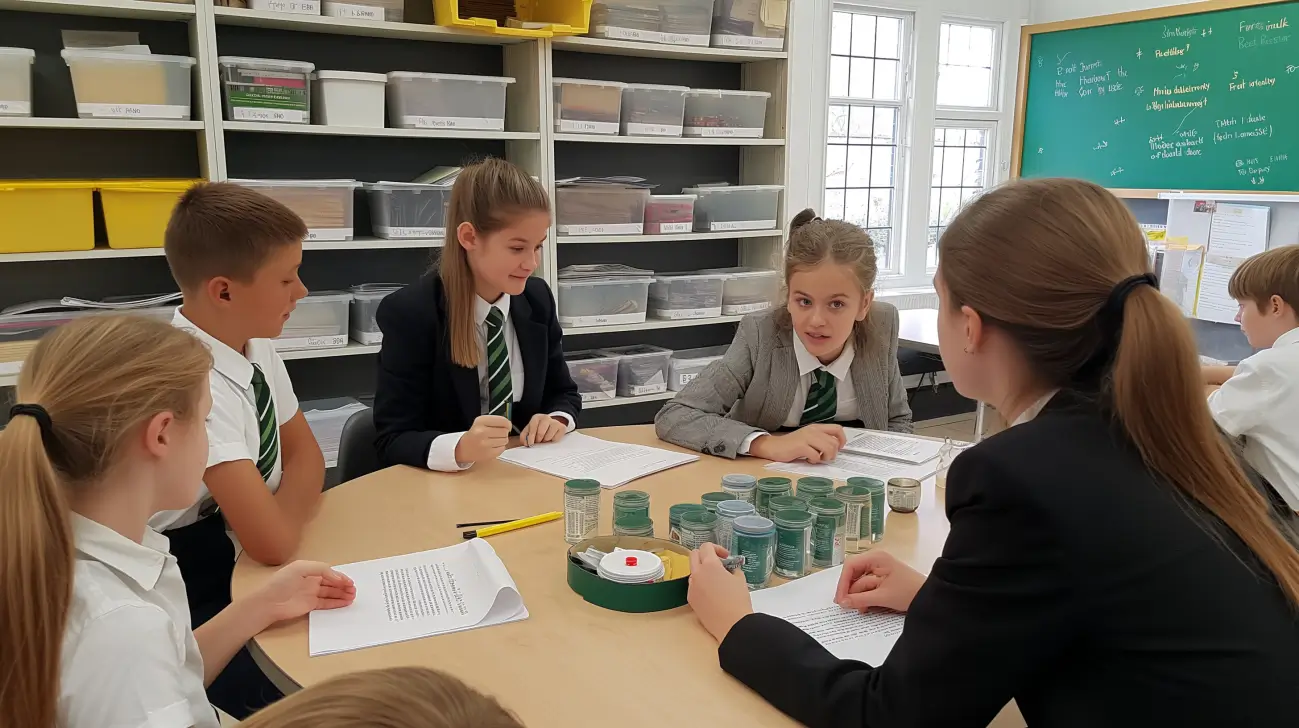
Activities that look complex may still require only recall, while a short question can require strategic reasoning. Use department moderation to compare task evidence and agree the DOK level. Note where prior knowledge or language demand may change what learners actually experience.
The Depth of Knowledge Toolkit below gives you the four level descriptors, question stems for each level, a desk card and a checklist for auditing a scheme of work, as printable pages for your classroom and staff room.
Teacher-training courses often set this as a quiz, and the quiz items turn up in search. Here are eight tasks of the kind they use. Decide the level of each before you read the key, and remember that DOK is about what the task requires of the learner, not the verb it opens with (Webb, 1997; Hess et al., 2009).
Answer key
If your answers differed from the key on tasks four, six or seven, you are in good company: trained item writers disagree with committees on exactly these borderline tasks (Wyse and Viger, 2011). The classifier below walks through the same decision as a short tree. Paste in any of the eight, or one of your own, and compare its verdict with yours. Treat it as a second opinion, never as the judge.
Evaluate the depth of knowledge in your assessment questions
DOK stands for Depth of Knowledge. It is Norman Webb's four-level scale for how much thinking a task or test item demands, built in 1997 to check whether state assessments matched their standards (Webb, 1997). Teachers now use the same four levels to plan questions and check that classroom tasks ask for the reasoning the curriculum expects.
There are four. Level 1 is recall and reproduction: a fact, a definition, a one-step procedure. Level 2 is skills and concepts: apply, classify, summarise, explain a relationship. Level 3 is strategic thinking: reason with evidence, justify a choice, plan an investigation. Level 4 is extended thinking: an investigation or project that draws on several sources over several lessons.
A Level 3 question makes the learner reason and justify, usually with evidence they have to choose. In history: Two accounts of the 1926 General Strike disagree about who ended it. Decide which is more reliable and say why. In geography: Choose the best site on the map for a new flood defence and defend it against one alternative. In PE: Watch the two rallies and justify one change to the losing player's positioning.
The tell is that there is more than one defensible route and the learner has to defend theirs.
Bloom's names the type of thinking (remember, understand, apply, analyse, evaluate, create). DOK names how deeply the learner must engage with the content to complete the task. They are two axes, not two versions of one ladder, which is why Hess et al. (2009) crossed them into the Cognitive Rigor Matrix. A task can ask learners to create something and still sit at DOK 1 if all it needs is recall.
No. The wheel of verbs is a planning aid that Webb did not make and has warned against. It files each verb at one level, but the same verb sits at different levels depending on what the learner must do with the content. Use the wheel to find question openers if you like, then judge the level from the task, not the verb.
No. Difficulty is how many learners get it right; depth is the kind of thinking required. Recalling the capital of Kazakhstan is hard and still Level 1. Explaining why two familiar fractions are equal is easy for many and still Level 2. Plan the depth you want first, then adjust difficulty with vocabulary, scaffolds and time.
Cover the verb and ask what the learner has to do with the content: repeat it (1), use it in a familiar way (2), reason and justify with it (3), or sustain an investigation with it across lessons (4). Try the eight tasks in the section above, then paste your own into the classifier on this page and compare its verdict with your own.
Webb's DOK is useful, but it is not a universal measure of lesson quality. Schools should use it to improve task design, curriculum mapping and assessment moderation (Webb, 1997).
Teachers will not always agree on a task's DOK level, most often at the line between Level 2 and Level 3. Trained item writers understand the features of DOK and still sort tasks differently from committees across grades and subjects (Wyse and Viger, 2011), and Webb's own 2007 account of alignment reviews says the judgements have an element of subjectivity. Teachers therefore need calibration using real learner work, and discussion between rounds is what raises agreement.
Risk of checkbox compliance. When schools mandate DOK alignment, teachers sometimes relabel existing tasks rather than redesigning them. A worksheet that asks learners to "analyse" may still require nothing more than recall if the information is provided on the same page. The label does not guarantee the cognitive demand (Hess et al., 2009).
DOK also says little about motivation, classroom relationships, cultural knowledge or the social conditions that support extended thinking. A Level 4 inquiry can still fail if learners do not feel they belong. It can also fail if they lack language access or secure foundational knowledge. Combine DOK with formative assessment, explicit teaching and scaffolded discussion (Black and Wiliam, 1998).
Thin evidence of effect. Learning rarely follows a neat progression from Level 1 to Level 4, and DOK describes a task rather than causing learning. In the longest test of the underlying idea, a 16-month study of 30 classes, Ni and colleagues (2018) found that the frequency of high-demand tasks did not predict any of three cognitive outcomes, though it did predict interest and participation. Treat DOK as a lens for alignment and cognitive demand, not as a rule that every lesson must finish at Level 4.
An American language. Every DOK study above is a US large-scale assessment study, and UK teachers on social media in 2026 do not discuss DOK levels at all, only a Northern Ireland languages-policy slogan that borrows the phrase. The UK's tested cousin is questioning for depth through dialogic teaching, which added two months' progress for 4,985 Key Stage 2 learners across 76 schools in an EEF trial (Alexander, 2018). Use DOK's vocabulary if a scheme of work already speaks it; the evidence for depth lives in the questioning.
Three planning tables for uses beyond the single lesson. Each is the same lens, what the task requires, applied to a project, an online sequence and a staff training session.
Take a challenge to design a sustainable school garden. A DOK 1 task lists plants suited to the local climate. A DOK 2 task compares different irrigation systems. A DOK 3 task asks learners to justify their garden layout and plant choices on water conservation grounds. A DOK 4 task has them build a prototype section, monitor it and evaluate its sustainability over several weeks.
| DOK Level | CBL Task Description | Learner Action Example |
|---|---|---|
| DOK 1: Recall & Reproduction | Identify basic facts or definitions related to the challenge. | Learners list common causes of local air pollution. |
| DOK 2: Skills & Concepts | Apply information, compare, or classify within the challenge context. | Learners compare the effectiveness of different public transport options for reducing emissions. |
| DOK 3: Strategic Thinking | Formulate a plan, justify a solution, or analyse complex aspects of the challenge. | Learners propose a strategy to encourage cycling in their community, justifying their choices with evidence. |
| DOK 4: Extended Thinking | Design and execute an investigation, synthesise multiple sources, or create an original solution over time. | Learners design and conduct a survey on local transport habits, analyse the data, and present a comprehensive policy recommendation to the school council. |
Online lessons drift toward recall unless the sequence plans for more. The table gives one strategy and one learner activity at each level.
| DOK Level | Online Lecture Strategy | Learner Activity Example |
|---|---|---|
| Level 1: Recall | Micro-lectures with embedded comprehension checks. | Learners answer multiple-choice questions recalling key terms from a short video. |
| Level 2: Skills/Concepts | Interactive simulations or guided problem-solving demonstrations. | Learners apply a mathematical formula to new data sets in an online spreadsheet. |
| Level 3: Strategic Thinking | Case study analysis in virtual breakout rooms or structured debates. | Learners collaboratively analyse a historical document, identifying biases and forming arguments. |
| Level 4: Extended Thinking | Long-term research projects or complex problem-based learning scenarios. | Learners design and present a solution to a real problem, drawing on several sources over several weeks. |
When you plan professional development, DOK levels can help you set the right level of challenge. A DOK 1 task may ask teachers to recall key safeguarding policies. A DOK 2 task could ask them to use these policies in a practice scenario. At DOK 3, teachers may review how well different assessment strategies work in their subject. They would then support their choices with clear evidence.
| DOK Level | Teacher Professional Development Task Example |
|---|---|
| DOK 1 | Recall the main components of the school's behaviour policy. |
| DOK 2 | Explain how to differentiate a lesson for learners with specific learning needs. |
| DOK 3 | Analyse learner data to identify patterns in misconceptions and propose targeted interventions. |
| DOK 4 | Design, implement, and evaluate a new whole-school literacy initiative over a term. |
Try one move this week. Take a task you already teach, keep it exactly as it is, and write one extra question that asks learners to justify, compare or plan. Ask it after the task, not instead of it, and do not soften it when the first answers are thin. Then bring the task and three learner answers to your next department meeting and ask colleagues which level they would give it. That conversation is where DOK earns its keep.
Download the DOK Toolkit above if you want the four levels as a one-page reference for your planning folder. It carries the level descriptors, the question stems and the eight-task classification key from this guide in a printable form.
Webb, N. L. (1997). Criteria for alignment of expectations and assessments in mathematics and science education. Research Monograph No. 6. Council of Chief State School Officers and National Institute for Science Education.
Webb, N. L. (2002). Depth-of-Knowledge levels for four content areas. Unpublished paper, Wisconsin Center for Education Research, University of Wisconsin-Madison.
Webb, N. L. (2007). Issues related to judging the alignment of curriculum standards and assessments. Applied Measurement in Education, 20(1), 7 to 25.
Alexander, R. (2018). Developing dialogic teaching: genesis, process, trial. Research Papers in Education, 33(5).
Education Endowment Foundation (2017). Dialogic Teaching: trial. Evaluator: Sheffield Hallam University.
Agarwal, P. K. (2019). Retrieval practice and Bloom's taxonomy: Do students need fact knowledge before higher order learning? Journal of Educational Psychology, 111(2).
Biggs, J. B. and Collis, K. F. (1982). Evaluating the Quality of Learning: The SOLO Taxonomy. Academic Press.
Black, P. and Wiliam, D. (1998). Assessment and classroom learning. Assessment in Education: Principles, Policy and Practice, 5(1), 7 to 74.
Bloom, B. S. (ed.) (1956). Taxonomy of Educational Objectives: The Classification of Educational Goals. Handbook I: Cognitive Domain. Longmans, Green.
Fox, D. et al. (2026). Baseline performance of AI tools in classifying cognitive demand of mathematical tasks. arXiv preprint, not peer reviewed.
Hess, K. K., Jones, B. S., Carlock, D. and Walkup, J. R. (2009). Cognitive Rigor: Blending the strengths of Bloom's Taxonomy and Webb's Depth of Knowledge to enhance classroom-level processes. ERIC ED517804.
Ni, Y., Zhou, D.-H. R., Cai, J., Li, X., Li, Q. and Sun, I. X. (2018). Improving cognitive and affective learning outcomes of students through mathematics instructional tasks of high cognitive demand. The Journal of Educational Research, 111(6).
Stein, M. K., Grover, B. W. and Henningsen, M. (1996). Building student capacity for mathematical thinking and reasoning: An analysis of mathematical tasks used in reform classrooms. American Educational Research Journal, 33(2).
Vygotsky, L. S. (1978). Mind in Society: The Development of Higher Psychological Processes. Harvard University Press.
Wiliam, D. (2011). Embedded Formative Assessment. Solution Tree Press.
Wyse, A. E. and Viger, S. G. (2011). How item writers understand Depth of Knowledge. Educational Assessment, 16(4).