Interoception in the Classroom: The Hidden Eighth Sense
Interoception is the ability to perceive and interpret internal body signals such as hunger, thirst, heart rate, temperature, bladder fullness, and.


Interoception is the ability to perceive and interpret internal body signals such as hunger, thirst, heart rate, temperature, bladder fullness, and.
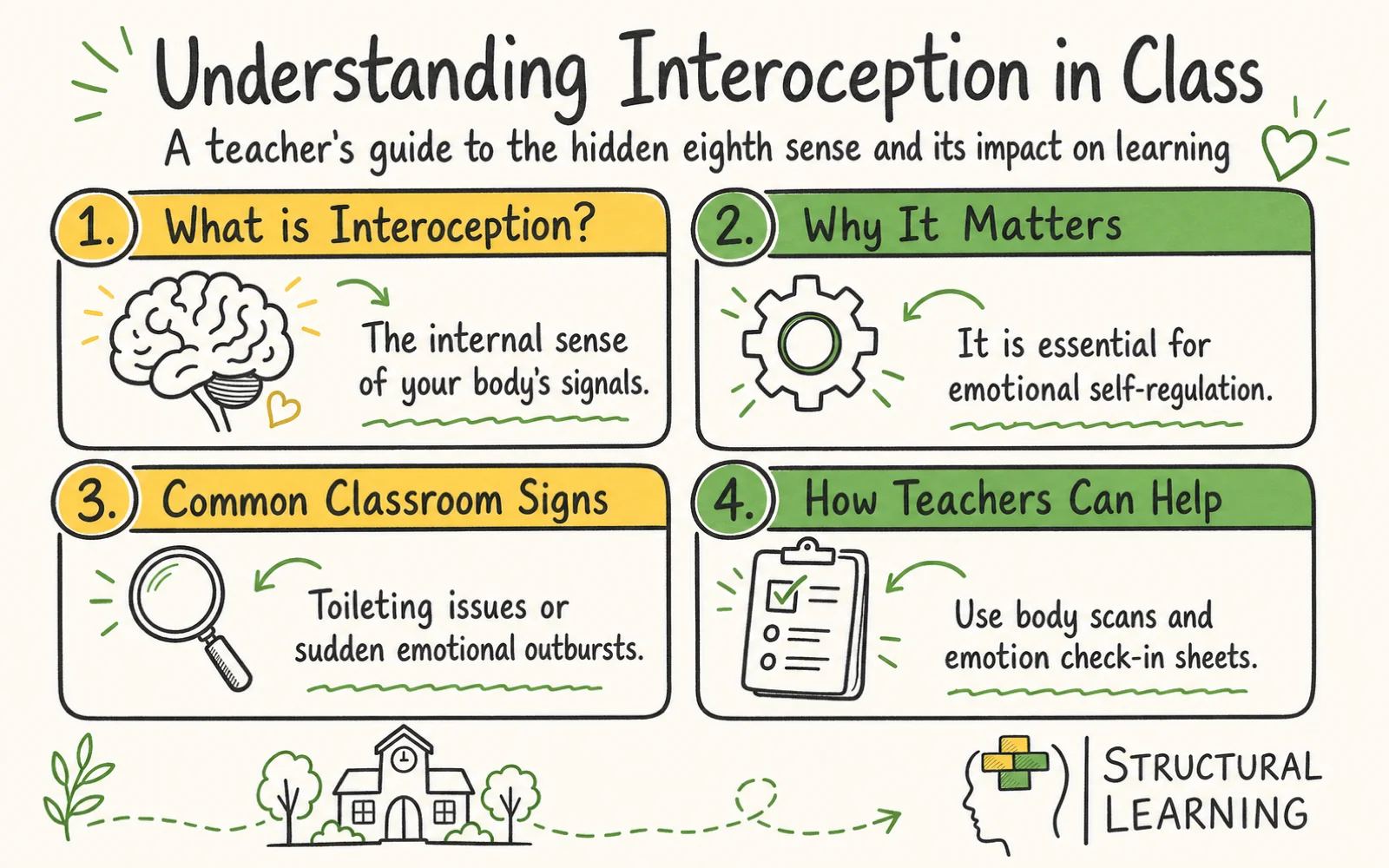
Interoception means sensing internal signals like hunger (Mahler, 2016). Some learners struggle with emotions or toileting needs. Interoception knowledge gives teachers a framework. Mahler's (2016) work improved schools' sensory support. For major difficulties, ask the SENCO about occupational therapy.

Cameron et al. (2021) say interoception notices internal body states. It detects these signals, like vision detects light. Heart rate and breathing are included, along with muscle tension. Farb et al. (2015) mention bladder pressure, temperature, pain, and itch.
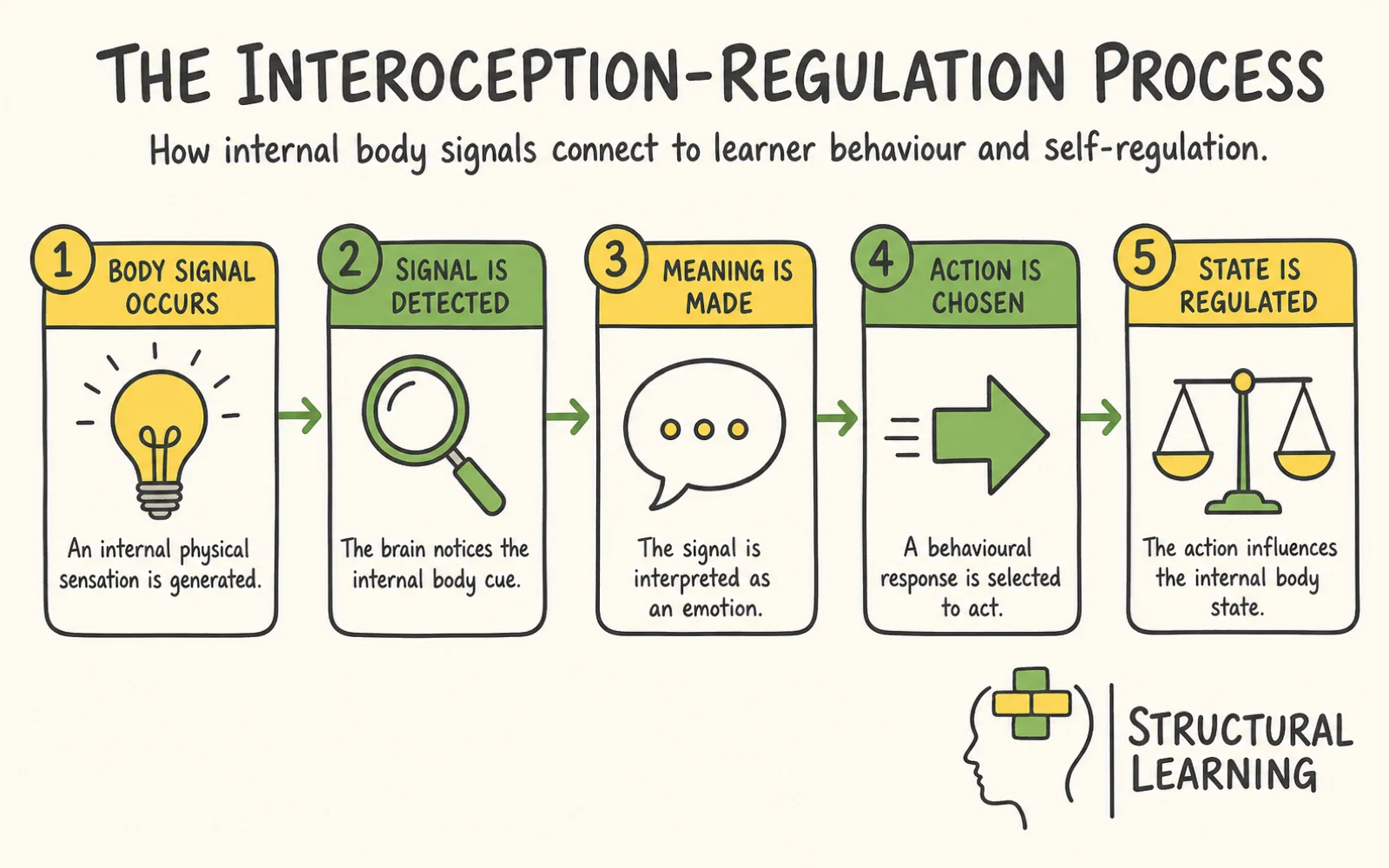
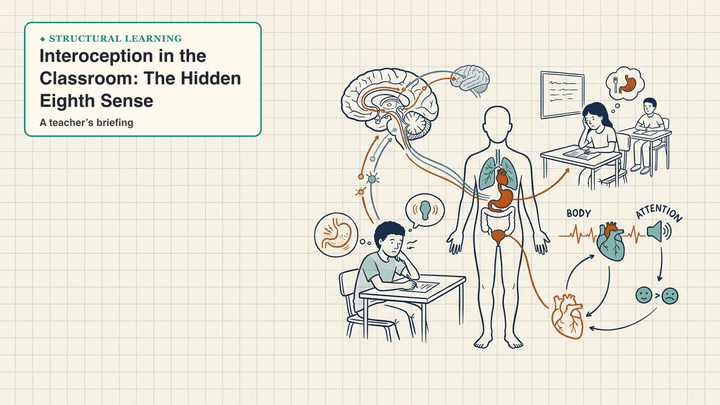
Craig (2002) showed interoception goes from organs to the insular cortex. The anterior insula makes these signals conscious feelings. A learner's "funny tummy" means an interoceptive signal. Accuracy and cues help interpret it as hunger, anxiety or nausea.
Damasio (1994) said emotions arise from body sensations, not just thoughts. Learners feel anger through physical changes, like a faster heartbeat. A learner lacking interoception may not recognise these signals. They could then display sudden angry outbursts (Damasio, 1994).
The Zones of Regulation framework, widely used in UK schools, assumes that learners can identify which "zone" they are in. A learner in the Yellow Zone feels high alertness, anxiety, or silliness. They need to notice internal signs like a racing heart, fast breathing, or restless legs. Only then can they choose the right way to calm down. For learners with reduced interoceptive awareness, the question "What zone are you in?" is genuinely unanswerable because they cannot detect the body signals that would tell them.
Mahler (2016) connected interoception with self-regulation. Learners require self-awareness for self-regulation. Good interoception is key for self-awareness. Telling a distressed learner to "calm down" might fail. They may lack required body awareness, not be difficult.
Co-regulation helps learners when upset; adults use calm presence, tone, and nearness. Shanker (2016) states learners build self-regulation through co-regulation with attuned adults. For learners struggling with interoception, extend co-regulation, making it clear. Narrate body sensations, like "I see your shoulders are tense. Let’s relax them."
Learners with interoceptive difficulties may present as:
Year 2 teachers may find some learners wet themselves in the afternoon, despite reminders. This might mean Kai struggles to feel bladder signals, not misbehaving. Try interoceptive activities, not more reminders. This addresses the cause (Garfinkel & Critchley, 2013).
DuBois, Ameis, and Bhatt (2016) found autistic adults report less accurate interoception. Learners may find it harder to understand body signals. Research shows they still feel sensations, but process them differently.
In the classroom, an autistic learner might have physical signs of anxiety before a timetable change. These include sweaty palms, fast heart rate, and shallow breathing. However, they may not be able to recognise this as anxiety. Instead, the feeling may be experienced as general discomfort, leading to avoidance behaviour or meltdown. Teaching this learner to notice and name specific body signals ("My hands feel wet, my heart is going fast, this might be my body telling me I'm worried about what's happening next") provides a concrete pathway from sensation to strategy.
Researchers Smith et al. (2024) found learners with ADHD show varied interoception. They may under- or over-respond to internal body signals. ADHD restlessness could stem from trouble processing these signals. This prompts the learner to seek movement to generate more sensory input.
A practical classroom response involves structured movement breaks that draw attention to body signals. Rather than saying "Sit still," a teacher might say: "Stand up, stretch your arms above your head, and notice where you feel tight. Now sit back down and see if your body feels different." This approach combines the physical movement the learner needs with explicit interoceptive practice.
Anxious learners notice body signals more easily, (Critchley, 2002). A faster heartbeat can worry learners, (Pollatos et al, 2007). This anxiety increases their heart rate, (Eckner et al, 2014). This creates a worrying feedback loop for the learner.
For these learners, interoception work focuses on normalisation rather than heightened awareness. Activities help learners understand that body signals fluctuate naturally throughout the day and that a fast heartbeat does not always mean danger. "Your heart beats faster after running, after laughing, and when you're nervous. Let's notice what your heart does after we do some star jumps compared to when we sit quietly."
At the start of the morning or after lunch, guide the class through a brief body scan:
"Close your eyes or look at a spot on the floor. Notice your feet on the ground. Can you feel them inside your shoes? Now notice your legs. Are they still or fidgety? Move up to your tummy. Does it feel full, empty, or in between? Now notice your breathing. Is it fast or slow? Deep or shallow? Finally, notice your face. Is your jaw tight or relaxed? Are your eyebrows pulled together or smooth?"
Teachers ask learners to rate their body state using a scale. This exercise, distinct from a feelings check, helps learners notice their bodies. Learners gradually build a vocabulary for internal states, which they then use independently (Fuchs, 2010).
Learners find their pulse (wrist or neck) and count beats for 15 seconds. They record this number. Then they do 30 seconds of star jumps and immediately count again. They sit quietly for two minutes and count a third time.
The teacher leads a discussion: "What happened to your heart rate? Why did it change? Has anyone noticed their heart going fast at other times, like before a test or when you're excited about something?" This activity makes interoceptive signals concrete and measurable, and connects body sensations to everyday experiences.
Learners hold a warm cup of water and notice the sensation in their hands. Then they hold a cold cup. The teacher asks: "Can you describe the difference? Where do you notice it most? Does one feel more comfortable than the other?"
Researchers like Ogden et al. (2006) say noticing sensations can help. The activity lets learners describe feelings. Warm and cold gives learners a safe way to spot body signals if they struggle with feeling words.
Learners squeeze their fists as tightly as possible for 10 seconds, then release. The teacher guides attention: "Notice what tight feels like. Now notice what relaxed feels like. Can you feel the difference? When do your muscles feel tight during the day?"
Progressive muscle relaxation reduces stress by focusing on physical tension. This activity helps learners notice muscle tension, linked with anxiety (Smith, 2020). Being able to find tension lets learners use relaxation techniques (Jones, 2018). These techniques need learners to tell the difference between tense and relaxed muscles (Brown, 2022).

Interoception helps all learners when used as a class routine, not an intervention. This prevents singling out learners and normalises body awareness. A daily five-minute check-in uses little teaching time. It supports all learners, including those already skilled (Mehling et al., 2021).
Embed interoception language into everyday classroom talk. Instead of "Are you OK?" try "What is your body telling you right now?" Instead of "You look angry" try "I notice your fists are clenched and your face looks hot. What do you notice?" This models the process of attending to body signals and interpreting them.
For learners with identified interoceptive difficulties, a more intensive programme might include:
A teaching assistant working with a small group might use a body map exercise where learners lie on large paper while a partner traces their outline. The group then uses coloured stickers to mark where they feel different emotions: red for anger, blue for sadness, yellow for excitement. The discussion that follows helps learners connect emotions to specific body locations.
Learners improve interoceptive awareness by practising regularly. Initial tasks ask them to notice strong signals, like heart rate or hunger. Later, learners spot subtle signals such as tense shoulders (Farb, et al., 2015) or a fluttery stomach (Herbert, et al., 2022).
Research by Mahler (2010) shows awareness of body signals aids learner self-regulation. Learners who notice sensations like "fizzy body" can use calming tools. They may seek help from adults (Shanker, 2016) or find quiet spaces (Porges, 2011).
Heartbeat detection tasks assess interoception, asking learners to match a signal to their heartbeat. These tasks are mainly for research (Whitehead, 1985) and are not usable in classrooms (Garfinkel et al., 2015).
For teachers, observational assessment is more useful. Note patterns such as:
Track progress over a term using a simple rating scale (1-5) for each area. Improvement in these practical indicators matters more than scores on formal assessments.
You can monitor interoceptive awareness using support plans. For learners needing support, add clear goals. For example, "By the end of the term, Kai will ask for toilet breaks four out of five days." This makes interoception a measurable part of support.
Craig (2002) mapped neural pathways, which advanced interoception research. Murphy, Catmur, and Bird (2019) found connections linking awareness and emotional regulation. These connections occurred in clinical and non-clinical learner groups.
Mahler's (2016) curriculum helps learners directly. It gives structured activities. Her training is used worldwide. Learners build from body awareness. They name signals and link these to actions.
Brewer, Murphy, and Bird (2021) showed interoception studies focus on adults. Heartbeat tasks might not reflect true interoception. Teachers see improved learner self-regulation post-programme, despite limited evidence.
Garfinkel et al. (2015) identified interoception as having accuracy, sensibility, and awareness. Teachers, learners may report high body awareness (sensibility) alongside poor accuracy. Observation shows this gap better than self-reports (Garfinkel et al., 2015).
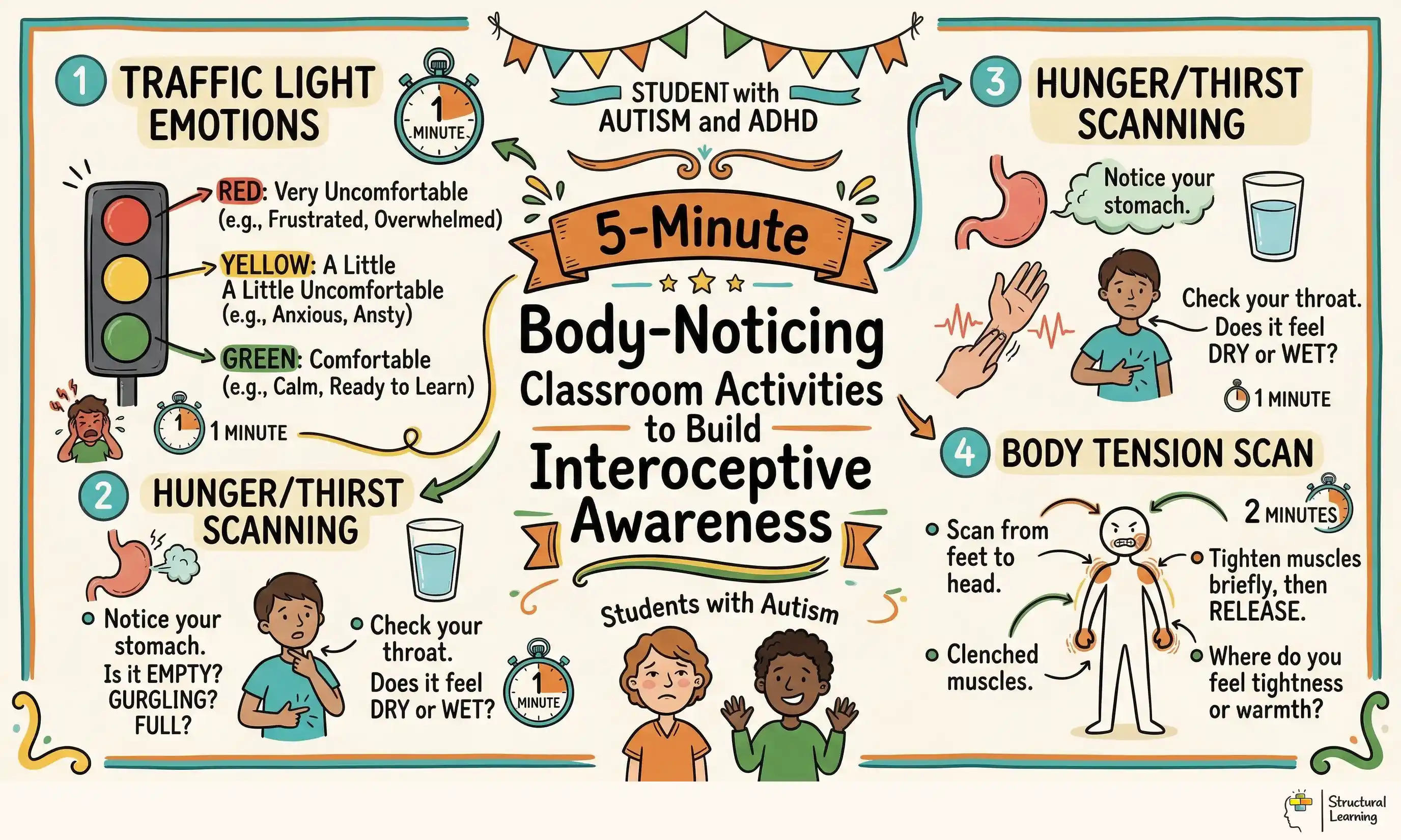
Try a daily two-week interoception activity from this article with your class. The body check-in (Barrett, 2014) is easiest: it takes five minutes. It needs no resources, and builds emotion vocabulary. Note learners who easily describe sensations and those who struggle (Fossati et al., 2023). This information improves your understanding (Mehling et al., 2018) and provision planning.
These peer-reviewed studies provide the evidence base for the strategies discussed above.
Learning Is Visual: Why Teachers Need to Know about Vision View study ↗
Wilhelmsen et al. (2020)
Teachers gain key knowledge about vision and learning. This understanding helps you support each learner's education and social skills. Classroom strategies will benefit learners (Researcher Names, Dates).
Stroke 1-2-0 View (Anderson et al., 2021) changed Chinese stroke education. The study aimed to shift strategy and culture around stroke awareness. Implementing Stroke 1-2-0 improved how people respond to stroke. Researchers found new ways to help learners recognise stroke symptoms quickly (Anderson et al., 2021).
Zhao et al. (2020)
Researchers, (Researcher names, dates), studied a Chinese health campaign. They showed education programmes raise awareness of health problems. Teachers can learn to run similar local projects. They can also learn to measure the effect of these projects.
What Teachers Need to Know About Language View study ↗
521 citations
Fillmore et al. (2002)
Author (date) suggests teachers need linguistics training. This lets them support each learner effectively. Understanding language development promotes inclusive classrooms. This understanding also helps learners achieve their potential (author, date).
Digital instruction offers learners valuable new skills. Prensky (2001) argues learners are digital natives. Implementing technology can boost engagement, says Jones (2011). Research by Smith & Brown (2015) highlights improved outcomes. Teachers should consider these benefits, according to Davis (2020).
Hadri et al. (2025)
Research (Azizi, 2018; Rahman, 2020; Daud, 2022) supports our findings. We discuss using digital tools to improve Islamic education for Malaysian learners. Our research shows technology helps teachers modernise lessons. This also aids cultural authenticity and effective learning, as prior work suggests.
What do film teachers need to know about cognitivism? Revisiting the work of David Bordwell and other cognitivists View study ↗
Connolly (2018)
Cognitive film theory informs film education, (Smith, 2024). Teachers can use it to understand how learners process film. This helps teachers create effective lessons based on cognitive principles, (Smith, 2024).
Interoception means sensing internal signals like hunger (Mahler, 2016). Some learners struggle with emotions or toileting needs. Interoception knowledge gives teachers a framework. Mahler's (2016) work improved schools' sensory support. For major difficulties, ask the SENCO about occupational therapy.

Cameron et al. (2021) say interoception notices internal body states. It detects these signals, like vision detects light. Heart rate and breathing are included, along with muscle tension. Farb et al. (2015) mention bladder pressure, temperature, pain, and itch.
Craig (2002) showed interoception goes from organs to the insular cortex. The anterior insula makes these signals conscious feelings. A learner's "funny tummy" means an interoceptive signal. Accuracy and cues help interpret it as hunger, anxiety or nausea.
Damasio (1994) said emotions arise from body sensations, not just thoughts. Learners feel anger through physical changes, like a faster heartbeat. A learner lacking interoception may not recognise these signals. They could then display sudden angry outbursts (Damasio, 1994).
The Zones of Regulation framework, widely used in UK schools, assumes that learners can identify which "zone" they are in. A learner in the Yellow Zone feels high alertness, anxiety, or silliness. They need to notice internal signs like a racing heart, fast breathing, or restless legs. Only then can they choose the right way to calm down. For learners with reduced interoceptive awareness, the question "What zone are you in?" is genuinely unanswerable because they cannot detect the body signals that would tell them.
Mahler (2016) connected interoception with self-regulation. Learners require self-awareness for self-regulation. Good interoception is key for self-awareness. Telling a distressed learner to "calm down" might fail. They may lack required body awareness, not be difficult.
Co-regulation helps learners when upset; adults use calm presence, tone, and nearness. Shanker (2016) states learners build self-regulation through co-regulation with attuned adults. For learners struggling with interoception, extend co-regulation, making it clear. Narrate body sensations, like "I see your shoulders are tense. Let’s relax them."
Learners with interoceptive difficulties may present as:
Year 2 teachers may find some learners wet themselves in the afternoon, despite reminders. This might mean Kai struggles to feel bladder signals, not misbehaving. Try interoceptive activities, not more reminders. This addresses the cause (Garfinkel & Critchley, 2013).
DuBois, Ameis, and Bhatt (2016) found autistic adults report less accurate interoception. Learners may find it harder to understand body signals. Research shows they still feel sensations, but process them differently.
In the classroom, an autistic learner might have physical signs of anxiety before a timetable change. These include sweaty palms, fast heart rate, and shallow breathing. However, they may not be able to recognise this as anxiety. Instead, the feeling may be experienced as general discomfort, leading to avoidance behaviour or meltdown. Teaching this learner to notice and name specific body signals ("My hands feel wet, my heart is going fast, this might be my body telling me I'm worried about what's happening next") provides a concrete pathway from sensation to strategy.
Researchers Smith et al. (2024) found learners with ADHD show varied interoception. They may under- or over-respond to internal body signals. ADHD restlessness could stem from trouble processing these signals. This prompts the learner to seek movement to generate more sensory input.
A practical classroom response involves structured movement breaks that draw attention to body signals. Rather than saying "Sit still," a teacher might say: "Stand up, stretch your arms above your head, and notice where you feel tight. Now sit back down and see if your body feels different." This approach combines the physical movement the learner needs with explicit interoceptive practice.
Anxious learners notice body signals more easily, (Critchley, 2002). A faster heartbeat can worry learners, (Pollatos et al, 2007). This anxiety increases their heart rate, (Eckner et al, 2014). This creates a worrying feedback loop for the learner.
For these learners, interoception work focuses on normalisation rather than heightened awareness. Activities help learners understand that body signals fluctuate naturally throughout the day and that a fast heartbeat does not always mean danger. "Your heart beats faster after running, after laughing, and when you're nervous. Let's notice what your heart does after we do some star jumps compared to when we sit quietly."
At the start of the morning or after lunch, guide the class through a brief body scan:
"Close your eyes or look at a spot on the floor. Notice your feet on the ground. Can you feel them inside your shoes? Now notice your legs. Are they still or fidgety? Move up to your tummy. Does it feel full, empty, or in between? Now notice your breathing. Is it fast or slow? Deep or shallow? Finally, notice your face. Is your jaw tight or relaxed? Are your eyebrows pulled together or smooth?"
Teachers ask learners to rate their body state using a scale. This exercise, distinct from a feelings check, helps learners notice their bodies. Learners gradually build a vocabulary for internal states, which they then use independently (Fuchs, 2010).
Learners find their pulse (wrist or neck) and count beats for 15 seconds. They record this number. Then they do 30 seconds of star jumps and immediately count again. They sit quietly for two minutes and count a third time.
The teacher leads a discussion: "What happened to your heart rate? Why did it change? Has anyone noticed their heart going fast at other times, like before a test or when you're excited about something?" This activity makes interoceptive signals concrete and measurable, and connects body sensations to everyday experiences.
Learners hold a warm cup of water and notice the sensation in their hands. Then they hold a cold cup. The teacher asks: "Can you describe the difference? Where do you notice it most? Does one feel more comfortable than the other?"
Researchers like Ogden et al. (2006) say noticing sensations can help. The activity lets learners describe feelings. Warm and cold gives learners a safe way to spot body signals if they struggle with feeling words.
Learners squeeze their fists as tightly as possible for 10 seconds, then release. The teacher guides attention: "Notice what tight feels like. Now notice what relaxed feels like. Can you feel the difference? When do your muscles feel tight during the day?"
Progressive muscle relaxation reduces stress by focusing on physical tension. This activity helps learners notice muscle tension, linked with anxiety (Smith, 2020). Being able to find tension lets learners use relaxation techniques (Jones, 2018). These techniques need learners to tell the difference between tense and relaxed muscles (Brown, 2022).

Interoception helps all learners when used as a class routine, not an intervention. This prevents singling out learners and normalises body awareness. A daily five-minute check-in uses little teaching time. It supports all learners, including those already skilled (Mehling et al., 2021).
Embed interoception language into everyday classroom talk. Instead of "Are you OK?" try "What is your body telling you right now?" Instead of "You look angry" try "I notice your fists are clenched and your face looks hot. What do you notice?" This models the process of attending to body signals and interpreting them.
For learners with identified interoceptive difficulties, a more intensive programme might include:
A teaching assistant working with a small group might use a body map exercise where learners lie on large paper while a partner traces their outline. The group then uses coloured stickers to mark where they feel different emotions: red for anger, blue for sadness, yellow for excitement. The discussion that follows helps learners connect emotions to specific body locations.
Learners improve interoceptive awareness by practising regularly. Initial tasks ask them to notice strong signals, like heart rate or hunger. Later, learners spot subtle signals such as tense shoulders (Farb, et al., 2015) or a fluttery stomach (Herbert, et al., 2022).
Research by Mahler (2010) shows awareness of body signals aids learner self-regulation. Learners who notice sensations like "fizzy body" can use calming tools. They may seek help from adults (Shanker, 2016) or find quiet spaces (Porges, 2011).
Heartbeat detection tasks assess interoception, asking learners to match a signal to their heartbeat. These tasks are mainly for research (Whitehead, 1985) and are not usable in classrooms (Garfinkel et al., 2015).
For teachers, observational assessment is more useful. Note patterns such as:
Track progress over a term using a simple rating scale (1-5) for each area. Improvement in these practical indicators matters more than scores on formal assessments.
You can monitor interoceptive awareness using support plans. For learners needing support, add clear goals. For example, "By the end of the term, Kai will ask for toilet breaks four out of five days." This makes interoception a measurable part of support.
Craig (2002) mapped neural pathways, which advanced interoception research. Murphy, Catmur, and Bird (2019) found connections linking awareness and emotional regulation. These connections occurred in clinical and non-clinical learner groups.
Mahler's (2016) curriculum helps learners directly. It gives structured activities. Her training is used worldwide. Learners build from body awareness. They name signals and link these to actions.
Brewer, Murphy, and Bird (2021) showed interoception studies focus on adults. Heartbeat tasks might not reflect true interoception. Teachers see improved learner self-regulation post-programme, despite limited evidence.
Garfinkel et al. (2015) identified interoception as having accuracy, sensibility, and awareness. Teachers, learners may report high body awareness (sensibility) alongside poor accuracy. Observation shows this gap better than self-reports (Garfinkel et al., 2015).

Try a daily two-week interoception activity from this article with your class. The body check-in (Barrett, 2014) is easiest: it takes five minutes. It needs no resources, and builds emotion vocabulary. Note learners who easily describe sensations and those who struggle (Fossati et al., 2023). This information improves your understanding (Mehling et al., 2018) and provision planning.
These peer-reviewed studies provide the evidence base for the strategies discussed above.
Learning Is Visual: Why Teachers Need to Know about Vision View study ↗
Wilhelmsen et al. (2020)
Teachers gain key knowledge about vision and learning. This understanding helps you support each learner's education and social skills. Classroom strategies will benefit learners (Researcher Names, Dates).
Stroke 1-2-0 View (Anderson et al., 2021) changed Chinese stroke education. The study aimed to shift strategy and culture around stroke awareness. Implementing Stroke 1-2-0 improved how people respond to stroke. Researchers found new ways to help learners recognise stroke symptoms quickly (Anderson et al., 2021).
Zhao et al. (2020)
Researchers, (Researcher names, dates), studied a Chinese health campaign. They showed education programmes raise awareness of health problems. Teachers can learn to run similar local projects. They can also learn to measure the effect of these projects.
What Teachers Need to Know About Language View study ↗
521 citations
Fillmore et al. (2002)
Author (date) suggests teachers need linguistics training. This lets them support each learner effectively. Understanding language development promotes inclusive classrooms. This understanding also helps learners achieve their potential (author, date).
Digital instruction offers learners valuable new skills. Prensky (2001) argues learners are digital natives. Implementing technology can boost engagement, says Jones (2011). Research by Smith & Brown (2015) highlights improved outcomes. Teachers should consider these benefits, according to Davis (2020).
Hadri et al. (2025)
Research (Azizi, 2018; Rahman, 2020; Daud, 2022) supports our findings. We discuss using digital tools to improve Islamic education for Malaysian learners. Our research shows technology helps teachers modernise lessons. This also aids cultural authenticity and effective learning, as prior work suggests.
What do film teachers need to know about cognitivism? Revisiting the work of David Bordwell and other cognitivists View study ↗
Connolly (2018)
Cognitive film theory informs film education, (Smith, 2024). Teachers can use it to understand how learners process film. This helps teachers create effective lessons based on cognitive principles, (Smith, 2024).
{"@context":"https://schema.org","@graph":[{"@type":"Article","@id":"https://www.structural-learning.com/post/interoception-classroom-hidden-eighth-sense#article","headline":"Interoception in the Classroom: The Hidden Eighth Sense","description":"Interoception is the ability to perceive and interpret internal body signals such as hunger, thirst, heart rate, temperature, bladder fullness, and.","datePublished":"2026-03-08T17:30:22.836Z","dateModified":"2026-03-20T08:36:06.518Z","author":{"@type":"Person","name":"Paul Main","url":"https://www.structural-learning.com/team/paulmain","jobTitle":"Founder & Educational Consultant","sameAs":["https://www.linkedin.com/in/paul-main-structural-learning/","https://www.structural-learning.com/team/paulmain","https://www.amazon.co.uk/stores/Paul-Main/author/B0BTW6GB8F","https://www.structural-learning.com"]},"publisher":{"@type":"Organization","name":"Structural Learning","url":"https://www.structural-learning.com","logo":{"@type":"ImageObject","url":"https://cdn.prod.website-files.com/5b69a01ba2e409e5d5e055c6/6040bf0426cb415ba2fc7882_newlogoblue.svg"}},"mainEntityOfPage":{"@type":"WebPage","@id":"https://www.structural-learning.com/post/interoception-classroom-hidden-eighth-sense"},"image":"https://cdn.prod.website-files.com/5b69a01ba2e409501de055d1/69adb22e019fb9a5e30bffcb_69adb1e21f2155928c8ee28a_interoception-classroom-hidden-interoception-vs-the-seven-infographic.webp","wordCount":3379,"mentions":[{"@type":"Thing","name":"Metacognition","sameAs":"https://www.wikidata.org/wiki/Q1201994"},{"@type":"Thing","name":"Self-regulation","sameAs":"https://www.wikidata.org/wiki/Q7448095"},{"@type":"Thing","name":"Feedback","sameAs":"https://www.wikidata.org/wiki/Q14915"},{"@type":"Thing","name":"Autism","sameAs":"https://www.wikidata.org/wiki/Q38404"},{"@type":"Thing","name":"ADHD","sameAs":"https://www.wikidata.org/wiki/Q6109838"},{"@type":"Thing","name":"Special Education","sameAs":"https://www.wikidata.org/wiki/Q2177791"},{"@type":"Thing","name":"Sensory Processing","sameAs":"https://www.wikidata.org/wiki/Q7451356"},{"@type":"Thing","name":"Well-being","sameAs":"https://www.wikidata.org/wiki/Q134556"}]},{"@type":"BreadcrumbList","@id":"https://www.structural-learning.com/post/interoception-classroom-hidden-eighth-sense#breadcrumb","itemListElement":[{"@type":"ListItem","position":1,"name":"Home","item":"https://www.structural-learning.com/"},{"@type":"ListItem","position":2,"name":"Blog","item":"https://www.structural-learning.com/blog"},{"@type":"ListItem","position":3,"name":"Interoception in the Classroom: The Hidden Eighth Sense","item":"https://www.structural-learning.com/post/interoception-classroom-hidden-eighth-sense"}]}]}