DP Maths and Science teachers guide to embedding Theory of Knowledge into STEM lessons. Copy-paste five-minute starters for Maths and Science, the Thinking Framework TOK mapping table, an Areas of Knowledge reference card, and how TOK integration affects diploma bonus points.
Embedding TOK in DP STEM: A What, Why, How Framework
The TOK teacher runs a session on the nature of scientific knowledge. Next door, a DP Biology teacher explains enzyme activity.
They never mention that experiments rely on the assumption that nature is uniform. Both teachers are doing their jobs. Neither realises that the most powerful teaching moment is happening in the gap between them.
This is the structural failure of TOK in most IB schools. The Theory of Knowledge course lives in one room, taught by one or two specialists. Meanwhile, STEM teachers get on with covering content.
The IB Organisation (2022) is clear: TOK is not a standalone subject. It is a cross-curricular framework, which means it should link ordinary lesson routines to the current Theory of Knowledge framework. In practice, this link rarely happens. STEM teachers say, with some justification, that they already have enough to cover without adding philosophy.
This article removes that excuse. It gives DP Maths and Science teachers five-minute activities, ready-to-use discussion prompts, and a clear map between the Thinking Framework and TOK epistemology. None of it requires a philosophy degree. All of it takes less than five minutes of lesson time.
Key Takeaways
TOK belongs in every DP classroom: TOK is part of the DP core, and subject teachers help learners connect disciplinary knowledge to the TOK course. Treating the TOK timetable slot as the only place for epistemology leaves learners underprepared for the TOK exhibition, the TOK essay and Extended Essay conversations.
TOK concepts are already in STEM lessons: When a learner says "I just know this answer is right," they are using intuition. When they run an experiment, they use sense perception and reason. Naming these turns implicit epistemology into deliberate teaching while keeping the current TOK course structure in view.
Five minutes is enough: A single TOK starter question at the beginning of a lesson, or a one-sentence epistemological framing mid-lesson, is sufficient to create genuine TOK moments. This article provides copy-paste activities for both Maths and Science.
The Thinking Framework maps directly onto TOK inquiry: The eight cognitive operations (Compare, Perspective, Cause and Effect, Systems Thinking, Analogy, Part-Whole, Classify, Sequence) correspond directly to the epistemological moves TOK requires of learners.
TOK integration supports diploma outcomes: The maximum Diploma score is 45: six subjects can contribute 42 points, with up to 3 additional points from the TOK and EE matrix. CAS is a completion requirement and earns no points.
TOK Ways of Knowing Podcast
Listen to this guide's key ideas.
~22 min
The Problem: TOK Lives in Room 14
In a typical IB school, the timetable says "TOK" and points to a specific room. The label is useful for scheduling, but it can quietly distort curriculum design. Use it as a starting point for professional discussion: identify the learner's current need, record evidence from more than one lesson, and agree the next classroom adjustment with the SENCO or family.
Once TOK has a room, it has an owner. The unspoken implication is that everyone else is off the hook. Science teachers teach science, and Maths teachers teach maths.
The epistemological questions then get outsourced to the TOK specialist. Learners meet them again, briefly, when they prepare the TOK exhibition and essay.
At leadership level, the issue is not just teacher effort. TOK leads and STEM heads of department need time to plan together. Without that time, the timetable makes integration unlikely before any teacher opens a syllabus.
The result is that learners live a split intellectual life. In most lessons, knowledge appears as subject-specific fact. Once a week in TOK, they switch into a questioning mode.
These two modes rarely connect. A learner studying HL Chemistry meets Dalton's atomic model, then Bohr's model, then quantum mechanics. Without an epistemological frame, these are just theories to memorise.
With that frame, they become a case study in how scientific knowledge develops. Learners can see how evidence changes consensus and what it means to say a theory has been "proved wrong." That is the difference TOK makes, and STEM lessons are where that difference is most powerful.
Van de Lagemaat (2015) argues that TOK is most effective when it arises from genuine disciplinary inquiry rather than abstract philosophical questions. The best TOK moment in a school week may not be in the TOK lesson at all. It may be in the moment a Physics teacher pauses and asks: "How do we actually know the speed of light?" That question costs thirty seconds. The intellectual habit it builds lasts a career.
What Ways of Knowing Actually Mean for a STEM Teacher
Earlier TOK materials used eight "Ways of Knowing": reason, language, sense perception, emotion, imagination, faith, intuition and memory. The old pairing of Ways of Knowing and Areas of Knowledge has now been superseded.
Since first assessment 2022, teachers use the knowledge framework: scope, perspectives, methods and tools, and ethics. They teach this alongside the core theme, optional themes and five areas of knowledge. Assessment now consists of the TOK exhibition, built around three objects, and the TOK essay, written from prescribed titles.
In this article, "Ways of Knowing" is used only as legacy classroom shorthand. It refers to acts of reasoning, observing, interpreting language and checking intuition in STEM.
Reason is a central epistemic act in Mathematics. Every proof, algebra step, and geometric argument uses deductive or inferential reasoning. Most Maths teachers use it every lesson, even if they do not name it.
Naming it takes one sentence: "Today we are using deductive reasoning to prove this theorem." This links Maths lessons to Theory of Knowledge without treating the old Ways of Knowing list as the current TOK syllabus.
Sense Perception is central to Science because experimental data comes through observation. Yet observation is not always neutral. Theory may shape what we notice and how we read it. This is an important epistemological debate, and it affects how learners interpret results.
Kuhn (1962) argued that scientists can see different things in the same data because they hold different theories. If a Science teacher spends two minutes on this before a practical investigation, learners gain a clearer sense of what experimental evidence means.
Intuition appears in both subjects more often than teachers may notice. When a learner says "I can just tell this answer is wrong" before checking their working, they are using Intuition. When a mathematician has a "feel" for which proof strategy will work, that is also Intuition.
Naming it gives the experience value and opens a useful question: how reliable is mathematical intuition? When should we trust it?
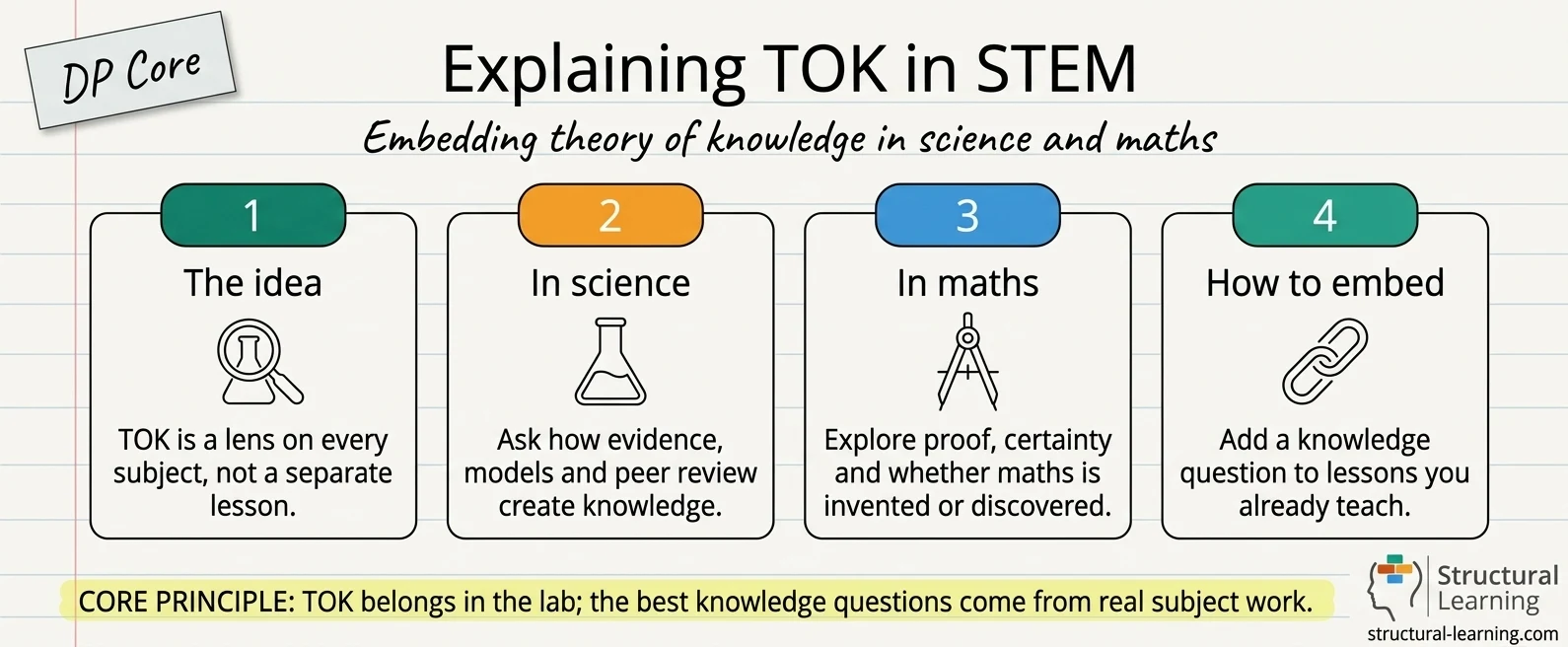
An at-a-glance visual summary of TOK Is Not a Subject: How to Embed Ways of Knowing into DP Maths and Science.
Imagination drives how scientists form a hypothesis. Popper (1959) placed imagination at the centre of scientific creativity: before a hypothesis can be tested, someone has to think of it first. Briefly telling Year 12 learners this before they write a hypothesis helps them see imagination as a valid epistemic tool, not just something used in Art and English.
Language shapes scientific and mathematical thinking in ways we can easily miss. The choice between "law" and "theory" in Science carries epistemological weight: a scientific law describes; a theory explains. Many learners, and some teachers, use these terms as if they mean the same thing.
A one-minute explanation of this difference can become a TOK moment inside a Science lesson. For a deeper look at how language shapes thinking, see this guide to critical thinking in education.
Emotion and Memory are less obvious in STEM, but they are still real. In the history of science, strong emotional investment in a theory has sometimes delayed acceptance of evidence that challenged it. Memory shapes what scientists notice and what they set aside.
Dombrowski (2013) points out that all knowers are situated, and this includes emotional and memorial dimensions that no scientific method can fully remove. These are not arguments against science; they are arguments for epistemic humility, which is exactly what TOK teaches.
Five-Minute TOK Starters for Maths
Each of the following activities takes between three and six minutes. They can open a lesson, close one, or sit as a mid-lesson break when learners need a change of cognitive register. None requires preparation beyond reading the prompt.
Activity 1: Discovered or invented? Ask the class: "Is mathematical knowledge discovered or invented?" Give learners sixty seconds to choose a view. Then ask them to note one reason.
Take a quick show of hands, then hear two or three reasons. The question has no settled answer. Platonists argue that mathematics exists independently of human minds. Formalists argue that it is a human construction.
The aim is not to resolve the debate. It is to notice that the question exists. This places Mathematics within the wider TOK conversation about the nature of knowledge.
Activity 2: The false proof
Write on the board: Let a = b, so a² = ab. Then a² - b² = ab - b². Factorise this as (a+b)(a-b) = b(a-b). Next, divide both sides to get a+b = b. Since a = b, this becomes 2b = b, so 2 = 1.
Ask: "Where does this go wrong?" The error is dividing by (a-b), which equals zero.
The teaching point is that deductive reasoning has rules. If the premises are valid and the reasoning is sound, the conclusion must be true. The proof shows what happens when one step breaks a foundational rule. This embeds TOK in algebraic thinking and links to the epistemological question: how do mathematicians know when a proof is correct?
Activity 3: Proof versus empirical evidence Ask: "Is it enough to check that a pattern holds for the first million cases?" Most learners say yes.
Then introduce mathematical proof. Mathematicians need proof, not just extensive testing. A pattern that works for a trillion cases might fail on the next case.
The Goldbach conjecture says that every even integer greater than 2 is the sum of two primes. It has been verified for numbers up to four quintillion and remains unproved. This shows the difference between empirical evidence and deductive certainty.
In TOK terms, it is Sense Perception (checking cases) versus Reason (proof). It takes four minutes and changes how learners understand what Mathematics is.
Activity 4: Perspective in Mathematics
Use the Thinking Framework's Perspective operation. Ask: "Is 0.999... equal to 1?" Then ask how a pure mathematician might answer, and how an engineer might answer differently.
The pure mathematician says yes, because the limit of the series is exactly 1. The engineer may say it is close enough for any practical purpose, so the distinction does not matter. Neither is wrong within their framing. The question shows how the purpose of knowledge shapes how we understand it, which is a TOK insight with broad application.
Activity 5: Intuition audit
Before learners attempt a problem, ask them: "What does your intuition tell you the answer will be?" Record predictions on the board, then work through the problem. Discuss where intuition was right, where it was wrong, and why. This builds metacognitive awareness about the reliability of intuition as a source of judgement in Mathematics. For more on metacognition in the classroom, including how to make thinking visible, the research base is strong.
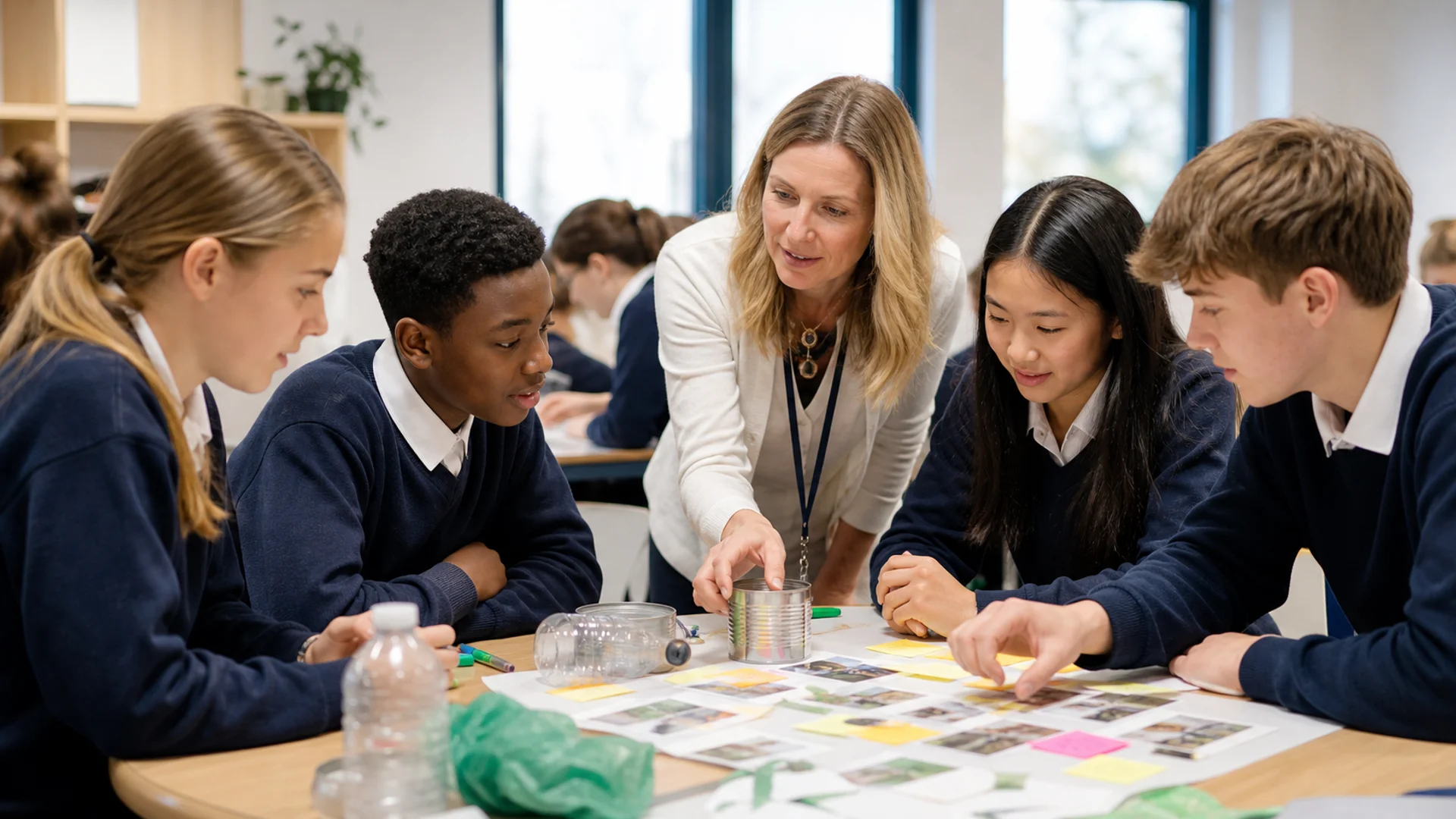
Theory of Knowledge Discussion in Action in practice: learners test claims and evidence through structured TOK discussion.
Five-Minute TOK Starters for Science
Epistemological discussion fits naturally in science. Science teaching already asks how claims become trustworthy knowledge. Sandoval (2005), Lederman (2007), Duschl (2008) and Osborne et al. (2003) all put evidence, explanation and argument at the centre of science learning. These are not optional discussion tasks.
Activity 1: The duck-rabbit
Show the duck-rabbit illusion (or any other ambiguous figure). Ask: "Are you seeing the object, or are you seeing your interpretation of it?" This opens the question of whether observation is theory-laden. Kuhn (1962) argued it always is: what scientists see is shaped by the theories they bring to their observations. A Science teacher who spends three minutes on this before a practical investigation has given learners a genuine philosophical frame for thinking about their own experimental data.
Activity 2: Scientific consensus
Ask: "When should we trust scientific consensus?" Use climate science as the example, or vaccination, or the germ theory of disease before it was accepted.
The question is not whether scientific consensus is right. Instead, ask how we know when to trust it, what makes expert judgement reliable, and what evidence would make a consensus change. This connects to the current TOK knowledge framework: methods and tools, perspectives, and the language used to report evidence. It builds knowledge skills that help learners judge evidence beyond the classroom.
Activity 3: Fact, theory, law Write three terms on the board: scientific fact, scientific theory, scientific law. Ask learners to rank them by how certain they are.
Most people rank them like this: fact means certain, law means very certain, and theory means uncertain. The correct epistemological answer is more useful than that. A scientific theory is not an uncertain guess. It is an explanatory framework, which means a way to explain evidence, backed by extensive evidence.
Evolution is a theory. Gravity is a theory. A scientific law describes a pattern, while a theory explains why the pattern exists. This three-minute correction of a widespread misconception is also a real TOK moment about how language shapes knowledge claims in the natural sciences.
Activity 4: Compare investigative approaches
Use the Thinking Framework's Compare operation. Ask: "What causes ageing, and how would a physicist and a biologist investigate it?" A physicist might look at entropy and thermodynamics. A biologist might focus on cell damage and telomere shortening.
A sociologist might look instead at lifestyle factors. None of these perspectives is wrong. Each one shows a different part of the question, and the activity takes five minutes. It also addresses the TOK idea that Areas of Knowledge act as different lenses on the same phenomena.
Activity 5: The ethics of experimentation. Before any practical investigation, ask: "What ethical rules limit what we can test?" This works especially well in Biology, but it also applies to any science.
The question links the natural sciences area of knowledge to the ethics element of the TOK knowledge framework. It also prepares learners who may discuss ethical limits in their Internal Assessments. A Biology investigation is stronger when ethical choices shape the design, sampling and evaluation, rather than appearing as a formulaic disclaimer. The link between TOK and IA quality is practical, but it still has to be expressed through the subject criteria.
The Thinking Framework as TOK Scaffold
The Thinking Framework's eight cognitive operations are not only teaching tools. They are also epistemological moves, which means they help learners think about how knowledge is made. Each operation matches a type of inquiry that TOK examines directly.
STEM teachers who already use the Thinking Framework are therefore already doing TOK work. The table below makes that link clear.
Thinking Framework Operation
TOK Epistemological Move
STEM Application
Compare
"How do different knowers approach this?"
Compare how a physicist and biologist investigate the same phenomenon
Perspective
"Whose perspective is missing from this knowledge claim?"
Who benefits from and who is marginalised by this scientific consensus?
Cause and Effect
"What assumptions cause us to reach this conclusion?"
What must we assume about nature for this experiment to be valid?
Systems Thinking
"How does this knowledge connect to other areas?"
How does mathematical modelling change when applied to biological vs physical systems?
Analogy
"What is this knowledge claim LIKE in another Area of Knowledge?"
Is a mathematical proof more like a scientific experiment or a philosophical argument?
Part-Whole
"What does each component contribute to the knowledge system?"
How do observation, hypothesis, and peer review together produce scientific knowledge?
Classify
"What category of knowledge is this?"
Is this a fact, a law, a theory, or a model? What does the classification imply?
Sequence
"How does knowledge develop over time?"
Trace the development of atomic theory from Dalton to quantum mechanics
Each of these operations can be deployed in under five minutes. A teacher who uses just two of these per week will help learners develop thinking skills. These learners will enter their TOK assessment with real subject experience, not just abstract classroom exercises. For a fuller treatment of how cognitive operations build critical thinking skills across subjects, the evidence base is well-established.
Areas of Knowledge: The STEM Teacher's Quick Reference
The IB identifies five areas of knowledge in the current TOK course. For STEM teachers, Natural Sciences, Mathematics and Human Sciences will feel closest to their lessons. The knowledge framework matters too: scope, perspectives, methods and tools, and ethics. Use the reference card each week to find one TOK moment, such as when learners judge experimental data, statistical models or AI-generated explanations.
Area of Knowledge
Two Knowledge Questions
Real-World Situation
Classroom Activity
Natural Sciences
1. What role does falsifiability play in establishing scientific knowledge? 2. To what extent is scientific objectivity possible?
The replication crisis: Ioannidis (2005) argued that many published findings can be false, and the Open Science Collaboration (2015) found that many psychology results did not replicate. What does this imply for scientific knowledge claims?
Give learners two contradictory research findings on the same question. Ask: which do you believe, and why? What would make you change your mind?
Mathematics
1. Is mathematical knowledge certain, and if so, what makes it so? 2. Is mathematics discovered or invented?
Non-Euclidean geometry: for two thousand years, Euclid's parallel postulate was treated as self-evident. Its rejection created entirely new mathematical worlds.
Give learners a visual proof (e.g., the Pythagorean theorem via squares). Ask: does seeing it make it true, or does it need algebraic proof? Why?
Human Sciences
1. Can human behaviour be studied scientifically in the same way as natural phenomena? 2. How do ethical constraints shape what human scientists can know?
Milgram's obedience experiments: profoundly revealing about human behaviour but impossible to replicate today on ethical grounds. What does this mean for the knowledge they produced?
Ask learners to design a study to answer a question about human behaviour, then identify every ethical constraint on their design. What can they now not find out?
These questions do not require specialist TOK knowledge to help. They require curiosity and a willingness to sit with uncertainty for five minutes. The IB Learner Profile describes the ideal IB learner as a reflective thinker who examines their own perspectives. STEM teachers who use the activities above are building that disposition in the context where it matters most: the subject itself.
For STEM teachers who want to develop inquiry-based teaching, the principles are similar. Good inquiry teaching and good TOK teaching both start with a genuinely open question.
How TOK Integration Affects DP Assessment
TOK integration is more than extra philosophical discussion. It affects assessment through the TOK and Extended Essay core matrix. It can also improve scientific investigation write-ups by sharpening research design, conclusion and evaluation. Do not present it as a separate route to marks in CAS or as a replacement for subject criteria.
The maximum Diploma score is 45: six subjects can contribute 42 points, and the TOK and Extended Essay matrix can add up to three more. CAS sits in the DP core with TOK and the Extended Essay, but CAS earns no points; it is a completion requirement. A learner who scores an A on both TOK and the Extended Essay can receive three additional points, which can affect university offers at the margin.
STEM teachers who build TOK moments into Year 12 and 13 help learners reach the TOK exhibition, the TOK essay and EE methodology conversations with a developed epistemological vocabulary. That means they have the language to talk clearly about knowledge. This vocabulary is built through practice, not through one term of TOK lessons.
Frame Science IA writing through research design, data analysis, conclusion and evaluation. Do not treat it as a separate personal engagement label. A Biology investigation is stronger when the learner explains why the method is valid, what assumptions shape observation, and how limits affect the conclusion.
This does not need to be long. One or two precise sentences can be enough when they clarify the knowledge being produced rather than add generic reflection.
STEM teachers can prepare learners for this by modelling it in class. "This is an interesting result. Before we accept it, what assumptions did we make in designing this experiment?" Asked once a week, that question builds the reflective habit.
For teachers whose learners are preparing Extended Essays, the connection between EE methodology and TOK is particularly strong. An EE research question about science is stronger when learners think about what counts as evidence. It is weaker when they treat methodology as just a box to tick. That difference comes from the habits of mind built in STEM lessons, not just in TOK class.
Free slide deck
The key ideas on this topic as classroom-ready slides.
In schools that teach the full IB continuum, learners start building ideas about knowledge before they meet DP TOK. The IB has four programmes: PYP for ages 3 to 12, MYP for ages 11 to 16, DP for ages 16 to 19 and Career-related Programme (CP) for ages 16 to 19. In the current PYP, the seven specified concepts are form, function, causation, change, connection, perspective and responsibility.
Older resources often list eight concepts because Reflection used to be a separate lens. The Enhanced PYP (2018) moved reflection into the ongoing cycle of inquiry, assessment and action. Many school websites and teacher resources still say "8 lenses" in 2026, but this article follows the current seven.
MYP concept-based assessment then asks learners to make connections, use their understanding in new contexts, and reflect on how they know what they know. Teachers who want to see this across the IB curriculum can explore this guide to MYP conceptual assessment.
The move from MYP to DP TOK is smoother when learners have spent four years practising epistemological thinking, even if they have not called it that. A Year 10 learner who often asks "how do we know this?" and "what would change our minds?" arrives in Year 12 TOK with a conceptual toolkit.
The STEM teacher's role in building that toolkit is not optional; it is part of the programme design. The ATL skills framework makes a similar argument. IB cross-curricular frameworks work best when they are built into ordinary teaching, not added on top.
Ready to plan it?
You have explored Curriculum Design. Now turn it into a lesson learners will remember.
Free for teachers. The platform builds a classroom-ready lesson plan from your topic in under two minutes.
Learners meet clearer challenge across the sequence.
Difficult concepts are broken into teachable steps.
Choose one topic from your DP syllabus. Then ask which main act of knowing helps learners understand it. Is it reasoning, observation, language, modelling, imagination or ethical judgement? Use it as a starting point for professional discussion: identify the learner's current need, record evidence from more than one lesson, and agree the next classroom adjustment with the SENCO or family.
If it is reasoning, name it at the start of the lesson. If it is observation, tell learners before the practical that observation is an epistemic tool, which means it helps them build knowledge, but it has limits. If it is imagination, tell them before writing a hypothesis that they must imagine what might be true before evidence exists.
Naming the epistemic act takes one sentence. That sentence links your lesson to the TOK framework your learners already use.
You do not need to become a philosophy teacher. You only need to notice how knowledge is being built in your lesson and say it aloud. The learners do the rest.
Start with one activity from the lists above. Maths teachers can try the false proof, while Science teachers can try the duck-rabbit. Run it once and notice what happens to the quality of discussion. The learners who engage most deeply are often not the ones who perform best on content tests.
TOK moments reveal different kinds of intelligence. Seeing this often changes how teachers think about their learners. For those interested in a full school-wide approach to thinking, the Thinking Framework provides the structure. For those starting with one lesson and one question, that is enough.
For more background on the International Baccalaureate, see the full programme description. It places TOK inside the DP core alongside the Extended Essay and CAS. Up to 3 additional points come from the TOK and EE matrix, while CAS is a completion requirement and carries no points. STEM teachers build the shared disposition behind the core every time they ask a genuinely open question in a lesson where the answer is already known.
Quick-check quiz
10-question self-test
Q1
0%
Limitations and Critiques
Embedding TOK in DP Maths and the natural sciences is not a neutral technical fix. High-stakes assessment can narrow curriculum, reward speed and compliance, and make epistemological doubt feel risky rather than intellectually valuable (Au, 2011). In that context, separating TOK from STEM is often a rational response to examination pressure. The problem is partly assessment design, not simply teacher reluctance.
There is also a methodological risk. If science lessons present "the scientific method" as a single route from hypothesis to truth, they miss the unsettled nature of scientific knowledge. Kuhn (1962) showed that observation is shaped by disciplinary commitments, while Ioannidis (2005) showed how many published findings can be false under common research conditions. TOK integration should therefore strengthen learners' trust in disciplined inquiry, including replication, uncertainty and Bayesian updating, without sliding into lazy relativism.
A third criticism is cultural. Standard STEM examples often privilege Western histories of proof, experiment and discovery. Linda Tuhiwai Smith (1999) and Aikenhead and Ogawa (2007) caution that Indigenous and non-Western knowledge systems are often treated as context rather than as knowledge in their own right. Teachers need examples from ethnomathematics, ecological knowledge and local inquiry, not only European case studies.
Finally, generative AI changes the task. Learners can now outsource symbolic reasoning, written explanation and hypothesis generation, so TOK work must include verification of algorithmic claims, proof checking and evidence trails (Boczkowski et al., 2024). Despite these limits, TOK remains valuable because it gives learners disciplined language for asking what counts as knowledge, why it counts, and who gets to decide.
Further Reading: Key Research and Scholarship
These works underpin the epistemological arguments in this article and provide deeper reading for teachers who want to develop their TOK practice.
Theory of Knowledge for the IB Diploma (6th edition) View study ↗ Core IB text
Van de Lagemaat, R. (2015)
The most widely used TOK textbook in IB schools. Van de Lagemaat provides accessible coverage of all eight Ways of Knowing and five Areas of Knowledge, with disciplinary examples that STEM teachers can draw on directly. Particularly useful for the Natural Sciences and Mathematics chapters.
Theory of Knowledge: Perspectives and Possibilities (3rd edition) View study ↗ IB resource
Dombrowski, E. (2013)
Dombrowski (2013) finds knowledge depends on context. STEM teachers can see Emotion, Memory, and Perspective matter in science and maths. These are not just for humanities learners.
The Structure of Scientific Revolutions (2nd edition) View study ↗ 1,270 citations
Kuhn, T. S. (1962)
The foundational text for understanding how scientific knowledge changes. Kuhn's concept of major theory changes and theory-laden observation is directly relevant to DP Science teachers. Reading even the first two chapters provides the epistemological framework for several months of TOK starter questions.
The Logic of Scientific Discovery View study ↗ Classic text
Popper, K. (1959)
Popper's argument that falsifiability distinguishes science from non-science is the foundation of the scientific method as IB Science understands it. His emphasis on imagination in hypothesis formation gives STEM teachers a philosophical grounding for valuing creative thinking in their classrooms.
Theory of Knowledge Guide for the IB Diploma (2022 edition) View study ↗ Official IB
IB Organisation (2022)
The official IB guide is the authoritative source for how TOK relates to all DP subjects. Pages 14 to 23 address the role of subject teachers in TOK integration. Every DP STEM teacher should have read these pages: they make clear that TOK is a shared responsibility, not the TOK teacher's alone.
Sequence a Curriculum Design unit in three steps.
Mapped to the curriculum. CPD-aligned. Free for teachers.
Curriculum PlatformCurriculum design
Learners meet clearer challenge across the sequence.
Difficult concepts are broken into teachable steps.
Plans keep the curriculum thread visible.
1
Year
Year 5
2
Lesson plan
Sequenced unit
3
Export
PDF
Cognitive Science Platform
Make Thinking Visible
Open a free account and help organise learners' thinking with evidence-based graphic organisers. Reduce cognitive load and guide schema building through explicit schema building.
Paul Main is an educator and metacognition researcher who founded Structural Learning in 2002. With a psychology degree from the University of Sunderland and 22+ years helping schools embed thinking skills, he bridges the gap between educational research and classroom practice. Fellow of the RSA and Chartered College of Teaching, with 128+ Google Scholar citations.