Neurodivergent IB Learners: Surviving the DP Core
A guide for SENCOs and DP coordinators on scaffolding the IB Diploma Core (EE, TOK, CAS) for neurodivergent learners, without reducing intellectual demand.


A guide for SENCOs and DP coordinators on scaffolding the IB Diploma Core (EE, TOK, CAS) for neurodivergent learners, without reducing intellectual demand.
The IB suits self-directed learners comfortable with ambiguity. Abstract reasoning motivates these learners, enabling research projects like those mentioned by researchers in their works (dates vary). Many learners fit this description. However, a growing number find this skill profile challenging.
IB classrooms include many neurodivergent learners. More learners with ADHD, autism, dyspraxia, dyscalculia and PDA now take the Diploma. Numbers are rising as IB schools improve access and identify learners more accurately. The DP Core (EE, TOK, CAS) can be hard because it needs executive function, abstract reasoning, and social initiative, which some learners find difficult.
This guide is for learning support staff, SENCOs in IB schools, DP coordinators, and class teachers who supervise neurodivergent learners through the Core. The strategies here do not lower the intellectual bar. The IB Diploma is rigorous, and it should be. What they do is remove the hidden barriers that prevent some learners from showing what they actually know and can do.
IB schools are proud of their inclusivity, and the IB learner profile describes learners who are open-minded, risk-taking and reflective. The harder question is whether the DP Core's ideal of a self-directed learner can quietly penalise executive dysfunction. If independence is treated as proof of academic rigour, missed drafts, unanswered emails and empty CAS portfolios can look like character problems. In fact, they may be access barriers.
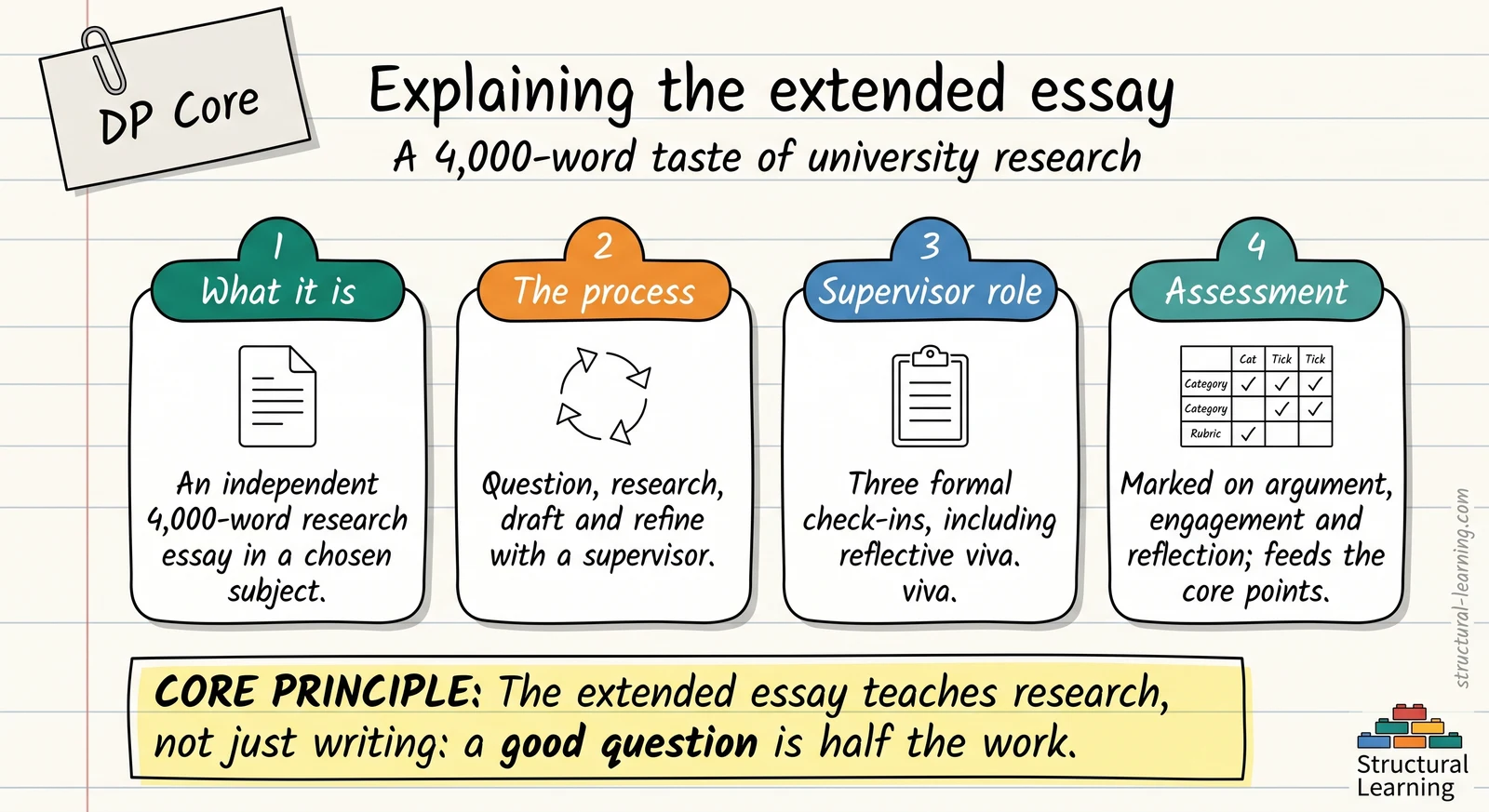
The Extended Essay is an independent research task. Learners direct their own work and produce a 4,000-word paper. Theory of Knowledge now uses the knowledge framework: scope, perspectives, methods and tools, and ethics. It also includes the core theme of knowledge and the knower, optional themes, and five areas of knowledge.
TOK assessment includes the TOK exhibition, using three objects, and the TOK essay based on prescribed titles. Creativity, activity, service runs alongside academic study. Learners reflect on CAS experiences and give evidence of the CAS learning outcomes. Together, the DP core is TOK, EE and CAS; CAS is a completion requirement and adds no points to the 45-point Diploma total.
These demands can be sound teaching when schools make the scaffolds clear. For neurodivergent learners, the DP core can create barriers that are not linked to intellect. These include long time horizons, unclear success criteria, social interpretation, reflection language and portfolio organisation.
Treat these as design problems. Reduce needless load and model routines. Keep the intellectual challenge in place through explicit instruction, metacognition and UDL principles (Vygotsky, 1978; Education Endowment Foundation, 2020; Meyer, Rose and Gordon, 2014).
Working memory research shows why a learner may understand the task but still lose the steps needed to finish it (Gathercole and Alloway, 2008). The social barrier is different. Milton's double empathy account says that communication can break down when autistic and non-autistic people make meaning in different ways, not because the autistic learner has a one-sided deficit (Milton, 2012). CAS group work and reflection rubrics can reward neurotypical performativity unless schools accept varied ways to show evidence.
The Extended Essay places high cognitive demands on secondary learners. It asks them to plan independently for 18 months. They must keep choosing a research direction and cope with uncertainty.
They also need to write clear, coherent arguments. Diamond (2013) identifies inhibitory control, working memory, and cognitive flexibility as key skills. The EE puts pressure on these skills, which are often weaker in neurodivergent learners.
For learners with ADHD, the primary barriers are task initiation, time estimation and sustained attention. Barkley (1997) argued that ADHD involves difficulty with self-regulation across time: present action does not attach to distant consequence in the way long-term projects assume. The EE's 18-month timeline, with infrequent formal check-ins, is exactly the kind of structure that ADHD makes hardest.
Research does not happen in neat sessions. It sprawls. Deadlines feel abstract until they arrive. The learner who could write a strong essay in a structured environment can produce nothing when structure is assumed rather than taught.
For autistic learners, a different cluster of difficulties appears. Topic selection is often the first crisis. A learner can have a deep, specific interest and still find a "manageable" research question paralysing. Their preferred question may be too narrow, too broad or outside the subjects available for the EE.
Once a topic is chosen, the open-ended research process itself can create anxiety. How much reading is enough? When do I stop gathering sources and start writing? The absence of a clear stopping rule is deeply uncomfortable for learners who prefer defined parameters.
Practical strategies for supervisors who support neurodivergent learners through the EE:
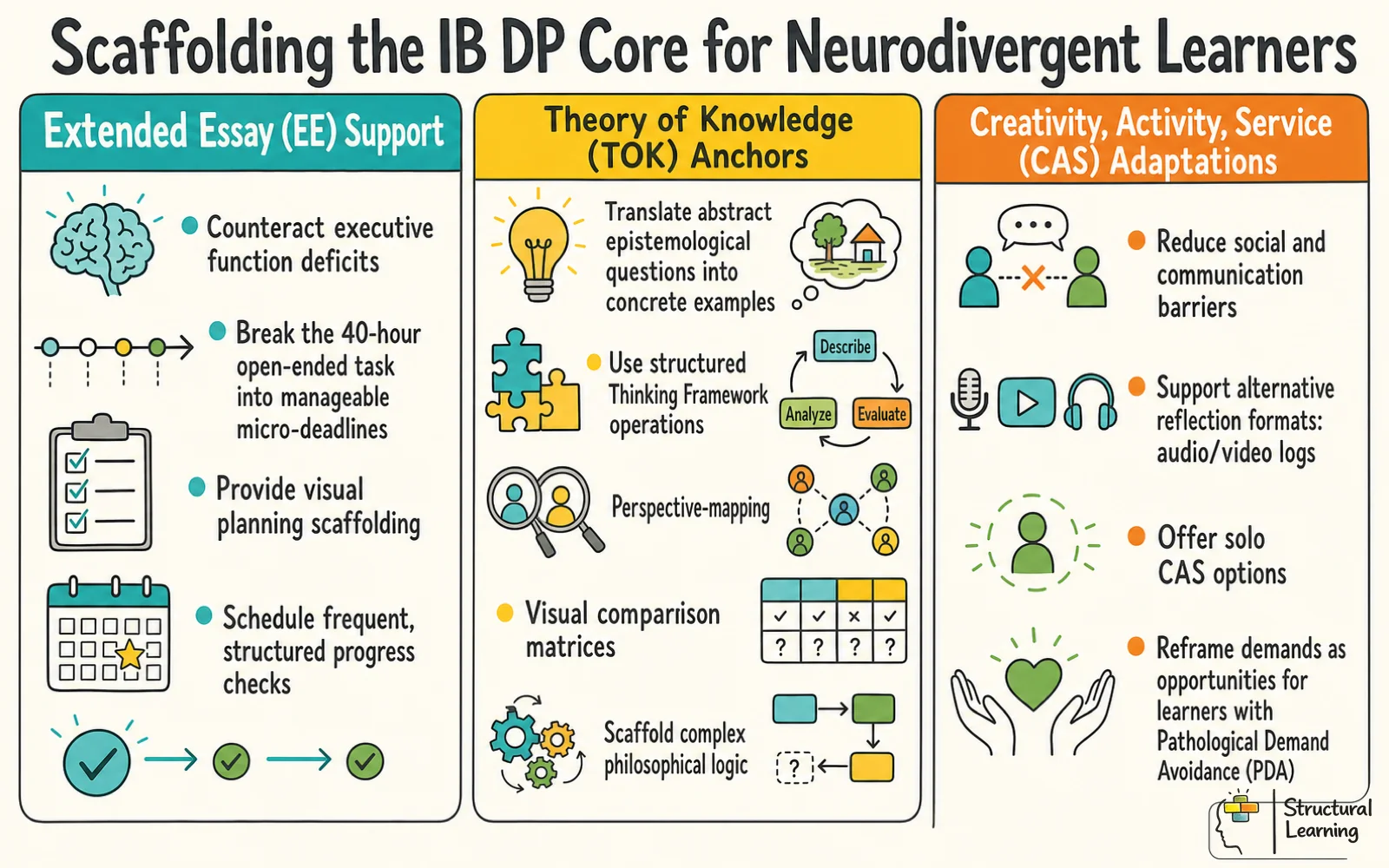
Break the 40 hours into 20 micro-deadlines. Give each session a clear deliverable. Instead of 'research for 2 hours', say 'read three sources and write one paragraph about their key claim'. This gives learners a clear place to start and turns vague tasks into manageable steps.
The metacognitive planning deficit behind avoidance is addressed when the learner and supervisor plan the forethought phase together (Zimmerman, 2002).
Create a visual EE timeline with weekly checkpoints, supervision dates and the next concrete action. Add a simple progress column so the learner can see what has been started, what is blocked and what is finished. This supports working memory by externalising the plan instead of asking the learner to hold every step in mind.
Use fortnightly short check-ins, not monthly formal sessions. IB regulations allow supervisors to hold regular meetings. More frequent, shorter meetings reduce the gap between support sessions and lower the risk of a learner becoming stuck and silently disengaging. A 15-minute check-in every two weeks is more protective than a 45-minute session once a month.
Separate topic selection from research question formation. Allow the learner to explore three or four possible areas before narrowing. For autistic learners with special interests, ask "what aspect of X could we investigate using available evidence?" Don't just say "pick a topic." The constraint is the same, but this framing acknowledges their interest rather than dismissing it.
Theory of Knowledge is abstract by design, but the current TOK course is not the old "knowledge framework" model. Since first assessment in 2022, learners work through the knowledge framework: scope, perspectives, methods and tools, and ethics. They study the core theme, knowledge and the knower, optional themes and five areas of knowledge. For learners who think concretely, TOK can still feel like thinking about thinking in a language they do not yet speak, especially where English is an additional language.
TOK questions are hard: How do we know? What links evidence and certainty? Can experience be knowledge? Philosophers have thought about these questions for years.
Asking learners to answer them in essays is ambitious. Asking autistic learners to answer without support often leads to failure.
The Thinking Framework's Perspective operation is useful here. Instead of "How does language shape knowledge?", the teacher reframes: "A doctor and a patient use the word 'pain' in the same conversation. What does each of them know that the other does not? How does language help and hinder their understanding?" The abstract question becomes a concrete comparison between two perspectives learners can understand. The intellectual demand stays the same, but the entry point is now accessible.
Compare tasks make the knowledge framework visible. Instead of asking a learner to "evaluate certainty", teachers can place two claims side by side and ask what counts as evidence, which methods are being used, whose perspective is missing and what ethical risk follows. This is still TOK. It simply gives learners the cognitive procedure that fluent abstract thinkers often generate without noticing (Vygotsky, 1978; Bruner, 1961).
The TOK exhibition replaced the TOK presentation for first assessment in 2022. Learners choose three objects and connect them to a prescribed prompt. This can be more concrete than the essay, but it still needs careful object selection, explicit modelling and attention to academic integrity.
Practical approaches for TOK teachers:
Give learners examples before you explain abstract concepts. When you introduce the knowledge framework, start with real scenarios. A doctor and patient can explore different views of pain.
A historian using diaries can explore methods, evidence and interpretation. A musician explaining composition can explore the link between personal experience and shared criteria. Multilingual learners may need direct teaching of TOK vocabulary before they can show the quality of their reasoning.
Use structured templates for essay planning. A TOK essay plan with named sections gives learners a clear framework to work within. These sections include knowledge claim, counterclaim, examples from two Areas of Knowledge, and conclusion about implications. This is scaffolding, not simplification.
Teach TOK words like any other subject's vocabulary. Terms such as "justified true belief" need direct instruction. Neurodivergent learners can grasp the ideas but still struggle with the jargon. Explicit vocabulary teaching is vital in TOK, as much as in languages (Education Endowment Foundation, 2020).
Learning support teams often discuss CAS less than EE or TOK because it is not formally assessed. This can hide barriers for learners with anxiety, PDA, autism or ADHD. Starting activities, arranging evidence, reflecting on personal growth and managing group expectations can all place demands on executive function or communication. Plan CAS support before avoidance patterns become fixed.
Group CAS projects present a distinct challenge. The IB expects learners to demonstrate collaborative skills and to consider the ethical implications of actions. Those outcomes are defensible, but they also require sustained engagement with others around shared goals.
For autistic learners, group projects create hidden cognitive load around social inference: what does the group expect of me, who is making the decisions, and what should I do when the group is doing something I think is wrong? If supervisors only check whether the project is happening, they miss the learner's experience of participation. The double empathy problem matters here because communication difficulty sits between people, not inside one learner alone.
For learners with PDA profiles, presenting CAS as a requirement can trigger demand avoidance. PDA is commonly described as anxiety-driven resistance to perceived demands (Newson et al., 2003). Avoid telling the learner that CAS is a set of hours to complete.
The IB expects meaningful CAS experiences and evidence of learning outcomes, not a fixed 150-hour quota. Present the requirement through bounded choice, agreed language and predictable review points. Our guide to PDA in schools covers this in depth, but DP coordinators need to adapt the CAS framing specifically.
Practical adaptations for CAS:
The IB's CAS project guidance says CAS projects can focus on one strand or combine creativity, activity and service. Use that flexibility with care. A learner who finds large group tasks overwhelming may still show initiative, perseverance, collaboration, problem solving and decision making through a smaller project with clearer support.
Plan CAS reflection with the programme coordinator, and record it in a format the school accepts. The official CAS page says learners reflect on CAS experiences and give evidence of the learning outcomes. For neurodivergent learners, agree accessible formats early, such as short notes, audio, visuals, structured prompts or supervised oral reflection. This keeps reflection focused on growth, not on neurotypical emotional display.
Use approved AI as an executive-function prosthesis, not as a shortcut. A learner who can describe a CAS experience verbally but cannot organise it into written reflection can use an approved AI tool to turn their spoken notes into a first structure. The learner still checks accuracy, adds judgement and owns the final submission. This is closer to a word processor, planner or scribe than to contract cheating, provided the school sets clear disclosure rules and follows IB academic integrity policy (Kasneci et al., 2023).
Frame CAS choice as genuine choice. For PDA learners, present CAS options as a menu rather than a mandate. "We need to plan your CAS for Year 12. Here are eight different types of project. Which of these interests you?" changes the frame from compliance to autonomy.
The requirement is unchanged; the learner's relationship to it shifts. Self-regulation of learning research links perceived autonomy with stronger engagement and lower controlled motivation (Deci and Ryan, 2000).
The IB allows access arrangements for learners with learning differences. Schools apply through the IB coordinator and provide supporting evidence. Standard extra time, often 25 percent, is mainly used in exams for timed written papers. Word processors, rest breaks, separate invigilation, readers and scribes can also be authorised when the evidence supports them.
For the DP Core, schools need to separate official IB assessment arrangements from coursework support managed in school. The TOK essay and Extended Essay are long-term coursework components, so standard exam extra time does not simply apply to their final deadlines. Schools can set earlier internal deadlines, agree staged drafts, increase supervision check-ins and support planning. Official IB deadline extensions are normally for adverse or unforeseen circumstances, not routine access arrangements.
Schools often miss informal accommodation spaces. The IB CAS page states that CAS is not formally assessed, but learners still reflect on their CAS experiences and provide evidence of the learning outcomes. Schools should therefore agree EE supervision, TOK planning support and CAS reflection formats clearly. They can use Universal Design principles to reduce unnecessary barriers for all learners (Rose, 2000; Meyer, Rose and Gordon, 2014).
The conversation between the learning support team and the DP coordinator is the highest impact point for intervention. In many IB schools, these teams work in parallel. Learning support staff understand the learner's cognitive profile, while DP coordinators understand IB regulations.
In UK schools, unmanaged Core barriers can become a sixth-form retention problem. They can also create a reasonable-adjustment risk and a pastoral concern. The strongest practice is a Year 12 start-of-course meeting. This meeting records access needs, informal supports, named adults and review dates.

The Thinking Framework has eight operations for all subjects: Compare, Classify, Sequence, Cause and Effect, Part-Whole, Analogy, Perspective and Systems Thinking. These operations turn open tasks into clear thinking steps. This matters in the DP Core because the hard part is often not the academic content. It is the planning, switching, prioritising and self-monitoring around it.
Consider the EE research process through the Sequence operation. The learner and supervisor map the research process step by step. They identify the knowledge gap and choose three starting sources. Then they read, annotate, identify themes and write summary paragraphs.
Finally, they identify connecting arguments and draft the introduction. This is not a simplified version of the EE process; it is the EE process made explicit. The Sequence operation puts the planning outside the learner's working memory, without removing any intellectual demand.
In TOK, the Perspective operation gives structure to discussions about "points of view." Learners identify two specific perspectives on a knowledge claim. They name what each perspective shows and what it hides. Then they judge which perspective has better evidence.
This is the same intellectual work as a TOK essay argument. The difference is that learners use a structured operation instead of an open discussion. This makes the task accessible to learners who cannot create that structure on their own.
The Part-Whole operation helps learners map project components in CAS. They identify the goal, the activities that contribute to it, the portfolio evidence needed and the next review point. This supports project planning without reducing the CAS learning outcomes. It is especially useful when a learner has a learning assistant, co-teacher or mentor, because each adult can see the same agreed plan.
The IB Diploma is demanding. That is not the problem. The Thinking Framework's contribution is to make the intellectual pathway more visible. When a neurodivergent learner uses Compare to structure a TOK argument, they can reach the same depth of thinking through a structured route rather than an assumed one.
This is Universal Design for Learning applied to the most challenging curriculum many of these learners will encounter. It respects both the rigour of the IB and the reality of the learner.
The changes that make the biggest difference for neurodivergent learners in the DP Core are structural and inexpensive, but they require ownership. Coordinators and learning support teams need a shared Core-access map for Year 12, with each EE, TOK and CAS barrier named before it becomes a crisis. Schools should apply IB flexibility carefully, record informal adjustments and review them at set points.
A practical checklist for DP coordinators:
Audit your DP Core for hidden barriers at the start of each cohort. For each neurodivergent learner entering Year 12, ask what the EE requires that this learner finds hardest. Then ask what TOK requires, and what CAS requires. Identify which requirements can be scaffolded without reducing the assessment demand.
Map barriers before they become crises. This keeps the DP Core demanding, but makes the support clearer.
Train EE supervisors in neurodivergent-aware mentoring. Most EE supervisors know their subject well, but they are not usually learning support staff. They may not realise that a missed email or draft often reflects executive function difficulty, not disrespect or laziness. A one-hour yearly briefing on ADHD, autism, anxiety and executive function can improve support across the cohort.
Keep a CAS flexibility register with three columns: barrier, agreed adjustment and review date. This helps teams separate genuine access support from drifting expectations. It also gives the learner a predictable record of what has been agreed, which reduces negotiation load and supports independence.
Create a TOK scaffolding bank. Planning templates, worked examples, and annotated sample essays create a resource bank for learners. These tools help learners who struggle to create essay structure on their own. This is not giving them the answers; it is giving them the planning architecture.
Apply early for examination access arrangements. Start IB applications for Year 13 exams in Year 12 Term 1, not Year 13 Term 2. For the TOK essay and Extended Essay, keep exam arrangements separate from coursework support managed by the school.
Plan internal checkpoints, draft windows, word processor use and how often supervision will happen. Use official requests for deadline extensions only for adverse or unforeseen circumstances.
Connect learning support to Core supervision from day one. The learning support SENCO and the DP coordinator should meet at the start of each year to review the neurodivergent cohort entering Year 12. Shared knowledge of each learner's profile, planned accommodations, and risk factors means that neither team is operating without the other's information.
Start with three learners. Identify three neurodivergent learners in your current DP cohort who are most at risk in the Core. Look for the learner who has not started their EE, one who disengages in TOK and one whose CAS portfolio is empty. Sit with each of them individually and ask one question: what is the hardest part of this for you?
Listen to the answer without reframing it into what you expected to hear. A learner who says "I don't know where to start with my EE" is telling you the forethought phase is not happening. A learner who says "TOK doesn't feel real to me" is telling you they need concrete anchors before abstraction. A learner who says "I hate doing CAS with my group" is telling you the social demands are the barrier, not the activities themselves.
Then apply one strategy from this guide to each learner. For the EE learner, break the next two months into fortnightly micro-deadlines with clear deliverables. For the TOK learner, use the Perspective operation to reframe their next essay question in concrete terms. For the CAS learner, offer a solo option or a non-verbal reflection format.
One strategy used consistently is more useful than a thorough plan used inconsistently.
The IB Diploma is worth doing well. Neurodivergent learners who complete the DP Core with proper support often describe it as a meaningful academic experience because it was challenging and they were not left to struggle alone. The final step is transition planning: by the end of Year 13, learners should know which scaffolds they can recreate at university, which ones need disability-service evidence, and which study routines they can manage independently.
Free for teachers. Visual schedules, sensory adaptations, low-demand routines, built into the plan.
First, neurodiversity can become too broad to guide planning if schools use it as one label. Cook (2024) warns that reductive accounts of neurodiversity can leave teachers with goodwill but weak pedagogy. ADHD, autism, dyspraxia, dyscalculia, anxiety and PDA profiles each create different barriers, and many learners have overlapping needs.
Second, much of the evidence base is not specific to the IB. Barkley's work on executive function is strongest for ADHD (Barkley, 1997). UDL research and the EEF SEND guidance use evidence from wider school groups, not only Diploma Programme cohorts (Education Endowment Foundation, 2020). Schools should treat these recommendations as principled adaptations, not as proof that every scaffold will work in every DP classroom.
Third, cultural and language factors make the model more complex. Henrich, Heine and Norenzayan (2010) showed that many psychological claims are based on WEIRD samples, while Milton (2012) challenged one-sided accounts of autistic communication. TOK and CAS reflection can favour confident verbal self-disclosure. This may disadvantage learners who manage masking, EAL demands or cultural norms of modesty.
Finally, inclusion research still finds it hard to define the aim of support: attainment, wellbeing, participation or independence (Perrelet et al., 2025). Even so, the framework remains useful because it helps schools keep academic challenge in place while making the path into that challenge clear.
Barkley (1997).
Deci and Ryan (2000).
Gathercole and Alloway (2008).
Kasneci et al. (2023).
Milton (2012).
Newson et al. (2003).
Perrelet et al. (2025).
Zimmerman (2002).
Use the further reading below as the evidence base for adapting the DP core. Diamond (2013) explains executive functions; Barkley (1997) reframes ADHD as a self-regulation difficulty over time; Milton (2012) explains the double empathy problem in autism; Gathercole and Alloway (2008) connect working memory limits with classroom learning; and Meyer, Rose and Gordon (2014) give the stronger Universal Design for Learning source.
Executive Functions View study ↗
227 citations
Diamond, A. (2013). Annual Review of Psychology, 64, 135-168.
Diamond (2013) says executive functions include inhibitory control, working memory, and cognitive flexibility. Diamond (2013) shows how these skills grow in learners. Teachers can use this when planning tasks for learners with ADHD or developmental differences.
ADHD and the Nature of Self-Control View study ↗
4,800+ citations
Barkley, R. A. (1997). Guilford Press.
Barkley (1997) says ADHD affects self-regulation across time, not just attention. This helps teachers understand learners' task and time struggles. This explains why open EE timelines can create barriers for learners with ADHD.
The Ontological Status of Autism: The Double Empathy Problem View study ↗
1,200+ citations
Milton, D. E. M. (2012). Disability & Society, 27(6), 883-887.
Milton (2012) saw autism as differing communication, not deficit. This impacts CAS. Group CAS projects use "double empathy" in assessments. Coordinators can redesign social requirements, considering this (Milton, 2012).
Working Memory and Learning: A Practical Guide for Teachers View study ↗
560+ citations
Gathercole, S., & Alloway, T. P. (2008). SAGE Publications.
Working memory difficulties can make multi-step planning, note organisation and independent project management harder. Gathercole and Alloway (2008) are a stronger source for this claim than the previous generic placeholder citation, and their work supports practical classroom moves such as external checklists, shorter instructions and visible task sequences.
EEF SEND in Mainstream Schools Guidance Report View study ↗
EEF, 2020
Education Endowment Foundation. (2020). Education Endowment Foundation.
EEF names three SEND tiers: quality teaching, targeted support, specialist help. Vygotsky (1978) and Wood (1976) link metacognition and instruction to DP Core's scaffolding. These approaches help every learner.
Visual schedules, sensory adaptations, low-demand routines. Built in.