Storage Strength and Retrieval Strength: Why Forgetting
Bjork's storage and retrieval strength theory explains why students forget after exams and why forgetting is a feature, not a bug.


Bjork's storage and retrieval strength theory explains why students forget after exams and why forgetting is a feature, not a bug.
Most teachers know this moment. A learner did well in last week's lesson, answered questions with confidence, and seemed to understand the material. Three weeks later, the same learner looks blankly at the same content as if they have never met it before.
The teacher feels the material must be taught again from scratch. This experience is so common that schools often treat it as a fixed part of classroom life. Bjork and Bjork (1992) argue that it is not. It is the expected result of confusing two separate properties of memory.
Definition: Storage strength means how durable knowledge is in long-term memory. Retrieval strength means how easily a learner can recall that knowledge right now, using the current cues, context, and conditions (Bjork & Bjork, 1992).
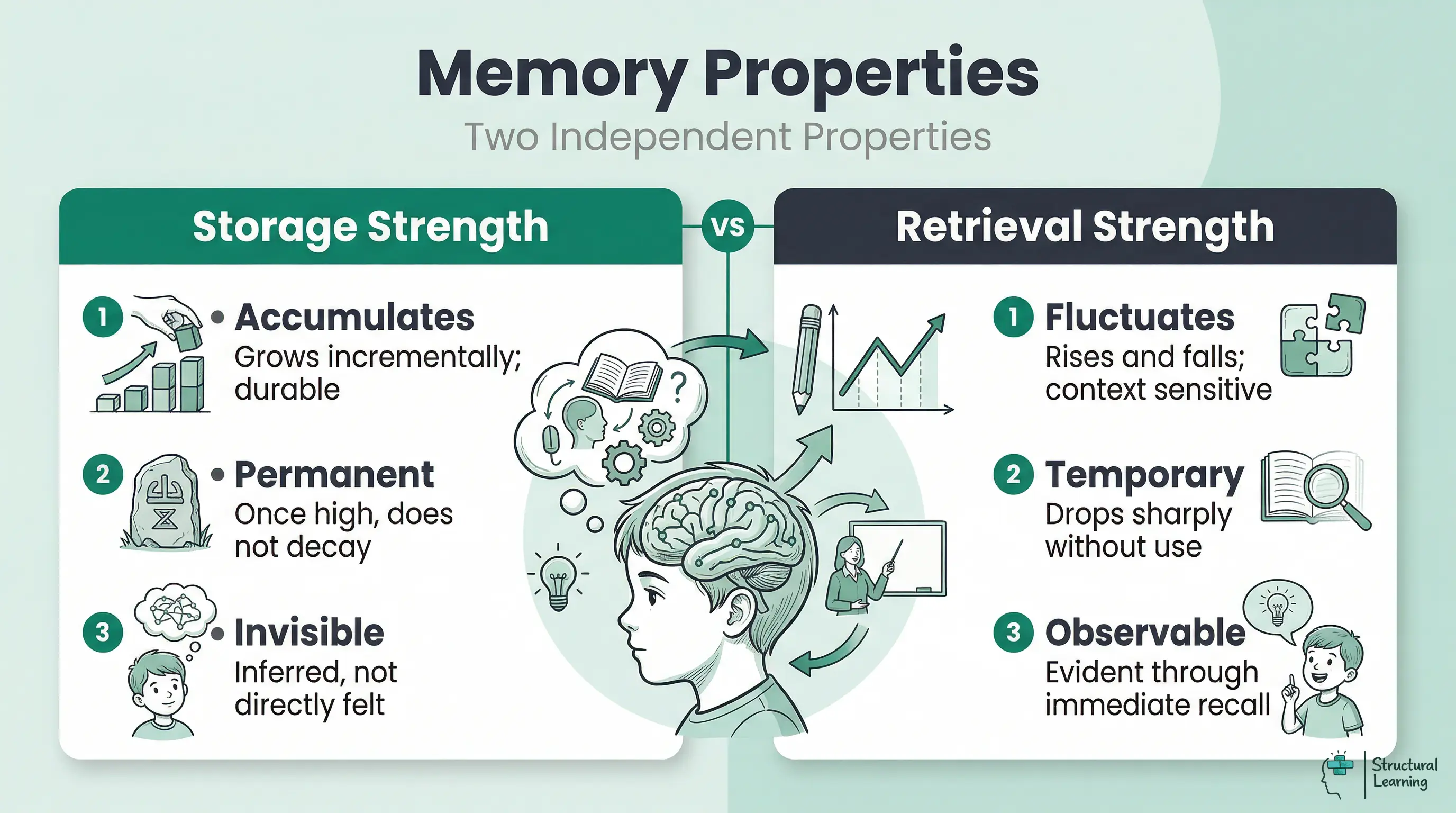
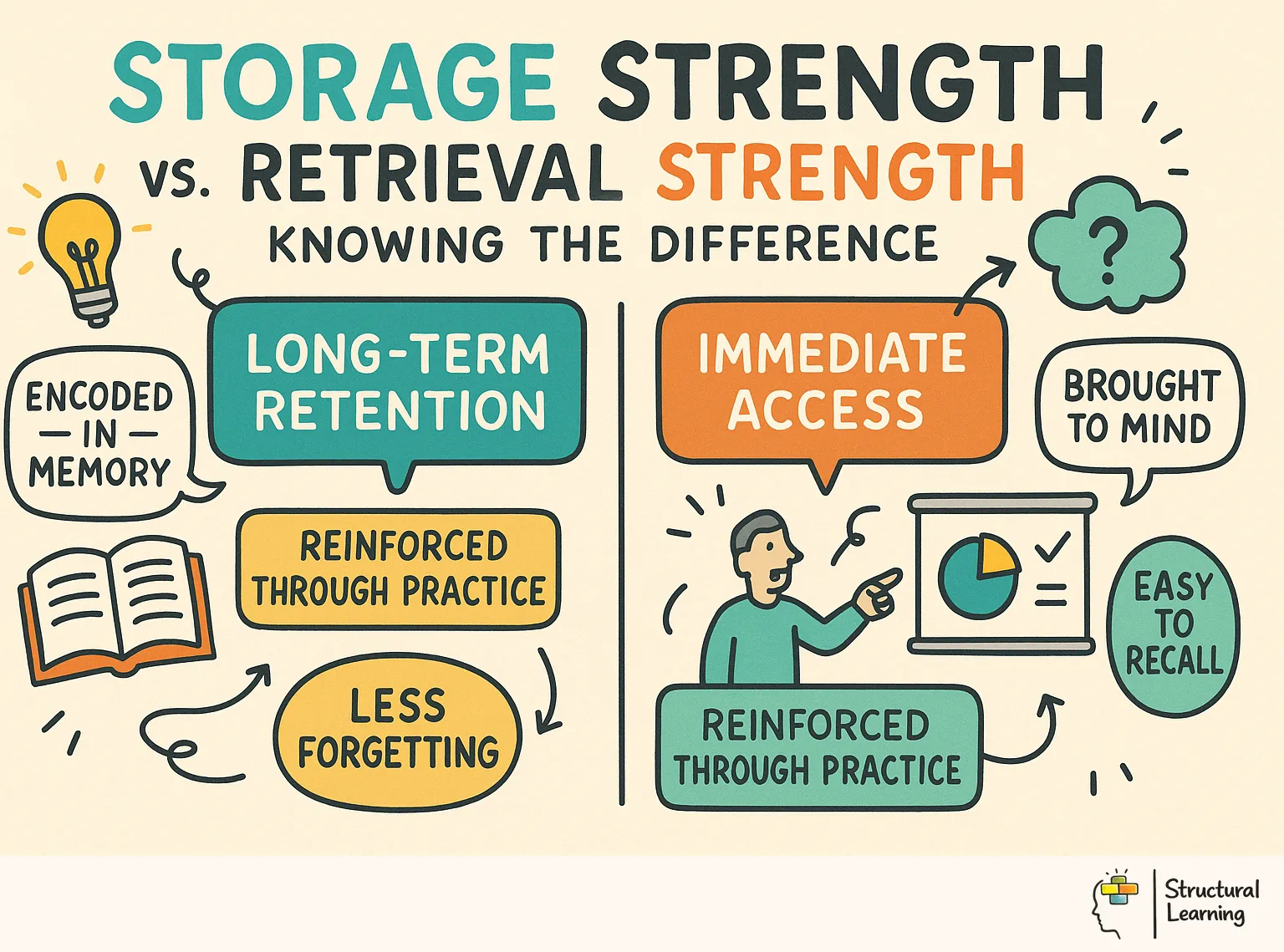
Bjork and Bjork (1992) proposed that every memory has two separate properties. Each one follows its own rules. Each one also responds to practice in a different way. Use it as a starting point for professional discussion: identify the learner's current need, record evidence from more than one lesson, and agree the next classroom adjustment with the SENCO or family.
Storage strength means how well a piece of knowledge is encoded in long-term memory. It builds step by step over time. Once it is strong, it does not decay.
This matters because you do not gradually lose knowledge that is well stored. Storage strength is fairly permanent, but it is also hard to see. You cannot simply look inside your mind and judge it. You can only infer it from how well you retrieve that knowledge under different conditions.
Retrieval strength means how easy it is to access a memory at a given moment. Unlike storage strength, retrieval strength can change a great deal. It is highest straight after study or practice, then falls quickly over hours and days without use.
Retrieval strength rises again after successful retrieval. It also depends on context: it is usually higher in familiar environments, with familiar cues, and in low-stress conditions than in new ones.
The critical insight is that these two properties are independent of each other. You can have high storage strength and low retrieval strength (the "knew it but couldn't recall it" experience in an exam). You can also have low storage strength and high retrieval strength (you can answer the question easily right after the lesson, but the knowledge will be gone within days). These two failure modes look identical from the outside, but they have completely different implications for what a teacher should do next.
A useful way to understand the theory is to arrange the two properties on two axes, producing four combinations. Each quadrant corresponds to a recognisable situation in the classroom. Use it as a starting point for professional discussion: identify the learner's current need, record evidence from more than one lesson, and agree the next classroom adjustment with the SENCO or family.
Knowledge can seem forgotten, but learners may still recall it later (Bjork, 1975). This is temporary inaccessibility, not complete forgetting (Tulving & Pearlstone, 1966). Retrieval practice helps solve this common problem (Roediger & Karpicke, 2006).
| Quadrant | Storage Strength | Retrieval Strength | What This Looks Like | Teacher Response |
|---|---|---|---|---|
| 1 | High | High | Learner recalls fluently; knowledge is durable and accessible. This is the target state for key content. | Maintain with widely-spaced retrieval; move on to new material. |
| 2 | High | Low | A single retrieval practice event will restore access rapidly. Do not reteach from scratch. | |
| 3 | Low | High | Learner can answer correctly right now, but the knowledge is shallowly encoded. It will be gone within days. This is the cramming quadrant. Also the "seems to understand in the lesson" quadrant. | The learner needs spaced retrieval practice, not more exposure to the content. Additional input will not fix shallow encoding. |
| 4 | Low | Low | Learner neither recalls it nor has it stored durably. Genuine gap: either the content was never taught, was taught inaccessibly, or prerequisite knowledge is missing. | Reteach. Check prerequisites. Address cognitive load barriers before expecting encoding to occur. |
The practical value of this table is that it forces a diagnostic question. When a learner fails to recall something, the instinctive teacher response is to reteach it (Quadrant 4 response). But if the learner is actually in Quadrant 2, reteaching is wasteful. A five-minute retrieval activity would restore access far more efficiently, and the act of retrieval would also increase storage strength further, moving the learner securely into Quadrant 1.
Bjork and Bjork (1992) called their account the 'New Theory of Disuse' to distinguish it from older models, which held that memories simply decay or fade through lack of use, in the way that a unused path through a field gradually becomes overgrown.
The new theory suggests a different view. In this model, storage strength lasts, while retrieval strength rises and falls with use, cues, context, and time. This fall in retrieval strength is not a fault. It helps memory deal with interference from competing ideas.
For teachers, a useful image is filing, not erasing. The information has moved from the front of the desk to a labelled drawer. The learner may need a cue, a pause, or a retrieval attempt to reach it again.
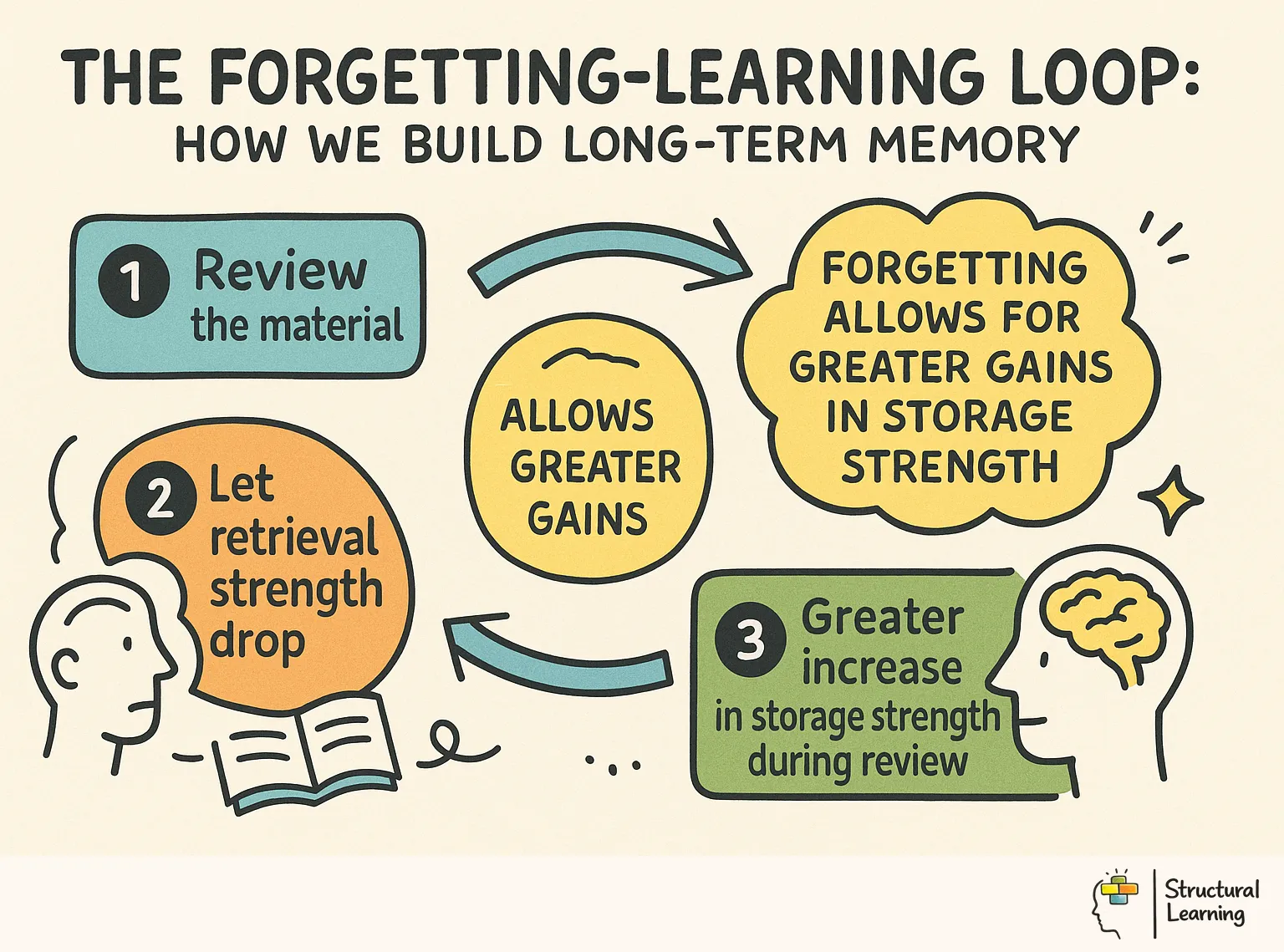
The practical result of this model is that forgetting is not the enemy of learning. It is a needed middle stage on the way to durable encoding. A memory has not been truly tested until it has been retrieved when retrieval strength is lower. Until then, its storage strength is still uncertain.
When a memory becomes partly hard to reach and is then retrieved, it shows genuine storage strength. The act of retrieval also strengthens that storage strength itself (Bjork, 1994).
This reframing has a direct implication for how teachers think about revision and review. The common approach of reviewing material when it is still fresh (high retrieval strength) produces the comfortable experience of fluent recall, but adds little to long-term retention. Reviewing material after a gap (low retrieval strength) feels harder and produces more errors, but those errors and the effort of retrieval are precisely the conditions that drive storage strength upward.
Cramming gives a clear classroom example of the difference between storage strength and retrieval strength. A learner may read through notes the night before an examination and arrive with very high retrieval strength. The material feels familiar, answers come quickly, and the learner may do well in the next twelve to twenty-four hours.
But this short-term fluency is not the same as storage strength. It tells the teacher that the material is available today, not that it will still be available in six weeks.
However, the learner has mainly reviewed material that already had high retrieval strength. This means they have done very little to build storage strength (Bjork & Bjork, 1992). Within days of the examination, retrieval strength can drop sharply. Because storage strength is low, the information then becomes truly hard to access.
This explains what teachers often call "forgetting everything after the exam." It does not mean learners have stopped caring about the subject. It also does not mean their memory has simply erased itself. The content was learned in a shallow way, and cramming did not change that.
Spaced retrieval helps learners more than cramming. Learners remember information better with gaps between practices (Bjork, 1992). They might struggle just before exams, but knowledge sticks long term. This improved encoding lasts (Karpicke & Roediger, 2008).
Classroom example (Year 11 Biology, GCSE): A teacher notices that learners who reread notes on enzyme function the night before a test scored well. Six weeks later, in a practice paper, they could not answer questions about enzymes.
She adds a low-stakes retrieval quiz on enzyme function every three weeks across the year. Learners answer from memory, without notes, and at first they find the quizzes uncomfortable. By March, they can answer enzyme questions reliably, even for content taught in September. Retrieval strength still rises and falls between quizzes, but storage strength has grown through repeated retrieval.
Ebbinghaus (1885) showed new information retention drops quickly at first, then slows. Bjork's framework explains the forgetting curve Ebbinghaus found. Use it as a starting point for professional discussion: identify the learner's current need, record evidence from more than one lesson, and agree the next classroom adjustment with the SENCO or family.
Ebbinghaus was measuring retrieval strength: his forgetting curve shows retrieval strength declining from 100% at the time of study to roughly 20% after a month without re-exposure. Bjork's contribution is to distinguish this observable retrieval strength curve from the less visible storage strength curve. Storage strength, in Bjork's model, does not track the forgetting curve. It is built during retrieval events, particularly those that occur when retrieval strength is low.
This distinction matters for practical planning. If you only look at the Ebbinghaus curve, you may think learners should re-study material as often as possible. The aim would be to stop retrieval strength from falling. Bjork's theory shows that this is exactly wrong.
Instead, retrieval strength needs to fall before learners practise retrieval. When practice happens at the trough of the forgetting curve, storage strength increases most. So the goal is not to stop the forgetting curve from dropping. The goal is to use the drop by timing retrieval practice for moments of reduced retrieval strength (Bjork & Bjork, 1992).
In practice, review sessions should not all be spaced in the same way. The first review should happen fairly soon after learning, within one to two days. At this point, storage strength is low, and retrieval strength has fallen enough to make recall effortful but still possible.
Later reviews should be further apart. Each successful retrieval event builds storage strength and slows the later drop in retrieval strength. This expanding interval pattern sits behind spaced practice systems. For a detailed guide to using this in your classroom, see the article on spaced practice.
There is an asymmetry in the storage/retrieval relationship that has direct implications for lesson design. Bjork's research shows that the benefit of a study or practice event is inversely related to the current retrieval strength of the material being studied. When retrieval strength is high, a study event produces a small gain in storage strength. When retrieval strength is low, the same study event produces a much larger gain.
This asymmetry means that massed re-study is self-defeating. A learner who reads through a chapter, then immediately re-reads it, gains little from the second reading because retrieval strength is still maximal from the first. The same learner who reads the chapter, waits a day, then attempts to recall the main points from memory (with retrieval strength now reduced) will gain substantially more from that retrieval event than from any amount of immediate re-reading.
The practical implication is that the structure of practice matters more than the quantity. Fifteen minutes of spaced retrieval distributed over a week produces more durable learning than an hour of massed re-reading on a single evening. This finding has been replicated across subjects, age groups, and types of knowledge, from vocabulary learning in language classes to procedural skills in mathematics and science (Soderstrom & Bjork, 2015).
Classroom example (Year 9 French Vocabulary): A teacher sets homework using a vocabulary learning application that shows learners words they already know at high frequency alongside new words. Learners find this enjoyable: they are mostly getting correct answers because retrieval strength is high for known words. The teacher replaces this with a distributed retrieval task: on day one, learners learn twelve new words; on day two, they retrieve all twelve from memory before seeing them; on day five, they retrieve again; on day fourteen, they retrieve again. The second approach produces slower apparent progress in weeks one and two but substantially better retention at six weeks.
One of the clearest points in Bjork's framework is the gap between performance and learning. Performance is what a learner can do right now, in this lesson, under current conditions. Learning is a lasting change in knowledge or skill that holds over time and transfers to new contexts. Performance during a lesson correlates poorly with long-term learning (Soderstrom & Bjork, 2015).
This should make school leaders cautious about termly data drops and frequent mock examinations. If the system rewards short-term retrieval strength, teachers are pushed towards cramming cycles. These may make tracking sheets look better, while doing less for storage strength. A school that takes this model seriously will sample delayed recall, not just recent performance.
This means that the signals teachers typically use to assess whether learners have learned something are unreliable. A learner who can answer questions fluently during a lesson has high retrieval strength for the material right now. That high retrieval strength may reflect genuine high storage strength (Quadrant 1: excellent), or it may reflect the recent exposure to the material (Quadrant 3: fragile). The teacher cannot tell from the in-class performance which quadrant the learner is in.
The opposite point matters just as much. A learner who struggles to answer a retrieval question three weeks after the lesson is not always in Quadrant 4 (genuine gap requiring reteaching). They may be in Quadrant 2 (high storage, low retrieval), where a short retrieval practice event can restore access quickly.
If teachers treat every retrieval failure as evidence of insufficient learning, they will over-reteach. This uses time poorly and misses the chance to use the retrieval failure itself as a useful learning event.
Formative assessment connects to a wider framework. Good assessment finds temporary and real learning gaps. Asking learners to recall knowledge tests them better than testing straight after teaching (Bjork & Bjork, 2011).
Retrieval practice helps memory because it uses working memory (Bjork, 1992). When learners try to recall information, they switch on linked memory cues (Tulving, 1983). Working memory then rebuilds knowledge from small pieces of information (Anderson, 1983; Reder, 1982). This makes long-term storage stronger (Baddeley, 2000).
Karpicke and Blunt (2011) argue that building memories takes effort. Re-reading helps learners recognise information, but it does not make them recall it for themselves. Recognition and recall are different processes (Anderson, 1983; Bjork, 1975). Recognition uses cues that are given, while recall rebuilds the memory from within.
When retrieval strength is lower, recall takes more effort. That effort is what helps build storage strength. This is why making material more vivid, colourful, or interesting does not reliably improve long-term retention.
Visual presentation can affect encoding quality, which is the domain of cognitive load theory. But it does not deal with the retrieval dynamics that decide whether encoded information becomes durably stored. Storage strength is built through retrieval, not through re-exposure, even when that re-exposure is well designed.
Classroom example (Year 7 History): A teacher creates a beautiful, well-organised revision display on the causes of the Norman Conquest. Learners enjoy using it and answer questions confidently while it is on the wall. Two weeks after the display is removed, they are asked to recall the causes from memory, and performance drops sharply.
A parallel class uses five-minute brain dumps at the start of three later lessons. Learners write everything they can remember from memory. Two weeks later, their recall is significantly better than the class with the display, despite (or because of) the task feeling harder.
Bjork (1994) called helpful challenges 'desirable difficulties'. These challenges can slow progress at first, but they improve recall over time. Each difficulty uses storage and retrieval processes in its own way.
Spaced practice works by allowing retrieval strength to drop between practice sessions. The gap is not wasted time; it is the condition that makes the subsequent retrieval event more useful for storage strength.
This active recall strengthens memory (Kang, 2016). Interleaving forces learners to choose the right method (Rohrer, 2012). They identify the problem before solving it (Bjork, 1994). This knowledge retrieval improves learning, not just following patterns (Brown, Roediger & McDaniel, 2014).
The testing effect is the finding that testing produces better retention than re-studying, even when the test produces errors. It works directly on storage strength: each retrieval attempt, successful or not, reconstructs and reinforces the memory trace. Even a failed recall attempt primes subsequent learning of the correct answer.
Bjork (1994) found that "desirable difficulties" create short-term retrieval problems. For learners, these problems can improve long-term learning. Teachers can use this idea with flexibility (Bjork & Bjork, 2011). Understanding the logic supports flexible use, rather than rigid plans (Bjork, 1994).
Interleaving needs close attention because it often feels wrong to teachers and uncomfortable for learners. In blocked practice, a learner completes ten problems of one type, then ten of another type. In interleaved practice, the problem types are mixed. Blocked practice leads to better performance at once, while interleaved practice leads to better retention and transfer (Kornell & Bjork, 2008).
The storage/retrieval framework explains why this happens. In blocked practice, the learner solves the first problem of one type and sets up the retrieval pathway. Problems two to ten use the same pathway, with high and rising retrieval strength, so each one adds little storage strength.
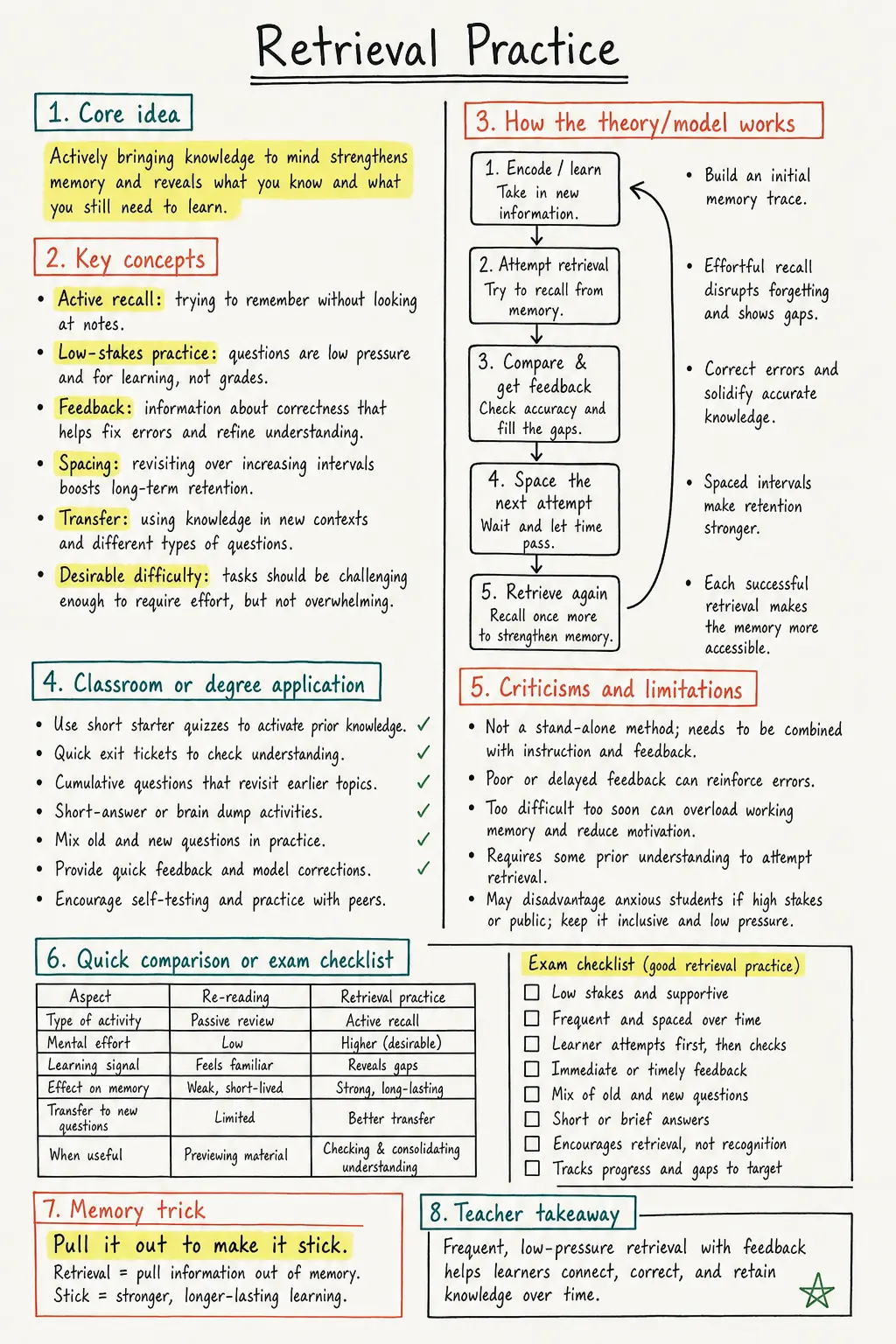
Download a one-page study note for Retrieval Practice, with the key ideas, limitations and classroom links in one place.
In interleaved practice, other problem types come between each example. This means retrieval strength for any one approach drops before the learner uses it again. Rebuilding the retrieval pathway is a real storage-strength-building event.
The practical problem is that learners using interleaved practice often tell teachers they feel confused. Their work looks worse at first, which can feel uncomfortable for both learner and teacher. Yet the research shows that this discomfort is not only acceptable but needed.
Kornell and Bjork (2008) found that learners kept choosing blocked practice and judged it as more effective. They did this even when their own test results showed the opposite. This is the metacognitive illusion caused by the difference between performance and learning.
A Year 10 maths teacher mixed simultaneous equations, quadratics, and inequalities. Learners found these weekly problem sets tough. After six weeks, they beat another class in topics and combined problems. This retrieval difficulty strengthened their understanding, as found by (Bjork & Bjork, 1992).
When teachers use interleaving, they need to explain the reason for it clearly. Without this, learners may see the difficulty as a sign that they are failing. Instead, they need to know that the task feels harder because the practice design is working. One way to explain this is to share the storage/retrieval distinction, which is covered in the section below.
Learners often have wrong ideas about memory and learning. This leads to poor revision, like rereading notes (Bjork & Bjork, 2011). Explain storage and retrieval to learners. This metacognitive instruction changes how they study.
The explanation does not need to be complex. A straightforward classroom version runs as follows:
"Your memory has two separate dials. One shows how well something is stored, deep down. The other shows how easy it is to get it out right now.
The problem is that study does little when you can already recall something with ease. That is why rereading your notes before a test feels helpful but often is not. Your brain already knows the information is there, so it does not make a stronger copy.
What stores things deeply is retrieval when it feels hard. When you have to struggle to get something out of memory, your brain makes the strongest copy."
Explain to learners that interleaved practice helps build stronger memories. This can change how they see difficulty. Instead of seeing struggle as failure, they can see it as a sign that their brains are working well. Soderstrom & Bjork (2015) found that this reduces resistance to helpful but challenging activities.
For younger learners, a simple physical analogy can help. Ask them to imagine that remembering something is like lifting a weight. Lifting a weight that is already in your hands (high retrieval strength) feels easy, but it does not build much strength.
Picking up a weight that has been put down and now feels heavy (low retrieval strength) is harder. But it builds strength faster. This metaphor shows the key imbalance without asking learners to understand the full theoretical framework.
Bjork's framework is useful, but teachers also need to know its limits. The theory explains how storage strength, retrieval strength, and practice are linked. It does not say exactly how much prior knowledge a learner needs before retrieval practice can work. If a learner has never met a concept, or lacks the needed schema structures, retrieval practice will cause confusion rather than learning.
In other words, the theory assumes there is already something in memory to retrieve, even if it is weak.
Spacing and testing work well for facts and procedures. This is shown in many studies (Soderstrom & Bjork, 2015). Evidence for complex knowledge is less clear. However, spacing and testing are not harmful to learners.
Desirable difficulties may not help every learner (Bjork, 1994). Anxious or disengaged learners may find it hard to gain the cognitive benefits of retrieval practice. For retrieval to work well, teachers may need to address motivation and anxiety first. Self-regulated learning models support this (Winne & Hadwin, 1998).
Metacognition and self-regulation have a strong impact, according to the EEF. Learners gain seven months' progress (Teaching and Learning Toolkit). Researchers also say that spacing, retrieval, and elaboration support learning. These strategies work by using storage and retrieval processes.
The EEF evidence on formative assessment, with four months' average impact, also fits this framework. Formative assessment based on retrieval, rather than recognition, gives teachers a clearer view of storage strength. It shows more than current retrieval strength.
For example, a low-stakes retrieval quiz two weeks after teaching a topic measures something closer to genuine learning. Questions asked during the lesson are less useful for this purpose, because retrieval strength is still high.
This matters for planning. If you want to know whether learners have learned something, ask them to retrieve it from memory under conditions of reduced retrieval strength: at least a day after teaching, without access to notes, in a format that requires recall rather than recognition. The results will be less impressive and more accurate than a lesson-end check. They will also be more useful for deciding what to do next, because they distinguish Quadrant 2 learners (who need a retrieval prompt) from Quadrant 4 learners (who need reteaching).
Retrieval practice improves recall, but teachers often miss storage strength (Bjork & Bjork, 1992). Storage strength means how well knowledge is built into long-term memory. Teachers can use this framework to judge advice about memory (Kang, 2016; Karpicke, 2016). This helps learners remember information better without relying on an unverifiable placeholder citation.
| Strategy | Effect on Retrieval Strength | Effect on Storage Strength | Verdict |
|---|---|---|---|
| Rereading notes | Raises temporarily | Minimal gain | Poor long-term return |
| Highlighting | Raises slightly during activity | Minimal to no gain | No evidence of benefit over rereading |
| Summarising | Raises during activity | Small to moderate gain if done from memory | Better if summary is written without notes |
| Mind mapping from notes | Raises during activity | Small gain | Better if done from memory (then becomes retrieval practice) |
| Retrieval practice (flashcards, free recall, quizzing) | Rises after each attempt | Large gain, especially when retrieval is effortful | Most effective single strategy |
| Spaced retrieval practice | Fluctuates between sessions; rises after each | Very large cumulative gain | Most effective overall approach |
| Practice tests under exam conditions | Variable (stress can suppress retrieval) | Large gain, particularly after feedback | Effective, especially with corrective feedback |
Research shows that retrieval practice helps memory (Karpicke & Blunt, 2011). Learners learn more when they try to recall information than when they only read it again. Teachers can guide revision towards recall, such as flashcards, rather than reading alone (Dunlosky et al., 2013).
The experience of learners forgetting all examination content within days of the exam is a diagnostic signal, not a mystery. Using Bjork's framework, the mechanism is clear. Use it as a starting point for professional discussion: identify the learner's current need, record evidence from more than one lesson, and agree the next classroom adjustment with the SENCO or family.
Learners often review content before exams so they can give correct answers. This can work because retrieval peaks around exam time. But rereading familiar material helps less, according to Bjork and Bjork (1992).
When retrieval is already high, each review gives only small storage gains. Learners keep retrieval going, but they do not build storage, state Bjork and Bjork (1992).
Within one to two weeks of the examination, retrieval strength decays (as it always does without use), and because storage strength is modest, the material crosses below the threshold of accessible recall. This is not a failure of memory, intelligence, or effort. It is the predictable outcome of using the wrong practice strategy.
Revising differently helps more than revising more. Learners using spaced retrieval (Weeks & months) retain info (Roediger & Butler, 2011). They recall material for years after (Karpicke & Blunt, 2011). Exam performance improves; retrieval remains strong even when stressed (Bjork, 1992).
Researchers (Bjork & Bjork, 1992; Karpicke, 2016) suggest spacing learning. Teachers should plan for learners to revisit material later. Frequent retrieval practice, as shown by Roediger & Butler (2011), strengthens memory. This approach applies to any subject area.
First, build retrieval events into your scheme of work rather than treating review as an end-of-unit activity. A minimum effective dose is three spaced retrieval practice events for each major piece of content, timed to coincide with periods of reduced retrieval strength. For content taught in Week 1, a retrieval event in Week 2, another in Week 5, and a third in Week 10 will produce substantially better retention than three revision lessons in Weeks 9, 10, and 11.
Second, use the four quadrants as a diagnostic lens. Before deciding whether to reteach, ask whether a retrieval event might restore access first. If learners struggle with a retrieval starter, wait for their responses before judging their knowledge. Learners in Quadrant 2 will often recall more than they initially think if given time and a few retrieval cues.
Brown et al. (2014) suggest teaching learners about storage and retrieval. Explain it clearly for their age. Learners who understand productive struggle are more likely to persist with revision. This approach links to self-regulated learning and needs no special training.
Fourth, align your formative assessment practices to measure storage strength rather than retrieval strength. Ask learners to retrieve content from memory with at least a day's gap from the last teaching of that content. Use low-stakes conditions to reduce the anxiety that can suppress retrieval strength independently of storage strength.
In your next lesson, identify one piece of content that you taught at least one week ago and design a five-minute blank-page retrieval activity around it. Ask learners to write everything they remember, without notes or prompts. Observe their responses using the four-quadrant lens: who recalls it fluently (Quadrant 1), who struggles but gets there with effort (Quadrant 2), and who has genuinely no access (Quadrant 4). Let the data determine whether your next move is to maintain, prompt, or reteach.
---

Storage strength measures how deeply a memory is encoded and is relatively permanent once built. Retrieval strength measures how easily you can access that memory at a specific moment. A learner might have high retrieval strength during a lesson but low storage strength, leading to rapid forgetting within days.
During a lesson, the context and recent teaching make retrieval strength very high, which masks the true level of learning. This creates a false impression of mastery for both the teacher and the learner. If the underlying storage strength is low, the information will quickly become inaccessible once the lesson is over.
The most effective way to build storage strength is to let retrieval strength drop before practising the material again. Teachers should use spaced retrieval practice, allowing learners to partially forget the content before asking them to recall it. This cognitive struggle to retrieve the information directly signals the brain to encode it more permanently.
Bjork and Bjork proposed that well-encoded memories do not simply fade or disappear over time. Instead, the brain lowers the retrieval strength of information we are not using, so it can manage cognitive resources. In this view, forgetting has a useful role. It helps us prioritise the information we need right now.
The most common error is assuming that a failure to recall information means the learner never learned it in the first place. Teachers often waste valuable class time reteaching the topic from scratch. In many cases, the storage strength is still high, and a simple five-minute retrieval activity is all that is needed to restore access to the memory.
Spacing and interleaving work because they let retrieval strength fall between study sessions. When learners return to the material, they have to work harder to recall it. This useful difficulty gives long-term storage strength a much larger boost than massed practice or cramming.
Free for teachers. The platform builds a working-memory-aware lesson plan from your topic in under two minutes.
Bjork and Bjork's distinction is useful, but it should not be treated as a complete account of memory. First, the claim that storage strength never decays is a model assumption. Hardt, Nader and Nadel (2013) argue that active forgetting can change memory traces, so the permanence claim is best read as a functional account of recall rather than settled biology.
Second, desirable difficulty does not help simply because it is hard. Nelson et al. (2023) show why teachers need to judge it alongside Cognitive Load Theory and the Challenge Point Framework. If prior knowledge is weak, retrieval tasks can overload working memory and cause learners to practise errors.
Third, much of the evidence comes from controlled tasks, short materials, and learners in Western school or university settings. This makes it harder to apply directly to multilingual classrooms, SEND contexts, and cultures where public error has different social costs.
Fourth, motivation and metacognition matter. Brown (1987) showed that learners need executive control over planning, monitoring, and regulation. Learners who are anxious or struggle to regulate themselves may need safety, cues, and early success before low retrieval strength becomes useful. With these limits in mind, the theory remains a useful diagnostic model for separating short-term performance from durable learning.
Bjork, R. (1994). Memory and metamemory considerations.
Brown, A. (1987). Metacognition, executive control, self-regulation, and other more mysterious mechanisms.
Bjork, R.A. & Bjork, E.L. (1992) "A new theory of disuse and an old theory of stimulus fluctuation" View study ↗ Use it as a starting point for professional discussion: identify the learner's current need, record evidence from more than one lesson, and agree the next classroom adjustment with the SENCO or family.
Bjork and Bjork (1992) presented the storage/retrieval distinction. They argued retrieval strength weakens without use, while storage strength stays stable. This difference explains why spaced and retrieval practice work better than cramming. Teachers should consider this theory for understanding learning difficulties.
Soderstrom, N.C. & Bjork, R.A. (2015) "Learning versus performance: An integrative review" View study ↗
This review paper synthesises decades of research distinguishing performance during learning (current retrieval strength) from actual learning (storage strength). Soderstrom and Bjork examine why the two dissociate and what conditions create the largest gap between them. Directly relevant to teachers who want to understand why in-class performance is a poor predictor of long-term retention.
Kornell, N., Bjork, R.A. & Garcia, M.A. (2011) "Why tests appear to prevent forgetting" View study ↗
Kornell, Bjork and Garcia (2011) say tests curb competing memories, not just boost recall. Their research suggests testing improves storage strength, not retrieval. This affects how teachers should create low stakes quizzes.
Storm, B.C., Bjork, R.A. & Storm, J.C. (2010) "Optimizing retrieval as a learning event" View study ↗
Storm, Bjork, and Storm (2010) studied successful learning retrieval conditions. They found that harder retrieval leads to better long-term retention. This only works if the learner successfully remembers, however (Storm et al., 2010).
Bjork, E.L. & Bjork, R.A. (2011) "Making things hard on yourself, but in a good way" View study ↗
Bjork and Bjork (date not provided) reviewed desirable difficulties (spacing, interleaving, testing, variation). They used storage/retrieval. They explored metacognitive illusions, explaining why learners pick weaker study methods. This is good for teachers new to Bjork's (date not provided) research.
Working-memory-aware. Schema-building built in. Free for teachers.