The Testing Effect: Why Retrieval Practice WorksThe Testing Effect: Why Retrieval Practice Works: classroom practice and examples for teachers

Updated on  

June 20, 2026

The Testing Effect: Why Retrieval Practice Works

|

December 29, 2025

Testing before and after lessons boosts retention. Practical retrieval practice strategies and activities for primary and secondary classrooms.


Build your next lesson freeExplore the toolkit
Copy citation

Main, P. (2026, January 9). The Testing Effect: How Retrieval Practice Strengthens Learning. Retrieved from www.structural-learning.com/post/testing-effect-retrieval-practice

You've just taught a brilliant lesson. Students nodded along, answered questions, and seemed to grasp the material. Yet three weeks later, during the assessment, blank faces stare back at you. What went wrong? The answer lies partly in the Ebbinghaus Forgetting Curve - our natural tendency to forget information rapidly without reinforcement.

For a practical overview of how these ideas apply in lessons, see our guide to working memory in the classroom.

Evidence overview

What the research says

Key Takeaways

  1. Retrieval practice is a superior learning strategy, not merely an assessment tool: This active process of recalling information from memory strengthens neural pathways and makes the information more accessible in the future, unlike passive re-reading which often creates an illusion of mastery (Roediger & Karpicke, 2006). Teachers should integrate frequent, low-stakes retrieval opportunities to enhance learners' long-term retention.
  2. Passive study methods like re-reading and highlighting are largely ineffective for deep learning: Extensive research indicates that while these techniques feel productive, they do not significantly improve long-term retention or transfer of knowledge (Dunlosky et al., 2013). Instead, they often lead to an overestimation of one's understanding, leaving learners unprepared for assessments.
  3. Frequent, low-stakes retrieval practice significantly boosts long-term memory in the classroom: Implementing brief quizzes, exit tickets, or 'brain dumps' throughout a unit, rather than just at the end, helps learners consolidate learning and identify gaps in their knowledge early (Agarwal et al., 2012). This consistent recall strengthens memory traces and makes information more readily available when needed.
  4. The benefits of retrieval practice extend beyond immediate recall, fostering durable and flexible knowledge: Retrieval practice can act as a desirable difficulty: Bjork (1994) described desirable difficulties, and Karpicke & Grimaldi (2012) review evidence that active retrieval can support meaningful learning and application. This approach directly counteracts the Ebbinghaus Forgetting Curve, ensuring learning endures.

Research shows retrieving info aids learning more than rereading (Roediger & Karpicke, 2006). Testing helps learners recall facts, according to Bjork (1994). Practice quizzes boost knowledge retention, as found by Karpicke & Blunt (2011).
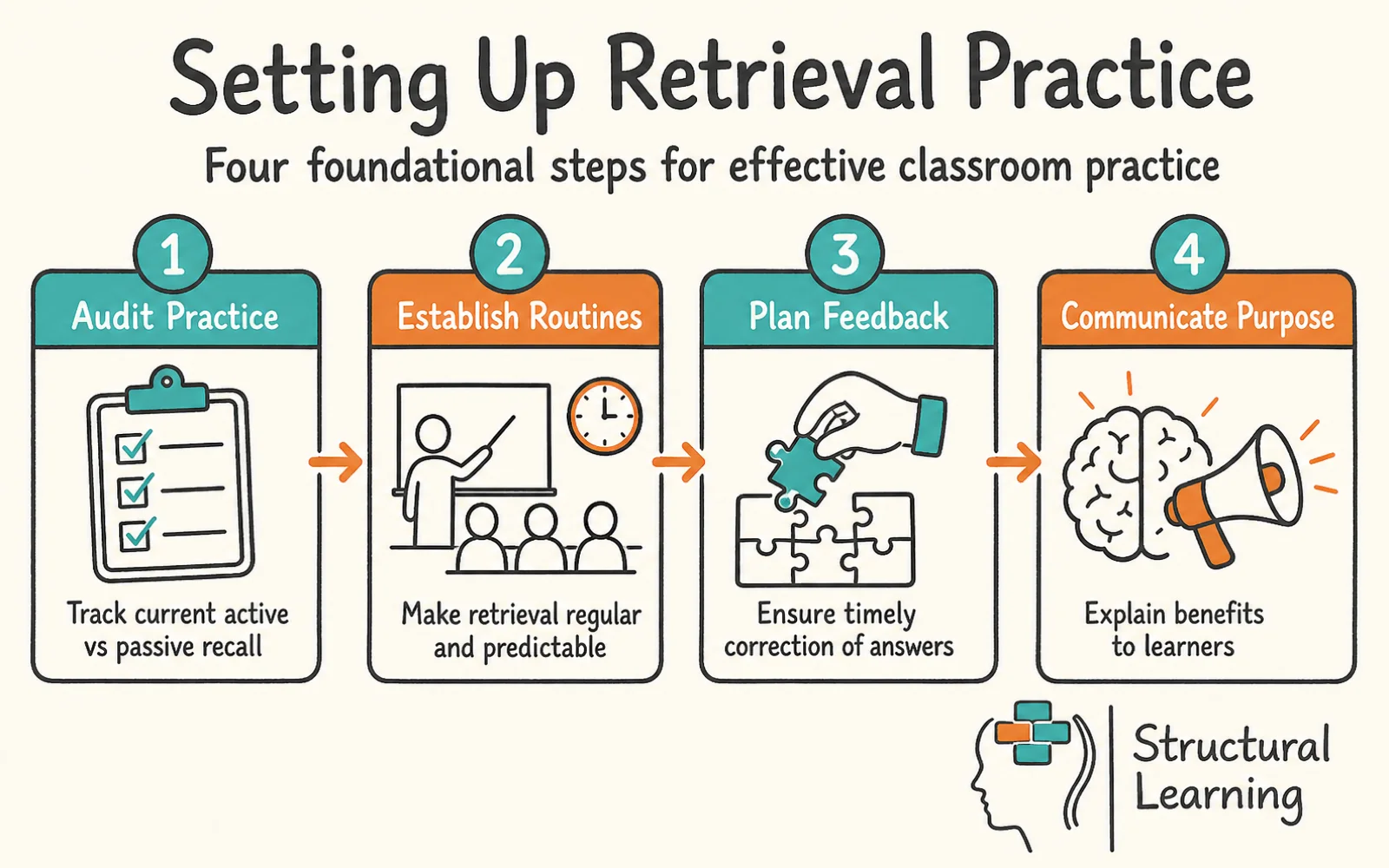
The Testing Effect infographic showing the steps to audit practice, establish routines, plan feedback, and communicate purpose in the classroom
Setting Up Retrieval

Retrieval practice works well, but the EEF notes a difference between research and classrooms. School studies often use test-like questions (Donoghue & Hattie, 2021). Feedback significantly changes how well retrieval practice works.

Retrieval practice helps learners remember (Karpicke, 2012). Use the Chartered College of Teaching guidance. The Learning Scientists provide practical resources.

Before You Begin: Setting Up Retrieval Practice

The testing effect, or retrieval practice, strengthens memory through active recall. Quizzes and low-stakes tests are useful tools. Learners gain more from active retrieval, rather than re-reading (Roediger & Karpicke, 2006). This improves their long-term retention (Karpicke & Blunt, 2011) and understanding.

Retrieval practice needs careful set-up. The evidence base supports low-stakes, repeated retrieval with feedback and clear routines rather than surprise testing or disconnected quizzes (Brown, Roediger, & McDaniel, 2014; Roediger & Butler, 2011). Do not skip preparation; retrieval works best when learners know its purpose and the task is matched to the knowledge you want them to remember.

Audit your current assessment. How often do learners recall information versus passively reviewing? Track a typical week: count retrieval activities against passive ones. Many teachers find they use retrieval practice less than they expect. (Brown, Roediger, & McDaniel, 2014).

Next, establish clear routines that make retrieval practise predictable rather than threatening. Begin each lesson with a five-minute "knowledge check" using whiteboards or quick-fire questions from previous topics. This transforms testing from a high-stakes event into a regular learning tool. Year 7 maths teacher Sarah Mills starts every lesson with three questions: one from yesterday, one from last week, and one from last term. Her students now expect it, prepare for it, and actually request more practise questions.
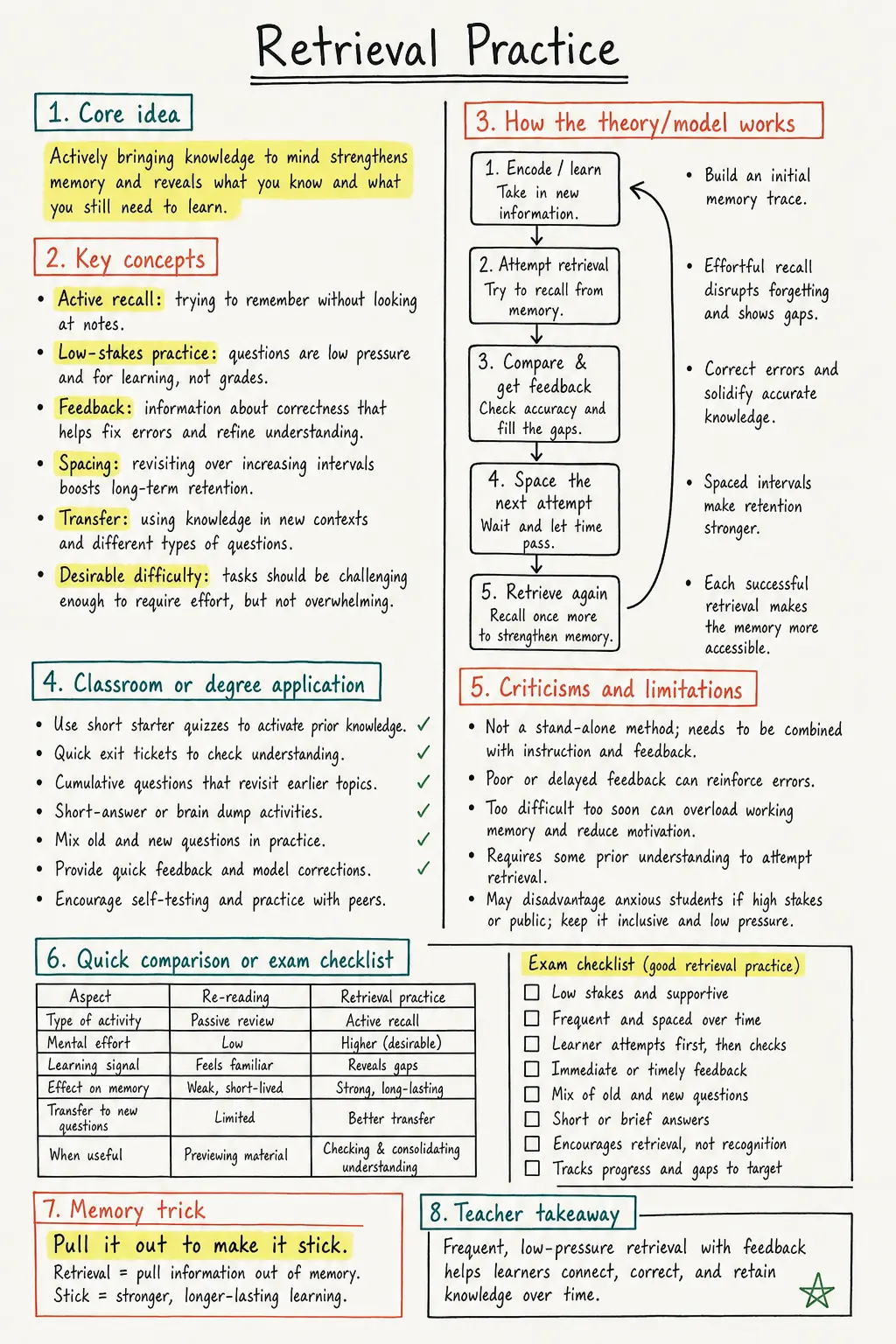
Retrieval Practice Study Notes preview
◆ Structural Learning
Retrieval Practice Study Notes
Study notesOne-page revision sheet

Download a one-page study note for Retrieval Practice, with the key ideas, limitations and classroom links in one place.

Something went wrong - please try again.

Before retrieval practice, check your feedback. Learners could remember errors if not corrected quickly. Simple methods are effective: use answer keys, peer checks, or whole-class reviews right after. (Agarwal et al., 2012; Brown et al., 2014; Roediger & Butler, 2011) Ensure learners know their results within the lesson.

Finally, communicate the purpose clearly to students. Explain that these aren't tests to catch them out, but tools to strengthen their memory. Show them the research; students often become more engaged when they understand the science behind what you're asking themto do.

Retrieval Practice Techniques: Effectiveness Comparison

Technique How It Works Effectiveness Best For
Free Recall Students write everything they remember without prompts or cues ★★★★★ Highest Building strong memory traces; identifying knowledge gaps; deepest encoding
Cued Recall Prompts or partial information trigger retrieval (e.g., fill-in-blanks) ★★★★☆ High Supporting struggling learners; vocabulary; definitions; scaffolded practice
Short-Answer Questions Open-ended questions requiring generated responses ★★★★☆ High Factual knowledge; conceptual understanding; quick formative assessment
Multiple Choice Recognition from options (must be well-designed with plausible distractors) ★★★☆☆ Moderate Large classes; quick checks; diagnostic testing; exam preparation
Elaborative Retrieval Recall plus explanation of why/how (connecting to prior knowledge) ★★★★★ Highest Deep understanding; transfer; complex concepts; higher-order thinking
Concept Mapping from Memory Creating visual representations of knowledge without notes ★★★★☆ High Relationships between ideas; schema building; revision summaries
Teach-Back Students explain content to peers as if teaching ★★★★★ Highest Identifying misconceptions; consolidation; social learning; metacognition

Based on research by Roediger & Butler (2011), Karpicke & Blunt (2011), and Rowland (2014). The testing effect works because retrieval strengthens memory traces more than re-reading, highlighting, or passive review.

The Testing Effect Podcast
Listen to this guide's key ideas.
~22 min

Types of Retrieval Practice: Active vs Passive Methods

Roediger and Karpicke (2006) showed retrieval boosts learning. Active methods, unlike passive ones, create lasting gains. Use testing to promote deeper learning for each learner.
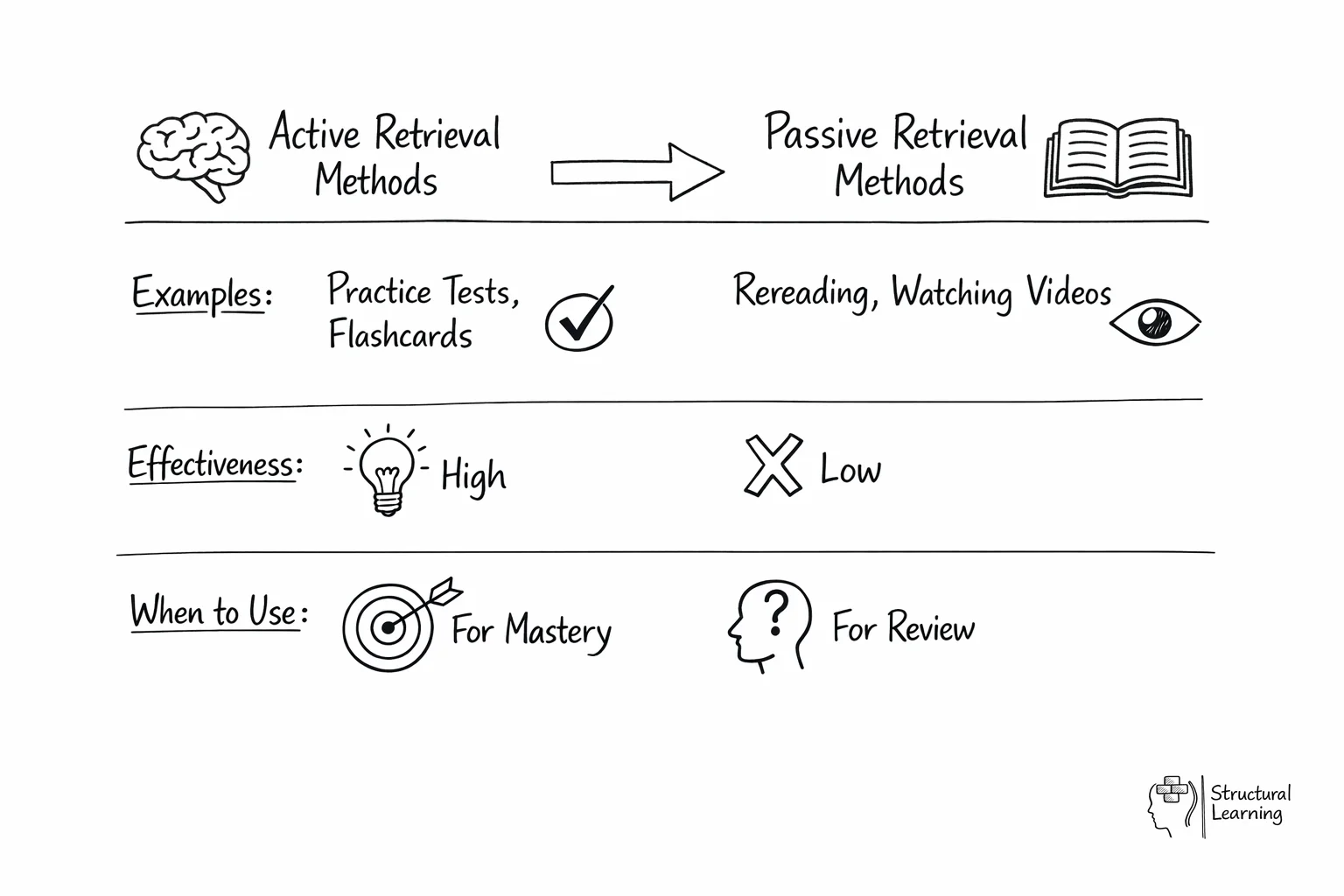
Comparison chart showing active vs passive retrieval practice methods with examples and usage guidance
Side-by-side comparison table: Active vs Passive Retrieval Practice Methods

Active retrieval asks learners to recall information without prompts. For example, Year 9 learners write all they know on photosynthesis. Karpicke and Blunt (2011) showed active retrieval improved retention by 50%. Learners remember more a week later compared to note review.

These methods still support learners but give recognition cues. Multiple choice, matching and cloze tasks can reduce cognitive load during early retrieval, while free recall and short-answer questions usually create a stronger retrieval demand (Dunlosky et al., 2013; Rowland, 2014). For Shakespeare, use multiple-choice questions on character motivations before asking learners to justify their answer in writing.

Passive learning builds learner confidence at the start (Vygotsky, 1978). Year 7 French learners match words to pictures. Next, they write French sentences from memory. GCSE learners can answer multiple choice questions (Bloom, 1956). Then, they write balanced chemical equations unaided (Atkinson & Shiffrin, 1968).

Learners stay engaged with mixed methods. Begin lessons with brief multiple choice questions. Then, learners explain answers in pairs. Finally, learners create test questions.

Step-by-Step Guide to Implementing Retrieval Practice

Making retrieval practice work in your classroom doesn't require a complete overhaul of your teaching methods. Here's a straightforward approach to get started:

Step 1: Start small with exit tickets. In the final five minutes of each lesson, ask students to write down three key points from memory without looking at their notes. This simple activity activates retrieval whilst the material is still fresh. For example, after a Year 9 history lesson on the Industrial Revolution, students might recall three changes to working conditions.

Step 2: Build in regular low-stakes quizzing. Begin each lesson with five quick-fire questions about previous topics. Keep these informal; use mini whiteboards or verbal responses to reduce anxiety. A maths teacher might start Monday's lesson asking students to solve problems from last Wednesday's work on algebraic expressions.

Step 3: Space your practise intervals. Rather than testing content immediately, wait a day, then a week, then a fortnight. This spacing forces effortful retrieval, which strengthens memory pathways. Research by Cepeda et al. (2006) suggests optimal spacing intervals depend on how long you need students to remember the material.

Offer learners specific feedback right away. Correct any errors directly. Explain why answers are wrong, don't just mark them so (Roediger & Butler, 2011). Give learners the right answers too. This retrieval and feedback helps learning.

Track progress and adapt activities. Note topics needing more retrieval practice. If learners struggle with concepts, offer frequent retrieval, (Bjork, 1992). Maintain spaced practice for mastered content areas, (Ebbinghaus, 1885; Karpicke & Roediger, 2007).
Slide deck preview
Free slide deck
The key ideas on this topic as classroom-ready slides.
Something went wrong — please try again.
✓ On its way. Download the slides now.
One email, instant download. No spam.

18 Retrieval Practice Activities That Boost Long-Term Retention

Retrieval practice is supported by a broad research base showing that low-stakes testing can improve long-term retention when it is spaced, purposeful and followed by useful feedback (Roediger & Karpicke, 2006; Rowland, 2014). It helps learners build and keep knowledge without turning every classroom check into a high-stakes assessment.

  1. Brain Dump Starters: Begin lessons with 3-5 minutes of free recall - students write everything they remember about the previous lesson or topic without notes. This retrieval practice strategy activates prior knowledge, identifies gaps, and primes the brain for new learning. Review brain dumps to spot common misconceptions.
  2. Exit Ticket Retrieval: End lessons with three quick questions: What were the key points? What's one thing you found challenging? What question do you still have? These retrieval-based exit tickets strengthen memory whilst providing formative assessment data.
  3. Two Things Tuesday (Daily Retrieval): On entry, students write two facts they remember from the previous lesson. This simple testing effect routine takes just 2-3 minutes but compounds dramatically over time. Vary the prompt: "Two key terms," "Two examples," "Two connections."
  4. Retrieval Grids: Create tables where students must recall information across different categories or time periods. A history grid might have rows for different events and columns for causes, key figures, and consequences. Filling from memory maximises the testing effect.
  5. Think-Pair-Share Retrieval: Pose a question, give students silent thinking time to retrieve individually, then pair discussion, then whole-class sharing. The individual retrieval phase is essential - don't let it become immediate partner discussion.
  6. Flashcard Rotation: Students create flashcards and rotate them weekly with classmates. Testing themselves on unfamiliar cards provides spaced retrieval practice on varied content. Digital platforms like Quizlet enable class-wide flashcard sharing.
  7. Quiz-Quiz-Trade: Students write questions on cards, then circulate asking their question, answering their partner's question, and swapping cards before finding new partners. This social retrieval practice generates high engagement and multiple retrieval attempts.
  8. Retrieval Relay Races: Teams compete to answer rapid-fire recall questions. One student answers, tags the next teammate, who must answer the next question. Gamification increases engagement whilst maintaining retrieval challenge.
  9. Elaborative Interrogation Prompts: After students recall facts, push deeper: "Why does that make sense?" "How does that connect to what we learned about..?" This elaborative retrieval builds richer understanding than simple recall alone.
  10. Spaced Retrieval Calendars: Schedule retrieval practice on topics at increasing intervals: Day 1, Day 3, Day 7, Day 14, Day 28. This spacing effect combined with retrieval practice produces exceptional long-term retention. Use a calendar to track which topics need revisiting.
  11. Low-Stakes Weekly Quizzes: Implement short, frequent quizzes counting minimally toward grades. The testing effect works best when anxiety is low. Research shows students who are regularly quizzed dramatically outperform those who only study.
  12. Retrieval Practice Homework: Instead of passive reading homework, assign retrieval tasks: "Write everything you remember about photosynthesis" before providing notes to compare. This tests-before-study approach uses the pretesting effect.
  13. Cumulative Retrieval Reviews: Include questions from previous units on every assessment. This cumulative testing maintains older learning whilst naturally providing spaced practice. Students expect they must remember everything, not just recent content.
  14. Concept Mapping from Memory: Students create visual diagrams showing concept relationships without referring to notes. Then compare with materials to identify gaps. This combines dual coding with retrieval practice.
  15. Peer Teaching Stations: Students prepare to teach a concept, then rotate through stations explaining to different partners. The act of teaching requires retrieval and organisation - explain-to-understand uses the testing effect powerfully.
  16. Retrieval Practice Playlists: Create question banks organised by topic and difficulty. Students self-select questions to test themselves, building metacognitive awareness alongside retrieval practice. Apps like Retrieval Roulette provide ready-made question sets.
  17. Last Lesson, Last Week, Last Unit: Each starter includes three retrieval questions: one from the previous lesson, one from the previous week, one from earlier in the unit. This simple structure builds automatic spaced retrieval into daily routines.
  18. Successively Relearning: Students study until they can recall correctly, then practise retrieval at increasing intervals until they achieve three consecutive correct recalls. This criterion-based approach ensures mastery before moving on.

The testing effect, researched by many, is key. Retrieval practice beats rereading (Roediger & Butler, 2011). Space out regular, low stakes tests. Learners may resist initially, as retrieval feels hard. But they'll quickly see retention improves (Karpicke & Blunt, 2011; Dunlosky et al., 2013).

Teacher and learners use low-stakes recall before feedback in a primary classroom.
The Anatomy of Retrieval Practice in practice: learners retrieve before the teacher reteaches.

Related Classroom Guides

Further Reading: Verified Sources on the Testing Effect and Retrieval Practice

These sources replace placeholder names and incomplete Further Reading entries with traceable DOI records for retrieval practice, classroom testing, meta-analysis and spaced practice.

Test widget placeholder

Use this interactive tool to plan learner retrieval practice. Choose your topics and spacing intervals. Generate a revision calendar that uses the testing effect (Roediger & Karpicke, 2006). Frequent testing improves learning (Kornell & Bjork, 2008; Karpicke, 2012).

Quick-check quiz
10-question self-test
Q1
0%

Spaced Practice Revision Scheduler

Generate an evidence-based revision timetable using the spacing effect

This tool creates revision schedules with increasing gaps using your topic and start date. Learners can use it to plan homework. Teachers can use it to sequence retrieval practice (Rohrer & Pashler, 2007). Spaced practice helps learners retain information for longer (Cepeda et al., 2008; Kang, 2016).

Spaced practice is one of the most robust findings in cognitive science. Distributing practice across time, rather than massing it, produces stronger and more durable memories. The spacing effect has been replicated thousands of times across subjects and age groups.

(Ebbinghaus, 1885; Cepeda et al., 2006)

  1. Enter the topic and start date.
  2. Choose the number of review sessions.
  3. Download or copy the generated schedule with dates and suggested review methods.
Topic name
First taught on
Subject
Retention goal
Your spaced practice timeline
Copied to clipboard!
Paul Main, Founder of Structural Learning
About the Author
Paul Main
Founder & Metacognition Researcher

Paul Main is an educator and metacognition researcher who founded Structural Learning in 2002. With a psychology degree from the University of Sunderland and 22+ years helping schools embed thinking skills, he bridges the gap between educational research and classroom practice. Fellow of the RSA and Chartered College of Teaching, with 128+ Google Scholar citations.

More →

Revision

Back to Blog