The Pretesting Effect: Why Testing Before Teaching Works
The pretesting effect shows that assessing learners before teaching enhances their learning, even with wrong answers, giving teachers a powerful strategy.


The pretesting effect shows that assessing learners before teaching enhances their learning, even with wrong answers, giving teachers a powerful strategy.
Testing students on material they haven't yet learned might seem counterproductive. Why quiz learners on content they're bound to get wrong? Yet a growing body of research reveals something unexpected: unsuccessful retrieval attempts before learning actually enhance how well students acquire and retain new information. This counterintuitive finding, known as the pretesting effect, suggests that errors made in the right context don't hinder learning; they prepare the mind for it.
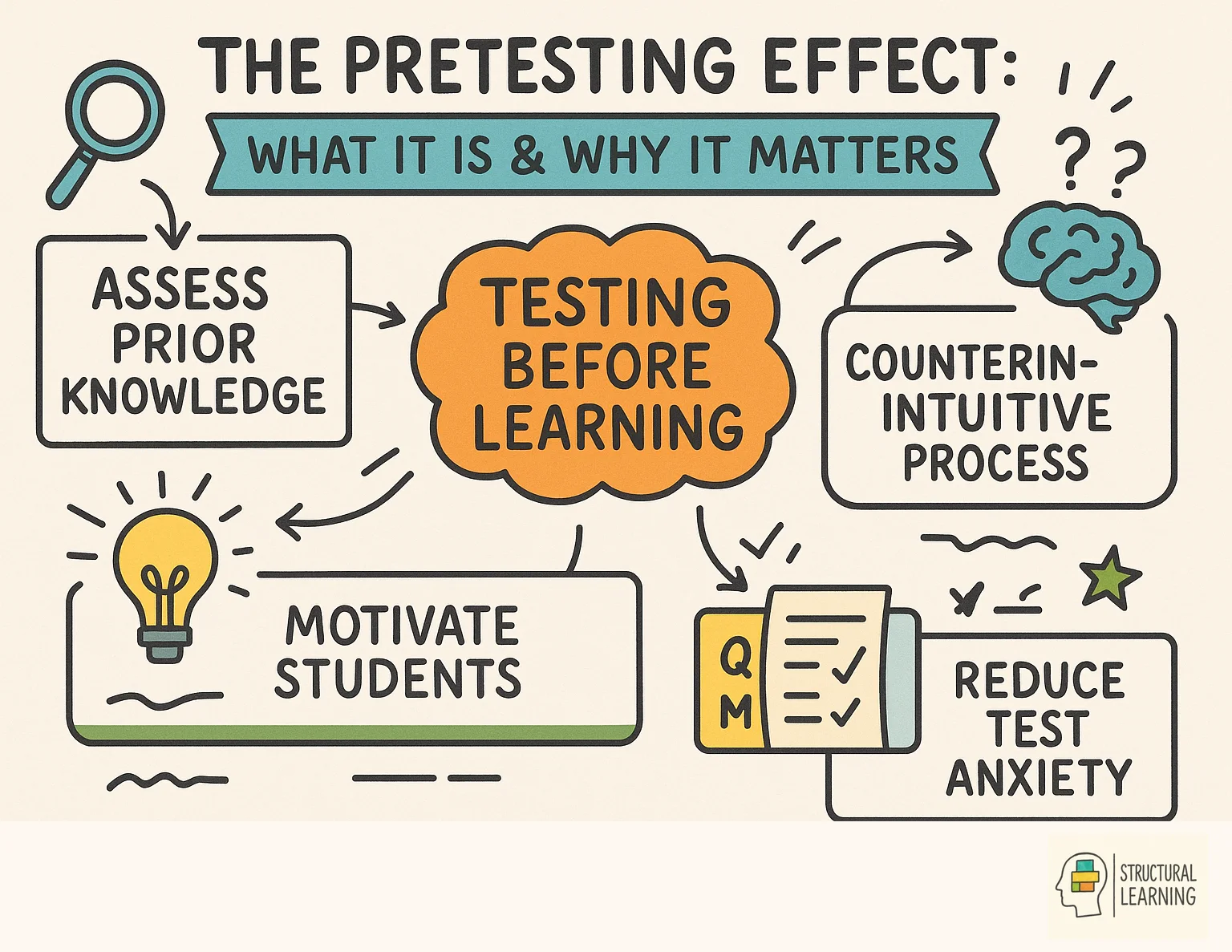
Pretesting improves learner memory, say researchers. (Roediger & Karpicke, 2006). It is the prequestioning or errorful generation effect. Learners understand new information better by testing first. Incorrect answers on pretests are helpful. (Kornell, Hays & Bjork, 2009).
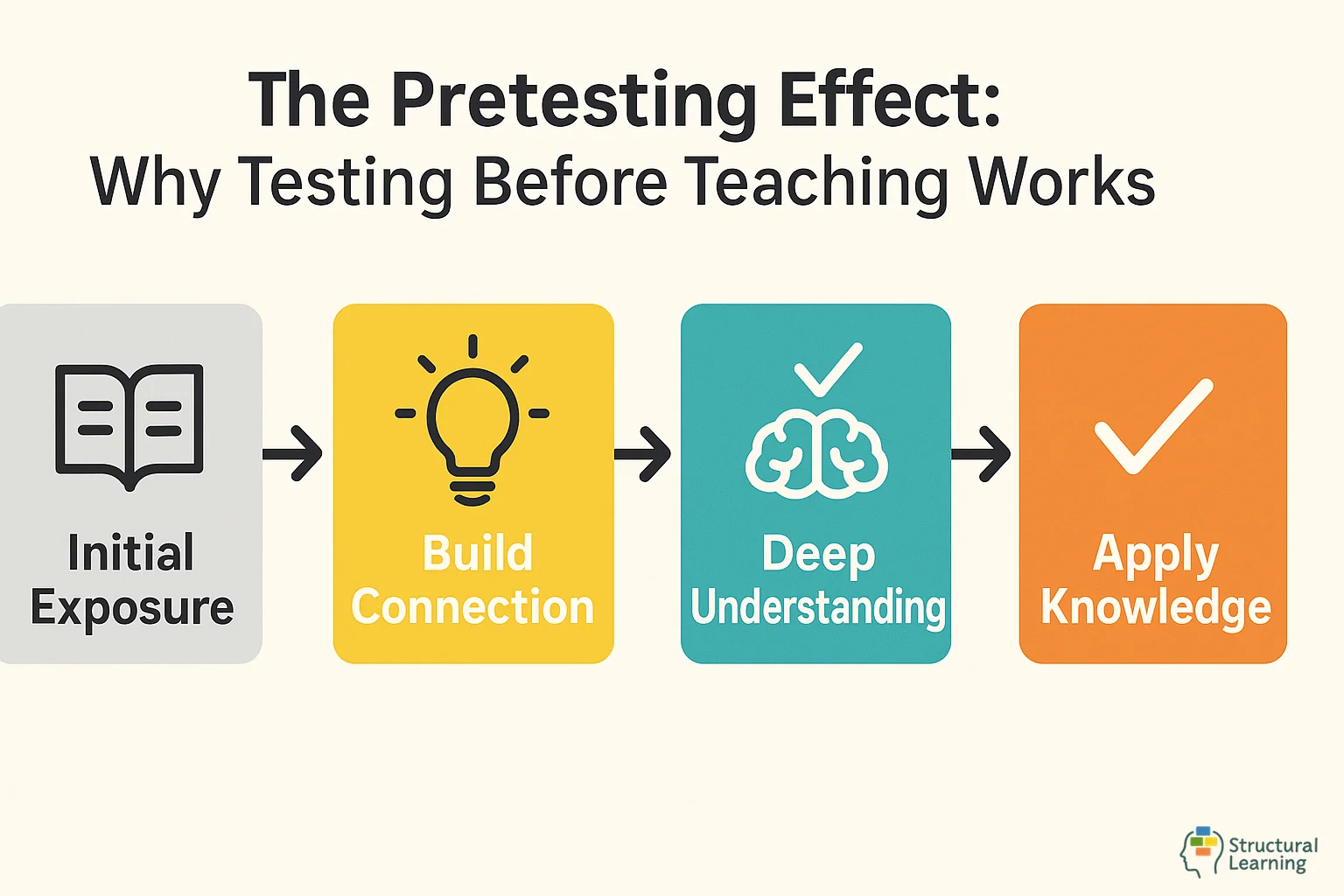
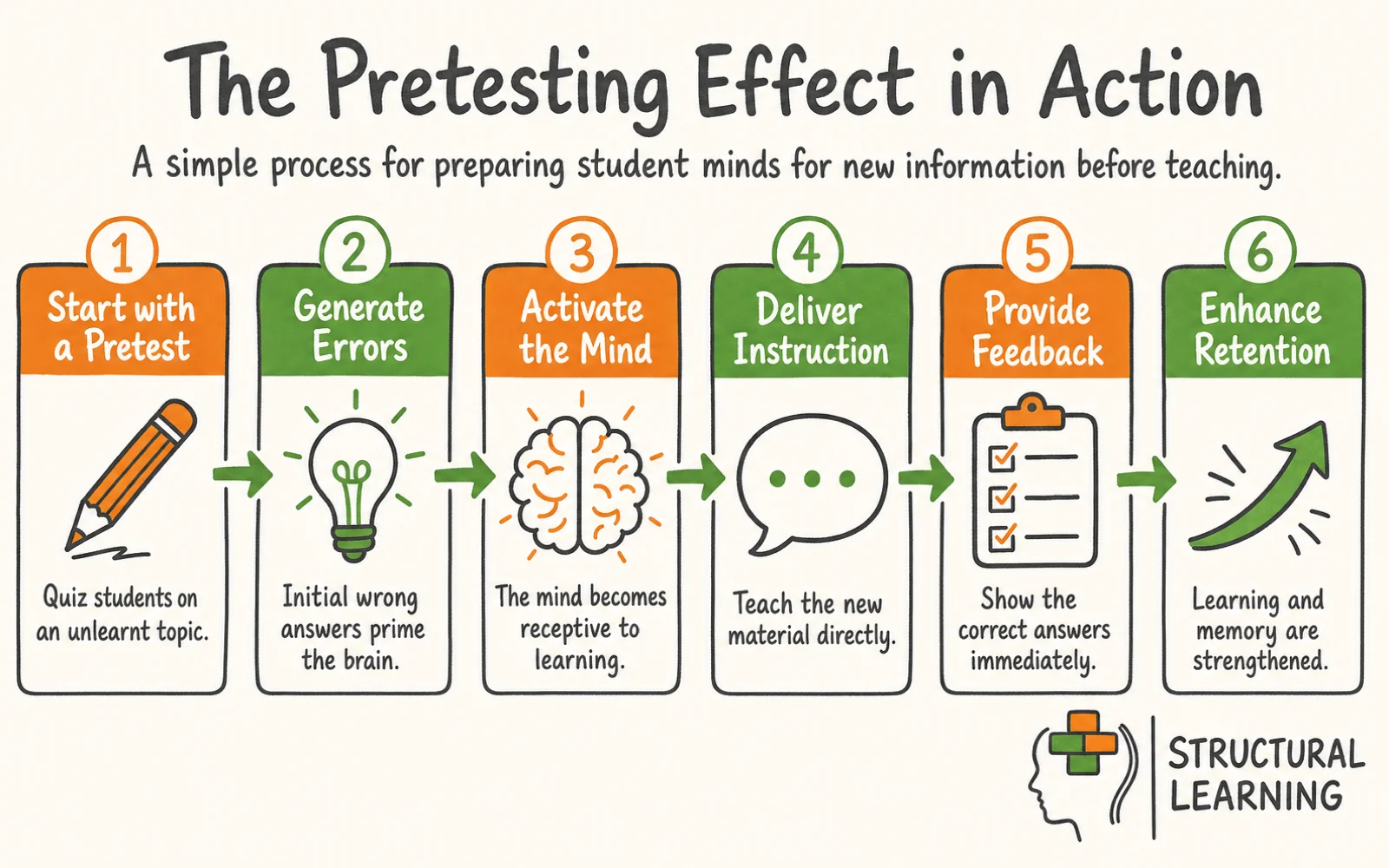
Consider a typical demonstration: one group of students takes a short quiz on a topic they haven't yet studied, getting most answers wrong. A second group spends the same time doing an unrelated activity. Both groups then receive identical instruction on the topic. When tested afterwards, the pretested group consistently outperforms the control group, despite their initial errors.
Research by Kornell, Hays, and Bjork (2009) shows errors can help learners. Pretesting, when done right, aids retention. Exposing learners to mistakes, followed by corrections, boosts learning, research shows (Metcalfe, 2017; Richland, Kornell, & Kao, 2009).
Richland, Kornell, and Kao (2009) popularised "pretesting effect", building on earlier work. Research interest has grown recently. Studies explore limits, reasons, and uses of pretesting for the learner.
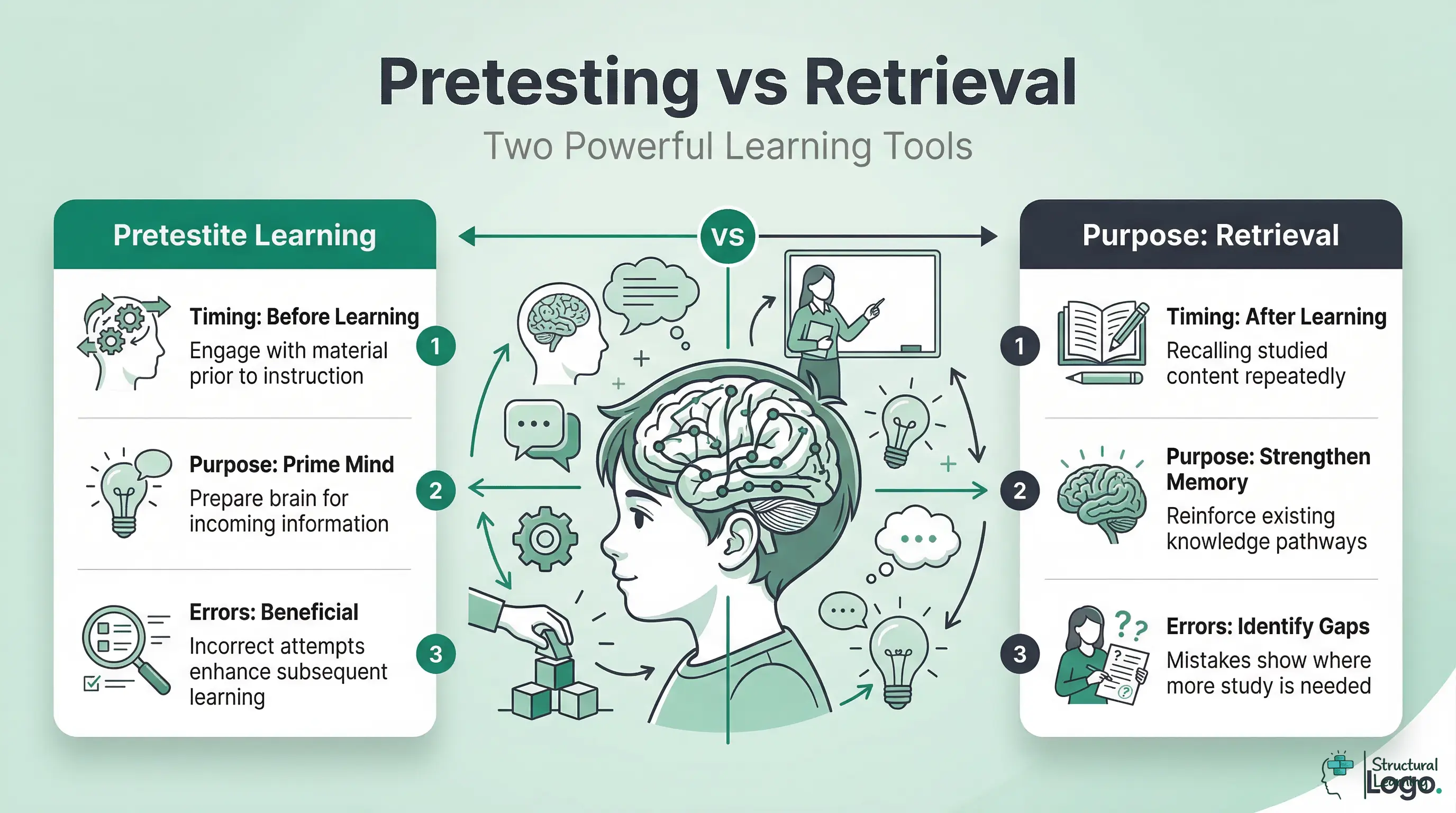
Researchers highlight contrasting effects. Pretesting, testing learners before teaching, helps future learning (Little & Bjork, 2016). Regular testing, on taught content, improves knowledge recall (Roediger & Karpicke, 2006). Both techniques boost learning, but function via separate cognitive routes (Metcalfe & Kornell, 2007).
Understanding the pretesting effect requires distinguishing it from related phenomena in the learning sciences.
Researchers such as Carrier and Pashler (1992) show retrieval strengthens memory. Practise tests help learners recall information well. Successful recall improves retention, say Roediger and Karpicke (2006). Testing helps learners remember, as found by Rowland (2014).
Pretesting happens before learning begins, so correct answers are unlikely (Kang et al., 2007). Learners guess, often wrongly, but later learning improves (Potts & Shanks, 2014). Thus, the reasons differ from standard testing effects (Arnold & McDermott, 2013).
Kapur's (2016) productive failure research shows initial problem struggles help learning. This works well for complex ideas. It's related to pretesting, but has learners try longer and create solutions.
Pretesting uses definitions and short questions to check memory. found overlap between different research approaches. These approaches focus on varied aspects of how learners learn from errors.
Bjork's desirable-difficulties work helps explain why effortful conditions can sometimes improve later retention, but the principle should be used carefully. Pretesting is useful when the difficulty is low stakes, followed by clear teaching, and connected to the target content (Kornell, Hays & Bjork, 2009; Little & Bjork, 2016).
Retrieval boosts learning after failure, say researchers. Several overlapping reasons may explain this (e.g. Bjork, 1975; Karpicke & Roediger, 2008; Pyc & Rawson, 2009). These explanations suggest multiple processes help the learner.
Researchers propose pretesting focuses learner attention on new information. Learners try to answer questions, then realise they don't know the material. This highlights knowledge gaps and creates a "need to know" (Richland et al., 2009). Learners then focus during instruction.
Pretesting, say researchers, reduces mind wandering when learners watch lectures (e.g. Szpunar, Khan & Schacter, 2013). Studies show learners report better focus after pretests (e.g. Richland, Kornell & Kao, 2009). This focused attention helps learners in distracting situations (e.g. Karpicke, 2012).
Pretesting might spark learners' curiosity regarding attention. Generating guesses makes learners invested while awaiting feedback (Metcalfe, 2017). This curiosity motivates them and improves how they encode correct answers (Kang et al., 2011; Richland et al., 2009).
Information presented as an answer to a question one has already contemplated may be processed more deeply than the same information presented without such priming. The learner's mind is already engaged with the relevant conceptual territory.
According to research (Richland et al., 2009), pretest questions activate prior knowledge. Even incorrect answers prompt related concept activation (Rawson & Dunlosky, 2011). This creates a network for new learning, says research by Karpicke and Blunt (2011). Learners integrate correct answers into this network (Pyc & Rawson, 2009).
Research shows existing knowledge impacts learning. If a learner guesses "Sydney" for Australia's capital, they activate related knowledge. Learning "Canberra" connects to this active network (Anderson, 1983). New information integrates more easily if the learner already knows something about the topic (Bransford et al., 2000).
Errors may enhance learning precisely because they're corrected. The discrepancy between what one believed (the incorrect guess) and reality (the correct answer) creates what some researchers call a prediction error signal. This signal may trigger enhanced attention and deeper processing of the corrective information.
(Metcalfe & Kornell, 2007) found pretesting helps learners remember better. Expectation violation, found in error correction, may explain this. (Friston, 2005) showed the brain notices unexpected information.
Pretesting helps learners create mental frameworks for new information. Considering prior knowledge supports learning (Ausubel, 1968). This helps learners organise later information (Anderson, 1990; Wittrock, 1974).
Metcalfe and Finn (2011) argue pretesting readies the learner's mind. It prepares them for a whole subject area, not just single questions. Karpicke and Roediger (2007) found pretesting improves later learning too.
Multiple studies show students who take pretests score significantly better (effect sizes d = 0.35-0.75) on final assessments than those who only study. Research across subjects from vocabulary to science concepts demonstrates consistent benefits when learners attempt questions before instruction. The effect has been replicated in laboratory and classroom settings with learners of various ages.
The pretesting effect has been demonstrated across diverse materials, settings, and populations.
Pretesting helps learners remember, say Richland, Kornell, and Kao (2009). Their work found pretests improved final test scores after reading. This happened even when learners got pretest questions wrong at first.
Subsequent studies have replicated and extended these findings using word pairs, trivia facts, scientific texts, and educational videos. The effect appears strong across different materials and test formats.
Pan, Schmitt, Bjork and Sana (2020) found that answering pretest questions before online lectures reduced mind wandering and improved later learning. This supports short prequestions before videos or teacher explanation, especially when attention is likely to drift.
Soderstrom and Bjork (2023) reported classroom evidence for pretesting in authentic course conditions. The result should be presented cautiously: the evidence supports pretesting as a practical learning routine, but it does not mean every pretest, subject or learner group will benefit equally.
Pretesting helps learners remember, research shows (Agarwal et al., 2012). Use pretesting as a simple, useful teaching strategy, not just a research idea. Don't ignore its practical classroom benefits (Roediger & Butler, 2011; Karpicke & Blunt, 2011).
Recent review evidence is better represented by Pan and Carpenter (2023), who describe prequestioning and pretesting as generally beneficial but moderated by question type, feedback, material and timing. Treat the effect as useful and evidence-informed, not as a guaranteed classroom gain.
Pretesting works best when questions target central lesson ideas, are low stakes and are followed by accurate feedback or instruction. Use Richland, Kornell and Kao (2009), Potts and Shanks (2014), Little and Bjork (2016), and Pan and Carpenter (2023) for the conditions and cautions.
While pretesting generally enhances learning, several factors moderate its effectiveness.
Corrective feedback after pretesting is key. Without it, pretesting benefits drop significantly, as shown by . Learners must see correct answers for pretesting to work well.
Pretests should be low stakes (Agarwal et al., 2008). Learners benefit when teachers give correct answers afterwards (Black & Wiliam, 1998). High-stakes tests risk learners making errors that go uncorrected (Bangert-Drowns et al., 1991).
Feedback timing is a design choice. Immediate feedback is useful when learners need the correct answer before instruction continues; delayed feedback can still work when the subsequent lesson resolves the question clearly. The safer classroom rule is to make sure feedback happens, is accurate and returns to the original pretest attempt (Potts & Shanks, 2014; Pan & Sana, 2021).
Some research suggests pretesting benefits are largest when the format of the pretest matches the format of the final assessment. If students will eventually take a short-answer test, short-answer pretests may be more effective than multiple-choice pretests.
Format matching can matter, but it should not be overstated. If the final task is short answer, a short-answer pretest may be more diagnostic than recognition alone. Multiple-choice pretests can still be useful when the options are well designed and the later teaching resolves the misconception (Little & Bjork, 2016; Pan & Carpenter, 2023).
Students with some relevant background knowledge may benefit more from pretesting than complete novices. Some prior knowledge provides material for the activation and search processes that support pretesting benefits. Complete novices may have no relevant knowledge to activate.
That said, pretesting benefits have been found even with novel material where prior specific knowledge is minimal. The activation of general schemas and frameworks may still occur.
Pretests that are moderately challenging, generating some errors but not complete failure, may be optimal. If pretests are too easy, they may not activate the mechanisms that drive pretesting benefits. If too difficult, students may disengage or become frustrated.
Use brief pretests at the beginning of lessons to prime students for incoming content. A few questions about today's topic, before any instruction begins, can activate relevant prior knowledge and focus attention.
These pretests should be framed as "thinking warm-ups" or "curious about what you already know" activities rather than graded assessments. The goal is activating minds, not evaluating knowledge.
Before students read textbook chapters or other texts, provide questions they should consider while reading. These function as pretests even if students don't formally record answers. The questions prime reading comprehension by highlighting what's important and creating purpose for reading.
Introducing questions beforehand focuses learners. They try answering before video or lecture. Research by and shows this reduces mind wandering. It also improves learner outcomes, noted.
Design homework that includes questions on upcoming topics alongside review of previous material. When students encounter questions they can't yet answer, they're being primed for the next lesson.
At the start of new units, give students a preview quiz covering material the unit will address. Collect the quizzes without grading, then return them at unit's end for students to see their growth. This approach uses pretesting while also providing motivating evidence of learning.
Before introducing new concepts through direct instruction, pose open questions that invite speculation. "Why do you think volcanoes are more common in some places than others?" Even incorrect speculation activates the mind for subsequent explanation.
Teachers reasonably worry that exposing students to errors will reinforce those mistakes. Research consistently shows otherwise: when errors are followed by corrective feedback, learning is enhanced, not hindered. The key is ensuring correction follows errors.
Skinner (1953) showed errorless learning helps some learners. Rose and Meyer (2002) stressed tailoring lessons. Neurotypical learners also gain from this approach; consider all needs.
Students may indeed find pretests initially frustrating if they expect to succeed and don't. Framing matters enormously. Present pretests as "brain priming" activities designed to get minds ready, not as assessments of what students should already know.
Learners feel less frustrated when they know errors aid learning. Share pretesting research with older learners (Rohrer et al., 2021). This helps them grasp how learning strategies work (Dunlosky et al., 2013).
Research (Kang, 2011; McDaniel et al., 2013) shows pretesting works in many subjects. This includes science and history. The effect is broad (Pan, 2015), not limited to one subject. Effective pretests depend on the subject, say researchers (Roediger & Butler, 2011).
Pretests should be brief. A few minutes of priming provides substantial benefits without consuming significant instructional time. Three to five questions before a lesson or video is typically sufficient.
Pretesting readies learners for practice and assessment. Try it before lessons or new topics. This strengthens learning alongside current teaching (Little & Bjork, 2016; Karpicke & Roediger, 2008).
According to research, pretesting, spaced practice, retrieval practice, and interleaving can boost learning. These methods make learning feel harder initially but improve long-term retention (Bjork & Bjork, 1992).
Spacing out learning strengthens memory via the testing effect. The Retrieve It framework uses this. (Karpicke, 2012; Roediger & Butler, 2011) Learners remember more with spaced practice. (Cull, 2000; Cepeda et al., 2008).
This promotes better learning outcomes (Hattie, 2009). Instructional clarity benefits learners in multiple ways (Kirschner, 2002). Teachers benefit from understanding why strategies work. This knowledge helps them implement strategies well and explain them to learners (Willingham, 2010).
Pretesting is easy to use. It needs little change to your teaching, unlike some strategies. Teachers can start by asking learners questions before new topics (Bangert-Drowns et al., 1991; Doabler et al., 2015; Frey et al., 2017).
Frame pretests as learning opportunities by explaining that errors can prepare learners to notice the later explanation. Celebrate effort and curiosity rather than correctness, and make the routine visibly low stakes so mistakes become useful information rather than public failure.
Learners gain from pretesting, but some dislike making mistakes. Normalising errors in class helps pretesting work (Kang et al., 2007). Valuing errors also supports wider learner goals (Metcalfe, 2017).
Researchers like Kapur (2016) say discuss errors openly. Share stories of success from mistakes, like Duckworth (2016) suggests. Show learners how to respond well to your own errors. These actions support pretesting and healthy mindsets (Dweck, 2006).
Do not present pretests as a test of worth. Explain that the class is expected to get many answers wrong, that answers are not graded and that the point is to make the later explanation easier to notice. This framing is a classroom implementation principle; Roediger and Karpicke (2006) should be used for retrieval practice, not as proof that pretesting reduces anxiety.
Pretesting works well alongside other supported learning routines. After a pretest, learners can compare answers, discuss why an option was tempting and then retrieve the corrected idea later. This combination is best treated as an application of pretesting plus feedback, elaboration and retrieval practice, not as a separate finding from placeholder citations.
Pretesting works well in combination with other scientifically supported approaches.
Priming activates relevant prior knowledge before learners engage with instruction. Retrieval practice after teaching helps solidify that new knowledge (Karpicke & Blunt, 2011). This strategy aids long term retention (Roediger & Butler, 2011; Rowland, 2014).
Pretests show gaps in learner understanding. Teachers can then directly tackle misconceptions and build upon existing knowledge. This focused approach, as suggested by researchers like Bangert-Drowns et al (1991) and Black & Wiliam (1998), improves pretest usefulness.
After instruction, retrieval practice helps consolidate the knowledge that pretesting made salient. Bring pretested content back after the lesson, then again after a delay, so learners have to retrieve the corrected idea rather than only recognise it (Roediger & Karpicke, 2006; Pan & Sana, 2021).
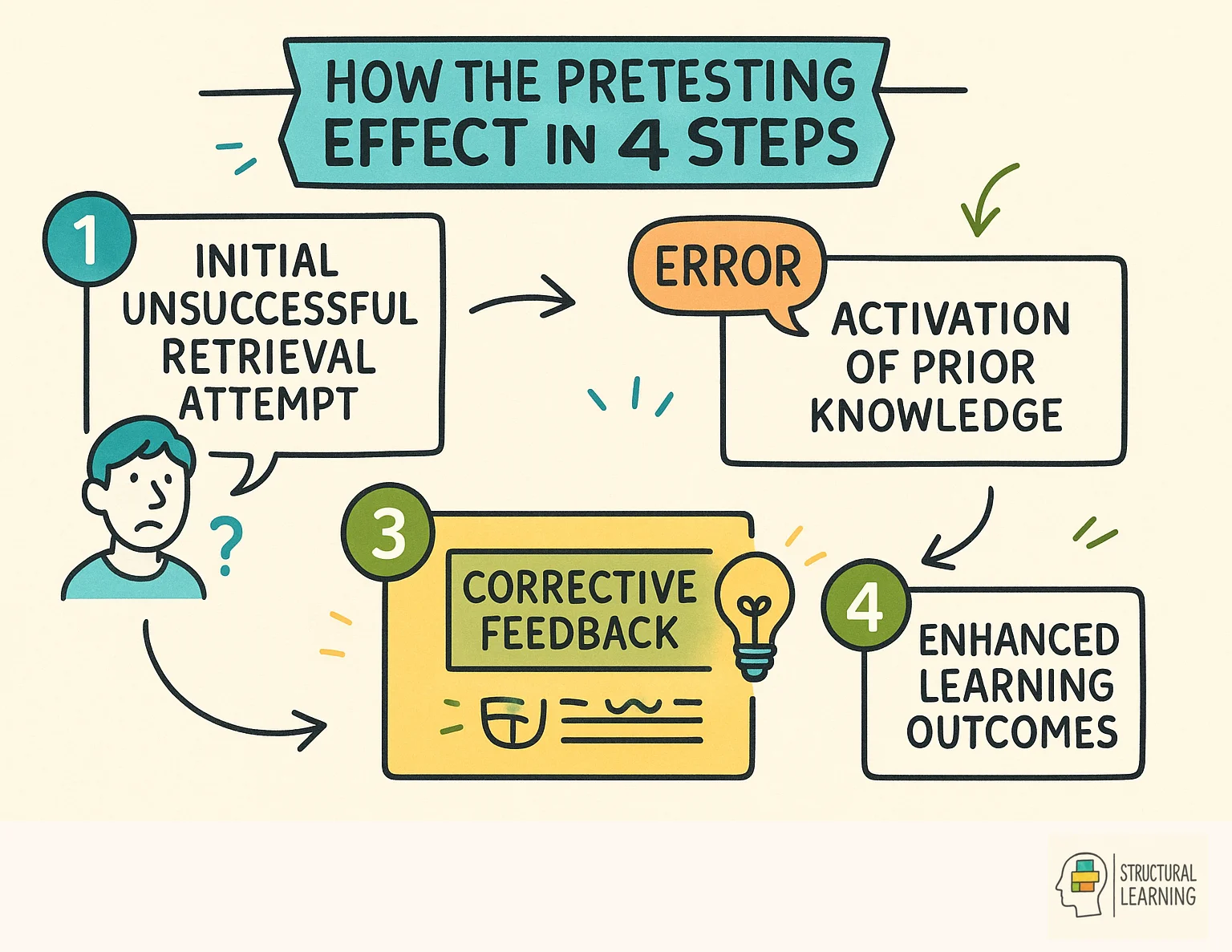
Pretesting helps learners learn better after trying questions on unseen topics. Richland, Kornell and Kao (2009), Kornell, Hays and Bjork (2009), and Potts and Shanks (2014) provide direct evidence that even wrong answers can prepare learners to encode the later correction more effectively.
Richland, Kornell and Kao (2009) show that pretesting can improve later test performance, but the size of the gain depends on the material, task and test. Present classroom percentages cautiously unless the same outcome is being measured.
In practical terms, imagine starting a Year 8 science lesson on photosynthesis by asking students to explain how plants make food, before any instruction. Most will provide incomplete or incorrect answers, perhaps mentioning sunlight and water but missing crucial details about chlorophyll or carbon dioxide. When you then teach the actual process, these students will pay closer attention to the gaps in their initial responses, creating stronger memories than if they'd simply listened passively to the explanation.
Pretesting works via three main methods. First, it sparks existing knowledge (Rohrer & Pashler, 2010). This creates "hooks" for later learning. Second, it makes learners curious about answers (Kang et al., 2011). This boosts focus when teaching. Third, it shows knowledge gaps (Metcalfe, 2017). Teachers can use starter questions, quizzes, or predictions before practicals.
Pretesting aids learning, so teachers should use it well. Cognitive psychology research shows that failed recall helps learners learn (Roediger & Butler, 2011; Kornell et al., 2009). This happens because of linked processes (Potts & Shanks, 2014; Rowland, 2014; Richland et al., 2009).
Pretesting sparks "productive failure" (Kapur, 2016). Learners try to answer questions before learning, actively problem-solving. Incorrect attempts build cognitive scaffolding, making later information stickier (Kapur, 2016). For example, ask Year 7 learners about seasons; they then build a framework for the tilt of the Earth.
Pretesting triggers hypercorrection (Butterfield & Metcalfe, 2001). Learners remember corrections better when wrong answers seemed logical. This works well in science or history, noted Metcalfe (2017). Ask learners about falling objects; most will likely be wrong. They will remember gravity’s acceleration better after this (Bangert-Drowns et al., 1991).
Pretesting can increase curiosity and attention when learners want to know whether their answer was right. Pan, Schmitt, Bjork and Sana (2020) support this attention route in online lectures, while Pan and Carpenter (2023) review the broader mechanism evidence. Provide quick feedback so learners correct errors while the question is still active.
Incorporating pretesting into your teaching practice doesn't require extensive preparation or resources. The key lies in strategic timing and thoughtful question design. Start by introducing brief pretests at the beginning of new units or topics, focusing on core concepts students will encounter during the lesson.
Researchers found pre-tests useful. Show learners pictures (biology) or ask prediction questions (chemistry). This triggers prior knowledge (Ausubel, 1968) and shows learning gaps. (Vygotsky, 1978). Focus learners' attention on new concepts. (Bransford et al, 2000).
Digital tools quickly check learners' prior knowledge. Online quizzes give instant misconception data, saving teaching time. Simple paper methods also work well (Wiliam, 2011). Use index cards with three key questions on the new topic (Black & Wiliam, 1998).
Provide answers in the same lesson when possible. Explain correct answers after learners try pretest questions, then address common errors. Feedback is the point at which the pretest becomes instruction rather than a list of wrong guesses.
Pretesting should feel informal. Frame it as a "curiosity check," not a test. Encourage learners to guess without fear. This approach helps learning and supports a positive classroom (Wiliam, 2011; Hattie, 2012). Errors become steps to understanding (Dweck, 2006).
The most useful source set for this article is narrower than the previous research list. Richland, Kornell and Kao (2009) and Kornell, Hays and Bjork (2009) anchor the claim that unsuccessful retrieval attempts can improve later learning. Potts and Shanks (2014) and Huelser and Metcalfe (2012) explain why generating and correcting errors can help, while Little and Bjork (2016) extends the principle to multiple-choice pretesting.
For classroom and digital instruction, Carpenter and Toftness (2017) and Pan, Schmitt, Bjork and Sana (2020) support cautious use of prequestions before videos or lectures. Pan and Sana (2021) is useful for comparing pretesting with retrieval practice after instruction, while Pan and Carpenter (2023) gives the broad review evidence and implementation cautions. Soderstrom and Bjork (2023) is the appropriate 2023 classroom source for the article's classroom-transfer wording.
Introducing pretesting into your teaching practice doesn't require extensive planning or resources. Start small by incorporating brief pretests at the beginning of new topics or units. For instance, before teaching photosynthesis in Year 9 science, present students with five multiple-choice questions about the process. Make it clear that you don't expect correct answers; this removes pressure and encourages genuine attempts.
Time pretests carefully. Brief questions just before teaching are easy to use, while earlier prequestions can still help when the later lesson explicitly resolves them. Verbal pretests suit younger learners, and prediction tasks can help surface misconceptions before teaching.
Digital tools can make pretests quick to administer and easy to review. Kahoot, Microsoft Forms or simple mini-whiteboards can all work if the questions target core ideas and the teacher uses the answers to adjust explanation. Pair discussion is useful, but the evidence claim should come from pretesting and feedback research rather than generic author-year placeholders.
Frame pretests positively: mistakes show the brain what to notice next. Keep the task brief, focus on core concepts and provide feedback that resolves the error. Huelser and Metcalfe (2012) are useful here because learners can undervalue related errors even when those errors help learning.
Students often react negatively to pretests, viewing them as unfair assessments or pointless exercises. "Why are you testing us on something we haven't learnt yet?" is a common refrain in classrooms introducing this approach. This resistance is understandable; decades of educational conditioning have taught learners that tests measure what they know, not what they don't. Breaking through this mindset requires careful framing and consistent messaging.
Huelser and Metcalfe (2012) showed that learners can underrate the value of related errors. Teachers should therefore explain the purpose of pretests before using them: they are prediction or curiosity checks, not graded assessments.
Sharing research findings with learners can work well. Show data on how pre-testing helps learning. You could run a class experiment (pre-test vs. no pre-test). Compare results; learners respond to involvement (Roediger & Karpicke, 2006).
Keep pretests genuinely low stakes. Remove any connection to marks or grades, keep them brief and celebrate incorrect answers as useful learning information. The classroom culture should make it clear that a pretest is there to guide attention, not judge prior knowledge.
Pretesting improves learning because learners use prior knowledge (Search Set Theory). Incorrect guesses build pathways, helping learners remember correct information later. Year 7 learners guessing about photosynthesis before lessons benefits them (Tulving, 1983; Karpicke & Roediger, 2010; Kornell et al., 2009).
The hypercorrection effect may help explain why some errors become memorable after feedback, especially when learners are surprised by a correction. Keep this as a possible mechanism, not a complete explanation of pretesting. The direct pretesting sources remain Richland, Kornell and Kao (2009), Kornell, Hays and Bjork (2009), Potts and Shanks (2014), and Pan and Carpenter (2023).
Errorful generation means learners make a prediction, compare it with instruction and notice the mismatch. This is a useful classroom account, but it should be tied to pretesting and error-correction evidence rather than unsupported prediction-error citations (Potts & Shanks, 2014; Metcalfe, 2017).
Pretests can help teachers see likely misconceptions before explanation. Use the answers diagnostically: identify the common wrong idea, teach the accurate concept, then ask learners to revisit the original question after feedback.
Pretesting studies usually compare groups that attempt questions before learning with groups that study, read or complete another activity first. Both groups then receive the target material and complete a later test. This design helps isolate whether the attempt before learning improved later performance.
Reported benefits vary by material, task and test timing. Richland, Kornell and Kao (2009), Kornell, Hays and Bjork (2009), and Pan and Sana (2021) support the general point that pretesting can improve later retention, but the article should avoid vague institutional claims or unsupported promises that primary learners will remember double the vocabulary.
Teachers can run low-stakes class comparisons to learn how pretesting works in their own context, but these should be treated as practical checks rather than formal research. Keep the design simple: use matched questions, teach both groups the same content and compare delayed understanding as well as immediate recall.
Timing matters in these studies. Research shows learners benefit from trying, not just feedback (Kulhavy, 1977). Pretesting 5-10 minutes before teaching works best, though 24-hour delays still help (Metcalfe & Kornell, 2007; Richland et al., 2009). Teachers can use pretests as homework or morning starters (Kang et al., 2007).
Measure pretesting with delayed assessments rather than immediate impressions alone. Compare performance on pretested and non-pretested ideas after a week or more, and look for whether learners can explain the corrected idea in their own words. Avoid unsupported percentage claims unless a specific study directly reports that outcome for the same task.
Transfer claims need careful evidence. A safer approach is to check whether learners can apply the corrected idea to a new example after instruction. Use delayed application questions, explanations and exit tickets to see whether pretesting has changed understanding beyond recall.
Exit tickets let you compare understanding of pretested and new lesson topics. Create similar assessments; one tests recall, the other applies learning. Learners explaining concepts to peers works well (Wiliam, 2011). Pretested learners give better, clearer explanations (Black & Wiliam, 1998; Hattie, 2008).
Classroom discussions show learning quality beyond tests. Learners pretested often ask complex questions and link topics themselves. Tracking sheets help teachers see which subjects gain most from pretesting (Bangert-Drowns et al., 1991). Teachers can then target pretesting for better understanding and retention (Roediger & Butler, 2011).
Free for teachers. The platform builds a working-memory-aware lesson plan from your topic in under two minutes.
Pretesting helps learners learn, even if they answer wrong, say researchers (e.g., Karpicke & Roediger, 2010). It differs from regular tests that check what learners already know to boost recall. Instead, pretesting focuses attention and sparks interest in topics, (Little & Bjork, 2016).
Pre-test learners with short quizzes on new topics before lessons. Encourage guessing. Immediate feedback during the lesson is vital. Correcting errors lets learners gain the pre-testing benefits (Bangert-Drowns et al., 1991; Kang et al., 2007).
(Kang et al., 2007) and (Metcalfe & Kornell, 2007) suggest pretest mistakes help learners. Errors show what they don't know and spark interest in correct answers. Pretest errors create mental structures to organise new information. (Butterfield & Metcalfe, 2006) found errors create brain signals for focus. This means learners pay better attention when they get the right answer.
Researchers typically use simple materials for pretesting (e.g., definitions), not hard problems. Focus on quick, test-style recall attempts (Rohrer & Pashler, 2007). Teachers can easily give feedback after these short pretests (Kornell & Son, 2009).
Pretesting, followed by feedback, does not reinforce learner errors (Roediger & Butler, 2011). This challenges "errorless learning". Benefits rely on learners getting the correct information after pretesting (Agarwal et al., 2012).
Research suggests giving corrective feedback soon after pretesting. This focuses learners' attention (Bangert-Drowns et al., 1991). Provide correct information while learners are still curious (Kang et al., 2007; Kornell et al., 2009).
The article shows the pretesting effect in studies, but researchers still investigate its limits. The effect is most plausible when learners make a genuine attempt, the later instruction resolves the question and the final check asks about the same important ideas.
These sources replace the previous flipped-classroom and MOOC papers with traceable DOI records directly relevant to pretesting, prequestioning, errorful generation and retrieval practice.
Working-memory-aware. Schema-building built in. Free for teachers.