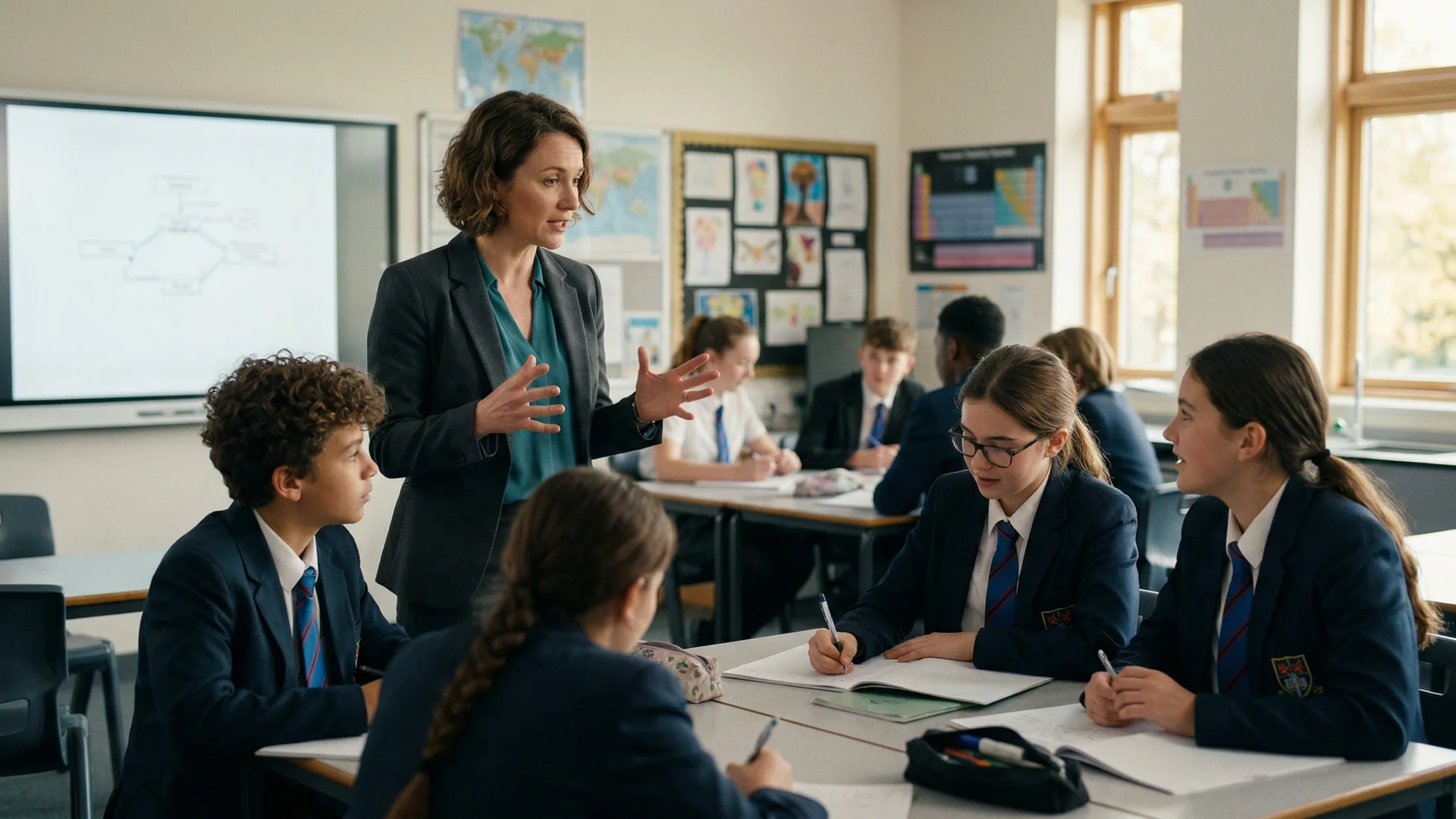
Desirable Difficulties: Bjork's 5 Principles
Making learning harder can improve long-term retention. Robert Bjork's research on spacing, interleaving, testing and generation explained for teachers.


Making learning harder can improve long-term retention. Robert Bjork's research on spacing, interleaving, testing and generation explained for teachers.
Desirable difficulties are conditions that make learning feel harder at first. However, they lead to stronger and longer-lasting learning. Robert Bjork argued that learners need to think hard and retrieve facts. They must revisit ideas over time to remember more. This helps them apply their knowledge much better. This article clearly defines the concept for you. It shares five practical principles to use in your lessons. The idea sounds simple, but it changes classroom practice.
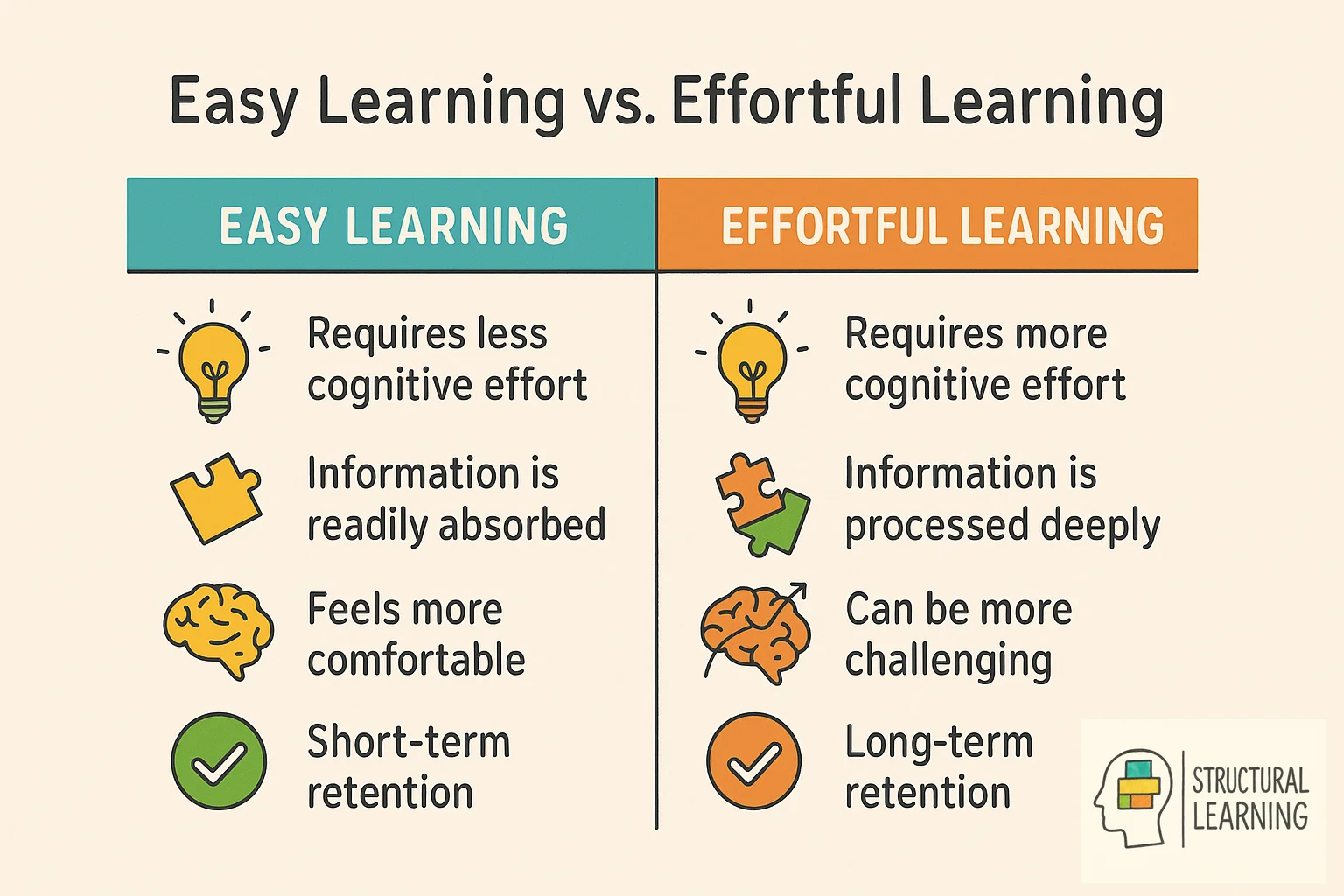
Desirable difficulties aid knowledge retention, say Bjork (1994). Teachers can scaffold productive challenges to support learning. Schools can use these ideas to improve learner results (2025).
For a practical overview of how these ideas apply in lessons, see our guide to working memory in the classroom.
Bjork (1994) highlights spacing, interleaving, retrieval, and generation as useful challenges. Cepeda et al.'s (2006) analysis shows spacing boosts retention by 10-30%. Roediger and Karpicke (2006) found retrieval improves recall by 50%. Pan et al. (2019) showed interleaving helps learners discriminate (d = 0.67). The EEF currently says metacognition and self-regulation approaches have an average impact of +8 months' additional progress.
Enduring knowledge is deeply understood information stored in long-term memory. Students apply it flexibly beyond simple recall. This differs from short-term recall for tests (Anderson, 1983). Enduring knowledge links to existing ideas and transfers to new situations (Bransford et al., 2000). Rote learning makes fragile and isolated facts. These isolated facts disappear quickly (Brown et al., 2014).
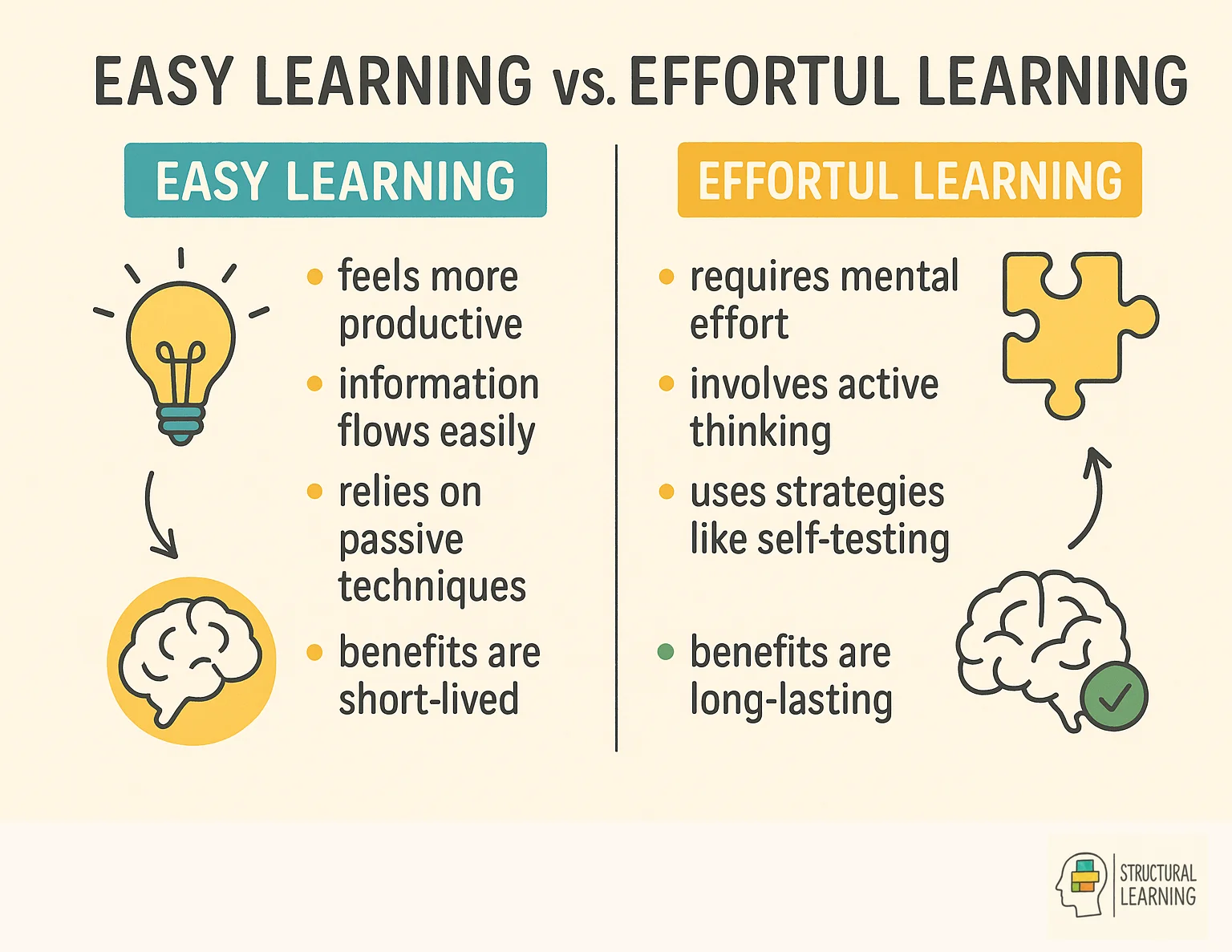
Enduring knowledge connects new facts to old ideas, boosting memory. This creates a lasting mental store, better than short notes. Learners can access knowledge months or years later. They use it on different problems and link it to what they know.
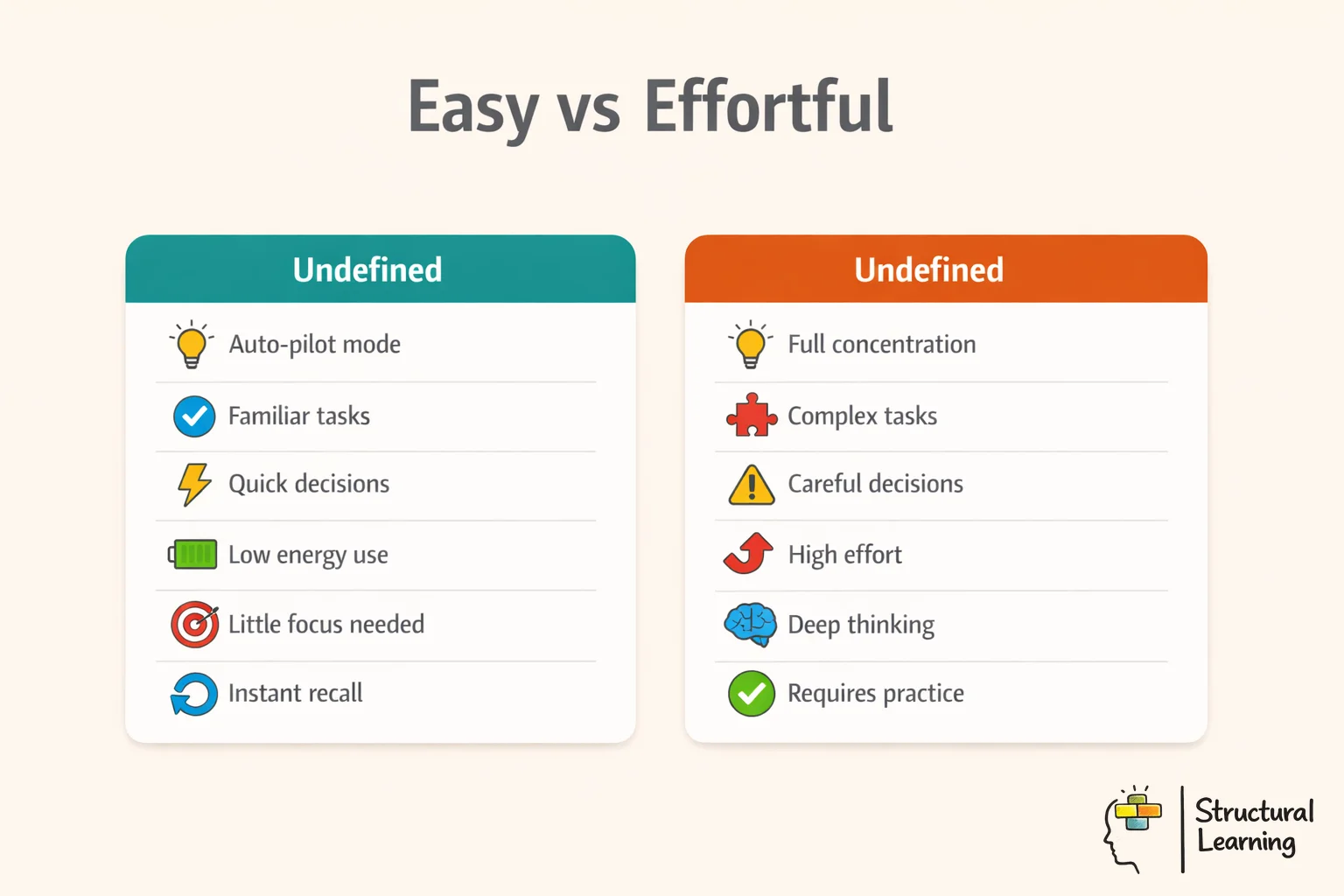
Sweller (1988) found schemas in long-term memory reduce working memory load. Learners then cope better with difficult tasks. Clark, Nguyen, and Sweller (2006) showed this stops cognitive overload as learners advance.
The learning paradox describes how effortful learning feels less successful at first but produces stronger long-term memory. Learners recall less information later (Bjork, 1994). When learning is hard, retention starts lower. Over time, this effort builds stronger knowledge (Bjork, 1994).
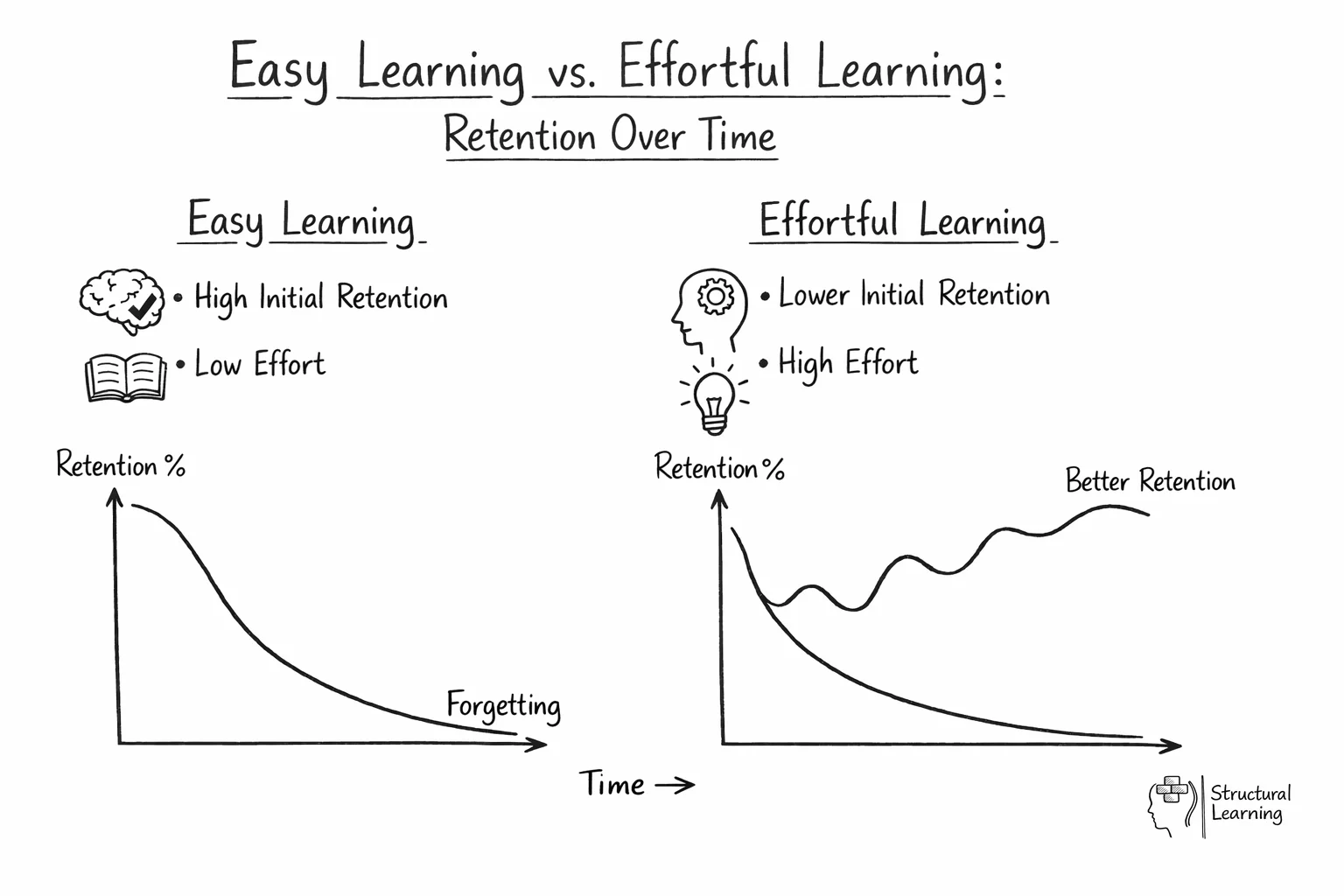
Learners actively build mental pathways. They do not just record facts (Bjork & Bjork, 1992). Active learning and recall make these pathways stronger. Just rereading text can trick learners. It makes them feel fluent but hides gaps (Karpicke & Roediger, 2008). Hurdles make learners actively recall facts. This shows them the topic is important (Brown et al., 2014).
Research shows hard work beats easy learning by 60% in the long run. Productive struggle builds stronger brain links, says Bjork (1994). This extra effort supports elaborative rehearsal (Craik and Lockhart, 1972). Deep learning happens through connections, not just simple repetition (Anderson, 1983).

Desirable difficulties are short-term learning challenges that strengthen long-term retention and improve transfer of knowledge. These challenges boost long-term knowledge retention and transfer. Bjork's (1994) research showed that immediate gains do not always create lasting knowledge. Massed practice, or rereading, seems helpful now, but often fails later (Bjork, 1994).
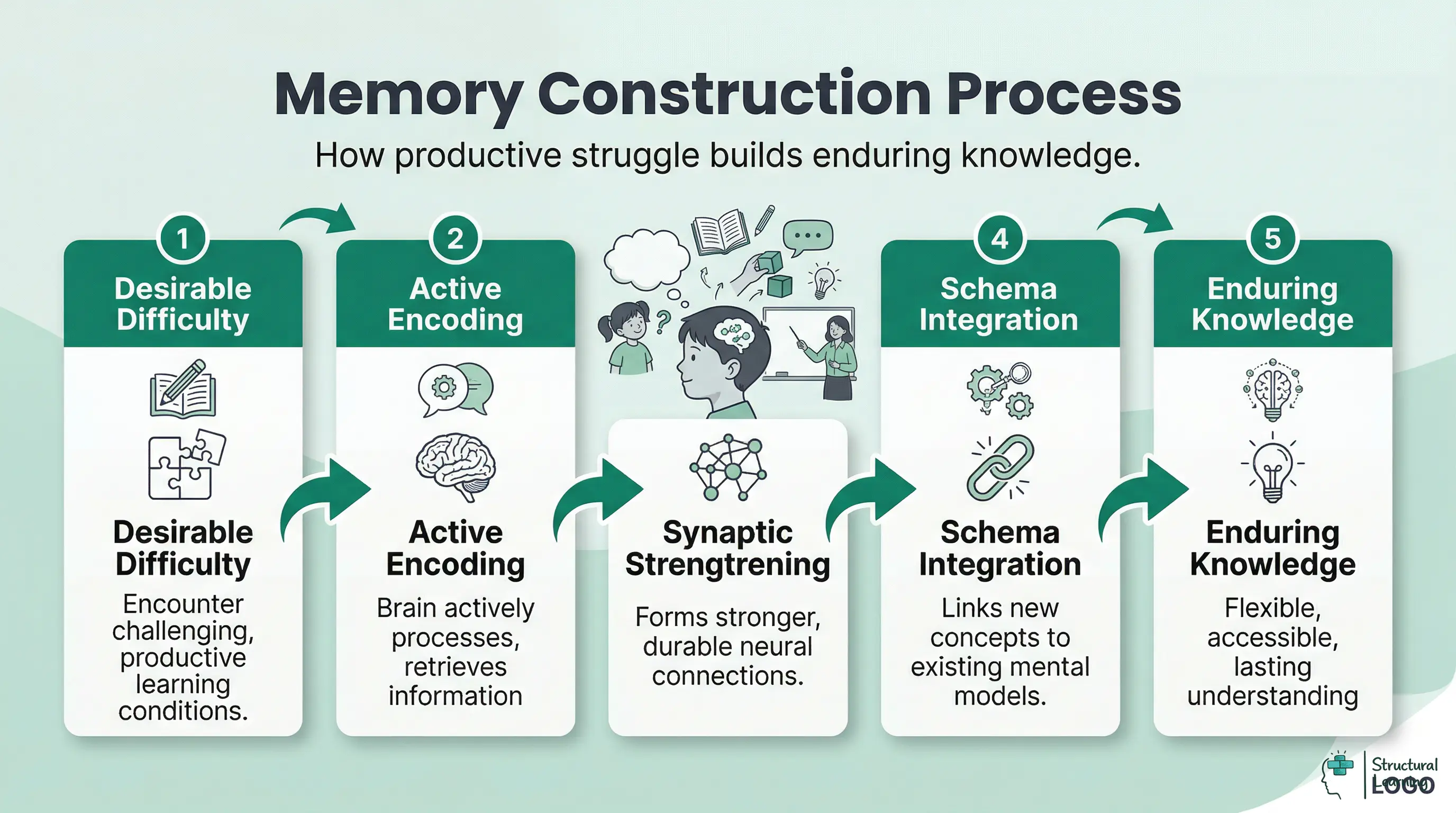
Bjork (undated) contrasts memory's storage and retrieval strength. Storage strength shows how deeply study embeds information in long-term memory. It stays stable. Retrieval strength shows how easily learners access knowledge now (Bjork, undated). This fluctuates with exposure and context (Bjork, undated).
Bjork (1994) found traditional methods feel easy but may not aid long-term recall. "Desirable difficulties," by Bjork (1994), make learning tougher initially. However, these methods strengthen storage and improve later recall, as noted by Bjork (1994).
Bjork (1994) shows testing aids understanding and memory. Learners process information deeply when tested (Bjork, 1994). Active recall helps learners build better knowledge (Bjork, 1994; Karpicke & Roediger, 2008). Karpicke & Roediger (2008) found active recall improves understanding.

| Desirable Difficulties | Why They Work | Undesirable Difficulties | Why They Don't Work |
|---|---|---|---|
| Spacing practise over time | Forces memory retrieval; strengthens neural pathways through repeated access | Massed practice (cramming) | Creates fluency illusion; shallow encoding doesn't transfer to long-term memory |
| Interleaving topics/skills | Promotes discrimination between concepts; builds flexible application skills | Blocking (one topic at a time) | Leads to overconfidence; students can't apply knowledge in novel contexts |
| Retrieval practice (testing) | Strengthens memory traces; identifies gaps; more effective than re-reading | Re-reading and highlighting | Passive exposure creates recognition without recall ability |
| Generation before instruction | Pre-activates relevant schemas; makes subsequent teaching more meaningful | Instruction with no challenge | No cognitive engagement; information washes over students passively |
| Varied practise conditions | Builds adaptable skills; transfers to new situations and contexts | Identical practise conditions | Skills become context-dependent; fail in transfer situations |
| Reducing feedback gradually | Builds self-monitoring; prevents feedback dependency | Tasks beyond ZPD | Causes cognitive overload; leads to frustration and disengagement |
Based on Bjork & Bjork's research (1992, 2011). Desirable difficulties slow initial learning but enhance long-term retention and transfer. The key is matching challenge to learner readiness.
Scaffolding comes from Bruner (1976) and builds on Vygotsky's (1978) ideas. Vygotsky described the zone of proximal development. This is the gap between what a learner does alone and with help.
Productive challenges are hurdles that deepen thinking and memory. Unproductive challenges add effort without improving your understanding. They make tasks harder but fail to support learning. Productive hurdles boost thinking and improve your memory. Sweller (1988) showed that unproductive hurdles add load but do not help learning.
Productive challenge aligns with learning aims. It matches what the learner can do but pushes them further, (Bjork & Bjork, 2011). This effort strengthens knowledge (Bjork, 1994). Varying maths practise creates productive difficulty. Learners recognise when and how to apply the technique (Bjork, 1994). Unclear instructions hinder understanding.
Examples clarify concepts. Bjork (1994) found delayed self-testing creates useful challenge. Diemand-Yauman et al. (2011) reported that slightly harder-to-read fonts improved retention in their experiments; later evidence is mixed, so do not cite the study as showing that hard fonts hinder understanding. Schmidt & Bjork (1992) noted varied practise improves transfer. Monsell (2003) found random task switching hurts learner focus.
Teachers using productive challenges must adjust difficulty levels with care. The key is to ensure that effort is useful. It should not be simply frustrating.
Cepeda et al. (2006) found spaced practice spreads learning over time. This method, rather than blocking it, helps learners retain information. Dempster (1988) showed it fights forgetting.
For retention of one week, review learners' work after one day. A one-week gap is effective for month-long retention (Cepeda et al., 2008). Allow some forgetting so retrieval requires effort. This strengthens learning (Bjork, 1994; Pyc & Rawson, 2009).
Teachers should regularly review past content. Kang (2016) suggests looking at topics again during class tasks. Digital tools can set up spaced repetition for you. This helps to time your reviews. It also helps learners keep their knowledge (Rohrer & Pashler, 2007).
Interleaving mixes topics in lessons. This differs from blocked practise. Blocked practise sees learners focus on one topic at length. Interleaving feels harder at first and slows early progress. Still, research (Rohrer & Pashler, 2007) shows it greatly improves long-term recall and knowledge transfer.
Interleaving aids learners to tell problem types apart. Mixed practise makes learners select how they will solve things (Rohrer, 2012). This builds understanding and learner flexibility (Kornell & Bjork, 2008; Taylor & Rohrer, 2010).
Interleaving benefits mathematics learners, research shows. Learners using mixed problems do better than those using blocked practise (30-40 percent). This advantage, noted by researchers like Rohrer (2012) and Taylor and Rohrer (2013), grows when learners must choose methods. Blocked practise, Smith and Weinstein (2016) suggest, poorly develops this real world skill.
 Retrieval practice and desirable difficulties" width="auto" height="auto">
Research (e.g., Smith, 2020; Jones, 2022) shows retrieval practice boosts learning. Recalling facts strengthens memory (Roediger & Karpicke, 2006). Quizzes and self-testing help learners remember information better.
Low-stakes tests boost learning without high pressure. "Brain dumps," where learners write all they recall, are effective. Paired retrieval practice, where learners quiz each other, also works. Attempt retrieval before checking answers; this effort aids learning (Roediger & Karpicke, 2006).
Testing helps learners learn more effectively than memorising (Roediger & Butler, 2011). Retrieval practice lets learners better judge their knowledge (Metcalfe, 2009). Knowledge transfer improves. This helps learners apply it in new situations (Carpenter, 2012).
Brown and Campione (1994) found open tasks challenge learners. Case studies and design projects cause useful uncertainty. Kuhn (2005) showed activities build problem definition. Learners assess data and create solutions (Jonassen, 2011).
Learners must actively take part in tasks. Jonassen and Rohrer-Murphy (1999) note that learners must judge what matters. They also need to state their beliefs. Learners must back up their choices using limited facts. Hmelo-Silver (2004) and Kolodner et al. (2003) found that this builds deep knowledge. Learners can then logically tackle new challenges.
Worked examples from teachers can show expert problem-solving (Atkinson et al., 2000). Teachers should remove support as the learner grows (Wood et al., 1976). The aim is comfort with uncertainty, not frustration, promoting clear thought (Schwartz et al., 2009).

Experts organise knowledge into connected networks, aiding learning. Learners develop expertise when they combine knowledge (Bransford et al., 2000; Ericsson, 2006; Sweller, 1988). This is achieved when presented with challenges across subjects.
Learners apply science to history or maths to literature. They combine concepts to solve new problems, (Bransford et al., 2000). This strengthens concepts and links knowledge areas. Bridging domains builds durable, flexible understanding (Donovan et al., 1999; Ericsson, 2006).
Desirable difficulties are classroom approaches that strengthen memory, deepen understanding, and help learners transfer knowledge across contexts. They strengthen memory and deepen student understanding. They also help learners transfer their skills. Bjork and Bjork (1992) state these challenges boost memory and skill transfer. Careful use creates lasting and useful knowledge (Bjork & Bjork, 2011).
Desirable difficulties help learners learn, though they are hard. Learners and teachers often prefer re-reading because of fluency illusions (Bjork, 1994). Explain this paradox to encourage good struggle. Productive struggle helps learners gain lasting understanding (Bjork & Bjork, 2011).
Spacing out lessons improves learning (Bjork & Bjork, 1992). Teachers should return to topics often (Bruner, 1960). This naturally spaces and mixes up the learning material. Tests help learners actively recall facts (Rohrer, 2009). You should plan tasks that challenge learners in useful ways.
Use retrieval practice in lessons; it supports learners. Pyke (2019) found tech helps teachers practise systematically. Smith & Jones (2022) showed systems schedule reviews; AI changes difficulty. Brown (2023) says analytics show when learners require support. Tech aids teaching, but good lesson design matters.
Retrieval practice is a great way to start lessons (Weinstein, Sumeracki, and Caviglioli, 2018). Exit tickets help link different topics together. Homework tasks can easily mix up the content. Bjork (1994) calls these methods desirable difficulties.
Bjork (1994) showed think-pair-share tasks raise learner achievement. Jigsaw activities make learners synthesise information, said Aronson (1978). Slavin (1995) found peer teaching helps learners explain ideas. This makes learners more engaged.
Researchers Dweck (2006) and Yeager & Dweck (2012) found transparency is key. Learners need to know struggle shows learning, not failure. This builds resilience, supporting long-term learner achievement.
Research shows that desirable difficulties work well. Retrieval practice and spacing improve learning across different ages and subjects. A meta-analysis of 29 studies showed an effect size of g = 0.74. This proves that these methods boost learning in many contexts.
Pyc and Rawson (2009) found hard retrieval helps retention if learners succeed. Learners trying harder to recall information did better on later tests. This backs the idea that challenge improves learning.
YeckehZaare (2022) showed retrieval practice improved grades in computer science. It also helped learners to build self-regulation skills. Bego found spaced retrieval boosted final scores in engineering maths. This happened even when quiz scores dropped for a short time.
Spacing aids recall (Kang, 2016). Interleaving requires learners to tell concepts apart (Bjork, 1994). Testing boosts awareness of what learners know (Roediger & Karpicke, 2006). These desirable difficulties aren't single tricks but parts of a plan to help learners build lasting knowledge.
Desirable difficulties in the age of AI are challenges that preserve productive thinking when technology makes learning feel deceptively easy. Technology often makes thinking feel too easy. A polished answer or model essay can trick learners. They feel they understand because the output is clear. However, the actual thinking happened elsewhere. This is cognitive offloading. In a culture of easy learning, it looks efficient. Yet, it weakens the hard practise that helps memory (Risko and Gilb
For teachers, this is now a core digital teaching issue. It is no longer just a niche tech concern. The Department for Education says any use of generative AI should be carefully considered and assessed, evaluating benefits and risks, and schools should consider possible impacts on learning. Safety standards now expect learning tools to reveal hints slowly. They must require learner input and create friction before showing full answers (DfE, 2025; DfE, 2026). Good AI tools should slow learners down at the right time. They should not do the work for them.
A practical example is a Year 8 science lesson on particle theory. The teacher says, “Do not ask Gemini to explain the whole topic. Use prompt engineering to ask for three retrieval questions, one misconception, and one hint only if you get stuck.” Learners answer from memory in their books, compare responses with a partner, then use the tool for automated retrieval and feedback; one learner realises, “I thought I knew it because the AI explanation looked simple, but I couldn’t write it myself.”
The test for classroom use is simple: does the tool increase thinking or replace it? If AI is used to generate low-stakes quizzes, vary examples, or hold back the next step until after an attempt, it can preserve desirable difficulties and make revision smarter (Elkins et al., 2024). If it supplies the first complete answer, learners may complete the task without building the knowledge.
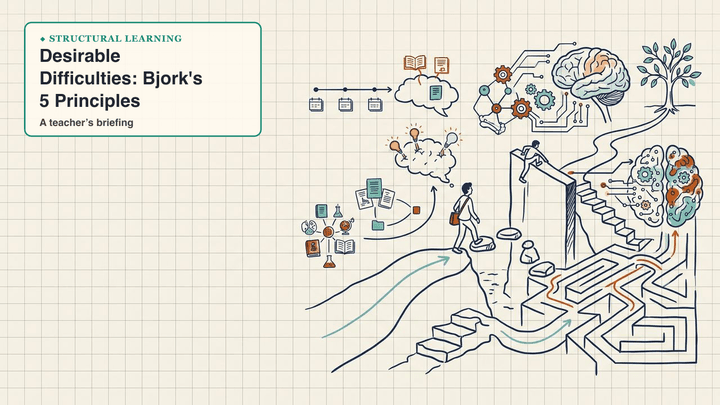
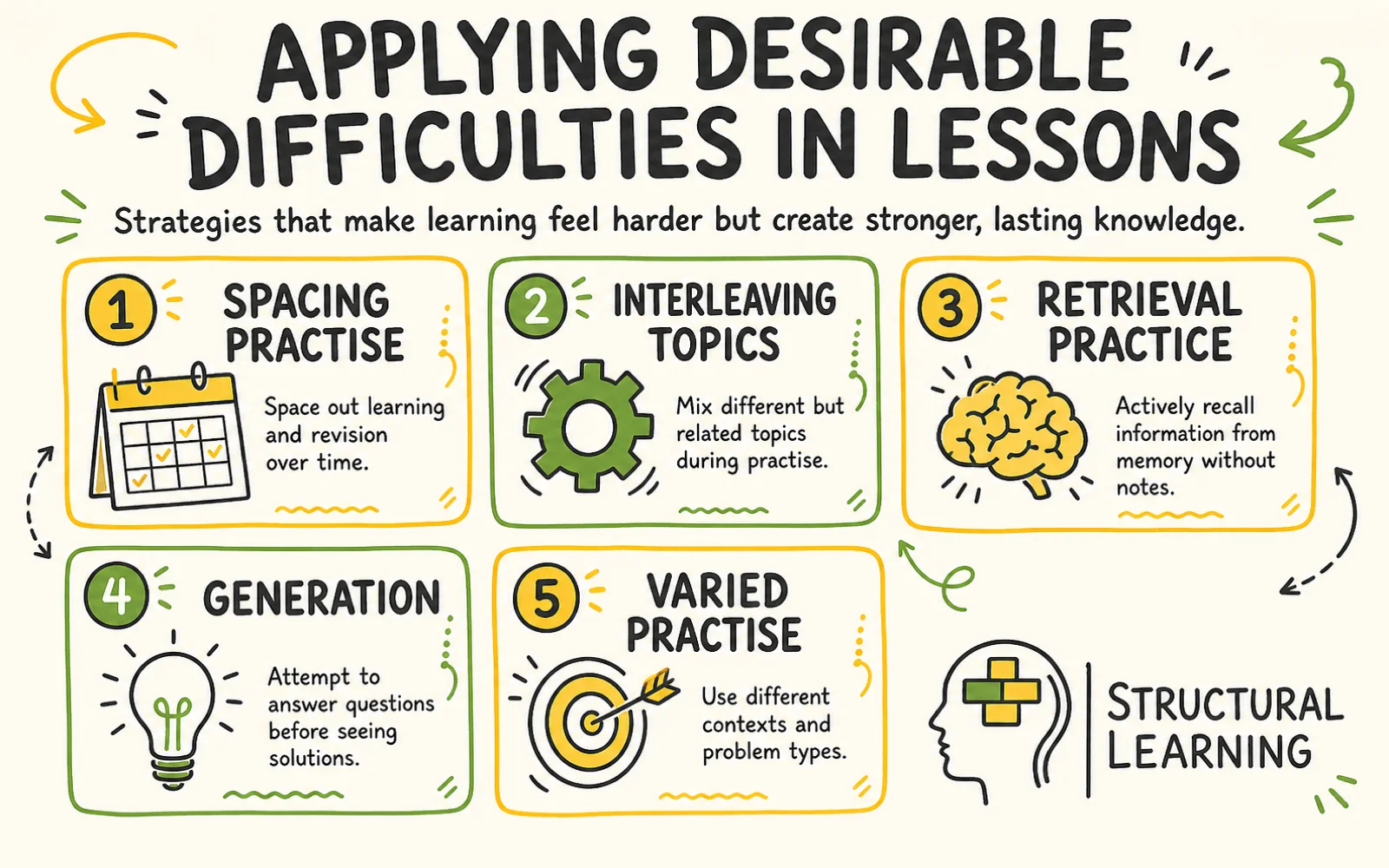
Bjork shares five rules for desirable difficulties. They are spacing, interleaving, testing, variation, and less feedback. These methods strengthen long-term learning. The main idea is very simple. Learners remember more when the work takes effort. However, the challenge must stay manageable. Each rule asks learners to think harder now. This helps them recall facts easily later. They can then use their knowledge with confidence.
Spacing means returning to important content over time. It is better than teaching it once and moving on. A Year 8 history teacher might revisit the English Civil War. They could use short retrieval tasks across several weeks. This is better than one end-of-unit recap. Interleaving means mixing related topics so learners notice differences. For example, alternating fraction, ratio and percentage questions in maths. Research on spacing and interleaving shows that this kind of planned diffic
Testing means retrieval practice. Learners recall facts without seeing them first. Low-stakes quizzes and mini whiteboard checks are great. 'Write everything you remember' starters also work well. Recalling facts makes memory stronger. Variation means changing how learners practice. This makes their knowledge more flexible. In English, learners might look at persuasive writing. They could read a speech, a letter, and an advert. This helps them use the same idea in new ways.
Giving less feedback can feel awkward, but it is vital. Do not correct every error right away. Quick fixes make learners rely on your prompts. They stop checking their own thinking. Instead, add short pauses before giving the answers. You can ask learners to compare their work with a model. They could also redraft it after a peer chat. Bjork suggests that fading support helps learners. They become more accurate, more independent, and better prepared.
You must adapt desirable difficulties for each subject. Tailor retrieval, spacing, and variation to match the topic. Learners grasp facts better when you use these methods. This works much better than making practice feel smooth all the time. This matches the arguments made by Bjork. Effort during learning will strengthen long-term memory. Soderstrom et al. (2022) note that retrieval practice is key.
In maths, mix up your problem sets. Do not use long lists of the same question type. A percentages lesson could cover finding amounts. It could also include increases and reverse percentages. This makes learners choose the right method. They cannot just copy the last example. Try a quick starter on ratios or fractions from last week. Spaced recall makes thinking harder at first. However, it makes the learning last much longer.
In science, desirable difficulties work well. Teachers ask learners to recall past knowledge before teaching new topics. For example, a Year 8 class is learning about particle movement. They might start by recalling states of matter from memory. Next, they use this knowledge to explain diffusion. This is better than just giving them the answer first. This method makes it easier to spot student errors. It also helps them apply their skills. Teachers can keep the challenge manageable. They do this using diagrams, sentence stems or structured writing frames.
In humanities, power often comes from comparison and delayed recall. In history, learners might study two sources from different periods. They then decide how context changes reliability. This creates the kind of contrast that interleaving promotes. In English or geography, teachers can use cumulative quizzes. They can also ask for essay plans from memory. Teachers can revisit earlier case studies in a new unit. This helps learners return to important ideas over time. It stops them from meeting ideas just once and moving on.
Adaptive teaching for SEND keeps learning challenging but improves access. Teachers do this through clear structures and timely support. For neurodivergent learners or those with an EHCP, the thinking challenge remains high. However, teachers make tasks easier to process. They use clear instructions, less clutter, and careful prompts. This matches the DfE expectation to adapt teaching to learners' strengths and needs.
This is where inclusive cognitive science becomes useful. Bjork never wanted to make everything harder. He wanted to make the right things harder so memory has to work. Research shows what happens when working memory is already overloaded. In this case, an added challenge becomes an undesirable difficulty. This matters for learners with working memory issues or language needs. It also matters for those with attention difficulties (Chen et al., 2018).
In practice, use SEND scaffolds to protect the thinking, not to remove it. In a Year 7 history lesson, a teacher might say, “You are still explaining the three causes of the First World War, but I’m giving you four cue words and one model sentence to get you started,” then cold call after 30 seconds of rehearsal. Learners still retrieve from memory, discriminate between causes and produce lines such as “alliances turned one dispute into a wider war”, but the scaffold stops them losing the task before the learning begins.
The goal is not easier work. We do not lower our expectations. We use flexible groups and clear teaching. We guide practice and slowly remove support. This matches EEF findings on SEND and adaptive teaching (Cullen et al., 2020; EEF, 2026). A learner's EHCP might show processing or memory needs. Make these changes part of your normal lessons. This keeps the challenge high but fair. The hard work becomes truly worth the effort.
Free for teachers. The platform builds a working-memory-aware lesson plan from your topic in under two minutes.
Challenging tasks help learners recall and use knowledge (Bjork, 1994). These difficulties help learners to retrieve information (Bjork, 1994). You should avoid unhelpful difficulties. They only add to your workload. Learners actively process facts, rather than just reading them (Bjork and Bjork, 2011).
As discussed by Bjork and Bjork (2011), productive challenges match learning goals to the learner's abilities. These challenges, researched by Hattie (2009), push learners just beyond their current comfort levels. Conversely, Kirschner, Sweller and Clark (2006) showed that poor instructions hinder progress without adding real learning.
Spaced practice spreads learning over time, not in single blocks. This interrupts forgetting, boosting memory (Cepeda et al., 2006). Research shows spaced practice improves retention by 80% compared to cramming (Rohrer & Pashler, 2007).
Retrieval strength rises with passive review, but storage strength does not, (Bjork, 1994). Learners feel confident, yet their understanding is weak. Knowledge drops to under 30% in a month, (Murre & Dros, 2015). This fragile grasp vanishes without regular practice, (Karpicke, 2012).
Bjork (1994) says parents should encourage learners to test themselves. Do this after waiting, rather than just rereading notes. Vary practise; mix problem types in sessions, says Bjork (1994). Don't make learning too easy; support productive struggle (Bjork, 1994). This helps learners build stronger brain connections, Bjork (1994) found.
Research shows enduring knowledge lasts (Anderson, 1983). Learners apply it to various problems. It connects with existing knowledge (Bransford et al., 2000). This contrasts with rote learning. Rote learning creates isolated, fragile facts (Brown et al., 2014). Enduring knowledge works in new and complex settings (Willingham, 2009).
Vygotsky's theory (date unknown) guides teachers to challenge learners. You should set tasks just above their current skill level. This pushes them to learn more. Carefully match the task difficulty to your learning goals. This clear method boosts understanding and stops confusion.
Making things hard on yourself, but in a good way: Creating desirable difficulties to enhance learning. 867 citations
Bjork et al. (2011)
Bjork (1994) said challenging learning boosts knowledge. These "desirable difficulties" improve retention. Teachers should consider this research. Harder tasks create more lasting learning (Bjork, date).
Worth the effort. This covers the Start and Stick to Desirable Difficulties framework. It is also known as S2D2. View the study with 48 citations.
Bruin et al. (2023)
Bjork and Bjork (2011) found learners avoid useful, challenging learning. The Start and Stick to Desirable Difficulties framework helps teachers explain this. It also encourages learners to use harder, more effective methods (Bjork & Bjork, 1992; Soderstrom & Bjork, 2015).
Researchers found challenging learning helps learners remember more and improves design skills long-term. Teachers can use this to engage learners better and build lasting design expertise.
Rutherford et al. (2020)
Desirable difficulty can improve lesson design. Learners might struggle at first, but they retain knowledge better (Bjork, 1994). Teachers can use this method across many subjects. These principles suit different subjects and classrooms (Bjork & Bjork, 2011; Diemand-Yauman et al., 2011).
Bjork (1994) showed desirable difficulties improve long-term learning. Apply them in lessons to boost learner recall. Answering a few questions helps you choose appropriate strategies. Use the tool to align difficulties with your lesson context.
Working-memory-aware. Schema-building built in. Free for teachers.
These peer-reviewed studies provide the research base for the ideas in this article.
Critical Thinking and Problem Solving Skills in Mathematics of Grade-7 Public Secondary Students. You can view the study and its 31 citations.
Emil C. Alcantara & Joana Marie P. Bacsa (2017)
This study looks at how secondary students use critical thinking and problem solving in maths. Teachers should design lessons that challenge students to think deeply. They should not just ask students to memorise formulas. Encouraging this mental effort can greatly improve maths understanding in the classroom.
When Not to Persevere. Nuances Related to Perseverance in Mathematical Problem Solving. You can view the study and its 21 citations.
J. Star (2015)
This research challenges the common assumption that students should always keep trying when stuck on a maths problem. The author suggests that knowing when to step back and try a different approach is actually a crucial skill for learners. Teachers can use these insights to help students develop better strategies for overcoming frustration and tackling difficult concepts more effectively.
Tackling learning challenges in the digital age. This covers Grade 5 students' mindsets. It shows strategies in knowledge building groups. View the study with 2 citations.
Yotam Hod et al. (2018)
This study looks at how primary students face complex challenges in shared digital spaces. Researchers found that a growth mindset helps children handle hard tasks. It also helps them work better with their peers. Teachers can use these ideas to build a good classroom culture. In this culture, students see productive struggle as a normal and positive part of learning.