Updated on
September 24, 2026
What Is Rote Learning? Definition, Examples and Uses
Rote memorisation strengthens fact recall; meaningful learning builds understanding. When to use each, where they conflict, with worked classroom examples.


Updated on
September 24, 2026
Rote memorisation strengthens fact recall; meaningful learning builds understanding. When to use each, where they conflict, with worked classroom examples.
What is rote learning?
Rote learning is memorising information through repetition, without necessarily understanding its meaning, useful for facts and procedures that need to be recalled quickly, such as number bonds or spellings. For teachers, it works best alongside meaningful learning: secure the facts by rote, then build the understanding that lets learners connect and apply them.
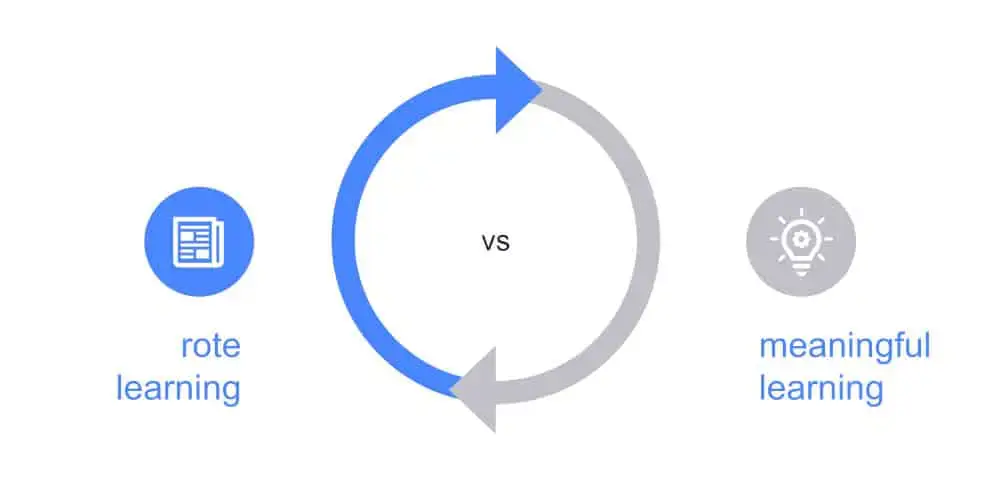
Rote learning and meaningful learning both work, but they do different jobs: rote learning helps students memorise facts and procedures, while meaningful learning helps them understand, connect and apply what they know. If the goal is quick recall, rote learning can be effective, but if the goal is deeper understanding and longer-term retention, meaningful learning usually has the edge. In practice, the strongest teaching often uses both at the right moment. The real question is not which one wins, but when each approach helps learning most.
Biggs (1996) called it the 'Chinese learner paradox'. Learners in China and Singapore do well in maths and science assessments. This is despite rote learning being common (Biggs, 1996). Western thought assumes rote learning hinders understanding. This makes China's success hard to explain.
Marton, Dall'Alba and Tse (1996) found Chinese learners link memory with understanding. In interviews, learners did not see them as opposites. Learning a text by heart helped them understand it better. This deep understanding then locked in their learning (Marton, Dall'Alba & Tse, 1996).
For a practical overview of how these ideas apply in lessons, see our guide to working memory in the classroom.
Confucianism views memorising classic texts as a first step. It is not the whole of education.
Watkins and Biggs (2001) found surface/deep learning is culturally specific. Rote learning may be a deep strategy in East Asia. Teachers, check cultural assumptions in your lessons. Repetition can be effective if used well (Watkins & Biggs, 2001).
Ebbinghaus (1885) started memory research. He tested himself in famous experiments. He learned nonsense words like DAX. This stopped his past knowledge from helping. It let him study how memory truly works.
Ebbinghaus (1885) found learners quickly forget new material. Retention drops sharply: 56% is lost within an hour. After one day, learners forget around 66% of what they learned. Without review, most learning fades within a week. What remains after a few days stabilises.
Ebbinghaus found the spacing effect: spread learning for better recall. Learners remember more when they study vocabulary over a week. This works better than one long session. Spaced repetition systems, like Anki, use this principle (Ebbinghaus, 1885). They review material based on individual forgetting.
Ebbinghaus found learners recall list starts and ends best. When teaching facts, focus on the middle (Ebbinghaus, 1885). This will help learners remember what they often forget.
Ebbinghaus (1885) used only himself, so results need care. Nonsense words aren't like learning resources. Later studies show meaning slows forgetting because learners have prior knowledge. Ebbinghaus's precision built memory research's base. Spacing and serial position replicate (Ebbinghaus, 1885).
Some view rote learning negatively. They link it to basic understanding and passive learners. It suggests memory replaces critical thought. This criticism has some truth. Yet, it struggles to explain puzzles in education research (Stevenson & Stigler, 1992; Watkins & Biggs, 2001).
Biggs (1996) called this the 'Chinese learner paradox'. Learners from China and Singapore do well in maths and science tests. This happens despite rote learning being common in their classrooms. These outcomes are hard to explain if rote learning prevents understanding.
Marton, Dall'Alba and Tse (1996) explored how Chinese learners view memorisation and understanding. They found learners often saw the two as linked, not opposites. Memorising text helped them understand it better, they said. Deeper understanding, in turn, helped learners remember the material more easily. Repetition helped access meaning over time, not replace it.
Confucian tradition sees memorisation as a starting point (Marton & Säljö, 1976). Learners first memorise texts before exploring meaning (Biggs, 1996). After recall, learners consider implications and debate interpretations (Entwistle, 2000). Those who dismiss rote learning miss this deeper logic (Watkins & Biggs, 2001).
Watkins and Biggs (2001) found that surface and deep learning differs across cultures. Rote learning, seemingly surface level, can be deep in some cultures. Teachers, reflect on cultural assumptions in teaching. Learners using repetition may have a valid, effective method (Watkins & Biggs, 2001).
A concise Structural Learning audio episode on rote learning, focused on practical classroom use.
Rote learning means learners memorise facts without understanding. Teachers may use times tables as one example. However, overusing rote learning restricts understanding. Encourage learners to apply knowledge and think critically. This helps them understand meaning, improving learning.
Rote learning means learners memorise facts by repeating them, but without understanding. It can help with things like times tables. Research from cognitive scientists shows learners need to process information actively. They also need to connect it to what they already know and practise recalling it.
Rote learning uses repetition, so learners recall facts without prompting. This method prioritises fact reproduction, not understanding. Despite criticism, rote learning builds crucial knowledge. Use it well for times tables, spelling, and new vocabulary (Patel, 2021).
Rote learning helps learners remember facts, but some say it hinders critical thought. Research explores rote learning's pros, cons, and other methods. Are there better long-term strategies for learners?.
Researchers like Bloom (1956) suggest rote learning helps learners remember facts. It is useful for dates or figures, as documented by Brown and Palincsar (1989). This method involves memorising specific content through repetition.
This method helps learners memorise music scales or history dates. Rote learning also helps adults in some settings. For example, they might need to quickly recall key facts at work.
Researchers argue rote learning helps learners memorise drug dosages. It also benefits learners grasping vocabulary and grammatical rules in a new language.
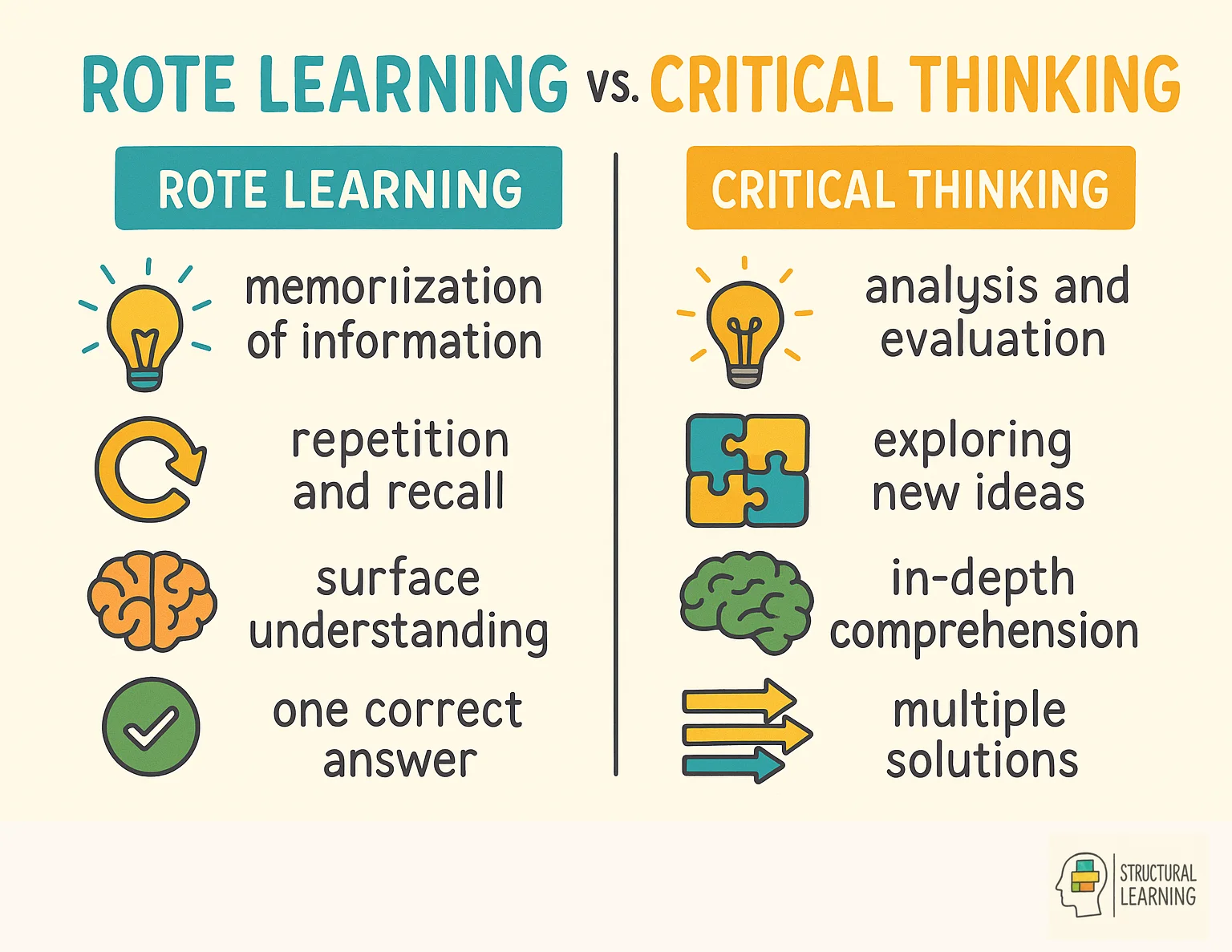
However, relying solely on rote learning may hinder deeper understanding. Surface learning can stop learners from applying knowledge flexibly. This approach may also limit the learner's capacity for critical thinking and problem-solving (Lee, 2022).
Repetitive practise helps learners memorise times tables and the alphabet. Learners also use rote learning for spelling, formulas, and languages. Exact recall is key for these basics. This benefits from repetition.
Rote learning means repeating information until learners remember it. Teachers often use it to embed basic knowledge (as noted above). This technique helps learners memorise facts quickly.
Concrete Examples of Rote Learning include:
Spelling Games:
Repetition of the Alphabet:
memorising Multiplication Tables:
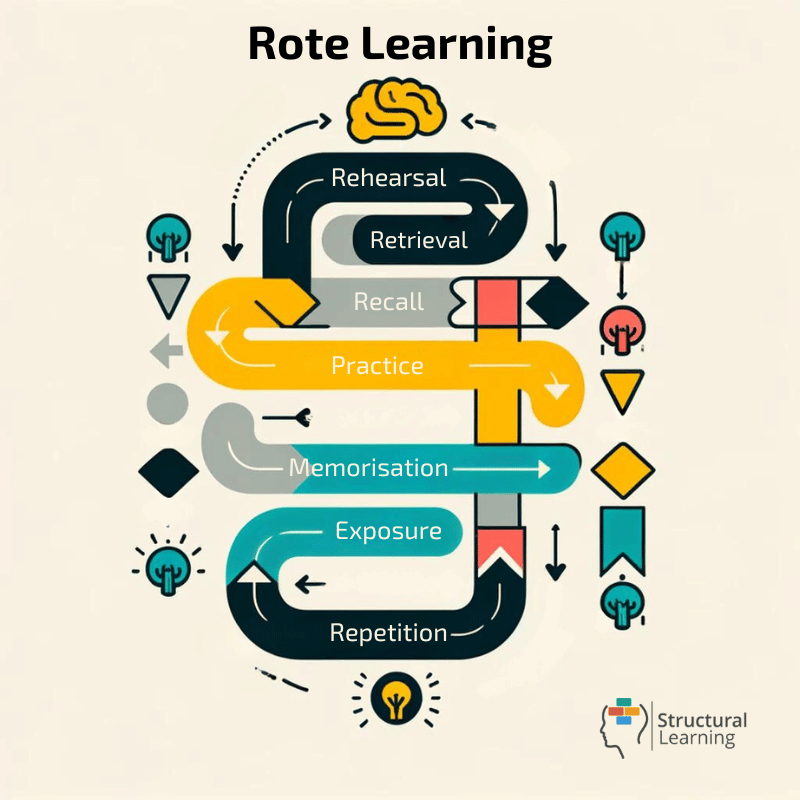
Memory Games:
Multi-Sensory Rote Learning:
Researchers like Brown et al. (2014) show techniques that help learners engage with rote learning. These approaches, supported by Willingham (2009), make remembering facts easier. Deliberate practice helps learners understand core concepts thoroughly (Ericsson et al., 1993).
Spacing out practice helps learners remember facts well. Memory tricks help learners build mental links for better recall (Baddeley, 1999). Using multiple senses boosts memory. Grouping facts also helps learners remember things (Miller, 1956).
Brown and Campione (1994) found that rote learning is memorising facts by repeating them. Learners memorise information without always understanding it. Anderson (2000) showed that this technique relies on simple recall. Mayer (2002) warned that learners may not grasp the meaning or context.
This method has been used for centuries in education and has been a common practise in many cultures. There are various techniques and strategies that can be employed to improve the effectiveness of rote learning, and understanding these methods can be beneficial in.
Ericsson et al. (1993) showed that repeating facts helps long-term memory. Brown and Craik (2000) proved that repetition locks facts into memory. Baddeley (2007) found that automatic recall frees up working memory.
Long-term memory helps learners avoid working memory overload. Recalling stored facts reduces rehearsal (Atkinson & Shiffrin, 1968). This helps learners solve tough problems (Baddeley, 1986; Cowan, 2010).
Repetition helps learners remember, which frees up space (Ericsson & Lehmann, 1996). Long-term memory lets learners beat working memory limits (Ericsson & Lehmann, 1996). This helps learners think more deeply (Anderson, 1983).
Spaced repetition helps learners retain information better. Review material at increasing intervals to use this technique. Research shows this improves knowledge retention. It works better than traditional learning.
Spaced repetition algorithms schedule reviews. Learners recall facts better with time (Pavlik & Anderson, 2005). Reviews happen when learners need them most (Cepeda et al., 2008).
Elearning platforms often use spaced repetition with quizzes and flashcards. These features remind learners to review material regularly, aiding memory (Anderson, 2000). This helps learners remember information better long term (Brown et al., 2014; Roediger & Butler, 2011).
Spaced repetition helps workplace learners memorise facts. Reviewing material regularly helps them keep vital knowledge for their jobs. Research by Ebbinghaus (1885) and others supports this. Practice with short, spaced sessions benefits learners (Cepeda et al., 2008).
Spaced repetition enhances workplace learning, (Ebbinghaus, 1885). Training programmes become more effective with this method (Cepeda et al., 2008). Improved learner performance results, say Karpicke & Roediger (2007).
Spaced repetition improves how learners remember facts (Baddeley, 1990). Brown et al. (2014) found it helps learners recall information for longer. Research by Karpicke (2012) shows spacing out learning boosts long-term knowledge retention.
Cognitive science shows rote learning supports thinking. Anderson's (1982) ACT theory explains this. Learners gain declarative (knowing what) and procedural (knowing how) knowledge. Practise makes facts automatic. This frees minds for analysis.
Working memory has very limited capacity, as Sweller (1988) showed. It only holds about four chunks at once. Overloading this impacts learning. Practise sub-skills until they become automatic, like single units in memory. This frees up space for complex thought.
LaBerge and Samuels (1974) showed reading needs automaticity. Learners decode words without thinking, which frees up memory. Practice with phonics builds effortless word recognition. This is key for inference, prediction and evaluating text (LaBerge & Samuels, 1974).
Learners using addition for 7 x 8 in problem-solving use working memory. This reduces resources for understanding the problem (Ashcraft, 1994). Research finds fluent multiplication recall helps with complex maths. This is because recall supports reasoning (Park & Klingbeil, 2007; Royer, Tronsky, Chan, Marchant, & Cajigas, 1999).
Ericsson (1993) stated expertise comes from focused, repeated practise. Musicians and chess players develop patterns through this repetition. These patterns help learners solve problems and recognise situations. Rote learning builds a foundation for creativity, it does not hinder it.
Dreyfus and Dreyfus (1980) outlined five stages for skill learning. This model shows how learners' knowledge changes from novice to expert. It explains when verbatim learning helps, and when it hinders progress.
Novice learners lack experience, so they follow fixed rules closely. A chess player uses memorised piece values without position awareness. A driver checks speed, gear, mirrors and markings separately (Dreyfus & Dreyfus, 1980). At this stage, memorising rules is essential, not a problem. Rules prevent big mistakes as experience grows (Berliner, 1975).
Learners gain understanding by using rules. Dreyfus and Dreyfus (1986) found patterns beat rules. Learners prioritise key situation features over thinking. Experts react fast, often unable to explain why (Dreyfus & Dreyfus, 1986). Teachers noticing disengaged learners show expert skill.
The Dreyfus model views rote learning as vital groundwork. It is not a poor strategy. Some teachers say experts do not use rote rules. This is like dismissing phonics because fluent readers do not sound out words. An expert is fluent because of early rote learning. Their skill would not exist without this first phase.
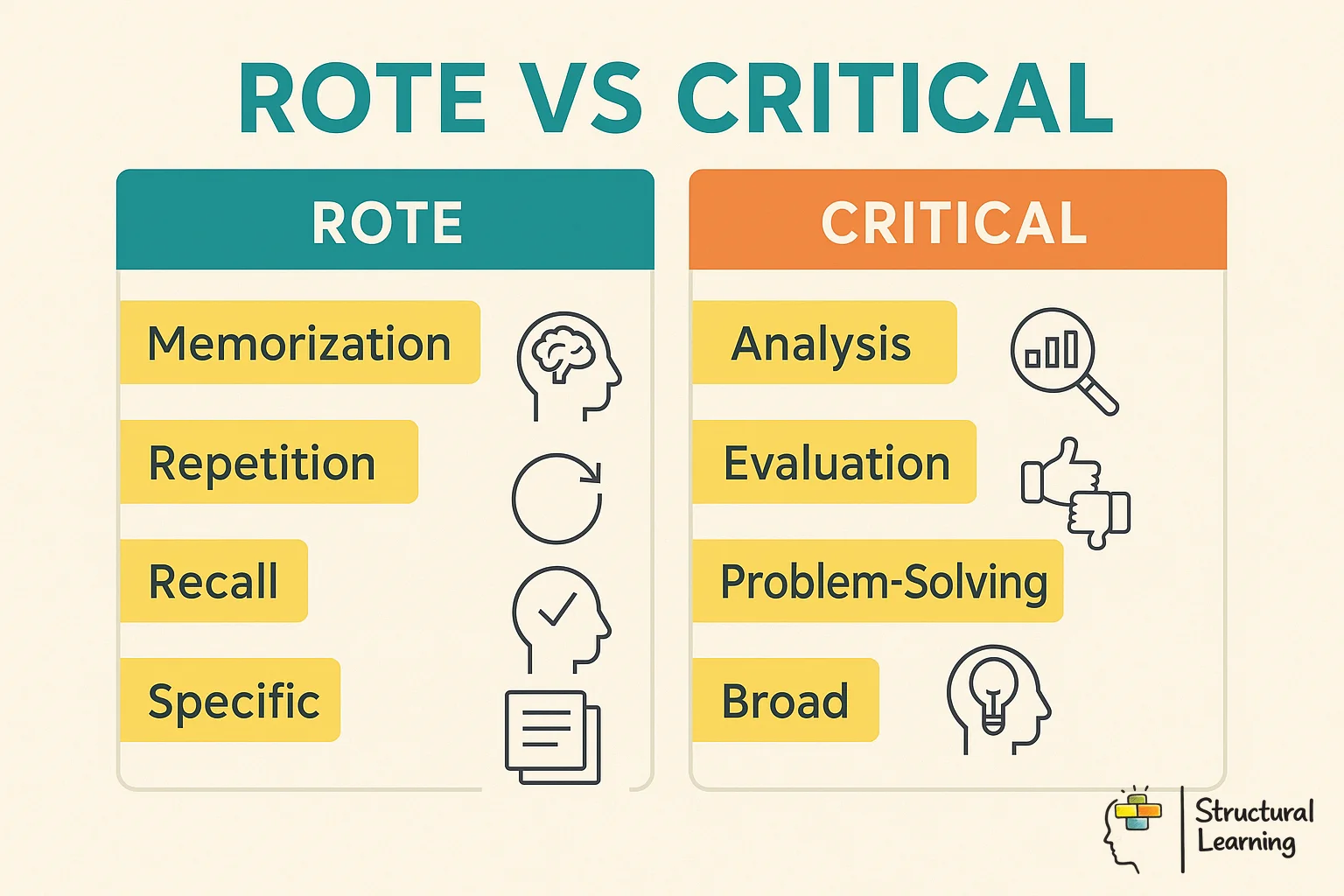
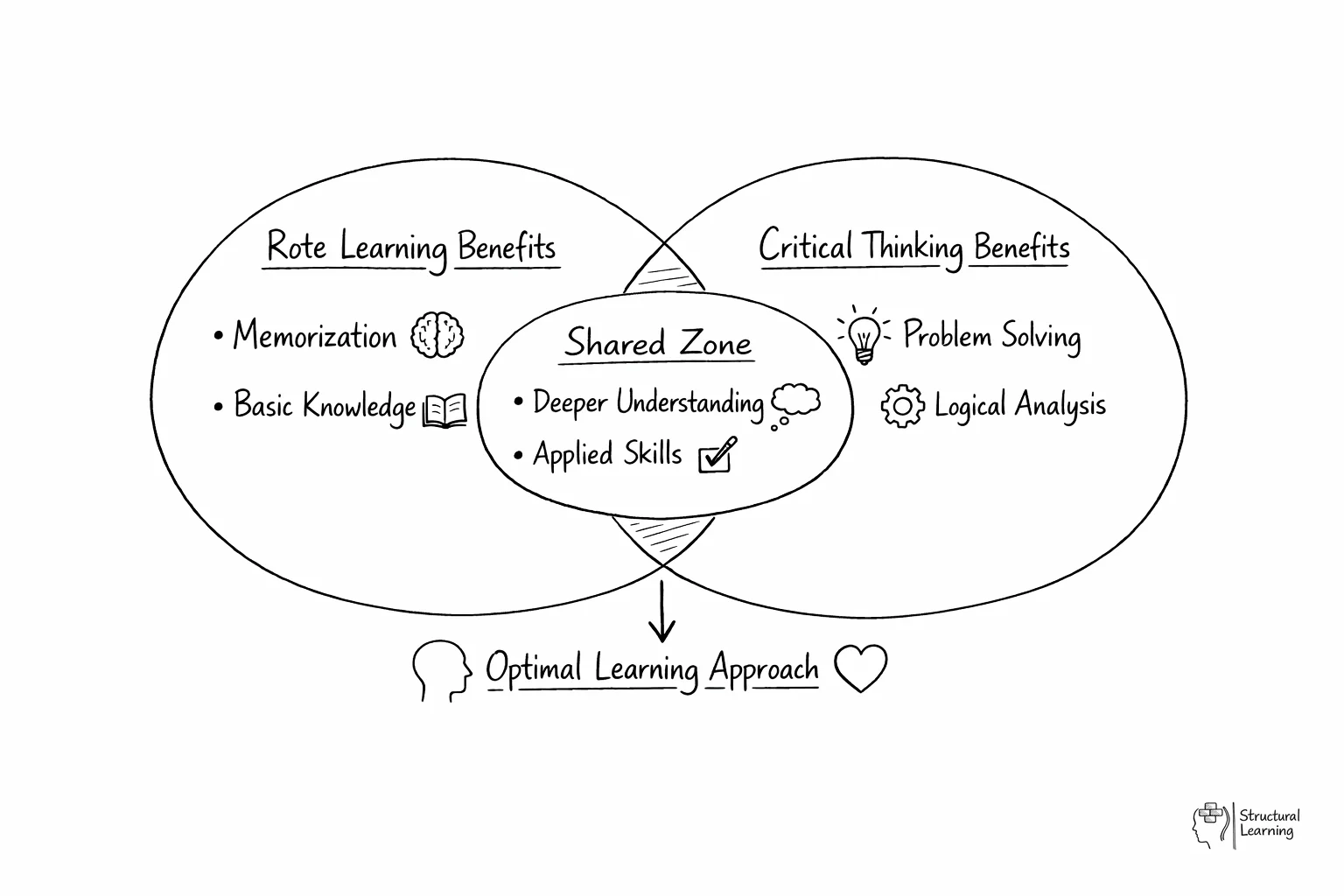
Rote learning means memorising facts by repeating them. Critical thinking involves analysing information and solving problems. Learners need basic knowledge from rote learning for deeper thinking skills. Combining both methods helps learners use their brains effectively.
Researchers find that rote learning and critical thinking must balance. Teachers know active learning boosts thinking skills in learners. Foundational knowledge, built by rote learning, helps learners engage critically.
Researchers like Bloom (1956) show learners build on knowledge. Rote learning gives them the vocabulary and concepts they need. This base helps learners do critical analysis (Anderson & Krathwohl, 2001).
It is this interplay of acquiring knowledge and then using it as a tool for deeper inquiry that constitutes the heart of meaningful learning.
This action matters in Special Education. Teachers must adapt their methods so learners with different needs can use knowledge (Vygotsky, 1978). This helps ensure learning fits each learner's profile (Gardner, 1983; Rose & Meyer, 2002).
Critical thinking does not replace rote learning. Instead, it shows why learners need basic facts first. They must know these facts before they can judge, infer, or create new ideas. This mental groundwork is not just a stepping stone. It is a vital part of learning.
Researchers want learners to use both rote learning and critical thought. Rote learning can help critical thought grow in your classroom. Teachers help learners understand, question, and build knowledge.
Active learning means learners interact and engage in lessons. Learners need a knowledge base to participate fully (Dewey, 1938). Teachers should consider this when planning activities (Piaget, 1954; Vygotsky, 1978).
Rote learning and expertise have a complex link. Kalyuga et al. (2003) found that methods helpful for new learners can hinder experienced learners. Times tables help learners grasp multiplication. This same drill can waste time and hinder expert learners' recall strategies.
Cognitive load theory explains this process. Worked examples help new learners manage information (Sweller, 1988). As learners gain knowledge, schemas form. Worked examples then add unnecessary load (Kalyuga, Ayres, Chandler, & Sweller, 2003). This redundancy effect reverses expertise (Kalyuga, 2007).
The expertise reversal effect helps decide when to stop rote learning. Younger learners benefit from multiplication drills (Kalyuga, 2007). Older learners, who know the facts, do not benefit. Automaticity differs; learners may need rote for French but not maths. Assess automaticity (Kalyuga, 2007), not age, to end rote support.
Sweller, Ayres and Kalyuga (2011) said start lessons with guidance and repetition. Gradually reduce support as the learner shows understanding. Keeping too much support slows expertise (Sweller, Ayres & Kalyuga, 2011). Mastery learning and direct instruction use this support reduction principle.
Rote learning helps learners build crucial, automatic knowledge. Basic maths facts and phonics rules are good examples. This frees up working memory for problem-solving and creative tasks. Learners can then progress to higher-level thinking.
Research by Brown et al. (2014) suggests rote learning still has a place. It helps learners memorise core facts but has limits for deeper understanding, so teachers should consider how it fits each subject.
Rote learning aids cognitive skill development. Research shows learners build knowledge through repetition. Foundational skills benefit from this method.
Rote learning builds knowledge, helping learners with complex tasks. This is helpful in Special Education. Rote learning supports memory pathways for some learners.
Rote learning still has a place in secondary schools, despite the focus on deeper understanding. Brown and Craik (2000) showed learners remember more with repetition. Practise helps learners recall essential facts. Cognitive load theory (Sweller, 1988) supports spaced repetition for knowledge retention.
Types of Knowledge Suited to Rote Learning:
Rote learning can support learners' education by giving them basic skills that help them manage harder tasks (Rosenshine, 2012). This builds a good base for deeper learning.
The rote method involves memorising facts through repetition. Some teachers find it helps learners quickly recall information. Others argue it stops learners from thinking critically. This debate continues across the literature on memorisation and conceptual understanding.
In this section, we will explore the advantages and disadvantages of using the rote method of learning.
Rote learning helps learners build knowledge. Critical thinking and problem-solving are also important (Bloom, 1956). A mix of methods aids deeper understanding (Anderson & Krathwohl, 2001).
Researchers have highlighted the need to move beyond rote learning. Teachers should use interactive methods to boost learner understanding. This helps learners think critically.
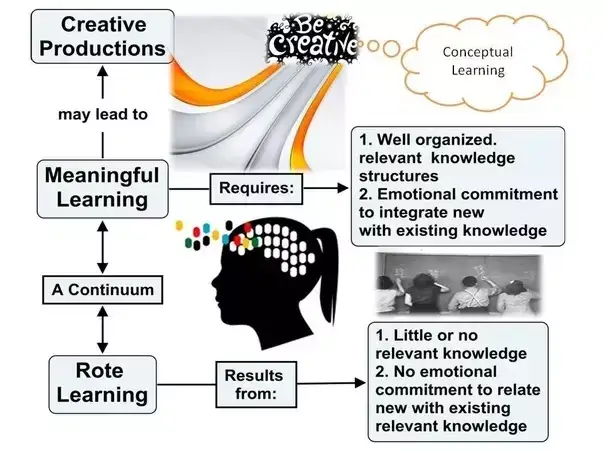
Ausubel (1968) said we must link new facts to what learners already know. Learners grasp new ideas better when they link to old ones. He described rote learning as simple memory work without these key links.
The distinction is not about the nature of the content but about the learner's approach to it. A learner can memorise the periodic table by rote or can learn it meaningfully by connecting each element's properties to its atomic structure and position. The same fact can be stored in either way, and the storage mode determines how readily it can be transferred and applied.
Ausubel (1968) said learners grasp new ideas by linking them to existing knowledge. A learner knowing "living things" grasps "photosynthesis" by connecting it, aiding recall. Rote learning lacks this link, so learners quickly forget it and struggle with application.
Ausubel (1968) found that advance organisers help learners. You should briefly link new topics to what learners already know. For example, review energy, plants, and sunlight before you teach photosynthesis.
Ausubel said learners need to memorise basic facts like number bonds. This supports later learning. Novak (2010) built on this. He used concept maps, diagrams showing a learner's understanding. Maps reveal gaps, showing if learners truly understand, or just memorise.
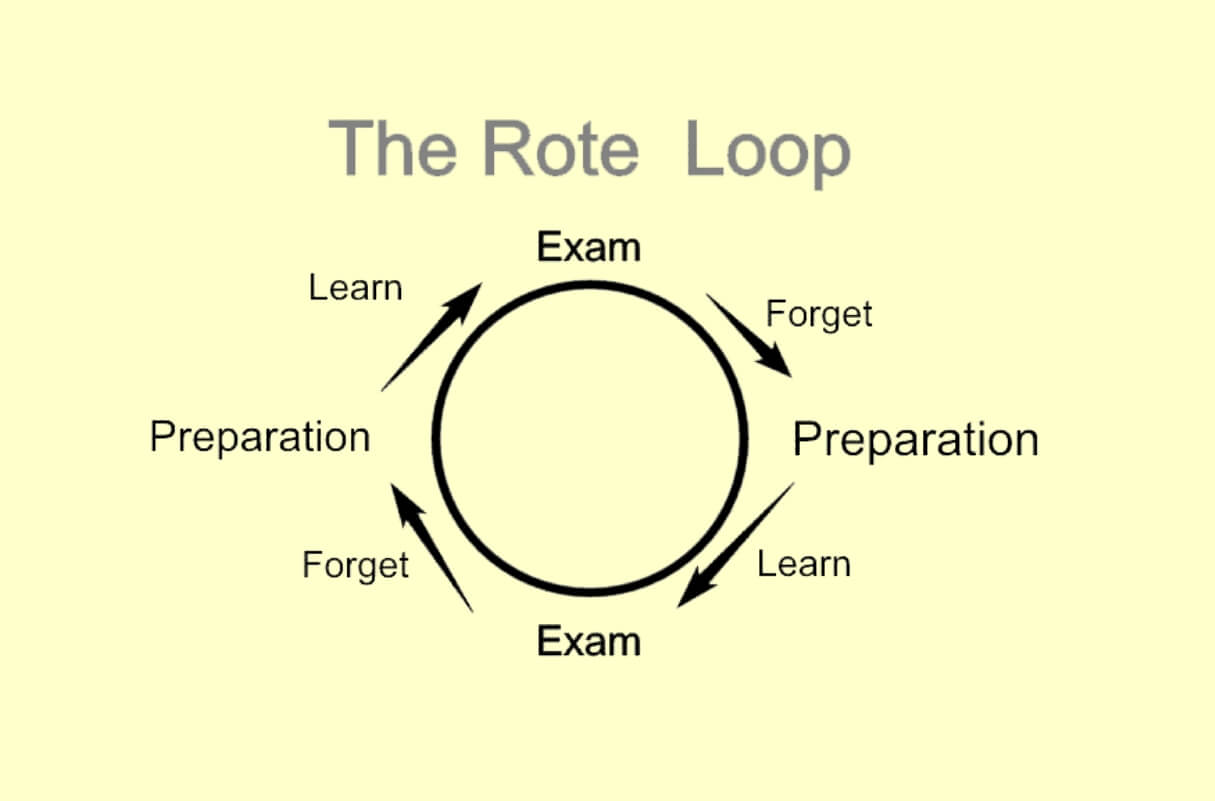
Rote learning stores facts in isolation. Meaningful learning, David Ausubel (1968) said, connects new information to a learner's existing knowledge. This helps learners build problem-solving schemas. Ausubel found rote learning stores "verbatim" information with weak links.
The practical consequence is predictable. A learner who memorises "photosynthesis is how plants make food" can recall the phrase. A learner who understands that photosynthesis is a chemical process converting light energy into glucose, and who connects this to their knowledge of chemical equations and energy transfer, can apply that knowledge to novel problems in an examination. The memorised phrase helps with the first step; it cannot carry the learner through the second.
This does not mean rote learning is worthless. Ausubel's framework actually clarifies when it is appropriate: when the knowledge to be memorised has no obvious conceptual anchor, when exact reproduction matters more than application, or when the goal is to build the prior knowledge base that will later support meaningful learning. Times tables are the classic example. A learner who knows that 7 x 8 = 56 without needing to reason through it has freed cognitive resources for the algebraic reasoning that depends on that fact.
The research question is not whether rote learning is good or bad, but which knowledge types require which approach. The answer shapes how teachers plan sequences, not just individual lessons.
Rote learning helps learners remember vocabulary, grammar, and phrases. This memorisation creates automatic recall of language basics. Learners can focus on meaning and speaking fluency. Pairing rote learning with context speeds up learning and retention.
Rote learning uses repetition. This needs much time for learners to memorise vocabulary and rules. The method can bore learners, which may hinder real language understanding.
Rote learning helps language learners memorise vocabulary and grammar faster, building language skill foundations. Consistent practice can boost fluency.
Rote learning can lead to forgetting if learners do not regularly reinforce information. This method may also limit how well learners adapt in real-life language use.
Rote learning helps learners memorise and start language learning. Supplement it with other methods for better understanding and lasting skills.
Repeating facts makes brain pathways stronger (Hebb, 1949). This helps learners recall facts faster. The hippocampus stores new facts. Repeated practice moves these facts to long-term memory (Squire, 1992). Sleep helps to lock in memories. It makes neural links stronger (Stickgold, 2005).
This can be particularly useful for foundational knowledge. Repetition strengthens neuron connections for better information recall. Learners benefit from rote learning of core facts. Practise improves retrieval speed.
Rote learning creates larger memory loads. Every new fact we learn increases data storage (Anderson, 1983). This can slow recognition. It also makes finding specific information harder (Ericsson & Kintsch, 1995).
To address this, a compensating mechanism of forgetting is essential in learning. This allows the brain to clear out unnecessary information and make room for new learning.
Researchers (e.g., Hinton, 2018) suggest neural networks can tackle rote learning by mirroring brain functions. Controlling these complex networks remains a key challenge for educators. Learners may overfit data, as shown by Goodfellow et al. (2016), reducing broader application.
Knowing how the brain handles rote learning is useful. Using brain science also shows great promise. Together, these could improve how we learn in the future.

Repetition strengthens memory, yet method counts. Long-term potentiation (LTP) strengthens connections through repeated neural firing. Passive re-reading yields weak traces, easily lost. Active retrieval, like rote practise, builds lasting traces (e.g. Bjork, 1994; Karpicke & Roediger, 2008).
Karpicke and Roediger (2008) demonstrated this in a landmark study. Students who repeatedly studied vocabulary pairs remembered 36% of them after a week. Students who studied once and then practised retrieval four times remembered 80%. The critical finding was not that retrieval practice is better than rote, it is that the act of retrieving changes the memory trace. Each successful retrieval strengthens the pathway and makes future retrieval more reliable. Each failed retrieval, followed by feedback, creates a stronger re-encoding than passive re-study.
Bjork and Bjork's (1992) distinction between storage strength and retrieval strength explains the mechanism. Storage strength reflects how well-learned something is. Retrieval strength reflects how easily it can be accessed right now. Rote repetition in massed practice (learning the same material in one long session) increases storage strength briefly but does not build retrieval strength. Spaced, interleaved retrieval practice builds both. A learner who recites the seven times table daily is building storage strength. A learner who answers random multiplication questions is building retrieval strength, the kind that survives a week, a month, and an examination.
Teachers, note this: massed repetition without retrieval is the issue, not rote learning itself. Learners chanting times tables whilst viewing answers differ cognitively from those recalling them. Only recall builds neural pathways transferring to new situations (Bjork & Bjork, 1992).
Ebbinghaus (1885) showed rote learning fades fast. Learners forget half within 24 hours without review. Spaced retrieval practice, not rote, builds lasting knowledge, research shows.
Kornell and Bjork (2008) found an important detail. Learners prefer massed practice over spaced practice. They think it works better, even when test scores show it does not. This is the illusion of knowing. Recent massed practice feels like real learning. However, this quick recall fades overnight. Teachers should not rely purely on learner feedback to judge memorisation. If they do, they will over-rate massed rote practice.
Bloom (1956) showed that learners first memorise facts. Teachers then give tasks to help learners apply this knowledge. Once they understand, learners can analyse and solve problems. This process builds on Bloom's Taxonomy (1956).
Researchers find rote learning useful for basic facts. However, it may limit a learner's critical thinking skills. More complex understanding might need other methods. Rote learning focuses on memorisation.
Metacognition and associative learning help learners beyond rote methods. These approaches encourage deeper thinking about information. Learners make connections between knowledge (Bjork, 1999; Brown et al., 2001; Dunlosky et al., 2013).
Bloom (1956) showed critical thinking boosts learner progress. Teachers can use activities making learners analyse information. Paul & Elder (2008) found this helps learners move past memorisation. Abrami et al. (2015) suggest critical thinking improves problem-solving skills.
Questioning builds critical thinking. Apply knowledge to new tasks so learners build skills. Move beyond pure rote learning to give learners deeper understanding (Abrami et al., 2015).
Rote learning and retrieval practice should work together. Rosenshine's (2012) Principles suggest initial repetition builds memory. Then, switch to retrieval practice to strengthen it. Timing this switch affects how long the learner remembers.
The following table shows how this applies across common classroom contexts:
| Knowledge Type | Initial Approach | When to Switch | Consolidation Strategy | Subject Examples |
|---|---|---|---|---|
| Number facts (times tables, bonds) | Chanting, visual grids, songs | After 3-4 sessions of confident recall | Low-stakes retrieval quizzes, random-order practise | Primary maths, KS3 mental arithmetic |
| Vocabulary (L1 and L2) | Flashcards, word walls, paired repetition | Immediately, test from day one in random order | Spaced flashcard review, sentence construction | MFL, English, Biology terminology |
| Spelling patterns | Look-cover-write-check, rule drilling | Once pattern is recognised, not just reproduced | Dictation, unscramble tasks, editing exercises | KS1-KS2 English, phonics |
| Historical dates and sequences | Mnemonics, timeline rehearsal | When isolated date is learned, contextualise | Chronology quizzes, causation links | GCSE and A-level History |
| Scientific formulae | Repeated writing, formula cards | After confident recall from memory | Application to novel calculations, derivation tasks | GCSE Physics, Chemistry, KS3 Science |
| Musical scales and notation | Scales practise, repetitive sight-reading | When motor memory is established | Improvisation, composition tasks | KS2-KS4 Music |
The key decision point in each row is "when to switch". Switching too early, before the memory trace is stable, results in failed retrievals that are demoralising rather than productive. Waiting too long keeps learners in passive repetition when they could be building durable retrieval pathways. Rosenshine (2012) suggests 80% success rate on practise items as a reliable indicator that foundational knowledge is solid enough for retrieval challenge to begin.
Once rote learning has established an initial trace, spacing determines how long it survives. Cepeda et al. (2006) reviewed 254 studies on distributed practice and found that spacing review sessions by at least 10-20% of the desired retention interval produces significantly better long-term retention than massed practice. For a learner needing to remember material for a GCSE six months away, that means review sessions at least two to three weeks apart. Daily chanting in the week before an exam is the least effective use of revision time for material that should have been spaced over months.
Teachers: start lessons with five minutes of low-stakes recall. This applies Rosenshine's (2012) "daily review" to memorised facts. Learners in Year 7 doing a vocab quiz use spaced retrieval practice. This practice supports rote learning.
Blended learning uses peer teaching and games for memory work. Learners practise facts with hands-on tasks. Learners quiz each other, like on times tables, or make songs for history dates. This boosts engagement while aiding recall and comprehension.
Researchers suggest rote learning works best with active methods. Learners gain more when they actively process information. Teachers can use interactive methods alongside rote learning to boost understanding. This mix also builds higher-order thinking skills.
Retrieval practice, with interaction, makes rote learning useful, not old-fashioned. This mix helps learners keep key knowledge, boosting analysis and problem-solving.

Teachers often encounter these three strategies as if they are competing alternatives. They are not. Each addresses a different stage of memory formation, and understanding the distinction prevents the common error of using one where another is needed.
| Strategy | What It Does | Memory Mechanism | Best Used For | Limitation | Evidence Base |
|---|---|---|---|---|---|
| Rote Learning | Encodes exact information through repetition | Builds storage strength via LTP | Initial encoding of facts, formulae, sequences that require exact recall | Creates fragile traces without spacing or retrieval challenge; does not support transfer | Ausubel (1968); Bjork & Bjork (1992) |
| Retrieval Practice | Strengthens memory by forcing recall from long-term memory | Builds retrieval strength; each retrieval re-encodes and strengthens trace | Consolidating knowledge after initial encoding; exam preparation; regular review | Requires an initial trace to retrieve, cannot replace initial encoding phase | Karpicke & Roediger (2008); Roediger & Butler (2011) |
| Spaced Practice | Distributes review sessions across time to exploit the spacing effect | Allows partial forgetting before retrieval, strengthening trace more than immediate review | Long-term retention of any encoded material; revision planning; curriculum sequencing | Requires planning and schedule discipline; less immediately satisfying than massed practice | Ebbinghaus (1885); Cepeda et al. (2006) |
| Mnemonic Devices | Creates memorable associations that act as retrieval cues | Exploits existing schemas to provide retrieval pathways for isolated facts | Lists, sequences, terminology that lacks natural conceptual hooks | Only as good as the cue, if cue is forgotten, so is the content | Bellezza (1981); Atkinson & Raugh (1975) |
| Interleaving | Mixes different problem types or topics in a single practise session | Forces discrimination between similar items, strengthening category boundaries | Mathematics problem types; science topics that are often confused; vocabulary sets | Slower initial acquisition than blocked practise; feels harder, learners may resist | Kornell & Bjork (2008); Rohrer & Taylor (2007) |
Rote repetition first establishes initial memory traces. Retrieval practice then consolidates this learning. Spaced review, as per spacing principles, aids retention. Mnemonic devices help learners recall difficult information. Interleave similar topics later, once initial learning is secure (e.g., Rohrer, 2009; Brown et al., 2014; Weinstein et al., 2018). Each strategy from research has a purpose.
Many revision guides tell learners to "use flashcards", but omit when to start. Learners should properly encode material first. Without this, flashcards lead to failure. Rote exposure helps before flashcard retrieval. Karpicke and Roediger (2008) showed the benefits of this approach.
Rote learning aids creative thought. Anderson's (1982) ACT theory explains this. It separates knowing facts from knowing how. Practise turns facts into automatic skills. These skills require less focus (Anderson, 1982).
Sweller (1988) showed working memory holds few items. It typically handles four chunks at once. Tasks needing focus on several parts risk overload. Automatic skills, gained through practise, ease working memory load. This frees capacity for complex thought.
LaBerge and Samuels (1974) found that quick word recall frees up memory. This helps learners understand texts. Learners decode words automatically through phonics practice. This skill helps them predict and judge written text. Early rote learning supports later reading skills.
Learners use up working memory if they rebuild 7 x 8 for complex maths, (Ashcraft, 1994). Fluency frees up space to monitor the whole problem. Research by (Hecht, 1999; Roy & Dowker, 2019) shows better complex task performance. Fluent recall enables better mathematical reasoning, but they are separate skills.
Ericsson (1993) said deliberate practice, which means focused repetition, helps experts. Musicians and chess players build patterns through practise. This practice, like the "10,000-hour rule," builds understanding. Rote learning is surprisingly the basis for creative thinking.
Anderson (2000) shows how memories form in textbooks. Research explores memorisation methods. Guides offer both traditional and new teaching ideas. Spaced repetition books give useful tactics (Roediger & Karpicke, 2006). Find studies on thinking and memory (Bjork, 1992).
Researchers explore rote learning. Rote learning aids language and programming skills (Jones, 2002). It can also help learners in special education. These papers show different views on rote learning's impact.
1. Prolonged Rote Learning Produces Delayed Memory Facilitation and Metabolic Changes in the Hippocampus of the Ageing Human Brain by R. Roche et al. (2009)
Rote learning boosts memory for verbal tasks in older brains. This improves neuronal plasticity. Rote recall helps learners keep cognitive skills as they age.
2. Achieving Unconscious Recall of Kanji: Can Rote Learning Help? by Dallas Nesbitt (2009)
Nesbitt (2009) shows guided rote learning helps beginners learn Japanese kanji. The study suggests rote learning builds neural pathways, aiding recall. Procedural memory plays a key part in the learner's experience.
3. Keyword Mnemonics Versus Rote Rehearsal: Learning Concrete and Abstract Foreign Words by Experienced and Inexperienced Learners by J. V. Hell, A. Mahn (1997)
Keyword mnemonics and rote rehearsal were compared (Atkinson & Raugh, 1975). Rote learning can aid critical thought for experienced learners (Pavlik, 1995; Hulme et al., 1984). It may prove more useful than keywords, research finds.
4. "Memo" Functions and Machine Learning by D. Michie (1968)
Michie (1968) looks at rote learning for programming efficiency. Simple rote learning helps programmes run much faster, Michie (1968) argues. This improves programme performance during execution.
5. Facilitative Effect of Mnemonic Strategies on Multiple-Associate Learning in EMR Children by D. Ross, S. Ross (1978)
Mnemonic strategies help learners more than rote repetition (Smith, 1999). Imagery techniques boost learning better than rote methods. This is especially true for multiple-associate learning (Jones & Brown, 2002).
LLMs show how much learning comes from memorisation versus generalisation. GPT-4's training brings this to the forefront. This mirrors Ausubel's (1968) ideas of rote and meaningful learning in learners. Research sheds light on these debates.
Henighan et al. (2023) studied how LLMs move from memorising data to new tasks. They found models memorising training well could generalise better. This mirrors human learning, like expertise: rote learning builds pattern recognition. This does not mean LLMs understand as humans do, just that memorisation helps generalisation (Henighan et al., 2023).
Rote learning has limits. LLMs with narrow training show weak performance. Learners memorising facts struggle with new tasks. Memorisation is needed, but not enough. Learners must connect facts to broader ideas for flexible use. This framework comes from teaching, practise or diverse data (Lee, 2023).
LLM research helps teachers rethink rote learning. It's not if learners memorise, but what and how they use it. Learners recalling historical events, vocabulary, or maths procedures, apply knowledge better. They handle new problems better than those learning only from scratch. Evidence supports structured rote learning within a knowledge programme (Anderson, 1983).
AI spaced repetition helps UK learners revisit information better. Algorithms improve learning by adapting to each learner (Settles & Meeder, 2016). These platforms schedule practise when memory starts to fade. This boosts retention rates compared to usual methods. AI systems distribute learning over time.
Retrieval practice solves rote learning's key problem: bad timing. EdTech uses machine learning to find when learners need to review knowledge. This creates bespoke pathways that adapt quickly. DfE guidance (2024) says these systems help SEND learners. The learners benefit from consistent feedback and individual pacing.
Researchers (e.g., Ericsson et al., 1993) showed that spaced repetition aids learning. AI can gamify this process, boosting learner engagement (Kapp, 2012). Immediate feedback further improves rote learning (Shute, 2008). This approach keeps the repetition needed for automaticity.
Sleep helps learners remember through practise, says Diekelmann and Born (2010). The brain replays information during sleep, boosting memory. Cepeda et al. (2006) found spacing practise works best for retention. Weekly practise aids exam prep better than daily cramming. Schedule tests and practise across the week for better learning.
Students still need facts in their heads, even when Generative AI can produce an instant answer. In practice, memorisation now does a new job: it gives learners enough domain knowledge to test what an LLM says, not just copy it. The OECD argues that people need content knowledge to evaluate AI outputs and decide when to reject them (OECD, 2023), while the DfE notes that generative AI can produce inaccurate, biased or fabricated material and requires careful checking (DfE, 2025).
When learners outsource too much thinking to a chatbot, they engage in cognitive offloading. Risko and Gilbert describe this as using external actions or tools to reduce mental effort (Risko & Gilbert, 2016), which is useful for low-value tasks but risky when students have not yet built an internal schema. Without secure knowledge in long-term memory, technological reliance feels efficient, but learners cannot tell whether an answer is precise, partial or simply wrong.
Think about a Year 9 science lesson on photosynthesis. The teacher asks learners a question before they use AI. They must write the word equation from memory. They also list two conditions needed for the process. Learners do this quick memory task first. Learners with this core knowledge can spot AI mistakes. They can notice wrong words or missing facts. Then they can improve the AI answer. Learners without this knowledge often believe fluent nonsense.
This is why rote learning still matters today. Its purpose is clearer in the age of AI. Quick recall practice helps learners. Remembering words and examples gives them subject knowledge. This knowledge helps them judge facts, rather than just repeating them. UNESCO puts critical thinking at the heart of AI skills (UNESCO, 2024). The message for teachers is simple. Teach learners enough facts to think with before you ask.
Meaningful learning happens when learners connect new ideas to what they already know, rather than only repeating information for a test. Ausubel argued that prior knowledge is the strongest influence on new learning, so classroom teaching should begin by finding out what learners already understand. A quick hinge question, a short discussion prompt, or a simple concept sort can reveal misconceptions and give new content somewhere to attach.
One practical approach is to frame new material with a clear organising idea. In a history lesson on the Industrial Revolution, for example, learners might first explore the question, "How does new technology change daily life?" before meeting specific dates and inventions. In science, a teacher introducing evaporation could begin with everyday examples such as drying clothes or puddles disappearing. This helps facts sit inside a bigger idea, which makes recall more durable and useable.
A second strategy is structured explanation. Research on self-explanation, including work by Chi and colleagues, shows that learners learn more when they explain how and why something works. After modelling a maths method, ask learners to annotate each step, compare two methods, or explain why one answer is wrong. This moves the lesson beyond copying procedures and helps teachers see whether understanding is secure or only superficial.
Concept maps and carefully chosen application tasks also help. Novak's work on concept mapping shows that learners remember more when they can see relationships between ideas. In English, learners might link character motives, themes and evidence across a text. In geography, they could connect climate, land use and settlement patterns. The goal is not to remove memorisation, but to place it in service of understanding, so learners can explain, adapt and use what they know in a new context.
The Expertise Reversal Effect describes how instructional methods effective for novice learners can become ineffective or even detrimental for more experienced learners. What helps a beginner understand a concept can impede an expert's learning by imposing unnecessary cognitive load. This phenomenon highlights the importance of adapting teaching strategies to the learner's level of prior knowledge and skill (Kalyuga et al., 2003).
For novices, explicit instruction, worked examples, and detailed scaffolding reduce intrinsic cognitive load and help build schemas (Sweller, 1988). These supports guide learners through complex tasks, preventing them from becoming overwhelmed. However, for experts who have already developed robust schemas, such detailed guidance can become redundant.
When experts are presented with information they already know or with overly detailed steps for a familiar process, it creates extraneous cognitive load. They must process both the problem and the redundant instructional support, which can hinder their ability to apply existing knowledge or discover more efficient solutions. This can slow down their learning and even lead to frustration.
Consider teaching learners how to solve quadratic equations. Novices benefit from worked examples that show each step clearly, such as x2 + 5x + 6 = 0 leading to (x+2)(x+3) = 0, then x = -2 or x = -3. An expert learner, however, might find these detailed steps tedious and prefer to solve the problem directly or tackle more complex, unstructured problems. The teacher might say, "For those new to this, follow these steps. For those confident, try the challenge questions."
| Learner Level | Effective Instructional Approach | Potential Impact on Learning |
|---|---|---|
| Novice | Worked examples, explicit instruction, detailed scaffolding, graphic organisers | Builds foundational knowledge, reduces cognitive overload, supports schema formation |
| Expert | Problem-solving tasks, minimal guidance, self-explanation, complex applications | Encourages deeper processing, refines existing schemas, promotes transfer of knowledge |
The Dreyfus Model of Skill Acquisition describes how individuals progress from rigid rule-following to intuitive expertise in any skill. It outlines five distinct stages: Novice, Advanced Beginner, Competent, Proficient, and Expert (Dreyfus & Dreyfus, 1986). Understanding these stages helps teachers tailor instruction to a learner's current level of development.
In the initial stages, rote learning plays a crucial role. Novices and Advanced Beginners rely heavily on memorised facts, rules, and procedures because they lack contextual understanding. This foundational knowledge provides the necessary building blocks for future, more sophisticated learning.
Consider a learner learning to write a persuasive essay. Initially, a novice learner might memorise a specific five-paragraph structure and a list of transition words. The teacher might say, "Start with an introduction, then three body paragraphs, and finish with a conclusion. Use 'Firstly,' 'Secondly,' and '.'" The learner produces an essay rigidly following these explicit, memorised rules, even if the content feels somewhat mechanical.
As the learner progresses through the stages, their reliance on explicit rules diminishes, replaced by a more nuanced and intuitive understanding. They move from simply recalling information to applying it flexibly, adapting strategies, and eventually performing with unconscious competence. This transition highlights how rote learning serves as a necessary stepping stone towards true mastery.
| Stage | Characteristics | Role of Rote Learning |
|---|---|---|
| Novice | Follows explicit rules rigidly; limited context. | High; memorises facts, steps, and procedures. |
| Advanced Beginner | Applies rules in relevant situations; begins to recognise patterns. | Moderate; builds on memorised rules, starts to apply them with some discretion. |
| Competent | Chooses rules based on context; plans and problem-solves. | Low; uses understanding to select appropriate procedures. |
| Proficient | Perceives situations comprehensively; anticipates outcomes; adapts rules. | Minimal; relies on experience and intuition. |
| Expert | Intuitive performance; no conscious rule-following; deep understanding. | None; performance is fluid and unconscious. |
Cognitive Load Theory identifies three distinct types of cognitive load, explaining how working memory limitations affect learning (Sweller, 1988). Understanding these types helps teachers design instruction that effectively supports learners' learning. Managing cognitive load is crucial for moving information from working memory to long-term memory.
Intrinsic cognitive load refers to the inherent difficulty of the learning material itself. This load is determined by the number of interacting elements learners must process simultaneously (Sweller, 1988). Teachers cannot reduce intrinsic load,
Educational psychology offers two foundational perspectives on how learning occurs: behaviorism and constructivism. These paradigms influence teaching approaches, particularly regarding the role of memorisation and understanding.
Behaviorism posits that learning is a change in observable behaviour, acquired through conditioning and reinforcement (Skinner, 1953). From this viewpoint, knowledge is a collection of facts and procedures, and learning involves forming associations between stimuli and responses.
For example, a teacher using a behaviourist approach might present multiplication flashcards, asking learners to recite answers. Correct responses are immediately praised, reinforcing the memorisation of facts without necessarily exploring the underlying mathematical concepts.
In contrast, constructivism views learning as an active process where individuals build new knowledge based on their existing understanding (Piaget, 1950s; Vygotsky, 1978). Learners actively interpret information and construct meaning, rather than passively receiving it.
A constructivist teacher might present a real-world problem, such as calculating the cost of ingredients for a class bake sale. Learners would collaborate, using their prior knowledge of fractions and money to devise solutions, thereby constructing a deeper understanding of mathematical application.
| Aspect | Behaviorism | Constructivism |
|---|---|---|
| View of Knowledge | External, objective facts and procedures. | Internal, subjective understanding constructed by the learner. |
| Learner's Role | Passive recipient, responds to stimuli. | Active constructor of meaning, problem-solver. |
| Teacher's Role | Transmitter of knowledge, dispenser of reinforcement. | Facilitator, guide, creator of learning experiences. |
| Learning Outcome | Correct responses, memorised facts, skilled performance. | Conceptual understanding, critical thinking, problem-solving abilities. |
While distinct, both behaviorist and constructivist principles have a place in effective instruction. Rote learning, often associated with behaviorism, can establish foundational knowledge, such as vocabulary or mathematical facts. Constructivist approaches then build upon this foundation, allowing learners to connect, apply, and deepen their understanding of these core elements.
Recent research in Artificial Intelligence reveals that Large Language Models (LLMs) employ rote learning as a foundational step towards generalisation. These models often operate on a "memorize-then-generalize" framework, where initial memorisation of vast datasets precedes the ability to apply knowledge to new situations (Jin et al., 2023). This challenges traditional views that strictly separate rote memorisation from deeper understanding, suggesting that memorised data forms a crucial basis for later flexible application.
In the classroom, this mirrors how learners might first memorise multiplication tables before they can apply these facts to solve complex word problems. A learner might recite "six times seven is forty-two" repeatedly, seemingly without full comprehension, yet this foundational recall later enables them to calculate the area of a rectangle or determine ratios. The initial rote practice builds the necessary mental components, allowing cognitive resources to be freed for higher-order thinking during generalisation tasks.
| Stage | Description | Classroom Example |
|---|---|---|
| Memorisation | Acquiring and storing specific facts, patterns, or procedures directly from input data. | Learners repeatedly practise spelling common irregular verbs like "was", "were", "said" until recall is automatic. |
| Generalisation | Applying the memorised knowledge to novel contexts, problems, or variations not explicitly encountered. | Learners then use these correctly spelled verbs within original sentences or creative writing tasks, adapting them to different grammatical needs. |
Direct instruction provides a structured approach to teaching foundational knowledge and skills. It systematically guides learners through new material, ensuring mastery before moving on (Rosenshine, 2012). Within this framework, rote learning plays a crucial role in establishing automaticity for essential facts and procedures.
Barak Rosenshine's Principles of Instruction highlight practices that support effective learning, many of which inherently involve memorisation. For instance, "daily review" and "extensive practice" directly rely on learners recalling previously learned information. This consistent retrieval strengthens memory traces and reduces cognitive load during more complex tasks.
Consider a Year 4 maths lesson on multiplication tables. The teacher explicitly models the 7x table, then leads the class in choral repetition. Learners then complete a quick-fire quiz, writing down answers to "7 x 3," "7 x 6," and "7 x 9" without hesitation, demonstrating memorised recall. This structured practice builds fluency, freeing up working memory for problem-solving.
A direct instruction approach often sequences learning to build from simple recall to complex application. The table below illustrates how memorisation supports this progression.
| Stage of Instruction | Role of Memorisation | Example |
|---|---|---|
| Present New Material | Initial encoding of facts or procedures | Teacher introduces a new scientific term and its definition. |
| Guided Practice | Repeated recall with support | Learners use flashcards to practise definitions with a partner. |
| Independent Practice | Automatic retrieval without support | Learners write out definitions from memory in a low-stakes quiz. |
| Daily Review | Long-term retention | Regular retrieval practice of past terms and concepts. |
Large Language Models (LLMs) represent a significant advancement in artificial intelligence, capable of generating coherent text, answering complex questions, and even writing code. Many educators might view these capabilities as rendering rote memorisation obsolete, suggesting that information is always accessible through AI tools.
However, recent research into the internal workings of LLMs reveals a crucial initial phase: a period of intensive, strict memorisation of vast datasets. Studies on LLM generalisation indicate that these models first internalise an enormous volume of specific data points before they can effectively generalise patterns or produce novel, creative outputs. This foundational memorisation is not a bypassable step but a prerequisite for their advanced functions.
This finding offers a powerful parallel to human cognition. Just as LLMs build their capacity for generalisation and complex reasoning upon a bedrock of memorised data, human learners develop deep understanding and problem-solving abilities from a strong foundation of readily recalled facts and procedures. This initial rote learning reduces cognitive load during more complex tasks, freeing up working memory for higher-order thinking (Sweller, 1988).
Understanding the AI parallel helps teachers recognise that foundational knowledge, acquired through initial memorisation, is not a barrier to understanding but a facilitator. When learners can recall essential information effortlessly, their working memory becomes available for analysis, synthesis, and evaluation.
Consider a Year 4 mathematics lesson where learners are learning long multiplication. A teacher ensures learners have memorised their times tables through regular, low-stakes recall practise. This rote knowledge allows learners to focus their cognitive effort on the multi-step procedure of long multiplication, rather than struggling with basic arithmetic facts at each stage.
Similarly, in a Year 9 history class, learners memorise key dates, figures, and definitions related to a historical period. For example, knowing the dates of major events or the names of significant leaders enables them to construct coherent arguments about cause and effect, analyse primary sources, or compare different historical interpretations without constant reference to external materials.
These examples demonstrate that rote learning, when applied strategically, serves as a vital first step. It equips learners with the automaticity needed to engage with more complex concepts and develop true mastery, mirroring the developmental stages observed in advanced artificial intelligence models.
Chronic stress and trauma significantly impair working memory capacity, making complex cognitive tasks challenging for affected learners. This impairment can hinder their ability to process new information and engage in higher-order thinking (Diamond, 2013).
When learners experience high anxiety or dysregulation, their "affective filter" rises, blocking access to cognitive resources needed for learning. This heightened emotional state increases intrinsic cognitive load, leaving less capacity for learning new material (Arnsten, 2009).
For these learners, rote learning can serve as a supportive tool by reducing the immediate cognitive demand of foundational tasks. Automating basic facts or procedures frees up limited working memory for more complex problem-solving or comprehension (Sweller, 1988).
Implementing rote learning effectively requires a calm, predictable classroom environment where learners feel safe to practise without fear of judgment. Consistent routines and clear expectations help lower anxiety, making learning more accessible.
In a Year 3 maths lesson, a teacher introduces times tables through daily, low-stakes chanting and quick recall games. A learner with high anxiety, initially struggling with multi-step problems, gradually gains confidence as automatic recall of facts reduces the mental effort required for calculations.
For Year 9 learners learning essay structures, a teacher provides a simple writing frame for paragraph construction, requiring memorisation of sentence starters and structural components. This repetitive practice helps learners internalise the structure, allowing them to focus their cognitive energy on developing ideas rather than recalling the format itself.
Teachers must present rote learning tasks as a means to build confidence and competence, not as a punitive measure. Explaining the purpose, to make learning easier later, can help learners understand its value and reduce resistance.
While rote learning commonly focuses on verbal repetition or visual aids, integrating tactile experiences offers a powerful and distinct pathway to automaticity. Physical manipulation engages motor memory, creating a multi-sensory anchor that significantly enhances information recall and retention.
This approach moves beyond passive reception, requiring learners to actively construct and deconstruct concepts using their hands. The physical act of arranging elements solidifies sequences and structures in memory, making subsequent recall more robust and immediate (Bruner, 1966).
In Early Years and Key Stage 1, teachers can effectively use physical manipulatives to help learners memorise fundamental sentence structures and common phrases. For example, learners might be provided with interlocking segments, each representing a subject, verb, or object, to physically build and repeatedly practise simple sentences.
A teacher might instruct, "Construct the sentence 'The small dog barked loudly' using these word blocks." As learners physically select and connect the appropriate blocks, they simultaneously articulate the sentence aloud, reinforcing the grammatical pattern and vocabulary. This multi-modal repetition, combining physical action with verbalisation, deeply embeds these foundational literacy skills.
The repeated physical construction of sentences helps learners develop an intuitive understanding of syntax and word order. This tactile engagement transforms abstract grammatical rules into concrete, memorable actions, leading to quicker recall and greater fluency in early writing tasks.
For Key Stage 2 learners, physical sequencing tools prove invaluable for the rote memorisation of multi-step processes in subjects like science, history, or mathematics. Teachers can prepare sets of cards or blocks, each clearly depicting a distinct stage in a process, such as the life cycle of a plant or the steps of long division.
Learners are tasked with physically arranging these components into the correct sequential order, verbalising each step as they place it. This active, physical reconstruction of a process, rather than mere recitation or passive viewing, significantly strengthens the recall of complex information and its precise sequence.
The motor actions involved in arranging and rearranging the physical elements become an integral part of the memory trace. This active engagement allows learners to internalise the structure through repeated physical interaction, building a deeper, more physically ingrained form of rote memory that supports both quick and accurate retrieval.
Teachers often recognise that learners must transition from memorising isolated facts to understanding their deeper meaning. However, the practical steps for facilitating this shift in the classroom frequently remain unclear.
The "Rote-to-Meaning" Cognitive Matrix provides a framework for teachers to guide learners systematically from initial recall towards integrated, flexible understanding. This involves deliberately structuring learning activities to move beyond simple memorisation into elaboration and application.
The initial phase focuses on ensuring learners can accurately and fluently recall foundational knowledge. This stage is crucial because a robust base of facts reduces cognitive load when learners engage in more complex tasks (Sweller, 1988).
Teachers achieve this through explicit instruction, repeated retrieval practice, and spaced repetition. For instance, a Year 4 history teacher might use flashcards and quick quizzes to ensure learners can recall key dates of the Roman invasion of Britain, such as 43 AD and 61 AD (Dunlosky, 2013).
The teacher might say, "What year did the Romans invade Britain?" and learners respond, "43 AD." This rapid recall builds a necessary factual foundation.
Once facts are recalled, the next stage involves helping learners connect these isolated pieces of information into a coherent network. This process of elaboration helps learners see relationships and build a more organised schema.
Teachers can use concept maps, timelines, or comparative graphic organisers to illustrate how facts interrelate. A Year 9 science teacher, for example, might ask learners to create a diagram linking the terms 'photosynthesis', 'chlorophyll', 'glucose', 'carbon dioxide', and 'oxygen', explaining the process in their own words (Rosenshine, 2012).
Learners might draw arrows showing inputs and outputs, adding brief explanations for each connection. This activity moves them beyond simply defining each term to understanding their functional relationship within a system.
The final stage requires learners to apply their connected knowledge in new contexts, demonstrating genuine understanding and transferability. This is where rote facts become truly meaningful and flexible.
Teachers design tasks that demand analysis, problem-solving, and synthesis, often incorporating formative assessment to guide learner learning (Wiliam, 2011). A Year 11 English teacher might ask learners to analyse an unseen poem, applying their knowledge of poetic devices like metaphor and simile, which they previously memorised and connected to effect.
Learners would write an analytical paragraph explaining how a specific metaphor contributes to the poem's overall theme, demonstrating not just recall of the term 'metaphor' but also understanding its function and impact (Hattie & Timperley, 2007).
These reviewed studies form the research base for the methods in this article:
Identifying rote learning and the supporting effects of hints in drills
4 citations
G. Stefansson et al. (2021)
This paper looks at how digital practice tools work. They can tell when a pupil is just memorising answers. They spot if a pupil does not truly understand the topic. Teachers can use these findings to plan better practice tasks. Using clever hints gently moves pupils away from mindless repetition. It guides them towards real understanding.
The magical number seven, plus or minus two: Some limits on our capacity for processing information
G. A. Miller (1956). Psychological Review, 63(2), 81-97.
Miller's paper on the limits of short-term memory and on grouping information into larger chunks.
Researchers like Baddeley (1986) show rote learning helps learners memorise information. This method builds a base knowledge, freeing working memory for critical thinking. Studies by Kirschner (2009) suggest this improves analysis skills.
Spaced repetition, where learners review material over time, boosts learning (Ebbinghaus, 1885). Multi-sensory methods, like using sight, sound, and movement, also help. Chunking data and using music or games improves retention and keeps learners engaged (Baddeley, 1994; Paivio, 1971).
Research shows rote learning helps learners. For example, try memorising times tables and the alphabet. Learners also recall dates from history. Reciting poems and speeches aids memory. Spelling, formulas and languages benefit too. Exact recall builds knowledge.
Rote learning with critical thinking builds better understanding. Memorised knowledge, (Anderson, 1983), helps learners solve problems. Storing facts through rote learning frees up working memory. Learners then focus on higher-order skills, (Bloom, 1956).
Parents make rote learning fun with spelling games. They can use colourful visuals and active rhythm. Memory games, like matching, boost recall. Multi-sensory learning helps learners understand basic facts.
Spaced repetition improves knowledge retention better than cramming (Ebbinghaus, 1885). Schedule regular review sessions of old content. Use quizzes or flashcards to boost learner memory at specific times (Pavlik & Anderson, 2005; Karpicke & Roediger, 2008).
Rote learning can help learners with SEND by giving them a base of quickly recalled facts. This reduces mental effort, freeing them to understand and use knowledge (Sweller, 1988).
| Subject | Rote Foundation | Meaning-Making Activity | Assessment Check |
|---|---|---|---|
| Mathematics | Times tables, number bonds | Multi-step problem solving | Explain your method to a partner |
| Science | Periodic table groups, key formulae | Predict reactions, design experiments | Apply knowledge to unfamiliar scenario |
| History | Key dates, events, figures | Cause-effect chains, source analysis | Compare interpretations using evidence |
| Languages | Vocabulary, verb conjugations | Free writing, spontaneous conversation | Respond to unseen text or audio prompt |
| Music | Scales, chord progressions, notation | Composition, improvisation | Perform an original piece using learned elements |
This matrix illustrates the principle that rote learning is never an end point. In every subject, automated foundational knowledge serves as the launch pad for higher-order thinking. The teacher's role is to be explicit about this progression: "We are memorising these verb endings now so that next week you can write freely without stopping to look them up." When students understand why they are drilling, compliance and motivation both increase.
The Expertise Reversal Effect describes how instructional methods effective for novice learners can become less effective, or even counterproductive, for more experienced learners. What helps a beginner acquire foundational knowledge might hinder an expert's deeper understanding and skill development (Kalyuga, 2007). Teachers must recognise that a 'one-size-fits-all' approach to instruction often fails to account for varying levels of prior knowledge.
For novices, highly structured and guided instruction, including explicit rote learning, proves highly beneficial. This approach helps them acquire basic facts, definitions, and procedures without excessive cognitive load (Sweller, 1988). When learners are new to a topic, direct memorisation of key terms or steps provides a necessary foundation.
However, as learners develop expertise, the same highly guided instruction can become redundant and inefficient. Experts possess well-developed schemas and can integrate new information with existing knowledge more readily (Kalyuga, 2007). Providing detailed, step-by-step guidance to an expert can impose unnecessary cognitive load, effectively slowing down their learning process.
Consider a Year 7 science class learning about the periodic table for the first time. The teacher might use a repetitive chant or a structured graphic organiser to help learners memorise the first 20 elements and their symbols. Learners might say aloud, "Hydrogen (H), Helium (He), Lithium (Li)..." to build rapid recall. This rote practise establishes a crucial knowledge base.
In contrast, for a Year 11 chemistry student who already knows the periodic table well, providing a similar rote memorisation task would be inefficient. Instead, the teacher might present a complex problem requiring them to apply their knowledge of periodicity to predict chemical reactions. For example, "Explain why Group 1 metals become more reactive down the group," requiring application rather than recall.
When experts are given instruction designed for novices, they expend mental effort processing information they already know, rather than engaging in higher-order thinking. This redundancy effect can impede their ability to construct more advanced mental models (Kalyuga, 2007). They benefit more from opportunities to solve complex problems independently or with minimal guidance.
Teachers must therefore continually assess learners' prior knowledge and adjust their instructional strategies accordingly. Beginning a new topic might warrant explicit instruction and rote practise, but as learners progress, the level of guidance should gradually decrease. This allows learners to take on more responsibility for their own learning and deepen their understanding.
This principle highlights that rote learning, when appropriately applied, serves as a powerful tool for building foundational knowledge in novices. However, as expertise grows, the focus must shift towards meaningful learning, application, and problem-solving. Effective teaching involves a careful balance, adapting instructional methods to match the learner's evolving cognitive architecture.
The Dreyfus Model of Skill Acquisition offers a valuable framework for understanding how individuals progress from beginners to experts. This model outlines five distinct stages: Novice, Advanced Beginner, Competent, Proficient, and Expert (Dreyfus & Dreyfus, 1980). Each stage describes a fundamental shift in how a learner perceives situations and makes decisions.
At the Novice stage, learners rely heavily on context-free rules. They follow instructions rigidly, without much understanding of the broader context. Rote learning is crucial here, providing the foundational facts and procedures needed to begin a task, such as memorising steps for long division.Memorisation is not merely a mental act; it involves profound physical changes within the brain. When learners learn new information, their brains adapt by strengthening existing connections and forming new ones between neurons. This intricate process is fundamental to the creation and retention of lasting memories.
At the cellular level, learning occurs through modifications at the synapses, the specialised junctions between neurons. Repeated activation of specific neural pathways leads to a phenomenon known as Long-Term Potentiation (LTP). LTP strengthens the synaptic connection, making it easier for signals to transmit between neurons in the future (Bliss & Lømo, 1973). This enduring physical change underpins the brain's capacity to remember and learn.
The hippocampus, a seahorse-shaped structure located deep within the temporal lobe, plays a critical role in forming new explicit memories. It acts as a temporary hub, integrating diverse sensory information into a coherent memory trace. Damage to the hippocampus severely impairs the ability to create new long-term memories, though older memories often remain intact (Squire, 1992).
Beyond the hippocampus, memory processing involves broader neural networks, including the Circuit of Papez. This circuit, comprising structures such as the hippocampus, mammillary bodies, anterior thalamic nuclei, and cingulate gyrus, is significant for emotional memory and memory consolidation. It helps integrate emotional context with factual information, influencing how memories are stored and retrieved (Papez, 1937).
Memory consolidation, the process of stabilising a memory trace after its initial acquisition, largely occurs during sleep. During deep sleep, the brain actively replays and transfers new information from the hippocampus to the neocortex for more permanent storage. This nocturnal reprocessing strengthens neural connections and integrates new learning with existing knowledge (Rasch & Born, 2013).
Teachers can use this understanding by encouraging good sleep hygiene, especially around significant learning periods. For instance, after a complex maths lesson, a teacher might advise learners, "Make sure you get a good night's sleep tonight; your brain uses that time to sort out all the new things you've learned today." This simple instruction reinforces the importance of rest for academic success.
Regular retrieval practice combined with adequate sleep enhances the brain's ability to consolidate memories effectively. Spacing out learning sessions allows for multiple cycles of hippocampal-neocortical dialogue during subsequent sleep periods. This repeated processing helps solidify learning and makes recall more robust (Dunlosky et al., 2013).
While rote learning focuses on the acquisition of facts, Constructivism offers a contrasting view, asserting that learners actively build their own knowledge and understanding. This perspective suggests that learning is not a passive reception of information but an active process of constructing meaning from experiences. Learners integrate new information with existing mental frameworks, adapting their understanding as they encounter new ideas (Piaget, 1954).
A core tenet of constructivism is the crucial role of prior knowledge; individuals interpret new information through the lens of what they already know. Effective teaching, from a constructivist standpoint, involves activating learners' existing ideas and helping them connect new concepts to their personal experiences. This process allows learners to develop a deeper, more personal understanding rather than simply memorising isolated facts.
Jean Piaget, a key figure in cognitive constructivism, emphasised how children individually construct knowledge through interaction with their environment. He proposed that learners develop mental structures, or schemata, to organise information. New experiences are either assimilated into existing schemata or require the accommodation, or modification, of these structures to make sense of novel information (Piaget, 1954).
Lev Vygotsky, another foundational theorist, advanced the concept of social constructivism, highlighting the profound influence of social and cultural contexts on learning. Vygotsky argued that learning is primarily a social process, occurring through interactions with more knowledgeable others. He introduced the Zone of Proximal Development (ZPD), describing the range of tasks a learner can perform with guidance but not independently (Vygotsky, 1978).
In a science lesson, a teacher employing constructivist principles might present learners with a problem, such as designing a device to filter dirty water, before explicitly teaching filtration methods. Learners first brainstorm ideas, discuss their prior knowledge about water and materials, and attempt to build prototypes. The teacher then guides their exploration, asking probing questions like 'What happens if you use this material?' or 'How could you make it more effective?', allowing learners to discover scientific principles through hands-on experimentation and peer discussion.
This approach contrasts with purely transmissive models where knowledge is simply delivered to learners. However, constructivism does not preclude direct instruction; rather, it suggests that direct teaching is most effective when learners have a conceptual framework to integrate new information. Teachers often find value in balancing constructivist activities, which encourage exploration and discovery, with explicit instruction to ensure foundational knowledge is secure (Kirschner, Sweller & Clark, 2006). This integrated approach recognises that while learners build understanding, they also benefit from structured guidance and the acquisition of essential facts.
Understanding cognitive load is fundamental for effective instructional design, especially when considering the role of memorisation. Cognitive Load Theory (CLT) posits that working memory has a limited capacity, and learning occurs most effectively when this capacity is not overloaded (Sweller, 1988). Teachers must manage the demands placed on learners' working memory to facilitate the construction of long-term knowledge schemas.
There are three distinct types of cognitive load. Intrinsic cognitive load is inherent to the learning material itself, determined by the complexity and interconnectedness of the concepts. For example, learning to solve a complex algebraic equation has a higher intrinsic load than memorising a simple definition, because more elements must be processed simultaneously.
Extraneous cognitive load arises from the way information is presented, rather than the content's inherent difficulty. This load is unproductive and hinders learning. Poorly designed instructional materials, such as cluttered worksheets, confusing diagrams, or irrelevant information, increase extraneous load and divert working memory resources away from actual learning.
Conversely, germane cognitive load is the productive mental effort dedicated to constructing and automating schemas in long-term memory. This desirable load is what leads to genuine understanding and mastery. Teachers aim to maximise germane load by minimising extraneous load and managing intrinsic load appropriately.
When teachers utilise rote learning, they are often addressing intrinsic cognitive load. By systematically memorising foundational facts, such as multiplication tables or scientific definitions, learners reduce the mental effort required for basic recall. This automation frees up working memory capacity, allowing learners to dedicate more cognitive resources to understanding complex relationships and applying knowledge, thus increasing germane load.
Consider a history lesson where learners must learn key dates and events. Initially, recalling "1066: Battle of Hastings" might impose a small intrinsic load. If the teacher presents this information clearly and without distractions, extraneous load remains low. Through structured repetition, learners commit this fact to memory, reducing its intrinsic load to near zero for future recall.
This memorised fact then becomes a readily available building block. Learners can then use this automated knowledge to engage in higher-order thinking, such as analysing the causes and consequences of the battle, without being bogged down by recalling the date itself. This deeper engagement represents the beneficial germane cognitive load, leading to a more robust understanding of historical context.
The historical roots of rote learning are deeply intertwined with behaviorism, a school of thought in psychology that dominated much of the early 20th century. Behaviorists focused on observable behaviours and how they are acquired through conditioning, largely ignoring internal mental processes. For them, learning was primarily about establishing strong stimulus-response connections through repetition and reinforcement (Skinner, 1953).
This perspective provided a powerful theoretical framework for educational practices centred on drills, memorisation, and the automatic recall of facts and procedures. Early behaviorists like Edward Thorndike emphasised the "Law of Exercise," stating that the more frequently a response is made to a stimulus, the stronger the connection becomes. This directly supported the use of repeated practise to embed knowledge.
In the classroom, a behaviorist approach to rote learning might involve a teacher presenting a new vocabulary word (stimulus) and having learners repeatedly chant its definition or spelling (response). For instance, a Year 4 teacher might display "photosynthesis" and then lead the class in repeating "the process by which green plants and some other organisms use sunlight to synthesise foods." Correct repetition would be reinforced, perhaps through praise or moving on to the next word.
While modern educational psychology has largely moved beyond a purely behaviorist view, incorporating insights from cognitive science about understanding and meaning-making, the functional utility of repetition remains. Cognitive load theory, for example, recognises that automating foundational knowledge through practise frees up working memory for higher-order thinking (Sweller, 1988). Therefore, rote learning, when applied judiciously, can serve as a building block for more complex learning.
Understanding behaviorism helps teachers recognise the historical context of many traditional teaching methods and appreciate why rote learning has persisted. It highlights that while memorisation alone is insufficient for deep understanding, it is a necessary component for developing fluency and automaticity in many subjects, from times tables to scientific definitions.
The field of artificial intelligence offers a compelling perspective on the relationship between memorisation and generalisation, particularly with Large Language Models (LLMs). These advanced AI systems are trained on colossal datasets, effectively "memorising" vast quantities of text and code. This extensive exposure allows LLMs to internalise intricate patterns, grammar rules, and factual information without explicit programming for each task.
Crucially, this large-scale memorisation is not merely about recall; it underpins the LLMs' capacity for generalisation. After processing trillions of words, an LLM can generate coherent text, answer complex questions, summarise documents, and even translate languages, tasks it was not specifically taught to do. This demonstrates an emergent ability to apply learned patterns to novel situations, moving beyond simple rote recall to exhibit what appears to be a form of understanding (Wei et al., 2022).
This phenomenon challenges traditional views that strictly separate rote learning from deeper comprehension. In LLMs, the sheer volume of "memorised" data enables the recognition of underlying structures and relationships, which then facilitates flexible application. The model does not "understand" in a human cognitive sense, but its ability to predict and generate contextually appropriate responses from its vast internalised knowledge base mimics generalisation.
Consider a classroom scenario where learners are learning about sentence structure. If a learner repeatedly practises identifying subjects, verbs, and objects across hundreds of varied sentences, they are engaging in a form of rote exposure to grammatical patterns. Over time, this extensive practice helps them to construct grammatically correct sentences themselves, even novel ones, and to identify errors in unfamiliar texts. The repeated exposure to examples builds an internal model that allows for flexible application, much like an LLM learns to generate new text from its training data.
Therefore, while LLMs do not possess human consciousness or understanding, their development highlights how extensive exposure and the internalisation of patterns, akin to a sophisticated form of memorisation, can lead to powerful generalisation capabilities. This suggests that for human learners, a robust foundation of memorised facts and procedures can similarly serve as a prerequisite for developing deeper understanding and the ability to apply knowledge flexibly across new contexts.
Building on the concept of working memory, John Sweller's Cognitive Load Theory (CLT) offers a crucial framework for understanding how learning occurs within the constraints of human cognition. Sweller (1988) established that working memory, the system responsible for processing information actively, has a severely limited capacity. This means learners can only attend to and manipulate a small number of information elements simultaneously.
CLT identifies three types of cognitive load: intrinsic, extraneous, and germane. Intrinsic load relates to the inherent complexity of the material itself; for example, understanding a complex mathematical equation has a high intrinsic load. Rote learning can effectively manage intrinsic load by automating foundational knowledge and procedures, reducing the mental effort required for basic recall.
When learners must recall basic facts, such as multiplication tables or chemical symbols, rote memorisation reduces the intrinsic load associated with these individual pieces of information. For instance, if a science teacher asks learners to balance a chemical equation, learners who have memorised common valencies and symbols will not expend working memory capacity trying to recall these basics. Instead, their working memory is freed to focus on the more complex task of balancing the equation itself.
This reduction in intrinsic load allows working memory to be allocated more effectively to germane load, which involves constructing schemas and deeper understanding. By committing essential components to long-term memory through rote practise, learners can then retrieve these effortlessly, enabling them to make connections and engage in higher-order thinking without cognitive overload (Sweller, 2010). Rote learning, therefore, serves as a vital precursor, building a robust knowledge base upon which more complex learning can be built.
Gamification applies game design elements to learning contexts, significantly enhancing the appeal of rote learning. It transforms repetitive tasks into engaging challenges by incorporating features like progression stages, immediate feedback, and visible accomplishment. This approach psychologically motivates students, helping them overcome the inherent tedium often associated with memorisation.
Psychologically, gamification taps into students' fundamental desire for competence and achievement (Deci & Ryan, 1985). By providing clear indicators of progress and regular feedback, learners experience a sense of mastery as they advance through structured activities. This sustained feedback loop encourages continued effort, even when the underlying task involves simple, repeated recall.
Consider a Year 4 class practising multiplication facts. Instead of endless worksheets, the teacher implements a "Times Table Quest" where each successfully completed set of facts earns learners a "star" or "badge" on a personal chart. This system unlocks the next "level" of difficulty, such as mixed operations or larger numbers. Learners actively track their progress, celebrating each new star as a tangible sign of their growing mathematical mastery.
This structured, game-like approach transforms rote memorisation from a potentially monotonous chore into a rewarding activity. Students are motivated to practise consistently, driven by the visible accumulation of accomplishments and the anticipation of reaching the next stage. Gamification thus provides a powerful framework for building foundational knowledge through sustained and enjoyable engagement.
Direct Instruction is an evidence-based teaching approach focused on explicit teaching of essential knowledge and skills (Rosenshine, 2012). It involves clear explanations, modelling, guided practice, and independent practice. This structured method ensures learners acquire foundational understanding before moving to complex tasks.
Within the framework of Direct Instruction, rote learning plays a crucial role in establishing automaticity and recall of fundamental information. For instance, memorising multiplication tables, scientific definitions, or historical dates provides the building blocks for higher-order thinking. Without this foundational knowledge, learners struggle to engage in problem-solving or critical analysis.
Consider a Year 4 maths lesson on fractions. The teacher uses explicit instruction to explain how to find equivalent fractions, explicitly stating the rule: "Whatever you do to the numerator, you must do to the denominator." Learners then practise this procedure repeatedly, memorising the steps to convert 1/2 to 2/4, 3/6, and so on. This repetitive practise, a form of rote learning, builds fluency.
Similarly, in a science lesson, learners might be asked to memorise the definitions of "photosynthesis" and "respiration" before analysing their interrelationship. This initial memorisation through Direct Instruction ensures all learners possess the necessary vocabulary and factual recall to participate meaningfully in subsequent, more complex discussions and applications.
Bartlett (1932) proposed Schema Theory, suggesting that our minds organise knowledge into mental structures called schemata. These schemata act as mental frameworks or "slots" that help us interpret new information and retrieve existing knowledge. Rote learning often involves memorising discrete facts or procedures, which initially might seem isolated. However, these facts can begin to populate and strengthen existing schemata, providing the foundational components for more complex understanding (Bartlett, 1932).
Consider a learner memorising multiplication tables. This rote task builds a foundational schema for numerical relationships. As the learner practises, these memorised facts become readily available to slot into more complex mathematical problems. A teacher might explicitly highlight this connection, stating, "Remembering that 7 x 8 = 56 helps us understand division later, because it's a key piece of our number system schema." This process moves beyond simple recall, allowing for deeper understanding and application as the schema becomes more robust.
Rosenshine's Principles of Instruction offer a robust framework for teaching that inherently supports the memorisation of foundational knowledge and procedures. His principles advocate for systematic, explicit teaching, ensuring learners acquire necessary building blocks for deeper understanding (Rosenshine, 2012). This structured approach helps commit essential facts and skills to long-term memory.
For instance, daily review directly reinforces previously learned material, preventing forgetting. Teachers might begin a maths lesson by asking learners to recall multiplication facts. Similarly, guided practice and independent practice allow learners to repeatedly apply new knowledge, such as practising spelling patterns, until recall becomes automatic. A high success rate during practice ensures correct memorisation.
When a teacher says, "Let's quickly recap yesterday's science vocabulary," guiding learners to recall terms like 'photosynthesis', they apply Rosenshine's principles. This consistent retrieval practice establishes foundational knowledge firmly before learners move to complex applications.