Nature vs Nurture in Education: What Teachers Need to Know
The nature vs nurture debate shapes how we view intelligence, behaviour, and potential. A balanced guide to genetics, environment, and the research.


The nature vs nurture debate shapes how we view intelligence, behaviour, and potential. A balanced guide to genetics, environment, and the research.
This contradicts claims suggesting genetic factors increasingly determine outcomes (Plomin & von Stumm, 2018). Better teaching can reduce genetic impact on a learner's achievement. Scarr and McCartney (1983) showed environments affect how genes shape development. Turkheimer et al. (2003) suggest genes are less influential with enriched learning.
Silventoinen et al. (2020) analysed twin data across 16 countries. Their work found genetics explained 43% of differences in education. They noted younger learners had lower heritability. This suggests good education can reduce the impact of genetics.
Nature versus nurture is an old question. Is a learner's ability decided by genes or environment? This affects how we teach and set expectations. Consider work by Plomin et al. (2016) and Asbury & Plomin (2014).
Locke (17th century) believed learners were blank slates, shaped by experience. Plato and Descartes thought some knowledge was innate. Research shows it's more complex. Psychologists now agree development comes from gene and environment interaction. This is called interactionism.
Understanding this debate will affect your teaching. It informs your view of learner differences. You'll set expectations and differentiate lessons. This will help you respond to perceived ability limits (Dweck, 2006; Boaler, 2015; Hattie, 2012).
Bouchard (1990) suggests genes shape learners' abilities. This impacts language, maths, personality and intelligence. Plomin et al. (2016) showed heredity greatly influences learner development too.
Chomsky (1965) believed learners possess an innate Language Acquisition Device. He thought this helps them gain grammar skills. Children quickly learn language naturally, even without direct teaching. This, Chomsky argued, points to a genetic base (Chomsky, 1986).
Kagan and Snidman (1991) showed that early temperamental differences, including high reactivity and inhibition, can predict later behavioural tendencies. Treat this as a probabilistic starting point, not a fixed destiny for any learner.
Twin studies help researchers estimate trait heritability. Identical twins share all genes; fraternal twins share about half. Stronger trait similarity in identical twins suggests genes play a bigger role. Intelligence (50%), personality (40-50%), and dyslexia show some heritability. Heritability refers to populations, not individual learners (Turkheimer, 2000). It also varies across different environments (Plomin et al., 2016).
Adoption studies show genetic links when learners resemble biological parents (Horn, 1983). Learners' IQ correlates with biological parents' IQ, even after separation (Scarr & Weinberg, 1976). Adoption boosts learners' IQ compared to biological parents, showing environment matters.
Why This Matters in Your Classroom: The nature perspective reminds us that children arrive with different starting points. Some learners may have genuine neurobiological differences (e.g., dyslexia, dyscalculia, ADHD) with genetic components. Recognising this prevents dismissing real difficulties as simple "laziness" or "lack of effort."
Behaviourism, exemplified by Skinner (1957), shows how learning comes from external stimuli. Social constructivism, championed by Vygotsky (1978), focuses on how social interaction shapes a learner. Bronfenbrenner (1979) explored ecological systems impacting learner growth.
B.F. Skinner showed how behaviour can change through consequences and reinforcement. Extreme behaviourist claims that environment can shape any child in any direction are outdated; the safer classroom point is that routines, reinforcement and relationships influence behaviour without determining a learner's whole development (Skinner, 1957).

Bandura's (1961) social-learning research showed that children can learn by observing others. The Bobo doll experiment showed imitation of aggressive behaviour after exposure to an aggressive model, so classroom models and peer norms can shape behaviour and attitudes without direct instruction.
Bronfenbrenner (1979) described development through nested ecological systems. Microsystems such as family, school and peers matter directly; mesosystems connect those settings; exosystems such as parental work can affect learners indirectly; and macrosystems and chronosystems capture cultural, economic and historical influences.
Researchers (Perry Preschool Project) found early nursery benefits lasted into adulthood. Learners achieved more at school, found jobs, and avoided crime. This shows environmental factors can shape developmental outcomes.
Nurture supports investing in good teaching, positive relationships and better environments. This opposes the idea that ability is unchangeable. A safer evidence-based claim is that expectations, instruction and classroom climate can improve outcomes, even though they do not erase every genetic, social or health-related constraint (Hattie, 2012; Blackwell et al., 2007).
This area includes both gene-environment correlation and gene-environment interaction. Scarr and McCartney (1983) argued that learners can help shape the environments they experience, while Rutter (2006) showed that early experiences and later development have complex, reciprocal links.
Gene-Environment Interaction (GxE): Rather than asking "Is it nature or nurture?" contemporary research asks "How do genes and environment interact?" A classic example is the study by Avshalom Caspi and colleagues on the MAOA gene, serotonin metabolism, and aggression. They found that a particular genetic variant of the MAOA gene was associated with aggressive behaviour, but only in children who had experienced childhood maltreatment. Children with the same genetic variant who experienced supportive parenting showed no increased aggression. The gene created a vulnerability; the environment activated it (or didn't).
Epigenetics shows how surroundings switch genes "on" or "off" without changing DNA. Early stress, nutrition, toxins, and caregiving alter gene methylation (Meaney, 2001). Some epigenetic changes reverse if conditions improve (Weaver et al., 2004). Twins with identical DNA differ because of this (Fraga et al., 2005).
Piaget (1951) said learners actively build understanding. This happens through interaction, considering both physical and social worlds. Piaget knew some cognitive skills have biological roots. He said development happens with experience and thought. This "middle way" stays vital for primary teaching.
Vygotsky (1978) stressed that social interaction shapes learning. The zone of proximal development, or ZPD, describes the difference between what a learner can do independently and what they can do with support. Collaborative work in rich environments therefore belongs in an interactionist account, not a simple nature-or-nurture argument.
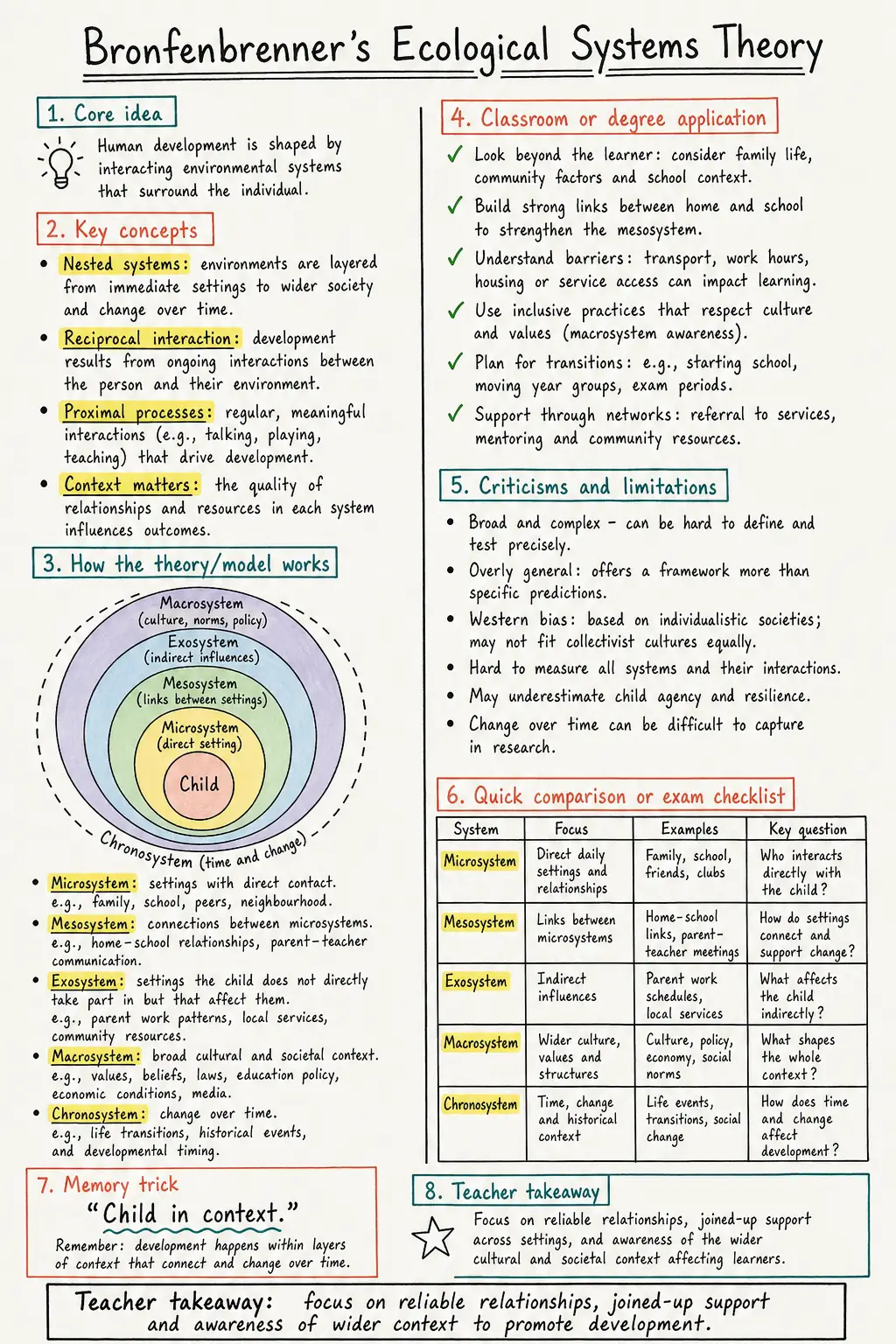
Download a one-page study note for Bronfenbrenner's Ecological Systems Theory, with the key ideas, limitations and classroom links in one place.
Bowlby's attachment theory (Bowlby, 1969) blends nature and nurture. He claimed that learners instinctively seek a caregiver. Consistent care fosters secure attachment. Nature and nurture are both needed, not one or the other.
Interactionism avoids genetic determinism and unrealistic expectations. It recognises that learners possess varied genetic foundations (Dickins & Flynn, 2001), and that they need suitable support and challenge to grow (Asbury & Plomin, 2014; Rutter, 2006).
Maya finds patterns easy but faced school moves (genetic influence, life events). Hassan has resilience, but dyslexia impacts number work. Effective teaching means understanding each learner's needs. Maya requires stability, routine, and pattern work. Hassan needs multisensory teaching for numeracy. (Bronfenbrenner, 1979; Sameroff, 2009) All learners benefit from high expectations and clear instruction. This shows interactionism: genes, environment, and support all matter.
Your beliefs about nature and nurture directly shape your classroom practice in three critical ways.
Learners may get less challenge if teachers think ability is fixed. Dweck's research (1988) says praising effort boosts motivation more than praising talent. An interactionist view supports growth mindset; all learners can improve with good teaching. (Blackwell et al., 2007; Yeager & Dweck, 2012)
Genetic and environmental factors mean we must differentiate. Some learners have strong language skills upon arrival, others lack them. Specific learning differences, like dyslexia, have neurological roots. Trauma can also affect learning. Good teaching adapts by scaffolding and providing safety (Tomlinson, 2014; Rose & Meyer, 2002). This ensures learners progress beyond uniform instruction (Vygotsky, 1978; Sousa, 2017).
Avoiding Stereotype Threat and Labelling: Research on stereotype threat (by Claude Steele and colleagues) shows that when learners are reminded of negative stereotypes about their group's abilities (e.g., "Girls aren't good at maths," "Working-class children underachieve"), their performance declines, even when they're capable. The implicit nature/nurture belief, that maths ability or academic potential is "in your genes or your background", can trigger this threat. Framing ability as developable through effort and good teaching protects against stereotype threat.

The nature versus nurture argument sparks debates, especially regarding intelligence. Research by Galton (1869) and others reveals important findings. Studies from Spearman (1904) to Deary et al. (2010) explore this concept. These investigations by Plomin et al. (2016) shape our understanding of learner abilities.
IQ has genetic links, around 50% in adults (twin and genome studies). This doesn't mean your intelligence is "50% genetic". Heritability shows how genes explain differences in a group. Identical education raises heritability; big differences lower it. Heritability tells us nothing about individual learner IQ change.
IQ Gains Over Time: The Flynn effect, the observed rise in IQ scores across generations in developed countries, shows that average IQ has risen substantially (roughly 3 points per decade) over the past 70 years. This cannot be explained by genetic change (human genes don't evolve that quickly); it reflects improved nutrition, more years of education, and increased cognitive demands in modern environments. This demonstrates that IQ, despite having genetic components, is responsive to environmental improvement.
Gardner (1983) said intelligence has many forms, not just one general ability. He suggested eight intelligences, like linguistic and musical skills. Learners have different strengths, and "smart" shows in many ways. These intelligences develop through practice and culture, noted Gardner (1999).
Why This Matters in Your Classroom: Avoid thinking of IQ or "intelligence" as a fixed trait that predicts success. Research on intelligence theories shows that persistence, self-regulation, growth mindset, and quality of instruction often matter more than measured IQ for long-term achievement. Offer all learners a rich, cognitively demanding curriculum, not a "lower" one, with appropriate scaffolding and support.
Caspi et al. (2002), Moffitt (1993) and Rutter (2006) show why behaviour should be understood through both biology and context. Teachers should respond with curiosity rather than blame: consider temperament, stress, learned patterns and classroom conditions before assuming defiance or low motivation.
Temperament: the innate starting point. Learners start with different temperaments (Thomas & Chess, 1977). These affect activity and emotional intensity. Learners with high energy may seem impulsive. Withdrawn learners may seem anxious. Temperament isn't behaviour choice or parenting failure. Being aware of temperament stops misattributions (Keogh, 2003).
Learned Behaviour and Conditioning: Yet behaviour is also learned through consequence and observation. A child whose classroom disruption is rewarded with teacher attention will disrupt more. A child who observes peers being praised for raising their hand will raise their hand. Effective behaviour management uses this principle: you shape the environment and reinforcement contingencies to encourage desired behaviour.
Chronic stress changes learners' stress response (cortisol, amygdala), say researchers. This isn't bad behaviour but a biological reaction to threats. Trauma can make learners struggle to regulate emotions or sit still. Understanding trauma (van der Kolk, 2014) lets us support, not punish.
Recognise learners' differing temperaments, but teach expected behaviours. Don't mislabel normal differences as disorders. For behavioural issues, check biological factors such as sleep, nutrition and stress, and also consider environmental influences such as expectations, relationships and reinforcement patterns (Thomas & Chess, 1977; Keogh, 2003).
Free for teachers. The platform builds a classroom-ready lesson plan from your topic in under two minutes.

The nature/nurture debate has real policy implications in English education.
Setting learners by ability seems sensible, but research suggests problems. Grouping widens attainment gaps, say Ofsted and the EEF. Set placement reflects past advantage more than ability (Boaler, 2008). Learners in lower sets get a weaker curriculum and less experienced teachers. This deepens inequality, as shown by Ireson and Hallam (2001). Mixed attainment groups and differentiated teaching are better.
Ofsted wants schools to help all learners achieve (Ofsted, 2019). Research shows teaching, expectations, and school atmosphere affect learner progress. Believing some learners cannot succeed is outdated, say researchers (Dweck, 2006; Yeager & Walton, 2011).
The SEND Code of Practice (2014) highlights unmet needs or unsuitable teaching, not fixed issues. Schools provide quality, tailored teaching first, modifying the environment. Before assuming dyslexia, ensure the learner had evidence-based phonics instruction. While dyslexia exists (Lyon et al., 2003), good support minimises impact, say Snowling & Hulme (2011).
The pupil premium aims to close attainment gaps for disadvantaged learners. Research shows environmental factors strongly predict achievement (Feinstein, 2003). Schools use extra funding for better teaching and wider support. Effective pupil premium use narrows gaps, proving investment matters (Sutton Trust, 2011).
Mixed attainment teaching works better than setting. Expect a lot and differentiate well. (Boaler, 2014). Do learners have enough opportunity before judging "ability"? (Hart, 2018). Try supports before blaming SEND for poor results. (Florian & Black-Hawkins, 2011).
| Aspect | Nature (Genetics) | Nurture (Environment) |
|---|---|---|
| Definition | Children's abilities, behaviour, and personality are primarily determined by their genetic inheritance and biological factors | Children's development is primarily shaped by their environment, experiences, and learning opportunities |
| Key Feature | Innate predispositions, temperamental differences, and genetic scaffolding for abilities like language acquisition | Environmental influences, teaching methods, cultural factors, and experiential learning shape development |
| Example | Chomsky's Language Acquisition Device, genetic components of dyslexia, temperamental differences in 4-month-old infants | John Locke's "tabula rasa" concept, IQ gains in adopted children through improved environments |
| Classroom Use | Recognising genuine neurobiological differences and avoiding dismissing learning difficulties as "laziness" | Creating enriched learning environments, differentiated instruction, and targeted interventions to maximise potential |
| Best For | Understanding individual differences, identifying learning disabilities, and setting realistic expectations based on starting points | Developing growth mindset approaches, implementing effective teaching strategies, and believing in students' capacity for improvement |
Academic References:
Related Articles on This Site:
These sources replace fake, future-dated and placeholder studies with verified genetics, development, social-learning and classroom-expectations evidence.
The new genetics of intelligence View PubMed record ↗
Plomin, R. and von Stumm, S. (2018). Nature Reviews Genetics.
Use this for cautious claims about genetics and intelligence, not for deterministic claims about individual learners.
How People Make Their Own Environments View DOI record ↗
Scarr, S. and McCartney, K. (1983). Child Development.
This supports the gene-environment correlation explanation without suggesting genes simply determine classroom outcomes.
Socioeconomic Status Modifies Heritability of IQ in Young Children View DOI record ↗
Turkheimer, E. et al. (2003). Psychological Science.
This is used for the limited claim that heritability estimates can vary by social and environmental conditions.
Role of genotype in the cycle of violence in maltreated children View DOI record ↗
Caspi, A. et al. (2002). Science.
This supports a careful gene-environment interaction example; it should not be used to label individual learners.
Transmission of aggression through imitation of aggressive models View DOI record ↗
Bandura, A., Ross, D. and Ross, S. A. (1961). The Journal of Abnormal and Social Psychology.
This is the specific source for the Bobo doll modelling claim.
Temperamental factors in human development View DOI record ↗
Kagan, J. and Snidman, N. (1991). American Psychologist.
This replaces the vague Kagan date placeholder with a specific temperament source.
The Ecology of Human Development View book record ↗
Bronfenbrenner, U. (1979). Harvard University Press.
This supports the ecological-systems paragraph and replaces undated Bronfenbrenner placeholders.
Implicit theories of intelligence predict achievement across an adolescent transition View DOI record ↗
Blackwell, L. S., Trzesniewski, K. H. and Dweck, C. S. (2007). Child Development.
This supports the cautious claim that beliefs, expectations and interventions can influence learner outcomes.
Theory grounded. Classroom workable. Free for teachers.