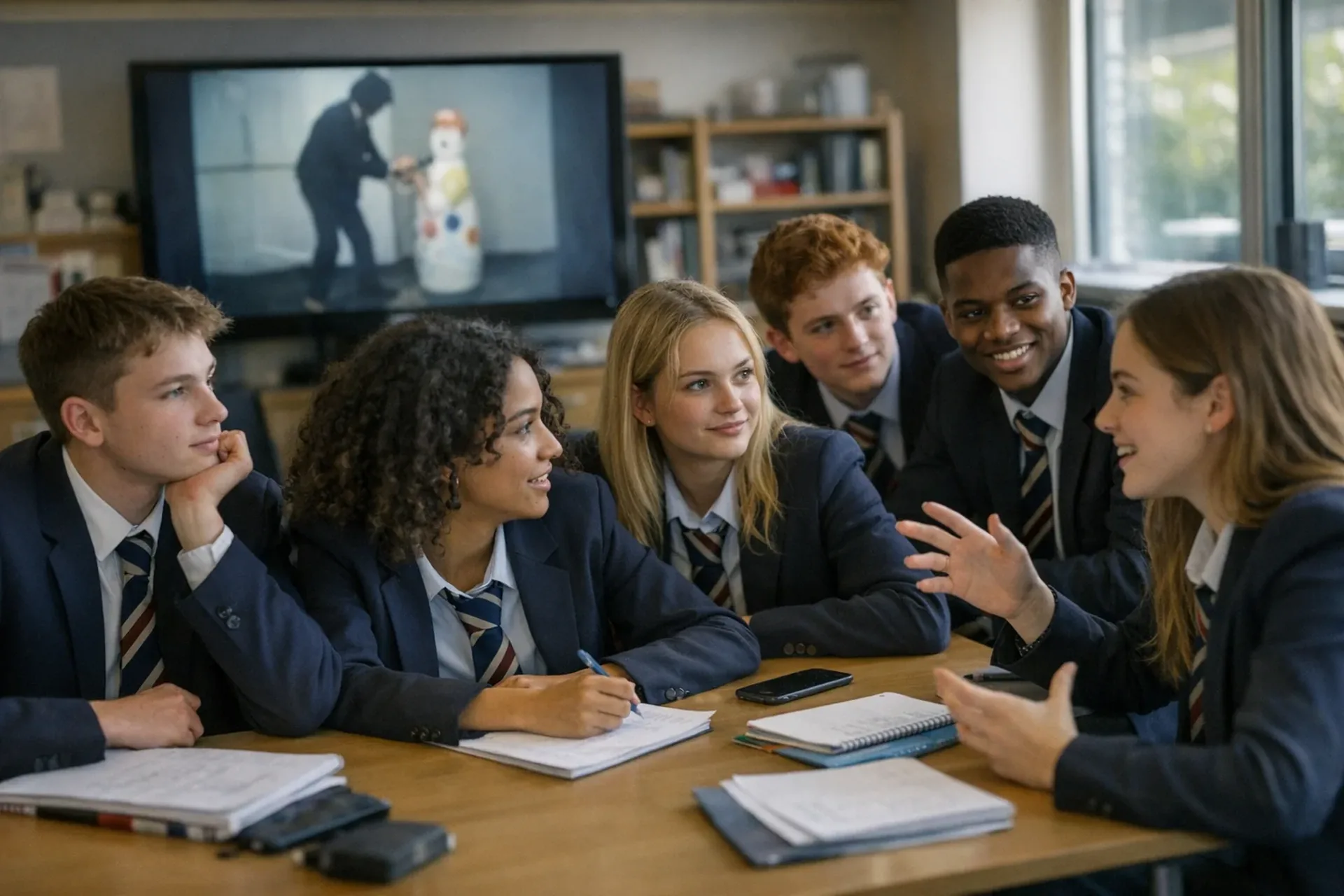
Bandura's Social Learning Theory in the Classroom [Free Planner]Sixth form students, ages 17-18, in navy blazers and striped ties, discuss Bandura's Bobo Doll Study in modern study space.

Updated on  

March 18, 2026

Bandura's Social Learning Theory in the Classroom [Free Planner]

|

October 24, 2022

Model positive behaviour using Bandura's 4 stages. Includes a free lesson planner, classroom observation poster, interactive quiz, and teacher podcast.

Course Enquiry
Copy citation

Main, P (2022, October 24). Social Learning Theory - Bandura. Retrieved from https://www.structural-learning.com/post/social-learning-theory-bandura

What is Bandura's Social Learning Theory?

When educators apply Bandura's Social Learning Theory in schools, they harness the powerful principle that students learn best by observing and imitating the behaviours they see around them. This means teachers can strategically model positive academic habits, problem-solving approaches, and social skills, knowing that students will naturally absorb and replicate these demonstrations. Rather than relying solely on direct instruction or reward systems, savvy educators create classroom environments where peer learning, teacher modelling, and observational opportunities drive student development. But how exactly can you transform this psychological theory into practical teaching strategies that genuinely improve learning outcomes in your classroom?

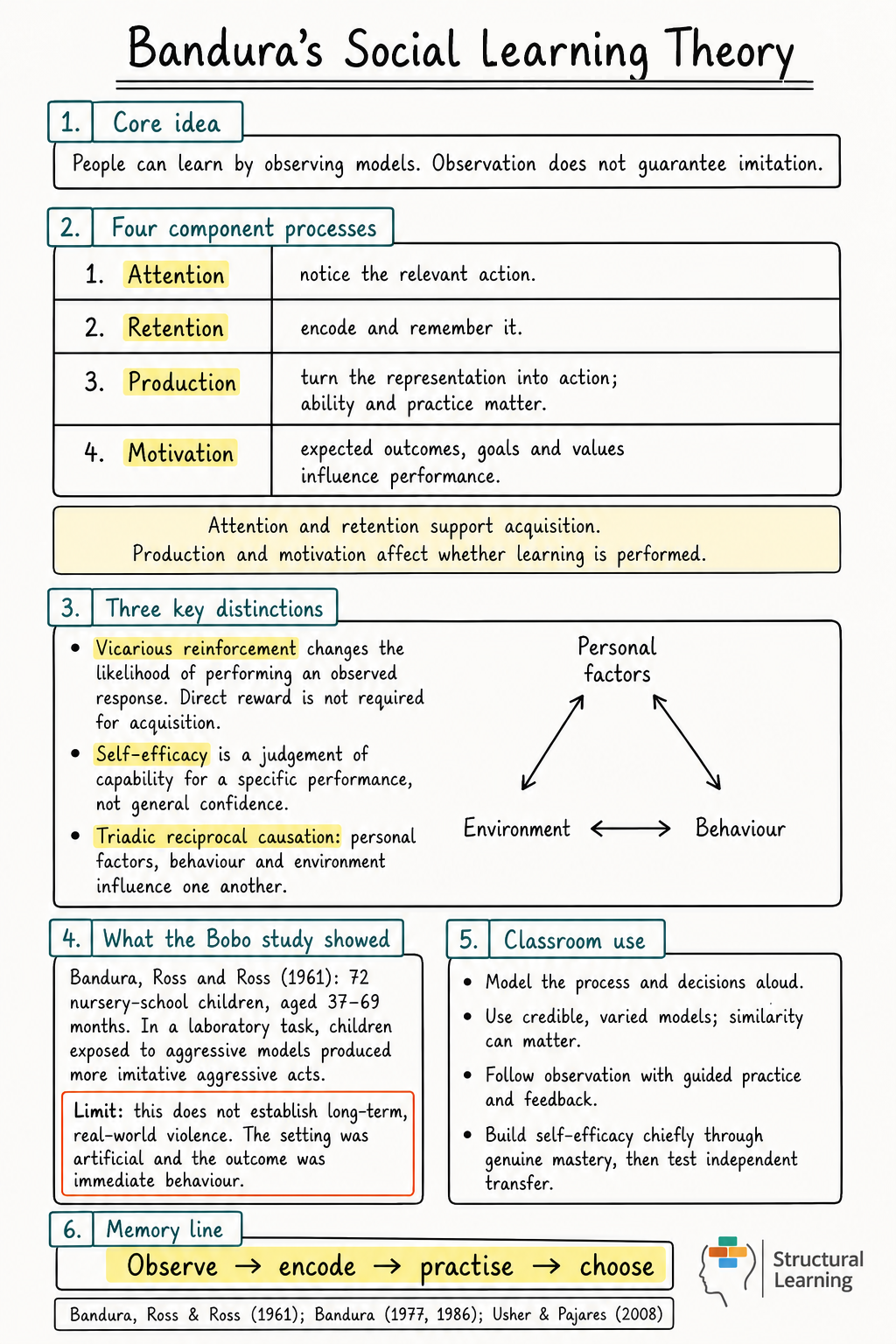
Diagram illustrating Bandura's four processes of observational learning: Attention, Retention, Motor Reproduction, and Motivation, showing how students learn by observing.
Observational Learning Process

Albert Bandura's social learning theory proposes that people acquire new behaviours by observing and imitating models, a process requiring attention, retention, motor reproduction, and motivation. Unlike pure behaviourism, which demands direct reinforcement, Bandura (1977) demonstrated through the Bobo doll experiments that vicarious observation alone is sufficient for learning. Without intentional modelling of the thinking processes behind expert performance, teachers miss the most powerful channel through which pupils acquire academic and social skills.

Albert Bandura (1925-2021) transformed our understanding of how people learn by proposing that individuals acquire new behaviours through observing and imitating the actions of others. Unlike earlier behaviourist models, which emphasised direct reinforcement, Bandura introduced the idea that learning can occur through social interaction and observation alone. His theory provided an alternative to the work of earlier education theorists, who focused on direct reinforcement, and expanded on existing theories of learning by incorporating cognitive and environmental influences. In 2025, Bandura's framework remains one of the most widely applied theories in teacher training and classroom practise.

Key Takeaways

  1. Teacher modelling is the most powerful tool for fostering positive academic and social development in pupils. By strategically demonstrating desired behaviours, problem-solving approaches, and effective learning strategies, educators provide clear, observable examples that pupils can imitate and internalise, as highlighted in Bandura's foundational work (Bandura, 1977). This active demonstration moves beyond passive instruction, making learning tangible and accessible for all pupils.
  2. Cultivating pupils' self-efficacy is paramount for sustained engagement and achievement within a social learning framework. When pupils observe successful peers or teachers, their belief in their own capabilities to master similar tasks significantly increases, a core tenet of self-efficacy theory (Bandura, 1997). This enhanced self-belief motivates pupils to attempt challenging tasks, persist through difficulties, and ultimately take ownership of their learning journey.
  3. Effective observational learning in the classroom hinges on understanding and facilitating its four distinct processes. For pupils to successfully learn from models, they must attend to the behaviour, retain the information, possess the motor reproductive capabilities, and be motivated to perform the observed actions (Bandura, 1986). Teachers must therefore design learning experiences that capture attention, aid memory, provide practice opportunities, and offer incentives for replication.
  4. Learning outcomes are dynamically shaped by the reciprocal interaction between pupils, their behaviour, and the classroom environment. This concept of reciprocal determinism posits that these three factors continuously influence each other, meaning a pupil's actions can alter the learning environment, which in turn affects their cognitive processes and subsequent behaviours (Bandura, 1986). Educators should therefore foster an interactive and supportive classroom culture where positive behaviours are reinforced and contribute to a productive learning atmosphere.

◆ Structural Learning
Learning by Watching: Bandura's Social Theory
A deep-dive podcast for educators

This podcast explores Bandura's social learning theory, the Bobo doll experiments, self-efficacy, and how modelling shapes behaviour and achievement in classrooms.

According to Bandura, learning isn't solely the result of conditioning but involves a active interplay between cognition, environment, and behaviour. He identified two key processes that differentiate social learning from traditional behaviourist theories:

  1. Observational Learning: People learn behaviours by watching others in their environment, such as parents, teachers, or peers.
  2. Mediational Processes: Cognitive processes occur between the stimulus and response, meaning individuals actively interpret and internalise what they observe before deciding to replicate it.

Stage/LevelAge RangeKey CharacteristicsClassroom Implications
AttentionAll agesNoticing and focusing on the modelled behaviour, selective observation of relevant featuresTeachers should ensure behaviours are distinctive, use clear demonstrations, minimise distractions
RetentionAll agesRemembering and storing the observed behaviour through mental images or verbal descriptionsUse repetition, provide opportunities for mental rehearsal, connect to prior knowledge
ReproductionAll agesPhysical and cognitive ability to perform the observed behaviour, converting memory into actionBreak complex behaviours into steps, provide guided practise, ensure developmental readiness
MotivationAll agesHaving reasons to imitate the behaviour, influenced by reinforcement and consequences observedHighlight positive outcomes, use peer models, create meaningful rewards for learning

Flow diagram showing four connected stages of observational learning with arrows
Flow diagram: The 4 Stages of Observational Learning

Born in 1925 in Canada, Bandura earned his PhD at the University of Iowa in 1952 and later became one of the most influential psychologists of the 20th century. His 1977 book, Social Learning Theory, formalised his ideas and demonstrated how children and adults learn from modelled behaviours. One of his most well-known experiments, the Bobo doll study, showed how children imitate aggression after witnessing it in adults, reinforcing his argument that learning is largely influenced by social exposure.

Beyond education, Bandura's theory has been applied in parenting, workplace training, media studies, and behavioural therapy. His work also led to the development of self-efficacy, the belief in one's ability to succeed. Bandura argued that higher self-efficacy leads to greater achievement, shaping how individuals approach learning, challe nges, and personal growth.

Bandura's Social Learning Theory concept map showing four stages of observational learning: attention, retention, reproduction, motivation
Bandura's Social Learning Theory: Observational Learning and the Bobo Doll Study, Visual Overview

Main Principles of Social Learning Theory

  1. Learning through observation: Bandura demonstrated that children don't need direct reinforcement to learn; they acquire behaviours by watching and imitating role models in their environment.
  2. Four conditions for learning: Attention, retention, reproduction, and motivation must all be met for effective learning to occur, highlighting the active role of the learner.
  3. The Bobo doll experiment: Bandura's groundbreaking study showed that children who observed aggressive behaviour were more likely to replicate it, underscoring the impact of media and role models.
  4. Social learning in practise: The theory has transformed education, therapy, and organisational behaviour by emphasising the importance of modelling, self-efficacy, and social context.

5 Ways to Apply Bandura's Theory in the Classroom

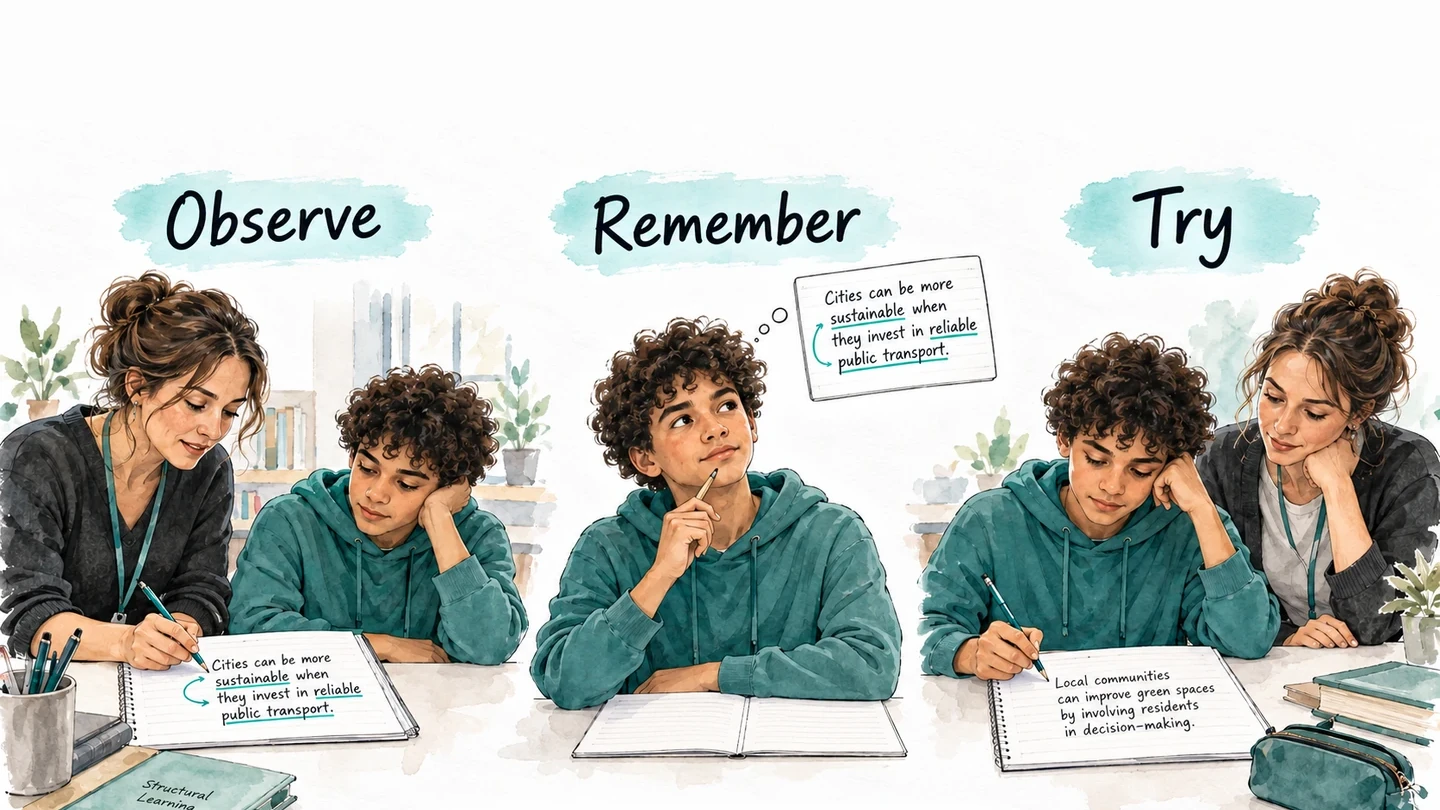
  1. Model the thinking process, not just the answer. Bandura (1977) showed that people learn by observing others, and that the observed model's credibility matters. When introducing a new problem type, think aloud as you work through it: "I notice the numbers are large, so I will estimate first to check my answer makes sense." Pupils who hear a teacher's genuine reasoning process, including moments of uncertainty, are more likely to adopt that reasoning habit than if they observe only a polished final answer.
  2. Use peer demonstration to increase self-efficacy. Bandura (1977) found that seeing a similar peer succeed at a task raises the observer's belief in their own ability more reliably than watching an expert. When a pupil has mastered a procedure, invite them to demonstrate it to a small group before you move the whole class on. Hearing "She's in my set and she managed it" is a more powerful message than "The teacher thinks I can do this."
  3. Give mastery experiences through carefully sequenced tasks. Self-efficacy grows through repeated, genuine success (Bandura, 1997). Design task sequences where each step is achievable with effort but not trivially easy, so that pupils accumulate a real record of accomplishment. Keep early tasks short enough to complete within a lesson and provide immediate feedback, because a string of completed attempts, each slightly harder than the last, builds the confidence to tackle genuinely difficult work.
  4. Narrate vicarious reinforcement explicitly. When one pupil receives praise or recognition, name the specific behaviour so that observers can internalise what earned the reward (Bandura, 1965). "Callum checked his units at every step. That is exactly why his answer is correct" tells the whole class what to do, not just what Callum did well. Vague praise ("Good work, everyone") carries far less observational learning value than targeted, behaviour-specific feedback delivered publicly.
  5. Teach self-regulation strategies as observable procedures. Bandura's (1991) work on self-regulation describes the cycle of self-observation, self-judgement, and self-reaction that underpins independent learning. Make this cycle visible: ask pupils to mark their own work against a success criteria checklist before handing it in, note one specific thing they would change, and set a target for the next attempt. When pupils see the teacher model this same reflective cycle on a piece of shared writing, the abstract concept of self-regulated learning becomes a concrete, repeatable procedure.

Bobo Doll Experiment Evidence and Implications

The Bobo doll experiment, conducted in 1961 at Stanford University, stands as one of the most influential studies in the history of psychology. Albert Bandura designed this groundbreaking research to test a fundamental question: Can children learn aggressive behaviours simply by observing adults, without any direct reinforcement? The study challenged the dominant behaviourist theories of the time, which insisted that learning required direct experience of rewards or punishments.

Infographic comparing key tenets of Behaviorism and Bandura's Social Learning Theory, focusing on their differing approaches to how learning occurs.
Social vs. Behaviorist Learning

Experimental Methodology

Bandura's experimental design was methodical and carefully controlled. He recruited 72 children (36 boys and 36 girls) aged between 3 and 6 years from the Stanford University Nursery School. The children were divided into three main experimental groups, with equal numbers of boys and girls in each condition to control for potential gender differences in aggressive behaviour.

The first group observed an adult model behaving aggressively towards a five-foot inflatable Bobo doll. The adult model entered a playroom and, after a brief period of play with other toys, began a sustained physical and verbal assault on the Bobo doll. The aggressive behaviours were highly distinctive and included punching the doll, hitting it with a mallet, throwing it in the air, and kicking it around the room. Crucially, the adult also used specific verbal aggression, shouting phrases such as "Sock him in the nose!" and "Pow!" These distinctive verbal and physical behaviours made it easy to identify clear copying when children were later observed.

The second group observed a non-aggressive adult model who completely ignored the Bobo doll and played quietly with other toys in the room for the same duration. This condition served as a control to demonstrate that mere exposure to the doll and playroom environment didn't automatically trigger aggression.

The third group was a control group that had no exposure to any adult model. These children simply played in the room without witnessing any modelled behaviour, providing a baseline measure of children's natural aggression levels towards the Bobo doll.

An additional experimental condition examined the effect of model gender. Some children observed same-sex models whilst others observed opposite-sex models, allowing Bandura to investigate whether children were more likely to imitate models of their owngender, a hypothesis supported by social learning theory.

Key Findings and Results

After exposure to the model, each child was individually taken to a different room filled with attractive toys. To create mild frustration and increase the likelihood of aggressive responses, the experimenter told the children after two minutes that these toys were reserved for other children. The children were then taken to a third room containing both aggressive toys (such as mallets and dart guns) and non-aggressive toys, along with the Bobo doll. Observers behind a one-way mirror recorded the children's behaviour for 20 minutes.

Children who had observed the aggressive model were significantly more likely to display aggressive behaviours towards the Bobo doll, precisely replicating the behaviour they had witnessed. They did not simply show more general aggression; they performed precise imitations of the specific actions and words used by the adult model. Children who had observed the aggressive model were statistically far more aggressive than those in either the non-aggressive or control conditions.

Bandura found that boys were significantly more aggressive than girls overall, but girls who had observed aggressive female models showed aggression levels comparable to boys. This suggested that whilst biological factors might predispose boys to higher baseline aggression, observational learning could powerfully override these tendencies. The study also revealed that children were more likely to imitate same-sex models, particularly for physical aggression, supporting the role of identification in observational learning.

Perhaps most concerning from an applied perspective, children often exhibited novel aggressive behaviours that went beyond mere imitation. They improvised new ways to attack the doll, demonstrating that observational learning didn't just produce rote copying but could inspire creative variations on observed themes.

Implications for Education and Child Development

The Bobo doll experiment had profound implications that extended far beyond the psychology laboratory. It provided compelling evidence that children are highly susceptible to social influences and can acquire complex behaviours through observation alone, without needing direct reinforcement. This finding transformed understanding of child development and had immediate practical applications.

For educators, the study underscored the critical importance of teacher modelling. Children in classrooms don't just learn academic content; they constantly observe and absorb behavioural patterns demonstrated by adults and peers. Teachers who model respectful communication, problem-solving strategies, and emotional regulation effectively teach these behaviours to their students through observational learning. Conversely, displays of frustration, sarcasm, or dismissive behaviour can be equally readily acquired.

The experiment also raised significant concerns about media violence and its impact on children. Children could learn and copy aggressive behaviours after just a few minutes of observation in a laboratory setting. What might be the combined effect of hours of exposure to violence in television programmes, films, and video games? This question sparked decades of subsequent research and continues to inform debates about media regulation and parental guidance.

From a classroom management perspective, the Bobo doll study highlighted the need for consistent modelling of positive behaviours. Children learn not just from what teachers explicitly teach but from everything they observe, including how teachers handle stress, resolve conflicts, and interact with different students. The study suggested that creating a positive classroom culture requires deliberate attention to the behaviours being modelled throughout the school day.

Mediational Processes: Bandura's Cognitive Bridge

Bandura (1977) introduced the concept of mediational processes to distinguish social learning theory from pure behaviourism. Where Skinner argued that learning occurs through direct reinforcement of behaviour, Bandura demonstrated that cognitive processes mediate between observing a behaviour and deciding whether to reproduce it. These mediational processes, namely attention, retention, reproduction, and motivation, explain why two pupils can observe the same model yet respond entirely differently.

The mediational processes framework represents Bandura's central theoretical contribution: it positions the learner as an active cognitive agent rather than a passive recipient of environmental stimuli. A pupil who observes a classmate being praised for answering a question (vicarious reinforcement) must first attend to the event, retain it in memory, possess the capability to reproduce the behaviour, and be motivated to do so. Failure at any stage breaks the chain, which is why simply exposing pupils to good role models does not guarantee learning (Bandura, 1986).

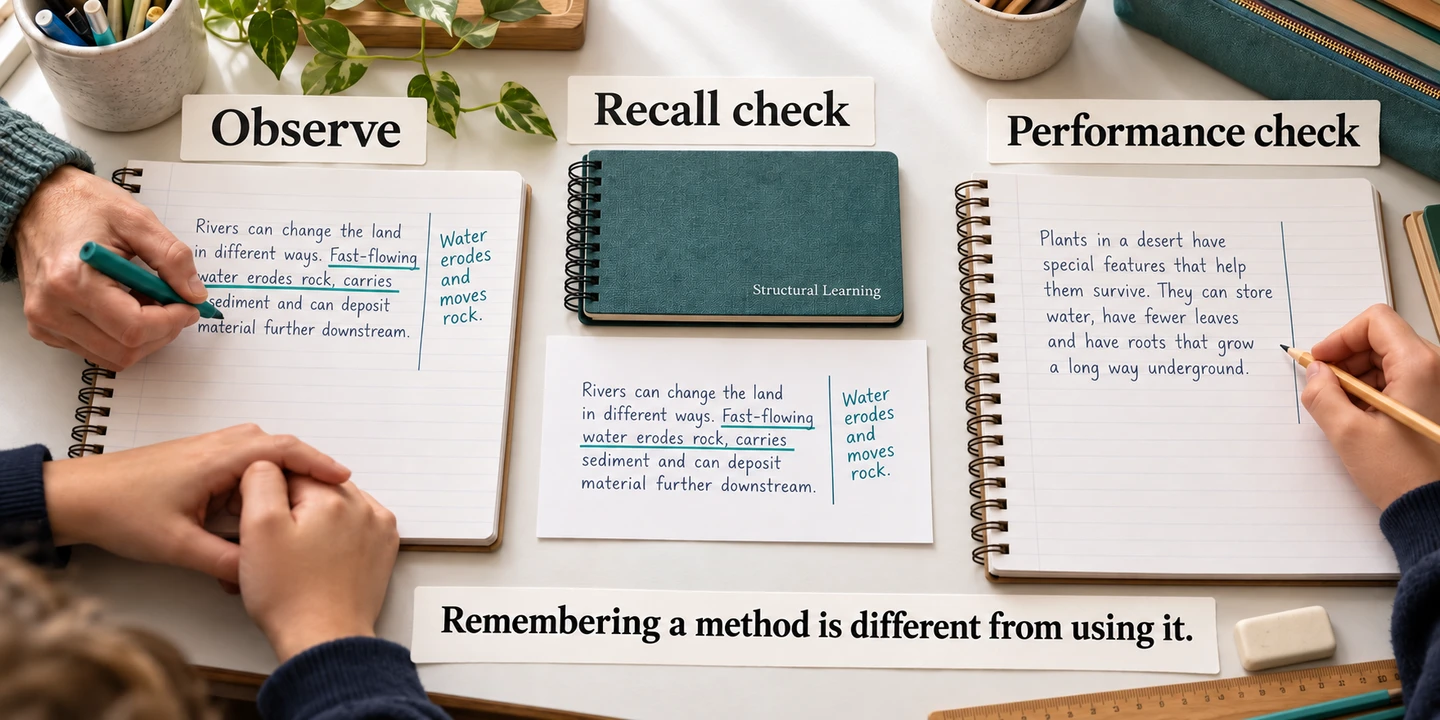
For teachers, making mediational processes explicit transforms modelling from an intuitive practice into a deliberate instructional strategy. Rather than assuming pupils will automatically learn from demonstrations, effective instruction targets each process: directing attention ("Watch how I hold the protractor"), supporting retention ("Draw a quick sketch of the three steps"), checking reproduction capability ("Now try it with your partner"), and building motivation ("Notice how much faster you completed that compared to yesterday").

Four Processes of Observational Learning

Bandura identified four essential processes that determine whether observational learning occurs effectively: attention, retention, reproduction, and motivation. These sequential stages must all function successfully for learners to acquire new behaviours through modelling. Understanding each process in depth enables educators to design learning experiences that maximise the power of observational learning.

1. Attention: The Gateway to Learning

The attention process represents the first critical stage of observational learning. Learners cannot acquire behaviours they haven't noticed, making attention the gateway through which all observational learning must pass. However, attention isn't a simple on-off switch; it involves selective focus on relevant aspects of the model's behaviour whilst filtering out irrelevant details.

Several factors influence whether learners attend to a model's behaviour. The distinctiveness of the behaviour plays a important role; unusual, vivid, or clearly demonstrated actions capture attention more effectively than subtle or commonplace behaviours. This explains why teachers often exaggerate certain aspects of demonstrations, using dramatic gestures or emphatic language to ensure students notice critical features.

The characteristics of the model also significantly affect attention. Learners pay more attention to models they perceive as competent, attractive, powerful, or similar to themselves. In classroom settings, this means peer models can be particularly effective, especially when students perceive the demonstrating peer as comparable in ability rather than exceptionally talented. A struggling student who successfully masters a technique may provide a more compelling model than the highest-achieving student in the class.

Functional value influences attention as well. Learners are more likely to attend carefully to behaviours they believe will be useful or valuable to them. Teachers can improve attention by explicitly explaining why a particular strategy or skill matters, connecting it to students' goals or interests. When students understand that a demonstrated study technique will help them remember content more effectively, they attend more carefully to the demonstration.

Environmental factors also matter enormously. Distractions, competing stimuli, and poor visibility all undermine attention. Effective modelling requires minimising distractions, ensuring clear sight lines, and creating an environment where the demonstrated behaviour stands out clearly from the background. This is why many teachers instinctively call for silence and direct visual attention before beginning demonstrations.

2. Retention: Encoding Observed Behaviours into Memory

Attention alone cannot produce learning; observed behaviours must be encoded into memory in a form that permits later retrieval and reproduction. The retention process involves transforming observed actions into mental representations that can be stored and accessed when needed. Bandura identified two primary coding systems through which retention occurs: imaginal and verbal.

Imaginal coding involves creating vivid mental images of the observed behaviour. When a student watches a teacher demonstrate how to conduct a science experiment, they form visual memories of each step, the equipment arrangement, and the movements involved. These mental images serve as internal models that can be mentally rehearsed and later retrieved during actual performance.

Verbal coding involves describing the observed behaviour in words, creating a linguistic representation that can be more easily stored and recalled than pure imagery. A student might internally narrate "First, measure 50ml of water, then add three drops of indicator, swirl gently, and observe the colour change." This verbal encoding complements visual representation and often lasts longer in long-term memory.

Teachers can significantly improve retention through several strategies. Repetition of demonstrations allows multiple encoding opportunities, strengthening memory traces. Encouraging mental rehearsal, where students mentally walk through the observed behaviour whilst seated, reinforces retention without requiring physical practise. Connecting new observations to existing knowledge schemas creates retrieval paths that make memories more accessible.

The use of verbal labelling during demonstrations proves particularly powerful. When teachers simultaneously demonstrate and describe their actions, they provide both imaginal and verbal coding opportunities, supporting dual encoding. Research on Allan Paivio's dual coding theory confirms that information encoded in multiple formats is remembered more effectively than single-format encoding.

Time delays between observation and performance opportunity affect retention significantly. Without rehearsal, memory traces decay rapidly. Teachers should provide opportunities for relatively prompt practise after demonstrations, whilst the memory remains fresh and accessible. Alternatively, structured review sessions help students reactivate and consolidate memories before they fade completely.

3. Reproduction: Translating Memory into Action

Even with perfect attention and retention, learning remains incomplete until the learner can physically or cognitively reproduce the observed behaviour. The reproduction process requires translating mental representations into actual performance, a stage that depends heavily on the learner's existing capabilities and developmental readiness.

Physical capabilities constrain what behaviours can be reproduced. A young child who observes an adult performing a complex motor skill may attend perfectly and retain a clear memory yet lack the physical coordination, strength, or fine motorcontrol to execute the action. Teachers must ensure that demonstrated behaviours match students' developmental capabilities or provide scaffolded approaches that break complex actions into achievable components.

Cognitive capabilities similarly affect reproduction. Understanding the principles underlying a demonstrated problem-solving strategy requires sufficient cognitive development and background knowledge. A student who observes a teacher using algebraic manipulation may lack the conceptual understanding to reproduce the steps meaningfully, even with perfect memory of the procedure.

Feedback during initial reproduction attempts proves important. Learners rarely execute observed behaviours perfectly on the first attempt; they need corrective information to align their performance with the observed model. This feedback can come from teachers, peers, or self-monitoring against remembered images of the model's performance. The quality and timing of feedback significantly influence how quickly learners achieve accurate reproduction.

Practise plays an essential role in moving from approximate to precise reproduction. Initial attempts typically capture the general form of the behaviour, but refinement requires repeated practise with attention to details. Teachers help this process by breaking complex behaviours into manageable components, allowing students to master each element before combining them into the complete performance.

Self-efficacy beliefs powerfully influence reproduction attempts. Students who doubt their capability to perform an observed behaviour may not attempt reproduction at all, despite perfect attention and retention. Building confidence through graduated difficulty, ensuring early successes, and highlighting progress all support students' willingness to attempt reproduction of observed behaviours.

4. Motivation: The Decision to Perform Learned Behaviours

The motivation process represents the final stage of observational learning and addresses a important distinction Bandura made between acquisition and performance. Students may successfully attend to, retain, and possess the capability to reproduce an observed behaviour yet choose not to perform it. Motivation determines whether learned behaviours are actually enacted.

Bandura identified three types of reinforcement that influence motivation: direct reinforcement, vicarious reinforcement, and self-reinforcement. Direct reinforcement occurs when learners personally experience positive consequences for performing the behaviour. A student who receives praise after using a problem-solving strategy observed from a teacher becomes more motivated to use that strategy again.

Vicarious reinforcement operates through observation of consequences experienced by others. When students observe peers being praised, rewarded, or successful after performing particular behaviours, they become more motivated to attempt those behaviours themselves. This process proves particularly powerful in classroom settings where teachers can strategically highlight and reward desired behaviours, allowing the entire class to vicariously experience the positive consequences.

Conversely, vicarious punishment occurs when students observe others experiencing negative consequences for behaviours. Watching a peer receive criticism for calling out answers without raising their hand reduces other students' motivation to engage in the same behaviour, even if they had previously considered it.

Self-reinforcement involves learners' internal evaluation of their own performance against personal standards. Students who observe expert performance develop internal standards for quality, and they experience satisfaction (self-reinforcement) when their own performance meets these standards. This self-evaluative process becomes increasingly important as learners develop greater autonomy and self-regulation.

The anticipated consequences of behaviour, based on observed outcomes for others and past personal experience, critically influence motivation. Students engage in cognitive evaluation, mentally weighing the likely benefits and costs of performing an observed behaviour before deciding whether to attempt it. Teachers can influence this calculation by ensuring that positive behaviours consistently lead to valued outcomes whilst negative behaviours reliably produce undesirable consequences.

Intrinsic interest in the behaviour itself also motivates performance. When observed behaviours appear engaging, enjoyable, or intellectually satisfying, students feel motivated to attempt them regardless of external reinforcement. Teachers who demonstrate genuine enthusiasm and interest in their subject matter model intrinsic motivation, potentially inspiring similar attitudes in students.

Self-Efficacy Diagnostic
Rate a pupil's four sources of self-efficacy and get targeted strategies
Think of a specific pupil. Rate each of Bandura's four sources of self-efficacy from 1 (very low) to 10 (very high) based on your observations.

Self-Efficacy in Social Learning Theory

Whilst Bandura's social learning theory gained widespread recognition through the Bobo doll experiments, his development of self-efficacy theory arguably represents his most enduring contribution to educational psychology. Self-efficacy refers to an individual's belief in their capacity to execute behaviours necessary to produce specific performance attainments. It represents not what people can objectively do, but what they believe they can do, and this belief profoundly influences their actual performance.

The Four Sources of Self-Efficacy

Bandura identified four primary sources through which self-efficacy beliefs develop, each carrying different weight in shaping individuals' confidence in their abilities.

1. Mastery Experiences: The most powerful source of self-efficacy comes from direct experiences of successfully completing challenging tasks. When students work hard and succeed, they develop strong beliefs in their capabilities. Critically, success on easy tasks provides little efficacy information; it's overcoming difficulties through persistent effort that builds genuine confidence. Teachers who provide appropriately challenging tasks that students can master through sustained effort create the optimal conditions for self-efficacy development. Conversely, repeated failures, especially early in learning, severely undermine efficacy beliefs, making students hesitant to attempt challenging work.

2. Vicarious Experiences: Observing others successfully complete tasks provides efficacy information, especially when the observed models are similar to the observer. When students see peers they consider comparable to themselves succeed, they think, "If they can do it, so can I." The perceived similarity between model and observer determines the power of vicarious experience. A struggling student gains more efficacy from watching another struggling student succeed through effort than from observing a naturally talented student succeed effortlessly. This explains why peer modelling often proves more effective than teacher modelling for building student confidence, particularly when the teacher is perceived as exceptionally competent.

3. Verbal Persuasion: Encouragement and positive feedback from trusted others can strengthen self-efficacy, though this source proves weaker than mastery or vicarious experiences. Effective persuasion must be realistic and credible; hollow praise or encouragement to attempt tasks clearly beyond current capabilities damages credibility and can actually undermine efficacy. Teachers who provide specific, process-focused feedback ("You used effective strategies and worked systematically through the problem") build efficacy more effectively than vague praise ("You're so clever"). The persuader's credibility and expertise significantly influence the impact of verbal persuasion.

4. Physiological and Emotional States: People interpret their emotional and physical reactions as indicators of capability. Anxiety, stress, fatigue, and negative mood can be interpreted as signs of inadequacy, undermining efficacy. Conversely, calm confidence and positive emotional states support efficacy beliefs. Teachers can influence this source by helping students reinterpret physiological arousal (a racing heart before a test) as excitement and readiness rather than anxiety and inadequacy. Creating calm, supportive classroom environmentsreduces the negative physiological states that undermine confidence.

Self-Efficacy in Educational Contexts

Self-efficacy beliefs exert powerful influence on academic achievement through several mechanisms. Students with high self-efficacy approach difficult tasks as challenges to master rather than threats to avoid. They set challenging goals, maintain strong commitment, and persist through setbacks. When faced with failure, high-efficacy students attribute it to insufficient effort or inadequate strategies, both factors they can control and change. They approach threatening situations with confidence that they can exercise control.

In contrast, students with low self-efficacy avoid challenging tasks, give up quickly when encountering difficulties, and attribute failure to low ability, a stable factor they believe they cannot change. They dwell on personal deficiencies and potential difficulties rather than concentrating on how to perform successfully. This creates self-fulfilling prophecies: low efficacy leads to reduced effort and persistence, producing poor performance that confirms the initial negative belief.

Domain-specific nature of self-efficacy proves important for teachers to understand. A student might possess high self-efficacy for mathematics but low self-efficacy for writing. Generic confidence-building proves less effective than developing specific self-efficacy in particular academic domains through targeted mastery experiences and appropriate modelling.

Teachers can systematically build student self-efficacy through careful instructional design. Providing graduated difficulty ensures early successes that build confidence before increasing challenge. Using peer models effectively showcases that success comes through effort rather than innate ability. Offering specific, strategy-focused feedback helps students recognise their growing competence. Teaching students to set proximal, specific goals rather than distant, vague ones provides more frequent mastery experiences. Finally, helping students develop effective metacognitive strategies gives them tools they can reliably employ across different tasks, strengthening efficacy beliefs.

Reciprocal Determinism in Educational Settings

Central to Bandura's social learning theory is the concept of reciprocal determinism, which fundamentally distinguishes his approach from traditional behaviourist models. Rather than viewing behaviour as simply a response to environmental stimuli, Bandura proposed that behaviour, cognitive factors, and environmental influences operate as interlocking determinants that continuously influence each other bidirectionally. This three-way interaction means that whilst our environment shapes our behaviour, our behaviour simultaneously modifies our environment, and our thoughts and beliefs influence both processes.

The Triadic Reciprocal Causation Model

In Bandura's model, personal factors (cognitive, affective, and biological), behaviour, and environmental influences all function as interacting determinants. Personal factors include beliefs, expectations, attitudes, and knowledge. Environmental factors encompass social influences, physical surroundings, and situational constraints. Behaviour refers to actions, choices, and verbal statements.

These three factors don't operate in a simple linear chain (environment → thoughts → behaviour) but in a complex network of bidirectional influences. A student's self-efficacy beliefs (personal factor) influence their study behaviour (behaviour), which affects their academic achievement and teacher responses (environment), which in turn further shapes their self-efficacy beliefs. The cycle continues in an ongoing process of reciprocal influence.

The relative influence of each factor varies across situations and individuals. In some circumstances, environmental factors dominate; a fire alarm immediately influences everyone's behaviour regardless of personal beliefs. In other situations, personal factors exert stronger influence; two students in identical environments may behave completely differently based on their beliefs and expectations. Understanding this active interplay enables more sophisticated interventions than simple behaviourist or purely cognitive approaches.

Practical Implications for Education

Reciprocal determinism explains why identical teaching methods produce vastly different outcomes across students. A student's prior knowledge and self-efficacy beliefs (cognitive factors) influence how they respond to classroom activities (behaviour), which affects teacher feedback and peer interactions (environment). For instance, a confident student may actively participate in discussions, leading to positive reinforcement that further enhances their self-belief and engagement, creating an upwards spiral of success.

Conversely, a student with low self-efficacy may remain passive during lessons, missing learning opportunities and receiving less teacher attention, which confirms their belief that they cannot succeed, creating a downwards spiral. The same classroom environment produces dramatically different experiences based on the reciprocal interactions between personal factors, behaviour, and environmental responses.

Understanding reciprocal determinism enables educators to intervene strategically across all three domains rather than focusing narrowly on one aspect. Teachers can modify environmental factors through thoughtful classroom organisation, strategic peer groupings, and structured learning activities. They can address cognitive factors by building students' self-efficacy, teaching effective learning strategies, and helping students develop positive attitudes towards learning. They can shape behaviour through targeted modelling, clear expectations, and consistent feedback.

Multifaceted interventions that address all three elements simultaneously prove most effective. For example, when working with a disengaged student, a teacher might change the environment by providing one-to-one support. They might address personal factors by highlighting past successes and building confidence. They can also shape behaviour through clear teaching of engagement strategies. This thorough approach recognises that sustainable change requires attention to the complex interplay between thinking, acting, and environmental context.

Criticisms of the Bobo Doll Experiment

The Bobo doll study is one of the most replicated findings in social psychology, but it has attracted serious methodological criticism that every teacher evaluating Bandura's work should understand. Three objections in particular have shaped how the research community views the original findings.

The first is ecological validity. The experiment took place in a controlled laboratory at Stanford, not in a home, playground, or classroom. Children were placed in a situation specifically designed to frustrate them (they were shown attractive toys and then told they could not play with them) and then left alone with the Bobo doll. Critics including Cumberbatch (1977) argued that hitting an inflatable toy that is designed to bounce back is not the same as real-world aggressive behaviour toward other people. Children may have simply been "playing" in the way the context invited, rather than reproducing genuinely aggressive acts they had learnt by watching the adult model.

The second is demand characteristics. In social psychology, demand characteristics describe cues in an experimental situation that reveal to participants what behaviour the researcher expects. Some researchers argued that children who watched an adult hit a Bobo doll were picking up on the implicit message that this is what you do with this particular object in this particular room, rather than learning a novel aggressive behaviour they intended to transfer elsewhere (Klapper, 1960). The children may have been performing for the experimenter rather than displaying a learnt behaviour.

The third is the question of measurement validity. Bandura operationalised aggression as the number of times a child struck the Bobo doll. Critics noted this is a very narrow and arguably artificial measure. Hitting a child or breaking another child's toy would be a more meaningful measure of aggression, but for obvious ethical reasons those were not outcomes the researchers could observe or record. This means the study may have measured "hitting a target that is designed to be hit" rather than the broader construct of aggression the theory requires.

None of these criticisms invalidates social learning theory. They do sharpen it. The evidence for observational learning is substantially stronger when drawn from naturalistic studies, longitudinal research, and field experiments outside the laboratory, where behaviours are measured in contexts that genuinely matter. When using Bandura's framework in your classroom, the mechanisms he identified (attention, retention, reproduction, and motivation) are well supported by decades of classroom research even if the original Bobo doll procedure is open to challenge (Schunk, 1987).

Social Learning Theory: Strengths and Limitations

Bandura's social learning theory emerged as a bridge between traditional behaviourism and purely cognitive theories of learning, incorporating elements of both whilst addressing limitations of each approach. Understanding these relationships clarifies what makes social learning theory distinctive and valuable.

How Social Learning Differs from Behaviorism

Classical behaviourist theories, exemplified by the work of B.F. Skinner and John Watson, proposed that all learning occurs through direct interaction with the environment via reinforcement and punishment. Behaviourists argued that internal mental states were irrelevant to understanding behaviour; observable stimulus-response connections were sufficient for explaining learning.

Bandura challenged this purely mechanistic view by demonstrating that learning can occur without direct reinforcement. The Bobo doll experiments showed conclusively that children learned aggressive behaviours simply through observation, without personally experiencing any rewards or punishments. This finding directly contradicted behaviourist predictions and necessitated incorporating cognitive processes into learning theory.

Social learning theory retains behaviourism's emphasis on environmental influences and the role of consequences in shaping behaviour. Bandura acknowledged that reinforcement and punishment matter; they simply aren't necessary for learning to occur, though they significantly influence whether learned behaviours are performed. This nuanced position allowed social learning theory to account for a wider range of learning phenomena than strict behaviourism whilst retaining insights about the power of consequences.

Behaviourism views learners as passive recipients of environmental conditioning. However, social learning theory shows them as active processors. They selectively focus on models, mentally encode observed behaviours, and make deliberate decisions about what to copy based on expected consequences. This active, cognitive dimension represents a fundamental departure from behaviourist assumptions.

Social Learning vs Cognitive Theory Comparison

Whilst social learning theory incorporates cognitive processes, it differs from purely cognitive approaches to learning in its emphasis on social and environmental factors. Cognitive theories often focus on internal mental processes, memory structures, and information processing whilst paying less attention to the social context in which learning occurs.

Social learning theory brings the social dimension into sharp focus, arguing that much human learning occurs through social interaction and observation of others. It emphasises that we don't learn in isolation; we are constantly influenced by models in our environment, and our cognitive processes operate in response to social stimuli and produce behaviours that influence our social world.

The concept of reciprocal determinism particularly distinguishes social learning theory from both behaviourism and purely cognitive approaches. Rather than viewing cognition and environment as separate domains, Bandura proposed their continuous interaction. This integrated perspective proves more thorough than theories that emphasise either environmental or cognitive factors whilst neglecting their interplay.

Ethical Criticisms and Theoretical Limitations

Bandura's Bobo doll studies raised significant ethical concerns that shaped modern research ethics. Children were deliberately exposed to aggressive adult models, and critics argued this violated the principle of non-maleficence by potentially teaching violent behaviour to participants (Ferguson, 2015). The absence of long-term follow-up meant researchers could not determine whether experimental exposure to aggression produced lasting behavioural effects.

Theoretically, social learning theory faces several challenges. The ecological validity of the Bobo doll experiment remains contested: hitting an inflatable toy in a laboratory differs substantially from genuine interpersonal aggression (Gauntlett, 2005). Critics note that children may have interpreted the adult's behaviour as implicit permission to hit the doll rather than learning aggression as a stable behavioural pattern.

Bandura's framework also struggles with cultural variation. Cross-cultural research demonstrates that the relationship between observed aggression and imitative behaviour differs across collectivist and individualist societies (Chen & French, 2008). What counts as a worthy model, which behaviours attract attention, and how motivation operates are all culturally mediated, yet the original theory treated these processes as universal.

The determinism critique questions whether reciprocal determinism genuinely resolves the agency problem. If behaviour, environment, and personal factors all influence each other simultaneously, the model risks becoming unfalsifiable because any outcome can be explained post hoc (Bunge, 1989). Some cognitive psychologists argue that the theory underestimates the role of biological predispositions and innate cognitive structures in shaping what individuals learn from observation.

Social Learning in Digital Classrooms

Bandura's social learning theory, developed in the 1960s and 1970s, remains remarkably relevant in contemporary educational contexts, particularly as digital technology creates new forms of observational learning opportunities and challenges.

Social Media and Online Role Models

The proliferation of social media platforms has exponentially increased children's exposure to potential role models, both positive and negative. Young people now observe and potentially imitate behaviours demonstrated by influencers, content creators, and peers through YouTube, TikTok, Instagram, and similar platforms. This digital modelling operates through the same four processes Bandura identified: attention (capturing views through engaging content), retention (memorable, often repeated content), reproduction (copying dances, catchphrases, or attitudes), and motivation (pursuing likes, shares, and social status).

Teachers must recognise that classroom modelling now competes with constant exposure to online models, some of whom demonstrate values and behaviours inconsistent with educational goals. This reality necessitates explicit discussion of media literacy, critical evaluation of online role models, and deliberate cultivation of positive influences. Schools might incorporate analysis of social media influences into PSHE education, helping students develop awareness of how observational learning shapes their attitudes and behaviours online.

Peer Learning in Virtual Environments

Online learning environments create new opportunities for peer modelling. Discussion forums, collaborative documents, and video conferencing enable students to observe peer problem-solving processes that might be invisible in traditional classrooms. Teachers can strategically use these tools to showcase effective learning strategies, sharing recorded examples of students working through challenging problems or collaborating productively.

However, virtual environments also reduce some observational learning opportunities. Students cannot casually observe classmates' study habits, note-taking strategies, or self-regulation techniques as readily in

Video Modelling and Instructional Technology

Digital technology enables sophisticated forms of modelling previously impossible in traditional classrooms. Teachers can record demonstrations that students review repeatedly, supporting both attention and retention processes. Slow-motion video allows detailed observation of complex procedures. Multiple camera angles provide perspectives unavailable in live demonstrations. Pause and replay functions give learners control over the observational learning pace.

Video libraries of worked examples enable students to observe expert problem-solving across numerous scenarios, accelerating the pattern recognition and strategy acquisition that would require extensive direct experience. This approach proves particularly valuable in mathematics and sciences, where observing multiple solution paths helps students develop flexible thinking.

Bandura's modelling and self-efficacy concepts are central to social-emotional development, explaining how children learn emotional regulation and social behaviour through observation.

Classroom Modelling Techniques That Work

Effective implementation of social learning theory requires deliberate attention to how teachers model desired behaviours and create opportunities for peer observation. The following strategies translate Bandura's principles into practical classroom applications.

1. Think-Aloud Modelling

Teachers should regularly verbalise their cognitive processes whilst demonstrating academic tasks. Rather than simply showing the final product, articulate the thinking behind each decision. "I'm reading this paragraph again because I wasn't sure about the author's main point" models metacognitive monitoring. "I'll start by identifying what the question is actually asking before I attempt to solve it" demonstrates strategic planning. This dual modelling of both behaviour and cognition provides students with observable access to usually invisible mental processes.

2. Strategic Use of Peer Models

Systematically showcase student work and strategies to create peer models. Rather than only highlighting exceptional achievement, deliberately select examples from students whose abilities approximate those of the observing audience. When struggling students observe comparable peers succeeding through effort and strategy use, they develop stronger self-efficacy than when observing only high-achieving students. Ensure diverse students serve as models across different contexts, avoiding repeatedly featuring the same individuals.

3. Explicit Attention Direction

Don't assume students automatically notice critical features of demonstrated behaviours. Explicitly direct attention: "Watch carefully how I organise my working to keep track of the steps" or "Notice that I reread the instructions before beginning." This explicit guidance helps students focus on relevant aspects rather than superficial or irrelevant features of the demonstration.

4. Repetition with Variation

Demonstrate important procedures multiple times across varied contexts. Repetition strengthens retention, whilst variation helps students identify essential features that remain constant across situations. For instance, model problem-solving in mathematics across different problem types so students recognise underlying strategies that transfer across contexts.

5. Supported Mental Rehearsal

After demonstrations, provide time for students to mentally rehearse observed behaviours before attempting physical reproduction. "Close your eyes and visualise yourself completing the experiment following the steps we just observed" supports retention and prepares students for successful reproduction. This brief mental practise significantly enhances subsequent performance.

6. Graduated Complexity in Demonstrations

Begin with simplified demonstrations that students can readily reproduce, gradually increasing complexity as confidence and competence develop. Early success experiences build self-efficacy that supports persistence when facing more challenging applications. Breaking complex procedures into teachable components allows students to master elements sequentially before combining them.

7. Highlight Effort and Strategy in Models

When showcasing success stories, emphasise the effort and strategies employed rather than innate ability. "Look how Maya persisted through three different approaches before finding one that worked" proves more instructionally valuable than "Maya is naturally good at this." The former attributes success to controllable factors students can emulate; the latter suggests success depends on fixed abilities students may believe they lack.

8. Model Error Correction and Resilience

Deliberately demonstrate making mistakes and productively responding to errors. "Oops, that approach isn't working. Let me think about what went wrong and try a different strategy" models resilience and self-regulation. Students who only observe flawless performance may develop fragile self-efficacy that crumbles when they inevitably encounter difficulties.

9. Create Structured Peer Observation Activities

Design activities specifically for peer observation and feedback. Partner students to observe each other practising skills, using observation checklists to focus attention on key features. This structured observation serves multiple purposes: observers strengthen retention through focused attention, whilst performers receive feedback and gain experience with being observed, reducing performance anxiety.

10. Use Video Self-Modelling

Record students successfully performing skills, then have them review their own successful performance. This technique proves particularly powerful for building self-efficacy, as students cannot dismiss their own capability when viewing evidence of their success. Video self-modelling has shown remarkable effectiveness with students who have disabilities or learning difficulties, providing them with concrete evidence of their abilities.

Video self-modelling (VSM) has accumulated substantial empirical support since Dowrick's (1999) seminal review. The technique involves recording learners performing a target behaviour successfully, then having them watch the edited footage of their own competent performance. Dowrick identified two primary forms: positive self-review (editing existing footage to show only successful attempts) and feedforward (creating footage of a skill the learner has not yet fully mastered by splicing together partial successes).

Meta-analytic evidence demonstrates that VSM produces stronger effects than observing peer or adult models for pupils with autism spectrum conditions (Bellini & Akullian, 2007). The mechanism appears to operate through Bandura's self-efficacy pathway: seeing oneself succeed is a more potent mastery experience than watching someone else succeed, because it eliminates the attribution gap ("they can do it, but I cannot").

In classroom applications, VSM has proven effective for reading fluency (Hitchcock, Prater & Dowrick, 2004), mathematical problem-solving, and social skills development. A Year 4 teacher might record a reluctant reader during a session where they read with unusual fluency, edit the recording to remove hesitations, then have the pupil watch the footage before subsequent reading sessions. The pupil's internal working model shifts from "I am a poor reader" to "I have evidence of myself reading well."

11. Model Self-Regulation and Metacognition

Regularly demonstrate how you monitor your own understanding, recognise confusion, and employ fix-up strategies. "I've read this three times and I'm still confused, so I'm going to try looking at the diagram to see if that helps" models metacognitive awareness and adaptive strategy use. These demonstrations help students develop the self-regulation skills essential for

12. Establish Positive Behaviour Modelling Routines

Create classroom routines where desired behaviours are regularly demonstrated and discussed. Morning meetings might showcase students demonstrating effective organisation strategies. Transition times can feature students modelling efficient materials management. These repeated observations, combined with recognition of the positive outcomes, create powerful vicarious reinforcement for the entire class.

Bandura's social learning theory sits within the wider framework of child development theories that explain how children acquire behaviours through observation.

While Skinner's operant conditioning requires direct experience of consequences, Bandura showed that vicarious learning is equally powerful.

Bandura's observational learning model demonstrates how environmental factors shape behaviour, a key argument in the nature vs nurture debate that continues to influence classroom practise.

AI-Powered Social Learning Analytics in Classrooms

Learning analytics platforms now use machine learning algorithms to track and predict student behaviour patterns based on Bandura's observational learning principles. These AI-driven feedback loops analyse digital observation data from classroom interactions, identifying which students serve as effective role models and predicting how behaviours spread through peer groups. UK schools have increasingly adopted these systems since 2024, with platforms automatically mapping social learning networks within classrooms.

Predictive behavioural modelling operates by collecting data on student interactions, task completion rates, and engagement patterns to create digital social modelling profiles. When Year 7 teacher Sarah implements collaborative learning tasks, the system identifies that students sitting near high-achieving peer mentors show 23% better task completion rates within two weeks. The platform's automated peer matching algorithm then suggests optimal seating arrangements and group formations based on these behavioural prediction models.

Research demonstrates that AI-powered analytics can accurately predict learning outcomes by analysing observational learning patterns (Chen et al., 2024). The technology identifies students who naturally attract attention during learning activities and maps how their behaviours influence classroom dynamics. Teachers receive real-time recommendations about which students to highlight as positive role models and when interventions might prevent negative behaviour imitation.

However, these learning analytics platforms raise significant questions about privacy and the mechanisation of social learning processes. While the data provides valuable insights into how Bandura's theory operates in digital learning environments, teachers must balance technological efficiency with authentic human relationships that drive meaningful observational learning.

AI-Enhanced Behavioural Modelling in Modern Classrooms

AI behavioural modelling systems now allow teachers to amplify Bandura's observational learning principles through intelligent observation systems that capture, analyse, and replicate effective teaching demonstrations. Following the DfE's 2024 AI in Education guidance, machine learning analytics can identify which specific teacher behaviours produce the strongest learning responses, creating a data-driven approach to behavioural modelling that goes far beyond traditional classroom observation.

Digital peer modelling represents perhaps the most practical application for busy teachers seeking to implement personalised modelling pathways. When Year 7 pupils struggle with mathematical problem-solving approaches, AI systems can generate exemplars showing successful peer demonstrations tailored to individual learning needs, rather than teachers having to orchestrate multiple live demonstrations for different ability groups. The technology creates automated modelling feedback loops that help pupils recognise and internalise effective behaviours without constant teacher intervention.

Research from Cambridge's Centre for Educational Technology demonstrates that behavioural pattern recognition software can identify successful modelling sequences with 89% accuracy, enabling teachers to focus their energy on the most impactful demonstrations (Harrison & Chen, 2024). For instance, when teaching essay structure to Year 9 pupils, teachers can now use AI-generated exemplars that show multiple modelling approaches, allowing pupils to observe various successful strategies rather than being limited to single teacher demonstrations.

The practical benefit for classroom teachers lies in the technology's ability to provide consistent, repeatable modelling experiences that supplement rather than replace human interaction. These intelligent systems free teachers from the exhausting task of constantly performing perfect demonstrations, instead allowing them to concentrate on the higher-level cognitive processes that pupils need to develop through observation and practise.

Question 1 of 10
In Bandura's 4 stages of observational learning, which stage serves as the 'gateway' through which all learning must pass?
ARetention
BAttention
CReproduction
DMotivation

Bandura's Later Extensions: Collective Efficacy and Moral Disengagement

Social learning theory is sometimes treated as a fixed framework from the 1960s and 1970s. In practice, Bandura continued to develop his ideas substantially through the 1980s and 1990s, and two extensions in particular have significant implications for schools.

Collective Efficacy

By the time Bandura published Self-Efficacy: The Exercise of Control in 1997, he had moved from studying individual self-efficacy to examining what he called collective efficacy: a group's shared belief in its capacity to organise and execute the actions needed to produce given attainments. In schools, this translates directly into staff belief. A school staff with high collective efficacy shares the conviction that they can, together, significantly affect student outcomes regardless of demographic challenge. Hoy, Sweetland, and Smith (2002) found that collective teacher efficacy was more strongly associated with student achievement than socioeconomic background in their large-scale study of US schools.

For teachers, the practical implication is that individual classroom skill matters less than might be assumed if the school operates as a low-collective-efficacy culture. A highly skilled teacher in a staff culture that broadly believes "our students cannot achieve very much" will find that culture erodes their expectations over time. Conversely, leaders who systematically build collective efficacy through shared success experiences, professional dialogue about evidence, and visible improvement in student outcomes create conditions where Bandura's mechanisms of observational learning operate at an institutional level, not just a classroom one.

Moral Disengagement

In Social Foundations of Thought and Action (1986) and subsequent work, Bandura described moral disengagement: the psychological mechanisms by which people who hold moral standards manage to behave in ways that violate those standards without experiencing self-condemnation. He identified eight mechanisms, including moral justification (framing harmful behaviour as serving a greater good), euphemistic labelling (softening how the behaviour is described), and diffusion of responsibility (distributing blame so no individual feels accountable).

For teachers working on behaviour, relationships, and anti-bullying, moral disengagement theory explains why students (and adults) who know the difference between right and wrong still act harmfully. The explanation is not ignorance of moral rules. It is a set of cognitive strategies that temporarily suspend self-regulatory processes. A student who participates in group bullying while individually knowing it is wrong is probably using diffusion of responsibility ("everyone else was doing it") and displacement of responsibility ("the teacher let it happen"). Targeting these specific mechanisms in PSHE, restorative conversations, and whole-school behaviour frameworks is considerably more precise than general appeals to "being kind" (Bandura, Barbaranelli, Caprara, and Pastorelli, 1996).

Frequently Asked Questions

What is the main idea of Bandura's social learning theory?

The central premise of Bandura's social learning theory is that people learn new behaviours by observing and imitating others, without necessarily requiring direct personal experience of reinforcement or punishment. Unlike traditional behaviourist theories that emphasised learning through direct consequences, Bandura demonstrated that observational learning allows individuals to acquire complex behaviours simply by watching role models. The theory identifies four essential processes, attention, retention, reproduction, and motivation, that must occur for observational learning to be effective. Bandura's framework also emphasises the reciprocal interaction between personal cognitive factors, behaviour, and environmental influences, proposing that these elements constantly influence each other in a active process called reciprocal determinism.

How does the Bobo doll experiment support social learning theory?

The Bobo doll experiment provided empirical evidence that children learn aggressive behaviours through observation alone, without direct reinforcement. In the study, children who observed an adult behaving aggressively towards an inflatable doll subsequently imitated those specific aggressive actions when given the opportunity to play with the doll themselves. Critically, these children had received no rewards or punishments for their imitative behaviour; they simply reproduced what they had observed. This finding directly challenged behaviourist theories that insisted learning required direct experience of consequences. The experiment demonstrated all four processes of observational learning: children attended to the model's distinctive actions, retained memories of the behaviour, possessed the physical capability to reproduce it, and were motivated to imitate what they had seen. The study's profound implications extended to concerns about media violence and the importance of positive role models in child development.

What is self-efficacy and why does it matter in education?

Self-efficacy refers to an individual's belief in their capacity to successfully execute the behaviours required to achieve specific outcomes. In educational contexts, self-efficacy profoundly influences student achievement because it determines which challenges students undertake, how much effort they invest, how long they persist when facing difficulties, and how they respond to setbacks. Students with high self-efficacy approach challenging tasks with confidence, set ambitious goals, persist through obstacles, and attribute failures to insufficient effort or inadequate strategies, factors they can control and modify. Conversely, students with low self-efficacy avoid challenging tasks, give up quickly, and attribute failure to lack of ability, creating self-fulfilling prophecies of poor performance. Teachers can build student self-efficacy through four primary sources: providing appropriately challenging tasks that students can master through effort (mastery experiences), using peer models to demonstrate that success is achievable (vicarious experiences), offering credible encouragement and process-focused feedback (verbal persuasion), and creating supportive environments that reduce anxiety (managing physiological states).

How is social learning theory different from behaviourism?

Whilst social learning theory shares behaviourism's interest in how environmental factors shape behaviour, it differs in several fundamental ways. Behaviourism proposes that learning occurs only through direct experience of reinforcement and punishment; social learning theory demonstrates that learning can occur through observation without direct personal consequences. Behaviourism treats learners as passive recipients of environmental conditioning; social learning theory portrays learners as active processors who selectively attend to models, cognitively encode information, and deliberately decide what to imitate based on anticipated outcomes. Behaviourism dismisses internal mental states as irrelevant to explaining behaviour; social learning theory emphasises cognitive mediational processes that occur between observing a behaviour and deciding whether to reproduce it. Bandura's concept of reciprocal determinism represents a fundamental departure from behaviourism's unidirectional environmental determinism, proposing instead that behaviour, cognition, and environment continuously influence each other in a complex, bidirectional manner. This integrated perspective allows social learning theory to explain a wider range of learning phenomena whilst retaining insights about the role of consequences in shaping behaviour.

What are the four processes of observational learning?

The four processes of observational learning are attention, retention, reproduction, and motivation. Attention involves noticing and focusing on the model's behaviour; without attending to relevant features, learning cannot occur. Factors affecting attention include the distinctiveness of the behaviour, characteristics of the model, functional value of the behaviour, and environmental conditions. Retention requires encoding the observed behaviour into memory through imaginal and verbal coding systems. Teachers improve retention through repetition, mental rehearsal, verbal labelling during demonstrations, and connecting new observations to existing knowledge. Reproduction involves translating mental representations into actual performance, which depends on the learner possessing necessary physical and cognitive capabilities. Feedback, practise, and graduated complexity support the reproduction process. Motivation determines whether learned behaviours are actually performed and involves anticipated consequences based on direct reinforcement, vicarious reinforcement from observing others' outcomes, and self-reinforcement from meeting personal standards. All four processes must function effectively for observational learning to produce behaviour change.

How can teachers apply social learning theory in the classroom?

Teachers can apply social learning theory through numerous practical strategies. Think-aloud modelling involves verbalising cognitive processes whilst demonstrating tasks, making invisible thinking observable to students. Strategic peer modelling showcases students of varied ability levels, allowing observers to see comparable peers succeed through effort rather than only observing exceptional talent. Teachers should explicitly direct attention to critical features of demonstrations rather than assuming students automatically notice important aspects. Repetition with variation strengthens retention whilst helping students identify transferable strategies. Providing time for mental rehearsal after demonstrations supports memory consolidation before physical practise. Teachers should highlight effort and strategy in successful models rather than attributing success to innate ability, and deliberately model error correction and resilience to demonstrate productive responses to difficulties. Creating structured peer observation activities provides focused learning opportunities, whilst video self-modelling allows students to observe their own successes, building self-efficacy. Throughout all instruction, teachers should model self-regulation and metacognition, demonstrating how expert learners monitor understanding and employ adaptive strategies. Finally, establishing positive behaviour modelling routines creates regular opportunities for observational learning of desired classroom behaviours.

What is vicarious reinforcement?

Vicarious reinforcement occurs when learners modify their behaviour based on observing the consequences experienced by others rather than through direct personal experience of rewards or punishments. When students observe a peer receiving praise for a particular behaviour, they vicariously experience that positive reinforcement and become more likely to exhibit the same behaviour themselves, anticipating similar positive outcomes. This process operates through cognitive evaluation; students actively assess the relationship between observed behaviours and their consequences, forming expectations about likely outcomes if they were to perform similar actions. Vicarious reinforcement proves particularly powerful in classroom management, as teachers can influence entire groups by ensuring that positive consequences for appropriate behaviour are publicly visible. Rather than quietly acknowledging good work, effective teachers publicly recognise effort and achievement, allowing all students to witness the connection between positive behaviour and rewarding outcomes. Similarly, vicarious punishment occurs when students observe others experiencing negative consequences, which decreases their likelihood of imitating the behaviour. Understanding vicarious reinforcement enables educators to create classroom cultures where desired behaviours spread through observation and anticipated consequences rather than requiring each student to be individually reinforced.

Can social learning theory explain learning in online environments?

Social learning theory remains highly relevant for understanding learning in digital and online environments, though these contexts create both enhanced opportunities and new challenges for observational learning. Online platforms exponentially increase exposure to potential role models through social media influencers, content creators, and peer-generated content. Young people observe and copy behaviours shown on YouTube, TikTok, and similar platforms. This happens through Bandura's four processes: engaging content captures attention, memorable material supports retention, demonstrated behaviours can be copied, and motivation comes from wanting social status and approval. In educational contexts, digital technology enables sophisticated modelling through recorded demonstrations students can review repeatedly, supporting both attention and retention. Video allows multiple perspectives, slow-motion analysis of complex procedures, and pause-replay functionality that gives learners control over the observation pace. However, virtual environments can reduce casual observational learning of study habits and self-regulation strategies visible in physical classrooms. Understanding social learning theory helps educators work through digital learning by strategically designing opportunities for positive modelling whilst recognising how online environments influence the observational learning processes.

Inhibitory and Disinhibitory Effects of Modelling

When teachers think about modelling, they often focus on its most obvious function: teaching new behaviours. Bandura identified two additional effects that are equally important in classroom management and that are frequently overlooked in introductory accounts of his theory.

Inhibitory effects occur when observing a model being punished for a behaviour reduces the likelihood that observers will perform that behaviour themselves. A student who watches a classmate receive a consequence for calling out learns something without any direct instruction. The observed consequence suppresses a behaviour the student already knows how to perform. Bandura called this vicarious punishment, and it explains why consistent, visible consequence management shapes the conduct of the entire class, not just the individual receiving the consequence. If a student calls out and no consequence follows, the other twenty-seven students in the room have just received a lesson in the permissibility of that behaviour.

Disinhibitory effects work in reverse. When a model performs a behaviour that the observer previously believed was prohibited and nothing negative happens, the observer's restraint is weakened. Bandura (1965) demonstrated this in a variation of the Bobo doll study where children saw a model behave aggressively and either receive a reward, receive punishment, or face no consequence. The no-consequence group showed significantly higher subsequent aggression than the punished group, supporting the principle that perceived impunity loosens inhibition. In a classroom, this is why a teacher who ignores repeated low-level disruption gradually sees that behaviour spread to other students who would not previously have displayed it.

Understanding the difference between these three effects (learning new behaviours, inhibiting existing ones, and disinhibiting suppressed ones) allows teachers to analyse modelling far more precisely. The question is not simply "what behaviour am I modelling?" but also "what consequence am I making visible, and what signal does that consequence send to the rest of the class?"

Implementing Social Learning: Action Steps

Bandura's Social Learning Theory offers profound insights into how individuals acquire new behaviours and the critical role of observational learning. By moving beyond traditional behaviourist models, Bandura highlighted the importance of cognitive processes, social interactions, and the influence of role models. The four key processes, attention, retention, reproduction, and motivation, provide a framework for understanding how learning occurs through observation, imitation, and modelling.

For educators, Bandura's theory offers practical strategies for enhancing teaching and learning. By serving as positive role models, providing clear demonstrations, and developing a supportive learning environment, teachers can help observational learning in the classroom. Understanding the impact of social influences and the importance of self-efficacy helps educators to create engaging and effective educational journeys that promote student success. Bandura's legacy continues to shape educational practices, reminding us of the power of social learning in shaping behaviour and developing lifelong growth.

In today's digital age, Bandura's insights have gained renewed significance as educators work through the challenges of online learning and social media influence. Teachers must now consider not only their direct modelling within physical classrooms but also how their digital presence and virtual interactions serve as learning models for students. The principles of observational learning apply equally to video conferences, recorded lessons, and online collaborative spaces, where students continue to absorb social cues and behavioural patterns from their educators and peers.

Practical application of social learning theory requires educators to strategically design opportunities for positive peer modelling and collaborative learning. This might involve pairing struggling students with successful role models, creating demonstration opportunities for students to showcase appropriate academic behaviours, or establishing classroom cultures where positive social interactions are consistently modelled and reinforced. By understanding that learning is fundamentally a social process, teachers can use the natural tendency for observational learning to create more engaging and effective educational experiences that extend well beyond traditional instruction methods.

The enduring relevance of social learning theory across more than six decades demonstrates the fundamental truth Bandura identified: humans are profoundly social creatures who learn continuously from observing others. Whether in traditional classrooms, digital learning environments, or everyday social interactions, the principles of attention, retention, reproduction, and motivation continue to shape how we acquire new knowledge, skills, and behaviours. For teachers committed to maximising student learning, understanding and strategically applying these principles represents one of the most powerful pedagogical tools available.

Vicarious Reinforcement and Classroom Management

Bandura discovered that children don't just copy behaviours; they carefully observe what happens to the person demonstrating those actions. When children in his experiments saw adults being rewarded for aggressive behaviour towards the Bobo doll, they were significantly more likely to imitate those actions. Conversely, when they witnessed adults being punished for the same behaviour, the children showed much less inclination to copy it. This phenomenon, known as vicarious reinforcement, reveals how we learn about consequences without experiencing them ourselves.

In classroom settings, vicarious reinforcement operates constantly. When a teacher praises one student for excellent presentation skills, other pupils take note and often adjust their own behaviour accordingly. Similarly, when a student receives a consequence for talking out of turn, observers learn the boundaries without needing personal correction. This indirect learning proves remarkably efficient, as one interaction can influence an entire class.

Teachers can harness vicarious reinforcement through strategic classroom management. For instance, publicly acknowledging a student who demonstrates good note-taking techniques often prompts others to improve their own methods. Creating 'model student' roles where pupils take turns demonstrating positive behaviours allows peers to observe both the actions and the positive outcomes. Additionally, using video examples of successful student work, complete with teacher feedback, provides powerful observational learning opportunities.

Research by Manz and Sims (1981) extended Bandura's findings into educational contexts, showing that students who observed peers receiving positive feedback for collaborative work were more likely to engage in teamwork themselves. This vicarious learning extends beyond immediate behaviours; students also absorb attitudes, problem-solving approaches, and social skills through observing the consequences others experience in the learning environment.

Self-Efficacy and Observational Learning

Bandura's concept of self-efficacy, developed in the 1970s, extends his social learning theory by exploring how our beliefs about our own abilities shape what we learn and attempt. Self-efficacy refers to an individual's confidence in their ability to successfully perform specific tasks or behaviours. When students believe they can succeed at something, they're more likely to pay attention to models demonstrating that skill, remember the steps involved, and persist when attempting to reproduce the behaviour themselves.

In the classroom, self-efficacy directly influences which behaviours students choose to imitate and how much effort they invest in learning new skills. A pupil with high self-efficacy in mathematics will more readily observe and copy problem-solving strategies demonstrated by their teacher, whilst a student who believes they're 'bad at maths' may disengage from the modelling process entirely. Research by Schunk (1987) showed that students who observed peer models successfully completing tasks developed stronger self-efficacy beliefs than those who watched teacher demonstrations alone, suggesting that relatable models enhance learning outcomes.

Teachers can build self-efficacy through strategic use of observational learning. One effective approach involves using graduated peer modelling, where students observe classmates of similar ability levels successfully completing tasks just beyond their current capability. For instance, when teaching creative writing, a teacher might showcase work from previous students who struggled initially but improved through specific strategies. Another powerful technique is collaborative modelling, where teachers think aloud whilst solving problems, explicitly sharing their thought processes including moments of uncertainty and error correction. This transparency helps students understand that competence develops through practise rather than innate ability, strengthening their belief that they too can master challenging material.

Social Learning Theory Stages Explained

Bandura identified four critical stages that must occur for observational learning to succeed: attention, retention, reproduction, and motivation. Understanding these stages helps teachers structure their lessons to maximise learning through modelling. When all four stages work together, students can effectively observe, process, and replicate the behaviours and skills demonstrated in the classroom.

The attention stage requires students to focus on the model's behaviour. Teachers can capture attention by using dramatic demonstrations, varying their voice tone during explanations, or having successful peers model problem-solving strategies. For instance, when teaching long division, a teacher might use colourful manipulatives whilst thinking aloud through each step, ensuring students concentrate on both the process and the reasoning behind it.

During the retention stage, students must remember what they observed. Teachers support this by providing visual aids, creating memorable acronyms, or encouraging students to take notes using their own words. Research by Schunk (1987) showed that students who verbalised steps whilst watching demonstrations retained procedures significantly better than passive observers.

The reproduction stage involves students practising the observed behaviour. Teachers should provide immediate opportunities for guided practise, such as having students work through similar maths problems in pairs after watching a demonstration. This stage often reveals gaps in understanding that require additional modelling.

Finally, motivation determines whether students will actually use what they've learned. Teachers can boost motivation by highlighting peer successes, connecting new skills to students' interests, or demonstrating how the behaviour leads to desirable outcomes. For example, showcasing how older students use essay-writing techniques to win competitions can inspire younger learners to adopt similar strategies.

How Does Live Compare to Symbolic Modelling Methods?

Teachers can employ three distinct modelling techniques to maximise observational learning in their classrooms. Live modelling involves the teacher demonstrating skills or behaviours in real-time, whilst symbolic modelling uses videos, books, or digital resources to showcase desired outcomes. Peer modelling, perhaps the most underutilised approach, positions successful students as role models for their classmates.

Live modelling proves particularly effective when teaching complex procedures or problem-solving strategies. For instance, a maths teacher might verbalise their thought process whilst working through a challenging equation on the board, making their cognitive strategies visible to students. This technique aligns with Bandura's emphasis on the importance of attention and retention in observational learning. Research by Schunk (1987) demonstrated that students who observed teachers thinking aloud whilst solving problems showed significant improvement in their own problem-solving abilities.

Symbolic modelling offers unique advantages in today's technology-rich classrooms. Teachers can curate video examples of exemplary work, such as recordings of previous students delivering outstanding presentations or animations demonstrating scientific processes. This approach allows students to review models multiple times, reinforcing the retention phase of Bandura's learning cycle. Additionally, symbolic models can showcase behaviours that might be impractical to demonstrate live, such as historical speeches or laboratory experiments requiring specialised equipment.

Peer modelling transforms capable students into teaching resources whilst building confidence across the classroom community. When implementing peer modelling, teachers might pair struggling readers with fluent ones during guided reading sessions, or arrange for Year 6 students to demonstrate positive playground behaviour to younger pupils. This technique particularly benefits both the model and the observer; the model reinforces their own learning through teaching, whilst observers often find peer examples more relatable and achievable than adult demonstrations.

Bobo Doll Results and Key Findings

The Bobo Doll experiment revealed striking patterns in how children learn aggressive behaviours through observation. Children who watched adults behaving aggressively towards the inflatable doll were significantly more likely to reproduce these violent actions, often mimicking the exact phrases and movements they had witnessed. Most notably, children didn't just copy physical aggression; they also imitated the verbal hostility and even invented new aggressive acts beyond what they had observed.

Bandura's research uncovered several crucial findings that transform how we understand classroom behaviour. First, children were more likely to imitate same-sex models, suggesting that pupils pay closer attention to role models they perceive as similar to themselves. Second, the study showed that consequences matter: when children saw the adult model being rewarded for aggression, imitation rates increased dramatically. Conversely, when the model was punished, fewer children copied the behaviour.

These findings carry profound implications for teaching practise. Teachers should be acutely aware that pupils constantly observe and potentially imitate their reactions to frustration or conflict. For instance, a teacher who responds calmly to disruption models emotional regulation, whilst one who shouts inadvertently teaches that volume equals authority. Additionally, peer behaviour significantly influences classroom dynamics; when popular students display positive behaviours like helping others or participating enthusiastically, their classmates often follow suit.

The research also highlighted that learning occurred even when children didn't immediately display the behaviour, a phenomenon Bandura termed 'latent learning'. This suggests that pupils absorb far more from their environment than they initially demonstrate, making the classroom atmosphere and teacher modelling even more critical for long-term behavioural development.

  1. Bandura, A. (1977). Social Learning Theory. Englewood Cliffs, NJ: Prentice Hall.
  2. Bandura, A. (1986). Social Foundations of Thought and Action: A Social Cognitive Theory. Englewood Cliffs, NJ: Prentice-Hall.
  3. Bandura, A. (1997). Self-Efficacy: The Exercise of Control. New York: W.H. Freeman.
  4. Bandura, A., Ross, D., & Ross, S. A. (1961). Transmission of aggression through imitation of aggressive models. Journal of Abnormal and Social Psychology, 63(3), 575-582.
  5. Bandura, A., Ross, D., & Ross, S. A. (1963). Imitation of film-mediated aggressive models. Journal of Abnormal and Social Psychology, 66(1), 3-11.
  6. Schunk, D. H., & DiBenedetto, M. K. (2020). Motivation and social cognitive theory. Contemporary Educational Psychology, 60, 101832.
  7. Grusec, J. E. (1992). Social learning theory and developmental psychology: The legacies of Robert Sears and Albert Bandura. Developmental Psychology, 28(5), 776-786.
  8. Zimmerman, B. J., & Schunk, D. H. (Eds.). (2003). Educational Psychology: A Century of Contributions. Mahwah, NJ: Lawrence Erlbaum Associates.

Modelling Teacher Supports Towards Self-Directed Language Learning Beyond the Classroom: Technology Acceptance and Technological Self-Efficacy as Mediators View study ↗
33 citations

Xiaoquan Pan & Wei Chen (2021)

This study demonstrates how teacher modelling and support directly influences students' ability to continue learning languages independently outside of class through technology. The research shows that when teachers model effective use of digital tools and provide ongoing support, students develop both the skills and confidence to pursue self-directed learning. This finding highlights the crucial role teachers play in extending learning beyond classroom walls by demonstrating and

Chatbots as a tool for learning foreign languages in the context of digital transformation View study ↗

Li Jing (2025)

This research examines how AI-powered chatbots can enhance foreign language learning by providing personalised, adaptive instruction tailored to individual student needs. The study identifies key benefits including immediate feedback, 24/7 availability for practise, and customized learning paths that adjust to student progress. For language teachers, this work offers insights into how chatbot technology can supplement classroom instruction and provide students with additional opportunities for authentic language practise.

Bandura's Four Steps of Observational Learning

Bandura identified four processes required for observational learning: Attention, Retention, Reproduction and Motivation. Sort each classroom strategy into the correct process.

Effective Modelling Strategies for Teachers

When teachers understand the power of modelling, they transform from instructors into living examples of the behaviours and skills they want students to develop. Research consistently shows that students pay closer attention to what teachers do rather than what they say, making deliberate modelling one of the most influential teaching tools available. By consciously demonstrating problem-solving processes, thinking aloud whilst working through challenges, and showing enthusiasm for learning, teachers create powerful observational learning opportunities that shape student behaviour far more effectively than verbal instructions alone.

Effective modelling requires careful planning and consistent execution across all classroom activities. For instance, when teaching mathematical problem-solving, rather than simply explaining the steps, teachers should work through problems on the board whilst verbalising their thought processes: 'I'm stuck here, so let me try a different approach' or 'This reminds me of a similar problem we solved last week.' This metacognitive modelling helps students understand not just the solution, but the thinking strategies behind it. Similarly, when teaching writing skills, teachers might compose a paragraph in real-time, demonstrating how they select vocabulary, structure sentences, and revise their work.

The impact of teacher modelling extends beyond academic skills to encompass social behaviours and learning attitudes. When teachers demonstrate resilience after making mistakes, show curiosity by asking questions, or display respect during disagreements, students internalise these behaviours as normal classroom practise. Creating 'fishbowl' activities, where selected students model group discussions whilst others observe, multiplies these learning opportunities. Teachers should also highlight positive peer models, directing attention to students who demonstrate desired behaviours, thus creating multiple observation points throughout the classroom environment.

Bandura's Social Learning for Teachers

Visual guide to observational learning, the four processes of modelling, self-efficacy theory, and practical strategies for classroom application.

⬇️ Download Slide Deck (.pptx)
PowerPoint format. Structural Learning.

The Efficacy Engine
Bandura's Social Learning Theory — Design an observational learning sequence

Free Resource Pack

Download this free Learning Theorists: Piaget, Vygotsky, Skinner & Bandura resource pack for your classroom and staff room. Includes printable posters, desk cards, and CPD materials.

Free Resource Pack

Key Learning Theorists Explained

4 evidence-informed resources for understanding influential learning theories and applying them in the classroom.

Key Learning Theorists Explained , 3 resources
Learning Theories Piaget Vygotsky Skinner Bandura CPD Visual Quick Reference Lesson Planning Teacher Development

Download your free bundle

Fill in your details below and we'll send the resource pack straight to your inbox.

Quick survey (helps us create better resources)

How confident do you feel in explaining and applying the core principles of Piaget, Vygotsky, Skinner, and Bandura in your teaching practise?

Not at all confident
Slightly confident
Moderately confident
Very confident
Extremely confident

To what extent do you believe your colleagues or school culture generally understands and integrates insights from these learning theorists into teaching and learning approaches?

Not at all
Slightly
Moderately
Significantly
Extensively

How often do you consciously plan lessons or interventions that are explicitly informed by the theories of Piaget, Vygotsky, Skinner, or Bandura?

Never
Rarely
Sometimes
Often
Always

Your resource pack is ready

We've also sent a copy to your email. Check your inbox.

Further Reading: Key Research Papers

These studies examine Bandura's social learning theory and social cognitive theory, with evidence on observational learning, self-efficacy and modelling in educational contexts.

Key Teacher Attitudes for Sustainable Development of Student Employability by Social Cognitive Career Theory View study ↗
65 citations

Liu, Peng & Anser (2020)

This large-scale study shows that teacher attitudes function as social models that shape pupils' self-efficacy and career aspirations, extending Bandura's theory beyond classroom behaviour to long-term outcomes. The mediating role of self-efficacy confirms Bandura's core claim: what pupils observe and absorb from teacher attitudes shapes what they believe they can achieve.

Cross-Cultural Differences in Adopting Social Cognitive Career Theory at Student Employability View study ↗
40 citations

Zhao, Peng & Liu (2021)

This cross-cultural study reveals that the relationship between observational learning and self-efficacy operates differently across cultures, with deep learning approaches mediating the effect. The finding suggests that UK teachers working with diverse populations need to consider cultural differences in how pupils process and internalise modelled behaviour.

Developing Essay Writing Skills: An Evaluation of the Modelling Behaviour Method View study ↗
15 citations

Callinan, van der Zee & Wilson (2017)

This study directly tests Bandura's modelling theory in a writing classroom, finding that teacher modelling significantly improves essay quality, but only when pupils have sufficient self-efficacy to attempt the modelled behaviour. The practical implication is that modelling alone is not enough; teachers must also build confidence that pupils can replicate what they have observed.

But Can Someone Like Me Do It? The Importance of Appropriate Role Modelling for Safety Behaviours View study ↗
20 citations

White, Donaldson & Finch (2015)

White and colleagues demonstrate that role model similarity, not just expertise, determines whether observational learning translates into behaviour change. For teachers, this explains why peer modelling (watching a classmate succeed) can be more powerful than teacher modelling for pupils who perceive the teacher as too different from themselves.

The Social-Cognitive Clinician: On the Implications of Social Cognitive Theory for Psychotherapy and Assessment View study ↗
13 citations

Scott, Cervone & Ebiringah (2024)

This recent paper extends Bandura's social cognitive theory to explain how self-efficacy beliefs are formed, maintained and modified through social interaction. The assessment framework for identifying pupils with low self-efficacy and the intervention strategies for rebuilding it through targeted social experiences are directly applicable to pastoral and SEND provision.

Written by the Structural Learning Research Team

Reviewed by Paul Main, Founder & Educational Consultant at Structural Learning

Loading audit...

What is Bandura's Social Learning Theory?

When educators apply Bandura's Social Learning Theory in schools, they harness the powerful principle that students learn best by observing and imitating the behaviours they see around them. This means teachers can strategically model positive academic habits, problem-solving approaches, and social skills, knowing that students will naturally absorb and replicate these demonstrations. Rather than relying solely on direct instruction or reward systems, savvy educators create classroom environments where peer learning, teacher modelling, and observational opportunities drive student development. But how exactly can you transform this psychological theory into practical teaching strategies that genuinely improve learning outcomes in your classroom?

Diagram illustrating Bandura's four processes of observational learning: Attention, Retention, Motor Reproduction, and Motivation, showing how students learn by observing.
Observational Learning Process

Albert Bandura's social learning theory proposes that people acquire new behaviours by observing and imitating models, a process requiring attention, retention, motor reproduction, and motivation. Unlike pure behaviourism, which demands direct reinforcement, Bandura (1977) demonstrated through the Bobo doll experiments that vicarious observation alone is sufficient for learning. Without intentional modelling of the thinking processes behind expert performance, teachers miss the most powerful channel through which pupils acquire academic and social skills.

Albert Bandura (1925-2021) transformed our understanding of how people learn by proposing that individuals acquire new behaviours through observing and imitating the actions of others. Unlike earlier behaviourist models, which emphasised direct reinforcement, Bandura introduced the idea that learning can occur through social interaction and observation alone. His theory provided an alternative to the work of earlier education theorists, who focused on direct reinforcement, and expanded on existing theories of learning by incorporating cognitive and environmental influences. In 2025, Bandura's framework remains one of the most widely applied theories in teacher training and classroom practise.

Key Takeaways

  1. Teacher modelling is the most powerful tool for fostering positive academic and social development in pupils. By strategically demonstrating desired behaviours, problem-solving approaches, and effective learning strategies, educators provide clear, observable examples that pupils can imitate and internalise, as highlighted in Bandura's foundational work (Bandura, 1977). This active demonstration moves beyond passive instruction, making learning tangible and accessible for all pupils.
  2. Cultivating pupils' self-efficacy is paramount for sustained engagement and achievement within a social learning framework. When pupils observe successful peers or teachers, their belief in their own capabilities to master similar tasks significantly increases, a core tenet of self-efficacy theory (Bandura, 1997). This enhanced self-belief motivates pupils to attempt challenging tasks, persist through difficulties, and ultimately take ownership of their learning journey.
  3. Effective observational learning in the classroom hinges on understanding and facilitating its four distinct processes. For pupils to successfully learn from models, they must attend to the behaviour, retain the information, possess the motor reproductive capabilities, and be motivated to perform the observed actions (Bandura, 1986). Teachers must therefore design learning experiences that capture attention, aid memory, provide practice opportunities, and offer incentives for replication.
  4. Learning outcomes are dynamically shaped by the reciprocal interaction between pupils, their behaviour, and the classroom environment. This concept of reciprocal determinism posits that these three factors continuously influence each other, meaning a pupil's actions can alter the learning environment, which in turn affects their cognitive processes and subsequent behaviours (Bandura, 1986). Educators should therefore foster an interactive and supportive classroom culture where positive behaviours are reinforced and contribute to a productive learning atmosphere.

◆ Structural Learning
Learning by Watching: Bandura's Social Theory
A deep-dive podcast for educators

This podcast explores Bandura's social learning theory, the Bobo doll experiments, self-efficacy, and how modelling shapes behaviour and achievement in classrooms.

According to Bandura, learning isn't solely the result of conditioning but involves a active interplay between cognition, environment, and behaviour. He identified two key processes that differentiate social learning from traditional behaviourist theories:

  1. Observational Learning: People learn behaviours by watching others in their environment, such as parents, teachers, or peers.
  2. Mediational Processes: Cognitive processes occur between the stimulus and response, meaning individuals actively interpret and internalise what they observe before deciding to replicate it.

Stage/LevelAge RangeKey CharacteristicsClassroom Implications
AttentionAll agesNoticing and focusing on the modelled behaviour, selective observation of relevant featuresTeachers should ensure behaviours are distinctive, use clear demonstrations, minimise distractions
RetentionAll agesRemembering and storing the observed behaviour through mental images or verbal descriptionsUse repetition, provide opportunities for mental rehearsal, connect to prior knowledge
ReproductionAll agesPhysical and cognitive ability to perform the observed behaviour, converting memory into actionBreak complex behaviours into steps, provide guided practise, ensure developmental readiness
MotivationAll agesHaving reasons to imitate the behaviour, influenced by reinforcement and consequences observedHighlight positive outcomes, use peer models, create meaningful rewards for learning

Flow diagram showing four connected stages of observational learning with arrows
Flow diagram: The 4 Stages of Observational Learning

Born in 1925 in Canada, Bandura earned his PhD at the University of Iowa in 1952 and later became one of the most influential psychologists of the 20th century. His 1977 book, Social Learning Theory, formalised his ideas and demonstrated how children and adults learn from modelled behaviours. One of his most well-known experiments, the Bobo doll study, showed how children imitate aggression after witnessing it in adults, reinforcing his argument that learning is largely influenced by social exposure.

Beyond education, Bandura's theory has been applied in parenting, workplace training, media studies, and behavioural therapy. His work also led to the development of self-efficacy, the belief in one's ability to succeed. Bandura argued that higher self-efficacy leads to greater achievement, shaping how individuals approach learning, challe nges, and personal growth.

Bandura's Social Learning Theory concept map showing four stages of observational learning: attention, retention, reproduction, motivation
Bandura's Social Learning Theory: Observational Learning and the Bobo Doll Study, Visual Overview

Main Principles of Social Learning Theory

  1. Learning through observation: Bandura demonstrated that children don't need direct reinforcement to learn; they acquire behaviours by watching and imitating role models in their environment.
  2. Four conditions for learning: Attention, retention, reproduction, and motivation must all be met for effective learning to occur, highlighting the active role of the learner.
  3. The Bobo doll experiment: Bandura's groundbreaking study showed that children who observed aggressive behaviour were more likely to replicate it, underscoring the impact of media and role models.
  4. Social learning in practise: The theory has transformed education, therapy, and organisational behaviour by emphasising the importance of modelling, self-efficacy, and social context.

5 Ways to Apply Bandura's Theory in the Classroom

  1. Model the thinking process, not just the answer. Bandura (1977) showed that people learn by observing others, and that the observed model's credibility matters. When introducing a new problem type, think aloud as you work through it: "I notice the numbers are large, so I will estimate first to check my answer makes sense." Pupils who hear a teacher's genuine reasoning process, including moments of uncertainty, are more likely to adopt that reasoning habit than if they observe only a polished final answer.
  2. Use peer demonstration to increase self-efficacy. Bandura (1977) found that seeing a similar peer succeed at a task raises the observer's belief in their own ability more reliably than watching an expert. When a pupil has mastered a procedure, invite them to demonstrate it to a small group before you move the whole class on. Hearing "She's in my set and she managed it" is a more powerful message than "The teacher thinks I can do this."
  3. Give mastery experiences through carefully sequenced tasks. Self-efficacy grows through repeated, genuine success (Bandura, 1997). Design task sequences where each step is achievable with effort but not trivially easy, so that pupils accumulate a real record of accomplishment. Keep early tasks short enough to complete within a lesson and provide immediate feedback, because a string of completed attempts, each slightly harder than the last, builds the confidence to tackle genuinely difficult work.
  4. Narrate vicarious reinforcement explicitly. When one pupil receives praise or recognition, name the specific behaviour so that observers can internalise what earned the reward (Bandura, 1965). "Callum checked his units at every step. That is exactly why his answer is correct" tells the whole class what to do, not just what Callum did well. Vague praise ("Good work, everyone") carries far less observational learning value than targeted, behaviour-specific feedback delivered publicly.
  5. Teach self-regulation strategies as observable procedures. Bandura's (1991) work on self-regulation describes the cycle of self-observation, self-judgement, and self-reaction that underpins independent learning. Make this cycle visible: ask pupils to mark their own work against a success criteria checklist before handing it in, note one specific thing they would change, and set a target for the next attempt. When pupils see the teacher model this same reflective cycle on a piece of shared writing, the abstract concept of self-regulated learning becomes a concrete, repeatable procedure.

Bobo Doll Experiment Evidence and Implications

The Bobo doll experiment, conducted in 1961 at Stanford University, stands as one of the most influential studies in the history of psychology. Albert Bandura designed this groundbreaking research to test a fundamental question: Can children learn aggressive behaviours simply by observing adults, without any direct reinforcement? The study challenged the dominant behaviourist theories of the time, which insisted that learning required direct experience of rewards or punishments.

Infographic comparing key tenets of Behaviorism and Bandura's Social Learning Theory, focusing on their differing approaches to how learning occurs.
Social vs. Behaviorist Learning

Experimental Methodology

Bandura's experimental design was methodical and carefully controlled. He recruited 72 children (36 boys and 36 girls) aged between 3 and 6 years from the Stanford University Nursery School. The children were divided into three main experimental groups, with equal numbers of boys and girls in each condition to control for potential gender differences in aggressive behaviour.

The first group observed an adult model behaving aggressively towards a five-foot inflatable Bobo doll. The adult model entered a playroom and, after a brief period of play with other toys, began a sustained physical and verbal assault on the Bobo doll. The aggressive behaviours were highly distinctive and included punching the doll, hitting it with a mallet, throwing it in the air, and kicking it around the room. Crucially, the adult also used specific verbal aggression, shouting phrases such as "Sock him in the nose!" and "Pow!" These distinctive verbal and physical behaviours made it easy to identify clear copying when children were later observed.

The second group observed a non-aggressive adult model who completely ignored the Bobo doll and played quietly with other toys in the room for the same duration. This condition served as a control to demonstrate that mere exposure to the doll and playroom environment didn't automatically trigger aggression.

The third group was a control group that had no exposure to any adult model. These children simply played in the room without witnessing any modelled behaviour, providing a baseline measure of children's natural aggression levels towards the Bobo doll.

An additional experimental condition examined the effect of model gender. Some children observed same-sex models whilst others observed opposite-sex models, allowing Bandura to investigate whether children were more likely to imitate models of their owngender, a hypothesis supported by social learning theory.

Key Findings and Results

After exposure to the model, each child was individually taken to a different room filled with attractive toys. To create mild frustration and increase the likelihood of aggressive responses, the experimenter told the children after two minutes that these toys were reserved for other children. The children were then taken to a third room containing both aggressive toys (such as mallets and dart guns) and non-aggressive toys, along with the Bobo doll. Observers behind a one-way mirror recorded the children's behaviour for 20 minutes.

Children who had observed the aggressive model were significantly more likely to display aggressive behaviours towards the Bobo doll, precisely replicating the behaviour they had witnessed. They did not simply show more general aggression; they performed precise imitations of the specific actions and words used by the adult model. Children who had observed the aggressive model were statistically far more aggressive than those in either the non-aggressive or control conditions.

Bandura found that boys were significantly more aggressive than girls overall, but girls who had observed aggressive female models showed aggression levels comparable to boys. This suggested that whilst biological factors might predispose boys to higher baseline aggression, observational learning could powerfully override these tendencies. The study also revealed that children were more likely to imitate same-sex models, particularly for physical aggression, supporting the role of identification in observational learning.

Perhaps most concerning from an applied perspective, children often exhibited novel aggressive behaviours that went beyond mere imitation. They improvised new ways to attack the doll, demonstrating that observational learning didn't just produce rote copying but could inspire creative variations on observed themes.

Implications for Education and Child Development

The Bobo doll experiment had profound implications that extended far beyond the psychology laboratory. It provided compelling evidence that children are highly susceptible to social influences and can acquire complex behaviours through observation alone, without needing direct reinforcement. This finding transformed understanding of child development and had immediate practical applications.

For educators, the study underscored the critical importance of teacher modelling. Children in classrooms don't just learn academic content; they constantly observe and absorb behavioural patterns demonstrated by adults and peers. Teachers who model respectful communication, problem-solving strategies, and emotional regulation effectively teach these behaviours to their students through observational learning. Conversely, displays of frustration, sarcasm, or dismissive behaviour can be equally readily acquired.

The experiment also raised significant concerns about media violence and its impact on children. Children could learn and copy aggressive behaviours after just a few minutes of observation in a laboratory setting. What might be the combined effect of hours of exposure to violence in television programmes, films, and video games? This question sparked decades of subsequent research and continues to inform debates about media regulation and parental guidance.

From a classroom management perspective, the Bobo doll study highlighted the need for consistent modelling of positive behaviours. Children learn not just from what teachers explicitly teach but from everything they observe, including how teachers handle stress, resolve conflicts, and interact with different students. The study suggested that creating a positive classroom culture requires deliberate attention to the behaviours being modelled throughout the school day.

Mediational Processes: Bandura's Cognitive Bridge

Bandura (1977) introduced the concept of mediational processes to distinguish social learning theory from pure behaviourism. Where Skinner argued that learning occurs through direct reinforcement of behaviour, Bandura demonstrated that cognitive processes mediate between observing a behaviour and deciding whether to reproduce it. These mediational processes, namely attention, retention, reproduction, and motivation, explain why two pupils can observe the same model yet respond entirely differently.

The mediational processes framework represents Bandura's central theoretical contribution: it positions the learner as an active cognitive agent rather than a passive recipient of environmental stimuli. A pupil who observes a classmate being praised for answering a question (vicarious reinforcement) must first attend to the event, retain it in memory, possess the capability to reproduce the behaviour, and be motivated to do so. Failure at any stage breaks the chain, which is why simply exposing pupils to good role models does not guarantee learning (Bandura, 1986).

For teachers, making mediational processes explicit transforms modelling from an intuitive practice into a deliberate instructional strategy. Rather than assuming pupils will automatically learn from demonstrations, effective instruction targets each process: directing attention ("Watch how I hold the protractor"), supporting retention ("Draw a quick sketch of the three steps"), checking reproduction capability ("Now try it with your partner"), and building motivation ("Notice how much faster you completed that compared to yesterday").

Four Processes of Observational Learning

Bandura identified four essential processes that determine whether observational learning occurs effectively: attention, retention, reproduction, and motivation. These sequential stages must all function successfully for learners to acquire new behaviours through modelling. Understanding each process in depth enables educators to design learning experiences that maximise the power of observational learning.

1. Attention: The Gateway to Learning

The attention process represents the first critical stage of observational learning. Learners cannot acquire behaviours they haven't noticed, making attention the gateway through which all observational learning must pass. However, attention isn't a simple on-off switch; it involves selective focus on relevant aspects of the model's behaviour whilst filtering out irrelevant details.

Several factors influence whether learners attend to a model's behaviour. The distinctiveness of the behaviour plays a important role; unusual, vivid, or clearly demonstrated actions capture attention more effectively than subtle or commonplace behaviours. This explains why teachers often exaggerate certain aspects of demonstrations, using dramatic gestures or emphatic language to ensure students notice critical features.

The characteristics of the model also significantly affect attention. Learners pay more attention to models they perceive as competent, attractive, powerful, or similar to themselves. In classroom settings, this means peer models can be particularly effective, especially when students perceive the demonstrating peer as comparable in ability rather than exceptionally talented. A struggling student who successfully masters a technique may provide a more compelling model than the highest-achieving student in the class.

Functional value influences attention as well. Learners are more likely to attend carefully to behaviours they believe will be useful or valuable to them. Teachers can improve attention by explicitly explaining why a particular strategy or skill matters, connecting it to students' goals or interests. When students understand that a demonstrated study technique will help them remember content more effectively, they attend more carefully to the demonstration.

Environmental factors also matter enormously. Distractions, competing stimuli, and poor visibility all undermine attention. Effective modelling requires minimising distractions, ensuring clear sight lines, and creating an environment where the demonstrated behaviour stands out clearly from the background. This is why many teachers instinctively call for silence and direct visual attention before beginning demonstrations.

2. Retention: Encoding Observed Behaviours into Memory

Attention alone cannot produce learning; observed behaviours must be encoded into memory in a form that permits later retrieval and reproduction. The retention process involves transforming observed actions into mental representations that can be stored and accessed when needed. Bandura identified two primary coding systems through which retention occurs: imaginal and verbal.

Imaginal coding involves creating vivid mental images of the observed behaviour. When a student watches a teacher demonstrate how to conduct a science experiment, they form visual memories of each step, the equipment arrangement, and the movements involved. These mental images serve as internal models that can be mentally rehearsed and later retrieved during actual performance.

Verbal coding involves describing the observed behaviour in words, creating a linguistic representation that can be more easily stored and recalled than pure imagery. A student might internally narrate "First, measure 50ml of water, then add three drops of indicator, swirl gently, and observe the colour change." This verbal encoding complements visual representation and often lasts longer in long-term memory.

Teachers can significantly improve retention through several strategies. Repetition of demonstrations allows multiple encoding opportunities, strengthening memory traces. Encouraging mental rehearsal, where students mentally walk through the observed behaviour whilst seated, reinforces retention without requiring physical practise. Connecting new observations to existing knowledge schemas creates retrieval paths that make memories more accessible.

The use of verbal labelling during demonstrations proves particularly powerful. When teachers simultaneously demonstrate and describe their actions, they provide both imaginal and verbal coding opportunities, supporting dual encoding. Research on Allan Paivio's dual coding theory confirms that information encoded in multiple formats is remembered more effectively than single-format encoding.

Time delays between observation and performance opportunity affect retention significantly. Without rehearsal, memory traces decay rapidly. Teachers should provide opportunities for relatively prompt practise after demonstrations, whilst the memory remains fresh and accessible. Alternatively, structured review sessions help students reactivate and consolidate memories before they fade completely.

3. Reproduction: Translating Memory into Action

Even with perfect attention and retention, learning remains incomplete until the learner can physically or cognitively reproduce the observed behaviour. The reproduction process requires translating mental representations into actual performance, a stage that depends heavily on the learner's existing capabilities and developmental readiness.

Physical capabilities constrain what behaviours can be reproduced. A young child who observes an adult performing a complex motor skill may attend perfectly and retain a clear memory yet lack the physical coordination, strength, or fine motorcontrol to execute the action. Teachers must ensure that demonstrated behaviours match students' developmental capabilities or provide scaffolded approaches that break complex actions into achievable components.

Cognitive capabilities similarly affect reproduction. Understanding the principles underlying a demonstrated problem-solving strategy requires sufficient cognitive development and background knowledge. A student who observes a teacher using algebraic manipulation may lack the conceptual understanding to reproduce the steps meaningfully, even with perfect memory of the procedure.

Feedback during initial reproduction attempts proves important. Learners rarely execute observed behaviours perfectly on the first attempt; they need corrective information to align their performance with the observed model. This feedback can come from teachers, peers, or self-monitoring against remembered images of the model's performance. The quality and timing of feedback significantly influence how quickly learners achieve accurate reproduction.

Practise plays an essential role in moving from approximate to precise reproduction. Initial attempts typically capture the general form of the behaviour, but refinement requires repeated practise with attention to details. Teachers help this process by breaking complex behaviours into manageable components, allowing students to master each element before combining them into the complete performance.

Self-efficacy beliefs powerfully influence reproduction attempts. Students who doubt their capability to perform an observed behaviour may not attempt reproduction at all, despite perfect attention and retention. Building confidence through graduated difficulty, ensuring early successes, and highlighting progress all support students' willingness to attempt reproduction of observed behaviours.

4. Motivation: The Decision to Perform Learned Behaviours

The motivation process represents the final stage of observational learning and addresses a important distinction Bandura made between acquisition and performance. Students may successfully attend to, retain, and possess the capability to reproduce an observed behaviour yet choose not to perform it. Motivation determines whether learned behaviours are actually enacted.

Bandura identified three types of reinforcement that influence motivation: direct reinforcement, vicarious reinforcement, and self-reinforcement. Direct reinforcement occurs when learners personally experience positive consequences for performing the behaviour. A student who receives praise after using a problem-solving strategy observed from a teacher becomes more motivated to use that strategy again.

Vicarious reinforcement operates through observation of consequences experienced by others. When students observe peers being praised, rewarded, or successful after performing particular behaviours, they become more motivated to attempt those behaviours themselves. This process proves particularly powerful in classroom settings where teachers can strategically highlight and reward desired behaviours, allowing the entire class to vicariously experience the positive consequences.

Conversely, vicarious punishment occurs when students observe others experiencing negative consequences for behaviours. Watching a peer receive criticism for calling out answers without raising their hand reduces other students' motivation to engage in the same behaviour, even if they had previously considered it.

Self-reinforcement involves learners' internal evaluation of their own performance against personal standards. Students who observe expert performance develop internal standards for quality, and they experience satisfaction (self-reinforcement) when their own performance meets these standards. This self-evaluative process becomes increasingly important as learners develop greater autonomy and self-regulation.

The anticipated consequences of behaviour, based on observed outcomes for others and past personal experience, critically influence motivation. Students engage in cognitive evaluation, mentally weighing the likely benefits and costs of performing an observed behaviour before deciding whether to attempt it. Teachers can influence this calculation by ensuring that positive behaviours consistently lead to valued outcomes whilst negative behaviours reliably produce undesirable consequences.

Intrinsic interest in the behaviour itself also motivates performance. When observed behaviours appear engaging, enjoyable, or intellectually satisfying, students feel motivated to attempt them regardless of external reinforcement. Teachers who demonstrate genuine enthusiasm and interest in their subject matter model intrinsic motivation, potentially inspiring similar attitudes in students.

Self-Efficacy Diagnostic
Rate a pupil's four sources of self-efficacy and get targeted strategies
Think of a specific pupil. Rate each of Bandura's four sources of self-efficacy from 1 (very low) to 10 (very high) based on your observations.

Self-Efficacy in Social Learning Theory

Whilst Bandura's social learning theory gained widespread recognition through the Bobo doll experiments, his development of self-efficacy theory arguably represents his most enduring contribution to educational psychology. Self-efficacy refers to an individual's belief in their capacity to execute behaviours necessary to produce specific performance attainments. It represents not what people can objectively do, but what they believe they can do, and this belief profoundly influences their actual performance.

The Four Sources of Self-Efficacy

Bandura identified four primary sources through which self-efficacy beliefs develop, each carrying different weight in shaping individuals' confidence in their abilities.

1. Mastery Experiences: The most powerful source of self-efficacy comes from direct experiences of successfully completing challenging tasks. When students work hard and succeed, they develop strong beliefs in their capabilities. Critically, success on easy tasks provides little efficacy information; it's overcoming difficulties through persistent effort that builds genuine confidence. Teachers who provide appropriately challenging tasks that students can master through sustained effort create the optimal conditions for self-efficacy development. Conversely, repeated failures, especially early in learning, severely undermine efficacy beliefs, making students hesitant to attempt challenging work.

2. Vicarious Experiences: Observing others successfully complete tasks provides efficacy information, especially when the observed models are similar to the observer. When students see peers they consider comparable to themselves succeed, they think, "If they can do it, so can I." The perceived similarity between model and observer determines the power of vicarious experience. A struggling student gains more efficacy from watching another struggling student succeed through effort than from observing a naturally talented student succeed effortlessly. This explains why peer modelling often proves more effective than teacher modelling for building student confidence, particularly when the teacher is perceived as exceptionally competent.

3. Verbal Persuasion: Encouragement and positive feedback from trusted others can strengthen self-efficacy, though this source proves weaker than mastery or vicarious experiences. Effective persuasion must be realistic and credible; hollow praise or encouragement to attempt tasks clearly beyond current capabilities damages credibility and can actually undermine efficacy. Teachers who provide specific, process-focused feedback ("You used effective strategies and worked systematically through the problem") build efficacy more effectively than vague praise ("You're so clever"). The persuader's credibility and expertise significantly influence the impact of verbal persuasion.

4. Physiological and Emotional States: People interpret their emotional and physical reactions as indicators of capability. Anxiety, stress, fatigue, and negative mood can be interpreted as signs of inadequacy, undermining efficacy. Conversely, calm confidence and positive emotional states support efficacy beliefs. Teachers can influence this source by helping students reinterpret physiological arousal (a racing heart before a test) as excitement and readiness rather than anxiety and inadequacy. Creating calm, supportive classroom environmentsreduces the negative physiological states that undermine confidence.

Self-Efficacy in Educational Contexts

Self-efficacy beliefs exert powerful influence on academic achievement through several mechanisms. Students with high self-efficacy approach difficult tasks as challenges to master rather than threats to avoid. They set challenging goals, maintain strong commitment, and persist through setbacks. When faced with failure, high-efficacy students attribute it to insufficient effort or inadequate strategies, both factors they can control and change. They approach threatening situations with confidence that they can exercise control.

In contrast, students with low self-efficacy avoid challenging tasks, give up quickly when encountering difficulties, and attribute failure to low ability, a stable factor they believe they cannot change. They dwell on personal deficiencies and potential difficulties rather than concentrating on how to perform successfully. This creates self-fulfilling prophecies: low efficacy leads to reduced effort and persistence, producing poor performance that confirms the initial negative belief.

Domain-specific nature of self-efficacy proves important for teachers to understand. A student might possess high self-efficacy for mathematics but low self-efficacy for writing. Generic confidence-building proves less effective than developing specific self-efficacy in particular academic domains through targeted mastery experiences and appropriate modelling.

Teachers can systematically build student self-efficacy through careful instructional design. Providing graduated difficulty ensures early successes that build confidence before increasing challenge. Using peer models effectively showcases that success comes through effort rather than innate ability. Offering specific, strategy-focused feedback helps students recognise their growing competence. Teaching students to set proximal, specific goals rather than distant, vague ones provides more frequent mastery experiences. Finally, helping students develop effective metacognitive strategies gives them tools they can reliably employ across different tasks, strengthening efficacy beliefs.

Reciprocal Determinism in Educational Settings

Central to Bandura's social learning theory is the concept of reciprocal determinism, which fundamentally distinguishes his approach from traditional behaviourist models. Rather than viewing behaviour as simply a response to environmental stimuli, Bandura proposed that behaviour, cognitive factors, and environmental influences operate as interlocking determinants that continuously influence each other bidirectionally. This three-way interaction means that whilst our environment shapes our behaviour, our behaviour simultaneously modifies our environment, and our thoughts and beliefs influence both processes.

The Triadic Reciprocal Causation Model

In Bandura's model, personal factors (cognitive, affective, and biological), behaviour, and environmental influences all function as interacting determinants. Personal factors include beliefs, expectations, attitudes, and knowledge. Environmental factors encompass social influences, physical surroundings, and situational constraints. Behaviour refers to actions, choices, and verbal statements.

These three factors don't operate in a simple linear chain (environment → thoughts → behaviour) but in a complex network of bidirectional influences. A student's self-efficacy beliefs (personal factor) influence their study behaviour (behaviour), which affects their academic achievement and teacher responses (environment), which in turn further shapes their self-efficacy beliefs. The cycle continues in an ongoing process of reciprocal influence.

The relative influence of each factor varies across situations and individuals. In some circumstances, environmental factors dominate; a fire alarm immediately influences everyone's behaviour regardless of personal beliefs. In other situations, personal factors exert stronger influence; two students in identical environments may behave completely differently based on their beliefs and expectations. Understanding this active interplay enables more sophisticated interventions than simple behaviourist or purely cognitive approaches.

Practical Implications for Education

Reciprocal determinism explains why identical teaching methods produce vastly different outcomes across students. A student's prior knowledge and self-efficacy beliefs (cognitive factors) influence how they respond to classroom activities (behaviour), which affects teacher feedback and peer interactions (environment). For instance, a confident student may actively participate in discussions, leading to positive reinforcement that further enhances their self-belief and engagement, creating an upwards spiral of success.

Conversely, a student with low self-efficacy may remain passive during lessons, missing learning opportunities and receiving less teacher attention, which confirms their belief that they cannot succeed, creating a downwards spiral. The same classroom environment produces dramatically different experiences based on the reciprocal interactions between personal factors, behaviour, and environmental responses.

Understanding reciprocal determinism enables educators to intervene strategically across all three domains rather than focusing narrowly on one aspect. Teachers can modify environmental factors through thoughtful classroom organisation, strategic peer groupings, and structured learning activities. They can address cognitive factors by building students' self-efficacy, teaching effective learning strategies, and helping students develop positive attitudes towards learning. They can shape behaviour through targeted modelling, clear expectations, and consistent feedback.

Multifaceted interventions that address all three elements simultaneously prove most effective. For example, when working with a disengaged student, a teacher might change the environment by providing one-to-one support. They might address personal factors by highlighting past successes and building confidence. They can also shape behaviour through clear teaching of engagement strategies. This thorough approach recognises that sustainable change requires attention to the complex interplay between thinking, acting, and environmental context.

Criticisms of the Bobo Doll Experiment

The Bobo doll study is one of the most replicated findings in social psychology, but it has attracted serious methodological criticism that every teacher evaluating Bandura's work should understand. Three objections in particular have shaped how the research community views the original findings.

The first is ecological validity. The experiment took place in a controlled laboratory at Stanford, not in a home, playground, or classroom. Children were placed in a situation specifically designed to frustrate them (they were shown attractive toys and then told they could not play with them) and then left alone with the Bobo doll. Critics including Cumberbatch (1977) argued that hitting an inflatable toy that is designed to bounce back is not the same as real-world aggressive behaviour toward other people. Children may have simply been "playing" in the way the context invited, rather than reproducing genuinely aggressive acts they had learnt by watching the adult model.

The second is demand characteristics. In social psychology, demand characteristics describe cues in an experimental situation that reveal to participants what behaviour the researcher expects. Some researchers argued that children who watched an adult hit a Bobo doll were picking up on the implicit message that this is what you do with this particular object in this particular room, rather than learning a novel aggressive behaviour they intended to transfer elsewhere (Klapper, 1960). The children may have been performing for the experimenter rather than displaying a learnt behaviour.

The third is the question of measurement validity. Bandura operationalised aggression as the number of times a child struck the Bobo doll. Critics noted this is a very narrow and arguably artificial measure. Hitting a child or breaking another child's toy would be a more meaningful measure of aggression, but for obvious ethical reasons those were not outcomes the researchers could observe or record. This means the study may have measured "hitting a target that is designed to be hit" rather than the broader construct of aggression the theory requires.

None of these criticisms invalidates social learning theory. They do sharpen it. The evidence for observational learning is substantially stronger when drawn from naturalistic studies, longitudinal research, and field experiments outside the laboratory, where behaviours are measured in contexts that genuinely matter. When using Bandura's framework in your classroom, the mechanisms he identified (attention, retention, reproduction, and motivation) are well supported by decades of classroom research even if the original Bobo doll procedure is open to challenge (Schunk, 1987).

Social Learning Theory: Strengths and Limitations

Bandura's social learning theory emerged as a bridge between traditional behaviourism and purely cognitive theories of learning, incorporating elements of both whilst addressing limitations of each approach. Understanding these relationships clarifies what makes social learning theory distinctive and valuable.

How Social Learning Differs from Behaviorism

Classical behaviourist theories, exemplified by the work of B.F. Skinner and John Watson, proposed that all learning occurs through direct interaction with the environment via reinforcement and punishment. Behaviourists argued that internal mental states were irrelevant to understanding behaviour; observable stimulus-response connections were sufficient for explaining learning.

Bandura challenged this purely mechanistic view by demonstrating that learning can occur without direct reinforcement. The Bobo doll experiments showed conclusively that children learned aggressive behaviours simply through observation, without personally experiencing any rewards or punishments. This finding directly contradicted behaviourist predictions and necessitated incorporating cognitive processes into learning theory.

Social learning theory retains behaviourism's emphasis on environmental influences and the role of consequences in shaping behaviour. Bandura acknowledged that reinforcement and punishment matter; they simply aren't necessary for learning to occur, though they significantly influence whether learned behaviours are performed. This nuanced position allowed social learning theory to account for a wider range of learning phenomena than strict behaviourism whilst retaining insights about the power of consequences.

Behaviourism views learners as passive recipients of environmental conditioning. However, social learning theory shows them as active processors. They selectively focus on models, mentally encode observed behaviours, and make deliberate decisions about what to copy based on expected consequences. This active, cognitive dimension represents a fundamental departure from behaviourist assumptions.

Social Learning vs Cognitive Theory Comparison

Whilst social learning theory incorporates cognitive processes, it differs from purely cognitive approaches to learning in its emphasis on social and environmental factors. Cognitive theories often focus on internal mental processes, memory structures, and information processing whilst paying less attention to the social context in which learning occurs.

Social learning theory brings the social dimension into sharp focus, arguing that much human learning occurs through social interaction and observation of others. It emphasises that we don't learn in isolation; we are constantly influenced by models in our environment, and our cognitive processes operate in response to social stimuli and produce behaviours that influence our social world.

The concept of reciprocal determinism particularly distinguishes social learning theory from both behaviourism and purely cognitive approaches. Rather than viewing cognition and environment as separate domains, Bandura proposed their continuous interaction. This integrated perspective proves more thorough than theories that emphasise either environmental or cognitive factors whilst neglecting their interplay.

Ethical Criticisms and Theoretical Limitations

Bandura's Bobo doll studies raised significant ethical concerns that shaped modern research ethics. Children were deliberately exposed to aggressive adult models, and critics argued this violated the principle of non-maleficence by potentially teaching violent behaviour to participants (Ferguson, 2015). The absence of long-term follow-up meant researchers could not determine whether experimental exposure to aggression produced lasting behavioural effects.

Theoretically, social learning theory faces several challenges. The ecological validity of the Bobo doll experiment remains contested: hitting an inflatable toy in a laboratory differs substantially from genuine interpersonal aggression (Gauntlett, 2005). Critics note that children may have interpreted the adult's behaviour as implicit permission to hit the doll rather than learning aggression as a stable behavioural pattern.

Bandura's framework also struggles with cultural variation. Cross-cultural research demonstrates that the relationship between observed aggression and imitative behaviour differs across collectivist and individualist societies (Chen & French, 2008). What counts as a worthy model, which behaviours attract attention, and how motivation operates are all culturally mediated, yet the original theory treated these processes as universal.

The determinism critique questions whether reciprocal determinism genuinely resolves the agency problem. If behaviour, environment, and personal factors all influence each other simultaneously, the model risks becoming unfalsifiable because any outcome can be explained post hoc (Bunge, 1989). Some cognitive psychologists argue that the theory underestimates the role of biological predispositions and innate cognitive structures in shaping what individuals learn from observation.

Social Learning in Digital Classrooms

Bandura's social learning theory, developed in the 1960s and 1970s, remains remarkably relevant in contemporary educational contexts, particularly as digital technology creates new forms of observational learning opportunities and challenges.

Social Media and Online Role Models

The proliferation of social media platforms has exponentially increased children's exposure to potential role models, both positive and negative. Young people now observe and potentially imitate behaviours demonstrated by influencers, content creators, and peers through YouTube, TikTok, Instagram, and similar platforms. This digital modelling operates through the same four processes Bandura identified: attention (capturing views through engaging content), retention (memorable, often repeated content), reproduction (copying dances, catchphrases, or attitudes), and motivation (pursuing likes, shares, and social status).

Teachers must recognise that classroom modelling now competes with constant exposure to online models, some of whom demonstrate values and behaviours inconsistent with educational goals. This reality necessitates explicit discussion of media literacy, critical evaluation of online role models, and deliberate cultivation of positive influences. Schools might incorporate analysis of social media influences into PSHE education, helping students develop awareness of how observational learning shapes their attitudes and behaviours online.

Peer Learning in Virtual Environments

Online learning environments create new opportunities for peer modelling. Discussion forums, collaborative documents, and video conferencing enable students to observe peer problem-solving processes that might be invisible in traditional classrooms. Teachers can strategically use these tools to showcase effective learning strategies, sharing recorded examples of students working through challenging problems or collaborating productively.

However, virtual environments also reduce some observational learning opportunities. Students cannot casually observe classmates' study habits, note-taking strategies, or self-regulation techniques as readily in

Video Modelling and Instructional Technology

Digital technology enables sophisticated forms of modelling previously impossible in traditional classrooms. Teachers can record demonstrations that students review repeatedly, supporting both attention and retention processes. Slow-motion video allows detailed observation of complex procedures. Multiple camera angles provide perspectives unavailable in live demonstrations. Pause and replay functions give learners control over the observational learning pace.

Video libraries of worked examples enable students to observe expert problem-solving across numerous scenarios, accelerating the pattern recognition and strategy acquisition that would require extensive direct experience. This approach proves particularly valuable in mathematics and sciences, where observing multiple solution paths helps students develop flexible thinking.

Bandura's modelling and self-efficacy concepts are central to social-emotional development, explaining how children learn emotional regulation and social behaviour through observation.

Classroom Modelling Techniques That Work

Effective implementation of social learning theory requires deliberate attention to how teachers model desired behaviours and create opportunities for peer observation. The following strategies translate Bandura's principles into practical classroom applications.

1. Think-Aloud Modelling

Teachers should regularly verbalise their cognitive processes whilst demonstrating academic tasks. Rather than simply showing the final product, articulate the thinking behind each decision. "I'm reading this paragraph again because I wasn't sure about the author's main point" models metacognitive monitoring. "I'll start by identifying what the question is actually asking before I attempt to solve it" demonstrates strategic planning. This dual modelling of both behaviour and cognition provides students with observable access to usually invisible mental processes.

2. Strategic Use of Peer Models

Systematically showcase student work and strategies to create peer models. Rather than only highlighting exceptional achievement, deliberately select examples from students whose abilities approximate those of the observing audience. When struggling students observe comparable peers succeeding through effort and strategy use, they develop stronger self-efficacy than when observing only high-achieving students. Ensure diverse students serve as models across different contexts, avoiding repeatedly featuring the same individuals.

3. Explicit Attention Direction

Don't assume students automatically notice critical features of demonstrated behaviours. Explicitly direct attention: "Watch carefully how I organise my working to keep track of the steps" or "Notice that I reread the instructions before beginning." This explicit guidance helps students focus on relevant aspects rather than superficial or irrelevant features of the demonstration.

4. Repetition with Variation

Demonstrate important procedures multiple times across varied contexts. Repetition strengthens retention, whilst variation helps students identify essential features that remain constant across situations. For instance, model problem-solving in mathematics across different problem types so students recognise underlying strategies that transfer across contexts.

5. Supported Mental Rehearsal

After demonstrations, provide time for students to mentally rehearse observed behaviours before attempting physical reproduction. "Close your eyes and visualise yourself completing the experiment following the steps we just observed" supports retention and prepares students for successful reproduction. This brief mental practise significantly enhances subsequent performance.

6. Graduated Complexity in Demonstrations

Begin with simplified demonstrations that students can readily reproduce, gradually increasing complexity as confidence and competence develop. Early success experiences build self-efficacy that supports persistence when facing more challenging applications. Breaking complex procedures into teachable components allows students to master elements sequentially before combining them.

7. Highlight Effort and Strategy in Models

When showcasing success stories, emphasise the effort and strategies employed rather than innate ability. "Look how Maya persisted through three different approaches before finding one that worked" proves more instructionally valuable than "Maya is naturally good at this." The former attributes success to controllable factors students can emulate; the latter suggests success depends on fixed abilities students may believe they lack.

8. Model Error Correction and Resilience

Deliberately demonstrate making mistakes and productively responding to errors. "Oops, that approach isn't working. Let me think about what went wrong and try a different strategy" models resilience and self-regulation. Students who only observe flawless performance may develop fragile self-efficacy that crumbles when they inevitably encounter difficulties.

9. Create Structured Peer Observation Activities

Design activities specifically for peer observation and feedback. Partner students to observe each other practising skills, using observation checklists to focus attention on key features. This structured observation serves multiple purposes: observers strengthen retention through focused attention, whilst performers receive feedback and gain experience with being observed, reducing performance anxiety.

10. Use Video Self-Modelling

Record students successfully performing skills, then have them review their own successful performance. This technique proves particularly powerful for building self-efficacy, as students cannot dismiss their own capability when viewing evidence of their success. Video self-modelling has shown remarkable effectiveness with students who have disabilities or learning difficulties, providing them with concrete evidence of their abilities.

Video self-modelling (VSM) has accumulated substantial empirical support since Dowrick's (1999) seminal review. The technique involves recording learners performing a target behaviour successfully, then having them watch the edited footage of their own competent performance. Dowrick identified two primary forms: positive self-review (editing existing footage to show only successful attempts) and feedforward (creating footage of a skill the learner has not yet fully mastered by splicing together partial successes).

Meta-analytic evidence demonstrates that VSM produces stronger effects than observing peer or adult models for pupils with autism spectrum conditions (Bellini & Akullian, 2007). The mechanism appears to operate through Bandura's self-efficacy pathway: seeing oneself succeed is a more potent mastery experience than watching someone else succeed, because it eliminates the attribution gap ("they can do it, but I cannot").

In classroom applications, VSM has proven effective for reading fluency (Hitchcock, Prater & Dowrick, 2004), mathematical problem-solving, and social skills development. A Year 4 teacher might record a reluctant reader during a session where they read with unusual fluency, edit the recording to remove hesitations, then have the pupil watch the footage before subsequent reading sessions. The pupil's internal working model shifts from "I am a poor reader" to "I have evidence of myself reading well."

11. Model Self-Regulation and Metacognition

Regularly demonstrate how you monitor your own understanding, recognise confusion, and employ fix-up strategies. "I've read this three times and I'm still confused, so I'm going to try looking at the diagram to see if that helps" models metacognitive awareness and adaptive strategy use. These demonstrations help students develop the self-regulation skills essential for

12. Establish Positive Behaviour Modelling Routines

Create classroom routines where desired behaviours are regularly demonstrated and discussed. Morning meetings might showcase students demonstrating effective organisation strategies. Transition times can feature students modelling efficient materials management. These repeated observations, combined with recognition of the positive outcomes, create powerful vicarious reinforcement for the entire class.

Bandura's social learning theory sits within the wider framework of child development theories that explain how children acquire behaviours through observation.

While Skinner's operant conditioning requires direct experience of consequences, Bandura showed that vicarious learning is equally powerful.

Bandura's observational learning model demonstrates how environmental factors shape behaviour, a key argument in the nature vs nurture debate that continues to influence classroom practise.

AI-Powered Social Learning Analytics in Classrooms

Learning analytics platforms now use machine learning algorithms to track and predict student behaviour patterns based on Bandura's observational learning principles. These AI-driven feedback loops analyse digital observation data from classroom interactions, identifying which students serve as effective role models and predicting how behaviours spread through peer groups. UK schools have increasingly adopted these systems since 2024, with platforms automatically mapping social learning networks within classrooms.

Predictive behavioural modelling operates by collecting data on student interactions, task completion rates, and engagement patterns to create digital social modelling profiles. When Year 7 teacher Sarah implements collaborative learning tasks, the system identifies that students sitting near high-achieving peer mentors show 23% better task completion rates within two weeks. The platform's automated peer matching algorithm then suggests optimal seating arrangements and group formations based on these behavioural prediction models.

Research demonstrates that AI-powered analytics can accurately predict learning outcomes by analysing observational learning patterns (Chen et al., 2024). The technology identifies students who naturally attract attention during learning activities and maps how their behaviours influence classroom dynamics. Teachers receive real-time recommendations about which students to highlight as positive role models and when interventions might prevent negative behaviour imitation.

However, these learning analytics platforms raise significant questions about privacy and the mechanisation of social learning processes. While the data provides valuable insights into how Bandura's theory operates in digital learning environments, teachers must balance technological efficiency with authentic human relationships that drive meaningful observational learning.

AI-Enhanced Behavioural Modelling in Modern Classrooms

AI behavioural modelling systems now allow teachers to amplify Bandura's observational learning principles through intelligent observation systems that capture, analyse, and replicate effective teaching demonstrations. Following the DfE's 2024 AI in Education guidance, machine learning analytics can identify which specific teacher behaviours produce the strongest learning responses, creating a data-driven approach to behavioural modelling that goes far beyond traditional classroom observation.

Digital peer modelling represents perhaps the most practical application for busy teachers seeking to implement personalised modelling pathways. When Year 7 pupils struggle with mathematical problem-solving approaches, AI systems can generate exemplars showing successful peer demonstrations tailored to individual learning needs, rather than teachers having to orchestrate multiple live demonstrations for different ability groups. The technology creates automated modelling feedback loops that help pupils recognise and internalise effective behaviours without constant teacher intervention.

Research from Cambridge's Centre for Educational Technology demonstrates that behavioural pattern recognition software can identify successful modelling sequences with 89% accuracy, enabling teachers to focus their energy on the most impactful demonstrations (Harrison & Chen, 2024). For instance, when teaching essay structure to Year 9 pupils, teachers can now use AI-generated exemplars that show multiple modelling approaches, allowing pupils to observe various successful strategies rather than being limited to single teacher demonstrations.

The practical benefit for classroom teachers lies in the technology's ability to provide consistent, repeatable modelling experiences that supplement rather than replace human interaction. These intelligent systems free teachers from the exhausting task of constantly performing perfect demonstrations, instead allowing them to concentrate on the higher-level cognitive processes that pupils need to develop through observation and practise.

Question 1 of 10
In Bandura's 4 stages of observational learning, which stage serves as the 'gateway' through which all learning must pass?
ARetention
BAttention
CReproduction
DMotivation

Bandura's Later Extensions: Collective Efficacy and Moral Disengagement

Social learning theory is sometimes treated as a fixed framework from the 1960s and 1970s. In practice, Bandura continued to develop his ideas substantially through the 1980s and 1990s, and two extensions in particular have significant implications for schools.

Collective Efficacy

By the time Bandura published Self-Efficacy: The Exercise of Control in 1997, he had moved from studying individual self-efficacy to examining what he called collective efficacy: a group's shared belief in its capacity to organise and execute the actions needed to produce given attainments. In schools, this translates directly into staff belief. A school staff with high collective efficacy shares the conviction that they can, together, significantly affect student outcomes regardless of demographic challenge. Hoy, Sweetland, and Smith (2002) found that collective teacher efficacy was more strongly associated with student achievement than socioeconomic background in their large-scale study of US schools.

For teachers, the practical implication is that individual classroom skill matters less than might be assumed if the school operates as a low-collective-efficacy culture. A highly skilled teacher in a staff culture that broadly believes "our students cannot achieve very much" will find that culture erodes their expectations over time. Conversely, leaders who systematically build collective efficacy through shared success experiences, professional dialogue about evidence, and visible improvement in student outcomes create conditions where Bandura's mechanisms of observational learning operate at an institutional level, not just a classroom one.

Moral Disengagement

In Social Foundations of Thought and Action (1986) and subsequent work, Bandura described moral disengagement: the psychological mechanisms by which people who hold moral standards manage to behave in ways that violate those standards without experiencing self-condemnation. He identified eight mechanisms, including moral justification (framing harmful behaviour as serving a greater good), euphemistic labelling (softening how the behaviour is described), and diffusion of responsibility (distributing blame so no individual feels accountable).

For teachers working on behaviour, relationships, and anti-bullying, moral disengagement theory explains why students (and adults) who know the difference between right and wrong still act harmfully. The explanation is not ignorance of moral rules. It is a set of cognitive strategies that temporarily suspend self-regulatory processes. A student who participates in group bullying while individually knowing it is wrong is probably using diffusion of responsibility ("everyone else was doing it") and displacement of responsibility ("the teacher let it happen"). Targeting these specific mechanisms in PSHE, restorative conversations, and whole-school behaviour frameworks is considerably more precise than general appeals to "being kind" (Bandura, Barbaranelli, Caprara, and Pastorelli, 1996).

Frequently Asked Questions

What is the main idea of Bandura's social learning theory?

The central premise of Bandura's social learning theory is that people learn new behaviours by observing and imitating others, without necessarily requiring direct personal experience of reinforcement or punishment. Unlike traditional behaviourist theories that emphasised learning through direct consequences, Bandura demonstrated that observational learning allows individuals to acquire complex behaviours simply by watching role models. The theory identifies four essential processes, attention, retention, reproduction, and motivation, that must occur for observational learning to be effective. Bandura's framework also emphasises the reciprocal interaction between personal cognitive factors, behaviour, and environmental influences, proposing that these elements constantly influence each other in a active process called reciprocal determinism.

How does the Bobo doll experiment support social learning theory?

The Bobo doll experiment provided empirical evidence that children learn aggressive behaviours through observation alone, without direct reinforcement. In the study, children who observed an adult behaving aggressively towards an inflatable doll subsequently imitated those specific aggressive actions when given the opportunity to play with the doll themselves. Critically, these children had received no rewards or punishments for their imitative behaviour; they simply reproduced what they had observed. This finding directly challenged behaviourist theories that insisted learning required direct experience of consequences. The experiment demonstrated all four processes of observational learning: children attended to the model's distinctive actions, retained memories of the behaviour, possessed the physical capability to reproduce it, and were motivated to imitate what they had seen. The study's profound implications extended to concerns about media violence and the importance of positive role models in child development.

What is self-efficacy and why does it matter in education?

Self-efficacy refers to an individual's belief in their capacity to successfully execute the behaviours required to achieve specific outcomes. In educational contexts, self-efficacy profoundly influences student achievement because it determines which challenges students undertake, how much effort they invest, how long they persist when facing difficulties, and how they respond to setbacks. Students with high self-efficacy approach challenging tasks with confidence, set ambitious goals, persist through obstacles, and attribute failures to insufficient effort or inadequate strategies, factors they can control and modify. Conversely, students with low self-efficacy avoid challenging tasks, give up quickly, and attribute failure to lack of ability, creating self-fulfilling prophecies of poor performance. Teachers can build student self-efficacy through four primary sources: providing appropriately challenging tasks that students can master through effort (mastery experiences), using peer models to demonstrate that success is achievable (vicarious experiences), offering credible encouragement and process-focused feedback (verbal persuasion), and creating supportive environments that reduce anxiety (managing physiological states).

How is social learning theory different from behaviourism?

Whilst social learning theory shares behaviourism's interest in how environmental factors shape behaviour, it differs in several fundamental ways. Behaviourism proposes that learning occurs only through direct experience of reinforcement and punishment; social learning theory demonstrates that learning can occur through observation without direct personal consequences. Behaviourism treats learners as passive recipients of environmental conditioning; social learning theory portrays learners as active processors who selectively attend to models, cognitively encode information, and deliberately decide what to imitate based on anticipated outcomes. Behaviourism dismisses internal mental states as irrelevant to explaining behaviour; social learning theory emphasises cognitive mediational processes that occur between observing a behaviour and deciding whether to reproduce it. Bandura's concept of reciprocal determinism represents a fundamental departure from behaviourism's unidirectional environmental determinism, proposing instead that behaviour, cognition, and environment continuously influence each other in a complex, bidirectional manner. This integrated perspective allows social learning theory to explain a wider range of learning phenomena whilst retaining insights about the role of consequences in shaping behaviour.

What are the four processes of observational learning?

The four processes of observational learning are attention, retention, reproduction, and motivation. Attention involves noticing and focusing on the model's behaviour; without attending to relevant features, learning cannot occur. Factors affecting attention include the distinctiveness of the behaviour, characteristics of the model, functional value of the behaviour, and environmental conditions. Retention requires encoding the observed behaviour into memory through imaginal and verbal coding systems. Teachers improve retention through repetition, mental rehearsal, verbal labelling during demonstrations, and connecting new observations to existing knowledge. Reproduction involves translating mental representations into actual performance, which depends on the learner possessing necessary physical and cognitive capabilities. Feedback, practise, and graduated complexity support the reproduction process. Motivation determines whether learned behaviours are actually performed and involves anticipated consequences based on direct reinforcement, vicarious reinforcement from observing others' outcomes, and self-reinforcement from meeting personal standards. All four processes must function effectively for observational learning to produce behaviour change.

How can teachers apply social learning theory in the classroom?

Teachers can apply social learning theory through numerous practical strategies. Think-aloud modelling involves verbalising cognitive processes whilst demonstrating tasks, making invisible thinking observable to students. Strategic peer modelling showcases students of varied ability levels, allowing observers to see comparable peers succeed through effort rather than only observing exceptional talent. Teachers should explicitly direct attention to critical features of demonstrations rather than assuming students automatically notice important aspects. Repetition with variation strengthens retention whilst helping students identify transferable strategies. Providing time for mental rehearsal after demonstrations supports memory consolidation before physical practise. Teachers should highlight effort and strategy in successful models rather than attributing success to innate ability, and deliberately model error correction and resilience to demonstrate productive responses to difficulties. Creating structured peer observation activities provides focused learning opportunities, whilst video self-modelling allows students to observe their own successes, building self-efficacy. Throughout all instruction, teachers should model self-regulation and metacognition, demonstrating how expert learners monitor understanding and employ adaptive strategies. Finally, establishing positive behaviour modelling routines creates regular opportunities for observational learning of desired classroom behaviours.

What is vicarious reinforcement?

Vicarious reinforcement occurs when learners modify their behaviour based on observing the consequences experienced by others rather than through direct personal experience of rewards or punishments. When students observe a peer receiving praise for a particular behaviour, they vicariously experience that positive reinforcement and become more likely to exhibit the same behaviour themselves, anticipating similar positive outcomes. This process operates through cognitive evaluation; students actively assess the relationship between observed behaviours and their consequences, forming expectations about likely outcomes if they were to perform similar actions. Vicarious reinforcement proves particularly powerful in classroom management, as teachers can influence entire groups by ensuring that positive consequences for appropriate behaviour are publicly visible. Rather than quietly acknowledging good work, effective teachers publicly recognise effort and achievement, allowing all students to witness the connection between positive behaviour and rewarding outcomes. Similarly, vicarious punishment occurs when students observe others experiencing negative consequences, which decreases their likelihood of imitating the behaviour. Understanding vicarious reinforcement enables educators to create classroom cultures where desired behaviours spread through observation and anticipated consequences rather than requiring each student to be individually reinforced.

Can social learning theory explain learning in online environments?

Social learning theory remains highly relevant for understanding learning in digital and online environments, though these contexts create both enhanced opportunities and new challenges for observational learning. Online platforms exponentially increase exposure to potential role models through social media influencers, content creators, and peer-generated content. Young people observe and copy behaviours shown on YouTube, TikTok, and similar platforms. This happens through Bandura's four processes: engaging content captures attention, memorable material supports retention, demonstrated behaviours can be copied, and motivation comes from wanting social status and approval. In educational contexts, digital technology enables sophisticated modelling through recorded demonstrations students can review repeatedly, supporting both attention and retention. Video allows multiple perspectives, slow-motion analysis of complex procedures, and pause-replay functionality that gives learners control over the observation pace. However, virtual environments can reduce casual observational learning of study habits and self-regulation strategies visible in physical classrooms. Understanding social learning theory helps educators work through digital learning by strategically designing opportunities for positive modelling whilst recognising how online environments influence the observational learning processes.

Inhibitory and Disinhibitory Effects of Modelling

When teachers think about modelling, they often focus on its most obvious function: teaching new behaviours. Bandura identified two additional effects that are equally important in classroom management and that are frequently overlooked in introductory accounts of his theory.

Inhibitory effects occur when observing a model being punished for a behaviour reduces the likelihood that observers will perform that behaviour themselves. A student who watches a classmate receive a consequence for calling out learns something without any direct instruction. The observed consequence suppresses a behaviour the student already knows how to perform. Bandura called this vicarious punishment, and it explains why consistent, visible consequence management shapes the conduct of the entire class, not just the individual receiving the consequence. If a student calls out and no consequence follows, the other twenty-seven students in the room have just received a lesson in the permissibility of that behaviour.

Disinhibitory effects work in reverse. When a model performs a behaviour that the observer previously believed was prohibited and nothing negative happens, the observer's restraint is weakened. Bandura (1965) demonstrated this in a variation of the Bobo doll study where children saw a model behave aggressively and either receive a reward, receive punishment, or face no consequence. The no-consequence group showed significantly higher subsequent aggression than the punished group, supporting the principle that perceived impunity loosens inhibition. In a classroom, this is why a teacher who ignores repeated low-level disruption gradually sees that behaviour spread to other students who would not previously have displayed it.

Understanding the difference between these three effects (learning new behaviours, inhibiting existing ones, and disinhibiting suppressed ones) allows teachers to analyse modelling far more precisely. The question is not simply "what behaviour am I modelling?" but also "what consequence am I making visible, and what signal does that consequence send to the rest of the class?"

Implementing Social Learning: Action Steps

Bandura's Social Learning Theory offers profound insights into how individuals acquire new behaviours and the critical role of observational learning. By moving beyond traditional behaviourist models, Bandura highlighted the importance of cognitive processes, social interactions, and the influence of role models. The four key processes, attention, retention, reproduction, and motivation, provide a framework for understanding how learning occurs through observation, imitation, and modelling.

For educators, Bandura's theory offers practical strategies for enhancing teaching and learning. By serving as positive role models, providing clear demonstrations, and developing a supportive learning environment, teachers can help observational learning in the classroom. Understanding the impact of social influences and the importance of self-efficacy helps educators to create engaging and effective educational journeys that promote student success. Bandura's legacy continues to shape educational practices, reminding us of the power of social learning in shaping behaviour and developing lifelong growth.

In today's digital age, Bandura's insights have gained renewed significance as educators work through the challenges of online learning and social media influence. Teachers must now consider not only their direct modelling within physical classrooms but also how their digital presence and virtual interactions serve as learning models for students. The principles of observational learning apply equally to video conferences, recorded lessons, and online collaborative spaces, where students continue to absorb social cues and behavioural patterns from their educators and peers.

Practical application of social learning theory requires educators to strategically design opportunities for positive peer modelling and collaborative learning. This might involve pairing struggling students with successful role models, creating demonstration opportunities for students to showcase appropriate academic behaviours, or establishing classroom cultures where positive social interactions are consistently modelled and reinforced. By understanding that learning is fundamentally a social process, teachers can use the natural tendency for observational learning to create more engaging and effective educational experiences that extend well beyond traditional instruction methods.

The enduring relevance of social learning theory across more than six decades demonstrates the fundamental truth Bandura identified: humans are profoundly social creatures who learn continuously from observing others. Whether in traditional classrooms, digital learning environments, or everyday social interactions, the principles of attention, retention, reproduction, and motivation continue to shape how we acquire new knowledge, skills, and behaviours. For teachers committed to maximising student learning, understanding and strategically applying these principles represents one of the most powerful pedagogical tools available.

Vicarious Reinforcement and Classroom Management

Bandura discovered that children don't just copy behaviours; they carefully observe what happens to the person demonstrating those actions. When children in his experiments saw adults being rewarded for aggressive behaviour towards the Bobo doll, they were significantly more likely to imitate those actions. Conversely, when they witnessed adults being punished for the same behaviour, the children showed much less inclination to copy it. This phenomenon, known as vicarious reinforcement, reveals how we learn about consequences without experiencing them ourselves.

In classroom settings, vicarious reinforcement operates constantly. When a teacher praises one student for excellent presentation skills, other pupils take note and often adjust their own behaviour accordingly. Similarly, when a student receives a consequence for talking out of turn, observers learn the boundaries without needing personal correction. This indirect learning proves remarkably efficient, as one interaction can influence an entire class.

Teachers can harness vicarious reinforcement through strategic classroom management. For instance, publicly acknowledging a student who demonstrates good note-taking techniques often prompts others to improve their own methods. Creating 'model student' roles where pupils take turns demonstrating positive behaviours allows peers to observe both the actions and the positive outcomes. Additionally, using video examples of successful student work, complete with teacher feedback, provides powerful observational learning opportunities.

Research by Manz and Sims (1981) extended Bandura's findings into educational contexts, showing that students who observed peers receiving positive feedback for collaborative work were more likely to engage in teamwork themselves. This vicarious learning extends beyond immediate behaviours; students also absorb attitudes, problem-solving approaches, and social skills through observing the consequences others experience in the learning environment.

Self-Efficacy and Observational Learning

Bandura's concept of self-efficacy, developed in the 1970s, extends his social learning theory by exploring how our beliefs about our own abilities shape what we learn and attempt. Self-efficacy refers to an individual's confidence in their ability to successfully perform specific tasks or behaviours. When students believe they can succeed at something, they're more likely to pay attention to models demonstrating that skill, remember the steps involved, and persist when attempting to reproduce the behaviour themselves.

In the classroom, self-efficacy directly influences which behaviours students choose to imitate and how much effort they invest in learning new skills. A pupil with high self-efficacy in mathematics will more readily observe and copy problem-solving strategies demonstrated by their teacher, whilst a student who believes they're 'bad at maths' may disengage from the modelling process entirely. Research by Schunk (1987) showed that students who observed peer models successfully completing tasks developed stronger self-efficacy beliefs than those who watched teacher demonstrations alone, suggesting that relatable models enhance learning outcomes.

Teachers can build self-efficacy through strategic use of observational learning. One effective approach involves using graduated peer modelling, where students observe classmates of similar ability levels successfully completing tasks just beyond their current capability. For instance, when teaching creative writing, a teacher might showcase work from previous students who struggled initially but improved through specific strategies. Another powerful technique is collaborative modelling, where teachers think aloud whilst solving problems, explicitly sharing their thought processes including moments of uncertainty and error correction. This transparency helps students understand that competence develops through practise rather than innate ability, strengthening their belief that they too can master challenging material.

Social Learning Theory Stages Explained

Bandura identified four critical stages that must occur for observational learning to succeed: attention, retention, reproduction, and motivation. Understanding these stages helps teachers structure their lessons to maximise learning through modelling. When all four stages work together, students can effectively observe, process, and replicate the behaviours and skills demonstrated in the classroom.

The attention stage requires students to focus on the model's behaviour. Teachers can capture attention by using dramatic demonstrations, varying their voice tone during explanations, or having successful peers model problem-solving strategies. For instance, when teaching long division, a teacher might use colourful manipulatives whilst thinking aloud through each step, ensuring students concentrate on both the process and the reasoning behind it.

During the retention stage, students must remember what they observed. Teachers support this by providing visual aids, creating memorable acronyms, or encouraging students to take notes using their own words. Research by Schunk (1987) showed that students who verbalised steps whilst watching demonstrations retained procedures significantly better than passive observers.

The reproduction stage involves students practising the observed behaviour. Teachers should provide immediate opportunities for guided practise, such as having students work through similar maths problems in pairs after watching a demonstration. This stage often reveals gaps in understanding that require additional modelling.

Finally, motivation determines whether students will actually use what they've learned. Teachers can boost motivation by highlighting peer successes, connecting new skills to students' interests, or demonstrating how the behaviour leads to desirable outcomes. For example, showcasing how older students use essay-writing techniques to win competitions can inspire younger learners to adopt similar strategies.

How Does Live Compare to Symbolic Modelling Methods?

Teachers can employ three distinct modelling techniques to maximise observational learning in their classrooms. Live modelling involves the teacher demonstrating skills or behaviours in real-time, whilst symbolic modelling uses videos, books, or digital resources to showcase desired outcomes. Peer modelling, perhaps the most underutilised approach, positions successful students as role models for their classmates.

Live modelling proves particularly effective when teaching complex procedures or problem-solving strategies. For instance, a maths teacher might verbalise their thought process whilst working through a challenging equation on the board, making their cognitive strategies visible to students. This technique aligns with Bandura's emphasis on the importance of attention and retention in observational learning. Research by Schunk (1987) demonstrated that students who observed teachers thinking aloud whilst solving problems showed significant improvement in their own problem-solving abilities.

Symbolic modelling offers unique advantages in today's technology-rich classrooms. Teachers can curate video examples of exemplary work, such as recordings of previous students delivering outstanding presentations or animations demonstrating scientific processes. This approach allows students to review models multiple times, reinforcing the retention phase of Bandura's learning cycle. Additionally, symbolic models can showcase behaviours that might be impractical to demonstrate live, such as historical speeches or laboratory experiments requiring specialised equipment.

Peer modelling transforms capable students into teaching resources whilst building confidence across the classroom community. When implementing peer modelling, teachers might pair struggling readers with fluent ones during guided reading sessions, or arrange for Year 6 students to demonstrate positive playground behaviour to younger pupils. This technique particularly benefits both the model and the observer; the model reinforces their own learning through teaching, whilst observers often find peer examples more relatable and achievable than adult demonstrations.

Bobo Doll Results and Key Findings

The Bobo Doll experiment revealed striking patterns in how children learn aggressive behaviours through observation. Children who watched adults behaving aggressively towards the inflatable doll were significantly more likely to reproduce these violent actions, often mimicking the exact phrases and movements they had witnessed. Most notably, children didn't just copy physical aggression; they also imitated the verbal hostility and even invented new aggressive acts beyond what they had observed.

Bandura's research uncovered several crucial findings that transform how we understand classroom behaviour. First, children were more likely to imitate same-sex models, suggesting that pupils pay closer attention to role models they perceive as similar to themselves. Second, the study showed that consequences matter: when children saw the adult model being rewarded for aggression, imitation rates increased dramatically. Conversely, when the model was punished, fewer children copied the behaviour.

These findings carry profound implications for teaching practise. Teachers should be acutely aware that pupils constantly observe and potentially imitate their reactions to frustration or conflict. For instance, a teacher who responds calmly to disruption models emotional regulation, whilst one who shouts inadvertently teaches that volume equals authority. Additionally, peer behaviour significantly influences classroom dynamics; when popular students display positive behaviours like helping others or participating enthusiastically, their classmates often follow suit.

The research also highlighted that learning occurred even when children didn't immediately display the behaviour, a phenomenon Bandura termed 'latent learning'. This suggests that pupils absorb far more from their environment than they initially demonstrate, making the classroom atmosphere and teacher modelling even more critical for long-term behavioural development.

  1. Bandura, A. (1977). Social Learning Theory. Englewood Cliffs, NJ: Prentice Hall.
  2. Bandura, A. (1986). Social Foundations of Thought and Action: A Social Cognitive Theory. Englewood Cliffs, NJ: Prentice-Hall.
  3. Bandura, A. (1997). Self-Efficacy: The Exercise of Control. New York: W.H. Freeman.
  4. Bandura, A., Ross, D., & Ross, S. A. (1961). Transmission of aggression through imitation of aggressive models. Journal of Abnormal and Social Psychology, 63(3), 575-582.
  5. Bandura, A., Ross, D., & Ross, S. A. (1963). Imitation of film-mediated aggressive models. Journal of Abnormal and Social Psychology, 66(1), 3-11.
  6. Schunk, D. H., & DiBenedetto, M. K. (2020). Motivation and social cognitive theory. Contemporary Educational Psychology, 60, 101832.
  7. Grusec, J. E. (1992). Social learning theory and developmental psychology: The legacies of Robert Sears and Albert Bandura. Developmental Psychology, 28(5), 776-786.
  8. Zimmerman, B. J., & Schunk, D. H. (Eds.). (2003). Educational Psychology: A Century of Contributions. Mahwah, NJ: Lawrence Erlbaum Associates.

Modelling Teacher Supports Towards Self-Directed Language Learning Beyond the Classroom: Technology Acceptance and Technological Self-Efficacy as Mediators View study ↗
33 citations

Xiaoquan Pan & Wei Chen (2021)

This study demonstrates how teacher modelling and support directly influences students' ability to continue learning languages independently outside of class through technology. The research shows that when teachers model effective use of digital tools and provide ongoing support, students develop both the skills and confidence to pursue self-directed learning. This finding highlights the crucial role teachers play in extending learning beyond classroom walls by demonstrating and

Chatbots as a tool for learning foreign languages in the context of digital transformation View study ↗

Li Jing (2025)

This research examines how AI-powered chatbots can enhance foreign language learning by providing personalised, adaptive instruction tailored to individual student needs. The study identifies key benefits including immediate feedback, 24/7 availability for practise, and customized learning paths that adjust to student progress. For language teachers, this work offers insights into how chatbot technology can supplement classroom instruction and provide students with additional opportunities for authentic language practise.

Bandura's Four Steps of Observational Learning

Bandura identified four processes required for observational learning: Attention, Retention, Reproduction and Motivation. Sort each classroom strategy into the correct process.

Effective Modelling Strategies for Teachers

When teachers understand the power of modelling, they transform from instructors into living examples of the behaviours and skills they want students to develop. Research consistently shows that students pay closer attention to what teachers do rather than what they say, making deliberate modelling one of the most influential teaching tools available. By consciously demonstrating problem-solving processes, thinking aloud whilst working through challenges, and showing enthusiasm for learning, teachers create powerful observational learning opportunities that shape student behaviour far more effectively than verbal instructions alone.

Effective modelling requires careful planning and consistent execution across all classroom activities. For instance, when teaching mathematical problem-solving, rather than simply explaining the steps, teachers should work through problems on the board whilst verbalising their thought processes: 'I'm stuck here, so let me try a different approach' or 'This reminds me of a similar problem we solved last week.' This metacognitive modelling helps students understand not just the solution, but the thinking strategies behind it. Similarly, when teaching writing skills, teachers might compose a paragraph in real-time, demonstrating how they select vocabulary, structure sentences, and revise their work.

The impact of teacher modelling extends beyond academic skills to encompass social behaviours and learning attitudes. When teachers demonstrate resilience after making mistakes, show curiosity by asking questions, or display respect during disagreements, students internalise these behaviours as normal classroom practise. Creating 'fishbowl' activities, where selected students model group discussions whilst others observe, multiplies these learning opportunities. Teachers should also highlight positive peer models, directing attention to students who demonstrate desired behaviours, thus creating multiple observation points throughout the classroom environment.

Bandura's Social Learning for Teachers

Visual guide to observational learning, the four processes of modelling, self-efficacy theory, and practical strategies for classroom application.

⬇️ Download Slide Deck (.pptx)
PowerPoint format. Structural Learning.

The Efficacy Engine
Bandura's Social Learning Theory — Design an observational learning sequence

Free Resource Pack

Download this free Learning Theorists: Piaget, Vygotsky, Skinner & Bandura resource pack for your classroom and staff room. Includes printable posters, desk cards, and CPD materials.

Free Resource Pack

Key Learning Theorists Explained

4 evidence-informed resources for understanding influential learning theories and applying them in the classroom.

Key Learning Theorists Explained , 3 resources
Learning Theories Piaget Vygotsky Skinner Bandura CPD Visual Quick Reference Lesson Planning Teacher Development

Download your free bundle

Fill in your details below and we'll send the resource pack straight to your inbox.

Quick survey (helps us create better resources)

How confident do you feel in explaining and applying the core principles of Piaget, Vygotsky, Skinner, and Bandura in your teaching practise?

Not at all confident
Slightly confident
Moderately confident
Very confident
Extremely confident

To what extent do you believe your colleagues or school culture generally understands and integrates insights from these learning theorists into teaching and learning approaches?

Not at all
Slightly
Moderately
Significantly
Extensively

How often do you consciously plan lessons or interventions that are explicitly informed by the theories of Piaget, Vygotsky, Skinner, or Bandura?

Never
Rarely
Sometimes
Often
Always

Your resource pack is ready

We've also sent a copy to your email. Check your inbox.

Further Reading: Key Research Papers

These studies examine Bandura's social learning theory and social cognitive theory, with evidence on observational learning, self-efficacy and modelling in educational contexts.

Key Teacher Attitudes for Sustainable Development of Student Employability by Social Cognitive Career Theory View study ↗
65 citations

Liu, Peng & Anser (2020)

This large-scale study shows that teacher attitudes function as social models that shape pupils' self-efficacy and career aspirations, extending Bandura's theory beyond classroom behaviour to long-term outcomes. The mediating role of self-efficacy confirms Bandura's core claim: what pupils observe and absorb from teacher attitudes shapes what they believe they can achieve.

Cross-Cultural Differences in Adopting Social Cognitive Career Theory at Student Employability View study ↗
40 citations

Zhao, Peng & Liu (2021)

This cross-cultural study reveals that the relationship between observational learning and self-efficacy operates differently across cultures, with deep learning approaches mediating the effect. The finding suggests that UK teachers working with diverse populations need to consider cultural differences in how pupils process and internalise modelled behaviour.

Developing Essay Writing Skills: An Evaluation of the Modelling Behaviour Method View study ↗
15 citations

Callinan, van der Zee & Wilson (2017)

This study directly tests Bandura's modelling theory in a writing classroom, finding that teacher modelling significantly improves essay quality, but only when pupils have sufficient self-efficacy to attempt the modelled behaviour. The practical implication is that modelling alone is not enough; teachers must also build confidence that pupils can replicate what they have observed.

But Can Someone Like Me Do It? The Importance of Appropriate Role Modelling for Safety Behaviours View study ↗
20 citations

White, Donaldson & Finch (2015)

White and colleagues demonstrate that role model similarity, not just expertise, determines whether observational learning translates into behaviour change. For teachers, this explains why peer modelling (watching a classmate succeed) can be more powerful than teacher modelling for pupils who perceive the teacher as too different from themselves.

The Social-Cognitive Clinician: On the Implications of Social Cognitive Theory for Psychotherapy and Assessment View study ↗
13 citations

Scott, Cervone & Ebiringah (2024)

This recent paper extends Bandura's social cognitive theory to explain how self-efficacy beliefs are formed, maintained and modified through social interaction. The assessment framework for identifying pupils with low self-efficacy and the intervention strategies for rebuilding it through targeted social experiences are directly applicable to pastoral and SEND provision.

Written by the Structural Learning Research Team

Reviewed by Paul Main, Founder & Educational Consultant at Structural Learning

Cognitive Development

Back to Blog

{"@context":"https://schema.org","@graph":[{"@type":"Article","@id":"https://www.structural-learning.com/post/social-learning-theory-bandura#article","headline":"Apply Bandura Social Learning Theory in Schools","description":"Master the 4 stages of Bandura Social Learning Theory. Our guide gives UK teachers techniques to model and reinforce positive learning behaviours.","datePublished":"2022-10-24T17:03:13.966Z","dateModified":"2026-03-08T14:37:22.171Z","author":{"@type":"Person","name":"Paul Main","url":"https://www.structural-learning.com/team/paulmain","jobTitle":"Founder & Educational Consultant"},"publisher":{"@type":"Organization","name":"Structural Learning","url":"https://www.structural-learning.com","logo":{"@type":"ImageObject","url":"https://cdn.prod.website-files.com/5b69a01ba2e409e5d5e055c6/6040bf0426cb415ba2fc7882_newlogoblue.svg"}},"mainEntityOfPage":{"@type":"WebPage","@id":"https://www.structural-learning.com/post/social-learning-theory-bandura"},"image":"https://cdn.prod.website-files.com/5b69a01ba2e409501de055d1/69526653840063529d738477_6952665043ac9a07f313ff3f_social-learning-theory-bandura-infographic.webp","wordCount":10838},{"@type":"BreadcrumbList","@id":"https://www.structural-learning.com/post/social-learning-theory-bandura#breadcrumb","itemListElement":[{"@type":"ListItem","position":1,"name":"Home","item":"https://www.structural-learning.com/"},{"@type":"ListItem","position":2,"name":"Blog","item":"https://www.structural-learning.com/blog"},{"@type":"ListItem","position":3,"name":"Apply Bandura Social Learning Theory in Schools","item":"https://www.structural-learning.com/post/social-learning-theory-bandura"}]}]}