Behaviourism vs Constructivism: A Teacher's Guide
Compare behaviourism and constructivism: when to use each, how they overlap, the role of social constructivism, and how to blend both in the classroom.

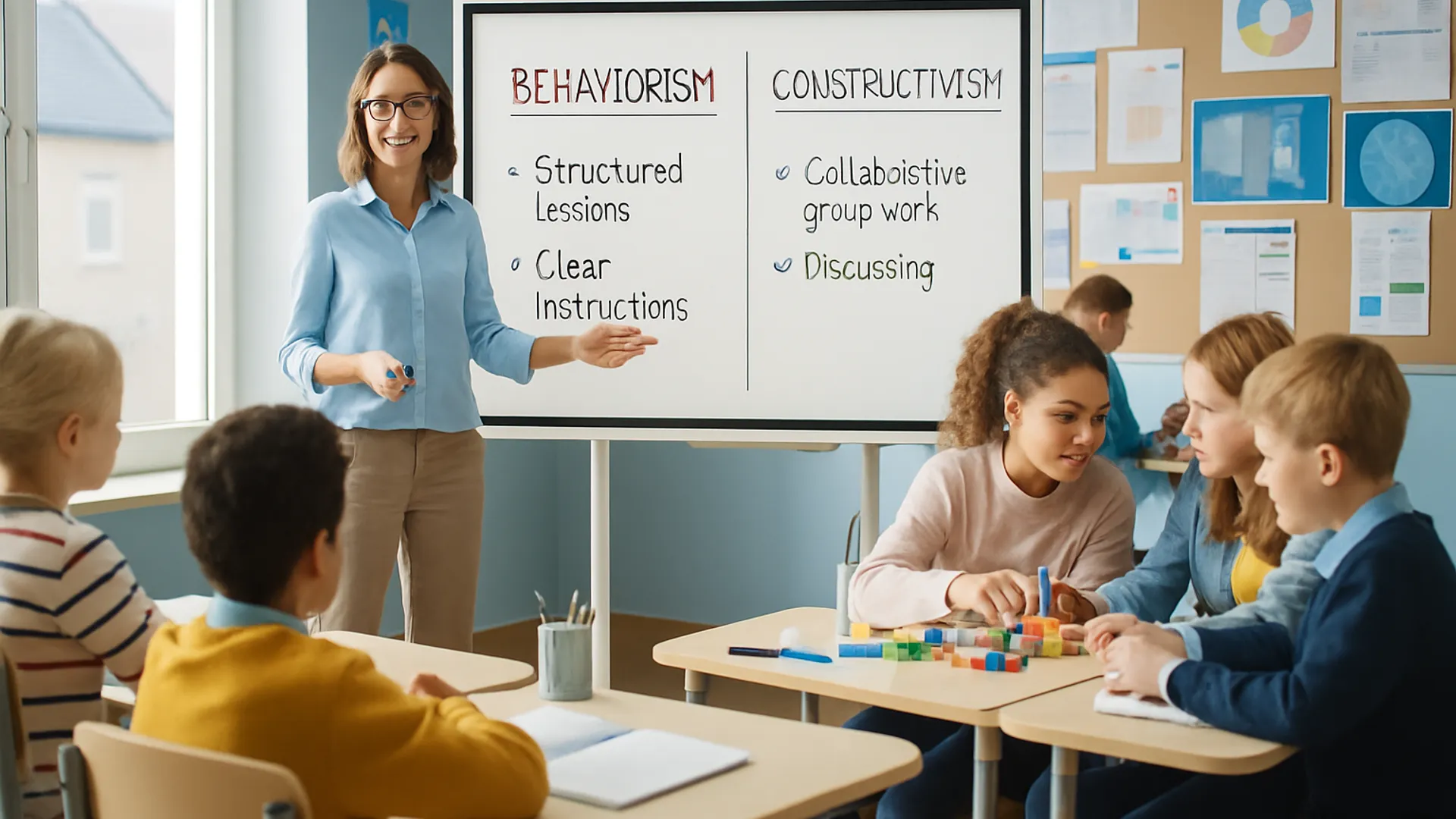
Compare behaviourism and constructivism: when to use each, how they overlap, the role of social constructivism, and how to blend both in the classroom.
Teachers debate reading methods in the staffroom. One uses phonics drills and stickers. The other lets learners discover letter patterns. Both approaches work, based on different learning theories. These are behaviourism and constructivism (see: Fundamental theories of learning).
Teachers often mix approaches without realising it. For instance, a Year 3 teacher uses behaviourism for routines, then constructivism for fractions. Understanding Skinner (1974) and Piaget (1970) helps justify methods to parents, governors and Ofsted.
Behaviourism starts with a simple idea: learning is a change in observable behaviour. It doesn't concern itself with what happens inside the learner's head (the "black box"). It only cares about what you can measure: what the learner does, what stimulus triggered it, and what consequence followed.
The theory emerged in the early 1900s from psychologists like John Watson and Ivan Pavlov, but it was B.F. Skinner who built the practical framework that most teachers still use today. Skinner showed that behaviour is shaped by its consequences. Positive reinforcement (a reward following desired behaviour) makes behaviour more likely to happen again. Punishment or lack of reinforcement makes behaviour less likely.
In the classroom, behaviourism looks like this: You want children to line up quietly. You establish a clear rule, model the expected behaviour, and reward the class with house points when they line up in silence (stimulus: the bell rings; response: children line up; consequence: house points awarded). Over time, most children learn to line up without needing the reward.
Constructivism says learners build understanding by interacting with ideas, materials and other people. Piaget (1952) describes children adapting mental models through experience, while Vygotsky (1978) and Bruner (1961; 1966) emphasise social support, language and discovery.
Piaget (1952) described learning as adaptation: children assimilate new experience into existing ideas and accommodate those ideas when the experience no longer fits. When a Year 1 learner sees 2 + 5 = 5 + 2 = 7, the useful teaching point is not only memorisation but the gradual rebuilding of number relationships.
This approach assumes that knowledge can't simply be handed over from teacher to learner. It must be built by the learner through active engagement. The teacher's job shifts from presenter to facilitator. You set up experiences, ask probing questions, and let children discover principles rather than telling them the answer.
Constructivism includes discovery learning (Bruner, 1961). Learners explore independently. Problem-based learning (Barrows & Tamblyn, 1980) presents real challenges. Project-based learning (Blumenfeld et al., 1991) has learners investigate questions over time. They build understanding by doing, not just listening.
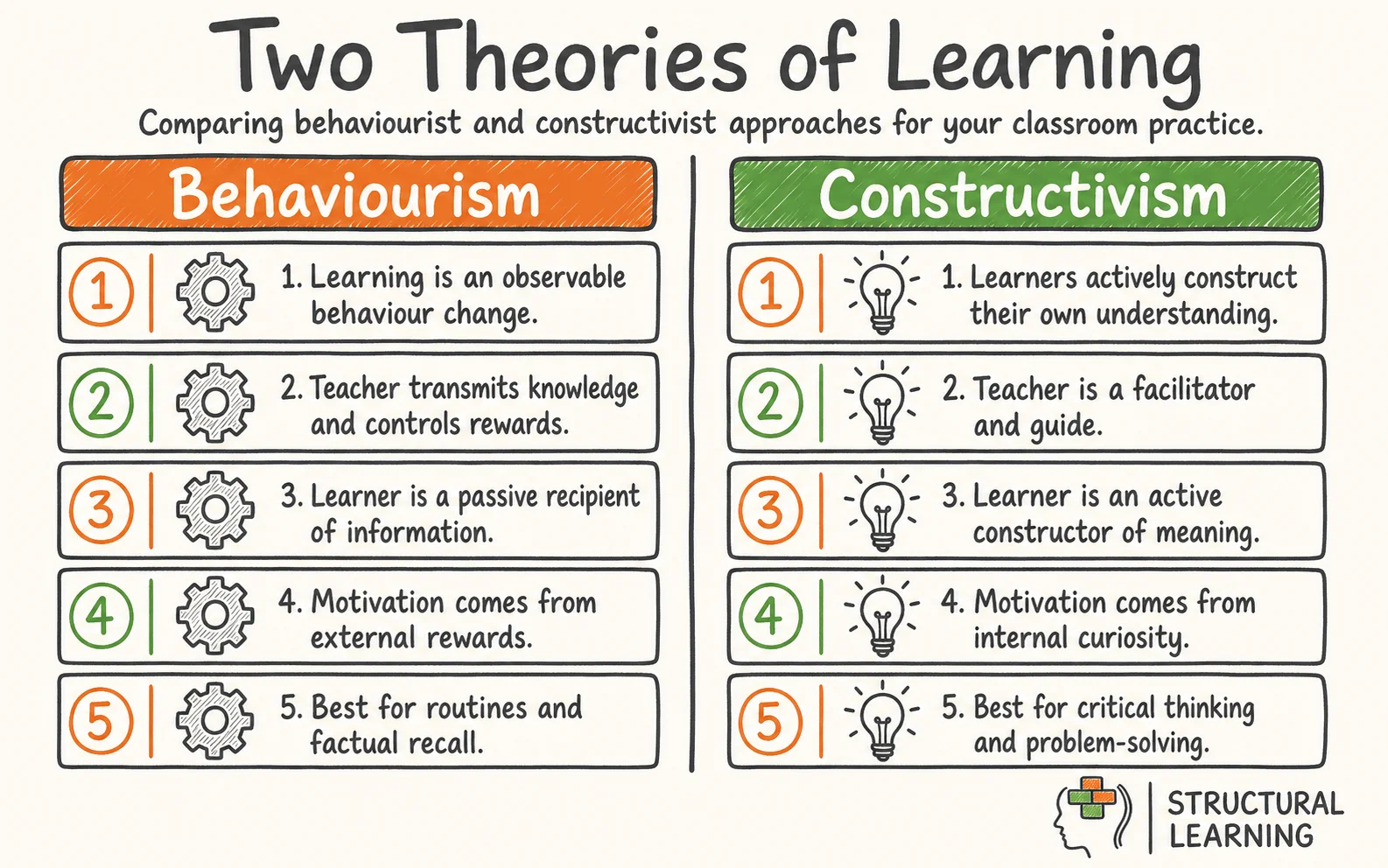
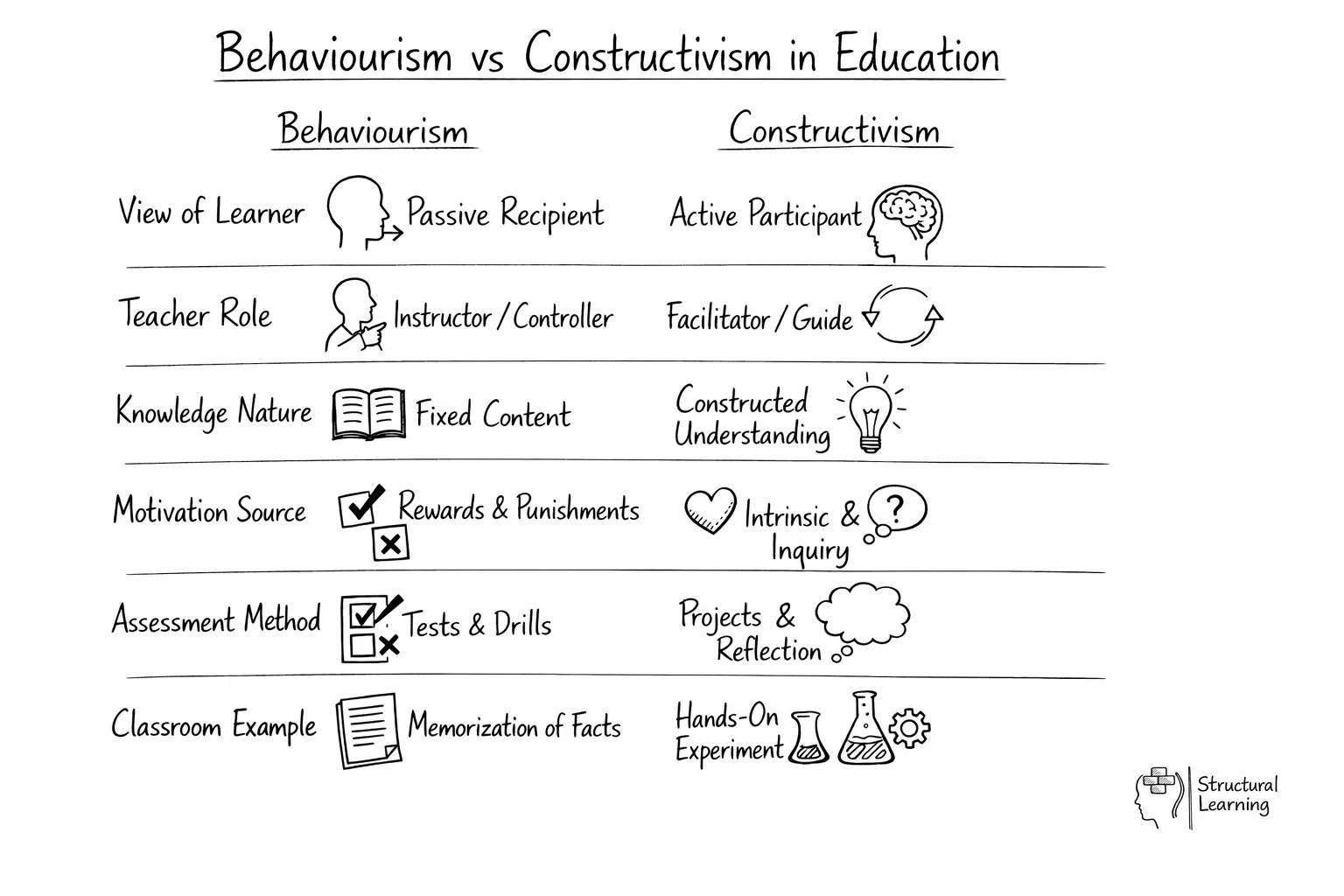
| Dimension | Behaviourism | Constructivism |
|---|---|---|
| View of the learner | Passive recipient shaped by environment | Active constructor of meaning |
| Role of the teacher | Transmitter of knowledge and controller of rewards | Facilitator and guide who creates opportunities |
| Nature of knowledge | External facts to be acquired | Internal understanding built through experience |
| What motivates learners | External rewards and punishments | Curiosity, intrinsic interest, challenge |
| How assessment works | Test observable behaviours and recall | Observe how learners solve novel problems and apply knowledge |
| Classroom example | Phonics flashcards with immediate feedback and stickers | Children investigate CVC words by manipulating letter cards and building patterns |
| Strengths | Efficient for teaching routines, facts, and specific skills | Builds deeper understanding and transfer of learning |
| Limitations | Doesn't explain how knowledge transfers or builds | Slow, inefficient for building foundational knowledge |
Skinner (1974), in About Behaviorism, argued that behaviour is shaped by environmental histories and consequences, rather than characterising learners simply as passive. Piaget (1972) and Vygotsky (1978) thought constructivism means learners build knowledge. They gain knowledge through active experience. These views show different ideas about learning.
In behaviourism, the learner is a bundle of instincts and habits waiting to be shaped. Environment and experience are the architects. Your role as a teacher is to engineer that environment carefully, controlling what stimuli the child encounters and what consequences follow their responses. This view comes from observing animals in labs. A rat in a box learns to press a lever if pressing it delivers food. The rat doesn't think about pressing the lever. It simply learns the association. Behaviourists see human learning similarly, especially in young children.
Constructivism flips this. The learner is curious, active, sense-making. Even a Year 1 child isn't a blank slate. She comes to school with schemas (mental models) about how the world works. She's already figured out that if you drop something, it falls. If you push your friend, they push back. These aren't taught. They're discovered through countless interactions. School learning, constructivists argue, should work the same way. You don't tell children what gravity is. You create experiences where they notice patterns and name them.
Here's what this looks like in practice. A behaviourist teaching fractions might say: "These are quarters. Look at this quarter here. Now look at this quarter. See? Same size. We call four quarters one whole." The child is shown the relationship explicitly. A constructivist might say: "Here are some brownies and four children. How could you share them so everyone gets the same amount?" The child discovers that four equal pieces make one whole, and the label "quarter" becomes meaningful because it solves a real problem.
The teacher's job looks utterly different depending on which approach you favour. Understanding this tension helps explain why some teachers love behaviourism and others find it stifling.
In behaviourism, you're an instructor and an architect of consequences. You decide what knowledge matters, you structure how it's presented (in small steps, with clear examples), you model the exact response you want, and you engineer rewards so children are motivated to respond correctly. This requires explicit planning. You know your learning objectives in advance. You scaffold skilfully, moving from concrete (pointing to a quarter of a pie) to abstract (the mathematical symbol ¼). This is direct instruction at its most systematic. It's not boring or joyless when done well. Children feel successful because they understand what you expect and they get immediate feedback.
In constructivism, you're a guide, facilitator, or co-explorer. You don't tell children the answer. You create problems, ask questions that provoke thinking, and respond to their discoveries by helping them formalise patterns they're noticing. This requires different skills. You need to improvise based on what children actually say and do. You can't follow a rigid script. When a child finds an unexpected way to solve a problem, you have to decide quickly whether to pursue it or steer back to your original plan. You trust that this messier approach builds more strong understanding because children own the discoveries.
Behaviourist teachers plan systematic phonics and routines; this is complex work. Constructivist teachers use learners' questions to build learning, which is also complex. The difference is not simple versus complex teaching: one approach is more tightly sequenced, while the other responds more to learners' emerging ideas (Skinner, 1953; Piaget, 1952).
Behaviourist methods, like those of Thorndike (1911), measure observable actions. Constructivist approaches, such as Piaget's (1972), assess knowledge construction. These researchers viewed learning very differently. Your assessment reveals your beliefs about how a learner learns.
Behaviourism focuses on observable, measurable outcomes. Can the child recite the alphabet? Can they spell these ten words correctly? Can they add two-digit numbers? These are testable, unambiguous. You can mark them right or wrong. This approach produces comparable data across learners and schools, which is why it dominates standardised testing. The phonics screening check, for example, is a statutory decoding assessment; its scoring is behaviourally observable, but the check itself is not pure behaviourism. Children read 40 words and pseudo-words aloud (20 real words and 20 pseudo-words), and the teacher marks whether each item is decoded correctly. The test is efficient and shows clearly who's learned the code.
Constructivism values open-ended assessment of thinking and problem-solving. You observe how children approach novel problems they've never seen before. Can they apply addition strategies to a new context? Can they explain why their method works? Can they justify their thinking to peers? These assessments are richer but harder to standardise and compare. There's more room for interpretation. A child's explanation of why 2 + 5 = 5 + 2 might be wonderfully creative and mathematically sound, but it doesn't fit into a simple right/wrong binary.
UK schools have many pressures. Statutory tests often reward fluency, accuracy and recall, while classroom observation also values reasoning, explanation and collaboration. Teachers balance these demands by using quick checks for core knowledge and richer tasks for deeper learner understanding (Vygotsky, 1978; Piaget, 1952).
Behaviourism, despite its age, still works well for specific learning types. Ignoring this fact is simply not realistic in education. Skinner (1953) and Thorndike (1911) showed us clear learning techniques. Researchers like Pavlov (1927) gave more insights into this learning.
It works brilliantly for establishing routines and behaviour. You want children to hang their coats on entry, line up quietly, and put hands up before speaking. These are habits you want automatic. Behaviourist methods are efficient here. You model the behaviour, praise children who do it correctly, and after a few weeks it becomes the default. Trying to help children "discover" why lining up matters through investigation is wasteful. You just need the behaviour established so learning time isn't disrupted.
It works for foundational skills that require automaticity. Number bonds, phonetically regular words, basic facts, times tables and spelling patterns form the bedrock for more complex thinking. A child who has to consciously decode every letter in "that" cannot easily attend to meaning. Practice, feedback and repetition are useful here, but phonics and decoding claims should be grounded in reading guidance rather than stretched from Pavlov or Piaget.
Explicit structure aids learners needing it. Learners with autism, ADHD, or language difficulties often respond well to clear rules and feedback. What feels restrictive to some, helps learners whose processing feels chaotic. Skinner's (1953) principles work for learners who don't naturally grasp patterns.
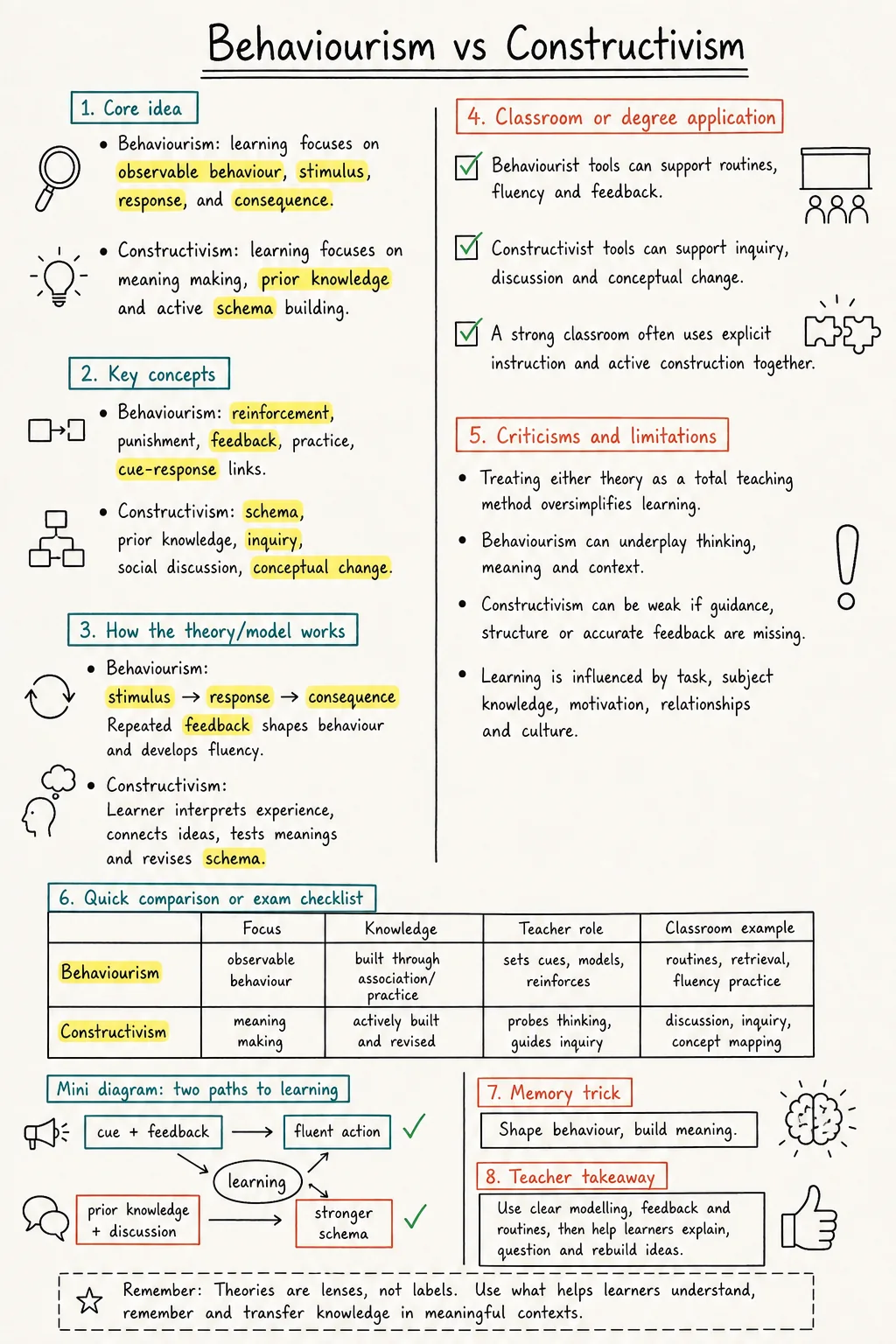
Download a one-page study note for Behaviourism vs Constructivism, with the key ideas, limitations and classroom links in one place.
It works for behaviour management and discipline. If a child is unsafe or showing challenging behaviour, behaviourist strategies are direct and effective. You don't pause to help them "construct meaning about why hitting is wrong." You remove the reinforcement (if the behaviour is attention-seeking), or apply a consequence (time out, loss of privilege), and the behaviour typically stops. Constructivism would suggest exploring why they're hitting, and that has value for deeper change. But sometimes you need the behaviour stopped now.
Behaviourism works less well for transfer and reasoning. If children learn "add the ones, then add the tens" by rote and reward, they often can't explain why the method works or apply it flexibly. If you change the context slightly (now add money, or add three-digit numbers), they freeze. They've learned a response to a specific stimulus, not a principle. That's the limitation.
Constructivism excels where behaviourism struggles: at building flexible, transferable understanding and developing thinking.
Hands-on learning builds maths and science understanding. Learners explore fractions by folding paper and sharing objects. They discover patterns and gain flexible understanding (Piaget, 1952). Learners then apply this understanding to new situations. Concrete interaction helps learners grasp abstract symbols.
It works for critical thinking and problem-solving. If you want children to analyse a text, evaluate sources, or solve an unfamiliar problem, you need them thinking, not recalling procedure. Constructivist approaches force this. You're not teaching the answer. You're asking: "What evidence supports your interpretation?" or "How did you figure that out?" The struggle is productive.
Autonomy and choice can support motivation when the task is well structured. Bandura's self-efficacy work (1977) is a stronger source for the narrower point: learners' beliefs about their capability can shape effort, persistence and response to difficulty. The article should not treat productive struggle as automatically beneficial without guidance.
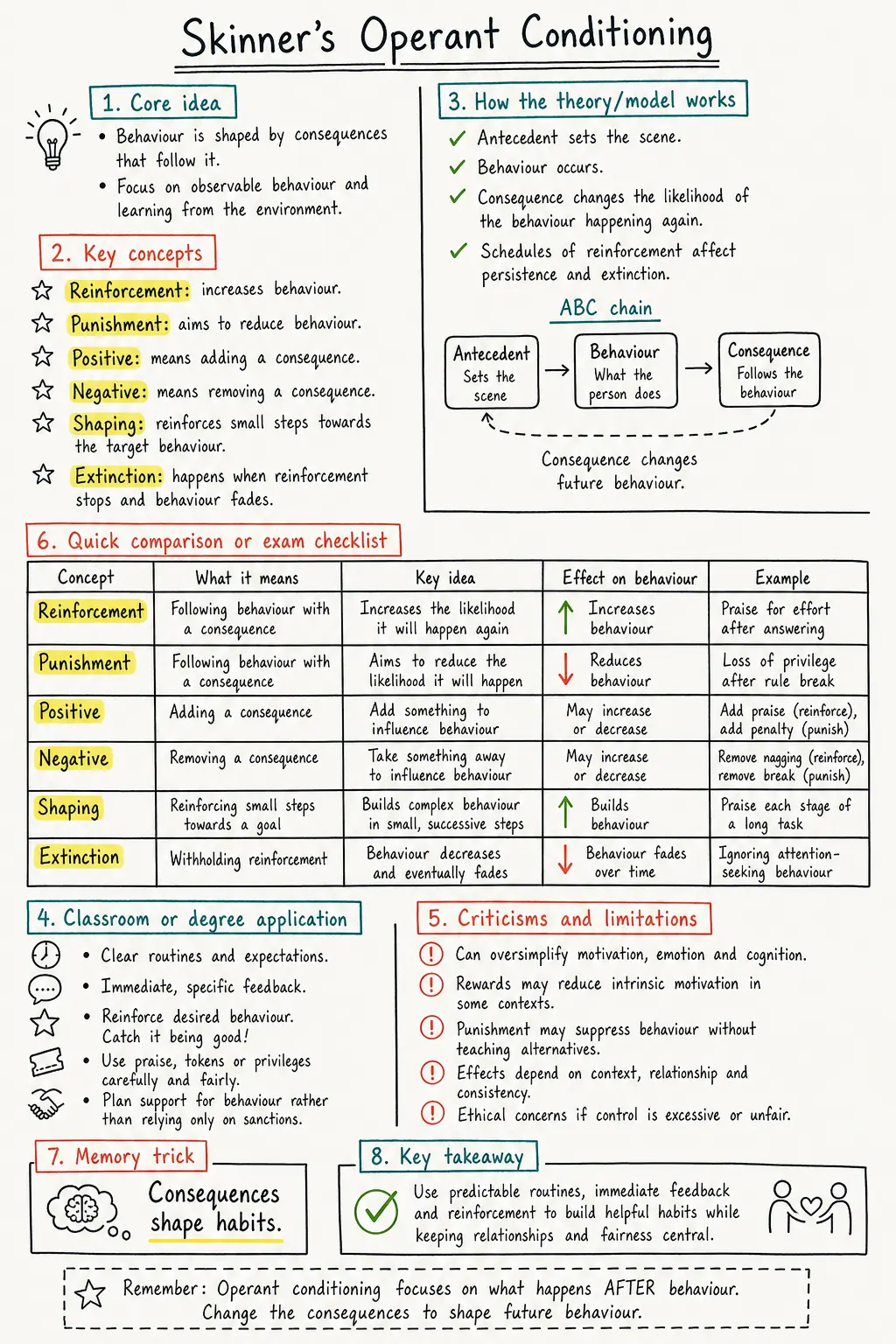
Download a one-page study note for Skinner's Operant Conditioning, with the key ideas, limitations and classroom links in one place.
Collaborative learning helps communication (Johnson & Johnson, 2009). Learners explain ideas and think about other views. They defend their reasons, building knowledge skills. Behaviourism often misses these chances; Vygotsky's constructivism (1978) values group work.
It works for deeper retention. Knowledge built through discovery and application tends to stick longer than knowledge acquired through passive instruction. If you discovered that 3 + 4 = 4 + 3 by building patterns with blocks, you're unlikely to forget it. If you were told it once and tested the next day, you might pass that test but forget within weeks.
Constructivism works less well for efficiency and breadth. Discovering everything is slow. You can't cover as much content. If you need children to learn a large body of knowledge in a limited time, behaviourist methods are faster. This is why most science curricula mix both. Children discover key concepts through investigation (constructivism) but learn factual content through instruction and practise (behaviourism).
Behaviourism and constructivism appear different yet work together in classrooms. (Skinner, 1974; Piaget, 1972) Learners benefit from both approaches, despite theoretical differences.
Practise matters, both agree. Behaviourists want learners to practise right answers to form habits. Constructivists want learners to practise using ideas to build understanding (Piaget, 1952). Different methods need engagement, retrieval and spacing, as Brown, Roediger and McDaniel (2014) explain.
Both recognise that feedback accelerates learning. A behaviourist uses feedback as a consequence that shapes behaviour ("correct, well done"). A constructivist uses it as information that helps you refine your model ("that's an interesting attempt, but let's think about why it didn't work"). Same feature, different frame.
Skinner (1974) said break skills into steps and model them for learners. Vygotsky (1978) suggested challenging problems and questions aid learning. Support reduces as the learner's skills improve. Scaffolding uses guided practice, based on behaviourist ideas.
Both can be misapplied. A behaviourist classroom that uses only worksheets and external rewards becomes mindless and demotivating. A constructivist classroom that never explains anything and leaves children floundering in confusion wastes time. Good practitioners in both camps know this and adjust.
Vygotsky (1978) argued that social interaction, language and guided participation shape learning. Collaboration can improve understanding when tasks are structured, and teachers can combine behaviourist routines with constructivist dialogue through modelling, prompts and gradual release.
Vygotsky agreed with Piaget that children actively construct understanding. But he emphasised something Piaget downplayed: the role of social interaction and language. Children learn most powerfully when working with more capable others (a teacher or older peer). The teacher provides structure, guidance, and language to help the child internalise new concepts. This is scaffolding.
Scaffolding in practice looks like this: A Year 2 child is learning to add two-digit numbers. The teacher first models the strategy explicitly (behaviourist element: clear instruction). Then they do it together, with the child practising while the teacher guides ("What do we do with the ones first?"). Then the child tries independently while the teacher asks prompting questions. Finally, the child works alone. Gradually, the teacher removes support as the child becomes capable.
Behaviourist methods offer clarity with modelling and guided practice. Learners gain understanding and solve problems using constructivist aims. They grasp why methods work through social interaction (Vygotsky, 1978). Learners do not rely on solitary discovery (Bruner, 1961).
Bruner's scaffolding gives teachers balance. Guide learners actively, structuring learning (Bruner, 1960). Don't just transmit information, or stand back completely. Release control gradually.
Vygotsky (1978) showed learners build understanding socially. Teachers can combine clear instruction with active tasks. Explaining place value helps learners, then base-ten blocks let them explore. This approach supports understanding by doing, as Bruner (1966) suggested.
The honest answer is both. But your context matters. Here's a practical framework for deciding when to emphasise each.
Behaviourist techniques work for routines, accuracy and fluency practice. Use them when teaching expectations, rehearsing decoding patterns or giving rapid feedback. This is helpful for learners needing structure and when teaching new material with tight curriculum timelines (Thorndike, 1911; Watson, 1913).
Constructivism supports learners' understanding. Mixed groups build skills in reasoning and problem solving. Collaboration and motivation help learners learn (Vygotsky, 1978; Piaget, 1972; Bruner, 1966). Learners transfer knowledge to new contexts.
Most experienced teachers do this instinctively. You might teach phonics through systematic behaviourist methods (phoneme to grapheme, rapid feedback, high repetition) in the autumn term. Then in spring, once children know the code, you switch to more constructivist reading activities where they investigate how words work, why texts have particular patterns, and how they can decode unknown words flexibly.
Age and stage are important factors to consider. EYFS and Key Stage 1 learners often need clear routines and guided practice. This behaviourist scaffolding supports their learning. Key Stage 2 learners benefit from constructivist teaching as they develop. Their working memory and abstract thought grow, preparing them for complex ideas.
UK education policy doesn't sit cleanly in either camp. Both approaches have been influential, sometimes in tension.
The phonics screening check tests whether learners decode words accurately. It shows who has mastered the alphabetic code and who needs more support. Systematic phonics, repetition and feedback are better grounded in the DfE reading framework than in a broad behaviourist citation.
Constructivist ideas shape Key Stage 2 reading expectations. Learners must infer, analyse and explain interpretations. Behaviourism alone will not achieve this: learners also need to construct meaning, justify textual reasoning and discuss evidence (Vygotsky, 1978; Piaget, 1952).
The National Curriculum values maths understanding and skills. This reflects constructivism. Learners need to grasp why maths works, not just repeat steps. Time constraints often force schools to use quick practice sheets (National Curriculum, 2013). These may sacrifice real understanding (Skemp, 1976; Hiebert & Grouws, 2007).
Montessori's constructivism impacts UK early years education. Learners freely explore prepared settings, guided by adults (Montessori, 1964). Successful schools use behaviourist structures. Bells signal transitions, learners return, and expectations are clear (Lillard, 2017).
Knowledge-rich curriculum advocates such as Hirsch (1987) worry that poorly structured discovery can leave learners without shared background knowledge. Dewey-inspired progressive educators worry that reward-heavy routines can create compliance without understanding. The defensible classroom position is to combine explicit instruction, practice, dialogue and inquiry according to the learning goal.
Behaviourism and constructivism link to the nature versus nurture debate. Watson (1913) and Skinner (1938) represent behaviourist accounts of observable learning and habit formation, while Piaget (1972) and Vygotsky (1978) represent constructivist accounts of knowledge-building, development and social interaction. These ideas can be complementary when teachers use each for the right kind of learning goal.
Explicit phonics routines and repeated practice can support decoding automaticity, but Skinner's Verbal Behavior should not be used as phonics evidence. Rosenblatt (1978) helps explain meaning-making in reading, Thorndike (1911) is a better fit for habit formation, and Piaget (1952) is a stronger source for active cognitive development in mathematics.
Teachers select methods to match what learners must achieve. Use behaviourist methods and feedback for learners needing automaticity. Constructivist discovery and questioning build understanding (Bruner, 1961; Piaget, 1972). Combining these methods supports each learner's firm grasp of concepts.
Bandura's social learning theory (1977) links behaviour and thought. Learners watch others, build confidence, and interact to learn. This theory provides a wider view than behaviourism or constructivism alone. See our guide for more on child development theories.
Knowing research (Gibbs, 1988) supports practice and helps identify valuable ideas. Research informs choices (Hattie, 2008; Wiliam, 2011). Learners benefit from evidence-based methods (Coe et al., 2014; Christodoulou, 2017).
Dunlosky, J., Rawson, K. A., Marsh, E. J., Nathan, M. J., & Willingham, D. T. (2013). Improving students' learning with effective learning techniques: Promising directions from cognitive and educational psychology. View study ↗
Weinstein, Sumeracki, and Caviglioli (2018) reviewed learning techniques. Their research showed which methods aid knowledge retention and skill transfer for learners. Cognitive science explains the success of spacing, retrieval, elaboration, and interleaving.
Free for teachers. The platform builds a classroom-ready lesson plan from your topic in under two minutes.
These sources support the corrected dates and claims in this article. They replace placeholder years and weak attributions with stable publisher, DOI, university catalogue and official guidance links.
The Behavior of Organisms View publisher page ↗
Skinner, B. F. (1938). Appleton-Century; current Sloan Publishing page.
Use this for Skinner's experimental behaviourist account rather than the incorrect 1936 date.
The Origins of Intelligence in Children View university catalogue record ↗
Piaget, J. (1952). International Universities Press.
This is the source behind the corrected Piaget year for the article's active-learning and adaptation claims.
Mind in Society View university catalogue record ↗
Vygotsky, L. S. (1978). Harvard University Press.
Use this source for the social-interaction and guided-participation claims rather than date placeholders.
Self-efficacy: Toward a unifying theory of behavioral change View DOI record ↗
Bandura, A. (1977). Psychological Review, 84(2), 191-215.
This is a stronger source for the self-efficacy point than the removed undated Bandura placeholder.
Make It Stick View DOI record ↗
Brown, P. C., Roediger, H. L. and McDaniel, M. A. (2014). Harvard University Press.
Use this for retrieval, spacing and durable learning, correcting the article's earlier Brown et al. 2007 date.
The reading framework View GOV.UK guidance ↗
Department for Education. Teaching the foundations of literacy.
This is the safer source for phonics and decoding practice than a misapplied Skinner citation.
Theory grounded. Classroom workable. Free for teachers.
Open a free account and help organise learners' thinking with evidence-based graphic organisers. Reduce cognitive load and guide schema building dynamically.