Maria Montessori and the Montessori Method Explained
A teacher's guide to Maria Montessori and her method: core principles, sensitive periods, the prepared environment, and strategies for the classroom.

A teacher's guide to Maria Montessori and her method: core principles, sensitive periods, the prepared environment, and strategies for the classroom.
Maria Montessori: The Montessori Method and Its Impact on Modern Education explains a structured way to support early learning. Children choose meaningful work in a carefully prepared environment. They use concrete materials first, so sensory experience can lead towards abstract understanding (Montessori, 1912).
For teachers, the value is practical rather than nostalgic. A Reception child sorting pink tower cubes, pouring water between jugs or building place value with bead bars is not just playing freely. The activity has limits, a precise material and a built-in way to notice errors. Recent evidence suggests Montessori education can support both academic and non-academic outcomes, although results depend on programme fidelity and context (Randolph et al., 2023).
This article explains where the method helps and where it is often misread. It also shows how UK classrooms can borrow its strongest ideas without pretending that EYFS, phonics screening and Ofsted expectations disappear.
Montessori (1870-1952), an Italian doctor and educator, altered how we view learning. She was one of the first women in Italy to qualify as a doctor, and later studied how learners learn naturally.
Montessori moved from medicine into education through close observation. While working with children with intellectual disabilities, she saw that they learned better by handling objects than by listening to verbal instruction. This led to a powerful question: what if all children learned this way?
In 1907, she opened the first Casa dei Bambini (Children's House) in a working-class area of Rome, where she used her principles with typically developing children. The results surprised educators across Europe and America. Children as young as three taught themselves to read and write, solve mathematical problems, and work with deep concentration, without coercion.
Montessori built her method through clinical observation, classroom trials and steady improvement. In The Montessori Method, the teacher is a trained observer who prepares the room. The teacher then watches how children choose tasks, repeat them and correct their own work (Montessori, 1912).
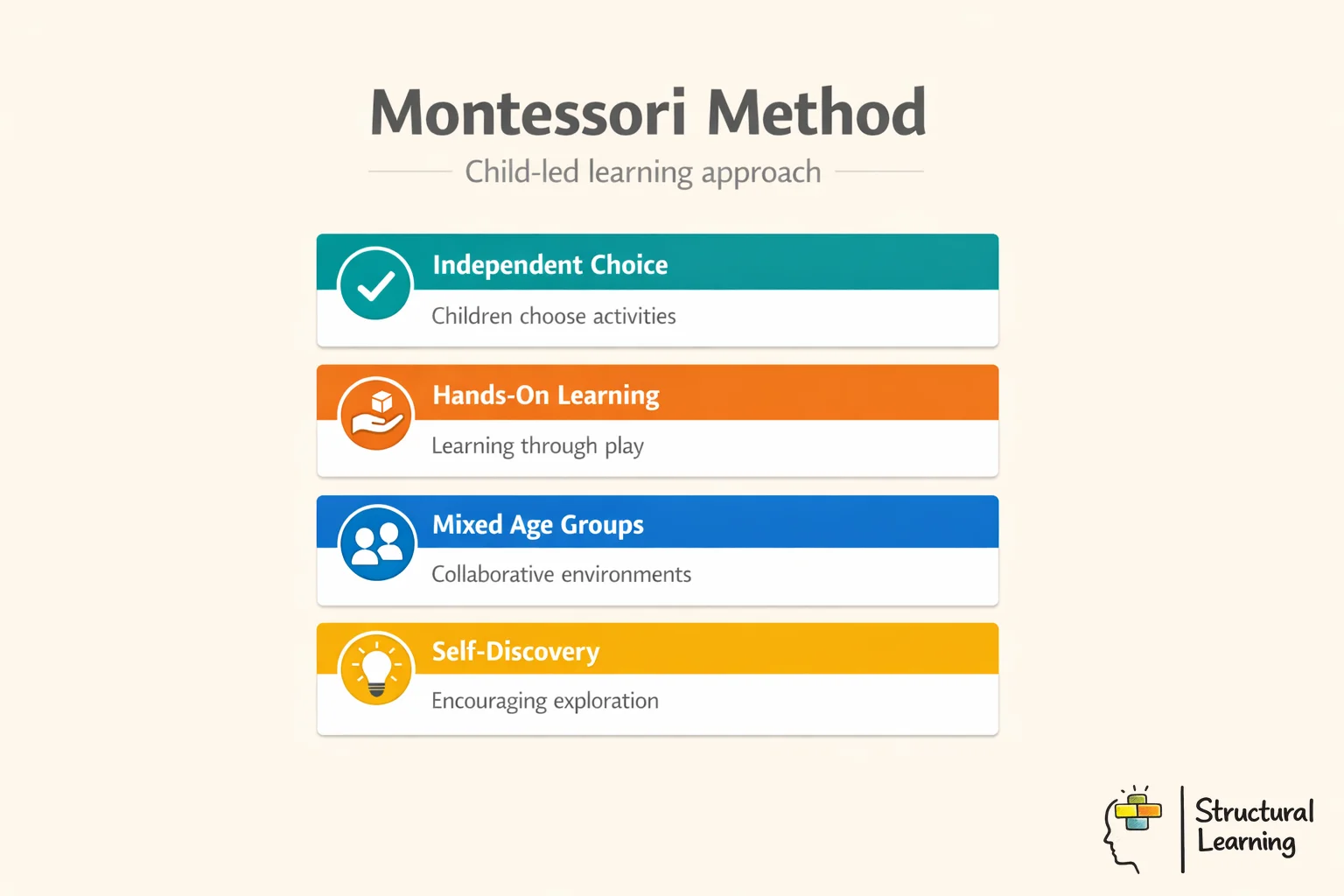
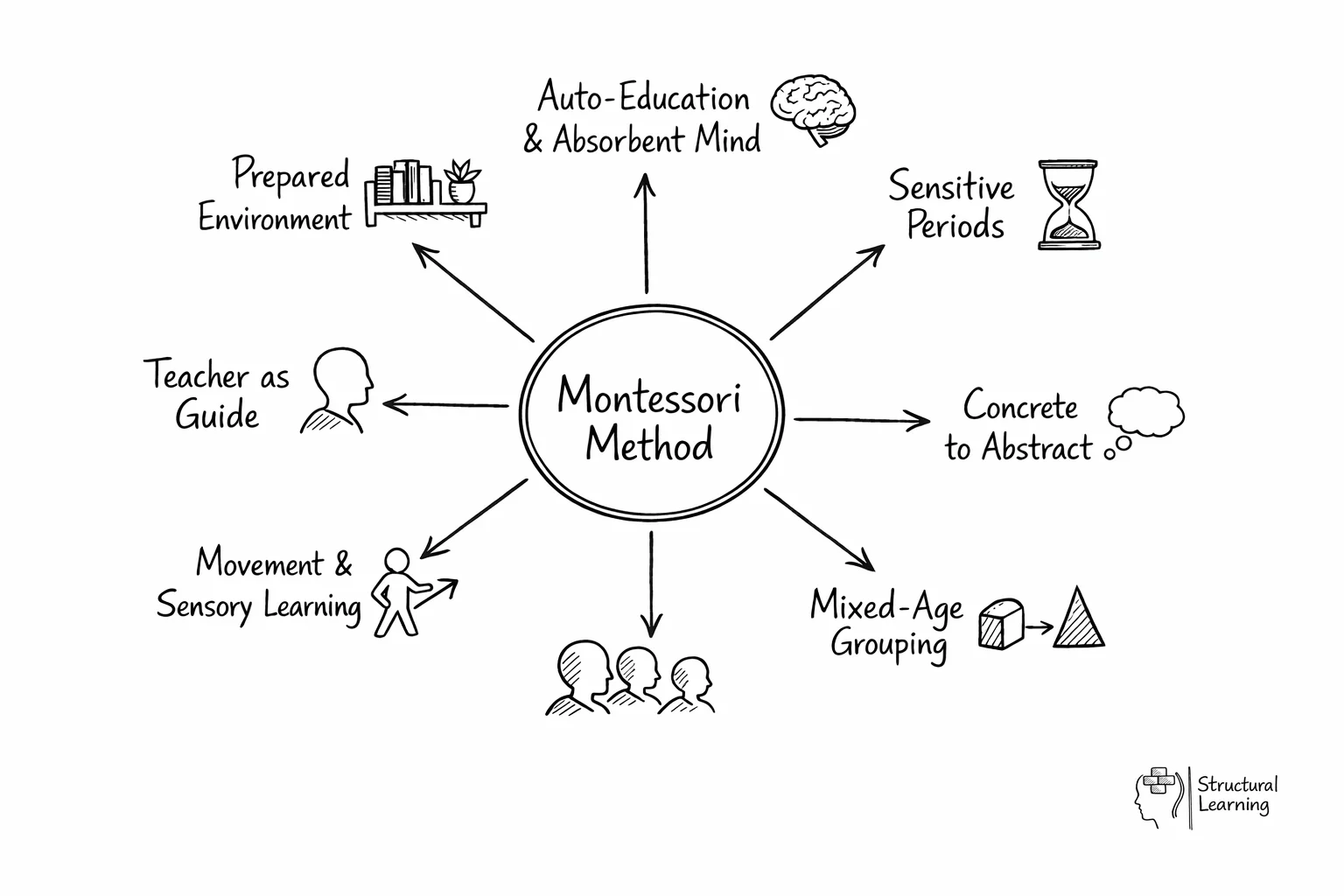
The Montessori Method is based on several linked principles. These principles are quite different from those used in many traditional schools: Use it as a starting point for professional discussion: identify the learner's current need, record evidence from more than one lesson, and agree the next classroom adjustment with the SENCO or family.
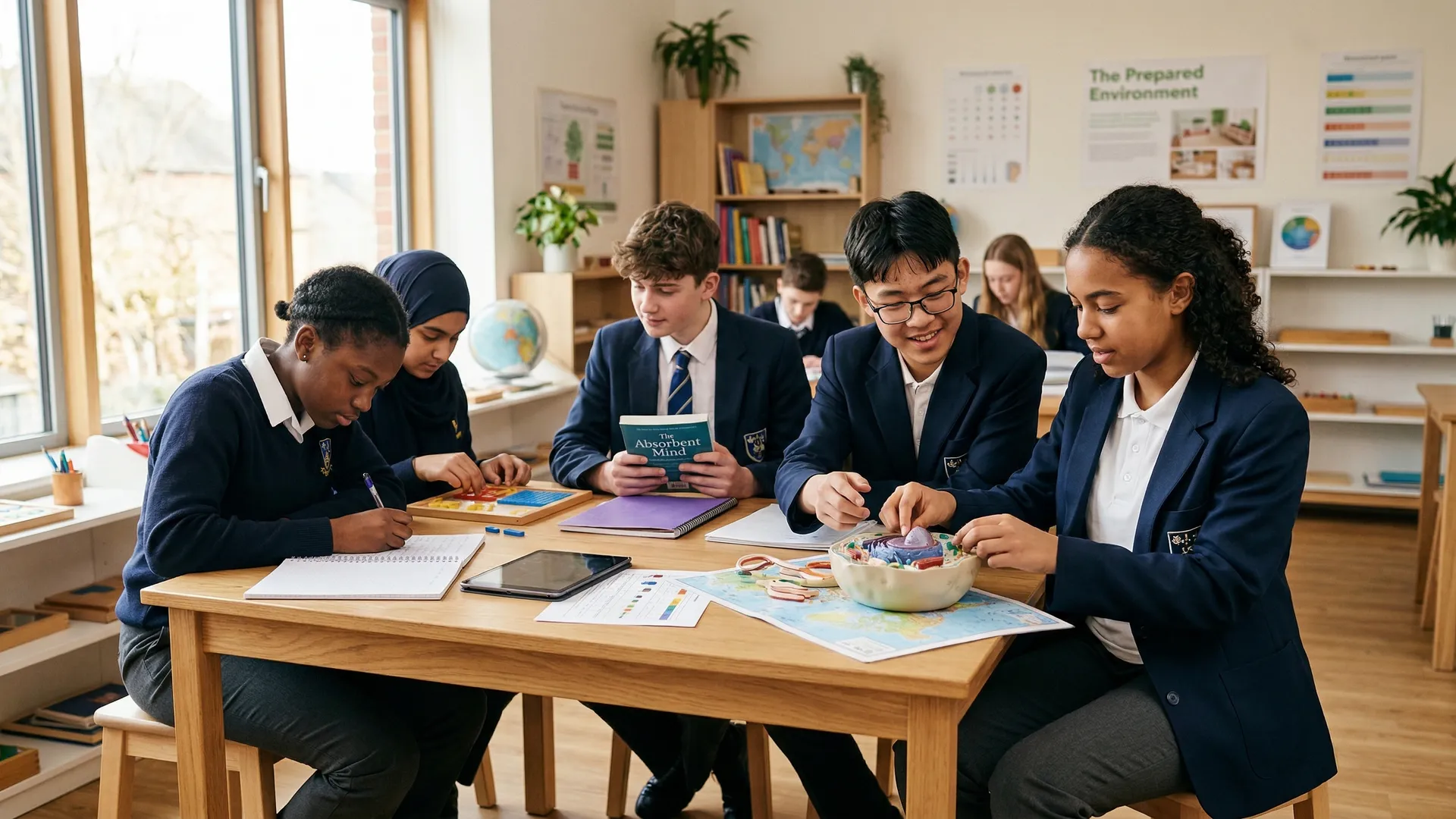
A Montessori classroom is carefully set up to draw children into learning. Each object has a clear purpose, sits at child height, and uses real-world proportions rather than scaled-down toys. The environment includes:
This is guided independence, not random choice. Each area has a clear order, and the materials move from simple to complex. Children can also see exactly what is available.
The environment reduces unnecessary cognitive load, which means children have less to hold in mind. A child can repeat the pink tower, spot that one cube is out of sequence, and correct the error without waiting for adult marking. In England, this overlaps with EYFS ideas about enabling environments, but Montessori's prepared environment is more tightly prescribed than ordinary continuous provision.
Montessori believed young children have an absorbent mind, which means they take in their surroundings without effort. Unlike adults, who often need to study on purpose, children learn through their senses and movement. This led her to the principle of auto-education: when the right material matches the child's developmental readiness, the child teaches themselves. The teacher does not "pour in" knowledge; the child draws it from the environment through self-directed activity.
Montessori noticed that children pass through short windows when they are especially ready for certain kinds of learning. A child may suddenly focus deeply on letters, colour, order or movement. She called these windows sensitive periods.
These periods do not last, and they may not return with the same strength if missed. Teachers who understand them watch for readiness, then offer the right material while the child is highly focused. This idea connects with Piaget's stages of cognitive development, although Montessori gave more weight to individual variation.
Montessori children rarely encounter abstract symbols divorced from physical experience. A child learning numbers first handles golden beads (ten unit beads, ten in a bar, ten bars in a square, ten squares in a cube), seeing and feeling the quantity. Only after this concrete experience with place value do they move to writing numerals. This progression, real object, picture, symbol, ensures deep understanding rather than rote memorisation.
In a Montessori classroom, three, four, and five-year-olds work together by design. Younger children watch older peers and learn from them.
Older children strengthen their knowledge when they explain tasks and offer help. There is no fixed "year group" barrier, so children can move at their own pace without the pressure of age-based grade progression.
Montessori saw that young learners think with their bodies. In the classroom, motor routines such as walking, carrying trays, pouring and building with bead materials link attention, movement and perception. Newer evidence is careful but useful: preschool reviews link well-designed self-regulation environments with executive-function growth (Muir et al., 2023), while Montessori-related brain research suggests pedagogy can be linked with different patterns of semantic processing, not a simple brain-training effect (Schetter et al., 2023). For post-pandemic Reception intakes used to fast digital feedback, slow tactile materials can protect attention because learners must plan, handle, check and repeat one action at a time.
Perhaps the most radical shift in Montessori education concerns the teacher's role. The teacher is not the source of knowledge or the centre of attention. Instead, they are a guide, observer, and facilitator.
The Montessori teacher's responsibilities include:
Montessori differs from standard teaching. Teachers observe each learner and respond to their needs (Montessori, 1912). This shifts scaffolding away from long teacher explanations at the start. Instead, support comes through prepared materials, self-correction and well-timed adult guidance.
Marshall's 2017 review also warns that fidelity matters. This means UK teachers should use specific principles with care, rather than treat Montessori as a general classroom style.
To understand Montessori's impact, it helps to compare it with conventional approaches: Use it as a starting point for professional discussion: identify the learner's current need, record evidence from more than one lesson, and agree the next classroom adjustment with the SENCO or family.
| Aspect | Traditional Teaching | Montessori Method |
|---|---|---|
| Pacing | Whole class moves through curriculum together, on a fixed schedule | Each child progresses at their own pace through mixed-age environments |
| Teacher Role | Instructor, authority figure, knowledge dispenser | Observer, guide, facilitator of self-directed learning |
| Materials | Textbooks, worksheets, abstract symbols from the start | Concrete, manipulative materials that progress from sensory to abstract |
| Motivation | External rewards (grades, stickers, praise) and consequences | Intrinsic motivation through interest, concentration, and competence |
| Assessment | Tests, grades, comparison to peers | Observation, self-correction, mastery of concepts |
| Discipline | Rules enforced by adults; behaviour management systems | Freedom within limits; natural consequences; community responsibility |
These approaches differ because they start from different views of learners and teachers. Traditional education often gives weight to efficiency and standardised results (Cuban, 1993). Montessori methods focus on prepared environments, individual activity, self-correction and developmental observation. Lillard (2017) and Marshall (2017) review this pattern in detail.
Montessori principles overlap with parts of the Early Years Foundation Stage statutory framework. This is especially clear in the focus on enabling environments, observation and children's active learning. However, this overlap should not be overstated. EYFS is a statutory English framework, while Montessori is a specific pedagogy with its own materials, training model and assumptions about child-led work.
State and private settings must balance Montessori ideals with everyday duties. These include statutory ratios, safeguarding, inspection, curriculum expectations, parent communication and available budgets. Such duties can work alongside Montessori practice. However, they are not the same thing as full Montessori fidelity.
The practical challenge is to decide which Montessori principles can be used without wrongly labelling ordinary early years practice. Lillard (2017) and Marshall (2017) both stress that implementation fidelity matters, which means schools should be clear when they adapt Montessori rather than present it as pure Montessori provision.
Implementation varies widely. Some Montessori schools follow the method closely. Others use Montessori language but also include conventional activities, worksheets or commercial materials. Evidence reviews suggest that this matters because outcomes are harder to interpret when fidelity, teacher training, family selection and school context vary across settings (Lillard, 2012; Marshall, 2017).
Further theories, like those of Piaget (1936) and Vygotsky (1978), built on this. Montessori's method still influences how teachers view learner development. These theories help us understand how learners learn and grow.
Froebel's kindergarten materials came before Montessori's and share clear links with later hands-on early years pedagogies. The Froebel Trust describes Gifts and Occupations as linked materials for curiosity, creativity and problem-solving. Montessori's own texts describe prepared materials for observation, movement, order and self-correction, so it is safer to call this a historical overlap and influence on early childhood practice, rather than a simple one-to-one inheritance.
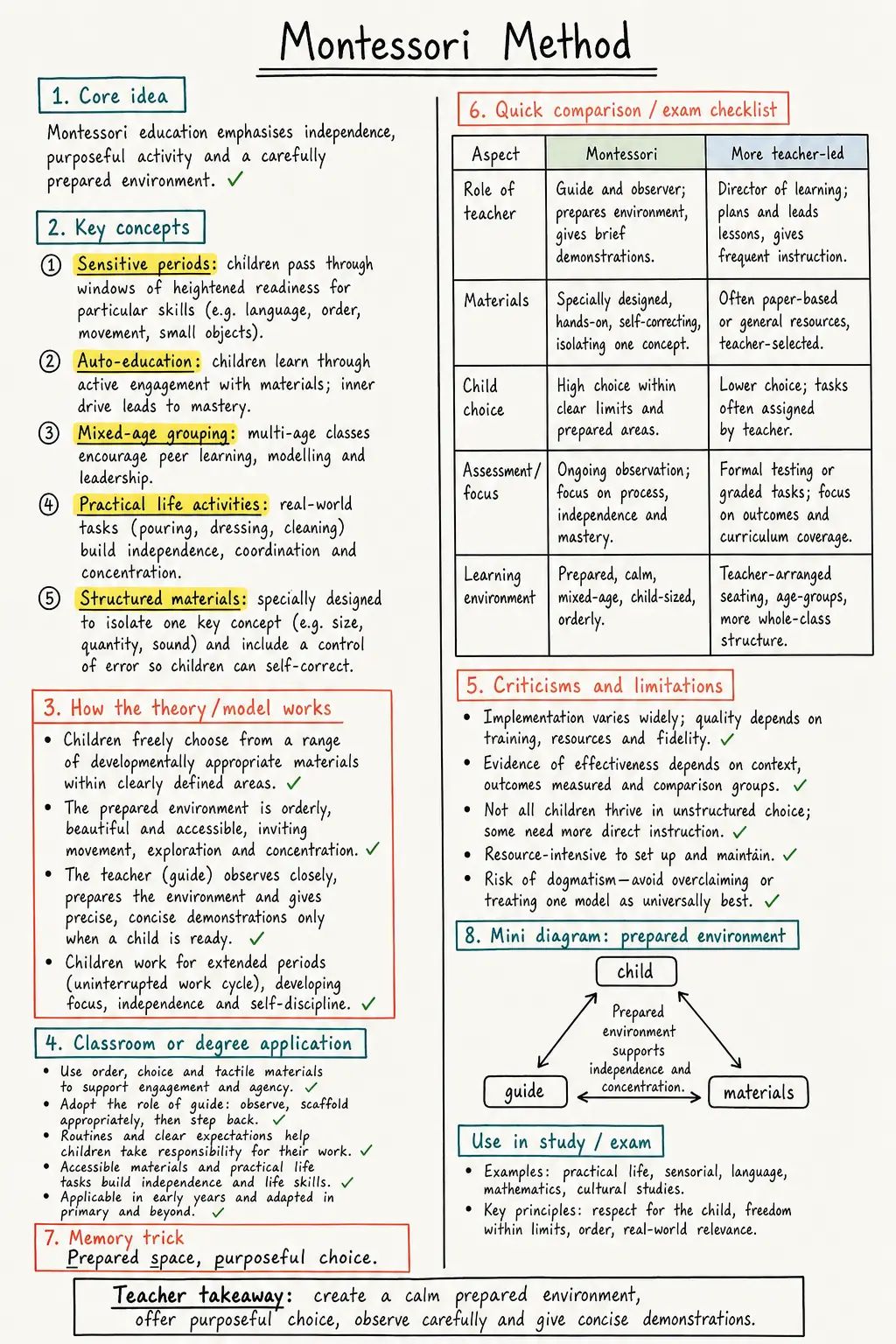
Download a one-page study note for Montessori Method, with the key ideas, limitations and classroom links in one place.
Child-led activity is still central to Montessori practice. Yet it is structured, not laissez-faire, which means leaving children to do whatever they want. The adult prepares the room, introduces materials and observes with care. The child then chooses, repeats and corrects work within agreed limits (Montessori, 1914; Marshall, 2017).
Montessori's influence is substantial, but it faces legitimate critiques: Use it as a starting point for professional discussion: identify the learner's current need, record evidence from more than one lesson, and agree the next classroom adjustment with the SENCO or family.
Specialist Montessori materials and accredited training can make full implementation costly. This creates a problem for access and fidelity, which means staying true to the method. A school may use low-cost principles such as observation, order, choice and self-correction. However, it may not be able to create a complete Montessori classroom.
There is also a historical irony. Casa dei Bambini began as work with marginalised working-class children in Rome. Yet modern Montessori provision in the UK and United States is often easiest to access for families who can pay fees, transport costs and specialist nursery charges. Equity should therefore be part of the method's integrity, not an optional add-on.
A school may borrow Montessori language while serving only affluent families. If it does, it has moved away from one of the original social purposes of the approach.
Montessori methods and phonics can lead to debate. Marshall's 2017 review notes that Montessori literacy includes phonics within a rich language context, but the wider evidence changes with programme fidelity and study design. Teachers should not assume that Montessori improves every reading outcome on its own, because sequence, explicit teaching and careful timing still matter.
A child educated in a Montessori Casa until age six may suddenly enter a traditional Year 1 classroom. They face 30 peers, a set curriculum, and whole-class instruction. This break can feel jarring. Some thrive and adapt quickly, while others struggle with the shift from self-directed exploration to teacher-directed learning.
The Montessori method assumes that children often move towards purposeful activity when the room is well prepared and freedom has clear limits. This is often true, but not for every child. Some children, including learners with ADHD, attachment difficulties or trauma histories, may need clearer prompts, adult co-regulation, rehearsal and positive feedback. For these learners, the aim is not to abandon independence, but to build enough structure so independence becomes possible.
US lottery-based and longitudinal studies report some academic and social advantages for learners in Montessori settings (Lillard & Else-Quest, 2006; Lillard, 2012; Lillard et al., 2025). Even so, the evidence is not a blank cheque. School numbers, fidelity, family choice, attrition and local context make causal claims hard, so results should be presented with caution (Marshall, 2017).
You don't need a Montessori classroom to use Montessori principles. Many ideas are practical, low-cost, and highly effective in state schools. Use it as a starting point for professional discussion: identify the learner's current need, record evidence from more than one lesson, and agree the next classroom adjustment with the SENCO or family.
Instead of planning a lesson and delivering it regardless of where children are, observe first. What fascinates children? Where do they struggle?
Use this knowledge to follow their lead. In EYFS, this is already practise. In Key Stage 1, it is less common but just as valuable.
When teaching number, start with objects children can touch and move (counters, bead strings, base-10 blocks). Progress to pictorial representations (drawing, dots, tallies). Only then move to abstract numerals. This CPA progression (Concrete-Pictorial-Abstract) is now central to mastery approaches in maths.
Rather than rigid ability bands, try flexible groups where younger and older children work together. The older child reads aloud; the younger child listens and absorbs. Older children often consolidate fluency through helping younger ones.
Everyday tasks, such as wiping tables, help children build fine motor skills. These activities also develop responsibility and concentration. Montessori's handbook treats practical activity as part of a prepared environment, while Dewey's work on experiential learning gives wider philosophical support for learning through activity, rather than direct evidence against worksheets.
Montessori teachers speak less. When you introduce something, keep it brief, clear, and unhurried. Then step back and let children work.
Notice how much talk fills traditional lessons, and how much of it may be unnecessary. Try reducing it and observe what happens. Children often rise to the challenge.
Set up your classroom so every part has a clear purpose. Remove clutter and label shelves and resources clearly.
Create separate areas for different types of work. When the room is well organised, children learn from the environment itself.
Before helping, ask: Can they figure this out? Resist the urge to correct immediately. Let children make mistakes, notice them, and try again. Self-correction builds confidence and understanding faster than adult correction.
Instead of punishment, let natural consequences teach. If a child rushes through work carelessly, the work speaks for itself. If they're challenging during a lesson, they miss it. This is gentler and more effective than adult punishment, and it respects the child's agency.
These ideas do not need expensive equipment or a full redesign. Small changes can still help. You can improve motivation, focus and learning outcomes by changing how you observe, organise materials and respond to children. This works best when routines are taught clearly and repeated often.
Free for teachers. The platform builds a classroom-ready lesson plan from your topic in under two minutes.
For example, Dewey (1938) supported experiential learning, where learners learn through experience. Piaget (1936) studied cognitive development, or how thinking develops in learners. Vygotsky (1978) showed why social learning matters. Bruner (1960) focused on discovery learning, which shaped curriculum design.
These links help teachers see shared aims. Steiner-Waldorf education, associated with Steiner (1919), and developmentally responsive teaching both respect learner agency and readiness. Piaget, Vygotsky, Dewey and Montessori each explain activity, social learning, experience and development in different ways. Treat them as overlapping traditions, not as one ideology.
Dewey, J. (1938). Experience and education.
Froebel, F. (1826). The education of man.
Montessori, M. (1912). The Montessori method.
Piaget, J. (1952). The origins of intelligence in children.
Steiner, R. (1919). The education of the child.
Vygotsky, L. (1978). Mind in society: The development of higher psychological processes.
These sources replace placeholder, misapplied and unverifiable entries previously shown in this section.
The Montessori Method View Project Gutenberg text
Maria Montessori (1912)
Use this primary text for Montessori's framing of observation, prepared environments, independence and self-correcting materials.
Dr. Montessori's Own Handbook View Project Gutenberg text
Maria Montessori (1914)
This primary handbook supports the article's claims about the Children's House, sensory materials and practical classroom organisation.
Montessori: The Science Behind the Genius View University of Virginia page
Angeline S. Lillard (2017), Oxford University Press
This university page verifies the book used for the article's broad explanation of Montessori principles and developmental science.
Montessori education: a review of the evidence base View DOI record
Marshall (2017), npj Science of Learning
Use this open review for cautious claims about the evidence base, fidelity, limitations and transferable Montessori elements.
Evaluating Montessori Education View DOI record
Lillard and Else-Quest (2006), Science
This peer-reviewed lottery-based study is a stronger source for Montessori outcome claims than generic author-date placeholders.
Preschool children's development in classic Montessori, supplemented Montessori, and conventional programs View DOI record
Lillard (2012), Journal of School Psychology
This paper supports cautious wording about implementation fidelity and the difference between classic and supplemented Montessori classrooms.
A national randomized controlled trial of the impact of public Montessori preschool at the end of kindergarten View DOI record
Lillard et al. (2025), Proceedings of the National Academy of Sciences
This newer study strengthens the evidence base while still requiring cautious interpretation of context, attrition and implementation.
Early years foundation stage statutory framework View GOV.UK framework
Department for Education
This is the appropriate source for English EYFS requirements; it should not be treated as proof that EYFS and Montessori are the same framework.
Froebel's Occupations View Froebel Trust resource
Froebel Trust
This supports the article's cautious comparison between Froebel's materials and Montessori's prepared learning environment.
The Montessori Toddler View publisher page
Simone Davies (2019), Workman Publishing Company
This corrects the earlier misattributed practitioner-book entry; it is useful for home practice, not as peer-reviewed outcome evidence.
Theory grounded. Classroom workable. Free for teachers.