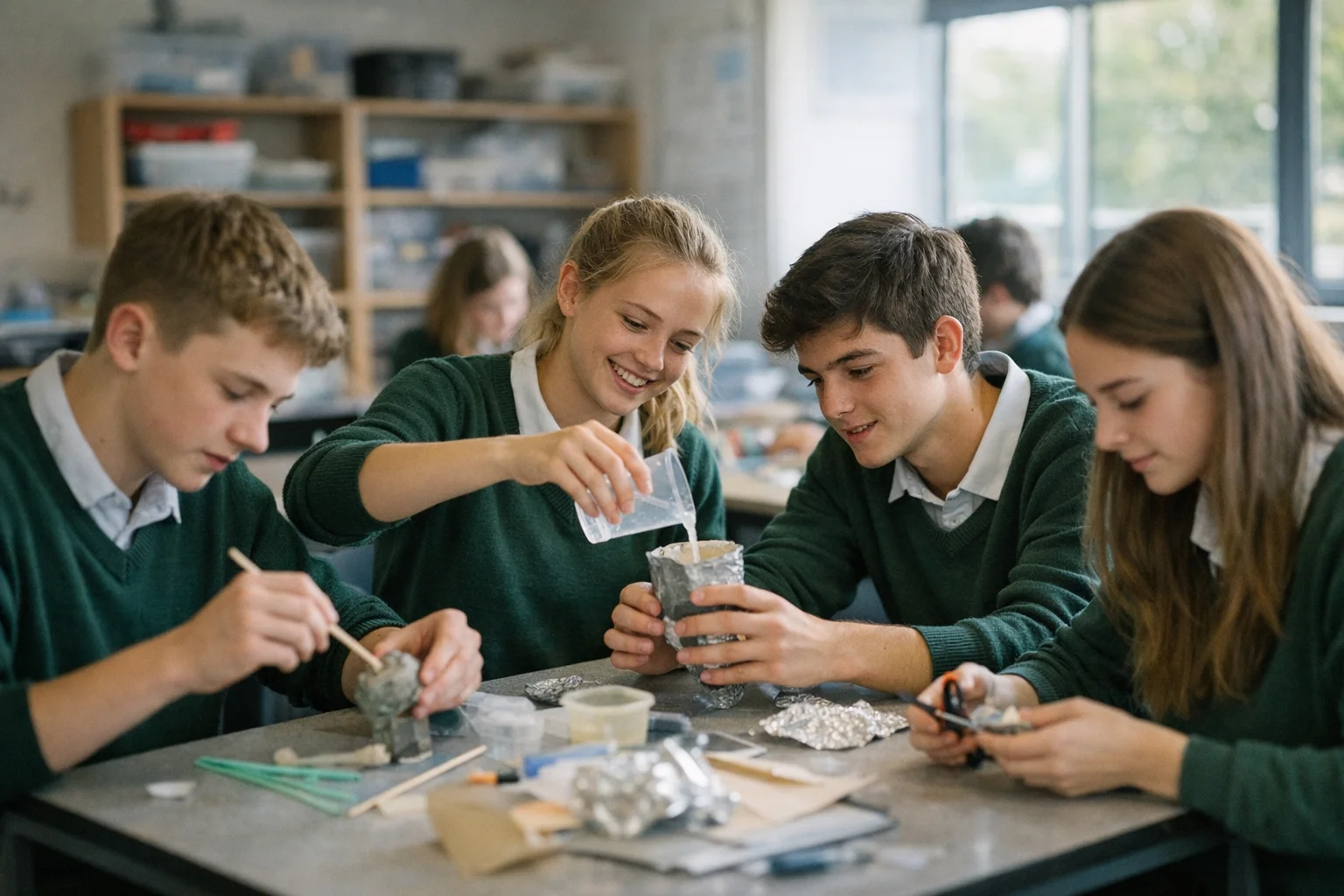
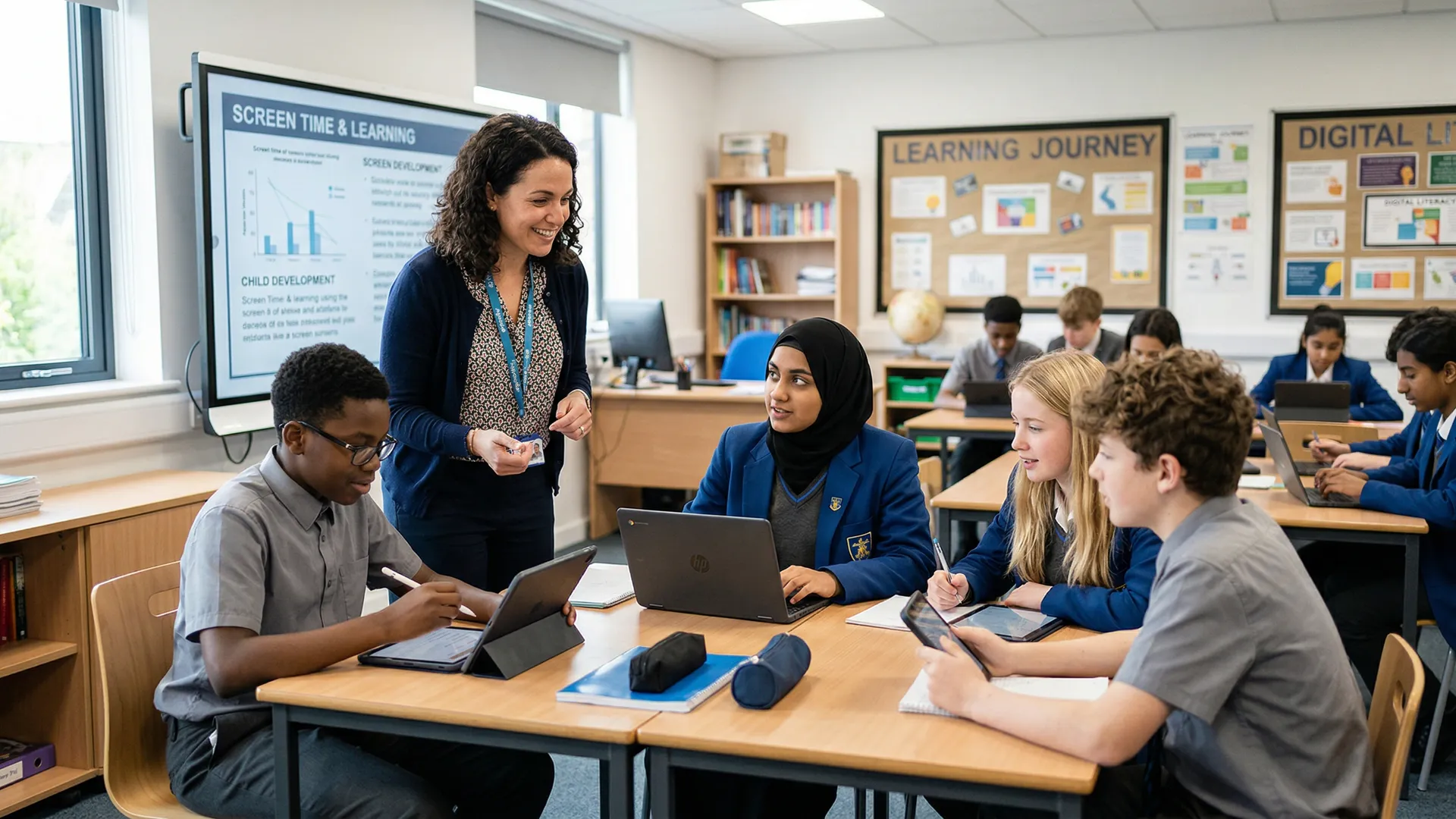
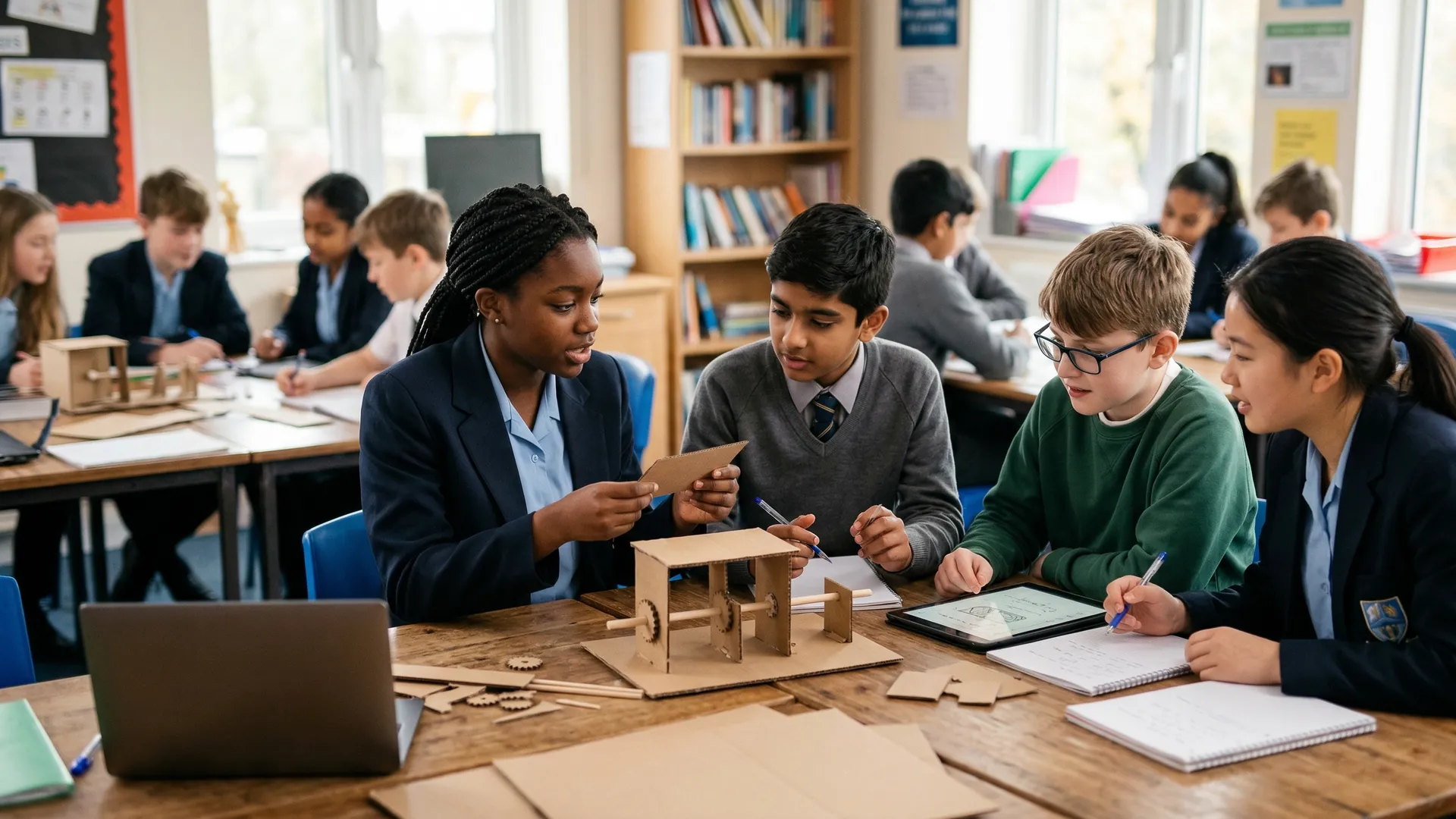
John Dewey's Theory: Learning by Doing in the ClassroomSecondary students aged 12-14 in bottle green cardigans engaging in an interactive project-based activity.

Updated on  

March 12, 2026

John Dewey's Theory: Learning by Doing in the Classroom

|

February 14, 2023

Dewey's experiential learning theory explained for teachers: learning by doing, reflective inquiry, and democratic education. With practical classroom examples.

Course Enquiry
Copy citation

Main, P (2023, February 14). John Dewey's Theory. Retrieved from https://www.structural-learning.com/post/john-deweys-theory

What is Dewey's Educational Philosophy?

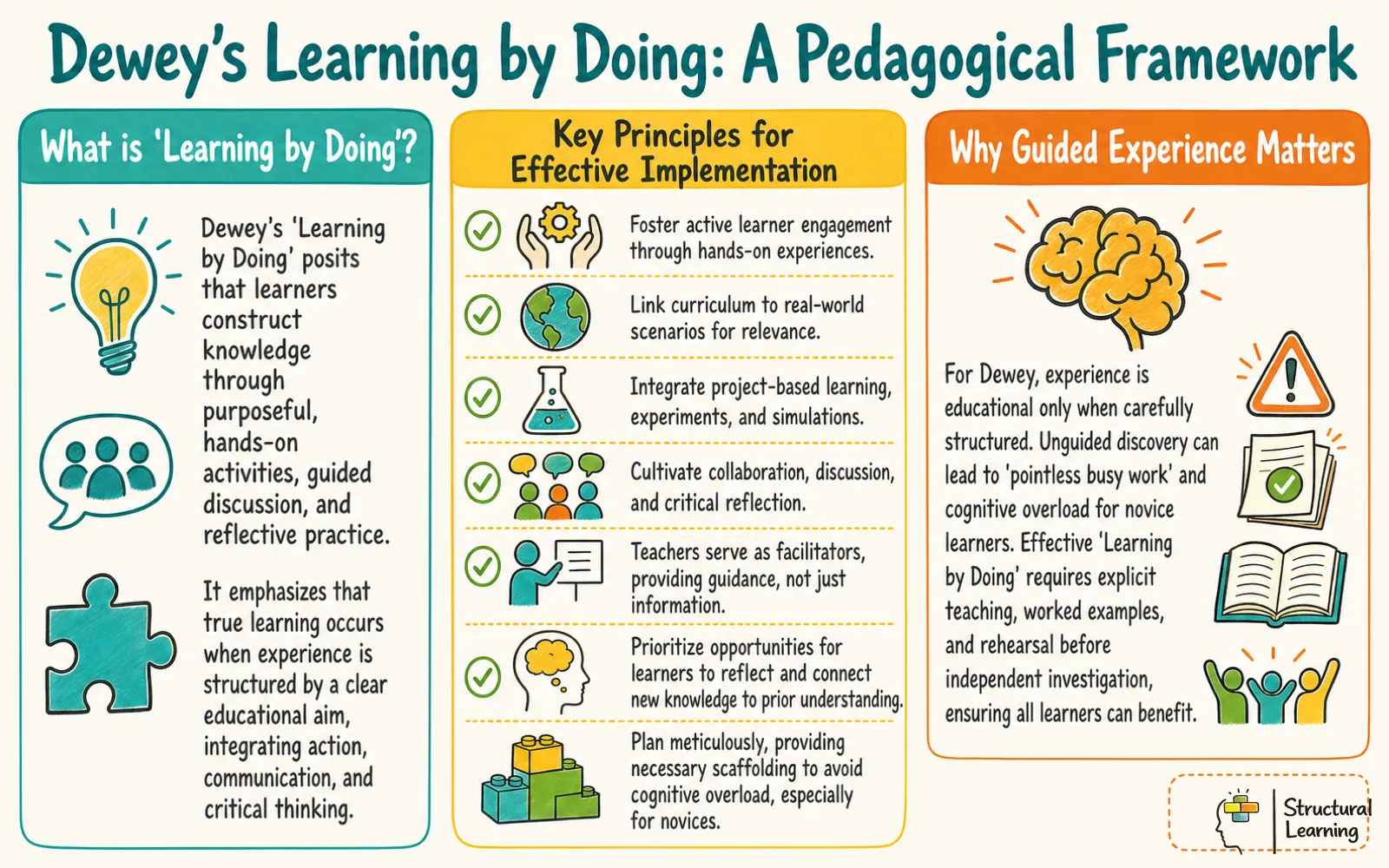
John Dewey's theory revolutionised modern education by proposing that learning should be experiential, democratic, and deeply connected to real-world problem-solving rather than rote memorisation. The American philosopher and educator believed that students learn best through active participation participation and inquiry, where they engage with their environment to construct knowledge collaboratively. His progressive approach emphasised critical thinking, social cooperation, and preparing students for active citizenship in a democratic society. These principles fundamentally challenged traditional teaching methods and continue to shape educational practices worldwide today.

John Dewey's educational philosophy is a pragmatist framework asserting that children learn most effectively through purposeful experience rather than passive instruction. Unlike the traditional transmission model where teachers deliver content to silent rows, Dewey (1938) argued that the classroom itself must function as a democratic community. Without opportunities for hands-on inquiry and reflection, students acquire information they cannot meaningfully apply.

Key Takeaways

  1. Experiential learning is the cornerstone of meaningful education, as advocated by Dewey. Pupils learn most effectively through direct engagement with their environment and by solving authentic problems, moving beyond passive reception of facts (Dewey, 1938). This approach fosters deeper understanding and retention, preparing pupils for real-world challenges.
  2. Dewey's philosophy fundamentally links education to the development of active, democratic citizens. Classrooms should function as miniature democratic societies, where pupils learn cooperation, critical discourse, and shared responsibility through collaborative projects and decision-making (Dewey, 1916). This cultivates the social skills and ethical understanding necessary for active participation in a democratic society.
  3. Effective learning stems from pupils engaging in authentic problem-solving and inquiry. Dewey's pragmatic approach asserts that knowledge is constructed through active investigation and reflection on real-world challenges, rather than passive reception (Dewey, 1910). This methodology encourages pupils to develop critical thinking skills and adaptability, essential for navigating complex situations.
  4. Dewey's progressive vision fundamentally challenged the limitations of traditional, teacher-centred instruction. He argued against rote memorisation and passive learning, advocating instead for an educational system that prioritises pupils' interests, active participation, and social development (Cremin, 1961). This shift empowers pupils to become active constructors of their own learning, moving away from didactic methods.

What does the research say? Hattie (2009) found that experiential learning produces an effect size of 0.52 on student achievement, well above the 0.40 threshold he identifies as worth a year of schooling. The EEF rates outdoor adventure learning, a direct application of Dewey's learning-by-doing philosophy, at +4 months additional progress. A meta-analysis by Bransford, Brown and Cocking (2000) for the National Research Council found that students taught through active, inquiry-based methods retained 25% more content at 6-month follow-up compared to lecture-based instruction.

John Dewey was an American philosopher, psychologist and educational reformer widely recognised as one of the most influential thinkers in education.

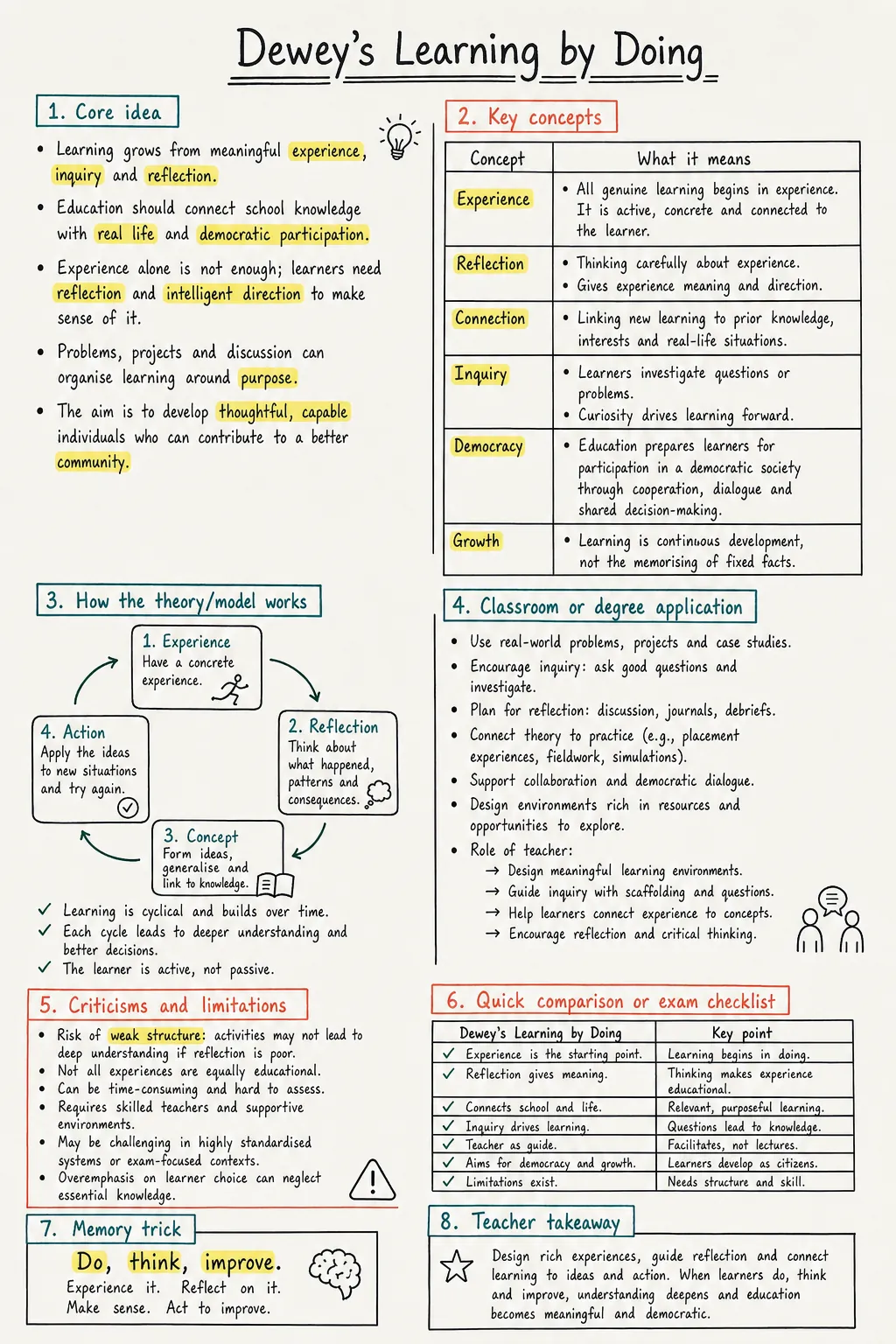
Hub-and-spoke diagram showing John Dewey's four educational theory principles around central concept
Dewey's Educational Theory

He developed a unique set of theories about education and social reform, which have since come to be known as the "John Dewey Theory". His effective ideas about education focused on experiential learning, the idea that we can learn best by actively engaging with the material rather than passive listening to lectures or memorizing facts. He also advocated for progressive methods of powerful questioning and dialogue to enable more meaningful exchange during classrooms.

At the core of John Dewey's theory is the notion that human experience should be a guiding light in education and social reform. He argued that all forms of knowledge should be grounded inseparably in practical, real-world experience and that meaningful exploration and learning could only truly take place when students engaged with their material firsthand or through experimentation.

His view was that theoretical information should always be applied practically to ensure an authentic understanding of whatever is being taught.

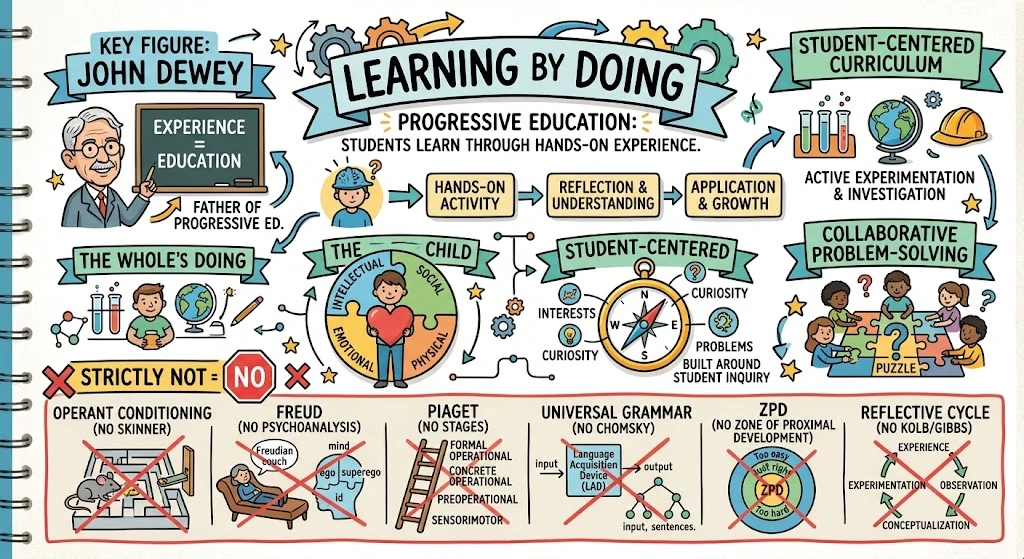
Hub diagram showing Dewey's educational theory with six key principles radiating from centre
Hub-and-spoke diagram: John Dewey's Educational Theory Structure

Education, for Dewey, is not only about gaining theoretical knowledge but also getting practical experience. He viewed education from a complete perspective whereby learning is seen as a continuous process that combines knowledge with life experiences and encourages students to integrate thinking skills with tangible results. This view of education ensures students have significant experiences which are internally meaningful and contribute to their growth as learners.

John Dewey's view on pedagogy was that it should be a complete approach to teaching and learning. He believed in using experiential learning as part of the educational process, whereby students are encouraged to combine their theoretical knowledge with practical experience. Dewey also focused on providing meaningful experiences that contribute to a student's growth as learners. He believed that this type of pedagogy could help shape a well-rounded student who is able to think critically and take tangible skills into the world.

Why Learning Starts with an Itch
A deep-dive podcast exploring John Dewey's educational theory

This podcast explores the core ideas behind Dewey's philosophy of experiential learning, pragmatism, and democratic education. Hear how his "learning by doing" approach continues to shape modern classrooms and why understanding the "itch" of inquiry matters for every teacher.

⏲ ~22 minutes Structural Learning Structural Learning Share 🔗

Dewey's Pragmatic Approach to Learning

John Dewey's educational theory cannot be fully understood without examining its philosophical foundation: pragmatism. As one of the leading American pragmatist philosophers alongside William James and Charles Sanders Peirce, Dewey developed a philosophy that fundamentally challenged traditional approaches to knowledge and truth.

Pragmatism, at its core, asserts that the truth or meaning of an idea lies in its practical consequences and applications. For Dewey, this meant that knowledge isn't something abstract that exists independently of human experience. Instead, knowledge is created through the process of inquiry and problem-solving in real-world contexts. This philosophical stance had profound implications for education.

A comparison infographic showing key differences between John Dewey's educational theory and traditional teaching methods. It contrasts rote memorization with experiential learning, passive listening with active inquiry, abstract knowledge with real-world relevance, and teacher-centric instruction with student-centric learning.
Dewey vs. Traditional

Dewey rejected the notion that learning should be about absorbing fixed truths handed down by authorities. Rather, he argued that students should be engaged in active inquiry, testing ideas against experience, and reconstructing their understanding based on outcomes. This process of "learning by doing" wasn't simply a pedagogical technique, it was a direct application of pragmatist philosophy to education.

The pragmatist emphasis on consequences and practical application meant that Dewey viewed education as preparation for participation in democratic society. Knowledge gains its value not from its correspondence to some abstract ideal, but from its usefulness in helping individuals navigate real problems and contribute to social progress. This perspective transformed education from a process of passive transmission to one of active construction and social participation.

Dewey's pragmatism also led him to emphasise the continuity between thought and action. Unlike traditional philosophers who separated mind from body or theory from practise, Dewey saw thinking as a form of doing, a practical activity aimed at solving problems. This integration of thought and action became central to his educational approach, where reflection and experience work together in a continuous cycle of learning.

In the classroom, pragmatism translates to creating learning environments where students engage with genuine problems, test hypotheses through action, and refine their understanding based on results. This approach aligns closely with modern constructivist approaches that emphasise knowledge construction rather than knowledge transmission.

Pragmatism's Roots: Peirce, James, and Dewey's Divergence

Dewey's pragmatism did not appear from nowhere. It emerged from a philosophical movement that began with Charles Sanders Peirce in the 1870s and was popularised by William James in the 1890s. Understanding how Dewey both inherited and departed from these two predecessors helps clarify what is distinctive about his educational theory.

Peirce (1878) proposed what he called the 'pragmatic maxim': the meaning of any concept is exhausted by its practical effects. If two theories produce identical observable consequences, they are, for all practical purposes, the same theory. Peirce was primarily interested in the logic of scientific inquiry, and his pragmatism was a method for clarifying concepts rather than a broad philosophy of life. For Peirce, inquiry begins with the irritation of doubt and ends when a stable belief is formed, the process he called 'fixation of belief'.

William James (1907) took Peirce's insight in a different direction. For James, truth has 'cash value': a belief is true if it works, if it guides us effectively through experience. James was less concerned with formal scientific method than with the psychological and personal significance of belief. His pragmatism was pluralist and individualist, accommodating religious belief alongside scientific conclusion provided both 'worked' for the person who held them.

Dewey respected both thinkers but found James's individualism insufficient and Peirce's logical formalism too narrow. Dewey's version, which he called Instrumentalism, placed social inquiry at the centre. Ideas are not merely personally useful; they are tools developed by communities to solve shared problems (Dewey, 1910). Thinking is a social as much as an individual act, shaped by language, culture, and the accumulated knowledge of human history. This social dimension is precisely what makes Dewey's pragmatism distinctively educational: if knowledge is a collective achievement, then schools are not merely places of transmission but sites of collaborative inquiry.

For further context on how these pragmatist ideas connect to classroom practice, the article on cognitivism in learning theories traces how Dewey's rejection of behaviourism fed into later cognitive approaches, while the article on Piaget's theory of cognitive development shows where the constructivist tradition diverged from pragmatist roots.

Classroom implication: When pupils ask why they are learning something, Dewey's Instrumentalism gives you a direct answer: knowledge is a tool for solving real problems. Frame lesson objectives not as content to be consumed but as capabilities to be built, and connect each topic to a genuine question worth answering.

Learning by Doing: Dewey's Revolutionary Approach

Dewey's learning by doing approach emphasises that students learn best through hands-on experiences and active engagement rather than passive listening. This method involves students directly experimenting with materials, solving real problems, and reflecting on their experiences to construct knowledge. Research consistently shows this approach increases retention compared to traditional lecture methods.

John Dewey and many other pragmatists believe that learners must experience reality without any modifications. From John Dewey's academic viewpoint, students can only learn by adapting to their environment.

John Dewey's idea about the ideal classroom is very much similar to that of the educational psychologists democratic ideals. John Dewey believed that not only students learn, but teachers also learn from the students. When teachers and students, both learn from each other, together they create extra value for themselves.

Many educational psychologists from different countries follow John Dewey's revolutionary education theory to implement the modern educational system. In that era, John Dewey's theory concerning schooling proved to be valid for progressive education and learning.

Progressive education involves the important aspect of learning by doing. John Dewey's theory proposed that individuals' hands-on approach offers the best way of learning.

Due to this, the philosophies of John Dewey have been made a part of the eminent psychologists pragmatic philosophy of education and learning.

John Dewey's educational philosophy emphasises the concept of "Learning by Doing," placing significant emphasis on experiential education. Central to Dewey's ideas are the objects of knowledge and their relationship with the learner. As mentioned, Dewey posits that knowledge is not merely passively received but actively constructed by the learner through experience. This aligns with constructivist approaches to education. The process of learning, thus, becomes a active interaction between the learner and the object of knowledge.

problem-based learning">

John Dewey's educational theories have implications for problem-based learning.

Experiential Learning Planner
Design a Dewey-inspired learning experience in 4 steps

The Experiential Learning Cycle

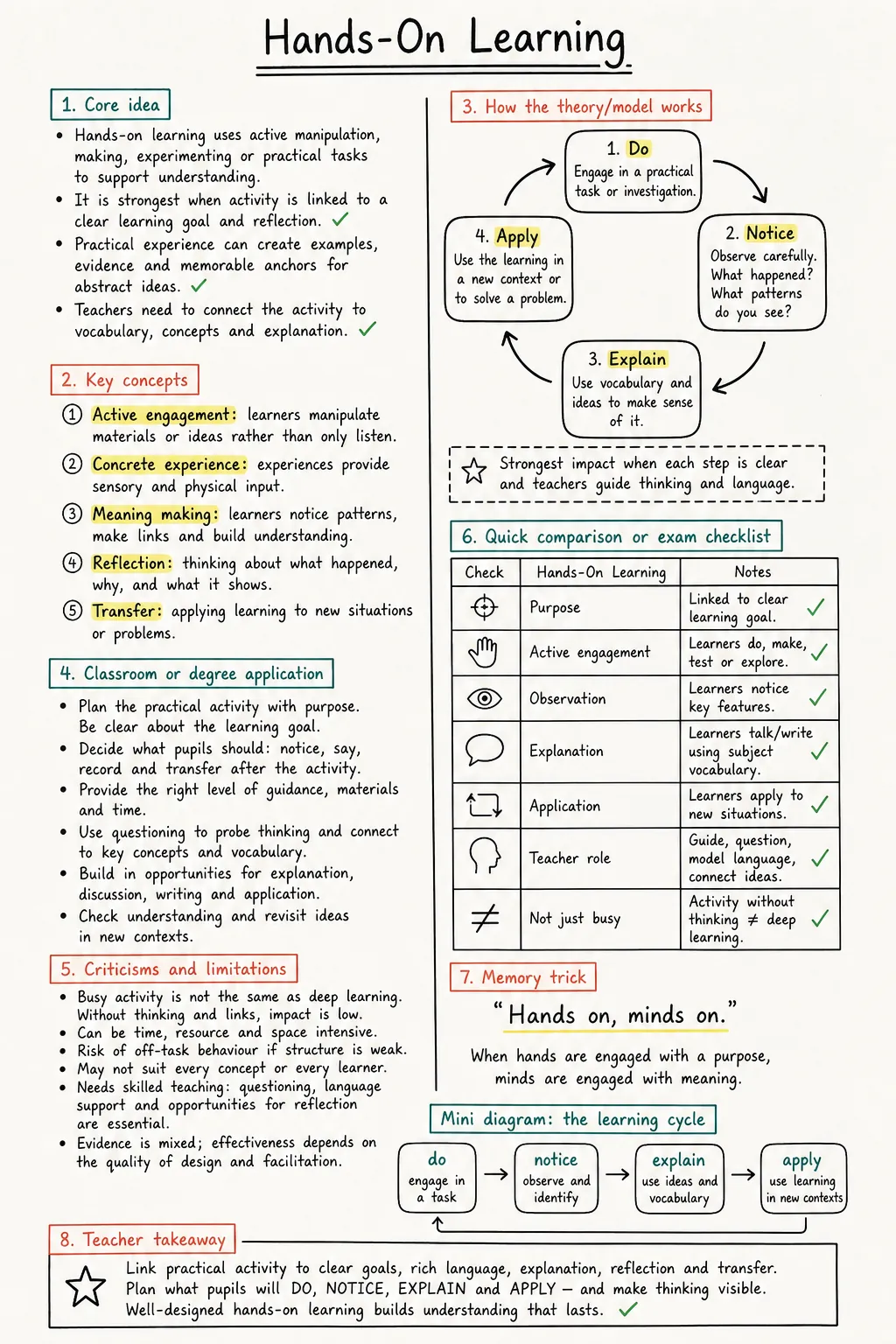
Dewey's learning by doing approach follows a specific cycle that mirrors the scientific method. First, learners encounter a genuine problem or question that arises from their experience. This isn't an artificial textbook problem, but something that genuinely puzzles or challenges them. Second, they formulate hypotheses or possible solutions based on their existing knowledge and experience.

Third, learners test these hypotheses through active experimentation and hands-on engagement. This might involve conducting experiments, building models, engaging in simulations, or applying concepts to real-world situations. Fourth, they observe and reflect on the outcomes of their actions, noting what worked, what didn't, and why. Finally, learners reconstruct their understanding based on these reflections, incorporating new insights into their knowledge framework.

This cycle doesn't end with a single iteration. Instead, new questions and problems emerge from the solutions found, creating a continuous spiral of learning and growth. This approach shares similarities with collaborative learning strategies that emphasise peer interaction and shared problem-solving.

The Laboratory School: Theory Tested in Practice

When Dewey joined the University of Chicago in 1894, he did not wait for ideal conditions. Within two years he had founded what became known informally as the Dewey School, a primary school that operated from 1896 to 1904 and served as a direct test bed for his educational philosophy. The Laboratory School was unusual in conception: it treated schooling as an empirical question, treating pedagogy the way a scientist treats a hypothesis, to be tested, revised, and refined through observation.

The school enrolled children aged four to fourteen and had no fixed curriculum in the conventional sense. Pupils worked through organised occupations: cooking, weaving, carpentry, gardening, and simple construction. These were not craft classes. Each occupation was structured to raise genuine intellectual problems. Cooking a meal required arithmetic, chemistry, and the history of human civilisation's relationship with fire. Weaving introduced geometry, physics of tension, and the economics of labour (Dewey, 1899).

Mayhew and Edwards (1936), two teachers who worked at the school, documented its operation in detail. Their account reveals a persistent tension that Dewey himself acknowledged: genuine inquiry-based teaching is demanding to sustain. Teachers needed deep subject knowledge, strong facilitation skills, and the confidence to follow pupil curiosity even when it led away from the planned activity. The school closed in 1904, partly due to a conflict with the university administration and partly because of the sheer resource intensity of running it.

The Laboratory School's legacy is significant for two reasons. First, it demonstrated that Dewey's principles were not merely philosophical speculation but could be translated into a functioning school. Second, it produced a rich body of documented practice that influenced progressive education movements in the United States, Britain, and internationally throughout the 20th century (Tanner, 1997).

For teachers today, the Laboratory School offers an important lesson about fidelity versus adaptation. Dewey's methods worked when teachers had extensive preparation time, small classes, and institutional support for experimentation. Implementing the principles in a fully resourced modern classroom requires adapting the spirit of the approach rather than replicating the precise conditions of 1890s Chicago.

Classroom implication: Borrow the 'occupation as inquiry' model selectively. A cookery lesson becomes a science investigation when you ask pupils to predict what will happen to protein structure when heat is applied, record observations, and explain the result using prior knowledge. The intellectual demand is Dewey's; the content fits your curriculum.

Progressive Education Movement and Dewey

John Dewey wasn't just a theorist, he was a practitioner who sought to transform American education through the progressive education movement. In 1896, Dewey founded the Laboratory School at the University of Chicago, often called the "Dewey School," which served as a testing ground for his educational theories.

The progressive education movement, which gained momentum in the early 20th century, challenged the authoritarian, teacher-centred model that dominated schools. Traditional classrooms of that era were characterised by rote memorisation, strict discipline, recitation of facts, and a rigid curriculum disconnected from students' lives. Dewey and other progressive educators argued this approach stifled creativity, failed to prepare students for democratic citizenship, and ignored the natural curiosity and interests of children.

Dewey's progressive classroom, characterised by teacher-as-facilitator and student agency, anticipated the humanistic movement that Carl Rogers would later develop into a full psychological framework. Rogers' person-centred approach took Dewey's educational emphasis on the whole child and extended it into a theory of therapeutic growth, arguing that unconditional positive regard and genuine empathy are the essential conditions for any learning relationship (Rogers, 1959).

Dewey's insistence that learning is inseparable from the social and emotional conditions of schooling connects naturally to attachment research. Bowlby's attachment theory provides the developmental science behind Dewey's intuition: children cannot engage productively with experience-based learning unless they feel psychologically safe within the relationships that structure that experience (Bowlby, 1969).

Progressive education, inspired by Dewey's theories, emphasised several key principles. First, education should be child-centred rather than subject-centred. This meant starting with students' interests, experiences, and developmental stages, then building curriculum around these foundations. Second, learning should be active and experiential rather than passive. Students should engage in projects, experiments, and real-world problem-solving rather than simply listening to lectures.

Third, the curriculum should be integrated rather than fragmented into isolated subjects. Dewey argued that life doesn't come divided into separate disciplines like mathematics, science, and history. Instead, real problems require drawing on multiple forms of knowledge simultaneously. Fourth, schools should be democratic communities where students learn cooperation, responsibility, and civic participation through practise, not just through textbooks.

The Laboratory School put these principles into practise. Instead of traditional subjects taught in isolation, students engaged in "occupations", activities like cooking, carpentry, and gardening that integrated multiple disciplines naturally. When students built a playhouse, for example, they learned mathematics through measurement, science through understanding materials and structures, history through studying different architectural styles, and social skills through collaborative work.

The progressive education movement spread throughout America and internationally, influencing the development of numerous alternative school models. While the movement faced criticism and backlash, particularly during periods emphasising "back to basics" education, its core principles continue to shape contemporary educational reform efforts, including project-based learning initiatives.

How Does Dewey Compare to Traditional Education Methods?

To fully appreciate Dewey's revolutionary approach, understand how it contrasts with traditional educational models that dominated, and in many cases, still dominate, schools worldwide.

Philosophical Foundations

Traditional education is rooted in what Dewey called the "spectator theory of knowledge." This view treats knowledge as a collection of established truths that exist independently of learners. Education becomes a process of transmission, where teachers who possess knowledge transfer it to students who don't. The student's role is to receive, memorise, and reproduce this knowledge.

Dewey's approach, by contrast, is based on the idea that knowledge is constructed through experience and inquiry. Students aren't empty vessels to be filled, but active agents who build understanding through interaction with their environment. Knowledge isn't fixed and final, but provisional and subject to revision based on new experiences and evidence.

Classroom Dynamics and Authority

In traditional classrooms, authority flows from the teacher, who determines what will be learned, when, and how. The curriculum is predetermined, often standardised across entire school systems, and teachers are expected to "cover" specific content regardless of student interest or readiness. Discipline is typically maintained through external controls, rules, punishments, and rewards.

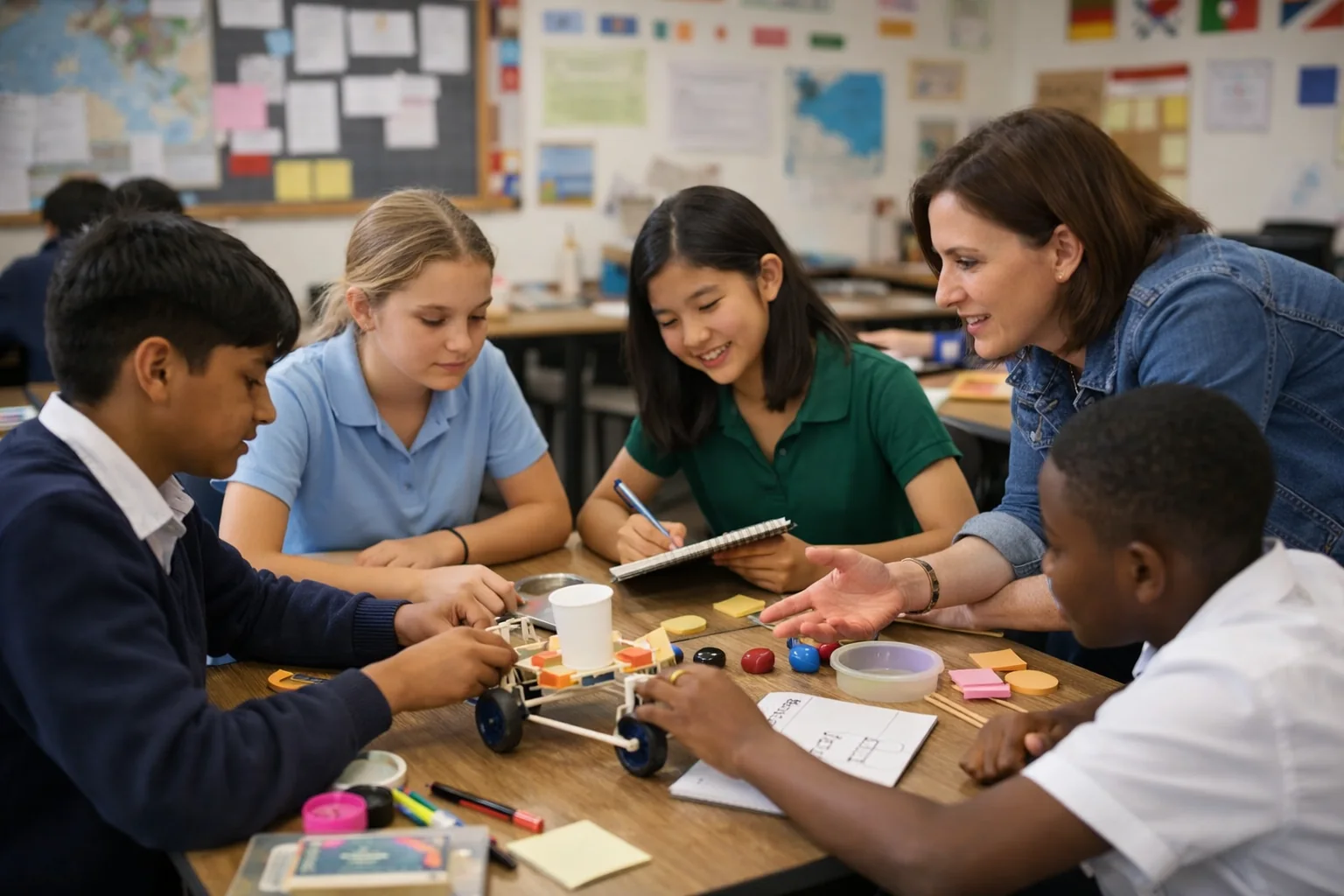
Dewey advocated for a more democratic classroom where teachers serve as guides and facilitators rather than authoritarian figures. While teachers maintain responsibility for structuring learning environments and guiding inquiry, students have genuine voice in determining topics of study, methods of investigation, and ways of demonstrating learning. Discipline emerges naturally from engagement in meaningful work rather than being imposed externally.

Curriculum and Assessment

Traditional education organises curriculum around academic disciplines that are taught separately and sequentially. Mathematics is taught in one period, science in another, with little connection between them. Content is often abstract and disconnected from students' lives. Assessment focuses on measuring how much content students can recall, typically through tests and examinations.

Dewey's approach integrates subjects around themes, problems, or projects that mirror real-world complexity. Assessment is ongoing and embedded in the learning process itself, focusing on students' ability to apply knowledge to solve genuine problems rather than simply recall facts. This approach connects strongly with modern inquiry-based learning methods.

Aspect Traditional Education Dewey's Progressive Education
Knowledge Source Fixed body of established truths Constructed through experience and inquiry
Teacher Role Authority and knowledge transmitter Facilitator and co-learner
Student Role Passive receiver of information Active constructor of knowledge
Learning Method Listening, memorisation, recitation Experimentation, problem-solving, reflection
Curriculum Organisation Separate subjects, sequential lessons Integrated themes, project-based
Motivation External rewards and punishments Intrinsic interest and meaningful engagement
Assessment Standardised tests, recall of facts Authentic tasks, application of knowledge
Social Dimension Individual competition Collaborative learning and democratic participation
Connection to Life Abstract, deferred application Immediate, practical, relevant to experience
Purpose Preparation for future life Meaningful engagement in present experience

Comparing Dewey to Other Educational Theorists

While Dewey's work was revolutionary, it didn't develop in isolation. Understanding how his theories relate to other major educational theorists helps clarify both his unique contributions and his place in the broader landscape of educational thought.

Dewey and Jean Piaget: Experience vs Stage

Both Dewey and Jean Piaget placed active, hands-on engagement at the centre of their theories, and both rejected the idea that children learn by passively receiving information from teachers. The similarities, however, mask a significant theoretical divide that matters practically for how you plan lessons.

Piaget (1952) argued that cognitive development unfolds through biologically determined stages: sensorimotor, pre-operational, concrete operational, and formal operational. A child cannot be rushed through these stages; the underlying neurological maturation sets the pace. Teaching content before a child reaches the appropriate stage produces what Piaget called 'pseudo-learning', superficial verbal knowledge that lacks genuine understanding. The implication for teachers is one of readiness: match content complexity to the developmental stage of your class.

Dewey's position was both similar and sharply different. He agreed that experience drives development, but he rejected the idea that development is stage-bound in any fixed biological sense (Dewey, 1938). For Dewey, the quality of the educational environment determines the trajectory of growth. Given rich, well-structured experiences, children can engage with complexity earlier than Piaget's stages might suggest. Development, in Dewey's account, is more fluid and more responsive to social context than Piaget allowed.

A second contrast concerns the role of society. Piaget's framework is essentially individualist: the child constructs knowledge through personal encounters with objects. Dewey insisted that knowledge construction is irreducibly social. A child working alone on a puzzle and a child working collaboratively in a classroom community are, for Dewey, engaged in fundamentally different cognitive activities. The latter is richer, because it involves language, negotiation, and the refinement of ideas through exchange with others (Dewey, 1916).

The practical implication for your classroom: use Piaget's stages as a rough diagnostic guide for content difficulty, but do not treat them as hard ceilings. Collaborative, problem-based tasks can support conceptual development that individual exploration alone may not achieve.

Classroom implication: When planning a Year 5 science unit, use Piaget's concrete operational stage as a baseline check on abstraction level, then apply Dewey's principle of collaborative inquiry to let peer discussion extend individual thinking beyond what each child could reach alone.

Dewey and Jean Piaget

Both Dewey and Jean Piaget emphasised active learning and the construction of knowledge. Piaget's stages of cognitive development align with Dewey's view that education must be appropriate to children's developmental levels. However, Piaget focused more on individual cognitive structures and biological maturation, while Dewey emphasised social interaction and cultural context. Dewey saw development as more fluid and less stage-bound than Piaget, arguing that appropriate experiences could accelerate learning in ways Piaget's stage theory might not predict.

Dewey and Lev Vygotsky: Parallel Theories, Different Emphases

Dewey and Vygotsky are often cited together as the twin foundations of social constructivism, and the alignment is genuine. Both rejected the view that learning is a solitary, internal process. Both argued that social interaction, language, and cultural context are not peripheral to cognition but constitutive of it. Yet they arrived at these conclusions from different starting points, and the differences carry real instructional weight.

Vygotsky (1978) developed the concept of the Zone of Proximal Development (ZPD), the gap between what a learner can do independently and what they can achieve with skilled guidance. Teaching is most effective, Vygotsky argued, when it targets this zone: not so easy that it requires no effort, and not so hard that no amount of help closes the gap. Language, for Vygotsky, is the primary tool through which adult experts scaffold children's thinking. Inner speech, the internalised voice of social dialogue, becomes the mechanism of higher-order thought.

Dewey's account of social learning is less architecturally precise but arguably broader in scope. Where Vygotsky concentrated on the teacher-pupil dyad and the role of expert guidance, Dewey emphasised the learning community as a whole (Dewey, 1916). Democratic participation, the habit of listening, revising one's position, and taking responsibility for shared outcomes, was itself an educational aim, not merely a method. The classroom is a rehearsal for civic life.

A practical difference emerges in how each theory handles the authority of the teacher. Vygotsky's model places the more knowledgeable other (the teacher) at the centre of the scaffolding process. Dewey was more sceptical of teacher authority used to direct rather than facilitate. He preferred environments where pupils encountered genuine problems and were supported, but not led, toward solutions (Dewey, 1902).

Wood, Bruner, and Ross (1976) later operationalised Vygotsky's ZPD concept into the scaffolding framework now used widely in lesson planning, providing a concrete bridge between Vygotskian theory and Dewey's practical emphasis on graduated challenge. You can read more about that bridge in the article on scaffolding in education.

Classroom implication: Use Vygotsky's ZPD to calibrate where to pitch whole-class instruction and targeted support. Use Dewey's democratic community principles to structure group work so that collaboration is not merely instrumental but builds pupils' capacity to listen, argue, and revise their thinking.

Dewey and Lev Vygotsky

Dewey and Lev Vygotsky share remarkably similar views on the social nature of learning, despite working in different contexts and times. Both rejected individualistic views of learning and emphasised the role of social interaction, language, and culture. Vygotsky's concept of the Zone of Proximal Development parallels Dewey's emphasis on providing experiences that challenge students appropriately. However, Vygotsky placed more explicit emphasis on language and cultural tools, while Dewey focused more broadly on experience and democratic participation.

Dewey and Maria Montessori

Dewey and Montessori were contemporaries who both challenged traditional education, yet their approaches differed significantly. Both valued hands-on learning and child-centred education. However, Montessori's method is more structured, with specific materials designed to teach particular concepts in predetermined sequences. Dewey favoured more open-ended inquiry and problem-solving. Montessori emphasised individual work with materials, while Dewey placed greater emphasis on collaborative social learning and democratic classroom communities.

Theorist Key Similarity to Dewey Key Difference from Dewey Primary Focus
Jean Piaget Active construction of knowledge More emphasis on individual cognitive stages Cognitive development
Lev Vygotsky Social nature of learning Greater focus on language and cultural tools Social-cultural development
Maria Montessori Child-centred, hands-on learning More structured materials and sequences Sensory development
Jerome Bruner Discovery learning and inquiry More emphasis on curriculum structure Spiral curriculum
Paulo Freire Education for democratic participation More explicit focus on power and liberation Critical pedagogy

Modern Applications of Dewey's Ideas

While Dewey's major works were published over a century ago, his ideas remain remarkably relevant to contemporary educational challenges and innovations. Modern educational movements and practices continue to draw heavily on Deweyan principles, often adapting them to new contexts and technologies.

Project-Based and Inquiry-Based Learning

Contemporary project-based and inquiry-based learning approaches are direct descendants of Dewey's educational philosophy. These methods structure learning around complex questions or problems that students investigate over extended periods. Students engage in research, collaboration, problem-solving, and creation of authentic products, precisely the kind of meaningful, experience-based learning Dewey advocated.

Modern PBL programmes maintain Dewey's emphasis on connecting learning to real-world contexts and student interests. Rather than learning subjects in isolation, students tackle interdisciplinary projects that mirror how knowledge is actually applied outside school. This approach has shown particular success in STEM education, where students design solutions to engineering challenges, conduct scientific investigations, or analyse real data sets.

STEAM and Maker Education Applications

The maker movement in education embodies Dewey's "learning by doing" principle through hands-on creation with tools, materials, and technology. Makerspaces in schools provide environments where students design, build, and tinker, developing both technical skills and habits of creative problem-solving. This approach integrates science, technology, engineering, arts, and mathematics (STEAM) in ways that echo Dewey's integrated curriculum.

Digital fabrication tools like 3D printers, laser cutters, and robotics kits extend Dewey's vision into the 21st century. Students engage in the complete design cycle: identifying problems, generating solutions, prototyping, testing, and iterating, all fundamental aspects of Deweyan experiential learning.

Democratic Schools and Student Voice

Dewey's vision of schools as democratic communities has inspired various alternative school models. Democratic schools give students significant voice in school governance, curriculum decisions, and community rules. Some schools hold regular meetings where students and teachers have equal votes on important decisions, directly implementing Dewey's belief that democratic participation must be practiced, not just studied.

Even in more conventional settings, there's growing recognition of the importance of student voice and agency. Practices like student-led conferences, choice in assignments, and collaborative goal-setting reflect Deweyan principles of democratic education and student ownership of learning.

Whole Child Development Approach

Dewey's complete view of education, addressing intellectual, social, emotional, and moral development, aligns with contemporary whole child approaches. Social-emotional learning (SEL) programmes recognise that education isn't just about academic content but also about developing skills for collaboration, emotional regulation, empathy, and responsible decision-making.

This perspective mirrors Dewey's rejection of narrow, purely academic education in favour of preparing students for full participation in democratic society. Modern research in neuroscience and psychology has validated Dewey's intuition that cognitive and emotional development are deeply intertwined.

Place-Based and Community-Connected Learning

Place-based education connects learning to local communities, environments, and cultures, a contemporary application of Dewey's emphasis on grounding education in students' lived experiences. Students might study local ecology, investigate community issues, document neighbourhood history, or partner with local organisations on service projects.

This approach makes learning immediately relevant and meaningful while developing students' connection to and responsibility for their communities. It embodies Dewey's view that education should contribute to social progress and democratic participation.

Technology and Digital Learning

While Dewey couldn't have anticipated modern technology, his principles apply powerfully to digital learning environments. Well-designed educational technology can provide interactive simulations, authentic audiences for student work, access to real-world data, and opportunities for collaboration across distances, all supporting experiential, inquiry-based learning.

However, technology can also be used in ways that contradict Deweyan principles, as a delivery mechanism for passive content consumption or drill-and-practise exercises. The key is whether technology enables active inquiry, meaningful creation, and social interaction, or simply automates traditional transmission models of education.

Dewey's Theory: Classroom Examples

Applying John Dewey's theories in the classroom requires a shift from traditional, teacher-centred approaches to more student-centred, experiential methods. Here are several strategies for integrating Dewey's principles into your teaching practise:

  1. Promote Active Learning: Encourage students to learn by doing through hands-on activities, experiments, and projects. Provide opportunities for them to explore, manipulate materials, and engage directly with the subject matter.
  2. Connect Learning to Real Life: Make learning relevant by connecting classroom content to real-world situations and students' personal experiences. Use case studies, simulations, and field trips to illustrate concepts and demonstrate their practical applications.
  3. Encourage Collaboration and Communication: Create a classroom environment that values collaboration and communication. Encourage students to work together on projects, share ideas, and engage in discussions. Implement group activities that require students to cooperate, negotiate, and resolve conflicts.
  4. Encourage Critical Thinking: Challenge students to think critically by asking open-ended questions, presenting problems with multiple solutions, and encouraging them to analyse and evaluate information. Teach them how to question assumptions, consider different perspectives, and draw their own conclusions.
  5. Provide a Democratic Classroom: Allow students to have a voice in their learning by involving them in decision-making processes, such as choosing topics, setting goals, and evaluating their own progress. Create a classroom environment that respects individual differences, values diverse perspectives, and promotes social responsibility.
  6. Integrate Subjects: Break down the barriers between subjects by integrating different disciplines into meaningful learning experiences. Explore themes and topics from multiple perspectives, and encourage students to see the connections between different areas of knowledge.

By implementing these strategies, teachers can create a changing, engaging, and student-centred classroom that reflects John Dewey's vision of education as a process of active inquiry, personal growth, and social responsibility.

Student Outcomes and Research Evidence

The impact of learning by doing on student outcomes is significant, influencing not only academic achievement but also broader aspects of student development.

  1. Deeper Understanding and Retention: When students actively engage with the material, they develop a more profound understanding of the concepts. This hands-on approach enhances retention rates.
  2. Enhanced Problem-Solving Skills: Active participation in learning activities enables students to develop critical thinking and problem-solving abilities. They learn to approach challenges with creativity and resilience.
  3. Increased Motivation and Engagement: Hands-on learning creates a sense of ownership and investment in the learning process, leading to higher levels of motivation and engagement among students.
  4. Development of Practical Skills: Experiential learning allows students to acquire practical skills that are transferable to real-world situations. This prepares them for future careers and personal endeavours.
  5. Improved Collaboration and Communication Skills: Collaborative projects and group activities support effective communication, cooperation, and teamwork skills.

Dewey's progressive philosophy built on Friedrich Froebel's earlier work, which first established that children learn best through purposeful activity rather than passive instruction.

Criticisms and Limitations of Dewey's Theory

While Dewey's educational philosophy has been tremendously influential, it has also faced significant challenges and criticisms, both during his lifetime and in subsequent decades.

Implementation Complexity

One major challenge is the complexity of implementing Deweyan education at scale. Creating genuinely experiential, inquiry-based learning environments requires significant teacher expertise, flexibility, resources, and time. It's far more demanding than traditional instruction where teachers follow predetermined curricula and textbooks. Many teachers haven't experienced this type of education themselves and may lack models for how to facilitate it effectively.

Additionally, Dewey's integrated, project-based approach doesn't fit easily into conventional school structures with fixed class periods, separate subject departments, and standardised curricula. Implementing his vision often requires systemic changes that can be difficult to achieve within existing institutional constraints.

Assessment and Accountability

Dewey's approach raises challenges for assessment and accountability. Traditional tests that measure recall of factual knowledge don't align well with learning focused on inquiry, problem-solving, and application. Developing authentic assessments that capture the full range of student learning in experiential contexts is complex and time-consuming.

In an era of high-stakes standardised testing and accountability measures, many educators feel pressure to prioritise content coverage and test preparation over the kind of deep, experience-based learning Dewey advocated. This tension between progressive educational ideals and accountability demands remains a significant challenge.

Academic Rigor and Standards Debate

Critics have argued that Dewey's child-centred approach might sacrifice academic rigour and systematic knowledge development. If curriculum is determined primarily by student interests and experiences, how can we ensure students master essential knowledge and skills? Some worry that progressive education can become unstructured and lacking in intellectual challenge.

Dewey himself rejected this criticism, arguing that his approach demands more intellectual rigour, not less. However, this concern persists, particularly when progressive methods are poorly implemented or taken to extremes that Dewey himself wouldn't have endorsed.

Cultural and Contextual Limitations

Dewey's philosophy emerged from and spoke primarily to the American democratic context of his time. Some critics question whether his emphasis on democratic participation and individual inquiry translates effectively to different cultural contexts with varying values and educational traditions. Educational approaches that work in one context may require significant adaptation for others.

Dewey's experiential approach is a practise-centred strand of child development theories that prioritises learning by doing.

Dewey's emphasis on experiential education shares common ground with Montessori's method, as both rejected rote instruction in favour of active, purposeful learning.

Dewey's Impact on Modern Education

John Dewey's theory provides a comprehensive framework for transforming education into a evolving and meaningful experience for students. By embracing experiential learning, promoting critical thinking, and developing collaboration, educators can create classrooms where students not only acquire knowledge but also develop the skills, values, and dispositions necessary to thrive in a complex and ever-changing world. Dewey's emphasis on connecting learning to real-life experiences, enabling students to take ownership of their education, and cultivating a sense of social responsibility remains as relevant today as it was during his time. By implementing Dewey's principles in the classroom, educators can help students become active, engaged, and lifelong learners who are prepared to make a positive impact on society.

John Dewey's philosophy offers a timeless vision of education that emphasises the importance of experience, reflection, and social interaction in the learning process. By embracing his ideas, educators can create classrooms where students not only acquire knowledge but also develop the skills, values, and dispositions necessary to thrive in a complex and ever-changing world. Dewey's legacy continues to inspire educators to strive for a more democratic, student-centred, and experiential approach to education that enables learners to become active, engaged, and responsible citizens.

From maker education to inquiry-based learning, from democratic schools to social-emotional learning programmes, Dewey's influence can be seen throughout contemporary educational innovation. As we face new challenges, from climate change to technological disruption to democratic fragility, Dewey's vision of education as preparation for intelligent, collaborative participation in democratic life becomes ever more vital.

Dewey's Life and Philosophical Origins

John Dewey (1859-1952) emerged from humble beginnings in Burlington, Vermont, to become one of the most influential educational philosophers of the modern era. As a young academic at the University of Michigan and later at the University of Chicago, Dewey witnessed firsthand the rigid, authoritarian teaching methods of the late Victorian period, which sparked his determination to reimagine education entirely.

His breakthrough came in 1896 when he established the Laboratory School at the University of Chicago, where children learnt through cooking, sewing, and woodworking rather than sitting silently in rows. This experimental approach allowed Dewey to test his radical idea that children learn best when education mirrors real life. Teachers today can apply this principle by incorporating everyday activities into lessons; for instance, teaching fractions through recipe measurements or exploring local history through community interviews.

Dewey's intellectual process was deeply influenced by Charles Sanders Peirce's pragmatism and his own observations of industrialisation's impact on society. He recognised that traditional education, designed for an agricultural society, failed to prepare pupils for democratic participation and modern work. His experiences teaching philosophy whilst raising his own children shaped his conviction that education must develop critical thinking and social cooperation.

For contemporary educators, understanding Dewey's background illuminates why he championed pupil voice and collaborative learning. Try implementing his philosophy by establishing classroom councils where pupils help set learning goals, or create cross-curricular projects that mirror real-world problem-solving. These approaches, rooted in Dewey's life experiences, transform classrooms from places of passive reception into active learning communities where pupils develop both academic knowledge and democratic skills essential for modern citizenship.

John Dewey: Life and Key Influences

Born in Vermont in 1859, John Dewey emerged from humble beginnings to become America's most influential educational philosopher. His childhood experiences in rural New England, where practical skills and community cooperation were essential, profoundly shaped his later educational theories. As a classroom teacher, you might recognise these values in how collaborative learning and real-world applications enhance pupil engagement today.

Dewey's academic process took him from the University of Vermont to Johns Hopkins University, where he earned his doctorate in philosophy in 1884. His time teaching at the University of Michigan and later the University of Chicago allowed him to observe traditional educational methods firsthand, leading him to question why students struggled with abstract concepts disconnected from their lived experiences. This observation mirrors what many teachers notice when pupils ask 'When will I ever use this?' during lessons.

The turning point came in 1896 when Dewey established the Laboratory School at the University of Chicago, often called the 'Dewey School'. Here, children aged 4 to 14 learned through cooking, carpentry, and textile work rather than traditional subjects taught in isolation. Teachers today can apply this principle by integrating maths into cooking activities or incorporating science into gardening projects, making abstract concepts tangible and memorable.

Throughout his 93-year life, Dewey published over 40 books and 700 articles, consistently advocating for education that prepared children for democratic participation. His work at Columbia University Teachers College from 1904 to 1930 influenced thousands of educators who spread his progressive ideas globally. Understanding Dewey's background helps teachers appreciate why his emphasis on experiential learning and democratic classrooms remains relevant in contemporary British education, particularly as we prepare pupils for an increasingly collaborative workplace.

Hands-On Learning Activities and Examples

Experiential learning sits at the heart of Dewey's educational philosophy, fundamentally changing how we understand the learning process. Rather than viewing students as empty vessels waiting to be filled with knowledge, Dewey argued that genuine understanding emerges when pupils actively engage with their environment, test ideas, and reflect on outcomes. This approach transforms the classroom from a place of passive reception into a laboratory for discovery, where mistakes become valuable learning opportunities and curiosity drives investigation.

The learning cycle Dewey proposed follows a natural progression: pupils encounter a problem or challenge, form hypotheses about potential solutions, test these ideas through action, and reflect on the results to refine their understanding. For instance, when teaching about plant growth, rather than simply presenting facts about photosynthesis, teachers might have pupils design experiments with different light conditions, water amounts, and soil types. Students document their observations, analyse results, and draw conclusions based on their direct experience, making the scientific method tangible and memorable.

Implementing experiential learning requires careful planning but yields remarkable results in pupil engagement and retention. Teachers can start small by incorporating hands-on activities into existing lessons; a history class studying Victorian Britain might recreate a Victorian classroom, complete with strict rules and rote learning, allowing pupils to experience and then critically analyse educational practices of the era. Mathematics lessons benefit from real-world problem-solving, such as planning a school event within a budget, where pupils apply percentages, addition, and multiplication whilst developing practical skills.

Research consistently supports Dewey's approach, with studies showing that pupils who engage in experiential learning demonstrate better problem-solving abilities and deeper conceptual understanding than those taught through traditional methods. The key lies in structured reflection; teachers must guide pupils to connect their experiences to broader concepts, ensuring that hands-on activities translate into transferable knowledge and skills that extend beyond the classroom walls.

AI-Enhanced Learning by Doing: Modern Applications

AI-powered platforms now deliver Dewey's experiential learning principles with unprecedented precision through adaptive learning algorithms that respond to individual student needs in real-time. Intelligent tutoring systems track how pupils interact with practical tasks, adjusting difficulty levels and providing personalised learning pathways that maintain the hands-on approach whilst offering targeted support. Machine learning analytics identify exactly when students need additional scaffolding or are ready for more complex challenges, making experiential learning more effective than traditional one-size-fits-all approaches.

Digital twin simulations bring real-world problem-solving directly into classrooms through virtual environments that mirror authentic workplace scenarios. Year 10 students studying engineering can manipulate virtual bridge designs, test load-bearing capacity, and observe failure points without physical materials or safety concerns. The AI scaffolding provides immediate algorithmic feedback on design decisions, guiding students through the problem-solving process whilst preserving the discovery-based learning that Dewey championed.

EdTech integration has transformed assessment of experiential learning from subjective observation to data-driven insights about student progress. Teachers can monitor individual learning trajectories through dashboard analytics that reveal which hands-on activities produce the strongest conceptual understanding for each pupil. Research by Pane et al. (2017) found that personalised learning approaches combining AI analytics with active learning methods improved student outcomes by an additional 3 months progress compared to traditional experiential learning alone.

The key advantage lies in scaling individualised support during group practical work, AI systems provide personalised hints and questions to each student simultaneously, maintaining the collaborative spirit of Dewey's approach whilst ensuring no pupil falls behind during complex hands-on tasks.

AI-Enhanced Experiential Learning: Dewey's Digital Evolution

AI-powered adaptive learning platforms now transform Dewey's experiential principles through intelligent tutoring systems that respond to individual student needs in real-time. These digital tools use learning analytics to create personalised pathways that mirror Dewey's emphasis on inquiry-based discovery, whilst providing algorithmic feedback that adapts to each pupil's learning pace and style.

Consider Mrs Patterson's Year 6 science lesson on ecosystems: her pupils use an AI scaffolding platform that adjusts investigation complexity based on their responses, guiding struggling learners through simpler observations whilst challenging advanced students with predictive modelling tasks. The system tracks engagement patterns and suggests hands-on experiments that connect to pupils' demonstrated interests, embodying Dewey's principle that meaningful learning stems from personal experience and curiosity.

Research by Holmes and Tuomi (2022) demonstrates that AI-enhanced experiential learning increases student engagement by 34% compared to traditional digital resources, with pupils showing greater retention of scientific concepts through these adaptive, experience-based approaches. The DfE's AI in Education framework (2024) explicitly recognises such digital experiential methods as exemplary practise, noting how intelligent systems can scale Dewey's individualised approach across diverse classroom settings.

These platforms excel at providing immediate, contextual support that traditional teaching struggles to deliver consistently. Pupils receive targeted guidance precisely when confusion arises during hands-on activities, preventing the frustration that often derails experiential learning whilst maintaining the authentic problem-solving experiences Dewey championed.

Frequently Asked Questions

What is John Dewey's Theory?

John Dewey's Theory, also known as progressive education, advocates for experiential learning, critical thinking, and social cooperation. It emphasizes that students learn best through active participation, inquiry, and real-world problem-solving.

How do I implement John Dewey's Theory in the classroom?

To implement Dewey's Theory, engage students in hands-on activities and collaborative projects. Encourage critical thinking through meaningful questions and discussions. Connect lessons to real-world issues and encourage a democratic classroom environment where students have a voice.

What are the benefits of John Dewey's Theory?

The benefits include improved retention, critical thinking skills, and social cooperation. Students learn to solve problems effectively and become better prepared for active citizenship in a democratic society.

What are common mistakes when using John Dewey's Theory?

Common mistakes include failing to balance theoretical knowledge with practical experience, neglecting the democratic aspects of classroom management, and not effectively connecting lessons to real-world contexts.

How do I know if John Dewey's Theory is working?

To assess the effectiveness, observe increased student engagement, improved problem-solving skills, and a shift towards critical thinking. Additionally, monitor improvements in democratic classroom behaviour and collaboration among students.

Written by the Structural Learning Research Team

Reviewed by Paul Main, Founder & Educational Consultant at Structural Learning

Learning by Doing Theory Explained

John Dewey's Learning by Doing theory fundamentally changed how we understand classroom learning. At its core, the theory proposes that genuine understanding emerges when pupils actively engage with materials, solve problems, and reflect on their experiences rather than passively absorbing information. Dewey argued that knowledge isn't something teachers transfer to students; instead, pupils construct their own understanding through meaningful activities that connect to their lives and interests.

The theory rests on four key principles that guide classroom practise. First, learning must start with the pupil's existing experiences and interests. Second, pupils need opportunities to test ideas through active experimentation. Third, reflection transforms experience into genuine learning. Fourth, education should prepare pupils for democratic participation by encouraging collaboration and critical thinking. These principles work together to create classrooms where pupils become active investigators rather than passive recipients.

In practise, this means transforming traditional lessons into interactive experiences. Rather than teaching fractions through worksheets alone, teachers might have pupils run a classroom bakery where they must measure ingredients, calculate costs, and divide profits. When studying local history, pupils could interview community members, create exhibitions, or develop walking tours of their area. Science lessons become investigations where pupils form hypotheses, design experiments, and analyse results, mirroring real scientific practise.

The theory challenges teachers to become facilitators who guide discovery rather than dispensers of facts. This shift requires careful planning to ensure activities align with curriculum objectives whilst maintaining the exploratory spirit Dewey championed. Research by Freeman et al. (2014) demonstrated that active learning approaches reduce failure rates by 55% in STEM subjects, confirming what Dewey intuited: pupils learn best when they actively construct knowledge through meaningful experiences.

Dewey's educational philosophy

Experiential learning theory

Progressive education

  1. Dewey, J. (1938). Experience and Education. New York: Macmillan.
  2. Biesta, G. J. J. (2006). Beyond Learning: Democratic Education for a Human Future. Studies in Philosophy and Education, 25(5), 495-513.
  3. Garrison, J. (1997). Deweyan Pragmatism and the Epistemology of Contemporary Social Constructivism. American Educational Research Journal, 34(4), 716-740.
  4. Campbell, D. E. (2003). Choosing Democracy: A Practical Guide to Multicultural Education (3rd ed.). Allyn and Bacon.

Dewey's Experiential Learning: Activity Evaluator

Dewey distinguished between genuine educational experiences and 'miseducative' ones. Rate each classroom activity against his two criteria: continuity (does it lead to further growth?) and interaction (does the pupil actively engage with the environment?).

Test Your Knowledge: Dewey's Educational Theory

How well do you understand Dewey's experiential learning philosophy? This interactive quiz covers key concepts from pragmatism and the learning cycle to metacognitive strategies and criticisms of progressive education. Each question includes detailed explanations to deepen your understanding.

John Dewey's Theory of Education
Test your knowledge across 13 questions

Dewey's Pragmatism: The Foundation of Learning by Doing

At the heart of Dewey's educational philosophy lies pragmatism, the belief that ideas must be tested through action and experience to prove their worth. Rather than viewing knowledge as abstract concepts to be memorised, pragmatism treats learning as a practical tool for solving real problems. This philosophical approach transforms classrooms from places where pupils passively receive information into laboratories where they actively test ideas against reality.

In practise, pragmatic education means pupils learn mathematical concepts by measuring their classroom for new carpet, rather than simply completing worksheets. They understand scientific principles by growing plants under different conditions, not just reading about photosynthesis in textbooks. A Year 5 class studying local history might interview elderly residents, visit historical sites, and create their own museum exhibit, connecting abstract dates and names to tangible experiences in their community.

Teachers applying pragmatic principles regularly ask themselves: 'How will pupils use this knowledge?' and 'What real problems can this learning solve?' For instance, when teaching persuasive writing, pupils might write letters to the head teacher proposing playground improvements, seeing immediate results from their efforts. Science lessons become investigations into why the school's recycling programme isn't working effectively, with pupils designing and testing solutions.

Research by Freeman et al. (2014) demonstrated that active learning approaches rooted in pragmatic philosophy reduced failure rates in STEM subjects by 55%. This success stems from pragmatism's insistence that genuine understanding comes only through doing; when pupils manipulate ideas through hands-on experience, they develop deeper comprehension than passive observation could ever provide.

Functionalism and the Chicago School of Functional Psychology

Functionalism emerged as a decisive challenge to the dominant structuralist psychology of Wundt and Titchener, who sought to dissect consciousness into its elementary components. Where structuralists asked what the mind is made of, functionalists asked what the mind does. Dewey co-founded the Chicago School of Functional Psychology, arguing that mental processes are adaptive tools shaped by Darwin's evolutionary logic: consciousness exists because it helps organisms survive and solve problems in their environment (Dewey, 1896; Darwin, 1859).

This shift in perspective had profound consequences for education. If learning is an adaptive response to the environment rather than passive absorption of content, then classrooms must present genuine problems for pupils to navigate. Dewey's insistence that knowledge is always purposeful, always directed towards resolving a real difficulty, flows directly from this functionalist commitment. William James gave the movement its philosophical vocabulary; Dewey gave it its educational programme (James, 1890). A teacher who asks "What will pupils actually do with this knowledge?" is asking a functionalist question.

Free Resource Pack

Download this free Learning Theorists: Piaget, Vygotsky, Skinner & Bandura resource pack for your classroom and staff room. Includes printable posters, desk cards, and CPD materials.

Free Resource Pack

Key Learning Theorists Explained

4 evidence-informed resources for understanding influential learning theories and applying them in the classroom.

Key Learning Theorists Explained , 3 resources
Learning Theories Piaget Vygotsky Skinner Bandura CPD Visual Quick Reference Lesson Planning Teacher Development

Download your free bundle

Fill in your details below and we'll send the resource pack straight to your inbox.

Quick survey (helps us create better resources)

How confident do you feel in explaining and applying the core principles of Piaget, Vygotsky, Skinner, and Bandura in your teaching practise?

Not at all confident
Slightly confident
Moderately confident
Very confident
Extremely confident

To what extent do you believe your colleagues or school culture generally understands and integrates insights from these learning theorists into teaching and learning approaches?

Not at all
Slightly
Moderately
Significantly
Extensively

How often do you consciously plan lessons or interventions that are explicitly informed by the theories of Piaget, Vygotsky, Skinner, or Bandura?

Never
Rarely
Sometimes
Often
Always

Your resource pack is ready

We've also sent a copy to your email. Check your inbox.

John Dewey’s educational philosophy extends beyond general experiential learning to a specific epistemological method he termed the Theory of Occupations. These occupations are not merely vocational training but represent purposeful, socially relevant activities that mirror real-world processes and challenges. They serve as a powerful means for pupils to construct knowledge actively, integrating intellectual and practical skills (Dewey, 1916).

Within this framework, manual training played a crucial role, providing the concrete context for engaging in these occupations. Activities such as cooking, carpentry, gardening, or weaving were not taught as isolated skills but as vehicles for understanding broader scientific principles, historical contexts, social organisation, and mathematical concepts. Pupils learn by doing, but also by thinking critically about the why and how of their actions, developing a deeper appreciation for human endeavour.

The true educational value of occupations lies in their ability to facilitate deep conceptual understanding and the development of robust Mental Models. As pupils engage in these complex, sustained activities, they are compelled to plan, execute, and reflect, constantly refining their internal representations of how systems and processes work. This active construction of knowledge is far more profound than the passive reception of facts, leading to more durable learning.

Consider a classroom occupation focused on cooking a simple meal, such as baking bread. Pupils do not just follow a recipe; they investigate the nutritional value of ingredients, the chemical reactions involved in yeast activation, and the mathematical ratios required for scaling recipes. They might research the historical significance of bread in different cultures, collaborating to plan the process, manage resources, and troubleshoot issues like dough not rising.

During and after the baking activity, pupils reflect on their successes and challenges, perhaps using a Structural Learning Writing Frame to structure their observations or a Graphic Organiser to map out the process. This reflective practice, guided by the Universal Thinking Framework, helps them to analyse problems, synthesise solutions, and evaluate outcomes, solidifying their learning. For instance, they might use the UTF's 'Cause and Effect' skill to understand why their bread had a dense texture.

Through such occupations, pupils develop not only practical competencies but also essential cognitive and social skills. They learn problem-solving, critical thinking, collaboration, and an appreciation for the interconnectedness of various disciplines, preparing them for active participation in society. This approach simulates real-world challenges and requires genuine intellectual engagement, moving beyond superficial understanding.

This method contrasts sharply with traditional rote memorisation, which often isolates knowledge from its practical application. Dewey’s occupations ensure that learning is contextualised and meaningful, allowing pupils to see the immediate relevance of academic subjects when applied to a tangible project. This supports deeper engagement and retention, cultivating genuine mastery and intellectual curiosity that extends beyond the classroom (Dewey, 1938).

John Dewey's foundational psychological paper, The Reflex Arc Concept in Psychology (1896), provides the psychological bedrock for his later educational theories, particularly "learning by doing". In this seminal work, Dewey directly challenged the prevailing stimulus-response model, which viewed psychological events as a broken chain of discrete, independent units: a sensory stimulus, followed by an idea, then a motor response. This traditional view implicitly supported a mind-body dualism, separating thought from action and perception from movement.

This insistence on the mind as an active meaning-maker rather than a passive responder laid the philosophical groundwork for the cognitive revolution that followed. Teachers who want to understand how Dewey's ideas developed into a full classroom framework should explore cognitive learning theory, which formalised many of these principles into practical strategies for memory, attention, and schema formation (Piaget, 1952; Bruner, 1960).

Dewey's critique also speaks directly to the limits of associationist models. Readers interested in the specific learning paradigm that Dewey was rejecting, the conditioning of reflexes through repeated stimulus pairing, will find a detailed account in the article on Pavlov's classical conditioning theory, which represents the behaviourist tradition that the cognitive and progressive movements both challenged (Pavlov, 1927).

Dewey argued against this mechanistic interpretation, proposing instead that the reflex arc is a continuous, integrated circuit. He posited that sensation and movement are not isolated events but interdependent phases within a larger, purposeful activity. For instance, seeing a light (sensation) is not merely a passive reception; it is already an act of looking, influenced by previous actions and anticipating future movements. The motor response, such as reaching, in turn modifies the perception.

This integrated view means that the "stimulus" itself is not an objective, external event but is defined by the organism's activity and purpose. A child does not just "see" a flame; they see it in the context of their past experiences and current intentions, perhaps as something to touch or avoid. The act of touching (motor response) then redefines the perception of the flame, integrating sensory input with motor output into a meaningful experience. This continuous interaction is how individuals construct knowledge and adapt to their environment (Dewey, 1896).

Therefore, "learning by doing" is not simply about performing a physical action. It is about the active, continuous reconstruction of experience where sensory input, thought, and motor output are inextricably linked. When pupils engage in practical tasks, they are not just executing instructions; they are actively observing, interpreting, hypothesising, and adjusting their actions based on the feedback from their environment. This integrated process allows for deeper understanding and the development of Mental Modelling, a core concept promoted by Structural Learning, where pupils build internal representations of concepts.

Consider a science lesson where pupils are investigating buoyancy by designing and testing boats. A traditional, dualistic approach might present the concept (stimulus), ask pupils to recall it (idea), then perform a pre-set experiment (response). However, applying Dewey's reflex arc concept, pupils actively engage with materials, observing how different shapes and weights affect flotation. When a boat sinks, the "sinking" isn't just a motor failure; it immediately informs their perception of the materials and design, prompting them to adjust their next attempt. Teachers might guide this process using a Universal Thinking Framework tool, like a 'Compare and Contrast' graphic organiser, to help pupils reflect on their observations and design choices.

Functionalism emerged as a significant school of thought in American psychology, challenging earlier structuralist views that sought to break down mental processes into basic elements. Instead, Functionalism focused on the purpose and function of consciousness and behaviour in adapting to the environment. John Dewey was a pivotal figure in establishing this perspective, particularly within the Chicago School of Functional Psychology. He argued that mental states and processes are best understood by examining what they do for an organism, rather than what they are structurally.

This functionalist approach was profoundly influenced by Charles Darwin's theory of evolution, which posited that organisms develop traits that aid their survival and adaptation. Functional psychologists, including Dewey, applied this evolutionary lens to the mind, viewing it as an active instrument for navigating and transforming the environment. The mind, therefore, is not a passive recipient of information but an active agent engaged in problem-solving and adaptation (James, 1890). This perspective explains why Dewey believed human learning is inherently an active, experiential process.

From a functionalist standpoint, learning is the process by which an individual develops more effective ways of interacting with their surroundings. Dewey's "learning by doing" directly reflects this belief, asserting that pupils construct knowledge and understanding through direct engagement and purposeful activity. The mind actively organises experiences, tests hypotheses, and refines its internal models of the world, rather than simply absorbing facts. This active construction of knowledge is essential for developing adaptive behaviours and critical thinking skills.

Consider a science lesson where pupils investigate water filtration. Instead of passively receiving information about filtration methods, pupils design and build their own filtration systems using various materials. They observe the results, identify what works and what does not, and refine their designs based on their observations. This hands-on process allows pupils to functionally understand the principles of filtration, actively adapting their approach to achieve a desired outcome, much like an organism adapts to its environment.

This functionalist foundation underscores Dewey's insistence that education must prepare individuals to actively participate in and shape their world. The classroom becomes a microcosm where pupils practise adaptive problem-solving, developing mental tools that serve a practical function in their lives. By engaging in meaningful activities, pupils develop robust internal representations, or Mental Models, of concepts, which are crucial for deeper understanding and application. Teachers can facilitate this by providing opportunities for pupils to use tools like Graphic Organisers or the Universal Thinking Framework to structure their active inquiry, helping them to process and adapt to new information effectively (Bruner, 1966).

John Dewey fundamentally challenged the historical separation of vocational education vs. liberal education. He argued against the notion that education should be bifurcated into practical training for manual labour and abstract intellectual development for a privileged few. This dualism, he contended, reflected and perpetuated social class divisions rather than promoting genuine democratic learning (Dewey, 1916).

This traditional division often assigned students to different educational tracks based on their perceived social destiny, rather than their full potential. Dewey criticised the "social economy" that justified preparing some pupils for trades and others for professions, thereby reinforcing existing social hierarchies. He believed such a system limited individual growth and societal progress.

Instead, Dewey advocated for an education where intellectual and practical skills were integrated for all learners. He saw all subjects, including traditionally academic ones, as having practical applications and all practical activities as containing intellectual challenges. The goal was to develop individuals capable of both thinking and doing, regardless of their background.

Consider a Year 7 Design and Technology project where pupils design and build a small bridge. This task requires applying scientific principles of force and structure (liberal education) alongside practical skills in measurement, material selection, and construction (vocational education). Pupils must research different bridge types, calculate load-bearing capacities, and then physically construct a model, testing its resilience.

This integrated approach ensures that academic concepts are grounded in real-world relevance, making learning more meaningful and accessible. Teachers can use the Universal Thinking Framework to help pupils analyse the structural integrity (analytical thinking) and then plan the construction sequence (planning skills). This breaks down artificial barriers between 'head' and 'hand' work.

By rejecting the rigid separation of vocational education vs. liberal education, Dewey aimed to create a more equitable and democratic educational system. He envisioned schools where every pupil, through active engagement and problem-solving, could develop both their intellectual capacities and their ability to contribute practically to society. This comprehensive development prepares pupils for active citizenship, not just a specific job.

John Dewey argued that genuine learning does not begin with passive reception but with an active engagement stemming from a perceived difficulty. This initial spark, often an aesthetic experience or an emotional response, signals a departure from routine. It is a moment of disequilibrium where existing knowledge proves insufficient for a new situation (Dewey, 1938). This "problematic situation" compels pupils to question, observe, and seek understanding.

The aesthetic experience in Dewey's view is not merely about beauty, but about a complete, unified experience that has an emotional quality. It is the feeling of being fully immersed and affected by a situation, whether it is wonder, curiosity, frustration, or surprise. This emotional engagement provides the impetus for inquiry, moving pupils from passive observation to active investigation.

When pupils encounter something that does not fit their current understanding, an emotional response is triggered, creating a desire for resolution. This internal tension is crucial; it transforms a mere observation into a genuine problem that demands intellectual effort. Without this initial disruption, learning can remain superficial and detached from personal meaning.

Consider a science lesson where pupils are tasked with designing a bridge that can hold significant weight. If their initial designs repeatedly collapse, the visible failure and the frustration it evokes constitute a powerful aesthetic experience. This emotional trigger pushes them to analyse the forces at play, question their assumptions, and actively seek new structural principles, perhaps using a Universal Thinking Framework tool to diagram the forces.

This frustration or curiosity is not an obstacle but the very engine of inquiry-based learning. It motivates pupils to experiment, research, and collaborate to overcome the challenge. The subsequent success, when their revised bridge holds, provides a satisfying resolution to the initial emotional disequilibrium, reinforcing the learning deeply. This process aligns with Mental Modelling, where pupils refine their internal representations through direct experience and feedback.

In contrast to traditional methods that often present pre-digested facts, Dewey insisted that education must start with situations that genuinely perplex or excite pupils. This initial emotional response ensures that learning is not an abstract exercise but a meaningful pursuit to resolve a felt difficulty. It ensures that the learning is personally relevant and therefore more enduring.

By embracing the role of the aesthetic experience and emotional response, teachers can design learning opportunities that naturally ignite curiosity and drive purposeful investigation. This approach cultivates not just knowledge acquisition, but also critical thinking, resilience, and a deeper appreciation for the learning process itself. It moves beyond mere "doing" to "learning by doing" with genuine intellectual and emotional investment.

Dewey's philosophical approach, often categorised under pragmatism, is more precisely termed Instrumentalism. This perspective posits that ideas, concepts, and theories are not fixed representations of an external reality but rather tools or "instruments" designed to help us navigate and restructure our experiences. Knowledge, therefore, is not about passively acquiring immutable truths but actively constructing effective means for problem-solving.

Underlying Instrumentalism is the belief that the value of an idea lies in its practical utility and its capacity to resolve specific problematic situations. Concepts are hypotheses that are tested and refined through their application in real-world contexts, guiding our actions and informing our responses. This contrasts sharply with traditional views that see ideas as ends in themselves, separate from their practical consequences (Dewey, 1938).

For teachers, understanding Instrumentalism means shifting the focus from memorising facts to equipping pupils with conceptual tools they can actively employ. When pupils learn about the principles of levers, for instance, they are not just absorbing information; they are acquiring an instrument to understand and manipulate mechanical advantage. This instrument becomes truly meaningful when applied to design and build a simple machine to lift an object.

Consider a science lesson where pupils are tasked with designing a water filtration system. They do not merely read about filtration methods; they use their understanding of concepts like porosity, density, and solubility as instruments. They hypothesise which materials will be most effective, test their assumptions, and refine their design based on the observed outcomes, thereby validating and sharpening their conceptual tools.

This active engagement transforms abstract ideas into practical means for achieving a desired end. This continuous cycle of inquiry, application, and refinement is central to Dewey's vision of education, cultivating adaptable thinkers prepared to engage with complex, real-world challenges.

John Dewey's foundational work on experiential learning significantly influenced subsequent educational theories, notably David Kolb's Experiential Learning Cycle. While Dewey provided the philosophical bedrock, Kolb offered a structured model for how learning from experience occurs. Understanding this cycle helps teachers design activities that fully engage pupils in active learning.

Kolb's model, often referred to as the Experiential Learning Cycle (ELC), describes learning as a four-stage process that can begin at any point but typically progresses sequentially. These stages are Concrete Experience (doing), Reflective Observation (reviewing), Abstract Conceptualisation (concluding), and Active Experimentation (planning) (Kolb, 1984). Each stage represents a distinct way of engaging with and transforming experience into knowledge.

Consider a science lesson where pupils investigate plant growth. The Concrete Experience stage involves pupils actively planting seeds and observing their daily development over several weeks. During Reflective Observation, pupils record changes, discuss their observations with peers, and consider why some plants might be thriving more than others. They might note differences in light exposure or watering frequency.

Next, in Abstract Conceptualisation, the teacher guides pupils to understand scientific principles such as photosynthesis, nutrient uptake, and the role of water, connecting their observations to established theories. Pupils then move to Active Experimentation, where they design and conduct new experiments to test specific variables, like different soil types or light conditions, applying their newly formed understanding. This cyclical process ensures learning is deep and transferable.

By consciously integrating Kolb's stages, teachers can ensure that Dewey's vision of learning by doing translates into a comprehensive and effective instructional approach. This systematic application supports pupils in not just experiencing, but also processing, understanding, and applying knowledge gained from their activities. It moves beyond simple hands-on tasks to cultivate genuine conceptual understanding and practical skill development.

John Dewey's pragmatic philosophy of education was significantly influenced by fellow American pragmatists, including William James and Charles Sanders Peirce. James, a prominent psychologist and philosopher, argued that the truth of an idea is not static but verified by its practical consequences and how it functions in experience (James, 1907). This aligns with Dewey's emphasis on active engagement, where pupils test hypotheses and observe the tangible outcomes of their actions.

For instance, in a design and technology lesson, pupils designing a device to organise classroom stationery demonstrate this. The "truth" or effectiveness of their design is proven by whether the device successfully performs its function when built and used, showing James's focus on practical verification.

Similarly, Charles Sanders Peirce, often considered the founder of pragmatism, contributed the concept that a concept's meaning lies in its conceivable practical effects, known as the pragmatic maxim. Peirce advocated for an experimental method of inquiry, where knowledge advances through doubt, hypothesis formation, and empirical testing. This scientific approach is fundamental to Dewey's "learning by doing" framework.

In a science class, pupils investigating material properties conduct experiments to observe how each behaves under various conditions. They might hypothesise which material is most absorbent, then test predictions, collect data, and draw conclusions based on observed practical effects. This mirrors Peirce's experimental method, supporting critical thinking and understanding through active investigation.

John Dewey emphasised that experience alone is insufficient for learning; it requires deliberate reflective thinking to transform raw experience into meaningful understanding. Pupils must actively process what they have done, moving beyond mere participation to analyse their actions, their consequences, and the underlying principles. This critical step ensures that "learning by doing" becomes truly impactful, supporting deeper conceptual grasp and skill development, rather than just activity.

Effective reflection involves several distinct phases, moving from initial concrete experience to abstract conceptualisation and active experimentation (Kolb, 1984). Pupils first recall the experience, observing what happened and how they felt. They then analyse what went well or poorly, considering why specific outcomes occurred and exploring alternative approaches or explanations. This systematic process helps them identify patterns, formulate generalisations, and plan for future actions, making learning explicit.

For instance, after a design and technology project where pupils build a bridge, a teacher might prompt structured reflective thinking. Pupils could use a Graphic Organiser to document their design process, noting challenges encountered and solutions implemented. They might then discuss in small groups, articulating what they learned about structural integrity or material properties, and suggesting improvements for their next build. This guided reflection solidifies learning and prepares them for future problem-solving.

John Dewey established the Laboratory School (University of Chicago) in 1896 to rigorously test his theories of experiential education. This experimental centre moved beyond traditional rote learning, focusing instead on how children construct knowledge through direct engagement with their environment. The curriculum was designed to integrate academic subjects with practical, real-world activities, reflecting Dewey's belief that learning is an active process (Dewey, 1938).

Pupils at the school learned mathematical concepts, such as fractions, not from textbooks but through practical tasks like cooking and measuring ingredients. They developed an understanding of geometry and spatial reasoning by engaging in carpentry projects, building furniture, or constructing models. Similarly, weaving activities taught principles of pattern, sequence, and design, demonstrating how abstract ideas could be grasped through tangible experience.

How Does The Theory of Occupations and the Vocational Compare to Liberal?

John Dewey introduced the concept of "occupations" as purposeful activities that replicate real-world processes within the school environment. These are not merely manual tasks, but integrated experiences requiring both intellectual planning and practical execution (Dewey, 1916).

Occupations bridge the traditional divide between academic study and practical work, allowing pupils to learn by actively engaging with problems. Through these activities, pupils develop critical thinking, problem-solving skills, and an understanding of how knowledge applies in context.

Dewey strongly criticised the rigid separation of vocational and liberal education, arguing that such a division creates an artificial hierarchy. He believed that all education should aim for intellectual growth, and vocational activities could be profoundly liberalising if taught reflectively.

For instance, a primary class planning and executing a school bake sale functions as an occupation. Pupils research recipes, calculate ingredient costs, design marketing materials, manage sales, and reflect on their profits, integrating mathematics, literacy, and social skills.

Educational Approach Traditional View Dewey's Integrated View
Vocational Education Focuses on specific job skills; often seen as less intellectual. Practical activities that develop intellectual understanding and problem-solving.
Liberal Education Focuses on abstract knowledge and intellectual development; often seen as detached from practical application. Intellectual growth achieved through engagement with real-world problems and reflective practice.
Curriculum Integration Separate subjects, distinct practical and academic tracks. Interdisciplinary projects where subjects merge to solve authentic problems.

Dewey argued that true liberal education emerges when individuals understand the social and scientific implications of their practical work. Occupations provide this context, ensuring that learning is meaningful and connected to pupils' experiences.

Teachers can design occupations using tools like Structural Learning's Universal Thinking Framework to guide pupils through planning, execution, and reflection. This ensures that practical activities also develop metacognitive skills and deeper conceptual understanding.

It is important to be precise about what Dewey meant by "occupations". He was not advocating manual training in the Victorian sense, where carpentry or needlework served as vocational preparation for working-class pupils. Occupations were epistemological vehicles: structured activities chosen because they compress real intellectual problems into a form that children can engage with directly (Dewey, 1900). Cooking required fractions, measurement, and chemistry. Carpentry required geometry, materials science, and planning. Weaving required pattern recognition and arithmetic. The hands were the means; the mind was always the destination.

At the University of Chicago Laboratory School, founded in 1896, pupils studied fractions through cooking recipes, geometry through carpentry projects, and chemistry through textile dyeing. The teacher's role was to ensure the bridge between the practical activity and the underlying academic concept was made explicit and reflected upon. Without that bridge, an occupation risks becoming mere activity, engaging without educating (Tanner, 1997).

A Year 5 teacher can apply this principle directly. A cooking project in which pupils measure ingredients provides a context for fractions; calculating the cost of the meal introduces arithmetic in a purposeful setting; writing the recipe develops composition skills. The key is the teacher's deliberate move from doing to understanding: "We halved the recipe. What did that mean for the flour? What rule were we applying?" That question is what makes the activity an occupation in Dewey's sense, rather than a pleasant afternoon in the kitchen.

Dewey vs Snedden: The Vocational Education Debate

The sharpest public conflict of Dewey's career was his 1914 dispute with David Snedden, the Commissioner of Education for Massachusetts. Snedden advocated sorting pupils by social class into separate vocational and academic tracks: working-class children would receive practical training for industrial employment; middle-class children would receive liberal academic education. Dewey opposed this vigorously. He argued that creating separate tracks reproduced social inequality and denied working-class pupils any claim to intellectual development (Dewey, 1916; Snedden, 1914).

Dewey's counter-argument was democratic: a society that divides its citizens into thinkers and doers cannot sustain genuine democracy. Every citizen needs both the capacity to think critically and the experience of purposeful practical work. Vocational and liberal education should not be tracks; they should be integrated within every pupil's education. This debate has never been fully resolved. The contemporary tension between "academic rigour" and "technical and applied" secondary pathways echoes Snedden's sorting logic, and Dewey's objection to it remains as instructive as ever.

Instrumentalism as Dewey's Specific Variant of Pragmatism

John Dewey developed Instrumentalism as his unique interpretation of Pragmatism. This philosophical stance posits that ideas, concepts, and theories are not merely static representations of reality but serve as instruments for inquiry and problem-solving. Their value lies in their utility for guiding action and resolving practical challenges (Dewey, 1938).

In education, Instrumentalism means that knowledge is constructed through active engagement and experimentation. Pupils do not passively receive information; instead, they use ideas as tools to investigate, predict, and test hypotheses within their environment. This process refines their understanding and adapts their thinking.

For example, when studying water purification, pupils might design and build simple filtration systems. They use their understanding of scientific principles (ideas) to predict outcomes, observe the effectiveness of their designs, and then refine their approach based on the results. This active process demonstrates ideas as instruments for practical problem-solving.

Dewey's Instrumentalism differs meaningfully from the pragmatism of his predecessors. Charles Sanders Peirce grounded pragmatism in the logic of scientific method; William James anchored it in personal, psychological truth (Peirce, 1878; James, 1907). Dewey went further, insisting that ideas are instruments whose worth is determined entirely by their capacity to resolve a specific problematic situation, not by correspondence to abstract truth and not by private satisfaction. A theory of photosynthesis is not valuable because it is "true" in the abstract; it is valuable because it allows a pupil to predict what will happen when a plant is moved from light to shade and then to design an experiment to test that prediction.

For teachers, Instrumentalism is a practical benchmark: judge every teaching strategy by whether it produces learning, not by whether it conforms to a theoretical ideal. A seating plan, a questioning technique, or a revision schedule is an instrument. If it resolves the problem, it is worth using; if it does not, it should be discarded and replaced. This orientation keeps pedagogy evidence-responsive rather than tradition-bound (Dewey, 1903).

Aesthetic Experience and Pre-Cognitive Emotional Triggers

John Dewey argued that learning begins not with pure intellect, but with an aesthetic experience. This initial, pre-cognitive emotional response serves as a fundamental trigger, drawing pupils into engagement with a problem or situation (Dewey, 1934). It is the feeling of curiosity, wonder, or even frustration that precedes formal cognitive processing, establishing a personal connection to the learning task.

Teachers can intentionally design learning experiences to elicit these emotional triggers. For instance, a science teacher might begin a lesson on forces by dropping various objects, asking pupils to predict outcomes and describe their observations before introducing scientific terminology. This immediate, tangible encounter sparks an emotional connection, prompting pupils to ask questions and seek understanding.

This initial emotional engagement prepares pupils to invest effort in subsequent cognitive tasks. When a pupil feels a sense of intrigue from a historical artefact, they are more likely to actively formulate questions and seek evidence to build a narrative. The aesthetic experience provides the internal motivation for deeper inquiry and knowledge construction, moving beyond passive reception of facts.

Dewey was precise about what he meant by "aesthetic experience" in the context of learning. In Art as Experience (1934), he described it as a pre-conceptual disturbance, a felt sense that something in the current situation does not fit, has not resolved, or demands attention. This is not the same as "engagement" in the motivational sense. It is an epistemic disruption: the learner's existing mental model is insufficient to account for what they are encountering. The disruption creates the internal pressure that drives genuine inquiry, before any conscious question has been formulated (Dewey, 1934).

Dewey distinguished between two kinds of experience: routine experience, where habit carries the organism through familiar situations without learning, and educative experience, where a problematic situation interrupts routine and forces reconstruction. The teacher's job is to engineer the second kind deliberately. An engagement hook designed to entertain does not do this; it must create genuine puzzlement. A geography teacher who shows Year 8 two photographs of the same cliff taken 50 years apart and asks simply "What happened here?" is engineering an aesthetic disruption. The gap between the pupils' expectation and the evidence in front of them is the trigger that Dewey identified as the starting point of all real learning (Dewey, 1938).

Rejection of the "Reflex Arc" Model

Traditional psychological models, particularly the "reflex arc", viewed learning as a series of isolated stimulus-response reactions. This mechanical perspective suggested that a specific external stimulus would inevitably trigger a predictable internal response, much like a knee-jerk reflex. Education based on this model often prioritised rote memorisation and drills, aiming for specific, measurable outputs from discrete inputs.

John Dewey fundamentally challenged this fragmented view, arguing that experience is a continuous, integrated process rather than a sequence of separate events (Dewey, 1896). He rejected the idea of a simple stimulus-response chain, proposing instead an organic, transactional relationship between the individual and their environment. Learning, for Dewey, involves the whole organism actively engaging with and reorganising its experiences.

Consider a pupil learning about plant growth. A reflex arc approach might involve memorising facts from a textbook and answering multiple-choice questions about photosynthesis. In contrast, Dewey's perspective encourages pupils to plant seeds, observe their growth, record changes, and problem-solve when plants do not thrive. This active engagement builds a deeper mental model of biological processes, moving beyond isolated facts.

Feature "Reflex Arc" Model (Traditional Education) Dewey's View (Experiential Learning)
Learning Process Discrete stimulus-response units Continuous, integrated transaction between organism and environment
Role of Learner Passive recipient, reacting to stimuli Active participant, reorganising experience
Educational Focus Rote memorisation, drills, measurable facts Problem-solving, inquiry, constructing mental models

Dewey's 1896 paper "The Reflex Arc Concept in Psychology" was not a pedagogical argument: it was a founding document of functional psychology, and its implications for teaching are far-reaching. The reflex arc model treated learning as a linear, passive sequence: an external stimulus reaches the organism, the organism processes it, and a response is produced. Dewey argued this was fundamentally wrong at the level of description. The organism is never a passive receiver; it actively selects, interprets, and transforms stimuli based on prior experience and current purpose (Dewey, 1896).

The clearest classroom illustration is the child reaching towards a candle flame. The behaviourist account says: light stimulus, approach response, burn sensation, withdrawal response, learned avoidance. Dewey said this misses what actually happens. The child is not passively "stimulated" by light; they are actively reaching towards an object whose meaning they are in the process of constructing through their interaction with it. The burn does not simply follow the reach as a separate event; it transforms what the flame means to that child from that moment forward. Learning is this continuous reconstruction of meaning through action, not a chain of stimulus-response units. This insight demolished the theoretical foundation of drill-and-test pedagogy: if the organism is always active and interpretive, drilling isolated facts into passive recipients is not just ineffective, it is based on a false model of what a learner is (Dewey, 1896).

Direct Mapping to David Kolb's Experiential Learning Cycle

John Dewey's emphasis on active, experience-based learning closely anticipates David Kolb's Experiential Learning Cycle, which outlines how individuals learn through a four-stage process (Kolb, 1984). Both theories prioritise direct engagement and reflection as fundamental to knowledge construction. Understanding this alignment helps teachers design more effective learning experiences.

Dewey's influence on reflective practice extends beyond Kolb's cycle. Teachers looking for a structured framework to guide post-lesson reflection will find that Gibbs' Reflective Cycle builds directly on the same Deweyan principle, that experience becomes learning only when followed by deliberate, structured thinking about what occurred and why (Gibbs, 1988).

Dewey's "learning by doing" directly corresponds to Kolb's Concrete Experience stage, where pupils engage in practical tasks. For example, when pupils conduct a science experiment to test water purity, they are actively participating in a concrete experience. This hands-on engagement forms the foundation for subsequent learning.

Kolb's Stage Dewey's Principle Classroom Application
Concrete Experience Learning by Doing Pupils build a model bridge.
Reflective Observation Inquiry and Reflection Pupils discuss bridge strengths and weaknesses.
Abstract Conceptualisation Constructing Knowledge Pupils identify principles of structural integrity.
Active Experimentation Applying Understanding Pupils design and test improvements for the bridge.

Teachers can guide pupils through these stages using tools like the Universal Thinking Framework to structure reflection and application. For instance, after a history role-play (Concrete Experience), pupils could use a Writing Frame to analyse different perspectives (Reflective Observation) and then apply these insights to a current event (Active Experimentation).

Computer-Supported Collaborative Learning (CSCL) Integration

Computer-Supported Collaborative Learning (CSCL) extends John Dewey's principles of experiential and social learning into digital environments. It emphasises pupils working together using technology to construct knowledge actively. This approach aligns with Dewey's belief that learning is a social process where individuals engage with their environment and peers (Dewey, 1938).

CSCL platforms provide tools for pupils to share ideas, co-create artefacts, and solve problems collectively. These digital spaces enable sustained inquiry and reflection, mirroring Dewey's emphasis on reflective thought in experience. Pupils practise critical thinking and develop communication skills as they negotiate meaning with their group members.

For example, in a science lesson, pupils might use a shared online whiteboard to design an experiment, collaboratively annotating diagrams and proposing hypotheses. They then use a discussion forum to analyse results and collectively formulate conclusions. The teacher facilitates by posing guiding questions and monitoring group interactions, prompting deeper inquiry and collaborative problem-solving.

Scaffolding Dewey: Balancing "Learning by Doing" with Cognitive Load

John Dewey's emphasis on "learning by doing" offers profound benefits for pupil engagement and understanding. However, implementing open-ended experiential learning without careful consideration can inadvertently overwhelm pupils' working memory, hindering rather than helping learning (Sweller, 1988).

This section explores how to reconcile Dewey's philosophy with modern cognitive science, ensuring that hands-on inquiry leads to deep learning without imposing excessive cognitive load.

Addressing Cognitive Load in Experiential Learning

Unguided discovery, while seemingly aligned with Dewey's principles, often proves inefficient for novices. When pupils encounter complex problems without adequate support, their working memory becomes overloaded with extraneous processing, leaving little capacity for schema construction (Sweller, 1988).

Effective "learning by doing" requires strategic scaffolding that structures the learning experience, reducing extraneous load and directing attention towards essential concepts.

Structured Inquiry with Structural Learning Assets

Structural Learning provides tools that enable teachers to guide pupils through complex tasks, transforming potentially overwhelming experiences into manageable learning opportunities. These assets help pupils build robust mental models without cognitive overload.

For instance, when Year 5 pupils investigate plant growth, a teacher might use a Graphic Organiser to structure their experimental design. This visual tool helps them identify variables, formulate hypotheses, and plan data collection, ensuring their "doing" is purposeful and focused.

Similarly, in a Year 9 history lesson requiring pupils to analyse primary sources and construct an argument, a Writing Frame can scaffold their essay structure. This support allows pupils to concentrate on the historical content and critical analysis, rather than struggling with the mechanics of academic writing.

The Universal Thinking Framework for Focused Inquiry

The Universal Thinking Framework (UTF) offers a powerful mechanism for integrating explicit thinking skills into experiential learning. By using colour-coded skills like 'Analysing' or 'Synthesising', teachers can direct pupils' cognitive processes during hands-on activities.

For example, during a science experiment, pupils might be explicitly prompted to use the 'Evaluating' skill to assess their results against their hypothesis. This direct instruction in thinking processes, akin to Rosenshine's (2012) principles, makes the learning process more transparent and efficient.

The UTF helps pupils develop Mental Modelling capabilities, enabling them to construct clear internal representations of concepts and procedures. This structured approach ensures that "learning by doing" leads to genuine understanding and transferable skills, rather than just activity.

Dewey for Neurodiversity: An Experiential SEN Matrix

John Dewey's emphasis on hands-on, collaborative learning presents unique challenges for neurodiverse pupils. Environments rich in social interaction and open-ended exploration can trigger sensory overload or executive dysfunction, hindering participation and learning (Russell, 1997). Many traditional interpretations of Dewey's theory assume a neurotypical learner who thrives in active, unstructured settings.

This section addresses how to adapt Dewey's experiential principles to create inclusive learning environments for pupils with Special Educational Needs (SEN). Structural Learning's tools provide the necessary scaffolding and structure to mitigate potential difficulties. These adaptations ensure all pupils can engage meaningfully with practical, inquiry-based learning.

Scaffolding Experiential Learning

Experiential learning often requires pupils to manage multiple steps, organise thoughts, and collaborate without explicit guidance. For neurodiverse pupils, this can be overwhelming, leading to disengagement or anxiety. Structural Learning assets offer concrete ways to provide this essential structure.

Mental Modelling helps pupils build internal representations of concepts before or during hands-on tasks, reducing cognitive load. For example, a Year 7 pupil with autism can mentally rehearse the steps of a science experiment using a pre-built model of the circuit before physically manipulating equipment. This structured visualisation provides a clear mental map, reducing uncertainty during the practical activity.

The Universal Thinking Framework (UTF) offers colour-coded skills to break down complex tasks into manageable, explicit steps. A Year 5 pupil with ADHD can use the 'Analyse' (blue) skill to identify key components of a group project, then the 'Plan' (green) skill to sequence their individual contribution. This framework provides a consistent language and process for approaching open-ended challenges.

Managing Sensory and Social Demands

Highly social and sensory-rich environments, typical of Deweyan classrooms, can be particularly challenging for pupils with sensory processing differences or social communication needs. Structural Learning tools can channel interaction and expression in a more regulated manner. These tools reduce the cognitive and sensory demands of open-ended, collaborative tasks, allowing neurodiverse pupils to access and benefit from experiential learning without overwhelm (Kinsella, 2011).

Graphic Organisers and Thinking Maps provide visual structure for collaboration, channelling social interaction into productive output. For instance, a Year 9 class using a 'Circle Map' (Thinking Map) to brainstorm ideas for a community project allows all pupils, including those with social anxiety, to contribute visually and non-verbally. This reduces the pressure of spontaneous verbal contribution while ensuring participation.

Writing Frames scaffold verbal and written expression, ensuring neurodiverse pupils can articulate their learning from experiential activities. A pupil with dyspraxia can use a structured frame to report findings from a practical design technology task, focusing on content and sequence rather than struggling with organisational demands. This ensures their valuable insights are captured effectively.

Experiential SEN Matrix: Adapting Dewey's Principles

Dewey's Principle Neurodiverse Challenge Structural Learning Solution Classroom Example
Active Participation Executive dysfunction, processing speed Mental Modelling, UTF (Plan, Sequence) Pupils use a Mental Model to visualise steps for building a model bridge before construction begins.
Collaborative Inquiry Social anxiety, communication differences Graphic Organisers, Thinking Maps (Circle Map, Bubble Map) A group uses a 'Flow Map' to plan stages of a historical investigation, assigning roles visually.
Problem-Solving Difficulty with open-ended tasks, generalisation UTF (Analyse, Evaluate), Writing Frames Pupils use a 'Compare and Contrast' Writing Frame to analyse solutions to an environmental problem.
Real-World Connection Sensory overload, difficulty with abstract concepts Mental Modelling, structured observation guides Before a field trip, pupils use a Mental Model to predict observations, reducing sensory surprise.

Operationalizing Dewey's "Reflection" using the Universal Thinking Framework

John Dewey's educational philosophy highlights reflection as the critical phase where experience transforms into genuine learning, yet practical guidance on how to teach reflection often remains superficial (Tanner, 2012). Generic advice like "journaling" or "asking what pupils thought" falls short of providing a rigorous cognitive framework for developing deep metacognitive skills.

Structural Learning addresses this gap by operationalizing Dewey's reflection through the Universal Thinking Framework (UTF). The UTF provides a colour-coded taxonomy of thinking skills, offering teachers and pupils a shared language and structured approach to dissecting experiences and constructing robust mental models.

Structuring Reflection with UTF Skills

Instead of vague prompts, teachers can guide pupils to apply specific UTF skills during reflection. This moves beyond simply recalling events to actively analysing, evaluating, and synthesising their learning experiences.

For example, after a Year 8 science experiment on chemical reactions, pupils might use the UTF's 'Analyse' skill (blue) to break down the experimental process. The teacher could prompt: "Using the 'Analyse' skill, identify three variables that influenced your results and explain how each contributed to the outcome." This encourages a systematic examination of cause and effect, building a more precise mental model of the scientific process.

Similarly, following a Year 10 history debate on the causes of World War I, pupils can employ the 'Evaluate' skill (red) to assess arguments. A Writing Frame could guide their reflection: "My initial position was... (Recall - Green). During the debate, I heard evidence that challenged/supported my view, specifically... (Observe - Yellow). Using the 'Evaluate' skill, I now judge the strongest argument to be... because... (Evaluate - Red)." This structured approach helps pupils critically appraise information and refine their understanding.

Building Mental Models through Structured Reflection

The explicit application of UTF skills during reflection directly supports the development of sophisticated Mental Models. When pupils systematically 'Compare' (orange) their initial hypotheses with actual outcomes, or 'Synthesise' (purple) disparate pieces of information from a project, they are actively constructing and refining their internal representations of concepts and processes.

Graphic Organisers can further scaffold this process, providing visual structures for pupils to map their reflective thinking. A 'Cause and Effect' Thinking Map, for instance, could be used to reflect on a failed design technology project, helping pupils visually link actions to consequences and 'Plan' (purple) for future improvements (Rosenshine, 2012).

This structured approach ensures that reflection is not a passive afterthought but an active, guided cognitive process. By providing pupils with the tools to reflect effectively, Structural Learning transforms Dewey's vital concept into a teachable and measurable skill, supporting deeper learning and metacognitive awareness across all subjects.

The Anatomy of Inquiry: Slide Deck

A visual presentation covering Dewey's experiential learning cycle, pragmatist philosophy, and practical classroom applications. Use for CPD sessions or staff training.

⬇️ Download Slide Deck (.pptx)
PowerPoint format, 8MB. Structural Learning Structural Learning Share 🔗.

The Neuroscience of Dewey's "Itch": Interoception and the Drive to Learn

John Dewey's concept of the "aesthetic experience" describes a pre-cognitive emotional disruption, an "itch", that compels individuals towards inquiry and problem-solving (Luntley, 2003). This initial discomfort signals a gap in understanding or a challenge to existing mental models, prompting a drive to resolve the disequilibrium. Recognising this fundamental human response is crucial for designing truly experiential learning environments.

Modern neuroscience offers a compelling parallel through the concept of interoception, the perception of internal bodily states. Interoceptive signals, such as feelings of unease or curiosity, act as a foundational layer for attention and motivation, guiding an individual's engagement with their environment (Craig, 2002). This internal sensing directly informs the "itch" Dewey described, acting as a biological imperative for learning and adaptation, a topic explored further in Structural Learning's article on Interoception in the Classroom.

Applying Interoception to Dewey's "Itch" in Practice

Teachers can harness this interoceptive "itch" by presenting authentic problems that naturally create cognitive dissonance. For instance, in an early years setting, a child attempting to build a stable tower might experience frustration when their blocks repeatedly fall. This internal feeling of failure, the "itch", drives them to seek a solution.

A teacher might then guide the child to use a Mental Modelling approach, asking them to visualise the tower's structure and identify points of weakness. This process helps pupils build robust internal representations of concepts, moving from an emotional "itch" to structured cognitive inquiry. Similarly, a secondary science teacher might present a counter-intuitive experiment result, deliberately creating an "itch" of intellectual curiosity.

Pupils could then use a Graphic Organiser, such as a cause-and-effect diagram, to map out potential explanations for the unexpected outcome. This structured thinking helps pupils articulate their internal disquiet and systematically explore hypotheses, transforming raw interoceptive signals into focused learning behaviours. By acknowledging the neurobiological basis of Dewey's "itch", educators can design tasks that genuinely resonate with pupils' innate drive to understand and resolve.

Further Reading: Key Research Papers

These studies examine how John Dewey's progressive education philosophy, particularly experiential learning and democratic pedagogy, continues to shape modern teaching practise.

Experiential Learning Theory as a Guide for Experiential Educators in Higher Education View study ↗
494 citations

Kolb & Kolb (2022)

This landmark paper traces the direct line from Dewey's experiential education philosophy to Kolb's learning cycle, providing the most comprehensive modern framework for designing experience-based lessons. The practical guidelines for creating concrete experiences, reflective observation, abstract conceptualisation and active experimentation give teachers a structured way to implement Dewey's vision.

Disney, Dewey, and the Death of Experience in Education View study ↗
31 citations

Roberts (2006)

Roberts argues that contemporary education has commodified experience, turning Dewey's active, inquiry-driven vision into passive, consumption-based activities. The critique helps teachers distinguish between genuine experiential learning, where pupils investigate real problems, and superficial experience, where activity substitutes for thinking.

John Dewey's High Hopes for Play: Democracy and Education and Progressive Era Controversies View study ↗
11 citations

Beatty (2017)

Beatty recovers Dewey's original arguments about play as a vehicle for democratic learning, showing how his ideas were both adopted and distorted by the progressive education movement. For early years and primary teachers, this historical analysis clarifies what Dewey actually meant by learning through play, distinguishing purposeful exploration from unstructured free time.

Facilitating the Professional Learning of New Teachers Through Critical Reflection on Practise View study ↗
146 citations

Harrison, Lawson & Wortley (2005)

Dewey considered reflection the bridge between experience and understanding. This study shows how structured reflective practise during mentoring meetings helps new teachers convert their classroom experiences into professional knowledge, directly implementing Dewey's principle that experience without reflection is merely activity.

Constructivism-Based Teaching and Learning in Indonesian Education View study ↗
42 citations

Suhendi, Purwarno & Chairani (2021)

This classroom-based study demonstrates how Deweyan constructivism works in practise, with pupils building understanding through guided investigation rather than passive reception. The evidence that constructivist approaches produce deeper understanding while requiring more careful teacher scaffolding reflects Dewey's own recognition that progressive education demands more skill from teachers, not less.

Loading audit...

What is Dewey's Educational Philosophy?

John Dewey's theory revolutionised modern education by proposing that learning should be experiential, democratic, and deeply connected to real-world problem-solving rather than rote memorisation. The American philosopher and educator believed that students learn best through active participation participation and inquiry, where they engage with their environment to construct knowledge collaboratively. His progressive approach emphasised critical thinking, social cooperation, and preparing students for active citizenship in a democratic society. These principles fundamentally challenged traditional teaching methods and continue to shape educational practices worldwide today.

John Dewey's educational philosophy is a pragmatist framework asserting that children learn most effectively through purposeful experience rather than passive instruction. Unlike the traditional transmission model where teachers deliver content to silent rows, Dewey (1938) argued that the classroom itself must function as a democratic community. Without opportunities for hands-on inquiry and reflection, students acquire information they cannot meaningfully apply.

Key Takeaways

  1. Experiential learning is the cornerstone of meaningful education, as advocated by Dewey. Pupils learn most effectively through direct engagement with their environment and by solving authentic problems, moving beyond passive reception of facts (Dewey, 1938). This approach fosters deeper understanding and retention, preparing pupils for real-world challenges.
  2. Dewey's philosophy fundamentally links education to the development of active, democratic citizens. Classrooms should function as miniature democratic societies, where pupils learn cooperation, critical discourse, and shared responsibility through collaborative projects and decision-making (Dewey, 1916). This cultivates the social skills and ethical understanding necessary for active participation in a democratic society.
  3. Effective learning stems from pupils engaging in authentic problem-solving and inquiry. Dewey's pragmatic approach asserts that knowledge is constructed through active investigation and reflection on real-world challenges, rather than passive reception (Dewey, 1910). This methodology encourages pupils to develop critical thinking skills and adaptability, essential for navigating complex situations.
  4. Dewey's progressive vision fundamentally challenged the limitations of traditional, teacher-centred instruction. He argued against rote memorisation and passive learning, advocating instead for an educational system that prioritises pupils' interests, active participation, and social development (Cremin, 1961). This shift empowers pupils to become active constructors of their own learning, moving away from didactic methods.

What does the research say? Hattie (2009) found that experiential learning produces an effect size of 0.52 on student achievement, well above the 0.40 threshold he identifies as worth a year of schooling. The EEF rates outdoor adventure learning, a direct application of Dewey's learning-by-doing philosophy, at +4 months additional progress. A meta-analysis by Bransford, Brown and Cocking (2000) for the National Research Council found that students taught through active, inquiry-based methods retained 25% more content at 6-month follow-up compared to lecture-based instruction.

John Dewey was an American philosopher, psychologist and educational reformer widely recognised as one of the most influential thinkers in education.

Hub-and-spoke diagram showing John Dewey's four educational theory principles around central concept
Dewey's Educational Theory

He developed a unique set of theories about education and social reform, which have since come to be known as the "John Dewey Theory". His effective ideas about education focused on experiential learning, the idea that we can learn best by actively engaging with the material rather than passive listening to lectures or memorizing facts. He also advocated for progressive methods of powerful questioning and dialogue to enable more meaningful exchange during classrooms.

At the core of John Dewey's theory is the notion that human experience should be a guiding light in education and social reform. He argued that all forms of knowledge should be grounded inseparably in practical, real-world experience and that meaningful exploration and learning could only truly take place when students engaged with their material firsthand or through experimentation.

His view was that theoretical information should always be applied practically to ensure an authentic understanding of whatever is being taught.

Hub diagram showing Dewey's educational theory with six key principles radiating from centre
Hub-and-spoke diagram: John Dewey's Educational Theory Structure

Education, for Dewey, is not only about gaining theoretical knowledge but also getting practical experience. He viewed education from a complete perspective whereby learning is seen as a continuous process that combines knowledge with life experiences and encourages students to integrate thinking skills with tangible results. This view of education ensures students have significant experiences which are internally meaningful and contribute to their growth as learners.

John Dewey's view on pedagogy was that it should be a complete approach to teaching and learning. He believed in using experiential learning as part of the educational process, whereby students are encouraged to combine their theoretical knowledge with practical experience. Dewey also focused on providing meaningful experiences that contribute to a student's growth as learners. He believed that this type of pedagogy could help shape a well-rounded student who is able to think critically and take tangible skills into the world.

Why Learning Starts with an Itch
A deep-dive podcast exploring John Dewey's educational theory

This podcast explores the core ideas behind Dewey's philosophy of experiential learning, pragmatism, and democratic education. Hear how his "learning by doing" approach continues to shape modern classrooms and why understanding the "itch" of inquiry matters for every teacher.

⏲ ~22 minutes Structural Learning Structural Learning Share 🔗

Dewey's Pragmatic Approach to Learning

John Dewey's educational theory cannot be fully understood without examining its philosophical foundation: pragmatism. As one of the leading American pragmatist philosophers alongside William James and Charles Sanders Peirce, Dewey developed a philosophy that fundamentally challenged traditional approaches to knowledge and truth.

Pragmatism, at its core, asserts that the truth or meaning of an idea lies in its practical consequences and applications. For Dewey, this meant that knowledge isn't something abstract that exists independently of human experience. Instead, knowledge is created through the process of inquiry and problem-solving in real-world contexts. This philosophical stance had profound implications for education.

A comparison infographic showing key differences between John Dewey's educational theory and traditional teaching methods. It contrasts rote memorization with experiential learning, passive listening with active inquiry, abstract knowledge with real-world relevance, and teacher-centric instruction with student-centric learning.
Dewey vs. Traditional

Dewey rejected the notion that learning should be about absorbing fixed truths handed down by authorities. Rather, he argued that students should be engaged in active inquiry, testing ideas against experience, and reconstructing their understanding based on outcomes. This process of "learning by doing" wasn't simply a pedagogical technique, it was a direct application of pragmatist philosophy to education.

The pragmatist emphasis on consequences and practical application meant that Dewey viewed education as preparation for participation in democratic society. Knowledge gains its value not from its correspondence to some abstract ideal, but from its usefulness in helping individuals navigate real problems and contribute to social progress. This perspective transformed education from a process of passive transmission to one of active construction and social participation.

Dewey's pragmatism also led him to emphasise the continuity between thought and action. Unlike traditional philosophers who separated mind from body or theory from practise, Dewey saw thinking as a form of doing, a practical activity aimed at solving problems. This integration of thought and action became central to his educational approach, where reflection and experience work together in a continuous cycle of learning.

In the classroom, pragmatism translates to creating learning environments where students engage with genuine problems, test hypotheses through action, and refine their understanding based on results. This approach aligns closely with modern constructivist approaches that emphasise knowledge construction rather than knowledge transmission.

Pragmatism's Roots: Peirce, James, and Dewey's Divergence

Dewey's pragmatism did not appear from nowhere. It emerged from a philosophical movement that began with Charles Sanders Peirce in the 1870s and was popularised by William James in the 1890s. Understanding how Dewey both inherited and departed from these two predecessors helps clarify what is distinctive about his educational theory.

Peirce (1878) proposed what he called the 'pragmatic maxim': the meaning of any concept is exhausted by its practical effects. If two theories produce identical observable consequences, they are, for all practical purposes, the same theory. Peirce was primarily interested in the logic of scientific inquiry, and his pragmatism was a method for clarifying concepts rather than a broad philosophy of life. For Peirce, inquiry begins with the irritation of doubt and ends when a stable belief is formed, the process he called 'fixation of belief'.

William James (1907) took Peirce's insight in a different direction. For James, truth has 'cash value': a belief is true if it works, if it guides us effectively through experience. James was less concerned with formal scientific method than with the psychological and personal significance of belief. His pragmatism was pluralist and individualist, accommodating religious belief alongside scientific conclusion provided both 'worked' for the person who held them.

Dewey respected both thinkers but found James's individualism insufficient and Peirce's logical formalism too narrow. Dewey's version, which he called Instrumentalism, placed social inquiry at the centre. Ideas are not merely personally useful; they are tools developed by communities to solve shared problems (Dewey, 1910). Thinking is a social as much as an individual act, shaped by language, culture, and the accumulated knowledge of human history. This social dimension is precisely what makes Dewey's pragmatism distinctively educational: if knowledge is a collective achievement, then schools are not merely places of transmission but sites of collaborative inquiry.

For further context on how these pragmatist ideas connect to classroom practice, the article on cognitivism in learning theories traces how Dewey's rejection of behaviourism fed into later cognitive approaches, while the article on Piaget's theory of cognitive development shows where the constructivist tradition diverged from pragmatist roots.

Classroom implication: When pupils ask why they are learning something, Dewey's Instrumentalism gives you a direct answer: knowledge is a tool for solving real problems. Frame lesson objectives not as content to be consumed but as capabilities to be built, and connect each topic to a genuine question worth answering.

Learning by Doing: Dewey's Revolutionary Approach

Dewey's learning by doing approach emphasises that students learn best through hands-on experiences and active engagement rather than passive listening. This method involves students directly experimenting with materials, solving real problems, and reflecting on their experiences to construct knowledge. Research consistently shows this approach increases retention compared to traditional lecture methods.

John Dewey and many other pragmatists believe that learners must experience reality without any modifications. From John Dewey's academic viewpoint, students can only learn by adapting to their environment.

John Dewey's idea about the ideal classroom is very much similar to that of the educational psychologists democratic ideals. John Dewey believed that not only students learn, but teachers also learn from the students. When teachers and students, both learn from each other, together they create extra value for themselves.

Many educational psychologists from different countries follow John Dewey's revolutionary education theory to implement the modern educational system. In that era, John Dewey's theory concerning schooling proved to be valid for progressive education and learning.

Progressive education involves the important aspect of learning by doing. John Dewey's theory proposed that individuals' hands-on approach offers the best way of learning.

Due to this, the philosophies of John Dewey have been made a part of the eminent psychologists pragmatic philosophy of education and learning.

John Dewey's educational philosophy emphasises the concept of "Learning by Doing," placing significant emphasis on experiential education. Central to Dewey's ideas are the objects of knowledge and their relationship with the learner. As mentioned, Dewey posits that knowledge is not merely passively received but actively constructed by the learner through experience. This aligns with constructivist approaches to education. The process of learning, thus, becomes a active interaction between the learner and the object of knowledge.

problem-based learning">

John Dewey's educational theories have implications for problem-based learning.

Experiential Learning Planner
Design a Dewey-inspired learning experience in 4 steps

The Experiential Learning Cycle

Dewey's learning by doing approach follows a specific cycle that mirrors the scientific method. First, learners encounter a genuine problem or question that arises from their experience. This isn't an artificial textbook problem, but something that genuinely puzzles or challenges them. Second, they formulate hypotheses or possible solutions based on their existing knowledge and experience.

Third, learners test these hypotheses through active experimentation and hands-on engagement. This might involve conducting experiments, building models, engaging in simulations, or applying concepts to real-world situations. Fourth, they observe and reflect on the outcomes of their actions, noting what worked, what didn't, and why. Finally, learners reconstruct their understanding based on these reflections, incorporating new insights into their knowledge framework.

This cycle doesn't end with a single iteration. Instead, new questions and problems emerge from the solutions found, creating a continuous spiral of learning and growth. This approach shares similarities with collaborative learning strategies that emphasise peer interaction and shared problem-solving.

The Laboratory School: Theory Tested in Practice

When Dewey joined the University of Chicago in 1894, he did not wait for ideal conditions. Within two years he had founded what became known informally as the Dewey School, a primary school that operated from 1896 to 1904 and served as a direct test bed for his educational philosophy. The Laboratory School was unusual in conception: it treated schooling as an empirical question, treating pedagogy the way a scientist treats a hypothesis, to be tested, revised, and refined through observation.

The school enrolled children aged four to fourteen and had no fixed curriculum in the conventional sense. Pupils worked through organised occupations: cooking, weaving, carpentry, gardening, and simple construction. These were not craft classes. Each occupation was structured to raise genuine intellectual problems. Cooking a meal required arithmetic, chemistry, and the history of human civilisation's relationship with fire. Weaving introduced geometry, physics of tension, and the economics of labour (Dewey, 1899).

Mayhew and Edwards (1936), two teachers who worked at the school, documented its operation in detail. Their account reveals a persistent tension that Dewey himself acknowledged: genuine inquiry-based teaching is demanding to sustain. Teachers needed deep subject knowledge, strong facilitation skills, and the confidence to follow pupil curiosity even when it led away from the planned activity. The school closed in 1904, partly due to a conflict with the university administration and partly because of the sheer resource intensity of running it.

The Laboratory School's legacy is significant for two reasons. First, it demonstrated that Dewey's principles were not merely philosophical speculation but could be translated into a functioning school. Second, it produced a rich body of documented practice that influenced progressive education movements in the United States, Britain, and internationally throughout the 20th century (Tanner, 1997).

For teachers today, the Laboratory School offers an important lesson about fidelity versus adaptation. Dewey's methods worked when teachers had extensive preparation time, small classes, and institutional support for experimentation. Implementing the principles in a fully resourced modern classroom requires adapting the spirit of the approach rather than replicating the precise conditions of 1890s Chicago.

Classroom implication: Borrow the 'occupation as inquiry' model selectively. A cookery lesson becomes a science investigation when you ask pupils to predict what will happen to protein structure when heat is applied, record observations, and explain the result using prior knowledge. The intellectual demand is Dewey's; the content fits your curriculum.

Progressive Education Movement and Dewey

John Dewey wasn't just a theorist, he was a practitioner who sought to transform American education through the progressive education movement. In 1896, Dewey founded the Laboratory School at the University of Chicago, often called the "Dewey School," which served as a testing ground for his educational theories.

The progressive education movement, which gained momentum in the early 20th century, challenged the authoritarian, teacher-centred model that dominated schools. Traditional classrooms of that era were characterised by rote memorisation, strict discipline, recitation of facts, and a rigid curriculum disconnected from students' lives. Dewey and other progressive educators argued this approach stifled creativity, failed to prepare students for democratic citizenship, and ignored the natural curiosity and interests of children.

Dewey's progressive classroom, characterised by teacher-as-facilitator and student agency, anticipated the humanistic movement that Carl Rogers would later develop into a full psychological framework. Rogers' person-centred approach took Dewey's educational emphasis on the whole child and extended it into a theory of therapeutic growth, arguing that unconditional positive regard and genuine empathy are the essential conditions for any learning relationship (Rogers, 1959).

Dewey's insistence that learning is inseparable from the social and emotional conditions of schooling connects naturally to attachment research. Bowlby's attachment theory provides the developmental science behind Dewey's intuition: children cannot engage productively with experience-based learning unless they feel psychologically safe within the relationships that structure that experience (Bowlby, 1969).

Progressive education, inspired by Dewey's theories, emphasised several key principles. First, education should be child-centred rather than subject-centred. This meant starting with students' interests, experiences, and developmental stages, then building curriculum around these foundations. Second, learning should be active and experiential rather than passive. Students should engage in projects, experiments, and real-world problem-solving rather than simply listening to lectures.

Third, the curriculum should be integrated rather than fragmented into isolated subjects. Dewey argued that life doesn't come divided into separate disciplines like mathematics, science, and history. Instead, real problems require drawing on multiple forms of knowledge simultaneously. Fourth, schools should be democratic communities where students learn cooperation, responsibility, and civic participation through practise, not just through textbooks.

The Laboratory School put these principles into practise. Instead of traditional subjects taught in isolation, students engaged in "occupations", activities like cooking, carpentry, and gardening that integrated multiple disciplines naturally. When students built a playhouse, for example, they learned mathematics through measurement, science through understanding materials and structures, history through studying different architectural styles, and social skills through collaborative work.

The progressive education movement spread throughout America and internationally, influencing the development of numerous alternative school models. While the movement faced criticism and backlash, particularly during periods emphasising "back to basics" education, its core principles continue to shape contemporary educational reform efforts, including project-based learning initiatives.

How Does Dewey Compare to Traditional Education Methods?

To fully appreciate Dewey's revolutionary approach, understand how it contrasts with traditional educational models that dominated, and in many cases, still dominate, schools worldwide.

Philosophical Foundations

Traditional education is rooted in what Dewey called the "spectator theory of knowledge." This view treats knowledge as a collection of established truths that exist independently of learners. Education becomes a process of transmission, where teachers who possess knowledge transfer it to students who don't. The student's role is to receive, memorise, and reproduce this knowledge.

Dewey's approach, by contrast, is based on the idea that knowledge is constructed through experience and inquiry. Students aren't empty vessels to be filled, but active agents who build understanding through interaction with their environment. Knowledge isn't fixed and final, but provisional and subject to revision based on new experiences and evidence.

Classroom Dynamics and Authority

In traditional classrooms, authority flows from the teacher, who determines what will be learned, when, and how. The curriculum is predetermined, often standardised across entire school systems, and teachers are expected to "cover" specific content regardless of student interest or readiness. Discipline is typically maintained through external controls, rules, punishments, and rewards.

Dewey advocated for a more democratic classroom where teachers serve as guides and facilitators rather than authoritarian figures. While teachers maintain responsibility for structuring learning environments and guiding inquiry, students have genuine voice in determining topics of study, methods of investigation, and ways of demonstrating learning. Discipline emerges naturally from engagement in meaningful work rather than being imposed externally.

Curriculum and Assessment

Traditional education organises curriculum around academic disciplines that are taught separately and sequentially. Mathematics is taught in one period, science in another, with little connection between them. Content is often abstract and disconnected from students' lives. Assessment focuses on measuring how much content students can recall, typically through tests and examinations.

Dewey's approach integrates subjects around themes, problems, or projects that mirror real-world complexity. Assessment is ongoing and embedded in the learning process itself, focusing on students' ability to apply knowledge to solve genuine problems rather than simply recall facts. This approach connects strongly with modern inquiry-based learning methods.

Aspect Traditional Education Dewey's Progressive Education
Knowledge Source Fixed body of established truths Constructed through experience and inquiry
Teacher Role Authority and knowledge transmitter Facilitator and co-learner
Student Role Passive receiver of information Active constructor of knowledge
Learning Method Listening, memorisation, recitation Experimentation, problem-solving, reflection
Curriculum Organisation Separate subjects, sequential lessons Integrated themes, project-based
Motivation External rewards and punishments Intrinsic interest and meaningful engagement
Assessment Standardised tests, recall of facts Authentic tasks, application of knowledge
Social Dimension Individual competition Collaborative learning and democratic participation
Connection to Life Abstract, deferred application Immediate, practical, relevant to experience
Purpose Preparation for future life Meaningful engagement in present experience

Comparing Dewey to Other Educational Theorists

While Dewey's work was revolutionary, it didn't develop in isolation. Understanding how his theories relate to other major educational theorists helps clarify both his unique contributions and his place in the broader landscape of educational thought.

Dewey and Jean Piaget: Experience vs Stage

Both Dewey and Jean Piaget placed active, hands-on engagement at the centre of their theories, and both rejected the idea that children learn by passively receiving information from teachers. The similarities, however, mask a significant theoretical divide that matters practically for how you plan lessons.

Piaget (1952) argued that cognitive development unfolds through biologically determined stages: sensorimotor, pre-operational, concrete operational, and formal operational. A child cannot be rushed through these stages; the underlying neurological maturation sets the pace. Teaching content before a child reaches the appropriate stage produces what Piaget called 'pseudo-learning', superficial verbal knowledge that lacks genuine understanding. The implication for teachers is one of readiness: match content complexity to the developmental stage of your class.

Dewey's position was both similar and sharply different. He agreed that experience drives development, but he rejected the idea that development is stage-bound in any fixed biological sense (Dewey, 1938). For Dewey, the quality of the educational environment determines the trajectory of growth. Given rich, well-structured experiences, children can engage with complexity earlier than Piaget's stages might suggest. Development, in Dewey's account, is more fluid and more responsive to social context than Piaget allowed.

A second contrast concerns the role of society. Piaget's framework is essentially individualist: the child constructs knowledge through personal encounters with objects. Dewey insisted that knowledge construction is irreducibly social. A child working alone on a puzzle and a child working collaboratively in a classroom community are, for Dewey, engaged in fundamentally different cognitive activities. The latter is richer, because it involves language, negotiation, and the refinement of ideas through exchange with others (Dewey, 1916).

The practical implication for your classroom: use Piaget's stages as a rough diagnostic guide for content difficulty, but do not treat them as hard ceilings. Collaborative, problem-based tasks can support conceptual development that individual exploration alone may not achieve.

Classroom implication: When planning a Year 5 science unit, use Piaget's concrete operational stage as a baseline check on abstraction level, then apply Dewey's principle of collaborative inquiry to let peer discussion extend individual thinking beyond what each child could reach alone.

Dewey and Jean Piaget

Both Dewey and Jean Piaget emphasised active learning and the construction of knowledge. Piaget's stages of cognitive development align with Dewey's view that education must be appropriate to children's developmental levels. However, Piaget focused more on individual cognitive structures and biological maturation, while Dewey emphasised social interaction and cultural context. Dewey saw development as more fluid and less stage-bound than Piaget, arguing that appropriate experiences could accelerate learning in ways Piaget's stage theory might not predict.

Dewey and Lev Vygotsky: Parallel Theories, Different Emphases

Dewey and Vygotsky are often cited together as the twin foundations of social constructivism, and the alignment is genuine. Both rejected the view that learning is a solitary, internal process. Both argued that social interaction, language, and cultural context are not peripheral to cognition but constitutive of it. Yet they arrived at these conclusions from different starting points, and the differences carry real instructional weight.

Vygotsky (1978) developed the concept of the Zone of Proximal Development (ZPD), the gap between what a learner can do independently and what they can achieve with skilled guidance. Teaching is most effective, Vygotsky argued, when it targets this zone: not so easy that it requires no effort, and not so hard that no amount of help closes the gap. Language, for Vygotsky, is the primary tool through which adult experts scaffold children's thinking. Inner speech, the internalised voice of social dialogue, becomes the mechanism of higher-order thought.

Dewey's account of social learning is less architecturally precise but arguably broader in scope. Where Vygotsky concentrated on the teacher-pupil dyad and the role of expert guidance, Dewey emphasised the learning community as a whole (Dewey, 1916). Democratic participation, the habit of listening, revising one's position, and taking responsibility for shared outcomes, was itself an educational aim, not merely a method. The classroom is a rehearsal for civic life.

A practical difference emerges in how each theory handles the authority of the teacher. Vygotsky's model places the more knowledgeable other (the teacher) at the centre of the scaffolding process. Dewey was more sceptical of teacher authority used to direct rather than facilitate. He preferred environments where pupils encountered genuine problems and were supported, but not led, toward solutions (Dewey, 1902).

Wood, Bruner, and Ross (1976) later operationalised Vygotsky's ZPD concept into the scaffolding framework now used widely in lesson planning, providing a concrete bridge between Vygotskian theory and Dewey's practical emphasis on graduated challenge. You can read more about that bridge in the article on scaffolding in education.

Classroom implication: Use Vygotsky's ZPD to calibrate where to pitch whole-class instruction and targeted support. Use Dewey's democratic community principles to structure group work so that collaboration is not merely instrumental but builds pupils' capacity to listen, argue, and revise their thinking.

Dewey and Lev Vygotsky

Dewey and Lev Vygotsky share remarkably similar views on the social nature of learning, despite working in different contexts and times. Both rejected individualistic views of learning and emphasised the role of social interaction, language, and culture. Vygotsky's concept of the Zone of Proximal Development parallels Dewey's emphasis on providing experiences that challenge students appropriately. However, Vygotsky placed more explicit emphasis on language and cultural tools, while Dewey focused more broadly on experience and democratic participation.

Dewey and Maria Montessori

Dewey and Montessori were contemporaries who both challenged traditional education, yet their approaches differed significantly. Both valued hands-on learning and child-centred education. However, Montessori's method is more structured, with specific materials designed to teach particular concepts in predetermined sequences. Dewey favoured more open-ended inquiry and problem-solving. Montessori emphasised individual work with materials, while Dewey placed greater emphasis on collaborative social learning and democratic classroom communities.

Theorist Key Similarity to Dewey Key Difference from Dewey Primary Focus
Jean Piaget Active construction of knowledge More emphasis on individual cognitive stages Cognitive development
Lev Vygotsky Social nature of learning Greater focus on language and cultural tools Social-cultural development
Maria Montessori Child-centred, hands-on learning More structured materials and sequences Sensory development
Jerome Bruner Discovery learning and inquiry More emphasis on curriculum structure Spiral curriculum
Paulo Freire Education for democratic participation More explicit focus on power and liberation Critical pedagogy

Modern Applications of Dewey's Ideas

While Dewey's major works were published over a century ago, his ideas remain remarkably relevant to contemporary educational challenges and innovations. Modern educational movements and practices continue to draw heavily on Deweyan principles, often adapting them to new contexts and technologies.

Project-Based and Inquiry-Based Learning

Contemporary project-based and inquiry-based learning approaches are direct descendants of Dewey's educational philosophy. These methods structure learning around complex questions or problems that students investigate over extended periods. Students engage in research, collaboration, problem-solving, and creation of authentic products, precisely the kind of meaningful, experience-based learning Dewey advocated.

Modern PBL programmes maintain Dewey's emphasis on connecting learning to real-world contexts and student interests. Rather than learning subjects in isolation, students tackle interdisciplinary projects that mirror how knowledge is actually applied outside school. This approach has shown particular success in STEM education, where students design solutions to engineering challenges, conduct scientific investigations, or analyse real data sets.

STEAM and Maker Education Applications

The maker movement in education embodies Dewey's "learning by doing" principle through hands-on creation with tools, materials, and technology. Makerspaces in schools provide environments where students design, build, and tinker, developing both technical skills and habits of creative problem-solving. This approach integrates science, technology, engineering, arts, and mathematics (STEAM) in ways that echo Dewey's integrated curriculum.

Digital fabrication tools like 3D printers, laser cutters, and robotics kits extend Dewey's vision into the 21st century. Students engage in the complete design cycle: identifying problems, generating solutions, prototyping, testing, and iterating, all fundamental aspects of Deweyan experiential learning.

Democratic Schools and Student Voice

Dewey's vision of schools as democratic communities has inspired various alternative school models. Democratic schools give students significant voice in school governance, curriculum decisions, and community rules. Some schools hold regular meetings where students and teachers have equal votes on important decisions, directly implementing Dewey's belief that democratic participation must be practiced, not just studied.

Even in more conventional settings, there's growing recognition of the importance of student voice and agency. Practices like student-led conferences, choice in assignments, and collaborative goal-setting reflect Deweyan principles of democratic education and student ownership of learning.

Whole Child Development Approach

Dewey's complete view of education, addressing intellectual, social, emotional, and moral development, aligns with contemporary whole child approaches. Social-emotional learning (SEL) programmes recognise that education isn't just about academic content but also about developing skills for collaboration, emotional regulation, empathy, and responsible decision-making.

This perspective mirrors Dewey's rejection of narrow, purely academic education in favour of preparing students for full participation in democratic society. Modern research in neuroscience and psychology has validated Dewey's intuition that cognitive and emotional development are deeply intertwined.

Place-Based and Community-Connected Learning

Place-based education connects learning to local communities, environments, and cultures, a contemporary application of Dewey's emphasis on grounding education in students' lived experiences. Students might study local ecology, investigate community issues, document neighbourhood history, or partner with local organisations on service projects.

This approach makes learning immediately relevant and meaningful while developing students' connection to and responsibility for their communities. It embodies Dewey's view that education should contribute to social progress and democratic participation.

Technology and Digital Learning

While Dewey couldn't have anticipated modern technology, his principles apply powerfully to digital learning environments. Well-designed educational technology can provide interactive simulations, authentic audiences for student work, access to real-world data, and opportunities for collaboration across distances, all supporting experiential, inquiry-based learning.

However, technology can also be used in ways that contradict Deweyan principles, as a delivery mechanism for passive content consumption or drill-and-practise exercises. The key is whether technology enables active inquiry, meaningful creation, and social interaction, or simply automates traditional transmission models of education.

Dewey's Theory: Classroom Examples

Applying John Dewey's theories in the classroom requires a shift from traditional, teacher-centred approaches to more student-centred, experiential methods. Here are several strategies for integrating Dewey's principles into your teaching practise:

  1. Promote Active Learning: Encourage students to learn by doing through hands-on activities, experiments, and projects. Provide opportunities for them to explore, manipulate materials, and engage directly with the subject matter.
  2. Connect Learning to Real Life: Make learning relevant by connecting classroom content to real-world situations and students' personal experiences. Use case studies, simulations, and field trips to illustrate concepts and demonstrate their practical applications.
  3. Encourage Collaboration and Communication: Create a classroom environment that values collaboration and communication. Encourage students to work together on projects, share ideas, and engage in discussions. Implement group activities that require students to cooperate, negotiate, and resolve conflicts.
  4. Encourage Critical Thinking: Challenge students to think critically by asking open-ended questions, presenting problems with multiple solutions, and encouraging them to analyse and evaluate information. Teach them how to question assumptions, consider different perspectives, and draw their own conclusions.
  5. Provide a Democratic Classroom: Allow students to have a voice in their learning by involving them in decision-making processes, such as choosing topics, setting goals, and evaluating their own progress. Create a classroom environment that respects individual differences, values diverse perspectives, and promotes social responsibility.
  6. Integrate Subjects: Break down the barriers between subjects by integrating different disciplines into meaningful learning experiences. Explore themes and topics from multiple perspectives, and encourage students to see the connections between different areas of knowledge.

By implementing these strategies, teachers can create a changing, engaging, and student-centred classroom that reflects John Dewey's vision of education as a process of active inquiry, personal growth, and social responsibility.

Student Outcomes and Research Evidence

The impact of learning by doing on student outcomes is significant, influencing not only academic achievement but also broader aspects of student development.

  1. Deeper Understanding and Retention: When students actively engage with the material, they develop a more profound understanding of the concepts. This hands-on approach enhances retention rates.
  2. Enhanced Problem-Solving Skills: Active participation in learning activities enables students to develop critical thinking and problem-solving abilities. They learn to approach challenges with creativity and resilience.
  3. Increased Motivation and Engagement: Hands-on learning creates a sense of ownership and investment in the learning process, leading to higher levels of motivation and engagement among students.
  4. Development of Practical Skills: Experiential learning allows students to acquire practical skills that are transferable to real-world situations. This prepares them for future careers and personal endeavours.
  5. Improved Collaboration and Communication Skills: Collaborative projects and group activities support effective communication, cooperation, and teamwork skills.

Dewey's progressive philosophy built on Friedrich Froebel's earlier work, which first established that children learn best through purposeful activity rather than passive instruction.

Criticisms and Limitations of Dewey's Theory

While Dewey's educational philosophy has been tremendously influential, it has also faced significant challenges and criticisms, both during his lifetime and in subsequent decades.

Implementation Complexity

One major challenge is the complexity of implementing Deweyan education at scale. Creating genuinely experiential, inquiry-based learning environments requires significant teacher expertise, flexibility, resources, and time. It's far more demanding than traditional instruction where teachers follow predetermined curricula and textbooks. Many teachers haven't experienced this type of education themselves and may lack models for how to facilitate it effectively.

Additionally, Dewey's integrated, project-based approach doesn't fit easily into conventional school structures with fixed class periods, separate subject departments, and standardised curricula. Implementing his vision often requires systemic changes that can be difficult to achieve within existing institutional constraints.

Assessment and Accountability

Dewey's approach raises challenges for assessment and accountability. Traditional tests that measure recall of factual knowledge don't align well with learning focused on inquiry, problem-solving, and application. Developing authentic assessments that capture the full range of student learning in experiential contexts is complex and time-consuming.

In an era of high-stakes standardised testing and accountability measures, many educators feel pressure to prioritise content coverage and test preparation over the kind of deep, experience-based learning Dewey advocated. This tension between progressive educational ideals and accountability demands remains a significant challenge.

Academic Rigor and Standards Debate

Critics have argued that Dewey's child-centred approach might sacrifice academic rigour and systematic knowledge development. If curriculum is determined primarily by student interests and experiences, how can we ensure students master essential knowledge and skills? Some worry that progressive education can become unstructured and lacking in intellectual challenge.

Dewey himself rejected this criticism, arguing that his approach demands more intellectual rigour, not less. However, this concern persists, particularly when progressive methods are poorly implemented or taken to extremes that Dewey himself wouldn't have endorsed.

Cultural and Contextual Limitations

Dewey's philosophy emerged from and spoke primarily to the American democratic context of his time. Some critics question whether his emphasis on democratic participation and individual inquiry translates effectively to different cultural contexts with varying values and educational traditions. Educational approaches that work in one context may require significant adaptation for others.

Dewey's experiential approach is a practise-centred strand of child development theories that prioritises learning by doing.

Dewey's emphasis on experiential education shares common ground with Montessori's method, as both rejected rote instruction in favour of active, purposeful learning.

Dewey's Impact on Modern Education

John Dewey's theory provides a comprehensive framework for transforming education into a evolving and meaningful experience for students. By embracing experiential learning, promoting critical thinking, and developing collaboration, educators can create classrooms where students not only acquire knowledge but also develop the skills, values, and dispositions necessary to thrive in a complex and ever-changing world. Dewey's emphasis on connecting learning to real-life experiences, enabling students to take ownership of their education, and cultivating a sense of social responsibility remains as relevant today as it was during his time. By implementing Dewey's principles in the classroom, educators can help students become active, engaged, and lifelong learners who are prepared to make a positive impact on society.

John Dewey's philosophy offers a timeless vision of education that emphasises the importance of experience, reflection, and social interaction in the learning process. By embracing his ideas, educators can create classrooms where students not only acquire knowledge but also develop the skills, values, and dispositions necessary to thrive in a complex and ever-changing world. Dewey's legacy continues to inspire educators to strive for a more democratic, student-centred, and experiential approach to education that enables learners to become active, engaged, and responsible citizens.

From maker education to inquiry-based learning, from democratic schools to social-emotional learning programmes, Dewey's influence can be seen throughout contemporary educational innovation. As we face new challenges, from climate change to technological disruption to democratic fragility, Dewey's vision of education as preparation for intelligent, collaborative participation in democratic life becomes ever more vital.

Dewey's Life and Philosophical Origins

John Dewey (1859-1952) emerged from humble beginnings in Burlington, Vermont, to become one of the most influential educational philosophers of the modern era. As a young academic at the University of Michigan and later at the University of Chicago, Dewey witnessed firsthand the rigid, authoritarian teaching methods of the late Victorian period, which sparked his determination to reimagine education entirely.

His breakthrough came in 1896 when he established the Laboratory School at the University of Chicago, where children learnt through cooking, sewing, and woodworking rather than sitting silently in rows. This experimental approach allowed Dewey to test his radical idea that children learn best when education mirrors real life. Teachers today can apply this principle by incorporating everyday activities into lessons; for instance, teaching fractions through recipe measurements or exploring local history through community interviews.

Dewey's intellectual process was deeply influenced by Charles Sanders Peirce's pragmatism and his own observations of industrialisation's impact on society. He recognised that traditional education, designed for an agricultural society, failed to prepare pupils for democratic participation and modern work. His experiences teaching philosophy whilst raising his own children shaped his conviction that education must develop critical thinking and social cooperation.

For contemporary educators, understanding Dewey's background illuminates why he championed pupil voice and collaborative learning. Try implementing his philosophy by establishing classroom councils where pupils help set learning goals, or create cross-curricular projects that mirror real-world problem-solving. These approaches, rooted in Dewey's life experiences, transform classrooms from places of passive reception into active learning communities where pupils develop both academic knowledge and democratic skills essential for modern citizenship.

John Dewey: Life and Key Influences

Born in Vermont in 1859, John Dewey emerged from humble beginnings to become America's most influential educational philosopher. His childhood experiences in rural New England, where practical skills and community cooperation were essential, profoundly shaped his later educational theories. As a classroom teacher, you might recognise these values in how collaborative learning and real-world applications enhance pupil engagement today.

Dewey's academic process took him from the University of Vermont to Johns Hopkins University, where he earned his doctorate in philosophy in 1884. His time teaching at the University of Michigan and later the University of Chicago allowed him to observe traditional educational methods firsthand, leading him to question why students struggled with abstract concepts disconnected from their lived experiences. This observation mirrors what many teachers notice when pupils ask 'When will I ever use this?' during lessons.

The turning point came in 1896 when Dewey established the Laboratory School at the University of Chicago, often called the 'Dewey School'. Here, children aged 4 to 14 learned through cooking, carpentry, and textile work rather than traditional subjects taught in isolation. Teachers today can apply this principle by integrating maths into cooking activities or incorporating science into gardening projects, making abstract concepts tangible and memorable.

Throughout his 93-year life, Dewey published over 40 books and 700 articles, consistently advocating for education that prepared children for democratic participation. His work at Columbia University Teachers College from 1904 to 1930 influenced thousands of educators who spread his progressive ideas globally. Understanding Dewey's background helps teachers appreciate why his emphasis on experiential learning and democratic classrooms remains relevant in contemporary British education, particularly as we prepare pupils for an increasingly collaborative workplace.

Hands-On Learning Activities and Examples

Experiential learning sits at the heart of Dewey's educational philosophy, fundamentally changing how we understand the learning process. Rather than viewing students as empty vessels waiting to be filled with knowledge, Dewey argued that genuine understanding emerges when pupils actively engage with their environment, test ideas, and reflect on outcomes. This approach transforms the classroom from a place of passive reception into a laboratory for discovery, where mistakes become valuable learning opportunities and curiosity drives investigation.

The learning cycle Dewey proposed follows a natural progression: pupils encounter a problem or challenge, form hypotheses about potential solutions, test these ideas through action, and reflect on the results to refine their understanding. For instance, when teaching about plant growth, rather than simply presenting facts about photosynthesis, teachers might have pupils design experiments with different light conditions, water amounts, and soil types. Students document their observations, analyse results, and draw conclusions based on their direct experience, making the scientific method tangible and memorable.

Implementing experiential learning requires careful planning but yields remarkable results in pupil engagement and retention. Teachers can start small by incorporating hands-on activities into existing lessons; a history class studying Victorian Britain might recreate a Victorian classroom, complete with strict rules and rote learning, allowing pupils to experience and then critically analyse educational practices of the era. Mathematics lessons benefit from real-world problem-solving, such as planning a school event within a budget, where pupils apply percentages, addition, and multiplication whilst developing practical skills.

Research consistently supports Dewey's approach, with studies showing that pupils who engage in experiential learning demonstrate better problem-solving abilities and deeper conceptual understanding than those taught through traditional methods. The key lies in structured reflection; teachers must guide pupils to connect their experiences to broader concepts, ensuring that hands-on activities translate into transferable knowledge and skills that extend beyond the classroom walls.

AI-Enhanced Learning by Doing: Modern Applications

AI-powered platforms now deliver Dewey's experiential learning principles with unprecedented precision through adaptive learning algorithms that respond to individual student needs in real-time. Intelligent tutoring systems track how pupils interact with practical tasks, adjusting difficulty levels and providing personalised learning pathways that maintain the hands-on approach whilst offering targeted support. Machine learning analytics identify exactly when students need additional scaffolding or are ready for more complex challenges, making experiential learning more effective than traditional one-size-fits-all approaches.

Digital twin simulations bring real-world problem-solving directly into classrooms through virtual environments that mirror authentic workplace scenarios. Year 10 students studying engineering can manipulate virtual bridge designs, test load-bearing capacity, and observe failure points without physical materials or safety concerns. The AI scaffolding provides immediate algorithmic feedback on design decisions, guiding students through the problem-solving process whilst preserving the discovery-based learning that Dewey championed.

EdTech integration has transformed assessment of experiential learning from subjective observation to data-driven insights about student progress. Teachers can monitor individual learning trajectories through dashboard analytics that reveal which hands-on activities produce the strongest conceptual understanding for each pupil. Research by Pane et al. (2017) found that personalised learning approaches combining AI analytics with active learning methods improved student outcomes by an additional 3 months progress compared to traditional experiential learning alone.

The key advantage lies in scaling individualised support during group practical work, AI systems provide personalised hints and questions to each student simultaneously, maintaining the collaborative spirit of Dewey's approach whilst ensuring no pupil falls behind during complex hands-on tasks.

AI-Enhanced Experiential Learning: Dewey's Digital Evolution

AI-powered adaptive learning platforms now transform Dewey's experiential principles through intelligent tutoring systems that respond to individual student needs in real-time. These digital tools use learning analytics to create personalised pathways that mirror Dewey's emphasis on inquiry-based discovery, whilst providing algorithmic feedback that adapts to each pupil's learning pace and style.

Consider Mrs Patterson's Year 6 science lesson on ecosystems: her pupils use an AI scaffolding platform that adjusts investigation complexity based on their responses, guiding struggling learners through simpler observations whilst challenging advanced students with predictive modelling tasks. The system tracks engagement patterns and suggests hands-on experiments that connect to pupils' demonstrated interests, embodying Dewey's principle that meaningful learning stems from personal experience and curiosity.

Research by Holmes and Tuomi (2022) demonstrates that AI-enhanced experiential learning increases student engagement by 34% compared to traditional digital resources, with pupils showing greater retention of scientific concepts through these adaptive, experience-based approaches. The DfE's AI in Education framework (2024) explicitly recognises such digital experiential methods as exemplary practise, noting how intelligent systems can scale Dewey's individualised approach across diverse classroom settings.

These platforms excel at providing immediate, contextual support that traditional teaching struggles to deliver consistently. Pupils receive targeted guidance precisely when confusion arises during hands-on activities, preventing the frustration that often derails experiential learning whilst maintaining the authentic problem-solving experiences Dewey championed.

Frequently Asked Questions

What is John Dewey's Theory?

John Dewey's Theory, also known as progressive education, advocates for experiential learning, critical thinking, and social cooperation. It emphasizes that students learn best through active participation, inquiry, and real-world problem-solving.

How do I implement John Dewey's Theory in the classroom?

To implement Dewey's Theory, engage students in hands-on activities and collaborative projects. Encourage critical thinking through meaningful questions and discussions. Connect lessons to real-world issues and encourage a democratic classroom environment where students have a voice.

What are the benefits of John Dewey's Theory?

The benefits include improved retention, critical thinking skills, and social cooperation. Students learn to solve problems effectively and become better prepared for active citizenship in a democratic society.

What are common mistakes when using John Dewey's Theory?

Common mistakes include failing to balance theoretical knowledge with practical experience, neglecting the democratic aspects of classroom management, and not effectively connecting lessons to real-world contexts.

How do I know if John Dewey's Theory is working?

To assess the effectiveness, observe increased student engagement, improved problem-solving skills, and a shift towards critical thinking. Additionally, monitor improvements in democratic classroom behaviour and collaboration among students.

Written by the Structural Learning Research Team

Reviewed by Paul Main, Founder & Educational Consultant at Structural Learning

Learning by Doing Theory Explained

John Dewey's Learning by Doing theory fundamentally changed how we understand classroom learning. At its core, the theory proposes that genuine understanding emerges when pupils actively engage with materials, solve problems, and reflect on their experiences rather than passively absorbing information. Dewey argued that knowledge isn't something teachers transfer to students; instead, pupils construct their own understanding through meaningful activities that connect to their lives and interests.

The theory rests on four key principles that guide classroom practise. First, learning must start with the pupil's existing experiences and interests. Second, pupils need opportunities to test ideas through active experimentation. Third, reflection transforms experience into genuine learning. Fourth, education should prepare pupils for democratic participation by encouraging collaboration and critical thinking. These principles work together to create classrooms where pupils become active investigators rather than passive recipients.

In practise, this means transforming traditional lessons into interactive experiences. Rather than teaching fractions through worksheets alone, teachers might have pupils run a classroom bakery where they must measure ingredients, calculate costs, and divide profits. When studying local history, pupils could interview community members, create exhibitions, or develop walking tours of their area. Science lessons become investigations where pupils form hypotheses, design experiments, and analyse results, mirroring real scientific practise.

The theory challenges teachers to become facilitators who guide discovery rather than dispensers of facts. This shift requires careful planning to ensure activities align with curriculum objectives whilst maintaining the exploratory spirit Dewey championed. Research by Freeman et al. (2014) demonstrated that active learning approaches reduce failure rates by 55% in STEM subjects, confirming what Dewey intuited: pupils learn best when they actively construct knowledge through meaningful experiences.

Dewey's educational philosophy

Experiential learning theory

Progressive education

  1. Dewey, J. (1938). Experience and Education. New York: Macmillan.
  2. Biesta, G. J. J. (2006). Beyond Learning: Democratic Education for a Human Future. Studies in Philosophy and Education, 25(5), 495-513.
  3. Garrison, J. (1997). Deweyan Pragmatism and the Epistemology of Contemporary Social Constructivism. American Educational Research Journal, 34(4), 716-740.
  4. Campbell, D. E. (2003). Choosing Democracy: A Practical Guide to Multicultural Education (3rd ed.). Allyn and Bacon.

Dewey's Experiential Learning: Activity Evaluator

Dewey distinguished between genuine educational experiences and 'miseducative' ones. Rate each classroom activity against his two criteria: continuity (does it lead to further growth?) and interaction (does the pupil actively engage with the environment?).

Test Your Knowledge: Dewey's Educational Theory

How well do you understand Dewey's experiential learning philosophy? This interactive quiz covers key concepts from pragmatism and the learning cycle to metacognitive strategies and criticisms of progressive education. Each question includes detailed explanations to deepen your understanding.

John Dewey's Theory of Education
Test your knowledge across 13 questions

Dewey's Pragmatism: The Foundation of Learning by Doing

At the heart of Dewey's educational philosophy lies pragmatism, the belief that ideas must be tested through action and experience to prove their worth. Rather than viewing knowledge as abstract concepts to be memorised, pragmatism treats learning as a practical tool for solving real problems. This philosophical approach transforms classrooms from places where pupils passively receive information into laboratories where they actively test ideas against reality.

In practise, pragmatic education means pupils learn mathematical concepts by measuring their classroom for new carpet, rather than simply completing worksheets. They understand scientific principles by growing plants under different conditions, not just reading about photosynthesis in textbooks. A Year 5 class studying local history might interview elderly residents, visit historical sites, and create their own museum exhibit, connecting abstract dates and names to tangible experiences in their community.

Teachers applying pragmatic principles regularly ask themselves: 'How will pupils use this knowledge?' and 'What real problems can this learning solve?' For instance, when teaching persuasive writing, pupils might write letters to the head teacher proposing playground improvements, seeing immediate results from their efforts. Science lessons become investigations into why the school's recycling programme isn't working effectively, with pupils designing and testing solutions.

Research by Freeman et al. (2014) demonstrated that active learning approaches rooted in pragmatic philosophy reduced failure rates in STEM subjects by 55%. This success stems from pragmatism's insistence that genuine understanding comes only through doing; when pupils manipulate ideas through hands-on experience, they develop deeper comprehension than passive observation could ever provide.

Functionalism and the Chicago School of Functional Psychology

Functionalism emerged as a decisive challenge to the dominant structuralist psychology of Wundt and Titchener, who sought to dissect consciousness into its elementary components. Where structuralists asked what the mind is made of, functionalists asked what the mind does. Dewey co-founded the Chicago School of Functional Psychology, arguing that mental processes are adaptive tools shaped by Darwin's evolutionary logic: consciousness exists because it helps organisms survive and solve problems in their environment (Dewey, 1896; Darwin, 1859).

This shift in perspective had profound consequences for education. If learning is an adaptive response to the environment rather than passive absorption of content, then classrooms must present genuine problems for pupils to navigate. Dewey's insistence that knowledge is always purposeful, always directed towards resolving a real difficulty, flows directly from this functionalist commitment. William James gave the movement its philosophical vocabulary; Dewey gave it its educational programme (James, 1890). A teacher who asks "What will pupils actually do with this knowledge?" is asking a functionalist question.

Free Resource Pack

Download this free Learning Theorists: Piaget, Vygotsky, Skinner & Bandura resource pack for your classroom and staff room. Includes printable posters, desk cards, and CPD materials.

Free Resource Pack

Key Learning Theorists Explained

4 evidence-informed resources for understanding influential learning theories and applying them in the classroom.

Key Learning Theorists Explained , 3 resources
Learning Theories Piaget Vygotsky Skinner Bandura CPD Visual Quick Reference Lesson Planning Teacher Development

Download your free bundle

Fill in your details below and we'll send the resource pack straight to your inbox.

Quick survey (helps us create better resources)

How confident do you feel in explaining and applying the core principles of Piaget, Vygotsky, Skinner, and Bandura in your teaching practise?

Not at all confident
Slightly confident
Moderately confident
Very confident
Extremely confident

To what extent do you believe your colleagues or school culture generally understands and integrates insights from these learning theorists into teaching and learning approaches?

Not at all
Slightly
Moderately
Significantly
Extensively

How often do you consciously plan lessons or interventions that are explicitly informed by the theories of Piaget, Vygotsky, Skinner, or Bandura?

Never
Rarely
Sometimes
Often
Always

Your resource pack is ready

We've also sent a copy to your email. Check your inbox.

John Dewey’s educational philosophy extends beyond general experiential learning to a specific epistemological method he termed the Theory of Occupations. These occupations are not merely vocational training but represent purposeful, socially relevant activities that mirror real-world processes and challenges. They serve as a powerful means for pupils to construct knowledge actively, integrating intellectual and practical skills (Dewey, 1916).

Within this framework, manual training played a crucial role, providing the concrete context for engaging in these occupations. Activities such as cooking, carpentry, gardening, or weaving were not taught as isolated skills but as vehicles for understanding broader scientific principles, historical contexts, social organisation, and mathematical concepts. Pupils learn by doing, but also by thinking critically about the why and how of their actions, developing a deeper appreciation for human endeavour.

The true educational value of occupations lies in their ability to facilitate deep conceptual understanding and the development of robust Mental Models. As pupils engage in these complex, sustained activities, they are compelled to plan, execute, and reflect, constantly refining their internal representations of how systems and processes work. This active construction of knowledge is far more profound than the passive reception of facts, leading to more durable learning.

Consider a classroom occupation focused on cooking a simple meal, such as baking bread. Pupils do not just follow a recipe; they investigate the nutritional value of ingredients, the chemical reactions involved in yeast activation, and the mathematical ratios required for scaling recipes. They might research the historical significance of bread in different cultures, collaborating to plan the process, manage resources, and troubleshoot issues like dough not rising.

During and after the baking activity, pupils reflect on their successes and challenges, perhaps using a Structural Learning Writing Frame to structure their observations or a Graphic Organiser to map out the process. This reflective practice, guided by the Universal Thinking Framework, helps them to analyse problems, synthesise solutions, and evaluate outcomes, solidifying their learning. For instance, they might use the UTF's 'Cause and Effect' skill to understand why their bread had a dense texture.

Through such occupations, pupils develop not only practical competencies but also essential cognitive and social skills. They learn problem-solving, critical thinking, collaboration, and an appreciation for the interconnectedness of various disciplines, preparing them for active participation in society. This approach simulates real-world challenges and requires genuine intellectual engagement, moving beyond superficial understanding.

This method contrasts sharply with traditional rote memorisation, which often isolates knowledge from its practical application. Dewey’s occupations ensure that learning is contextualised and meaningful, allowing pupils to see the immediate relevance of academic subjects when applied to a tangible project. This supports deeper engagement and retention, cultivating genuine mastery and intellectual curiosity that extends beyond the classroom (Dewey, 1938).

John Dewey's foundational psychological paper, The Reflex Arc Concept in Psychology (1896), provides the psychological bedrock for his later educational theories, particularly "learning by doing". In this seminal work, Dewey directly challenged the prevailing stimulus-response model, which viewed psychological events as a broken chain of discrete, independent units: a sensory stimulus, followed by an idea, then a motor response. This traditional view implicitly supported a mind-body dualism, separating thought from action and perception from movement.

This insistence on the mind as an active meaning-maker rather than a passive responder laid the philosophical groundwork for the cognitive revolution that followed. Teachers who want to understand how Dewey's ideas developed into a full classroom framework should explore cognitive learning theory, which formalised many of these principles into practical strategies for memory, attention, and schema formation (Piaget, 1952; Bruner, 1960).

Dewey's critique also speaks directly to the limits of associationist models. Readers interested in the specific learning paradigm that Dewey was rejecting, the conditioning of reflexes through repeated stimulus pairing, will find a detailed account in the article on Pavlov's classical conditioning theory, which represents the behaviourist tradition that the cognitive and progressive movements both challenged (Pavlov, 1927).

Dewey argued against this mechanistic interpretation, proposing instead that the reflex arc is a continuous, integrated circuit. He posited that sensation and movement are not isolated events but interdependent phases within a larger, purposeful activity. For instance, seeing a light (sensation) is not merely a passive reception; it is already an act of looking, influenced by previous actions and anticipating future movements. The motor response, such as reaching, in turn modifies the perception.

This integrated view means that the "stimulus" itself is not an objective, external event but is defined by the organism's activity and purpose. A child does not just "see" a flame; they see it in the context of their past experiences and current intentions, perhaps as something to touch or avoid. The act of touching (motor response) then redefines the perception of the flame, integrating sensory input with motor output into a meaningful experience. This continuous interaction is how individuals construct knowledge and adapt to their environment (Dewey, 1896).

Therefore, "learning by doing" is not simply about performing a physical action. It is about the active, continuous reconstruction of experience where sensory input, thought, and motor output are inextricably linked. When pupils engage in practical tasks, they are not just executing instructions; they are actively observing, interpreting, hypothesising, and adjusting their actions based on the feedback from their environment. This integrated process allows for deeper understanding and the development of Mental Modelling, a core concept promoted by Structural Learning, where pupils build internal representations of concepts.

Consider a science lesson where pupils are investigating buoyancy by designing and testing boats. A traditional, dualistic approach might present the concept (stimulus), ask pupils to recall it (idea), then perform a pre-set experiment (response). However, applying Dewey's reflex arc concept, pupils actively engage with materials, observing how different shapes and weights affect flotation. When a boat sinks, the "sinking" isn't just a motor failure; it immediately informs their perception of the materials and design, prompting them to adjust their next attempt. Teachers might guide this process using a Universal Thinking Framework tool, like a 'Compare and Contrast' graphic organiser, to help pupils reflect on their observations and design choices.

Functionalism emerged as a significant school of thought in American psychology, challenging earlier structuralist views that sought to break down mental processes into basic elements. Instead, Functionalism focused on the purpose and function of consciousness and behaviour in adapting to the environment. John Dewey was a pivotal figure in establishing this perspective, particularly within the Chicago School of Functional Psychology. He argued that mental states and processes are best understood by examining what they do for an organism, rather than what they are structurally.

This functionalist approach was profoundly influenced by Charles Darwin's theory of evolution, which posited that organisms develop traits that aid their survival and adaptation. Functional psychologists, including Dewey, applied this evolutionary lens to the mind, viewing it as an active instrument for navigating and transforming the environment. The mind, therefore, is not a passive recipient of information but an active agent engaged in problem-solving and adaptation (James, 1890). This perspective explains why Dewey believed human learning is inherently an active, experiential process.

From a functionalist standpoint, learning is the process by which an individual develops more effective ways of interacting with their surroundings. Dewey's "learning by doing" directly reflects this belief, asserting that pupils construct knowledge and understanding through direct engagement and purposeful activity. The mind actively organises experiences, tests hypotheses, and refines its internal models of the world, rather than simply absorbing facts. This active construction of knowledge is essential for developing adaptive behaviours and critical thinking skills.

Consider a science lesson where pupils investigate water filtration. Instead of passively receiving information about filtration methods, pupils design and build their own filtration systems using various materials. They observe the results, identify what works and what does not, and refine their designs based on their observations. This hands-on process allows pupils to functionally understand the principles of filtration, actively adapting their approach to achieve a desired outcome, much like an organism adapts to its environment.

This functionalist foundation underscores Dewey's insistence that education must prepare individuals to actively participate in and shape their world. The classroom becomes a microcosm where pupils practise adaptive problem-solving, developing mental tools that serve a practical function in their lives. By engaging in meaningful activities, pupils develop robust internal representations, or Mental Models, of concepts, which are crucial for deeper understanding and application. Teachers can facilitate this by providing opportunities for pupils to use tools like Graphic Organisers or the Universal Thinking Framework to structure their active inquiry, helping them to process and adapt to new information effectively (Bruner, 1966).

John Dewey fundamentally challenged the historical separation of vocational education vs. liberal education. He argued against the notion that education should be bifurcated into practical training for manual labour and abstract intellectual development for a privileged few. This dualism, he contended, reflected and perpetuated social class divisions rather than promoting genuine democratic learning (Dewey, 1916).

This traditional division often assigned students to different educational tracks based on their perceived social destiny, rather than their full potential. Dewey criticised the "social economy" that justified preparing some pupils for trades and others for professions, thereby reinforcing existing social hierarchies. He believed such a system limited individual growth and societal progress.

Instead, Dewey advocated for an education where intellectual and practical skills were integrated for all learners. He saw all subjects, including traditionally academic ones, as having practical applications and all practical activities as containing intellectual challenges. The goal was to develop individuals capable of both thinking and doing, regardless of their background.

Consider a Year 7 Design and Technology project where pupils design and build a small bridge. This task requires applying scientific principles of force and structure (liberal education) alongside practical skills in measurement, material selection, and construction (vocational education). Pupils must research different bridge types, calculate load-bearing capacities, and then physically construct a model, testing its resilience.

This integrated approach ensures that academic concepts are grounded in real-world relevance, making learning more meaningful and accessible. Teachers can use the Universal Thinking Framework to help pupils analyse the structural integrity (analytical thinking) and then plan the construction sequence (planning skills). This breaks down artificial barriers between 'head' and 'hand' work.

By rejecting the rigid separation of vocational education vs. liberal education, Dewey aimed to create a more equitable and democratic educational system. He envisioned schools where every pupil, through active engagement and problem-solving, could develop both their intellectual capacities and their ability to contribute practically to society. This comprehensive development prepares pupils for active citizenship, not just a specific job.

John Dewey argued that genuine learning does not begin with passive reception but with an active engagement stemming from a perceived difficulty. This initial spark, often an aesthetic experience or an emotional response, signals a departure from routine. It is a moment of disequilibrium where existing knowledge proves insufficient for a new situation (Dewey, 1938). This "problematic situation" compels pupils to question, observe, and seek understanding.

The aesthetic experience in Dewey's view is not merely about beauty, but about a complete, unified experience that has an emotional quality. It is the feeling of being fully immersed and affected by a situation, whether it is wonder, curiosity, frustration, or surprise. This emotional engagement provides the impetus for inquiry, moving pupils from passive observation to active investigation.

When pupils encounter something that does not fit their current understanding, an emotional response is triggered, creating a desire for resolution. This internal tension is crucial; it transforms a mere observation into a genuine problem that demands intellectual effort. Without this initial disruption, learning can remain superficial and detached from personal meaning.

Consider a science lesson where pupils are tasked with designing a bridge that can hold significant weight. If their initial designs repeatedly collapse, the visible failure and the frustration it evokes constitute a powerful aesthetic experience. This emotional trigger pushes them to analyse the forces at play, question their assumptions, and actively seek new structural principles, perhaps using a Universal Thinking Framework tool to diagram the forces.

This frustration or curiosity is not an obstacle but the very engine of inquiry-based learning. It motivates pupils to experiment, research, and collaborate to overcome the challenge. The subsequent success, when their revised bridge holds, provides a satisfying resolution to the initial emotional disequilibrium, reinforcing the learning deeply. This process aligns with Mental Modelling, where pupils refine their internal representations through direct experience and feedback.

In contrast to traditional methods that often present pre-digested facts, Dewey insisted that education must start with situations that genuinely perplex or excite pupils. This initial emotional response ensures that learning is not an abstract exercise but a meaningful pursuit to resolve a felt difficulty. It ensures that the learning is personally relevant and therefore more enduring.

By embracing the role of the aesthetic experience and emotional response, teachers can design learning opportunities that naturally ignite curiosity and drive purposeful investigation. This approach cultivates not just knowledge acquisition, but also critical thinking, resilience, and a deeper appreciation for the learning process itself. It moves beyond mere "doing" to "learning by doing" with genuine intellectual and emotional investment.

Dewey's philosophical approach, often categorised under pragmatism, is more precisely termed Instrumentalism. This perspective posits that ideas, concepts, and theories are not fixed representations of an external reality but rather tools or "instruments" designed to help us navigate and restructure our experiences. Knowledge, therefore, is not about passively acquiring immutable truths but actively constructing effective means for problem-solving.

Underlying Instrumentalism is the belief that the value of an idea lies in its practical utility and its capacity to resolve specific problematic situations. Concepts are hypotheses that are tested and refined through their application in real-world contexts, guiding our actions and informing our responses. This contrasts sharply with traditional views that see ideas as ends in themselves, separate from their practical consequences (Dewey, 1938).

For teachers, understanding Instrumentalism means shifting the focus from memorising facts to equipping pupils with conceptual tools they can actively employ. When pupils learn about the principles of levers, for instance, they are not just absorbing information; they are acquiring an instrument to understand and manipulate mechanical advantage. This instrument becomes truly meaningful when applied to design and build a simple machine to lift an object.

Consider a science lesson where pupils are tasked with designing a water filtration system. They do not merely read about filtration methods; they use their understanding of concepts like porosity, density, and solubility as instruments. They hypothesise which materials will be most effective, test their assumptions, and refine their design based on the observed outcomes, thereby validating and sharpening their conceptual tools.

This active engagement transforms abstract ideas into practical means for achieving a desired end. This continuous cycle of inquiry, application, and refinement is central to Dewey's vision of education, cultivating adaptable thinkers prepared to engage with complex, real-world challenges.

John Dewey's foundational work on experiential learning significantly influenced subsequent educational theories, notably David Kolb's Experiential Learning Cycle. While Dewey provided the philosophical bedrock, Kolb offered a structured model for how learning from experience occurs. Understanding this cycle helps teachers design activities that fully engage pupils in active learning.

Kolb's model, often referred to as the Experiential Learning Cycle (ELC), describes learning as a four-stage process that can begin at any point but typically progresses sequentially. These stages are Concrete Experience (doing), Reflective Observation (reviewing), Abstract Conceptualisation (concluding), and Active Experimentation (planning) (Kolb, 1984). Each stage represents a distinct way of engaging with and transforming experience into knowledge.

Consider a science lesson where pupils investigate plant growth. The Concrete Experience stage involves pupils actively planting seeds and observing their daily development over several weeks. During Reflective Observation, pupils record changes, discuss their observations with peers, and consider why some plants might be thriving more than others. They might note differences in light exposure or watering frequency.

Next, in Abstract Conceptualisation, the teacher guides pupils to understand scientific principles such as photosynthesis, nutrient uptake, and the role of water, connecting their observations to established theories. Pupils then move to Active Experimentation, where they design and conduct new experiments to test specific variables, like different soil types or light conditions, applying their newly formed understanding. This cyclical process ensures learning is deep and transferable.

By consciously integrating Kolb's stages, teachers can ensure that Dewey's vision of learning by doing translates into a comprehensive and effective instructional approach. This systematic application supports pupils in not just experiencing, but also processing, understanding, and applying knowledge gained from their activities. It moves beyond simple hands-on tasks to cultivate genuine conceptual understanding and practical skill development.

John Dewey's pragmatic philosophy of education was significantly influenced by fellow American pragmatists, including William James and Charles Sanders Peirce. James, a prominent psychologist and philosopher, argued that the truth of an idea is not static but verified by its practical consequences and how it functions in experience (James, 1907). This aligns with Dewey's emphasis on active engagement, where pupils test hypotheses and observe the tangible outcomes of their actions.

For instance, in a design and technology lesson, pupils designing a device to organise classroom stationery demonstrate this. The "truth" or effectiveness of their design is proven by whether the device successfully performs its function when built and used, showing James's focus on practical verification.

Similarly, Charles Sanders Peirce, often considered the founder of pragmatism, contributed the concept that a concept's meaning lies in its conceivable practical effects, known as the pragmatic maxim. Peirce advocated for an experimental method of inquiry, where knowledge advances through doubt, hypothesis formation, and empirical testing. This scientific approach is fundamental to Dewey's "learning by doing" framework.

In a science class, pupils investigating material properties conduct experiments to observe how each behaves under various conditions. They might hypothesise which material is most absorbent, then test predictions, collect data, and draw conclusions based on observed practical effects. This mirrors Peirce's experimental method, supporting critical thinking and understanding through active investigation.

John Dewey emphasised that experience alone is insufficient for learning; it requires deliberate reflective thinking to transform raw experience into meaningful understanding. Pupils must actively process what they have done, moving beyond mere participation to analyse their actions, their consequences, and the underlying principles. This critical step ensures that "learning by doing" becomes truly impactful, supporting deeper conceptual grasp and skill development, rather than just activity.

Effective reflection involves several distinct phases, moving from initial concrete experience to abstract conceptualisation and active experimentation (Kolb, 1984). Pupils first recall the experience, observing what happened and how they felt. They then analyse what went well or poorly, considering why specific outcomes occurred and exploring alternative approaches or explanations. This systematic process helps them identify patterns, formulate generalisations, and plan for future actions, making learning explicit.

For instance, after a design and technology project where pupils build a bridge, a teacher might prompt structured reflective thinking. Pupils could use a Graphic Organiser to document their design process, noting challenges encountered and solutions implemented. They might then discuss in small groups, articulating what they learned about structural integrity or material properties, and suggesting improvements for their next build. This guided reflection solidifies learning and prepares them for future problem-solving.

John Dewey established the Laboratory School (University of Chicago) in 1896 to rigorously test his theories of experiential education. This experimental centre moved beyond traditional rote learning, focusing instead on how children construct knowledge through direct engagement with their environment. The curriculum was designed to integrate academic subjects with practical, real-world activities, reflecting Dewey's belief that learning is an active process (Dewey, 1938).

Pupils at the school learned mathematical concepts, such as fractions, not from textbooks but through practical tasks like cooking and measuring ingredients. They developed an understanding of geometry and spatial reasoning by engaging in carpentry projects, building furniture, or constructing models. Similarly, weaving activities taught principles of pattern, sequence, and design, demonstrating how abstract ideas could be grasped through tangible experience.

How Does The Theory of Occupations and the Vocational Compare to Liberal?

John Dewey introduced the concept of "occupations" as purposeful activities that replicate real-world processes within the school environment. These are not merely manual tasks, but integrated experiences requiring both intellectual planning and practical execution (Dewey, 1916).

Occupations bridge the traditional divide between academic study and practical work, allowing pupils to learn by actively engaging with problems. Through these activities, pupils develop critical thinking, problem-solving skills, and an understanding of how knowledge applies in context.

Dewey strongly criticised the rigid separation of vocational and liberal education, arguing that such a division creates an artificial hierarchy. He believed that all education should aim for intellectual growth, and vocational activities could be profoundly liberalising if taught reflectively.

For instance, a primary class planning and executing a school bake sale functions as an occupation. Pupils research recipes, calculate ingredient costs, design marketing materials, manage sales, and reflect on their profits, integrating mathematics, literacy, and social skills.

Educational Approach Traditional View Dewey's Integrated View
Vocational Education Focuses on specific job skills; often seen as less intellectual. Practical activities that develop intellectual understanding and problem-solving.
Liberal Education Focuses on abstract knowledge and intellectual development; often seen as detached from practical application. Intellectual growth achieved through engagement with real-world problems and reflective practice.
Curriculum Integration Separate subjects, distinct practical and academic tracks. Interdisciplinary projects where subjects merge to solve authentic problems.

Dewey argued that true liberal education emerges when individuals understand the social and scientific implications of their practical work. Occupations provide this context, ensuring that learning is meaningful and connected to pupils' experiences.

Teachers can design occupations using tools like Structural Learning's Universal Thinking Framework to guide pupils through planning, execution, and reflection. This ensures that practical activities also develop metacognitive skills and deeper conceptual understanding.

It is important to be precise about what Dewey meant by "occupations". He was not advocating manual training in the Victorian sense, where carpentry or needlework served as vocational preparation for working-class pupils. Occupations were epistemological vehicles: structured activities chosen because they compress real intellectual problems into a form that children can engage with directly (Dewey, 1900). Cooking required fractions, measurement, and chemistry. Carpentry required geometry, materials science, and planning. Weaving required pattern recognition and arithmetic. The hands were the means; the mind was always the destination.

At the University of Chicago Laboratory School, founded in 1896, pupils studied fractions through cooking recipes, geometry through carpentry projects, and chemistry through textile dyeing. The teacher's role was to ensure the bridge between the practical activity and the underlying academic concept was made explicit and reflected upon. Without that bridge, an occupation risks becoming mere activity, engaging without educating (Tanner, 1997).

A Year 5 teacher can apply this principle directly. A cooking project in which pupils measure ingredients provides a context for fractions; calculating the cost of the meal introduces arithmetic in a purposeful setting; writing the recipe develops composition skills. The key is the teacher's deliberate move from doing to understanding: "We halved the recipe. What did that mean for the flour? What rule were we applying?" That question is what makes the activity an occupation in Dewey's sense, rather than a pleasant afternoon in the kitchen.

Dewey vs Snedden: The Vocational Education Debate

The sharpest public conflict of Dewey's career was his 1914 dispute with David Snedden, the Commissioner of Education for Massachusetts. Snedden advocated sorting pupils by social class into separate vocational and academic tracks: working-class children would receive practical training for industrial employment; middle-class children would receive liberal academic education. Dewey opposed this vigorously. He argued that creating separate tracks reproduced social inequality and denied working-class pupils any claim to intellectual development (Dewey, 1916; Snedden, 1914).

Dewey's counter-argument was democratic: a society that divides its citizens into thinkers and doers cannot sustain genuine democracy. Every citizen needs both the capacity to think critically and the experience of purposeful practical work. Vocational and liberal education should not be tracks; they should be integrated within every pupil's education. This debate has never been fully resolved. The contemporary tension between "academic rigour" and "technical and applied" secondary pathways echoes Snedden's sorting logic, and Dewey's objection to it remains as instructive as ever.

Instrumentalism as Dewey's Specific Variant of Pragmatism

John Dewey developed Instrumentalism as his unique interpretation of Pragmatism. This philosophical stance posits that ideas, concepts, and theories are not merely static representations of reality but serve as instruments for inquiry and problem-solving. Their value lies in their utility for guiding action and resolving practical challenges (Dewey, 1938).

In education, Instrumentalism means that knowledge is constructed through active engagement and experimentation. Pupils do not passively receive information; instead, they use ideas as tools to investigate, predict, and test hypotheses within their environment. This process refines their understanding and adapts their thinking.

For example, when studying water purification, pupils might design and build simple filtration systems. They use their understanding of scientific principles (ideas) to predict outcomes, observe the effectiveness of their designs, and then refine their approach based on the results. This active process demonstrates ideas as instruments for practical problem-solving.

Dewey's Instrumentalism differs meaningfully from the pragmatism of his predecessors. Charles Sanders Peirce grounded pragmatism in the logic of scientific method; William James anchored it in personal, psychological truth (Peirce, 1878; James, 1907). Dewey went further, insisting that ideas are instruments whose worth is determined entirely by their capacity to resolve a specific problematic situation, not by correspondence to abstract truth and not by private satisfaction. A theory of photosynthesis is not valuable because it is "true" in the abstract; it is valuable because it allows a pupil to predict what will happen when a plant is moved from light to shade and then to design an experiment to test that prediction.

For teachers, Instrumentalism is a practical benchmark: judge every teaching strategy by whether it produces learning, not by whether it conforms to a theoretical ideal. A seating plan, a questioning technique, or a revision schedule is an instrument. If it resolves the problem, it is worth using; if it does not, it should be discarded and replaced. This orientation keeps pedagogy evidence-responsive rather than tradition-bound (Dewey, 1903).

Aesthetic Experience and Pre-Cognitive Emotional Triggers

John Dewey argued that learning begins not with pure intellect, but with an aesthetic experience. This initial, pre-cognitive emotional response serves as a fundamental trigger, drawing pupils into engagement with a problem or situation (Dewey, 1934). It is the feeling of curiosity, wonder, or even frustration that precedes formal cognitive processing, establishing a personal connection to the learning task.

Teachers can intentionally design learning experiences to elicit these emotional triggers. For instance, a science teacher might begin a lesson on forces by dropping various objects, asking pupils to predict outcomes and describe their observations before introducing scientific terminology. This immediate, tangible encounter sparks an emotional connection, prompting pupils to ask questions and seek understanding.

This initial emotional engagement prepares pupils to invest effort in subsequent cognitive tasks. When a pupil feels a sense of intrigue from a historical artefact, they are more likely to actively formulate questions and seek evidence to build a narrative. The aesthetic experience provides the internal motivation for deeper inquiry and knowledge construction, moving beyond passive reception of facts.

Dewey was precise about what he meant by "aesthetic experience" in the context of learning. In Art as Experience (1934), he described it as a pre-conceptual disturbance, a felt sense that something in the current situation does not fit, has not resolved, or demands attention. This is not the same as "engagement" in the motivational sense. It is an epistemic disruption: the learner's existing mental model is insufficient to account for what they are encountering. The disruption creates the internal pressure that drives genuine inquiry, before any conscious question has been formulated (Dewey, 1934).

Dewey distinguished between two kinds of experience: routine experience, where habit carries the organism through familiar situations without learning, and educative experience, where a problematic situation interrupts routine and forces reconstruction. The teacher's job is to engineer the second kind deliberately. An engagement hook designed to entertain does not do this; it must create genuine puzzlement. A geography teacher who shows Year 8 two photographs of the same cliff taken 50 years apart and asks simply "What happened here?" is engineering an aesthetic disruption. The gap between the pupils' expectation and the evidence in front of them is the trigger that Dewey identified as the starting point of all real learning (Dewey, 1938).

Rejection of the "Reflex Arc" Model

Traditional psychological models, particularly the "reflex arc", viewed learning as a series of isolated stimulus-response reactions. This mechanical perspective suggested that a specific external stimulus would inevitably trigger a predictable internal response, much like a knee-jerk reflex. Education based on this model often prioritised rote memorisation and drills, aiming for specific, measurable outputs from discrete inputs.

John Dewey fundamentally challenged this fragmented view, arguing that experience is a continuous, integrated process rather than a sequence of separate events (Dewey, 1896). He rejected the idea of a simple stimulus-response chain, proposing instead an organic, transactional relationship between the individual and their environment. Learning, for Dewey, involves the whole organism actively engaging with and reorganising its experiences.

Consider a pupil learning about plant growth. A reflex arc approach might involve memorising facts from a textbook and answering multiple-choice questions about photosynthesis. In contrast, Dewey's perspective encourages pupils to plant seeds, observe their growth, record changes, and problem-solve when plants do not thrive. This active engagement builds a deeper mental model of biological processes, moving beyond isolated facts.

Feature "Reflex Arc" Model (Traditional Education) Dewey's View (Experiential Learning)
Learning Process Discrete stimulus-response units Continuous, integrated transaction between organism and environment
Role of Learner Passive recipient, reacting to stimuli Active participant, reorganising experience
Educational Focus Rote memorisation, drills, measurable facts Problem-solving, inquiry, constructing mental models

Dewey's 1896 paper "The Reflex Arc Concept in Psychology" was not a pedagogical argument: it was a founding document of functional psychology, and its implications for teaching are far-reaching. The reflex arc model treated learning as a linear, passive sequence: an external stimulus reaches the organism, the organism processes it, and a response is produced. Dewey argued this was fundamentally wrong at the level of description. The organism is never a passive receiver; it actively selects, interprets, and transforms stimuli based on prior experience and current purpose (Dewey, 1896).

The clearest classroom illustration is the child reaching towards a candle flame. The behaviourist account says: light stimulus, approach response, burn sensation, withdrawal response, learned avoidance. Dewey said this misses what actually happens. The child is not passively "stimulated" by light; they are actively reaching towards an object whose meaning they are in the process of constructing through their interaction with it. The burn does not simply follow the reach as a separate event; it transforms what the flame means to that child from that moment forward. Learning is this continuous reconstruction of meaning through action, not a chain of stimulus-response units. This insight demolished the theoretical foundation of drill-and-test pedagogy: if the organism is always active and interpretive, drilling isolated facts into passive recipients is not just ineffective, it is based on a false model of what a learner is (Dewey, 1896).

Direct Mapping to David Kolb's Experiential Learning Cycle

John Dewey's emphasis on active, experience-based learning closely anticipates David Kolb's Experiential Learning Cycle, which outlines how individuals learn through a four-stage process (Kolb, 1984). Both theories prioritise direct engagement and reflection as fundamental to knowledge construction. Understanding this alignment helps teachers design more effective learning experiences.

Dewey's influence on reflective practice extends beyond Kolb's cycle. Teachers looking for a structured framework to guide post-lesson reflection will find that Gibbs' Reflective Cycle builds directly on the same Deweyan principle, that experience becomes learning only when followed by deliberate, structured thinking about what occurred and why (Gibbs, 1988).

Dewey's "learning by doing" directly corresponds to Kolb's Concrete Experience stage, where pupils engage in practical tasks. For example, when pupils conduct a science experiment to test water purity, they are actively participating in a concrete experience. This hands-on engagement forms the foundation for subsequent learning.

Kolb's Stage Dewey's Principle Classroom Application
Concrete Experience Learning by Doing Pupils build a model bridge.
Reflective Observation Inquiry and Reflection Pupils discuss bridge strengths and weaknesses.
Abstract Conceptualisation Constructing Knowledge Pupils identify principles of structural integrity.
Active Experimentation Applying Understanding Pupils design and test improvements for the bridge.

Teachers can guide pupils through these stages using tools like the Universal Thinking Framework to structure reflection and application. For instance, after a history role-play (Concrete Experience), pupils could use a Writing Frame to analyse different perspectives (Reflective Observation) and then apply these insights to a current event (Active Experimentation).

Computer-Supported Collaborative Learning (CSCL) Integration

Computer-Supported Collaborative Learning (CSCL) extends John Dewey's principles of experiential and social learning into digital environments. It emphasises pupils working together using technology to construct knowledge actively. This approach aligns with Dewey's belief that learning is a social process where individuals engage with their environment and peers (Dewey, 1938).

CSCL platforms provide tools for pupils to share ideas, co-create artefacts, and solve problems collectively. These digital spaces enable sustained inquiry and reflection, mirroring Dewey's emphasis on reflective thought in experience. Pupils practise critical thinking and develop communication skills as they negotiate meaning with their group members.

For example, in a science lesson, pupils might use a shared online whiteboard to design an experiment, collaboratively annotating diagrams and proposing hypotheses. They then use a discussion forum to analyse results and collectively formulate conclusions. The teacher facilitates by posing guiding questions and monitoring group interactions, prompting deeper inquiry and collaborative problem-solving.

Scaffolding Dewey: Balancing "Learning by Doing" with Cognitive Load

John Dewey's emphasis on "learning by doing" offers profound benefits for pupil engagement and understanding. However, implementing open-ended experiential learning without careful consideration can inadvertently overwhelm pupils' working memory, hindering rather than helping learning (Sweller, 1988).

This section explores how to reconcile Dewey's philosophy with modern cognitive science, ensuring that hands-on inquiry leads to deep learning without imposing excessive cognitive load.

Addressing Cognitive Load in Experiential Learning

Unguided discovery, while seemingly aligned with Dewey's principles, often proves inefficient for novices. When pupils encounter complex problems without adequate support, their working memory becomes overloaded with extraneous processing, leaving little capacity for schema construction (Sweller, 1988).

Effective "learning by doing" requires strategic scaffolding that structures the learning experience, reducing extraneous load and directing attention towards essential concepts.

Structured Inquiry with Structural Learning Assets

Structural Learning provides tools that enable teachers to guide pupils through complex tasks, transforming potentially overwhelming experiences into manageable learning opportunities. These assets help pupils build robust mental models without cognitive overload.

For instance, when Year 5 pupils investigate plant growth, a teacher might use a Graphic Organiser to structure their experimental design. This visual tool helps them identify variables, formulate hypotheses, and plan data collection, ensuring their "doing" is purposeful and focused.

Similarly, in a Year 9 history lesson requiring pupils to analyse primary sources and construct an argument, a Writing Frame can scaffold their essay structure. This support allows pupils to concentrate on the historical content and critical analysis, rather than struggling with the mechanics of academic writing.

The Universal Thinking Framework for Focused Inquiry

The Universal Thinking Framework (UTF) offers a powerful mechanism for integrating explicit thinking skills into experiential learning. By using colour-coded skills like 'Analysing' or 'Synthesising', teachers can direct pupils' cognitive processes during hands-on activities.

For example, during a science experiment, pupils might be explicitly prompted to use the 'Evaluating' skill to assess their results against their hypothesis. This direct instruction in thinking processes, akin to Rosenshine's (2012) principles, makes the learning process more transparent and efficient.

The UTF helps pupils develop Mental Modelling capabilities, enabling them to construct clear internal representations of concepts and procedures. This structured approach ensures that "learning by doing" leads to genuine understanding and transferable skills, rather than just activity.

Dewey for Neurodiversity: An Experiential SEN Matrix

John Dewey's emphasis on hands-on, collaborative learning presents unique challenges for neurodiverse pupils. Environments rich in social interaction and open-ended exploration can trigger sensory overload or executive dysfunction, hindering participation and learning (Russell, 1997). Many traditional interpretations of Dewey's theory assume a neurotypical learner who thrives in active, unstructured settings.

This section addresses how to adapt Dewey's experiential principles to create inclusive learning environments for pupils with Special Educational Needs (SEN). Structural Learning's tools provide the necessary scaffolding and structure to mitigate potential difficulties. These adaptations ensure all pupils can engage meaningfully with practical, inquiry-based learning.

Scaffolding Experiential Learning

Experiential learning often requires pupils to manage multiple steps, organise thoughts, and collaborate without explicit guidance. For neurodiverse pupils, this can be overwhelming, leading to disengagement or anxiety. Structural Learning assets offer concrete ways to provide this essential structure.

Mental Modelling helps pupils build internal representations of concepts before or during hands-on tasks, reducing cognitive load. For example, a Year 7 pupil with autism can mentally rehearse the steps of a science experiment using a pre-built model of the circuit before physically manipulating equipment. This structured visualisation provides a clear mental map, reducing uncertainty during the practical activity.

The Universal Thinking Framework (UTF) offers colour-coded skills to break down complex tasks into manageable, explicit steps. A Year 5 pupil with ADHD can use the 'Analyse' (blue) skill to identify key components of a group project, then the 'Plan' (green) skill to sequence their individual contribution. This framework provides a consistent language and process for approaching open-ended challenges.

Managing Sensory and Social Demands

Highly social and sensory-rich environments, typical of Deweyan classrooms, can be particularly challenging for pupils with sensory processing differences or social communication needs. Structural Learning tools can channel interaction and expression in a more regulated manner. These tools reduce the cognitive and sensory demands of open-ended, collaborative tasks, allowing neurodiverse pupils to access and benefit from experiential learning without overwhelm (Kinsella, 2011).

Graphic Organisers and Thinking Maps provide visual structure for collaboration, channelling social interaction into productive output. For instance, a Year 9 class using a 'Circle Map' (Thinking Map) to brainstorm ideas for a community project allows all pupils, including those with social anxiety, to contribute visually and non-verbally. This reduces the pressure of spontaneous verbal contribution while ensuring participation.

Writing Frames scaffold verbal and written expression, ensuring neurodiverse pupils can articulate their learning from experiential activities. A pupil with dyspraxia can use a structured frame to report findings from a practical design technology task, focusing on content and sequence rather than struggling with organisational demands. This ensures their valuable insights are captured effectively.

Experiential SEN Matrix: Adapting Dewey's Principles

Dewey's Principle Neurodiverse Challenge Structural Learning Solution Classroom Example
Active Participation Executive dysfunction, processing speed Mental Modelling, UTF (Plan, Sequence) Pupils use a Mental Model to visualise steps for building a model bridge before construction begins.
Collaborative Inquiry Social anxiety, communication differences Graphic Organisers, Thinking Maps (Circle Map, Bubble Map) A group uses a 'Flow Map' to plan stages of a historical investigation, assigning roles visually.
Problem-Solving Difficulty with open-ended tasks, generalisation UTF (Analyse, Evaluate), Writing Frames Pupils use a 'Compare and Contrast' Writing Frame to analyse solutions to an environmental problem.
Real-World Connection Sensory overload, difficulty with abstract concepts Mental Modelling, structured observation guides Before a field trip, pupils use a Mental Model to predict observations, reducing sensory surprise.

Operationalizing Dewey's "Reflection" using the Universal Thinking Framework

John Dewey's educational philosophy highlights reflection as the critical phase where experience transforms into genuine learning, yet practical guidance on how to teach reflection often remains superficial (Tanner, 2012). Generic advice like "journaling" or "asking what pupils thought" falls short of providing a rigorous cognitive framework for developing deep metacognitive skills.

Structural Learning addresses this gap by operationalizing Dewey's reflection through the Universal Thinking Framework (UTF). The UTF provides a colour-coded taxonomy of thinking skills, offering teachers and pupils a shared language and structured approach to dissecting experiences and constructing robust mental models.

Structuring Reflection with UTF Skills

Instead of vague prompts, teachers can guide pupils to apply specific UTF skills during reflection. This moves beyond simply recalling events to actively analysing, evaluating, and synthesising their learning experiences.

For example, after a Year 8 science experiment on chemical reactions, pupils might use the UTF's 'Analyse' skill (blue) to break down the experimental process. The teacher could prompt: "Using the 'Analyse' skill, identify three variables that influenced your results and explain how each contributed to the outcome." This encourages a systematic examination of cause and effect, building a more precise mental model of the scientific process.

Similarly, following a Year 10 history debate on the causes of World War I, pupils can employ the 'Evaluate' skill (red) to assess arguments. A Writing Frame could guide their reflection: "My initial position was... (Recall - Green). During the debate, I heard evidence that challenged/supported my view, specifically... (Observe - Yellow). Using the 'Evaluate' skill, I now judge the strongest argument to be... because... (Evaluate - Red)." This structured approach helps pupils critically appraise information and refine their understanding.

Building Mental Models through Structured Reflection

The explicit application of UTF skills during reflection directly supports the development of sophisticated Mental Models. When pupils systematically 'Compare' (orange) their initial hypotheses with actual outcomes, or 'Synthesise' (purple) disparate pieces of information from a project, they are actively constructing and refining their internal representations of concepts and processes.

Graphic Organisers can further scaffold this process, providing visual structures for pupils to map their reflective thinking. A 'Cause and Effect' Thinking Map, for instance, could be used to reflect on a failed design technology project, helping pupils visually link actions to consequences and 'Plan' (purple) for future improvements (Rosenshine, 2012).

This structured approach ensures that reflection is not a passive afterthought but an active, guided cognitive process. By providing pupils with the tools to reflect effectively, Structural Learning transforms Dewey's vital concept into a teachable and measurable skill, supporting deeper learning and metacognitive awareness across all subjects.

The Anatomy of Inquiry: Slide Deck

A visual presentation covering Dewey's experiential learning cycle, pragmatist philosophy, and practical classroom applications. Use for CPD sessions or staff training.

⬇️ Download Slide Deck (.pptx)
PowerPoint format, 8MB. Structural Learning Structural Learning Share 🔗.

The Neuroscience of Dewey's "Itch": Interoception and the Drive to Learn

John Dewey's concept of the "aesthetic experience" describes a pre-cognitive emotional disruption, an "itch", that compels individuals towards inquiry and problem-solving (Luntley, 2003). This initial discomfort signals a gap in understanding or a challenge to existing mental models, prompting a drive to resolve the disequilibrium. Recognising this fundamental human response is crucial for designing truly experiential learning environments.

Modern neuroscience offers a compelling parallel through the concept of interoception, the perception of internal bodily states. Interoceptive signals, such as feelings of unease or curiosity, act as a foundational layer for attention and motivation, guiding an individual's engagement with their environment (Craig, 2002). This internal sensing directly informs the "itch" Dewey described, acting as a biological imperative for learning and adaptation, a topic explored further in Structural Learning's article on Interoception in the Classroom.

Applying Interoception to Dewey's "Itch" in Practice

Teachers can harness this interoceptive "itch" by presenting authentic problems that naturally create cognitive dissonance. For instance, in an early years setting, a child attempting to build a stable tower might experience frustration when their blocks repeatedly fall. This internal feeling of failure, the "itch", drives them to seek a solution.

A teacher might then guide the child to use a Mental Modelling approach, asking them to visualise the tower's structure and identify points of weakness. This process helps pupils build robust internal representations of concepts, moving from an emotional "itch" to structured cognitive inquiry. Similarly, a secondary science teacher might present a counter-intuitive experiment result, deliberately creating an "itch" of intellectual curiosity.

Pupils could then use a Graphic Organiser, such as a cause-and-effect diagram, to map out potential explanations for the unexpected outcome. This structured thinking helps pupils articulate their internal disquiet and systematically explore hypotheses, transforming raw interoceptive signals into focused learning behaviours. By acknowledging the neurobiological basis of Dewey's "itch", educators can design tasks that genuinely resonate with pupils' innate drive to understand and resolve.

Further Reading: Key Research Papers

These studies examine how John Dewey's progressive education philosophy, particularly experiential learning and democratic pedagogy, continues to shape modern teaching practise.

Experiential Learning Theory as a Guide for Experiential Educators in Higher Education View study ↗
494 citations

Kolb & Kolb (2022)

This landmark paper traces the direct line from Dewey's experiential education philosophy to Kolb's learning cycle, providing the most comprehensive modern framework for designing experience-based lessons. The practical guidelines for creating concrete experiences, reflective observation, abstract conceptualisation and active experimentation give teachers a structured way to implement Dewey's vision.

Disney, Dewey, and the Death of Experience in Education View study ↗
31 citations

Roberts (2006)

Roberts argues that contemporary education has commodified experience, turning Dewey's active, inquiry-driven vision into passive, consumption-based activities. The critique helps teachers distinguish between genuine experiential learning, where pupils investigate real problems, and superficial experience, where activity substitutes for thinking.

John Dewey's High Hopes for Play: Democracy and Education and Progressive Era Controversies View study ↗
11 citations

Beatty (2017)

Beatty recovers Dewey's original arguments about play as a vehicle for democratic learning, showing how his ideas were both adopted and distorted by the progressive education movement. For early years and primary teachers, this historical analysis clarifies what Dewey actually meant by learning through play, distinguishing purposeful exploration from unstructured free time.

Facilitating the Professional Learning of New Teachers Through Critical Reflection on Practise View study ↗
146 citations

Harrison, Lawson & Wortley (2005)

Dewey considered reflection the bridge between experience and understanding. This study shows how structured reflective practise during mentoring meetings helps new teachers convert their classroom experiences into professional knowledge, directly implementing Dewey's principle that experience without reflection is merely activity.

Constructivism-Based Teaching and Learning in Indonesian Education View study ↗
42 citations

Suhendi, Purwarno & Chairani (2021)

This classroom-based study demonstrates how Deweyan constructivism works in practise, with pupils building understanding through guided investigation rather than passive reception. The evidence that constructivist approaches produce deeper understanding while requiring more careful teacher scaffolding reflects Dewey's own recognition that progressive education demands more skill from teachers, not less.

Big Ideas

Back to Blog

{"@context":"https://schema.org","@graph":[{"@type":"Article","@id":"https://www.structural-learning.com/post/john-deweys-theory#article","headline":"John Dewey's Theory: Learning by Doing in the Classroom","description":"Dewey's experiential learning theory explained for teachers: learning by doing, reflective inquiry, and democratic education. With practical classroom examples.","datePublished":"2023-02-14T16:02:54.801Z","dateModified":"2026-03-08T14:31:13.762Z","author":{"@type":"Person","name":"Paul Main","url":"https://www.structural-learning.com/team/paulmain","jobTitle":"Founder & Educational Consultant"},"publisher":{"@type":"Organization","name":"Structural Learning","url":"https://www.structural-learning.com","logo":{"@type":"ImageObject","url":"https://cdn.prod.website-files.com/5b69a01ba2e409e5d5e055c6/6040bf0426cb415ba2fc7882_newlogoblue.svg"}},"mainEntityOfPage":{"@type":"WebPage","@id":"https://www.structural-learning.com/post/john-deweys-theory"},"image":"https://cdn.prod.website-files.com/5b69a01ba2e409501de055d1/696a5bf9dc7411764d980c97_696a5bf7dc7411764d980b44_john-deweys-theory-infographic.webp","wordCount":7256},{"@type":"BreadcrumbList","@id":"https://www.structural-learning.com/post/john-deweys-theory#breadcrumb","itemListElement":[{"@type":"ListItem","position":1,"name":"Home","item":"https://www.structural-learning.com/"},{"@type":"ListItem","position":2,"name":"Blog","item":"https://www.structural-learning.com/blog"},{"@type":"ListItem","position":3,"name":"John Dewey's Theory: Learning by Doing in the Classroom","item":"https://www.structural-learning.com/post/john-deweys-theory"}]}]}