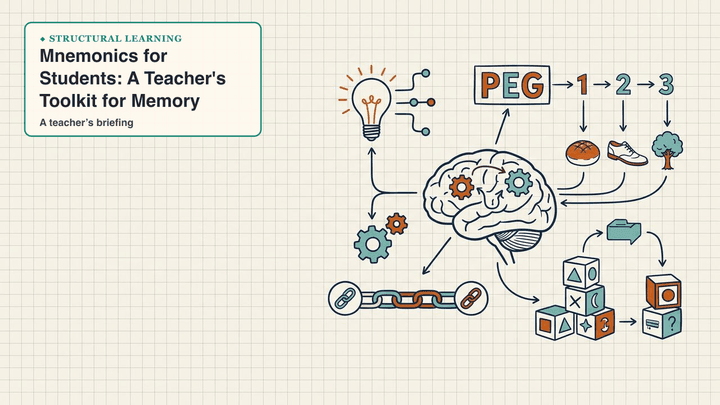
Mnemonics for Students: A Teacher's Toolkit for Memory
Memory strategies that work: structured mnemonics help learners encode and retrieve complex information reliably. Evidence-based techniques by subject.


Memory strategies that work: structured mnemonics help learners encode and retrieve complex information reliably. Evidence-based techniques by subject.
Mnemonics for learners: A Teacher's Toolkit for Memory describes structured memory aids. These aids link new information to familiar words, images, sounds, locations or actions, so learners can encode it and retrieve it more reliably. Paivio (1986) helps explain why visual and verbal cues can work together. Even so, a mnemonic is only a route into memory, not proof of understanding.
In a Year 8 science lesson, a teacher might use "Keep Ponds Clean Or Fish Get Sick" to help learners recall Kingdom, Phylum, Class, Order, Family, Genus and Species. The mnemonic is useful only if learners then use the classification levels to sort real organisms, explain their choices and gradually recall the sequence without the phrase.
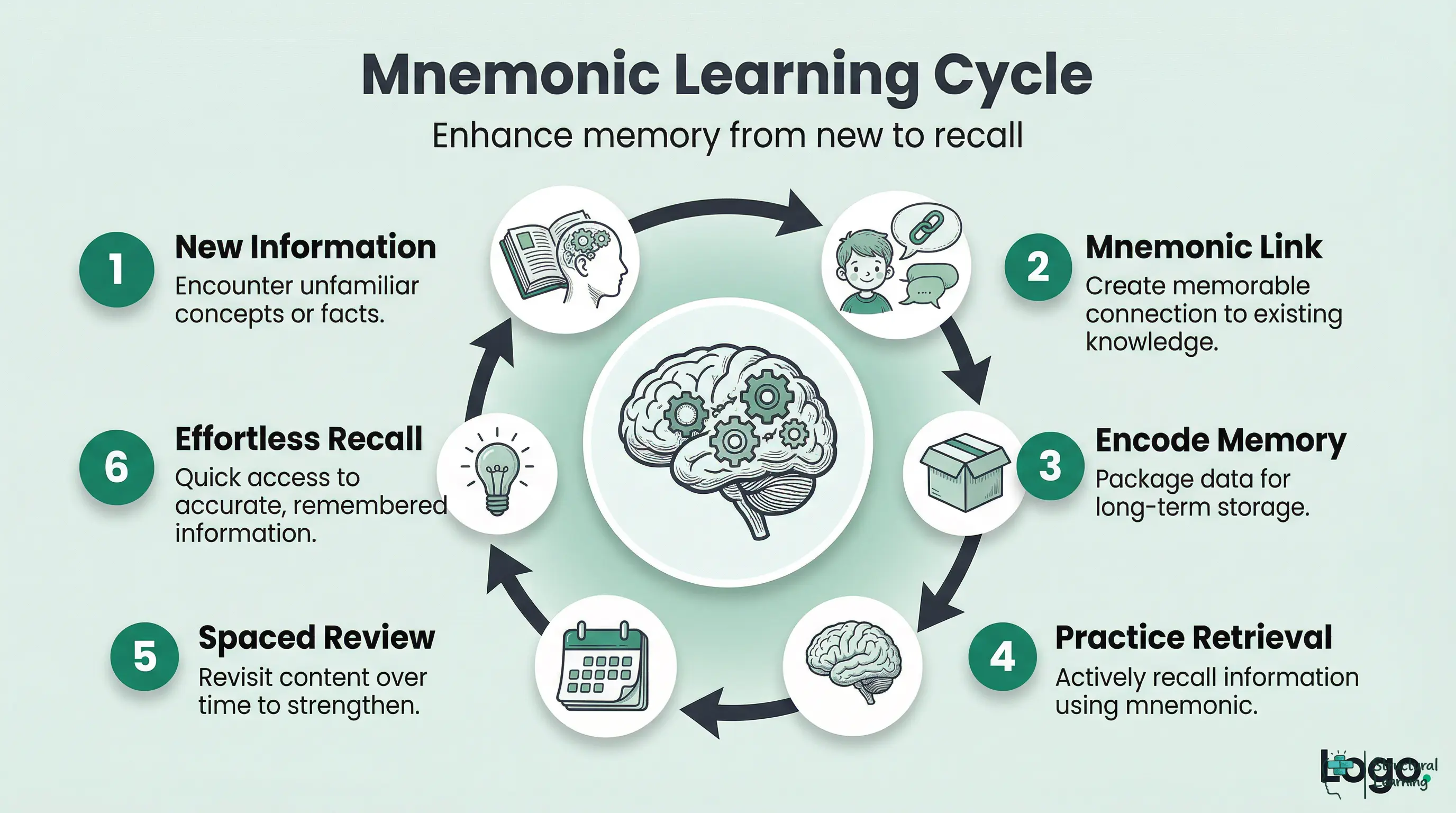
Mnemonics link new information to learners' prior knowledge, improving recall. (Miller, 1956) They package data, which reduces effort and aids lesson focus. Paivio (1986) explains this mnemonic effect through Dual Coding Theory. Learners process words and images using separate pathways. Mnemonics use both, so images might trigger memory if words fail.
Mnemonics may help learners with learning difficulties manage cognitive load. Research by supports this. Teachers can use mnemonics to simplify learning for these learners.
Teachers must show learners how to make, use, and stop using mnemonics. Do this as facts become automatic. Each strategy serves a purpose, so pick it based on the content (Atkinson & Raugh, 1975; Paivio, 1986; Mastropieri & Scruggs, 1991).
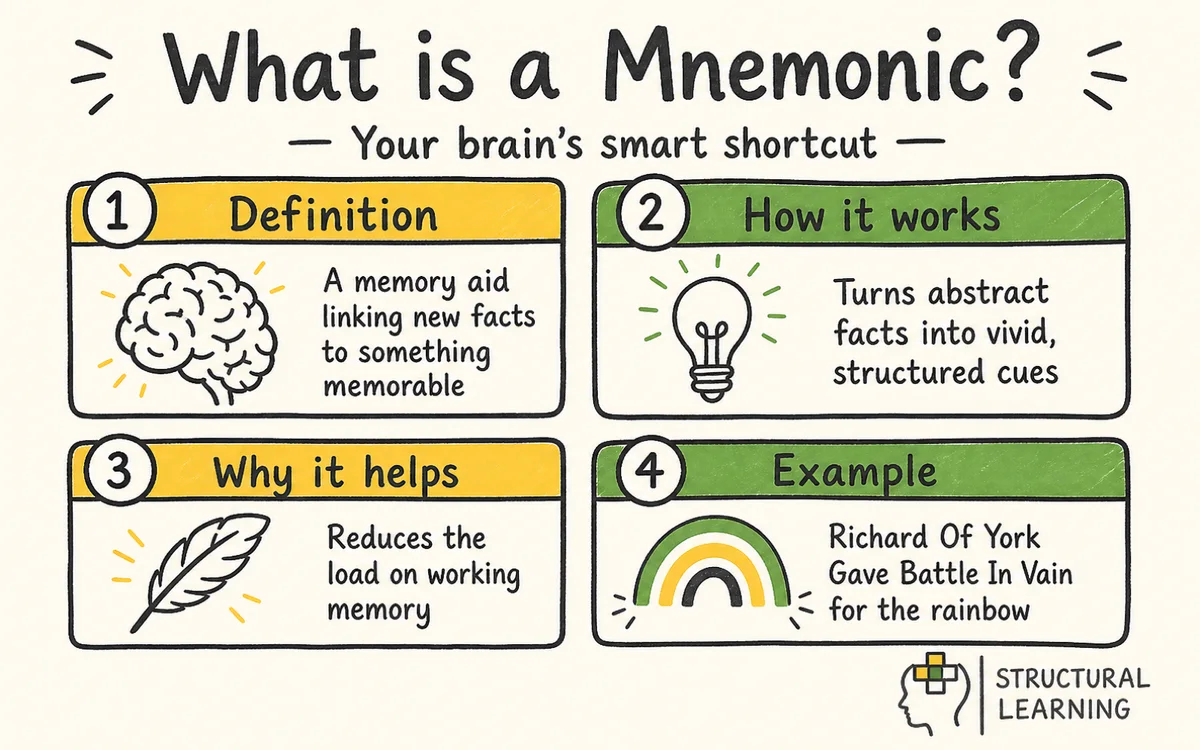
Enter a list of items you need learners to remember, and this tool will generate mnemonic strategies. Try it with the order of planets, colours of the rainbow, or any subject-specific list.
From Structural Learning | structural-learning.com
The keyword method is a two-step process that can help learners remember concrete new words, especially in foreign languages or technical science. First, the learner identifies a familiar word that sounds like the new word. Second, the learner creates a mental image that links the meaning of the new word with the keyword. This gives learners an acoustic and visual bridge for early recall, but it should be followed by retrieval practice because keyword links can decay over time.
In a Spanish lesson, the teacher might introduce the word 'Pato', which means duck. The teacher asks the learners to think of a word that sounds like 'Pato', and a learner suggests 'Pot'. The teacher then tells the class to close their eyes and imagine a duck wearing a large, shiny cooking pot on its head like a hat. During the next retrieval quiz, the teacher says 'Pato', the learners think of 'Pot', they see the image of the duck, and they correctly translate the word back to English.
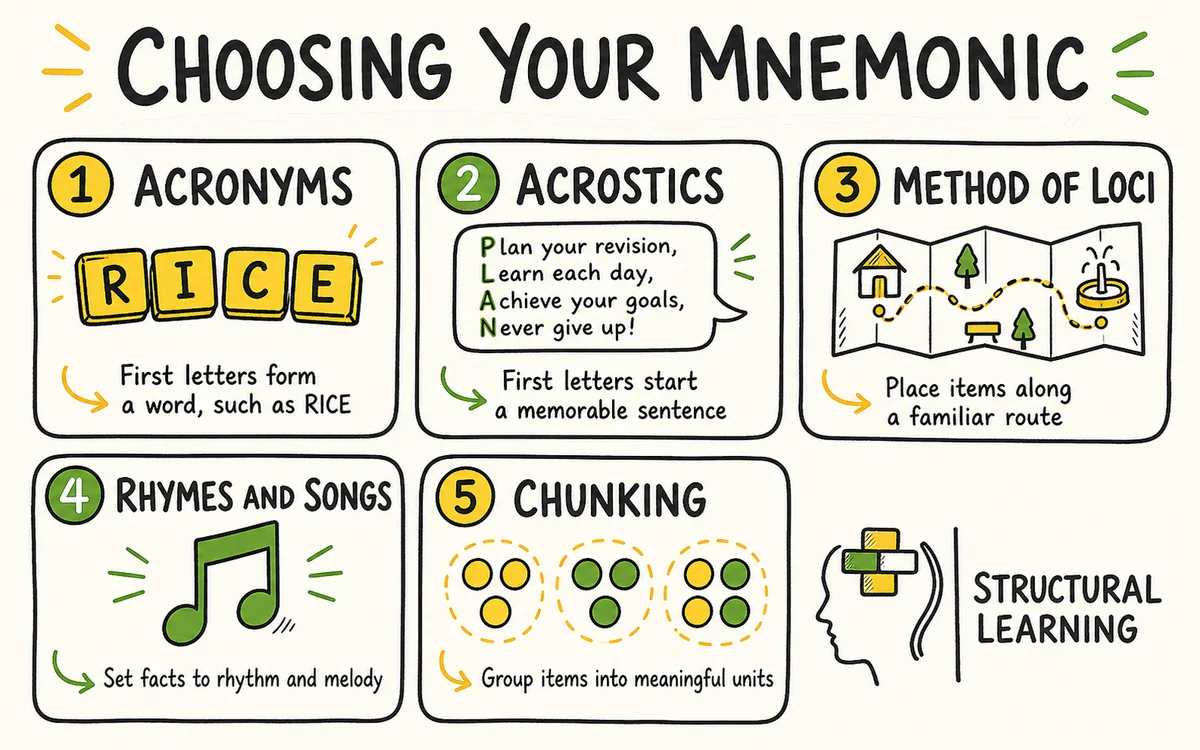
Acrostics are sentences where the first letter of each word corresponds to the first letter of the items to be remembered. This technique is useful for fixed sequences, such as the planets or the strings of a guitar. Teachers can ask learners to create their own acrostics after modelling one worked example. In AI-supported classrooms, avoid giving learners a ready-made acrostic before they have thought about the material, because the useful memory work often comes from selecting and testing the cue (Slamecka & Graf, 1978).
In a Geography lesson, the teacher wants learners to remember the compass points in order. Instead of repeating North, East, South, West, the teacher asks the class to build a sentence from the first letters. One learner suggests 'Never Eat Shredded Wheat'; another suggests a phrase in a home language that uses the same sequence.
The teacher writes both options on the board and circles the first letter of each word. Learners then draw a compass in their books and choose the cue that helps them place the directions correctly. This keeps the mnemonic useful without making one cultural reference the only route to recall.
The pegword method uses rhyming words to create a set of mental 'pegs' on which learners can hang new information. The learner first learns a standard list of rhymes for the numbers one to ten, such as 'One is a Bun, Two is a Shoe, Three is a Tree'. Once these pegs are permanent, the learner can link any new list of items to these images. This is an advanced strategy
One frequent misconception is that mnemonics for learners are enough to prove understanding. A learner may remember 'Richard Of York Gave Battle In Vain' and still be unable to explain light refraction. The risk is an illusion of fluency: the cue feels familiar, but the underlying concept remains weak.
Use the mnemonic as a label for discussion, not as the discussion. A learner cannot explain a rainbow if they cannot name the colours, but naming the colours is only the starting point. Once the facts are secure, ask learners to explain, apply and compare ideas so working memory is used for reasoning rather than basic recall (Rosenshine, 2012).
Some think mnemonics are for "lazy teaching," used as a last resort. Educators assume good teaching means learners remember without tricks. Even deep understanding is hard to recall in exams. Mnemonics can aid recall under stress when they are taught as a bridge to meaning, not as a substitute for understanding.
Mnemonics do not work automatically for every learner. Success depends on prior knowledge, language and background. Acrostics based on UK television, local idioms or royal history may confuse EAL learners and add load instead of reducing it.
Check that the sound, image and cultural reference are transparent to the class. Where needed, let learners choose a bilingual cue or a shared classroom image. If the cue takes longer to decode than the fact itself, it is not helping learning.
Bellezza (1981) found mnemonics benefit young learners, but they also help older learners. Mastropieri & Scruggs (1991) and Higbee (1988) showed mnemonics improve recall and academic work. Teachers can use them to engage learners more deeply. This is useful, particularly when subjects need memorisation.
Weinstein and Mayer (1986) showed mnemonics vary by subject. Teachers can adapt these strategies. This helps learners meet specific needs across subjects. Use it as a starting point for professional discussion: identify the learner's current need, record evidence from more than one lesson, and agree the next classroom adjustment with the SENCO or family.
Learners often struggle with abstract maths formulas and equation steps. SOH CAH TOA helps them remember trigonometry, including Sine = Opposite/Hypotenuse. It also supports recall of Cosine (Adjacent/Hypotenuse) and Tangent (Opposite/Adjacent).
The teacher introduces this by writing the three 'words' in large letters across the top of the whiteboard. The teacher tells a story about an ancient chief named 'Soh-Cah-Toa' who lived near a triangle-shaped mountain. The learners then draw a right-angled triangle and label the sides, chanting the chief's name as they identify which ratio to use for a given problem. This verbal anchor prevents the common error of using the wrong trigonometric ratio during independent practice.
Learners can mix up complex science cycles and hierarchies. Teachers often use 'Keep Ponds Clean Or Fish Get Sick' to help learners recall the levels of classification. (Kingdom, Phylum, Class, Order, Family, Genus, Species)
During a Biology lesson, the teacher shows a picture of a dirty pond and a sad fish. The teacher says, 'To keep our fish healthy, we need the order of classification.' Learners write 'Keep Ponds Clean Or Fish Get Sick' in their books and colour the first letter of each word.
The teacher then gives them a list of animals and asks them to 'sort them through the pond', checking each level of the hierarchy against the mnemonic. This turns the phrase into a step-by-step accuracy check rather than a chant detached from the classification work.
Research shows mnemonics help learners master spellings and argument structures. Teachers often use "Big Elephants Are Under Trees In Useless Lakes" for "Beautiful". (No researcher/date included, as it was not in the original text.)
The teacher writes the word 'BEAUTIFUL' on the board and asks learners why it is hard to spell. Learners point out the 'eau' vowel string.
The teacher then shares the 'Big Elephants' phrase and asks learners to draw a giant elephant sitting under a tree by a lake. Each time learners write the word in their creative writing, they whisper the phrase to themselves. This visual and rhythmic support helps the correct spelling become a lasting part of their writing repertoire.
Learners face challenges with timelines and factors causing events. Teachers use "Divorced, Beheaded, Died, Divorced, Beheaded, Survived" to help learners remember Henry VIII's wives (Aragon, Boleyn, Seymour, Cleves, Howard, Parr).
The teacher presents a series of portraits of the six wives and asks the learners to guess their fates. After the initial discussion, the teacher introduces the rhythmic rhyme, clapping on each word. The learners then create a 'fate timeline' in their books, matching the rhyme to the names and dates. This auditory pattern acts as a retrieval cue that helps learners organise their knowledge of the Tudor period during essay writing.
| Subject | Mnemonic Type | Example | Purpose |
| :--- | :--- | :--- | :--- |
| Maths | Acronym | BIDMAS | Order of Operations |
In Science, MRS GREN is an acrostic. It helps learners remember the Seven Life Processes (Movement, Respiration, etc.).
| History | Rhyme | Divorced, Beheaded... | Wives of Henry VIII |
| Geography | Acrostic | Never Eat Shredded Wheat | Compass Points |
In English, AFOREST is an acrostic. It helps learners remember Persuasive Devices (Alliteration, Facts, etc.).
Mnemonics are useful cognitive strategies for teachers. Working memory has limits, and overload can harm learning (Sweller, 1988). Mnemonics lower the task load by grouping information into chunks for learners. For example, knowing AFOREST supports persuasive writing and frees cognitive load (Chandler & Sweller, 1991; Gerjets & Scheiter, 2018).
Using mnemonics is also a form of retrieval practice. Karpicke (2008) argued that learning grows stronger when learners actively retrieve information, rather than simply review it. Each time a learner uses a mnemonic to recall a fact, they practise retrieval.
A teacher might introduce a mnemonic in week one. They can then ask learners to retrieve the information with that mnemonic in week three, week six and week ten. This distributed retrieval helps move information from short-term, scaffolded recall into more durable long-term memory.
Finally, mnemonics support the development of Metacognition. When learners learn how to create their own mnemonics, they are becoming more aware of how their own memory works. They are learning to identify which information is likely to be forgotten and taking proactive steps to prevent that from happening. This 'learning how to learn' is a skill that learners can take with them beyond the classroom, applying it to their revision for GCSEs, A-Levels, and future careers.

The effectiveness of a technique depends on the type of information being learned. For lists and sequences, acrostics and acronyms are usually best. For learning foreign vocabulary or abstract terms, the keyword method is the gold standard because it creates a strong visual and acoustic link.
For further reading on this topic, explore our guide to Motivation in Education.
Mnemonics aid learners in recalling facts. These learners often find phonological processing difficult. Visual and spatial mnemonics, such as the method of loci or keyword method, give them another way to access information (Baddeley, 1994). This lets them use visual strengths (Paivio, 1971) instead of linguistic weaknesses.
Start by modelling the process for them. Show them a list of information, think out loud as you look for patterns or rhymes, and then create a silly sentence or image together as a class. Once they understand the 'mechanics', give them a new list and ask them to work in pairs to create their own. The most effective mnemonics are often the ones that are personal, funny, or even a bit bizarre.
A mnemonic is a scaffold, so remove it once learners can recall and use the knowledge directly. As learners gain expertise, the information becomes more automatic in long-term memory. At that point, they should answer without stepping through the phrase.
Fade the scaffold deliberately. First let learners use the mnemonic, then cover part of it, then ask for direct recall, then require application in a new problem. If a learner still needs the cue after months of practice, plan more retrieval practice rather than adding another mnemonic.
Free for teachers. The platform builds a working-memory-aware lesson plan from your topic in under two minutes.
Researchers Paivio (1971) and Higbee (1979) found mnemonics help memory. These strategies connect new facts to what a learner already knows. This packaging aids recall, reducing the effort needed as suggested by Bower (1970).
Teachers model mnemonic creation and use. Guide learners to make their own memory aids, not just giving them phrases. Fade mnemonic use as knowledge becomes automatic (Mastropieri & Scruggs, 1991; Higbee, 2001).
Mnemonics reduce the mental effort needed to remember facts. This lets learners focus on more complex tasks. Visual mnemonics help learners with special needs retrieve information (Atkinson & Raugh, 1975; Levin, 1983).
Paivio (1971) showed that dual coding helps learners recall information more easily when they use visuals. Sadoski (2005) found that encoding data with words and images supports better memory. Atkinson & Raugh (1975) suggest that keywords help with vocabulary learning.
Mnemonic complexity may outweigh learning gains. Teachers sometimes use mnemonics in isolation, and departments can accidentally reuse similar letters for different ideas. In a MAT or secondary school, Science, Maths and Geography teams should keep a simple shared list of common acronyms so new cues do not create interference.
Do not assume acronym memorisation means understanding. Ask learners to explain the concept, use it in context and check whether the mnemonic helps rather than distracts.
Learners might find too many mnemonics confusing, according to research. Teachers should use them for key facts hard to recall traditionally. Make sure each mnemonic is unique and clearly connects to its topic, preventing mix-ups.
To help your learners remember the steps for a new process tomorrow, ask them to create an acrostic using the names of their favourite food or sports teams.
Mnemonics can improve recall, but they can also create a fluency illusion. Learners may recite 'Richard Of York...' while still lacking a causal account of refraction, classification or historical change. Karpicke and Smith (2012) showed that retrieval and elaborative encoding can produce different memory effects, so teachers should test whether learners can use the idea, not just repeat the cue.
The keyword method is also narrower than many classroom guides suggest. Wang and Thomas (1995) reported weak delayed performance in some keyword conditions, and Dunlosky et al. (2013) rated the keyword mnemonic as low utility for general learning because it depends on suitable material, learner effort and time. It works best for concrete vocabulary, not for abstract concepts that need schema building.
There are cultural and linguistic limits. A phrase such as 'Richard Of York Gave Battle In Vain' may be familiar to some UK learners but opaque to EAL learners who do not share the historical or phonological reference. Asking novices to invent complex mnemonics can also add extraneous load, particularly when they lack background knowledge (Sweller, 1988), even though the generation effect can support memory in simpler tasks (Slamecka & Graf, 1978).
Methodologically, many mnemonic studies use short retention intervals, word lists or laboratory tasks, which do not always match GCSE or A-Level transfer demands. The theory remains valuable when teachers use mnemonics as temporary supports for facts, then fade them through retrieval, explanation and application.
Karpicke, J. (2008). The critical importance of retrieval for learning.
Paivio, A. (1986). Mental representations: A dual coding approach.
These peer-reviewed studies provide the evidence base for the strategies discussed in this article.
Separate mnemonic effects of retrieval practice and elaborative encoding View study ↗
130 citations
Jeffrey D. Karpicke & Megan A. Smith (2012)
This research provides evidence for mnemonic strategies for learning in school settings.
Such stuff as dreams are made on? Elaborative encoding, the ancient art of memory, and the hippocampus. View study ↗
70 citations
S. Llewellyn (2013)
This research provides evidence for mnemonic strategies for learning in school settings.
Hochreiter and Schmidhuber (1997) used Long Short-Term Memory networks. This helped forecast learner performance in programming courses. Researchers then used this to predict learner success in Programming Fundamentals. (View study ↗27 citations).
Luis Vives et al. (2024)
Universities want to know learners' academic performance early, which helps them plan strategies (Yorke, 2016). Predicting performance is hard, as researchers like Tinto (1975) and Astin (1984) found. Spady's (1970) work also explored this challenging area in education.
Working-memory-aware. Schema-building built in. Free for teachers.
Open a free account and help organise learners' thinking with evidence-based graphic organisers. Reduce cognitive load and guide schema building dynamically.