Fluency Illusions: Why Students Think They Know More
Fluency illusions cause students to overestimate their learning when material feels easy to process, leading to poor study choices and unexpected exam failures.


Fluency illusions cause students to overestimate their learning when material feels easy to process, leading to poor study choices and unexpected exam failures.
Every teacher has witnessed the disconnect: a student insists they've studied thoroughly, yet performs poorly on the assessment. The student isn't lying or making excuses. They genuinely believed they knew the material. This gap between perceived and actual knowledge represents one of the most significant obstacles to effective learning. When students can't accurately judge what they know, they make poor decisions about how to study, when to stop studying, and which material needs more attention and how to transfer knowledge effectively.
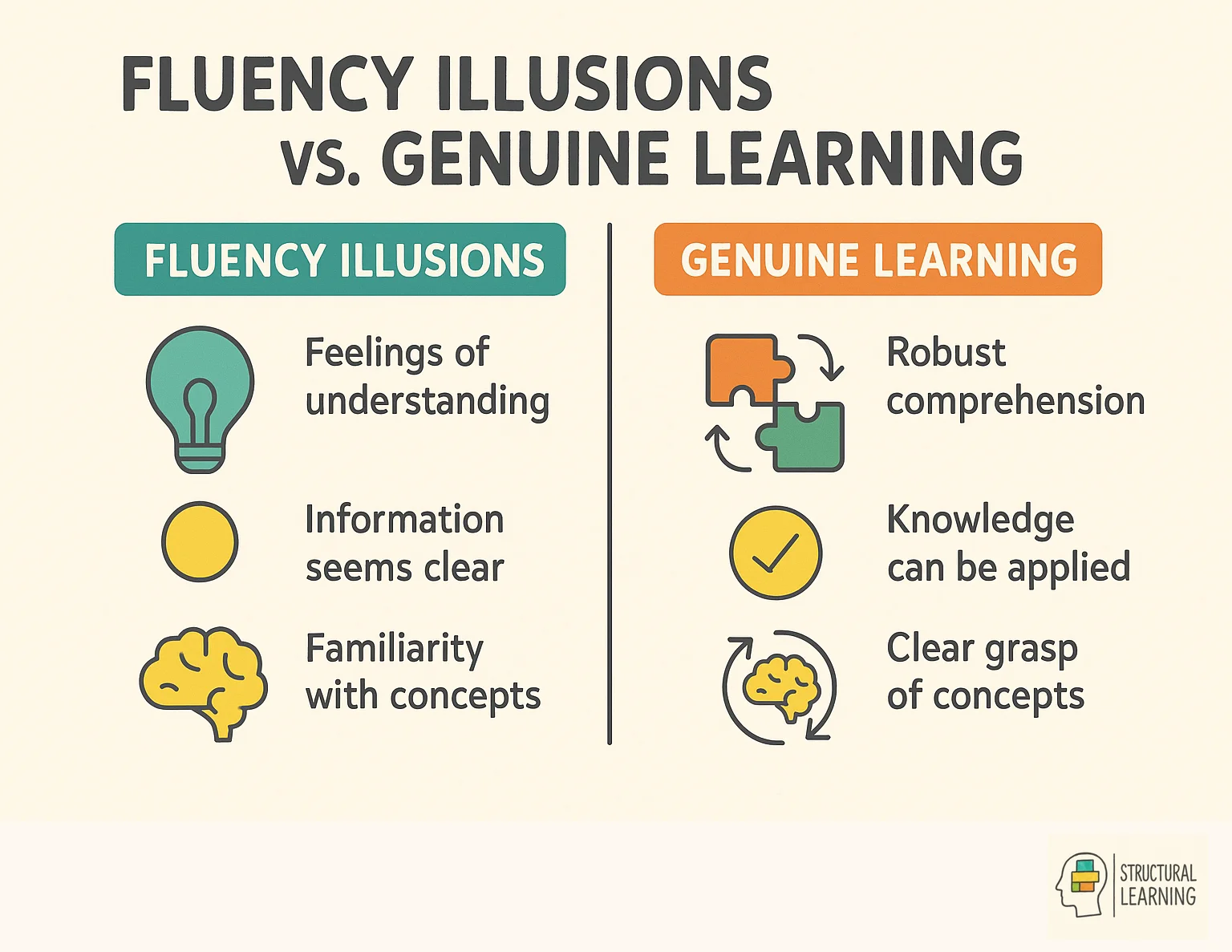
Fluency illusions cause learners to falsely believe they have learned something. Easy to process information feels like learned information. This confusion misleads learners (Bjork, 1999; Reder, 1987; Schwarz, 2004).
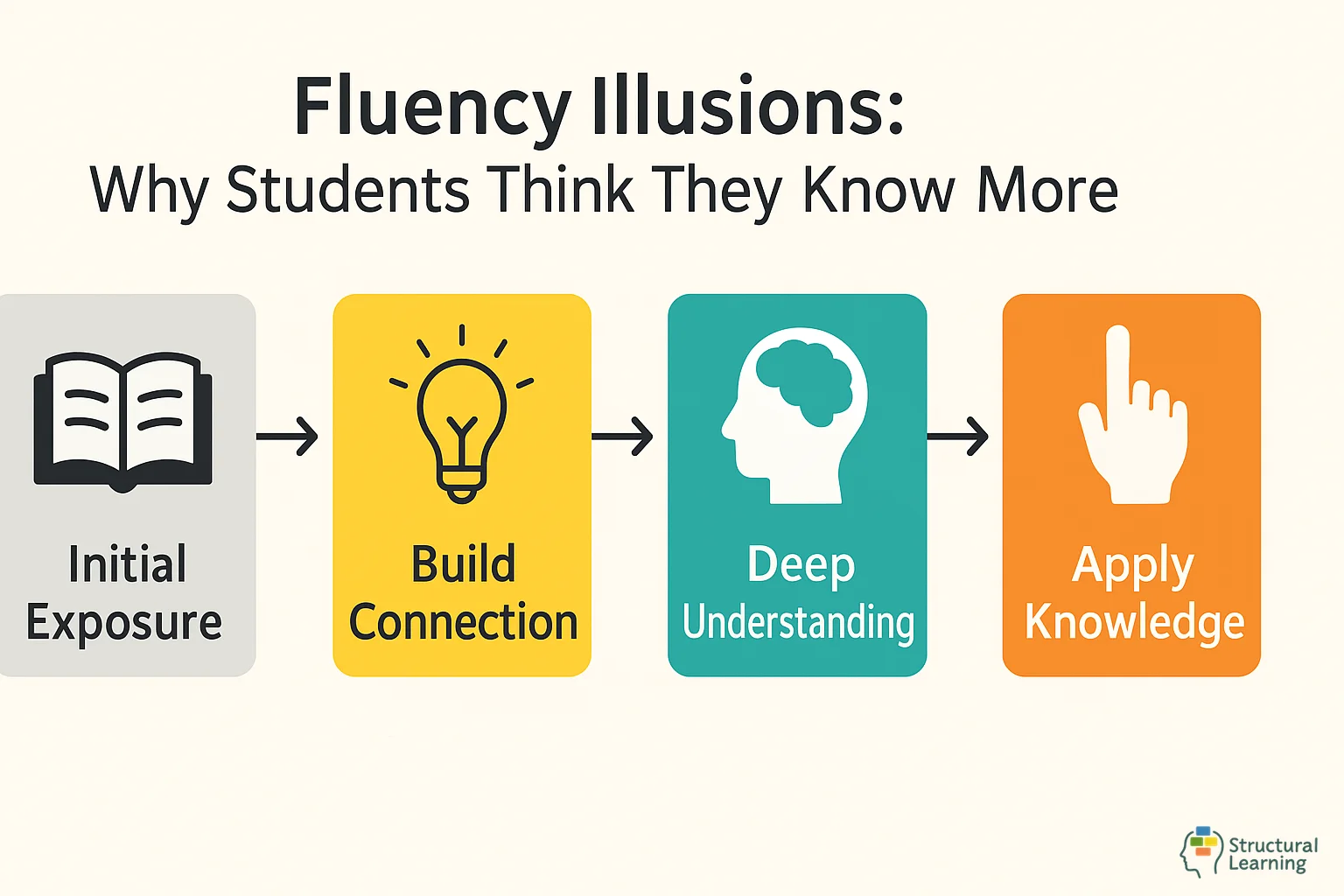
Key Takeaways
For a practical overview of how these ideas apply in lessons, see our guide to working memory in the classroom.
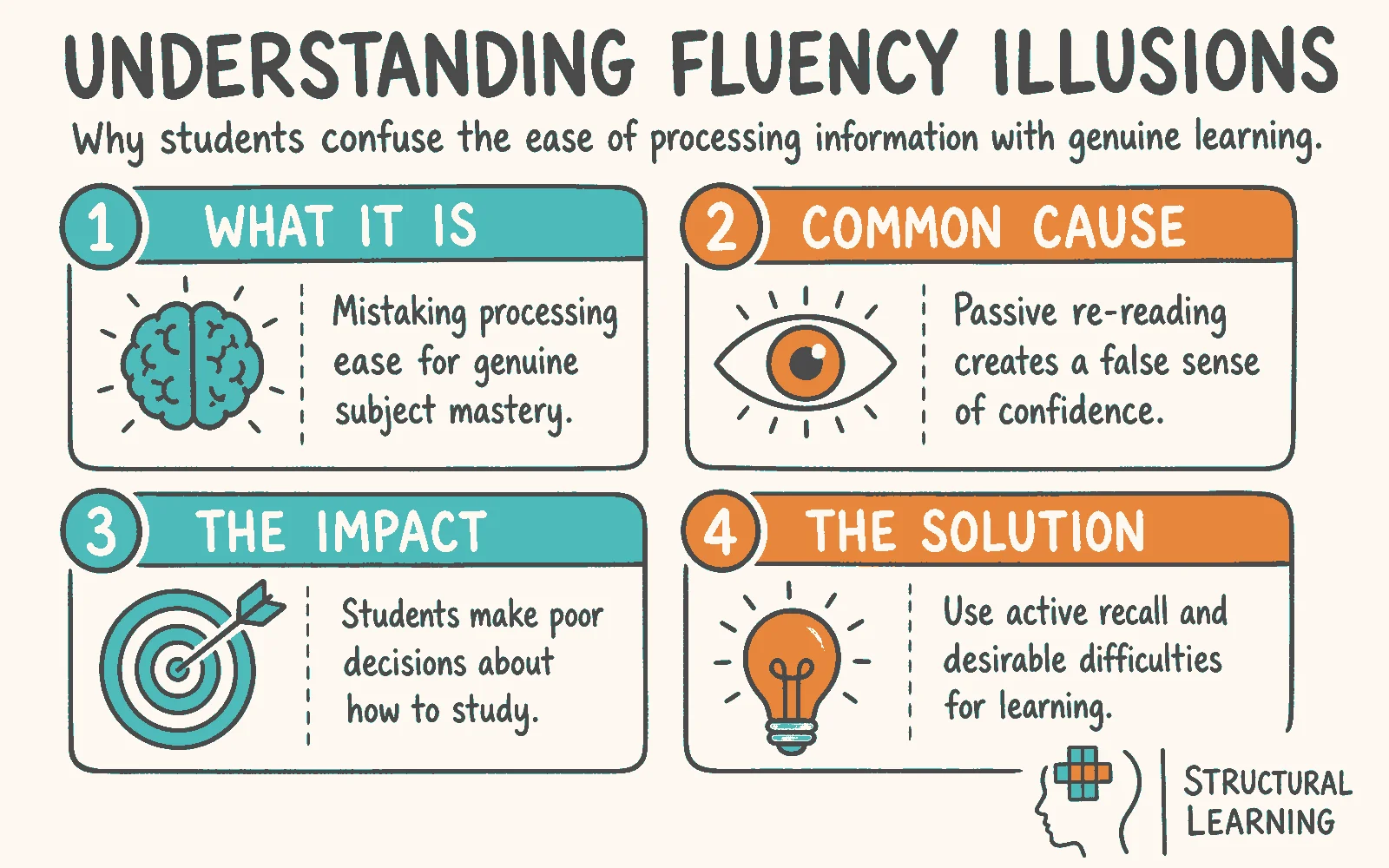
Research on fluency illusions shows that learners can mistake easy processing for durable learning. This can give learners false confidence about later recall and lead them to stop studying too soon (Dunlosky et al., 2013; Koriat & Bjork, 2005).
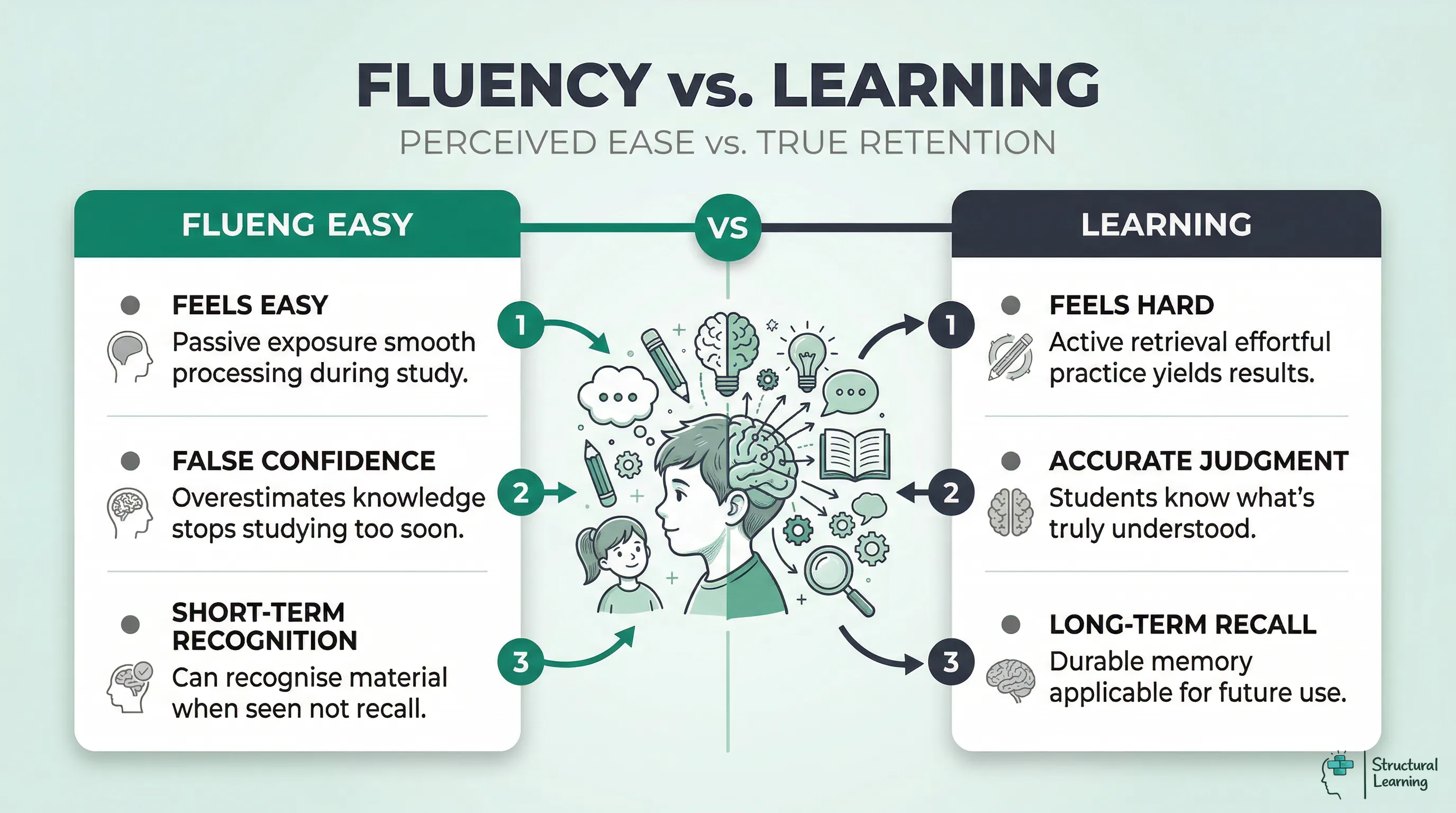
Processing fluency refers to the subjective ease with which information is perceived, understood, or retrieved. When you read a sentence in a clear font, it feels more fluent than the same sentence in a difficult-to-read typeface. When you recognise a familiar face, that recognition feels fluent compared to trying to identify someone you've met only once.
The brain uses fluency as a cue for many judgments. Fluent processing generally signals familiarity, truth, and liking. Statements that are easier to process are rated as more likely to be true. Products with pronounceable names are preferred over those with unpronounceable names. These effects occur automatically, below conscious awareness.
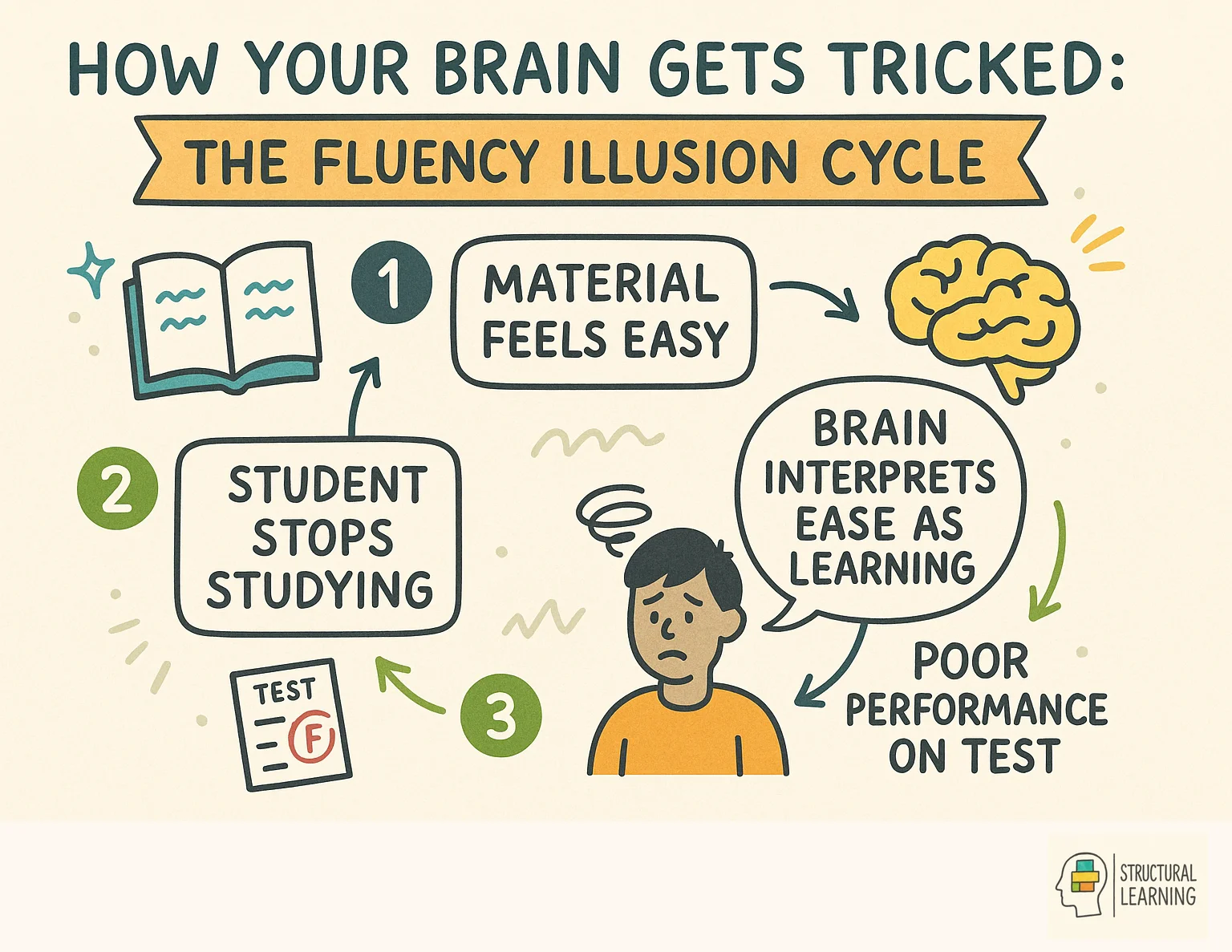
In learning contexts, fluency creates particular problems. When students re-read a textbook chapter, the material becomes increasingly fluent with each pass. Sentences that initially required effort to parse now flow smoothly. This fluency feels like understanding, like learning has occurred. But fluency during study predicts recognition in the moment, not recall in the future. The student can smoothly process the material while it's in front of them but may be unable to retrieve it when the book is closed.
Asher Koriat and Robert Bjork's influential research at UCLA demonstrated this phenomenon clearly. In their studies, participants learned word pairs and made predictions about how well they would remember them. Pairs that were easy to process during study, such as those with obvious semantic relationships, received high predictions. Yet on actual recall tests, these easy-to-encode pairs were often poorly remembered. The fluency of encoding misled judgments about future retrieval.
Learners confuse current understanding with future recall, say Bjork (1999). This fluency illusion impacts learning. Kornell and Bjork (2007) found easy information seems memorable but isn't always. This bias makes learners stop studying too soon (Nelson & Dunlosky, 2009).
Metacognition, or thinking about thinking, supports learners. Nelson & Narens (1990) showed accurate metacognition helps learners learn. Learners can spot gaps in their knowledge. Dunlosky & Metcalfe (2009) found learners can adjust their learning strategies.
Research by Metcalfe & Finn (2008) shows accuracy matters. Learners study well when they know what they know. Inaccurate judgements, from work by Dunlosky & Rawson (2012), waste time. Kruger & Dunning (1999) showed learners may miss gaps in knowledge.
Judgments of learning (JOLs) are predictions about future memory performance. When students rate how well they'll remember something, they're making JOLs. Research consistently shows that JOLs are heavily influenced by processing fluency, even when fluency doesn't predict actual recall.
The problem intensifies because students often lack awareness of these biases. They believe their sense of knowing is accurate. When told they performed poorly despite feeling prepared, students often attribute the failure to unfair test questions or bad luck rather than recognising their metacognitive error.
(Kornell & Bjork, 2007). Spaced retrieval practice yields better results (Rawson & Dunlosky, 2011). Learners often favour re-reading, thinking it aids understanding, but recognition isn't true learning.
Researchers have found rereading is popular, but not effective. Surveys reveal learners prefer rereading to testing themselves. This might be because rereading creates strong fluency illusions (Kornell & Bjork, 2007; Karpicke et al., 2009).
Re-reading makes processing easier. Words flow automatically after the first read. This fluency builds learners' sense of learning. Learners feel mastery because the content seems comfortable.
Karpicke's research showed re-reading helps learners less than retrieval (2007). Learners prefer re-reading and think it works, say Karpicke et al (2009). Learners thought re-reading improved recall by 50%, according to Karpicke and Blunt (2011). However, retrieval produced much better results, they found.
Re-reading builds fluency through recognition, not recall. Learners recognise familiar material but cannot always produce it without cues. Assessments by and large test recall, not recognition (Karpicke, 2012; McDaniel, 2007; Brown, Roediger & McDaniel, 2014).
Bjork's work (1994) shows encoding fluency is how easily learners store information. Retrieval fluency is how easily learners recall it later. Learners mistake easy encoding for successful retrieval (Bjork, 1999). Material harder to encode can create better recall (Bjork & Allen, 1970).
Researchers distinguish between two types of fluency that affect metacognitive judgments.
Clear organisation can help comprehension, but ease during study can also inflate judgements of learning. Benjamin, Bjork and Schwartz (1998) show that fluency can be a misleading cue, and Koriat and Bjork (2005) explain why study conditions can make future recall feel easier than it will be.
Retrieval fluency refers to the ease of accessing information from memory. When a memory comes to mind quickly and effortlessly, retrieval is fluent. When you strain to recall something that eventually surfaces, retrieval is disfluent.
Both types of fluency influence metacognitive judgments, but they can point in different directions. Information that was easy to encode may be difficult to retrieve later. Information that required effort to encode may be easily retrieved.
Study conditions and test conditions often differ. During study, information is visible and cues are available; during a test, learners usually have to generate the answer. This mismatch helps explain why study fluency can feel persuasive while still failing to predict later recall (Benjamin, Bjork & Schwartz, 1998; Koriat & Bjork, 2005).
Benjamin, Bjork and Schwartz (1998) called this problem the mismeasure of memory. Quick retrieval during an initial judgement can be misleading if learners treat present ease as proof of later retention. Teachers should therefore check recall after a delay, not only at the point where material feels familiar.
Fluency illusions happen when learners think they've studied, but tests say otherwise. They believe they understand in lessons, yet struggle to use it later. Learners may reread and highlight instead of actively learning. Teachers see learners passively reviewing notes, avoiding practice; they are surprised by bad marks. This shows learners confuse recognition and recall (Brown et al., 2014).
Fluency illusions manifest in predictable ways in educational settings.
Learners often highlight text, thinking it aids learning. Dunlosky et al. (2013) judge highlighting as a relatively low-utility technique when it is used on its own. Highlighting can make key phrases look familiar without forcing learners to retrieve, explain or use the idea.
Learners use worked examples in maths and science. Reading solutions seems easy initially. Learners understand steps, but struggle to solve independently. Following examples does not ensure problem solving skills. This connects with maths comprehension issues (Atkinson et al., 2000).
Students who attend lectures and follow along may experience high fluency as the instructor explains concepts. The explanation makes sense in the moment. But when students attempt to reconstruct that understanding on their own, they discover gaps and confusions that weren't apparent while the instructor was filling in the details.
Study groups can create fluency illusions when stronger students do most of the explaining. Weaker students nod along, understanding the explanations in the moment, and leave feeling confident. But they've engaged in recognition, not recall. They understood when information was provided but can't generate it independently.
Foresight bias means learners think they will remember information better than they actually do. When reviewing notes, learners struggle to imagine forgetting answers, giving them false confidence. This bias is strongest with study materials present, hindering realistic test preparation (Koriat & Bjork, 2005).
Koriat and Bjork (2005) described this metacognitive error as foresight bias. Learners see information during study that they cannot access during tests, so they often struggle to predict future recall accurately even when they know the test will be harder.
Consider learning the word pair "bread-butter." During study, seeing both words together, the association seems obvious and memorable. Both words are present; their connection is visible. Students predict high recall. But at test, only "bread" appears, and students must generate "butter" from memory. The presence of both words during study created fluency that won't exist at test.
Koriat and Bjork's (2005) foresight bias shows learners overestimate memory for related pairs. Learners underestimate memory for unrelated pairs. Obvious links cause fluency while learning, claim Undorf et al. (2018). This fluency does not aid recall without the target word, suggest Serra and Ariel (2014).
Self-testing and spaced practice feel hard, yet boost retention (Bjork, 1994). Learners may avoid these methods, wrongly linking struggle to failure. Easy methods yield weaker learning, unlike challenging strategies (Bjork & Bjork, 2011; Roediger & Karpicke, 2006).
Bjork (1994) found "desirable difficulties" aid long-term learning. Spaced practice, interleaving topics, and testing boost memory. Learners may struggle at first, but later gain more, research shows.
Desirable difficulties feel harder because they are harder in the moment. Spaced practice feels less smooth than massed practice. Interleaved practise feels more confusing than blocked practise. Testing feels more effortful than restudying. This difficulty creates disfluency.
Bjork and Bjork (2011) found strong fluency can mean weak learning. Weak fluency strategies may lead to strong learning instead. Learners often prefer quick fluency methods which aren't effective. This steers them away from more useful strategies (Kornell, 2009; Soderstrom & Bjork, 2015).
When students space their practise and experience difficulty retrieving information from earlier sessions, they may conclude they're learning poorly. They might switch to massed practice, which feels more effective because material remains fresh and retrieval is fluent. In doing so, they sacrifice long-term learning for short-term comfort.
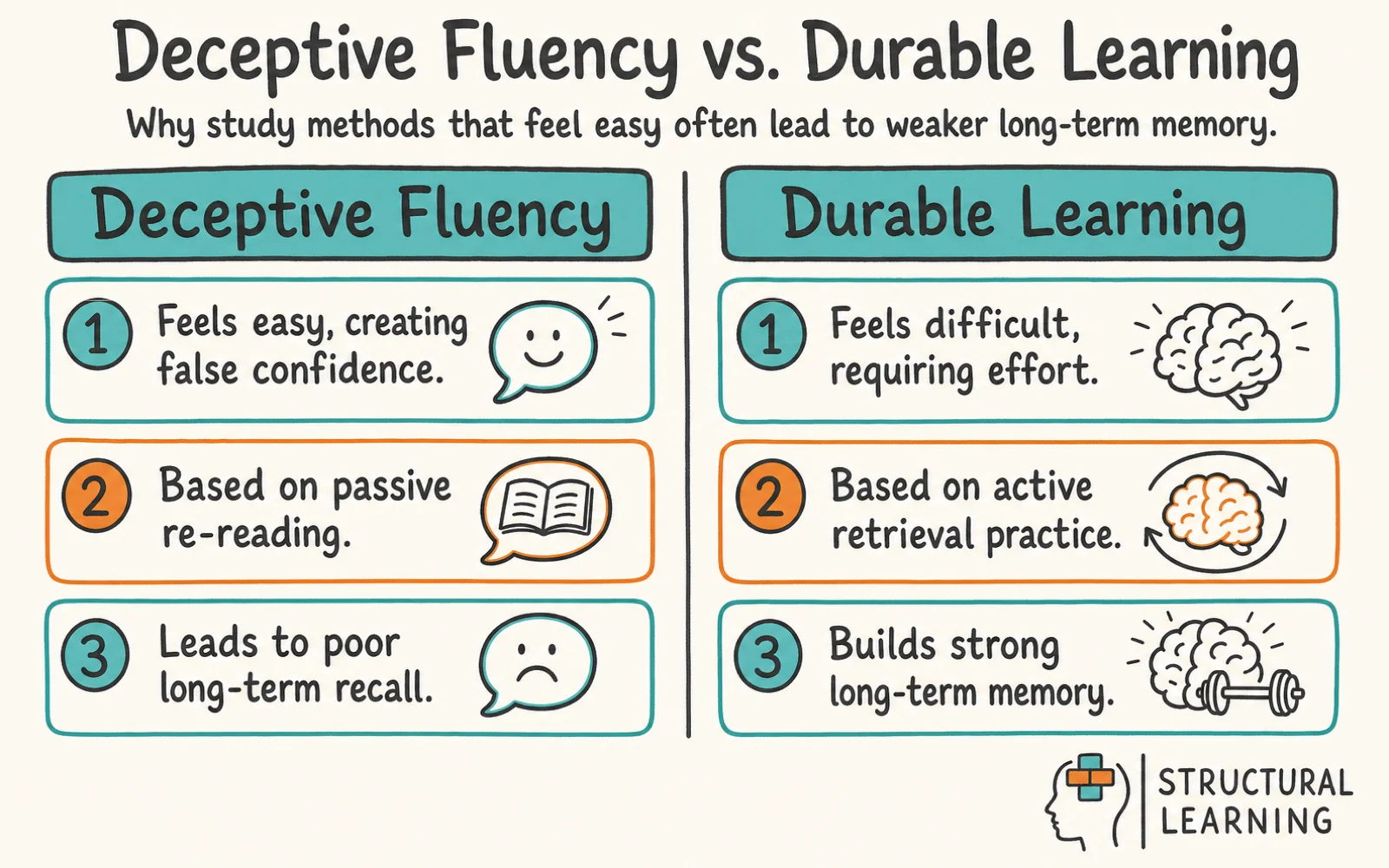
Learners improve fluency by self-testing without notes, (Bjork, 1994). Spaced practice and teaching others also helps, (Brown, Roediger & McDaniel, 2014). Active recall shows learners what they know, replacing passive review. Regular, low-stakes quizzes help learners assess their actual knowledge, (Agarwal et al., 2012).
Fortunately, research identifies approaches that can improve metacognitive accuracy and reduce fluency illusions.
Immediate learner judgments rely on how easily information is learned (Bjork, 1999). Delayed judgments are more accurate, as encoding fluency decreases over time (Nelson & Dunlosky, 1991). Nelson and Narens (1990) also found delay improves judgement accuracy.
Nelson and Dunlosky (1991) found that delayed judgements of learning can be much more accurate than immediate judgements. Waiting reduces the pull of encoding fluency because learners have to retrieve information rather than simply react to how easy it felt moments earlier.
Teachers can encourage delayed judgment by asking students to predict their test performance not at the end of a study session but at a later time, perhaps the next day.
Research from Bjork (1999) shows self-testing reveals knowledge gaps, unlike re-reading. Testing tells the learner what they know and don't know. Nelson and Dunlosky (1991) found failed recall makes learners judge their knowledge better.
Bjork (1994) showed that self-testing helps learners remember information better. Retrieval practice, as in self-testing, boosts long-term retention (Roediger & Karpicke, 2006). This method helps learners to both learn and understand their own learning (Metcalfe & Finn, 2008).
Generating information helps learners avoid fluency illusions because it forces them to produce an answer rather than recognise one. The generation effect is better linked to Slamecka and Graf (1978), while Kornell (2009) and retrieval-practice studies explain why effort can expose the limits of what learners know.
Teaching learners about fluency illusions can help them challenge misleading study intuitions. Bjork, Dunlosky and Kornell (2013) review why learners often choose strategies that feel effective but produce weaker learning, while Kruger and Dunning (1999) help explain why people may miss gaps in their own competence.
Metacognitive training helps learners choose better study methods. Learners often pick weak strategies because those strategies feel successful in the moment. Bjork, Dunlosky and Kornell (2013) support explicitly teaching why rereading and recognition feel convincing, and why retrieval, spacing and generation usually give better evidence of learning.
Explicitly teach learners about fluency illusions and use frequent retrieval practice (quizzes, cold calling, problem sets). Explain why difficult practice works better, helping learners persist (Bjork, 1994). Model accurate self-assessment by having learners predict quiz scores (Dunlosky & Rawson, 2012). Compare predictions to their actual scores.
Strategies such as retrieval practice (Karpicke & Roediger, 2008) and spaced repetition (Kang, 2016) help learners. Encourage learners to test themselves, as shown by Bjork, Dunlosky, & Kornell (2013). Prompt learners to actively recall information; this avoids fluency illusions, as explored by Brown, Roediger, & McDaniel (2014).
According to Bjork and Bjork (2011), introduce productive challenges in activities. Space practice over time. Interleave topics instead of blocking them, Dunlosky et al. (2013) say. Karpicke (2012) suggests learners retrieve information, not just recognise it. This builds durable learning, though it feels less fluent.
Bjork (1994) showed learners might resist harder methods initially. Explain research, like Bjork (1994), on desirable difficulties. This helps learners see that difficulty is useful for learning.
Frequent quizzes boost learning using the testing effect. They also give useful feedback, improving learners' metacognition. Learners who test themselves often gain a better sense of their knowledge.
Spacing out learning strengthens memories using the testing effect. This is key to the Retrieve It approach (Karpicke, 2016). Researchers like Rowland (2014) and Cepeda et al. (2006) show it helps learners retain information long term.
When students perform poorly despite confidence, explicitly address the metacognitive error. "You felt prepared, but your performance suggests your sense of knowing wasn't accurate. Let's discuss why that might have happened." This feedback helps students recognise the fluency trap.
Self-testing helps learners. Provide practice questions and flashcard creation. Teach techniques like the blank page method. These memorisation strategies give learners needed self-assessment opportunities.
Retrieval practice homework improves learners' self-awareness more than look-up work. Include some questions learners answer before checking notes. This helps them understand their knowledge (Bjork, 1994; Karpicke, 2012).
Learner beliefs affect fluency illusions; passive learners risk false confidence. Learners expecting easy learning quit effective strategies when challenged. Learners expecting challenge persevere (Bjork, 1999). Teaching learners that struggle means learning improves study choices (Dweck, 2006; Hattie, 2012).
Soderstrom and Bjork (2015) distinguish short-term performance from durable learning. Learners who equate easy performance with learning may treat struggle as failure, which can push them away from productive challenges.
Changing learners' beliefs on effort improves thinking skills. When learners see difficulty as learning, they persevere (Dweck, 2006). Learners then see struggle as useful, not as failure (Hattie, 2012). This links to attribution theory: learners explain their results (Weiner, 1985).
Carol Dweck's research on growth mindset suggests that students who believe abilities can be developed through effort are more likely to embrace challenges. These students may be less susceptible to fluency illusions because they don't expect learning to always feel easy.
Metacognitive accuracy varies among learners (Dunlosky & Rawson, 2012). Prior experience and memory play a role. Compensatory strategies may create illusions for some learners (Kornell & Bjork, 2007). Explicit teaching of these skills helps all learners (Nelson & Narens, 1990).
Koriat (2008) proved familiarity impacts judgements. Kruger and Dunning (1999) showed lower ability learners overrate their skills. Hacker et al (2000) found higher ability learners often underrate themselves.
Experts in a domain tend to have more accurate metacognition within that domain. Their extensive knowledge provides better benchmarks for judging new learning. They know what it feels like to truly understand something versus merely recognising it.
Novices, lacking these benchmarks, are more susceptible to fluency illusions. The smooth processing they experience may be their first encounter with certain material, leaving them no basis for comparison.
Learners show varied metacognitive skills. Nelson & Narens (1990) found some learners monitor learning better. Past experiences and teaching affect this, (Flavell, 1979). Veenman et al. (2006) showed cognitive traits also influence monitoring.
Flavell (1979) showed metacognitive skills can be taught. Learners initially struggling can improve through guided instruction and practice. Research by Dunlosky et al. (2013) supports this idea.
Metacognition improves as learners age (Brown, 1987). Younger learners may need more teacher feedback (Flavell, 1979). Monitoring their own learning is harder for them (Nelson & Narens, 1990).
Digital learning can give learners false confidence via quick answers and engaging videos. Content feels clear as learners watch, boosting the illusion (Bjork et al., 2013). Online learning needs retrieval practice and tests to fight these traps (Kornell & Bjork, 2007; Roediger & Karpicke, 2006).
Digital learning environments may exacerbate fluency illusions in several ways.
Online courses offer easy access to resources, enabling repeated reading for fluency, without genuine learning (Bjork, 1994). Quick searches might lower the need for actual learning (Carr, 2008). Learners may simply look up information instead (Sparrow et al., 2011).
Kornell and Bjork (2007) found video lectures can trick learners into thinking they understand. Clear explanations make lessons seem easy. Research by Karpicke and Blunt (2011) suggests learners need help to pause and self-test, instead of just watching.
Bjork (1994) found quizzes and spaced review help learners self-test. Retrieval practice tools calibrate metacognition well (Kornell & Bjork, 2007; Roediger & Karpicke, 2006). These tools combat learning illusions in digital learning.
Good discussions may mislead learners, say researchers. Learners may wrongly equate understanding with true knowledge. Assign roles like questioner to avoid this. This makes each learner show their own knowledge. Think-pair-share promotes recall before talks (Littlepage, 1991; Sniezek, 1992; Vollrath, 2007).
Fluency illusions affect not only individual study but also collaborative learning and classroom interactions.
Clear explanations can give learners a false sense of understanding. Assessments later reveal learning gaps (Bjork & Bjork, 2011). Teachers can create productive confusion to address this. Instead of solely giving explanations, ask learners to explain concepts themselves (Chi et al., 1989).
In classroom discussions, students who can follow others' reasoning may believe they could produce similar reasoning themselves. Teachers can check this by calling on students to extend, apply, or replicate reasoning rather than simply agreeing with it.
The core research base is well established: Koriat and Bjork (2005, 2006) explain foresight bias and metacognitive monitoring, Dunlosky et al. (2013) review effective study techniques, Roediger and Karpicke (2006) and Karpicke and Blunt (2011) support retrieval practice, and Soderstrom and Bjork (2015) separate short-term performance from long-term learning.
Initial work by researchers such as Bjork, Koriat and Karpicke examined how fluency shapes judgements of learning. The safer claim is that learners often rely on cues that feel convincing during study, while delayed recall and retrieval practice give better evidence of durable learning.
Koriat and Bjork (2005) found that learners overestimate recall when information is present during study. This ease creates a false sense of knowing, misleading predictions. Their research on paired-associate learning highlights this "foresight bias". The study set the stage for understanding these fluency illusions.
Benjamin, Bjork and Schwartz (1998) found that retrieval fluency can mislead predictions about later memory. Learners may treat quick access now as a sign of durable learning, even when the cue does not predict delayed recall.
Learners often predict reading comprehension poorly. This affects study choices because learners need accurate self-assessment to manage time, revisit weak material and choose strategies that require retrieval rather than recognition.
Kornell and Bjork (2009) showed learners pick restudying over better retrieval. This happens as learners favour instant success over lasting gains. Restudying creates easy fluency, said Karpicke, Butler and Roediger (2009). Learners pick what feels good, not what works (Metcalfe & Kornell, 2007).
Koriat and Bjork (2006) found that learners' monitoring can improve when study conditions make them more sensitive to the retrieval demands of the later test. The classroom translation is simple: ask learners to retrieve without the answer visible before they judge whether they know it.
---
Karpicke and Roediger (2008) showed retrieval practice works better than restudying. Learners who retrieved information did better, according to their Science study. Restudying learners felt more confident, but performed worse (Karpicke & Roediger, 2008).
Research by The Learning Scientists (n.d.) provides free resources on retrieval practice. These materials help learners avoid fluency illusions. The Chartered College of Teaching (n.d.) offers evidence-based metacognition resources for UK teachers.
Easy information processing tricks the brain into thinking a learner understands it. Bjork and Bjork (2011) found smooth processing feels like learning. We trust this "fluency" instead of actual recall ability, as shown in their research.
Learners seek brain efficiency, creating a psychological trap. Rereading familiar notes makes Year 10 learners feel like they understand (Bjork, 1994). Their brains wrongly signal success, even if they can't recall information. Revision videos cause this too; passive watching feels useful (Brown et al., 2014).
Show learners a solved maths problem, then ask them to rate their skills. Give them a similar problem without the solution. The difference makes the fluency illusion visible: following an explanation is not the same as generating a solution. Learners can also predict test scores after studying, then again the next day; a confidence drop shows why immediate feelings are unreliable (Nelson & Dunlosky, 1991).
Learners find repeated material familiar (Bjork, 1999). This ease fools them into thinking they know it well. They report, "I know this," but familiarity isn't understanding (Kornell, 2009). Smooth recall tricks the brain (Brown, Roediger & McDaniel, 2014).
Consider what happens during a typical revision session. A Year 10 student preparing for a history exam reads through their notes on the causes of World War One. The second time through, everything makes perfect sense; the connections feel clear and the facts seem memorable. The student closes their notebook, confident they've learnt the material. Yet when faced with an essay question requiring them to analyse these causes, their mind goes blank. The fluency of reading created an illusion that dissolved under the pressure of production.
This phenomenon intensifies with repeated exposure. Each additional reading makes the material feel more familiar, strengthening the illusion whilst adding little to actual retention. Students often describe the shock of exam day: 'I knew it all when I was revising, but I couldn't remember anything when I needed to write it down.' They're describing the collapse of a fluency illusion, not a failure of effort.
Learners can recognise these experiences. Ask them to predict test scores after studying, then compare these to results. They often overestimate performance. This awareness, though hard, helps learners see why difficult methods work better (Bjork, 1994; Karpicke, 2012).
Free for teachers. The platform builds a working-memory-aware lesson plan from your topic in under two minutes.
Researchers have found that learners can confuse easy processing with actual knowledge. This fluency illusion makes learners think they understand more than they really do. (Bjork, 1999; Karpicke, Butler, & Roediger, 2009). Consequently, learners may stop revising too soon (Metcalfe & Finn, 2008). This poor judgement can lead to disappointing results in assessments. (Dunlosky & Rawson, 2012).
Low-stakes tests let learners check knowledge (Bjork, Dunlosky & Kornell, 2013). Explain fluency illusions clearly: familiarity is not the same as mastery. This supports metacognitive awareness because learners compare prediction with performance.
Learners can misunderstand re-reading because familiarity mimics learning. Karpicke and Blunt (2011) found learners overestimate re-reading's value. Retrieval practice, however, improves memory better.
Active recall, like self-testing and explaining concepts, helps learners. Spaced practice works well too. While harder than rereading, these methods build stronger knowledge (Dunlosky et al., 2013). Learners also judge their understanding better (Bjork, 1994; Metcalfe, 2009).
These strategies support learners in actively recalling information. Parents can ask learners to explain topics without notes (Dunlosky et al., 2013). Encourage regular self-testing rather than just re-reading (Karpicke, 2012). Challenge learners who claim total understanding with specific questions (Willingham, 2009).
Learners recognise familiar information (Tulving, 1976). They recall information from memory (Anderson, 1983). Assessments frequently require recall, as shown by Bloom (1956). Learners can feel ready after reading notes, but struggle to recall knowledge in tests.
Retrieval practice boosts learning. Spaced repetition of key ideas works well. Avoid too much highlighting. Set homework asking learners to generate answers. This builds understanding and gives better feedback (Roediger & Karpicke, 2006).
These sources support the article's claims about fluency, metacognitive monitoring, retrieval practice and desirable difficulties using traceable DOI records.
Working-memory-aware. Schema-building built in. Free for teachers.
Open a free account and help organise learners' thinking with evidence-based graphic organisers. Reduce cognitive load and guide schema building dynamically.