Updated on
September 9, 2026
Developing Student Metacognition
Developing metacognition across all key stages: planning, monitoring and evaluation frameworks, with classroom-ready activities for every phase.


Updated on
September 9, 2026
Developing metacognition across all key stages: planning, monitoring and evaluation frameworks, with classroom-ready activities for every phase.
Developing learner metacognition means teaching learners to plan, monitor and review their thinking while they work. It is not a separate study skill or a reflection sheet at the end of a lesson.
In practice, teachers help learners notice what they know, choose a strategy, check whether it is working and explain what they will change next. The strongest routines are built into subject teaching, classroom talk and feedback.
This article sets out the core phases, classroom strategies and assessment routines teachers can use to make metacognition visible without turning it into extra paperwork.
For a more applied route through this topic, teachers can connect planning, monitoring and evaluation with practical examples in the metacognition in the MYP design cycle, tactile metacognition routines, and primary metacognition strategies.
Flavell (1979) said metacognition helps learners control their thinking. Self-awareness, planning, and reflection support learning in every subject. Hattie (2012) showed metacognition improves results and learner confidence. Zimmerman (2002) described self-regulated learning as a cyclical process of forethought, performance and self-reflection.
Metacognition means learners think about their thinking (Flavell, 1979). These strategies help learners become metacognitive (Nelson & Narens, 1990). Teachers support this awareness through guidance and practice (Hartman, 2001). We will make learning processes clear, valuing reflection.
Metacognitive knowledge means learners know about themselves as thinkers (Flavell, 1979). It also covers knowledge of tasks and strategies, influencing learning outcomes (Flavell, 1979). This practice encourages independent learning, popular since the pandemic (Brown, 1987; Zimmerman, 2002).
Learners show awareness of their memory and understanding. Rehearsal helps them monitor performance (Bjork et al., 2013). Chunking and elaborative interrogation are useful too (Dunlosky et al., 2013). These boost memory and create metacognitive skills (Flavell, 1979).
Metacognition is commonly divided into metacognitive knowledge and metacognitive regulation; Nelson and Narens (1990) modelled metacognition as monitoring and control between meta-level and object-level cognition. Learners track progress and use strategies like rehearsal (Flavell, 1979). Self-evaluation improves learning (Dunlosky & Metcalfe, 2009). This links to planning for classroom success (Diamond, 2013).
Flavell (1981) distinguished thinking strategies. Learners use 'cognitive strategies' to learn. They use 'metacognitive strategies' to check their learning. 'Cognitive strategy' can mean Metacognition. Yet, the terms differ. Cognitive strategies help learners solve problems (Flavell, 1981). Metacognitive strategies monitor their thinking during learning.
Metacognitive strategies can be divided into three categories: self-monitoring, reflection on performance, and evaluation of knowledge. Self-monitoring involves noticing what you do while trying to understand something; this includes noting your mental processes, such as how much time it takes for an idea to come up, whether you have made mistakes, etc. Reflection on performance means reflecting on why you did well or poorly at a task; this may include asking yourself questions about what worked well and what didn't work so well.
Checking understanding after a task evaluates knowledge. Ensure learners grasp concepts before moving on. Metacognitive strategies help learners identify their strengths and weaknesses. For example, learners with memory issues might use Post-it notes (e.g. Dunlosky et al., 2013).
Metacognition links to executive functions (planning, attention, etc.). These functions help learners plan, organise, remember and focus. Brown (1987) discussed metacognition alongside executive control and self-regulation, while Flavell (1979) defined metacognition in terms of knowledge and monitoring of cognition.
Reasoning and problem-solving apply to school and daily life. Metacognition impacts learning. Research shows learners using metacognition often do better (Flavell, 1979). Research reviews indicate metacognitive strategy instruction can improve academic performance. Learners who monitor thinking succeed by adjusting strategies (Schraw, 1998).
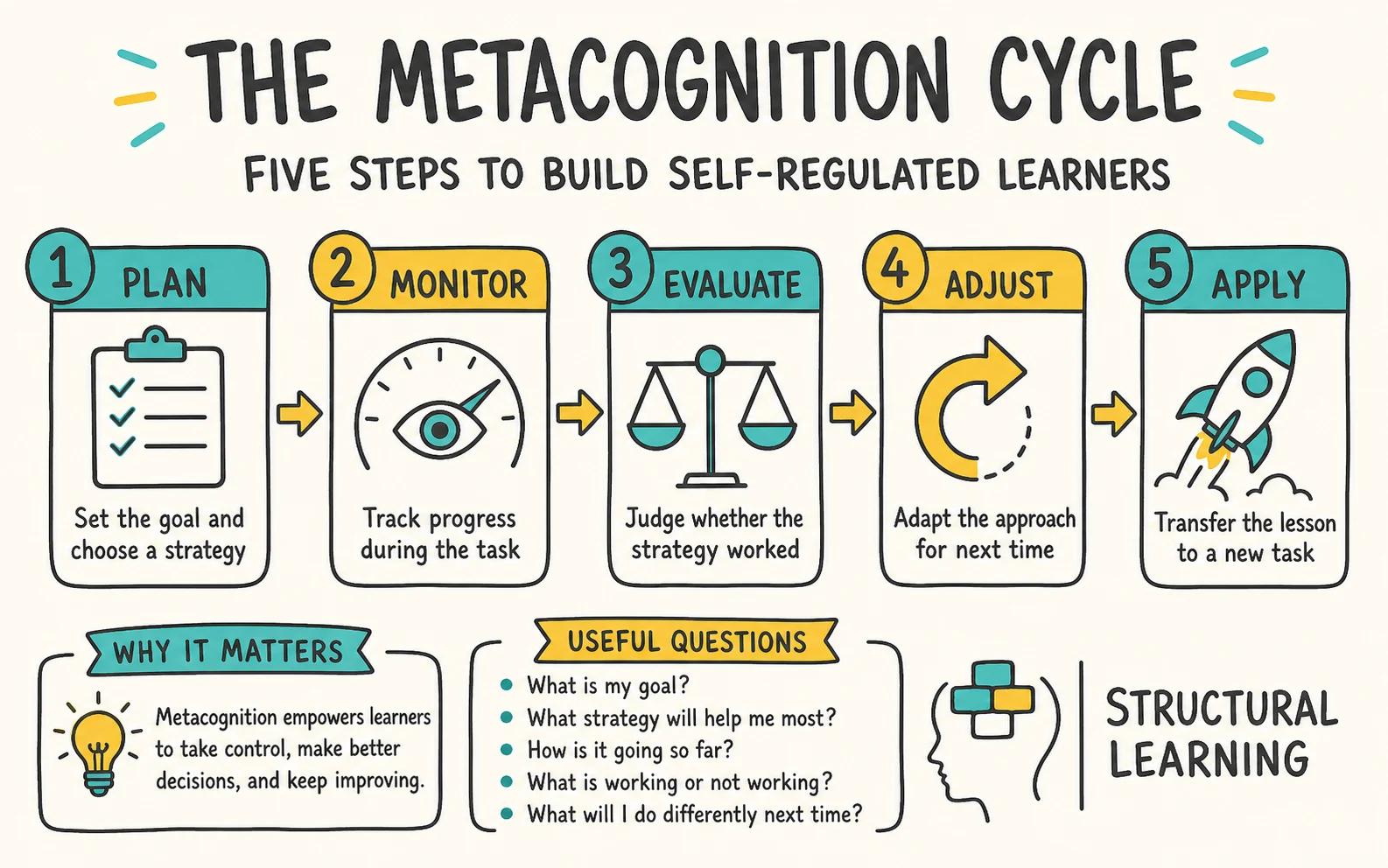 metacognition: Plan Learning, Self-Monitor, Regulate Actions, Reflect on Performance, and Evaluate Knowledge. This illustrates the iterative process of self-regulated learning." loading="lazy">
Attention skills help learners focus, alongside planning strategies for learning. Monitoring skills let learners check progress and debugging strategies address errors (Schraw, 1998). Evaluation skills help learners judge success.
1) Monitoring, observing oneself and one's environment
2) Reflective, analysing information
3) Evaluative, assessing progress
4) Control, managing effort and resources.
Metacognitive abilities are essential to successful learning. When we learn new information, we must first process it mentally. We then need to evaluate its meaning and relevance to ourselves. If we don't know where to begin with a subject, we should ask ourselves, "what am I good at? What am I bad at? Where would I benefit from additional study?" By doing these types of evaluations, we will make sure that we spend enough time studying topics that interest us most.
Learners think and act independently using self-regulated learning. They monitor, evaluate, and control their actions (Zimmerman, 2000). Learners need knowledge and motivation for self-regulation. This occurs during lessons and activities. Research shows practical skills improve learner performance (Panadero et al, 2017).
Study strategies, which include planning, organisation, goal setting, note-taking, rehearsal, testing and reviewing, could be regarded as metacognitive thinking. This type of metacognitive thinking helps learners become more aware of their strengths and weaknesses and has a general positive impact on learner outcomes. This includes planning, organising materials, setting goals, taking notes, reviewing concepts, and reflecting on what was covered. How Does Metacognition Affect Learner Achievement? Metacognition, or thinking about your thinking, is vital for academic success. It helps you understand yourself and improve your ability to think critically. Many learners can do well in memory tasks but struggle when looking at the broader meaning of this knowledge. A metacognitive approach might enable children to engage in deep learning where meaning has to be generated.
Metacognitive knowledge means a learner's understanding of themselves as thinkers (Flavell, 1979). Learners also consider tasks and strategies, impacting their learning. Research links metacognitive and self-regulated learning strategies with improved academic achievement (Hattie, 2012). This helps learners become independent in all subjects.
A common distinction is between working memory and long-term memory; long-term memory includes declarative or explicit memory and non-declarative forms such as procedural memory. Declarative knowledge includes things like n ames, dates, places, and events. Procedural knowledge consists of skills such as math calculations, grammar rules, and problem-solving techniques. Working memory is used in short term storage and retrieval. It allows people to hold pieces of information temporarily while processing other tasks.
Metacognitive knowledge involves what learners know about themselves as thinkers. It includes their awareness of tasks and strategies (Flavell, 1979). Learners think about their own thinking in learning and problem-solving (Nelson, 1996). This "thinking about thinking" includes self-knowledge, as described by various researchers.
Learners using rote learn facts, not skills (Anderson, 1983). They struggle to use knowledge in new situations. For example, a learner may learn times tables by repetition. They might not apply this knowledge unprompted (Bransford et al., 2000).
Study strategies are essential for academic achievement. Learners need a variety of study methods that will allow them to manage their time spent studying effectively. Some learners prefer to read textbooks from cover to cover before doing any practise problems. Others prefer to work out questions first then go back over the material. Still, others prefer to write down key points and make flashcards. Regardless of the method chosen, learners must know how to choose appropriate study tools based upon their needs. How should they Study Effectively? There are many ways to approach studying. The most effective way depends on an individual learner's preferences and the type of learning task.

Here are some tips for your learners.
1) Plan, Make sure you have enough time to complete all assignments.
2) Organise Materials, Keep everything organised not to waste valuable class time searching for needed items.
3) Set Goals, Know exactly where you want to end up when you start studying.
4) Take Notes, Write down anything you wish to retain.
5) Re-read Material, Read what you wrote down earlier; this will help reinforce concepts learned during previous lessons.
6) Practise Problems, Work out answers ahead of time.
7) Use Resources, Find additional resources online or at home.
8) Review Test Questions, Go over test questions after completing homework.
9) Reflect, Think about what went well and what could be improved next time around.
10) Reward Yourself!
11) Be Flexible, Don't get too attached to one particular strategy.
Learners benefit from monitoring, reflecting, evaluating, and controlling (Zimmerman, 2002; Pintrich, 2002). These self-regulation tactics let learners check understanding and adapt approaches. Reflection and strategy evaluation boost independent learning, the research suggests.
Metacognition means learners regulate their thoughts and actions. Self-regulation helps learners focus and avoid distractions. It lets them check their work to improve their performance (Nelson & Narens, 1990). Think about monitoring, regulation, and control (Flavell, 1979).

Metacognition is not just limited to academics. People with high levels of Metacognition perform better academically as well as socially. A person's level of Metacognition may change depending on the context. People with high levels of Metacognition perform better academically as well as socially. For example, someone who has trouble focusing might do much better in school than he would outside of school. On the other hand, someone who does very well in school but struggles with social interactions might find himself struggling more in college. Therefore, people differ in terms of which areas of life require higher levels of Metacognition.
Here are some examples of situations requiring different amounts of metacognitive management.
• Studying a foreign language requires more attention to detail than reading a book.
• Playing sports requires focus and concentration, while watching TV requires less.
• Working on a project that requires creativity requires more thoughtfulness than working on a routine job assignment.
• Writing a paper requires more planning than writing a letter.
• Meeting new friends requires more effort than meeting old ones.
• Talking to strangers requires more preparation than talking to family members.
• Making decisions requires more reflection than making choices.
• Learning how to play an instrument requires more practise than learning how to read music.
• Reading books requires more attention than listening to lectures.
• Listening to lectures requires more attention than doing homework.
• Doing homework requires more attention than playing video games.
Metacognition research helps SEND learners, (Hattie, 2012). Teachers can use metacognitive strategies in class, (EEF, 2018). These findings build on work from researchers like Flavell, (1979).
Metacognition can help learners learn by helping them regulate their behaviour. This means learners will pay close attention to what they need to know to not miss anything. They will also have time for self-reflection after studying or performing tasks. Finally, when they encounter problems during study or task completion, they will use strategies such as re-reading material, taking notes and asking questions to solve those problems.

Metacognition involves monitoring thoughts and regulating emotions (Flavell, 1979). These skills help learners control behaviour and make good choices. Cognitive skills include critical thinking, problem-solving, and communication (Lai, 2011). Critical thinking means considering all sides before deciding (Ennis, 1993). Problem-solving is finding answers (Anderson, 1983).
Collaborative tasks boost skills (Mercer & Littleton, 2007). Learners reason by understanding concepts and using logic (Inhelder & Piaget, 1958). Learners build judgement by assessing ideas with evidence (Kahneman, 2011). Effective communication helps learners express themselves clearly (Vygotsky, 1978).
Metacognitive strategies are used to improve academic performance. Learners who use these strategies tend to perform better academically because they can monitor themselves and adjust their work accordingly. For instance, if learners have trouble understanding a concept, they may ask themselves why this happens. If the answer is not clear, then they should try to find out where their knowledge gaps exist.
Metacognition is key; learners manage their thinking with it. It helps them create better ways to handle thoughts and actions. Brown (1987), Flavell (1979) and Dunlosky and Metcalfe (2009) show useful activities.
Monitor yourself while reading. You might notice that you get distracted easily. Try to identify which parts of the text attract your attention first. Ask yourself whether there are any other reasons why you do not like specific passages.
Self-regulation Control your behaviour according to how well you are doing with an assignment. When you start feeling anxious, remind yourself that anxiety usually disappears once you begin working on something challenging. Self-evaluation Evaluate your progress towards achieving goals. Are you getting closer to completing assignments? Do you still have homework left to complete? How much effort did you put into each part of the assignment?
Flavell (1979) showed metacognition improves learning. Strategies from researchers like Dunlosky et al. (2013) help learners reflect. Implementing these ideas, as explored by Nelson (1996), supports learner progress in the classroom.
Successful learning requires learners to be self-regulated learners. They need to know what works best for them when studying or performing tasks. Learners must understand how to regulate their behaviour so that they can achieve success at school and beyond. To help learners become more successful, teachers should provide opportunities for learners to practise self-regulation by giving feedback on their efforts. Teachers also need to teach learners how to recognise and cope with stressors during study sessions. Stressful situations often cause learners to lose focus and forget details.
Learners need content knowledge for problem-solving. Learners use existing knowledge to gain new understanding (Anderson, 1983). They identify, organise, analyse, and evaluate information, then apply it (Bransford & Stein, 1993). Learners must consider options before choosing a solution (Sternberg, 1997).
Metacognitive teaching helps learners reflect and use strategies. Teachers model thinking, then guide learners to independence across subjects. Small classroom steps build self-regulation (Perry et al., 2019).
Metacognition is key for learning. Universal thinking frameworks aid cognitive processing (Flavell, 1979). They help learners break down tasks. School communities can boost metacognitive awareness. Use cognitive tasks to set achievable learning goals (Higgins et al., 2004; EEF, 2018).
This type of metacognitive approach is both manageable and immediately useful on a practical level. With this approach, content knowledge does not have to be sacrificed for procedural knowledge, the two work in tandem. As well as the framework, we also have ready-made graphic organisers that can be used as an off-the-shelf thinking strategy. Over time, we believe that this type of metacognitive approach can boost the confidence level of all learners. If you would like to see this learning concept and action, please do explore our dedicated webpage.
Metacognitive knowledge includes declarative, procedural, and conditional aspects. Paris et al. (1983) found conditional knowledge is hardest to teach. However, it is the most useful for knowledge transfer between subjects.
Kruger and Dunning (1999) showed new learners often think they understand more than they do. Expert learners, however, may underrate their knowledge. This misjudgment means learners require metacognitive training to assess themselves well.
Teachers need useful metacognition strategies, plus tools to measure learner self-awareness. They seek age-appropriate ways to add metacognition to the curriculum with ease. These questions explore a move toward independent learners (e.g. Flavell, 1979; Dunlosky & Metcalfe, 2009).
Can Metacognition Be Taught?
We all have metacognitive skills, but we tend to rely on others to tell us when we're right or wrong. However, we can teach ourselves to improve these skills, and it's something that everyone should strive to do. There are many ways to practise metacognition, such as asking yourself why you believe something, or evaluating your own reasoning process.
One of the best ways to improve your metacognitive skills is to write down your thoughts and analyse them later. By writing down your thoughts, you force yourself to consider them objectively, and you may realise that you weren't thinking clearly at the moment.
Another great way to practise metacognititon is to ask yourself questions like "How did I arrive at my conclusion?" or "Is this true?" These questions require you to step outside of your current thought pattern and look at your conclusions from another perspective. Once you've practiced metacognition, you'll notice that you're able to identify flaws in your logic much faster and more accurately.
What is the Purpose of Metacognition?
We use metacognitive skills to understand ourselves and others, and to improve our performance. Metacognition is a skill that everyone should practise, especially learners.
This metacognitive ability is important for academic success (Flavell, 1979). Learners who reflect on learning usually improve (Zimmerman, 2000). Effective reflection helps learners understand their strengths and weaknesses (Hattie, 2008). This understanding supports better learning outcomes (Black & Wiliam, 1998).
Metacognition also plays a role in professional development. People who are good at identifying strengths and weaknesses tend to excel in their careers. By practising metacognition, we can become better leaders, teachers, parents, and employees.
What are four Metacognitive Skills?
Here are four metacognition skills:
Self Awareness: Self awareness involves recognising your strengths and weaknesses, and knowing what you like and dislike. It's about understanding yourself and becoming comfortable with who you are.
Critical thinking involves evaluating information, (Facione, 1990). Learners question assumptions and evidence presented to them. Skills help learners challenge ideas critically, (Ennis, 2011; Willingham, 2007).
Reflection: Reflection is about reflecting on past experiences and applying lessons learned. It's about analysing your successes and failures, and figuring out why certain events happened.
Learning: Learning is about actively seeking knowledge and trying new things.
Teachers need structured ways to use metacognition. The Education Endowment Foundation research shows explicit teaching can boost learner progress seven months per year. This makes it a cost-effective classroom intervention (EEF).
The 'Think Aloud' method stands as one of the most powerful tools for developing metacognitive awareness. When teachers verbalise their thought processes whilst solving problems or reading texts, they model the internal dialogue that skilled learners use naturally. For instance, a maths teacher might say: "I'm stuck on this equation, so I'll try working backwards from the answer" or "This method seems complicated; let me check if there's a simpler approach." This explicit modelling helps learners recognise that confusion and strategic adjustment are normal parts of the learning process.
Several studies offer practical classroom techniques for learners using digital tools. These build metacognitive skills. Consider using these resources to support learner self-regulation (Dignath & Büttner, 2008). Research by Zimmerman (2002) shows this boosts learner achievement.
Structured reflection journals provide another evidence-based approach, particularly effective in Key Stages 3 and 4. Rather than asking learners to write general reflections, provide specific prompts that target metacognitive skills: "What strategy did you use to memorise these vocabulary words?" or "At what point did this concept click for you, and what helped?" These targeted questions guide learners towards recognising their own learning patterns and successful strategies.
Exit tickets give teachers quick assessment data and build learner self-evaluation skills. Simple questions, like "Rate understanding 1-5, explain why," help learners check their progress. This regular checking builds self-monitoring habits in successful, independent learners (Black & Wiliam, 1998).
This connects closely with research on learning to learn, which provides further classroom strategies for teachers.
Assessing metacognitive growth is tricky, as these skills are not always obvious. Teachers must capture learners' thinking, not just content knowledge, as per traditional tests. A systematic assessment helps identify metacognitive gaps, letting teachers adapt their instruction. (Brown, 1987; Flavell, 1979; Pintrich, 2000)
One effective method involves using learning journals where learners regularly document their thinking processes. Teachers can provide prompts such as "What strategy did you use to solve this problem?" or "What would you do differently next time?" These reflections reveal patterns in learners' metacognitive thinking over time. For younger learners, simplified visual tools like traffic light cards (red, amber, green) allow them to signal their confidence levels during tasks, providing immediate insight into their self-monitoring abilities.
Think-aloud protocols help you assess learners. Ask learners to describe their thinking while doing tasks. This shows you metacognitive strategies, as seen by Ericsson and Simon (1993). Use this in maths or science problem-solving. Regular recordings make a good progress record.
Rubrics help learners assess their progress and give you data. These can include criteria like, "I know when I don't understand". Panadero and Jonsson (2013) found self-assessment boosts metacognition. Consistent use supports each learner's metacognitive growth, allowing targeted help.
| Key Stage | Self-Monitoring Strategies | Planning Strategies | Evaluation Strategies |
|---|---|---|---|
| EYFS (3-5 years) | Thumbs up/down signals, emotion faces, "I'm stuck" hand signals | Visual task sequences, picture steps, "First-Then" boards | Smiley face self-assessment, verbal "What did you do?" prompts |
| KS1 (5-7 years) | Traffic light cards, confidence continuum, "stuck" strategies posters | Think-Plan-Write-Check sequences, illustrated checklists | Success criteria checklists, peer thumbs up, simple rubrics |
| KS2 (7-11 years) | Learning journals, think-alouds, self-questioning during tasks | Goal setting templates, task breakdown organisers, time estimation | Reflection prompts, "What worked?" analysis, error identification |
| KS3 (11-14 years) | Comprehension monitoring, strategy selection awareness, concentration checks | Study schedules, resource gathering, approach selection | Exam wrappers, performance analysis, strategy effectiveness review |
| KS4/5 (14-18 years) | Independent self-regulation, metacognitive questioning, calibration awareness | Long-term revision planning, strategy repertoire selection, resource evaluation | Sophisticated self-assessment, transfer analysis, knowledge gap identification |
Learners benefit when teachers directly teach and model strategies. This is based on developmental psychology research and the EEF metacognition guidance. Expect independent use after modelling (Bjork, 1994; Dunlosky et al., 2013; Hattie, 2012).
Research by Flavell (1979) highlights metacognition’s development. Teachers can choose strategies matching learner readiness. Work by Vygotsky (1978) on the Zone of Proximal Development helps this process.
In Key Stage 1 (ages 5-7), metacognitive development begins with simple self-monitoring activities. Young learners benefit from visual tools like traffic light cards to indicate their understanding: green for confident, amber for uncertain, and red for needing help. Teachers can introduce basic planning skills through illustrated task cards that break activities into clear steps. For instance, before a writing task, children might use picture prompts showing "think," "plan," "write," and "check" to sequence their work.
During Key Stage 2 (ages 7-11), learners can handle more sophisticated reflection techniques. Learning journals become powerful tools, where learners record not just what they learnt but how they learnt it. Teachers might use prompts such as "What helped me understand this?" or "What would I do differently next time?" Think-aloud modelling proves particularly effective at this stage; teachers verbalise their thought processes whilst solving problems, making invisible thinking strategies visible to learners.
Strategy instruction helps learners aged 11-16 (EEF, 2018). Exam wrappers improve self-awareness as learners analyse test results. Subject-specific strategies like prediction work well in science. Questioning and summarising also benefit learners in English (Dignath & Büttner, 2008).
A judgment of learning (JOL) is a learner's prediction of how well they will remember material on a future test. Nelson and Dunlosky (1991) found that delayed judgements of learning, made after a short gap rather than immediately, are far more accurate and help learners calibrate their revision effort.
The Education Endowment Foundation found metacognition works well. Tailor it to the learner's age for best results. Effective use adds seven months' progress on average (Education Endowment Foundation).
Metacognition helps learners think about their thinking (Brown, 1987; Flavell, 1979; Hattie, 2012). Regular practice builds learner self-awareness, planning, and evaluation skills. This helps learners become successful and independent individuals.
Sustained practice develops learners' metacognitive skills best. Begin with two or three techniques suited to their level. Embed them into routines, then expand your toolkit. Research shows explicit instruction boosts learning across subjects (e.g., Hattie, 2008; Zimmerman, 2002).
Generate an 8-week metacognition roadmap tailored to your key stage, subject, and current practice level.
Metacognition in education
Teaching metacognitive skills
Self-regulated learning
These peer-reviewed studies provide the research foundation for the strategies discussed in this article:
Exploring Teachers' Metacognition in MathematicsClassroom under PLC for Learners' Self-Regulated Learning View study ↗
(2023)
Professional learning communities help teachers improve their thinking. Stronger teacher metacognition makes them better at teaching learners to self-regulate. Teacher metacognition impacts how learners think about maths strategies.
Global Trends and Research Clusters in Learner Metacognition in Mathematics Education View study ↗
Metacognition in maths learners is the focus of current research. The analysis shows key themes and trends in mathematical thinking. Educators gain a clear overview of evidence based methods. Teachers can use insights to support strategy implementation (e.g. Flavell, 1979; Schoenfeld, 1985; Veenman, 2006).
Metacognition means learners think about their thinking. It includes self, task, action, and strategy awareness. These skills such as reasoning and planning help learners become independent. Research shows metacognitive practices improve grades, test scores, and knowledge retention (e.g., Flavell, 1979; Dunlosky & Metcalfe, 2009).
Metacognition improves learning. Teachers guide learners through practice, making thinking visible. Learners use self-monitoring (AI partner) (Nelson & Narens, 1990). They reflect on performance (Winne & Hadwin, 1998). Learners evaluate knowledge (checking understanding; Flavell, 1979) to identify strengths.
Zimmerman's (2002) four strategies include monitoring and reflecting. Learners also evaluate progress and control resources. These strategies help learners track their thinking and make changes. Winne and Hadwin (1998) found this provides feedback for future learning.
Anderson (1983) stated learners use thinking skills for problem solving. Flavell (1979) found learners check understanding using metacognitive strategies. Brown (1987) showed thinking skills improve learners; metacognition checks progress. Zimmerman (2000) linked metacognition with planning and feelings to help learners succeed.
Learners' metacognitive skills improve through practice and help. Self-regulated learning means learners work independently; they need knowledge and drive (Brown, 1987). Zimmerman (2002) and Dunlosky & Rawson (2012) found strong self-regulation improves learner performance.
Learners can use strategies such as rehearsal, chunking, and elaborative interrogation whilst monitoring their performance during ongoing tasks. They should regularly ask themselves evaluative questions like 'What am I good at? What am I bad at? Where would I benefit from additional study?' Learners can also use memory aids like Post-it notes and engage in regular self-evaluation to become more aware of their learning processes.
Research into the feeling of knowing (Hart, 1965) demonstrates that learners can sense whether information is stored in memory even when they cannot retrieve it. Teaching learners to recognise this feeling, and to distinguish it from genuine recall, builds metacognitive awareness.
Flavell (1979) found metacognitive experiences are feelings during tasks. Learners realise they don't understand passages, for example. Teachers can use these "aha" and "stuck" moments. This builds learner metacognitive awareness.
Metacognition is popular post-pandemic because it boosts independent learning. Learners may have less direct teacher help now. Specific techniques turn passive learners into self-regulated ones, useful for all ages (Flavell, 1979). This approach develops independent thinking, which helps struggling learners succeed (Bjork et al., 2013).