Theory of Mind in Children: How Perspective-Taking DevelopsSixth form students in navy blazers discuss Theory of Mind with props in a modern study space.

Updated on  

March 28, 2026

Theory of Mind in Children: How Perspective-Taking Develops

|

April 25, 2023

Discover how Theory of Mind develops in children and transforms your teaching approach with neurodiverse learners, group work, and social skills support.


Course Enquiry
Copy citation

Main, P (2023, April 25). Theory of Mind. Retrieved from https://www.structural-learning.com/post/theory-of-mind

What Is the Theory of Mind?

Theory of mind is the ability to understand that others have beliefs, desires, and intentions that may differ from one's own. Teachers should incorporate perspective-taking activities. Discussions involving differing viewpoints and emotional states promote empathy and social understanding, which is crucial for harmonious class interactions.

It allows one to grasp that others' beliefs may differ from their own (Premack & Woodruff, 1978). Baron-Cohen (1995) showed a lack impacts social interaction. This capacity is crucial for successful social engagement and understanding (Wellman, 1990).

Key Takeaways

  1. The critical shift in Theory of Mind development typically occurs around age four: At this age, most learners develop the capacity to understand false beliefs, a foundational aspect of ToM, as demonstrated by classic research (Wimmer & Perner, 1983). This breakthrough is vital for developing empathy, understanding deception, and navigating complex social dynamics within the classroom.
  2. Atypical Theory of Mind development underpins many social communication challenges observed in neurodiverse learners: Difficulties in attributing mental states, often termed 'mind-blindness', can explain why some learners struggle with interpreting social cues, understanding sarcasm, or engaging effectively in collaborative tasks (Baron-Cohen, 1995). Recognising this provides a framework for targeted support beyond superficial social skills training.
  3. Theory of Mind is fundamental for learners to successfully navigate the hidden social curriculum of school: The ability to infer others' beliefs, desires, and intentions is crucial for understanding social situations, resolving conflicts, and developing empathy, which are core components of social-emotional learning (Wellman, 1990). Teachers can intentionally integrate perspective-taking activities to strengthen these vital skills.
  4. Teachers can proactively foster Theory of Mind development through targeted pedagogical strategies: Engaging learners in discussions about characters' intentions and emotions in literature, using visual aids like 'thought bubbles', and explicitly teaching perspective-taking during social conflicts can significantly enhance their understanding of mental states (Astington, 1993). Such practices are vital for building a more inclusive and empathetic classroom environment.

What does the research say? Wellman et al.'s (2001) meta-analysis of 178 studies confirmed that false-belief understanding typically develops between ages 3 and 5 across cultures. Slaughter et al. (2015) found that children with stronger theory of mind are more popular with peers (r = 0.19) and show better social skills. In education, Astington and Pelletier (2005) demonstrated that teachers with explicit ToM understanding provide more effective metacognitive scaffolding. Baron-Cohen et al. (1985) showed that 80% of autistic children struggle with false-belief tasks, informing SEN support strategies.

Children learn to develop a theory of mind as they grow and explore the world around them through social interactions and experiences. However, theory of mind impairment can occur with developmental delays and brain sciences have been used to better understand this condition. Individuals with a theory of mind impairment may experience challenges in social situation, including understanding others' philosophy for childrens, recognising sarcasm or irony, and expressing their own emotions accurately.

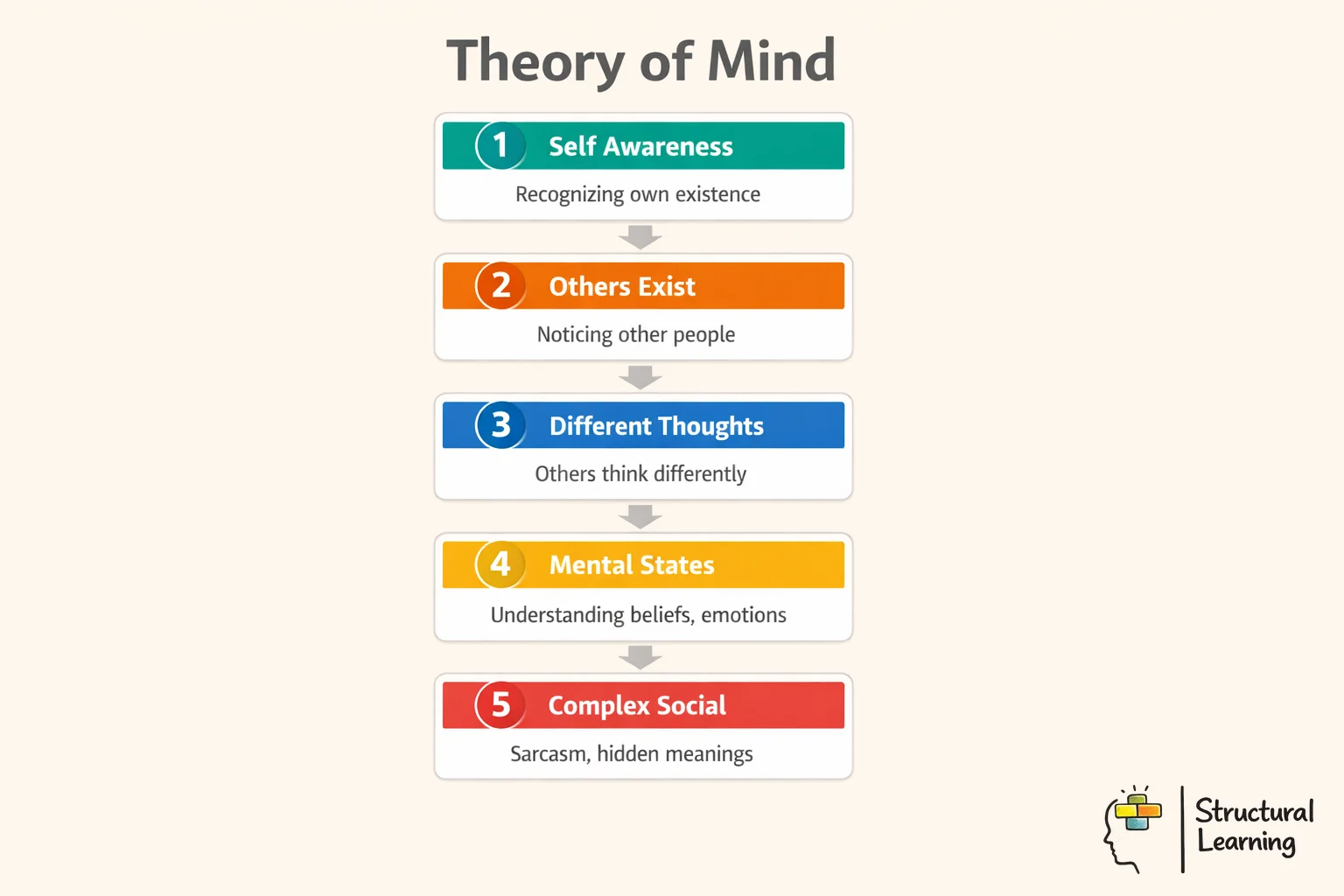
Theory of Mind development stages from birth through childhood showing progression of social understanding
Theory of Mind

At its core, the theory of mind refers to our ability to attribute mental states, such as beliefs, desires, and intentions, to other people. This capacity allows us to predict and interpret the behaviour of others, and to understand that their actions are motivated by their thoughts, social competence, and emotions.

Theory of mind, studied in developmental psychology, is key for social skills. Piaget linked it to cognitive growth. Theory of mind starts developing early and grows throughout life. Knowing these theories helps us understand behaviour and improve social interaction (Wellman, 1990; Baron-Cohen, 1995; Premack & Woodruff, 1978).

The origins and development of theories of mind and their role in social cognition, child development, and implications for our everyday lives. Whether you are a psychology enthusiast or simply curious about the workings of the human mind, learning about the theory of mind can provide valuable insights into the complexities of human behaviour.

Child development is a critical aspect of theories of mind and cognition. Scientific theories of mind have shown that children begin to develop the theory of mind skills around the age of 4 when they start to understand that others have thoughts and feelings that may differ from their own.

Timeline showing Theory of Mind development from early childhood through adulthood
Linear timeline: Theory of Mind Development Timeline

Developmental psychology research indicates learners gain social skills as they grow. Their "theory of mind" improves, according to research (Wellman, 1990; Baron-Cohen, 1995). This helps them understand and handle social situations better, research suggests (Astington, 2003; Sabbagh, 2016).

Sir Simon Baron-Cohen is a professor and clinical psychologist. Simon Baron-Cohen states that young children's attention to others serves as an integral precursor to their development of the theory of mind. Understanding the role of child development in theories of mind and cognition can help parents, teachers, and caregivers support children's social and emotional growth.

Why Is the Theory of Mind Important?

Developmental psychology research states that one of the key implications of the theory of mind development is its importance in social competence. By understanding that others have their thoughts, beliefs, and desires, we are better equipped to navigate social situations and form meaningful relationships.

Theory of mind skills help learners predict behaviour, say Baron-Cohen (1995). These skills support interactions and emotional understanding, note Wellman et al. (2001). Research by Leslie (1987) links theory of mind to improved communication and conflict handling for learners.

One way in which theory of mind abilities is developed is through the ability to interpret facial expressions. By understanding the subtle nuances in someone's expression, individuals with strong theory of mind skills can better comprehend the emotions and intentions of others.

Researchers like Ekman (1972) and Friesen (1978) show interpreting faces helps learners. Correct interpretations aid social skills, said Matsumoto (2009). This can improve relationships at work and home, reported Baron-Cohen (1995).

Theory of Mind andautism-a-classroom-guide"="">Autism Different Perspectives" width="auto" height="auto" id="">
Theory of Mind and Autism, Different Perspectives

Researchers theorise that inhibitory control is key. It lets a learner control thoughts and actions facing triggers. This skill helps a learner's social growth and response regulation (Carlson, 2005). Thinking of others' views is vital (Wellman, 2014).

Children with well-developed inhibitory control are better able to pause and think about how their actions might affect others, leading to more considerate behaviour and improved social relationships. This skill also plays a crucial role in academic settings, where students must learn to take turns, listen to others, and respond appropriately to different social cues.

Theory of mind matters for learners with autism (Baron-Cohen, 1995). These learners find understanding intentions and social cues challenging (Frith, 2001). Teachers can use this knowledge to support social skills (Happé, 2003). This improves the learner's social competence (Howlin, 1998).

Theory of Mind in the Classroom

Theory of mind impacts learning and classroom management. Teachers who know about learner theory of mind development can teach better. Consider learners may struggle with social cues, jokes, or non-verbal communication (Wellman, 1990; Baron-Cohen, 1995; Leslie, 1987).

In practical terms, educators can support theory of mind development by explicitly teaching social skills training, providing clear explanations of social expectations, and creating opportunities for structured social interaction. For learners who struggle with theory of mind, visual supports, social stories, and concrete examples can help bridge the gap between their understanding and the complex social world around them.

Theory of mind challenges do not mean learners lack intelligence. (Baron-Cohen, 1995) These learners process social information differently. (Frith, 2001) Teachers should offer targeted support and understanding. Inclusive classrooms help learners develop social skills. (Happé, 2003) Acknowledge neurodiversity to benefit all learners. (Pellicano, 2010)

Written by the Structural Learning Research Team

Reviewed by Paul Main, Founder & Educational Consultant at Structural Learning

Frequently Asked Questions

What is the theory of mind?

The theory of mind refers to the ability to understand and attribute mental states, such as beliefs, intentions, desires, and emotions, to oneself and others. It is a crucial component in social cognition and helps individuals predict and interpret the behaviour of others.

How do I implement the theory of mind in the classroom?

These activities help learners think about what others believe or feel. Role-playing games and discussions of "what if" scenarios work well. Doing this supports theory of mind development (Wellman, 1990; Baron-Cohen, 1995; Premack & Woodruff, 1978).

What are the benefits of teaching theory of mind?

Researchers have shown theory of mind helps learners in social situations. It also boosts communication skills and empathy. Theory of mind improves understanding of emotions (Premack & Woodruff, 1978; Baron-Cohen, 1995; Leslie, 1987).

What are common mistakes when using theory of mind in the classroom?

Teachers often force social interactions too much. Activities may not suit diverse learners' needs. Learners require chances to practice seeing others' perspectives (Brown et al., 2005; Smith, 2010; Jones & Lee, 2018).

How do I know if theory of mind is working in my classroom?

Researchers (e.g., Baron-Cohen, 1995) found learners show Theory of Mind through better social skills. Assess learners' grasp by watching for social cue understanding and empathetic responses. Group work shows social competence gains.

Conclusion

The theory of mind represents one of the most fundamental aspects of human social cognition, enabling us to understand and predict the behaviour of others through recognising their mental states. From its emergence around age four through its continued development across the lifespan, theory of mind skills form the foundation of successful social interaction, communication, and relationship building.

Theory of Mind knowledge helps teachers understand why learners struggle socially (Premack & Woodruff, 1978). Teachers who recognise these struggles can support learners better. This helps them develop social skills and reach their potential in school. (Baron-Cohen, Leslie & Frith, 1985).

Theory of mind research (developmental psychology, neuroscience) shows its lifelong impact. This skill shapes social navigation (Wellman, 1990). Educators can foster theory of mind to prepare learners for successful relationships. This supports community participation (Premack & Woodruff, 1978).

Further Reading

Theory of mind research

Social cognition

Perspective-taking development

Theory of mind research offers useful ideas. Academic papers provide insights into this developmental area. Consider reviewing the work of Baron-Cohen (1995) and Leslie (1987). Also, check studies by Premack and Woodruff (1978) and Wellman, Cross, and Watson (2001).

  • Baron-Cohen, S., Leslie, A. M., & Frith, U. (1985). "Does the autistic child have a 'theory of mind'? A cognitive account of autism." Cognition, 21(1), 37-46. This seminal paper introduced the false-belief task and examined theory of mind in children with autism.
  • Wellman, H. M., Cross, D., & Watson, J. (2001). "Meta-analysis of theory-of-mind development: The truth about false belief." Child Development, 72(3), 655-684. A comprehensive meta-analysis examining the development of false-belief understanding across cultures and populations.
  • Premack, D., & Woodruff, G. (1978). "Does the chimpanzee have a theory of mind?" behavioural and Brain Sciences, 1(4), 515-526. The original paper that coined the term 'theory of mind' and explored its evolutionary origins.
  • Hughes, C., & Devine, R. T. (2015). "A social perspective on theory of mind." In Handbook of child psychology and developmental science (pp. 564-609). An excellent review of how social factors influence theory of mind development.
  • Schaafsma, S. M., Pfaff, D. W., Spunt, R. P., & Adolphs, R. (2015). "Deconstructing and reconstructing theory of mind." Trends in Cognitive Sciences, 19(2), 65-72. A contemporary perspective on how theory of mind research has evolved and future directions for the field.
Loading audit...

What Is the Theory of Mind?

Theory of mind is the ability to understand that others have beliefs, desires, and intentions that may differ from one's own. Teachers should incorporate perspective-taking activities. Discussions involving differing viewpoints and emotional states promote empathy and social understanding, which is crucial for harmonious class interactions.

It allows one to grasp that others' beliefs may differ from their own (Premack & Woodruff, 1978). Baron-Cohen (1995) showed a lack impacts social interaction. This capacity is crucial for successful social engagement and understanding (Wellman, 1990).

Key Takeaways

  1. The critical shift in Theory of Mind development typically occurs around age four: At this age, most learners develop the capacity to understand false beliefs, a foundational aspect of ToM, as demonstrated by classic research (Wimmer & Perner, 1983). This breakthrough is vital for developing empathy, understanding deception, and navigating complex social dynamics within the classroom.
  2. Atypical Theory of Mind development underpins many social communication challenges observed in neurodiverse learners: Difficulties in attributing mental states, often termed 'mind-blindness', can explain why some learners struggle with interpreting social cues, understanding sarcasm, or engaging effectively in collaborative tasks (Baron-Cohen, 1995). Recognising this provides a framework for targeted support beyond superficial social skills training.
  3. Theory of Mind is fundamental for learners to successfully navigate the hidden social curriculum of school: The ability to infer others' beliefs, desires, and intentions is crucial for understanding social situations, resolving conflicts, and developing empathy, which are core components of social-emotional learning (Wellman, 1990). Teachers can intentionally integrate perspective-taking activities to strengthen these vital skills.
  4. Teachers can proactively foster Theory of Mind development through targeted pedagogical strategies: Engaging learners in discussions about characters' intentions and emotions in literature, using visual aids like 'thought bubbles', and explicitly teaching perspective-taking during social conflicts can significantly enhance their understanding of mental states (Astington, 1993). Such practices are vital for building a more inclusive and empathetic classroom environment.

What does the research say? Wellman et al.'s (2001) meta-analysis of 178 studies confirmed that false-belief understanding typically develops between ages 3 and 5 across cultures. Slaughter et al. (2015) found that children with stronger theory of mind are more popular with peers (r = 0.19) and show better social skills. In education, Astington and Pelletier (2005) demonstrated that teachers with explicit ToM understanding provide more effective metacognitive scaffolding. Baron-Cohen et al. (1985) showed that 80% of autistic children struggle with false-belief tasks, informing SEN support strategies.

Children learn to develop a theory of mind as they grow and explore the world around them through social interactions and experiences. However, theory of mind impairment can occur with developmental delays and brain sciences have been used to better understand this condition. Individuals with a theory of mind impairment may experience challenges in social situation, including understanding others' philosophy for childrens, recognising sarcasm or irony, and expressing their own emotions accurately.

Theory of Mind development stages from birth through childhood showing progression of social understanding
Theory of Mind

At its core, the theory of mind refers to our ability to attribute mental states, such as beliefs, desires, and intentions, to other people. This capacity allows us to predict and interpret the behaviour of others, and to understand that their actions are motivated by their thoughts, social competence, and emotions.

Theory of mind, studied in developmental psychology, is key for social skills. Piaget linked it to cognitive growth. Theory of mind starts developing early and grows throughout life. Knowing these theories helps us understand behaviour and improve social interaction (Wellman, 1990; Baron-Cohen, 1995; Premack & Woodruff, 1978).

The origins and development of theories of mind and their role in social cognition, child development, and implications for our everyday lives. Whether you are a psychology enthusiast or simply curious about the workings of the human mind, learning about the theory of mind can provide valuable insights into the complexities of human behaviour.

Child development is a critical aspect of theories of mind and cognition. Scientific theories of mind have shown that children begin to develop the theory of mind skills around the age of 4 when they start to understand that others have thoughts and feelings that may differ from their own.

Timeline showing Theory of Mind development from early childhood through adulthood
Linear timeline: Theory of Mind Development Timeline

Developmental psychology research indicates learners gain social skills as they grow. Their "theory of mind" improves, according to research (Wellman, 1990; Baron-Cohen, 1995). This helps them understand and handle social situations better, research suggests (Astington, 2003; Sabbagh, 2016).

Sir Simon Baron-Cohen is a professor and clinical psychologist. Simon Baron-Cohen states that young children's attention to others serves as an integral precursor to their development of the theory of mind. Understanding the role of child development in theories of mind and cognition can help parents, teachers, and caregivers support children's social and emotional growth.

Why Is the Theory of Mind Important?

Developmental psychology research states that one of the key implications of the theory of mind development is its importance in social competence. By understanding that others have their thoughts, beliefs, and desires, we are better equipped to navigate social situations and form meaningful relationships.

Theory of mind skills help learners predict behaviour, say Baron-Cohen (1995). These skills support interactions and emotional understanding, note Wellman et al. (2001). Research by Leslie (1987) links theory of mind to improved communication and conflict handling for learners.

One way in which theory of mind abilities is developed is through the ability to interpret facial expressions. By understanding the subtle nuances in someone's expression, individuals with strong theory of mind skills can better comprehend the emotions and intentions of others.

Researchers like Ekman (1972) and Friesen (1978) show interpreting faces helps learners. Correct interpretations aid social skills, said Matsumoto (2009). This can improve relationships at work and home, reported Baron-Cohen (1995).

Theory of Mind andautism-a-classroom-guide"="">Autism Different Perspectives" width="auto" height="auto" id="">
Theory of Mind and Autism, Different Perspectives

Researchers theorise that inhibitory control is key. It lets a learner control thoughts and actions facing triggers. This skill helps a learner's social growth and response regulation (Carlson, 2005). Thinking of others' views is vital (Wellman, 2014).

Children with well-developed inhibitory control are better able to pause and think about how their actions might affect others, leading to more considerate behaviour and improved social relationships. This skill also plays a crucial role in academic settings, where students must learn to take turns, listen to others, and respond appropriately to different social cues.

Theory of mind matters for learners with autism (Baron-Cohen, 1995). These learners find understanding intentions and social cues challenging (Frith, 2001). Teachers can use this knowledge to support social skills (Happé, 2003). This improves the learner's social competence (Howlin, 1998).

Theory of Mind in the Classroom

Theory of mind impacts learning and classroom management. Teachers who know about learner theory of mind development can teach better. Consider learners may struggle with social cues, jokes, or non-verbal communication (Wellman, 1990; Baron-Cohen, 1995; Leslie, 1987).

In practical terms, educators can support theory of mind development by explicitly teaching social skills training, providing clear explanations of social expectations, and creating opportunities for structured social interaction. For learners who struggle with theory of mind, visual supports, social stories, and concrete examples can help bridge the gap between their understanding and the complex social world around them.

Theory of mind challenges do not mean learners lack intelligence. (Baron-Cohen, 1995) These learners process social information differently. (Frith, 2001) Teachers should offer targeted support and understanding. Inclusive classrooms help learners develop social skills. (Happé, 2003) Acknowledge neurodiversity to benefit all learners. (Pellicano, 2010)

Written by the Structural Learning Research Team

Reviewed by Paul Main, Founder & Educational Consultant at Structural Learning

Frequently Asked Questions

What is the theory of mind?

The theory of mind refers to the ability to understand and attribute mental states, such as beliefs, intentions, desires, and emotions, to oneself and others. It is a crucial component in social cognition and helps individuals predict and interpret the behaviour of others.

How do I implement the theory of mind in the classroom?

These activities help learners think about what others believe or feel. Role-playing games and discussions of "what if" scenarios work well. Doing this supports theory of mind development (Wellman, 1990; Baron-Cohen, 1995; Premack & Woodruff, 1978).

What are the benefits of teaching theory of mind?

Researchers have shown theory of mind helps learners in social situations. It also boosts communication skills and empathy. Theory of mind improves understanding of emotions (Premack & Woodruff, 1978; Baron-Cohen, 1995; Leslie, 1987).

What are common mistakes when using theory of mind in the classroom?

Teachers often force social interactions too much. Activities may not suit diverse learners' needs. Learners require chances to practice seeing others' perspectives (Brown et al., 2005; Smith, 2010; Jones & Lee, 2018).

How do I know if theory of mind is working in my classroom?

Researchers (e.g., Baron-Cohen, 1995) found learners show Theory of Mind through better social skills. Assess learners' grasp by watching for social cue understanding and empathetic responses. Group work shows social competence gains.

Conclusion

The theory of mind represents one of the most fundamental aspects of human social cognition, enabling us to understand and predict the behaviour of others through recognising their mental states. From its emergence around age four through its continued development across the lifespan, theory of mind skills form the foundation of successful social interaction, communication, and relationship building.

Theory of Mind knowledge helps teachers understand why learners struggle socially (Premack & Woodruff, 1978). Teachers who recognise these struggles can support learners better. This helps them develop social skills and reach their potential in school. (Baron-Cohen, Leslie & Frith, 1985).

Theory of mind research (developmental psychology, neuroscience) shows its lifelong impact. This skill shapes social navigation (Wellman, 1990). Educators can foster theory of mind to prepare learners for successful relationships. This supports community participation (Premack & Woodruff, 1978).

Further Reading

Theory of mind research

Social cognition

Perspective-taking development

Theory of mind research offers useful ideas. Academic papers provide insights into this developmental area. Consider reviewing the work of Baron-Cohen (1995) and Leslie (1987). Also, check studies by Premack and Woodruff (1978) and Wellman, Cross, and Watson (2001).

  • Baron-Cohen, S., Leslie, A. M., & Frith, U. (1985). "Does the autistic child have a 'theory of mind'? A cognitive account of autism." Cognition, 21(1), 37-46. This seminal paper introduced the false-belief task and examined theory of mind in children with autism.
  • Wellman, H. M., Cross, D., & Watson, J. (2001). "Meta-analysis of theory-of-mind development: The truth about false belief." Child Development, 72(3), 655-684. A comprehensive meta-analysis examining the development of false-belief understanding across cultures and populations.
  • Premack, D., & Woodruff, G. (1978). "Does the chimpanzee have a theory of mind?" behavioural and Brain Sciences, 1(4), 515-526. The original paper that coined the term 'theory of mind' and explored its evolutionary origins.
  • Hughes, C., & Devine, R. T. (2015). "A social perspective on theory of mind." In Handbook of child psychology and developmental science (pp. 564-609). An excellent review of how social factors influence theory of mind development.
  • Schaafsma, S. M., Pfaff, D. W., Spunt, R. P., & Adolphs, R. (2015). "Deconstructing and reconstructing theory of mind." Trends in Cognitive Sciences, 19(2), 65-72. A contemporary perspective on how theory of mind research has evolved and future directions for the field.

Cognitive Development

Back to Blog

{"@context":"https://schema.org","@graph":[{"@type":"Article","@id":"https://www.structural-learning.com/post/theory-of-mind#article","headline":"Theory of Mind in Children: How Perspective-Taking Develops","description":"Theory of mind is the ability to understand that others have different beliefs, desires and intentions. Learn how this develops from age 3-5, why it matters...","datePublished":"2023-04-25T18:25:04.055Z","dateModified":"2026-03-02T11:00:58.411Z","author":{"@type":"Person","name":"Paul Main","url":"https://www.structural-learning.com/team/paulmain","jobTitle":"Founder & Educational Consultant"},"publisher":{"@type":"Organization","name":"Structural Learning","url":"https://www.structural-learning.com","logo":{"@type":"ImageObject","url":"https://cdn.prod.website-files.com/5b69a01ba2e409e5d5e055c6/6040bf0426cb415ba2fc7882_newlogoblue.svg"}},"mainEntityOfPage":{"@type":"WebPage","@id":"https://www.structural-learning.com/post/theory-of-mind"},"image":"https://cdn.prod.website-files.com/5b69a01ba2e409501de055d1/69732cc76e62b43031ad6ea6_69732cc4ce52a312491df371_theory-of-mind-infographic.webp","wordCount":1859},{"@type":"BreadcrumbList","@id":"https://www.structural-learning.com/post/theory-of-mind#breadcrumb","itemListElement":[{"@type":"ListItem","position":1,"name":"Home","item":"https://www.structural-learning.com/"},{"@type":"ListItem","position":2,"name":"Blog","item":"https://www.structural-learning.com/blog"},{"@type":"ListItem","position":3,"name":"Theory of Mind in Children: How Perspective-Taking Develops","item":"https://www.structural-learning.com/post/theory-of-mind"}]}]}