Teacher well-being
Teacher wellbeing depends on systemic support, not individual coping. Strategies for workload, movement, micro-successes and cultures that retain teachers.

Teacher wellbeing depends on systemic support, not individual coping. Strategies for workload, movement, micro-successes and cultures that retain teachers.
Teacher well-being means the physical, mental, social and emotional conditions that help teachers do good work without long-term harm to their health. Current research presents it as a school-level and occupational issue. It is shaped by workload, autonomy, relationships, leadership and the behaviour climate (Hascher & Waber, 2021).
Freud (1923) gave psychology useful terms for unconscious conflict and defence. However, using psychoanalysis to explain teacher well-being is now mainly of historical interest. Today, teacher well-being draws more on burnout theory, occupational psychology and positive psychology: Maslach & Leiter (2016) explain long-term job stress through emotional exhaustion, cynicism and reduced efficacy, while Seligman (2011) emphasises meaning, engagement and relationships. So schools need whole-school change, not programmes that ask individual teachers to cope with broken systems (Fullan, 2016; Schaufeli, 2021).
Movement can help teachers reset during the school day. Dance, stretching or a brisk playground walk can lift mood, reduce tension and support physical health. It is too strong to say that dancing wards off dementia.
A more accurate claim is that complex sensorimotor activities, including dance, may support cognitive reserve. In some studies, they are also linked with a lower risk of cognitive decline (Verghese et al., 2003). Just as active learning techniques energise learners, physical movement can help teachers recover between demanding lessons.
The song was deliberately chosen to remind the team to celebrate all the micro successes. Every single one. We tend to celebrate the big wins and let the little ones pass us by.
This mirrors how easily schools miss the small routines that support both learner progress and teacher recovery. For more on this topic, see Reducing teacher burnout. Everyday teaching gains matter because they give staff evidence that their work still has meaning. Celebrating a small win does not remove workload, but it can protect attention from being captured only by complaints.
When complaints arrive or something goes wrong, teachers need enough recorded evidence of useful work to keep the setback in proportion. A micro-success can be marked with a small physical cue, such as a pumped fist or star-shaped pose, if that feels natural.
Imagine you are just about to win that race and you are heading over the finish line. What would you do? The physical movement registers in your brain physiologically and produces happy hormones, bringing about positive well-being and emotions. Ultimately this impacts on your life balance and will also improve your sense of job satisfaction.
I then asked two fundamental questions: what is mental health and well-being in schools and who is in charge of it? This resulted in much debate as you can imagine. Before you read on, I ask you to stop and think about these two questions. Simply pause and consider:
What does mean to you? What does good well-being of teachers look like for you? Is that the same for everyone in your school? Senior leaders?
Education support staff? Who is responsible for your well-being? Can anybody else have an impact on your well-being?
Put simply, "well-being" is about how we are doing both now and also how sustainable that is in the years ahead. It is about feeling good and functioning well. The English Oxford Dictionary defines it as "the state of being comfortable, healthy or happy".
In many ways here is the challenge. How can you ensure that you and your team are "comfortable, healthy and happy"? In reality I suggest that you cannot.
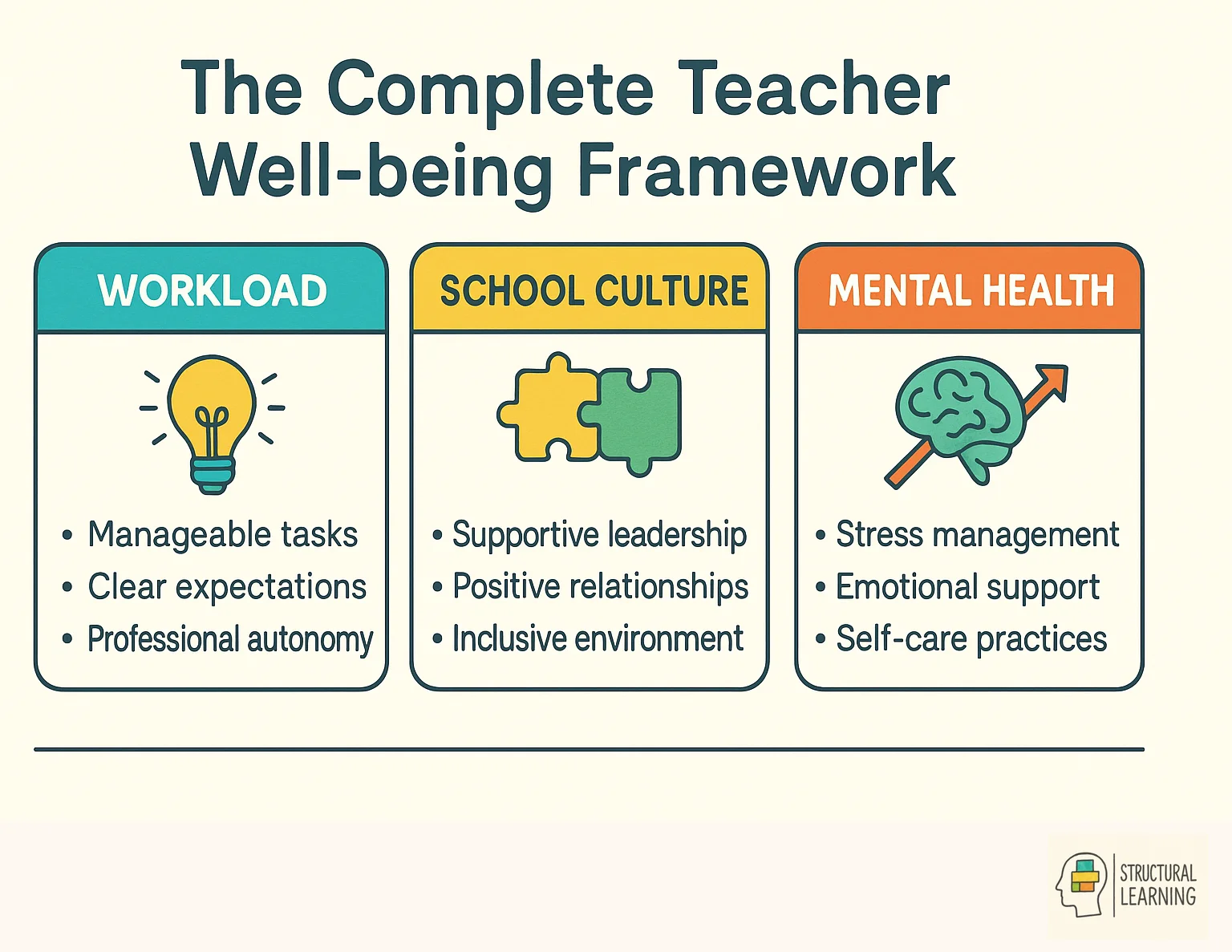
Teacher well-being is shaped by personal, relational and organisational conditions. Sleep, health, finances, digital habits and family life all matter. So do timetables, behaviour systems, planning load, inspection pressure and leadership trust. Ecological models show that a teacher's health is shaped across nested contexts, from the classroom to national policy, so responsibility sits with individuals, teams, leaders and the wider system (Bronfenbrenner, 1979; Collie, 2022).
School culture shapes teacher well-being through support and clear communication. Avola et al. (2025) found that schools create toxic cultures when only administrators hold responsibility for well-being. Stronger cultures share that responsibility, build peer networks and celebrate small wins.
School culture shapes how well-being is felt in daily work. Staff notice whether leaders reduce friction or simply ask people to cope. For example, is there a culture of direct conversation rather than negative gossip? Do staff experience feedback as a route to professional growth or as another accountability threat?
All staff contribute to culture, but leaders set the conditions. Teaching also involves emotional labour: the repeated work of staying calm, encouraging and fair while managing frustration, conflict or worry (Hochschild, 1983). When teachers have to perform calm all day while feeling unsupported, surface acting drains energy and increases burnout risk.
Negative gossip in school, and by that I mean that talking about people rather than having direct conversations, results in people believing what they think is being said. This can result in negative effects.
Your thoughts about what people are saying are just that, thoughts. They are not facts. Remember you will never speak to anyone more than you speak to yourself, so be kind when you speak to yourself.
Relationships between teachers matter. They affect teacher well-being and everyone in the building. At the same time, they can also affect job satisfaction (Assaf & Antoun, 2024).
I suggest that it is everyone's responsibility as a whole school to feed into that state of being comfortable. In other words, everyone in the school is responsible for the well-being of themselves and each other. In other words, positive teacher well-being is impacted by everyone.
How we view the world impacts on this. Those internal working models we create about what we think is happening matter. For more on this topic, see Work life balance. How we construe what is happening around us has an impact on this positive teacher well-being.
As already mentioned, if you view feedback as an opportunity rather than a negative experience, you will seek feedback rather than reject it. If the culture of your school sees mistakes as a chance to learn rather than an error, you will create a positive learning environment (Cece et al., 2021).
Use these practical strategies to audit workload and recovery, not as a list of personal fixes. Well-being work should not mean adding mindfulness on top of excessive marking, data drops and behaviour escalation. If that happens, it shifts responsibility onto the teacher instead of changing the job design (Schaufeli, 2021).
Teacher well-being is a condition for sustainable teaching. Schools need to understand the full range of pressures on staff. When they implement practical strategies to support staff, they create calmer conditions for both teachers and learners. This includes reducing performative marking, stopping duplicate data entry and protecting time for lesson preparation.
Prioritising well-being is linked with better job satisfaction, lower burnout and stronger learner outcomes (Granziera et al., 2023; Dreer, 2024).
A stronger culture starts when leaders remove avoidable friction. This includes unnecessary data drops, unclear behaviour systems, duplicated planning, late-night emails and marking policies that no one uses. Staffroom treats can lift a hard Friday, but they cannot make up for routines that make good teaching unsustainable.

The numbers paint a stark picture of teacher wellbeing across UK schools. Recent data from the Education Support charity reveals that 78% of education professionals describe themselves as stressed, whilst 44% experience symptoms of poor mental health. Most alarmingly, teacher retention rates have plummeted, with nearly one in three teachers leaving the profession within their first five years.
These statistics represent real people in real classrooms. Consider Sarah, a Year 3 teacher in Manchester who marks books until midnight every night, skips lunch to run interventions, and hasn't taken a proper break in months. Or James, a secondary maths teacher who manages behaviour incidents all day, then faces two hours of data entry each evening. Their experiences reflect a profession at breaking point.
The impact reaches far beyond individual teachers. When teachers work in survival mode, they have less space for classroom creativity, patience and strong relationships. Learners quickly sense adult stress. Burnout can also overlap with secondary traumatic stress and compassion fatigue, especially for teachers with heavy pastoral, safeguarding or SEND responsibilities (Figley, 1995; Klusko et al., 2022).
Even with these worrying trends, some schools are making positive changes. Schools using weekly 'marking-free Fridays' report better staff morale without affecting learner progress. Others have introduced 'email curfews', which stop work communications after 6pm and help teachers switch off. One Birmingham primary school turned its staffroom into a real retreat space, with comfortable seating and a coffee machine, and noted a 30% reduction in stress-related absences within six months.
Understanding these statistics is not about accepting defeat. It is about recognising the urgent need for system-wide change in how we support our teaching workforce.
The Department for Education's Education Staff Wellbeing Charter marks a major change in how schools approach teacher welfare. Launched in 2021, this voluntary commitment asks schools to prioritise staff wellbeing through clear actions and accountability. Over 1,200 schools have already signed up, recognising that teacher wellbeing directly affects learner outcomes and school performance.
The Charter has eleven commitments, such as workload reviews and mental health support. Schools using it report improvements.
Researchers find this helpful. Education Support Partnership offers free helplines (24/7). Wellbeing for Education Recovery gives training to spot staff stress.
Local authorities use wellbeing leads. These leads help schools apply strategies based on research (Government, various dates).
A Birmingham school used monthly surveys. Staff used the data to adjust parent evenings and add quiet spaces.
Wellbeing champions in departments can also work well. These staff receive government training to support all learners, so wellbeing becomes a shared duty, not just leadership's.
Building a personal wellbeing toolkit doesn't require expensive programmes or lengthy training sessions. The best resources are often simple, evidence-based strategies. They work well when they fit smoothly into your existing routine.
Start with the Wellbeing Action Plan (WAP), a free template developed by Mind that helps you identify your stress triggers and early warning signs. Many teachers find completing this with a trusted colleague creates accountability whilst normalising conversations about mental health. Keep it visible in your planner; when marking deadlines pile up or parent evenings loom, you'll have pre-planned coping strategies ready.
Digital tools can reduce some workload, but they do not remove the emotional work of teaching. AI planning prompts can draft resources quickly; teachers still need to check accuracy, adapt examples, protect privacy and judge whether a lesson fits the class in front of them. Use tools to remove repetitive planning tasks, then protect the saved time for recovery or better feedback.
Physical resources matter too. A small restoration drawer with water, snacks, a stress ball or a grounding prompt can help during difficult moments. Keep the claim modest: micro-breaks support recovery during the day, but they cannot compensate for chronic overload or unsafe behaviour systems.
Finally, set up a peer support network using the 'check-in buddy' system. Pair with a colleague for a weekly five-minute conversation about wellbeing wins and challenges. This simple practise, recommended by the Anna Freud (Freud, 1923) Centre, creates chances for early intervention before stress grows into a crisis.
Teaching is facing a wellbeing crisis, and recent data shows a serious picture of teacher mental health. According to the Education Support Partnership's 2023 survey, 78% of UK teachers report symptoms of poor mental health due to work. Teacher retention rates have also fallen to their lowest point in a decade. This is not just about job dissatisfaction; it is a system-wide issue that threatens the foundation of quality education.
The main stressors pushing teachers to breaking point are heavy workload, behaviour management challenges and high-stakes accountability. Performativity means staff spend energy proving that work has happened, as well as doing the work itself (Ball, 2003). By 2026, generative AI can reduce the amount of planning, but it can also create authenticity fatigue. Teachers still have to check quality, adapt materials, manage behaviour and respond to post-pandemic dysregulation in the room (CEPEO, 2025).
The impact goes far beyond individual teachers. When educators feel stressed and exhausted, they find it harder to create engaging learning environments. Research from the University of Bristol shows that teacher stress is directly linked to lower learner achievement and more classroom disruption. Schools with high teacher turnover also face ongoing disruption, as learners have to adapt to new teaching styles and relationships.
Addressing the issue can lead to real change. Schools use email curfews to protect staff time (Hochschild, 1997).
Shared resources cut planning time (Sahlberg, 2011). Weekly marking sessions give teachers support (Hargreaves, 1994). Together, these actions improve learner and teacher wellbeing (Burns, 2000; Day, 2004).
The Department for Education's Education Staff Wellbeing Charter gives schools a clear way to support teacher mental health and job satisfaction. This voluntary framework has been signed by over 1,000 schools across England. It sets out clear commitments schools can make to prioritise staff wellbeing alongside learner outcomes.
The charter recognises teacher wellbeing affects classroom work. Education Support Partnership (2023) found 78% of teachers had stress. Thus, wellbeing support is vital. The charter sets standards for managing workload, development, and workplace culture.
Schools implementing the charter often start with practical changes. For instance, many have introduced 'email curfews'. These stop work communications after 6pm or during weekends. This simple boundary helps teachers keep a better work-life balance and feel less pressure to be available.
Some schools have also changed their meeting schedules. They have replaced long after-school sessions with focussed 15-minute morning briefings. This protects teachers' planning time.
The Ofsted inspection framework now clearly includes staff wellbeing in leadership and management evaluations. This change recognises that lasting school improvement needs healthy, motivated teachers. Schools can show this commitment through regular wellbeing surveys, peer support networks, and dedicated spaces for staff breaks. One primary school in Manchester turned an unused classroom into a staff wellbeing room, with comfortable seating and resources for mindfulness activities during break times.
Researchers argue that these frameworks offer structure and accountability. They change wellbeing from an idea into practical steps for teachers and learners. These steps benefit everyone in the school.
You do not need costly kit or long training courses to build a personal wellbeing toolkit. The best tools are often simple and easy to use during the school day. Research from the Education Support Partnership shows that teachers who use regular wellbeing practices report 40% better stress management and improved classroom performance.
Start with mindfulness apps designed. Apps like Calm Schools or Headspace for Educators offer quick, three-minute sessions you can use during transition periods or whilst learners complete independent work. Many schools now provide free subscriptions, recognising that a teacher who takes brief mental breaks teaches more effectively than one who powers through exhaustion.
Physical wellbeing tools are equally important. Keep a refillable water bottle on your desk; dehydration significantly impacts concentration and mood. Consider a standing desk converter for your planning periods, as alternating between sitting and standing reduces back pain and increases energy levels. Some teachers swear by acupressure mats, which they use for five minutes during lunch to release tension from hours of standing.
Digital boundaries protect your wellbeing outside school hours. Email scheduling lets you write parent messages when it suits you, but send them at a suitable time. The "Focus" mode on smartphones can silence work alerts after 6pm, giving you needed recovery time. Many academies now ask staff to include wellbeing boundaries in email signatures, so no one expects instant replies to non-urgent messages.
Focus on simple tools and use them often. Regular practice improves wellbeing more than complex strategies used now and then.
Free for teachers. The platform builds a classroom-ready lesson plan from your topic in under two minutes.
Early signs of teacher burnout include feeling drained after work, dreading Monday mornings, becoming more irritable with learners or colleagues, and having headaches or sleep problems. Teachers should also notice when they feel less empathy towards learners or more cynical about their job. Spotting these warning signs early makes it easier to act before wellbeing is badly harmed.
Teachers can practise the 4-3-7 breathing technique between lessons, take a brief walk around the playground during break time, or do simple desk stretches. Even a 30-second mindfulness moment focusing on three things you can see, hear, and feel can reset your stress levels. These micro-breaks help manage cortisol levels and prevent stress from building throughout the day.
Teacher well-being affects how learners engage in lessons, the emotional support they receive and the quality of relationships in the room. When teachers feel stressed, they are more likely to use reactive discipline. When they feel emotionally supported, they can create calmer classroom climates. Jennings & Greenberg (2009) link teachers' social and emotional competence with better classroom relationships, and Granziera et al. (2023) report links between teacher well-being and learner achievement.
School leaders should treat well-being as a design problem, not a morale campaign. The strongest moves are operational: protect planning time, remove duplicate data entry, simplify marking policies, use clear behaviour routines and check whether meetings have a real purpose. Regular check-ins matter, but they work best when leaders can change the conditions staff report.
Teacher well-being programmes can support retention when they change the work, not just the mood around the work. Peer support, protected planning time and behaviour support are more credible than one-off stress sessions. Retention evidence is strongest when well-being is linked to workload, leadership trust and professional autonomy (Skaalvik & Skaalvik, 2017; Dreer, 2024).
Freud (1923) described the ego, id and superego in a way that can help teachers name inner conflict, but it is a weak primary framework for modern teacher well-being. The first limitation is historical fit. Burnout, workload, emotional labour and organisational justice are workplace constructs, so occupational models explain the problem more directly than psychoanalysis (Maslach & Leiter, 2016; Schaufeli, 2021).
A second criticism is methodological. Freud built much of his theory from clinical case interpretation rather than controlled school-based research. Popper (1959) argued that psychoanalytic claims were often hard to falsify, and Grünbaum (1984) challenged the causal evidence behind Freud's interpretations. This makes direct claims about teacher stress, retention or classroom behaviour difficult to defend without newer empirical evidence.
Third, the theory carries cultural limits. Freud's core cases came from a narrow European clinical world, not from diverse school workforces. Feminist and cultural critics have argued that psychoanalysis can universalise experiences shaped by gender, class, race and institutional power (Gilligan, 1982; Benjamin, 1988). Teacher well-being research also needs to account for intersectionality, including the extra emotional load carried by teachers of colour, neurodivergent teachers and staff in under-resourced schools (Crenshaw, 1989).
Finally, a Freudian lens can individualise distress. If burnout is read mainly as unresolved conflict or defence, leaders may miss workload, performativity, poor behaviour systems and secondary traumatic stress. Used carefully, Freud remains useful for thinking about defence, emotion and professional identity, but his ideas should sit beside contemporary occupational, social and cultural evidence rather than replace it.
Freud, S. (1923). The ego and the id.
These peer-reviewed studies provide the evidence base for the strategies discussed above.
Interventions to Teacher Well-Being and Burnout A Scoping Review View study ↗
32 citations
Avola et al. (2025)
The review examines interventions reducing teacher burnout and improving well-being. Findings show what works, practically. Teachers and leaders can use evidence-based strategies. These strategies address stress and prevent burnout (Maslach & Leiter, 2016; Skaalvik & Skaalvik, 2017).
Teacher well-being and learner achievement: A multilevel analysis View study ↗
41 citations
Granziera et al. (2023)
Researchers found a link between teacher well-being and learner results. (21 words) Teachers' self-care affects learner achievement, according to the study by [Researcher Names, Date]. (19 words) Consider well-being a key part of your job, the research suggests. (13 words)
Teacher Well-Being and Perceived School Climate during COVID-19 School Closure: The Case of Physical Education in Switzerland View study ↗
Cece et al. (2021)
The research examines how COVID-19 closures impacted PE teachers' well-being and school climate views. Teachers can use these insights from to manage well-being in crises. Adapt teaching, maintaining job satisfaction by using resources.
Inclusive. Sustainable. Free for teachers.