Productive Failure in Education: What Teachers Need to Know
Productive failure in education involves letting learners struggle with complex problems before instruction to improve deep learning and knowledge transfer.


Productive failure in education involves letting learners struggle with complex problems before instruction to improve deep learning and knowledge transfer.
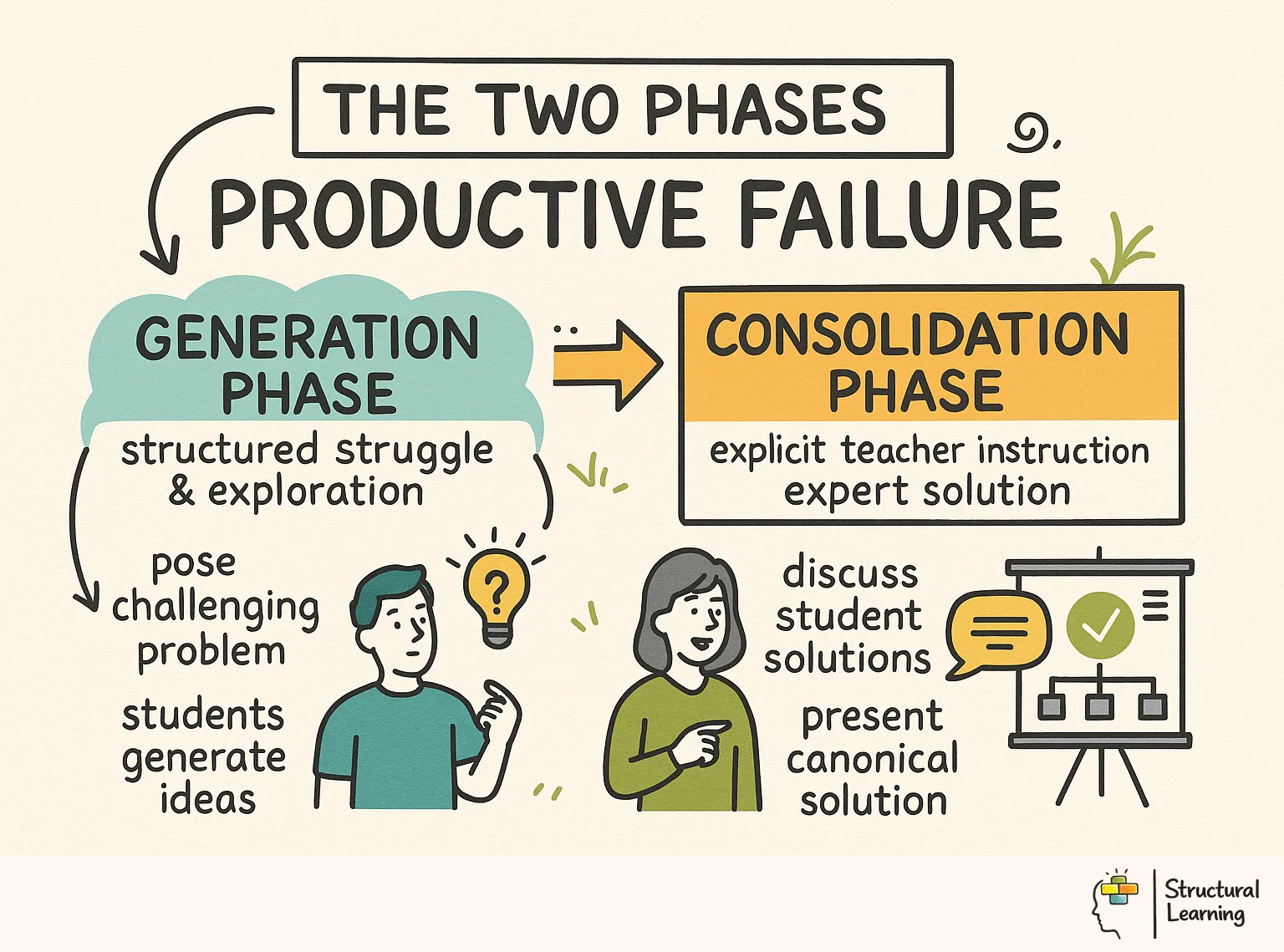
Productive Failure in Education: What Teachers Need to Know describes a two-phase teaching design. First, learners try a carefully chosen problem before explicit instruction. Then they compare their attempts with the expert method. The evidence is strongest when tasks are well structured and followed by teacher-led consolidation (Sinha & Kapur, 2021).
In practice, a Year 8 maths teacher might ask learners to invent a way to compare the spread of two data sets before teaching standard deviation. Some learners subtract the highest and lowest scores; others reason about distance from the mean. The later explanation lands because learners can see exactly what their first methods captured, missed and distorted.
Productive failure is a problem-solving before instruction model. Learners first try a demanding but accessible task using prior knowledge, then receive explicit teaching that connects their attempts to the formal concept (Kapur, 2008; Sinha & Kapur, 2021). The aim is not to leave learners stuck. It is to prepare them to understand why the later method works.
For example, a teacher might ask learners to calculate the area of a circle before providing the formula. Learners might try to fill the circle with squares or divide it into triangles. This struggle makes the eventually provided formula more memorable.
Kapur (2008) argued that learners can benefit from trying to solve a rich problem before being shown the method. The first attempt exposes the limits of their existing strategies. Teacher explanation then has a clear job: connect partial ideas, correct misconceptions and build transfer beyond copied steps.
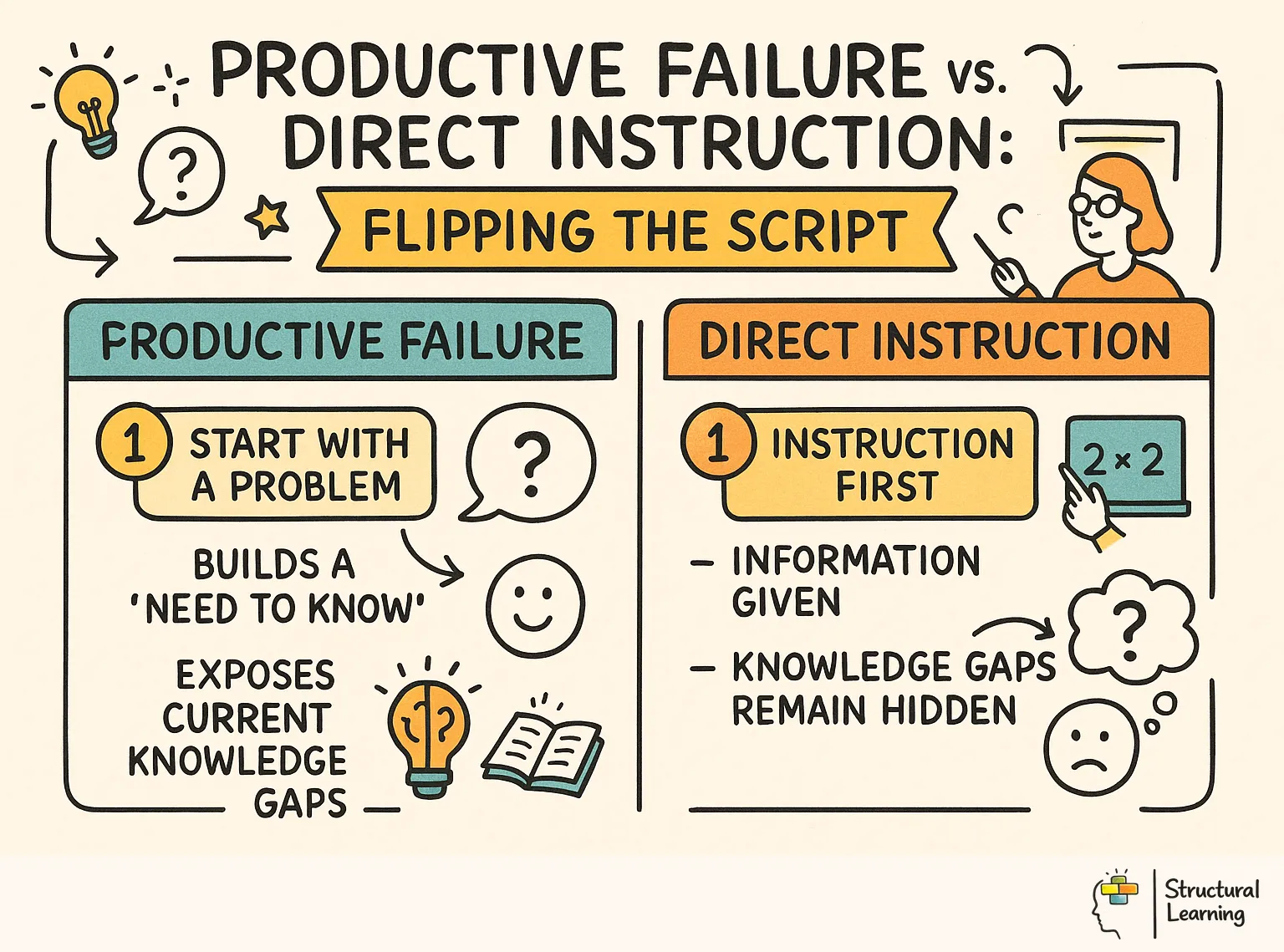
Experience productive failure first-hand. Try to solve the problem below WITHOUT any instruction first. Then see the method. Research shows this struggle improves learning.
From Structural Learning | structural-learning.com
Kapur and Kinzer (2009) studied maths learners tackling tough problems. Direct instruction helped learners on basic tasks. Productive failure learners showed better conceptual knowledge. This shows struggle helps learners engage deeply.
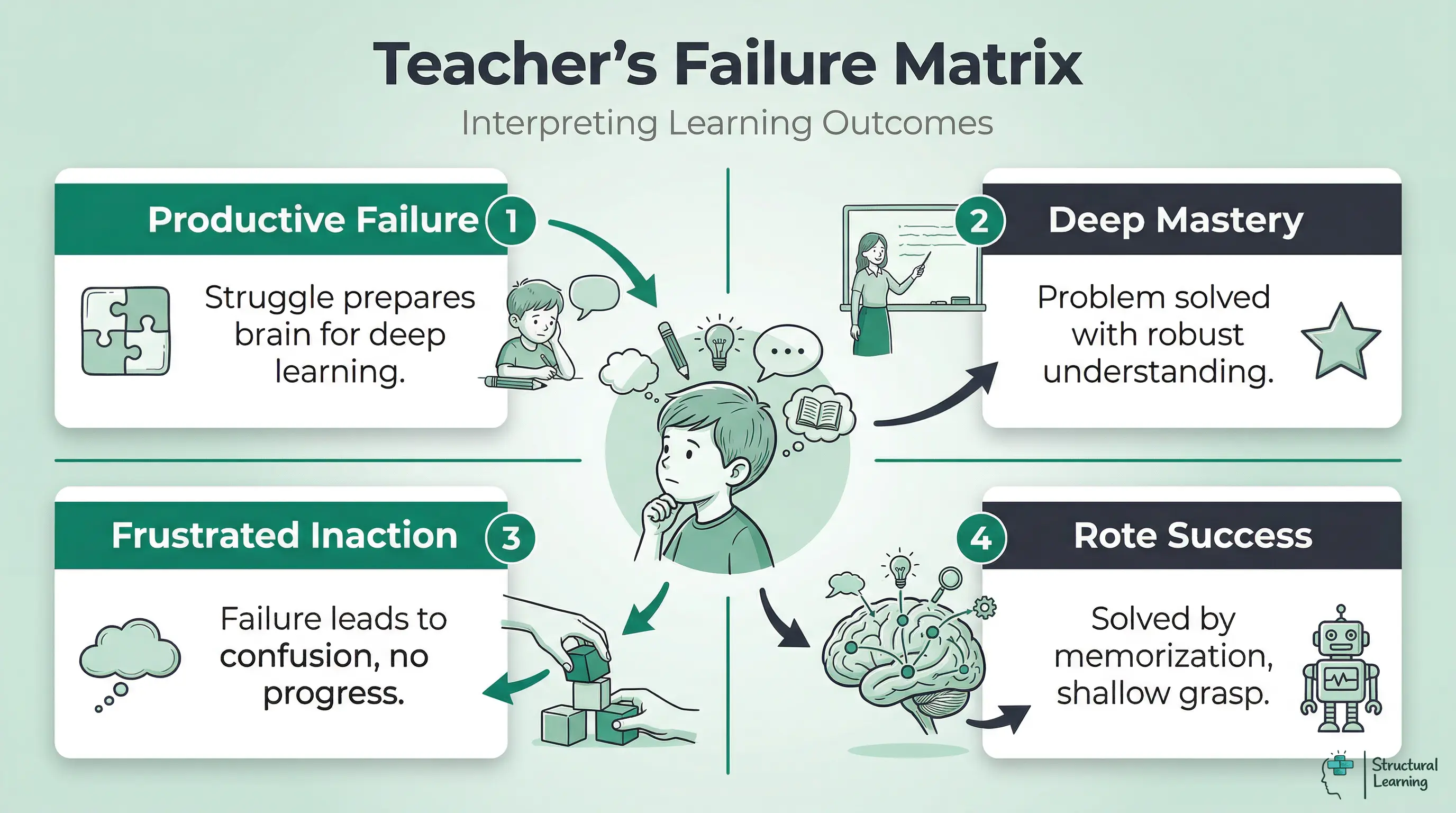
Kapur (2012) created a matrix for teachers to understand lesson outcomes. The matrix sorts lessons by how learners perform when generating and consolidating knowledge. Productive failure happens when learners initially struggle, but later grasp concepts well. This is unlike unproductive success, where learners solve problems fast but miss key learning (Kapur, 2012).
Sinha and Kapur (2021) provided the stronger review of evidence on problem-solving before instruction. They analysed 53 studies and 166 comparisons. They found a moderate benefit for conceptual learning, especially when lessons followed productive failure principles. Loibl, Roll and Rummel (2017) emphasise that generation works best when learners use relevant prior knowledge, then compare their ideas with the formal concept.
Teachers must shift from being providers of answers to designers of challenges. In a UK school, that shift also needs a clear learning-walk rationale. If an observer sees confused learners and a teacher holding back, the planned sequence must be visible: problem attempt, collection of learner strategies, comparison with the expert model and explicit consolidation.
In this strategy, the teacher presents a complex problem at the start of the lesson before any formal explanation. The teacher withholds worked methods at first, but still defines the task, success criteria and time limit.
Learners work in pairs to test possible solutions, even if they know their methods are incomplete. In a Year 8 Geography lesson on population density, for example, the teacher might give learners a map of an imaginary island and ask them to decide where a city should be built.
The teacher says, "I want you to try and figure out a way to measure which area is the most crowded. I haven't shown you the formula yet, so I want to see how you would invent your own way to show crowdedness." Learners might draw dots, use ratios, or create their own scoring systems. This process activates their prior knowledge of space and numbers. When the teacher later introduces the standard formula for population density, learners immediately see how it improves upon or confirms their own messy attempts.
Learners compare their ideas with expert methods. Teachers gather and anonymise learner work, then show the standard answer. Learners compare their work to the expert model, noting successes and areas for improvement (Schwartz et al., 2009; Loibl & Rummel, 2014).
The teacher challenged Year 10 learners to light three bulbs equally using one battery (Physics, electrical circuits). Learners created series and parallel circuits; some failed. The teacher showed a successful learner's design and a typical parallel circuit. Learners then discussed differences in electron flow, which helped them understand physics principles. (Researcher name and date were not included as they were absent from the original paragraph).
Teachers help learners use failure by managing four things. These are activation, awareness, affect, and assembly (Kapur, 2016).
Teachers give tasks that are simple to begin, but complex enough for learners to fail. They help learners see what they do not know, while staying positive. Finally, teachers link new teaching to the first attempt to help learners build knowledge.
In a Year 6 English lesson on persuasive writing, the teacher gives learners a letter written by a child asking for a later bedtime. The teacher says, "This letter is not working well. You can change only five sentences. Which changes would make it more convincing?"
Learners struggle to choose the highest-impact changes. After ten minutes, the teacher introduces rhetorical devices such as the rule of three and emotive language. Learners then apply the new tools to the exact sentences they had already tried to improve.
Teachers must check that their methods are evidence-based. Some think productive failure means learners solve problems alone. This is wrong. Use it as a starting point for professional discussion: identify the learner's current need, record evidence from more than one lesson, and agree the next classroom adjustment with the SENCO or family.
Discovery learning lacks guidance, so learners can build misconceptions (Mayer, 2004). Kirschner, Sweller and Clark (2006) argued that novice learners usually need explicit guidance. Productive failure includes explicit instruction.
A teacher might worry that failure will demotivate a Year 4 class during a science experiment on friction. To prevent this, the teacher frames the task as a puzzle to solve rather than a test to pass. This framing ensures learners focus on the process of discovery rather than the anxiety of getting the wrong answer. The goal is the cognitive activation that happens during the struggle.
The expertise reversal effect is better associated with Kalyuga, Ayres, Chandler and Sweller (2003). It means support that helps novices can become redundant or distracting for more expert learners. Productive failure has the opposite risk. For true novices, early struggle can become cognitive overload, so direct instruction should come first when they lack the background knowledge needed to make useful attempts.
For example, in a Maths lesson on standard deviation, a teacher might ask learners to invent a way to measure the spread of a set of scores. One pair subtracts the lowest score from the highest. Another pair measures how far each score is from the average. The teacher then introduces standard deviation as a formal way to calculate average distance from the mean.
In a Year 11 Biology lesson, the teacher provides a diagram of beetles on a dark background. Some beetles are light and some are dark. A predator is present in the environment. The teacher asks, "Over 100 years, what will happen to this population? Write down a step by step process of change."
During the instruction phase, the teacher introduces Darwin’s four steps: Variation, Inheritance, Selection, and Time. The teacher points to a learner's work that said the light ones get eaten. The teacher explains that the learner correctly identified selection. The learners then look at why their idea of deciding to change is different from the biological reality of inheritance.
A Year 7 History teacher wants to explore why the Normans won the Battle of Hastings. Before providing the traditional list of factors, the teacher gives learners a list of resources and conditions on the day of the battle. They ask learners to design a battle plan for both William and Harold. Learners struggle to account for the shield wall and the faked retreat.
When the teacher later tells the story of the battle, learners are highly attuned to the specific moments where their own battle plans would have failed. They understand the faked retreat as a tactical response to a problem they had just tried to solve themselves. This makes the concept of military leadership as a cause much more concrete.
In Year 10 English, the teacher provides the opening and closing paragraphs of a short story but removes the middle sections. The teacher asks learners to write a 200-word bridge that connects the two. Learners struggle to maintain the tone and resolve the conflict established in the opening. They find it difficult to plant the clues needed for the ending.
The teacher then introduces the concept of foreshadowing and structural shifts. They show how the original author used a specific recurring image to bridge the two sections. Learners compare their own plot points with the author’s subtle use of structure. The struggle to bridge the gap makes them appreciate the craftsmanship of the writer.

Productive failure is supported by several other key concepts in cognitive science. Use it as a starting point for professional discussion: identify the learner's current need, record evidence from more than one lesson, and agree the next classroom adjustment with the SENCO or family.
Research suggests that teachers can manage germane cognitive load with structured tasks. Teachers should structure tasks carefully (Sweller, 1988). This helps prevent cognitive overload when learners face open-ended prompts (Clark, Nguyen, & Sweller, 2006).
Bjork (1994) argued that certain 'desirable difficulties' can impair short-term performance while improving long-term retention and transfer. This focuses the learner's effort on new concepts, not recalling basic facts.
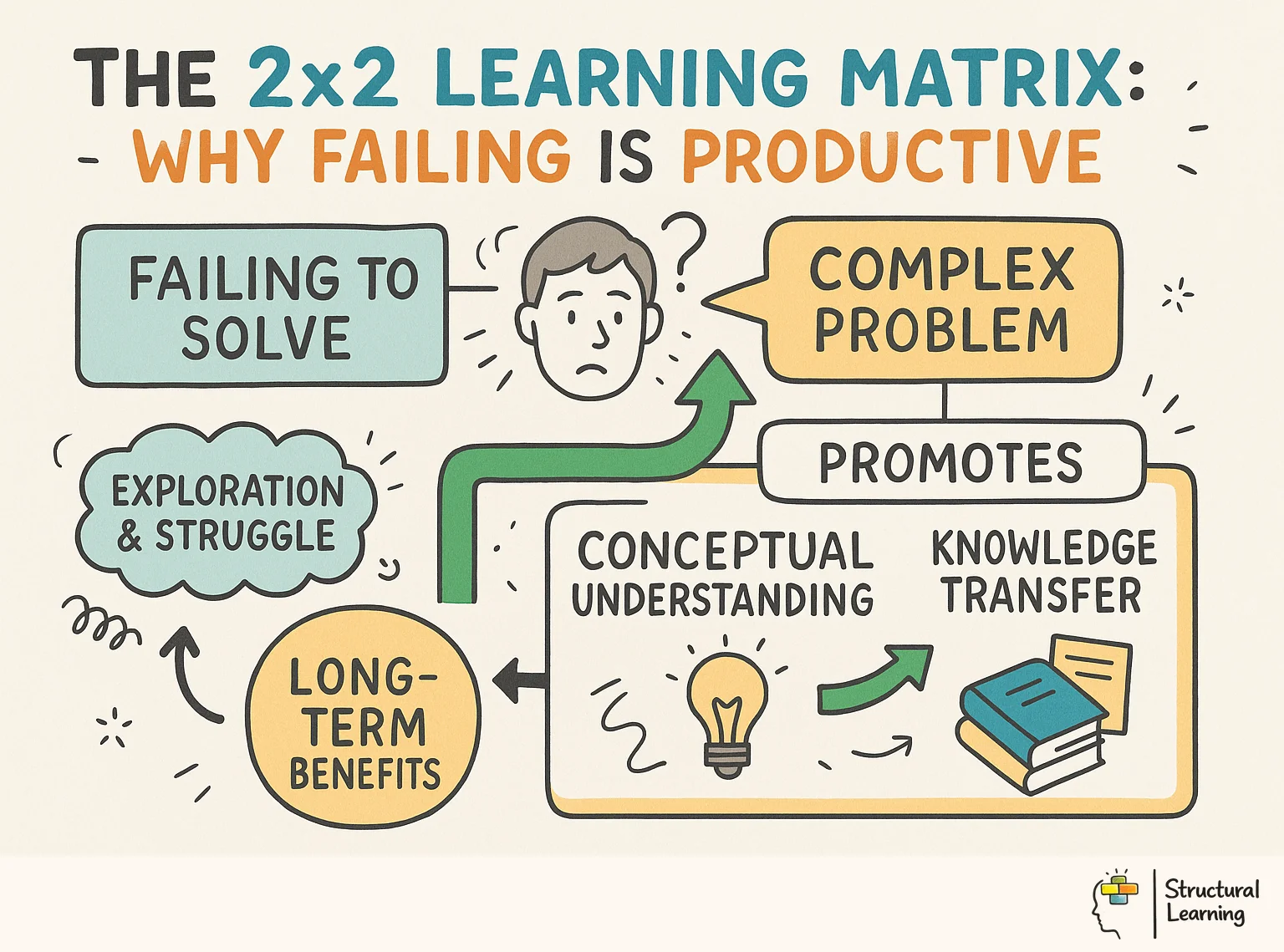
Productive failure supports learning when the teacher guides it well (Kapur, 2010). This teaching helps learners make sense of the struggle they faced.
Unproductive failure happens when learners are left to struggle alone. The teacher's role is to turn failure into a path towards understanding. For example, in Year 3 maths, explain that struggle helps brains grow.
Kapur (2008) showed that productive failure includes instruction, unlike discovery learning. Learners grapple with problems first, then teachers explain concepts. This structured struggle precedes formal teaching (Kapur, 2010; Loibl & Rummel, 2014). Teachers still provide expert guidance and the correct answer (Schwartz et al., 2011).
Avoid productive failure when learners have no prior knowledge of the domain, when the task is a simple procedure, or when the problem space is too open. It is strongest in structured maths and science tasks where learners can generate comparable representations. In humanities tasks, use tighter source sets, sentence stems or contrasting cases, otherwise the generation phase may produce confident misconceptions rather than useful readiness (Loibl, Roll, & Rummel, 2017; Sinha & Kapur, 2021).
Transparency is key. Tell learners they are trying a problem they are not expected to solve yet. Keep the struggle short, name the feeling of uncertainty, and move into consolidation before frustration becomes threat. For learners with anxiety, neurodivergent profiles or a history of public failure, use private rehearsal, pair talk and opt-out routes so struggle does not become shame.
Free for teachers. The platform builds a classroom-ready lesson plan from your topic in under two minutes.
Learners first try complex tasks without instruction, activating prior knowledge (Kapur, 2008). They then realise current strategies' limits (Loibl & Rummel, 2014). Teachers then provide methods; learning is more memorable (Schwartz & Bransford, 1998).
Teachers start lessons with tough tasks learners likely cannot solve (Kapur, 2008). Learners then find solutions alone or in pairs, using what they know. Next, teachers compare learner ideas to expert methods (Schwartz et al., 2011). This comparison shows why the expert approach works best (Loibl & Rummel, 2014).
Bjork and Bjork (2011) showed that productive struggle can support retention. Learners understand concepts better than with direct instruction alone. This struggle stops learners falsely believing they are competent (Kapur, 2016). Brown et al., (2014) found learners transfer skills to new situations easier.
Kapur's research shows that problem-solving before instruction can improve later conceptual learning. This works when the task is carefully designed and followed by teacher-led consolidation (Kapur, 2008; Kapur & Bielaczyc, 2012; Sinha & Kapur, 2021). The strategy is not unguided discovery: the teacher still connects learner attempts to the formal concept.
Learners struggle when tasks are too easy, too hard or too open. Unstructured tasks create frustration, not productive effort. Teachers should provide explicit consolidation after the generation phase and compare expert solutions with learners' work (Kirschner, Sweller, & Clark, 2006; Bjork, 1994).
Discovery learning allows learners to find answers alone, with limited help. Productive failure is structured and includes direct teaching (Kapur, 2008). Teachers explain the correct answer, linking it to learners' initial ideas (Loibl & Rummel, 2014; Roll, 2011).
In the AI era, teachers also need to protect the generation phase. If learners can paste the task into a multimodal AI tool and receive the method instantly, the productive struggle has been bypassed. Ask for sketches, first attempts, annotations or oral reasoning before any tool use, then use AI only after learners have committed to an approach (Lodge et al., 2023).
Yes, but the tasks must be appropriately scaled. For a Year 2 class, it might involve trying to figure out how to balance a see-saw with different weights before being taught about pivot points. The generation phase should be shorter, and the instruction phase should be more immediate to match their shorter attention spans.
Instruct learners on a complex concept in your next lesson. Allow them ten minutes to try a related problem using existing knowledge. Black et al. (1998) and Wiliam (2011) support this. Ask learners to identify knowledge gaps, as suggested by Sadler (1989).
Productive failure is not a general licence to let learners flounder. Kirschner, Sweller and Clark (2006) argued that novice learners need explicit guidance because unguided search can overload working memory. This matters in Year 7 maths, early reading, SEND support and any topic where learners lack schemas. The expertise reversal effect also cuts both ways: Kalyuga, Ayres, Chandler and Sweller (2003) showed that guidance can help novices but become redundant for more expert learners, so task sequence must change with prior knowledge.
The evidence base also has domain and method limits. Much productive failure research uses structured maths or science problems with clear representations and assessable transfer. Loibl, Roll and Rummel (2017) warn that problem-solving before instruction depends on design features such as prior-knowledge activation, contrast and consolidation. In poorly bounded humanities tasks, learners may generate plausible misconceptions rather than useful readiness.
There are cultural and affective limits too. Studies from Singaporean and other high-performing settings may not transfer neatly to classrooms where learners experience stereotype threat, public shame or low trust in school. Steele (1997) showed how identity threat can depress performance, and this risk is greater for anxious or neurodivergent learners when failure is made visible. In the AI era, instant tools can also remove the productive struggle unless teachers design tasks that require first attempts and reasoning traces (Lodge et al., 2023). Even with these limits, productive failure remains valuable when struggle is brief, structured, emotionally safe and followed by clear teaching.
Kirschner, P. (2006). Why minimal guidance during instruction does not work.
These sources replace the removed placeholder entries and are directly relevant to productive failure and problem-solving before instruction.
Theory grounded. Classroom workable. Free for teachers.
Open a free account and help organise learners' thinking with evidence-based graphic organisers. Reduce cognitive load and guide schema building as learners build schemas.