Attention and Learning: A Cognitive Science Approach
Examine how attention influences learning in classrooms and apply evidence-based strategies to enhance student focus and minimize distractions effectively.


Examine how attention influences learning in classrooms and apply evidence-based strategies to enhance student focus and minimize distractions effectively.
Attention and Learning: A Cognitive Science Approach explains how learners select, hold and use information. These processes shape what they remember. In cognitive science, attention is not just effort or quiet behaviour; it is a limited control system that filters sensory information, protects working memory and helps learners decide what matters. Kirschner (2006) argued that novices need clear instructional guidance because unguided discovery can overload limited working memory.
For a teacher, this matters when a learner tries to listen to an explanation while copying a diagram, checking a phone notification or watching a classmate move across the room. Each demand competes for the same limited capacity. Strong teaching reduces that competition through concise modelling, phone-free routines, worked examples and pauses that let learners rehearse key ideas before moving on.
Researchers have long studied attention as a way to select information (Posner, 1980). Attention helps learners focus on what matters by filtering out other stimuli. The brain receives too much sensory input to process everything (Broadbent, 1958).
Think of attention as a spotlight in a dark theatre. The spotlight illuminates only a small portion of the stage at any moment. What falls within the beam is visible; what falls outside remains in darkness. Attention works similarly, selecting certain information for conscious processing while the rest fades into the background.
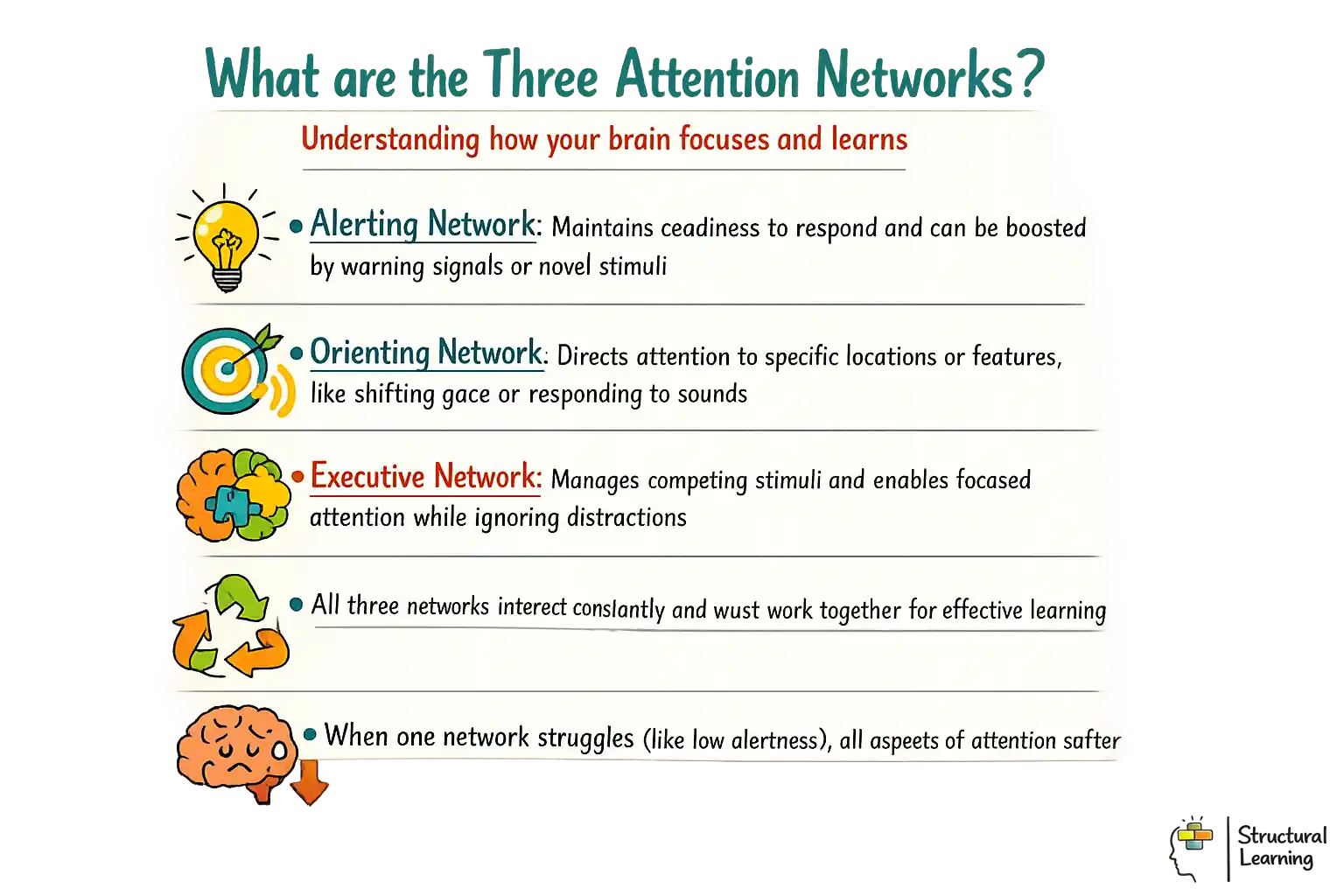
These systems include alerting, orienting, and executive control (Posner, 2004). Alerting helps learners get ready, while orienting helps them focus attention (Petersen & Posner, 2012). Executive control manages conflicts and helps learners plan actions (Diamond, 2013; Zelazo et al., 2016). Together, these systems help learners process information.
Michael Posner and his colleagues found three attention networks. The networks are linked, but each one has a different job.
The alerting network keeps learners ready to respond. Alertness changes daily, but warnings or new things can briefly boost it. Low alertness harms all areas of learner attention (Posner, 2008).
The orienting network directs attention to specific locations or features. When you shift your gaze to look at something, or when a loud sound captures your attention, the orienting network is at work.
Posner and Rothbart (2007) say the executive network handles conflicting stimuli and focusses attention. This system helps learners ignore distractions and concentrate on tasks. Learners with ADHD often struggle with this executive function.
These networks work together all the time. When learners are alert, they can focus on the teacher and use executive control to ignore distractions (Posner, 2004). When learners are tired, they may find it hard to keep attention (Kahneman, 1973; Hockey, 1993).
Researchers like Baddeley (1992) show that attention guides information into working memory. If learners do not focus, sensory input will not reach working memory. This blocks encoding and later learning (Gathercole & Alloway, 2008). Limited capacity and high load can harm learning (Sweller, 1988).
| Attention Type | Definition | Classroom Example | Support Strategy |
|---|---|---|---|
| Selective. | Focus on one stimulus. | Listening to teacher. | Reduce distractions. |
| Sustained. | Maintain focus over time. | Extended reading. | Chunked activities. |
| Divided. | rapid task-switching between demands, with a switch-cost each time attention moves. | Note-taking while listening. | Reduce demands. |
| Executive. | Control and regulation. | Ignoring distractions. | Self-monitoring training. |
These processes impact learning outcomes. Research by Cowan (1988) shows attention links closely to memory. It directly affects what learners store in working memory. Working memory keeps information active as learners process it.
Information must be attended to before it can be encoded into memory. This makes attention the critical first stage of learning. If learners aren't attending during instruction, they can't be learning, regardless of how well the material is presented.
Showing content is not enough for learning. Learners also need attention to take in new knowledge (James, 1890). Teachers help information stick when they draw learners in (Dewey, 1938). Use clear strategies that gain learner focus (Hattie, 2009).
Effective teaching works within learners' attention limits, as explained by cognitive load theory. When teaching overloads attention capacity, learning decreases (Sweller, 1988). Good lesson design reduces demands, so learners can process the key information (Clark, Nguyen, & Sweller, 2006).
Cognitive load uses attention, leaving less for learning (Sweller, 1988). Reduce extra load so learners focus on content (Mayer, 2009). Teachers can scaffold learning and lessen unneeded demands (Kirschner, Sweller & Clark, 2006).
Alerting keeps learners ready and watchful (Posner, 2012). Orienting directs focus towards stimuli, such as words, images, or sounds (Corbetta & Shulman, 2002). Executive control manages conflicts and helps learners keep their focus (Posner & Rothbart, 2007).
Teachers can design active learning that uses each attention system. This helps all learners, especially those with special needs.
Knowing how attention works helps teachers support learners with specific challenges. The right feedback can help learners focus, especially when teachers pair it with social-emotional support (James, 1890; Posner, 1980; Petersen & Posner, 2012).
Understanding attention mechanisms is important, but translating this knowledge into practical classroom strategies is where the real impact lies. Here are a few evidence-based techniques teachers can use to enhance learner attention and learning: *
Minimise Distractions: Create a learning environment free from unnecessary visual and auditory distractions. This could involve strategic seating arrangements, designated quiet zones, and clear classroom routines. Address sources of digital distraction proactively by setting clear expectations for device use. * Incorporate Movement: Brief movement breaks can revitalise the alerting network and improve focus. Consider incorporating activities that require learners to stand up, stretch, or engage in brief physical exercises. * Use Attention-Grabbing Hooks: Start lessons with engaging hooks, such as intriguing questions, surprising facts, or relevant anecdotes. This will activate the orienting network and capture learner interest from the outset. * Break Down Complex Tasks: Divide large, complex tasks into smaller, more manageable chunks. This reduces cognitive load and allows learners to allocate attention more effectively. Use techniques like chunking and progressive disclosure to ease the burden on working memory. * Provide Clear Instructions and Expectations: Ensure learners understand precisely what is expected of them. Ambiguous instructions consume attentional resources, leaving less available for learning. Provide clear, concise directions and check for understanding regularly. * Promote Active Learning: Engage learners in active learning activities, such as discussions, debates, and hands-on projects. Active participation requires sustained attention and promotes deeper learning. Project-based learning is a great example. * Teach Metacognitive Strategies: Explicitly teach learners metacognitive strategies for monitoring and regulating their own attention. Encourage them to identify distractions, practice mindfulness, and develop self-regulation skills. * Mindfulness Activities: Short mindfulness exercises such as deep breathing or body scans can help learners improve focus and reduce the impact of distractions. Mindfulness practices boost the executive control network and creates social-emotional learning skills. * Gamification: Incorporate game-based elements into lessons t o make learning more engaging and interactive. The novelty and challenge involved in gamification can help capture and sustain learner attention.
Free for teachers. The platform builds a working-memory-aware lesson plan from your topic in under two minutes.
Cognitive science shows that attention is key for learners. It filters what learners see and hear before it enters working memory. Without focussed attention at the start, learners cannot process information (Posner, 1980; Cowan, 2010). They also struggle to encode and remember it (Baddeley, 2007; Gathercole & Alloway, 2008).
Teachers can help learners focus by chunking lessons, reducing distractions, and using clear visual cues. These steps protect working memory and reduce unnecessary load (Baddeley, 2007; Gathercole & Alloway, 2008; Sweller, 1988). Teachers can also teach short self-monitoring routines. These routines help learners notice when attention has drifted and return to the task.
Attention and working memory work together. Learners must select information and keep it in mind before they can process it and store it. Without focus, material fades before learners can link it to prior knowledge (Baddeley, 1992; Cowan, 2010). Effective learning needs focused attention and a cognitive load that feels manageable.
The alerting network keeps learners ready (Posner, 2004). The orienting network directs focus (Corbetta & Shulman, 2002). The executive network helps ignore distractions (Miyake et al., 2000). Tired learners find it hard to coordinate these systems.
Many people wrongly think that presenting information means learners will absorb it. Teachers can overwhelm working memory when they give too much information at once (Sweller, 1988). Expecting constant attention without breaks can also hinder learning (Sousa, 2006; Jensen, 2000).
Cognitive science gives teachers useful constraints, but its evidence base can be narrower than classroom life. Many attention studies use short laboratory tasks, adult samples and tightly controlled stimuli. So findings may not transfer cleanly to noisy classrooms, group discussion or pastoral routines. Henrich et al. (2010) also warned that much psychology research relies on Western, educated samples, which limits claims across cultures.
Kirschner, Sweller and Clark's (2006) critique of minimally guided instruction is important, but it can be used too bluntly. Hmelo-Silver, Duncan and Chinn (2007) argued that well-scaffolded inquiry is not the same as unguided discovery. So the key question is how much guidance novices need at each point. A second limit is methodological: scores on attention or working memory tasks do not always predict durable classroom learning, and commercial executive-function training has shown weak far transfer in reviews by Sala and Gobet (2017, 2020).
There are also cultural and neurodiversity concerns. Rules that treat eye contact, stillness and quick compliance as proof of attention can misread autistic, ADHD or culturally diverse learners. Milton (2012) and Kapp (2020) show why listening and engagement cannot be judged by one visible posture. Even so, attention research helps teachers give clearer explanations, reduce avoidable distraction and protect working memory, while still leaving room for context, identity and professional judgement.
Kirschner, P. (2006). Why minimal guidance during instruction does not work.
Working-memory-aware. Schema-building built in. Free for teachers.