Implementing a Knowledge-Rich Curriculum
Knowledge-rich curriculum design builds schema and closes equity gaps. Learn evidence-based implementation strategies using cognitive science.


Knowledge-rich curriculum design builds schema and closes equity gaps. Learn evidence-based implementation strategies using cognitive science.
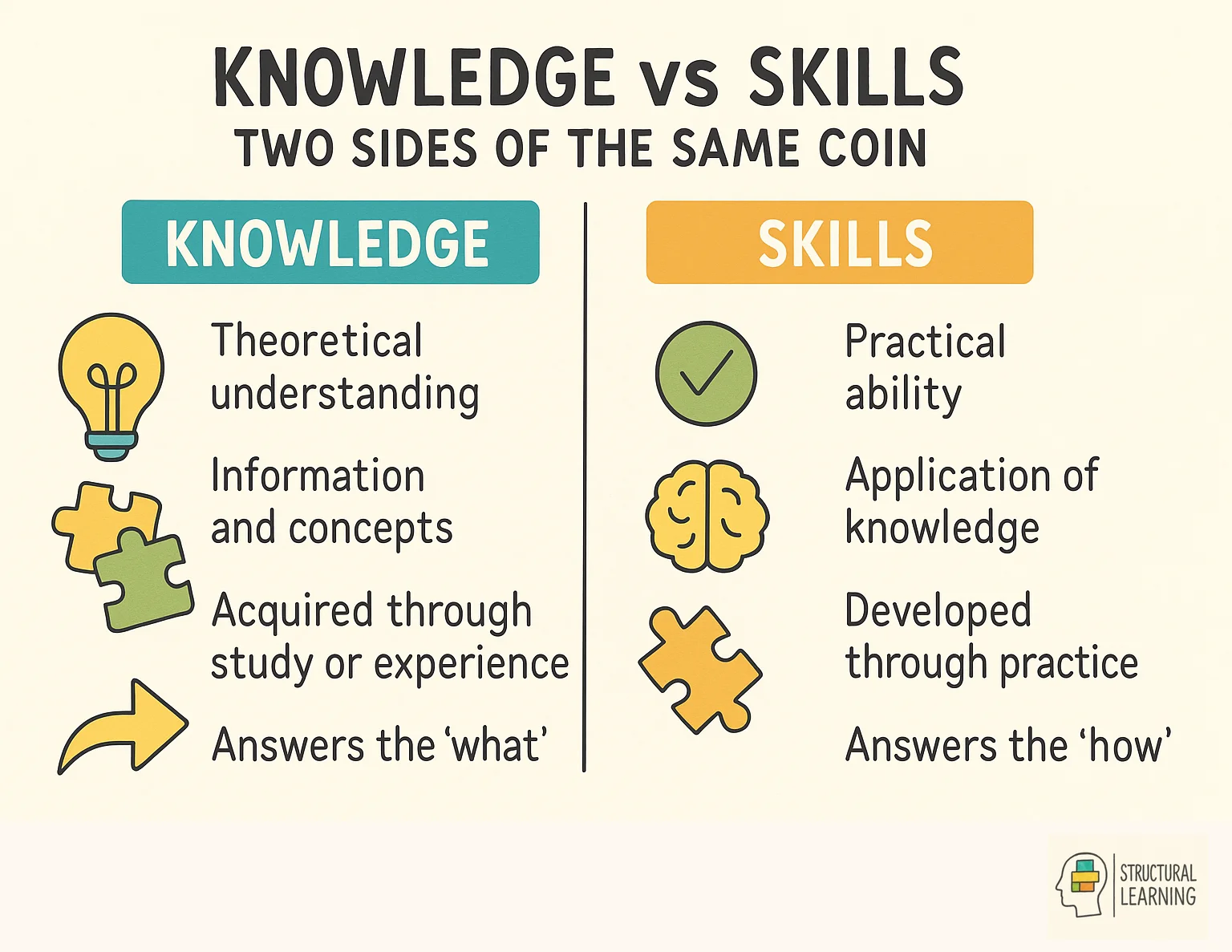
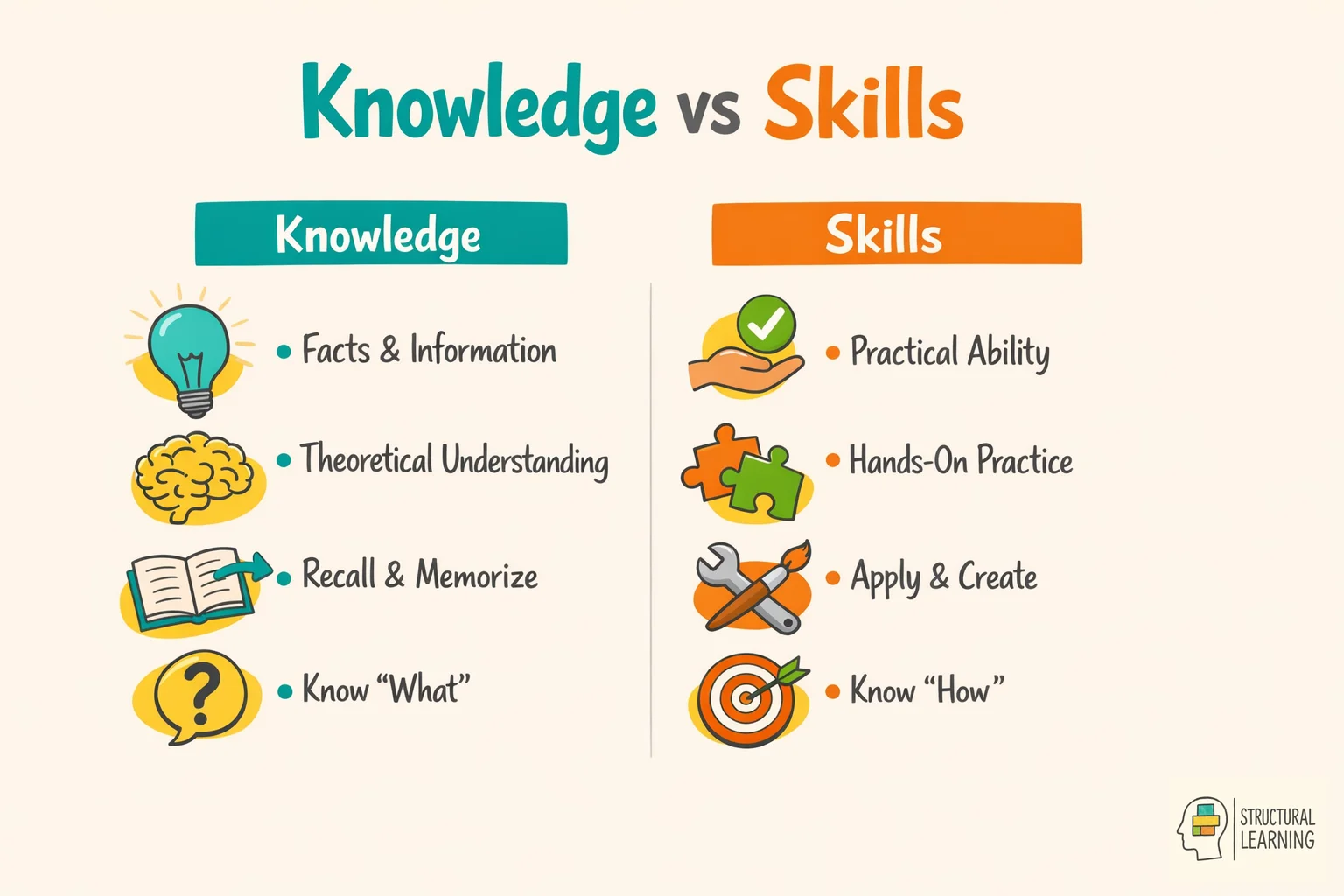
The outdated knowledge versus skills debate has become obsolete in 2025. We now understand that skills build knowledge and knowledge enables skills. They're two sides of the same coin, interdependent and inseparable. A student can't think critically without something to think critically about. You can't problem-solve in a vacuum.
This shift matters. Since the rise of the knowledge-rich curriculum movement under figures like Nick Gibb and Michael Young, we've seen political changes that raise new questions. Where does curriculum thinking stand now? What relevance does a knowledge-rich approach hold in an era of that can retrieve facts instantly?
| Aspect | Knowledge-Rich | Skills-Based | Integration Approach |
|---|---|---|---|
| Focus | Substantive knowledge | Transferable skills | Skills built on knowledge foundation |
| Content | Specified, sequenced | Flexible, student-led | Carefully selected powerful knowledge |
| Assessment | Knowledge retention | Skill application | Both knowledge and application |
| Teacher Role | Expert transmitter | Facilitator | Expert guide and facilitator |
| Memory | Long-term storage priority | Working memory focus | Build schema for thinking |
AI makes powerful knowledge more vital, not less. Learners need schemas to assess AI, find errors, and use data well. Limitations (Laurillard, 2002) remain. Mental models (Johnson-Laird, 1983) are still needed. Automation increases the value of real understanding (Bereiter & Scardamalia, 1993).
The intensity has shifted. Five years ago, knowledge-rich curriculum dominated every staffroom conversation. You couldn't escape it. Then came ChatGPT, Claude, and dozens of AI models. Some wondered if curriculum content still mattered when machines could answer any factual question. But here's what teachers discovered: AI tools work best for students who already possess deep. Without foundational understanding, students can't evaluate whether an AI response makes sense.
Evidence overview

Hirsch (2016) says knowledge-rich curricula detail what learners should know each year. This curriculum responds to those focussed only on general skills. As Young (2013) suggests, skills such as analysis need specific knowledge. Learners can't analyse war causes without key facts, figures and context, as suggested by Willingham (2009).
This makes teachers curriculum architects. We must intentionally design a coherent learning process that builds logically over years. It's not just about "doing the Romans." It's about specifying the essential knowledge, the vocabulary, concepts, and stories, that all students must master and remember.
Michael Young described this as powerful knowledge. Not random facts, but conceptual understanding that gives learners new ways to think about the world. This knowledge is often abstract, theoretical, and developed by subject specialists. It takes students beyond their immediate experiences into academic disciplines they might not otherwise access.
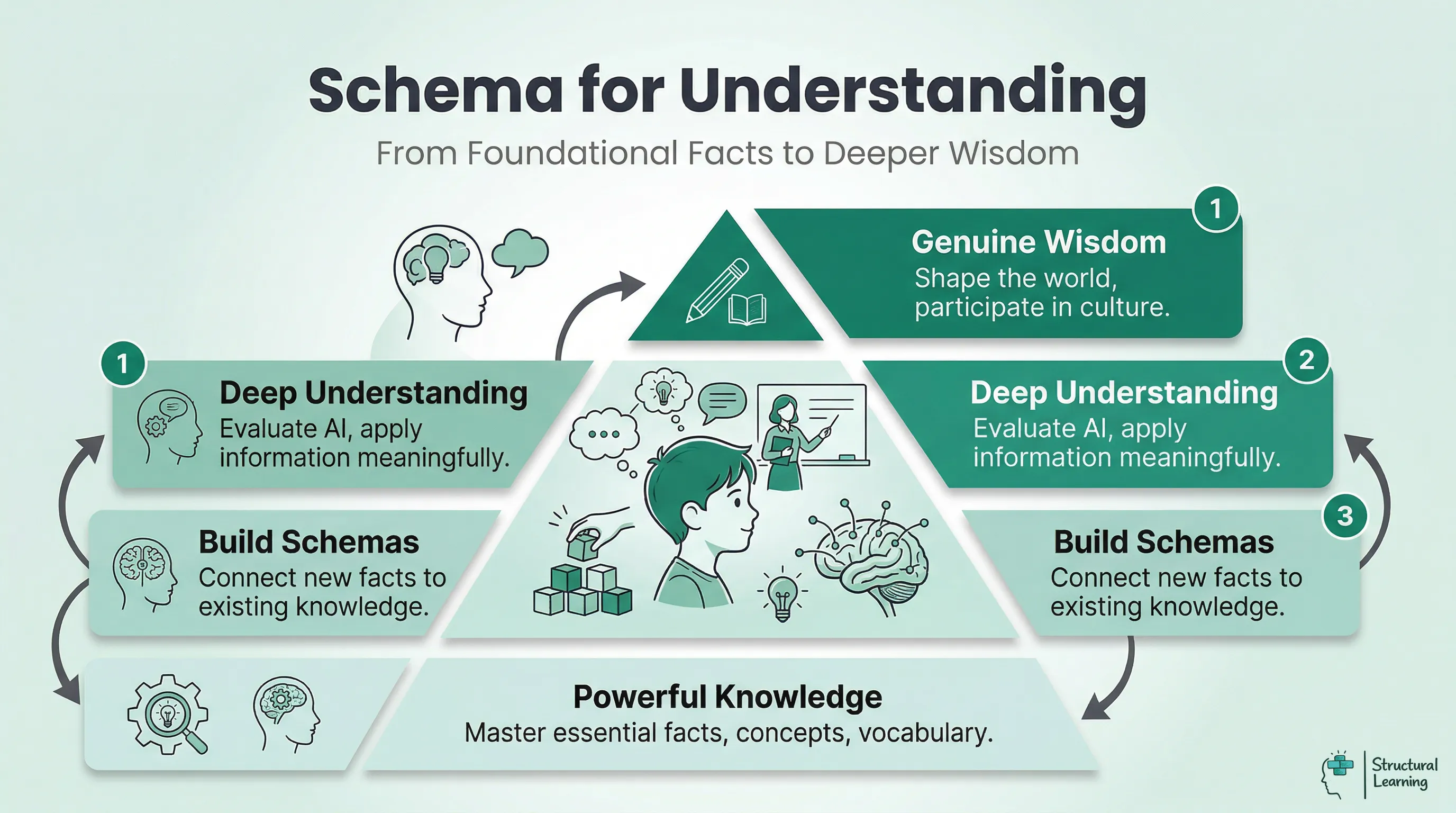
The curriculum itself becomes the primary driver of achievement, not a student's home background. This distinction matters for. Children in the highest socioeconomic group entering kindergarten have cognitive scores 60% higher than peers in the lowest group. A specified, shared curriculum aims to close this gap.
Cognitive science is crucial for lasting learning. We avoid fleeting "memorable experiences" (episodic memory). Instead, build flexible, durable knowledge (semantic memory). Use proven methods such as low-stakes quizzing (e.g., Roediger & Karpicke, 2006; Brown, Roediger & McDaniel, 2014).
The goal isn't turning students into pub quiz champions. It's about enabling every child with the powerful knowledge they're entitled to. This enables them to participate in the great conversations of our culture and develop the wisdom and compassion to shape their world for the better.

New learning builds on what learners already know. Learners with strong background knowledge understand new ideas more easily and can reason about them critically. Without prior knowledge, learners struggle to make sense of new material, and cognitive load on working memory can block progress (Willingham, 2009).
The goal is building coherent schemas in long-term memory. Research from cognitive science shows that forgetting curves are steep. Without reinforcement, learners forget 70% of new information within 24 hours. This isn't a flaw in student effort. It's how memory works.
Retrieval practice combats forgetting, say Roediger and Karpicke (2006). Ebbinghaus (1885) showed spaced repetition reinforces learning. Interleaving topics boosts recall, according to Rohrer (2012). Brown, Roediger, and McDaniel (2014) found these techniques build stronger learner memories.
From an equity perspective, curriculum specification is the most powerful intervention available. Students can't learn what isn't taught. By defining exactly what knowledge schools will teach, we create opportunities for all students regardless of home resources.
A concise Structural Learning audio episode on Implementing a Knowledge-Rich Curriculum, grounded in the curated research dossier and focused on practical classroom use.
Senior leadership teams need a systematic approach. Here's a practical roadmap:
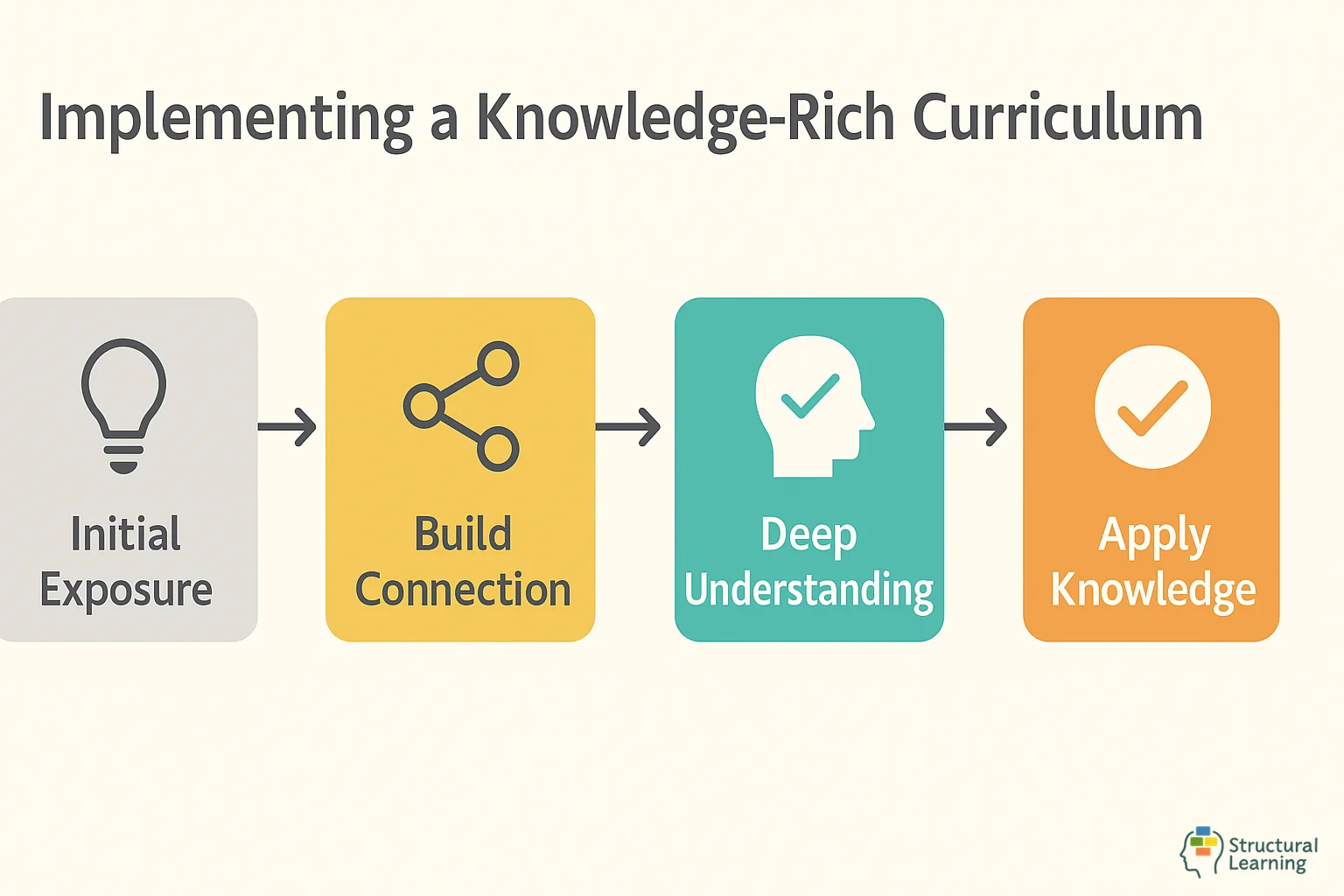
Start with the end in mind. What should students know and be able to do when they leave your school? Map the pinnacle concepts, principles, and debates that define each subject. Don't stop at National Curriculum topic headings. Specify the granular knowledge required.
Instead of "The Romans," define key concepts like republic and empire, the significance of the Punic Wars, and reasons for Western Roman Empire decline. This detail ensures every teacher understands the non-negotiable content.
Arrange knowledge so each piece builds on what came before. Curriculum design isn't a disconnected list of facts. It's a narrative where prior learning prepares students for what comes next.
Consider both chronological and conceptual logic. History often follows chronological order. Science might teach cells before tissues and organs. Plan vertically across year groups and horizontally across subjects within each year. The aim is a compelling story of learning that makes knowledge easier to retain and apply.

Knowledge organisers recap a unit's core content. They include key vocabulary, important dates and crucial facts. Diagrams and concepts help learners remember (Willingham, 2009). Use them to aid learning (Sweller, 1988; Mayer, 2009; Clark, Nguyen, & Sweller, 2006).
These tools serve multiple purposes. For teachers, they ensure clarity and consistency. For students, they provide a clear overview supporting independent study. For parents, they offer a window into their child's learning. Remember, they're not the curriculum itself but a tool supporting it.

Brilliant curriculum documents fail if content doesn't reach long-term memory. Build retrieval practice into every lesson. Low-stakes quizzing should become routine. Space out practice sessions. Mix topics within practice.
Formative assessment is key. Regularly check learner understanding and find mistakes. Adjust teaching based on feedback. Use questioning, mini-whiteboards, and exit tickets. These approaches reveal how learners connect new knowledge to existing knowledge (Wiliam, 2011; Black & Wiliam, 1998).
The most crucial element is deepening teacher expertise. Schools must provide time for teachers to read, research, and collaborate with subject peers. Professional learning should also focus on cognitive science principles. Teachers need to understand why strategies like retrieval practice work.
Leaders prioritise curriculum development. They ensure time for joint planning and subject training (Stoll et al., 2006). Invest in good resources and professional growth (Hattie, 2008). This shows deep learner knowledge is key (Wiliam, 2018).
Summative assessment should check more than facts. Design tasks testing key knowledge understanding. Learners can write essays linking ideas. They can analyse sources using background, or solve problems applying what they learned.
The assessment should reveal schemadepth and coherence, not just isolated fact memorisation. A 2023 study found students in schools using knowledge-rich sequences scored 16 percentile points higher on state tests than peers. The evidence suggests this approach works.
The Colorado charter network reportedly improved by 16 percentile points, with researchers cautioning that the curriculum's effect could not be cleanly isolated from other school factors (University of Virginia REACH Center, 2023). For UK context, the Education Endowment Foundation's English Mastery evaluation offers a closer comparator for knowledge-rich learner progress.
The Thinking Framework acts as an insurance policy. It ensures children actually develop knowledge by thinking it through at deeper levels. The 30+ thinking skill cards grouped in five coloured categories give teachers a cognitive menu for planning, questioning, and assessment.
Anderson and Krathwohl (2001) found active use builds stronger learner schemas. Learners process knowledge deeply when they extract, categorise, explain, and connect ideas. This deeper processing improves how well learners retain knowledge (Marzano, 2001).
Graphic organisers help children generate their own ideas, leading to deeper knowledge. Templates like Fishbone, Cycle, Flow-chart, and Diamond 9 provide visual structures for thinking. They're not just note-making tools. They're thinking maps that scaffold how students organise information.
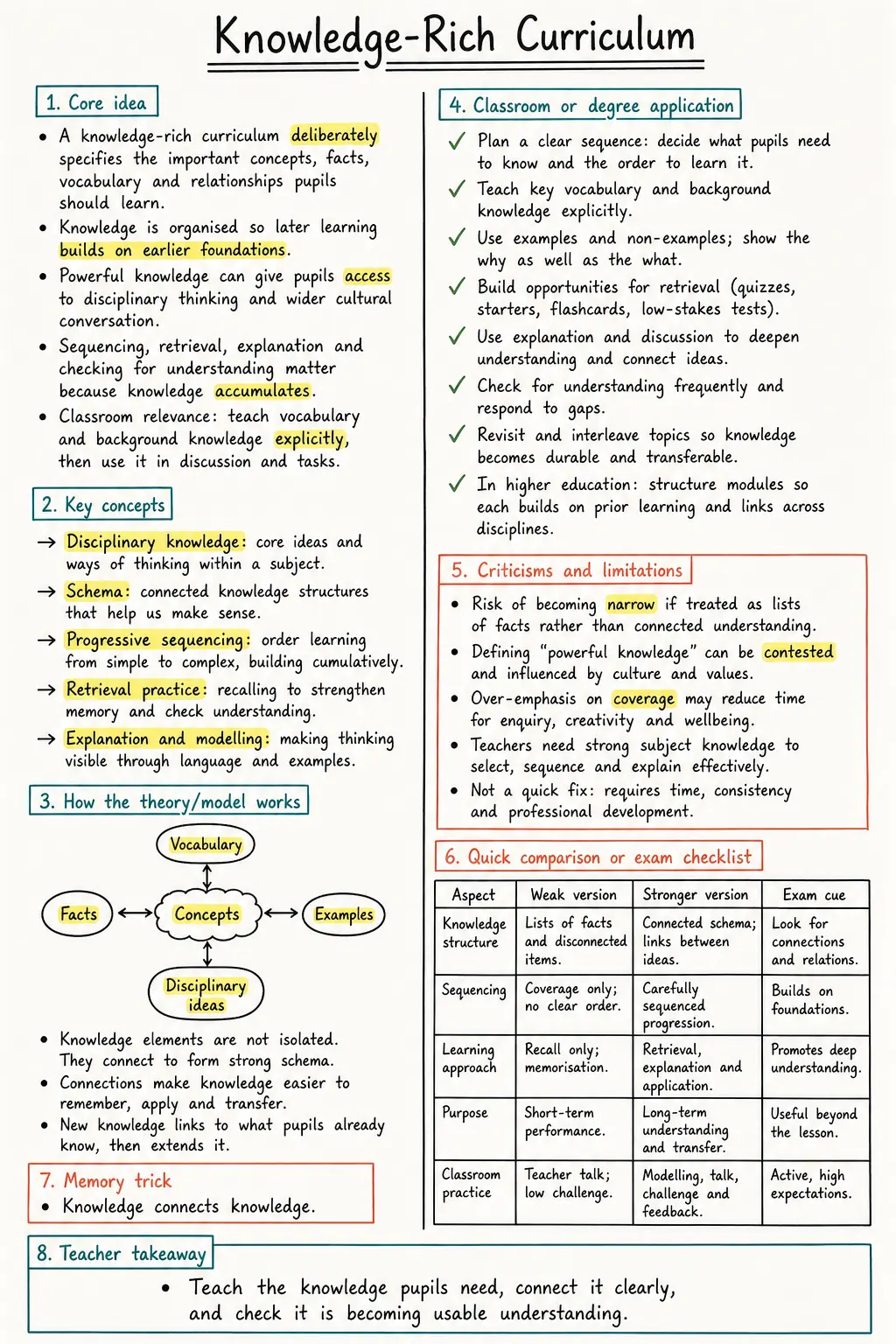
Download a one-page study note for Knowledge-Rich Curriculum, with the key ideas, limitations and classroom links in one place.
Writer's Block helps learners grasp subject knowledge. Whiteboard blocks let them physically build sentences and map ideas. Learners handle concepts and rearrange connections. This hands-on approach builds understanding (Fisher & Frey, 2014).
This isn't one or the other. Skills build the knowledge. The tools work together to ensure curriculum content moves from teacher explanation into student understanding and finally into durable long-term memory.
Early years learners need knowledge-rich curricula. Hirsch (2016) argues their knowledge differs from older learners. Systematically introduce vocabulary and cultural knowledge. Willingham (2009) and Christodoulou (2014) find these basics boost later learning.
Early years practitioners should specify the knowledge children will encounter. This includes core vocabulary around emotions, quantities, colours, and shapes. It includes stories, rhymes, and songs that build cultural capital. It includes basic scientific concepts like floating, sinking, and growing.
The sequencing matters here too. Continuous provision should build cumulatively. Each week's activities connect to previous learning while introducing new concepts. Knowledge organisers work in early years when adapted to visual formats with fewer words and more images.
Early years retrieval means regularly revisiting songs, stories, and rhymes. Ask learners to recall yesterday's learning. Use consistent vocabulary across contexts. Spacing and interleaving happen via planned provision with themes of increasing complexity. (Rohrer, 2009; Brown et al., 2014)
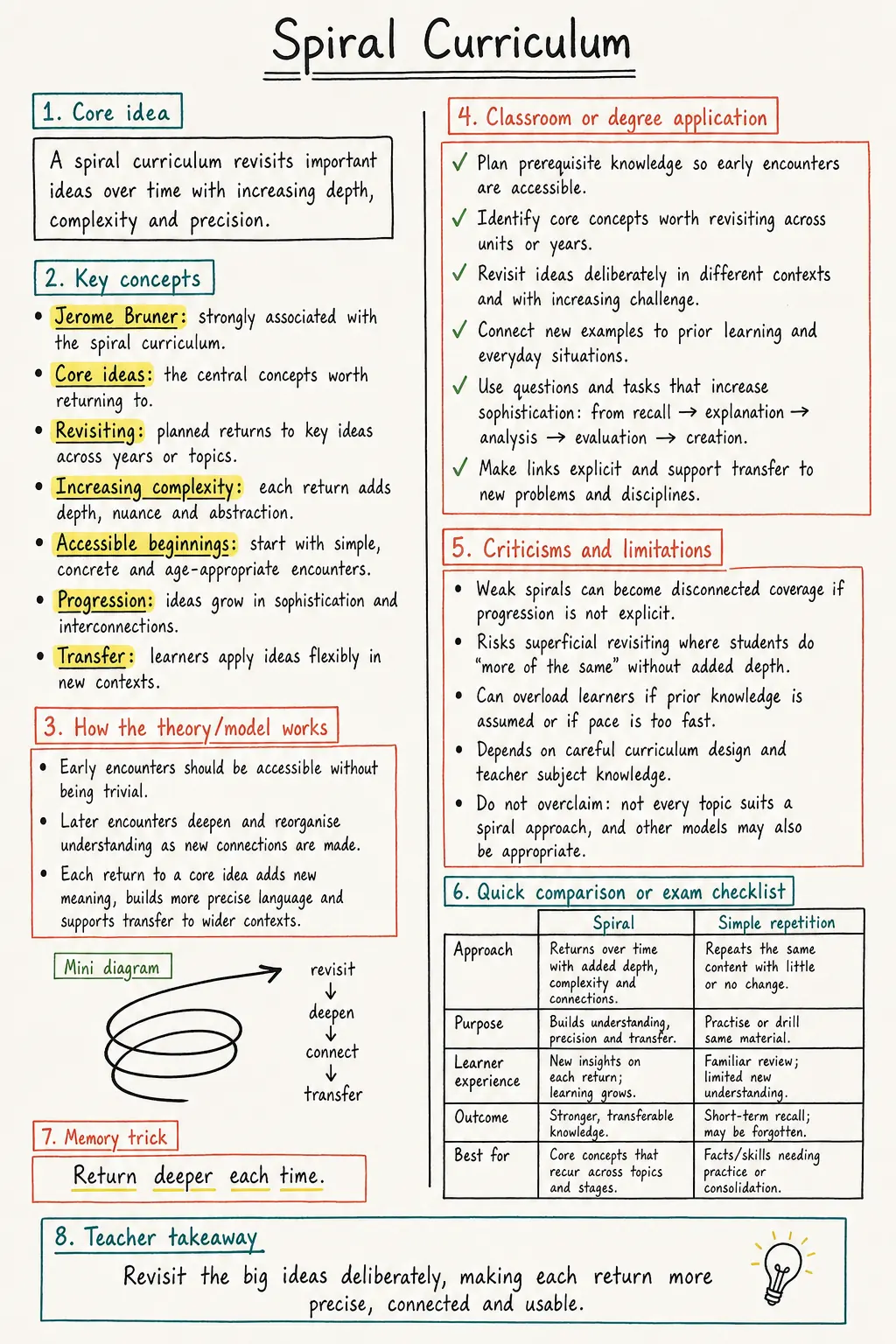
Download a one-page study note for Spiral Curriculum, with the key ideas, limitations and classroom links in one place.
Researchers have shown that metacognition starts young. Even little learners can say what they know and learn. Simple self-checks and thinking about thinking help early development (e.g. Flavell, 1979; Veenman et al., 2006; Dunlosky & Metcalfe, 2009). Teaching vocabulary explicitly also supports this.
John Flavell (1979) first described metacognitive knowledge. Barry Zimmerman's (2002) self-regulated learning model helps us teach these crucial skills to every learner. This framework supports their development.
Evidence shows a vocabulary gap at age three. (Hart & Risley, 1995) Knowledge-rich teaching reduces this gap for all learners. Early exposure to rich language supports every learner's understanding.
The forgetting curve presents a challenge. Students forget most new information quickly without strategic reinforcement. This isn't laziness. It's neuroscience.
remains the most powerful tool. Quiz students regularly on previously learned material in low-stakes contexts. The act of pulling information from memory strengthens the memory trace. Make it easier to recall in future.
revisits content at increasing intervals. Don't teach a topic once and move on. Return to it a week later, then a month later, then a term later. Each revisit strengthens the memory.
mixes different topics within practice sessions. Don't mass practice on one topic. Mix topics so students must discriminate between different types of problems and concepts. This builds more flexible, transferable knowledge.
Misconceptions claim knowledge-rich curricula stop independent thought, but the reverse is true. Knowledge is the raw material for metacognition, (Willingham, 2009). Learners with secure knowledge possess the mental architecture to think about their own learning (Bjork, 1994; Dunlosky, 2013).
Teachers develop this by explicitly teaching how memory works. Show students strategies like retrieval practice for effective study. Knowledge organisers become tools for self-quizzing. By giving students a clear map of what they need to know, we enable them to take ownership of learning, identify gaps in understanding, and become more effective independent learners.
Flavell (1979) and Nelson (1990) found metacognition includes planning, monitoring and evaluating learning. Dochy et al. (1999) showed learners use subject knowledge to plan tasks better. Winne & Hadwin (1998) found they use it to monitor understanding, and Zimmerman (2000) to evaluate learning.

In a knowledge-rich classroom, the teacher acts as expert, guiding students through complex new material. Explicit instruction, where the teacher clearly explains concepts, models processes, and provides gu ided practice, is the most efficient way to transmit new knowledge and build foundational understanding.
This approach places high value on teacher subject expertise. A teacher with deep knowledge of their discipline can craft compelling narratives, make insightful connections between concepts, and anticipate common misconceptions. They move beyond surface level to bring content to life, inspiring curiosity and developing genuine love of the subject.
Rosenshine's Principles (Rosenshine, 2012) support knowledge-rich lessons. Teachers should review prior learning each day. Present new content in small, manageable steps. Question learners and check their understanding. Offer models and worked examples to guide them. Provide extensive guided practice before independent tasks.
The false dichotomy between knowledge and skills has wasted countless hours of professional development time. Critical thinking is not a generic, transferable skill. One thinks critically with something. A student with deep historical knowledge analyses sources more critically than one without.
The curriculum aims to grow subject-specific thinking. It combines core knowledge with vital skills. Historians think differently than scientists do. Mathematicians solve problems differently from poets. Learners develop these thinking methods through engagement with knowledge (Willingham, 2009; Young, 2013).
Skills also build knowledge. When students use graphic organisers to categorise information, they're using a skill that deepens their knowledge. When they practice retrieval, they're using a skill that strengthens knowledge. When they engage in structured classroom dialogue, they're using oracy skills that clarify and extend their understanding.
Knowledge-rich curricula face rote learning criticisms. This misunderstands the method. Deep understanding for learners is the aim. Factual recall is the start, not the end (Hirsch, 2016).
Careful sequencing, schema building and narrative connect knowledge for learners. Teachers should use questions and tasks that move learners beyond recall to applying, analysing and synthesising. Anderson and Krathwohl's (2001) revision of Bloom's Taxonomy provides one well-known scaffold for designing these tasks.
Deliberate practice helps learners progress. This needs focused effort and AI feedback (Ericsson, 1993). It’s not just repeating tasks (Brown et al, 2007). Learners actively apply knowledge, increasing task difficulty (Ambrose et al, 2010).
Researchers (Young, 2023; Hirsch, 2016) say all learners deserve access to ambitious knowledge. Curriculum scope should not be reduced with AI for any learner. Careful curriculum design promotes knowledge access for all (Christodoulou, 2017).
Instead, achieve differentiation through expert scaffolding and support. This might involve pre-teaching vocabulary, providing graphic organisers to structure thinking, or breaking complex ideas into smaller steps. The ambition remains high for all students. The support to get there is tailored.
Students with SEND often struggle most when curriculum content is vague or generic. Clear specification of knowledge, explicit teaching, and structured support give these students the best chance of success. High expectations combined with strong scaffoldingis the most equitable approach.
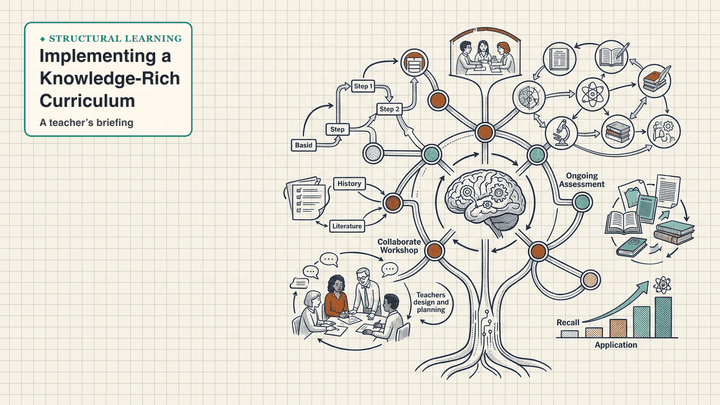
Implementing a Knowledge-Rich Curriculum in practice — a classroom-ready briefing you can use this week.
Young (2013) notes new teachers need to implement knowledge-rich instruction effectively. ITT programmes should give new teachers curriculum theory and cognitive science knowledge. This supports them to create knowledge-rich lessons and develop teaching skills (Willingham, 2009; Christodoulou, 2014).
Department for Education figures show recent year-on-year variation in postgraduate trainee numbers; the figures are tracked in the official Initial Teacher Training Census. Trainee numbers fluctuate, but well-designed training remains effective. Once in school, a robust induction programme coupled with ongoing mentoring from experienced subject experts helps early career teachers translate theoretical understanding into confident classroom practice.
Instructional coaching aids continuous growth. Observation, feedback, and planning help teachers improve their methods. Focus on subject knowledge and making direct instruction more effective (Joyce & Showers, 1982; Knight, 2007).
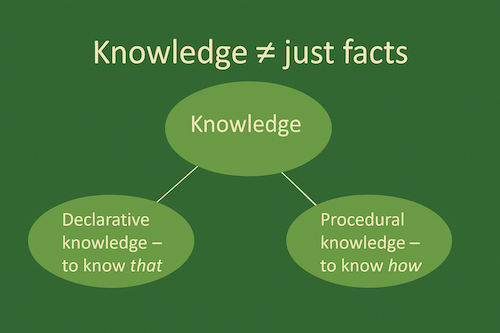
Knowledge-rich curricula require work but are worthwhile. They give learners intellectual tools to understand the world and discuss complex ideas. This helps academic success (Hirsch, 2016). It reduces inequality and boosts opportunities for learners.
Teachers who use research improve their skills. They focus on what they love teaching and good methods. Working together builds knowledge for the learners (Cochran-Smith & Lytle, 1999).
This isn't about reaching a final, perfect curriculum. It's a commitment to continuous cycles of design, implementation, and refinement. It's a active process of school reform, driven by a clear vision of what constitutes truly enabling education.
By placing powerful knowledge at the heart of their work, schools can build a lasting foundation for learning. This equips every student with understanding and confidence to thrive. In 2025 and beyond, as AI reshapes how we access information, the case for a knowledge-rich curriculum becomes stronger. Students need robust mental models, not just facts. They need deep understanding, not surface memorisation. They need powerful knowledge that transforms how they see and interact with the world.
Researcher Hirsch (2016) says knowledge-rich curricula specify what learners should know. They sequence knowledge for schema building and use retrieval practice (Brown et al., 2014). These methods help learners store knowledge in long-term memory. This approach is more intentional and based on research than unplanned topic teaching.
Q: Won't this stifle creativity and critical thinking? A: No. Knowledge is the foundation for creativity and critical thinking. You can't think critically without something to think critically about. Students with deep knowledge can apply it creatively and evaluate ideas more effectively than those with surface understanding.
Set ambitious knowledge goals for every learner. Support them through scaffolding, not by simplifying content. Pre-teach vocabulary, use graphic organisers, and break down complex ideas. This approach, advocated by (Hirsch, 2016; Willingham, 2009), maintains high expectations for all.
Free for teachers. The platform builds a classroom-ready lesson plan from your topic in under two minutes.
Knowledge-rich curricula face challenges (various dates). Researchers question assumptions in curriculum design. These papers give teachers insights, helping them rethink access for learners.
Rudolph, Sriprakash, and Gerrard (2018) challenge powerful knowledge's neutrality. They show its colonial roots. They urge curriculum design to include racial justice within subjects.
Robert Eaglestone (2020) claims scientific models distort English teaching. He believes this approach neglects specific knowledge domains. This harms subjects such as literature in the curriculum.
Deng (2022) says knowledge-rich curricula help learners develop. He criticises strict plans reducing subject leader impact. This boosts specific skills, helping learners thrive.
Sleeter (2016) challenges rigid standardised curricula. She argues classrooms should balance subjects with culturally responsive content. This helps address cognitive and achievement gaps in the learner (Sleeter, 2016).
Priestley and Philippou (2019) review critiques of powerful knowledge. They call for subject leaders to engage more in curriculum making. This should value educational practice and learner knowledge content.
A knowledge-rich curriculum defines essential content across years. Learners need specific knowledge before developing skills like analysis (Hirsch, 2016). Rather than generic skills, learners gain 'powerful knowledge'. This helps them think differently about the world beyond their lives.
Specify core concepts, principles and debates in each subject. Go beyond topic headings to identify the precise knowledge every learner needs. Sequence knowledge carefully so each piece builds on the last. This builds coherent schemas in each learner's long-term memory (Kirschner, Sweller & Clark, 2006).
Knowledge organisers recap a unit's core content on a single page. They highlight key vocabulary, dates and facts that learners need to commit to long-term memory. Used well, they support independent study, help teachers stay consistent and offer parents a window into the curriculum. They are a tool that supports the curriculum, not a replacement for it.
Learners forget 70% of new information in 24 hours without reinforcement. Broad background knowledge helps learners process information better. This frees up space for higher-order thinking. Retrieval practice, spaced repetition, and interleaving help learners remember. These strategies, like those suggested by researcher findings, build lasting knowledge.
A knowledge-rich curriculum details essential learning. This gives all learners access to vital knowledge, regardless of background. Research shows socioeconomic gaps exist when learners start school (Hart & Risley, 1995). Curriculum specification then becomes a key tool for equity.
Learners need strong knowledge to assess AI, not less, said research. They must spot errors and use info well. Without subject knowledge, learners cannot judge AI or use tools for learning.
Teachers need time for reading and subject collaboration; this is crucial. Professional learning should build subject knowledge and cognitive science understanding. Teachers then grasp why retrieval practice and spaced repetition aid long-term learner retention (Bjork, 1992; Karpicke, 2008).
Select your subject and key stage to see the top five EEF-ranked strategies with subject-specific examples and key researchers.
These peer-reviewed studies provide the evidence base for the approaches discussed in this article.
Researchers are adapting a long-term nutrition and activity plan for a rural community. This biethnic, low-income area will benefit, according to the View study ↗ 35 citations.
E. Belansky et al. (2006)
The paper explores nutrition curriculum challenges in the US. Teachers can adapt strategies from this work to local settings. Consider for tailoring knowledge to meet each learner's needs.
Project-based work joins curriculum, teaching, and assessment. Grant and Branch's (2005) case study looks at one experienced teacher. Examining this lets teachers connect these areas better, as shown by research. Thomas' (2000) work supports using projects.
A. Petrosino (2004)
Project-based learning links curriculum, teaching and assessment. Teachers planning projects can learn from this case study. showed learning objectives must match assessment.
Curriculum design and classroom use sometimes differ. Research shows this in tech-based maths lessons (View study ↗ 20 citations). Prensky (2001) discussed "digital natives." Selwyn (2010) added important cautions. Understanding these issues helps every learner. See also work by Hoyles (2018) and Lagrange (2019).
A. Clark-Wilson & C. Hoyles (2019)
Clark-Wilson et al (2018) and Hennessy et al (2022) found curriculum enactment issues with maths teachers. This research explores curriculum design against classroom practice using technology. Think about these challenges when implementing knowledge-rich curricula with tech.
Saudi teachers describe how an integrated curriculum approach affects Arabic language learning. The paper draws on Bandura's (1977, 1997) self-efficacy theory and related teacher-belief studies to argue that what teachers think they can achieve in their classrooms shapes what learners actually learn.
A. Alfayez (2022)
The wider lesson for UK teachers is that teacher confidence and subject knowledge sit alongside curriculum design. Strong subject knowledge supports clearer explanations and better questioning when teaching a knowledge-rich curriculum.
Indonesian teachers describe how they adapt the national Merdeka Curriculum when teaching English. The study traces the learning steps teachers move through as they interpret the new specification, identifies areas where learners need most support and discusses classroom strategies that emerged in practice.
Helmia Latifa et al. (2023)
The Merdeka curriculum study in Indonesia looks at how English learners progress under a centrally specified curriculum. UK teachers can compare its approach to a knowledge-rich curriculum here. The takeaway is consistent: clearly defined learning steps support effective learning.
Mapped to the curriculum. CPD-aligned. Free for teachers.
Open a free account and help organise learners' thinking with evidence-based graphic organisers. Reduce cognitive load and guide schema building dynamically.