Updated on
September 9, 2026
Forest Schools
Forest Schools build confidence and behaviour through regular outdoor learning in nature. An evidence-based approach for development and SEND needs.

Updated on
September 9, 2026
Forest Schools build confidence and behaviour through regular outdoor learning in nature. An evidence-based approach for development and SEND needs.
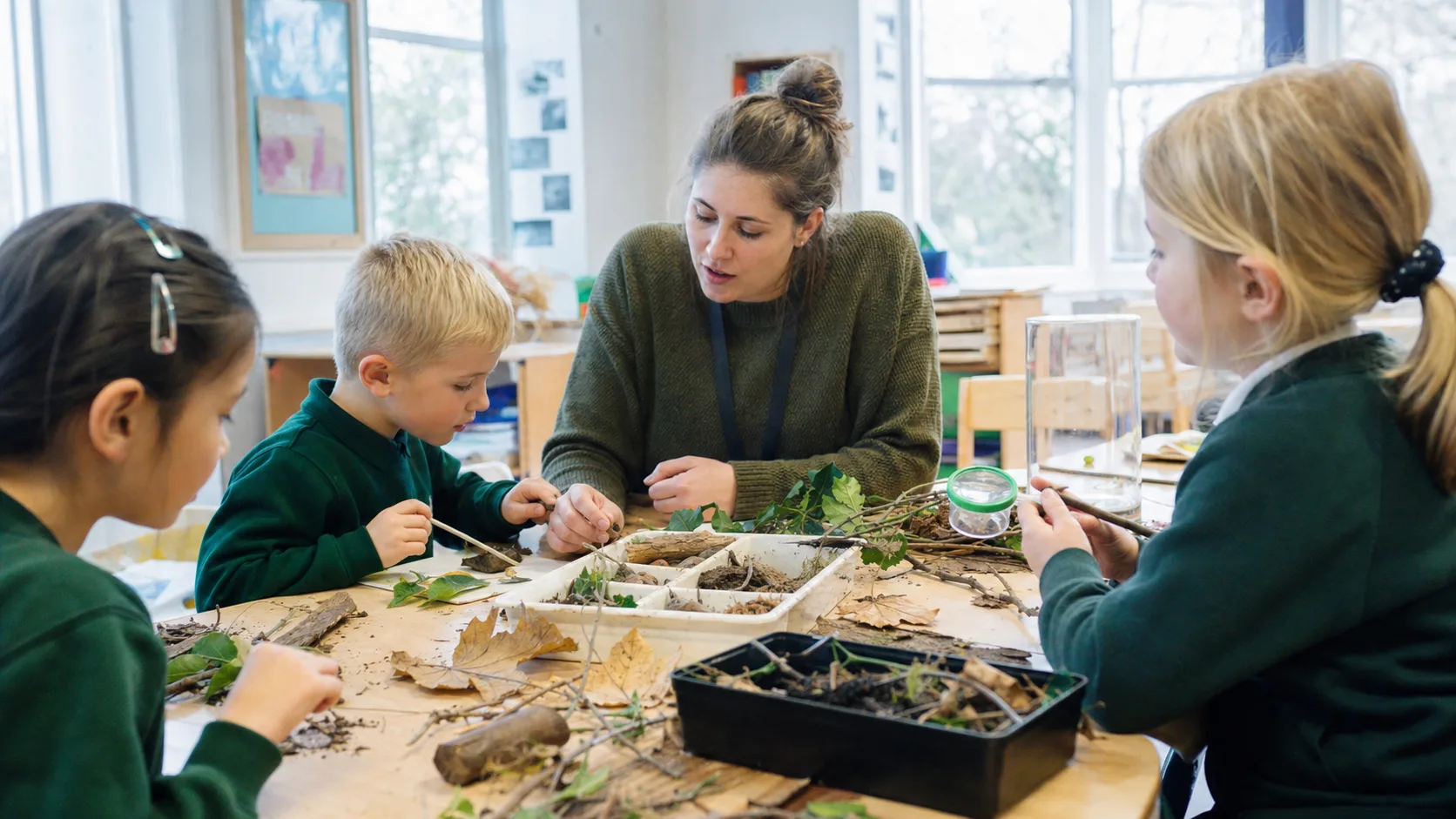
Forest Schools describes a long-term, learner-led approach to outdoor education in which the same group meets regularly in a woodland or natural setting to explore, take managed risks and reflect on learning (Egan, Egan and Brophy, 2022). In a Year 3 session, for example, learners might test which twigs make a stable den, record why one structure failed, then use the evidence back in class for science vocabulary, maths measurement and oral explanation.
For UK teachers, the value is not simply time outside. Forest School works best when adults plan the bridge between outdoor confidence and classroom learning, such as asking learners to use the same problem-solving language during a reading inference task or a SATs-style maths question. The evidence is promising for wellbeing and attention, but schools should treat academic claims carefully and build clear curriculum links from the start.
Research on Forest School suggests possible gains in wellbeing, confidence, motor development and attention, but the evidence is uneven. A 2023 review of preschool Forest School studies found benefits across several outcomes, while later syntheses caution that many studies still rely on small samples and weak comparison groups (Gimenez-Dasi et al., 2023; Egan, Egan and Brophy, 2022). For teachers, this means using outdoor sessions as part of planned curriculum work rather than treating them as a guaranteed fix.
Forest School is a sustained form of outdoor learning, not a one-off activity. Sessions work best when learners return to the same natural space, notice change over time and use talk, movement and practical problem solving to build confidence, language and relationships (Murray and O'Brien, 2005; Waite, 2011). Teachers should connect these gains to classroom routines, such as using the same planning language for den building and written explanation.
There is a widespread perception that children are not spending as much time in woods and green spaces as their parents did because of safety concerns and the growing variety of indoor activities that are on the market. There is also evidence that if children do not visit woodlands and greenspaces when they are young, they will grow up to be people who do not use these spaces, missing out on the physical and emotional benefits of exposure to nature.
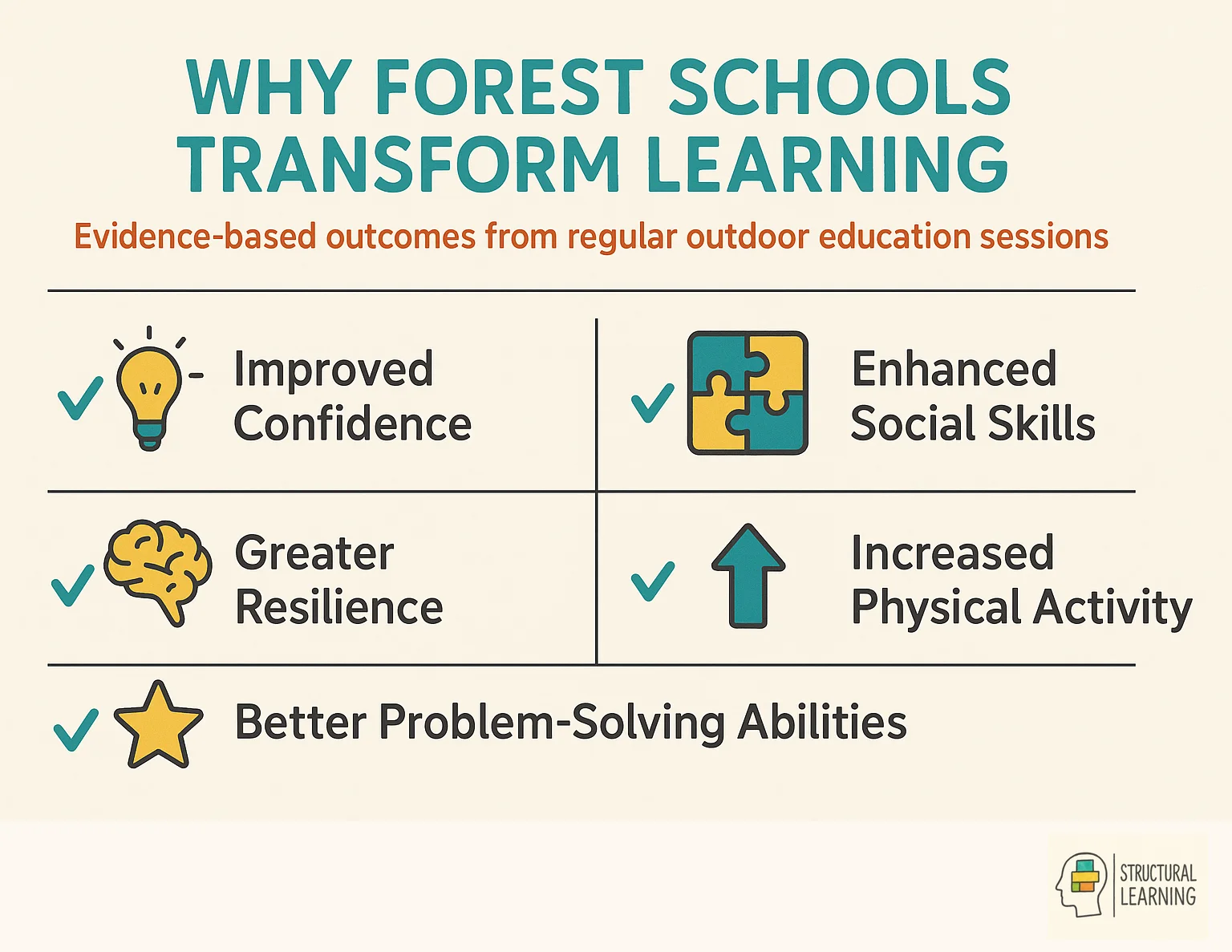
This outcome echoes research by Waite (2011). Maynard et al. (2013) suggest it can improve learners' self-esteem. Rickinson et al. (2004) found that it boosted social skills. Natural environments also encouraged physical activity.
For post-pandemic classes, teachers can use outdoor learning to help attention recover, not only to value nature. Attention Restoration Theory suggests that natural settings can help directed attention recover after demanding tasks. Recent reviews also report small cognitive benefits for attention and executive function in children and adolescents (Kaplan, 1995; Nguyen and Walters, 2024). This is not a cure for screen habits, but it supports short observation, movement and reflection routines after screen-heavy lessons.
They are ideal places to support inclusion. Experiences in nature improve well-being for most learners (Pretty et al, 2005). Greenspaces can offer calm for learners with autism and other additional needs. These spaces provide varied learning opportunities for everyone (Waite, 2011).
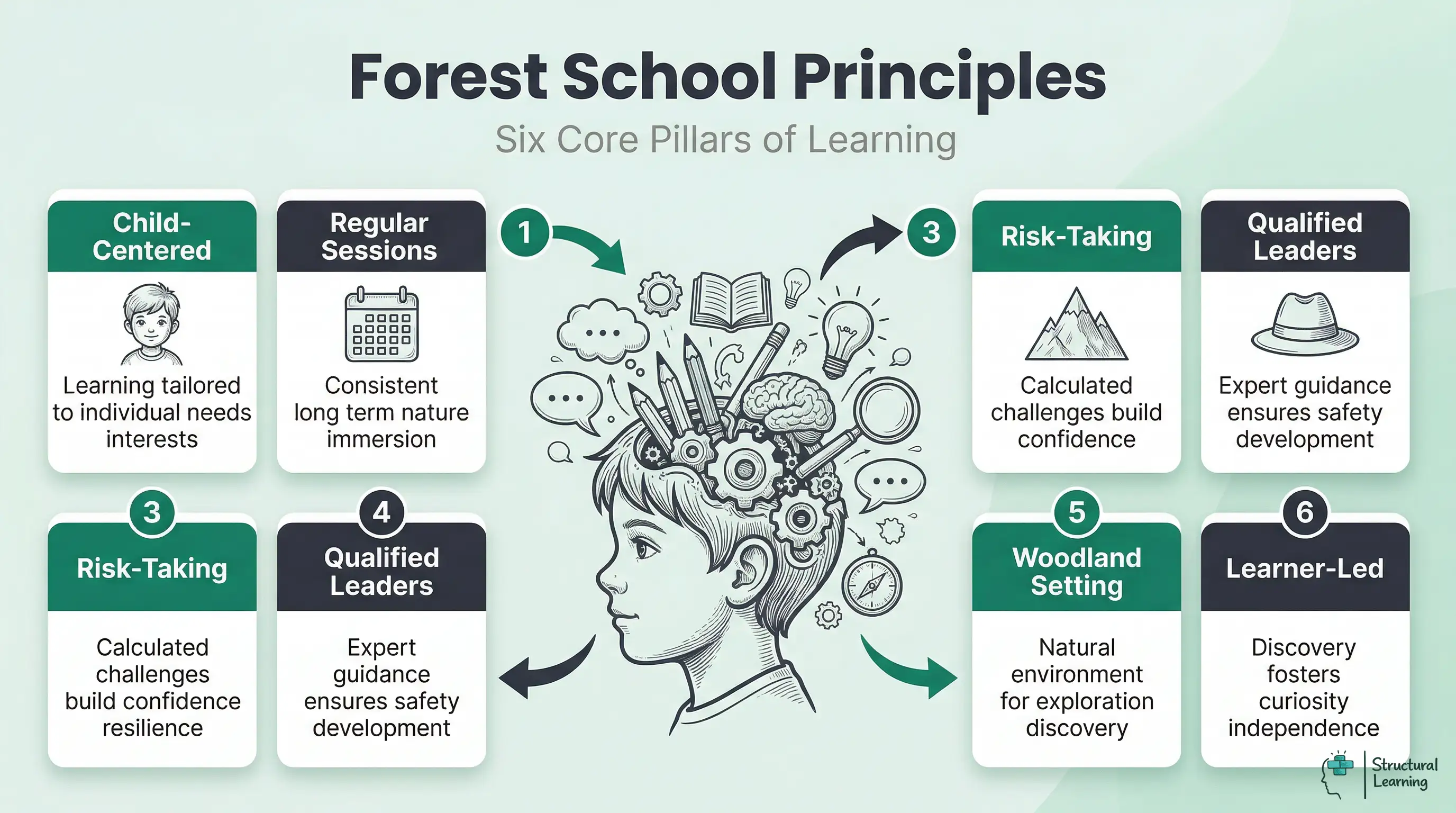
Forest Schools have six principles: regular sessions, a natural setting, learner-led enquiry, managed risk, qualified leadership and reflective planning. Trained adults guide exploration, but they do not turn every outdoor moment into a worksheet. Play, observation and personal development sit alongside curriculum links. This works best when teachers name the vocabulary and thinking strategies they want learners to reuse (Knight, 2013; Forest School Association, 2024).
Forest School is often traced to Scandinavian outdoor early years practice. This includes Ella Flatau's Danish walking kindergarten in 1952 and Sweden's Skogsmulle movement, developed by Gosta Frohm in 1957. The UK model is better described as a translation of Scandinavian friluftsliv, or outdoor life, rather than as one method with one founder (Leather, 2018; Egan, Egan and Brophy, 2022).
Forest School Ethos and Principles:
A Forest School is a long-term process with regular sessions in a natural setting. Practitioners should aim to run sessions at least once every two weeks over a long period of time. Ideally, the same group of learners should attend each session.
Planning, adaptation, observation, and review are all essential. The programme's structure should focus on collaboration between learners and practitioners. Learning advancement should be clearly highlighted and fit within the wider school curriculum.
Forest School often uses woodland, but schools should not treat woodland as the only valid setting. A courtyard with planters, a line of street trees, a local park or a housing-estate green can still support repeated observation, managed risk and learner-led enquiry. The key question is whether the site allows continuity, boundaries, reflection and connection to living systems, not whether it looks like a Scandinavian forest (Leather, 2018; Forest School Association, 2024).
Forest Schools should involve every learner and support their full development. Waite (2011) found that Forest Schools help learners become more resilient, confident and creative.
O’Brien and Murray (2007) showed growth in physical, social, cognitive and emotional areas. Goleman (1995) stated that practical tasks can help emotional intelligence develop. Maynard (2007) links this learning to home, school, jobs and life.
Forest School should support planned risk taking that suits each learner's age, using risk-benefit assessment (Gill, 2007). Staff should adjust the risk benefit analysis for each learner's age. After risk assessment, activities must suit the learners. Planned challenges build self regulation (Gill, 2007; Knight, 2011; Maynard, 2007; O'Brien, 2009).
In UK Forest School Association guidance, Forest School is led by qualified practitioners. They should hold at least an accredited Level 3 Forest School qualification, while assistants often work at Level 2. This is a UK quality assurance model, not a rule used in every country. Before starting a programme, schools should check first aid cover, insurance, safeguarding, tool use and staff roles (Forest School Association, 2024).
Forest School puts the learner at the centre and creates a strong learning community. It responds to the individual needs and interests of each learner. Cooperative learning includes teaching, watching, talking, connecting and support. This helps learners feel ownership and responsible for learning.
Forest Schools can support learning when teachers make the link between outdoor enquiry and classroom knowledge explicit. Measuring den poles can rehearse standard units; sorting leaves can strengthen classification language; and a sit-spot journal can give reluctant writers something real to describe. The stronger claim, that Forest School reliably raises attainment on its own, is not yet secure in the research base (Egan, Egan and Brophy, 2022).
Forest Schools improve learners' social and emotional skills, (Waite, 2011). Shared tasks and play support teamwork and communication. Learners negotiate and solve outdoor problems. Facing challenges builds their confidence and resilience.
Forest Schools can support physical activity and motor development through outdoor play (Fägerstam and Grahn, 2014). Learners improve motor skills and balance in woodland environments. Nature exposure is associated with lower stress and better mood, while broad health claims need careful wording (McMahan and Estes, 2015; Roe et al., 2013). Outdoor time can support environmental responsibility (Chawla, 2015).
Research shows Forest Schools help learners with SEND. They get sensory experiences classrooms cannot offer. These natural spaces allow for easier differentiation (Waite, 2011). This removes stigma often linked to adapted classroom tasks (O'Brien, 2009).
Researchers have noted the predictable rhythms of nature help learners with autism (Moore, 2001). Natural environments can reduce anxiety for learners with autism (Sobel, 1993). Outdoor activities, like den building, offer clear goals, needing fewer verbal instructions (Dyment & Bell, 2008). Reduced classroom noise and lighting benefit learners (Mostafa, 2008).
Waite (2011) says Forest School helps learners with emotional and behavioural issues through natural movement. Learners can release energy through tasks such as digging and carrying logs. Physical tasks can reduce problems, while real achievements build self-esteem (O’Brien, 2009).
Woodland can calm learners. Watching insects can help them manage their emotions without a classroom intervention. This self-regulation supports long-term coping (McMillan, 2017). It works better than formal behaviour plans.
Beginning Forest School provision requires careful planning but need not be overwhelming. Start by identifying a suitable site within walking distance of your school. This could be local woodland, a park with trees, or even a corner of your school grounds with natural features. The key is regular access rather than pristine wilderness.
Active risk assessments are key for safe Forest School. Consider seasons, weather, and learner needs. Tell parents about clothing and managed risk benefits. Some schools start with half-termly tasters (Simonds & Baston, 2020).
Training staff is a real budget decision. A Level 3 Forest School Leader qualification gives stronger preparation, but schools may begin with basic outdoor learning training, mentoring from a local Forest School provider and tightly scoped low-risk sessions. Build the budget around staffing, cover, waterproofs, tools, first aid, storage and maintenance. For many UK schools, a realistic starter budget sits around £2,000 to £3,000, so leaders should link the programme to curriculum, attendance, SEND and wellbeing priorities rather than treating it as a reward activity.
Some studies report gains in focus, problem solving and language after Forest School, but transfer is not automatic (Waite et al., 2016). Teachers need a bridge task: after den building, ask learners to name the planning move they used, then reuse the same move in a written explanation, a science prediction or a SATs-style maths problem. Without this step, confidence shown outdoors can remain tied to the outdoor setting.
Natural materials make maths real. Measuring den sticks reinforces standard units. Learners develop algebraic thought when they create leaf patterns.
Shadow lengths help learners estimate tree height. This brings proportion to life. These experiences give learners memorable anchors for classroom maths.
Forest Schools give real language learning contexts. Learners expand their vocab by describing bark or explaining den builds. They negotiate fire circle rules with their peers. This multi-sensory setting helps learners remember and use new words (Fägerstam, 2012).
Learners often write better when they record real experiences. Forest School journals, with drawings and weather notes, improve writing more than artificial tasks. Teachers find that struggling learners are often happy to record outdoor discoveries. This gives real assessment data (Knight, 2015; Davies, 2018).
Forest School Leader training is helpful, but teachers can use forest learning now. Many UK schools run outdoor sessions by starting small. Try one hour weekly in your school grounds, focusing on learner-led exploration (Waite, 2011).
Forest School practitioners can mentor your first sessions. Some offer 'taster days' to show techniques while you take part. This helps you learn with your learners and build shared confidence. Begin with simple tasks, such as process sticks, fairy houses, or 'sit spots' for observing seasons. (Waite, 2011)
Assess the site before outdoor learning, checking boundaries and hazards. Use ropes or landmarks for clear boundaries that learners can see. Discuss safety rules with learners, like staying in sight (Waite, 2011; Tovey, 2007). Ensure learners check before eating anything (Knight, 2009; Gill, 2014).
Create a simple emergency protocol with first aid and contacts. Involve learners in creating safety agreements for increased commitment. Remember, managed risk differs from hazard. Supervise climbing, tools, and fires with skill-building.
Forest Schools help learners meet many National Curriculum goals across key stages. Outdoor learning can improve descriptive writing and storytelling in English. Learners often write well about forest adventures, even when classroom writing feels hard (Waite, 2011; Maynard, 2007).
Learners measure trees and count items in nature. They make patterns with materials found outdoors and solve problems while building dens. In this way, maths grows naturally from the activity.
Science becomes real when learners observe seasonal changes, habitats, and life cycles. A Year 4 teacher found that understanding of food chains grew after seeing evidence of predation.
Forests help learners with extra needs (Louv, 2008). The natural setting supports learners with autism. Learners with ADHD can move freely in the space (Grahn et al., 1997).
Teachers saw better behaviour and focus (O’Brien, 2009). Some non-verbal learners started talking outdoors (Waite, 2011).
Forest schools can use visuals, quiet spaces, and buddies for learner support. Forest settings may remove barriers seen in classrooms (Fägerstam & Blomdahl, 2021). Share learner progress using photos and observations with parents and services (Knight, 2013; O’Brien & Murray, 2007).
Parents worry about weather, clothing, and safety. Tell them clearly about outdoor play's benefits and how to prepare. Research by Fjortoft (2001) and Brussoni et al. (2015) shows stronger immunity and health. Give parents a kit list with waterproofs, clothes, and good shoes.
Show parents learning activities and explain safety (Edwards & Clarke, 2010). Ask parents to help; turn critics into supporters. Share digital portfolios showing learners enjoying success. Parents often change their minds when they see happy, confident learners.
Keeping a shared set of "forest clothes" at school reduces pressure on families. Some schools use grants, PTA funding or clothing swaps so learners can take part without needing new kit. This matters because the woodland ideal can exclude urban or low-income communities unless schools plan access carefully (Leather, 2018; Nxumalo and Cedillo, 2017).
Forest School is strongest when it is regular, well planned and linked to classroom teaching. Use it to create concrete experiences that learners can revisit in reading, writing, science and PSHE, while being honest that the evidence for direct attainment gains is still developing (Egan, Egan and Brophy, 2022).
Consider simple Forest School ideas for your learners. Take them outside for nature walks or group projects. Outdoor learning supports development, and sensory activities also support learning (Knight, 2013).
The natural world gives learners useful chances to practise observation, language and shared problem solving (Maynard, 2007).
Forest Schools should not be presented as a proven way to raise attainment. Reviews note that many studies use small samples, practitioner self-report and weak comparison groups. This makes it hard to separate the effects of woodland, lower adult-to-learner ratios, novelty and adult enthusiasm (Egan, Egan and Brophy, 2022; Education Endowment Foundation, 2025). This matters for headteachers because staffing, training, transport and equipment costs are real, while academic gains remain hard to attribute.
A second critique is about cultural translation. Leather argues that UK Forest School can turn a Scandinavian tradition linked to friluftsliv into a branded product. He says it can become tied too closely to woodland ideals (Leather, 2018). This model can leave out urban schools, where learners meet nature through street trees, courtyards, parks or housing-estate greens.
Decolonial scholars also warn that outdoor education can romanticise "wild" nature. At the same time, it can ignore Indigenous land knowledge, local histories and unequal access to green space (Nxumalo and Cedillo, 2017).
There is also a transfer problem. Skills used outdoors do not move into classroom work on their own. Waite's work on the formal and informal boundaries of outdoor learning suggests that confidence in den-building may not support spelling, SATs preparation or classroom problem solving unless teachers name the strategy and rehearse it indoors (Waite, 2011). Forest School keeps enduring value when schools treat it as sustained pedagogy, not a reward activity: it can widen experience, build language, support attention and give learners concrete memories that teachers can connect to curriculum learning.
A Forest School is a long term process that offers regular opportunities for children to grow in confidence through hands on experiences in a woodland setting. It focuses on child led exploration and play rather than traditional classroom based instruction. This approach allows learners to develop a deep connection with nature while building essential social and emotional skills.
Schedule sessions every two weeks with the same learner group for consistency. Link activities to subjects like science and geography. A Level 3 practitioner must plan and observe lessons (Smith, 2003; Jones, 2018).
Forest sessions help learners with autism and behaviour needs through sensory activities. The outdoor space lets them practice social skills and solve problems together naturally. Studies (e.g. O'Brien, 2019; Brown, 2021) show forests cut anxiety and improve self-regulation for many learners.
NFER research shows that outdoor learning improves thinking and physical skills. Regular outdoor sessions may improve concentration. Even so, teachers should be careful about linking Forest School to literacy and maths gains unless the programme has clear curriculum bridging (Waite, 2011; Egan, Egan and Brophy, 2022). Nature exposure may support wellbeing and attention, with recent reviews finding small benefits for attention and executive function in children and adolescents (Nguyen and Walters, 2024).
Learners benefit from continuous programmes, not single sessions. Schools should ensure qualified Level 3 leaders deliver safe sessions. Allow time for child-led play, which is vital (O'Brien, 2009; Waite, 2011).
Risk taking helps learners judge their own skills. It also builds resilience through managed challenges. Practitioners use risk benefit analyses to make sure activities suit each learner's age (Gill, 2007). Through this process, learners build independence as they recognise limits and learn safety.
Chawla (2015).
Fägerstam (2012).
Fägerstam and Grahn (2014).
Gill (2007).
Grahn et al. (1997).
Knight (2013).
Knight (2011).
Leather (2018).
Louv (2008).
Maynard (2007).
McMillan (2017).
Moore (2001).
Mostafa (2008).
Nguyen and Walters (2024).
Nxumalo and Cedillo (2017).
O'Brien (2007).
O'Brien (2009).
Pretty et al (2005).
Sobel (1993).
Waite (2011).
Waite et al. (2016).