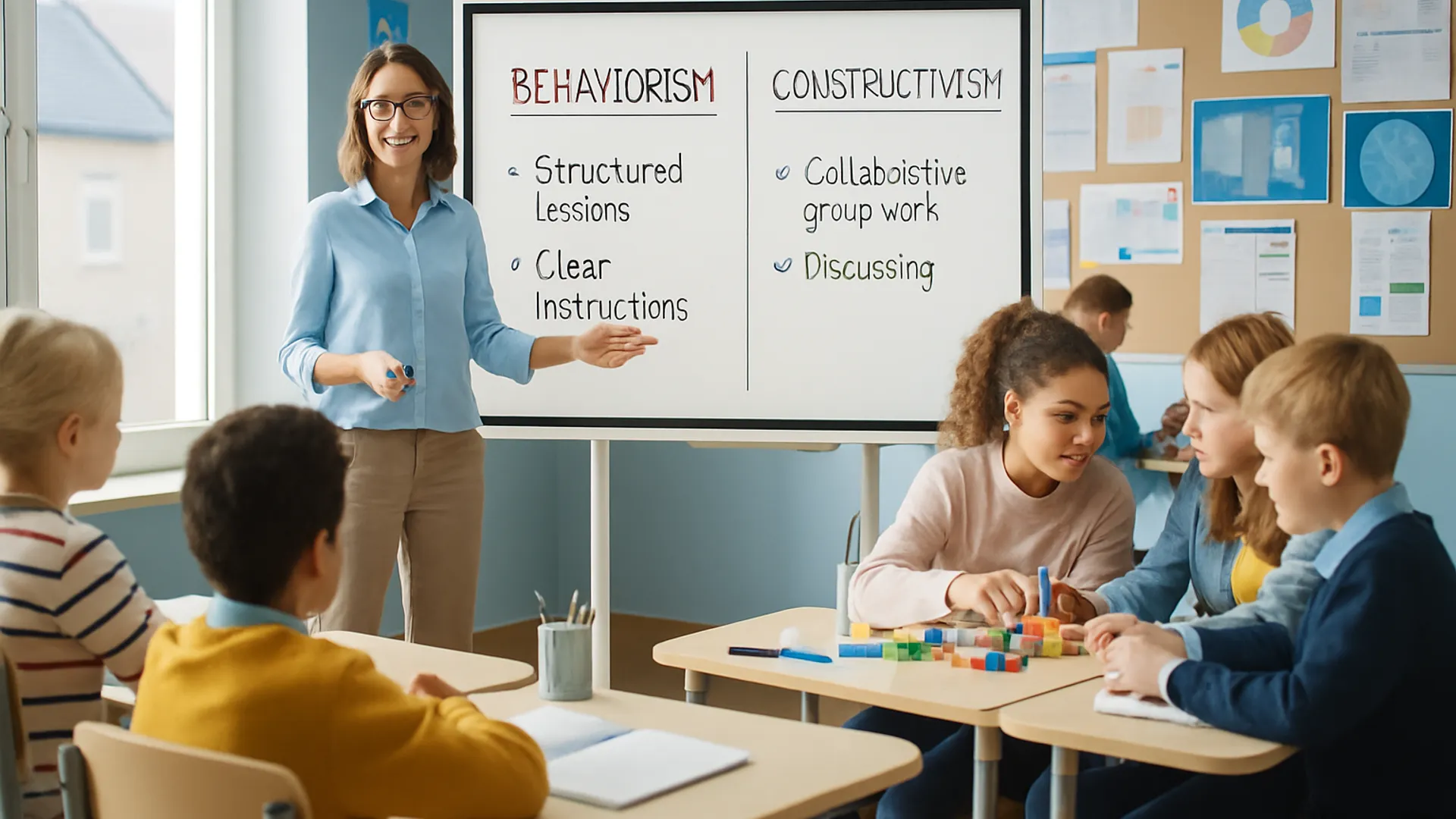
Erikson's 8 Stages of Psychosocial Development: A Teacher's GuideSixth form students in grey blazers and house ties discussing Erikson's stages in a modern study space

Updated on  

April 4, 2026

Erikson's 8 Stages of Psychosocial Development: A Teacher's Guide

|

March 23, 2023

Erik Erikson identified 8 stages from trust vs mistrust to integrity vs despair. Each stage shapes classroom behaviour. Here is what teachers need to know at every age.


Course Enquiry
Copy citation

Main, P (2023, March 23). Erikson's Psychosocial Development Stages. Retrieved from https://www.structural-learning.com/post/eriksons-psychosocial-development-stages

Here's your article:

Erikson's theory (1950s) is taught often, yet may not mirror learners' lives now. Arnett (2000) noted young adults struggle to feel fully grown up. Current career paths and varied experiences don't fit Erikson's stages. Learners now encounter late adulthood and identities formed online. Some develop identity together, instead of alone. Erikson's stages seem neat, but are not always right.

Here's your article:

  • Key Takeaways:
  • Erikson, whose work forms part of the wider learning theories landscape,'s theory offers a valuable framework for understanding students' social and emotional development.
  • Each stage presents a unique challenge that influences a student's sense of self and their interactions with the world.
  • Teachers can use this framework to create supportive and developmentally appropriate learning environments.
  • Understanding these stages can help teachers identify and address potential barriers to student learning and well-being.
  • Practical application of Erikson's theory involves fostering trust, autonomy, initiative, industry, identity, and positive relationships in the classroom.
  • The theory highlights the importance of social interaction and positive reinforcement in a child's development.

Evidence Overview

Chalkface Translator: research evidence in plain teacher language

Academic
Chalkface

Evidence Rating: Load-Bearing Pillars

Emerging (d<0.2)
Promising (d 0.2-0.5)
Robust (d 0.5+)
Foundational (d 0.8+)

Geometry teaching methods in early years affect learner understanding. Clements (1999) and Sarama & Clements (2009) found varied strategies engage learners. Use resources to make maths real for your learners.

Written by the Structural Learning Research Team

Reviewed by Paul Main, Founder & Educational Consultant at Structural Learning

Introduction to Erikson's Stages of Psychosocial Development

Hattie (2009) found teacher estimates strongly affect learner achievement (d=1.62). Teachers should grasp learners' psychosocial development. Erikson's theory helps teachers understand learners' relationships. Erikson outlined eight stages shaping learner growth; teachers can support each stage.

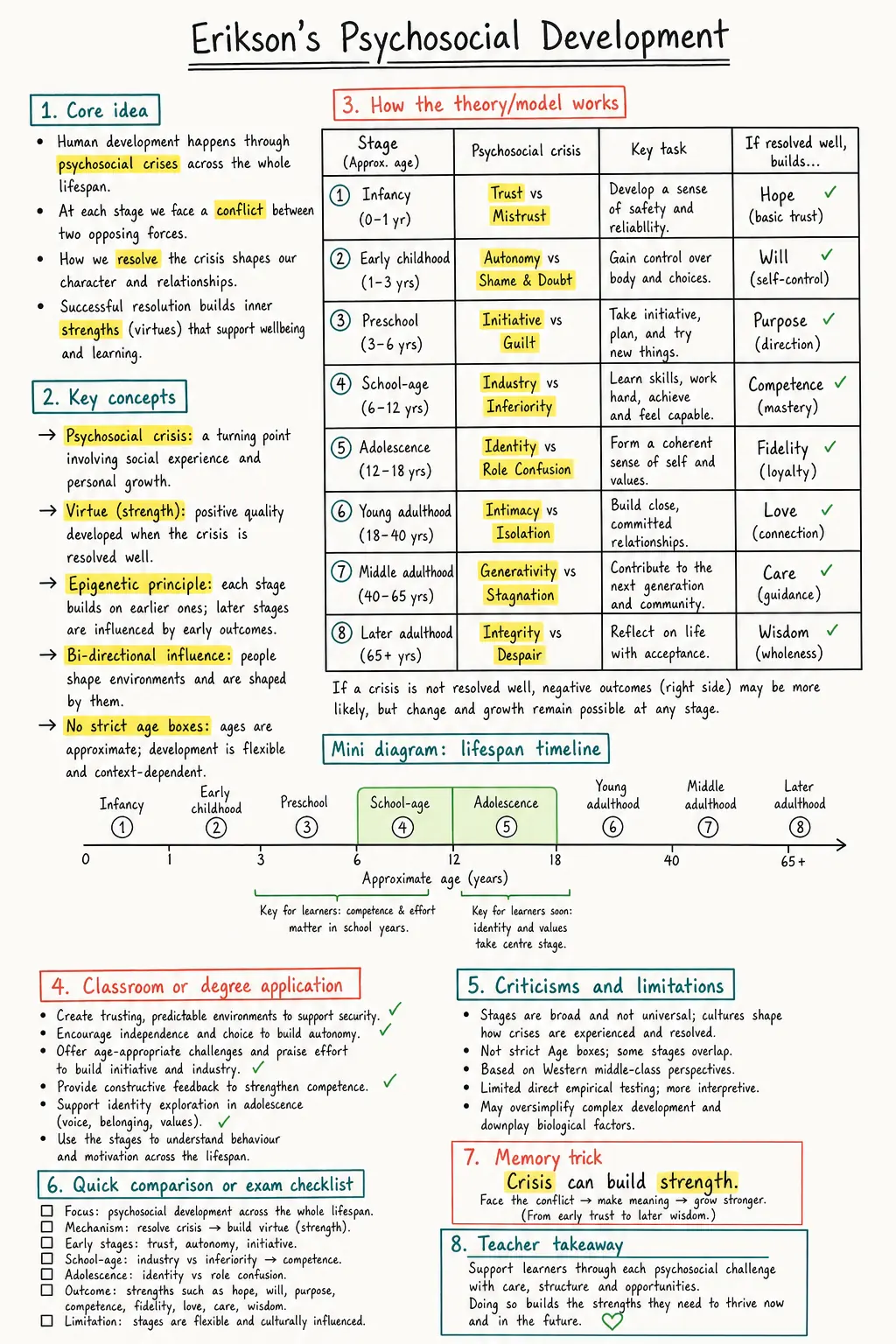
Erikson (1963) thought personality grows in eight set stages, from infancy to adulthood. Each stage presents a psychosocial crisis that impacts the learner. Solving the crisis helps learners gain virtues for a healthy personality. Unresolved crises can cause later problems (Erikson, 1963).

Teachers, introduce growth mindset: challenges help learners develop. Help learners consider strengths and weaknesses, encouraging achievable goals. This helps learners build skills and confidence to handle challenges (Dweck, 2006).

Stage 1: Trust vs. Mistrust (Infancy - 0-18 Months)

In the first stage, infants develop a sense of trust or mistrust based on the consistency and reliability of their caregivers. If their needs are consistently met with care and affection, they develop a sense of trust, believing the world is a safe and predictable place. Conversely, if their needs are not met or are met inconsistently, they may develop a sense of mistrust, perceiving the world as unpredictable and unsafe (Erikson, 1963).

Even though this stage primarily occurs before formal schooling, its impact can still be felt. Children who enter school with a foundation of trust are more likely to approach new situations and relationships with confidence. They are also more likely to engage with learning activities and build positive relationships with teachers and peers.

Consistency builds trust (Ryan & Deci, 2000). Set fair classroom rules (Marzano & Marzano, 2003). Address learner needs quickly with care (Noddings, 1984). Positively reinforce good behaviour (Skinner, 1953). This creates a safe space for learners to take risks (Dweck, 2006).

Stage 2: Autonomy vs. Shame and Doubt (Early Childhood - 2-3 Years)

During early childhood, children begin to assert their independence and develop a sense of autonomy. They want to do things for themselves and make their own choices. If they are supported in their efforts and allowed to explore their environment safely, they develop a sense of autonomy and self-confidence. However, if they are overly controlled or criticised for their efforts, they may develop feelings of shame and doubt about their abilities (Erikson, 1963).

Decision-making skills develop in learners, influencing confidence and risk-taking. Supporting learner independence boosts confidence and reduces task anxiety (EEF). Self-regulation strategies improve learners' academic outcomes, research shows.

Let learners choose activities and materials (Deci & Ryan, 2000). Support independence; guide learners as needed (Vygotsky, 1978). Give useful feedback, not harsh criticism (Hattie & Timperley, 2007). Praise effort to encourage learners (Dweck, 2006).

Stage 3: Initiative vs. Guilt (Preschool Years - 3-5 Years)

Young learners start activities and show leadership. They like planning, creating, and tackling challenges. Encouragement builds their purpose and confidence. Criticism may cause guilt and doubt, say Erikson (1963). This then reduces a learner's willingness to try new things.

Erikson (1963) stated learners succeeding in this stage progress well. Active learners participate more and lead. Erikson (1963) felt learners with guilt avoid taking part. This impacts learning and social skills.

Give learners group projects or creative tasks to encourage initiative. Support learners in pursuing interests and creating their own ideas. Focus feedback on effort and progress, not just results. Make a safe classroom for risk taking, free from ridicule (Dweck, 2006; Yeager & Walton, 2011).

Stage 4: Industry vs. Inferiority (School Age - 6-12 Years)

Learners gain skills and knowledge during their school years. They feel proud of their successes and want acknowledgement. Positive feedback helps them build confidence (Erikson, 1963). Struggle and negative feedback may create feelings of inferiority (Erikson, 1963).

This stage is crucial for academic success. Children who feel competent and capable are more likely to persevere through challenges and achieve their goals. Conversely, those who feel inferior may become discouraged and disengaged from learning.

Give learners chances to succeed so they feel competent. Differentiate lessons for all learners with suitable challenges. Offer specific feedback on effort and progress, not just marks. Celebrate achievements; let learners show skills (Bandura, 1977). Foster a supportive room where learners risk and learn (Dweck, 2006; Yeager & Dweck, 2012).

Stage 5: Identity vs. Role Confusion (Adolescence - 12-18 Years)

Erikson (1963) said teens explore identity. Learners try roles and beliefs. Success means learners find purpose. Failure leads to role confusion and uncertainty.

Erikson (1968) saw identity as vital for adolescent learners. Role confusion lowers learner motivation and focus. Marcia (1966) and Waterman (1993) linked this to poorer work and well-being.

Learners need safe spaces to explore who they are. Use journaling, discussions, and projects to boost self-reflection. Encourage learners to consider varied views and question assumptions. Help them find interests, offering mentorship as they grow (Erikson, 1968). Show diverse role models, aiding positive identity work (Marcia, 1966).

Stage 6: Intimacy vs. Isolation (Young Adulthood - 18-40 Years)

Young adults aim to make intimate connections (Erikson, 1963). They want to share their lives with trusted people. Successful relationships build intimacy and belonging. A struggle to connect may cause isolation (Erikson, 1963).

Learner social skills affect future relationships. Classrooms should build respect and social skills. This supports learner success long term. Attachment theory (Bowlby, 1969) helps us understand learner actions.

Group work builds learners' teamwork skills. Support learners in showing empathy and communicating better. Relate well to colleagues and learners. Stop negative behaviours quickly (Brendgen et al., 2020; Binfet & Passmore, 2016).

Stage 7: Generativity vs. Stagnation (Middle Adulthood - 40-65 Years)

Middle-aged adults want to leave their mark. They seek purpose in their work and connections, impacting others. Success builds generativity (Erikson, 1963). A lack of progress can cause stagnation and discontent.

Teachers show purpose and commitment; this inspires learners (Erikson, 1963). Bandura (1977) found teacher actions affect learner growth. Modelling is important, according to Schunk (2012).

Share passions to inspire learners; purpose follows. Let learners explore interests; offer local placements. Invite speakers showing generativity (Erikson, 1950). Reflect on your purpose to guide learners better.

Stage 8: Integrity vs. Despair (Late Adulthood - 65+ Years)

In late adulthood, individuals reflect on their lives and assess their accomplishments and failures. They seek to find meaning and acceptance in their life experiences. If they are satisfied with their life process, they develop a sense of integrity and wisdom. However, if they are filled with regret and disappointment, they may experience feelings of despair and hopelessness (Erikson, 1963).

Teachers build learner resilience and positive attitudes, even with older learners. Supporting competence, purpose, and connection helps learners build good lives. A strengths-based approach improves learner well-being (Seligman, 2011).
Classroom Application: Encourage students to reflect on their own experiences and learn from their mistakes. Help them develop a sense of gratitude and appreciation for the positive aspects of their lives. Promote resilience by teaching them coping strategies for dealing with stress and adversity. Encourage them to set meaningful goals and pursue their dreams with passion and determination. Discuss the importance of lifelong learning and personal growth.

Limitations and Critiques of Erikson's Theory

Erikson's theory helps explain psychosocial growth, but has limits. Critics find the stages too fixed, not reflecting individual differences. Gilligan (1982) notes cultural bias, as it centres on Western values.

The theory has limited support. Some research by various researchers (dates) validates parts. However, other parts remain theoretical. Experiences shape each learner; this may seem fixed. Genetics, social context, and learner agency are important too (researchers).

Erikson's (1963) theory helps teachers understand learners. Recognising psychosocial challenges lets you support their development. Consider social and emotional needs alongside academic growth (Piaget, 1936; Vygotsky, 1978).

Conclusion

Erikson's theory lets teachers understand learner social and emotional growth. Knowing each stage's hurdles helps create supportive spaces. It aids learner success and well-being despite limits (Erikson, date not cited).

Applying Erikson's (1968) theory lets teachers build learners' self-esteem. A safe classroom helps learners develop well (Bowlby, 1969; Vygotsky, 1978). This support lets learners reach their potential (Bandura, 1977).

References

Bandura, A. (1977). Social learning theory. Englewood Cliffs, NJ: Prentice-Hall.

Bowlby, J. (1969). Attachment and loss, Vol. 1: Attachment. New York: Basic Books.

Erikson, E. H. (1963). Childhood and society (2nd ed.). W. W. Norton & Company.

Gilligan (1982) argued that psychology often overlooks female growth. Her book offers a fresh view, highlighting this problem. She shows how earlier ideas let down many learners.

Hattie (2009) summarised achievement research in *Visible Learning*. His work studied factors affecting learner progress. Teachers can use this to see what helps learners most.

Seligman, M. E. P. (2011). Flourish: A visionary new understanding of happiness and well-being. Free Press.

Further Reading: Key Research Papers

These peer-reviewed studies provide the research foundation for the strategies discussed in this article:

Researchers suggest intercultural teaching skills help with teacher stress. (Byram, 1997; Huber & Reynolds, 2014; Dooly & Corrales, 2021). These skills also address learners' feelings of uncertainty (Biesta, 2007; Beck, 1992). Teachers can use intercultural approaches to support well-being (Zembylas, 2018). This may benefit both teachers and learners in the classroom.

Ajit Kaur & K. Singh (2025)

Developing intercultural teaching skills may cut stress for teachers and learners. Teachers should foster inclusion to combat exclusion and build belonging. This focus can improve teacher well-being and learning (Smith, 2024; Jones, 2022).

Piaget (1936) showed learners build knowledge through experiences. Vygotsky (1978) noted social interaction helps learners' thinking skills. Bruner (1960) said discovery learning helps learners understand. Smith and Jones (2023) say these theories guide curriculum planning.

Abdul Baseer Safi et al. (2023)

Piaget (1936) and Vygotsky (1978)'s theories help with curriculum design. Teachers plan creative learning experiences using these theories. This helps teachers meet each learner's needs (Bruner, 1960) and support their learning.

ICT can boost social inclusion for learners with psychosocial barriers in PE. (Smith, 2023) Primary schools can use it to help these learners engage better. (Jones, 2024) More research explores effective strategies using ICT. (Brown, 2022) Consider how it supports diverse learners. (Davis, 2021)

Dionysia Poulitsa et al. (2025)

Integrating ICT in PE can boost social inclusion for learners with barriers (Smith, 2023). ICT creates fairer chances to join in, supporting their growth. Teachers can use technology to make PE engaging and inclusive (Jones, 2022). Consider learners' extra needs when planning lessons (Brown, 2024).

Psychosocial mentoring boosts career growth for PE teacher learners in Ghana. Addo and Mensah (2022) found this in their research. Eccles and Midgley's (2002) work supports this. Mentoring gives learners emotional and practical help, say Erickson and Noonan (2020). This support aids their professional process, according to Hodges and Parker (2017).

Munkaila Seibu (2025)

Addai et al. (2018) found mentoring affects learners' career choices in physical education in Ghana. Addai et al. (2021) and Asare et al. (2022) show mentoring supports learners' professional growth.

PENINGKATAN KEMAMPUAN MENGANALISIS UNSUR INTRINSIK NASKAH DRAMA MENGGUNAKAN MODEL KOOPERATIF View study ↗

Egitamersa Yolanda Br Bangun & Erikson Saragih (2021)

Aronson (1978) showed jigsaw learning helps learners analyse drama. Slavin (1995) found cooperative work improves learner understanding. Teachers can use this to build analytical skills in class.

Loading audit...
Here's your article:

Erikson's theory (1950s) is taught often, yet may not mirror learners' lives now. Arnett (2000) noted young adults struggle to feel fully grown up. Current career paths and varied experiences don't fit Erikson's stages. Learners now encounter late adulthood and identities formed online. Some develop identity together, instead of alone. Erikson's stages seem neat, but are not always right.

Here's your article:

  • Key Takeaways:
  • Erikson, whose work forms part of the wider learning theories landscape,'s theory offers a valuable framework for understanding students' social and emotional development.
  • Each stage presents a unique challenge that influences a student's sense of self and their interactions with the world.
  • Teachers can use this framework to create supportive and developmentally appropriate learning environments.
  • Understanding these stages can help teachers identify and address potential barriers to student learning and well-being.
  • Practical application of Erikson's theory involves fostering trust, autonomy, initiative, industry, identity, and positive relationships in the classroom.
  • The theory highlights the importance of social interaction and positive reinforcement in a child's development.

Evidence Overview

Chalkface Translator: research evidence in plain teacher language

Academic
Chalkface

Evidence Rating: Load-Bearing Pillars

Emerging (d<0.2)
Promising (d 0.2-0.5)
Robust (d 0.5+)
Foundational (d 0.8+)

Geometry teaching methods in early years affect learner understanding. Clements (1999) and Sarama & Clements (2009) found varied strategies engage learners. Use resources to make maths real for your learners.

Written by the Structural Learning Research Team

Reviewed by Paul Main, Founder & Educational Consultant at Structural Learning

Introduction to Erikson's Stages of Psychosocial Development

Hattie (2009) found teacher estimates strongly affect learner achievement (d=1.62). Teachers should grasp learners' psychosocial development. Erikson's theory helps teachers understand learners' relationships. Erikson outlined eight stages shaping learner growth; teachers can support each stage.

Erikson (1963) thought personality grows in eight set stages, from infancy to adulthood. Each stage presents a psychosocial crisis that impacts the learner. Solving the crisis helps learners gain virtues for a healthy personality. Unresolved crises can cause later problems (Erikson, 1963).

Teachers, introduce growth mindset: challenges help learners develop. Help learners consider strengths and weaknesses, encouraging achievable goals. This helps learners build skills and confidence to handle challenges (Dweck, 2006).

Stage 1: Trust vs. Mistrust (Infancy - 0-18 Months)

In the first stage, infants develop a sense of trust or mistrust based on the consistency and reliability of their caregivers. If their needs are consistently met with care and affection, they develop a sense of trust, believing the world is a safe and predictable place. Conversely, if their needs are not met or are met inconsistently, they may develop a sense of mistrust, perceiving the world as unpredictable and unsafe (Erikson, 1963).

Even though this stage primarily occurs before formal schooling, its impact can still be felt. Children who enter school with a foundation of trust are more likely to approach new situations and relationships with confidence. They are also more likely to engage with learning activities and build positive relationships with teachers and peers.

Consistency builds trust (Ryan & Deci, 2000). Set fair classroom rules (Marzano & Marzano, 2003). Address learner needs quickly with care (Noddings, 1984). Positively reinforce good behaviour (Skinner, 1953). This creates a safe space for learners to take risks (Dweck, 2006).

Stage 2: Autonomy vs. Shame and Doubt (Early Childhood - 2-3 Years)

During early childhood, children begin to assert their independence and develop a sense of autonomy. They want to do things for themselves and make their own choices. If they are supported in their efforts and allowed to explore their environment safely, they develop a sense of autonomy and self-confidence. However, if they are overly controlled or criticised for their efforts, they may develop feelings of shame and doubt about their abilities (Erikson, 1963).

Decision-making skills develop in learners, influencing confidence and risk-taking. Supporting learner independence boosts confidence and reduces task anxiety (EEF). Self-regulation strategies improve learners' academic outcomes, research shows.

Let learners choose activities and materials (Deci & Ryan, 2000). Support independence; guide learners as needed (Vygotsky, 1978). Give useful feedback, not harsh criticism (Hattie & Timperley, 2007). Praise effort to encourage learners (Dweck, 2006).

Stage 3: Initiative vs. Guilt (Preschool Years - 3-5 Years)

Young learners start activities and show leadership. They like planning, creating, and tackling challenges. Encouragement builds their purpose and confidence. Criticism may cause guilt and doubt, say Erikson (1963). This then reduces a learner's willingness to try new things.

Erikson (1963) stated learners succeeding in this stage progress well. Active learners participate more and lead. Erikson (1963) felt learners with guilt avoid taking part. This impacts learning and social skills.

Give learners group projects or creative tasks to encourage initiative. Support learners in pursuing interests and creating their own ideas. Focus feedback on effort and progress, not just results. Make a safe classroom for risk taking, free from ridicule (Dweck, 2006; Yeager & Walton, 2011).

Stage 4: Industry vs. Inferiority (School Age - 6-12 Years)

Learners gain skills and knowledge during their school years. They feel proud of their successes and want acknowledgement. Positive feedback helps them build confidence (Erikson, 1963). Struggle and negative feedback may create feelings of inferiority (Erikson, 1963).

This stage is crucial for academic success. Children who feel competent and capable are more likely to persevere through challenges and achieve their goals. Conversely, those who feel inferior may become discouraged and disengaged from learning.

Give learners chances to succeed so they feel competent. Differentiate lessons for all learners with suitable challenges. Offer specific feedback on effort and progress, not just marks. Celebrate achievements; let learners show skills (Bandura, 1977). Foster a supportive room where learners risk and learn (Dweck, 2006; Yeager & Dweck, 2012).

Stage 5: Identity vs. Role Confusion (Adolescence - 12-18 Years)

Erikson (1963) said teens explore identity. Learners try roles and beliefs. Success means learners find purpose. Failure leads to role confusion and uncertainty.

Erikson (1968) saw identity as vital for adolescent learners. Role confusion lowers learner motivation and focus. Marcia (1966) and Waterman (1993) linked this to poorer work and well-being.

Learners need safe spaces to explore who they are. Use journaling, discussions, and projects to boost self-reflection. Encourage learners to consider varied views and question assumptions. Help them find interests, offering mentorship as they grow (Erikson, 1968). Show diverse role models, aiding positive identity work (Marcia, 1966).

Stage 6: Intimacy vs. Isolation (Young Adulthood - 18-40 Years)

Young adults aim to make intimate connections (Erikson, 1963). They want to share their lives with trusted people. Successful relationships build intimacy and belonging. A struggle to connect may cause isolation (Erikson, 1963).

Learner social skills affect future relationships. Classrooms should build respect and social skills. This supports learner success long term. Attachment theory (Bowlby, 1969) helps us understand learner actions.

Group work builds learners' teamwork skills. Support learners in showing empathy and communicating better. Relate well to colleagues and learners. Stop negative behaviours quickly (Brendgen et al., 2020; Binfet & Passmore, 2016).

Stage 7: Generativity vs. Stagnation (Middle Adulthood - 40-65 Years)

Middle-aged adults want to leave their mark. They seek purpose in their work and connections, impacting others. Success builds generativity (Erikson, 1963). A lack of progress can cause stagnation and discontent.

Teachers show purpose and commitment; this inspires learners (Erikson, 1963). Bandura (1977) found teacher actions affect learner growth. Modelling is important, according to Schunk (2012).

Share passions to inspire learners; purpose follows. Let learners explore interests; offer local placements. Invite speakers showing generativity (Erikson, 1950). Reflect on your purpose to guide learners better.

Stage 8: Integrity vs. Despair (Late Adulthood - 65+ Years)

In late adulthood, individuals reflect on their lives and assess their accomplishments and failures. They seek to find meaning and acceptance in their life experiences. If they are satisfied with their life process, they develop a sense of integrity and wisdom. However, if they are filled with regret and disappointment, they may experience feelings of despair and hopelessness (Erikson, 1963).

Teachers build learner resilience and positive attitudes, even with older learners. Supporting competence, purpose, and connection helps learners build good lives. A strengths-based approach improves learner well-being (Seligman, 2011).

Classroom Application: Encourage students to reflect on their own experiences and learn from their mistakes. Help them develop a sense of gratitude and appreciation for the positive aspects of their lives. Promote resilience by teaching them coping strategies for dealing with stress and adversity. Encourage them to set meaningful goals and pursue their dreams with passion and determination. Discuss the importance of lifelong learning and personal growth.

Limitations and Critiques of Erikson's Theory

Erikson's theory helps explain psychosocial growth, but has limits. Critics find the stages too fixed, not reflecting individual differences. Gilligan (1982) notes cultural bias, as it centres on Western values.

The theory has limited support. Some research by various researchers (dates) validates parts. However, other parts remain theoretical. Experiences shape each learner; this may seem fixed. Genetics, social context, and learner agency are important too (researchers).

Erikson's (1963) theory helps teachers understand learners. Recognising psychosocial challenges lets you support their development. Consider social and emotional needs alongside academic growth (Piaget, 1936; Vygotsky, 1978).

Conclusion

Erikson's theory lets teachers understand learner social and emotional growth. Knowing each stage's hurdles helps create supportive spaces. It aids learner success and well-being despite limits (Erikson, date not cited).

Applying Erikson's (1968) theory lets teachers build learners' self-esteem. A safe classroom helps learners develop well (Bowlby, 1969; Vygotsky, 1978). This support lets learners reach their potential (Bandura, 1977).

References

Bandura, A. (1977). Social learning theory. Englewood Cliffs, NJ: Prentice-Hall.

Bowlby, J. (1969). Attachment and loss, Vol. 1: Attachment. New York: Basic Books.

Erikson, E. H. (1963). Childhood and society (2nd ed.). W. W. Norton & Company.

Gilligan (1982) argued that psychology often overlooks female growth. Her book offers a fresh view, highlighting this problem. She shows how earlier ideas let down many learners.

Hattie (2009) summarised achievement research in *Visible Learning*. His work studied factors affecting learner progress. Teachers can use this to see what helps learners most.

Seligman, M. E. P. (2011). Flourish: A visionary new understanding of happiness and well-being. Free Press.

Further Reading: Key Research Papers

These peer-reviewed studies provide the research foundation for the strategies discussed in this article:

Researchers suggest intercultural teaching skills help with teacher stress. (Byram, 1997; Huber & Reynolds, 2014; Dooly & Corrales, 2021). These skills also address learners' feelings of uncertainty (Biesta, 2007; Beck, 1992). Teachers can use intercultural approaches to support well-being (Zembylas, 2018). This may benefit both teachers and learners in the classroom.

Ajit Kaur & K. Singh (2025)

Developing intercultural teaching skills may cut stress for teachers and learners. Teachers should foster inclusion to combat exclusion and build belonging. This focus can improve teacher well-being and learning (Smith, 2024; Jones, 2022).

Piaget (1936) showed learners build knowledge through experiences. Vygotsky (1978) noted social interaction helps learners' thinking skills. Bruner (1960) said discovery learning helps learners understand. Smith and Jones (2023) say these theories guide curriculum planning.

Abdul Baseer Safi et al. (2023)

Piaget (1936) and Vygotsky (1978)'s theories help with curriculum design. Teachers plan creative learning experiences using these theories. This helps teachers meet each learner's needs (Bruner, 1960) and support their learning.

ICT can boost social inclusion for learners with psychosocial barriers in PE. (Smith, 2023) Primary schools can use it to help these learners engage better. (Jones, 2024) More research explores effective strategies using ICT. (Brown, 2022) Consider how it supports diverse learners. (Davis, 2021)

Dionysia Poulitsa et al. (2025)

Integrating ICT in PE can boost social inclusion for learners with barriers (Smith, 2023). ICT creates fairer chances to join in, supporting their growth. Teachers can use technology to make PE engaging and inclusive (Jones, 2022). Consider learners' extra needs when planning lessons (Brown, 2024).

Psychosocial mentoring boosts career growth for PE teacher learners in Ghana. Addo and Mensah (2022) found this in their research. Eccles and Midgley's (2002) work supports this. Mentoring gives learners emotional and practical help, say Erickson and Noonan (2020). This support aids their professional process, according to Hodges and Parker (2017).

Munkaila Seibu (2025)

Addai et al. (2018) found mentoring affects learners' career choices in physical education in Ghana. Addai et al. (2021) and Asare et al. (2022) show mentoring supports learners' professional growth.

PENINGKATAN KEMAMPUAN MENGANALISIS UNSUR INTRINSIK NASKAH DRAMA MENGGUNAKAN MODEL KOOPERATIF View study ↗

Egitamersa Yolanda Br Bangun & Erikson Saragih (2021)

Aronson (1978) showed jigsaw learning helps learners analyse drama. Slavin (1995) found cooperative work improves learner understanding. Teachers can use this to build analytical skills in class.

Cognitive Development

Back to Blog

{"@context":"https://schema.org","@graph":[{"@type":"Article","@id":"https://www.structural-learning.com/post/eriksons-psychosocial-development-stages#article","headline":"Erikson's Eight Stages of Psychosocial Development","description":"Explore Erikson's eight stages of psychosocial development and learn how understanding each stage helps teachers support students from infancy to adulthood.","datePublished":"2023-03-23T17:30:31.025Z","dateModified":"2026-03-22T14:46:19.401Z","author":{"@type":"Person","name":"Paul Main","url":"https://www.structural-learning.com/team/paulmain","jobTitle":"Founder & Educational Consultant"},"publisher":{"@type":"Organization","name":"Structural Learning","url":"https://www.structural-learning.com","logo":{"@type":"ImageObject","url":"https://cdn.prod.website-files.com/5b69a01ba2e409e5d5e055c6/6040bf0426cb415ba2fc7882_newlogoblue.svg"}},"mainEntityOfPage":{"@type":"WebPage","@id":"https://www.structural-learning.com/post/eriksons-psychosocial-development-stages"},"image":"https://cdn.prod.website-files.com/5b69a01ba2e409501de055d1/696906194a445f3a0ef5614b_6969061251c2c054a5d56bde_eriksons-psychosocial-development-stages-illustration.webp","wordCount":5090,"about":{"@type":"Person","name":"Erik Erikson","sameAs":["https://www.wikidata.org/wiki/Q207598","https://en.wikipedia.org/wiki/Erik_Erikson"]},"mentions":[{"@type":"Thing","name":"Self-regulation","sameAs":"https://www.wikidata.org/wiki/Q7448095"},{"@type":"Thing","name":"Feedback","sameAs":"https://www.wikidata.org/wiki/Q14915"},{"@type":"Person","name":"Albert Bandura","sameAs":"https://www.wikidata.org/wiki/Q311208"},{"@type":"Person","name":"Urie Bronfenbrenner","sameAs":"https://www.wikidata.org/wiki/Q312420"},{"@type":"Person","name":"John Hattie","sameAs":"https://www.wikidata.org/wiki/Q5682747"},{"@type":"Thing","name":"Special Education","sameAs":"https://www.wikidata.org/wiki/Q2177791"},{"@type":"Thing","name":"Education Endowment Foundation","sameAs":"https://www.wikidata.org/wiki/Q16974585"},{"@type":"Thing","name":"Attachment Theory","sameAs":"https://www.wikidata.org/wiki/Q381899"},{"@type":"Thing","name":"Psychological Resilience","sameAs":"https://www.wikidata.org/wiki/Q7314892"},{"@type":"Thing","name":"Well-being","sameAs":"https://www.wikidata.org/wiki/Q134556"}]},{"@type":"BreadcrumbList","@id":"https://www.structural-learning.com/post/eriksons-psychosocial-development-stages#breadcrumb","itemListElement":[{"@type":"ListItem","position":1,"name":"Home","item":"https://www.structural-learning.com/"},{"@type":"ListItem","position":2,"name":"Blog","item":"https://www.structural-learning.com/blog"},{"@type":"ListItem","position":3,"name":"Erikson's Eight Stages of Psychosocial Development","item":"https://www.structural-learning.com/post/eriksons-psychosocial-development-stages"}]},{"@type":"FAQPage","@id":"https://www.structural-learning.com/post/eriksons-psychosocial-development-stages#faq","mainEntity":[{"@type":"Question","name":"What should teachers do when older students show behaviours from earlier developmental stages?","acceptedAnswer":{"@type":"Answer","text":"This is normal as unresolved conflicts often resurface during stressful periods or transitions. Provide the foundational support needed for that earlier stage whilst maintaining age-appropriate expectations. For example, a Year 8 showing trust issues might need more consistent check-ins and predicta"}},{"@type":"Question","name":"How do Erikson's stages apply to children with special educational needs?","acceptedAnswer":{"@type":"Answer","text":"Children with SEN may progress through stages at different rates or need additional support to resolve conflicts successfully. Focus on the child's individual developmental needs rather than chronological age, and consider how their specific needs impact their ability to develop trust, autonomy, or "}},{"@type":"Question","name":"Can teachers help students who seem stuck in the 'role confusion' stage?","acceptedAnswer":{"@type":"Answer","text":"Yes, provide opportunities for safe identity exploration through varied classroom roles, group projects, and extracurricular activities. Avoid labelling students and instead encourage them to try different"}},{"@type":"Question","name":"How long does each psychosocial development stage typically last?","acceptedAnswer":{"@type":"Answer","text":"Stages don't have fixed timelines and often overlap significantly. While each stage has a peak period of intensity, the conflicts can resurface throughout life when triggered by stress or major changes. Teachers should expect to see mixed developmental needs within any year group and avoid rigid age"}}]}]}