Updated on
September 24, 2026
Attribution Theory in Education: Definition and Examples
Attribution theory explains how learners interpret success and failure. Explore Weiner's three dimensions, classroom examples and controllable causes.


Updated on
September 24, 2026
Attribution theory explains how learners interpret success and failure. Explore Weiner's three dimensions, classroom examples and controllable causes.
What is attribution theory?
Attribution theory, developed largely by Bernard Weiner, explains how people interpret the causes of events—attributing success or failure to factors such as ability, effort, task difficulty, or luck. For teachers, it matters because learners who credit effort, which they can control, stay more motivated than those who blame fixed ability.
Attribution theory explains how individuals interpret events and assign causes to behaviours. Students attribute their successes or failures to factors like ability, effort, or luck. Teachers can encourage students to focus on controllable factors like effort. This mindset promotes resilience and a growth mindset in order to tackle future obstacles.
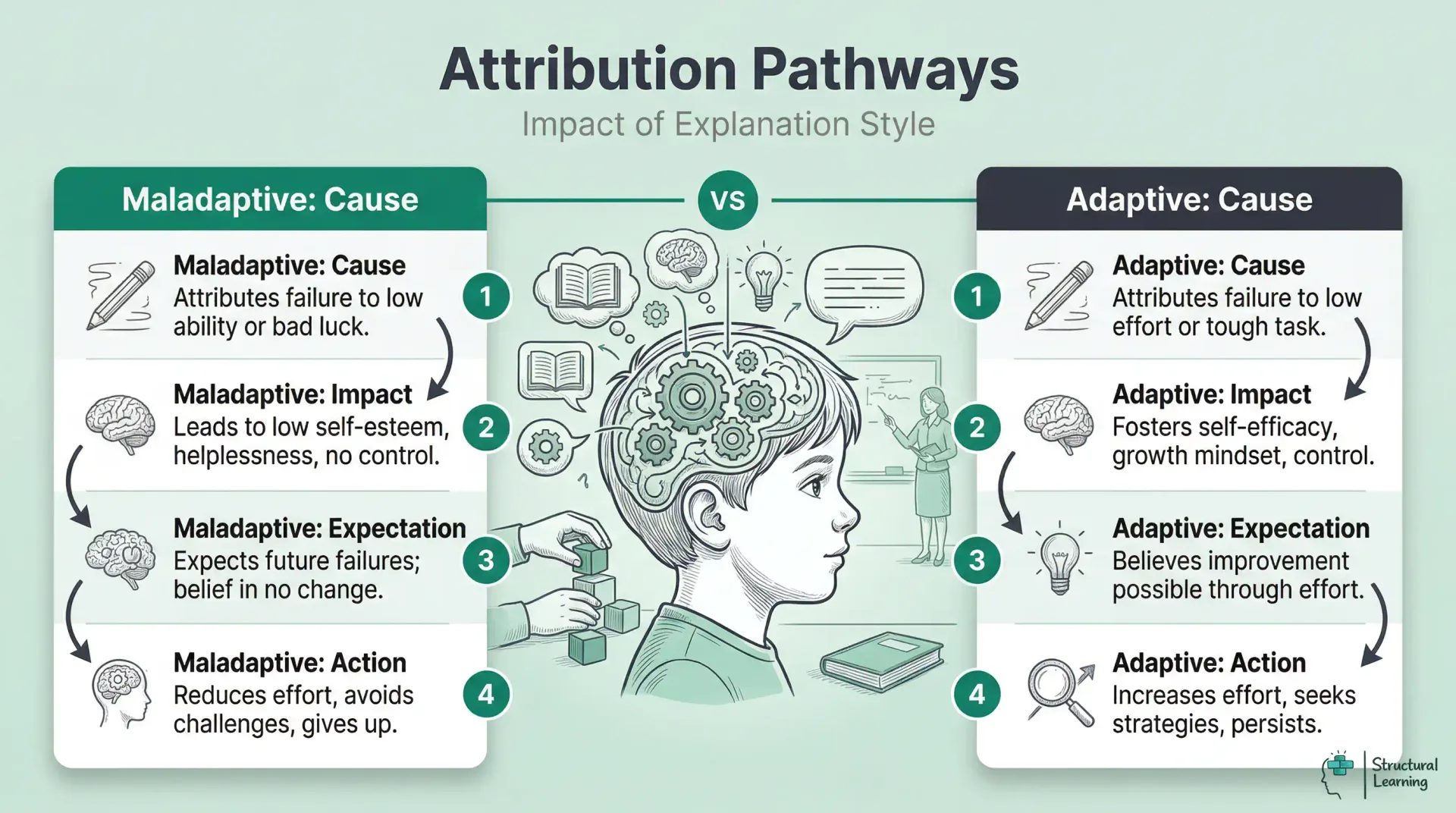
Attribution theory explains how learners find causes for events (Heider, 1958). Do learners blame internal factors (effort) or external factors (luck)? Weiner's (1985) research shows this affects motivation and later behaviour. Dweck (2006) links mindset to achievement.
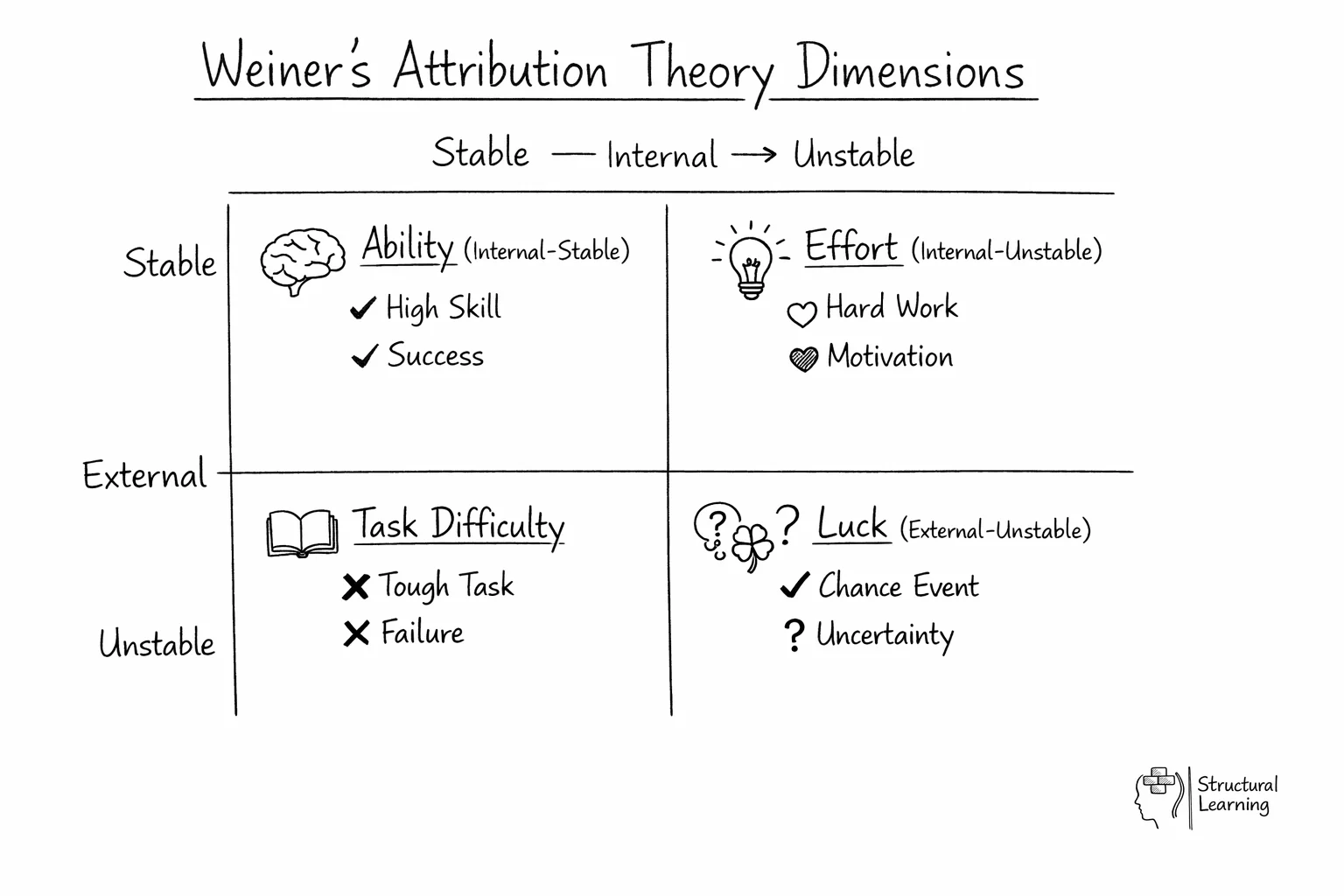
| Attribution Type | Stable | Unstable |
|---|---|---|
| Internal (within the person) | Ability: "I'm naturally good/bad at this subject" Impact: Affects self-esteem and future expectations | Effort: "I studied hard/didn't try" Impact: Controllable; affects motivation and persistence |
| External (outside the person) | Task Difficulty: "This test is always hard/easy" Impact: Affects expectations but not self-worth | Luck: "I was lucky/unlucky today" Impact: Uncontrollable; minimal impact on future motivation |
Attribution theory explores why learners attribute causes (Heider, 1958). Learners try to understand events, assigning internal or external causes. These attributions greatly affect motivation, attitudes, and future behaviour. Understanding learner explanations of success/failure is vital (Weiner, 1985; Dweck, 2006).
What does the research say? Attribution retraining teaches learners to attribute outcomes to effort rather than ability. Dweck (2006) demonstrated that students taught a growth mindset improved maths grades by 0.30 grade points over a semester. The EEF currently rates metacognition and self-regulation approaches at +8 months additional progress; source: EEF Teaching and Learning Toolkit, Metacognition and self-regulation, last updated May 2025.
The way people attribute causes to positive and negative events can greatly affect their motivation and . For instance, attributing success to personal effort rather than task difficulty or external sources can lead to increased self-esteem and a stronger sense of self-efficacy (Zhang & Huang, 2021). Conversely, consistently attributing failures to personal shortcomings can result in decreased self-esteem and a sense of helplessness (Abramson, Seligman, & Teasdale, 1978).
Understanding the complexities of human behaviour and the attributions people make is essential and parents, as it allows them to better support . By recognising the aspects of person perception that contribute to attribution processes, adults can guide children towards more balanced and accurate attributions. This can promote healthier self-perceptions and encourage resilience in the face of challenges.
Attribution understanding informs teaching (Weiner, 1985). Teachers should stress effort when learners face challenges. Acknowledge external factors' role in results. This helps learners understand their abilities and what affects success.
Attribution theory helps teachers understand learner emotions and behaviours. Teachers can then support learners and communicate effectively with them. This fosters a good learning environment (Weiner, 1985; Dweck, 2006).
Heider (1958) created attribution theory, contrasting internal and external causes. Kelley built on this with his covariation model. Weiner added stability and controllability in his three-dimensional model. For more on this topic, see Locus of control. These researchers shaped attribution theory in social psychology.
rather than external factors. Weiner (1985) suggested learners often attribute success and failure to internal causes. These can include their own ability or the effort they put in. This attribution impacts motivation and future achievement (Weiner, 1986, 2010).
Weiner's attribution theory explains self-serving biases. Learners link success to their skills but blame failures on external things. This bias protects self-esteem and keeps a positive self-image (Weiner, 1985).
Attribution theory shapes how learners experience classroom tasks: a learner's self-perception is affected by internal attributions and biases. Adults guide learners to more balanced viewpoints, which helps their emotional responses.
Adults help learners see internal and external performance factors. This encourages realistic understanding of their abilities (Dweck, 2006; Yeager & Dweck, 2012). Learners then grasp success and failure factors more easily (Weiner, 1985).
Moreover, Weiner's work on stability and controllability offers valuable insights for growth mindset and responsibility for their actions. This, in turn, can contribute to a more adaptiv e attribution style and greater resilience in the face of challenges.
Heider, Kelley, and Weiner's attribution theory helps us understand social perception. Adults can use this in education and parenting to support learners. This creates better environments, improving well-being and success (Heider, Kelley, Weiner).
Attribution theory impacts classroom work, influencing feedback and motivation. Teachers understand learner attributions to build effective strategies. This promotes success and well-being (Weiner, 1985; Dweck, 2006; Graham, 1991).
Teachers use attribution theory by giving useful feedback (Meccawy & Sebai, 2024). When learners succeed, highlight their effort. If learners fail, attribution retraining is key. Guide them to see effort, strategies or context, not just lack of ability (Wang et al, 2022). For more on this topic, see Just world hypothesis. This change stops helplessness and keeps learners motivated.

Self-efficacy links to attribution theory (Weiner, 1985). Learners who credit success to effort build stronger beliefs in their abilities (Bandura, 1977). This encourages learners to tackle challenges and persevere (Dweck, 2006).
Attribution theory helps learners understand why peers act as they do. Teachers can explain behaviour stems from situations, not just personality (Heider, 1958). This builds empathy and improves classroom relationships, especially when managing behaviour. (Weiner, 1986).
Attribution theory supports differentiated instruction by helping teachers respond to how learners explain success and failure (Weiner, 1985). Learners see success and failure in varied ways. Teachers can tailor support and help learners recognise their achievements. They can also help learners take responsibility for improvements.
Weiner (1985) found learners attribute success/failure in four ways. These attributions affect their motivation and future learning. The classic four causes are based on locus of causality (internal/external) and stability (stable/unstable); Weiner's later three-dimensional model also includes controllability. Internal factors are ability or effort. External factors include task difficulty or teacher actions. Stability means causes are either fixed or changeable.
Understanding these attribution patterns proves invaluable in educational settings. When students attribute success to internal, unstable factors like effort ("I worked hard on this essay"), they maintain both confidence and motivation for future tasks. Conversely, attributing failure to internal, stable factors such as lack of ability ("I'm just not good at mathematics") can lead to learned helplessness and academic disengagement. Teachers can recognise these patterns through student language and responses to feedback.
Dweck (2006) suggests we reshape learner attributions with specific feedback. Instead of praising ability, focus on effort, like "Your strategy achieved great results." This helps learners see performance as manageable and improves resilience (Yeager & Dweck, 2012).
Weiner (1980s) found learners link success to effort and do better. They also keep trying longer. Dweck's later work shows effort-based thinking boosts learning. This especially helps learners during school changes.
Classroom interventions support attribution retraining. Classroom programmes that reframe attributions toward effort and strategy use have been shown to improve learner outcomes and motivation (Hattie, 2009). Improvements are largest when retraining used strategy instruction.
Process feedback works, say researchers. Explicitly teach learners about effort, as Dweck (2006) showed. Help learners see failures as chances to learn, like Yeager & Dweck (2012) advised. These actions improve learner engagement and results.
Teachers shape feedback and responses to learner performance at the start of attribution training. When learners struggle, emphasise effort and strategy instead of ability. This helps learners see challenges as growth, said Dweck (various dates). Praise process over intelligence; it builds resilience and motivation, her research shows. Ability focused comments can discourage learners, Dweck found.
Attribution retraining shapes classroom talk, (Weiner, 1985). Model effort-based praise: "Your method works," not, "You are naturally gifted." (Dweck, 2006). Guide learners after errors. Ask, "Which strategies can improve results?" Don't accept "I'm not good at this." This builds useful habits, (Perry, 2003).
Researchers show routines boost growth mindsets. Learners reflect weekly on effective strategies they used. Discussions about challenges faced normalise effort and achievement. This approach, as noted by researchers, helps learners see setbacks as temporary (not personal failings).
Learner attributions impact motivation (Weiner, 1985). Learners who credit effort show more motivation (Dweck, 2006). Abramson, Seligman and Teasdale (1978) argued that attributing negative events to internal, stable and global causes increases vulnerability to helplessness and depressive responses. This reduces their problem-solving drive (Seligman, 1975).
Learners connect events to internal or external factors. Dispositional attribution relates to learner traits (Heider, 1958). Situational attribution concerns the environment instead. Teachers benefit from understanding these attribution styles (Kelley, 1967). This knowledge shows how learners view their academic progress.
Consider a student who fails a maths test. A dispositional attribution might be "I'm terrible at maths" (ability) or "I didn't study enough" (effort). A situational attribution could be "The test was unfair" (task difficulty) or "The classroom was too noisy" (environmental factors). These different explanations profoundly affect how students approach future challenges.
Teachers can guide students towards healthier attribution patterns through specific strategies. First, when providing feedback, explicitly highlight the role of effort and strategy rather than fixed ability. Instead of saying "You're naturally gifted at writing," try "Your careful planning and revision really improved this essay." This reinforces the controllable nature of success.
Reflection helps learners analyse causes. Use questionnaires after tests (Weiner, 1985). Learners see if effort, ability, luck, or task affected their scores. Awareness can help learners spot bad patterns (Dweck, 2006).
Dweck (2006) found effort helps learners become more resilient and perform better. Teachers can show learners the difference between internal and external factors. This helps build confidence and encourages them to see challenges as chances (Dweck, 2006).
Attribution biases affect how learners and teachers understand events, impacting results. The fundamental attribution error is common (Ross, 1977). We blame personality, ignoring context. Teachers might see a learner's poor work as laziness, not home stress or lack of resources. (Heider, 1958).
These biases affect learners. Self-serving bias makes learners credit success to themselves and blame failures on external things (Ross & Nisbett, 1991). Learners with low self-esteem may blame themselves for failures (Beck, 1979). Actor-observer bias means learners judge themselves by situation, others by character (Jones & Nisbett, 1971).
Teachers can address these biases through specific strategies. First, implement structured reflection activities where students analyse both internal and external factors contributing to their outcomes. For instance, after assessments, ask students to complete attribution charts listing all possible causes for their performance.
Second, model balanced attributions in your feedback. Rather than saying "You're naturally gifted at maths," try "Your consistent practise and problem-solving approach led to this success." This helps students recognise controllable factors in their achievements.
Dweck's (2006) research shows that learners gain resilience and perform better when aware of attribution biases. Teachers can help learners understand biases. Give learners tools to accurately assess themselves after success or failure.
Kelley's (1967) covariation model aids teachers in understanding learner actions. It highlights consensus, distinctiveness, and consistency (Kelley, 1967). Teachers use these patterns to interpret learner responses and inform self-assessment strategies.
Consensus means people act similarly in situations. If learners struggle with maths, they blame external factors (Kelley, 1973). Teachers can share class data. This helps learners see challenges as common (Weiner, 1985; Graham, 1991).
Distinctiveness means behaviour varies across situations. A learner good at science, but struggling elsewhere, shows it (Kelley, 1973). Teachers should see what makes science work for that learner. Perhaps experiments suit them, informing teaching in other subjects.
Consistency means behaviour repeats, (Kelley, 1967). A learner late in the morning but on time after lunch shows a pattern. Teachers should investigate, (Kelley, 1967). Unreliable transport or care duties are possible external causes, not laziness, (Kelley, 1967).
Practical application involves teaching students to analyse their own attributions systematically. When reviewing test results, guide students through these three questions: Did others find it difficult? Do I struggle only with this subject?
Is this a recurring pattern? This structured reflection helps students develop more accurate and helpful explanations for their academic experiences, moving beyond simplistic "I'm just bad at this" attributions.
Fritz Heider introduced attribution theory in the 1950s. Heider thought people try to understand why things happen. Heider distinguished between internal and external causes. Educators use this framework to understand learner behaviour (Heider, 1950s).
Weiner (1970s, 1980s) made attribution theory useful for education. His model focused on achievement, with three dimensions. These were locus of control, stability, and controllability. If a learner fails, Weiner's ideas help teachers see why. Do they blame lack of ability (Weiner, internal, stable, uncontrollable) or poor revision (Weiner, internal, unstable, controllable)?
Weiner's research revealed that students who attribute failure to lack of effort rather than lack of ability maintain higher motivation levels. This insight revolutionised classroom practice; teachers began explicitly discussing with students how effort leads to improvement. For instance, replacing comments like 'You're not a maths person' with 'You haven't mastered this concept yet' encourages students to view challenges as opportunities for growth rather than evidence of fixed limitations.
Attribution retraining, a popular UK classroom tool, helps learners shift thinking (Weiner, 1985). Journals encourage learners to link results to controllable factors, like study skills (Dweck, 2006). They should avoid blaming fixed ability or hard tests (Rotter, 1966).
Dweck's mindset theory shows interventions can change attribution patterns. Learners with a growth mindset link performance to effort, not just talent. Learners with a fixed mindset focus on ability (Dweck). This impacts academic resilience and success (Dweck).
Teach learners to spot and change their thinking about causes, as per Dweck (2006). Teachers can show good examples by linking tactics to success, not talent, as said by Weiner (1985). Learners should think about how they learn, celebrating progress, not just grades, which fosters motivation, according to Ames (1992).
Attribution theory helps teachers grasp how learners interpret experiences. It reveals how beliefs about capability develop (Weiner, 1985). Adults can foster supportive settings by understanding attribution's impact on motivation (Dweck, 2006). This boosts self-esteem and shapes future actions (Graham, 1991).
Attribution theory impacts learners' challenges, interactions, and resilience. Teachers using it in feedback and lessons help learners understand their world better. This supports learning and how they handle success and failure (Weiner, 1985; Dweck, 2006).
Attribution theory, (Weiner, 1985), still explains learner motivation. Teachers can use this in their classrooms daily. They can build settings where learners gain helpful beliefs. This boosts self-belief, (Bandura, 1977), and persistence, (Dweck, 2006). Learners can then confidently meet their goals.
Heider (1958) proved attribution theory is key for teaching. Dispositional attribution connects behaviour to the learner's traits. Situational attribution pins blame on the learner's surroundings (Kelley, 1967).
Consider a Year 9 student who fails a maths test. A dispositional attribution might be "Sarah is lazy" or "She lacks mathematical ability." A situational attribution would consider external factors: "The test covered material taught whilst Sarah was ill" or "The classroom was noisy during the exam." This distinction profoundly affects how teachers respond to student performance and behaviour.
Ross (1977) found people overestimate personality when judging others. This is the fundamental attribution error. Teachers may label learners "challenging" due to this bias. Consider family stress, peer issues, or unclear directions (Ross, 1977).
To counter this bias, effective teachers employ several strategies. First, they gather context before making judgements; a behaviour tracking sheet that includes time of day, subject, and recent events helps identify patterns. Second, they use neutral language when discussing student behaviour, focusing on specific actions rather than character traits. Instead of "Tom is aggressive," they might note "Tom pushed another student during PE after losing a game."
Teaching learners about attribution patterns benefits them. Teachers can help learners spot effort and preparation. They should also identify test anxiety and distractions, says Weiner (1985). This approach builds accurate self-assessments and learning skills, claim Dweck (2006) and Yeager & Dweck (2012).
Jones and Davis's (1965) Correspondent Inference Theory helps teachers understand learner judgements. It explores how learners infer personality traits from actions in classrooms. Social interactions are very important here.
Jones and Davis found learners link personality to intentional behaviour. Unique outcomes suggest more about personality (Jones & Davis). Socially unexpected behaviour reveals character, according to Jones and Davis.
Attribution theory explains classroom behaviours. When quiet learners speak passionately, teachers may infer genuine interest. Learners working alone on group projects could seem independent or antisocial. Context matters in these assumptions (Heider, 1958; Weiner, 1985).
Next, explicitly teach learners about attribution theory, discussing internal versus external causes, as Heider (1958) proposed. Also, have learners reflect on their own attributions (Jones & Davis, 1965; Kelley, 1967) to promote self-awareness.
Learners show diverse behaviours in different contexts, which helps classmates understand them better. Teach learners about attribution biases in PSHE using classroom examples (Jones & Davis, 1965; Kelley, 1967). This highlights how quick judgements cause misunderstandings (Ross, 1977; Gilbert & Malone, 1995).
Attribution theory is a psychological framework that explains how learners interpret the causes of their academic successes and failures. It examines whether students credit internal factors like their own effort or external factors like the difficulty of a test. Understanding these explanations helps teachers recognise why some children remain motivated while others feel helpless.
Teachers can implement this approach by providing feedback that links a student's progress to specific effort and strategies. Instead of praising innate ability, educators should highlight the concrete steps a learner took to overcome a challenge. This helps learners realise that their results are within their control and can be improved by practising specific skills regularly.
The primary benefit is the development of a resilient mindset where learners view setbacks as temporary and surmountable. By shifting a child's focus from fixed ability to controllable effort, schools can increase engagement and academic persistence. This approach reduces anxiety around failure and encourages students to take on more complex tasks.
Attribution retraining teaches learners to value effort over luck or ability. The Education Endowment Foundation also highlights that metacognitive approaches involving self-regulation and attribution can add seven months of progress. These findings demonstrate that how children explain their results directly affects their long-term academic outcomes.
A common error is overemphasising effort when a learner actually lacks the foundational knowledge or skills to complete a task. If a child tries hard but fails because the work is too difficult, simply telling them to try harder can lead to frustration. Another mistake is the fundamental attribution error, where teachers might judge a learner's character rather than considering the external circumstances affecting their behaviour.
Internal attribution is essential because it provides learners with a sense of agency and self-efficacy. When a child believes their success is the result of their own actions, they feel more responsible for their learning and are more likely to persevere. This internal focus helps prevent the development of learned helplessness and builds the confidence needed to tackle new academic challenges.
Kelley's covariation model (1967) helps teachers understand learner attribution. It examines consensus, consistency, and distinctiveness. These factors show if learners attribute behaviour to internal or external causes.
Consensus reflects how others act in similar situations. If Emma struggles with fractions, and others do not (low consensus), learners may blame Emma's ability. If the whole class struggles (high consensus), they may blame teaching or the topic itself. (Kelley, 1973)
Consistency means behaviour happens regularly over time. If Tom often arrives late to maths, learners and teachers blame his motivation (Kelley, 1967). If Tom is only late once, traffic is the more likely reason (Weiner, 1985).
High distinctiveness, as shown in Sarah's science class (Kelly, 1967), suggests situational factors. Low distinctiveness, like Sarah disrupting all lessons, points to learner behaviour patterns (Kelly, 1967).
Teachers can apply this model practically by helping students analyse their own attribution patterns. When a student claims "I'm terrible at languages," encourage them to consider: Do others find French difficult? (consensus) Have they always struggled, or is this new?
Researchers found learners need structured reflection (consistency). Do they do well in subjects using similar skills (distinctiveness)? This reflection lets learners make balanced attributions. It also supports learning, rather than limiting beliefs.
These peer-reviewed studies provide the evidence base for the strategies discussed above.
Kelley (1973) found causal attribution impacts learners' business education. Weiner (1985, 1986) showed learners' success or failure beliefs are important. Dweck (2006) proved mindset affects a learner's achievement. Heider (1958) suggests this helps teachers support learner growth.
Wang et al. (2022)
Attribution theory helps teachers understand learner motivation . Teachers can use this to support learner engagement in entrepreneurship. Curriculum design can address psychological barriers for learners.
Meccawy et al. (2024)
The research by attribution theory experts examines why learners quit third languages. Teachers can use these insights into learner motivation to reduce language programme drop-out. This helps maintain learner engagement in multilingual education.