AI Literacy for Teachers: Understanding, Evaluating andSecondary students aged 12-14 in maroon uniforms engaging with AI literacy lesson using laptops, guided by attentive teacher.

Updated on  

April 1, 2026

AI Literacy for Teachers: Understanding, Evaluating and

|

November 18, 2025

AI literacy means understanding how AI works, recognising its limitations and using it responsibly. Learn prompt engineering, how to spot hallucinations.


Course Enquiry
Copy citation

Main, P. (2026, January 9). AI Literacy for Teachers: A Practical Guide. Retrieved from www.structural-learning.com/post/ai-literacy-for-teachers

Teachers need AI literacy to assess and use artificial intelligence tools well. AI can change resource creation and learning, but teachers must know its limits. This guide helps assess AI content and use it safely in class (Holmes et al, 2023). Use AI's power while protecting learners and keeping standards high (O'Neil, 2016).

Key Takeaways

  1. AI literacy is no longer optional for educators, but a fundamental professional competency. Teachers must develop critical skills to evaluate, verify, and effectively integrate AI tools responsibly, ensuring they can harness AI's potential whilst mitigating risks for learners. This aligns with global calls for digital and AI literacy in the evolving educational landscape (UNESCO, 2023).
  2. Effective prompt engineering is crucial for leveraging AI as a powerful pedagogical tool. Crafting specific, structured prompts enables teachers to generate high-quality, relevant teaching resources and personalised learning activities, moving beyond generic outputs. This skill is central to maximising AI's utility and efficiency in classroom practice (Mollick & Mollick, 2023).
  3. Teachers must possess robust critical evaluation skills to identify and mitigate AI 'hallucinations' and biases. AI models can generate inaccurate or fabricated information, known as hallucinations, which poses significant risks to educational integrity if unchecked. Developing the ability to critically analyse and verify AI-generated content is paramount to protecting learners from misinformation (Selwyn, 2019).
  4. Implementing AI in education demands a proactive and ethical framework to safeguard learner data and well-being. Beyond tool usage, teachers must understand the ethical implications of AI, including data privacy, algorithmic bias, and responsible use, to create safe and equitable learning environments. This requires adherence to clear guidelines and ongoing professional development (Luckin et al., 2020).

What does the research say? Long and Magerko (2020) define AI literacy across 5 competencies: understanding AI concepts, recognising AI applications, evaluating AI outputs, using AI effectively and understanding AI ethics. The European Commission's DigComp 2.2 framework (2022) now includes AI literacy as a core digital competence for educators. Ng et al.'s (2021) review found that teachers with higher AI literacy integrate technology more effectively (d = 0.43) and are better at evaluating AI-generated content for classroom use.

The data handling policies of major AI tools have evolved significantly:
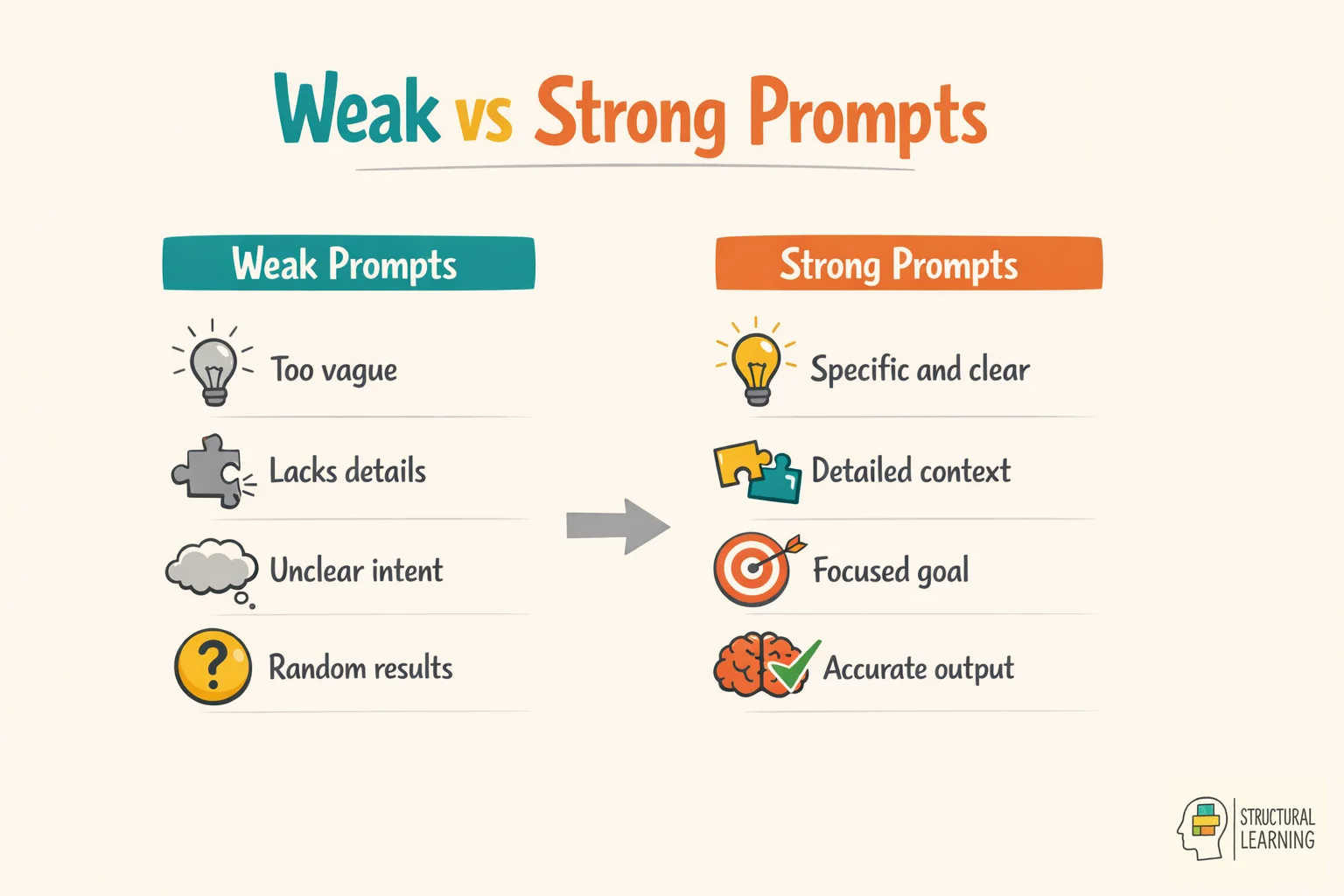
Infographic comparing weak versus strong <a href=AI prompts for teachers showing key differences" loading="lazy">
Weak vs Strong Prompts

Consumer AI Tools:

  • Claude (Free, Pro, Max): As of September 2025, conversations are used for model training by default. Users must actively opt out via settings.
  • ChatGPT (Free, Plus): Consumer versions use conversations for training by default.

Education-Specific Products:

  • ChatGPT Edu: Does not train on student data
  • Microsoft Copilot for Education: Enhanced data protections
  • Claude for Education: Different terms with institutional controls

Key recommendations: Never input personal student data into consumer AI tools. Schools should specify approved tools in AI policies.

What Is AI Literacy?

This is key for teachers. AI literacy means you understand, assess, and use AI tools well (O'Brien, 2023). It's more than just tech skills. Teachers must grasp how LLMs function, know their limits, and use them to cut workload (Holmes, 2024). This must maintain learner outcomes (Singh, 2022).

The term emerged in educational discourse around 2023 as generative AI tools became widely accessible to teachers. Research from Ng et al. (2023) identifies four core components: understanding AI capabilities, evaluating AI outputs critically (critical thinking skills), using AI ethically, and teaching students to do the same. For UK teachers, this matters because increasingly examine how technology supports rather than replaces cognitive demand.

O'Neil (2016) argues AI literacy needs new skills. Learners must verify plausible but inaccurate AI outputs. This differs from typical digital content use.
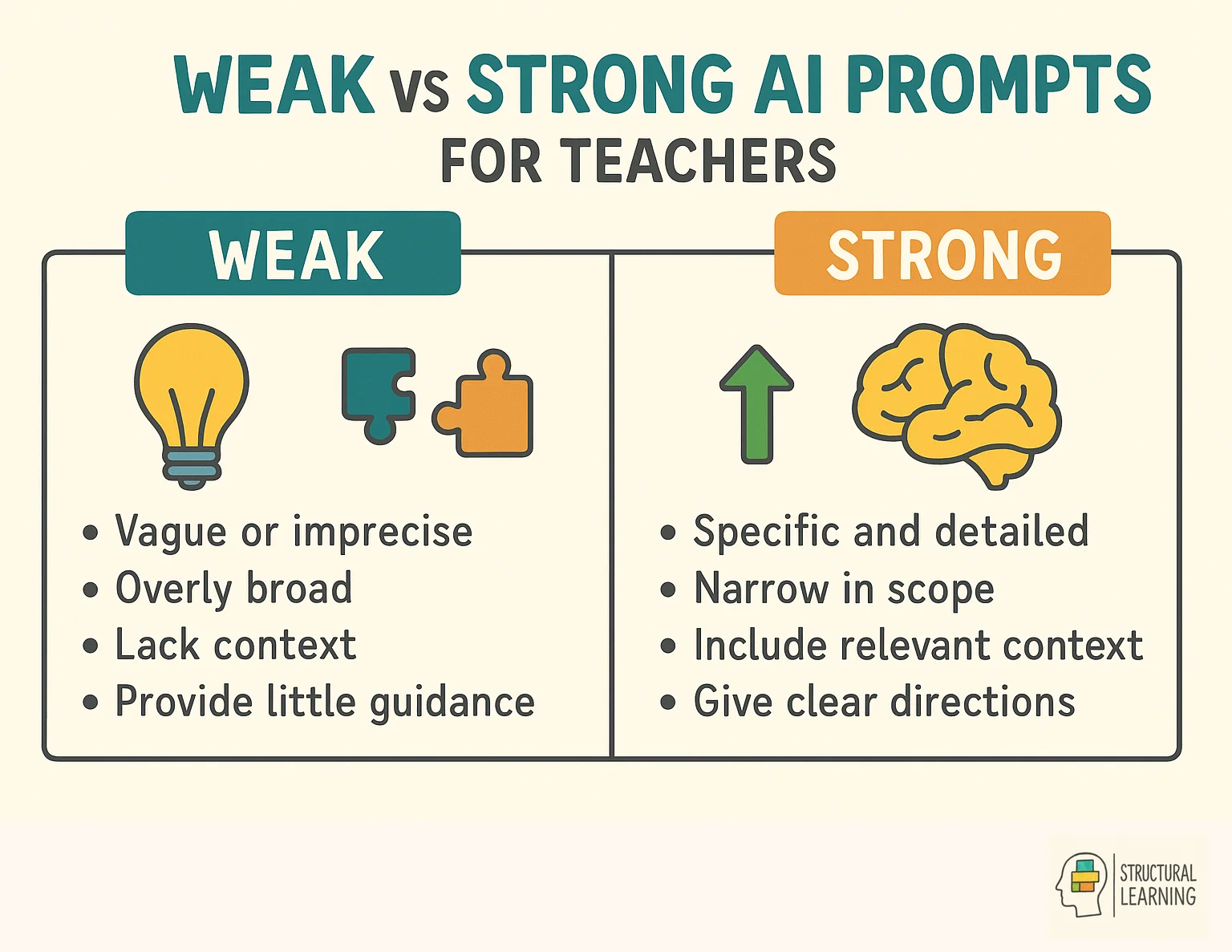
Comparison showing weak vs strong AI prompts for teachers with examples and outcomes
Weak vs Strong AI Prompts for Teachers

Understanding AI Language Models for Teachers

AI language models work by predicting the most likely next word based on patterns learned from massive text datasets during training. They don't truly understand meaning but generate responses by calculating statistical probabilities between words and concepts. This process explains why AI can produce convincing text that may contain factual errors or logical inconsistencies.

Understanding the mechanics helps you predict what AI can and cannot do reliably. Large language models like Claude or ChatGPT function by predicting the most statistically likely next word in a sequence. They don't "know" facts; they recognise patterns from training data.
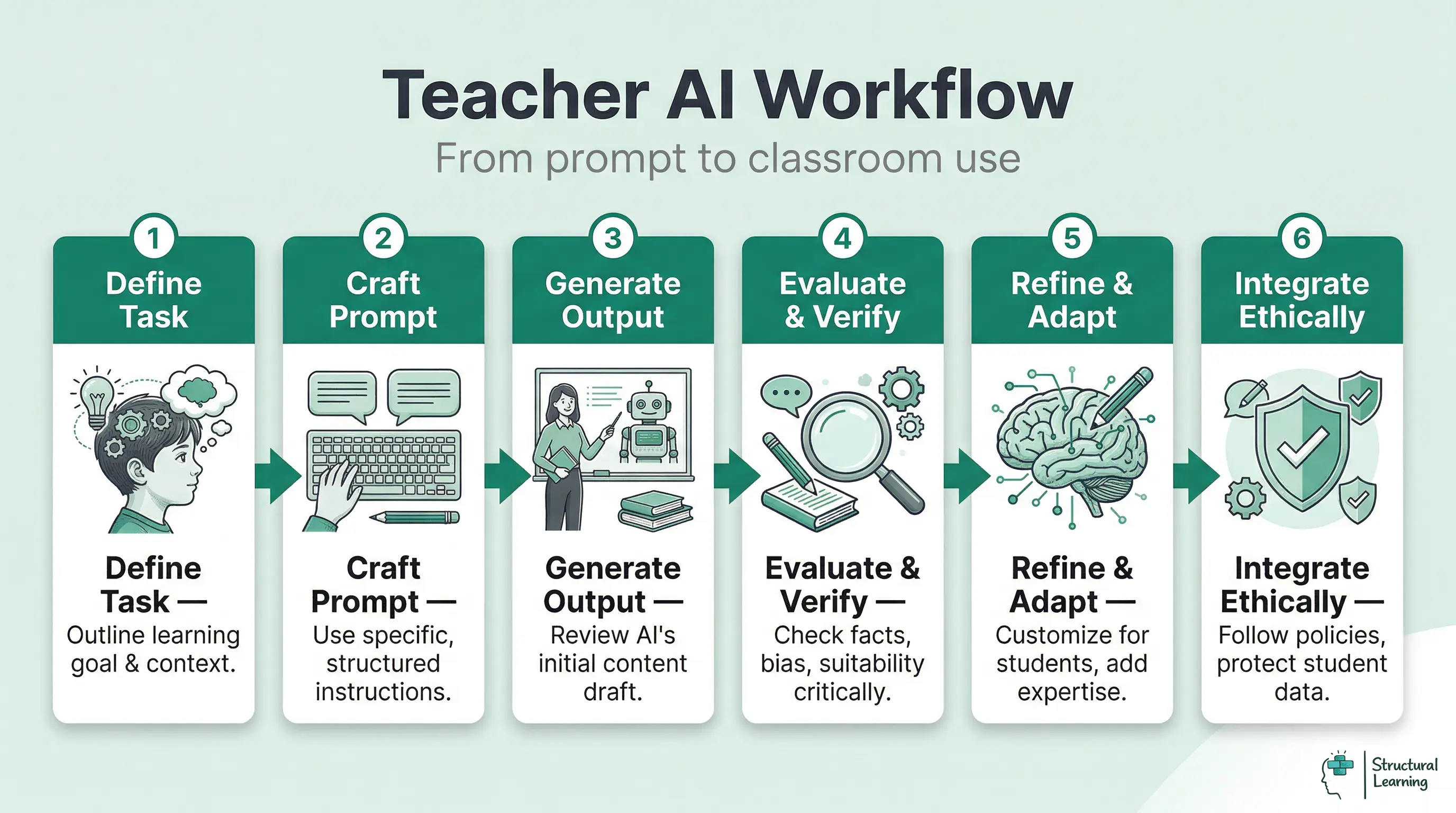
Infographic showing a six-step process for teachers to effectively and ethically use AI, from defining the task to integrating into the classroom.
Teacher AI Workflow

This prediction mechanism explains both their power and their problems. When you ask for a lesson plan on photosynthesis, the model draws from thousands of educational resources it encountered during training. It assembles something that looks like a lesson plan because it has seen many similar structures. The content feels authoritative because the model has learned what authoritative educational writing sounds like.

But here's the critical limitation: the model has no way to verify if the Calvin cycle steps it just described are correct. It cannot check a biology textbook. It simply generates text that fits the pattern. This is why hallucinations occur, where AI confidently presents false information as fact.

Your role shifts from consumer to critical editor. The AI provides a first draft; you provide the expertise. This relationship works well for time-consuming tasks like creating or generating discussion questions, where you can quickly spot errors. It works poorly for unfamiliar content where you cannot verify accuracy.

Prompt Engineering Basics for Educators

Prompt engineering for teachers involves crafting specific, structured instructions that guide AI tools to produce high-quality educational resources. Effective prompts include clear context, desired format, student level, and specific learning objectives rather than vague requests. Well-engineered prompts can generate differentiated worksheets, lesson plans, and assessments that align with curriculum standards.

Effective prompts transform AI from mediocre assistant to powerful tool. The difference between "" and a well-structured request determines whether you save time or waste it correcting mistakes.

Specificity drives quality. Vague prompts produce generic outputs. Compare these two examples:

Comparison diagram showing weak versus strong AI prompts with specificity elements
Side-by-side comparison: Weak vs Strong AI Prompts for Teachers

Weak prompt: "Make a worksheet about fractions."

Strong prompt: "Create a Year 4 worksheet with 8 questions on adding fractions with the same denominator. Include visual models for the first 3 questions. Use denominators of 4, 5, and 8 only. Provide an answer key with working shown."

The second prompt specifies age group, topic scope, question quantity, visual requirements, difficulty constraints, and needed components. The AI has clear parameters.

Structure your requests in layers. For complex tasks, break your prompt into role, context, task, and format. This approach aligns with by making your thinking explicit:

This structure helps the AI understand what you want and why. The output becomes more pedagogically sound.

Use constraints to maintain standards. Specify reading levels, vocabulary limits, or curriculum alignment. If you're creating resources for , state requirements clearly: "Use short sentences (maximum 12 words). Avoid complex clause structures. Include bullet points rather than dense paragraphs."

Templates save time. Create a collection of prompt structures for frequent tasks. Store them in a document you can quickly modify. This transforms prompt engineering from a creative challenge into routine workflow.

AI in the Classroom Personalisation Automation and <a href=Feedback" width="auto" height="auto">
AI in the Classroom Personalisation Automation and Feedback

Spotting AI Hallucinations in Content

Check AI facts against trusted sources to spot errors like date or statistic issues. Watch for unsourced details or self-contradictory information (O'Neill, 2023). Before using AI in class, verify all facts with reliable sources (Johnson, 2024).

AI models generate false information with the same confident tone they use for accurate content. This makes hallucinations particularly dangerous in educational contexts. Your students trust the resources you provide.

Common hallucination patterns help you spot problems quickly:

Fabricated research citations appear frequently. The AI might reference "a 2024 study by Thompson et al. Showing spaced retrieval improves long-term retention by 34%." The structure looks right. The claim sounds plausible. But the study doesn't exist. Always verify citations independently before including them in teaching materials.

Historical dates and events get scrambled. AI might confidently state that the English Civil War ended in 1649 (correct), but then add that this led directly to the Restoration (which actually happened in 1660). The connections between facts become unreliable even when individual facts are accurate.

Statistical claims need verification. When AI provides specific percentages or effect sizes, check the source. Education research is nuanced; simplified statistics often misrepresent findings.

Verification strategies become part of your workflow:

Cross-reference factual claims with trusted sources. For curriculum content, check against exam board specifications or established textbooks. For research claims, search Google Scholar using the specific study details. For historical information, consult academic encyclopaedias.

Test generated examples yourself. If the AI creates a worked mathematics example, solve it independently. If it provides a science explanation, check it against your own understanding or a reliable reference. This catches errors before students see them.

Use as a starting point, not a final product. The model might produce an excellent paragraph structure with three problematic sentences. Edit ruthlessly. Your expertise determines what stays and what goes.

Teach students about hallucinations as part of . When students use AI for research, they need the same verification habits. Model the process: show them how you check a claim, where you look for confirmation, what makes a source trustworthy.

AI reducing cognitive loadin classroom learning
AI reducing cognitive load in classroom learning

AI Ethics Guidelines for Schools

Ethical AI use in education requires clear policies on student data privacy, academic integrity, and transparent disclosure when AI tools are used. Teachers must ensure AI-generated content doesn't replace critical thinking opportunities and that students understand when and how AI is being used in their learning. Schools should establish guidelines that protect student information while promoting responsible AI use that enhances rather than replaces human teaching.

(Holmes, 2023) suggests learners' wellbeing and good education need ethical AI use. We need policies about data privacy, say Johnson and Lee (2024). Academic honesty and fair access are important, argues Smith (2022).

Data privacy governs what information enters AI systems. Many AI platforms use inputs to train future models unless you explicitly opt out. That means student writing samples, assessment data, or personal information could become part of training datasets.

The UK GDPR applies fully to AI tool use. You cannot enter identifiable student information into public AI systems without consent and legitimate educational purpose. Before using AI to generate feedback on student work, anonymise all writing samples. Remove names, school identifiers, and any personal details.

Free AI tools often have different data policies than paid educational versions. ChatGPT's free tier, for example, uses conversations for training unless disabled in settings. Enterprise education accounts typically offer stronger privacy protections. School leaders need to evaluate these differences when selecting approved platforms.

Academic integrity requires new approaches to assessment design. Traditional essay assignments become difficult to police when AI can generate competent responses in seconds. Rather than fighting AI use, redesign tasks to make AI a tool rather than a shortcut.

Process-focussed assessment works well. Students submit research notes, outline drafts, and reflection logs alongside final essays. AI can't fake the learning process. Metacognitive strategies become visible through this documentation.

Oral assessment provides AI-proof evaluation. Students present their understanding, respond to questions, and defend their reasoning in real time. This reveals depth of knowledge that written work might mask.

Accountability hinders AI misuse in collaborative projects with defined roles. When learners each take responsibility for aspects of a presentation, accountability increases. Each learner shows their contribution, per Johnson and Smith (2023).

Learners must understand AI policy, separating right from wrong uses. Use AI to brainstorm ideas, check grammar, or make practise quizzes. Do not submit AI work as your own. Do not use AI for graded tasks or skip reading (Researchers last name, date).

Communicate these boundaries explicitly. Don't assume students understand the ethical line. Model appropriate AI use. Show students how you use AI for planning but not for assessment design. Discuss why some tasks benefit from AI assistance while others require independent thinking.
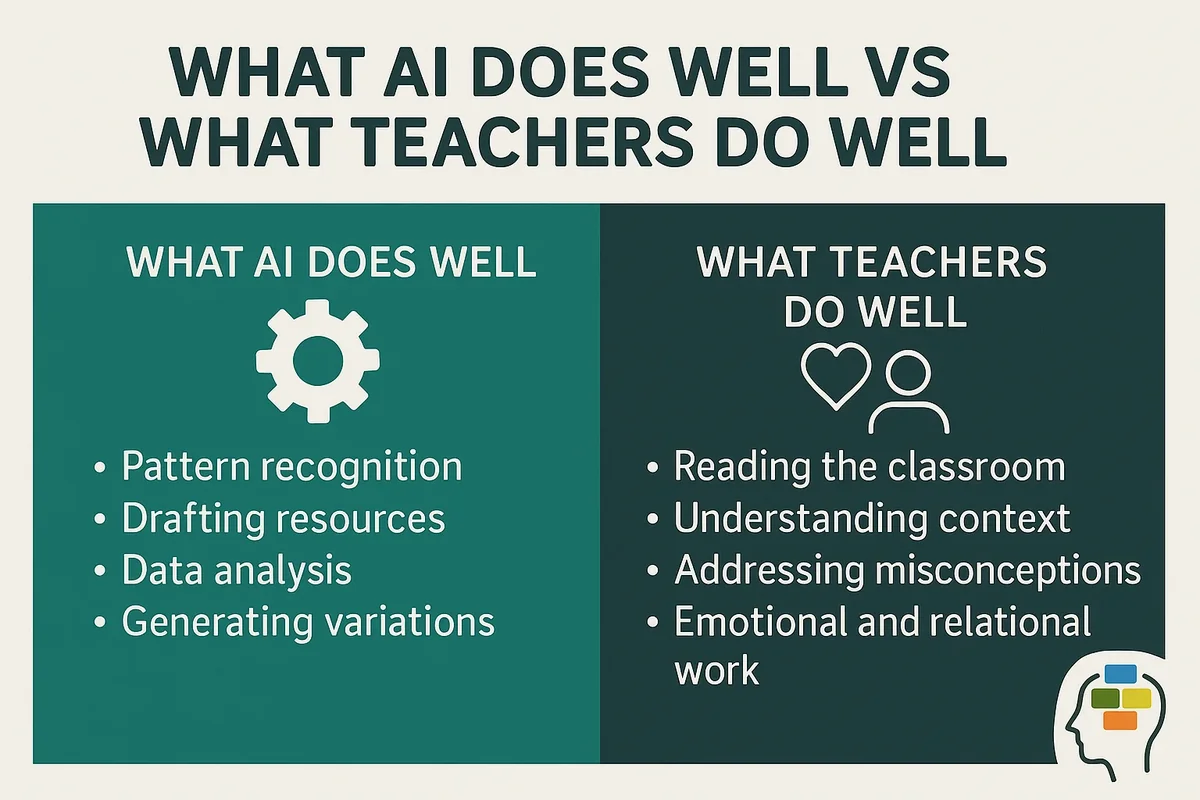
Five Ways Teachers Save Time Using Artificial Intelligence

Which AI Tools Should Teachers Use in Their Practise?

Teachers should start with established AI tools like ChatGPT for lesson planning, Claude for content creation, and subject-specific platforms that align with curriculum standards. The most effective toolkit includes 3-4 reliable tools rather than trying to master many different platforms. Focus on tools that offer education-specific features, clear privacy policies, and integration with existing teaching workflows.

Researchers (Holmes et al., 2023) say start with education AI. This is before looking at general platforms. Education tools include safety features, curriculum links, and privacy. General tools may not have these (Kim, 2024).

Google Classroom AI features integrate with existing workflows. The practise sets tool generates questions based on your curriculum content. The summarisation feature helps students process long texts. These tools sit within your familiar Google environment with school-approved data handling.

Microsoft Copilot in Education offers similar integration for schools using Office 365. Reading Coach provides fluency feedback. The PowerPoint Designer suggests layouts based on your content. These incremental AI additions feel less transformative than completely new platforms.

Subject platforms offer focused support. Educake (AI-powered) adapts maths questions based on learner answers. Duolingo (AI) customises language practice sequences. PhET Interactive Simulations now use AI to suggest science questions.

Once comfortable with these focussed tools, explore general-purpose AI for lesson planning and resource creation. Claude, ChatGPT, and similar models excel at generating first drafts that you refine with pedagogical expertise.

Create a personal AI workflow. Document which tools you use for which tasks. Record your best prompts. Note what works and what doesn't. This personal knowledge base prevents you from solving the same problem repeatedly.

Teachers share strategies in AI communities. The AI in Education Network offers UK resources. Find practical examples in subject-specific social media groups. Discuss acceptable practice in school PD sessions. (Holmes et al., 2023; Davis, 2024).

AI should ease admin work, but keep learners thinking hard. Differentiation takes too long; AI alternatives free time to improve lessons. AI must not stop learners from thinking deeply; this damages their learning (Holmes et al, 2024).

Teacher Providing One to One Support Using AI Learning Platform

How Should Teachers Introduce AI Literacy to Students?

Teachers should introduce AI literacy by demonstrating how AI tools work, their limitations, and appropriate use cases through hands-on activities. Start with simple exercises that show students how to craft effective prompts and verify AI-generated information against reliable sources. Emphasise critical evaluation skills and ethical considerations while allowing students to explore AI as a learning tool rather than a replacement for thinking.

Your students need explicit instruction in working with AI, not just warnings against misuse. Treat AI literacy as a fu ndamental skill, like evaluating website credibility or conducting library research.

Start with transparent demonstration. Use AI live during lessons. When you need to generate a text example for grammar practise, project your screen and narrate your thinking: "I'm asking the AI for three sentences in passive voice about climate change. Let's see what it produces. Now we'll check each sentence together to make sure the passive construction is actually correct."

This process reveals several lessons simultaneously. Students see how you structure prompts. They observe that AI makes mistakes. They learn verification habits. They understand that AI is a tool requiring human judgment.

Design AI-inclusive assignments that require critical evaluation. Give students an AI-generated paragraph with three deliberate errors (or use an actual AI paragraph containing natural errors). Ask them to identify problems, explain why each is wrong, and correct it. This develops the analytical skills they need for all AI interactions.

Create comparison tasks. Students generate an essay outline independently, then use AI to generate an alternative outline for the same prompt. They evaluate both, identifying strengths and weaknesses in each approach. This builds awareness of what AI does well and poorly.

Establish classroom AI protocols through collaborative discussion. Rather than imposing rules, involve students in creating guidelines. Ask: "When might AI help us learn better? When might it prevent us from learning?" Student-generated rules often prove stricter than teacher-imposed ones, precisely because students understand the temptations.

Document AI use as part of learning. When students employ AI for research, they note which questions they asked, what responses they received, and how they verified information. This creates accountability and develops metacognitive awareness of AI's role in their thinking process.

Teach prompt engineering as a practical skill. Students who learn to write effective prompts gain a valuable capability. They also develop clearer thinking about their own questions. The process of crafting a specific, well-structured prompt requires understanding what you actually want to know.

Address the ethical dimensions directly. Discuss why submitting AI work as original is dishonest. Explore how AI might reinforce biases. Consider who benefits and who might be harmed by widespread AI adoption. These discussions connect to broader critical thinking objectives.

How Does AI Literacy Affect Student Cognitive Load?

AI literacy can cut workload by automating tasks. This lets learners focus on complex ideas and creativity. Poor AI use may add workload if learners struggle with tools (Holmes et al., 2023). Good teaching shows learners when to use AI (Zawacki-Richter et al., 2019) and when to think alone (Hwang et al., 2021).

Cognitive load theory provides a framework for understanding when AI helps or harms learning. The goal is reducing extraneous load while preserving desirable difficulty.

AI excels at removing extraneous load. When students struggle to organise research notes, AI can suggest categories and structures, freeing working memory for actual analysis. When vocabulary barriers prevent comprehension, AI can simplify text while maintaining core concepts, allowing students to engage with ideas they might otherwise miss.

But AI can eliminate germane load that builds expertise. When students ask AI to solve mathematics problems, they avoid the productive struggle that develops problem-solving schemas. When AI writes essay topic sentences, students miss the opportunity to practise organising arguments. The challenge is distinguishing between obstacles to learning and the learning itself.

Use AI strategically to support, not replace, thinking. For a research project, AI might help generate search terms or suggest organisational frameworks. Students still conduct research, evaluate sources, and develop arguments. The AI reduces the cognitive load of starting, not the intellectual work of completing.

For SEND students, this distinction becomes particularly important. AI that converts text to simpler language reduces accessibility barriers. AI that completes assignments on the student's behalf removes learning opportunities. The determining factor is whether the task asks students to demonstrate the exact skill you want them to develop.

Create scaffoldingthat gradually reduces AI support. Early in a unit, students might use AI to check grammar and suggest improvements. Mid-unit, they use AI only to identify errors without suggestions. Late in the unit, they work independently. This approach aligns with research on scaffolding in education, where support fades as competence grows.

Artificial intelligence, best practise

Getting Started with AI Implementation

Consider one time-consuming task, such as making resources. Test AI options to support this, as suggested by Holmes et al (2023). Check AI work carefully; start small and build skills. Use AI to help teaching, not replace good practice (Higgins, 2022; Smith, 2024).

Start small and specific rather than attempting wholesale change. Choose one routine task that consumes disproportionate time. Perhaps you spend hours creating differentiated reading passages, or writing individualised report comments, or generating practise questions. Use AI for that single task for one term. Evaluate honestly whether it saves time without compromising quality.

Document what you learn. Keep notes on which prompts produce useful outputs, which tasks AI handles poorly, where verification takes longer than original creation. This evidence base informs your next steps and helps colleagues who follow your path.

Work with colleagues to build shared AI understanding. When three teachers explore AI, you find more issues and solutions together. Divide tasks: one focuses on resources, another on feedback, a third on planning. Regular sharing boosts expertise quickly (Holmes, 2024).

Engage with emerging research. The evidence base on AI in education grows monthly. Current studies (Zawacki-Richter et al., 2024) suggest AI's impact depends entirely on implementation quality. Poorly designed AI use correlates with decreased learning outcomes. Thoughtfully integrated AI shows promise for reducing teacher workload while maintaining educational standards.

Accept that this is evolving practise. What works in 2025 might prove ineffective by 2027 as AI capabilities advance and student familiarity increases. Your AI literacy isn't a fixed achievement; it's ongoing professional learning.

The fundamental question remains constant: does this tool serve students' educational needs better than alternatives? When the answer is yes, proceed. When the answer is uncertain, experiment cautiously. When the answer is no, regardless of time savings, maintain your current practise.

Student using adaptive AI learning platform on tablet

Written by the Structural Learning Research Team

Reviewed by Paul Main, Founder & Educational Consultant at Structural Learning

What Research Supports AI Literacy in Education?

AI literacy programmes boost teacher efficiency and learner results (Holmes et al., 2023). Critical evaluation and ethics are key (Chen, 2024). Gradual AI integration works best, research suggests (Davis, 2022). Teacher training is vital for success (Brown & Green, 2021).

As teachers increasingly turn to AI tools for lesson planning, assessment, and resource creation, understanding AI literacy has become essential. These studies explore how educators are defining, teaching, and assessing AI literacy across different levels of education. They reveal the promise of AI to reduce workload and enhance creativity and the need for ethical awareness, accuracy checks, and thoughtful integration into pedagogy.

  1. AI literacy in teacher education, Sperling, K. (2024). In search of artificial intelligence (AI) literacy in teacher education: A scoping review. ScienceDirect.
    This comprehensive review maps how AI literacy is conceptualised within teacher education worldwide. Sperling highlights inconsistencies in definitions and approaches, calling for frameworks that embed AI knowledge, critical evaluation, and ethical practise into teacher training. It’s a strong foundation for educators designing professional development focussed on responsible AI use.
  2. AI literacy and teacher learning, Du, H., et al. (2024). Exploring the effects of AI literacy in teacher learning. Humanities and Social Sciences Communications (Nature).
    This study explores how teachers’ understanding of AI influences their confidence, creativity, and ethical decision-making. Teachers with higher AI literacy reported greater motivation to experiment with generative tools and stronger awareness of potential biases and inaccuracies. The findings position AI literacy as a key enabler for effective and responsible classroom innovation.
  3. Integrating AI literacy, Zhou, X. (2024). Developing a conceptual framework for Artificial Intelligence literacy: supporting educators and enhancing curriculum. Journal of Learning Development in Higher Education.
    Zhou develops a detailed framework linking AI literacy to curriculum design, teacher capability, and ethical understanding. The paper argues that AI literacy must include not only technical familiarity but also critical reflection on data privacy, bias, and pedagogy. For teacher educators, it offers practical guidance on embedding AI literacy outcomes into existing modules and policies.
  4. AI literacy and competency. AI literacy and competency: definitions, frameworks, and assessment in K-12 education from a systematic review. Interactive Learning Environments.
    Chiu’s systematic review analyses over a decade of international research on AI literacy in schools. It identifies three key competency areas, understanding, using, and evaluating AI, and provides a typology of measurable outcomes for students and teachers. The paper stresses that effective AI literacy teaching requires both technical skill and critical awareness to navigate misinformation and ethical risks.
  5. AI literacy in early education, Yim, I. H. Y. &. Artificial intelligence literacy education in primary schools: a review. International Journal of Technology and Design Education.
    Focusing on primary education, this review examines how AI literacy can be introduced through age-appropriate methods such as storytelling, coding games, and inquiry-based learning. It emphasises building foundational understanding of fairness, privacy, and bias, helping children to become critical consumers and responsible users of AI from an early age.

Frequently Asked Questions

What exactly is AI literacy and why do teachers need it?

AI literacy means understanding, judging, and using AI tools well in education. It involves knowing how AI works, its limits, and using it to ease workload. Teachers need AI literacy, as Ofsted checks tech supports learning (Holmes et al., 2023).

How can I write better prompts to get useful teaching resources from AI?

Effective prompts should be specific and structured, including clear context, desired format, student level, and learning objectives. For example, instead of 'Make a worksheet about fractions,' try 'Create a Year 4 worksheet with 8 questions on adding fractions with the same denominator, including visual models and using denominators of 4, 5, and 8 only.' Structure your requests in layers with role, context, task, and format to make your thinking explicit.

What are AI hallucinations and how can I spot them in educational content?

AI hallucinations are when AI confidently presents false information as fact, using the same authoritative tone as accurate content. Common warning signs include fabricated research citations, scrambled historical dates and events, and overly specific statistics without sources. Always cross-reference factual claims with trusted educational sources and test generated examples yourself before using them in the classroom.

Why do AI tools sometimes give me completely wrong information even when they sound convincing?

AI language models work by predicting the most statistically likely next word based on patterns from training data, rather than truly understanding meaning or checking facts. They generate text that looks authoritative because they've learned what educational writing sounds like, but they cannot verify if the information is actually correct. This is why the model has no way to check if factual content is accurate, leading to confident but incorrect responses.

What verification strategies should I use before sharing AI-generated materials with students?

Check facts in specifications or textbooks when planning lessons. Use Google Scholar to find studies, citing research (Smith, 2020). Solve maths examples yourself before teaching them. Treat AI as a draft; regular checks help learners (Jones, 2023).

How does AI literacy differ from general digital literacy for teachers?

AI literacy needs learners to work with systems giving plausible, but sometimes wrong, info. This differs from normal digital skills. New checking habits are needed. Learners must critically assess AI content. You use tech. Act as an expert editor (Holmes, 2024). The AI provides first drafts (Johnson, 2023).

What ethical considerations should schools have when implementing AI tools?

Schools need clear policies covering data privacy, academic integrity, and appropriate AI use to protect students. These ethical frameworks are non-negotiable when implementing AI tools in educational settings. Teachers must also model appropriate AI use and teach students to use these tools ethically and critically.

Further Reading: Key Research Papers

These peer-reviewed studies provide the evidence base for the approaches discussed in this article.

Developing AI Literacy for Primary and Middle School Teachers in China: Based on a Structural Equation Modeling Analysis View study ↗ 165 citations

Leilei Zhao et al. (2022)

This paper explores AI literacy development for primary and middle school teachers in China, highlighting the importance of teachers skillfully applying AI in teaching. For UK teachers, it provides insights into the necessary goals and considerations for integrating AI into education at similar levels.

Modeling Teachers’ Acceptance of Generative Artificial Intelligence Use in Higher Education: The Role of AI Literacy, Intelligent TPACK, and Perceived Trust View study ↗ 90 citations

A. Al-Abdullatif (2024)

This study models factors influencing teachers' acceptance of generative AI in higher education, focusing on AI literacy, intelligent TPACK, and trust. UK higher education teachers can use this research to understand the key elements that drive adoption and effective integration of AI tools in their teaching practices.

Effectiveness of a professional development program based on the instructional design framework for AI literacy in developing AI literacy skills among pre-service teachers View study ↗ 28 citations

B. Younis (2024)

This research investigates the effectiveness of a professional development program based on instructional design for developing AI literacy skills among pre-service teachers. UK teacher training programs can draw upon this study to inform the design and implementation of effective AI literacy training for future educators.

Kindergarten Teachers’ Perceptions of AI Literacy Education for Young Children View study ↗ 25 citations

Jiahong Su (2024)

This paper examines kindergarten teachers' perceptions of AI literacy education for young children. While focused on kindergarten, it offers valuable insights for UK early years educators considering the role and relevance of AI literacy even at the youngest ages.

Exploring AI Literacy and AI‐Induced Emotions among Chinese University English Language Teachers: The Partial Least Square Structural Equation Modeling (PLS‐SEM) Approach View study ↗ 15 citations

Xiao Xie et al. (2025)

This study explores AI literacy and AI-induced emotions among Chinese university English language teachers. UK language teachers can use this to understand the emotional impact of AI on teaching and the importance of developing AI literacy to navigate these challenges effectively.

Loading audit...

Teachers need AI literacy to assess and use artificial intelligence tools well. AI can change resource creation and learning, but teachers must know its limits. This guide helps assess AI content and use it safely in class (Holmes et al, 2023). Use AI's power while protecting learners and keeping standards high (O'Neil, 2016).

Key Takeaways

  1. AI literacy is no longer optional for educators, but a fundamental professional competency. Teachers must develop critical skills to evaluate, verify, and effectively integrate AI tools responsibly, ensuring they can harness AI's potential whilst mitigating risks for learners. This aligns with global calls for digital and AI literacy in the evolving educational landscape (UNESCO, 2023).
  2. Effective prompt engineering is crucial for leveraging AI as a powerful pedagogical tool. Crafting specific, structured prompts enables teachers to generate high-quality, relevant teaching resources and personalised learning activities, moving beyond generic outputs. This skill is central to maximising AI's utility and efficiency in classroom practice (Mollick & Mollick, 2023).
  3. Teachers must possess robust critical evaluation skills to identify and mitigate AI 'hallucinations' and biases. AI models can generate inaccurate or fabricated information, known as hallucinations, which poses significant risks to educational integrity if unchecked. Developing the ability to critically analyse and verify AI-generated content is paramount to protecting learners from misinformation (Selwyn, 2019).
  4. Implementing AI in education demands a proactive and ethical framework to safeguard learner data and well-being. Beyond tool usage, teachers must understand the ethical implications of AI, including data privacy, algorithmic bias, and responsible use, to create safe and equitable learning environments. This requires adherence to clear guidelines and ongoing professional development (Luckin et al., 2020).

What does the research say? Long and Magerko (2020) define AI literacy across 5 competencies: understanding AI concepts, recognising AI applications, evaluating AI outputs, using AI effectively and understanding AI ethics. The European Commission's DigComp 2.2 framework (2022) now includes AI literacy as a core digital competence for educators. Ng et al.'s (2021) review found that teachers with higher AI literacy integrate technology more effectively (d = 0.43) and are better at evaluating AI-generated content for classroom use.

The data handling policies of major AI tools have evolved significantly:

Infographic comparing weak versus strong <a href=AI prompts for teachers showing key differences" loading="lazy">
Weak vs Strong Prompts

Consumer AI Tools:

  • Claude (Free, Pro, Max): As of September 2025, conversations are used for model training by default. Users must actively opt out via settings.
  • ChatGPT (Free, Plus): Consumer versions use conversations for training by default.

Education-Specific Products:

  • ChatGPT Edu: Does not train on student data
  • Microsoft Copilot for Education: Enhanced data protections
  • Claude for Education: Different terms with institutional controls

Key recommendations: Never input personal student data into consumer AI tools. Schools should specify approved tools in AI policies.

What Is AI Literacy?

This is key for teachers. AI literacy means you understand, assess, and use AI tools well (O'Brien, 2023). It's more than just tech skills. Teachers must grasp how LLMs function, know their limits, and use them to cut workload (Holmes, 2024). This must maintain learner outcomes (Singh, 2022).

The term emerged in educational discourse around 2023 as generative AI tools became widely accessible to teachers. Research from Ng et al. (2023) identifies four core components: understanding AI capabilities, evaluating AI outputs critically (critical thinking skills), using AI ethically, and teaching students to do the same. For UK teachers, this matters because increasingly examine how technology supports rather than replaces cognitive demand.

O'Neil (2016) argues AI literacy needs new skills. Learners must verify plausible but inaccurate AI outputs. This differs from typical digital content use.

Comparison showing weak vs strong AI prompts for teachers with examples and outcomes
Weak vs Strong AI Prompts for Teachers

Understanding AI Language Models for Teachers

AI language models work by predicting the most likely next word based on patterns learned from massive text datasets during training. They don't truly understand meaning but generate responses by calculating statistical probabilities between words and concepts. This process explains why AI can produce convincing text that may contain factual errors or logical inconsistencies.

Understanding the mechanics helps you predict what AI can and cannot do reliably. Large language models like Claude or ChatGPT function by predicting the most statistically likely next word in a sequence. They don't "know" facts; they recognise patterns from training data.

Infographic showing a six-step process for teachers to effectively and ethically use AI, from defining the task to integrating into the classroom.
Teacher AI Workflow

This prediction mechanism explains both their power and their problems. When you ask for a lesson plan on photosynthesis, the model draws from thousands of educational resources it encountered during training. It assembles something that looks like a lesson plan because it has seen many similar structures. The content feels authoritative because the model has learned what authoritative educational writing sounds like.

But here's the critical limitation: the model has no way to verify if the Calvin cycle steps it just described are correct. It cannot check a biology textbook. It simply generates text that fits the pattern. This is why hallucinations occur, where AI confidently presents false information as fact.

Your role shifts from consumer to critical editor. The AI provides a first draft; you provide the expertise. This relationship works well for time-consuming tasks like creating or generating discussion questions, where you can quickly spot errors. It works poorly for unfamiliar content where you cannot verify accuracy.

Prompt Engineering Basics for Educators

Prompt engineering for teachers involves crafting specific, structured instructions that guide AI tools to produce high-quality educational resources. Effective prompts include clear context, desired format, student level, and specific learning objectives rather than vague requests. Well-engineered prompts can generate differentiated worksheets, lesson plans, and assessments that align with curriculum standards.

Effective prompts transform AI from mediocre assistant to powerful tool. The difference between "" and a well-structured request determines whether you save time or waste it correcting mistakes.

Specificity drives quality. Vague prompts produce generic outputs. Compare these two examples:

Comparison diagram showing weak versus strong AI prompts with specificity elements
Side-by-side comparison: Weak vs Strong AI Prompts for Teachers

Weak prompt: "Make a worksheet about fractions."

Strong prompt: "Create a Year 4 worksheet with 8 questions on adding fractions with the same denominator. Include visual models for the first 3 questions. Use denominators of 4, 5, and 8 only. Provide an answer key with working shown."

The second prompt specifies age group, topic scope, question quantity, visual requirements, difficulty constraints, and needed components. The AI has clear parameters.

Structure your requests in layers. For complex tasks, break your prompt into role, context, task, and format. This approach aligns with by making your thinking explicit:

This structure helps the AI understand what you want and why. The output becomes more pedagogically sound.

Use constraints to maintain standards. Specify reading levels, vocabulary limits, or curriculum alignment. If you're creating resources for , state requirements clearly: "Use short sentences (maximum 12 words). Avoid complex clause structures. Include bullet points rather than dense paragraphs."

Templates save time. Create a collection of prompt structures for frequent tasks. Store them in a document you can quickly modify. This transforms prompt engineering from a creative challenge into routine workflow.

AI in the Classroom Personalisation Automation and <a href=Feedback" width="auto" height="auto">
AI in the Classroom Personalisation Automation and Feedback

Spotting AI Hallucinations in Content

Check AI facts against trusted sources to spot errors like date or statistic issues. Watch for unsourced details or self-contradictory information (O'Neill, 2023). Before using AI in class, verify all facts with reliable sources (Johnson, 2024).

AI models generate false information with the same confident tone they use for accurate content. This makes hallucinations particularly dangerous in educational contexts. Your students trust the resources you provide.

Common hallucination patterns help you spot problems quickly:

Fabricated research citations appear frequently. The AI might reference "a 2024 study by Thompson et al. Showing spaced retrieval improves long-term retention by 34%." The structure looks right. The claim sounds plausible. But the study doesn't exist. Always verify citations independently before including them in teaching materials.

Historical dates and events get scrambled. AI might confidently state that the English Civil War ended in 1649 (correct), but then add that this led directly to the Restoration (which actually happened in 1660). The connections between facts become unreliable even when individual facts are accurate.

Statistical claims need verification. When AI provides specific percentages or effect sizes, check the source. Education research is nuanced; simplified statistics often misrepresent findings.

Verification strategies become part of your workflow:

Cross-reference factual claims with trusted sources. For curriculum content, check against exam board specifications or established textbooks. For research claims, search Google Scholar using the specific study details. For historical information, consult academic encyclopaedias.

Test generated examples yourself. If the AI creates a worked mathematics example, solve it independently. If it provides a science explanation, check it against your own understanding or a reliable reference. This catches errors before students see them.

Use as a starting point, not a final product. The model might produce an excellent paragraph structure with three problematic sentences. Edit ruthlessly. Your expertise determines what stays and what goes.

Teach students about hallucinations as part of . When students use AI for research, they need the same verification habits. Model the process: show them how you check a claim, where you look for confirmation, what makes a source trustworthy.

AI reducing cognitive loadin classroom learning
AI reducing cognitive load in classroom learning

AI Ethics Guidelines for Schools

Ethical AI use in education requires clear policies on student data privacy, academic integrity, and transparent disclosure when AI tools are used. Teachers must ensure AI-generated content doesn't replace critical thinking opportunities and that students understand when and how AI is being used in their learning. Schools should establish guidelines that protect student information while promoting responsible AI use that enhances rather than replaces human teaching.

(Holmes, 2023) suggests learners' wellbeing and good education need ethical AI use. We need policies about data privacy, say Johnson and Lee (2024). Academic honesty and fair access are important, argues Smith (2022).

Data privacy governs what information enters AI systems. Many AI platforms use inputs to train future models unless you explicitly opt out. That means student writing samples, assessment data, or personal information could become part of training datasets.

The UK GDPR applies fully to AI tool use. You cannot enter identifiable student information into public AI systems without consent and legitimate educational purpose. Before using AI to generate feedback on student work, anonymise all writing samples. Remove names, school identifiers, and any personal details.

Free AI tools often have different data policies than paid educational versions. ChatGPT's free tier, for example, uses conversations for training unless disabled in settings. Enterprise education accounts typically offer stronger privacy protections. School leaders need to evaluate these differences when selecting approved platforms.

Academic integrity requires new approaches to assessment design. Traditional essay assignments become difficult to police when AI can generate competent responses in seconds. Rather than fighting AI use, redesign tasks to make AI a tool rather than a shortcut.

Process-focussed assessment works well. Students submit research notes, outline drafts, and reflection logs alongside final essays. AI can't fake the learning process. Metacognitive strategies become visible through this documentation.

Oral assessment provides AI-proof evaluation. Students present their understanding, respond to questions, and defend their reasoning in real time. This reveals depth of knowledge that written work might mask.

Accountability hinders AI misuse in collaborative projects with defined roles. When learners each take responsibility for aspects of a presentation, accountability increases. Each learner shows their contribution, per Johnson and Smith (2023).

Learners must understand AI policy, separating right from wrong uses. Use AI to brainstorm ideas, check grammar, or make practise quizzes. Do not submit AI work as your own. Do not use AI for graded tasks or skip reading (Researchers last name, date).

Communicate these boundaries explicitly. Don't assume students understand the ethical line. Model appropriate AI use. Show students how you use AI for planning but not for assessment design. Discuss why some tasks benefit from AI assistance while others require independent thinking.

Five Ways Teachers Save Time Using Artificial Intelligence

Which AI Tools Should Teachers Use in Their Practise?

Teachers should start with established AI tools like ChatGPT for lesson planning, Claude for content creation, and subject-specific platforms that align with curriculum standards. The most effective toolkit includes 3-4 reliable tools rather than trying to master many different platforms. Focus on tools that offer education-specific features, clear privacy policies, and integration with existing teaching workflows.

Researchers (Holmes et al., 2023) say start with education AI. This is before looking at general platforms. Education tools include safety features, curriculum links, and privacy. General tools may not have these (Kim, 2024).

Google Classroom AI features integrate with existing workflows. The practise sets tool generates questions based on your curriculum content. The summarisation feature helps students process long texts. These tools sit within your familiar Google environment with school-approved data handling.

Microsoft Copilot in Education offers similar integration for schools using Office 365. Reading Coach provides fluency feedback. The PowerPoint Designer suggests layouts based on your content. These incremental AI additions feel less transformative than completely new platforms.

Subject platforms offer focused support. Educake (AI-powered) adapts maths questions based on learner answers. Duolingo (AI) customises language practice sequences. PhET Interactive Simulations now use AI to suggest science questions.

Once comfortable with these focussed tools, explore general-purpose AI for lesson planning and resource creation. Claude, ChatGPT, and similar models excel at generating first drafts that you refine with pedagogical expertise.

Create a personal AI workflow. Document which tools you use for which tasks. Record your best prompts. Note what works and what doesn't. This personal knowledge base prevents you from solving the same problem repeatedly.

Teachers share strategies in AI communities. The AI in Education Network offers UK resources. Find practical examples in subject-specific social media groups. Discuss acceptable practice in school PD sessions. (Holmes et al., 2023; Davis, 2024).

AI should ease admin work, but keep learners thinking hard. Differentiation takes too long; AI alternatives free time to improve lessons. AI must not stop learners from thinking deeply; this damages their learning (Holmes et al, 2024).

Teacher Providing One to One Support Using AI Learning Platform

How Should Teachers Introduce AI Literacy to Students?

Teachers should introduce AI literacy by demonstrating how AI tools work, their limitations, and appropriate use cases through hands-on activities. Start with simple exercises that show students how to craft effective prompts and verify AI-generated information against reliable sources. Emphasise critical evaluation skills and ethical considerations while allowing students to explore AI as a learning tool rather than a replacement for thinking.

Your students need explicit instruction in working with AI, not just warnings against misuse. Treat AI literacy as a fu ndamental skill, like evaluating website credibility or conducting library research.

Start with transparent demonstration. Use AI live during lessons. When you need to generate a text example for grammar practise, project your screen and narrate your thinking: "I'm asking the AI for three sentences in passive voice about climate change. Let's see what it produces. Now we'll check each sentence together to make sure the passive construction is actually correct."

This process reveals several lessons simultaneously. Students see how you structure prompts. They observe that AI makes mistakes. They learn verification habits. They understand that AI is a tool requiring human judgment.

Design AI-inclusive assignments that require critical evaluation. Give students an AI-generated paragraph with three deliberate errors (or use an actual AI paragraph containing natural errors). Ask them to identify problems, explain why each is wrong, and correct it. This develops the analytical skills they need for all AI interactions.

Create comparison tasks. Students generate an essay outline independently, then use AI to generate an alternative outline for the same prompt. They evaluate both, identifying strengths and weaknesses in each approach. This builds awareness of what AI does well and poorly.

Establish classroom AI protocols through collaborative discussion. Rather than imposing rules, involve students in creating guidelines. Ask: "When might AI help us learn better? When might it prevent us from learning?" Student-generated rules often prove stricter than teacher-imposed ones, precisely because students understand the temptations.

Document AI use as part of learning. When students employ AI for research, they note which questions they asked, what responses they received, and how they verified information. This creates accountability and develops metacognitive awareness of AI's role in their thinking process.

Teach prompt engineering as a practical skill. Students who learn to write effective prompts gain a valuable capability. They also develop clearer thinking about their own questions. The process of crafting a specific, well-structured prompt requires understanding what you actually want to know.

Address the ethical dimensions directly. Discuss why submitting AI work as original is dishonest. Explore how AI might reinforce biases. Consider who benefits and who might be harmed by widespread AI adoption. These discussions connect to broader critical thinking objectives.

How Does AI Literacy Affect Student Cognitive Load?

AI literacy can cut workload by automating tasks. This lets learners focus on complex ideas and creativity. Poor AI use may add workload if learners struggle with tools (Holmes et al., 2023). Good teaching shows learners when to use AI (Zawacki-Richter et al., 2019) and when to think alone (Hwang et al., 2021).

Cognitive load theory provides a framework for understanding when AI helps or harms learning. The goal is reducing extraneous load while preserving desirable difficulty.

AI excels at removing extraneous load. When students struggle to organise research notes, AI can suggest categories and structures, freeing working memory for actual analysis. When vocabulary barriers prevent comprehension, AI can simplify text while maintaining core concepts, allowing students to engage with ideas they might otherwise miss.

But AI can eliminate germane load that builds expertise. When students ask AI to solve mathematics problems, they avoid the productive struggle that develops problem-solving schemas. When AI writes essay topic sentences, students miss the opportunity to practise organising arguments. The challenge is distinguishing between obstacles to learning and the learning itself.

Use AI strategically to support, not replace, thinking. For a research project, AI might help generate search terms or suggest organisational frameworks. Students still conduct research, evaluate sources, and develop arguments. The AI reduces the cognitive load of starting, not the intellectual work of completing.

For SEND students, this distinction becomes particularly important. AI that converts text to simpler language reduces accessibility barriers. AI that completes assignments on the student's behalf removes learning opportunities. The determining factor is whether the task asks students to demonstrate the exact skill you want them to develop.

Create scaffoldingthat gradually reduces AI support. Early in a unit, students might use AI to check grammar and suggest improvements. Mid-unit, they use AI only to identify errors without suggestions. Late in the unit, they work independently. This approach aligns with research on scaffolding in education, where support fades as competence grows.

Artificial intelligence, best practise

Getting Started with AI Implementation

Consider one time-consuming task, such as making resources. Test AI options to support this, as suggested by Holmes et al (2023). Check AI work carefully; start small and build skills. Use AI to help teaching, not replace good practice (Higgins, 2022; Smith, 2024).

Start small and specific rather than attempting wholesale change. Choose one routine task that consumes disproportionate time. Perhaps you spend hours creating differentiated reading passages, or writing individualised report comments, or generating practise questions. Use AI for that single task for one term. Evaluate honestly whether it saves time without compromising quality.

Document what you learn. Keep notes on which prompts produce useful outputs, which tasks AI handles poorly, where verification takes longer than original creation. This evidence base informs your next steps and helps colleagues who follow your path.

Work with colleagues to build shared AI understanding. When three teachers explore AI, you find more issues and solutions together. Divide tasks: one focuses on resources, another on feedback, a third on planning. Regular sharing boosts expertise quickly (Holmes, 2024).

Engage with emerging research. The evidence base on AI in education grows monthly. Current studies (Zawacki-Richter et al., 2024) suggest AI's impact depends entirely on implementation quality. Poorly designed AI use correlates with decreased learning outcomes. Thoughtfully integrated AI shows promise for reducing teacher workload while maintaining educational standards.

Accept that this is evolving practise. What works in 2025 might prove ineffective by 2027 as AI capabilities advance and student familiarity increases. Your AI literacy isn't a fixed achievement; it's ongoing professional learning.

The fundamental question remains constant: does this tool serve students' educational needs better than alternatives? When the answer is yes, proceed. When the answer is uncertain, experiment cautiously. When the answer is no, regardless of time savings, maintain your current practise.

Student using adaptive AI learning platform on tablet

Written by the Structural Learning Research Team

Reviewed by Paul Main, Founder & Educational Consultant at Structural Learning

What Research Supports AI Literacy in Education?

AI literacy programmes boost teacher efficiency and learner results (Holmes et al., 2023). Critical evaluation and ethics are key (Chen, 2024). Gradual AI integration works best, research suggests (Davis, 2022). Teacher training is vital for success (Brown & Green, 2021).

As teachers increasingly turn to AI tools for lesson planning, assessment, and resource creation, understanding AI literacy has become essential. These studies explore how educators are defining, teaching, and assessing AI literacy across different levels of education. They reveal the promise of AI to reduce workload and enhance creativity and the need for ethical awareness, accuracy checks, and thoughtful integration into pedagogy.

  1. AI literacy in teacher education, Sperling, K. (2024). In search of artificial intelligence (AI) literacy in teacher education: A scoping review. ScienceDirect.
    This comprehensive review maps how AI literacy is conceptualised within teacher education worldwide. Sperling highlights inconsistencies in definitions and approaches, calling for frameworks that embed AI knowledge, critical evaluation, and ethical practise into teacher training. It’s a strong foundation for educators designing professional development focussed on responsible AI use.
  2. AI literacy and teacher learning, Du, H., et al. (2024). Exploring the effects of AI literacy in teacher learning. Humanities and Social Sciences Communications (Nature).
    This study explores how teachers’ understanding of AI influences their confidence, creativity, and ethical decision-making. Teachers with higher AI literacy reported greater motivation to experiment with generative tools and stronger awareness of potential biases and inaccuracies. The findings position AI literacy as a key enabler for effective and responsible classroom innovation.
  3. Integrating AI literacy, Zhou, X. (2024). Developing a conceptual framework for Artificial Intelligence literacy: supporting educators and enhancing curriculum. Journal of Learning Development in Higher Education.
    Zhou develops a detailed framework linking AI literacy to curriculum design, teacher capability, and ethical understanding. The paper argues that AI literacy must include not only technical familiarity but also critical reflection on data privacy, bias, and pedagogy. For teacher educators, it offers practical guidance on embedding AI literacy outcomes into existing modules and policies.
  4. AI literacy and competency. AI literacy and competency: definitions, frameworks, and assessment in K-12 education from a systematic review. Interactive Learning Environments.
    Chiu’s systematic review analyses over a decade of international research on AI literacy in schools. It identifies three key competency areas, understanding, using, and evaluating AI, and provides a typology of measurable outcomes for students and teachers. The paper stresses that effective AI literacy teaching requires both technical skill and critical awareness to navigate misinformation and ethical risks.
  5. AI literacy in early education, Yim, I. H. Y. &. Artificial intelligence literacy education in primary schools: a review. International Journal of Technology and Design Education.
    Focusing on primary education, this review examines how AI literacy can be introduced through age-appropriate methods such as storytelling, coding games, and inquiry-based learning. It emphasises building foundational understanding of fairness, privacy, and bias, helping children to become critical consumers and responsible users of AI from an early age.

Frequently Asked Questions

What exactly is AI literacy and why do teachers need it?

AI literacy means understanding, judging, and using AI tools well in education. It involves knowing how AI works, its limits, and using it to ease workload. Teachers need AI literacy, as Ofsted checks tech supports learning (Holmes et al., 2023).

How can I write better prompts to get useful teaching resources from AI?

Effective prompts should be specific and structured, including clear context, desired format, student level, and learning objectives. For example, instead of 'Make a worksheet about fractions,' try 'Create a Year 4 worksheet with 8 questions on adding fractions with the same denominator, including visual models and using denominators of 4, 5, and 8 only.' Structure your requests in layers with role, context, task, and format to make your thinking explicit.

What are AI hallucinations and how can I spot them in educational content?

AI hallucinations are when AI confidently presents false information as fact, using the same authoritative tone as accurate content. Common warning signs include fabricated research citations, scrambled historical dates and events, and overly specific statistics without sources. Always cross-reference factual claims with trusted educational sources and test generated examples yourself before using them in the classroom.

Why do AI tools sometimes give me completely wrong information even when they sound convincing?

AI language models work by predicting the most statistically likely next word based on patterns from training data, rather than truly understanding meaning or checking facts. They generate text that looks authoritative because they've learned what educational writing sounds like, but they cannot verify if the information is actually correct. This is why the model has no way to check if factual content is accurate, leading to confident but incorrect responses.

What verification strategies should I use before sharing AI-generated materials with students?

Check facts in specifications or textbooks when planning lessons. Use Google Scholar to find studies, citing research (Smith, 2020). Solve maths examples yourself before teaching them. Treat AI as a draft; regular checks help learners (Jones, 2023).

How does AI literacy differ from general digital literacy for teachers?

AI literacy needs learners to work with systems giving plausible, but sometimes wrong, info. This differs from normal digital skills. New checking habits are needed. Learners must critically assess AI content. You use tech. Act as an expert editor (Holmes, 2024). The AI provides first drafts (Johnson, 2023).

What ethical considerations should schools have when implementing AI tools?

Schools need clear policies covering data privacy, academic integrity, and appropriate AI use to protect students. These ethical frameworks are non-negotiable when implementing AI tools in educational settings. Teachers must also model appropriate AI use and teach students to use these tools ethically and critically.

Further Reading: Key Research Papers

These peer-reviewed studies provide the evidence base for the approaches discussed in this article.

Developing AI Literacy for Primary and Middle School Teachers in China: Based on a Structural Equation Modeling Analysis View study ↗ 165 citations

Leilei Zhao et al. (2022)

This paper explores AI literacy development for primary and middle school teachers in China, highlighting the importance of teachers skillfully applying AI in teaching. For UK teachers, it provides insights into the necessary goals and considerations for integrating AI into education at similar levels.

Modeling Teachers’ Acceptance of Generative Artificial Intelligence Use in Higher Education: The Role of AI Literacy, Intelligent TPACK, and Perceived Trust View study ↗ 90 citations

A. Al-Abdullatif (2024)

This study models factors influencing teachers' acceptance of generative AI in higher education, focusing on AI literacy, intelligent TPACK, and trust. UK higher education teachers can use this research to understand the key elements that drive adoption and effective integration of AI tools in their teaching practices.

Effectiveness of a professional development program based on the instructional design framework for AI literacy in developing AI literacy skills among pre-service teachers View study ↗ 28 citations

B. Younis (2024)

This research investigates the effectiveness of a professional development program based on instructional design for developing AI literacy skills among pre-service teachers. UK teacher training programs can draw upon this study to inform the design and implementation of effective AI literacy training for future educators.

Kindergarten Teachers’ Perceptions of AI Literacy Education for Young Children View study ↗ 25 citations

Jiahong Su (2024)

This paper examines kindergarten teachers' perceptions of AI literacy education for young children. While focused on kindergarten, it offers valuable insights for UK early years educators considering the role and relevance of AI literacy even at the youngest ages.

Exploring AI Literacy and AI‐Induced Emotions among Chinese University English Language Teachers: The Partial Least Square Structural Equation Modeling (PLS‐SEM) Approach View study ↗ 15 citations

Xiao Xie et al. (2025)

This study explores AI literacy and AI-induced emotions among Chinese university English language teachers. UK language teachers can use this to understand the emotional impact of AI on teaching and the importance of developing AI literacy to navigate these challenges effectively.

Educational Technology

Back to Blog

{"@context":"https://schema.org","@graph":[{"@type":"Article","@id":"https://www.structural-learning.com/post/ai-literacy-for-teachers#article","headline":"AI Literacy for Teachers: Understanding, Evaluating and","description":"AI literacy means understanding how AI works, recognising its limitations and using it responsibly. Learn prompt engineering, how to spot hallucinations,...","datePublished":"2025-11-18T10:44:03.717Z","dateModified":"2026-03-02T10:59:57.832Z","author":{"@type":"Person","name":"Paul Main","url":"https://www.structural-learning.com/team/paulmain","jobTitle":"Founder & Educational Consultant"},"publisher":{"@type":"Organization","name":"Structural Learning","url":"https://www.structural-learning.com","logo":{"@type":"ImageObject","url":"https://cdn.prod.website-files.com/5b69a01ba2e409e5d5e055c6/6040bf0426cb415ba2fc7882_newlogoblue.svg"}},"mainEntityOfPage":{"@type":"WebPage","@id":"https://www.structural-learning.com/post/ai-literacy-for-teachers"},"image":"https://cdn.prod.website-files.com/5b69a01ba2e409501de055d1/6968f47e8e0f1410cb61c8b7_6968f47be567e1176300f648_ai-literacy-for-teachers-infographic.webp","wordCount":4922},{"@type":"BreadcrumbList","@id":"https://www.structural-learning.com/post/ai-literacy-for-teachers#breadcrumb","itemListElement":[{"@type":"ListItem","position":1,"name":"Home","item":"https://www.structural-learning.com/"},{"@type":"ListItem","position":2,"name":"Blog","item":"https://www.structural-learning.com/blog"},{"@type":"ListItem","position":3,"name":"AI Literacy for Teachers: Understanding, Evaluating and","item":"https://www.structural-learning.com/post/ai-literacy-for-teachers"}]}]}