Updated on
September 24, 2026
SOLO Taxonomy: Five Levels of Understanding Explained
SOLO taxonomy explained: five levels from prestructural to extended abstract. Design learning outcomes and assessments that track learner progress.

Updated on
September 24, 2026
SOLO taxonomy explained: five levels from prestructural to extended abstract. Design learning outcomes and assessments that track learner progress.
What is SOLO taxonomy?
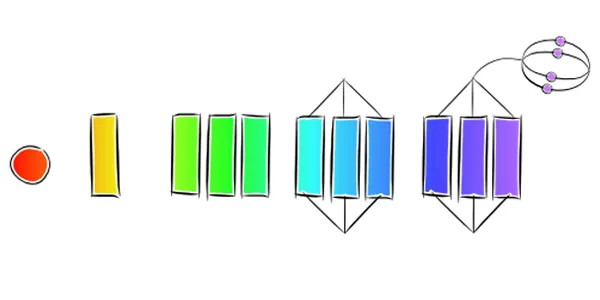
SOLO taxonomy, developed by Biggs and Collis, describes five levels in the quality of a learner's understanding, prestructural, unistructural, multistructural, relational, and extended abstract, moving from no grasp to transferable, abstract reasoning. For teachers, it gives a shared language to judge depth of understanding and design tasks that move learners from facts to connected thinking.
SOLO Taxonomy: Five Levels of Understanding Explained is a teacher guide to the Structure of Observed Learning Outcomes. John Biggs and Kevin Collis (1982) developed this assessment framework. It describes the quality of a learner's response, from no relevant understanding to abstract reasoning that they can transfer to new tasks.
SOLO Taxonomy means Structure of Observed Learning Outcomes. John Biggs and Kevin Collis (1982) developed this framework to assess learning. Teachers use it to judge the quality and complexity of the responses that learners can show. It has five SOLO levels: prestructural, unistructural, multistructural, relational and extended abstract.
For a busy teacher, its value is diagnostic: it helps separate a demanding task from the response a learner actually gives. In a Year 8 science lesson on evaporation, one learner may name heat as a factor, another may list heat, surface area and airflow, while a third explains how those factors interact and predicts what would happen in a new context.
To see how this model compares with others, read our guide to thinking frameworks, covering 42 models in four families.
John Biggs and Kevin Collis (1982) developed SOLO Taxonomy, or the Structure of Observed Learning Outcome. It groups the understanding that learners show into five levels. These are prestructural, unistructural, multistructural, relational, and extended abstract. Teachers use SOLO to check understanding and help learners connect facts and create new ideas.
For a broader view of how this fits alongside other classroom methods, see our guide to evidence-based pedagogy.
Biggs and Collis (1982) created the SOLO taxonomy. It uses five levels to check the quality of learner answers.
The five levels are prestructural, unistructural, multistructural, relational, and extended abstract. Unlike Bloom's (1956) taxonomy, SOLO looks at how learners respond. Teachers can use it for formative assessment and decide what to teach next.
Biggs and Collis (1982) created SOLO Taxonomy to assess learner understanding. It shows five levels, from basic recall to complex application. Teachers use this framework to build learners' thinking skills. Hattie (2009) also shows how SOLO Taxonomy can inform activity planning.
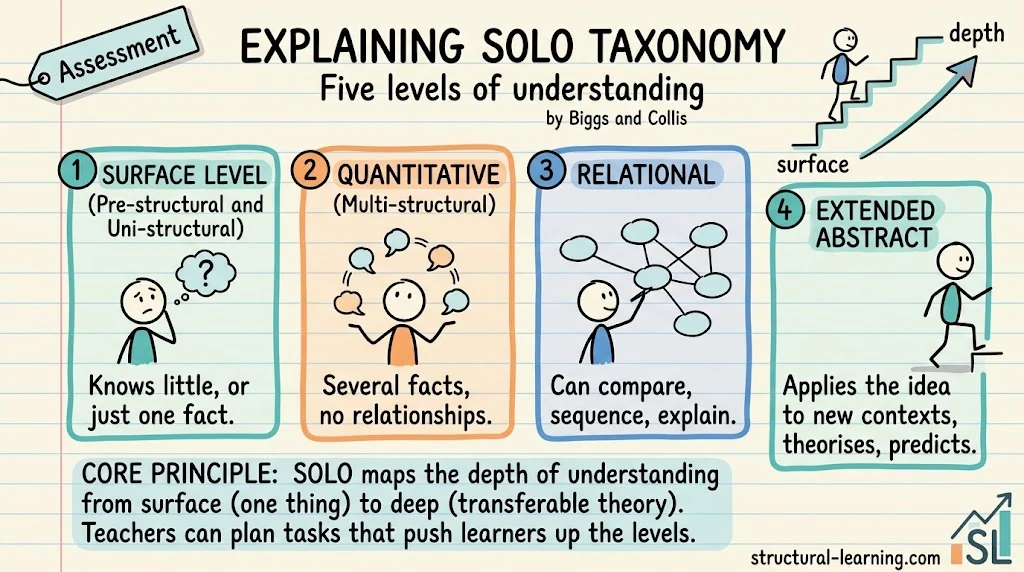
Biggs and Collis created SOLO Taxonomy to describe the structure of observed learning outcomes. The framework helps teachers see the quality of learner understanding and plan suitable next steps (Biggs & Collis, 1982).
Constructive alignment means matching learning aims, activities, and assessments. Biggs (2003) says this improves learning. When these areas fit together, learners are more likely to build understanding, as suggested by Hattie (2009) and Marzano (2000).
SOLO Taxonomy helps teachers understand what learners know (Biggs & Collis, 1982). Teachers can then give targeted feedback that supports learner progress (Hattie & Timperley, 2007).
This framework also supports critical thinking, such as analysis (Bloom, 1956). Teachers can use it to personalise learning, so each learner can reach their potential (Vygotsky, 1978).
SOLO Taxonomy aids learner progress. It shows learners their current understanding level and next steps. Teachers use SOLO levels to plan lessons matching each learner’s knowledge, helping them move from isolated ideas towards connected and extended understanding (Biggs & Collis, 1982; Hook & Mills, 2011).
Damopolii (2020) shows how learners build their understanding through SOLO Taxonomy. Teachers use it to support learning and comprehension, which means understanding ideas clearly. Scaffolding and ZPD help learners make similar progress.
SOLO Taxonomy is a valuable tool for assessing the structure and quality of understanding that learners show in a particular subject or task. It allows teachers to identify where learners are in their learning process and determine what steps need to be taken to move them to a deeper level of understanding (Biggs & Collis, 1982).
SOLO Taxonomy lets teachers plan lessons matched to each learner's understanding. It helps them gain deeper knowledge. This is like differentiation and makes learning better (Biggs & Collis, 1982). Learners engage more, improving their results (Hattie, 2008).
Biggs and Collis published SOLO Taxonomy in 1982, influenced by Piaget's (1952) account of cognitive development. They found learners' task responses changed structurally, not just in number (Biggs & Collis, 1982). Learners moved from fragmented ideas to abstract understanding. SOLO focuses on thinking structure, unlike earlier taxonomies that looked at knowledge content.
SOLO (Structure of Observed Learning Outcome) matters because it focuses on what learners produce. Biggs and Collis (1982) linked SOLO to observable learner work. This helps teachers assess written work, explanations, or demonstrations.
SOLO is more practical than frameworks based on thinking teachers cannot see. Piaget's stages showed limits, but SOLO shows levels within a task. A learner can be relational in geography, but unistructural in maths (Biggs, 1999).
Biggs and Tang (2011) link SOLO taxonomy with constructive alignment. In simple terms, this means matching learning outcomes, activities, and assessments to SOLO levels.
For example, explaining climate change needs relational tasks, where learners connect ideas. This alignment shows learners the depth of understanding they need. It may improve learner achievement and awareness.
Biggs and Collis (1982) created SOLO Taxonomy to show different levels of learner thinking. Teachers can use it to check learner understanding effectively. The taxonomy has five levels. Each level shows a specific depth of what the learner knows.
Each level builds upon the previous one, creating a progression that teachers can use to design learning activities and assess learner understanding (Biggs & Collis, 1982). The value of SOLO Taxonomy lies in its ability to show what learners know and how they can use that knowledge to think and reason.
This detailed understanding lets teachers pinpoint a learner's progress. It helps teachers plan support to aid learner development. SOLO Taxonomy shows thinking quality, unlike simple right or wrong marking (Biggs & Collis, 1982). This moves beyond traditional assessment.
Teachers use SOLO and Bloom's Taxonomies for assessment design. To use them well, it helps to know how they differ.
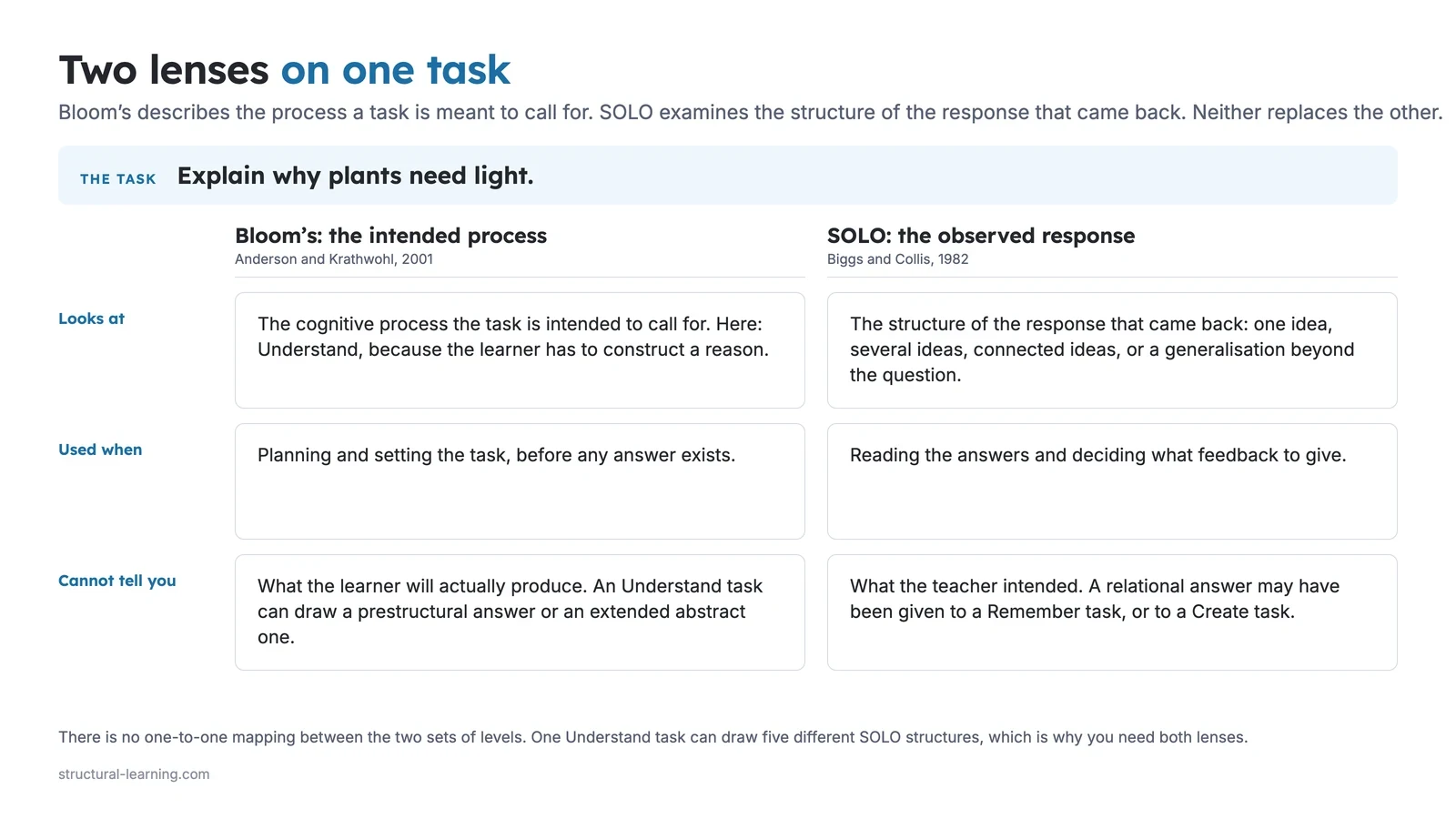
Bloom's Revised Taxonomy (Anderson & Krathwohl, 2001) uses six categories to show how learners think. SOLO Taxonomy (Hattie & Purdie, 1998) looks at the quality of a learner's response, not only their thinking. At the Multistructural level, a learner applies knowledge one step at a time (Hattie & Purdie, 1998).
For planning, Bloom's Taxonomy helps teachers map curricula (Biggs & Tang, 2011). Its categories help teachers state the cognitive challenge in learning aims. Does the unit ask learners to recall, or evaluate and create?
SOLO Taxonomy better suits in-lesson checks because it shows the quality of a learner's response. If a learner lists facts without links, teachers know it's Multistructural. A "How do these ideas connect?" question prompts better thinking (Biggs & Tang, 2011).
Teachers often find Bloom's and SOLO Taxonomies work well together. Use Bloom's Taxonomy to plan learning objectives and schemes of work. SOLO Taxonomy helps teachers design lesson questions and rubrics.
Biggs and Tang (2011) suggest writing SOLO learning outcomes clearly. Choose activities that show the required SOLO level. Bloom's and SOLO languages work together because they describe different aspects of learning.
SOLO describes the structure of a response to a task, not the learner who wrote it (Biggs and Collis, 1982). The same learner can give a relational answer in science on Monday and a unistructural one in history on Tuesday. The five fictional responses below all answer one prompt, "Why do plants need light?", so the difference between levels is the structure of the answer, not the topic or the length.
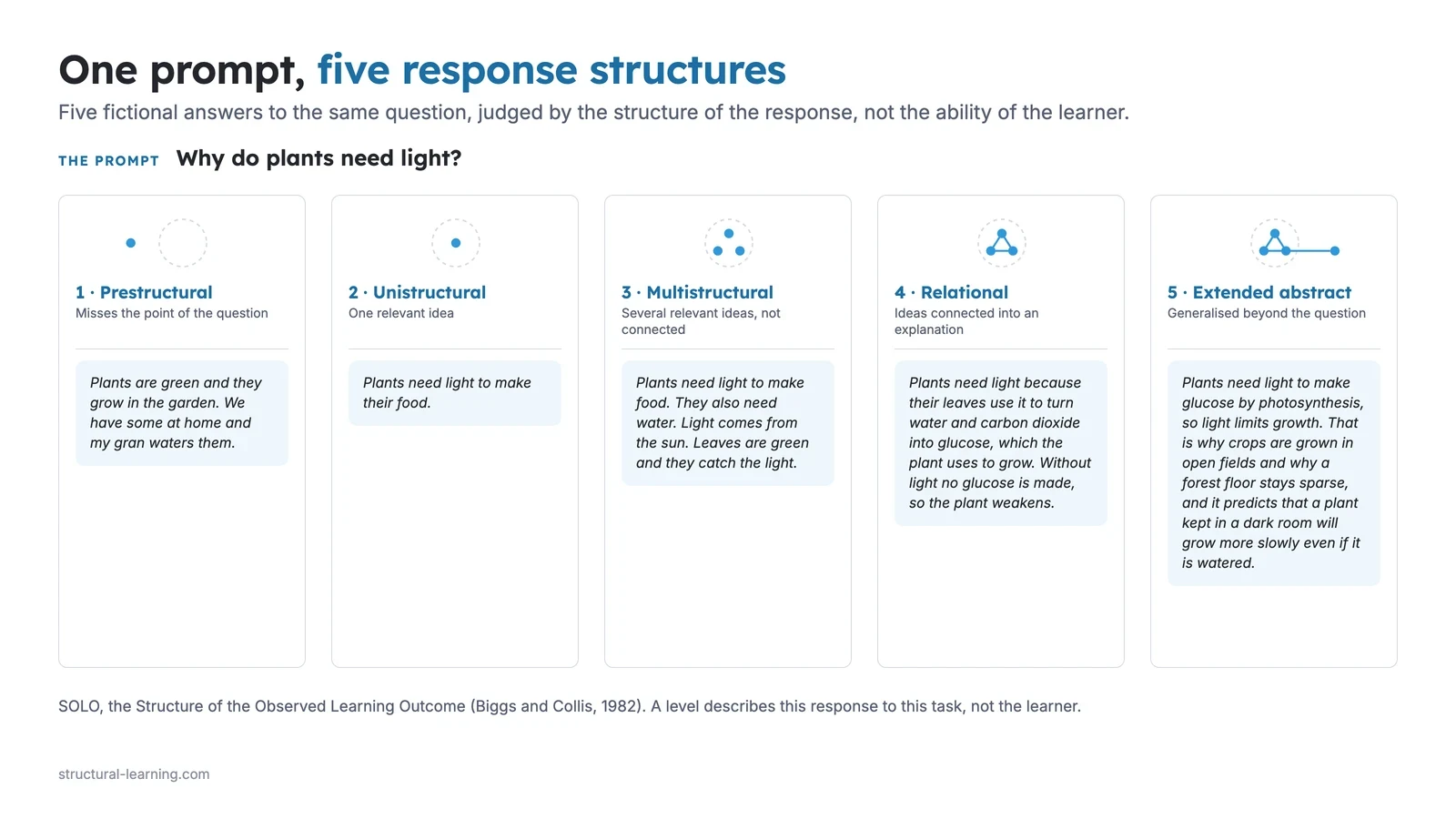
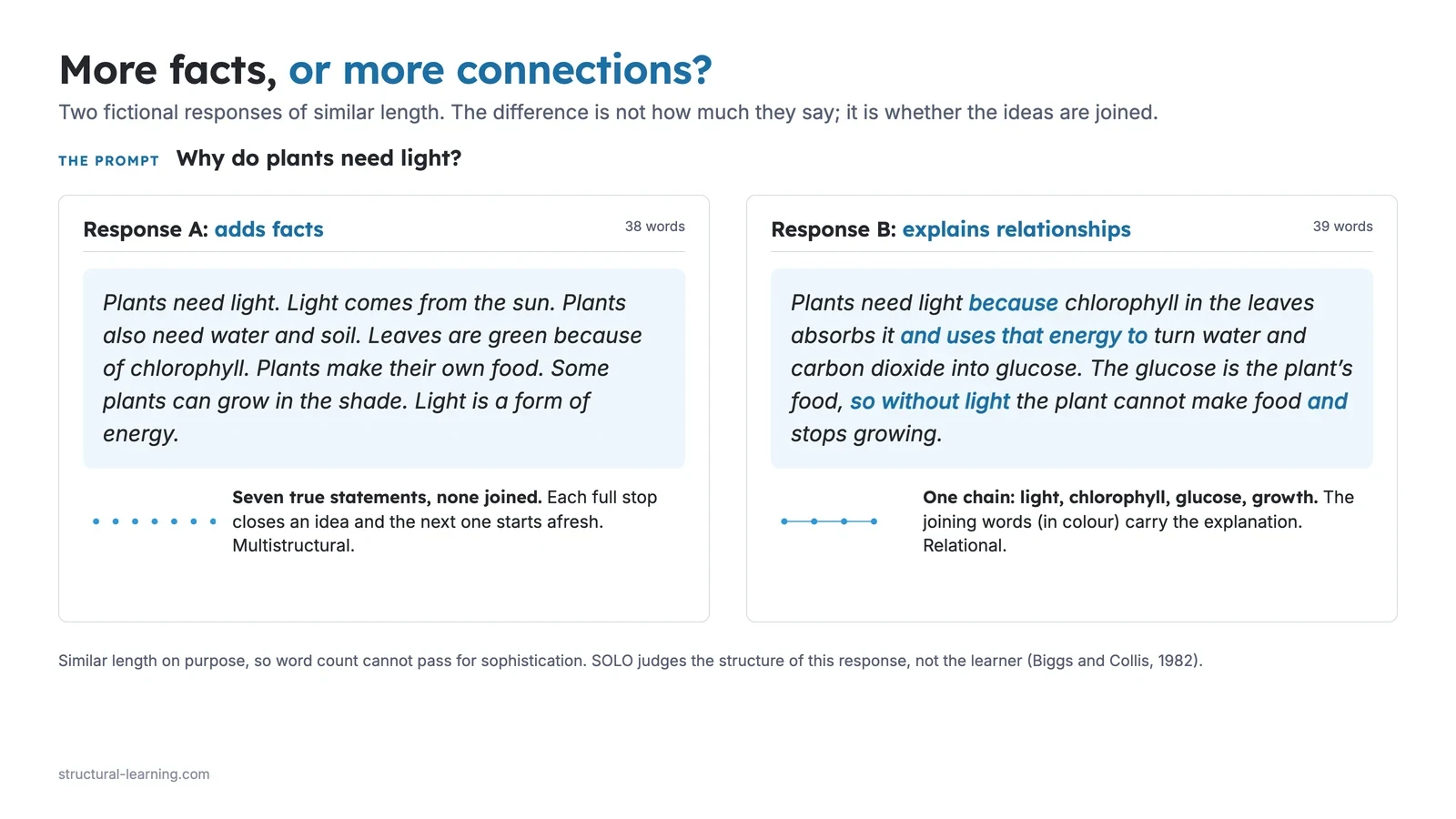
Length does not reveal the level of understanding. A multistructural answer can be longer than a relational one because adding facts is easier than linking them. Teachers should look for linking words such as because, so, which means and unless.
A relational response makes a claim and explains how it works. Hattie and Donoghue (2016) describe this move from surface to deep learning as the point when a learner relates ideas instead of collecting them.
The feedback prompt should focus on the next structural move. After a multistructural answer, the teacher asks, "Which of those facts causes which?" After a relational answer, the teacher asks, "Would that still be true for a plant on a windowsill in winter?"
Neither prompt simply asks for more writing. Bloom's revised taxonomy describes the type of thinking a task aims to prompt, while SOLO examines the response that the learner produces. The frameworks do not map directly onto each other (Anderson and Krathwohl, 2001). Our guide to Bloom's cognitive processes explains this distinction in more detail.
SOLO Taxonomy helps teachers design learning. Use the five levels from Biggs and Collis (1982) for activities and feedback. First, identify the target SOLO level.
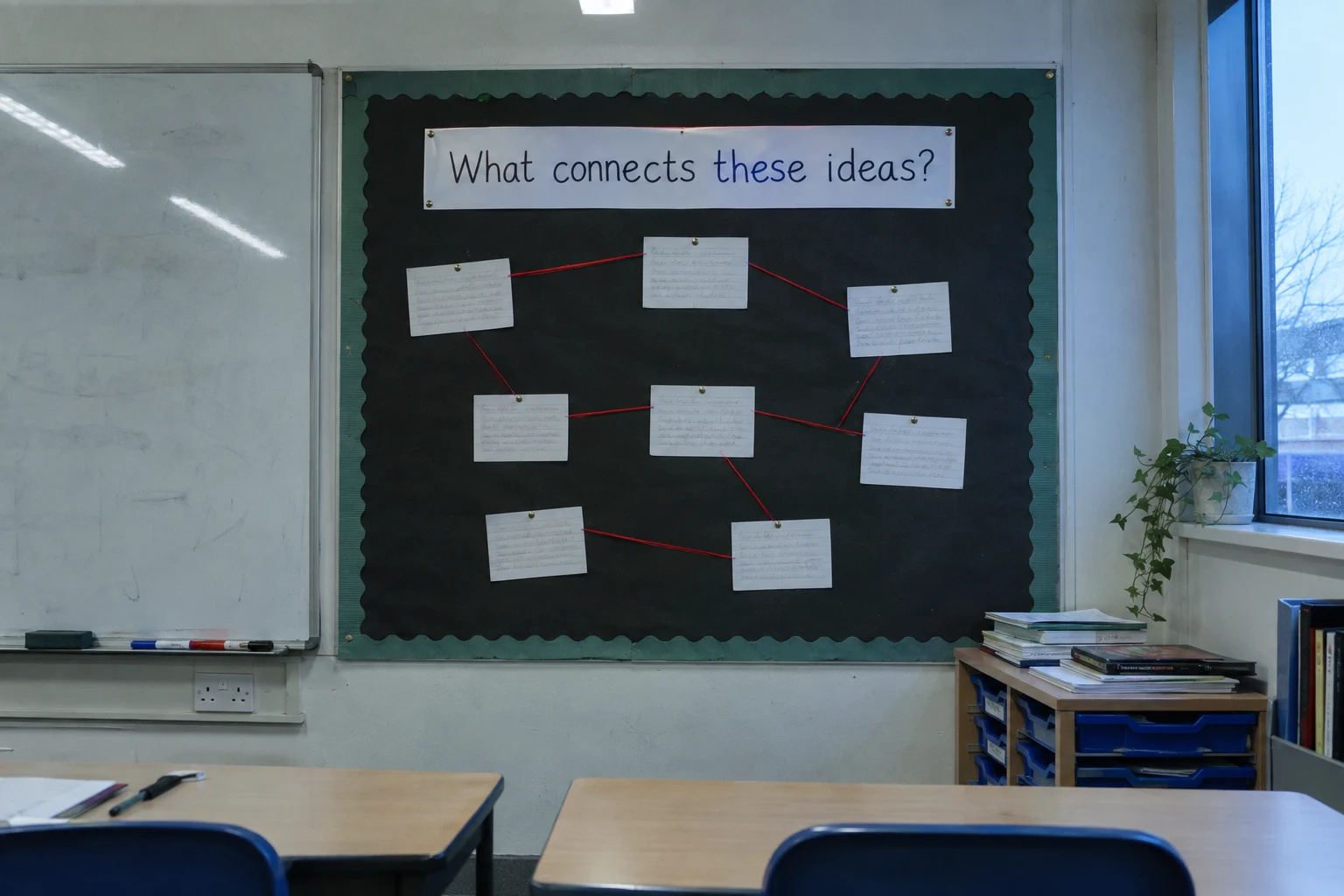

Then, design activities that help learners progress. Use SOLO questions and rubrics to check understanding.
Use SOLO Taxonomy when planning lessons. Begin with activities that help learners understand one idea (unistructural).
Next, use tasks where learners work with several facts (multistructural). Biggs and Collis (1982) suggest retrieval practice for basic levels. For higher levels, they advise problem solving.
SOLO levels can make digital assessment more useful. This works best when teachers treat AI and automated marking as a prompt for professional judgement. In an AI-assisted classroom, extended abstract writing can be generated quickly. So teachers should also assess the live cognitive process: oral explanation, draft history, worked examples and how learners respond to probing questions (Bearman et al., 2023).
SOLO rubrics change how you teach and how learners learn. These rubrics clearly state expectations (Biggs & Collis, 1982). Teachers gain a structured way to check learner progress.
Learners use this approach to self-assess and to understand deeper thinking (Hattie & Timperley, 2007). It builds metacognition, which means thinking about and guiding your own learning. This includes monitoring and executive control, as described by Brown (1987) and Flavell (1979).
Questioning should mirror SOLO levels. Teachers can plan questions building cognitive demand, from recall to abstract thought (Biggs & Collis, 1982). This helps every learner gain deeper understanding and face suitable challenges (Bloom, 1956).
Biggs and Collis (1982) linked verbs to SOLO levels. Use these verbs in questions and tasks. Matching verbs to SOLO levels aligns tasks to learning. This helps learners understand expected responses, clarifying rubrics.
At the Prestructural level, verbs such as misidentify, tautologise, and miss the point describe the response a learner gives. This helps teachers diagnose a starting point, but it is not a useful task verb. Teachers use this level as a baseline, not as a target.
At the Unistructural level, useful task verbs include identify, name, define, follow a simple procedure, and recall one relevant fact. A history teacher can ask: "Name one cause of the First World War." At the Multistructural level, verbs shift to describe, list, enumerate, classify, and outline several features. The same teacher can ask: "Describe three causes of the First World War", which needs more information but does not yet ask learners to link the causes into a clear explanation (Hook & Mills, 2011).
At the Relational level, learners explain, compare, and analyse (Hook & Mills, 2011). They bring information together so they can explain links.
At the Extended Abstract level, activities ask learners to theorise and evaluate (Hook & Mills, 2011). Teachers can use these verb levels to build reasoning skills and help learners see their next steps (Hook & Mills, 2011).
SOLO Taxonomy helps teachers view learner understanding (Biggs & Collis, 1982). It moves beyond basic tests to check how learners think. This helps teachers plan better lessons. The five levels guide teachers and learners toward deeper knowledge (Biggs & Collis, 1982).
SOLO Taxonomy helps teachers assess learning and adapt their teaching. When teachers design lessons with SOLO levels, they build learner thinking (Biggs & Collis, 1982). This helps learners develop cognitive skills, not just memorise facts. They gain real understanding and apply knowledge creatively (Biggs & Tang, 2007).
SOLO Taxonomy helps learners think critically. Teachers can use it to support deeper learning, said Biggs & Collis (1982). Frameworks help learners remember and use knowledge. This boosts results, according to Biggs & Tang (2011).
SOLO Taxonomy is popular, but teachers need to know its limits. Hattie and Purdie (1998) find linearity a key issue, because the model assumes learners move through five levels in order.
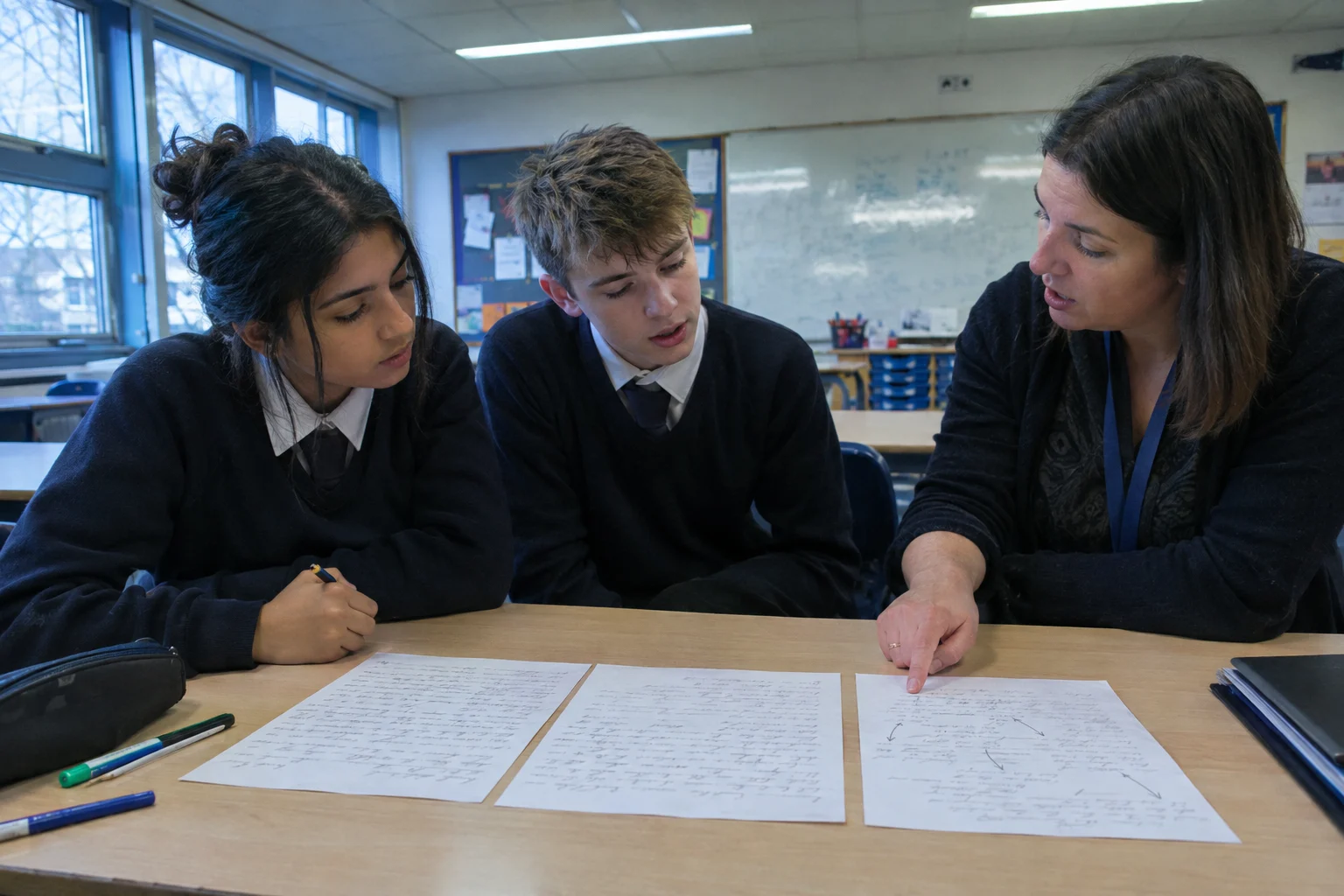
In practice, learners may show Extended Abstract thinking at an early stage. This can happen before they gain Unistructural knowledge. Learners may also copy Relational writing without truly understanding it.
Biggs and Collis (1982) found SOLO levels differ across subjects. Extended Abstract thinking varies in maths and English. Critics say the framework is too generic (Marzano & Kendall, 2007). Teachers need subject-specific examples for reliable learner assessment.
Culture and language affect learning. Watkins and Biggs (2001) noted SOLO is not always easy to use in East Asia.
Some learners show understanding in different ways, so SOLO may mark them down. SOLO is useful, but its scores do not show everything.
Teachers can use basic SOLO Taxonomy quickly (Biggs & Collis, 1982). Apply the five levels to one lesson area first. Expand to other subjects after a term for confident results.
SOLO Taxonomy works for primary learners if you use simple language and pictures. Young learners grasp "one idea" versus "linking ideas" with colours or symbols. It helps you scaffold learning and see where each learner needs help.
SOLO Taxonomy tracks the structure of learner answers, while Bloom's stresses thinking skills (Bloom, 1956). Teachers use SOLO to design questions that show learners' ability to link ideas. SOLO feels more useful for daily marking, as it reveals learner understanding (Biggs & Collis, 1982).
Identify your subject's core concept and abstract versions of it. History learners, for example, move from facts to cause and effect explanations. Offer subject-specific examples for each learning level. (Bloom, 1956) (Krathwohl, 2002)
SOLO Taxonomy can support learners with SEN. It shows small steps in progress and values different levels of understanding.
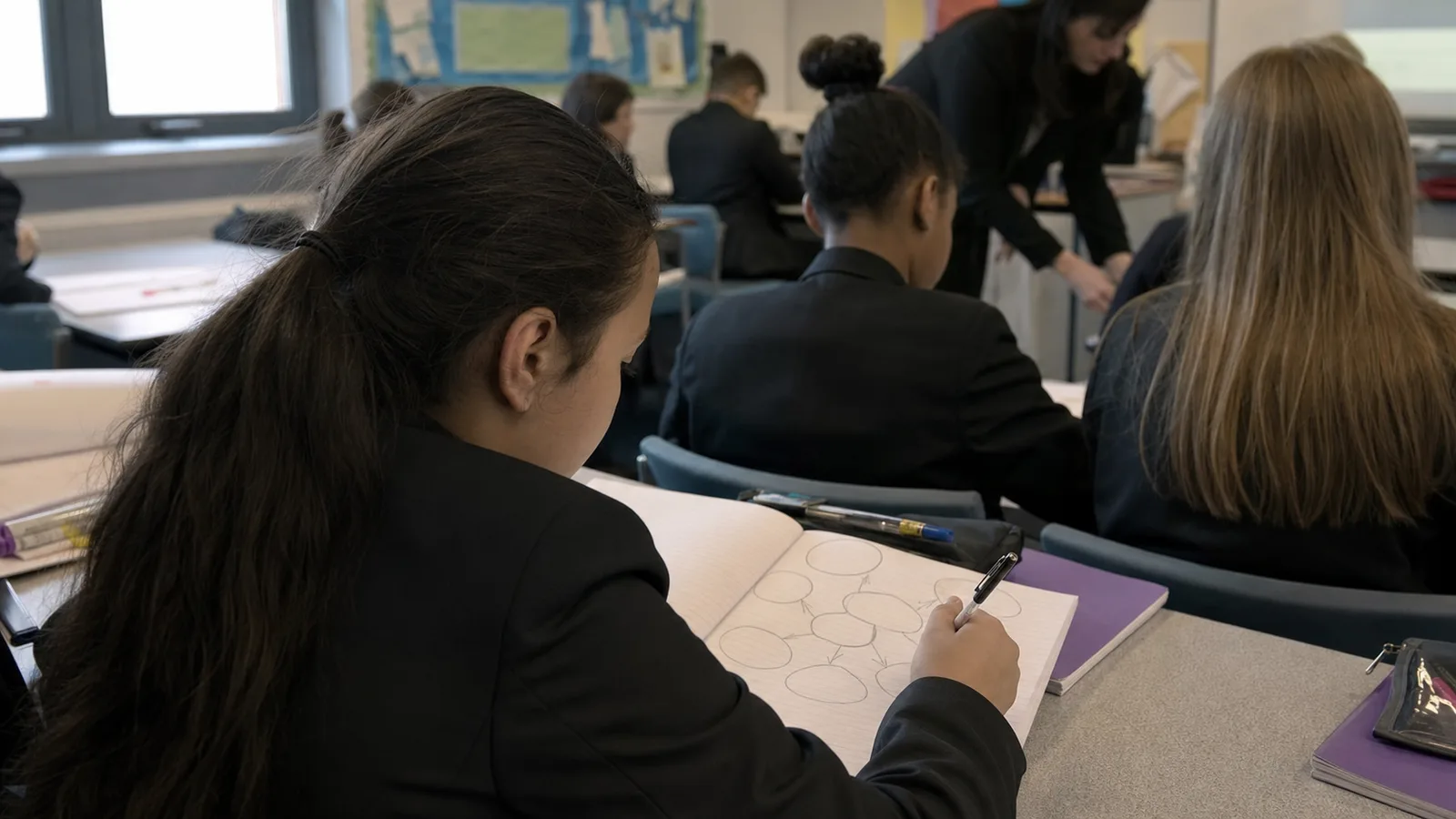
Teachers can use the framework to set realistic goals. They can also recognise achievement at every level (Biggs & Collis, 1982). Visuals help learners understand abstract concepts (Hattie, 2009).
Download this free Thinking Framework (Green/Orange/Blue/Red) resource pack for your classroom and staff room. Includes printable posters, desk cards, and CPD materials.
A Taxonomy for Learning, Teaching, and Assessing: A Revision of Bloom's Taxonomy of Educational Objectives. Anderson, L. W. and Krathwohl, D. R. (eds) (2001). New York: Longman.
Evaluating the Quality of Learning: The SOLO Taxonomy (Structure of the Observed Learning Outcome). Biggs, J. B. and Collis, K. F. (1982). New York: Academic Press. https://doi.org/10.1016/b978-0-12-097552-5.50007-7
Taxonomy of Educational Objectives: The Classification of Educational Goals. Handbook I: Cognitive Domain. Bloom, B. S., Engelhart, M. D., Furst, E. J., Hill, W. H. and Krathwohl, D. R. (1956). New York: David McKay.
Metacognition, executive control, self-regulation, and other more mysterious mechanisms. Brown, A. L. (1987). In F. E. Weinert and R. H. Kluwe (eds), Metacognition, Motivation, and Understanding (pp. 65-116). Hillsdale, NJ: Lawrence Erlbaum.
Visible Learning: A Synthesis of Over 800 Meta-Analyses Relating to Achievement. Hattie, J. (2009). London: Routledge.
Learning strategies: a synthesis and conceptual model. Hattie, J. A. C. and Donoghue, G. M. (2016). npj Science of Learning, 1, 16013. https://doi.org/10.1038/npjscilearn.2016.13
The Critical Importance of Retrieval for Learning. Karpicke, J. D. and Roediger, H. L. (2008). Science, 319(5865), 966-968. https://doi.org/10.1126/science.1152408
A Revision of Bloom's Taxonomy: An Overview. Krathwohl, D. R. (2002). Theory Into Practice, 41(4), 212-218. https://doi.org/10.1207/s15430421tip4104_2
The Origins of Intelligence in Children. Piaget, J. (1952). New York: International Universities Press.
Mind in Society: The Development of Higher Psychological Processes. Vygotsky, L. S. (1978). Cambridge, MA: Harvard University Press.