Updated on
September 9, 2026
Virtual Reality in Education: A Teacher's Guide
Virtual reality in education promises immersion, but what does the evidence say about learning? A teacher's guide to when VR is worth the cost.

Updated on
September 9, 2026
Virtual reality in education promises immersion, but what does the evidence say about learning? A teacher's guide to when VR is worth the cost.
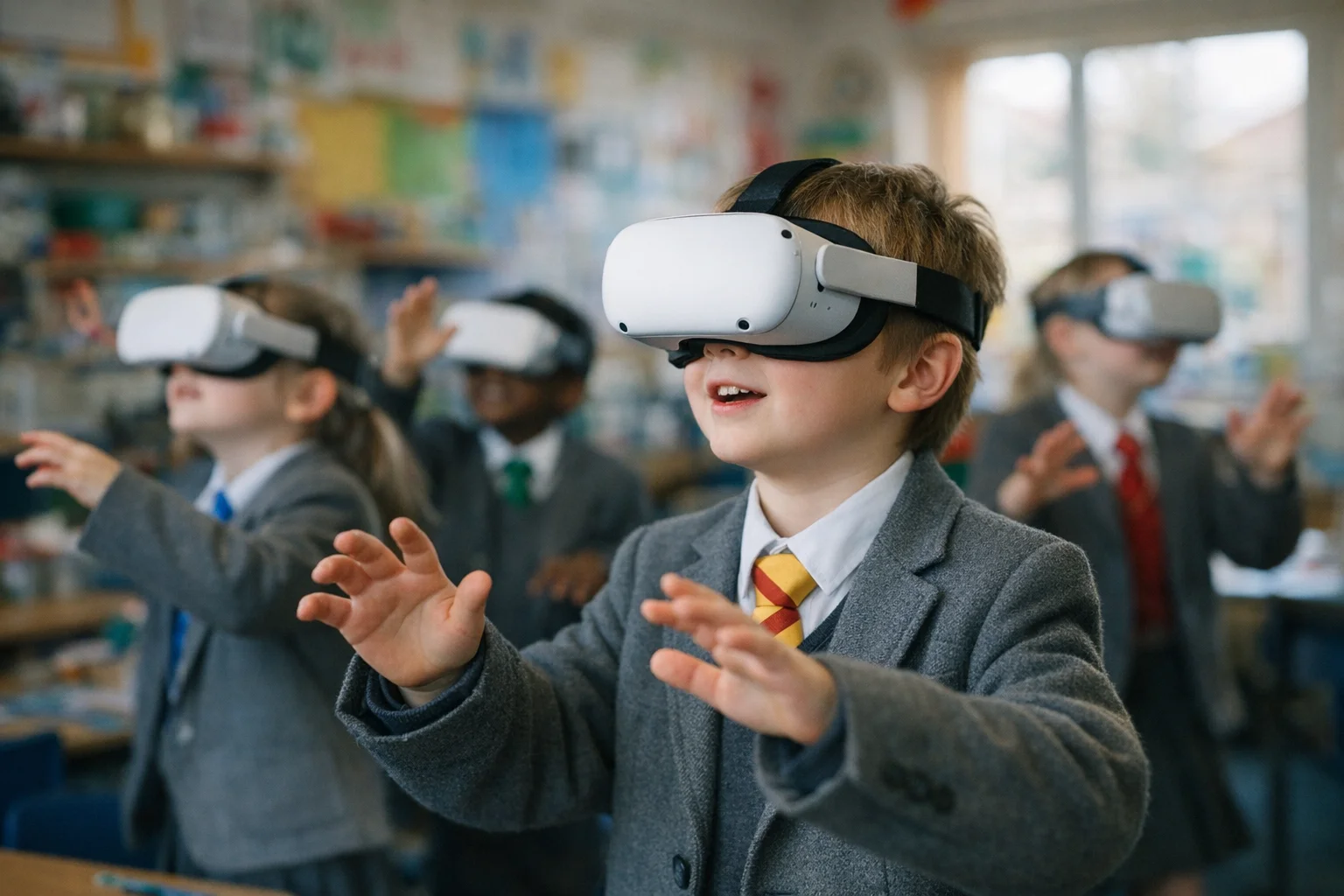
Virtual reality in education places a learner inside an interactive, computer-generated 3D scene. Instead of watching a video of a coral reef, the learner stands on the reef and turns their head to follow a passing shark. Its defining feature is presence: the strong sense of really being somewhere else.
Classroom VR comes in three broad forms. Fully immersive VR uses a headset that fills your field of view and tracks your movement, so the scene responds as you turn and step. Desktop VR shows a 3D world on an ordinary screen, navigated with a mouse or controller, with no headset at all. Mobile VR sits between the two, slotting a phone into a low-cost viewer. Each level of immersion carries a different price and a different set of trade-offs.
The most common school use is the virtual field trip: a class visits ancient Rome, the surface of Mars, or the inside of a human heart without leaving the room. Other uses include risk-free science experiments and 3D models learners can rotate and take apart. VR has arrived alongside a wider wave of AI in schools and other classroom technology, and it raises the same question every new tool does: does it actually help learners learn?
Here is the part most VR marketing leaves out. When researchers measure whether learners actually learn more from immersive VR, the results are mixed, and some of the strongest studies point the wrong way.
Take a science lesson delivered two ways. One well-known experiment taught learners about how the body fights infection, once through an immersive VR experience and once through a slideshow with the same content (Parong & Mayer, 2018). Learners in the VR version enjoyed it more and felt more motivated. On the test of what they had learned, the slideshow group did better. The headset raised interest but not understanding.
A second study makes the mechanism clear (Makransky et al., 2019). Learners worked through the same science laboratory simulation in two versions, one on a desktop and one in an immersive headset. The headset group reported a much stronger sense of presence, exactly what VR is meant to deliver, yet they learned less. EEG readings taken during the lesson showed they were carrying a heavier cognitive load, because the immersive version gave their brains more to process before any learning could happen. This is where the neuroscience of learning meets a hard limit: attention and working memory are finite.
That limit has a name. Cognitive load theory, argues that we learn through a working memory that can hold only a few items at once (Sweller, 1988). Anything that loads working memory without helping the learner build understanding is extraneous load, and it crowds out the thinking that matters. A vivid virtual world is full of extraneous load: things to look at, places to turn, controls to master. Years of multimedia research reached a similar conclusion: richer and more immersive media often hurt learning rather than help it (Mayer, 2009).
None of this means immersion is always bad. A model now explains the pattern: the Cognitive Affective Model of Immersive Learning, or CAMIL (Makransky & Petersen, 2021). It proposes that immersion helps through two routes, higher interest and a sense of presence, but hurts through two others, added cognitive load and the effort of working the technology. Whether VR helps or harms a given lesson depends on which of these forces wins, and that depends on how the lesson is designed.
The wider evidence base is thin on exactly this point. A systematic review of immersive VR applications built for higher education found that most were not grounded in any learning theory at all (Radianti et al., 2020). They were built because the technology was available, not because a teaching problem needed solving. That is the honest state of the field: the medium is powerful, the design is often an afterthought, and the learning results follow the design, not the hardware.
So when is a headset worth the money and the setup time? The evidence and the CAMIL model point to a clear pattern: VR earns its place when the immersion itself carries the learning, not when it decorates content a page could hold.
The strongest case is places and scales you cannot otherwise reach. A class cannot stand on the surface of Mars, walk through a rainforest canopy, or shrink to the size of a red blood cell and travel through an artery. VR can take them there, and the sense of scale and place is the lesson, not a wrapper around it. For a school without the budget for real trips, a virtual visit to a museum, a coastline, or a historical site can open a door that would otherwise stay shut for its learners.
Dangerous or costly procedures are a second strong case. Trainee nurses, engineers, and technicians can rehearse a risk-free version of a task that would be hazardous or expensive to practise for real: handling a chemical spill, wiring a live circuit, responding to a medical emergency.
Spatial understanding is a third. Some ideas are genuinely three-dimensional and hard to grasp on a flat page: molecular structures, the geometry of a building, the layers of the Earth. Walking around a model and viewing it from any angle can help in a way a diagram cannot, because the spatial relationships are the thing being learned.
Finally, VR can support embodied perspective-taking. Standing in a recreated historical setting, or seeing a situation through another person's eyes, can build understanding that a description struggles to reach. Used with care, and with clear questions to answer, this pairs well with inquiry-based learning, where learners explore a scenario and construct their understanding from what they find. The EEF Teaching and Learning Toolkit is a good habit here: before spending on any approach, check what the wider evidence says about impact for the cost.
For a large share of what we teach, a headset is the wrong tool, and a cheaper one will teach more.
Start with direct instruction. When learners are meeting a new idea for the first time, clear explicit instruction, with worked examples and guided practice, is one of the best-evidenced approaches we have. A headset adds nothing to a well-structured explanation except distraction and cost, competing for the attention the explanation needs.
Abstract concepts are a second poor fit. Grammar rules, algebraic manipulation, the causes of inflation: these live in ideas, not places. There is nowhere for VR to take a learner, so the headset becomes decoration. Here a simple diagram often beats a virtual world. The technique of dual coding, pairing clear words with a matching image, gives learners two routes to the same idea without the load of a 3D scene to navigate. It is cheap, it is fast, and the research behind it is strong.
The reason sits in cognitive load theory again: if a diagram carries the idea with less extraneous load than a headset does, the diagram is the better teaching tool. More immersion is not more learning.
There is also the novelty effect to reckon with. The first time a class puts on headsets, engagement spikes. Much of that is the newness, not the teaching, and it fades as the novelty wears off. If your case for VR rests on how excited learners are on day one, be honest that the excitement is temporary and may not survive to the assessment. Treating technology as a teaching decision rather than a novelty is part of the critical use of classroom technology that keeps budgets and lesson time working for learners.
If you decide a topic genuinely calls for VR, the next question is which hardware, and the choices spread across a wide range of cost and effort.
ClassVR is built specifically for schools. It sells standalone headset sets with a teacher console that lets one person steer a whole class through the same scene, along with a library of curriculum-linked content. This solves the management problem that general-purpose kit leaves open, which is why many schools that commit to VR start here. It sits at the higher end of the cost range, because you are buying the classroom system, not just the headsets.
Meta Quest headsets are the most common consumer option and offer strong hardware for the price. They are not designed for classroom management out of the box, so a school using them typically needs extra tools to run a set of them together, and needs to think carefully about accounts, content, and supervision. The hardware cost per headset is lower than a school-specific set, but the management overhead is higher.
At the lighter end, desktop and mobile options cost far less. A 3D world explored on the classroom screen or on laptops needs no headset at all, and mobile VR using a phone in a low-cost viewer can give a taste of immersion for very little. Free platforms matter here too. Google Arts & Culture offers virtual visits to museums and landmarks around the world at no cost. Google's Expeditions, once the default school VR tool, has been retired, and its virtual-tour role has passed to Arts & Culture and similar successors.
Match the spend to the pedagogy. If the lesson only needs a look around a museum, a free tour on existing screens does the job, and the expensive immersive kit is best reserved for lessons where full presence genuinely carries the learning.
A good VR lesson looks very different from handing out headsets and letting learners roam. The design is what turns immersion into learning, so plan it with the same care as any other lesson.
Start with the learning objective, not the technology. Write what you want learners to know or be able to do by the end, then ask whether VR is genuinely the best way to get there. If a diagram or a demonstration would teach it as well, use those instead. VR should be the answer to a teaching problem, not the reason for the lesson.
Keep the immersion short. A headset raises cognitive load and can tyre the eyes, so the time inside is best kept to brief, focused bursts with a clear task. A few minutes with a specific thing to find or notice does more than twenty minutes of wandering.
Pre-teach the vocabulary and the key ideas before the headset goes on. If learners meet new words and a new virtual world at the same time, working memory has too much to carry at once. Front-load the language and the framing while learners can still take notes and ask questions, so that inside the headset they are recognising ideas rather than meeting them cold.
Protect the time after the headset comes off. This is where much of the learning actually lands. Reflection, discussion, and a task that asks learners to put what they saw into words or onto paper turn a vivid experience into durable understanding. Without this consolidation, VR risks being a memorable event that leaves little behind.
Finally, use pair work to your advantage. Most schools have fewer headsets than learners, so rotate the immersion: one learner in the headset describing what they see, a partner recording, asking questions, or following on a screen, then swap. Well-structured collaborative learning means the learner outside the headset is working just as hard as the one inside, and the talk between them often does more teaching than the scene itself.
Beyond the teaching questions, VR brings a set of practical hurdles that schools underestimate at their cost.
Cost is the obvious one, and it is not only the headsets. There is the content, the charging and storage, the replacement of broken or lost kit, and the staff time to manage it all. A class set is a real capital decision, and that money could buy a great deal of other teaching resource.
IT infrastructure is the quiet one. Headsets need charging, updating, and often a solid wireless network to load content. Schools with stretched IT support can find that a cupboard of headsets becomes a cupboard of flat batteries and pending updates. Someone has to own the day-to-day upkeep, or the kit stops being used.
Teacher training matters just as much. A headset in untrained hands tends to become a novelty. Staff need time to learn the equipment, the software, and above all how to build a lesson around it, and that time has to come from somewhere.
Safeguarding and supervision need thought. A learner in a headset cannot see the room, so the teacher must manage the physical space, keep an eye on content, and make sure nobody walks into furniture or each other. Clear rules and a controlled setup are not optional.
Motion sickness is a real physical limit. A share of people feel nauseous, dizzy, or unwell in immersive VR, and younger learners can be more sensitive than adults. Sessions should be short, an opt-out should always be available, and no learner should ever be pushed to keep a headset on. Most manufacturers set a minimum age for their headsets, and those limits are worth respecting.
Hygiene is the last, mundane hurdle. Headsets pressed against many faces in a day need wiping between users, and shared kit can spread infection if it is not cleaned. It is small, and it becomes real across a full timetable.
An honest guide has to be honest about its own evidence too, and the research on classroom VR has real weaknesses.
Many of the studies are short. They measure what learners recall a few minutes or days after a single session, not what they still know weeks later, which is what schools actually care about. A method that wins on a same-day test can lose over a term. We often do not know, because the studies do not run long enough to tell us.
The novelty effect muddies almost everything. When something is new and exciting, learners pay more attention and try harder, and that lifts results for reasons that have nothing to do with the medium itself. As VR becomes ordinary, that lift is likely to fade, and few studies have followed learners long enough to see what remains.
Sample sizes are often small, and the tasks are narrow. A study of one science topic with a few dozen university learners tells us something, but not much about a full timetable of mixed classes across a school year. The research base is growing, but it leans heavily towards higher education rather than schools.
This scepticism is shared at the top of the field. The British Educational Research Association, or BERA, published a considered piece asking whether VR in education is a genuine change or, as its title put it, smoke and mirrors. That is the right question. The technology is genuinely capable, and in the right lesson it does things no other tool can. But the burden of proof sits with the headset, not against it. If you cannot say clearly why immersion will teach this particular thing better than a cheaper alternative, the honest answer is usually to save the money and reach for the diagram.
VR in education is neither a miracle nor a fraud. It is a specialist tool with a narrow band of genuine strengths and a wide band of expensive distractions. Teachers who keep the learning objective in front of the technology, and who ask the evidence what it really shows, will spend their budget where it counts and leave the headset in the cupboard when a simpler tool would teach more.
Makransky, G., & Petersen, G. B. (2021). The Cognitive Affective Model of Immersive Learning (CAMIL): A theoretical research-based model of learning in immersive virtual reality. Educational Psychology Review, 33(3), 937-958.
Makransky, G., Terkildsen, T. S., & Mayer, R. E. (2019). Adding immersive virtual reality to a science lab simulation causes more presence but less learning. Learning and Instruction, 60, 225-236.
Mayer, R. E. (2009). Multimedia learning (2nd ed.). Cambridge University Press.
Parong, J., & Mayer, R. E. (2018). Learning science in immersive virtual reality. Journal of Educational Psychology, 110(6), 785-797.
Radianti, J., Majchrzak, T. A., Fromm, J., & Wohlgenannt, I. (2020). A systematic review of immersive virtual reality applications for higher education. Computers & Education, 147, 103778.
Sweller, J. (1988). Cognitive load during problem solving: Effects on learning. Cognitive Science, 12(2), 257-285.