Updated on
September 24, 2026
Unconditional Positive Regard: Meaning, Evidence and Teaching
Unconditional positive regard explained: its meaning, place in Rogers's therapy, evidence limits and safe classroom use for teachers and SENCOs.


Updated on
September 24, 2026
Unconditional positive regard explained: its meaning, place in Rogers's therapy, evidence limits and safe classroom use for teachers and SENCOs.
What is unconditional positive regard?
Unconditional positive regard is a person-centred attitude of valuing someone without making their basic worth depend on approval, agreement or performance. In Rogers's therapy theory, a therapist can accept the client as a person while still recognising harmful or unacceptable actions. In school, the safest translation is to preserve the learner's dignity while naming behaviour clearly, applying proportionate boundaries and following safeguarding, SEND and referral procedures. It is not praise, permissiveness or a stand-alone evidence-based classroom programme.
Unconditional positive regard means valuing a person without making their basic worth depend on approval, agreement or performance. In Carl Rogers's therapy theory, a therapist could accept the client as a person while still recognising harmful or unacceptable actions. In school, the safest translation is to preserve a learner's dignity while naming behaviour clearly, applying proportionate boundaries and following safeguarding, SEND and referral procedures.
UPR is an attitude within a bond. It is not constant praise, permissiveness, a behaviour programme or a promise that one kind response will produce growth. Readers seeking the wider theory can use our guide to learning theories.
Rogers (1957) placed UPR within six therapy conditions. Farber et al. (2018) reviewed 64 therapy studies. Those facts set the scope: the idea began in therapy, and its most direct outcome research is clinical rather than classroom based.
Unconditional positive regard is a stance of warm acceptance and respect for another person. The regard is unconditional because the person's worth is not earned by pleasing the other person. The word positive does not mean cheerful. It points to care, prizing and respect.
Rogers used the idea in client-centred, later called person-centred, therapy. The therapist receives the client's feelings and experience without making acceptance depend on the client saying the right thing. This makes UPR a quality of the bond, not a line from a script.
The word regard also needs care. A therapist can recognise that an act harmed someone without treating the client as worthless. A teacher can challenge racism, aggression, unsafe conduct or unfinished work while speaking to the learner as a person whose dignity remains intact.
“Unconditional” can be misread. It never makes harm acceptable or removes an adult's duty to keep people safe.
UPR is one specialist idea within humanistic psychology. The wider tradition also covers agency, experience, meaning and personal growth. This page stays with the precise construct and its evidence.
UPR is not praise. Praise rates something, such as effort, a sound answer or a helpful act. Regard concerns the person's worth in the bond. A teacher can use apt praise while avoiding the message that care is on offer only after success.
UPR is not agreement. A listener may understand a view and still reject its reasoning. Respect does not require silence about prejudice, misinformation or harm.
UPR is not approval of every action. A warm response can include a direct limit. “I will listen, and I will not let you hit” holds both ideas at once.
UPR is not the absence of consequences. A school can apply a fair consequence, teach a replacement action and preserve the learner's dignity. Humiliation, withdrawal of care and global labels are different from a proportionate consequence.
UPR is not therapy by another name. Teachers educate and safeguard. They do not need to invite clinical disclosure, interpret a learner's inner life or offer treatment. The full therapeutic context belongs with trained practitioners and the specialist account of person-centred therapy.
On a small screen, swipe the table horizontally to compare all columns.
| Idea | Main question | Example | What it does not mean |
|---|---|---|---|
| Unconditional positive regard | Is this person's basic worth being made conditional? | “What happened is serious. You still deserve to be heard fairly.” | Every act is acceptable |
| Praise | What did the person do well? | “Your explanation used the evidence precisely.” | The adult values only successful learners |
| Empathy | Can I understand the person's frame of reference? | “You expected the task to be private and felt exposed.” | The interpretation must be correct |
| Congruence | Is the adult genuine rather than presenting a false front? | “I am concerned about what happened, and I want us to work through it.” | Every adult feeling should be disclosed |
| Boundary | What must stop or happen next? | “The message must be removed now. We will follow the school's procedure.” | Respect has been withdrawn |
The history is more precise than “Carl Rogers invented UPR”. Rogers had already written about acceptance in client-centred therapy. Stanley Standal, one of his students, developed the need-for-positive-regard account in a 1954 doctoral dissertation. Rogers then incorporated and developed the construct in his wider theory.
Standal's work is important because it shows that the idea did not appear as a finished classroom principle. It grew inside a clinical research community that was trying to describe how a client experiences acceptance and how regard from others relates to self-regard.
Rogers's 1957 paper placed UPR within six proposed conditions for therapeutic personality change. His 1959 theory linked positive regard, conditions of worth and self-regard. His later writing gave the idea its familiar person-centred language (Rogers, 1957, 1959, 1961).
The wider account of self-concept, actualising tendency, congruence and conditions of worth belongs in our guide to Carl Rogers's theory. Here, those concepts matter only where they clarify UPR.
UPR is often listed with empathy and congruence as one of three “core conditions”. That shorthand is useful but incomplete. Rogers's full claim named six conditions within a therapy relationship.
UPR was the fourth, not a stand-alone method. Rogers (1957) proposed these six conditions:
Only conditions three, four and five describe therapist attitudes. Rogers's claim concerned all six and the client had to perceive some of the communication. This matters when evidence is discussed. A study of a client's perception is not the same as an observer deciding that a therapist was warm.
Rogers called the conditions necessary and sufficient. That was his theory, not a settled verdict from one test. Later work has tried to measure parts of the bond and link them to outcome. The task of how to measure them remains key.
Barrett-Lennard (1962) made a bond scale that split regard, empathy and congruence. Such tools made the bond open to study. They also show why loose use of “UPR” can be too vague.
Empathy concerns understanding another person's frame of reference. UPR concerns how the person is regarded. Congruence concerns the helper's genuineness. The ideas can work together, but one does not guarantee the others.
A teacher may respond warmly yet misunderstand why a learner is upset. That could show regard without accurate empathy. A teacher may understand the learner but speak with concealed contempt. That would not express positive regard.
Congruence does not mean saying every thought aloud. Professional genuineness is selective and responsible. “I am worried because someone was hurt” can be honest and useful. “You make me furious and I cannot stand you” burdens the learner and attacks the person.
Praise is also distinct. Well-chosen feedback names evidence, strategy or improvement. Conditional regard appears when belonging or adult warmth seems to depend on meeting the adult's standards.
The answer is not to stop evaluating work. It is to separate evaluation of the work from evaluation of the learner's worth.
The most direct review concerns positive regard in therapy. Farber, Suzuki and Lynch (2018) combined 64 studies. The first meta-analysis found a small positive link between therapist positive regard and outcome, g = .28. A model that took repeat data and samples into account found g = .36.
These are group mean scores. They show that more positive regard and better outcomes tended to occur together in the therapy studies. They do not say that each client gains, that UPR is enough by itself or that the same score fits a school.
The review also used the umbrella term positive regard. Included studies could describe unconditional regard, acceptance, warmth, affirmation or non-possessive warmth. Measures, raters, clients and treatments varied. This breadth helps a meta-analysis include a research tradition, but it makes a narrow claim about UPR alone harder.
Some studies measure the therapist's view, some the client's experience and some an observer's judgement. These sources can disagree. Rogers's sixth condition makes the client's perception important, yet perception can also relate to progress for other reasons. Better sessions may shape both perceived regard and outcome.
A meta-analysis gives a more exact mean by pooling studies. It cannot turn each design into a true test of cause or remove all bias. The safe view is that positive regard has support as one part of the therapy bond. The evidence does not show one route to change or a school effect.
On a small screen, swipe the table horizontally to compare evidence and limits.
| Evidence source | Setting and construct | Main finding | Safe conclusion |
|---|---|---|---|
| Rogers (1957) | Therapy theory, six proposed conditions | UPR is condition four | A foundational clinical proposition, not an outcome trial |
| Barrett-Lennard (1962) | Perceived relationship conditions in therapy | Operationalised several relationship dimensions | UPR requires careful measurement and cannot be assumed from warmth alone |
| Farber et al. (2018) | Positive regard across 64 psychotherapy studies | Small positive pooled association, with estimates of g = .28 and .36 | Supports positive regard as one relationship factor in psychotherapy |
| Cornelius-White (2007) | Broad learner-centred teacher-learner relationships | Mean association of r = .31 across 119 studies | Relationship qualities matter together; UPR was not isolated |
| Roorda et al. (2011) | Affective teacher-learner relationships | Associations with engagement and achievement | Supports attention to relationship quality, not a UPR programme claim |
Schools have useful evidence on bonds, but it tests a broad set of traits. Cornelius-White (2007) pooled 119 studies from 1948 to 2004. The review had 1,450 findings and 355,325 learners. The mean link between person-centred teacher traits and good learner outcomes was r = .31.
The predictor was not UPR alone. It included empathy, warmth or positive regard, genuineness, non-directivity, encouragement and other learner-centred qualities. Outcomes also varied across cognitive, affective and behavioural domains.
A link of .31 is not .31 of a standard deviation. It does not show that a teacher can cause an outcome with one phrase. Many studies watched what took place. Learners who take part may see the bond in a good light, and strong teaching may help both the bond and the result.
Roorda et al. (2011) also found that the warmth of teacher-learner bonds was linked with taking part and school work. This backs close thought about bonds. It still does not isolate UPR, replace sound teaching or tell us what caused one learner's result.
School use should be modest. A kind, steady bond can form part of good care. It sits beside clear teaching, checks on work, fair changes, behaviour support, family work and skilled help.
The most useful school translation is a discipline of language and attention. Staff keep the learner's dignity separate from evaluation of the work or behaviour. They stay curious about what happened, while acting promptly where safety or access is at risk.
This does not require a new intervention. It can shape ordinary moments: greeting after yesterday's incident, correcting work, holding a boundary, repairing conflict and discussing support.
A quick test is to ask, “Would my words still leave a fair way back?” If the answer is no, split the person from the act. Say what took place. Say what must happen now. Say when and how help will be offered.
Keep this plain. A calm face is not enough if the words shame the learner. Kind words are not enough if the adult lets harm go on. The aim is firm care: stop the act, keep the person safe, and set out the next step.
Try five checks after a hard event. Did I name the act, not brand the child? Did I make the rule clear? Did I keep each person safe?
Did I give a fair next step? Did I note a need for more help? These short checks can guide a calm review. They do not ask the learner to tell a life story or the teacher to guess why the act took place.
Start with observable facts. “The chair was pushed and another learner fell” is clearer than “You are aggressive”. The first statement identifies what must be addressed. The second turns one event into an identity.
Name the boundary. “I cannot let anyone be hurt” is direct and professional. Then name the route: move people to safety, apply the agreed procedure, gather accounts and plan the next step.
Preserve a route back into learning. A consequence can remain in place while the teacher makes clear how the learner can return, repair and succeed. This reduces the risk that adult warmth feels like a prize available only after perfect conduct.
These examples fit a wider commitment to inclusive education. They do not guarantee trust. Learners differ in how they read tone, eye contact, proximity and public correction. Ask what helps, observe the effect and adapt.
A useful response has four parts: person, behaviour, boundary and next step. The adult keeps respect in place, names what took place, gives a clear limit and shows the fair route on. Not every sentence needs all four parts, but the full response should make each one clear.
On a small screen, swipe the table horizontally to compare all examples.
| Situation | Avoid | Bounded response | Why it is safer |
|---|---|---|---|
| Incorrect work | “You are careless.” | “These two steps do not yet follow. Let us find where the method changed.” | Evaluates the work, not the learner's worth |
| Repeated lateness | “You never respect this class.” | “You arrived after the starter three times this week. We need a plan that gets you in and ready.” | Uses observable evidence and invites a practical plan |
| Unsafe act | “You are dangerous.” | “Throwing the object could hurt someone. It stops now. We will follow the safety procedure.” | Names risk and action without a fixed identity label |
| Hurtful comment | “That is just who you are.” | “That comment was racist and it caused harm. We will address it through the school's policy.” | Rejects the act clearly and keeps formal accountability |
| Withdrawal | “You are being avoidant.” | “You have not started and you are looking away. Would written instructions or a first step help?” | Checks access without inferring an inner cause |
| Return after consequence | Cold silence | “The consequence is complete. Here is today's task and the support available.” | Makes re-entry possible without erasing accountability |
A script is only a prompt. Tone, timing, privacy and follow-through matter. If the words sound mechanical, shorten them. If a learner uses an augmentative system or needs more processing time, adapt the route rather than insisting on a spoken exchange.
Do not force reflection during high arousal. Establish safety first. Return to the account and repair when the learner can take part. The same dignity-and-boundary principle can support social and emotional learning, but it does not replace explicit teaching of the skill.
UPR is not a treatment for dyslexia, autism, ADHD, speech and language needs, SEMH needs or trauma. A learner with SEND deserves the same dignity as any other learner. They may also need explicit instruction, accessible materials, communication support, sensory changes, assessment or specialist provision.
Begin with the observed barrier. If reading is slow, check decoding, vocabulary, fluency, task load and assistive access. Do not infer that the learner needs more acceptance instead of literacy support.
Use the school's graduated response and involve the SENCO where a pattern suggests additional or different provision. Our overview of special educational needs explains that needs are identified through evidence across contexts, not through one theory or label.
Safeguarding overrides conversational comfort. If a learner discloses harm, do not promise confidentiality, investigate alone or keep listening in a way that delays action. Receive the disclosure calmly, use the learner's words, record accurately and follow the school's safeguarding procedure.
Risk also matters when conduct may harm the learner or others. Stop unsafe action, obtain help and follow policy. Respect for the person is compatible with decisive protection.
Persistent distress, significant change, suspected mental-health need or concerns beyond staff competence require the established pastoral, SEND, safeguarding or health route. NICE (2015) illustrates the wider principle that formal attachment assessment and treatment need age-appropriate tools and trained professionals. Classroom warmth is not an assessment.
Most errors turn UPR into an extreme. It is neither limitless approval nor a cure for hard conduct. It does not ask staff to hide concern, drop a fair sanction or like every act. It asks them to keep human worth apart from the judgement of that act.
“Unconditional means no consequences.” No. Regard for the person can remain steady while a fair consequence follows an act.
“Positive means cheerful.” No. UPR can be quiet, serious and direct. It concerns acceptance and prizing, not forced optimism.
“UPR means finding a nice explanation for harm.” No. Understanding context does not excuse harm. Context helps staff choose prevention, support, accountability and repair.
“If a teacher is warm enough, behaviour will improve.” The evidence does not support that promise. Teaching, relationships, task access, routines, peer context, health and support may all matter.
“Cornelius-White proved UPR works in classrooms.” The meta-analysis covered broad learner-centred relationship qualities. It did not isolate one UPR intervention.
“Farber's effect size applies to schools.” It does not. The studies concerned therapist positive regard and psychotherapy outcomes.
“A teacher must feel affection for every learner.” Professional respect and care can guide conduct even when an interaction is difficult. UPR is not a demand for a particular private emotion or forced closeness.
“The learner must talk about feelings.” No. Respect includes communication choice, privacy and a right not to make personal disclosure in class.
UPR is hard to isolate. It occurs beside empathy, trust, therapist skill, the type of help and client factors. Studies also use terms such as warmth, acceptance and affirmation. As a result, the research can support a broad link, but it cannot give a neat effect for UPR alone.
The source of a score matters. A therapist, client and onlooker may rate the same bond in a new way. Each view answers a new point. A client's view may sit close to Rogers's claim, but it can also change with gains or past hopes.
Therapy findings cannot be moved straight into class. Teachers lead the course, mark work and guide conduct. They work with groups, not one client in private. Their duty to keep children safe also shapes what they must do.
The education evidence is broader than UPR. Relationship correlations may reflect effects in both directions and shared causes. Study samples, ages, outcomes and measures vary.
Cultural meanings also vary. Eye contact, emotional disclosure, praise, closeness and adult authority are not read in one universal way. “Warm” practice must not become a demand that every learner accepts the same interaction style.
Finally, acceptance can become vague when it is detached from observable practice. A school should judge a proposed use by what staff will do, how safety is protected, how learners can respond, and what evidence would show that the approach is helpful or harmful.
The resource set for this article is designed around four questions: Are we preserving the person's dignity? What behaviour or work needs to be named? What boundary applies? What happens next?
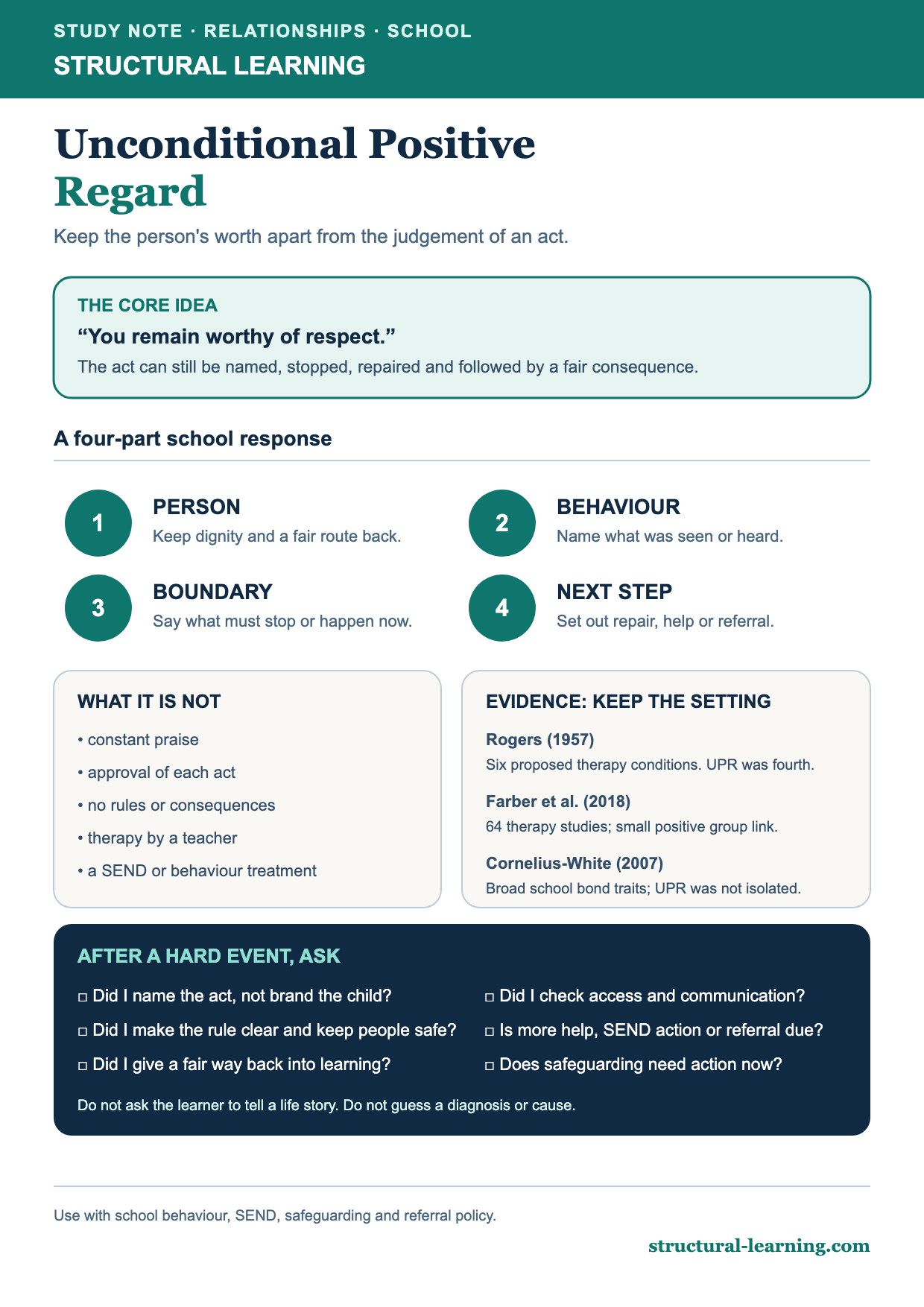
The note defines UPR as steady regard for the person, not praise or approval of each act. Its four-part school response names the person, the act or work, the rule, and the fair next step. Rogers's 1957 therapy claim stays apart from the Farber et al. therapy review and the broad Cornelius-White school review.
UPR is not constant praise, no consequences, teacher-led therapy, or a SEND treatment. Staff ask whether they named the act, made the rule clear, kept people safe, gave a fair way back, checked access, and used SEND, referral or safeguarding routes. They do not seek a life story or guess a diagnosis.
A one-page A4 visual that separates UPR from praise and permissiveness, maps the evidence boundaries, and gives a short school response routine.
A two-page printable record for observed facts, access checks, the boundary used, learner communication, repair and referral. It avoids attachment or personality labels.
Twelve duplex cards for staff discussion, covering definition, six conditions, research settings, SEND, safeguarding and common language errors.
Select one real interaction. Rewrite the adult response in four parts, then check whether policy, access or referral action is also needed.
Download the difficult-interaction response record PDF.
Download the evidence and boundary flashcards PDF.
The final download controls must be keyboard reachable and exact-byte verified.
These answers keep the key lines clear. UPR concerns regard for the person, not approval of each act. It began in therapy, and school use is a bounded translation. It can shape staff language, but it does not replace teaching, support, policy, safeguarding or skilled care.
It is an attitude of accepting and valuing a person without making their basic worth depend on approval, performance or agreement.
Rogers developed and popularised the construct within person-centred theory. Stanley Standal's 1954 dissertation made an important earlier contribution to the need-for-positive-regard account.
Yes, it is one of the three therapist attitudes often called the core conditions. Rogers's 1957 proposition contained six conditions in total, including psychological contact and the client's perception of empathy and regard.
No. It separates the person's worth from the acceptability of an act. A teacher can stop harm, apply a consequence and require repair while speaking respectfully.
It can mean using observable descriptions, avoiding identity labels, holding a clear boundary and preserving a fair route back into learning. It does not require therapy or personal disclosure.
No study reviewed here isolates UPR as a classroom programme. Education reviews support the importance of broad teacher-learner relationship quality, while psychotherapy research concerns a different relationship and setting.
Use it as a check on dignity and language, not as a needs category. Keep observation, assessment, reasonable adjustments, provision, safeguarding and specialist referral evidence separate.
No. It can shape how policy is enacted, especially the distinction between the learner and the act. It does not remove safety procedures, proportionate consequences or accountability.