Thinking Skills Assessments
Explore key methods to assess and enhance critical thinking and problem-solving skills in educational settings.


Explore key methods to assess and enhance critical thinking and problem-solving skills in educational settings.
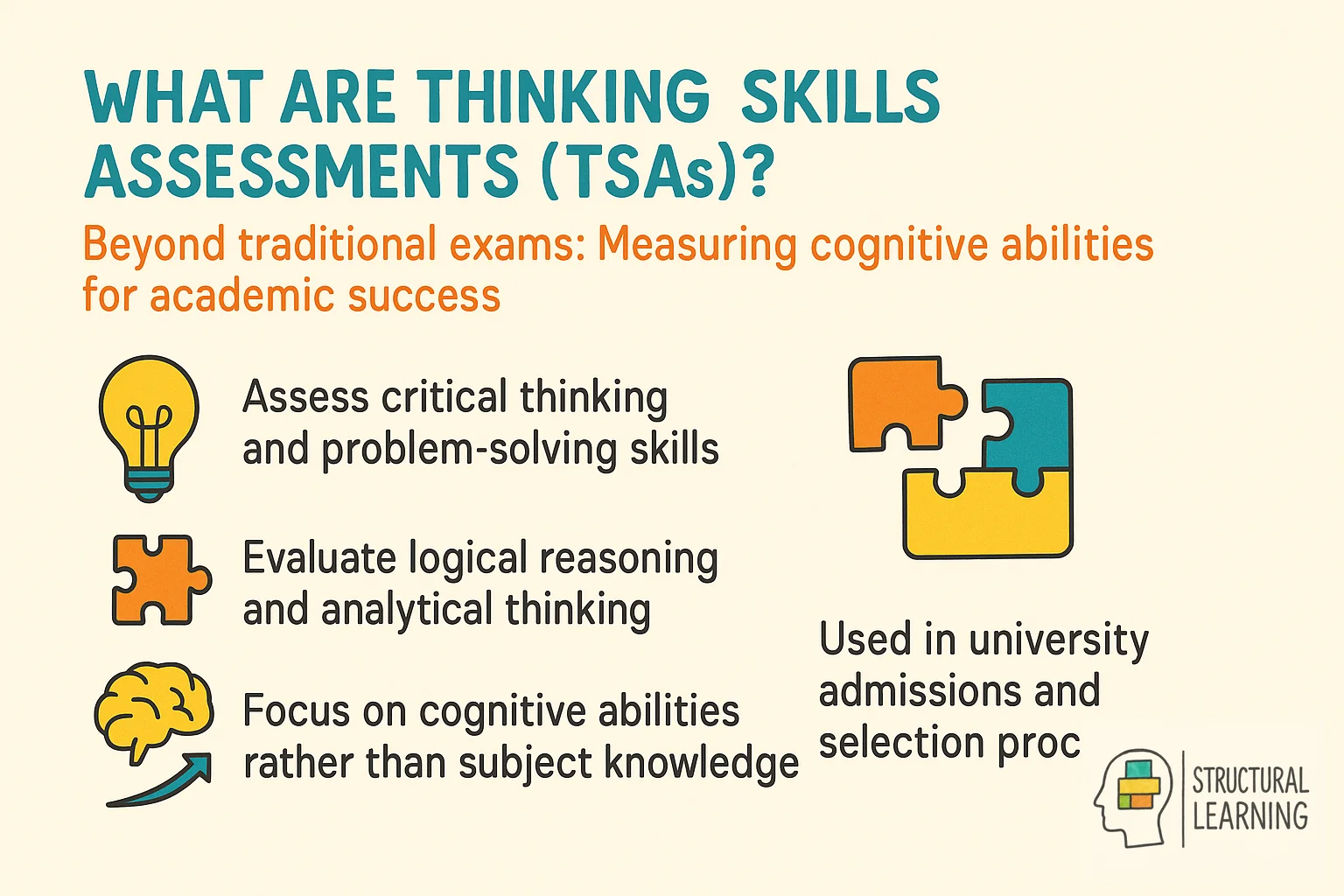
Thinking Skills Assessments (TSAs) are structured tests designed to evaluate an individual's cognitive capabilities, particularly in the context of university admissions. Historically associated with the entry criteria of prestigious universities, TSAs have become a critical tool in educational settings, including schools and colleges. They offer an academic assessment beyond traditional exam scores, emphasizing an applicant's ability to think critically and reason effectively.
The typical TSA comprises about 50 multiple-choice questions, evaluating a wide range of cognitive abilities. They measure critical thinking skills and the ability to apply these skills in academic situations. By understanding the average score or marking scheme, educators can align assessment content with desired learning outcomes.

Building assessments like these require a meticulous approach. For instance, Cambridge Assessment, a renowned Assessment Team, creates a thinking skill assessment that challenges students under timed conditions. This encourages the development of time management strategies, which are crucial for academic success.
These assessments also serve a dual purpose. They not only gauge a student's preparedness for rigorous academic pursuits but also foster metacognitive awareness. Students become more aware of their intellectual strengths and weaknesses, a key component in developing self-understanding. Through regular practice with practice materials, such as critical-thinking tests and skill tests, students can improve their chances of success in various academic and intellectual arenas, from Oxford PPE to History and Economics.
In essence, TSAs are more than a gateway to university applications; they are instruments for enhancing intellectual abilities and metacognitive skills, essential for lifelong learning and self-awareness.
Critical thinking is at the heart of academic and intellectual endeavors. It is a skill that allows individuals to analyze information, conceptualize ideas, and evaluate arguments. A critical-thinking test, therefore, becomes an essential component of Thinking Skills Assessments. These tests challenge students to dissect complex scenarios and select the correct answer under timed conditions, which simulates the pressure of real-world problem-solving.
The assessment of critical thinking skills involves an array of tests, including but not limited to, scenarios requiring basic double-digit math test to more complex critical thinking screening tests. These tests aim to measure a student's ability to engage with, understand, and critique the information presented to them, reflecting their analytical capabilities.

The assessment content in such tests is designed to gauge a student’s verbal reasoningability and numerical reasoning skills, both of which are predictive of academic success. For example, in a typical assessment, the student might face a critical-thinking question that requires analyzing a piece of text under timed conditions. The performance on such questions, indicated by the average score or raw mark, offers insight into the student's analytical prowess.
Universities like Oxford and Cambridge, known for their rigorous academic standards, include these assessments as part of their university applications process. The TSA Oxford, for instance, incorporates a 30-minute writing task alongside multiple-choice questions to measure the depth and clarity of a student’s thought process.
Regular practice with these tests can significantly enhance a student's critical thinking abilities. Assessment software and practice materials provide a platform for students to engage in academic assessment regularly, refining their critical thinking skills over time. The transformation from answering choice assessments to mastering comprehensive culture tests is not just about attaining a numerical score but also about preparing for the diverse challenges of future academic and professional landscapes.

Problem-solving is a dynamic skill set that involves interpreting, reasoning, and devising a strategy to navigate and resolve an issue. Assessing this ability is crucial as it stands as a predictor of performance in academic and real-world settings. Here are five methods used in Thinking Skills Assessments to measure problem-solving skills:

Regular practice with assessment software and customizable assessments allows students to enhance their skills. An array of tests, from basic math to complex critical-thinking tests, ensures a comprehensive evaluation of a student's abilities. This practice not only boosts their exam scores but also their overall academic performances.
Moreover, the anonymous, 22-question assessments often used by schools provide a baseline of a student's problem-solving skills without the pressure of high-stakes testing. These assessments help in building a culture of continuous improvement and self-awareness among students.
The mastery of problem-solving skills equips students with the capacity to navigate their academic pursuits and future careers successfully.
higher order thinking skills" width="auto" height="auto" id="">Planning and execution skills are critical for translating thought into action and are a fundamental component of successful academic and professional outcomes. Assessments that measure these skills typically include:
For example, an assessment may include a basic triple-digit math test that requires developing a step-by-step solution under timed conditions. The speed and accuracy of the solution indicate the student's planning abilities and their skill in executing the plan effectively.

Reflective judgment is the capacity to critically evaluate evidence and arguments in the context of one’s own belief systems and make reasoned decisions. It is a higher-order thinking skill essential for mature understanding and decision-making. Here’s how reflective judgment can be assessed:
For instance, a student’s approach to a critical-thinking screening test may involve weighing different perspectives before arriving at a conclusion, demonstrating their ability to think reflectively and judge critically.
Reflective judgment is not only crucial for academic success but also for navigating the complexities of the world. Cultivating this skill through regular practice, such as engagement with critical thinking questions and tackling types of questions under timed conditions, is pivotal in developing well-rounded thinkers.

Deductive and inductive reasoning are pivotal cognitive processes in logical thinking and problem-solving. Several well-known tests are available for schools and colleges to assess these skills:
Each of these tests presents an array of questions under timed conditions, evaluating a student's quick thinking and logical reasoning capabilities. They are invaluable tools for educators looking to enhance their students' reasoning skills. Schools and colleges can use these tests to prepare students not only for their academic pursuits but also for successful careers that require sharp deductive and inductive reasoning abilities.

Assessing social and emotional thinking, components of interpersonal intellect, is nuanced. Traditional tests may not capture the full spectrum of these abilities. These skills involve understanding and managing one's emotions, empathy, and navigating social complexities, capabilities that are deeply personal and context-dependent.
The challenge in measuring social and emotional intelligence lies in the subjective nature of emotions and the variability of social interactions. It requires more than a multiple-choice test or a correct answer. Tools like role-playing exercises, peer feedback mechanisms, and reflective journals are often used to provide a more dynamic and authentic assessment environment.
One approach is the use of scenario-based assessments that ask students to interpret emotions, intentions, and social cues within varied contexts. Another is through group projects that offer a window into a student’s interpersonal skills, such as collaboration and conflict resolution.
Despite the difficulties in quantification, the importance of these skills in academic and professional success is undeniable. They contribute significantly to a student’s academic assessment, affecting group dynamics and overall academic performance.
Assessments in thinking skills often present students with scenarios that require analysis, inference, and deduction. Here’s how typical questions are structured and their educational purpose:
Each question, accompanied by multiple-choice options, is designed to push students to engage with the material critically. Such questions encourage the development of intellectual abilities and metacognitive awareness regarding how arguments and evidence can be interpreted and critiqued.
These questions have a dual purpose. They test specific critical thinking skills, such as evaluation of arguments, and they also promote a deeper understanding of the complexities involved in real-world problems. In doing so, students become better equipped to apply these skills in various academic and professional situations.

Thinking Skills Assessments (TSAs) are structured tests that evaluate cognitive capabilities, particularly critical thinking and reasoning skills, rather than just subject knowledge. Unlike traditional exams that focus on memorised content, TSAs comprise around 50 multiple-choice questions designed to measure problem-solving abilities and analytical thinking under timed conditions. They reveal cognitive abilities that traditional exams miss, making them valuable for identifying hidden academic potential in students.
Teachers can incorporate TSA methods by using multiple-choice questions that test logic and reasoning, presenting complex case studies for analysis, and setting timed problem-solving tasks. Regular practice with critical thinking questions and 30-minute writing tasks helps students develop analytical skills whilst building time management strategies. Assessment software and customisable materials can provide ongoing opportunities for students to refine their thinking abilities.
TSAs foster metacognitive awareness by helping students identify their intellectual strengths and weaknesses, leading to more targeted learning approaches. They develop essential time management strategies and prepare students for real-world problem-solving under pressure. Regular TSA practice transforms student self-awareness and builds resilience, ultimately boosting overall academic achievement beyond just exam scores.
Timed conditions in TSAs simulate real-world pressure and force students to prioritise their problem-solving strategies whilst making quick decisions. This approach better predicts real-world success compared to coursework because it develops students' ability to perform under pressure. The time constraints help build resilience and teach students to manage their cognitive resources effectively in high-stakes situations.
TSAs measure critical thinking skills, analytical abilities, verbal reasoning, numerical reasoning, and problem-solving capabilities through various question types. They assess students' ability to analyse information, conceptualise ideas, evaluate arguments, and apply logical reasoning to complex scenarios. The assessments also gauge planning and execution skills, helping students translate thought into action effectively.
Anonymous 22-question assessments provide a baseline of students' problem-solving skills without the pressure of high-stakes testing, allowing for honest self-evaluation. These assessments help build a culture of continuous improvement and self-awareness amongst students by identifying areas for development. Schools can use the results to tailor support and create targeted learning opportunities that address specific cognitive weaknesses.
Writing tasks, typically lasting 30 minutes, reveal how students structure their thoughts, articulate reasoning, and reach logical conclusions under time pressure. Teachers can implement these by setting regular timed writing exercises that require students to analyse complex scenarios and propose solutions. These tasks showcase students' problem-solving approaches and help develop their ability to communicate analytical thinking clearly and coherently.
Here are five key studies or papers on the efficacy of thinking skills assessments:
These studies provide valuable insights into the efficacy of thinking skills assessments and their implications for educational practices, including the admissions process, benchmark scores, and application across universities.
Thinking Skills Assessments (TSAs) are structured tests designed to evaluate an individual's cognitive capabilities, particularly in the context of university admissions. Historically associated with the entry criteria of prestigious universities, TSAs have become a critical tool in educational settings, including schools and colleges. They offer an academic assessment beyond traditional exam scores, emphasizing an applicant's ability to think critically and reason effectively.
The typical TSA comprises about 50 multiple-choice questions, evaluating a wide range of cognitive abilities. They measure critical thinking skills and the ability to apply these skills in academic situations. By understanding the average score or marking scheme, educators can align assessment content with desired learning outcomes.

Building assessments like these require a meticulous approach. For instance, Cambridge Assessment, a renowned Assessment Team, creates a thinking skill assessment that challenges students under timed conditions. This encourages the development of time management strategies, which are crucial for academic success.
These assessments also serve a dual purpose. They not only gauge a student's preparedness for rigorous academic pursuits but also foster metacognitive awareness. Students become more aware of their intellectual strengths and weaknesses, a key component in developing self-understanding. Through regular practice with practice materials, such as critical-thinking tests and skill tests, students can improve their chances of success in various academic and intellectual arenas, from Oxford PPE to History and Economics.
In essence, TSAs are more than a gateway to university applications; they are instruments for enhancing intellectual abilities and metacognitive skills, essential for lifelong learning and self-awareness.
Critical thinking is at the heart of academic and intellectual endeavors. It is a skill that allows individuals to analyze information, conceptualize ideas, and evaluate arguments. A critical-thinking test, therefore, becomes an essential component of Thinking Skills Assessments. These tests challenge students to dissect complex scenarios and select the correct answer under timed conditions, which simulates the pressure of real-world problem-solving.
The assessment of critical thinking skills involves an array of tests, including but not limited to, scenarios requiring basic double-digit math test to more complex critical thinking screening tests. These tests aim to measure a student's ability to engage with, understand, and critique the information presented to them, reflecting their analytical capabilities.

The assessment content in such tests is designed to gauge a student’s verbal reasoningability and numerical reasoning skills, both of which are predictive of academic success. For example, in a typical assessment, the student might face a critical-thinking question that requires analyzing a piece of text under timed conditions. The performance on such questions, indicated by the average score or raw mark, offers insight into the student's analytical prowess.
Universities like Oxford and Cambridge, known for their rigorous academic standards, include these assessments as part of their university applications process. The TSA Oxford, for instance, incorporates a 30-minute writing task alongside multiple-choice questions to measure the depth and clarity of a student’s thought process.
Regular practice with these tests can significantly enhance a student's critical thinking abilities. Assessment software and practice materials provide a platform for students to engage in academic assessment regularly, refining their critical thinking skills over time. The transformation from answering choice assessments to mastering comprehensive culture tests is not just about attaining a numerical score but also about preparing for the diverse challenges of future academic and professional landscapes.

Problem-solving is a dynamic skill set that involves interpreting, reasoning, and devising a strategy to navigate and resolve an issue. Assessing this ability is crucial as it stands as a predictor of performance in academic and real-world settings. Here are five methods used in Thinking Skills Assessments to measure problem-solving skills:

Regular practice with assessment software and customizable assessments allows students to enhance their skills. An array of tests, from basic math to complex critical-thinking tests, ensures a comprehensive evaluation of a student's abilities. This practice not only boosts their exam scores but also their overall academic performances.
Moreover, the anonymous, 22-question assessments often used by schools provide a baseline of a student's problem-solving skills without the pressure of high-stakes testing. These assessments help in building a culture of continuous improvement and self-awareness among students.
The mastery of problem-solving skills equips students with the capacity to navigate their academic pursuits and future careers successfully.
higher order thinking skills" width="auto" height="auto" id="">Planning and execution skills are critical for translating thought into action and are a fundamental component of successful academic and professional outcomes. Assessments that measure these skills typically include:
For example, an assessment may include a basic triple-digit math test that requires developing a step-by-step solution under timed conditions. The speed and accuracy of the solution indicate the student's planning abilities and their skill in executing the plan effectively.

Reflective judgment is the capacity to critically evaluate evidence and arguments in the context of one’s own belief systems and make reasoned decisions. It is a higher-order thinking skill essential for mature understanding and decision-making. Here’s how reflective judgment can be assessed:
For instance, a student’s approach to a critical-thinking screening test may involve weighing different perspectives before arriving at a conclusion, demonstrating their ability to think reflectively and judge critically.
Reflective judgment is not only crucial for academic success but also for navigating the complexities of the world. Cultivating this skill through regular practice, such as engagement with critical thinking questions and tackling types of questions under timed conditions, is pivotal in developing well-rounded thinkers.

Deductive and inductive reasoning are pivotal cognitive processes in logical thinking and problem-solving. Several well-known tests are available for schools and colleges to assess these skills:
Each of these tests presents an array of questions under timed conditions, evaluating a student's quick thinking and logical reasoning capabilities. They are invaluable tools for educators looking to enhance their students' reasoning skills. Schools and colleges can use these tests to prepare students not only for their academic pursuits but also for successful careers that require sharp deductive and inductive reasoning abilities.

Assessing social and emotional thinking, components of interpersonal intellect, is nuanced. Traditional tests may not capture the full spectrum of these abilities. These skills involve understanding and managing one's emotions, empathy, and navigating social complexities, capabilities that are deeply personal and context-dependent.
The challenge in measuring social and emotional intelligence lies in the subjective nature of emotions and the variability of social interactions. It requires more than a multiple-choice test or a correct answer. Tools like role-playing exercises, peer feedback mechanisms, and reflective journals are often used to provide a more dynamic and authentic assessment environment.
One approach is the use of scenario-based assessments that ask students to interpret emotions, intentions, and social cues within varied contexts. Another is through group projects that offer a window into a student’s interpersonal skills, such as collaboration and conflict resolution.
Despite the difficulties in quantification, the importance of these skills in academic and professional success is undeniable. They contribute significantly to a student’s academic assessment, affecting group dynamics and overall academic performance.
Assessments in thinking skills often present students with scenarios that require analysis, inference, and deduction. Here’s how typical questions are structured and their educational purpose:
Each question, accompanied by multiple-choice options, is designed to push students to engage with the material critically. Such questions encourage the development of intellectual abilities and metacognitive awareness regarding how arguments and evidence can be interpreted and critiqued.
These questions have a dual purpose. They test specific critical thinking skills, such as evaluation of arguments, and they also promote a deeper understanding of the complexities involved in real-world problems. In doing so, students become better equipped to apply these skills in various academic and professional situations.

Thinking Skills Assessments (TSAs) are structured tests that evaluate cognitive capabilities, particularly critical thinking and reasoning skills, rather than just subject knowledge. Unlike traditional exams that focus on memorised content, TSAs comprise around 50 multiple-choice questions designed to measure problem-solving abilities and analytical thinking under timed conditions. They reveal cognitive abilities that traditional exams miss, making them valuable for identifying hidden academic potential in students.
Teachers can incorporate TSA methods by using multiple-choice questions that test logic and reasoning, presenting complex case studies for analysis, and setting timed problem-solving tasks. Regular practice with critical thinking questions and 30-minute writing tasks helps students develop analytical skills whilst building time management strategies. Assessment software and customisable materials can provide ongoing opportunities for students to refine their thinking abilities.
TSAs foster metacognitive awareness by helping students identify their intellectual strengths and weaknesses, leading to more targeted learning approaches. They develop essential time management strategies and prepare students for real-world problem-solving under pressure. Regular TSA practice transforms student self-awareness and builds resilience, ultimately boosting overall academic achievement beyond just exam scores.
Timed conditions in TSAs simulate real-world pressure and force students to prioritise their problem-solving strategies whilst making quick decisions. This approach better predicts real-world success compared to coursework because it develops students' ability to perform under pressure. The time constraints help build resilience and teach students to manage their cognitive resources effectively in high-stakes situations.
TSAs measure critical thinking skills, analytical abilities, verbal reasoning, numerical reasoning, and problem-solving capabilities through various question types. They assess students' ability to analyse information, conceptualise ideas, evaluate arguments, and apply logical reasoning to complex scenarios. The assessments also gauge planning and execution skills, helping students translate thought into action effectively.
Anonymous 22-question assessments provide a baseline of students' problem-solving skills without the pressure of high-stakes testing, allowing for honest self-evaluation. These assessments help build a culture of continuous improvement and self-awareness amongst students by identifying areas for development. Schools can use the results to tailor support and create targeted learning opportunities that address specific cognitive weaknesses.
Writing tasks, typically lasting 30 minutes, reveal how students structure their thoughts, articulate reasoning, and reach logical conclusions under time pressure. Teachers can implement these by setting regular timed writing exercises that require students to analyse complex scenarios and propose solutions. These tasks showcase students' problem-solving approaches and help develop their ability to communicate analytical thinking clearly and coherently.
Here are five key studies or papers on the efficacy of thinking skills assessments:
These studies provide valuable insights into the efficacy of thinking skills assessments and their implications for educational practices, including the admissions process, benchmark scores, and application across universities.
{"@context":"https://schema.org","@graph":[{"@type":"Article","@id":"https://www.structural-learning.com/post/thinking-skills-assessments#article","headline":"Thinking Skills Assessments","description":"Explore key methods to assess and enhance critical thinking and problem-solving skills in educational settings.","datePublished":"2024-03-14T12:05:01.565Z","dateModified":"2026-01-26T10:09:32.212Z","author":{"@type":"Person","name":"Paul Main","url":"https://www.structural-learning.com/team/paulmain","jobTitle":"Founder & Educational Consultant"},"publisher":{"@type":"Organization","name":"Structural Learning","url":"https://www.structural-learning.com","logo":{"@type":"ImageObject","url":"https://cdn.prod.website-files.com/5b69a01ba2e409e5d5e055c6/6040bf0426cb415ba2fc7882_newlogoblue.svg"}},"mainEntityOfPage":{"@type":"WebPage","@id":"https://www.structural-learning.com/post/thinking-skills-assessments"},"image":"https://cdn.prod.website-files.com/5b69a01ba2e409501de055d1/69502ea9e2ac17a6ef4a62e4_q6qhfq.webp","wordCount":3235},{"@type":"BreadcrumbList","@id":"https://www.structural-learning.com/post/thinking-skills-assessments#breadcrumb","itemListElement":[{"@type":"ListItem","position":1,"name":"Home","item":"https://www.structural-learning.com/"},{"@type":"ListItem","position":2,"name":"Blog","item":"https://www.structural-learning.com/blog"},{"@type":"ListItem","position":3,"name":"Thinking Skills Assessments","item":"https://www.structural-learning.com/post/thinking-skills-assessments"}]},{"@type":"FAQPage","@id":"https://www.structural-learning.com/post/thinking-skills-assessments#faq","mainEntity":[{"@type":"Question","name":"What are Thinking Skills Assessments and how do they differ from traditional exams?","acceptedAnswer":{"@type":"Answer","text":"Thinking Skills Assessments (TSAs) are structured tests that evaluate cognitive capabilities, particularly critical thinking and reasoning skills, rather than just subject knowledge. Unlike traditional exams that focus on memorised content, TSAs comprise around 50 multiple-choice questions designed "}},{"@type":"Question","name":"How can teachers integrate TSA-style assessments into their classroom practice?","acceptedAnswer":{"@type":"Answer","text":"Teachers can incorporate TSA methods by using multiple-choice questions that test logic and reasoning, presenting complex case studies for analysis, and setting timed problem-solving tasks. Regular practice with critical thinking questions and 30-minute writing tasks helps students develop analytica"}},{"@type":"Question","name":"What are the main benefits of using Thinking Skills Assessments for student development?","acceptedAnswer":{"@type":"Answer","text":"TSAs foster metacognitive awareness by helping students identify their intellectual strengths and weaknesses, leading to more targeted learning approaches. They develop essential time management strategies and prepare students for real-world problem-solving under pressure. Regular TSA practice trans"}},{"@type":"Question","name":"Why do TSAs use timed conditions and how does this benefit student learning?","acceptedAnswer":{"@type":"Answer","text":"Timed conditions in TSAs simulate real-world pressure and force students to prioritise their problem-solving strategies whilst making quick decisions. This approach better predicts real-world success compared to coursework because it develops students' ability to perform under pressure. The time con"}},{"@type":"Question","name":"What specific skills do Thinking Skills Assessments measure in students?","acceptedAnswer":{"@type":"Answer","text":"TSAs measure critical thinking skills, analytical abilities, verbal reasoning, numerical reasoning, and problem-solving capabilities through various question types. They assess students' ability to analyse information, conceptualise ideas, evaluate arguments, and apply logical reasoning to complex s"}}]}]}